

Most marketing tips sound useful until you try to apply them. “Post consistently,” “know your audience,” and “build a funnel” are not wrong, but they are incomplete. The real question is what to do first, what to ignore, and how to connect your daily marketing work to revenue.
Marketing is also changing fast. AI is now part of the workflow, social platforms are becoming search engines, and buyers expect more relevant experiences without feeling tracked or manipulated. The teams that win are not chasing every tactic; they are building simple systems they can repeat, measure, and improve.

This article is split into six parts so each section can go deep without turning into a random list of hacks. Here is the full structure:
- Part 1: Why Better Marketing Tips Need a Clear System
- Part 2: Research Your Market Before You Create Anything
- Part 3: Build Offers, Messages, and Content Around Buyer Intent
- Part 4: Choose the Right Channels and Create a Repeatable Publishing System
- Part 5: Turn Attention Into Leads, Sales, and Retention
- Part 6: Measure What Matters, Improve the System, and Answer Common Questions
Why Better Marketing Tips Need a Clear System
The biggest problem with most marketing advice is that it treats tactics like they work in isolation. A stronger headline will not save a weak offer. A better email sequence will not fix poor audience targeting. A viral post will not matter much if there is no next step for the right people to take.
This matters because marketing teams are under more pressure to prove impact. In the 2025 Sprout Social Index, the research was based on surveys of more than 4,000 consumers and 1,200 marketers, which shows how seriously brands are now treating social as a business function rather than a posting calendar. The useful lesson is simple: visibility is not enough anymore; marketing has to connect attention, trust, conversion, and measurement.
Good marketing tips should help you make better decisions, not just add more tasks to your week. Before you test a tactic, ask what part of the system it improves. Does it help you understand the buyer, sharpen the offer, create demand, capture leads, close sales, or keep customers longer?
The Framework Behind Practical Marketing Tips
A practical marketing system has four connected layers: market understanding, message clarity, channel execution, and performance improvement. You need all four because each one supports the next. When one layer is weak, the tactics built on top of it become harder to scale.
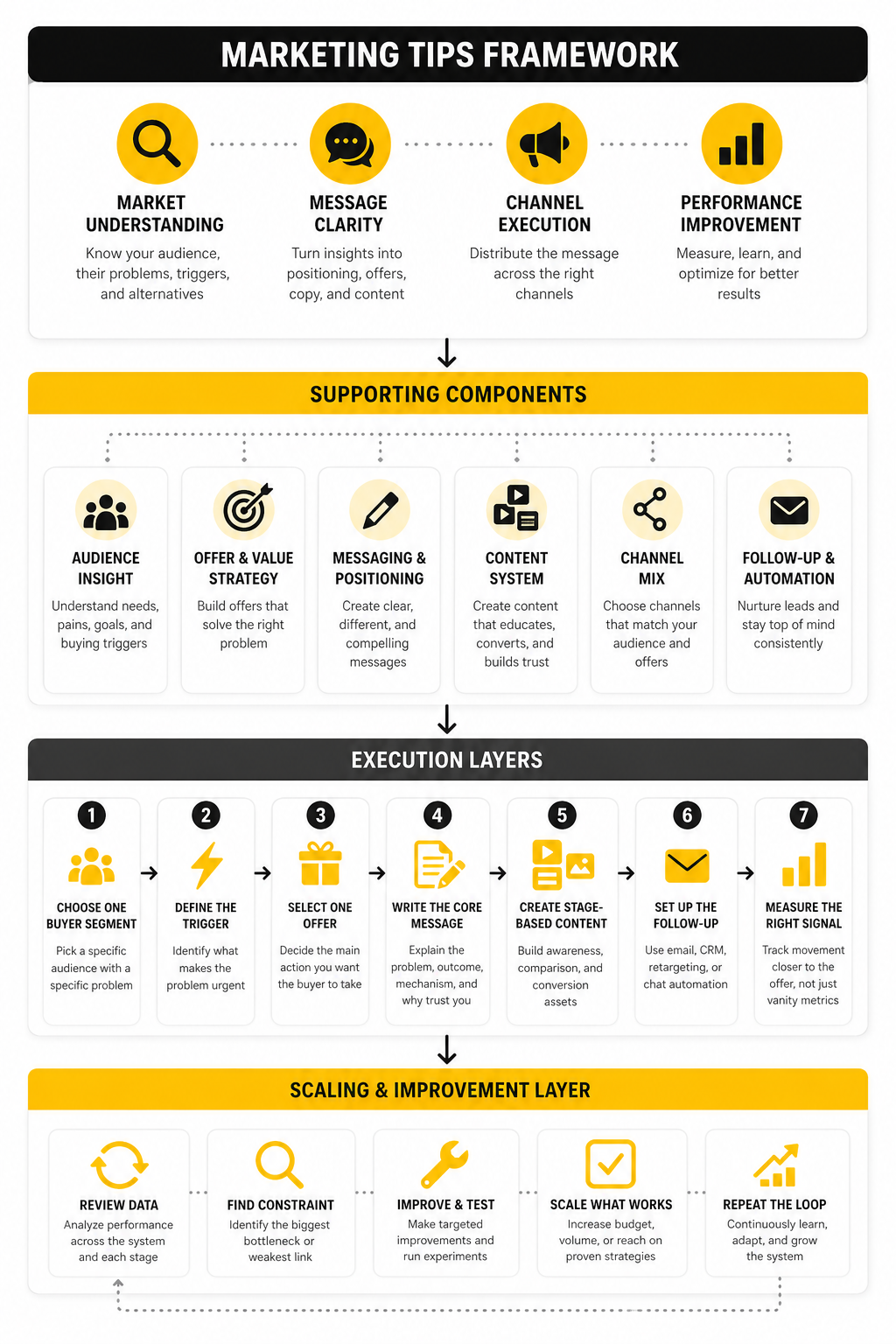
Market understanding tells you who you are speaking to and what they already care about. Message clarity turns that research into positioning, offers, hooks, landing pages, emails, and content. Channel execution helps you distribute the message through search, social, email, paid ads, partnerships, communities, or sales-assisted outreach.
Performance improvement is where most people fall short. They publish, promote, and launch, but they do not learn fast enough from the results. That is why the best marketing tips are not just “do this tactic”; they are “run this tactic, measure this signal, and decide what to change next.”
Research Your Market Before You Create Anything
Most marketing tips fail because they start too late. They begin with content, ads, funnels, emails, or tools, when the real starting point is the market. Before you create anything, you need to understand what people already want, what they are comparing, what makes them hesitate, and what language they use when they describe the problem.
This is not busywork. It is the difference between marketing that feels relevant and marketing that feels like noise. When you do the research properly, your copy gets sharper, your content ideas get easier, and your offers stop sounding like guesses.
Start With the Problem, Not the Product
Your product is not the center of the buyer’s world. Their problem is. That sounds obvious, but a lot of marketing still begins with features, dashboards, deliverables, and internal language that only the company cares about.
A better approach is to write down the problem in the buyer’s words before writing any campaign. What is frustrating them? What have they already tried? What are they afraid will happen if they do nothing? These questions give you stronger marketing angles than another list of product benefits.
This is where practical marketing tips become useful instead of generic. Do not ask, “How do we promote this?” Ask, “What painful situation makes someone actively look for this?” The second question forces you closer to the buyer’s reality.
Find the Buying Triggers
A buying trigger is the moment that turns passive interest into active demand. Someone might know they need better marketing for months, but they only act when something changes. Maybe leads slow down, ad costs rise, a competitor pulls ahead, a launch underperforms, or a founder finally gets tired of random tactics.
Your job is to identify those moments. Look at sales calls, support tickets, community posts, reviews, search queries, and customer interviews. You are looking for patterns in timing, urgency, and emotion.
Once you know the trigger, your content becomes much more specific. Instead of writing “10 marketing tips for small businesses,” you can write for the founder whose referral pipeline dried up or the agency owner who needs a better lead capture system. Specific beats broad almost every time.
Study the Alternatives Your Buyer Already Trusts
Your real competition is not always another company. Sometimes it is a spreadsheet, a freelancer, an internal team member, a cheaper tool, a YouTube tutorial, or simply doing nothing. If you ignore those alternatives, your messaging will feel incomplete.
Make a list of what your buyer compares before making a decision. Then study the strengths and weaknesses of each option. This helps you explain why your approach is better without sounding defensive or pushy.
For example, someone choosing a funnel tool may compare simplicity, templates, integrations, email automation, and price before deciding. In that context, a platform like ClickFunnels fits naturally when the buyer wants a dedicated funnel builder rather than a pile of disconnected tools. The point is not to force a tool into the conversation; it is to match the recommendation to the buyer’s actual decision process.
Build a Simple Customer Research File
You do not need a complicated research database to improve your marketing. You need a living file that captures useful buyer language and turns it into action. Keep it simple enough that you will actually use it.
Include these sections:
- Problems: The pains buyers mention repeatedly.
- Triggers: The events that make the problem urgent.
- Desired outcomes: What buyers want life or business to look like after solving it.
- Objections: The reasons they hesitate, delay, or choose another option.
- Exact phrases: The words buyers use in reviews, calls, comments, searches, and emails.
- Proof points: The claims you can honestly support with demos, testimonials, data, or product experience.
This file should influence every campaign. It should shape your landing pages, lead magnets, emails, ads, social posts, sales scripts, and product positioning. If your marketing team is creating without checking it, the file is not part of the system yet.
Turn Research Into Clear Positioning
Research only matters if it changes what you say. Once you understand the buyer, turn that insight into a positioning statement. Keep it direct: who you help, what problem you solve, what outcome you create, and why your approach is different.
A useful positioning statement sounds simple because it has done the hard thinking already. It removes vague claims and replaces them with a clear promise. It also gives your team a filter for what not to say.
Here is the test: can someone understand your value without needing a long explanation? If not, keep tightening. Strong marketing starts with clarity, and clarity starts with knowing the market better than your competitors do.
Build Offers, Messages, and Content Around Buyer Intent
Once the research is clear, the next step is implementation. This is where a lot of marketing gets messy, because teams jump straight from “we know the customer” to “let’s publish more.” Better marketing tips do not stop at research; they turn research into offers, messaging, content, and conversion paths that match what the buyer is trying to do.
Buyer intent is the signal behind the action. Someone reading a beginner guide is not in the same mindset as someone comparing platforms, checking pricing, or looking for a demo. If you treat every visitor, subscriber, or follower the same way, you make your marketing work harder than it needs to.
Match Your Message to the Buyer’s Stage
Every buyer moves through stages, even if the journey is not perfectly linear. Early on, they want clarity around the problem. In the middle, they compare approaches. Near the end, they need proof, confidence, and a clear reason to act now.
Your message should change at each stage. A cold audience needs education, not a hard pitch. A warm audience needs a sharper explanation of why your approach is different. A ready-to-buy audience needs proof, pricing clarity, risk reduction, and an easy next step.
This is why one landing page or one content style rarely does the whole job. The Salesforce State of Marketing report is based on insights from nearly 4,500 marketers and highlights how marketing is moving away from one-way communication toward more connected customer experiences. That shift matters because the buyer now expects the message to fit the moment.
Turn One Core Offer Into Multiple Entry Points
A strong offer should be easy to understand, but that does not mean everyone should enter through the same door. Some people are ready for a call. Some want a checklist, template, calculator, webinar, product tour, free trial, or comparison page first. The job is to give them a next step that matches their level of trust.
Start with the core offer and build lighter entry points around it. If the main offer is a service, create a diagnostic or consultation path. If the main offer is software, create a demo, trial, use-case page, or product walkthrough. If the main offer is education, create a short workshop, guide, or email sequence that proves your thinking before asking for a bigger commitment.
This is also where your tools should support the strategy instead of replacing it. For example, if your offer needs a simple funnel with pages, checkout, and follow-up, ClickFunnels can fit that job. If you need a broader CRM, pipeline, automation, and agency-style follow-up system, GoHighLevel may make more sense.
Build the Execution Process Before You Publish
Good execution is not random creativity. It is a repeatable process that turns research into assets, assets into campaigns, and campaigns into learning. Without that process, every new marketing idea feels like starting from zero.
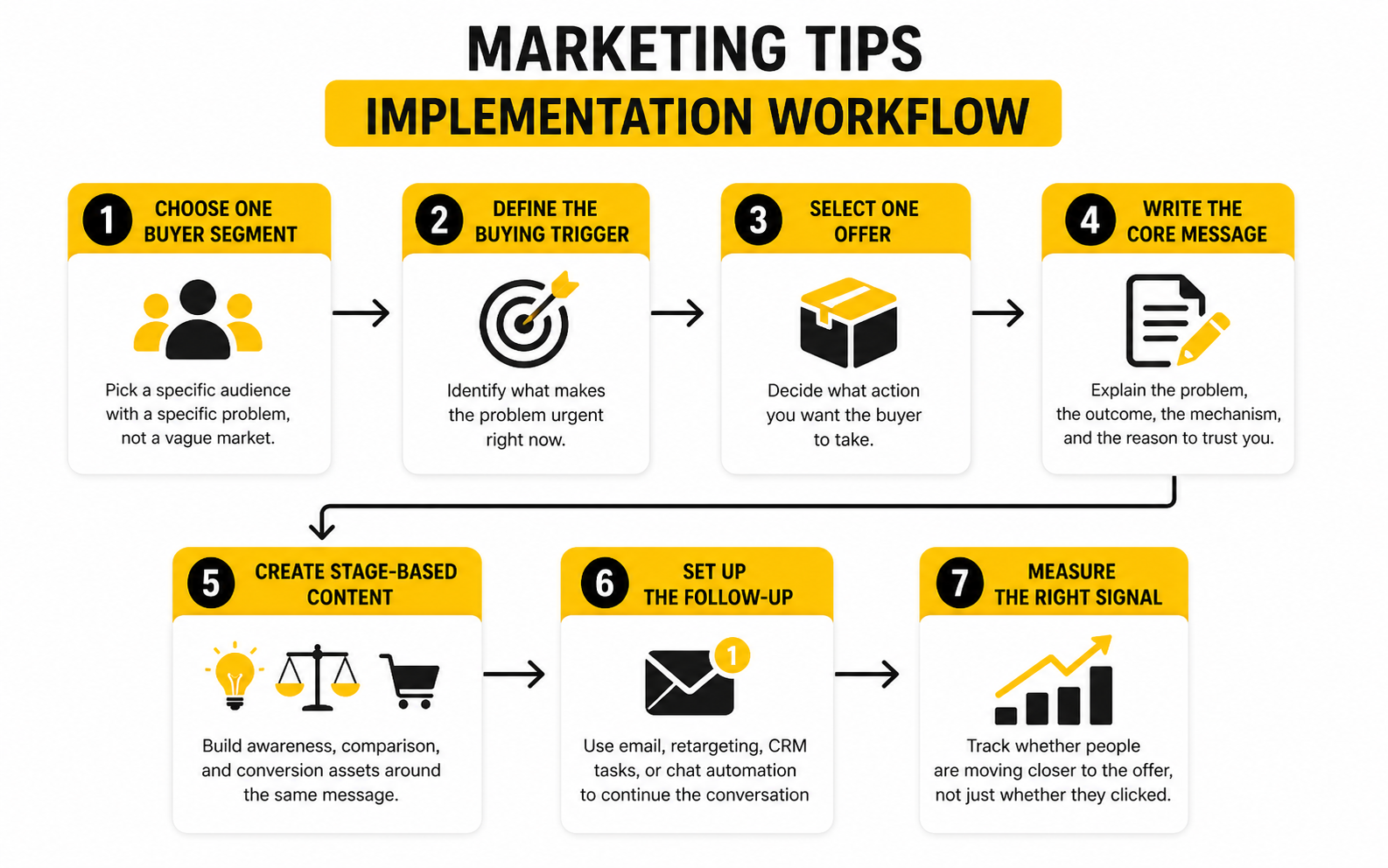
Use this simple workflow:
- Choose one buyer segment. Pick a specific audience with a specific problem, not a vague market.
- Define the buying trigger. Write down what makes the problem urgent right now.
- Select one offer. Decide what action you want the buyer to take after engaging.
- Write the core message. Explain the problem, the outcome, the mechanism, and the reason to trust you.
- Create stage-based content. Build awareness, comparison, and conversion assets around the same message.
- Set up the follow-up. Use email, retargeting, CRM tasks, or chat automation to continue the conversation.
- Measure the right signal. Track whether people are moving closer to the offer, not just whether they clicked.
This process keeps your marketing grounded. You are not creating content because the calendar is empty. You are creating specific assets that help a specific buyer take the next logical step.
Create Content That Answers Real Buying Questions
Content works best when it removes confusion. That means your content plan should be built from real questions, objections, comparisons, and use cases. Do not just ask, “What can we post this week?” Ask, “What does the buyer need to believe before they can move forward?”
Some content should explain the problem. Some should compare options. Some should show how the solution works. Some should reduce risk by addressing objections before they become deal blockers.
This is where educational content becomes a serious growth asset. The Content Marketing Institute’s 2025 B2B research shows how top-performing marketers are treating content as a strategic function, not a pile of disconnected posts. The takeaway is practical: create content that helps buyers make decisions, not content that only keeps your brand active.
Make Follow-Up Part of the Offer
The sale rarely happens the first time someone sees your message. People get distracted, compare options, talk to teammates, wait for budget, or simply forget. Follow-up is not annoying when it is relevant; it is part of helping the buyer finish the decision.
Your follow-up should match the action someone took. If they downloaded a guide, send more context and a natural next step. If they watched a demo, send proof, objections, and a call to action. If they abandoned a form or checkout, remind them what they were trying to solve and make it easy to continue.
For conversational follow-up, tools like ManyChat can work well when your audience engages through social messaging. For email campaigns, platforms like Brevo or Moosend can support the nurture sequence. The tool is not the strategy, but the right tool makes the strategy easier to execute consistently.
Statistics and Data
Data should make your marketing decisions calmer, not more chaotic. The point is not to collect every possible metric or fill a dashboard with numbers nobody uses. The point is to understand which signals show attention, which signals show intent, and which signals show revenue movement.
This is where many marketing tips become dangerous. A benchmark can tell you whether your numbers are unusually low or unusually strong, but it cannot tell you the whole story. A low conversion rate on a cold educational page may be normal, while the same number on a high-intent demo page could be a serious problem.
Separate Activity Metrics From Business Metrics
Activity metrics show what your team is doing. These include publishing frequency, impressions, email sends, ad spend, landing page tests, and social posts. They are useful for managing execution, but they do not prove that marketing is working.
Business metrics show whether the work is creating value. These include qualified leads, booked calls, pipeline created, conversion rate, customer acquisition cost, payback period, retention, expansion, and revenue influenced. If your reporting stops at clicks and views, you are looking at the surface.
The smart move is to connect both layers. For example, if social content is getting reach but no qualified traffic, the issue may be audience fit or call-to-action clarity. If landing pages get traffic but no conversions, the issue may be offer strength, proof, friction, or intent mismatch.
Use Benchmarks as Context, Not Targets
Benchmarks are useful because they give you a rough sense of reality. The 2025 Sprout Social benchmark research analyzed billions of messages across public profiles, which makes it helpful for understanding how social performance varies by industry and platform. But even strong benchmark data should be treated as context, not as a universal goal.
Your own baseline matters more than someone else’s average. If your email click rate improves from 1.2% to 2.1% after tightening your segmentation, that is meaningful even if another industry reports a higher number. If your demo page conversion rate drops while traffic quality stays the same, that deserves attention even if your overall site traffic is growing.
Use benchmarks to ask better questions. Are we below the range because our offer is weak, our audience is wrong, or our measurement is messy? Are we above the range because the campaign is strong, or because we are only reaching a small, high-intent audience?
Build a Simple Analytics System
Your analytics system should follow the buyer journey from first touch to revenue. It does not need to be fancy, but it does need to be consistent. If every channel is measured differently, you will end up debating attribution instead of improving performance.
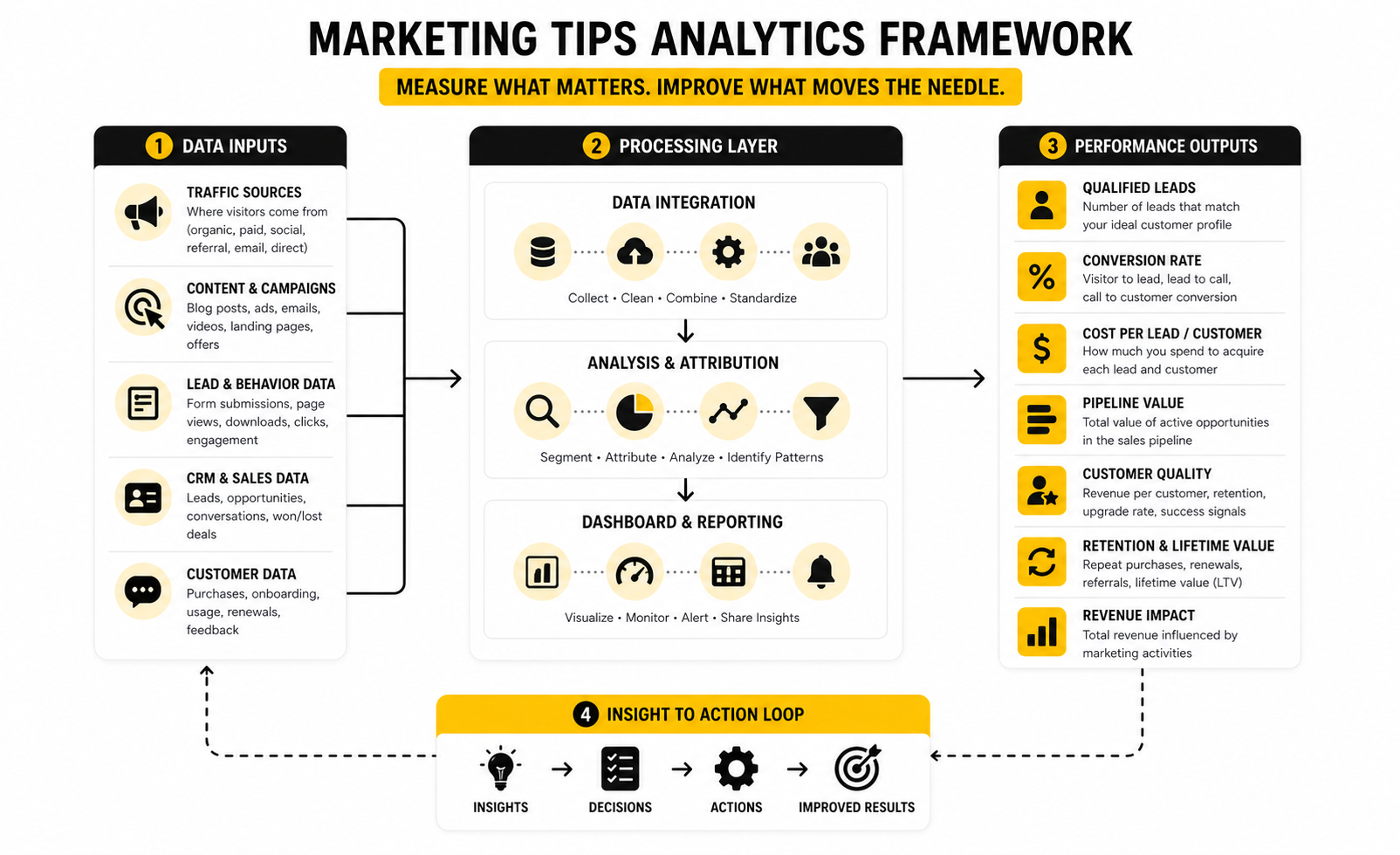
A clean analytics system tracks five layers:
- Reach: How many relevant people saw the message?
- Engagement: Did they care enough to click, watch, reply, save, share, or continue?
- Intent: Did they visit a key page, request information, start a form, compare options, or engage with sales content?
- Conversion: Did they become a lead, book a call, start a trial, purchase, or request a proposal?
- Revenue quality: Did they become a good customer, stay, expand, refer, or buy again?
This structure keeps your reporting practical. You can see where the system is leaking instead of blaming the whole campaign. More importantly, it helps you choose the next action instead of just reacting emotionally to a number.
Interpret Email, Content, and Funnel Data Properly
Email data is easy to misread. Open rates can be distorted by privacy features, inbox behavior, and list quality, so they should not be treated as the main success metric. Clicks, replies, conversions, unsubscribes, and revenue movement tell you much more about whether the email helped.
The 2025 Brevo email benchmark data shows that email performance varies heavily by industry, which is exactly why averages should not become blind targets. A newsletter, sales sequence, onboarding flow, abandoned cart email, and reactivation campaign all have different jobs. Measure each one by the action it is supposed to drive.
Content data needs the same discipline. A post that brings in high-intent search traffic may matter more than a viral post that attracts the wrong audience. A comparison page with fewer visitors can still be more valuable than a broad awareness article if it helps buyers choose faster.
Decide What Action Each Metric Should Trigger
A metric is only useful if it changes what you do next. If a number goes up or down and nobody knows what decision it affects, it is probably dashboard decoration. Strong marketing teams define the action before they obsess over the report.
Use simple rules:
- High reach, low engagement: sharpen the hook, audience, angle, or creative.
- High engagement, low intent: improve the call to action and next step.
- High intent, low conversion: fix the offer, proof, page clarity, or form friction.
- High conversion, low sales quality: tighten targeting and qualification.
- High acquisition, low retention: review onboarding, expectations, product fit, and customer success.
This is one of the most practical marketing tips in the whole article: do not measure everything equally. Measure the signals that help you make the next better decision. The goal is not prettier reporting; the goal is better marketing behavior.
Turn Attention Into Leads, Sales, and Retention
At this stage, the work shifts from performance tracking to strategic control. You already know who the buyer is, what they care about, how to build the message, and how to measure the system. Now the question is how to scale without breaking the thing that made the marketing work in the first place.
This is where advanced marketing tips become more about tradeoffs than tactics. Faster growth can create weaker leads. More automation can create colder experiences. More content can create less clarity if the team starts publishing without a sharp point of view.
Scale the Channels That Match Your Buying Motion
Not every channel deserves equal effort. A high-ticket B2B service might need founder-led content, webinars, case studies, direct outreach, and sales follow-up. A lower-priced product might grow better through search, short-form content, email, referral loops, and simple checkout flows.
The mistake is copying a channel mix from a business with a completely different sales cycle. A SaaS company, local agency, ecommerce brand, coaching offer, and newsletter business do not need the same marketing system. They need a channel strategy that matches price, trust level, decision complexity, and buying urgency.
A good scaling rule is simple: double down where intent and economics already make sense. If a channel creates qualified conversations at a sustainable cost, improve it before chasing something new. If a channel creates attention but no serious movement, either redesign the offer path or stop treating it like a growth engine.
Protect Trust While Using Automation
Automation is useful when it removes friction, speeds up follow-up, and keeps the buyer experience consistent. It becomes a problem when it makes the brand feel lazy, generic, or overly aggressive. People can tell when they are being pushed through a machine with no real understanding of their situation.
Modern marketing teams are clearly moving deeper into AI, personalization, and automation. The Salesforce State of Marketing report is built on insights from nearly 4,500 marketers and shows how brands are prioritizing connected customer experiences, not just more campaign output. The practical lesson is that automation should make the experience more relevant, not just cheaper to produce.
Use automation for reminders, segmentation, routing, lead scoring, onboarding, and helpful follow-up. Keep human judgment involved when the buyer has high intent, a complex problem, or a meaningful objection. The higher the trust required, the more carefully you should blend automation with real human interaction.
Avoid the Scaling Trap of More Everything
More content is not always better. More ads are not always better. More tools are definitely not always better. Scaling weak marketing usually just makes the weakness more expensive.
Before adding volume, check whether the current system is already converting at a healthy level. If your offer is unclear, more traffic will expose the problem. If your follow-up is weak, more leads will leak out. If your sales handoff is messy, more demand may create more confusion instead of more revenue.
This is why restraint matters. The best operators do not scale every working idea immediately. They tighten the message, improve the conversion path, confirm lead quality, and then add budget, cadence, or team capacity.
Make the Tech Stack Serve the Buyer Journey
A marketing stack should help you move buyers from attention to action with fewer gaps. It should not become a museum of tools your team barely uses. Every tool should have a clear job in the system.
For example, you might use Buffer to keep publishing organized, Fillout to capture structured lead information, Cal.com to reduce booking friction, and GoHighLevel to manage CRM, pipelines, automation, and follow-up. That stack only makes sense if each piece supports a real step in the buyer journey.
The same rule applies to AI tools. Use them to research faster, draft faster, repurpose content, summarize calls, analyze feedback, and improve internal speed. Do not let them replace your positioning, customer understanding, or taste. That is where mediocre marketing gets produced at scale.
Balance Acquisition With Retention
Acquisition gets the attention because it feels more exciting. Retention is often where the profit lives. If your marketing creates customers who do not stay, upgrade, refer, or succeed, the growth engine has a hidden leak.
Retention starts before the sale. The promises you make in ads, pages, emails, and calls shape what customers expect after they buy. If the marketing oversells the outcome or hides the effort required, customer success has to clean up the mess later.
Strong marketing should attract the right customers and prepare them to win. That means clear expectations, honest positioning, useful onboarding content, and follow-up that continues after the first conversion. The goal is not just to get more buyers; it is to create buyers who are glad they chose you.
Know When a Tactic Is Not the Problem
Sometimes the tactic is fine and the strategy is broken. A landing page may underperform because the offer is weak. Ads may look expensive because the audience is too broad. Email may look ineffective because the list was built from low-intent leads.
This is where experienced marketers slow down before changing everything. They look for the constraint. Is the problem awareness, intent, trust, conversion, fulfillment, pricing, or retention?
That diagnostic thinking is what separates random marketing tips from real strategy. You are not trying to collect more tactics. You are trying to find the highest-leverage constraint and fix it before you scale the next layer.
Measure What Matters, Improve the System, and Keep It Simple
The best marketing systems are not the most complicated. They are the ones people can actually run every week without losing the thread. You need enough structure to make smart decisions, but not so much structure that your team spends more time managing the system than improving the marketing.
By this point, the pattern should be clear. Research gives you direction, positioning gives you clarity, content creates demand, channels distribute the message, analytics show what is happening, and follow-up turns attention into revenue. When those pieces work together, marketing becomes less random and much easier to improve.
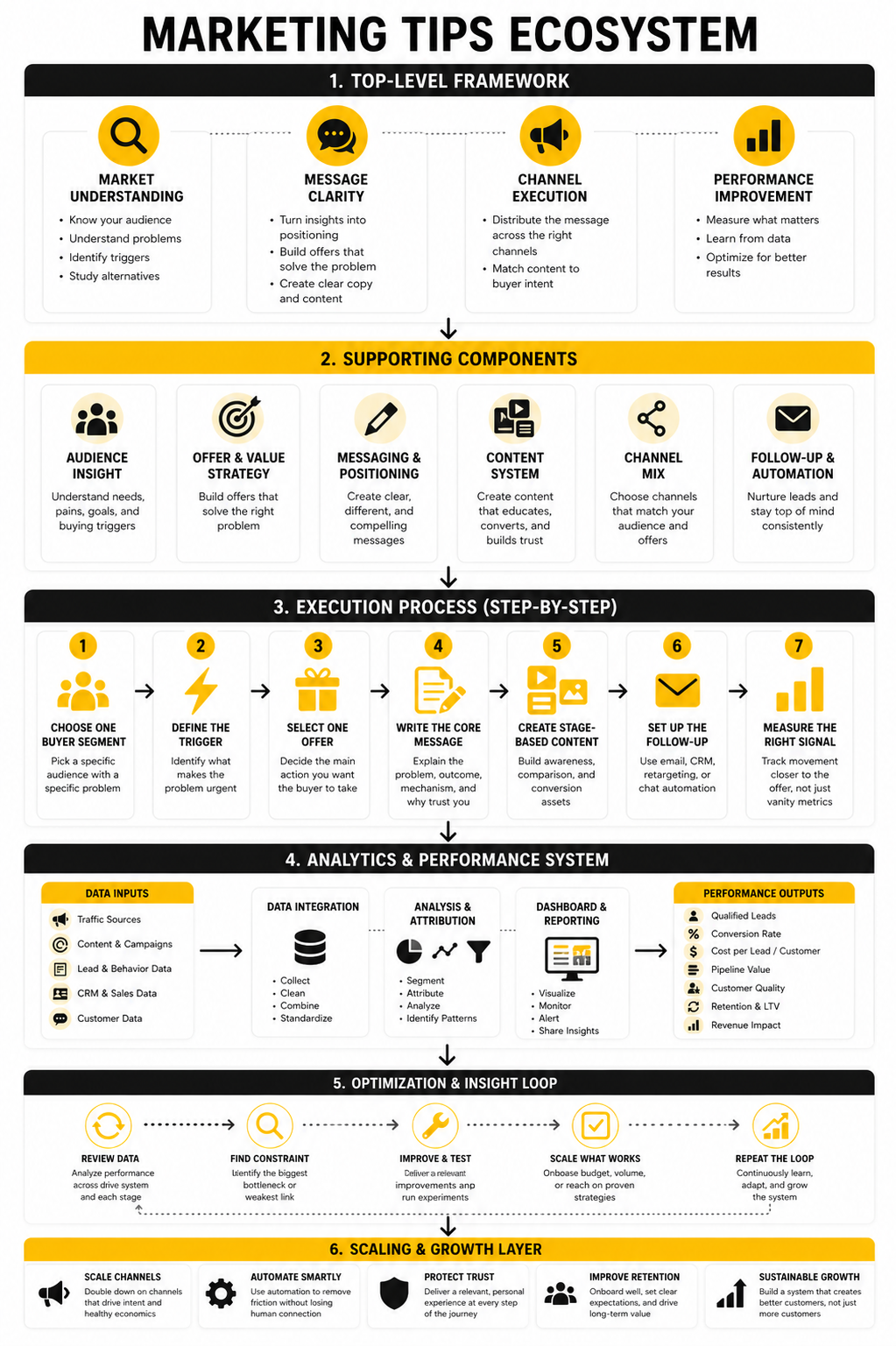
The final system is not a one-time setup. It is a loop. You learn from the market, create based on that insight, publish through the right channels, measure the movement, and refine the next version.
FAQ - Built for Complete Guide
What are the most important marketing tips for beginners?
Start with the market before you start with tactics. Know who you are helping, what problem they care about, and what makes that problem urgent. Then build a simple offer, create helpful content around real buying questions, and measure whether people are moving closer to action.
How do I choose which marketing channel to focus on first?
Choose the channel that matches your buyer’s behavior and your sales process. If people search before buying, SEO and comparison content matter. If trust is built through personality and expertise, social content, email, and webinars may work better.
How often should I post marketing content?
Post as often as you can maintain quality and consistency. A weak daily schedule is not better than three strong pieces per week. The real goal is to create content that answers useful questions, supports the buyer journey, and gives people a reason to take the next step.
What is the biggest mistake businesses make with marketing?
The biggest mistake is creating before understanding. Businesses often launch campaigns, ads, pages, and content without knowing the buyer’s trigger, objection, or decision process. That creates activity, but not momentum.
How do I know if my marketing is working?
Your marketing is working when the right people are moving through the system. Look beyond impressions and clicks. Track qualified leads, booked calls, conversion rates, pipeline, retention, and revenue quality.
Should I use AI for marketing?
Yes, but use it carefully. AI can help with research, drafts, repurposing, summaries, and workflow speed. It should not replace customer understanding, positioning, judgment, or the final quality check.
Are funnels still useful?
Funnels are still useful when they match how the buyer makes decisions. A funnel is not just a page sequence; it is a guided path from interest to action. Tools like ClickFunnels can help when you need a focused path for leads, sales, webinars, or offers.
What metrics should small businesses track first?
Start with traffic source, lead source, conversion rate, booked calls or purchases, cost per lead, cost per customer, and customer quality. Do not overbuild the dashboard at the beginning. Track the numbers that help you make better weekly decisions.
How do I make marketing feel less overwhelming?
Reduce the number of active priorities. Pick one audience, one offer, one main channel, and one conversion goal. Once that works, improve it before adding more complexity.
What is the difference between content marketing and direct response marketing?
Content marketing builds trust, education, and demand over time. Direct response marketing asks for a specific action now. Strong marketing usually uses both: helpful content to build belief and clear calls to action to turn belief into movement.
How do I improve weak conversion rates?
Start by checking intent. If the wrong people are landing on the page, copy changes will only help so much. If the traffic is relevant, improve the offer, headline, proof, friction, urgency, and follow-up.
When should I hire marketing help?
Hire help when the opportunity is clear but execution is slowing you down. That could mean strategy, copywriting, ads, SEO, email, automation, analytics, or funnel building. Do not hire someone just to “do marketing”; hire for the specific constraint holding growth back.
Work With Professionals
Explore 10K+ Remote Marketing Contracts on MarkeWork.com
Most marketers spend too much time chasing clients, competing on crowded platforms, and losing a percentage of every project to middlemen.
MarkeWork gives you a better way. Browse thousands of remote marketing contracts and connect directly with companies desperate to hire skilled marketers like you, without platform commissions and without unnecessary gatekeepers.
If you are serious about finding better opportunities and keeping 100% of what you earn, explore available contracts and create a profile for free at MarkeWork.com.