

Marketing gets reduced to ads, social posts, and promotional campaigns far too often. That view is too small to be useful. The American Marketing Association defines marketing as the activity and processes for creating, communicating, delivering, and exchanging offerings that have value, which is a much better starting point because it connects marketing to the full customer and business experience.
That broader definition matters right now because modern teams are being asked to produce more growth with tighter scrutiny. The pressure is real: average marketing budgets fell to 7.7% of company revenue in Gartner’s 2024 CMO Spend Survey, while marketers in The CMO Survey’s March 2025 report still projected stronger overall and digital spending growth over the next year. In plain English, marketing is under more pressure, not less, and that usually makes the difference between random activity and a real system painfully obvious.
The good news is that marketing becomes much easier to understand once you stop treating it as a bag of tactics. The strongest teams run it as a connected discipline that links audience insight, positioning, messaging, channels, conversion, retention, and measurement. That is the structure this article will follow.
Article Outline
- What Marketing Actually Means Today
- Why Marketing Still Matters
- The Modern Marketing Framework
- The Core Components of a Strong Marketing System
- How to Implement Marketing Professionally
- How to Measure, Improve, and Scale Marketing
What Marketing Actually Means Today
Marketing is the work of creating demand, shaping perception, making choice easier, and improving the path from awareness to loyalty. It includes research, positioning, offers, content, distribution, conversion, customer experience, and retention, not just promotion. That is exactly why weak marketing usually feels fragmented while strong marketing feels coherent from the outside.
A modern buyer does not experience your business in neat departmental boxes. They see a search result, a social post, a review, a landing page, an email, a product page, and the actual product or service itself as one continuous experience. Google’s work on omnichannel customer experience and Adobe’s 2025 customer engagement research both point to the same reality: people expect consistency across channels, and they notice when brands fail to deliver it.
That is why the old split between “brand marketing” and “performance marketing” is too simplistic on its own. Marketing today has to build trust, create demand, capture demand, and improve the customer experience after the sale. If one of those pieces is missing, the whole system gets more expensive and less effective.
Why Marketing Still Matters
Marketing matters because markets are crowded, switching costs are often low, and attention is brutally competitive. Even an excellent product can struggle if the wrong audience sees it, the value proposition is unclear, or the buying journey feels confusing. Marketing reduces that friction by helping the right people understand why something matters and what to do next.
It also matters because growth depends on more than demand generation alone. In McKinsey’s recent work on the modern rethinking of marketing’s core, leaders put renewed emphasis on brand distinctiveness and clear value propositions, while BCG’s 2025 measurement research found that companies with stronger measurement approaches can outperform peers on revenue growth. The lesson is simple: marketing is not decoration around the business model; it is one of the engines that makes the business model work.
The customer side tells the same story. PwC’s 2024 Voice of the Consumer survey shows that many consumers are willing to share data when the value exchange is clear and personalization is useful, while Deloitte’s 2024 personalization research highlights how much spending can shift when experiences feel relevant. Good marketing matters because relevance matters, and relevance is one of the fastest ways to separate a serious brand from background noise.
The Modern Marketing Framework
The easiest way to understand marketing is to see it as a system with four jobs: understand the market, shape the message, move people through the journey, and improve the economics over time. That framework is practical because it keeps strategy, execution, and performance connected. It also stops teams from overinvesting in channels before they know what they are trying to say and to whom.
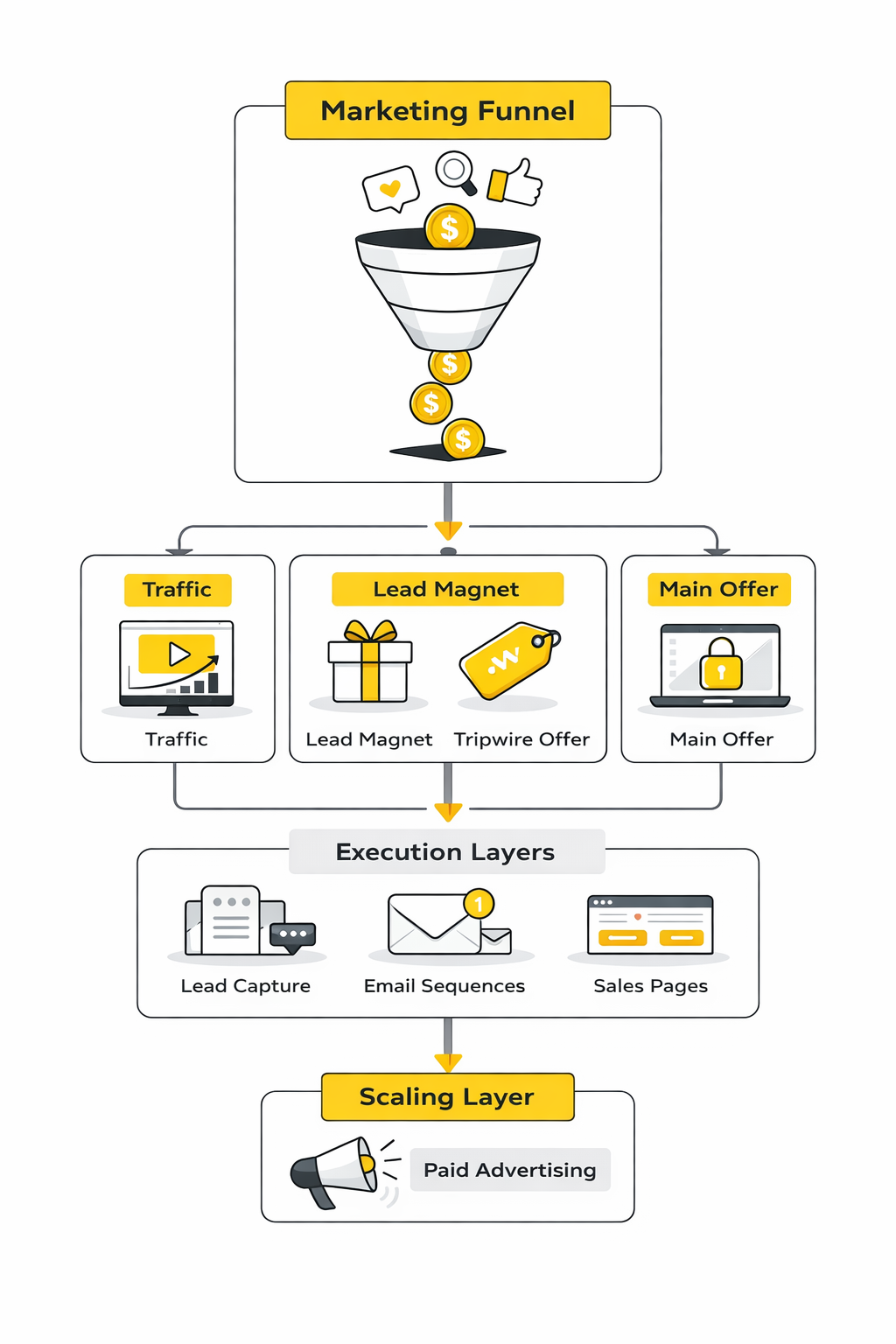
The first job is market understanding. That means knowing the audience, the problem they are trying to solve, the alternatives they compare you against, and the triggers that move them from passive interest to active buying. Without that layer, most “marketing strategy” is just guessing with nicer slides.
The second job is message and positioning. This is where marketing answers the hardest commercial questions: who this is for, why it is different, why it is credible, and why it matters now. The third and fourth jobs are journey orchestration and economic improvement, which is where channels, conversion paths, retention systems, and measurement start to work together instead of acting like separate teams fighting over attribution.
That structure will guide the rest of this article. Next, we will break down the core components that turn marketing from a vague business function into an operating system a team can actually run.
The Core Components of a Strong Marketing System
A strong marketing system is built from a few components that reinforce each other. Miss one, and the rest usually get more expensive, slower, or harder to scale. Get them aligned, and marketing stops feeling like scattered activity and starts acting like a growth engine.
This is where a lot of teams go wrong. They jump into channel execution before they have nailed audience clarity, positioning, or the actual buying journey. That usually creates a familiar mess: decent-looking campaigns, inconsistent results, and no clear reason why one launch works while the next one stalls.
The practical fix is to think in layers. You need to know who you want, what they care about, why they should believe you, where they will encounter you, and what should happen after they click. Those are the components that make marketing work in the real world.
Audience Insight and Market Focus
Everything starts here because marketing gets weak the moment the audience is fuzzy. If you do not know which segment you want, what problem they are trying to solve, what alternatives they compare, and what anxieties slow them down, you end up writing generic copy for a generic market. That is how brands become invisible even when they are technically active everywhere.
This matters even more now because buyer behavior is not linear. Google’s research on the “messy middle” shows that people loop between exploration and evaluation, often spending more time comparing options and considering more brands before they buy. A useful marketing strategy has to reflect that reality instead of pretending the customer journey is a simple funnel from awareness to purchase in one clean motion.
Good audience insight is not just demographics either. It includes motivations, timing, objections, trust triggers, and the context around the purchase. In B2B, that gets even more complex because Forrester’s 2024 business buying research makes clear that buying remains frustrating, committee-driven, and difficult to navigate, which means marketing has to help buyers make decisions, not just “generate leads.”
Positioning, Offer, and Message
Once you understand the market, the next component is positioning. This is the part that tells the audience what you do, who it is for, why it is different, and why it deserves attention right now. When positioning is weak, teams compensate by pushing harder on ads, discounts, or content volume, and that is almost always an expensive mistake.
Clear positioning also sharpens the offer. An offer is not just the product or service itself. It is the way the value is packaged, explained, priced, de-risked, and made easier to say yes to. In crowded categories, that difference matters a lot because the buyer is not choosing in a vacuum; they are comparing promises, proof, friction, and perceived risk.
This is exactly why distinctiveness and clear value perception have moved back to the center of serious marketing work. McKinsey’s recent research on marketing’s core points to a renewed focus on brand distinctiveness, creativity, and full-funnel programs, which is a reminder that strong marketing is not built by sounding like everyone else with slightly better targeting.
Channels and Journey Design
Channels matter, but not in the way many marketers talk about them. A channel is not the strategy. It is a delivery mechanism for the strategy. Search, email, social, partnerships, referral loops, landing pages, webinars, and sales enablement all perform differently depending on the audience, the message, and the buying stage they support.
That is why journey design matters more than channel obsession. You need to decide what should happen at each stage: how people discover you, what builds confidence, what removes friction, what captures intent, and what keeps the relationship alive after the first conversion. Nielsen’s 2024 Annual Marketing Report highlighted a painful disconnect here: marketers say long-term and full-funnel ROI matter most, while their tactics and measurement often stay fragmented and overly channel-specific.
A modern marketing system should feel coherent across touchpoints. Google’s omnichannel research and Adobe’s digital trends work both reinforce the same lesson: people expect smoother cross-channel experiences, and they punish brands that force them to restart the journey every time they move from one touchpoint to another. That means content, landing pages, emails, product pages, and post-click experiences need to feel connected, not like separate departments accidentally sharing the same logo.
This is also the layer where tools become practical rather than theoretical. If your team needs a simpler way to manage social publishing and maintain consistency across channels, Buffer fits naturally into that workflow. If email nurturing and lifecycle automation are central to your funnel, platforms like Brevo or Moosend make sense when the goal is to move leads and customers through the journey without building a bloated stack too early.
Data, Trust, and Retention
The best marketing systems do not stop at acquisition. They improve the economics after the first conversion by building trust, increasing repeat behavior, and learning from customer responses. This is one of the biggest differences between immature marketing and professional marketing: the immature version celebrates the click, while the professional version follows the customer.
Trust has become a core component because personalization and AI have raised the stakes. Salesforce’s latest connected customer research found that 73% of customers feel brands treat them as unique individuals, but only 49% feel brands use their information in a beneficial way. That gap matters because personalized marketing only works when people feel the exchange is fair.
The spending side makes the point even harder. Deloitte’s 2024 personalization research found that 80% of consumers prefer brands that offer personalized experiences and report spending 50% more with those brands, but most brands still overestimate how well they are delivering that experience. So retention is not just a CRM problem. It is a marketing quality problem, a trust problem, and often a relevance problem.
This is why strong marketing systems keep first-party data, customer feedback, lifecycle messaging, and experience quality close to the center. The goal is not to collect more data for its own sake. The goal is to use enough real customer insight to make future interactions more useful, more timely, and more credible. When that happens, retention improves, referrals get easier, and acquisition costs stop carrying the whole business on their back.
Why These Components Need to Work Together
Each component looks manageable on its own, but marketing rarely fails one piece at a time. It fails in the handoff between pieces. The audience is loosely defined, so the positioning stays generic. The positioning is generic, so the content does not persuade. The content underperforms, so the team blames the channel. The channel gets optimized, but retention still suffers because the promise made in the campaign does not match the customer experience.
That is why the system matters more than any single tactic. BCG’s measurement work argues for more holistic, actionable measurement and tighter coordination between marketing, sales, and finance, which is really another way of saying that performance improves when the parts stop operating in silos. Marketing gets dramatically stronger when its components are designed to support one another instead of competing for budget, ownership, or credit.
In the next section, we will move from components to execution and look at how professional teams actually implement marketing without drowning in busywork, vanity metrics, or disconnected campaigns.
How to Implement Marketing Professionally
Once the core components are clear, marketing becomes an execution discipline. The difference between average teams and professional teams is rarely creativity alone. It is the presence of a repeatable process that turns strategy into consistent action.
Professional marketing implementation connects insight, positioning, content, channels, and measurement into a loop that continuously improves. Without that loop, teams launch campaigns, celebrate or panic based on short-term metrics, and then start over again with a slightly different idea. With the loop in place, marketing turns into a system that compounds.
This is where process matters most. The goal is not to create bureaucracy. The goal is to build a structure that makes good marketing easier to repeat and weak marketing easier to diagnose.
The Practical Marketing Execution Process
A strong marketing implementation model usually moves through a small set of repeatable phases. These phases create clarity before execution and learning after execution.
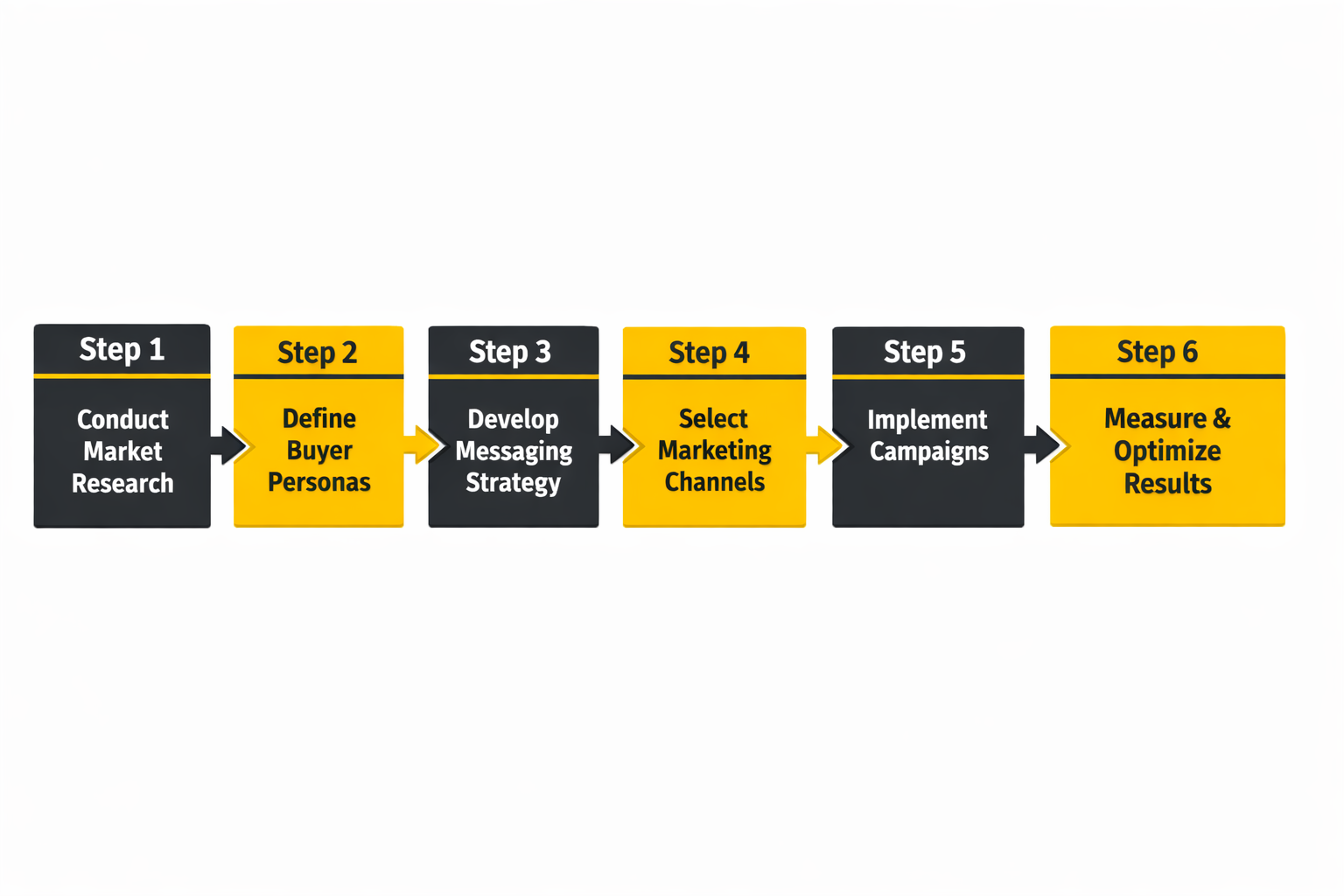
The practical sequence looks like this:
- Market clarity and research
- Positioning and offer design
- Campaign architecture
- Content and asset production
- Distribution and channel execution
- Measurement and optimization
This cycle is intentionally simple. The real value comes from repeating it consistently and improving each stage over time.
Step 1: Market Clarity and Research
Execution begins with a disciplined understanding of the market. That means identifying the audience segment, the buying triggers, and the alternatives people compare before they purchase. Marketing campaigns become dramatically stronger when the team knows exactly what problem they are solving and who feels that problem most urgently.
Buyer behavior research reinforces this step. Google’s work on the messy middle of purchasing shows that people repeatedly move between exploring options and evaluating alternatives before committing to a decision. That loop means marketing must provide clarity, reassurance, and comparison value rather than assuming a linear path to purchase.
Research also reveals language. The words customers use to describe their problem often become the most powerful marketing copy because they reflect real motivations instead of internal assumptions. Strong teams treat this stage as insight generation, not a quick brainstorming session.
Step 2: Positioning and Offer Design
Once the market is understood, the next step is shaping the offer and the positioning around it. Positioning clarifies what the product does, who it serves best, and why it deserves attention in a crowded field.
Offer design makes the decision easier. That includes pricing structure, guarantees, onboarding simplicity, and the clarity of the value proposition. A good offer removes doubt rather than creating more comparison friction.
Many modern marketing teams use funnel structures to package this experience. Platforms like ClickFunnels or Systeme.io are often used to structure landing pages, lead magnets, upsells, and follow-up sequences because they simplify the technical side of building a coherent conversion journey.
The goal here is not to create complexity. The goal is to reduce friction so the right customer immediately understands the value and the next step.
Step 3: Campaign Architecture
Campaign architecture defines how a marketing initiative will reach the audience and guide them toward conversion. This is where messaging, channels, and timing start working together.
Instead of launching isolated ads or random content, professional marketing teams design campaigns around specific objectives:
- Lead generation
- Product launch
- Brand awareness expansion
- Demand capture
- Customer retention
Each objective requires a different structure. A lead generation campaign might focus on educational content and gated resources, while a demand capture campaign prioritizes high-intent search traffic and direct response messaging.
Industry research consistently shows that coordinated campaigns outperform isolated tactics. Nielsen’s global marketing measurement work demonstrates that brands integrating multiple channels with unified messaging achieve stronger return on investment compared with single-channel efforts.
Step 4: Content and Asset Production
Content production is where marketing becomes visible to the outside world. Every landing page, article, email, and social post represents the brand’s promise in action.
The challenge is scale. HubSpot’s 2025 State of Marketing report highlights that marketers are producing more content than ever while also trying to maintain quality and personalization. That tension explains why many teams struggle to keep output consistent.
The most reliable solution is structured production. Instead of creating content randomly, teams build content around campaign themes, customer questions, and search demand. Tools such as Buffer or Flick help maintain consistent social publishing workflows, while email platforms like Brevo or Moosend support lifecycle messaging that continues the conversation after the first interaction.
This stage is where clarity of message pays off. When positioning and offers are clear, content creation becomes far easier because every piece has a defined purpose.
Step 5: Distribution and Channel Execution
Content only works when it reaches the right audience. Distribution is the operational side of marketing, and it includes organic channels, paid media, partnerships, and direct outreach.
The modern channel mix typically includes:
- Search engines
- Social media platforms
- Email marketing
- Influencer or partner collaborations
- Community engagement
- Paid advertising networks
The challenge here is fragmentation. Consumers interact with brands across multiple touchpoints, often switching devices and channels during the same buying journey. Research on omnichannel engagement from Adobe and Google highlights how critical cross-channel consistency has become for maintaining trust and momentum.
Professional marketing teams treat distribution as orchestration rather than experimentation alone. They decide which channels serve discovery, which channels capture demand, and which channels nurture relationships.
Step 6: Measurement and Continuous Optimization
Marketing execution becomes professional when measurement closes the loop. Without measurement, campaigns rely on intuition. With measurement, every campaign becomes a learning opportunity.
Key metrics typically include:
- Customer acquisition cost
- Conversion rate
- Lifetime customer value
- Retention rate
- Marketing return on investment
Better measurement leads to better decision-making. Boston Consulting Group’s research on marketing measurement shows that companies using advanced attribution and integrated data approaches consistently outperform peers in revenue growth and efficiency.
The real advantage appears over time. Every campaign generates data that sharpens the next campaign. Messaging improves. Channels become clearer. The marketing system gets stronger.
Implementation Is Where Strategy Becomes Reality
Strategy explains what should happen. Implementation determines whether it actually happens. Many organizations understand marketing theory but struggle to build the operational discipline required to apply it consistently.
Professional marketing implementation requires three habits:
- clear planning before execution
- coordinated campaign design
- continuous measurement and learning
When those habits are present, marketing stops feeling unpredictable. Growth becomes more consistent because every campaign improves the next one.
The final parts of this article will focus on how marketing performance is measured, how organizations scale their marketing systems, and how the discipline continues evolving in a technology-driven world.
Marketing Metrics That Actually Matter
Once marketing is implemented, measurement becomes the discipline that determines whether the system improves or stagnates. Metrics are not simply reporting tools. They are feedback signals that show whether the audience, positioning, campaigns, and channels are working together effectively.
The problem is not a lack of data. Modern marketing teams have access to more analytics than ever before. The problem is interpretation. Many organizations collect large volumes of metrics without understanding which signals actually reflect progress toward revenue and customer growth.
The goal of marketing measurement is simple: determine whether the marketing system is creating sustainable demand and profitable customer relationships. When the right metrics are monitored consistently, they guide smarter decisions about budget allocation, campaign design, and product positioning.
The Marketing Analytics System
Marketing analytics works best when it reflects the full customer journey. Instead of measuring isolated campaigns, strong teams build an analytics system that tracks movement from awareness to acquisition to retention.
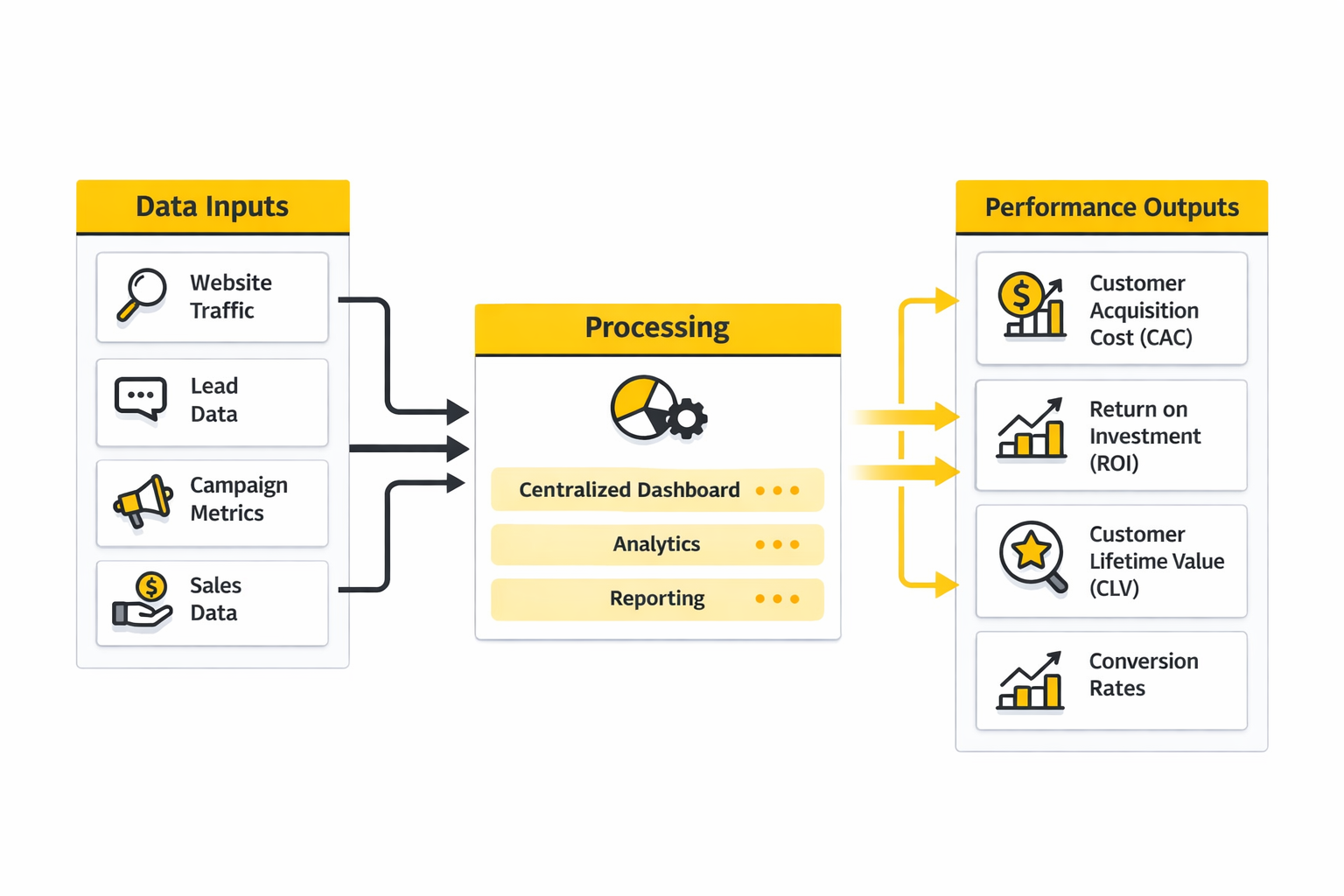
The analytics structure usually follows three measurement layers:
- Awareness and reach metrics
- Conversion and acquisition metrics
- Customer value and retention metrics
Each layer answers a different question. Awareness metrics show whether the market is discovering the brand. Conversion metrics show whether interest turns into action. Retention metrics reveal whether marketing is attracting the right customers in the first place.
Understanding how these layers interact is the key to interpreting marketing performance correctly.
Awareness Metrics and Market Reach
Awareness metrics track how effectively marketing exposes the brand to potential customers. This stage includes impressions, reach, organic search visibility, content engagement, and social interaction.
These numbers matter because attention is limited. The global advertising market surpassed $1 trillion in total spending in 2024, which means brands are competing in one of the most crowded communication environments in history. If marketing cannot consistently generate visibility, the rest of the funnel struggles to function.
However, awareness alone is not success. High reach with low engagement often indicates that the message or audience targeting is misaligned. The real signal appears when awareness metrics correlate with deeper interactions such as website visits, content consumption, and brand searches.
Search visibility is particularly useful because it reflects real intent. When people actively search for solutions related to a product category, marketing is influencing demand rather than simply generating passive impressions.
Conversion Metrics and Customer Acquisition
Conversion metrics show whether marketing activity leads to measurable action. These signals include lead generation, signup rates, landing page conversion, sales inquiries, and completed purchases.
Conversion rates matter because they expose friction in the customer journey. If awareness metrics are strong but conversions remain weak, the problem usually lies in the offer, the messaging clarity, or the buying experience itself.
Industry benchmarks illustrate the importance of this stage. Analysis from WordStream’s recent advertising benchmarks shows that average conversion rates for Google Ads across industries typically fall between 4% and 7%, though high-performing campaigns often exceed those levels with strong targeting and messaging alignment.
This metric becomes even more meaningful when paired with customer acquisition cost. A campaign that converts well but requires excessive spending may still be unsustainable. Marketing measurement must always connect performance metrics to the economics of growth.
Conversion tracking is also where funnel infrastructure becomes essential. Platforms such as ClickFunnels or Systeme.io are commonly used to structure landing pages and sales flows because they simplify tracking the steps between visitor interest and final purchase.
Customer Value and Retention Signals
The most important marketing metrics often appear after the first sale. Customer value metrics reveal whether marketing is attracting the right audience and creating long-term growth.
Three signals are especially important:
- Customer lifetime value
- Repeat purchase rate
- Customer retention rate
Retention metrics matter because acquiring new customers is typically far more expensive than keeping existing ones. Analysis across multiple industries consistently shows that improving customer retention can dramatically increase profitability.
Customer experience research from PwC’s global consumer insights study highlights another critical insight: many consumers will leave brands they like after just a few poor experiences. That means marketing cannot be separated from the broader customer experience.
If marketing promises convenience or premium quality but the product experience fails to deliver it, retention metrics quickly expose the gap.
Interpreting Marketing Benchmarks Correctly
Benchmarks help marketers understand whether performance is typical, strong, or underperforming. But benchmarks only become useful when they are interpreted within context.
For example, a low conversion rate may not indicate weak marketing if the campaign targets a cold audience at the earliest stage of awareness. Similarly, a high click-through rate may look impressive but still produce poor revenue outcomes if the offer lacks clarity or differentiation.
Professional marketing teams therefore interpret benchmarks alongside qualitative signals such as customer feedback, product reviews, and support inquiries. These signals explain why certain numbers move and reveal opportunities that raw data alone might miss.
This is also why integrated measurement systems are becoming more important. Research from Boston Consulting Group highlights that companies using unified measurement approaches across channels can achieve significantly stronger marketing ROI because they understand how brand-building and performance marketing interact over time.
Data Should Drive Decisions, Not Just Reports
The ultimate purpose of marketing analytics is decision-making. Metrics should answer practical questions that improve strategy and execution.
Examples of useful marketing decisions driven by data include:
- shifting budget toward the channels producing the highest lifetime value customers
- improving landing page messaging when conversion rates fall below benchmarks
- increasing retention programs when repeat purchase behavior declines
- refining audience targeting when engagement signals weaken
Measurement only works when the insights lead to action. Otherwise marketing dashboards become elaborate scoreboards that describe the past without improving the future.
The final sections of this article will focus on how marketing systems scale over time, how organizations strengthen their competitive advantage through marketing, and what the future of the discipline looks like as technology continues reshaping how brands connect with audiences.
Scaling Marketing Without Breaking What Works
Scaling marketing sounds exciting until the system starts expanding faster than the underlying strategy can support. That is the point where many teams run into the same problem: more campaigns, more tools, more content, more reporting, and somehow less clarity. Growth creates pressure, and pressure exposes every weak assumption that looked acceptable at a smaller scale.
This is why scaling marketing is not just about adding budget or headcount. It is about protecting message clarity, preserving channel discipline, and keeping measurement tied to business outcomes as complexity rises. Nielsen’s 2025 marketing research shows that marketers are still struggling with fragmented cross-channel data and stakeholder alignment, which becomes even more painful as a company grows and adds more platforms, agencies, and reporting layers Nielsen’s 2025 Annual Marketing Report and its cross-media ROI analysis.
The practical lesson is simple: scaling only works when the marketing system gets stronger, not just bigger. If the foundation is weak, additional spend amplifies waste. If the foundation is solid, scale turns consistency into momentum.
The Strategic Tradeoffs That Shape Marketing Performance
Every serious marketing team lives inside tradeoffs. You cannot maximize brand reach, short-term efficiency, creative quality, speed, channel coverage, and measurement precision all at once. The job is not to avoid tradeoffs. The job is to choose them deliberately.
One of the biggest tradeoffs is between short-term demand capture and long-term brand building. Performance channels can produce quick wins, but overreliance on them can leave a business vulnerable when acquisition costs rise or competition intensifies. BCG’s 2025 measurement research makes this point clearly: stronger-performing marketing organizations are more likely to use KPI frameworks that include both brand and performance measures rather than reducing marketing to immediate sales signals alone BCG’s 2025 measurement study and the supporting June 2025 BCG presentation.
Another tradeoff is between speed and strategic coherence. AI tools, templates, and automation platforms make it easier to publish more content and launch more assets, but volume is not the same thing as market impact. Adobe’s 2025 customer engagement research found that customers increasingly expect consistency, with 78% wanting consistent brand experiences, which means scaling output without controlling quality can quietly weaken the brand rather than strengthen it.
That is the danger most teams underestimate. They assume inconsistency is a creative issue when it is really an operational issue. Once messaging starts drifting across channels, campaigns stop compounding and start competing with each other.
The Risks That Undermine Marketing as It Grows
The first major risk is channel dependency. A company finds one reliable source of growth, often search, paid social, referrals, or creator partnerships, and then starts behaving as if that channel will remain stable forever. It rarely does. Auction dynamics change, platform rules change, audience behavior shifts, and what looked efficient at one stage can become fragile very quickly.
The second risk is tool sprawl. Marketing stacks tend to grow through convenience, not design. A team adds one platform for email, another for automation, another for landing pages, another for reporting, another for scheduling, and another for CRM enrichment. Adobe’s 2025 data and insights research points directly at this problem by highlighting fragmented data as a barrier to real-time personalization and better decision-making Adobe’s 2025 data and insights report.
The third risk is metric inflation. As teams mature, dashboards usually expand faster than decision quality. More charts can create the illusion of control while hiding the real issue, which is that no one has agreed on which signals matter most. Nielsen’s 2025 ROI work argues that strategy matters more than tools for exactly this reason: measurement improves when organizations connect data to strategic priorities rather than collecting everything and hoping insight appears later Nielsen’s 2025 ROI blueprint commentary.
There is also a subtler risk that hits content-heavy teams especially hard: sameness. As AI-assisted production accelerates, more brands sound polished but forgettable. HubSpot’s 2026 State of Marketing framing around brand point of view reflects the same pressure from a different angle: distinctiveness matters more when low-cost content becomes abundant HubSpot’s 2026 State of Marketing.
What Advanced Marketing Teams Do Differently
Advanced marketing teams scale by standardizing the right things and protecting the right things. They standardize workflows, briefs, dashboards, campaign planning, asset production, and review cycles. They protect positioning, message quality, audience understanding, and the integrity of the customer experience.
They also get sharper about operating rhythm. Instead of treating every campaign as a one-off project, they build repeatable systems for planning, launching, reviewing, and iterating. That sounds basic, but it changes everything because consistency makes learning cumulative. Over time, the team gets faster without getting sloppier.
This is also where infrastructure choices become more important. A lighter stack can be an advantage when it keeps execution simple and data more usable. For teams that need to tighten lead capture and conversion flow as they grow, tools like ClickFunnels or Systeme.io can fit naturally when the problem is funnel coordination rather than enterprise-level architecture. For teams trying to keep communication and follow-up clean as the audience base expands, Brevo and Moosend are more useful when they support lifecycle discipline, not just more email volume.
The strongest teams also widen their definition of performance. They care about efficiency, but they do not let efficiency become a trap. BCG found that marketing leaders with stronger measurement practices can deliver up to 70% higher revenue growth than peers, which is a useful reminder that better marketing is usually the result of better systems and better decisions, not just harder optimization.
How to Scale Without Losing Relevance
The first rule is to scale from proven positioning, not from internal enthusiasm. A brand should earn the right to scale by showing that the audience understands the offer, responds to the message, and moves through the journey with reasonable consistency. Scaling before that point usually means paying to distribute confusion.
The second rule is to expand one layer at a time. Add a new channel only after the existing channel logic is clear. Add automation only after the message works manually. Add more content only after the editorial and conversion logic are already strong. This sounds slower, but it is usually faster in practice because it reduces rework.
The third rule is to treat consistency as a growth asset. Adobe’s 2025 customer engagement findings reinforce that expectation, and the market is only moving further in that direction Adobe’s 2025 customer engagement report. Consistency is not cosmetic. It is what allows awareness, conversion, and retention to reinforce one another instead of resetting the relationship at every touchpoint.
That is what mature marketing really looks like. Not endless motion. Not a heroic content calendar. Not a dashboard with fifty tabs. Just a clear system that keeps getting better as the company grows.
The final part of this article will bring everything together, answer the most common questions people still have about marketing, and close with the practical principles that matter most.
The Marketing Ecosystem in Practice
By this point in the article, the full marketing system should feel clearer. Strategy defines the audience and positioning. Implementation turns that strategy into campaigns and content. Measurement evaluates performance and identifies improvements. Scaling expands what works while protecting message clarity and customer experience.
What ties everything together is the marketing ecosystem. It includes the people, tools, workflows, channels, and feedback loops that allow marketing to operate consistently over time. When these pieces work together, marketing stops feeling like a sequence of disconnected campaigns and starts behaving like an integrated growth engine.
Modern marketing ecosystems typically combine several layers:
- Audience insight systems such as analytics platforms and customer research tools
- Content and publishing workflows for articles, social media, video, and campaigns
- Conversion infrastructure including landing pages, funnels, and lead capture systems
- Lifecycle communication platforms for email, automation, and retention messaging
- Measurement systems that connect marketing activity to business outcomes
The important point is not the specific tools. The important point is the integration. A marketing ecosystem only becomes powerful when insights flow smoothly between research, content, campaigns, and measurement.
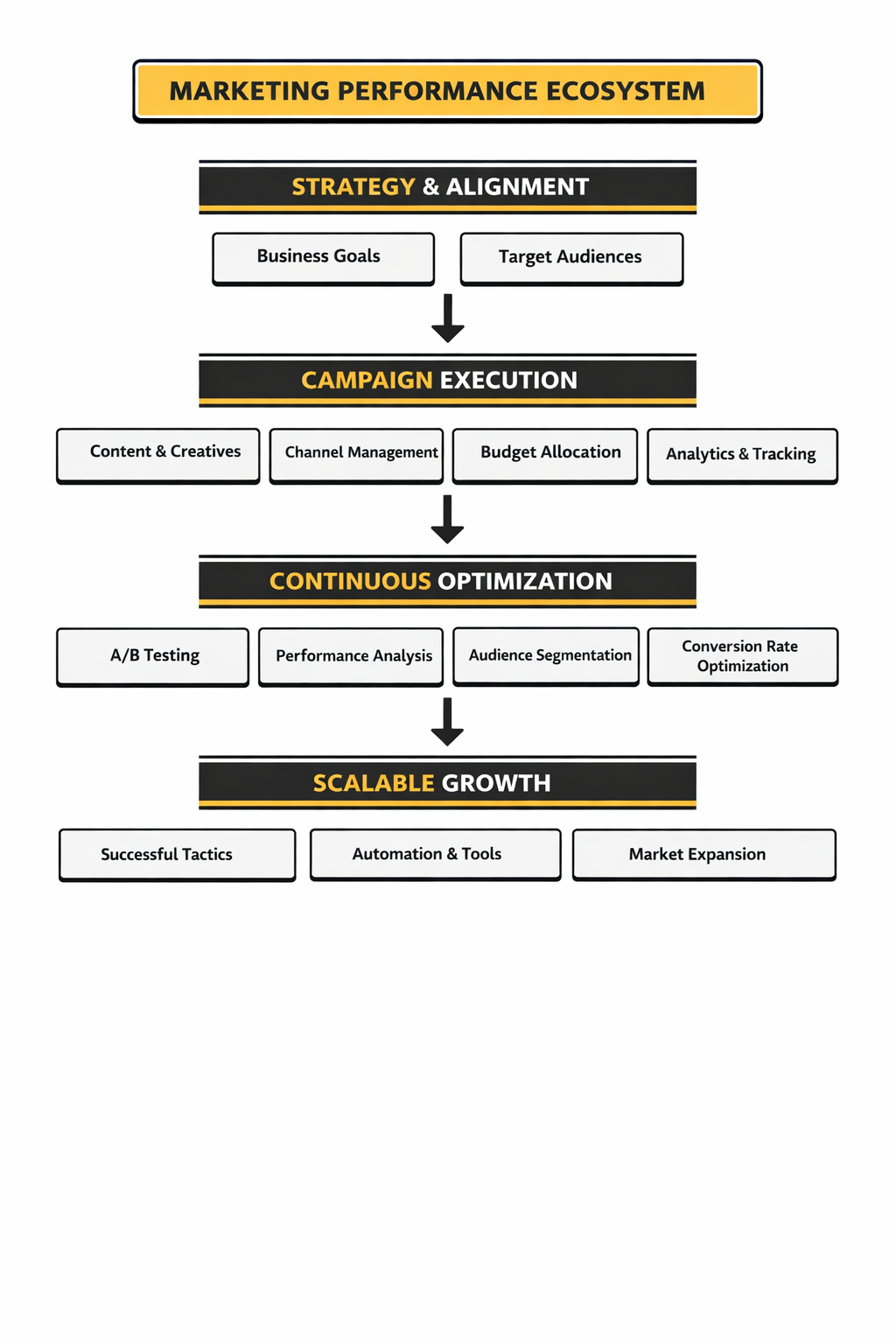
When this ecosystem works correctly, marketing becomes a learning system. Every campaign improves the next one. Every audience interaction sharpens positioning. Every data point strengthens decision-making. Over time the brand becomes easier to discover, easier to trust, and easier to choose.
FAQ - Built for Complete Guide
What is marketing in simple terms?
Marketing is the process of understanding customer needs, communicating value, and guiding people toward a product or service that solves their problem. It includes research, positioning, messaging, distribution, and relationship-building with customers. The purpose of marketing is not just promotion but sustainable demand and long-term customer relationships.
Why is marketing important for businesses?
Marketing helps businesses reach the right audience, communicate why their product matters, and convert attention into revenue. Without marketing, even excellent products often remain invisible in crowded markets. Global advertising investment exceeded $1 trillion in 2024, which shows how intensely brands compete for attention.
What are the main types of marketing?
Most marketing activity falls into several broad categories:
- digital marketing
- content marketing
- social media marketing
- email marketing
- search engine marketing
- influencer marketing
- brand marketing
These approaches often work together rather than independently. A strong marketing strategy combines several methods depending on the audience and buying journey.
How does digital marketing differ from traditional marketing?
Digital marketing uses online channels such as search engines, websites, social media, and email to reach audiences. Traditional marketing includes channels such as television, radio, print media, and outdoor advertising. The biggest difference is measurement and targeting, because digital platforms allow marketers to track user behavior and optimize campaigns more precisely.
What are marketing funnels?
Marketing funnels represent the journey from initial awareness to final purchase and retention. Typical stages include awareness, interest, consideration, conversion, and loyalty. Tools such as ClickFunnels or Systeme.io are often used to organize landing pages, lead capture, and automated follow-up within these funnels.
What metrics define successful marketing?
Successful marketing is measured through metrics that connect activity to business results. These commonly include:
- customer acquisition cost
- conversion rate
- customer lifetime value
- retention rate
- marketing return on investment
These metrics help marketers determine whether campaigns are attracting the right customers and generating profitable growth.
How does content marketing support overall marketing strategy?
Content marketing builds trust by educating, informing, or entertaining an audience before a purchase decision occurs. Articles, videos, and guides help customers understand problems and solutions while positioning a brand as credible and knowledgeable. Content also improves search visibility and supports long-term audience growth.
Why is personalization becoming more important in marketing?
Consumers increasingly expect brands to understand their preferences and deliver relevant experiences. Research from Deloitte’s personalization study shows that many customers spend significantly more with brands that offer personalized experiences. This makes customer data, segmentation, and lifecycle communication essential components of modern marketing.
What tools are commonly used in marketing systems?
Modern marketing ecosystems rely on specialized tools for different functions. Social scheduling platforms such as Buffer or Flick help manage publishing workflows. Email automation platforms like Brevo or Moosend support lifecycle communication and retention campaigns.
The exact stack varies depending on company size and marketing complexity. The key factor is integration rather than the number of tools.
How long does it take for marketing to produce results?
Marketing timelines vary depending on the strategy and channel. Paid advertising campaigns can produce results quickly, while brand building, search visibility, and content marketing often take several months to compound. Long-term marketing success usually comes from combining short-term acquisition tactics with sustained brand and audience development.
What skills make someone effective in marketing?
Effective marketers combine analytical thinking, communication skills, creativity, and strategic judgment. They understand customer psychology, data interpretation, content development, and campaign execution. The strongest marketers also develop systems thinking, allowing them to connect audience insight, messaging, distribution, and measurement into a coherent strategy.
Work With Professionals
Explore 10K+ Remote Marketing Contracts on MarkeWork.com
Most marketers spend too much time chasing clients, competing on crowded platforms, and losing a percentage of every project to middlemen.
MarkeWork gives you a better way. Browse thousands of remote marketing contracts and connect directly with companies desperate to hire skilled marketers like you, without platform commissions and without unnecessary gatekeepers.
If you're serious about finding better opportunities and keeping 100% of what you earn, explore available contracts and create a profile for free at MarkeWork.com.