

MarketMuse is not just another SEO writing tool. It is a content intelligence platform built around a bigger idea: your content should not be planned one keyword at a time, because Google, AI search systems, and serious buyers do not evaluate expertise that way.
That matters because content teams are under pressure from every direction. AI has made average content cheaper, faster, and noisier, while search results are becoming more crowded with summaries, ads, forums, videos, and answer-style results. A recent Semrush study analyzed more than 200,000 keywords and found that AI Overviews are being layered into search experiences rather than simply replacing traditional rankings, which means brands now need stronger topic coverage, clearer expertise, and better content systems to stay visible: AI Overviews’ impact on search in 2025.
MarketMuse fits into that shift because it helps teams move from “What keyword should we write next?” to “Where do we already have authority, what are we missing, and what should we publish or update first?” That is the real difference. The value is not only in optimizing a single article. The value is in building a repeatable content strategy that connects topics, gaps, briefs, updates, and publishing priorities.

This guide breaks MarketMuse down in a practical way. Not as hype. Not as a generic software review. The goal is to help you understand what MarketMuse does, where it fits, when it is worth using, and how a professional content team can turn it into a workflow instead of another unused SEO subscription.
- Why MarketMuse Matters Now
- The MarketMuse Framework
- Core Components Of MarketMuse
- How To Use MarketMuse In A Professional Content Workflow
- MarketMuse Compared With Other Content And SEO Tools
- MarketMuse FAQs And Final Recommendations
Why MarketMuse Matters Now
Content strategy has become harder because the old playbook is breaking down. Publishing more articles is not enough when many competitors can now produce acceptable first drafts in minutes. The teams that win are the ones that know which topics deserve investment, which existing pages can be improved, and which content gaps are actually worth closing.
That is where MarketMuse becomes relevant. It is designed to analyze your content inventory, identify topic opportunities, compare coverage against competitors, and support content briefs that are based on topical depth rather than guesswork. In plain English, it helps you stop treating every article like an isolated asset.
The demand for this kind of discipline is rising because content marketing performance is uneven. In the 2025 B2B content marketing benchmark research, only a minority of marketers rated their programs as extremely or very successful, while top performers were much more likely to connect success with audience understanding and strategic planning: B2B Content Marketing Benchmarks, Budgets, and Trends. MarketMuse matters because it supports that strategic layer before writers start drafting.
The MarketMuse Framework
The easiest way to understand MarketMuse is to think of it as a framework, not a writing assistant. A writing assistant helps you produce words. MarketMuse helps you decide which content deserves attention, how complete that content needs to be, and how it should connect to the rest of your site.
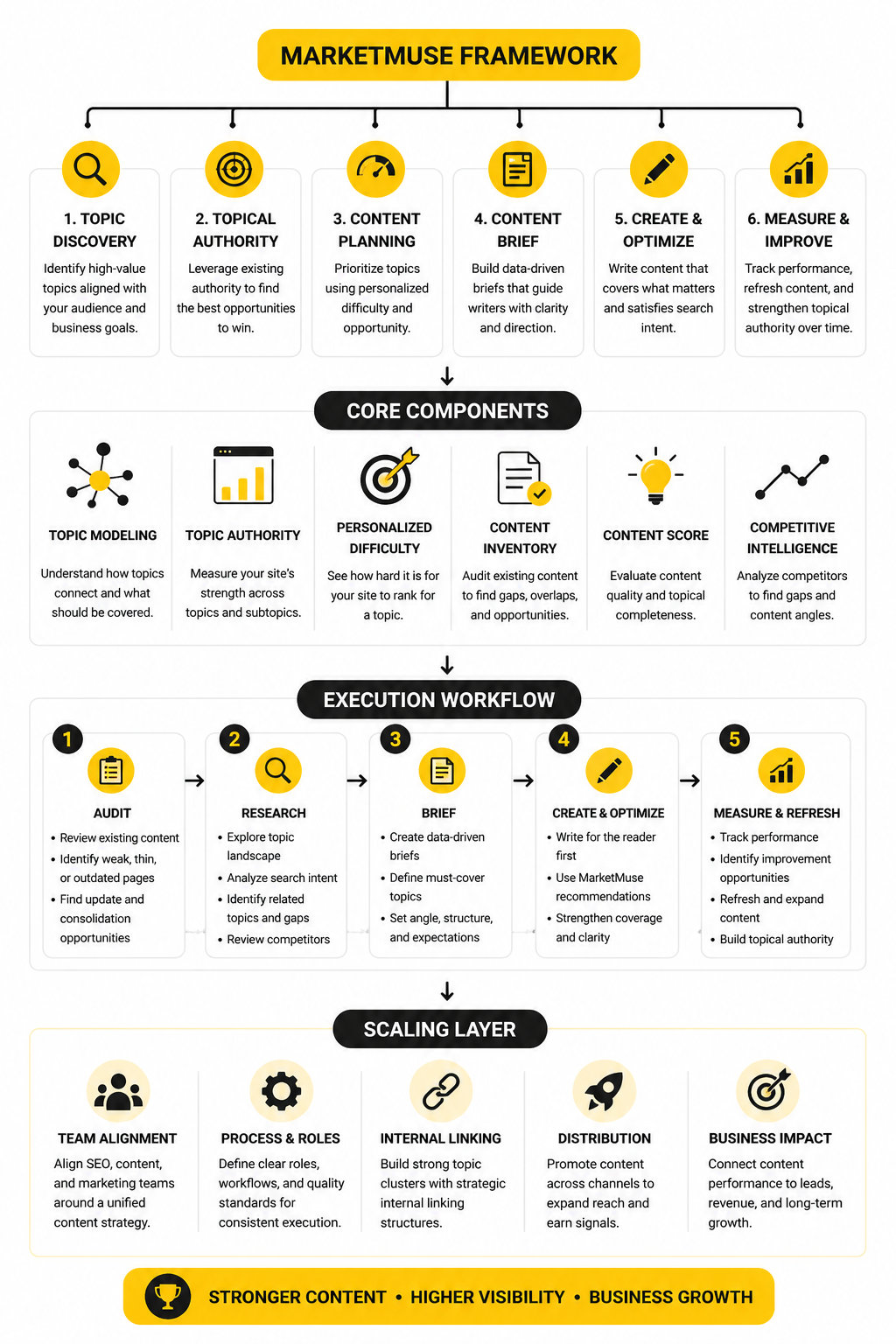
A practical MarketMuse workflow usually starts with inventory analysis. You look at what you already have, where you have authority, and which pages may be strong enough to update instead of replacing. From there, you move into topic research, competitor gap analysis, content brief creation, optimization, and performance review.
That sequence matters because it prevents random content production. Without a framework, teams often chase keywords that look attractive in isolation but do not support the site’s broader authority. With MarketMuse, the better question becomes: “Does this topic strengthen our position in a cluster we can realistically own?”
Core Components Of MarketMuse
MarketMuse is built around a few core components that work together. The first is content inventory analysis, which helps you understand the strengths and weaknesses of your existing content library. This is especially useful for mature websites that already have dozens, hundreds, or thousands of pages but no clear sense of which assets should be updated first.
The second component is topic and competitive research. Instead of only showing a keyword list, MarketMuse helps reveal related concepts, missing coverage, and competitor gaps. This gives editors and strategists a better foundation for planning articles that feel complete, useful, and aligned with search intent.
The third component is content briefs and optimization. This is where strategy turns into execution. A strong brief helps writers understand the angle, structure, important subtopics, and depth required before they write, which can reduce rewrites and make the editorial process more predictable.
How MarketMuse Turns Content Strategy Into Priorities
The biggest mistake teams make with content strategy is treating every opportunity as equal. A keyword with search volume is not automatically worth writing about. A competitor ranking for a topic does not automatically mean your site should chase it.
MarketMuse is useful because it forces a more practical question: where do you already have enough authority to win? That changes the planning process. Instead of building a calendar from generic keyword exports, you start with your existing content footprint, your topic strengths, your weak pages, and your realistic opportunities.
That approach fits the direction search has been moving for years. Google’s own guidance pushes creators toward content that demonstrates depth, usefulness, and a clear audience purpose, not pages created mainly to collect rankings: creating helpful, reliable, people-first content. MarketMuse works best when you use it for that exact job: building a stronger body of content around topics your audience actually cares about.
Inventory Comes Before Ideation
Before you create new content, you need to know what your existing content is already doing. That sounds obvious, but many teams skip it because auditing content manually is slow and messy. The result is a bloated site with overlapping articles, forgotten pages, weak internal links, and missed update opportunities.
MarketMuse helps by analyzing your content inventory and identifying where your site already has topical strength. That matters because an update to an existing page can sometimes be more valuable than creating a new article from scratch. It also helps you avoid publishing another piece that competes with content you already own.
This is where the platform becomes more strategic than a basic SEO writing checker. MarketMuse is not only asking, “Does this article mention the right related terms?” It is asking, “How does this page fit into the larger topic ecosystem on your site?” That is a much better question for serious content teams.
Personalized Difficulty Changes The Planning Conversation
Traditional keyword difficulty scores can be useful, but they are limited. They usually estimate how hard a keyword is in the general market. They do not always reflect how hard that topic is for your specific website.
MarketMuse’s personalized difficulty concept is valuable because it accounts for your site’s existing authority around a topic. A keyword that looks difficult in a generic SEO tool may be more realistic if your site already has strong related content. The reverse is also true: a keyword with moderate difficulty may still be a poor target if your site has no supporting authority.
This helps editors, SEO leads, and founders make better tradeoffs. You can prioritize topics where you have a real path to visibility instead of wasting budget on content that looks attractive but has no strategic foundation. That is the kind of decision-making content teams need when budgets are tight and expectations are high.
The MarketMuse Framework In Practice
A strong MarketMuse workflow has four layers: audit, research, brief, and improve. Each layer supports the next one. When the workflow is done properly, content production becomes less reactive and more deliberate.
The audit layer shows what already exists. The research layer reveals topic gaps, competitor angles, and related questions. The brief layer turns that research into a usable plan for writers. The improvement layer helps you refresh, expand, and strengthen content over time.
This matters because content is not finished when it is published. In competitive search markets, content becomes an asset only when it is maintained. MarketMuse is strongest when it becomes part of that ongoing editorial rhythm.
Audit The Existing Site
The first practical step is to review your current content library. You want to identify strong pages, thin pages, outdated pages, and pages that compete with each other. This gives you a cleaner picture of what should be refreshed, consolidated, expanded, or left alone.
MarketMuse can help surface opportunities that are easy to miss in a spreadsheet. For example, a page may have decent topical alignment but weak coverage in a few important areas. Another page may have enough authority to justify a serious update instead of creating a brand-new competing article.
This is especially useful for established sites. If you already have a large archive, your biggest opportunity may not be more publishing. It may be making your existing content work harder.
Research The Topic Before The Keyword
Once the audit is clear, the next step is topic research. This is where MarketMuse helps you move beyond one target keyword and understand the broader subject. The goal is not to stuff more phrases into an article. The goal is to understand what a genuinely complete resource should cover.
This is important because modern search results often reward content that satisfies the full intent behind a query. A page about MarketMuse, for example, should not only define the tool. It should explain use cases, workflow fit, strengths, limitations, alternatives, pricing considerations, and who should or should not use it.
That is why topic modeling matters. It gives the writer and editor a more complete map before drafting begins. Better inputs usually lead to better content.
Build Briefs That Writers Can Actually Use
A content brief should make writing easier, not heavier. Bad briefs are stuffed with disconnected keywords, vague instructions, and competitor links with no editorial point of view. Good briefs clarify the reader, the angle, the structure, the must-cover ideas, and the expected depth.
MarketMuse can support this by turning topic research into a more structured brief. That gives writers a clear direction before they start drafting. It also gives editors a better standard for reviewing the piece later.
This is where workflow discipline pays off. A strong brief reduces back-and-forth, prevents shallow drafts, and keeps the article aligned with the broader content strategy. For teams publishing at scale, that difference is not small.
How To Use MarketMuse In A Professional Content Workflow
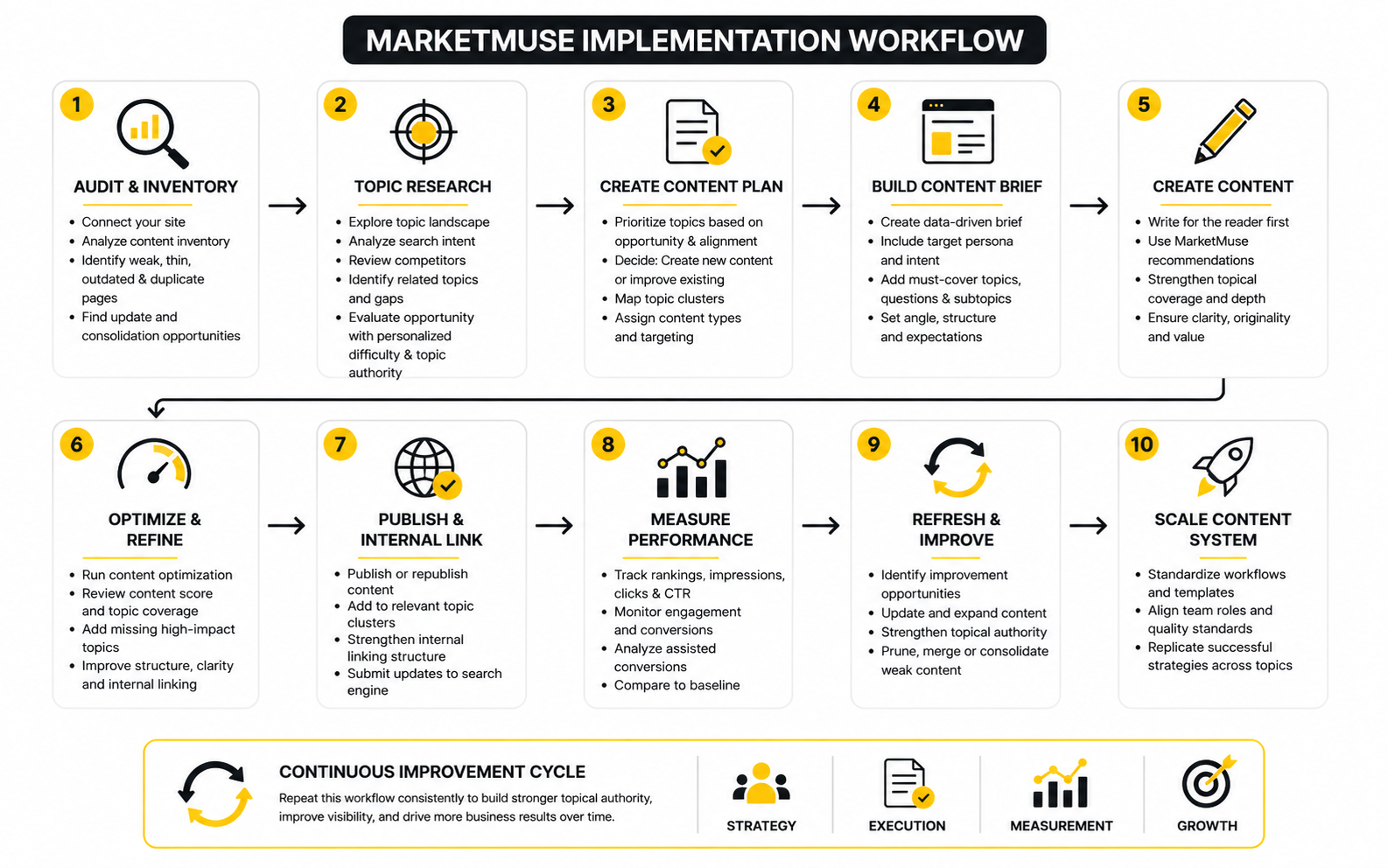
MarketMuse becomes much more valuable when it is connected to a real production process. If it sits outside the workflow, it becomes another dashboard people check occasionally and forget. If it shapes planning, briefing, editing, and updating, it can help the whole content operation become sharper.
The goal is not to let software make every decision. The goal is to use MarketMuse to reduce guesswork at the points where content teams usually lose time. That means choosing better opportunities, giving writers better direction, and improving pages with a clear reason instead of vague “SEO updates.”
A practical workflow should be simple enough that people actually follow it. The more complicated the system becomes, the more likely it is to fail. Start with the decisions that matter most, then build from there.
Step 1: Choose The Topic Cluster
Start with a topic cluster, not a random keyword. This keeps the work tied to a broader authority goal instead of a single ranking target. For example, a team reviewing MarketMuse would not only look at “MarketMuse” as one keyword, but also the surrounding cluster: content intelligence, topic modeling, content briefs, content optimization, competitor gaps, and content inventory.
This step helps you decide whether the topic is strategically relevant. A topic may have search volume, but if it does not support your product, service, or audience, it may not deserve attention. Strong content strategy is partly about knowing what not to publish.
MarketMuse is useful here because it can help identify related topics and show where your existing content already has strength. That gives the team a better starting point than a blank content calendar. It also helps prevent scattered publishing that never compounds into authority.
Step 2: Audit Existing Content
Before creating a new brief, check whether you already have a page that can be improved. This is one of the most practical steps in the whole process. Many sites do not need more content first; they need better use of what they already have.
Look for pages that are outdated, thin, misaligned with search intent, or missing important subtopics. Also look for pages that overlap too much with each other. If two articles are competing for the same intent, publishing a third article usually makes the problem worse.
MarketMuse can support this audit by helping you see content quality, topical coverage, and inventory-level opportunities. That gives editors a clearer view of whether to update, consolidate, expand, or create something new. This is where the platform starts to save real editorial time.
Step 3: Build The Brief Before Writing
A professional brief should come before the draft, not after it. This sounds basic, but many teams still write first and optimize later. That creates rewrites, weak structure, and content that feels patched together.
MarketMuse content briefs are designed to turn planning data into writing direction. The platform’s documentation explains that briefs can be created from planning documents and associated content groups, which makes the brief part of a larger strategy rather than a standalone writing prompt: creating a content brief. That connection matters because writers need context, not just keywords.
The brief should clarify the search intent, target reader, main angle, must-cover subtopics, internal linking opportunities, and pages that should be avoided because they overlap. The more precise the brief, the easier the writing becomes. Good briefs do not restrict good writers; they protect them from wasting time.
Step 4: Draft For The Reader First
Once the brief is ready, the writer should focus on clarity, usefulness, and flow. This is where many teams get it wrong. They treat optimization terms as a checklist and end up producing content that technically covers topics but does not feel helpful.
MarketMuse should guide the draft, not dominate it. A strong article still needs a clear point of view, natural transitions, useful explanations, and a structure that respects the reader’s time. The tool can help reveal what should be covered, but the editor still needs to decide how to make the article worth reading.
This matters even more now because Google’s guidance emphasizes content created for people rather than content created mainly to manipulate search rankings: helpful, reliable, people-first content. In practice, that means the article should answer the real question behind the query. If the page only sounds optimized, it is not enough.
Step 5: Optimize Without Flattening The Article
Optimization should improve the article, not make it robotic. Use MarketMuse to identify missing concepts, weak sections, and areas where the article may not be complete enough. Then decide what actually belongs in the piece.
Not every suggested topic deserves a sentence. Some ideas may be irrelevant to your angle, too advanced for the reader, or better handled in a separate article. This is why editorial judgment still matters.
The best workflow is simple: review the recommendations, add what strengthens the article, ignore what does not, and keep the writing natural. The final page should feel like a better answer, not like a document built to satisfy a software score. That distinction is important.
Step 6: Publish, Measure, And Refresh
Publishing is not the finish line. After a page goes live, track how it performs and decide when it needs improvement. Search results change, competitors update their pages, and your own product or positioning may evolve.
MarketMuse can support refresh cycles by helping teams identify pages that deserve updates. This is especially useful for evergreen content, comparison pages, and strategic topic hubs. Instead of waiting until traffic drops, you can build a regular review rhythm.
For teams running serious campaigns, this process can connect with the rest of the marketing stack. A content team might use MarketMuse for strategy and briefs, then pair it with tools for landing pages, email, automations, or funnels depending on the business model. For example, a service business that turns organic traffic into appointments may connect content to a CRM and follow-up system like GoHighLevel, while a creator or small team may prefer a simpler funnel setup through Systeme.io. The key is to make sure the content has a commercial path after the click.
Statistics And Data
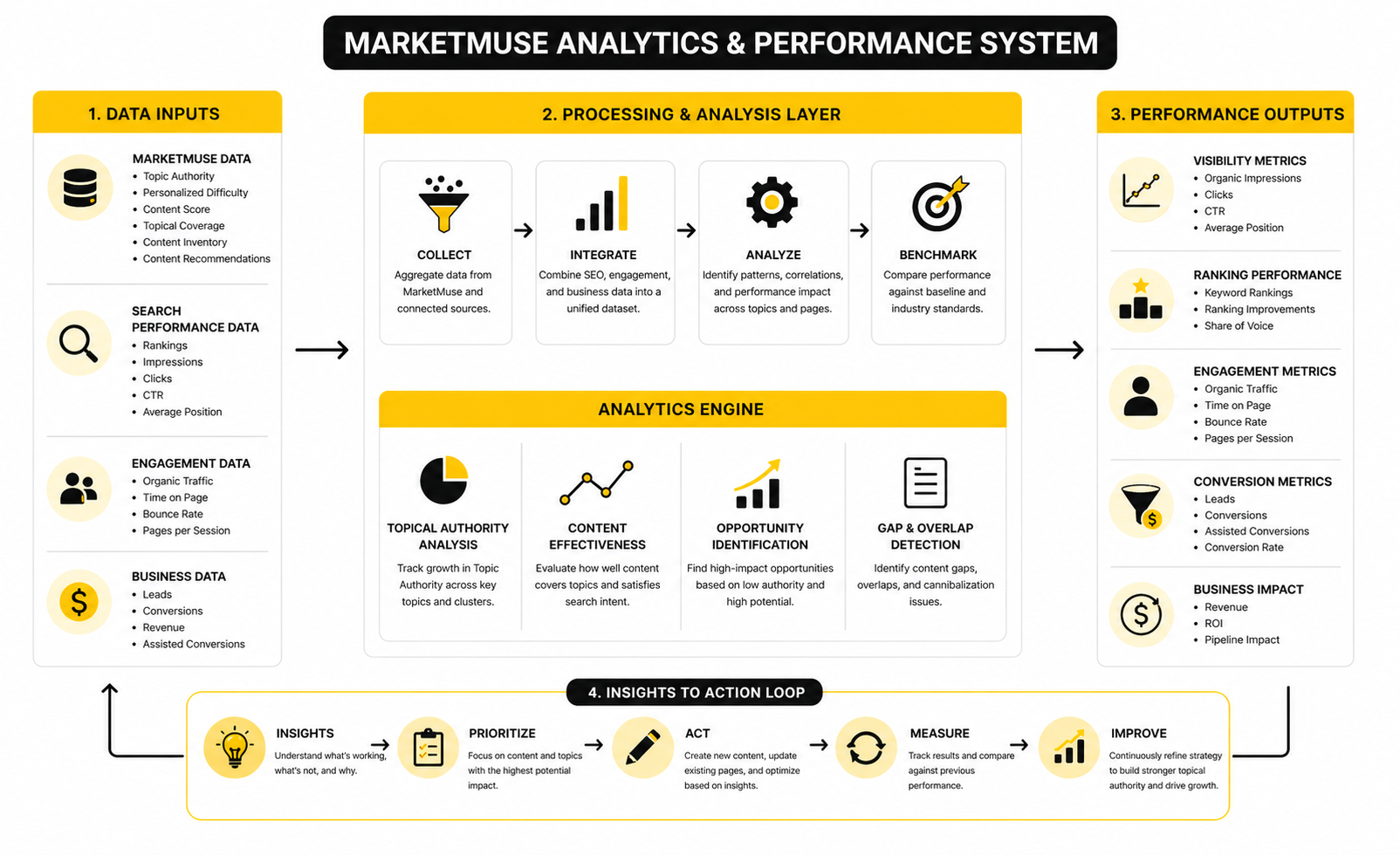
Measurement is where MarketMuse either becomes a serious strategy tool or turns into another content dashboard. The point is not to collect more numbers. The point is to understand which signals should change your next editorial decision.
The modern content environment makes this more important because rankings alone no longer tell the full story. A page can rank, lose clicks to AI answers, attract unqualified traffic, or fail to move readers toward a useful next step. That is why MarketMuse should be measured alongside search visibility, engagement, conversions, and content quality signals.
A good measurement system answers four questions. Are we choosing topics where we can realistically win? Are our pages becoming more complete and useful? Are updates creating measurable gains? Are those gains connected to business outcomes?
The Metrics That Matter Most
Start with topic-level metrics before page-level metrics. MarketMuse is strongest when it helps you understand topical authority, personalized difficulty, content gaps, and optimization opportunities. Those metrics matter because they help you decide where to focus before you spend time writing or updating.
MarketMuse defines Topic Authority as a signal of competitive advantage and Personalized Difficulty as a site-specific estimate of how hard it may be for your domain to rank for a topic: Personalized Difficulty and Topic Authority. That distinction is important. Generic keyword difficulty tells you how competitive a query looks in the market, while personalized difficulty helps you judge whether your site has a realistic path.
The action is simple: prioritize topics where your authority is already developing and the effort-to-upside ratio makes sense. Do not blindly chase the highest-volume keywords. In a professional workflow, MarketMuse should help you rank opportunities by strategic fit, not just by search volume.
Content Score Is A Diagnostic, Not The Goal
Content Score can be useful, but it should not become the entire strategy. A higher score may show that a page covers more relevant concepts, but it does not automatically mean the page is persuasive, original, or aligned with the reader’s intent. Treat it as a diagnostic signal, not a finish line.
This matters because teams can easily optimize themselves into bland content. If every article becomes a checklist of recommended terms, the writing starts to feel generic. The better approach is to use the score to find weak coverage, then improve the article with better explanations, clearer structure, and stronger editorial judgment.
The action is to compare Content Score changes with actual performance changes. If a page improves its topical coverage but search impressions, clicks, or conversions do not move, the issue may be intent, positioning, internal linking, page experience, or the offer after the click. MarketMuse can point you toward content gaps, but it cannot replace strategic interpretation.
Search Visibility Needs Context
Organic search is harder to measure cleanly because the search results page has changed. AI Overviews, ads, video blocks, forums, local packs, and featured snippets can all change how much traffic a ranking actually produces. A position that once drove meaningful clicks may now deliver less value.
Semrush’s 2025 AI Overviews research analyzed more than 200,000 keywords and found that AI Overviews are being layered into search results alongside existing features, ads, video results, and discussion blocks: AI Overviews’ impact on search in 2025. SparkToro’s zero-click research also showed that many Google searches end without a click to the open web, which means traffic is no longer a perfect proxy for visibility: 2024 zero-click search study. The takeaway is not panic. The takeaway is that your dashboard needs to measure more than rankings.
The action is to track impressions, click-through rate, ranking position, SERP features, branded search growth, assisted conversions, and topic-level visibility together. If impressions rise but clicks fall, the issue may be SERP layout. If clicks rise but conversions stay flat, the issue may be content intent or offer alignment. If rankings improve across a cluster, the strategy may be working even before one single page becomes a major traffic driver.
Benchmarks Should Guide, Not Control
Benchmarks are useful when they give you a reality check. They are dangerous when teams treat them as universal targets. A B2B software article, an affiliate comparison page, a local service page, and a media article should not be judged by the same engagement or conversion expectations.
The Content Marketing Institute’s 2025 B2B benchmark research shows that the strongest content programs are more likely to connect performance with strategy, audience understanding, and clear goals: B2B content marketing benchmarks and trends. That matters because the right benchmark depends on the job of the page. Some content should drive leads now. Some content should build authority. Some content should support sales conversations later.
The action is to assign each content asset a role before judging performance. A glossary page may be measured by visibility and internal link flow. A comparison page may be measured by qualified clicks and demo intent. A strategic guide may be measured by assisted conversions, newsletter signups, pipeline influence, or returning visitors.
Update Performance Is Often More Important Than New Publishing Volume
One of the most useful ways to measure MarketMuse is by update performance. If the platform helps you identify pages that can be improved, you should track what happens after those updates. This creates a cleaner feedback loop than only measuring new content.
A strong refresh measurement process looks at the page before and after the update. Track impressions, clicks, average position, query spread, conversions, internal clicks, and engagement quality. Then compare the result to the size of the update so you understand whether the effort was worth it.
This is where MarketMuse can support better resource allocation. If refreshes consistently outperform new articles in a topic cluster, shift more editorial capacity toward optimization. If new articles are needed to close structural gaps in the cluster, publish them with a clear internal linking plan.
Connect Content Metrics To Revenue Paths
Content measurement should not stop at Google Search Console. Search data tells you how people find the page. It does not always tell you whether the content helped the business.
For commercial content, connect MarketMuse-driven work to downstream actions. That may include email signups, booked calls, product trials, affiliate clicks, demo requests, checkout starts, or sales-qualified leads. The exact metric depends on the business model.
This is why content operations need clean handoffs after the page. A content-heavy business may use Buffer to distribute refreshed articles across social channels, Brevo to nurture subscribers, or GoHighLevel to connect organic traffic to appointments and follow-up. MarketMuse can help improve the content asset, but the business still needs a conversion path that makes the traffic useful.
MarketMuse Compared With Other Content And SEO Tools
MarketMuse is not the right tool for every team. That is not a weakness. It just means you need to understand what problem you are actually trying to solve before you buy software.
Some tools are better for fast on-page optimization. Some are better for rank tracking, technical SEO, or backlink analysis. MarketMuse is strongest when the real problem is content strategy: knowing what to create, what to update, where your authority already exists, and how to brief content more intelligently.
That distinction matters because teams often buy tools for the wrong reason. If you only need a simple writing score for one article at a time, MarketMuse may feel heavier than necessary. If you need to manage a serious content inventory and make better strategic decisions across a site, that is where it starts to make more sense.
MarketMuse Vs Traditional Keyword Research Tools
Traditional keyword research tools are useful, but they usually start from the keyword. They show search volume, keyword difficulty, SERP data, and related terms. That can help with discovery, but it does not always tell you whether your specific site has the authority to win.
MarketMuse starts from a more strategic place. Its documentation explains that Topic Authority looks at how your whole site covers a topic across breadth, depth, and search performance, while Personalized Difficulty helps prioritize opportunities based on your existing advantage: Personalized Difficulty and Topic Authority. That changes the conversation from “Is this keyword popular?” to “Is this topic realistic and valuable for us?”
The best setup is often not either-or. Use traditional SEO tools to understand the market, search demand, and competitive landscape. Use MarketMuse to decide where your site has the best chance to build authority and which content actions should come first.
MarketMuse Vs On-Page Optimization Tools
On-page optimization tools are usually built around improving a specific draft. They help writers compare a page against competing results, find missing terms, and tune structure. That can be useful, especially for teams that publish frequently and need quick editorial feedback.
MarketMuse can also support optimization, but its bigger advantage is upstream planning. It helps with inventory analysis, content quality analysis, cluster work, and content briefs, not just final-page scoring. The platform’s own documents section includes workflows for cluster analysis, keyword and intent analysis, content quality analysis, content plans, and briefs: MarketMuse strategy documents.
This is a key tradeoff. If the team only wants a lightweight editor, a simpler tool may be enough. If the team needs a system for deciding what to write and what to update across a broader content portfolio, MarketMuse is usually the more strategic option.
MarketMuse Vs AI Writing Tools
AI writing tools can create drafts quickly, but speed is not the same as strategy. A fast draft can still target the wrong topic, miss the real search intent, duplicate an existing page, or fail to support the larger content architecture. That is the hidden cost of publishing without a plan.
MarketMuse is better viewed as the planning and intelligence layer before writing. It can help define the topic, brief, gaps, and opportunity before a writer or AI tool produces the draft. That makes the writing process more focused.
There is still a place for AI writing in the workflow. A team might use MarketMuse to build the brief, then use an AI assistant for early drafting, outlines, summaries, or repurposing. But the editorial decision should stay human, especially when the content affects trust, buying decisions, or brand authority.
The Risk Of Over-Optimization
The biggest risk with MarketMuse is not the tool itself. The risk is using it mechanically. If a team treats every recommendation as mandatory, the content can become bloated, repetitive, and unnatural.
This is where editors need to be firm. A recommended topic should earn its place in the article. If it supports the reader’s understanding, include it. If it distracts from the main argument, leave it out or handle it in a separate page.
Professional teams should set clear editorial rules before scaling MarketMuse across writers. Decide how to use content scores, how to handle suggested topics, when to create a new page, when to update an existing page, and when to ignore the data. Tools should improve judgment, not replace it.
Scaling MarketMuse Across A Team
MarketMuse becomes more powerful when multiple people use it consistently. That includes SEO leads, editors, writers, content managers, and sometimes product marketers. The challenge is making sure everyone uses the tool in the same way.
Start with a simple operating system. Define who chooses topics, who reviews inventory, who creates briefs, who approves outlines, who edits for search intent, and who measures performance after publication. Without clear ownership, even strong recommendations get lost.
This matters even more for agencies and multi-brand teams. If every writer interprets the data differently, output quality becomes inconsistent. A shared workflow turns MarketMuse from a specialist tool into a repeatable production system.
When MarketMuse Is Worth It
MarketMuse is most worth it when content is a serious growth channel. That usually means the site already has a meaningful content library, the team publishes or updates regularly, and the business needs better prioritization. In that environment, better decisions can save enough time and missed opportunity to justify the tool.
It is less compelling for very small sites with only a few pages, casual bloggers, or teams that only need occasional keyword suggestions. Those users may get more immediate value from simpler SEO tools, a lightweight content optimizer, or a focused publishing workflow. The software should match the maturity of the content operation.
The honest test is this: do you have enough content and enough publishing velocity that prioritization mistakes are expensive? If yes, MarketMuse deserves a serious look. If no, build the basics first, then come back when the content system is ready.
FAQ - Built For Complete Guide
What Is MarketMuse?
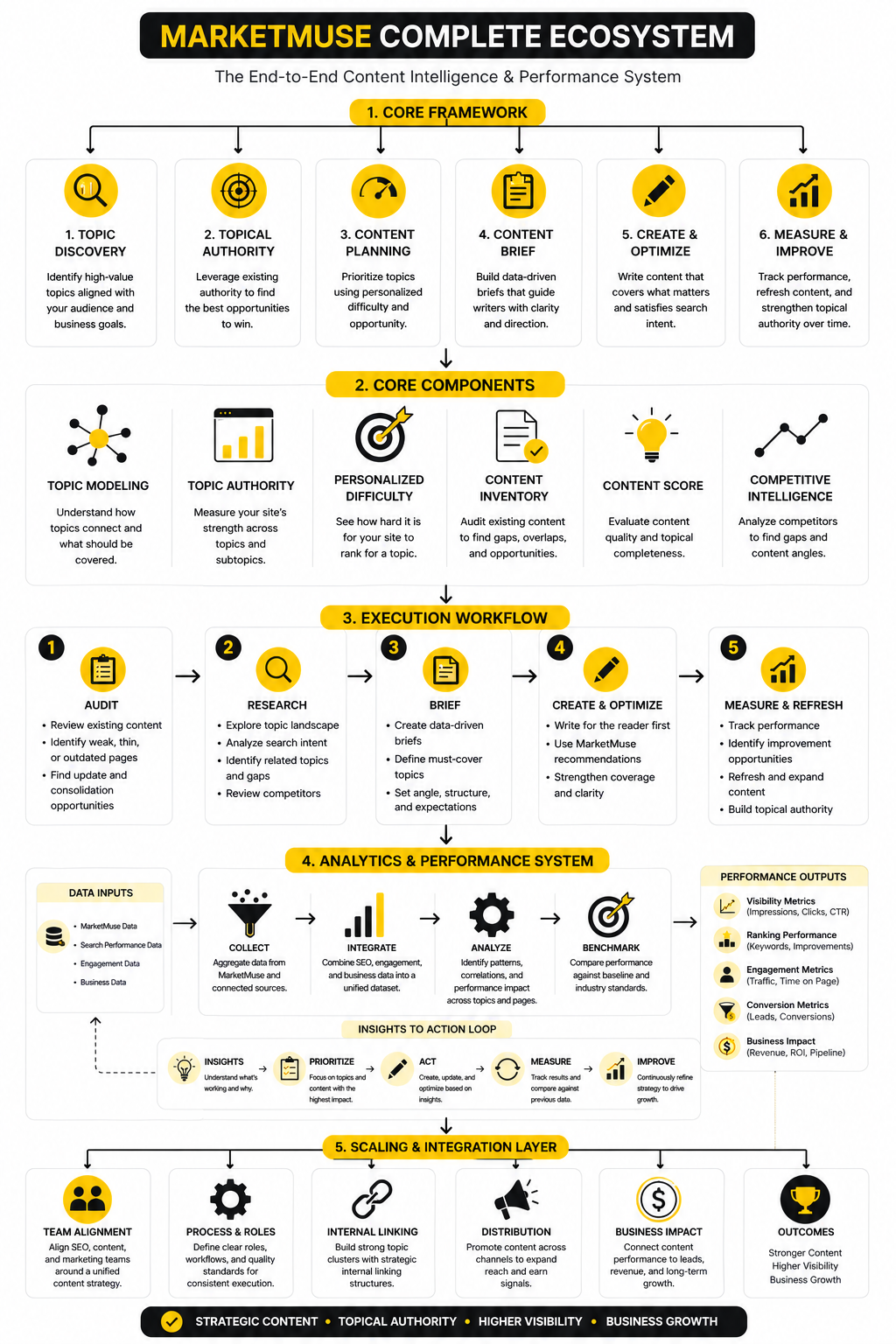
MarketMuse is a content intelligence platform that helps teams plan, brief, optimize, and improve content based on topical authority and competitive gaps. It is not just a keyword tool, because it looks at how topics connect across a website. That makes it especially useful for teams that want a more strategic content workflow instead of a one-page-at-a-time optimization process.
What Is MarketMuse Best Used For?
MarketMuse is best used for content strategy, content audits, topic prioritization, content briefs, and optimization planning. It helps teams decide what to create, what to update, and where they already have enough authority to compete. This is most valuable when a website has enough existing content that manual prioritization becomes slow or unreliable.
Is MarketMuse An SEO Tool?
Yes, MarketMuse supports SEO, but it is more accurate to call it a content intelligence tool. Traditional SEO tools often focus on keywords, backlinks, rank tracking, and technical issues. MarketMuse focuses more on topic coverage, content quality, personalized difficulty, and strategic content planning.
How Does MarketMuse Help With Content Briefs?
MarketMuse helps content teams create briefs that are grounded in topic research, search intent, competitive analysis, and related concepts. Its brief workflow can include elements like target persona, intent analysis, important topics, information gain, and content type considerations: MarketMuse content briefs for writers. That gives writers clearer direction before they draft, which can reduce rewrites and improve consistency.
What Is Personalized Difficulty In MarketMuse?
Personalized Difficulty estimates how hard it may be for your specific site to rank for a topic based on your existing content and authority. This is different from generic keyword difficulty, which usually looks at competition across the wider search market. MarketMuse explains that Personalized Difficulty is connected to the amount of effort required for your site, while Topic Authority represents a competitive advantage: Personalized Difficulty and Topic Authority.
What Is Topic Authority In MarketMuse?
Topic Authority is a MarketMuse metric that helps show where your site already has strength around a topic. That matters because content teams should not treat every keyword as equally realistic. When you already have authority in a topic area, it may be easier to improve visibility with targeted updates, stronger internal links, and better coverage.
Can MarketMuse Replace Human Editors?
No, and it should not try to. MarketMuse can identify gaps, opportunities, and structural weaknesses, but it cannot fully replace editorial judgment, product knowledge, brand voice, or real expertise. The strongest workflow uses MarketMuse for intelligence and humans for strategy, nuance, and quality control.
Is MarketMuse Good For Small Websites?
MarketMuse can help small websites, but it is usually more valuable once content becomes a serious growth channel. A very small site may need basic positioning, product clarity, and a few strong pages before investing in a deeper content intelligence platform. Once the site has enough pages, topics, and update decisions to manage, MarketMuse becomes much more useful.
How Often Should You Use MarketMuse?
Use MarketMuse during planning, briefing, optimization, and refresh cycles. For an active content team, that may mean weekly planning sessions, pre-draft brief creation, and monthly or quarterly content audits. The key is consistency, because the value comes from better decisions over time.
Does MarketMuse Help With AI Content?
MarketMuse can help make AI-assisted content more strategic by improving the inputs before drafting begins. Instead of asking AI to write from a vague keyword, you can use MarketMuse to shape the topic, structure, gaps, and brief first. That matters because AI can produce words quickly, but speed does not fix weak strategy.
What Metrics Should You Track With MarketMuse?
Track MarketMuse metrics like Topic Authority, Personalized Difficulty, Content Score, and topical coverage alongside performance metrics from search and analytics tools. Useful external signals include impressions, clicks, rankings, click-through rate, assisted conversions, leads, and revenue contribution. The goal is to understand whether content improvements are creating business value, not just higher scores.
Is MarketMuse Worth It?
MarketMuse is worth it when content decisions are expensive enough that better prioritization matters. If your team publishes regularly, manages a large content library, or depends on organic search for growth, the platform can help you avoid wasted effort. If you only publish occasionally and do not yet have a clear content strategy, start with the basics before adding a heavier intelligence layer.
Work With Professionals
Explore 10K+ Remote Marketing Contracts on MarkeWork.com
Most marketers spend too much time chasing clients, competing on crowded platforms, and losing a percentage of every project to middlemen.
MarkeWork gives you a better way. Browse thousands of remote marketing contracts and connect directly with companies desperate to hire skilled marketers like you, without platform commissions and without unnecessary gatekeepers.
If you're serious about finding better opportunities and keeping 100% of what you earn, explore available contracts and create a profile for free at MarkeWork.com.