

Direct email marketing remains one of the most powerful tools for businesses aiming to reach their audience with precision. Despite the rise of social media and AI-driven messaging, email consistently delivers a higher ROI, with some reports indicating an average return of $42 for every $1 spent. Its success hinges on targeted messaging, personalization, and a deep understanding of audience behavior.
The goal of this article is to break down direct email marketing into actionable insights, showing how to build campaigns that don’t just reach inboxes, but inspire action. We’ll cover everything from the foundational strategy to professional execution.
Article Outline
- Why Direct Email Marketing Matters
- Framework Overview for Effective Campaigns
- Core Components of Successful Emails
- Professional Implementation Strategies
- Optimizing Performance and Deliverability
- Measuring Success and Scaling Campaigns
Why Direct Email Marketing Matters
Direct email marketing offers unparalleled direct access to customers’ inboxes, making it a critical channel for engagement. Unlike social platforms where algorithms dictate visibility, email gives brands control over who sees their message and when. For example, personalized emails can boost open rates by 26%, and campaigns targeting segmented audiences often see conversion improvements exceeding 50%.
The effectiveness comes not just from reach but relevance. Emails allow for tailored offers, dynamic content, and actionable calls to action that resonate with specific customer segments. Brands that understand their audience can nurture relationships over time, moving prospects along the customer journey more efficiently than many other channels.
A real-world example is a mid-sized e-commerce retailer that faced stagnating online sales despite heavy social media spending. By implementing a segmented email campaign with personalized product recommendations, they saw a 38% lift in revenue over three months. The turning point was identifying high-intent customers through past purchase behavior and sending hyper-relevant offers, proving that email’s direct nature can cut through digital noise.
Framework Overview for Effective Campaigns
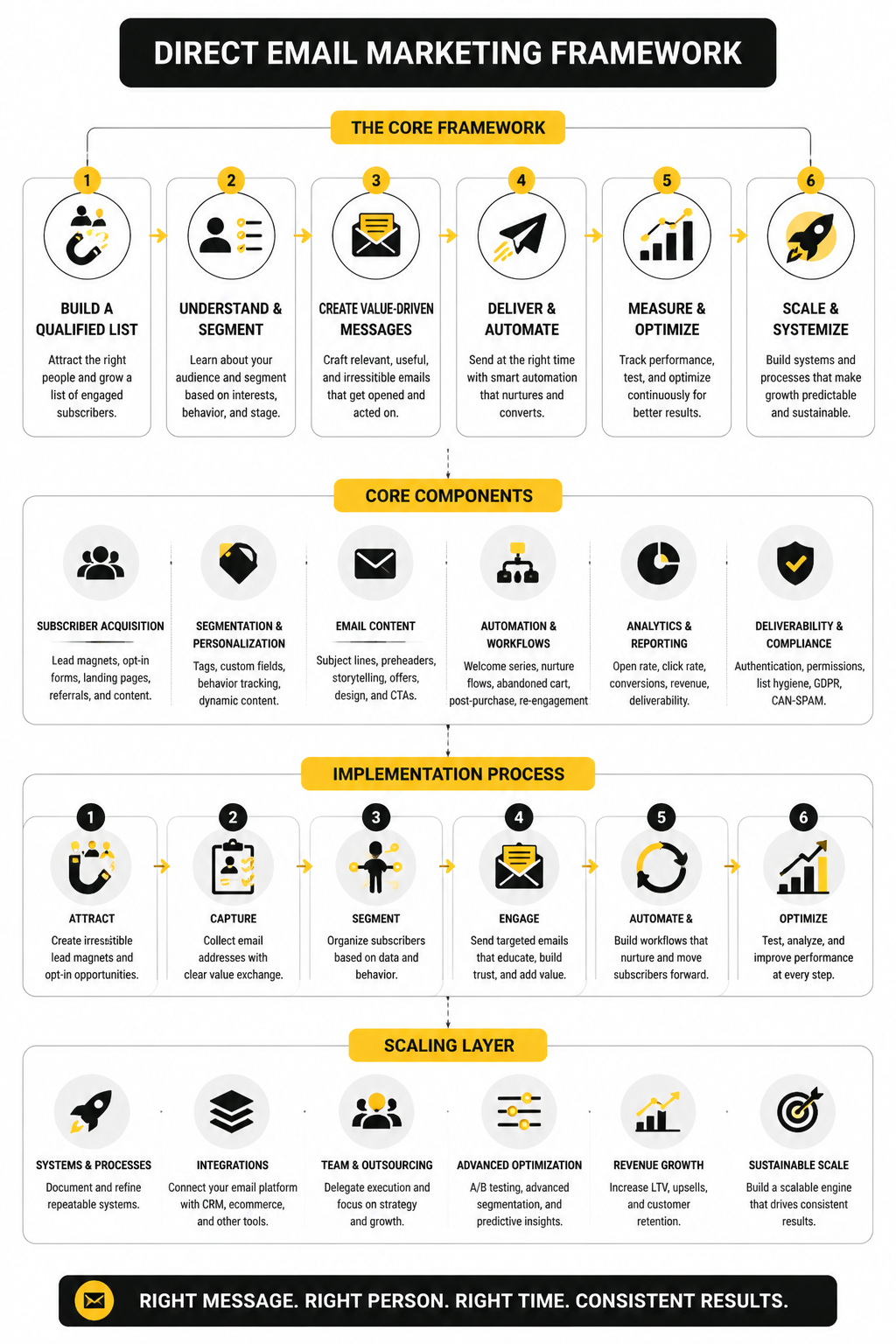
A structured framework is essential to turning email outreach into measurable results. At its core, a strong email marketing framework consists of:
- Audience Segmentation – Dividing subscribers into meaningful groups based on behavior, interests, and demographics.
- Content Strategy – Designing messages that align with each segment’s preferences while providing value.
- Automation & Timing – Sending messages at the right moment using automation tools to maintain consistency.
- Testing & Optimization – Continuously A/B testing subject lines, content, and CTAs to refine performance.
This framework ensures that every email sent is purposeful, targeted, and performance-driven. Companies that apply such structures systematically see higher engagement rates and better ROI compared to ad hoc campaigns.
A notable case is a SaaS company that integrated an automated onboarding email series. By mapping the user journey and segmenting by feature usage, they increased trial-to-paid conversion by 24% in six weeks. The framework didn’t just organize their email schedule—it guided strategic decisions that impacted the bottom line.
This sets up the foundation for exploring the next stages: diving into core components, professional implementation, optimization, and measurable scaling of direct email marketing campaigns.
Core Components of Successful Emails
Effective direct email marketing relies on several core components that work together to capture attention, drive engagement, and inspire action. Each element is essential for creating emails that don’t just get opened but actually convert.
Compelling Subject Lines
The subject line is the first—and often only—chance to grab attention. Emails with personalized subject lines see higher open rates than generic ones, sometimes exceeding a 26% increase. Great subject lines are short, clear, and spark curiosity without being misleading.
Engaging Content
Once the email is opened, content must deliver value immediately. Whether it’s a tutorial, exclusive offer, or industry insight, the content should align with the audience’s interests. Using concise paragraphs, bullet points, and actionable language helps readers digest and act on the message quickly.
Clear Call to Action (CTA)
Every email should include a clear CTA that tells the recipient exactly what to do next. Whether it’s making a purchase, signing up for a webinar, or downloading a resource, the CTA should be prominent and benefit-driven. Testing CTA placement and wording can significantly improve click-through rates.
Visual and Brand Consistency
Visual design reinforces credibility and brand recognition. Consistent use of colors, logos, and fonts ensures the email feels familiar and trustworthy. Even subtle visual cues can increase engagement by creating a professional, polished impression.
Personalization and Segmentation
Segmenting your audience and tailoring messages is no longer optional. Personalized emails based on past behavior, purchase history, or preferences see higher engagement. Brands that leverage segmentation experience conversion improvements far above generic mass campaigns.
Automation and Timing
Automation allows businesses to reach customers at the optimal moment, without manual effort. Welcome sequences, abandoned cart reminders, and behavior-triggered messages ensure timely relevance, which boosts response rates. For instance, a welcome email series can increase long-term customer retention by creating immediate connection.
Testing and Optimization
Continuous testing—A/B testing subject lines, content blocks, and CTAs—is critical. Even small tweaks can dramatically impact performance. A SaaS provider increased conversions by 18% after optimizing subject lines and CTA placement based on systematic testing.
Professional Implementation Strategies
Building professional-grade campaigns requires more than knowing the components—it’s about execution. Professionals treat email marketing as a strategic discipline, combining data, creativity, and tools to maximize impact.
Leveraging Advanced Tools
Modern tools such as GoHighLevel, ManyChat, and Brevo provide automation, segmentation, and analytics capabilities that streamline professional campaigns. They help schedule, personalize, and optimize messages at scale without losing the human touch.
Workflow Planning
Professional implementation starts with mapping the customer journey. Every email should serve a purpose within a larger strategy, whether it’s onboarding, nurturing leads, or re-engaging dormant customers. This prevents disjointed messaging and improves ROI.
Compliance and Deliverability
Staying compliant with laws like GDPR and CAN-SPAM protects your reputation and ensures emails reach the inbox. Using verified sending domains, avoiding spam triggers, and maintaining clean lists improves deliverability, which directly impacts campaign performance.
Monitoring and Iteration
Professional marketers track key metrics—open rates, click-through rates, conversions, and unsubscribes—and use this data to refine campaigns. Iteration based on insights allows continuous improvement and scalability, rather than static, one-off campaigns.
These strategies set the stage for exploring how to optimize campaigns and measure performance effectively, which will be the focus of the next section.
Implementing Direct Email Marketing Campaigns
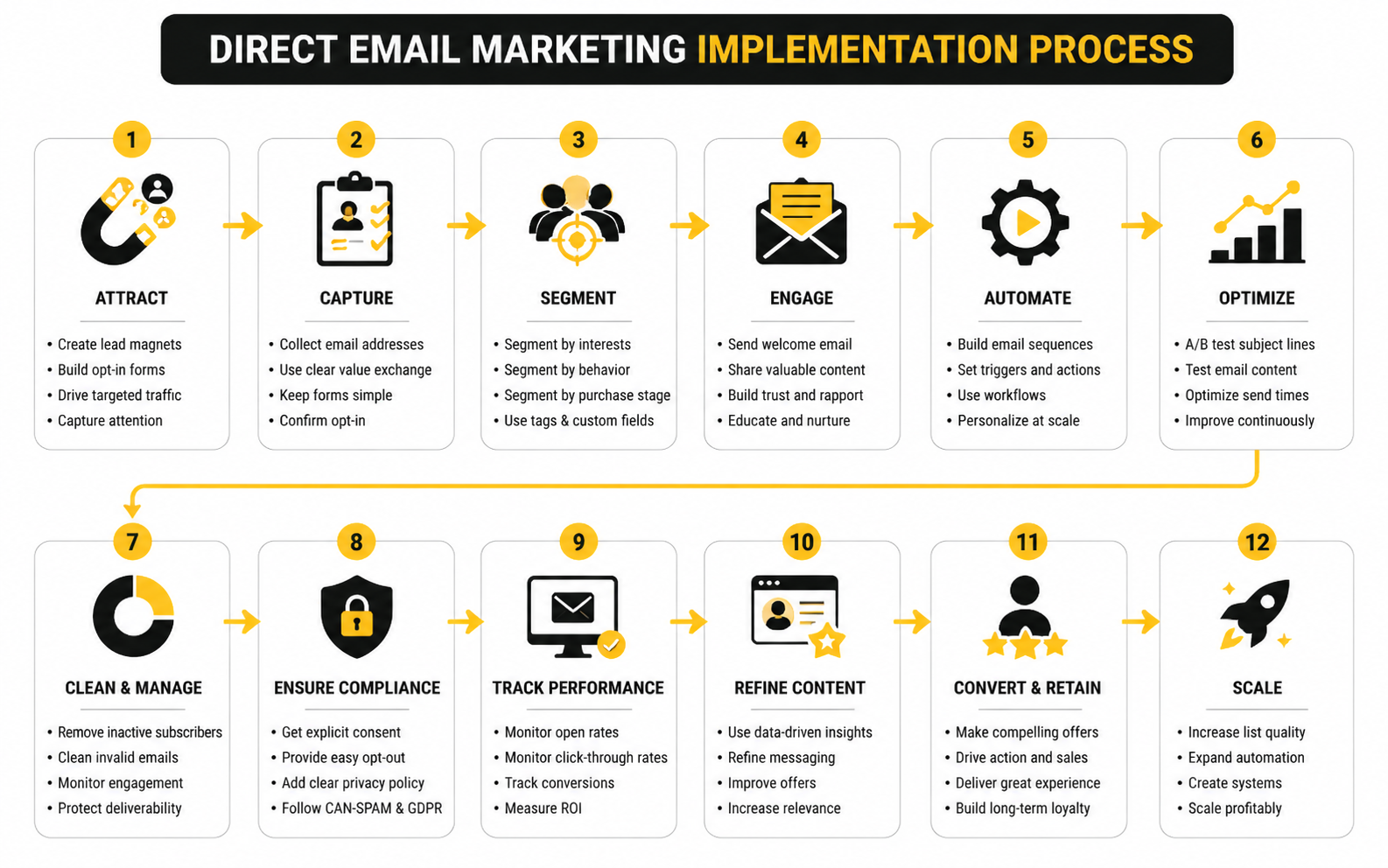
Turning strategy into action is where direct email marketing delivers real results. Professional implementation is not just about sending emails—it’s about following a precise, repeatable process that maximizes engagement and conversions.
Step 1: Define Campaign Goals
Every campaign starts with clear objectives. Are you aiming to increase sales, drive webinar registrations, or nurture leads over time? Setting measurable goals ensures that every email, sequence, and automation aligns with the desired outcome. For instance, a SaaS company targeting trial-to-paid conversions set a goal of increasing conversions by 20% within 60 days, which guided all content and automation choices.
Step 2: Build and Segment Your List
High-quality, segmented email lists are the backbone of effective campaigns. Segmentation can be based on demographics, past purchases, engagement history, or behavioral triggers. Businesses that use advanced segmentation see significant uplift in engagement compared to one-size-fits-all campaigns. Proper list hygiene, including removing inactive subscribers, also improves deliverability and open rates.
Step 3: Craft Content and CTAs
With your segments defined, craft content that speaks directly to each audience group. Personalization, relevance, and clarity are key. Strong CTAs drive action, whether it’s making a purchase, downloading a resource, or registering for an event. Testing multiple variations of subject lines and CTAs helps identify which approach resonates best with each segment.
Step 4: Set Up Automation and Triggers
Automation ensures timely delivery without manual intervention. Triggered sequences—such as welcome emails, abandoned cart reminders, or post-purchase follow-ups—increase relevance and engagement. Companies using tools like GoHighLevel or ManyChat can automate complex workflows that respond dynamically to user behavior, making campaigns both scalable and personalized.
Step 5: Test and Optimize
Before full deployment, testing is essential. A/B test subject lines, content, CTAs, and sending times to identify what works best. Iterative optimization based on data ensures that campaigns improve over time. For example, a retailer adjusted their email series timing based on open and click patterns, resulting in a 15% increase in click-through rates.
Step 6: Monitor Metrics and Adjust
Once the campaign is live, continuous monitoring is crucial. Key metrics include open rates, click-through rates, conversions, and unsubscribes. Using these insights allows marketers to refine messaging, update segments, and improve future campaigns. This data-driven approach transforms email marketing from a static communication tool into a growth engine for your business.
With a structured implementation process in place, marketers can now focus on refining performance, optimizing deliverability, and scaling campaigns for maximum impact, which will be the focus of the next section.
Measuring Performance and Interpreting Data in Direct Email Marketing
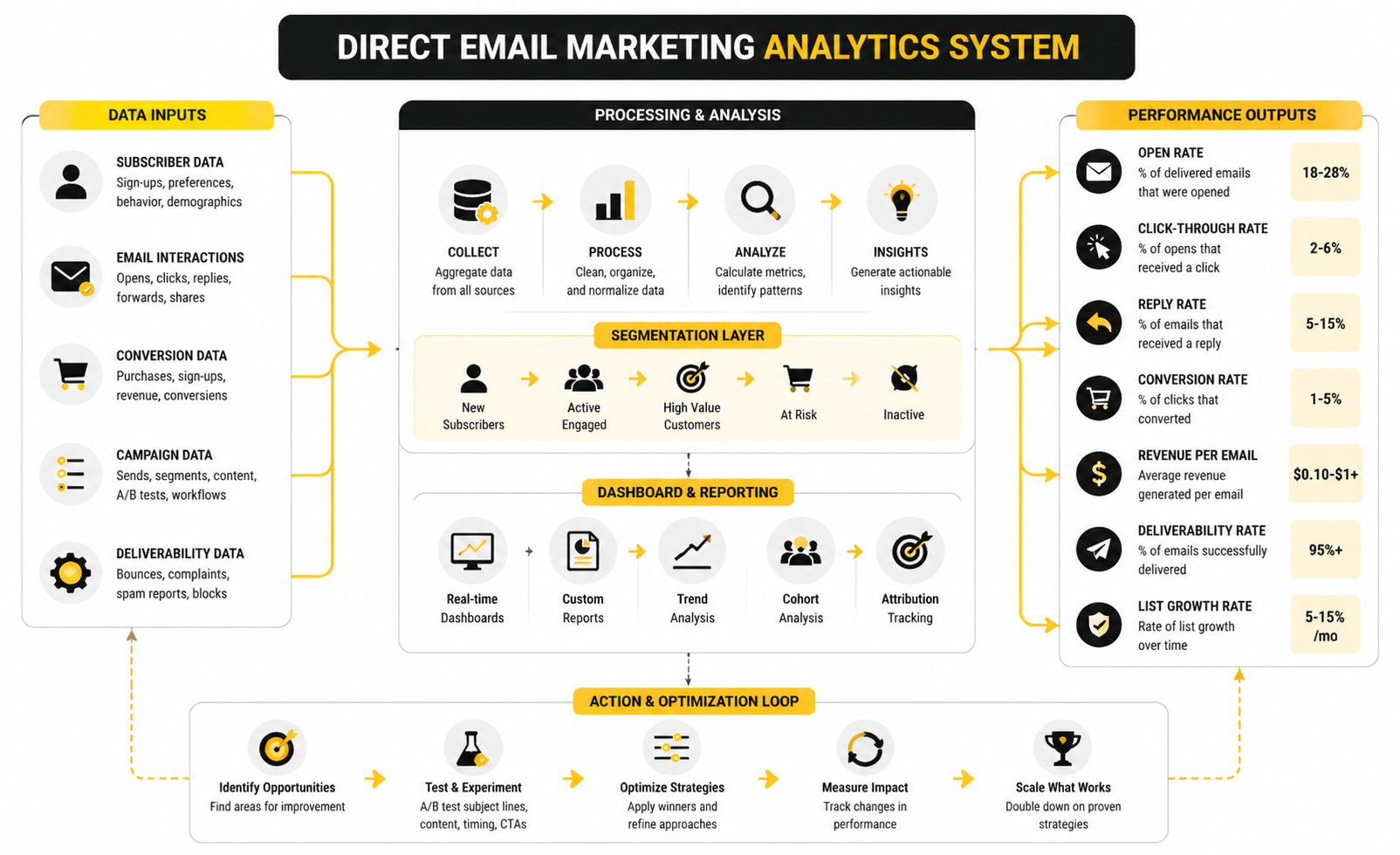
Numbers are meaningless without context. In direct email marketing, understanding what metrics signal success and what they reveal about your audience is critical for making informed decisions and improving ROI.
Key Metrics to Track
- Open Rate – Indicates how compelling your subject lines are and whether your audience recognizes your brand. While a high open rate is positive, it alone doesn’t guarantee conversions.
- Click-Through Rate (CTR) – Measures how effectively your email content and CTAs drive action. A low CTR despite high opens suggests your messaging or offers need refinement.
- Conversion Rate – The ultimate metric of campaign effectiveness. Tracking conversions allows you to see which emails are driving revenue or desired actions.
- Bounce Rate – Signals deliverability issues or outdated email lists. High bounces can harm your sender reputation and should trigger list-cleaning initiatives.
- Unsubscribe Rate – Provides insights into audience satisfaction. Sudden spikes indicate content misalignment or overly aggressive campaigns.
Benchmarks and Context
Benchmarks vary by industry, but understanding them helps contextualize performance. For instance, e-commerce emails often see average open rates around 18-20% and CTRs between 2-4%, while B2B campaigns may report lower open rates but higher conversion impact due to high-value leads. Metrics should always be interpreted in combination, not isolation.
Actionable Insights
Data analysis should lead to specific actions. A/B testing subject lines, experimenting with send times, and segmenting audiences based on engagement are all driven by metrics. For example, a software company noticed low CTR on onboarding emails; by adjusting content to focus on immediate benefits and including a clear CTA to a demo, they increased trial activation by 22%.
Analytics Tools and Visualization
Using advanced tools like GoHighLevel, Brevo, or ManyChat allows marketers to visualize performance trends, set automated reports, and quickly identify areas for optimization. Visualization helps teams spot patterns that raw numbers might obscure, such as seasonal engagement shifts or segment-specific behaviors.
By interpreting these metrics thoughtfully, marketers can refine strategies, optimize content, and scale campaigns effectively, turning direct email marketing from a tactical tool into a strategic growth engine.
Advanced Strategies and Scaling Considerations
Once basic campaigns are running smoothly, advanced strategies help maximize the long-term impact of direct email marketing. These approaches focus on scaling, risk management, and strategic tradeoffs that separate amateur campaigns from professional-grade programs.
Strategic Segmentation and Dynamic Content
Scaling requires going beyond basic demographics. Advanced marketers use behavioral triggers, purchase history, and engagement patterns to create dynamic content that adapts in real-time. This approach not only improves engagement but reduces fatigue by sending only relevant messaging to each subscriber. For example, integrating tools like GoHighLevel enables automated adjustments in email sequences based on user interactions, effectively tailoring communication at scale.
Balancing Frequency and Engagement
High-volume campaigns can drive revenue, but over-communicating risks unsubscribes and spam complaints. Successful scaling relies on monitoring engagement metrics and adjusting frequency intelligently. Businesses that segment based on engagement levels can send more often to active subscribers while limiting emails to less engaged segments, maintaining overall health of the list.
Risk Management and Compliance
Scaling introduces operational risks. Maintaining deliverability, adhering to GDPR, CAN-SPAM, and other privacy regulations, and preventing blacklisting are essential. Automation tools such as Brevo or ManyChat help enforce compliance, while ongoing list hygiene and authentication protocols protect sender reputation.
Multi-Channel Integration
Professional marketers recognize that direct email marketing works best within a broader ecosystem. Integrating email campaigns with SMS, social media retargeting, and CRM platforms increases touchpoints and conversions. Platforms like Replo or ClickFunnels allow seamless orchestration of cross-channel campaigns, helping scale without losing personalization.
Iterative Growth and Data-Driven Scaling
Scaling should be methodical, relying on data-driven decisions. By testing new segments, experimenting with content variations, and analyzing conversion trends, marketers can identify growth levers. For instance, a B2B SaaS company scaled their onboarding campaigns by adding behavior-triggered sequences, increasing trial-to-paid conversion by over 20%. Iterative improvements ensure scaling enhances results rather than diluting effectiveness.
These advanced considerations prepare marketers for sustainable growth, setting up the transition into final reflections and practical tips for ongoing success in direct email marketing.
Ecosystem and Final Insights
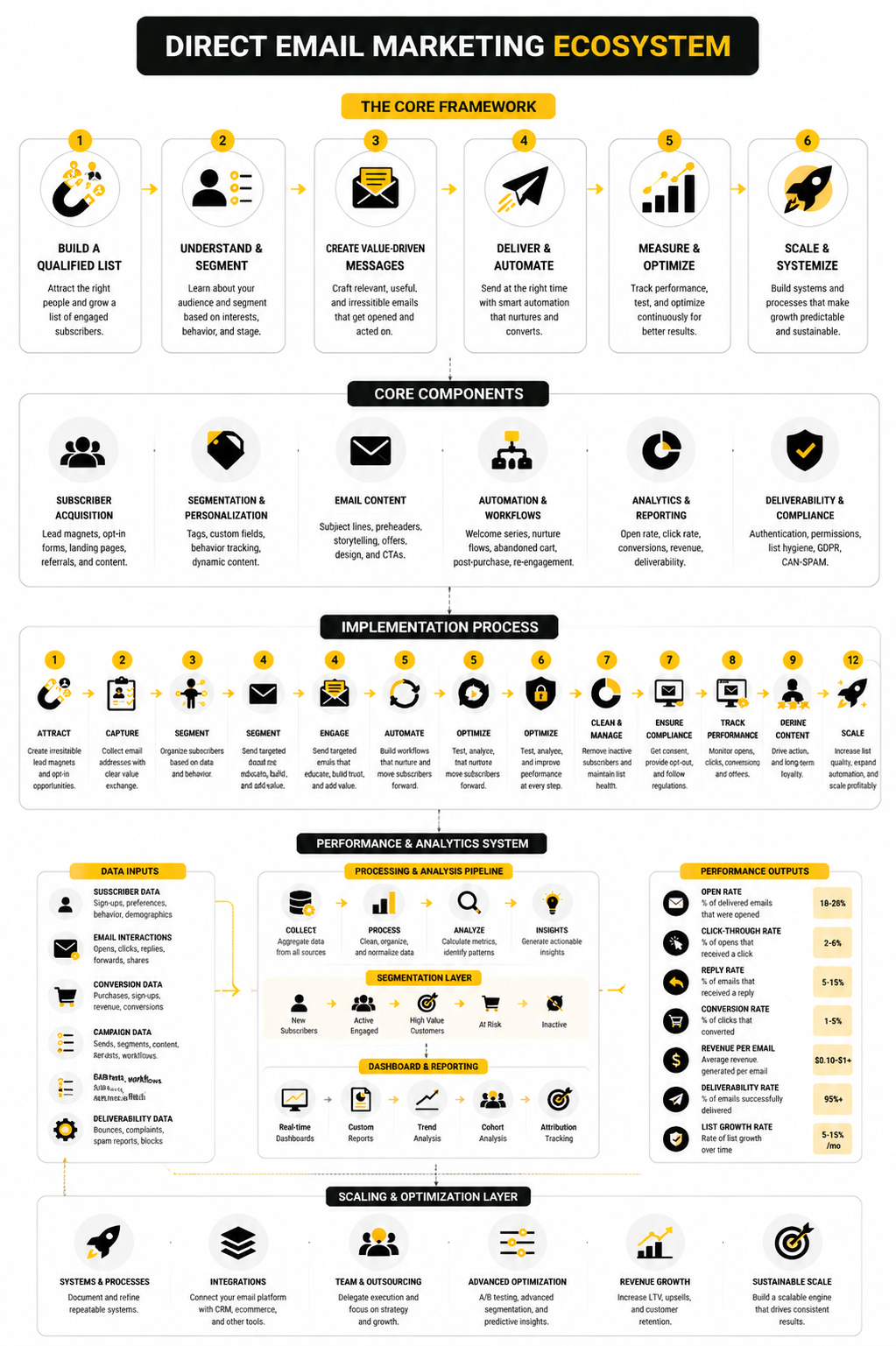
Direct email marketing works best as part of a broader, integrated ecosystem. Campaigns that connect email, CRM data, automation workflows, and cross-channel touchpoints deliver the highest impact. This final system perspective ensures every message contributes to long-term engagement, brand loyalty, and revenue growth.
FAQ - Built for Complete Guide
1. What is direct email marketing?
Direct email marketing is the practice of sending targeted messages directly to a subscriber's inbox to promote products, services, or content while nurturing relationships.
2. Why is segmentation important?
Segmentation allows marketers to tailor messages based on behavior, interests, or demographics, increasing relevance, engagement, and conversion rates.
3. How often should I send emails?
Frequency depends on audience engagement. High-value content sent too often can cause unsubscribes, while too little communication may reduce brand recall. Monitoring engagement metrics is key.
4. What metrics should I prioritize?
Open rates, click-through rates, conversion rates, bounce rates, and unsubscribe rates are essential. Together, they reveal how effectively campaigns reach, engage, and convert your audience.
5. How can I improve deliverability?
Maintain clean email lists, authenticate sending domains, and avoid spam triggers. Using verified platforms like Brevo helps maintain high inbox placement.
6. Should I use automation?
Yes. Automation ensures timely, relevant messages without manual effort. Triggered emails like welcome sequences or abandoned cart reminders boost conversions significantly.
7. How do I measure ROI?
Track conversions and revenue generated from email campaigns relative to the cost of execution. High ROI campaigns often combine segmentation, personalization, and timely messaging.
8. Can direct email marketing work for B2B?
Absolutely. B2B campaigns often focus on lead nurturing, onboarding sequences, and event invitations. Personalization and value-driven content are critical for results.
9. How do I avoid email fatigue?
Segment your audience based on engagement, rotate content types, and adjust frequency. A/B testing helps identify the ideal sending cadence.
10. What tools are recommended for professionals?
Advanced marketers leverage platforms like GoHighLevel, ManyChat, and Replo for automation, personalization, and analytics.
11. How important is A/B testing?
Critical. Testing subject lines, content, and CTAs informs what resonates with your audience and allows iterative improvement to maximize engagement and conversions.
12. What role does cross-channel integration play?
Integrating email with SMS, social media, and CRM systems amplifies results, ensuring consistent messaging and multiple touchpoints that strengthen customer relationships.
Work With Professionals
Explore 10K+ Remote Marketing Contracts on MarkeWork.com
Most marketers spend too much time chasing clients, competing on crowded platforms, and losing a percentage of every project to middlemen. MarkeWork gives you a better way. Browse thousands of remote marketing contracts and connect directly with companies desperate to hire skilled marketers like you, without platform commissions and without unnecessary gatekeepers.
If you're serious about finding better opportunities and keeping 100% of what you earn, invite readers to explore available contracts and create a profile for free at MarkeWork.com.