

Media marketing is no longer just buying ads, posting content, or getting press. It is the system a brand uses to earn attention across owned, paid, shared, and earned channels, then turn that attention into trust, demand, leads, sales, and retention.
That matters because the media environment has become both bigger and harder to control. Digital advertising revenue reached nearly $300 billion in 2025, global social media user identities passed 5.24 billion, and digital channels now represent 61.1% of total marketing spend. More channels does not automatically mean more growth, though. It usually means more noise, more fragmented attention, and more pressure to prove what is actually working.
The useful way to think about media marketing is simple: your brand needs a clear message, the right media mix, consistent distribution, useful creative, and measurement that connects activity to business outcomes. Without that structure, teams end up chasing trends. With it, every campaign has a job, every channel has a role, and every result teaches you what to improve next.
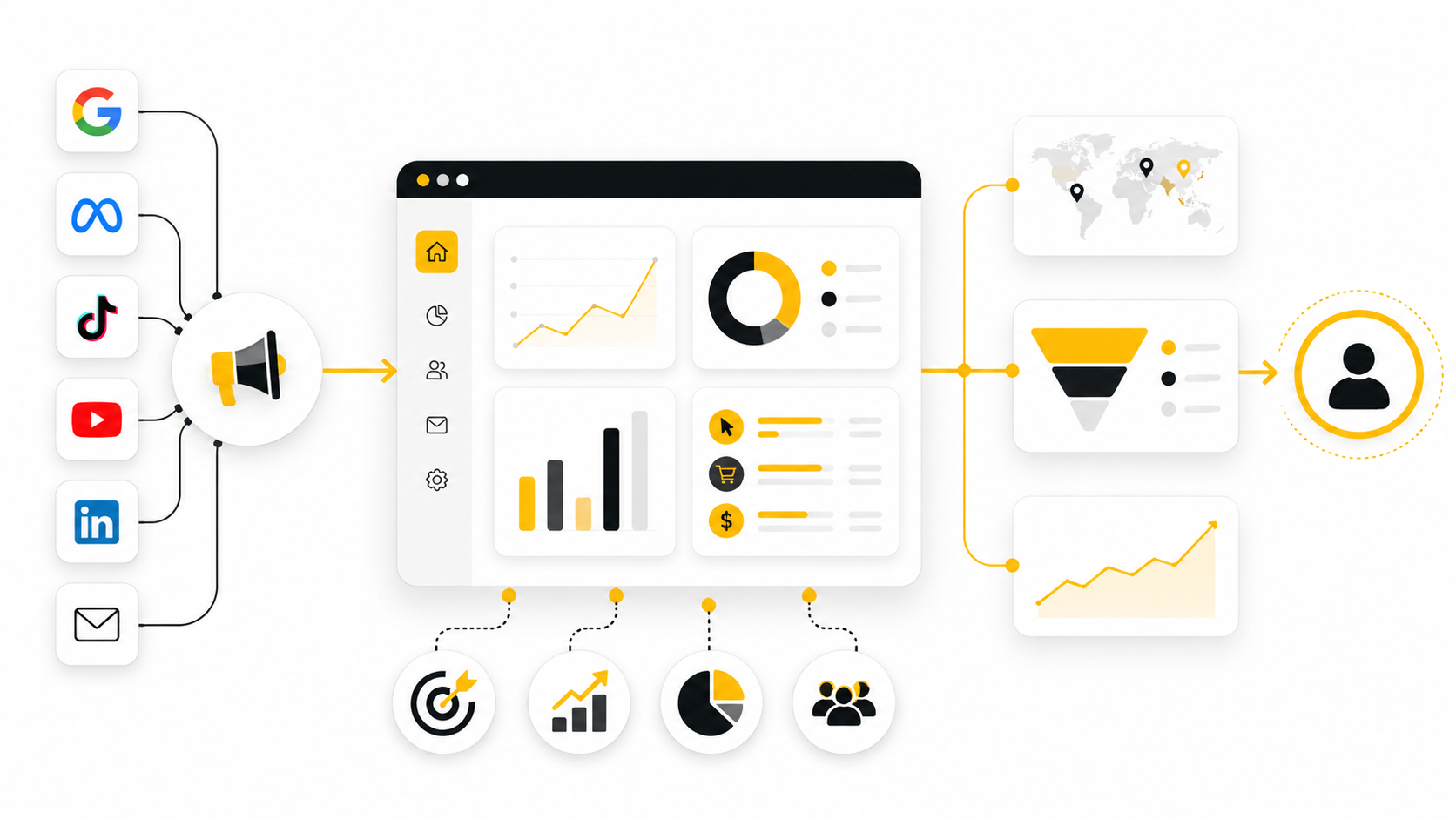
Article Outline
- Media Marketing Strategy: Why It Matters Now
- The Media Marketing Framework
- Core Components Of A Strong Media Marketing System
- How To Choose The Right Media Channels
- Professional Implementation: Campaigns, Tools, And Team Workflows
- Measurement, Optimization, And FAQs
Media Marketing Strategy: Why It Matters Now
Media marketing matters because attention has become distributed across many small moments instead of a few predictable channels. People search, scroll, watch, listen, compare, message, and buy across different platforms in the same day. A brand that only thinks in isolated campaigns will miss how these moments connect.
It also matters because trust is harder to earn than reach. The 2025 Edelman research shows that 80% of people trust brands they use, which means familiar, useful, and consistent brand experiences still have real power. The goal is not to shout louder everywhere. The goal is to show up with enough relevance and repetition that people remember you when the need becomes real.
Media marketing gives that effort a practical structure. It helps you decide what to publish, where to distribute it, when to pay for reach, how to support sales, and how to measure progress. That is why the rest of this article will treat media marketing as a working system, not a loose collection of tactics.
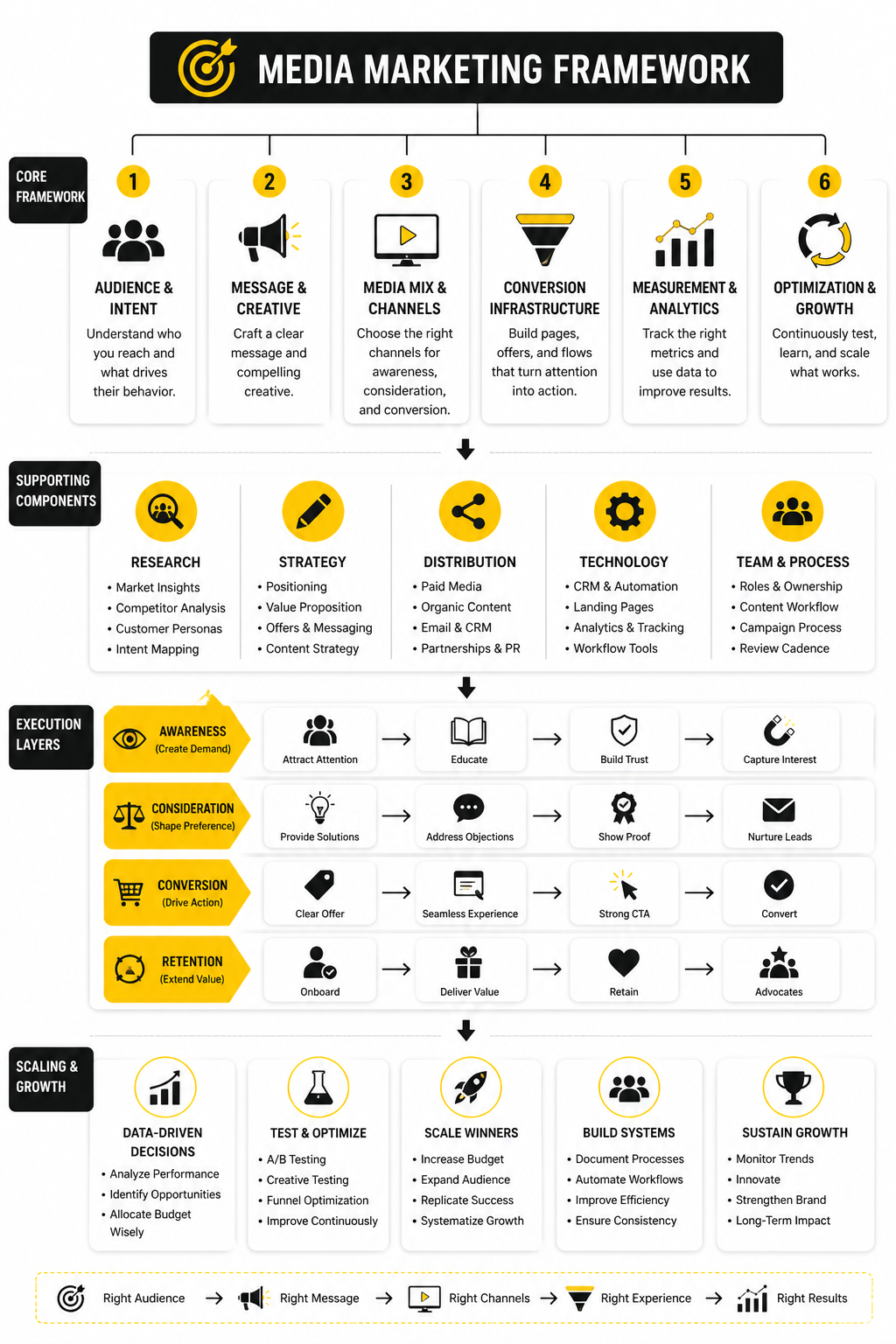
The Media Marketing Framework
The framework starts with audience clarity. Before choosing channels, formats, budgets, or tools, you need to know who you are trying to reach, what they already believe, what problem they are trying to solve, and what would make them trust you. Without that foundation, media activity becomes expensive guessing.
The next layer is channel strategy. Owned media gives you control, paid media gives you scale, shared media gives you participation, and earned media gives you credibility. Strong media marketing does not rely on only one of those. It blends them around the customer journey so each channel supports the others instead of competing for attention.
The final layer is execution and feedback. Campaigns need creative assets, landing pages, automation, reporting, and regular optimization. Tools can help here, especially when they remove friction from publishing, lead capture, and follow-up, but the tool is never the strategy. The strategy is the logic that decides what each media touchpoint is supposed to achieve.
Core Components Of A Strong Media Marketing System
A strong media marketing system starts with positioning. Before you publish anything, you need a clear answer to three questions: who is this for, what problem are we helping them solve, and why should they believe us instead of another option? When that answer is fuzzy, every channel becomes harder to manage because the creative, offers, landing pages, and follow-up messages all pull in different directions.
The second component is the media mix. Paid search, social ads, organic content, email, partnerships, creator content, PR, events, and website content all behave differently. Gartner’s 2025 CMO research shows that marketing budgets remain tight at 7.7% of company revenue, so the point is not to be everywhere. The point is to choose the channels that match buyer intent, sales cycle length, creative capacity, and measurement quality.
The third component is conversion infrastructure. Attention is useful only when people have a clear next step. That might be a product page, lead form, webinar, quiz, booking page, newsletter, or automated conversation. For service businesses and agencies, a platform like GoHighLevel can make sense when the goal is to connect funnels, CRM, email, SMS, booking, and follow-up in one place instead of stitching everything together manually.
Audience And Intent
Audience research should go deeper than demographics. Age, job title, location, and income can help, but they rarely explain what someone is trying to achieve in the moment they interact with your media. Intent is more useful because it tells you whether the person is researching, comparing, buying, trying to solve a problem, or simply becoming aware that a better solution exists.
This is where many media marketing plans become too shallow. A broad audience like “small business owners” is not enough. A better audience definition would separate the owner who wants more local leads from the founder comparing software, the agency owner trying to reduce fulfillment work, or the ecommerce manager trying to improve landing page conversion.
Once you understand intent, channel decisions become cleaner. Search captures active demand. Social and video create demand by making problems visible. Email and retargeting help people come back when they are not ready to act today. Each channel has a different job, and that job should be decided before the campaign goes live.
Message And Creative
Message is the strategic idea. Creative is the way that idea gets expressed. Good media marketing needs both, because a strong offer with weak creative gets ignored, while beautiful creative with no clear message gets attention without action.
The message should make the value obvious quickly. People should understand what you do, who it helps, and why it matters without working hard. This is especially important in social feeds, inboxes, and short-form video, where the first few seconds decide whether the audience stays or moves on.
Creative should then adapt the message to the channel. A landing page needs clarity and proof. A short video needs a strong opening and one focused idea. A carousel needs a logical sequence. A chatbot flow through ManyChat can work well when the campaign depends on fast responses, comment-to-message automation, or guided lead capture from social platforms.
Distribution And Consistency
Distribution is where good ideas either compound or disappear. Publishing once and hoping the right people find it is not a strategy. A useful piece of content should be repurposed, promoted, emailed, clipped, referenced in sales conversations, and reused in campaigns when it keeps proving relevant.
Consistency matters because most buyers do not act after one touchpoint. They notice a brand, forget it, see it again, compare it, ask someone about it, revisit it, and only then take action. That journey is messy, but consistent media makes the brand easier to remember across those moments.
This is also where workflow tools become practical instead of decorative. A scheduling tool like Buffer can help small teams maintain publishing rhythm without turning every post into a last-minute scramble. The real win is not just saving time. It is creating enough consistency that your audience starts recognizing your point of view.
How To Choose The Right Media Channels
Choosing channels is not about copying what a competitor is doing. It is about matching the channel to the buyer’s intent, the offer, the sales cycle, the creative format, and the team’s ability to execute consistently. A channel that works brilliantly for one brand can waste money for another if the audience is not there or the message does not fit the moment.
Start by separating demand capture from demand creation. Demand capture channels help you reach people who are already looking for a solution, which is why search, comparison content, review pages, and retargeting are so valuable. Demand creation channels help people understand the problem, build trust with your brand, and remember you before they are ready to buy.
This distinction matters because media marketing often fails when teams expect every channel to behave like bottom-funnel search. Social content may not convert instantly, but it can build recognition and warm up future buyers. Email may not create a new audience, but it can turn existing attention into repeat visits, sales conversations, and customer retention.
Map Channels To The Buyer Journey
The buyer journey is not a perfect straight line, but it is still useful for planning. At the awareness stage, your job is to make the problem visible and memorable. At the consideration stage, your job is to explain your approach, handle objections, and show proof. At the conversion stage, your job is to make action easy.
A practical media marketing plan should assign channels to those jobs. Short-form video, creator partnerships, PR, and social content can introduce the category or problem. Search, educational articles, webinars, product pages, comparison pages, and case studies can help people evaluate their options. Email, retargeting, sales enablement content, and booking pages can move serious prospects closer to a decision.
This is where landing pages become more important than most teams admit. Sending paid traffic to a generic homepage is often lazy. If a campaign has a specific promise, the page should continue that promise with focused copy, proof, and one clear action. For ecommerce and direct-response teams, a builder like Replo can be useful when the team needs faster landing page testing without waiting on a full development queue.
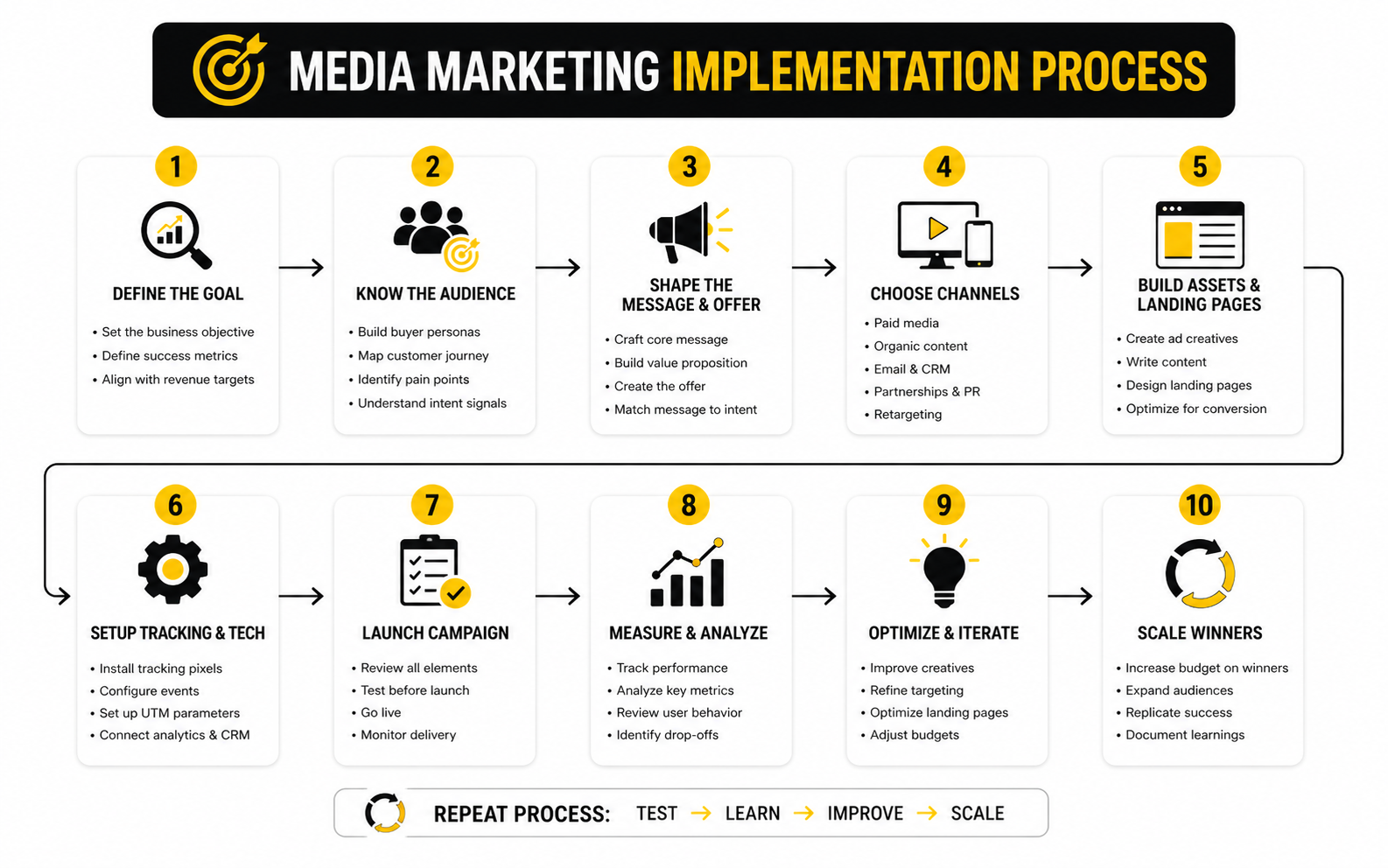
Build The Channel Selection Process
A simple process beats a complicated media plan that nobody follows. Before launching a channel, decide what role it plays, what audience it reaches, what creative it needs, what conversion path it supports, and what result would make it worth continuing. This keeps the team from treating every channel like an isolated experiment.
Use this sequence when choosing channels:
- Define the business goal, such as pipeline, sales, retention, awareness, or market education.
- Identify the audience segment and the specific intent behind the campaign.
- Choose the channel based on how that audience behaves at that stage.
- Match the creative format to the channel, not the other way around.
- Build the conversion path before the campaign goes live.
- Set one primary metric and a few supporting metrics.
- Review performance on a fixed schedule and decide what to improve, scale, pause, or replace.
This process sounds basic, but basic is where money is made. Gartner’s 2025 CMO research shows digital channels account for 61.1% of total marketing spend, and IAB reported that U.S. digital ad revenue reached nearly $300 billion in 2025. When that much budget moves through digital media, loose execution gets expensive fast.
Balance Paid, Owned, Shared, And Earned Media
Paid media gives you speed, but it also exposes weak messaging quickly. Owned media gives you control, but it needs patience and consistency. Shared media gives you reach through audiences, communities, and creators, but it requires participation instead of just broadcasting. Earned media gives credibility, but it cannot be switched on like an ad campaign.
The strongest media marketing plans use these types together. A strong article can support SEO, be repurposed into social posts, become a newsletter topic, fuel a webinar, and give paid campaigns a better destination. A creator collaboration can be amplified with paid media, clipped for social, added to product pages, and referenced by sales.
This is why channel planning should not happen in silos. The search team, social team, email team, sales team, and content team need to share what they are learning. If paid ads reveal an objection that keeps hurting conversion, that insight should improve landing pages and sales scripts. If organic content reveals a topic people care about, that topic can inform ads, lead magnets, and product education.
Decide What Not To Do
A good media marketing strategy is also a decision about what to ignore. Most teams do not fail because they lack options. They fail because they chase too many options at the same time and never give any channel enough focus to work.
The easiest filter is capacity. If your team cannot create enough quality video, do not build a strategy that depends entirely on daily video output. If you cannot manage complex ad testing, start with a simpler campaign structure. If you do not have strong email follow-up, do not spend heavily on lead generation until that follow-up path exists.
This is not about playing small. It is about sequencing. Pick the channels that match your current strengths, build repeatable execution, then expand when the system can handle more pressure. That is how media marketing becomes an asset instead of a monthly scramble.
Statistics And Data
Measurement is where media marketing becomes honest. Creative opinions, channel preferences, and campaign ideas all matter, but the numbers show whether the system is producing useful business movement. The key is to measure the right signals at the right stage instead of pretending one dashboard can explain everything.
Benchmarks are useful only when they create better decisions. A click-through rate can tell you whether an ad or email is getting attention, but it does not prove the audience is profitable. A low cost per lead can look impressive until sales shows that the leads are unqualified. A high return on ad spend can still hide weak retention, discount dependency, or underinvestment in brand demand.
The current spending environment makes this discipline even more important. Marketing budgets have remained flat at 7.7% of company revenue, while digital channels now take 61.1% of total marketing spend. That combination means teams are not just being asked to do more online. They are being asked to prove which online activity deserves more budget.
Build A Measurement System, Not A Reporting Habit
A useful analytics system starts before the campaign launches. Decide the business goal, define the conversion path, set tracking standards, and agree on what success looks like. If those decisions happen after the campaign is live, the team usually ends up arguing over incomplete data.
The system should separate three layers of performance. The first layer is attention, such as reach, impressions, views, watch time, email opens, and engagement. The second layer is intent, such as clicks, landing page visits, form starts, product views, replies, and booked calls. The third layer is business impact, such as qualified pipeline, sales, revenue, retention, payback period, and lifetime value.
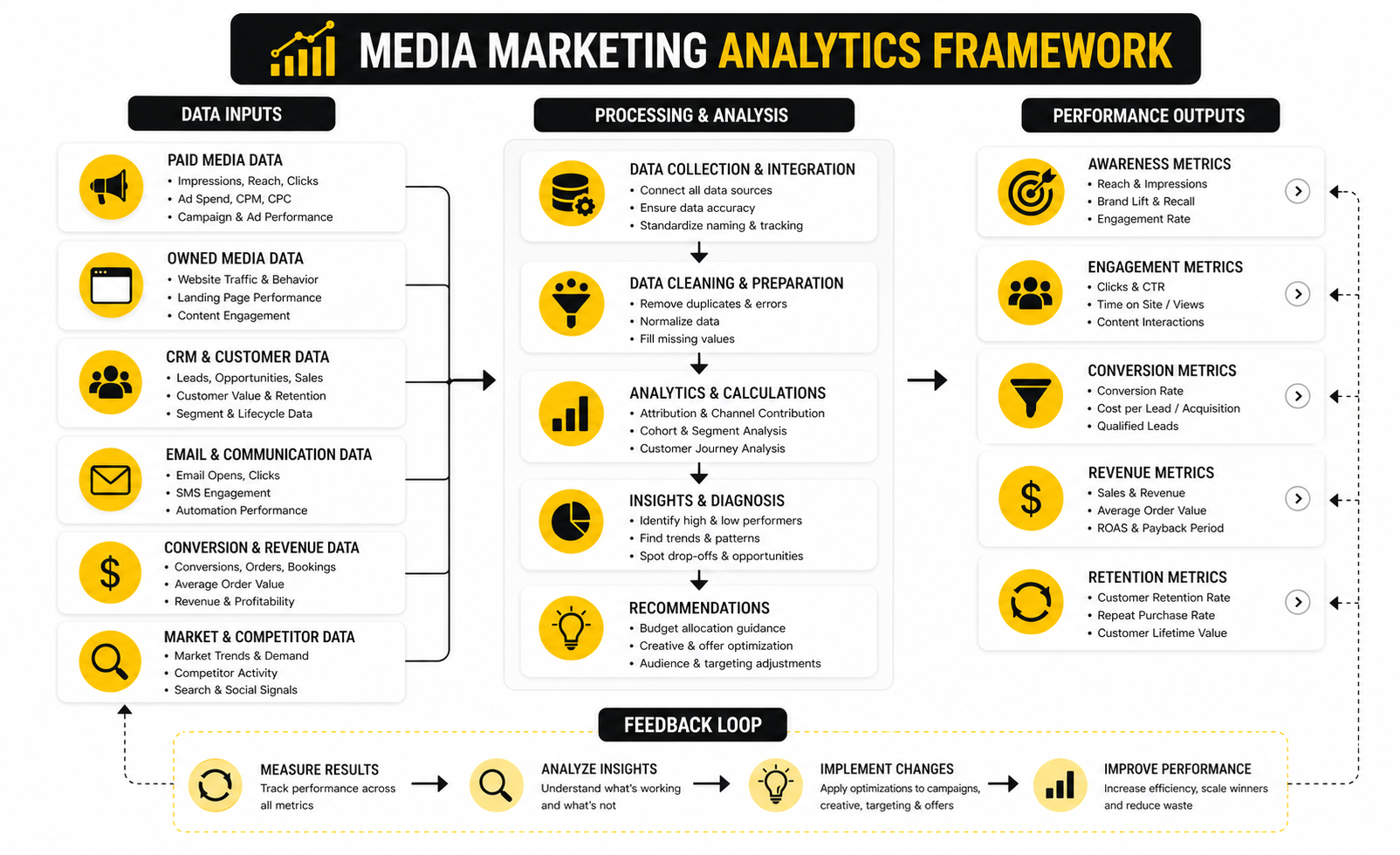
This layered view prevents lazy interpretation. If attention is weak, the problem may be creative, targeting, or distribution. If intent is weak, the problem may be message match, offer relevance, or landing page clarity. If business impact is weak, the issue may be lead quality, pricing, sales follow-up, product fit, or retention.
Use Benchmarks Without Becoming Trapped By Them
Benchmarks help you spot obvious problems, but they should not become the boss. An email campaign with a below-average click rate can still be profitable if it reaches high-intent buyers. A paid social campaign with a high engagement rate can still be a distraction if it never moves people toward a meaningful next step.
Email benchmarks show why context matters. The DMA’s 2025 email report found that delivery rates reached 98% in 2024, open rates climbed to 35.9%, and unique click rates reached 2.3%. Those numbers are useful as a health check, but they do not tell you whether your subject line attracted the right people, whether the offer matched the segment, or whether the click produced revenue.
The same logic applies to paid media. A high click-through rate may mean the creative is strong, but it can also mean the ad is attracting curiosity instead of buyers. A low cost per acquisition may look great, but it needs to be compared with average order value, gross margin, refund rate, and repeat purchase behavior. The number is never the whole story. It is the start of the investigation.
Read Performance Signals By Channel Role
Every channel should be judged by the role it was assigned. Search campaigns should usually be held closer to intent and conversion because users are actively looking. Organic social and creator content may need more weight on reach, saves, shares, comments, assisted traffic, and branded search lift because they often influence demand before conversion happens.
Owned media should be evaluated differently again. A newsletter is not just a traffic source. It can increase repeat visits, educate prospects, support launches, and reduce dependence on paid retargeting. A blog article is not only an SEO asset. HubSpot’s 2026 marketing statistics show blog posts were one of the top five highest-ROI content formats used by marketers in 2025, which makes sense when articles support search, email, sales enablement, and remarketing at the same time.
For lead generation, the most important signal is rarely the raw lead count. The better question is what percentage of leads become qualified opportunities, how quickly the team follows up, and what messages move people forward. If the campaign generates leads but the CRM is messy, the team is flying blind. That is where a connected system like GoHighLevel can help teams keep forms, conversations, pipelines, appointments, and follow-up activity closer to the same performance record.
Measure Incrementality When The Stakes Are High
Attribution reports are helpful, but they are not perfect truth. They show which touchpoints received credit inside a tracking model. They do not always prove what would have happened without the campaign.
That is why incrementality matters. Incrementality asks a sharper question: did this media activity create additional results, or did it simply take credit for customers who were already going to convert? For bigger budgets, this distinction is not academic. It can change where the next serious chunk of money goes.
The practical way to start is simple. Hold out a market, audience, or time period where possible. Compare exposed and unexposed groups carefully. Look for lift in sales, qualified pipeline, branded search, repeat purchase, or another business signal that matches the campaign objective. You do not need a perfect laboratory to make better decisions, but you do need enough discipline to stop treating last-click attribution as the whole truth.
Turn Analytics Into Action
Reporting should end with decisions. If the report only lists numbers, it is not finished. Every review should answer what changed, why it likely changed, what the team will do next, and what result would confirm the decision was right.
A simple media marketing review can focus on four questions:
- Which channel or campaign created the strongest business signal?
- Which part of the journey caused the biggest drop-off?
- Which message, audience, or offer deserves another test?
- Which activity should be scaled, paused, simplified, or rebuilt?
This is where teams become better over time. They stop reacting to every spike and dip. They build a memory of what works, what fails, and what conditions make performance change. That learning loop is the real advantage, because media costs will keep shifting, platforms will keep changing, and the brands with cleaner feedback will make better moves faster.
Professional Implementation: Campaigns, Tools, And Team Workflows
Advanced media marketing is mostly about tradeoffs. You can move fast or build more control. You can chase short-term conversions or invest in future demand. You can use more automation or protect a more personal customer experience. The right answer depends on the business model, but the wrong answer is usually the same: trying to maximize everything at once.
Scaling exposes weak systems quickly. A campaign that works at a small budget can break when the audience gets broader, creative fatigue appears, lead quality drops, or the sales team cannot follow up fast enough. This is why serious implementation is not just about launching more campaigns. It is about building the operating rhythm that lets campaigns improve without creating chaos.
The best teams treat media marketing like a managed growth system. They know which campaigns are meant to create demand, which ones are meant to capture it, and which ones are meant to retain or reactivate existing customers. That separation protects the team from judging every activity by the same metric and cutting useful work too early.
The Scaling Tradeoff
The first scaling decision is whether the business needs more volume, better efficiency, or better quality. Those goals sound compatible, but they often pull against each other. More volume can mean broader targeting, weaker intent, and higher operational load. Better efficiency can mean tighter audiences, slower learning, and less total reach.
This is especially important when budgets are flat and expectations are not. Marketing budgets have held at 7.7% of company revenue, so scaling usually has to come from sharper allocation rather than simply spending more. That means cutting low-quality activity, simplifying reporting, improving conversion paths, and giving strong campaigns enough room to compound.
A practical scaling rule is simple: do not scale a campaign until the follow-up system can handle the extra demand. If leads sit untouched, if bookings are messy, or if sales notes never make it back into marketing, the campaign is not really scalable yet. For teams selling through calls, demos, or local service appointments, tools like Cal.com can reduce friction by making scheduling cleaner and easier to connect with the rest of the customer journey.
Automation Without Losing Trust
Automation is powerful when it removes repetitive work. It is dangerous when it makes the brand feel careless. People can usually tell when they are being pushed through a generic sequence that has no relationship to what they actually asked for.
The smarter approach is to automate the handoffs, reminders, routing, tagging, and follow-up timing while keeping the message relevant. A lead who downloaded a buyer’s guide should not receive the same sequence as someone who requested pricing. A customer who just purchased should not be treated like a cold prospect. Good automation respects context.
AI adds another layer to this. McKinsey’s 2025 global AI research shows that companies creating real value from AI are more likely to have defined processes for when outputs need human validation, especially where accuracy matters. That is a useful warning for media teams. AI can help draft, summarize, personalize, analyze, and speed up production, but the brand still needs human judgment before important messages reach the market.
Brand Safety, Reputation, And Channel Risk
Media channels are not neutral pipes. They shape how your brand is seen, what content appears beside your message, and how much control you actually have. That matters more as campaigns spread across creator content, programmatic inventory, AI-generated assets, and fast-moving social platforms.
Brand safety is not only about avoiding obvious disasters. It is also about protecting trust, avoiding misleading claims, respecting consent, and making sure partners or creators do not create reputational debt. The creator economy is growing fast, with U.S. creator ad spending projected to reach $37 billion in 2025, but more spend also means more competition, more scrutiny, and more need for clear guidelines.
Creator partnerships should be evaluated beyond follower count. Look at audience fit, content quality, comment quality, past brand work, disclosure practices, and whether the creator can explain the product honestly. Sprout Social’s 2025 influencer research shows B2B brands use influencer marketing for awareness and trust, with 67% using it to increase brand awareness and 54% using it to increase credibility and trust. That only works when the partnership feels believable.
First-Party Data And Customer Ownership
The more expensive media gets, the more valuable customer ownership becomes. If every sale depends on renting attention from ad platforms, the business is exposed to rising costs, algorithm shifts, tracking changes, and platform policy risk. Owned data does not remove those risks completely, but it gives the brand more control.
First-party data should be earned, not grabbed. People are more willing to share information when they get something useful in return, such as better recommendations, helpful reminders, exclusive education, faster support, or a clearer buying experience. If the exchange feels one-sided, it damages trust.
This is where email, SMS, CRM, community, and customer support become part of media marketing rather than separate departments. A platform like Brevo can support teams that need email marketing and customer communication in one place, while a CRM like Copper may fit teams that want relationship tracking closer to sales workflows. The tool choice matters less than the principle: build media assets you can keep learning from.
Governance Keeps Growth From Getting Messy
Governance sounds boring until the wrong claim goes live, the wrong segment receives the wrong offer, or nobody knows which campaign version is current. As media marketing scales, the team needs clear rules for approvals, compliance, naming conventions, tracking links, creative storage, campaign ownership, and performance reviews. Without that, growth creates confusion.
This does not mean every campaign needs a slow approval maze. It means the team needs enough structure to move quickly without creating avoidable mistakes. A good workflow defines who owns the strategy, who owns creative, who approves claims, who checks tracking, who reviews performance, and who decides what happens next.
The point is not bureaucracy. The point is repeatability. When a team can launch, measure, learn, and improve without reinventing the process every time, media marketing becomes easier to scale. That is the stage where strategy stops living in a document and starts becoming how the business operates.
Measurement, Optimization, And FAQs
Media marketing becomes more valuable when every part of the system feeds the next part. Campaign data should improve creative. Sales feedback should improve offers. Customer conversations should improve content. Support questions should reveal gaps in education, onboarding, and product clarity.
This is the ecosystem view. Instead of treating ads, content, email, social, landing pages, CRM, and analytics as separate activities, the business treats them as one connected revenue system. That is when marketing stops feeling like random output and starts becoming a practical advantage.
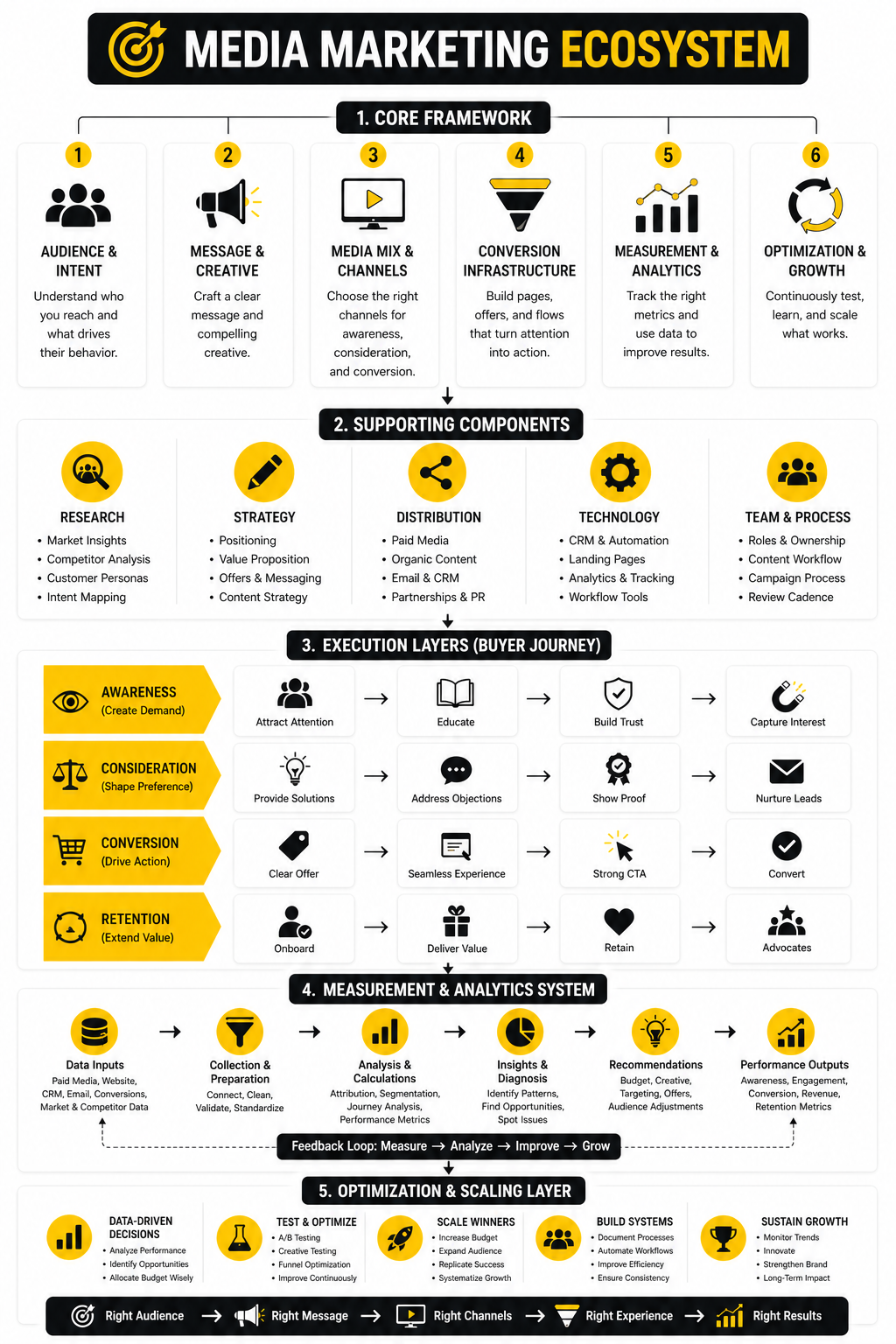
Optimization should not mean changing everything every week. It should mean improving the highest-leverage constraint first. Sometimes that constraint is weak creative. Sometimes it is poor landing page clarity. Sometimes it is slow follow-up, messy attribution, low-quality leads, or a sales process that does not match the promise made in the campaign.
The final goal is not to build the most complicated media marketing machine possible. The goal is to build the simplest system that reliably turns attention into trust, trust into action, and action into measurable growth. Keep that standard in mind, and the strategy becomes much easier to manage.
FAQ - Built For Complete Guide
What Is Media Marketing?
Media marketing is the process of using media channels to attract attention, build trust, and drive business outcomes. It includes owned media, paid media, shared media, and earned media. A strong strategy connects those channels instead of treating each one as a separate tactic.
Why Is Media Marketing Important?
Media marketing matters because buyers now interact with brands across many touchpoints before they act. They may see social content, search for reviews, visit a website, join an email list, compare competitors, and return later through retargeting. Without a clear media system, those moments become disconnected and harder to measure.
What Are The Main Types Of Media Marketing?
The main types are owned, paid, shared, and earned media. Owned media includes your website, email list, blog, podcast, community, and customer database. Paid media includes ads, sponsorships, paid search, paid social, and promoted content. Shared and earned media include creator mentions, PR, organic shares, reviews, and public conversations around the brand.
How Do You Build A Media Marketing Strategy?
Start with the audience, the problem, the offer, and the business goal. Then choose the channels that match buyer intent and the stage of the customer journey. After that, build the creative, landing pages, follow-up system, tracking, and review rhythm before scaling spend.
Which Media Channel Should A Business Use First?
The best first channel depends on intent and capacity. If people are already searching for the solution, search and conversion-focused content may be the best starting point. If the market needs education, social content, video, partnerships, and creator-led distribution may be more useful. The right channel is the one your audience uses when they are closest to the problem you solve.
How Much Should A Business Spend On Media Marketing?
There is no universal number that fits every business. The better approach is to define the revenue goal, target payback period, sales cycle, average order value, margin, and conversion rate. From there, budget can be assigned based on what the business can afford to test, learn from, and scale responsibly.
What Metrics Matter Most In Media Marketing?
The most useful metrics depend on the channel’s job. Awareness campaigns should look at reach, attention quality, engagement, recall signals, and branded demand. Conversion campaigns should look at qualified leads, sales, revenue, acquisition cost, payback period, and retention. The mistake is using one metric to judge every channel.
How Often Should Media Marketing Campaigns Be Reviewed?
Campaigns should be monitored regularly, but major decisions need enough data to be meaningful. High-spend campaigns may need daily checks for delivery, tracking, and obvious issues. Strategic reviews usually work better weekly or biweekly, because that gives the team enough time to see patterns instead of reacting emotionally to noise.
What Is The Biggest Mistake In Media Marketing?
The biggest mistake is confusing activity with progress. Posting more, spending more, or launching more campaigns does not automatically create growth. Media marketing works when each activity has a role, a clear audience, a strong message, a conversion path, and a feedback loop.
How Does AI Affect Media Marketing?
AI can help teams research faster, generate creative variations, summarize customer data, personalize communication, and improve campaign operations. It should not replace strategy, judgment, compliance review, or brand thinking. The strongest use of AI is to speed up useful work while keeping humans responsible for the final message and decision.
Is Media Marketing Only For Big Brands?
No. Smaller businesses can often benefit faster because they are closer to their customers and can make decisions quickly. The key is to start with a focused system instead of trying to copy enterprise-level complexity. One strong offer, one clear audience, one reliable channel, and one clean follow-up process can outperform a scattered presence everywhere.
How Do You Know When Media Marketing Is Working?
It is working when the right people are paying attention, taking useful next steps, and creating measurable business value. That value might show up as qualified pipeline, booked calls, ecommerce sales, repeat purchases, stronger retention, or lower dependence on one acquisition channel. The clearest sign is not just better numbers. It is a system the team can understand, improve, and scale.
Work With Professionals
Explore 10K+ Remote Marketing Contracts on MarkeWork.com
Most marketers spend too much time chasing clients, competing on crowded platforms, and losing a percentage of every project to middlemen.
MarkeWork gives you a better way. Browse thousands of remote marketing contracts and connect directly with companies desperate to hire skilled marketers like you, without platform commissions and without unnecessary gatekeepers.
If you're serious about finding better opportunities and keeping 100% of what you earn, explore available contracts and create a profile for free at MarkeWork.com.