

Mobile marketing stopped being a side channel a long time ago. It is now the environment where people discover products, compare options, open emails, watch short-form video, message businesses, redeem offers, and complete purchases without ever moving to a laptop. When a brand still treats mobile like a resized desktop experience, it usually pays for that mistake in lower conversion rates, weaker retention, and wasted ad spend.
That shift is not just anecdotal. Global digital behavior data shows mobile remains the primary way people access connected experiences, while browsing is only a small share of total smartphone time because apps now dominate the attention mix, as shown in DataReportal’s 2025 device trends coverage and Sensor Tower’s State of Mobile 2025 report. At the same time, mobile commerce keeps gaining ground, with Adobe reporting that smartphones generated 54.5% of U.S. online holiday sales in 2024 after forecasting mobile would drive 53% of holiday online sales.
For marketers, that changes the assignment. The job is no longer to “be present on mobile.” The job is to design a full customer journey around how people actually behave on phones: short bursts of attention, high intent, constant context switching, and a strong expectation that every tap will feel effortless. That is where mobile marketing becomes a growth system instead of a media line item.
Article Outline
- What Mobile Marketing Really Means
- Why Mobile Marketing Matters More Than Ever
- The Mobile Marketing Framework
- Core Channels and Customer Touchpoints
- How Professionals Build Mobile Marketing Programs
- Measuring Performance, Fixing Friction, and Scaling What Works
What Mobile Marketing Really Means
Mobile marketing is the practice of reaching, persuading, and retaining customers through experiences designed for phones and tablets rather than merely displayed on them. That includes SMS, mobile email, in-app messaging, push notifications, paid social, mobile search, messaging apps, wallets, location-aware offers, mobile landing pages, and checkout flows built for thumb-speed decisions. The important distinction is that true mobile marketing is behavior-led, not format-led.
That difference matters because mobile users do not behave like desktop users shrunk onto a smaller screen. They move faster, they bounce harder when pages lag, and they often arrive with immediate intent: to solve something, buy something, compare something, or message someone right now. A brand that understands those patterns builds faster pages, tighter creative, clearer calls to action, and journeys that remove every unnecessary field, click, and delay.
Mobile marketing also sits at the intersection of acquisition and retention. A paid ad may generate the first tap, but the follow-up often happens through email, SMS, push, app engagement, or remarketing across mobile environments. That is why the strongest programs do not separate channels into silos; they treat the phone as the customer’s operating system for the entire relationship.
Why Mobile Marketing Matters More Than Ever
The biggest reason mobile marketing matters is simple: attention has already moved. Global digital reporting shows there were 5.78 billion mobile users at the start of 2025, and mobile internet continues to define how people connect, shop, and consume content. In practice, that means many brands are still trying to win modern demand with journeys built for an older web.
The commercial case is just as strong. Adobe’s holiday data showed U.S. consumers spent a record $241.4 billion online during the 2024 holiday season, with smartphones responsible for more than half of that revenue. Salesforce also reported record Cyber Week ecommerce sales in 2024, reinforcing that the path from product discovery to purchase is increasingly completed on mobile devices rather than handed off to desktop later in the funnel, as summarized in its Cyber Week release.
There is also a channel-efficiency argument that too many teams miss. Mobile is where performance media, owned audiences, and conversion UX finally meet in one place. When marketers improve mobile landing pages, simplify forms, use stronger message timing, and connect channels like SMS and chat more intelligently, they are not making cosmetic changes; they are reducing friction exactly where the customer is most likely to act.
The Mobile Marketing Framework
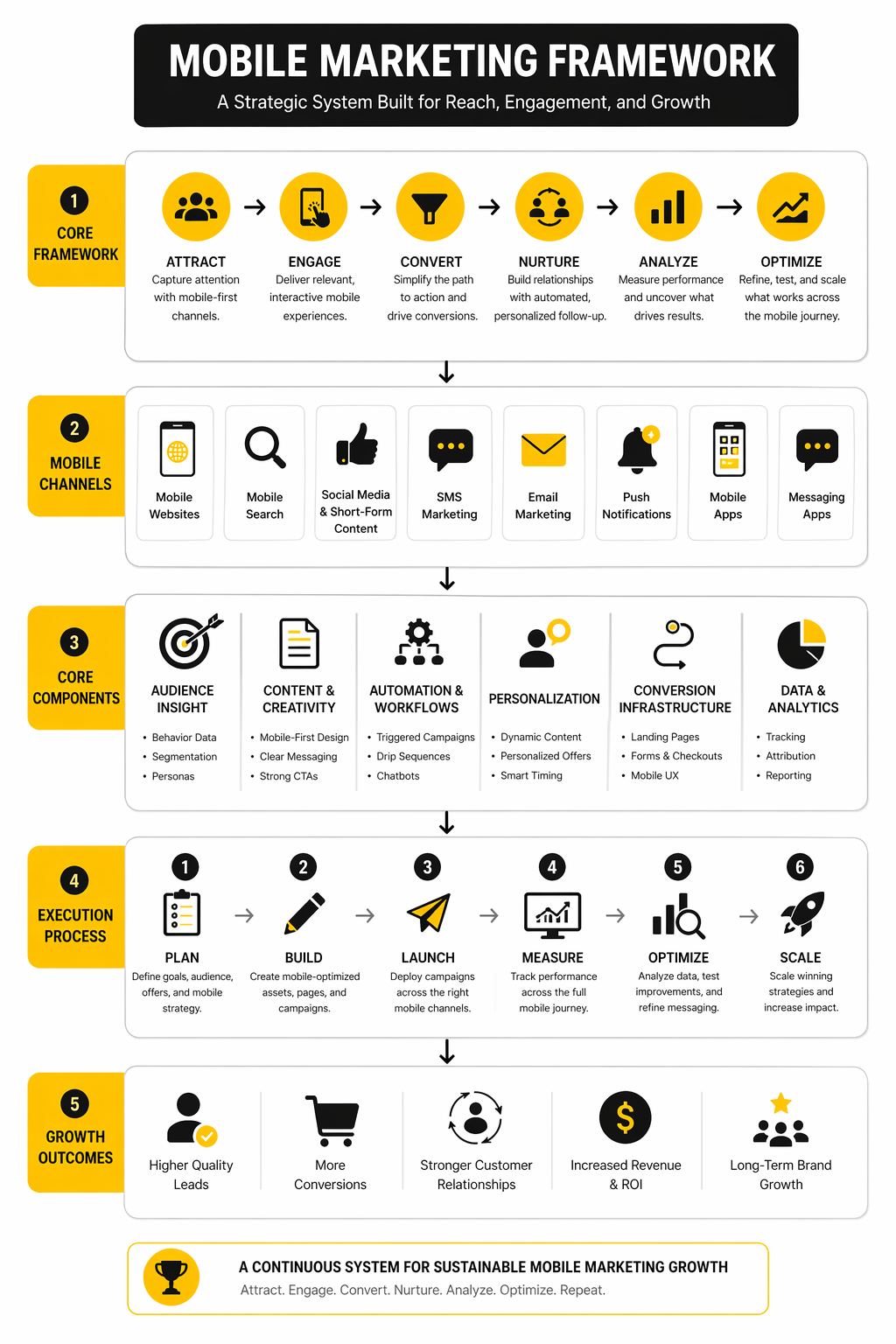
A useful way to think about mobile marketing is as a four-part system: attention, action, retention, and optimization. Attention covers discovery channels such as paid social, short-form video, search, app store visibility, creators, and mobile display. Action covers the first meaningful step, whether that is a click, lead form, chat, install, opt-in, or purchase.
Retention is where many programs either become profitable or stall out. This layer includes email, SMS, push notifications, in-app messaging, loyalty flows, customer support touchpoints, and lifecycle automation that brings people back without paying to reacquire them every time. Airship’s push benchmark research, for example, found opted-in users generated 13% more purchases than users who were opted out, which is exactly why retention mechanics matter so much on mobile.
Optimization is the final layer, and it is where professional implementation separates itself from guesswork. Teams need to measure delivery, click-through rate, tap-to-load speed, scroll depth, checkout completion, repeat purchase behavior, unsubscribe patterns, and channel overlap. Mobile marketing works best when the system is treated like a live product: tested constantly, simplified aggressively, and improved based on real user behavior rather than internal opinions.
Core Channels and Customer Touchpoints
The easiest way to make mobile marketing harder than it needs to be is to treat every channel like a separate game. It is not. On a phone, the customer experiences one journey that happens to move through different surfaces: a social ad, a search result, a text message, a product page, a checkout screen, a post-purchase update, and maybe a reactivation message two weeks later. The channels are different, but the standard is the same everywhere: relevance, speed, and almost zero friction.
That is why strong mobile marketing programs are built around touchpoints, not tactics. The question is not whether SMS is better than push, or whether paid social beats email. The real question is what the customer needs at that exact moment on that exact device, and which channel can move them forward with the least resistance.
SMS and Messaging for Immediate Action
SMS remains one of the most direct tools in mobile marketing because it reaches people in the one place they check reflexively. Consumer research cited across recent benchmarks continues to show extremely high read and engagement behavior for text messaging, while business adoption keeps rising as opt-in programs become more disciplined and better segmented, as seen in SimpleTexting’s 2025 roundup and Infobip’s 2025 benchmark summary. That does not mean every brand should text more often. It means every text has to earn its place.
The best use cases are time-sensitive and high-intent. Shipping updates, appointment reminders, restock alerts, limited-time offers, abandoned cart nudges, and service follow-ups all fit because they align with how people already use their phones. If the message asks the customer to take one obvious next step, SMS can feel incredibly natural; if it feels promotional for the sake of being promotional, it burns trust fast.
Messaging apps add another layer when the brand wants an actual conversation instead of a broadcast. That is where tools like ManyChat can fit naturally into a mobile marketing stack, especially for lead qualification, automated replies, and moving social traffic into a more controlled follow-up flow. The point is not automation for its own sake. The point is reducing delay between interest and response while the buyer is still holding the phone.
Mobile Email Still Matters, but Only When It Behaves Like Mobile
Email is still a major part of mobile marketing, but only when marketers stop designing it like a desktop newsletter. Most people now read brand emails on phones first, which means subject lines, preview text, spacing, button size, image weight, and landing-page continuity matter far more than clever layout tricks. If the email looks polished on a laptop but feels cramped on a phone, it is not polished at all.
This is also where channel sequencing gets interesting. Email is often better than SMS for richer context, product education, and post-purchase content, while SMS is better for urgency and simpler calls to action. Used together, they can create a cleaner customer journey: email explains, text reminds, and the landing page closes.
Execution matters here more than theory. Platforms like Brevo or Moosend make sense when the goal is mobile-first lifecycle messaging rather than generic batch sending. The winning approach is usually boring in the best way: short copy, one clear action, fast-loading destinations, and segmentation that respects where the user is in the journey.
Push Notifications Work Best After You Earn the Right to Use Them
Push notifications are powerful because they sit at the operating-system level, which makes them feel immediate and personal. They are also easy to abuse. Recent benchmark data from Airship and Pushwoosh shows push engagement can still be strong when messages are timely and behavior-based, but performance drops when brands over-send or ignore platform differences between Android and iOS, as detailed in Airship’s 2025 benchmarks and Pushwoosh’s 2025 benchmark analysis.
That makes push a retention channel, not a shortcut. It works best after the customer has installed the app, enabled notifications, and already found recurring value in the experience. At that point, a well-timed reminder, price-drop alert, usage prompt, or loyalty nudge can bring someone back without the brand paying again for attention it already earned.
This is exactly why retention has become more central in mobile marketing. AppsFlyer’s latest trend data shows global remarketing spend reached $31.3 billion in 2025, and its share of overall app marketing spend continued to rise. That is a very practical signal: mature teams are not just buying new users; they are building systems to reactivate existing ones more efficiently.
Paid Social, Mobile Search, and the Landing Page Have to Work as One Unit
Most mobile acquisition does not fail because the targeting was terrible. It fails because the click experience collapses after the ad. Someone taps from Instagram, TikTok, YouTube, or Google on a phone, lands on a slow or cluttered page, gets asked for too much too soon, and leaves. The media channel gets blamed, but the real problem is broken continuity.
Mobile search is especially high intent because people often use it when they want an answer, a place, a product, or a comparison right now. Google’s long-standing local behavior data is still relevant here because smartphone searches regularly lead to near-term action, including store visits and purchases, which is why mobile search pages need clean offers, tap-friendly design, and obvious trust signals, as summarized in Google’s local search guidance archive and echoed by multiple current local search analyses such as BrightLocal’s consumer research hub.
The landing page is where intent either gets captured or wasted. Tools like Replo are useful in that context because they help teams create faster, more conversion-focused mobile storefront experiences without defaulting to bloated templates. In mobile marketing, page speed and clarity are not design preferences. They are conversion mechanics.
Social Content Is the Discovery Layer, Not the Whole Strategy
A lot of brands over-invest in content reach and under-invest in what happens after the view. Mobile users discover products constantly through social feeds, creator content, and short-form video, but discovery is only valuable when the next step is clear and frictionless. That is why content strategy has to connect directly to messaging capture, site conversion, or app engagement instead of living as a vanity layer on top of the funnel.
This is also why consistency across surfaces matters. If a brand sounds sharp on social but confusing on its landing pages, or if the ad promise does not match the checkout experience, mobile users notice immediately. Sensor Tower’s latest overview of app behavior shows people still spend enormous amounts of time on mobile, with 4.2 trillion hours spent in apps in 2024 and roughly 3.5 hours per day per mobile user, but that attention is fragmented and competitive, not generous.
Distribution tools can support this layer, but they do not replace strategic coherence. A platform like Buffer can help manage consistent publishing across social touchpoints, yet the bigger win comes from connecting content to a mobile-first destination and follow-up path. Reach without journey design is noise.
The Best Channel Mix Depends on the Moment, Not the Hype
There is no universal channel stack that works for every business. A local service brand may get the biggest lift from mobile search, click-to-call flows, review visibility, and text reminders. A DTC brand may lean harder on paid social, SMS, mobile checkout optimization, and post-purchase lifecycle sequences. An app business may care more about install quality, onboarding, push, and remarketing than almost anything else.
That is the real lesson from current mobile marketing data. The ecosystem keeps shifting, but the winning pattern is stable: meet users where they already are, remove friction at every touchpoint, and invest in retention as seriously as acquisition. Once that foundation is in place, the channel mix gets much easier to decide because it follows customer behavior instead of trend-chasing.
How Professionals Build Mobile Marketing Programs
Professional mobile marketing does not start with channel selection. It starts with architecture. Before a team sends a single campaign, it needs a clean view of the customer journey, a realistic understanding of where intent appears on mobile, and a measurement setup that can show what actually moved revenue instead of what simply generated taps.
This is where weaker programs usually drift into chaos. One person is running paid traffic, another is sending email, someone else owns SMS, and the landing pages live in a totally different workflow. From the outside it looks like activity, but underneath it is fragmented execution, which is exactly why serious teams build mobile marketing like an operating system rather than a pile of disconnected campaigns.
Start With the Mobile Journey, Not the Tool Stack
The first practical move is mapping the actual path a customer takes on a phone from discovery to conversion to retention. That means identifying where they first see the brand, where they click, what page or app screen they land on, what friction appears, what follow-up they receive, and what brings them back later. Until that journey is visible, most channel decisions are guesses dressed up as strategy.
Once the journey is mapped, the priorities become much clearer. Some businesses need faster mobile landing pages before they need more traffic. Others need a better opt-in system, cleaner follow-up, or a tighter checkout flow before adding more automation. Mobile marketing gets easier when the bottleneck is named honestly.
Build the Core Infrastructure First
The implementation phase becomes much more predictable when the base stack is simple. You need a landing environment that is fast on mobile, a CRM or lifecycle system that keeps contact data usable, an opt-in mechanism that does not feel clumsy on a phone, and a reporting layer that connects campaign inputs to customer outcomes. None of that is glamorous, but this is the part that makes everything else work.
For brands selling directly through mobile pages, Replo can make sense because it helps teams ship mobile-focused storefront experiences faster without forcing every test through a developer queue. On the data and follow-up side, platforms like GoHighLevel or Copper fit when the goal is keeping leads, conversations, and downstream actions connected instead of scattered across tools. The stack itself matters less than the rule behind it: every tool in the system should reduce friction, not create another layer of operational drag.
The Execution Process That Actually Works
Once the foundation is in place, the best teams move through implementation in a disciplined order. They do not launch every channel at once, and they do not try to automate an experience that is still broken. They build the sequence in a way that lets each layer prove itself before the next one is added.
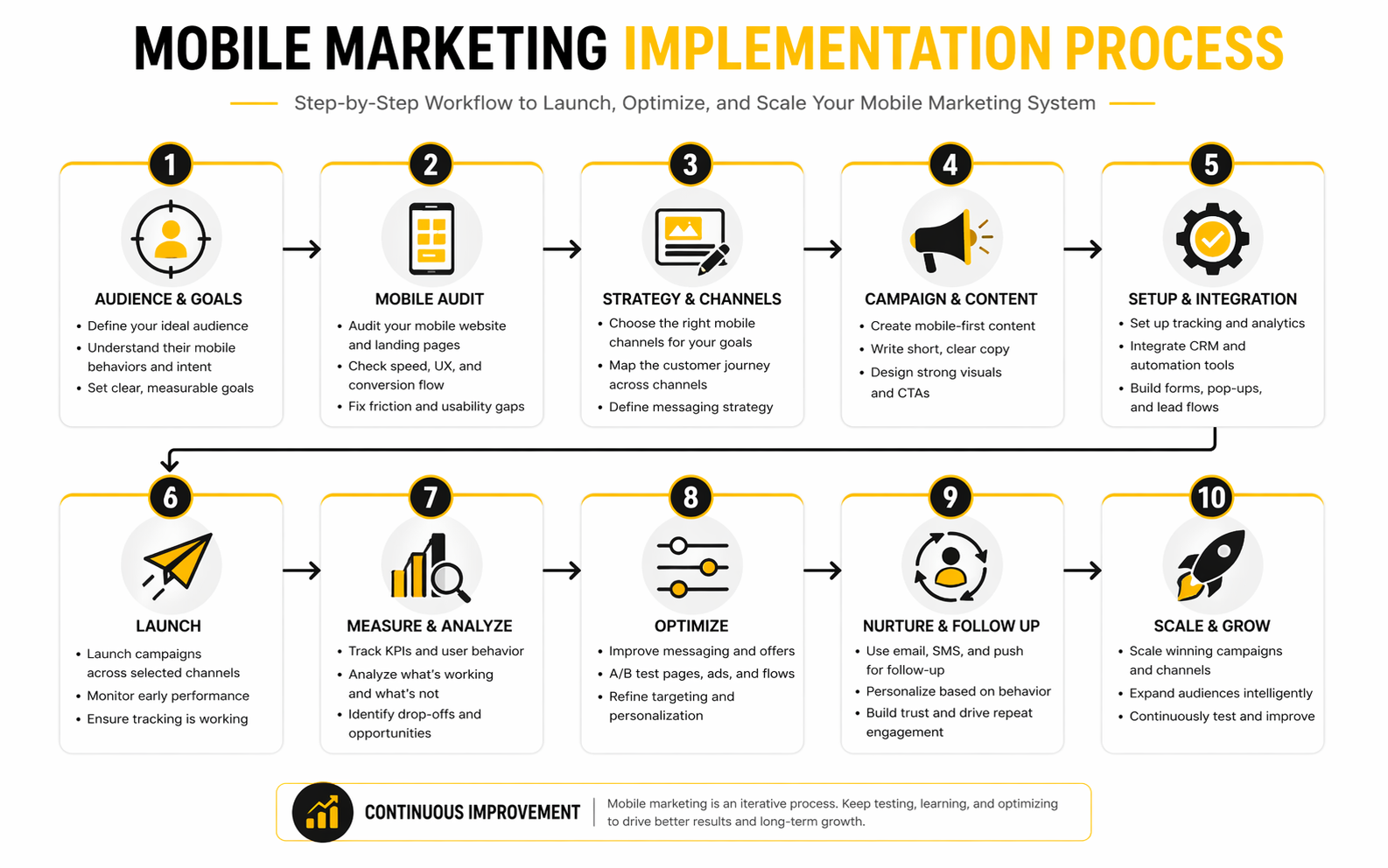
- Define the primary mobile conversion event. This could be a purchase, booked call, lead form, app install, demo request, or qualified chat. The mistake here is choosing too many goals at once. Professional mobile marketing works better when one primary action anchors the rest of the system.
- Create one fast mobile destination for that action. This could be a landing page, product page, quiz, booking page, or app install path. What matters is that the page loads quickly, removes unnecessary form fields, and makes the next step obvious without forcing users to think too hard.
- Add one capture mechanism and one follow-up path. If the business needs lead capture, that might mean a short form built with something like Fillout. If the brand relies on conversation, that might mean using ManyChat to continue the exchange while interest is still fresh.
- Launch a small paid or owned traffic source first. This is where teams learn whether the journey works in real conditions. You do not need scale to find obvious friction. You need enough real users to see where taps stop turning into outcomes.
- Instrument the full path before expanding. Track source, device behavior, opt-in rate, completion rate, reply rate, and repeat action. If the analytics only show clicks and impressions, the system is still half blind.
That sequence is not flashy, but it is effective because it protects the team from scaling a bad journey. Too many mobile marketing programs spend heavily before they have proof that the mobile experience deserves more traffic. That usually ends the same way: acquisition gets blamed for a conversion problem that was really caused by execution.
Separate Message Roles Across Channels
One of the clearest signs of professional implementation is that each channel has a job. Email handles richer explanation, onboarding depth, and broader lifecycle communication. SMS handles urgency, reminders, and short prompts to act. Push notifications work for app re-engagement after the user has already chosen to stay connected. Mobile landing pages close the gap between interest and action.
That channel clarity matters because customers experience confusion immediately on mobile. If every channel says the same thing in the same tone at the same time, the brand starts to feel noisy. If each channel moves the user forward in a distinct way, the journey feels coordinated instead of repetitive.
This is also where planning tools become useful, but only in service of execution. A lightweight layer like Cal.com can help when the mobile conversion event is booking-based, while link-routing tools like Anything.com can simplify multi-destination journeys when social traffic needs a cleaner handoff. The right tool is the one that makes the customer’s next tap easier.
Write Mobile Creative for Real Conditions
A lot of mobile marketing underperforms because the copy was written in a calm desktop mindset for people who are not calm and not on desktop. On a phone, attention is fragmented, distractions are constant, and the user often has one hand free at most. That changes how offers, headlines, buttons, and message timing should be designed.
The creative rule is simple: say less, mean more, and make the next action obvious. A strong mobile headline does not try to explain everything. A strong button does not sound clever. A strong message arrives when it matches context, which is why timing, audience state, and sequence matter more than writing flair alone.
Build Feedback Loops Into the System
The teams that get good at mobile marketing do not rely on one heroic campaign. They create loops. New traffic generates behavioral data, that data improves segmentation, segmentation improves messaging, better messaging improves retention, and stronger retention improves acquisition economics. That is how mobile marketing becomes compounding instead of exhausting.
This is also why post-click data deserves more attention than many teams give it. Reply patterns, form drop-off, page scroll depth, booking completion, support questions, and repeat purchase timing all reveal where the journey still feels awkward. When that feedback is reviewed weekly and acted on quickly, the mobile program gets sharper without requiring constant reinvention.
Keep Governance Tight as the Program Expands
As soon as a mobile marketing program starts working, complexity tries to sneak in. New audiences get added, extra automations appear, more campaigns go live, and exceptions start piling up. Without governance, the system becomes harder to manage right when performance begins to matter most.
The fix is to keep a few non-negotiables. Every mobile campaign should point to a clear destination. Every message should have a defined purpose. Every automation should have an owner. Every experiment should be measurable. That level of discipline is what turns mobile marketing from a promising channel mix into a repeatable growth process.
Measuring Performance, Fixing Friction, and Scaling What Works
This is the part where mobile marketing either becomes a real growth engine or stays a reporting hobby. Plenty of teams can show impressions, clicks, and traffic spikes. Far fewer can explain which mobile touchpoints created qualified demand, which ones helped conversion, and which ones only looked good because they sat near the top of the funnel.
That is why measurement in mobile marketing has to go beyond vanity metrics. The job is not to collect random numbers. The job is to understand where the mobile journey gains momentum, where it leaks, and what those signals should change in your next round of execution.
The Numbers That Actually Matter
The first metric layer is attention, but attention alone is not enough. Click-through rate, thumb-stop rate on video, tap rate on messages, and landing-page visits help you understand whether the offer is resonating, but they do not tell you whether the journey is commercially healthy. A campaign can attract cheap mobile traffic and still destroy profitability if users hit friction immediately after the click.
The second layer is behavior after the click. This is where mobile marketing gets more honest. You need to know page load speed, bounce rate, scroll depth, form completion rate, add-to-cart rate, booking completion, reply rate, and return visits because these are the signals that show whether the mobile experience is helping people act or quietly pushing them away.
The third layer is outcome. That means purchases, qualified leads, pipeline creation, retention, repeat orders, app re-engagement, and customer value over time. If a metric does not help explain progress toward one of those outcomes, it probably belongs lower in the decision stack.
Mobile Commerce Data Is a Signal, Not Just a Headline
The reason mobile marketing deserves so much operational focus is that mobile is already carrying enormous commercial weight. Adobe reported that smartphones generated 54.5% of U.S. online holiday sales in 2024, and Reuters’ coverage of Adobe’s year-end data showed mobile purchases reached a record share during the same season in a market that totaled $241.4 billion in online holiday sales. Salesforce’s holiday reporting told a similar story from a different dataset, with smartphones driving a dominant share of order volume during peak periods and mobile becoming even more important in last-minute shopping windows, as covered by Reuters on Salesforce’s holiday data.
What matters here is not just that mobile is large. It is that mobile now carries enough purchase intent that execution mistakes become expensive very quickly. If more than half of key ecommerce activity is happening on smartphones, then weak mobile pages, awkward forms, slow checkout steps, and bad post-click continuity are no longer edge-case issues. They are revenue problems.
Build an Analytics System Around the Journey
A good mobile analytics setup should follow the path the customer actually takes. Start with source data, then connect it to behavior on the landing page or app screen, then to the conversion event, and then to the retention signal that matters most for the business. That sounds obvious, but many teams still measure channels separately and never see the full chain.
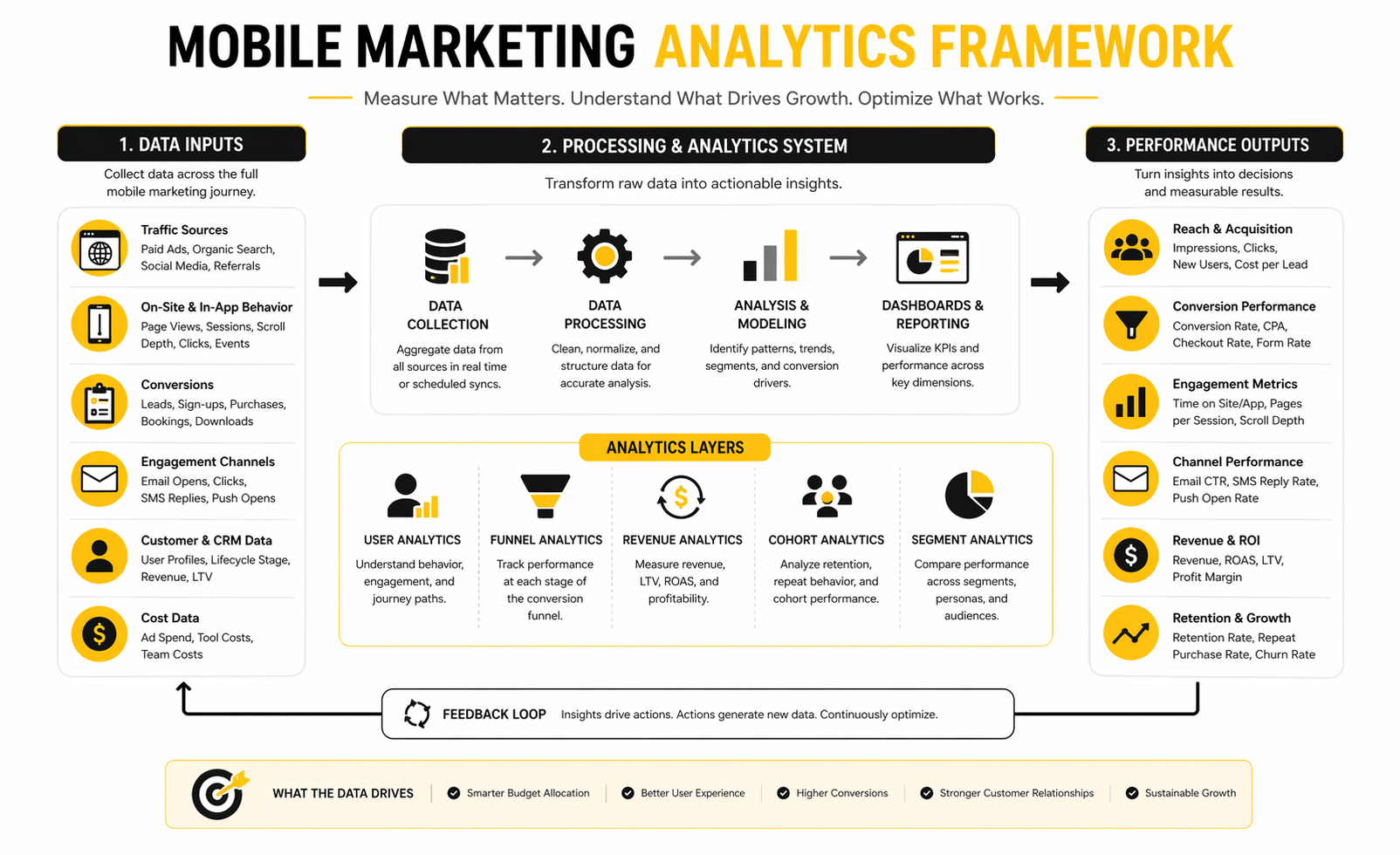
At a practical level, the system should answer five questions clearly:
- Where did the mobile user come from?
- What did they do immediately after landing?
- Where did they hesitate or abandon?
- Did they complete the intended action?
- Did that user come back, buy again, or move deeper into the relationship?
When those answers are visible, performance reviews get sharper. Instead of saying a campaign underperformed, you can say the ad was fine, the opt-in page was weak, the form had too many fields, or the follow-up timing was off. That level of specificity is what makes optimization real.
Benchmark With Context or Do Not Benchmark at All
Benchmark data is useful, but only when used intelligently. Recent push research from Airship’s 2025 benchmarks shows that apps using both push and in-app messaging with segmentation and automation saw an average 31% higher engagement score than their app category average. That does not mean every brand should immediately increase push volume. It means message relevance, segmentation, and coordinated lifecycle design tend to outperform generic broadcasting.
The same caution applies to SMS and email numbers. High read rates or strong click benchmarks can be useful directional markers, but they become dangerous when treated as universal promises. A flash-sale text for an opted-in retail audience should not be compared blindly to a long-consideration B2B nurture flow. The benchmark only matters if the business model, audience, and user intent are close enough to make the comparison meaningful.
That is why the best teams use benchmarks as tension, not truth. If your results are far below a reasonable range, it signals a problem worth investigating. If your results look healthy, the next question is whether those healthy-looking metrics are producing downstream value.
Device Behavior Tells You Where to Look First
Broader behavior data can also help teams set priorities. DataReportal’s 2025 device trends showed internet users now spend an average of 3 hours and 46 minutes per day on mobile devices versus 2 hours and 52 minutes on computers. That does not mean desktop is irrelevant. It means the burden of proof has shifted. If a mobile experience is weak, the brand is likely underperforming in the environment where users spend the most connected time.
App behavior tells a similar story. Sensor Tower’s 2025 mobile analysis found consumers spent 4.2 trillion hours in apps in 2024 and global in-app purchase revenue reached $150 billion. The action this should drive is not “we need an app” for every company. The real action is understanding that mobile attention is deep, fragmented, and habitual, which makes continuity across content, landing pages, messaging, and retention channels far more important than isolated campaign wins.
The Right Performance Signals by Stage
In mobile marketing, different metrics matter at different stages of the journey. Mixing them together creates confusion. A clean interpretation model makes optimization much easier.
For awareness, pay attention to reach quality, video hold rate, click-through rate, and cost per engaged visit. If these are weak, the offer, creative angle, or audience targeting probably needs work before anything else.
For conversion, focus on page speed, bounce rate, form completion, add-to-cart rate, checkout completion, booked meetings, or qualified replies. If attention metrics are solid but these numbers are weak, the problem is likely post-click friction rather than channel performance.
For retention, look at repeat purchase rate, push opt-in quality, SMS response patterns, unsubscribe rate, reactivation performance, and customer value over time. This is where mobile marketing becomes financially stronger because reacquiring the same user repeatedly is usually more expensive than keeping the relationship warm.
What the Data Should Make You Do Next
The point of measurement is action. If mobile traffic is high and conversion is low, simplify the page before buying more traffic. If SMS clicks are strong but downstream conversion is weak, tighten the landing experience rather than assuming the channel is broken. If push engagement is falling, reduce noise and improve segmentation instead of increasing send frequency.
If customers engage on one mobile channel and convert on another, do not panic. That is normal. Mobile marketing is often assistive before it is final. The smarter move is to understand the pattern and strengthen the handoff between channels rather than forcing every touchpoint to close the deal alone.
This is also where workflow tools can help turn measurement into execution. A system like GoHighLevel can be useful when the goal is tying leads, follow-up, and attribution together in one place instead of reviewing scattered reports. The value is not in having more dashboards. The value is in making the next decision faster and more accurate.
Healthy Mobile Marketing Looks Consistent, Not Magical
Teams often go hunting for one magical number that proves success. In reality, strong mobile marketing looks more balanced than dramatic. Traffic quality improves, page friction falls, response timing gets tighter, repeat behavior rises, and paid acquisition becomes easier to justify because retention is carrying more weight than before.
That is the real interpretation lens. A single big metric spike can be exciting, but sustained performance usually comes from a cleaner system. When measurement is tied closely to the mobile journey, the data stops being decorative and starts becoming operational. That is when brands stop reacting to reports and start improving the experience that the reports are describing.
Advanced Strategy, Tradeoffs, and Scaling Risks
Once a mobile marketing program starts producing results, the next challenge is not getting more ideas. It is keeping the system effective as complexity rises. More campaigns, more audiences, more automations, and more channels can look like maturity from the outside, but they often reduce clarity underneath unless the brand gets stricter about priorities.
That is why scaling mobile marketing is less about adding volume and more about protecting signal quality. The brands that scale well usually become more selective, not less. They get clearer about what deserves a message, what deserves a campaign, and what should be removed because it adds noise without moving the business forward.
Privacy Has Changed the Game, Not the Need for Measurement
One of the biggest expert-level shifts in mobile marketing is that measurement is no longer as deterministic as many teams want it to be. Privacy-safe attribution frameworks, aggregated reporting, platform-side data loss, and growing restrictions around user tracking have changed how marketers interpret performance. Google’s ongoing Privacy Sandbox updates and industry analysis from Singular’s 2025 measurement review make the same broader point: mobile marketers now have to operate with less perfect visibility and better decision discipline.
That does not mean measurement is broken. It means the old expectation of crystal-clear individual tracking across every touchpoint is less realistic than it used to be. The practical response is to triangulate data across platforms, on-site behavior, CRM signals, and downstream outcomes instead of pretending one dashboard can explain everything.
This change matters because it forces better strategic thinking. Teams that depended too heavily on shallow attribution often overfunded channels that looked efficient in-platform but underperformed commercially. Mobile marketing gets stronger when marketers accept ambiguity, look for directional truth across multiple signals, and tie reporting back to revenue and retention instead of obsessing over one perfect source of truth.
Personalization Is Powerful Until It Starts Feeling Creepy
Advanced mobile marketing almost always moves toward personalization because broad messaging gets less effective as competition intensifies. The problem is that personalization can improve relevance and still damage trust if it feels invasive, overfitted, or poorly timed. Adobe’s 2025 AI and Digital Trends for Retail frames this tension clearly: brands are under pressure to deliver more tailored experiences, but those experiences only work when they feel useful rather than manipulative.
This is where many teams get seduced by capability instead of judgment. They can segment more, trigger more, and customize more, so they do. Then response quality drops because the customer feels watched instead of understood. Mobile marketing works best when personalization serves the moment without making the user wonder how the brand knows so much.
The safer rule is to personalize around context and intent before leaning too hard on identity detail. Recent browsing behavior, purchase stage, location relevance, product category interest, and timing windows often do more for performance than hyper-specific personal references ever could. Good personalization feels helpful. Bad personalization feels like surveillance wearing a discount code.
Owned Audiences Get More Valuable as Paid Acquisition Gets Harder
As programs mature, one lesson keeps getting reinforced: renting attention gets expensive faster than building access. Paid acquisition still matters, but the economics become much healthier when the brand owns a direct relationship through email, SMS, app engagement, or community-based follow-up. That is one reason AppsFlyer’s latest data showed global remarketing spend reached $31.3 billion in 2025, with retention and re-engagement taking a larger role in growth planning.
This has a strategic consequence that a lot of teams resist at first. The best mobile marketing programs do not judge a campaign only by the first conversion. They also ask whether that campaign added a reachable contact, improved lifecycle data, or strengthened the brand’s ability to bring the customer back without paying again.
That is why owned-audience infrastructure becomes a scaling asset, not just a retention add-on. A system like Brevo or GoHighLevel fits here when the goal is not simply sending campaigns, but organizing follow-up, segmentation, and response workflows around actual customer behavior. The more expensive paid traffic becomes, the more valuable owned audience quality becomes.
AI Changes the Pace of Mobile Commerce, but It Does Not Remove the Need for Clarity
Mobile marketing is also being reshaped by AI-assisted discovery, support, and shopping behavior. Adobe’s recent reporting found 39% of consumers have used AI for online shopping, and 85% of those users said it improved the experience. That should not be read as a signal to automate everything. It should be read as proof that customers increasingly value faster discovery, easier comparison, and less friction in decision-making.
The smart move is to use AI where it compresses effort for the customer. Better product discovery, smarter routing, faster support responses, cleaner knowledge retrieval, and stronger internal content operations all fit naturally. What does not fit is using AI to multiply low-quality messages or generate generic creative at scale without fixing the actual mobile experience.
This is where tools can help if they serve a real operational purpose. Something like Chatbase can be useful when the brand needs a faster conversational layer on mobile, while Guideless may fit teams trying to move more quickly through execution and workflow clarity. But the principle stays the same: the technology should simplify the customer journey, not just make the marketing team feel more advanced.
The Biggest Scaling Risk Is Message Saturation
A program can look healthy in aggregate while quietly exhausting the audience underneath it. This happens when teams scale sends faster than they scale relevance. SMS volume rises, push frequency increases, emails stack on top of each other, retargeting becomes repetitive, and the customer starts feeling surrounded rather than served.
This is one of the hardest mobile marketing problems because the early numbers can still look decent. Short-term clicks may hold up for a while. Revenue can even rise temporarily. Then unsubscribes climb, engagement quality weakens, and previously responsive segments become harder and more expensive to activate.
The answer is not to avoid scale. It is to treat audience fatigue as a first-class metric. Watch repeat exposure, unsubscribe behavior, opt-out timing, delayed conversions, reply sentiment, and assisted channel overlap. When a customer starts seeing the same pressure from multiple mobile touchpoints at once, the brand usually needs better orchestration, not more intensity.
Operational Simplicity Beats Tool Sprawl
As budgets grow, teams often assume maturity means adding more software. In reality, scaling mobile marketing usually gets easier when the operating model becomes simpler. Too many teams end up with one tool for landing pages, another for forms, another for chat, another for email, another for SMS, another for attribution, another for scheduling, and a messy layer of exports trying to hold everything together.
That creates lag, not leverage. Data gets delayed, ownership becomes fuzzy, and fixes take longer because every problem crosses multiple systems. The better move is usually to choose a stack that covers the essential workflow cleanly, then add specialized tools only where the gain is obvious and measurable.
For some teams, that means consolidating more into one operating layer. For others, it means keeping a leaner combination of best-in-class tools with very clear responsibilities. Either way, the rule holds: every additional system should earn its place by making the mobile journey more effective or the team more decisive.
Strategic Tradeoffs Get Sharper as the Program Matures
At an advanced level, mobile marketing becomes a series of tradeoffs rather than a checklist. More personalization can increase relevance, but it can also raise operational burden and privacy sensitivity. More automation can improve speed, but it can also spread mistakes faster. More paid scale can drive growth, but it can also expose weak retention economics that were hidden at a smaller budget.
That is why mature teams stop asking only, “Can we do this?” and start asking, “What does this create downstream?” The discipline to think one or two steps ahead is what protects a program from scaling into fragility. Mobile marketing becomes much stronger when every new initiative is judged not only by upside, but also by what it adds to complexity, risk, and maintenance load.
What Expert Teams Keep Coming Back To
At the expert level, the same fundamentals keep proving themselves. Fast mobile experiences still win. Clear offers still beat clever clutter. Direct response still works better when the follow-up is coordinated. Retention still makes acquisition more affordable. Owned audiences still matter more when paid costs rise. None of that is glamorous, but it is durable.
That is also why advanced mobile marketing rarely looks chaotic from the inside. The best teams are not running more random plays than everyone else. They are usually doing fewer things, with better timing, stronger data discipline, and much tighter control over what the customer experiences from one mobile touchpoint to the next.
By this stage, the takeaway should be obvious: mobile marketing rewards sophistication, but it punishes unnecessary complexity. The closer a brand gets to scale, the more that distinction matters.
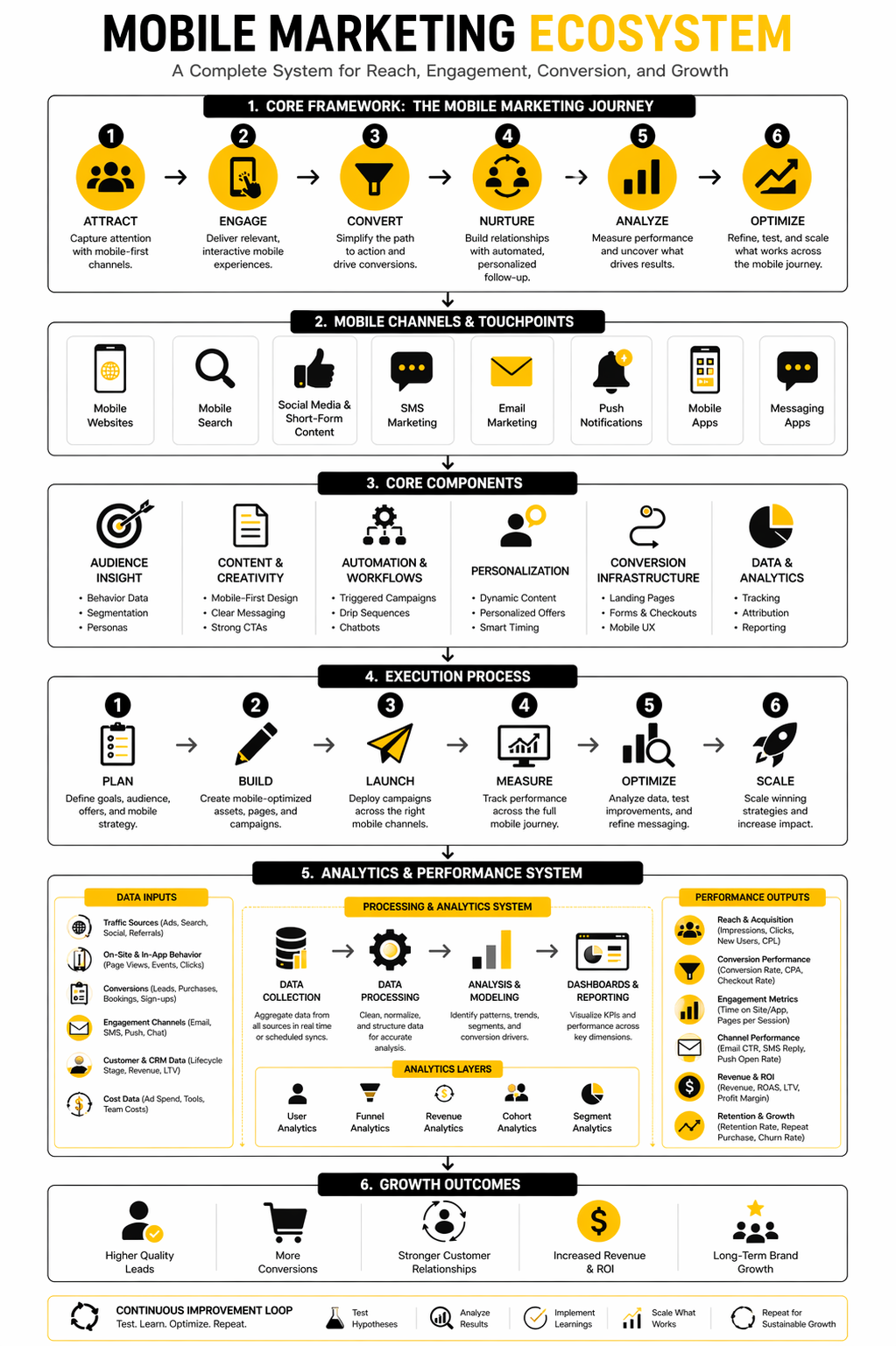
The final lesson in mobile marketing is that it is not really about the phone. It is about the system behind the phone. The brands that win are the ones that connect acquisition, conversion, retention, analytics, and follow-up into one experience that feels easy for the customer and manageable for the team.
That is the ecosystem view most companies miss at first. They look at ads, landing pages, SMS, email, push, chat, and reporting as separate functions. In practice, mobile marketing works best when those pieces act like one coordinated engine instead of a stack of isolated tasks.
FAQ
What is mobile marketing in simple terms?
Mobile marketing is the practice of reaching and converting people through experiences built for smartphones and tablets. That includes mobile-friendly websites, SMS, email, push notifications, paid social, search, apps, and chat-based journeys. The important part is not the channel itself, but whether the experience matches how people actually behave on a phone.
Why is mobile marketing so important now?
Because mobile is where attention and action already live. Global digital behavior research shows people spend 3 hours and 46 minutes per day on mobile internet use, and Sensor Tower reported that consumers spent 4.2 trillion hours in apps in 2024. When that much attention sits on mobile, brands that still treat mobile as a secondary experience are operating with a serious handicap.
Is mobile marketing only for ecommerce brands?
Not even close. Ecommerce gets a lot of attention because mobile checkout is easy to measure, but service businesses, SaaS companies, local brands, media companies, educators, and B2B firms all benefit from stronger mobile journeys. If people discover you, research you, message you, or book with you on a phone, mobile marketing matters.
What channels count as mobile marketing?
The main channels are mobile websites, mobile search, paid social, short-form video, SMS, email opened on phones, push notifications, in-app messaging, messaging apps, and mobile wallets. The list is less important than the role each channel plays in the journey. Strong mobile marketing gives every channel a job instead of blasting the same message everywhere.
How is mobile marketing different from digital marketing?
Digital marketing is the bigger category. Mobile marketing is the part of digital marketing that is designed around mobile behavior, constraints, and opportunities. That means smaller screens, faster decisions, shorter attention windows, higher context switching, and much less patience for friction.
What is a good first step for a small business?
Start by auditing the mobile journey you already have. Check how fast your pages load, how easy your forms are to complete, whether your buttons are obvious, and whether the follow-up happens quickly after a lead or purchase. Most small businesses do not need more tactics first; they need fewer points of friction.
Do I need an app to do mobile marketing well?
Usually no. Many businesses can build an excellent mobile marketing system with a fast site, strong landing pages, good SMS or email follow-up, and clear conversion paths. An app makes sense when the product has repeat usage, ongoing utility, or loyalty behavior that genuinely benefits from an installed experience.
How do SMS and email work together in mobile marketing?
They work best when they do different jobs. Email is better for explanation, education, and richer lifecycle content, while SMS is better for urgency, reminders, quick nudges, and immediate action. When those roles are clear, the customer journey feels coordinated instead of repetitive.
What should I measure first?
Start with the full path from source to outcome. That means traffic source, page behavior, opt-in or conversion rate, follow-up engagement, and repeat value over time. If you only measure clicks, you are measuring motion, not progress.
How much does page speed really matter on mobile?
A lot more than many teams admit. Mobile users are often distracted, in motion, or comparing multiple options quickly, so even small delays can destroy momentum. That is why tools built for faster mobile pages, such as Replo, can be valuable when the landing experience is clearly the bottleneck.
Is SMS still worth it in 2026?
Yes, but only when it is permission-based, relevant, and timed well. SMS still works because it reaches people in a highly visible environment, but it also burns trust faster than almost any other channel when used badly. The best programs keep the message useful, short, and tied to a clear next action.
How can I automate mobile marketing without making it feel robotic?
Automation works when it reacts to behavior instead of ignoring it. A welcome sequence after an opt-in, a reminder after cart abandonment, or a follow-up after a booking request can feel helpful because the message matches the moment. Platforms like ManyChat are most useful when they reduce delay and confusion, not when they multiply noise.
What is the biggest mistake brands make with mobile marketing?
They assume getting the click is the hard part. In reality, the hard part is making the experience after the click fast, clear, and convincing enough to keep momentum alive. Weak landing pages, cluttered forms, slow follow-up, and overlapping messages usually do more damage than the traffic source itself.
How do I know whether my mobile marketing is improving?
Look for consistency across the system, not one flashy metric spike. Better mobile marketing usually shows up as stronger conversion quality, lower friction, faster follow-up, healthier repeat engagement, and more stable economics across paid and owned channels. When the system gets cleaner, the results tend to get more durable.
Work With Professionals
Explore 10K+ Remote Marketing Contracts on MarkeWork.com
Most marketers spend too much time chasing clients, competing on crowded platforms, and losing a percentage of every project to middlemen. MarkeWork gives you a better way. Browse thousands of remote marketing contracts and connect directly with companies desperate to hire skilled marketers like you, without platform commissions and without unnecessary gatekeepers.
If you're serious about finding better opportunities and keeping 100% of what you earn, explore available contracts and create a profile for free at MarkeWork.com.