

Music marketing used to mean press outreach, playlist pitching, and hoping the release week carried enough momentum to push a song into the world. That model is too narrow now. In a market where global recorded music revenue grew 6.4% in 2025, streaming represented 69.6% of recorded music income, and U.S. paid subscriptions reached 106.5 million accounts, marketing is not a layer on top of the music business anymore. It is the operating system that turns songs into audience growth, audience growth into repeat listening, and repeat listening into durable career momentum.
That shift matters because discovery is fragmented and fan behavior is no longer linear. TikTok’s latest music impact research frames the platform as a driver of discovery, monetization, and chart success, while YouTube reports that fans discovered a song on Shorts and then consumed it on long-form video 700 million times within a week. Spotify’s current royalty data also shows how global and cross-platform this has become: artists see more than half of royalties come from outside their home country within two years of debut on average, which means good music marketing now has to connect local identity with international reach.
Article Outline
- Why Music Marketing Matters More Than Ever
- The Modern Music Marketing Framework
- Discovery Channels That Actually Move the Needle
- Release Campaigns That Convert Attention Into Listening
- Retention, Revenue, and Fan Ownership
- What to Measure, What to Avoid, and the Final FAQ
Why Music Marketing Matters More Than Ever
The biggest misunderstanding in music marketing is thinking the job is to “get exposure.” Exposure is cheap. What artists actually need is qualified attention from the right listeners, in the right context, with enough repetition and clarity that a casual viewer becomes a saved track, a follower, a ticket buyer, or a customer. That is why modern campaigns are built around movement through a funnel, not around isolated spikes.
The data keeps pointing in the same direction. Paid subscription streaming made up 52.4% of global recorded music revenue in 2025, and Spotify reports that more than a third of artists generating at least $10,000 in royalties were DIY or started that way. In plain English, that means independent artists have more access than ever, but they also compete inside a brutally crowded attention market where strategy matters just as much as talent.
The same pattern shows up on discovery platforms. YouTube’s artist guidance argues for a multi-format release plan because audience behavior changes across Shorts, video, and live content, and the platform says fans who saw a music video in its sampled analysis consumed 94% more of that artist’s music in the following month. TikTok has moved in the same direction by launching TikTok for Artists, with daily analytics and a pre-release tool built specifically to connect fan engagement with off-platform listening.
That is the real reason music marketing matters now. It is the discipline that aligns platform-native discovery, release planning, audience data, and direct fan relationships into one system. Without that system, even strong songs can disappear into the noise. With it, an artist has a real chance to build a career instead of just collecting moments.
The Modern Music Marketing Framework
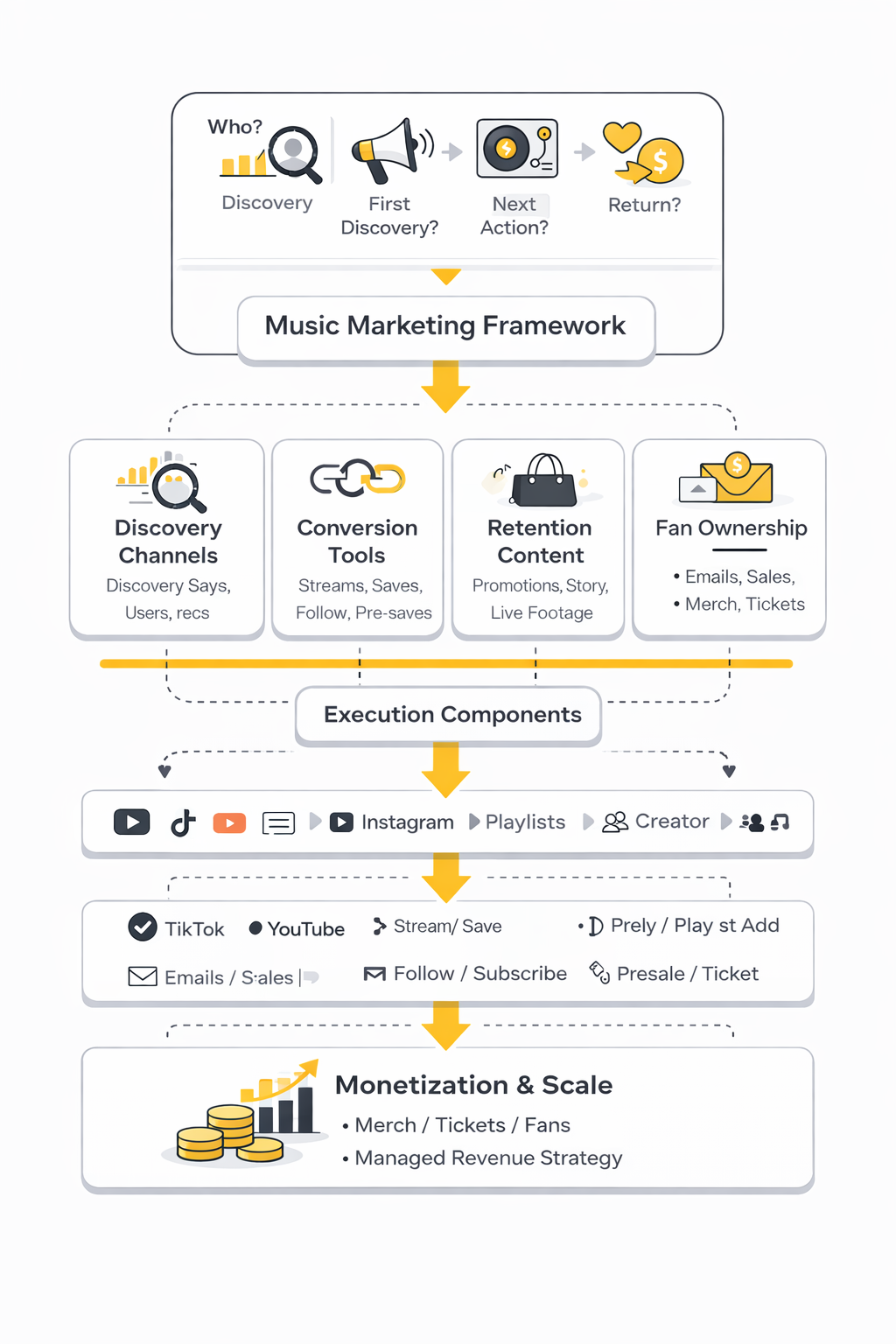
A useful music marketing framework starts with one simple idea: every campaign has to answer four questions. Who is this for, where will they first discover it, what action do you want next, and how will you bring them back again? If you cannot answer those clearly, the campaign is probably built on activity instead of strategy.
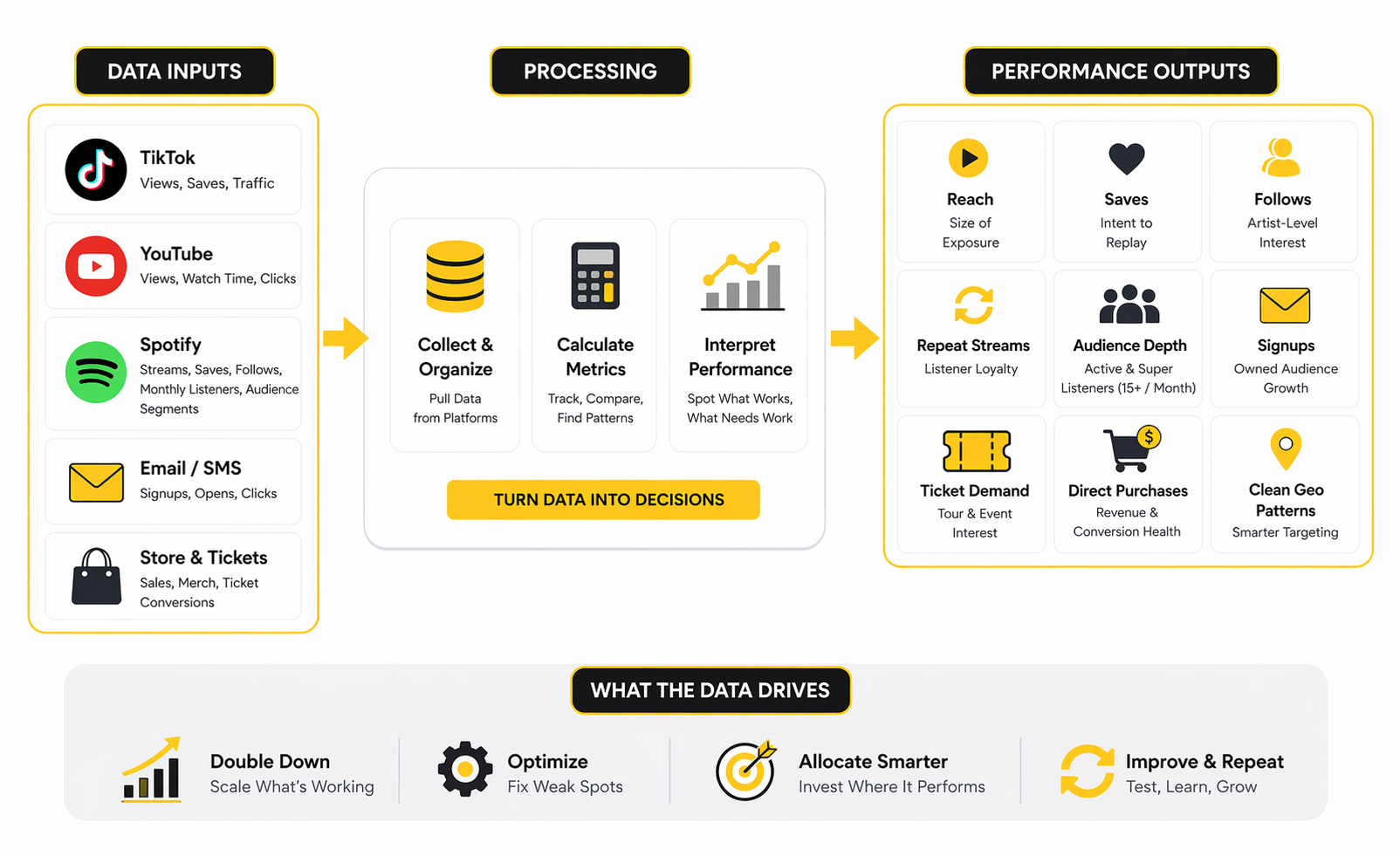
The strongest teams now think in connected layers. Discovery happens on platforms such as TikTok, YouTube, Instagram, playlists, and creator ecosystems. Conversion happens when that attention becomes a stream, save, pre-save, follow, email signup, merch purchase, or ticket sale. Retention happens when the artist keeps showing up with enough consistency and identity that the audience stays engaged between releases. Bandcamp remains a useful reminder that owned fan relationships still matter, since the platform says artists or labels receive an average of 82% of the money from purchases, and its own community features drive 30% of monthly sales.
This article will keep returning to that framework because it reflects how the market actually works now. Music marketing is no longer just about shouting louder on release day. It is about designing a repeatable system for discovery, conversion, retention, and monetization across the channels where fans already spend their time.
Discovery Channels That Actually Move the Needle
The fastest way to waste a music marketing budget is to treat every platform like it does the same job. It does not. Some channels are built for first discovery, some are better at deepening interest, and some are strongest when the listener is already halfway convinced. Good artists stop posting randomly the moment they understand that difference.
That is why the best music marketing strategies are channel-specific without becoming fragmented. The goal is not to be everywhere at once. The goal is to know where a song is most likely to break, what format the platform rewards, and what step should happen next after the first touch. Spotify now positions playlist pitching, Discovery Mode, Marquee, and Showcase as separate audience-development tools inside one system, while TikTok and YouTube both keep emphasizing the connection between short-form discovery and off-platform listening behavior.
Short-Form Video Is Still the Discovery Engine
Short-form video remains the clearest top-of-funnel channel in music marketing because it compresses sound, story, and identity into a format people can process instantly. TikTok’s latest music impact research found that U.S. users on the platform are 74% more likely to discover and share new music on social and short-form video platforms than the average short-form video user, and the same report says TikTok’s Add to Music App feature has already driven more than a billion track saves. Those numbers matter because they show discovery is not just happening on-platform; it is translating into measurable listening intent.
YouTube is reinforcing the same pattern from a different angle. Its artist education materials highlight that fans discovered a song on Shorts and then consumed it on long-form video more than 700 million times within a week, which is a useful reminder that short clips do not replace deeper content. They create the opening that makes deeper content worth watching.
For artists, the implication is practical. If a track has a strong hook, a recognizable emotional trigger, or a repeatable lyrical moment, short-form is usually the fastest place to test positioning. But the content still has to feel native. A great song with lazy creative usually loses to a good song with a clear premise, a memorable angle, and enough repetition for the audience to recognize it on the second and third exposure.
Streaming Platforms Convert Curiosity Into Real Listening
Discovery gets attention, but streaming platforms are where that attention starts turning into behavior that actually compounds. Spotify’s own marketing stack makes this unusually explicit: playlist pitching helps with editorial visibility, Discovery Mode boosts songs in personalized surfaces, and Marquee or Showcase are designed to reach listeners who are most likely to stream after seeing a recommendation. That matters because it reframes music marketing from “get seen” to “get seen by the right listener at the right moment.”
The platform’s release guidance is even more useful because it shows where many campaigns go wrong. Spotify recommends pitching a focus track at least two weeks before release and says Countdown Pages published at least seven days early generate nearly twice as many pre-saves on average as pages launched later. It also reports that more than 60% of listeners who pre-save an album stream it in week one, which is exactly the kind of conversion signal artists should care about more than vanity reach.
This is where a lot of music marketing becomes more disciplined. Not every viewer should be pushed to a streaming link immediately, but once interest is warm, the handoff has to be simple. If the listener likes the clip, the next step should be obvious: pre-save, stream, save, follow, or add to playlist. Friction kills momentum faster than most artists realize.
YouTube Works Best When You Treat It Like a Catalog, Not a Campaign
A lot of artists still treat YouTube as a place to dump a music video and move on. That is leaving too much value on the table. YouTube’s own artist resources keep pushing a broader approach built around Shorts, long-form video, live content, and repeatable audience education because fans do not all enter through the same door.
That matters for music marketing because YouTube is one of the few platforms where catalog depth can keep working long after release week. A song can surface through Shorts, lead into an official video, then lead into live performance clips, interviews, alternate versions, or behind-the-scenes content. Instead of asking one upload to do everything, smart teams let each asset handle one stage of fan development.
There is also a practical branding advantage here. YouTube gives artists more room to explain context, show personality, and build search visibility around a song or project. On short-form-first platforms, people often remember a moment. On YouTube, they are more likely to remember the artist.
Instagram Helps Shape Perception, Not Just Reach
Instagram still matters in music marketing, but usually not because it is the single biggest source of discovery. Its real strength is how it sharpens perception around the artist. Instagram’s own explanations of ranking make it clear that recommendations and feed visibility depend on signals like watch time, engagement, and the relationship between creator and viewer, which means lazy reposting rarely performs for long.
That changes how artists should use it. Instagram is less effective when it becomes a duplicate of TikTok with worse timing. It becomes more effective when it turns scattered attention into a clearer artistic world through strong visuals, recurring themes, and consistent proof that the artist is active, relevant, and worth following between releases.
The platform is especially useful when a song already has some momentum somewhere else. Once a listener has heard the track on TikTok, Spotify, or YouTube, Instagram often becomes the place where they decide whether they actually care about the person behind it. That is not a small job. It is the bridge between passive consumption and early fandom.
Playlists and Creator Ecosystems Still Matter, but for Different Reasons
Playlists remain powerful, but artists often over-romanticize them. Spotify is right to frame playlist pitching as one tool among several because playlists are excellent for distribution and sampling, but they are not always great at building strong artist memory on their own. You can get streams from a playlist without creating real fan recognition if the surrounding campaign is weak.
Creator ecosystems work differently. On TikTok, Shorts, and Reels-style formats, creators can attach a song to a behavior, joke, visual pattern, or emotional template that helps people remember it. That is why creator-driven discovery can feel more durable than a single passive playlist placement: the song enters culture with context instead of just entering a queue.
The best music marketing campaigns usually use both. Playlists help scale listening once a track is moving, while creator usage helps make the song recognizable before and during that scale-up. One gives you distribution. The other gives you narrative.
Release Campaigns That Convert Attention Into Listening
Once the discovery layer is clear, the next challenge is sequencing. This is where many artists sabotage themselves. They generate interest too early, reveal too much too soon, or send every audience to the same generic link regardless of intent. The result is activity without traction.
A better release campaign is structured around timing, asset hierarchy, and audience temperature. Spotify’s current artist tools are built around that exact logic, from early playlist pitching and Countdown Pages to post-release promotion through Marquee, Showcase, and Discovery Mode. That structure matters because great music marketing is rarely one big moment. It is a chain of smaller moments that each move the listener one step closer to habitual behavior.
Build the Campaign Before the Song Drops
A real music marketing campaign starts before release day, not on it. Spotify’s release guidance recommends pitching a focus track at least two weeks before launch, and the platform says Countdown Pages published at least seven days early generate nearly twice as many pre-saves on average as later setups. That is a useful benchmark because it shows the campaign window is not optional decoration. It is part of the conversion process itself. (release guidance from Spotify for Artists)
The practical move here is to stop thinking in terms of “promo content” and start thinking in terms of pre-release intent. You need a clear lead asset, a focus track if relevant, a short-form angle, a destination link, and a reason for the audience to care now instead of later. TikTok’s TikTok for Artists platform is leaning directly into this with analytics and pre-release tools because platforms know anticipation is one of the few levers that can be engineered before listening volume exists. (TikTok for Artists)
For most artists, the pre-release phase works best when the message is simple. Do not try to explain the entire project at once. Give people one emotional entry point, one memorable piece of language, or one recognizable visual pattern, then repeat it until the market starts to recognize the release on sight.
Use a Process, Not Random Promotion
Once you accept that music marketing is a system, the implementation gets clearer. Every campaign needs a sequence that moves from setup to launch to follow-up, with each stage doing one job well. YouTube’s artist resources are strong on this because they separate pre-release, release-day, and post-release planning instead of treating promotion like one giant burst of content. (YouTube for Artists resources)
That matters because artists usually fail from inconsistency, not from a lack of ideas. They post heavily for a few days, disappear, then wonder why the audience does not convert. A process fixes that by forcing each asset to support a stage: early awareness, release-day action, or post-release reinforcement.
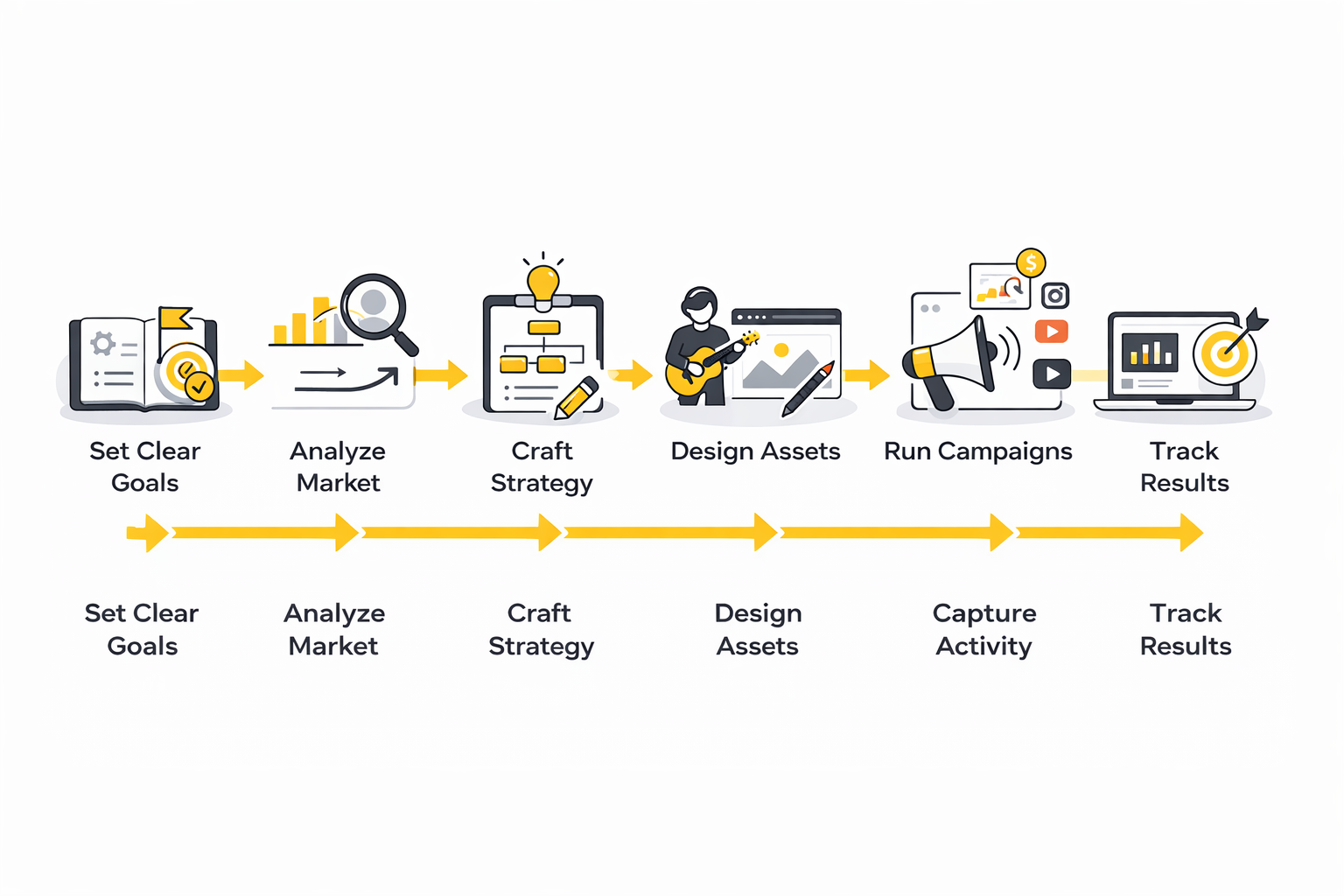
A simple implementation flow for music marketing usually looks like this:
- Define the release goal
- Pick the primary audience
- Choose the lead platform for discovery
- Build the pre-release assets
- Launch with platform-specific content
- Retarget warm listeners and viewers
- Extend the campaign with follow-up content
- Measure saves, streams, follows, and repeat behavior
This kind of flow is boring in the best possible way. It removes guesswork. Instead of asking every day what to post, you already know what stage you are in and what action you need from the audience next.
The Pre-Release Window Should Create Signals
The pre-release phase is where the artist gives platforms and fans something to respond to before the track is live. On Spotify that can mean a Countdown Page, Clips, a Canvas plan, and an early focus track pitch. On YouTube it can mean Shorts, teasers, and channel activity that warms up the audience before the official drop. (Spotify new releases tools, YouTube for Artists)
This is also where direct audience capture becomes valuable. Social reach is rented. Email, SMS, and owned audience data are not. If an artist wants a cleaner way to collect interest before release and follow up after launch, tools like GoHighLevel, ManyChat, or Brevo fit naturally into the workflow when the goal is to move beyond pure platform dependence.
The point is not to overbuild some giant funnel on day one. The point is to make sure that when attention shows up, you have somewhere useful to send it. That single decision can change the economics of a release because it gives the artist a way to reconnect with interested listeners later instead of starting from zero every time.
Release Day Should Reduce Friction
Release day is where attention either converts or leaks away. Spotify’s tools are explicit about this: the platform pushes artists to make the release easy to discover, easy to save, and easy to revisit through profile optimization, campaign tools, and audience analytics. YouTube’s release-day guidance makes the same case from the video side by emphasizing a multi-format plan instead of relying on one upload to carry everything. (Spotify for Artists, YouTube release-day strategy)
In practice, that means the artist should not be asking the audience to do five different things at once. Pick the priority action. For a single, it might be stream and save. For an EP or album, it might be pre-save, then full-project listening. For a tour-linked release, it might be stream first and then move the hottest fans toward ticket demand.
This is where weak music marketing usually reveals itself. The content may look busy, but the path is muddy. Great campaigns feel obvious. The listener sees the clip, gets curious, clicks once, and lands exactly where they expected.
Post-Release Is Where Winning Campaigns Separate Themselves
A lot of artists treat release day like the finish line. It is not. It is the first real test. Spotify’s own guidance tells artists to review their numbers after the first week because that is when you can start seeing how the release affected audience segments, streams, and listener conversion. That advice matters because it shifts the job from celebration to interpretation. (Spotify release guide)
The strongest music marketing campaigns are often built in the weeks after launch. You look at what format worked, what line got quoted back, what region overperformed, what creator behavior emerged, and what content angle kept producing saves instead of just views. Then you build the second wave around those signals rather than repeating the first wave blindly.
This is also where scheduling discipline helps. A tool like Buffer can make sense for artists or small teams who need a steady publishing rhythm without turning content ops into chaos. The tool does not replace judgment, but it does reduce the operational friction that causes so many campaigns to fade too early.
Retention, Revenue, and Fan Ownership
Once a release has generated discovery and listening, the next job is to turn that burst into something durable. This is where music marketing becomes more than promotion. It becomes audience design. Spotify’s own framing around “super listeners” makes the point clearly: the listeners who go deeper matter disproportionately, and artists need systems that help identify and grow them over time. (Spotify’s guide to super listeners)
That shift changes how you think about success. A campaign that gets a pile of passive streams but no repeat engagement can look impressive on the surface and still be strategically weak. A smaller campaign that produces repeat listeners, followers, direct signups, merch buyers, and ticket demand is usually more valuable because it compounds.
The next section will go deeper into that compounding layer: how artists keep fans, monetize attention without burning trust, and build assets they actually control instead of renting every relationship from platforms.
The retention layer is where music marketing either becomes a business or stays a content hobby. Streaming platforms are excellent at helping fans discover music, but they do not give artists full ownership of the relationship. That is why smart artists treat attention as something to convert into repeat behavior, direct contact, and higher-value actions over time.
Spotify’s current fan segmentation is useful here because it forces a more serious conversation about audience quality. The platform distinguishes between light listeners, moderate listeners, and super listeners, and its own fan study says super listeners make up just 2% of an artist’s monthly listeners on average while driving more than 18% of monthly streams. That is exactly the kind of imbalance serious music marketing should exploit, because the people who care most are not just more emotionally invested. They are commercially more valuable too. (Spotify fan study)
Retention Starts When the Listener Chooses You On Purpose
The most important distinction in audience data is passive versus intentional behavior. Spotify’s analytics documentation defines monthly active listeners as people who intentionally streamed an artist from active sources such as the artist profile or their own library, while programmed listeners are people who streamed from programmed sources only. That difference matters because intentional listening is a much stronger signal of future loyalty than passive background consumption. (Spotify analytics definitions)
In practical terms, this means a stream is not just a stream. A playlist-driven spike can be helpful, but it should not be mistaken for durable traction unless it leads to follows, library saves, repeat plays, or movement into active audience segments. When artists ignore that distinction, they end up optimizing for numbers that look good in screenshots and feel terrible in real life.
This is also why release follow-up matters so much. If a song breaks through a programmed surface or a viral moment, the job is immediately to give the listener reasons to come back deliberately. Better artist profiles, strong catalog structure, consistent visuals, and fast follow-up content all help move someone from accidental exposure into chosen fandom.
Revenue Quality Matters More Than Raw Reach
A lot of music marketing advice gets stuck on reach because reach is easy to talk about. Revenue quality is harder, but it is more useful. An audience that streams passively and disappears can inflate top-line numbers without improving the artist’s long-term position. An audience that buys directly, signs up, shows up, and returns is smaller on paper but usually stronger in the real world.
Bandcamp is still a valuable counterweight in this conversation because it shows what direct fan economics can look like. The company says artists or labels receive an average of 82% of the money from purchases, usually within 24 to 48 hours. That is not a reason to abandon streaming. It is a reminder that music marketing should not end at the stream if the artist has any realistic path to direct commerce. (Bandcamp about page)
This is where owned audience infrastructure earns its keep. If an artist wants to capture emails, segment fans, automate follow-up, or route different listeners toward merch, tickets, or exclusive drops, a system like GoHighLevel, Brevo, or Systeme.io can fit naturally into the stack. The point is not to turn an artist into a software company. The point is to stop letting every valuable interaction disappear into a platform feed with no way to reconnect later.
What the Numbers Actually Mean
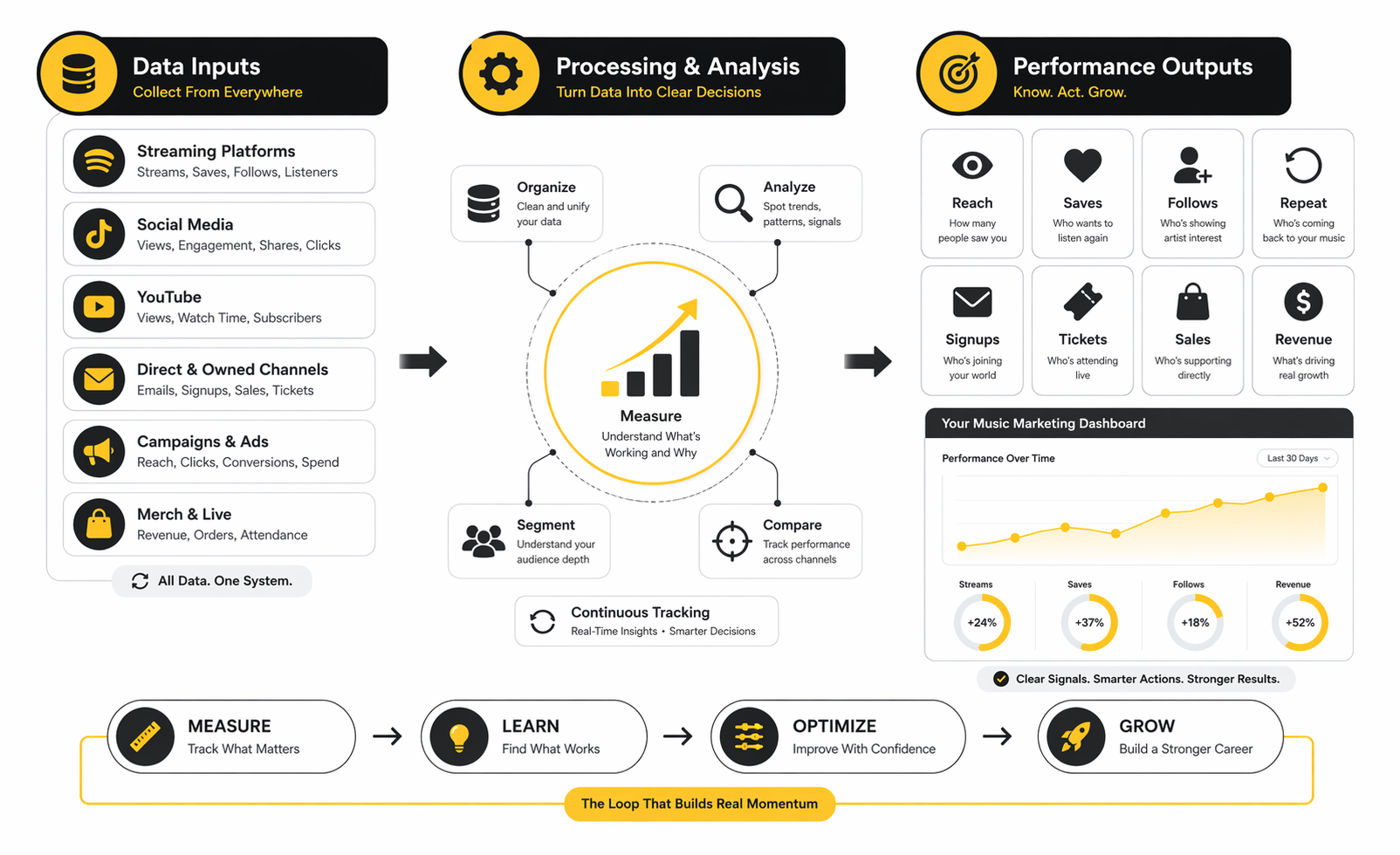
The useful statistics in music marketing are the ones that change your next decision. Everything else is trivia. You do not need a bigger spreadsheet. You need a measurement system that tells you whether discovery is turning into intentional listening, whether intentional listening is turning into loyalty, and whether loyalty is turning into revenue.
Spotify’s current ecosystem is helpful because it already separates some of these layers. Audience segments show listener depth. Analytics surfaces show how listeners found the music. Campaign tools reveal whether promotion reached warm or cold audiences. TikTok for Artists adds daily song and post performance data, while TikTok’s latest music impact research shows how important it is to watch the handoff from short-form exposure into listening behavior. (TikTok for Artists launch, TikTok and Luminate music impact data)
The Right Analytics System Tracks Movement, Not Just Size
A healthy music marketing analytics setup should answer four questions. How many people discovered the song, how many chose to listen intentionally, how many came back, and how many did something higher value after that. If the dashboard cannot answer those four questions, it is probably overloaded with vanity metrics.
This is why single-number thinking is dangerous. Monthly listeners can rise because of one playlist, one viral post, or one major feature, but that does not automatically mean the artist is growing in a durable way. Spotify’s own segmentation guidance is more useful because it shows how listeners sit at different depths of intent, and that helps artists understand whether the campaign is broadening awareness or deepening fandom. (Spotify audience segments guide)
A simple way to think about it is this. Reach tells you whether the market noticed. Active listening tells you whether the artist earned attention. Repeat behavior tells you whether the artist is building a career.
Discovery Metrics Are Only Step One
Short-form video can create massive surface-level demand, but the real question is whether that demand migrates. TikTok’s music impact report says 84% of songs that entered the Billboard Global 200 in 2024 went viral on TikTok first, and the platform says its Add to Music App feature has generated more than a billion track saves. Those are not just flashy stats. They tell artists what to look for after a strong content moment: not just views, but actions that show users want to continue the relationship off-platform. (TikTok and Luminate music impact data)
That should change how artists evaluate content. A post with huge reach and weak downstream behavior may be entertaining but strategically limited. A smaller post that drives strong saves, profile visits, pre-saves, or library adds may be far more valuable because it is creating movement into an ecosystem the artist can build on.
This is why the best music marketing teams do not ask only, “Did it go viral?” They ask, “What did the audience do next?” That is a much harder question, and it leads to much better campaigns.
Benchmarks Only Matter in Context
Industry numbers are useful when they help you interpret your own position. For example, Spotify’s Loud & Clear data shows that in 2025 more than 81,000 artists earned at least $10,000 from Spotify alone, and more than 80% of artists generating over $1 million on Spotify did so without a Top 50 hit. That matters because it pushes back against the lazy belief that music marketing only works when an artist lands one giant mainstream breakthrough. (Spotify Loud & Clear FAQ)
But those numbers should not be read as promises. They should be read as evidence that the market rewards sustained audience development more often than people think. The action they should drive is not blind optimism. It is more disciplined investment in catalog strategy, repeat engagement, and fan conversion.
The same applies to global data. Spotify reports that artists now see more than half of their royalties come from outside their home country on average within two years of debuting. That tells artists to take geo data seriously. If a track starts overperforming in a country or city the artist did not expect, that is not a fun side note. It may be the beginning of a real market. (Spotify Loud & Clear 2026 highlights)
The Best Performance Signals Usually Show Up in Combination
One metric alone can mislead you. Combinations are better. When saves rise with repeat streams, that usually suggests the song has staying power. When profile visits rise with follows, that suggests artist-level interest instead of single-track curiosity. When creator usage rises with streaming conversion, that suggests the content is not just entertaining people. It is selling the music.
This is where workflow starts to matter as much as insight. A simple reporting habit every week can be enough: track discovery source, active versus passive listeners, listener depth, geo changes, direct signups, and revenue actions. If an artist wants a cleaner way to centralize links, audience routing, and conversion pages, tools such as Anything.com, Fillout, or Cal.com can support the operational side without overcomplicating the artist-facing experience.
The main point is straightforward. Data should reduce confusion, not increase it. If the reporting system does not lead to a specific next move, it is probably measuring too much or measuring the wrong thing.
What to Measure, What to Avoid, and the Final FAQ
Once the artist understands how to read discovery, conversion, retention, and revenue signals together, the final challenge is judgment. Not every number deserves equal attention. Not every tactic deserves a repeat. And not every spike deserves celebration. The last section will pull that together with the metrics that actually deserve focus, the traps that keep campaigns weak, and the FAQ that clears up the most common misunderstandings around music marketing.
What to Measure, What to Avoid, and the Final FAQ
At a more advanced level, music marketing stops being a question of what works in general and becomes a question of what works for this artist, with this catalog, in this market, at this moment. That sounds obvious, but it is where a lot of campaigns fail. Teams borrow tactics from breakout artists, copy the surface, and miss the structural reason the original campaign worked in the first place.
The real advantage comes from understanding tradeoffs early. Growth can be fast or stable. Reach can be broad or qualified. Content can be frequent or distinctive. The job is not to maximize every variable at once. The job is to know which tradeoff is worth making now and which one will quietly damage the artist later.
Scale Only After the Signal Is Real
One of the biggest mistakes in music marketing is scaling too early. A song gets one strong clip, one playlist add, or one influencer moment, and suddenly the team starts spending like product-market fit has already been proven. Usually it has not. Usually the artist has one promising signal that still needs confirmation across multiple surfaces.
Spotify’s own artist tools keep pointing people back toward fan depth for a reason. The platform’s fan study and super-listener guidance are built around the idea that career growth comes from developing listeners who return, not just listeners who appear once. When Spotify says super listeners are a small share of the audience but meaningfully over-index on streams and ticket demand, the action this should drive is patience: scale the campaign harder only after intentional listening and repeat behavior are visible, not just after the first spike. (Spotify Fan Study, Spotify’s super listeners guide)
That is the practical threshold advanced teams watch for. If reach rises without active listeners, follows, saves, or repeat plays, the signal is weak. If several of those metrics move together, the signal is stronger, and larger investment starts making more sense.
Protect the Brand While You Grow the Audience
There is a real scaling problem that does not show up cleanly in dashboards: brand erosion. Artists can absolutely grow by chasing every trend, borrowing every format, and feeding the algorithm constantly, but that kind of growth often creates an audience that remembers the content style more than the music. When that happens, marketing is no longer supporting the artist. It is slowly replacing the artist.
YouTube’s artist resources are useful here because they push multi-format promotion rather than one-note repetition. Shorts, long-form video, and post-release content each do different work, which helps an artist stay visible without flattening their identity into one gimmick. That matters because advanced music marketing is not just about staying in motion. It is about staying recognizable while you move. (YouTube post-release strategy)
This is where discipline matters more than intensity. Not every format deserves equal effort. The right move is usually to find the smallest repeatable system that keeps the artist present, coherent, and memorable without training the audience to expect low-context content forever.
Do Not Confuse Distribution With Demand
A lot of artists overestimate traction because they mistake distribution for demand. A track can reach a huge number of people through playlists, recommendations, or algorithmic surfaces and still fail to create real artist-level pull. Spotify’s audience definitions make this distinction unusually clear by separating monthly listeners from monthly active listeners and programmed listeners. That difference is not a technical detail. It is one of the most important judgment calls in music marketing. (Spotify audience segments support, Spotify analytics overview)
The strategic consequence is simple. If most of the lift is coming from programmed discovery and very little is converting into active listening, the campaign has not finished its job. It may still be useful, but it is not yet proof of durable artist demand. That should drive more follow-up content, better profile optimization, clearer calls to action, and stronger reasons for the listener to come back intentionally.
This is also why catalog strategy matters more than people think. When a new listener lands, the rest of the artist page, the surrounding releases, and the visual identity either strengthen the moment or waste it. Advanced teams treat the whole catalog as conversion infrastructure, not just the current single.
The Risk Nobody Talks About Enough Is Fraud
As music marketing becomes more data-driven, bad actors get more creative too. IFPI’s latest global report makes it explicit that AI innovation and the industry response to streaming fraud will shape the next era of music. That is not abstract policy language. It is a warning that some growth signals are now easier to fake, pollute, or misread than they used to be. (IFPI Global Music Report 2026)
This matters for independent artists especially because fraud can look tempting when growth feels slow. Bot traffic, fake streams, shady playlist networks, and inflated engagement can create the illusion of progress while damaging recommendation systems, wasting budget, and poisoning future decision-making. Even worse, they can teach an artist to trust numbers that have no relationship to real audience intent.
The correct response is not paranoia. It is cleaner judgment. If the audience is real, there should be some human pattern underneath the growth: geo clusters that make sense, comments with substance, profile visits, saves, repeats, signups, or some other evidence that people are actually responding. If none of that appears, the spike deserves suspicion, not celebration.
International Growth Creates Opportunity and Complexity
One of the most interesting changes in music marketing is how quickly artists can become global now. Spotify’s latest Loud & Clear data says artists see more than half of their royalties come from outside their home country on average within two years of debuting. That is a huge opportunity, but it also creates new operational problems around timing, content localization, touring priorities, merch fulfillment, and market sequencing. (Spotify Loud & Clear 2026 highlights)
Advanced teams do not treat surprising geo growth as trivia. They treat it like an early market test. If one city, country, or language cluster starts overperforming, the smart move is to investigate whether the artist should localize creative, target creators in that market, adjust posting windows, or route future ad spend there.
This is one of the clearest examples of data creating leverage. The number itself is not the win. The win is the decision it unlocks.
Owned Audience Becomes More Valuable As Attention Gets More Expensive
As the market grows, attention usually gets more crowded and more expensive. IFPI says global recorded music revenue reached $31.7 billion in 2025, which is strong news for the business overall, but it also means more competition, more content, and more pressure on discovery surfaces. In that environment, owned audience assets become more valuable, not less. (IFPI Global Music Report 2026)
That is why advanced music marketing eventually expands beyond platform metrics. Email lists, SMS, direct commerce, ticketing data, and fan segmentation start to matter more because they reduce reliance on rented reach. Bandcamp’s model is still a useful reminder here: artists or labels receive an average of 82% of purchase money there, and community features drive 30% of monthly sales, which shows how much value can come from direct fan infrastructure when it is actually used well. (Bandcamp about page, Bandcamp artist guide)
This does not mean every artist needs a massive funnel stack tomorrow. It means the closer an artist gets to real demand, the more dangerous it becomes to own none of the relationship. The final part will close this out with the metrics that deserve the most attention, the traps to ignore, and the FAQ that answers the questions artists keep getting wrong.
The practical conclusion is simple: music marketing works best when it is treated as an ecosystem, not a stunt. Discovery, conversion, retention, revenue, and measurement are all connected. If one layer is weak, the rest of the system struggles to compound no matter how promising the song is.
That is why the best artists stop asking whether they need music marketing and start asking what kind of system they are really building. In a market where global recorded music revenue reached $31.7 billion in 2025 and paid streaming subscribers climbed to 837 million worldwide, the opportunity is clearly there. The harder question is whether the artist is converting exposure into an audience they can keep, grow, and monetize without losing the core of what makes the music worth hearing in the first place.
FAQ About Music Marketing
What is music marketing, really?
Music marketing is the system artists use to turn songs into attention, attention into listening, and listening into fan relationships that last. That includes discovery content, streaming conversion, profile optimization, release planning, analytics, direct audience capture, merch, tickets, and repeat engagement. If it only creates noise and does not move people closer to intentional listening, it is not strong music marketing.
Why is music marketing more important now than it used to be?
Because the market is bigger, more global, and more competitive at the same time. Recorded music revenue grew to $31.7 billion in 2025, while streaming accounted for nearly 70% of global recorded music income. That creates massive reach, but it also means artists are fighting inside crowded feeds, recommendation systems, and playlists where strategy matters just as much as the music.
What is the biggest mistake artists make with music marketing?
They confuse activity with progress. Posting constantly, pitching everywhere, and chasing every trend can feel productive, but if those actions do not lead to saves, follows, repeat streams, signups, or purchases, the campaign is probably leaking value. Strong music marketing is focused on movement, not busyness.
Which platform matters most for music marketing right now?
There is no single winner because platforms do different jobs. TikTok remains a major discovery engine, and its latest music impact report says the Add to Music App feature has generated more than one billion track saves, which makes it especially valuable for top-of-funnel attention that turns into listening intent. Spotify, YouTube, Instagram, Bandcamp, and direct channels each become more important at different points in the journey.
Is TikTok still worth it for artists in 2026?
Yes, but only if the artist understands its role. TikTok is strongest when it creates first contact, recognizable moments, and demand that can move into streaming or deeper audience behavior. The platform’s own 2025 report also says U.S. TikTok users are 68% more likely to use a paid music streaming subscription than the general population, which is exactly why it remains relevant for music marketing even when not every post explodes.
Should artists focus more on streaming or direct sales?
They need both, but for different reasons. Streaming is unbeatable for discovery, accessibility, and repeat listening at scale. Direct sales matter because they create stronger unit economics, and Bandcamp says artists or labels receive an average of 82% of the money from purchases, usually within 24 to 48 hours, which shows why direct fan support should be part of the long-term model.
How early should a music marketing campaign start before release day?
Earlier than most artists think. Spotify’s release guidance recommends pitching a focus track at least two weeks before launch, and it says Countdown Pages created at least seven days early generate nearly twice as many pre-saves on average. That matters because anticipation is not a bonus layer. It is one of the clearest conversion tools available before the track is out.
What metrics matter most in music marketing?
The most useful metrics are the ones that show movement across the system. Reach matters, but only if it leads to active listening. Saves matter because they often signal future replay. Follows matter because they indicate artist-level interest. Repeat streams, audience depth, signups, ticket demand, and direct purchases matter because they show the campaign is building something durable instead of just creating a temporary spike.
Are monthly listeners a good measure of success?
Only in context. Monthly listeners can rise for great reasons or shallow reasons. Spotify separates listener behavior into audience segments and defines super listeners as monthly active listeners who intentionally stream an artist 15 or more times in a month, which is far more useful for long-term judgment than a raw listener total by itself. A big passive audience is not worthless, but it is also not the same thing as real fan demand.
How do artists know when to spend more money on promotion?
When several signals move together, not when one vanity metric spikes. If strong reach is paired with good saves, rising follows, repeat listening, and clean geo patterns, that is a healthier sign that the market is responding. If the campaign gets views but weak downstream behavior, it usually makes more sense to improve the message, asset quality, or funnel before increasing spend.
Is playlisting still worth pursuing?
Yes, but it should be treated as one distribution tool, not the whole strategy. Playlists can drive streams, sampling, and useful audience exposure, but they do not automatically create artist memory or long-term loyalty. If the song benefits from playlist activity, the artist still needs strong profile presentation, follow-up content, and a clear next step for new listeners.
How important is YouTube in music marketing now?
Very important, especially because it works across multiple depths of attention. Shorts can create quick discovery, official videos can deepen interest, and long-form content can build artist memory over time. YouTube’s artist resources keep emphasizing multi-format strategy for a reason: different fan types enter through different content doors, and smart music marketing uses all of them deliberately.
What does fan ownership actually mean for artists?
It means the artist has some way to reconnect with listeners without depending entirely on an algorithmic feed. Email lists, SMS, direct checkout, ticketing data, membership products, and customer histories all matter because they make the audience less fragile. As attention gets more expensive, owned audience assets become more valuable.
What tools actually help with music marketing operations?
The answer depends on the stage of the artist, but the pattern is consistent. Artists need ways to collect leads, automate follow-up, organize links, publish consistently, and manage direct relationships. Tools like GoHighLevel, ManyChat, Brevo, and Buffer can support those workflows when the goal is to turn scattered attention into a cleaner operating system.
Can independent artists actually win with music marketing now?
Yes, but usually not through one miracle moment. Spotify’s Loud & Clear data shows that more than 81,000 artists generated at least $10,000 from Spotify alone in 2025, and more than 80% of artists earning over $1 million on Spotify did so without a Top 50 hit. That is a strong reminder that music marketing is often less about cracking one giant mainstream breakthrough and more about building enough sustained audience depth that the career starts compounding.
Work With Professionals
Explore 10K+ Remote Marketing Contracts on MarkeWork.com
Most marketers spend too much time chasing clients, competing on crowded platforms, and losing a percentage of every project to middlemen.
MarkeWork gives you a better way. Browse thousands of remote marketing contracts and connect directly with companies desperate to hire skilled marketers like you, without platform commissions and without unnecessary gatekeepers.
If you're serious about finding better opportunities and keeping 100% of what you earn, explore available contracts and create a profile for free at MarkeWork.com.