

Neuromarketing gets talked about like a magic trick, but the real value is much more practical than that. It is the use of tools from consumer neuroscience and behavioral research to understand how people pay attention, react emotionally, form memories, and move toward decisions in real buying situations, not just in surveys or focus groups (Frontiers review, Springer review).
That matters because modern marketing is brutally noisy. A campaign can win impressions and still lose attention, or generate clicks and still fail to leave a memory that helps the brand later at the point of choice (Kantar on attention, Ipsos on emotion, attention, and memory). Neuromarketing is useful when it helps answer a more serious question: not whether people saw the message, but whether the message actually registered in the brain and changed the odds of future action.
The field has also matured. Recent reviews describe neuromarketing less as a fringe tactic and more as a structured research discipline that combines tools like EEG, fMRI, eye tracking, and related biometric measures with conventional marketing analysis to study decision making across the customer journey (Frontiers review, Frontiers on neuroscience tools in marketing research).
Article Outline
- Why Neuromarketing Matters
- The Neuromarketing Framework
- The Core Signals Marketers Measure
- How Brands Turn Signals Into Creative Decisions
- Limits, Ethics, and What Neuromarketing Cannot Do
- Professional Implementation and Frequently Asked Questions
Why Neuromarketing Matters
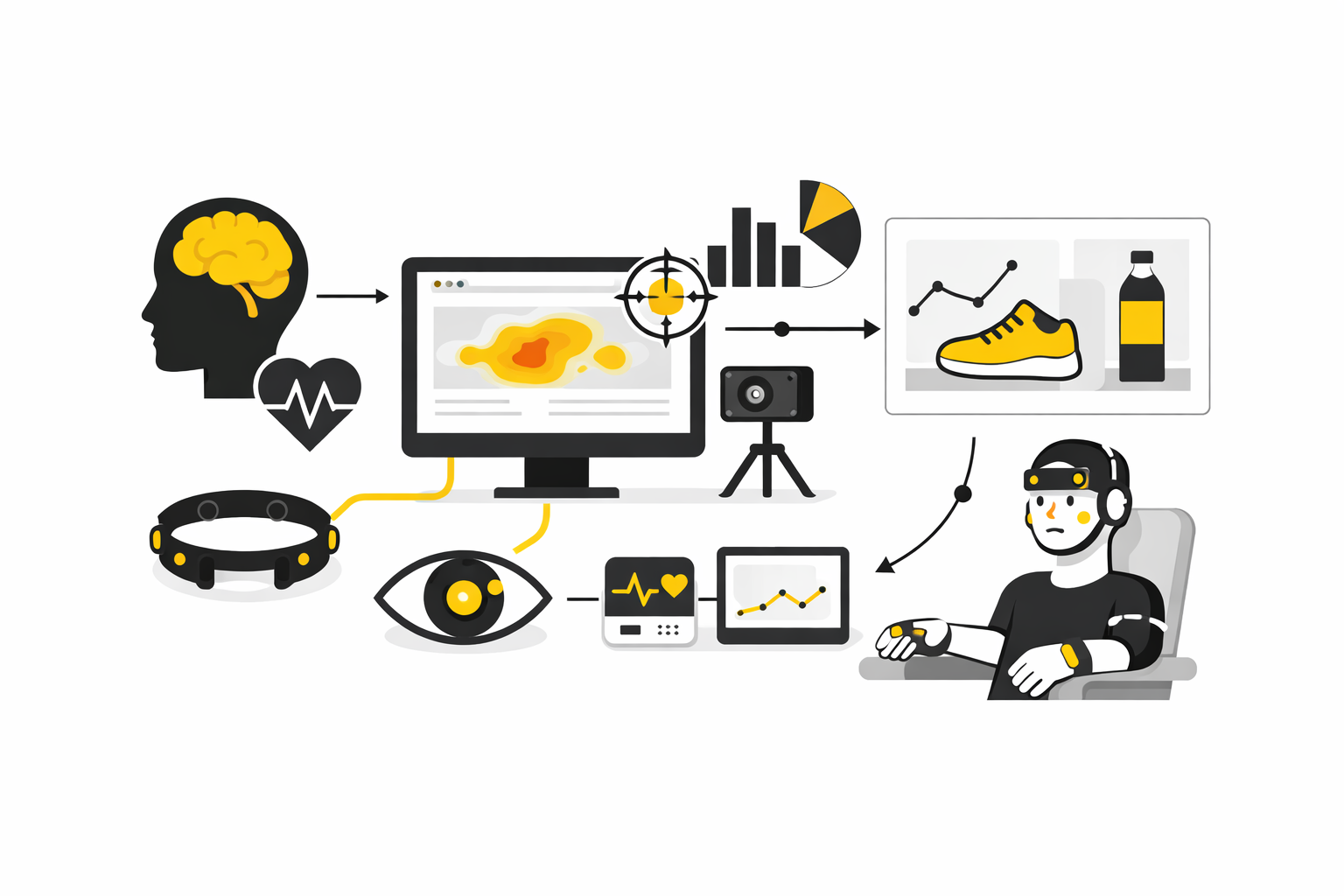
The biggest reason neuromarketing matters is that self-reported answers are often incomplete. People can tell you what they remember, what they think they prefer, or what they want to believe about their choices, but they are much worse at reporting fast, automatic reactions that shape attention, emotional response, and later recall (Frontiers review, Springer EEG review).
That gap becomes expensive in advertising. Kantar’s recent work argues that viewability alone is not enough because there is a real difference between an ad being technically seen and being meaningfully watched, and its analysis links stronger emotional response with much better long-term brand impact (Kantar on attention). In the same direction, Nielsen reported that ads scoring better in neuroscience-based testing delivered a 23% overall sales increase in the sample studied, which is exactly why serious marketers pay attention to these tools.
Neuromarketing also matters because creative quality is getting harder to fake. NielsenIQ’s 2024 research on AI-generated ads found weaker memory activation and more negative intuitive reactions even when some of the ads looked polished on the surface. That is a useful reminder that the brain responds to coherence, relevance, and authenticity before a dashboard tells you whether a campaign “performed.”
There is another reason this topic matters now: marketers are operating in a tighter ethical environment. The FTC’s 2024 review of subscription sites and apps found that nearly 76% used at least one possible dark pattern, while the EU AI Act entered into force on August 1, 2024, pushing harder on transparency, risk, and manipulative uses of AI. So the conversation is no longer just “Can this influence behavior?” but also “Should it be used this way, and under what safeguards?”
The Neuromarketing Framework
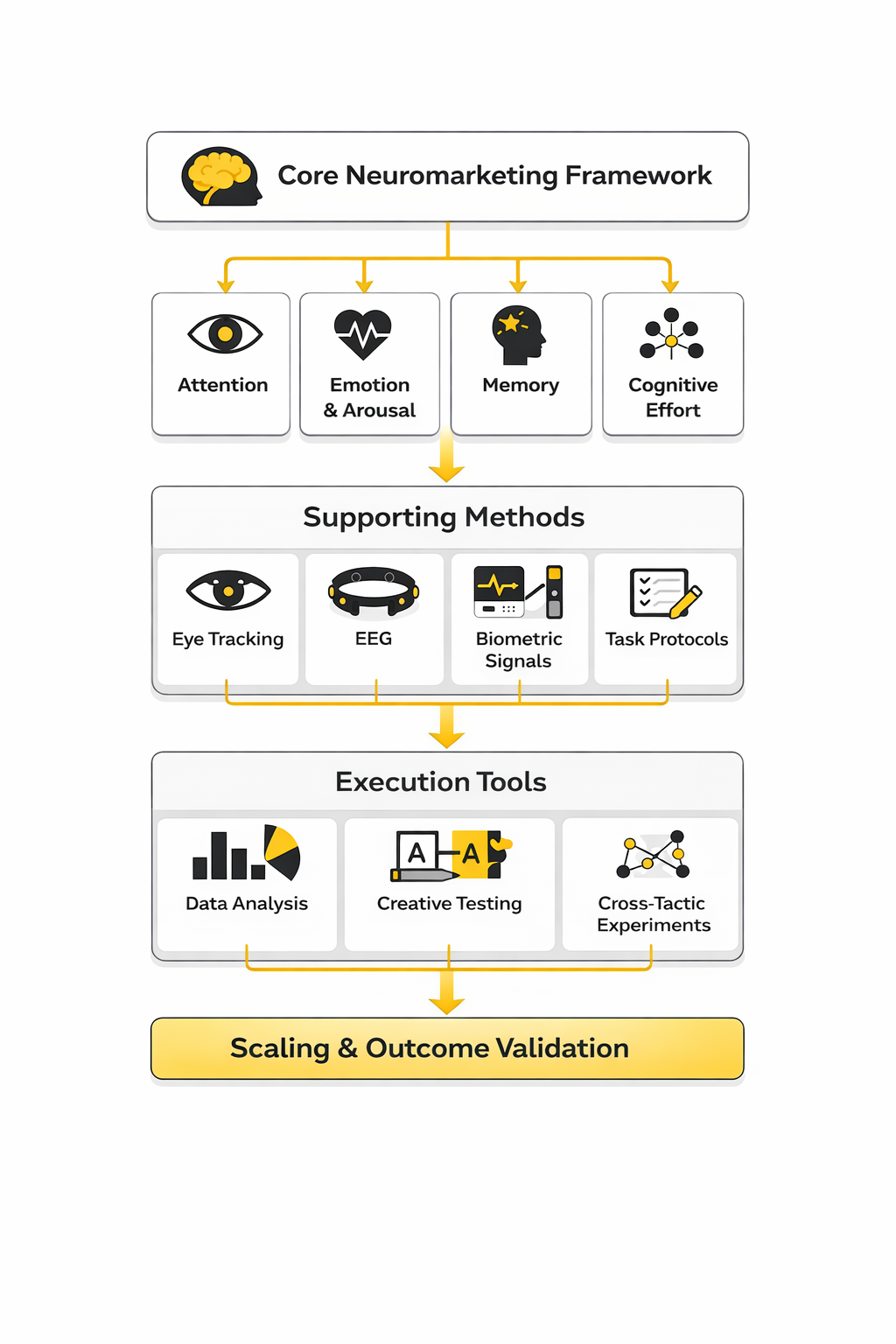
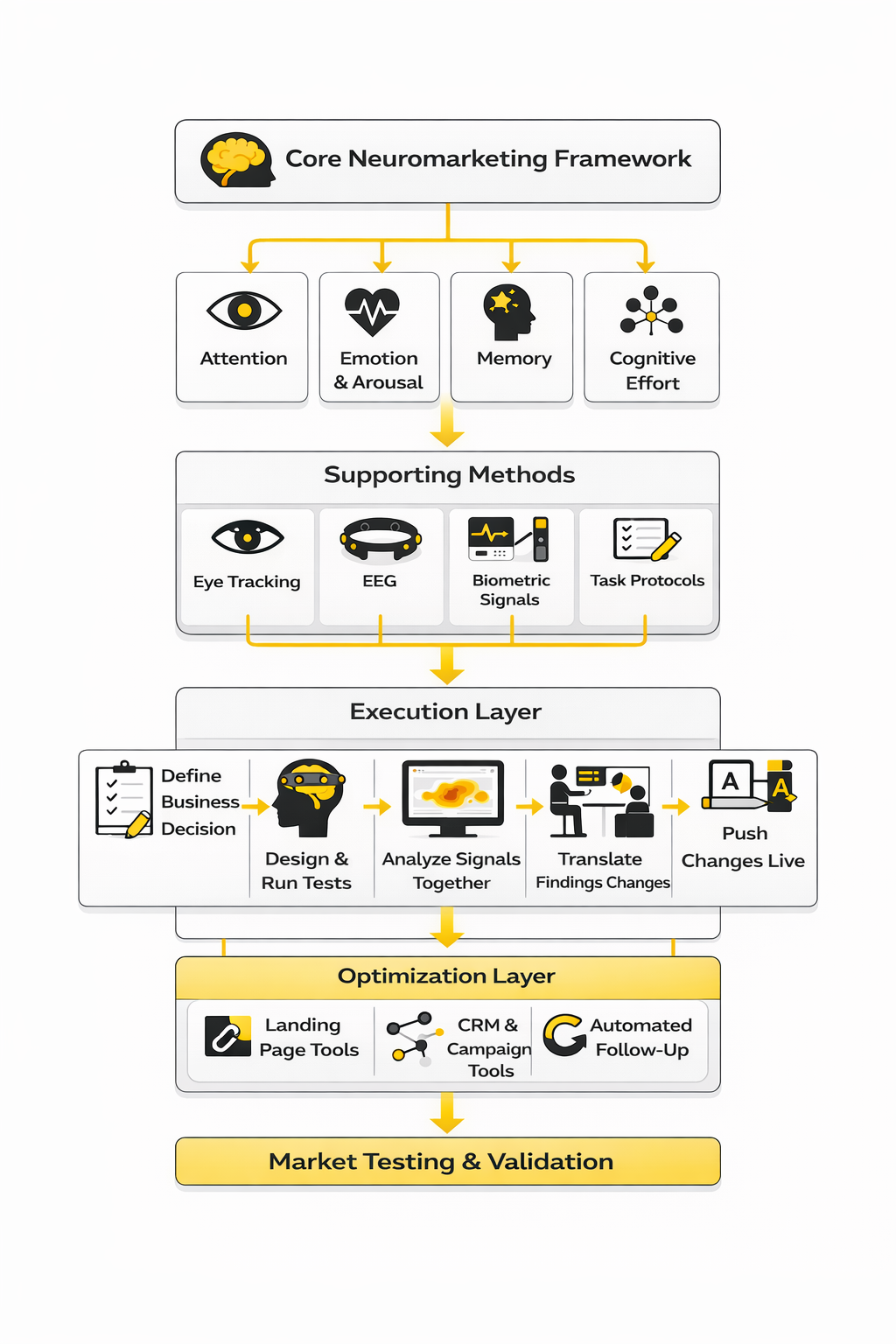
A practical way to understand neuromarketing is to think in four linked stages: attention, emotion, memory, and action. First, a stimulus has to break through enough clutter to be noticed. Then it needs to create some level of emotional significance, because emotion helps determine what the brain treats as worth processing and storing (Ipsos on emotion, attention, and memory, Kantar on emotional involvement).
From there, memory becomes the bridge between exposure and later choice. Kantar’s recent analysis makes the point clearly: ads that evoke genuine emotional responses are more likely to leave memory traces and associations that shape future purchasing decisions, which is why good neuromarketing work is never just about a spike in attention for its own sake (Kantar on emotional involvement). Attention without memory is wasted media spend.
The final stage is action, but that is where people often misunderstand the field. Neuromarketing does not read minds and it does not guarantee a sale. What it does well is improve the odds that a message is noticed, felt, remembered, and connected to the brand in a way that makes future action more likely (Frontiers review, Springer EEG review).
This framework also explains why multiple tools are usually combined. Eye tracking is useful for visual attention and gaze patterns, EEG helps with fast changes in engagement and cognitive processing, and other measures can add context around arousal or effort, which is why recent research keeps emphasizing mixed-method setups instead of one-device answers (Frontiers on neuroscience tools in marketing research, Frontiers review).
The key thing to remember is simple. Neuromarketing is not a replacement for strategy, positioning, pricing, or product quality. It is a sharper lens for understanding the hidden part of response that traditional research often misses, and that makes it especially valuable when brands need to improve creative, packaging, digital experiences, and message design under real competitive pressure (Springer EEG review, NMSBA Code of Ethics).
The Core Signals Marketers Measure
When neuromarketing is done well, marketers are not chasing a mysterious “buy button.” They are measuring a set of signals that help explain how a person moves from noticing a stimulus to processing it, reacting to it, and potentially remembering it later. Recent reviews keep coming back to the same toolkit because the strongest studies usually combine methods instead of pretending one device can explain the whole decision process.
That is the practical shift. Instead of asking one broad question like “Did you like the ad?”, neuromarketing breaks response into observable layers: where attention went, how strongly the stimulus activated arousal or emotion, how demanding the experience felt, and whether the brand or message had a realistic chance of sticking in memory. That is a much better starting point for improving creative, packaging, landing pages, video edits, and retail experiences.
Attention
Attention is the first gate, and eye tracking is usually the most direct tool for studying it. It shows where people look, how long they fixate, how often they return to a visual element, and whether the sequence of gaze supports or disrupts the intended flow of information. That makes it especially useful for packaging design, shelf layouts, websites, product pages, and any creative where visual hierarchy matters.
But attention is also easy to misunderstand. Looking at something does not automatically mean a person understood it, liked it, or encoded it into memory, and newer work makes that limitation clear. One 2024 study on online purchase factors found that some information could influence processing even when people were not directly looking at it, which is a strong reminder that gaze data is valuable but incomplete on its own.
This is why experienced teams rarely stop at heatmaps. Heatmaps are good for presentation slides, but the real value comes from pairing gaze patterns with brain or physiological data that explains whether the stimulus was merely seen or actually processed in a meaningful way. Once you understand that difference, a lot of bad creative decisions suddenly become easier to spot.
Emotion and Arousal
Emotion is where neuromarketing starts to become commercially useful, because emotional significance affects both immediate response and the odds of later recall. Researchers often look at electrodermal activity, heart rate patterns, facial signals, or EEG-related markers to estimate arousal, valence, and engagement during exposure to a message or product experience. These measures do not tell a complete emotional story by themselves, but they do reveal when something lands with force instead of passing through unnoticed.
Arousal matters because not all attention is equal. A page element can attract the eye because it is confusing, jarring, or visually loud, yet still damage persuasion if it produces friction rather than meaningful involvement. That is why neuromarketing work focused on emotional response is often more revealing than simple visibility metrics, especially in categories where brand feel and sensory cues shape the final choice.
There is also a useful discipline here for marketers who love overdesigned creative. If a stimulus produces intensity without coherence, the result may be noise rather than persuasion. Good neuromarketing does not reward drama for its own sake; it looks for emotional responses that strengthen relevance, fluency, and brand connection.
Memory and Cognitive Effort
Memory is the signal that links exposure to later market behavior. A campaign can create a brief reaction and still fail if the brand, offer, or message does not become accessible later when the person is comparing options, scrolling a store shelf, or deciding whether to click. This is why so much neuromarketing work is ultimately about identifying which creative elements improve encoding and which ones overload the viewer before anything durable is formed.
Cognitive effort matters because the brain does not reward clutter. EEG-based work is often used here because it can capture rapid changes related to engagement, processing load, and shifts in response to small changes in packaging, pricing displays, branding, and ad structure. When marketers talk about an experience feeling “too busy” or “too hard to follow,” this is the layer they are usually describing, even if they are not using scientific language.
This is also where multimodal measurement becomes especially helpful. Eye tracking can show whether a message was visually navigable, while EEG or related measures can show whether the sequence felt smooth, confusing, or mentally taxing. Put together, those signals help teams make a far more useful decision than “Which version won?” because they show why one version worked better and what should be changed next.
How Brands Turn Signals Into Creative Decisions
The most valuable output of neuromarketing is not a scientific-looking dashboard. It is a clearer creative decision. Brands use these signals to decide which scene should appear first in a video, where the product should sit in the frame, whether packaging pulls the eye to the brand or to a distracting graphic, and whether the call to action arrives at the right moment instead of feeling bolted on at the end.
In practice, this usually means testing specific variables rather than abstract concepts. A team might compare two packaging concepts, two landing page layouts, or two ad edits and look at differences in attention flow, arousal, and processing effort across the same journey. That approach is much more useful than a vague conversation about whether one version “feels better,” because it turns instinct into something observable.
The strongest implementation is rarely isolated from the rest of the marketing stack. Neuromarketing findings become more powerful when they are combined with conversion data, retention patterns, qualitative interviews, and standard experimentation, because that creates a loop between hidden response and real-world outcomes. On its own, neuromarketing can show where friction or impact exists; inside a broader system, it helps marketers decide what to change first and what to ignore.
That is the real professional standard. Use neuroscience to sharpen judgment, not to replace it. The brands that get value from neuromarketing are usually the ones treating it as a decision tool for creative and experience design, not as a theatrical way to make ordinary research sound smarter.
Professional Implementation
The difference between interesting neuromarketing and useful neuromarketing is process. A serious project starts with a business decision that needs to be made, not with a gadget that needs to be justified. If the team cannot clearly say whether it is trying to improve ad recall, packaging standout, page flow, offer comprehension, or conversion friction, the research usually turns into expensive theater instead of actionable work. (2025 Frontiers review)
That is why the best implementation work looks a lot more disciplined than people expect. It connects a commercial question to a measurable behavioral or neurophysiological signal, runs the test under controlled conditions, and then translates the output into a concrete creative or experience decision. Recent reviews keep emphasizing this multimethod, decision-focused approach because single-tool studies tend to oversimplify consumer response. (2024 systematic review on EEG-based neuromarketing, 2025 review of neuroscience in consumer research)
Start With the Decision, Not the Device
A neuromarketing project should begin with one sharp question. Which package design is easier to process on shelf. Which edit holds attention through the branded moment. Which landing page sequence creates less friction before the form or checkout. Those are strong questions because they imply a real decision and a clear next step.
Weak questions are the ones that sound broad and impressive. “What does the consumer brain think about our brand?” sounds ambitious, but it is too vague to produce a reliable action plan. Strong implementation narrows the problem until the team can connect it to attention, emotional activation, memory potential, or cognitive load in a format that can actually be tested. (2025 Frontiers review, 2024 behavioral economics review on eye tracking in consumer research)
This matters because neuromarketing is not a replacement for product strategy or positioning. It is a measurement layer that helps the team choose between specific alternatives when ordinary feedback is noisy or misleading. Once that is clear, the process becomes much cleaner.
Match the Method to the Problem
Not every project needs the same toolset. Eye tracking is often the best place to start when the challenge is visual hierarchy, packaging layout, retail shelf navigation, or interface flow. EEG becomes more useful when the team needs to understand moment-by-moment engagement, cognitive effort, or the timing of response inside an ad, a shopping task, or a digital experience. (2024 eye tracking research roundup, 2024 EEG review)
This is where many projects go wrong. Teams sometimes choose the most impressive-looking method instead of the one that best fits the decision. The more professional approach is to ask which signal will reduce uncertainty fastest, then combine methods only when the added complexity will improve interpretation rather than clutter it. (2025 Frontiers review)
A practical example makes this obvious. If a brand is testing a product page, eye tracking may show whether the gaze path reaches the price, trust cues, and call to action in the intended order. If the same page also feels overloaded or mentally taxing, adding EEG or related biometric measures can help explain why the path looked acceptable on the surface but the experience still underperformed. (2025 multimodal consumer choice study, 2024 Frontiers study on online purchase factors)
Build the Test Around Real Stimuli
Neuromarketing becomes much more useful when the stimuli look like the real decision environment. That means real packaging concepts instead of generic mockups, real ad edits instead of abstract storyboards, and real screens instead of disconnected page fragments. The closer the test is to the actual choice context, the more likely the findings will translate into something the team can ship with confidence. (2025 Frontiers review)
This is especially important in digital marketing. A landing page headline does not exist by itself. It is processed alongside spacing, hierarchy, proof, form length, page speed, and the emotional tone of the surrounding design. If you are testing performance pages or ecommerce flows, tools such as Replo can make that iteration cycle faster because the page variants are easier to deploy and compare once the research reveals where friction actually lives.
The same logic applies to lead capture and follow-up. A neuromarketing-informed page can still underperform if the handoff into chat, form completion, or nurture is clumsy. That is why execution-minded teams connect research findings to the full funnel, including follow-up systems run through tools like ManyChat or a broader workflow stack such as GoHighLevel. The neuroscience insight only pays off when the operational system is strong enough to use it.
The Step-by-Step Execution Process
Once the objective, method, and stimuli are set, the execution process gets very concrete. This is the stage where neuromarketing stops sounding exotic and starts looking like disciplined applied research. The teams that do it well are usually boring in the best possible way: clear brief, careful protocol, clean data, and hard decisions at the end.
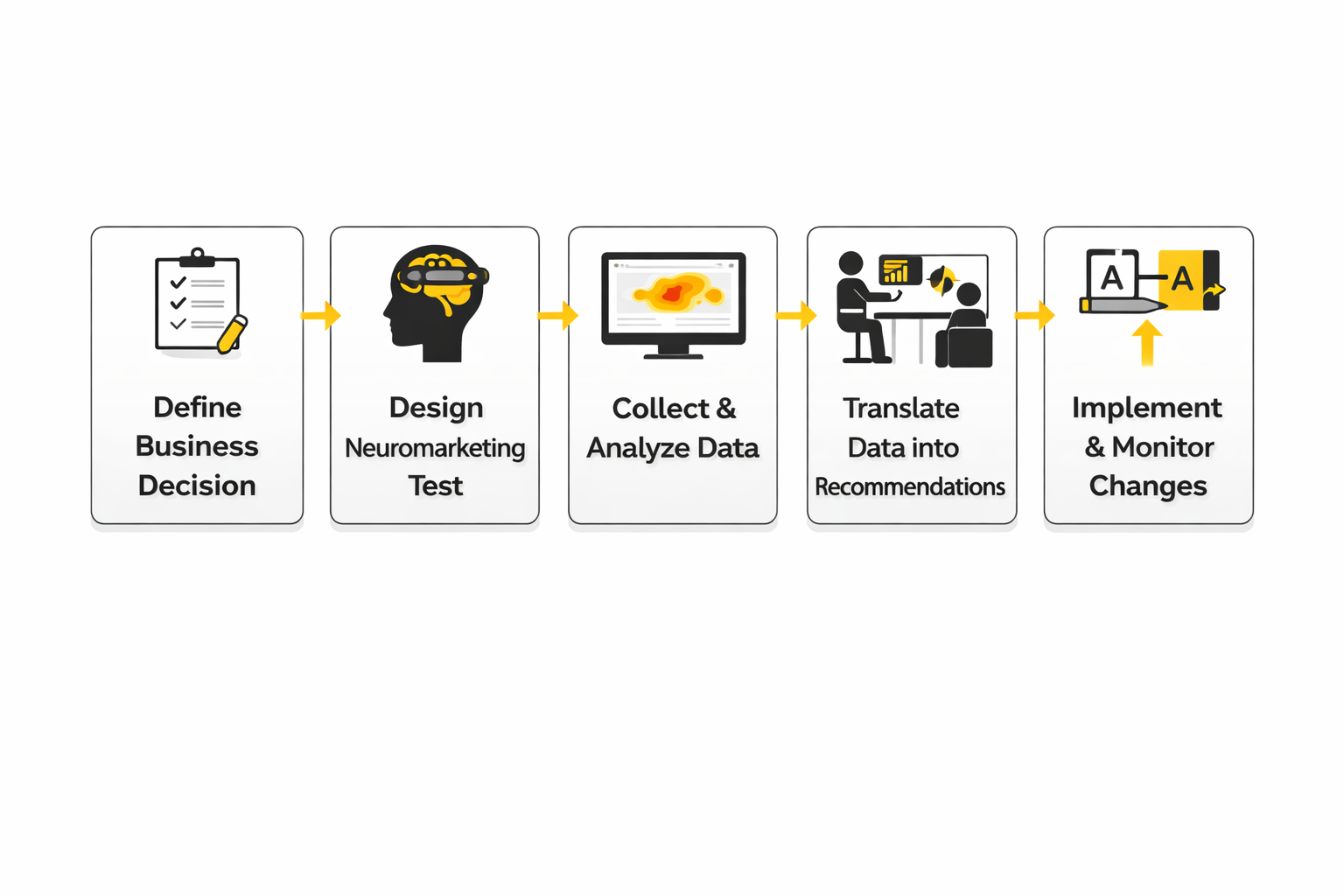
- Define the commercial decision.
- Choose the stimulus set and realistic test context.
- Select the measurement mix that fits the question.
- Recruit participants who resemble the target buyer.
- Run the test with a consistent protocol.
- Interpret the signals together, not in isolation.
- Translate the findings into creative or UX changes.
- Validate the changes with market-facing performance data.
Each step matters because mistakes early in the chain distort everything that follows. If the participant pool is wrong, the test may be precise but commercially irrelevant. If the stimulus is unrealistic, the output may look scientific while telling you very little about the actual moment of choice. (2025 Frontiers review, 2024 EEG review)
The most important step is still the last one. Neuromarketing should produce changes that can be carried back into live campaigns, packaging updates, page experiments, or retail execution. If the team cannot point to a decision that changed because of the work, the project may have been interesting, but it was not implemented professionally.
Turn Findings Into Changes the Market Can Feel
This is where a lot of teams lose momentum. They finish the research, get a thick report, hold one meeting, and then nothing happens. Real implementation means reducing the findings into a short set of actions that creative, ecommerce, growth, and product teams can actually execute within a normal production cycle.
In practice, those actions are often surprisingly specific. Shorten the intro before the brand appears. Remove a distracting visual that steals early gaze from the product. Increase contrast around the claim that carries the most memory value. Rework a landing page sequence so the trust cue appears before the commitment ask. Those are the kinds of decisions neuromarketing is good at informing because they sit right at the intersection of perception and performance. (2022 packaging case study summary, Unravel Research packaging testing overview)
There is also a strong operational principle here: do not dump every insight into one giant redesign. When a team changes too many variables at once, it becomes hard to know what actually improved the result. Implementation works better when the research leads to a prioritized queue of changes, then those changes are pushed into controlled market testing so the business can separate signal from wishful thinking.
Combine Neuroscience With Performance Data
Neuromarketing is strongest when it works alongside standard measurement, not against it. Attention, arousal, and cognitive effort can show why a message or experience feels stronger or weaker before the market fully reveals the answer. Performance data then tells you whether that hidden advantage translated into clicks, conversion, retention, or sales.
This combined model is becoming more important as marketers operate across more fragmented channels. The creative that works in a short-form paid video may fail on a product page. The packaging that wins in isolation may lose on shelf if it weakens brand recognition at distance. Professional implementation keeps that reality in view by treating neuroscience as one layer inside a broader decision system. (2025 integrative review on neuromarketing and the marketing mix, 2025 digital marketing case study)
That is also why execution teams care about the handoff into reporting and automation. Once a page or creative change is made, distribution, follow-up, and CRM structure still determine how much value the improvement captures. A tool like Buffer can support channel-level testing and publishing rhythm, while Brevo can help operationalize message follow-up once the customer journey becomes clearer. The neuromarketing part sharpens the insight, but the stack still has to deliver the outcome.
What Good Implementation Looks Like in Practice
Good implementation is usually less dramatic than the sales pitches make it sound. It does not promise to decode every subconscious motive, and it does not pretend a headset can replace strategic thinking. It gives marketers a more reliable view of how people actually respond to real stimuli, then turns that view into better decisions.
That is the standard worth aiming for. A focused question, the right methods, realistic stimuli, disciplined execution, and a hard link back to creative or commercial action. When those pieces are in place, neuromarketing stops being a buzzword and starts becoming a legitimate advantage.
Reading the Numbers That Matter
Neuromarketing data gets misused when people treat it like a scoreboard with one winning metric. That is not how the field works in practice. The useful question is not whether a number is “high” in isolation, but whether it reveals stronger attention, lower friction, better emotional involvement, or better memory potential for a specific decision in a specific context. (2025 Frontiers review, 2025 integrative review)
That is why good neuromarketing teams do not dump raw EEG traces, gaze plots, and arousal curves into a client deck and call it insight. They translate those signals into practical interpretations: people reached the product too slowly, the brand appeared too late, the claim attracted looks but not sustained processing, or the page demanded too much cognitive effort before the call to action. The numbers only matter when they help a team change something real. (2024 overview of eye-tracking measures, 2025 Frontiers review)
The Most Useful Metrics in Neuromarketing
The first group of metrics is about visual access. In eye tracking work, teams often look at time to first fixation, total fixation time, fixation count, revisit count, and the share of participants who looked at a defined area of interest. These are useful because they show whether the product, brand, claim, price, or button was actually reached, how quickly it was reached, and whether it kept pulling attention back. (2024 eye-tracking metrics overview, 2024 overview of eye-tracking measures)
The second group is about engagement and emotional force. EEG-based studies often focus on patterns connected to attention, workload, and affective response, while electrodermal activity and related biometric measures help estimate arousal during exposure. These metrics matter because a stimulus can be seen quickly and still fail to create enough emotional weight to be remembered or acted on later. (2024 systematic review on EEG in neuromarketing, 2025 Frontiers review)
The third group is about memory potential and downstream effect. This is where neuromarketing becomes commercially interesting, because the goal is not just to win a glance but to increase the odds that the brand, message, or offer remains mentally available later. Industry evidence keeps pointing in the same direction: emotional involvement and memorable brand linkage are much closer to business impact than surface-level exposure metrics alone. (Kantar on emotional involvement and memory, Nielsen on neuroscience-tested ads and sales)
Why Benchmarks Need Context
One of the biggest mistakes in neuromarketing is chasing universal benchmarks that do not really exist. A good time to first fixation on a cereal box in a crowded retail test is not the same as a good time to first fixation on a hero product shot on a minimalist landing page. The environment, the task, the category, the creative density, and the audience all change what “good” looks like. (2024 eye-tracking measures overview, 2025 Tobii consumer research roundup)
That means the most useful benchmark is usually relative, not absolute. Version A versus Version B. Current packaging versus redesign. Old edit versus new cut. Existing product page versus simplified page sequence. The data gets far more valuable when it is used to reduce uncertainty between comparable options instead of pretending there is one universal threshold that defines success across every format. (2025 multimodal consumer choice study, 2025 Frontiers review)
This is also why cross-method interpretation matters. A shorter time to first fixation can be good, but only if it is reaching the right element. More dwell time can be good, but it can also signal confusion when paired with higher cognitive load or fragmented gaze behavior. Neuromarketing numbers become meaningful when they are read together, not when they are cherry-picked to support a favorite design. (2025 in-app eye-tracking and memory study, 2024 study on online purchase factors)
What the Performance Signals Actually Tell You
Fast access to the brand or product usually tells you the visual hierarchy is doing its job. If the eye reaches the intended focal point quickly and a large share of participants actually sees it, the design is at least clearing the first hurdle. That is especially useful in packaging, retail display, short-form video, and landing page headers where early seconds do a huge amount of work. (2024 eye-tracking measures overview, 2025 packaging eye-tracking overview)
Longer dwell time needs more careful reading. It can mean the viewer found the element compelling, but it can also mean the message was hard to decode. That is why marketers should not celebrate attention metrics automatically; they need to ask whether the extra time reflects interest or effort. When the goal is smooth comprehension, long dwell paired with scattered fixations or delayed progression can be a warning sign, not a win. (2024 eye-tracking metrics overview, 2025 Frontiers review)
High emotional response is usually more valuable when it supports memory and brand linkage rather than just raw stimulation. Kantar’s recent work argues that ads which make viewers feel something meaningful are more likely to create memories and associations, and its broader evidence base has also shown that stronger emotional digital ads can generate 4 times the impact of low-emotion videos. That matters because the goal is not to create sensation in isolation. It is to create sensation that reinforces the brand and improves later choice. (Kantar on emotional involvement and memory, Kantar on ad impact)
Weak memory activation is one of the clearest warning signs in the data. NielsenIQ’s 2024 research on AI-generated ads found weaker memory activation and more negative intuitive reactions even when some ads appeared high quality on the surface. For marketers, that is a practical lesson: polished output is not enough if the underlying stimulus does not connect cleanly with recognition, relevance, and existing memory structures. (NielsenIQ AI ad study)
A Simple Analytics System for Interpreting Results
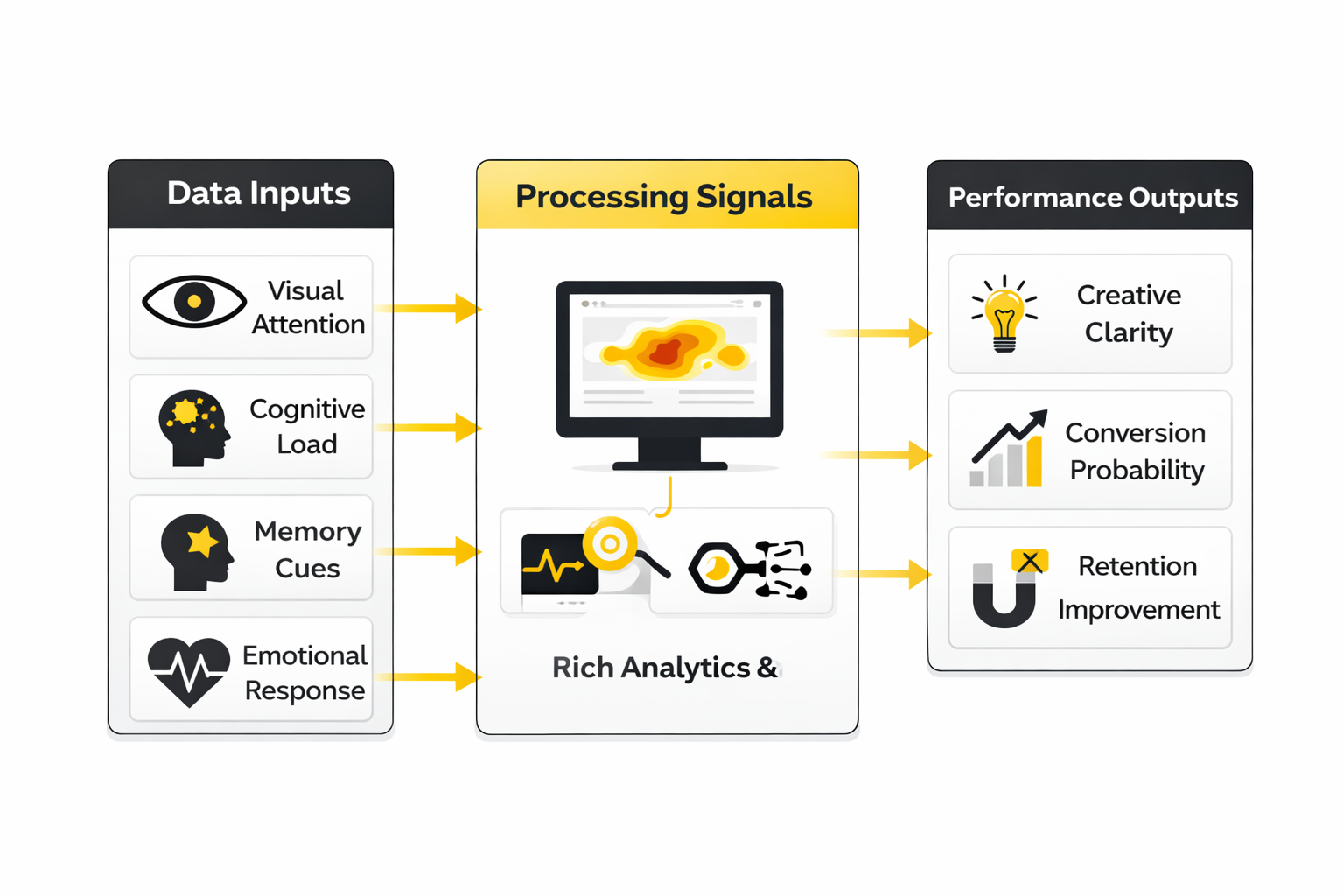
A practical way to read neuromarketing data is to think in four layers. First, did people reach the key element quickly enough. Second, did they process it smoothly or with friction. Third, did the experience trigger emotional involvement strong enough to support memory. Fourth, did the brand remain visible and linked to the strongest moment in the experience. (2025 Frontiers review, Unravel Research on ad effectiveness)
This kind of system is much more useful than staring at raw numbers. A landing page with fast headline fixation but weak progression to the offer may have a message-sequencing problem. A video with strong emotional peaks but poor brand linkage may entertain without building the brand. Packaging with heavy revisits and long inspection time may not be winning attention at all; it may simply be making shoppers work too hard. (2025 in-app eye-tracking and memory study, 2024 eye-tracking metrics overview)
This is the point where the data should force action. Simplify the page. Move the brand cue earlier. Reduce visual competition around the core claim. Shorten the preamble in the ad. Tighten the sequence before the call to action. Neuromarketing analytics are not there to impress a room. They are there to make the next creative decision harder to screw up. (2025 Frontiers review)
The Few Statistics That Actually Matter
A few numbers are worth remembering because they connect measurement to business outcomes. Nielsen found that ads performing better than average in neuroscience-based testing produced a 23% overall sales increase in the sample studied, which is a useful reminder that these signals can matter commercially when the creative difference is real. Kantar has also shown that stronger emotional digital ads can drive 4 times the impact of low-emotion videos, reinforcing the idea that emotion is not decorative; it is part of the performance engine. (Nielsen sales effect study, Kantar on ad impact)
The mistake would be to treat those numbers as guarantees. They are directional evidence, not promises that any ad with a strong arousal curve will suddenly become a sales machine. What they should drive is better discipline: test for meaningful attention, emotional engagement, and memory support before scaling spend, then validate the strongest candidates with live performance data. That is the right relationship between neuromarketing analytics and business results. (2025 integrative review, NMSBA Code of Ethics)
How Marketers Should Use the Data
The right use of neuromarketing data is prioritization. It helps marketers see which creative assets deserve iteration, which packaging concepts are worth advancing, which product pages need simplification, and which emotional moments are strong enough to preserve instead of editing out. It is a decision filter, not a replacement for standard experimentation. (2025 Frontiers review, 2025 neuromarketing and marketing mix review)
This becomes especially powerful when the insight is pushed into execution systems quickly. If research shows a weaker landing page sequence, teams can rebuild and test faster with a tool like Replo. If the issue sits in message timing or follow-up quality after initial engagement, systems like ManyChat or GoHighLevel can help operationalize the fix across the funnel.
That is the cleanest way to think about the data. Do not worship the metric. Read the pattern, understand the friction, make the change, and then verify the result in the market. That is where neuromarketing stops being interesting and starts being useful.
Limits, Ethics, and What Neuromarketing Cannot Do
Neuromarketing gets overhyped when people talk about it as if it can decode hidden motives with total precision. It cannot. Recent reviews describe it as a useful but constrained research discipline that improves visibility into attention, emotion, memory, and decision processes, while still requiring careful interpretation, triangulation, and traditional research context.
That limitation is not a weakness. It is actually the healthy way to use the field. Neuromarketing works best when it reduces uncertainty between real options, such as two page layouts, two edits, or two packaging concepts, rather than pretending to reveal a complete map of the consumer mind.
What Neuromarketing Cannot Do
It cannot replace strategy. If the offer is weak, the product is undifferentiated, or the positioning is muddy, better attention curves will not rescue the business. The research can show where friction or response is happening, but it cannot manufacture market fit that is not there.
It also cannot turn correlation into certainty. A stronger emotional or attentional pattern may align with better market performance, but that does not mean a single neural or biometric signal is a direct proxy for sales in every category and channel. That is why the strongest recent work keeps favoring multimodal designs and external validation over one-metric claims.
And it definitely cannot serve as a moral permission slip for manipulation. The fact that a message can be optimized for subconscious impact does not automatically make that message fair, transparent, or acceptable, especially when it is aimed at vulnerable audiences or deployed in highly personalized digital environments.
The Real Ethical Line
The serious ethical issue in neuromarketing is not the equipment. It is the intent and the deployment. A study designed to make packaging clearer, reduce confusion on a product page, or improve message relevance is very different from a system designed to exploit stress, impulsivity, or asymmetries in consumer understanding.
That distinction matters more now because modern persuasion systems are no longer limited to a single ad or a single screen. The ethical risk rises when consumer neuroscience is combined with AI-driven personalization, behavioral tracking, and automated content variation that can respond at scale to user vulnerability, emotional state, or momentary hesitation.
Regulators are already circling related behavior even when they are not using the word neuromarketing. The FTC’s 2024 international sweep on subscription practices found that nearly 76% of the reviewed sites and apps used at least one possible dark pattern, while the EU AI Act, which entered into force on August 1, 2024, pushes harder on risk, transparency, and harmful manipulation in AI systems. Those developments should matter to any brand trying to combine neuromarketing insight with automated persuasion.
Strategic Tradeoffs Smart Teams Have to Manage
The first tradeoff is depth versus speed. High-quality neuromarketing can reveal things standard analytics misses, but it is slower and more operationally demanding than simply shipping five variants into a live test. That means teams need to reserve it for decisions where hidden friction is costly enough to justify the extra rigor.
The second tradeoff is realism versus control. Lab-style setups give cleaner measurement, but market environments are messy, social, distracted, and competitive. Strong implementation has to balance experimental control with realistic stimuli and realistic decision conditions, otherwise the findings may look precise without traveling well into the real world.
The third tradeoff is personalization versus trust. The more precisely a brand can tailor emotional and attentional triggers, the greater the risk of crossing from relevance into perceived manipulation. This becomes especially sensitive in youth-heavy, health-related, financial, or emotionally charged categories where the long-term brand cost of over-optimization can outweigh any short-term lift.
Scaling Neuromarketing Without Breaking It
One of the most common scaling mistakes is treating a good neuromarketing result like a universal law. A winning structure in one creative format or audience segment does not automatically generalize across channels, cultures, price points, and buying states. Recent reviews on consumer neuroscience applications keep emphasizing heterogeneity in methods, contexts, and interpretive limits for exactly this reason.
A better scaling model is to turn findings into design principles rather than rigid templates. For example, a team might learn that earlier brand linkage, lower visual competition, or faster claim comprehension improves response in one test, then carry those principles into future creative development without assuming the exact same execution will always win. That is how expert teams scale insight while still respecting context.
This is also where operational systems matter. Once the research points to a cleaner page structure or a better flow, teams need fast deployment and follow-up infrastructure to capitalize on it. A stack built around tools such as Replo, GoHighLevel, and Brevo can help teams apply the learning faster, but speed only helps if the underlying interpretation was sound in the first place.
Expert-Level Guidance for Using Neuromarketing Well
The first rule is to use neuromarketing where the upside is asymmetric. It is most useful when a small improvement in clarity, memorability, or emotional response can materially change media efficiency, shelf performance, or funnel economics. It is much less useful when the team is really dealing with a basic strategic problem and hoping neuroscience will make it feel more advanced.
The second rule is to interpret patterns, not isolated spikes. A moment of attention without brand linkage, or emotional activation without comprehension, is not a complete win. The quality of the response matters more than the raw intensity of the response.
The third rule is to protect trust aggressively. The rapid review on neuromarketing ethics and broader work on AI-powered persuasion both point to privacy, autonomy, transparency, and vulnerability as the real fault lines. Brands that ignore those boundaries may still get short-term performance, but they are building on a weaker moral and strategic foundation.
That is the mature view of neuromarketing. It is powerful, but not magical. It is commercially useful, but only when paired with judgment, restraint, and a clear sense of where optimization should stop.
FAQ
What is neuromarketing in simple terms?
Neuromarketing is the use of tools from neuroscience and behavioral science to study how people actually react to marketing, often beyond what they can explain clearly in a survey or interview. It usually focuses on signals tied to attention, emotion, memory, and cognitive effort, then connects those signals to creative, packaging, product, or funnel decisions. The modern research base describes it as a practical measurement layer, not a mind-reading machine.
Is neuromarketing the same as psychology-based marketing?
Not exactly. Psychology-based marketing often uses established ideas about bias, framing, motivation, and decision-making, while neuromarketing adds measurement tools such as EEG, eye tracking, and biometric methods to observe response more directly. The two overlap heavily, but neuromarketing is usually more instrument-driven and more focused on measurable reactions to real stimuli.
Does neuromarketing really work?
It can work well when the goal is specific and the test is designed properly. The strongest use cases involve comparing real alternatives, such as two ad edits, two package designs, or two landing page structures, then using the data to reduce uncertainty before rollout. Its value is highest when it helps explain why something is underperforming, not when it is sold as a magical shortcut to sales.
Can neuromarketing predict sales?
Not directly and not with certainty. Some studies and industry research show meaningful links between neuroscience-based ad testing, emotional response, memory potential, and stronger business outcomes, but those relationships are probabilistic, not guaranteed. A smarter way to use neuromarketing is as an early diagnostic tool that improves creative quality before live market validation does the final filtering.
What tools are most common in neuromarketing?
The most common tools are eye tracking, EEG, facial coding, skin conductance, heart-rate related measures, and sometimes fMRI in more specialized research settings. Eye tracking helps with visual attention and navigation, while EEG and biometric tools help estimate engagement, workload, and emotional activation over time. Recent reviews keep favoring mixed-method setups because no single tool explains the full buying process on its own.
Is eye tracking enough on its own?
Usually not. Eye tracking is extremely useful for understanding where attention goes, how quickly people reach a key element, and whether a design supports a clean sequence of information processing. But it cannot fully tell you whether the attention reflected interest, confusion, mental effort, or emotional impact, which is why stronger studies often pair it with other signals.
Where does neuromarketing help the most?
It tends to help most in places where fast perception matters and traditional feedback is noisy. That includes advertising creative, packaging, product pages, checkout flows, retail displays, app interfaces, and branded experiences where small changes in clarity or emotional force can have outsized performance effects. It is especially useful when a team already has traffic or distribution and wants to improve how the message lands.
Is neuromarketing ethical?
It can be ethical, but only when it is used with clear consent, sound research standards, and honest commercial intent. The biggest ethical concerns in the current literature revolve around privacy, autonomy, vulnerable groups, scientific overclaiming, and the risk of using subconscious insights to support manipulative design. The field’s own ethics codes and newer reviews are very clear that responsible practice depends on restraint, transparency, and participant protection.
How does neuromarketing relate to dark patterns?
This is where things get serious. Neuromarketing becomes risky when insight about attention, friction, or emotional triggers is used to steer people into choices they did not truly mean to make, especially in subscriptions, privacy settings, or high-pressure digital flows. That risk is not theoretical either, because the FTC and international enforcement partners reported in July 2024 that nearly 76% of reviewed subscription sites and apps used at least one possible dark pattern.
Can small businesses use neuromarketing, or is it only for big brands?
Small businesses can use the underlying logic even when they cannot afford formal lab research. The smart version is to borrow the framework: study attention flow, reduce cognitive load, strengthen emotional clarity, improve memory cues, and test those changes with real users and live performance data. Even a lean stack built around better page building, automation, and message sequencing can apply neuromarketing principles without pretending to run a full neuroscience program. Tools like Replo, ManyChat, and GoHighLevel fit naturally into that kind of execution model.
How should marketers interpret neuromarketing data without overreacting?
They should read patterns, not worship isolated spikes. Faster fixation, longer dwell time, or higher arousal only matter when interpreted inside the full context of the task, the creative objective, and the downstream business outcome. Good interpretation asks what the data should change in the work, then checks whether that change improved performance in the market.
What is the biggest mistake companies make with neuromarketing?
The biggest mistake is using it as decoration instead of decision support. Teams sometimes collect sophisticated data, produce an impressive report, and then fail to connect the findings to clear creative, UX, packaging, or funnel changes. The second biggest mistake is overclaiming what the tools can do, which hurts trust and usually leads to bad strategy.
Is neuromarketing becoming more important because of AI?
Yes, and that is one of the most important shifts happening right now. As AI makes it easier to generate more creative variants, more landing pages, more offers, and more automated persuasion sequences, the value of understanding real human attention, emotion, and memory goes up rather than down. At the same time, the ethical risk also rises, which is why newer ethics discussions increasingly focus on the combination of consumer neuroscience, personalization, and AI-driven optimization.
What should a company do before hiring a neuromarketing provider?
Start by defining the business decision that actually needs help. A good provider should be able to explain which question is being answered, why a particular method fits that question, how the test will be run, and how the findings will translate into a real change in creative or customer experience. If the pitch sounds like science theater or vague claims about unlocking the subconscious, walk away.
Work With Professionals
Explore 10K+ Remote Marketing Contracts on MarkeWork.com
Most marketers spend too much time chasing clients, competing on crowded platforms, and losing a percentage of every project to middlemen.
MarkeWork gives you a better way. Browse thousands of remote marketing contracts and connect directly with companies desperate to hire skilled marketers like you, without platform commissions and without unnecessary gatekeepers.
If you're serious about finding better opportunities and keeping 100% of what you earn, explore available contracts and create a profile for free at MarkeWork.com.