

Most marketers say they want to understand why people buy. The problem is that people are not always great at explaining their own decisions. They forget what caught their eye, they rationalize choices after the fact, and they often tell researchers what sounds reasonable rather than what actually happened in the moment.
That gap is exactly why neuromarketing became so interesting. In the academic literature, the term is usually framed as the application of neuroscience and related physiological measurement to marketing questions, with the goal of understanding how people respond to ads, packaging, websites, prices, and brand cues beyond what surveys alone can capture, as outlined in the classic discussion and research agenda on neuromarketing, the open NeuMa dataset paper in Scientific Data, and a recent systematic review of neuromarketing and consumer decision-making.
That does not mean mind reading. In practice, neuromarketing usually means tracking patterns like visual attention, emotional arousal, cognitive effort, memory encoding, and approach or avoidance signals with tools such as EEG, eye tracking, galvanic skin response, facial coding, and, less often in commercial settings, fMRI. The field sits somewhere between behavioral science, experimental psychology, UX research, and media testing, which is why it keeps showing up in both research labs and agency decks.
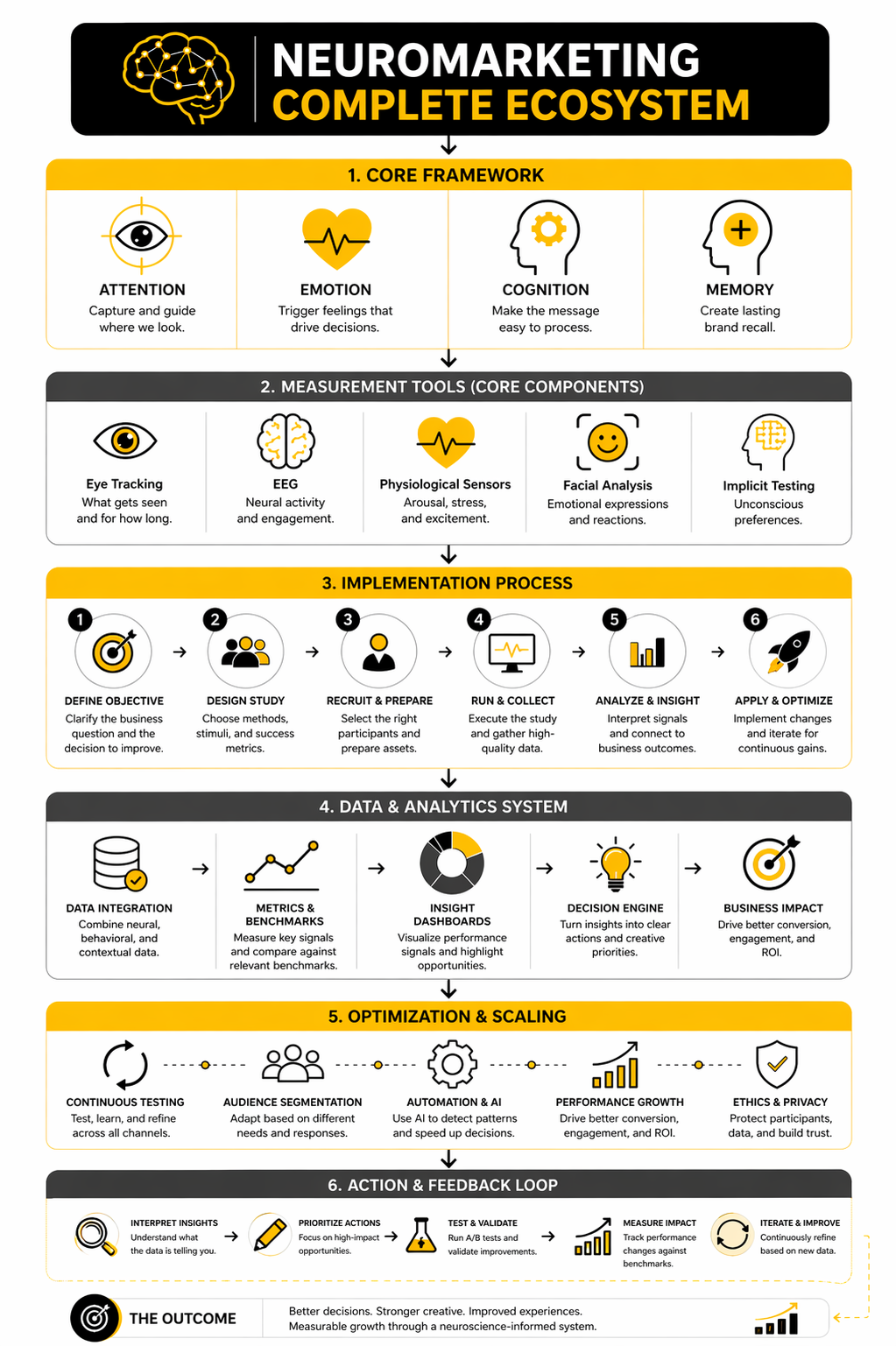
Before going deeper, here is the structure this article will follow from start to finish:
- What Neuromarketing Actually Means
- Why Neuromarketing Matters Now
- The Neuromarketing Framework
- The Core Tools and Signals
- How Brands Use Neuromarketing in Practice
- Ethics, Limits, and What Comes Next
What Neuromarketing Actually Means
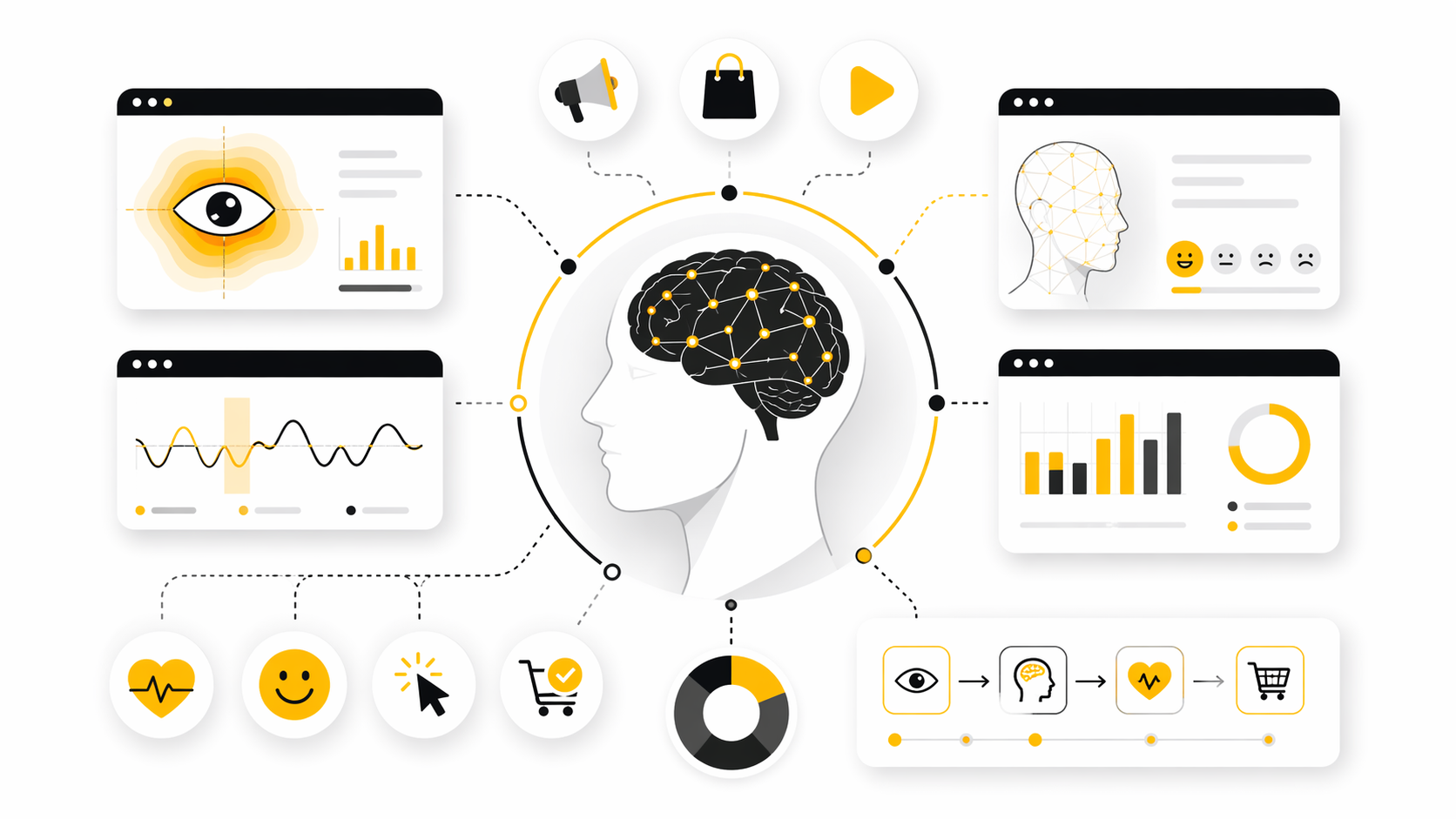
The cleanest way to understand neuromarketing is to stop thinking about it as a magic trick and start thinking about it as a measurement layer. Traditional research asks people what they noticed, what they liked, and what they intend to do. Neuromarketing adds data about what they looked at, how intensely they reacted, how mentally demanding the experience felt, and whether the stimulus created the kind of emotional and memory response that tends to matter later.
That distinction matters because the field is broader than brain scans. A 2024 systematic review of EEG-based neuromarketing shows just how much recent work focuses on practical signal capture and analysis rather than flashy lab imagery, while a 2024 review of EEG in consumer behavior and marketing highlights how researchers are using these methods to study attention, emotion, workload, and choice. In other words, the point is not to stare at a brain image. The point is to reduce guesswork around how real people process marketing stimuli.
The strongest version of neuromarketing also does not try to replace surveys, interviews, or sales data. It complements them. A good research design combines what people say, what they do, and what their physiological responses suggest in the moment, which is one reason recent reviews keep describing the field as interdisciplinary rather than standalone, including the 2025 Frontiers review and the earlier content-analysis review of neuromarketing research.
Why Neuromarketing Matters Now
Neuromarketing matters more today because marketing environments have become brutally noisy. Audiences scroll faster, creative is tested across more channels, and product decisions are shaped by tiny moments of friction that people rarely describe well after the fact. In that kind of environment, methods that capture attention and effort directly become much more useful.
That is also why large measurement firms and research platforms keep investing in neuroscience-informed testing. Nielsen has argued for years that effective advertising depends on a combination of attention, memory, and emotion, and reported in one analysis that ads performing better than average on neuroscience-based testing increased sales by 23% overall. Kantar continues to position neuroscience inside creative testing, and Tobii’s recent consumer research roundups show how eye tracking is being used to study everything from labels to digital interfaces.
There is another reason the topic matters now, and it is less comfortable. As measurement gets closer to emotion, cognition, and neural signals, the ethical stakes rise fast. California’s SB 1223 was signed in September 2024 and added neural data to the definition of sensitive personal information under the CCPA, while UNESCO’s Recommendation on the Ethics of Neurotechnology and its broader ethics work on neurotechnology make it clear that privacy, autonomy, and mental integrity are no longer fringe concerns. So the modern relevance of neuromarketing is double-sided: better insight on one side, bigger responsibility on the other.
The Neuromarketing Framework
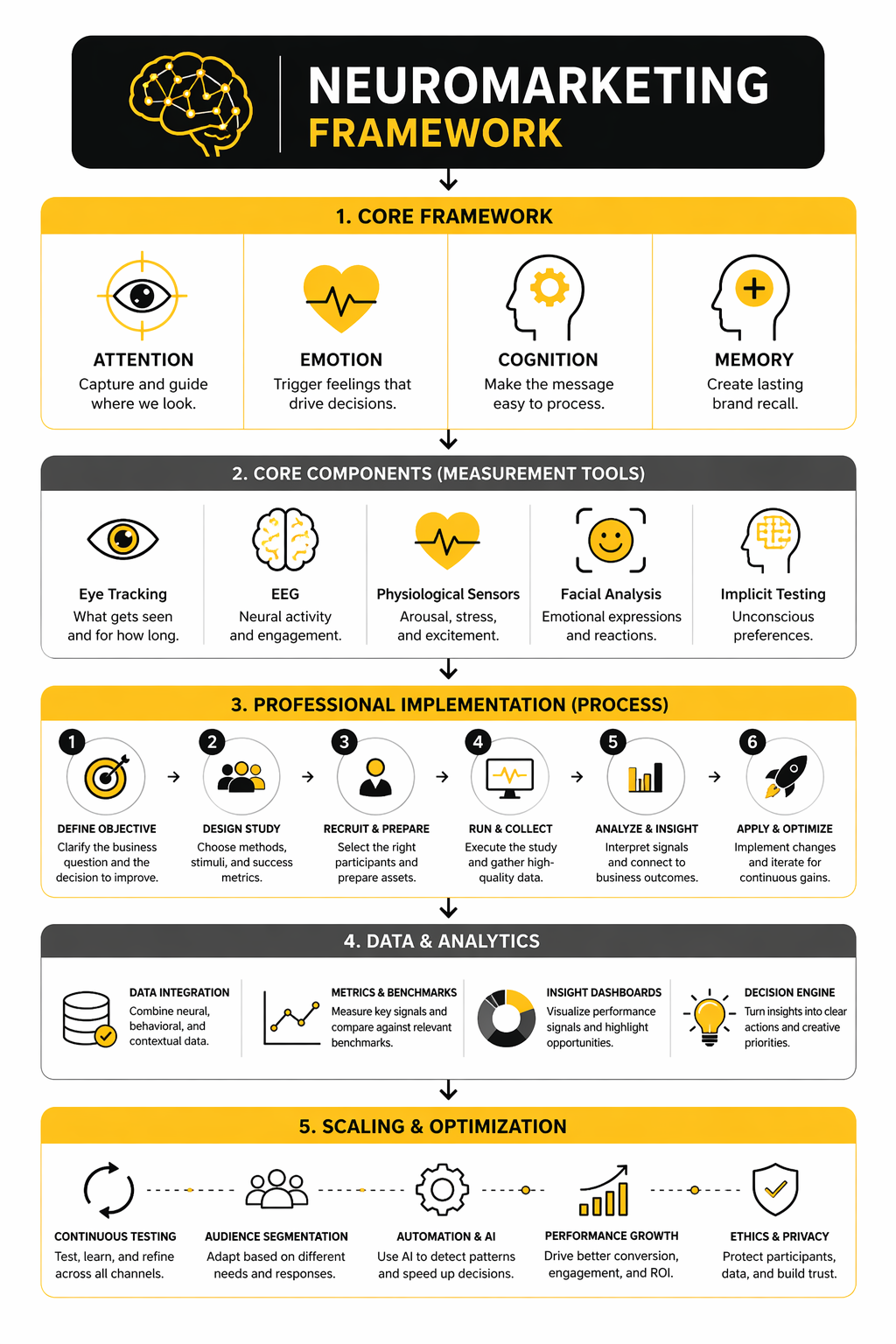
The easiest way to make sense of the field is through a simple sequence: stimulus, signal, interpretation, decision. First, a person encounters something concrete such as an ad, a package, a price, a product page, or a shelf layout. Second, tools capture signals like gaze, arousal, mental effort, or neural activity. Third, researchers interpret those signals in context rather than treating them as proof on their own. Finally, a marketer turns that interpretation into a decision about creative, UX, messaging, packaging, timing, or placement.
That sounds straightforward, but the quality of the work depends on not skipping steps. A spike in arousal does not automatically mean someone loved the ad. Longer visual fixation does not automatically mean stronger persuasion. Recent academic discussions around low ecological validity, reverse inference, and overclaiming in the field keep stressing this exact issue, including the 2025 editorial on machine learning in neuromarketing and consumer neuroscience and the 2025 rapid review of neuromarketing ethics.
So the practical framework is not “scan brains, find the buy button.” It is “measure hidden parts of response more carefully, then combine those signals with behavior and context.” That is the version serious researchers and serious operators can actually use.
In the next part, we will break down the core tools and signals behind neuromarketing, including what EEG, eye tracking, facial coding, galvanic skin response, and related methods can actually tell you without overselling any of them.
The Core Tools and Signals
Once the framework is clear, the next question is simple: what does neuromarketing actually measure in the real world? This is where the field gets more practical and more honest, because every tool sees only part of the picture. The strongest recent overviews of neuromarketing keep making the same point: different methods are useful for different stages of the buying journey, and the best work usually combines them instead of pretending one signal explains everything, as laid out in this 2025 systematic review across buying stages and this 2025 integrative review of neuromarketing and the marketing mix.
EEG: Fast Insight Into Attention, Effort, and Engagement
EEG is one of the most commonly used tools in neuromarketing because it captures electrical activity from the scalp in real time. That makes it especially useful for testing fast-moving experiences like video ads, product demos, landing pages, and in-store stimuli where reactions unfold second by second. A 2024 systematic review of EEG-based neuromarketing and a separate 2024 review covering 118 EEG papers in consumer behavior both show how heavily the field relies on EEG when researchers want time-sensitive signals rather than after-the-fact explanations.
The reason marketers like EEG is not mystery. It can help estimate whether a piece of creative is holding attention, creating cognitive strain, or generating patterns associated with emotional engagement and memory-related processing. That is why EEG keeps turning up in ad testing, and why work on the reliability of EEG metrics for video advertisements matters so much right now. If the metric is not stable, the insight is not worth much.
Still, this is exactly where people oversell neuromarketing. EEG does not tell you that someone “will buy” with perfect certainty, and it definitely does not decode a complete thought. What it does well is reveal patterns in attention, workload, and engagement that are hard to capture through self-report alone, which is useful, but only if the analysis stays disciplined.
Eye Tracking: Seeing What People Actually Notice
If EEG is strong on timing, eye tracking is strong on visibility. It shows where people look, what they ignore, how long they fixate, and what they revisit before making a choice. That makes it one of the most practical tools in neuromarketing for testing packaging, shelf layouts, comparison tables, navigation menus, labels, and product pages, which is why recent Tobii consumer research summaries from Q4 2024 and Q2 2025 keep highlighting applications in labelling, interfaces, and digital decision-making.
This matters because visual attention is often the first gate. If shoppers never notice a price cue, sustainability claim, CTA, logo, or product benefit, the rest of the persuasion sequence never gets a chance. Recent work on eye-tracking studies in online shopping and additional consumer eye-tracking publications gathered by Tobii makes that point very clearly: attention is not the whole decision, but it is often the opening move.
But eye tracking also has a limit that smart marketers need to respect. Looking at something does not automatically mean liking it, trusting it, or remembering it later. Eye tracking answers the question “did this get seen?” far better than it answers “did this persuade?”
Facial Coding and Skin Response: Reading Arousal More Than Meaning
Facial coding and skin conductance are often grouped together because both are used to get closer to emotional response without relying on verbal explanations. Facial analysis tries to infer affect from expressions, while galvanic skin response tracks changes in skin conductance linked to physiological arousal. In plain English, these tools are often less about what a person says they feel and more about whether a stimulus triggered a measurable reaction at all, which is why recent work on automated emotion recognition in marketing research and GSR in advertising evaluation is drawing attention.
Used well, these tools can be valuable. Skin response is especially helpful when you want to know whether a scene, message, review, price reveal, or UX moment increased arousal, and that kind of signal has already been used in work on online reviews and emotional contagion and broader communication research summarized in this review of neuromarketing tools in communication studies. Facial coding can add another layer by spotting patterns in visible reactions during ad exposure, retail interactions, or digital browsing.
But this is where interpretation gets tricky fast. Arousal is not the same thing as positive emotion, and a facial expression is highly dependent on context, culture, and the limits of the model doing the classification, which is why the 2025 review on automated emotion recognition spends real time on theoretical and practical weaknesses. So these methods can be useful, but they are at their best when they support other evidence rather than carry the whole story on their own.
fMRI and Other High-Resolution Methods: Powerful, Expensive, and Less Practical
fMRI gets the most public attention because brain scans look dramatic. It can offer high spatial resolution and help researchers study which brain regions are more active during exposure to brands, prices, product categories, or emotional stimuli. That is part of why consumer neuroscience continues to attract researchers working on theory-heavy questions, including newer work featured in Frontiers research on machine learning in consumer neuroscience and broader discussions of non-invasive neuroscience tools in marketing.
In commercial terms, though, fMRI is not usually the default tool. It is expensive, lab-heavy, slower to deploy, and less suited to routine website or creative optimization than methods like eye tracking or EEG. That is why the practical side of neuromarketing has leaned harder toward scalable tools that can be used in repeated testing cycles.
This distinction matters because marketers sometimes confuse “most advanced” with “most useful.” A premium brain-imaging setup may be fascinating for theory or flagship research, but a brand trying to improve a PDP, a checkout flow, or a six-second ad often gets more usable answers from simpler measures. In neuromarketing, the right tool is the one that matches the question, not the one that looks most scientific in a pitch deck.
What These Signals Can Tell You, and What They Cannot
Across all of these methods, a pattern shows up again and again. Neuromarketing tools are strongest when they help answer narrow, operational questions like which scene loses attention, which package element gets ignored, which screen creates cognitive friction, or which message creates more arousal and recall potential. They are much weaker when people try to stretch them into broad claims about hidden desires, guaranteed sales, or complete psychological truth, a concern raised both in the 2025 ethics rapid review and in the growing discussion around scientific rigor and stage-specific measurement in neuromarketing.
That is the real professional standard. A serious neuromarketing setup does not treat signals as magic. It treats them as additional evidence that can sharpen decisions when combined with behavioral data, controlled experiments, interviews, sales outcomes, and good judgment.
And that is the bridge to the next section. Once you understand what the tools can actually measure, the more interesting question is how brands use neuromarketing in practice without turning the process into pseudoscience or theater.
How Brands Use Neuromarketing in Practice
This is where neuromarketing either becomes useful or turns into expensive theater. The brands that get value from it do not start with a vague goal like “understand the customer’s brain.” They start with a concrete business question, tie it to a decision that actually matters, and then choose the lightest method that can produce a credible answer.
That sounds obvious, but it is the difference between research that changes outcomes and research that just decorates a slide deck. Recent reviews of neuromarketing keep showing that the field works best when it is connected to specific stages of decision-making and specific elements of the marketing mix, not when it is treated like a mystical all-purpose truth machine in Frontiers’ 2025 stage-based review and the 2025 integrative review on neuromarketing and the marketing mix.
Start With One Commercial Question
The first step is narrowing the scope. A serious neuromarketing project usually asks something operational, like which opening scene loses attention, whether a product claim is actually seen, whether a pricing layout creates friction, or whether a landing page directs the eye in the intended order. That is a far better starting point than broad questions about brand love or hidden motivation because it gives the research team something they can test and the marketing team something they can change.
This is also why so much commercial neuromarketing work clusters around ad testing, packaging, retail visibility, and digital UX. Those are high-leverage environments where small adjustments can change how people notice, process, and remember information. The practical studies highlighted in Tobii’s 2024 eye-tracking research roundup make that especially clear, with recent work focused on label visibility, sustainability cues, and interface behavior rather than abstract psychological storytelling.
Match the Tool to the Decision
Once the question is clear, the next step is choosing the right measurement setup. If the problem is visual hierarchy, eye tracking is often the most direct option. If the problem is moment-by-moment engagement in a video or ad, EEG may be more helpful. If the team wants to understand arousal around a reveal, a message shift, or a stressful checkout moment, skin conductance can add useful context.
This part matters more than most people realize because neuromarketing is full of tool mismatch. Teams sometimes use heavy methods when a lighter one would answer the question faster, or they use a sexy method even though the business decision really depends on basic behavioral evidence. Good implementation is not about collecting more signals. It is about collecting the signal that best fits the decision in front of you.
Build the Test Around Real Exposure
The next practical move is designing the stimulus so it resembles the real moment of choice as closely as possible. That might mean showing a full ad rather than a still frame, testing a product detail page in realistic screen dimensions, or presenting shelf stimuli with competitor context instead of isolated packaging. If the exposure is too artificial, the findings may look clean in the lab and fall apart in the market.
That concern shows up constantly in serious writing about the field. Researchers and reviewers keep warning about ecological validity because a neat signal captured in an unrealistic setting can be deeply misleading, a point raised again in the 2025 rapid review on neuromarketing ethics and limitations and the broader 2025 editorial on machine learning, rigor, and neuromarketing interpretation. If the setup does not resemble real consumption, the confidence should drop immediately.
Combine Implicit Signals With Behavioral Evidence
This is the step that separates professional implementation from overclaiming. Neuromarketing signals should almost never stand alone. The most defensible process combines implicit measures with behavioral outcomes such as click-through, recall, completion rate, product choice, shelf selection, task success, dwell time, or downstream sales lift.
In practice, that means you do not stop at “people looked at this area first” or “engagement rose here.” You ask whether the signal lined up with what happened next. Did recall improve, did confusion fall, did selection change, did the winning creative perform better in market, and did the new layout reduce friction? Without that second layer, the signal is interesting but not yet commercially useful.
A Practical Neuromarketing Workflow
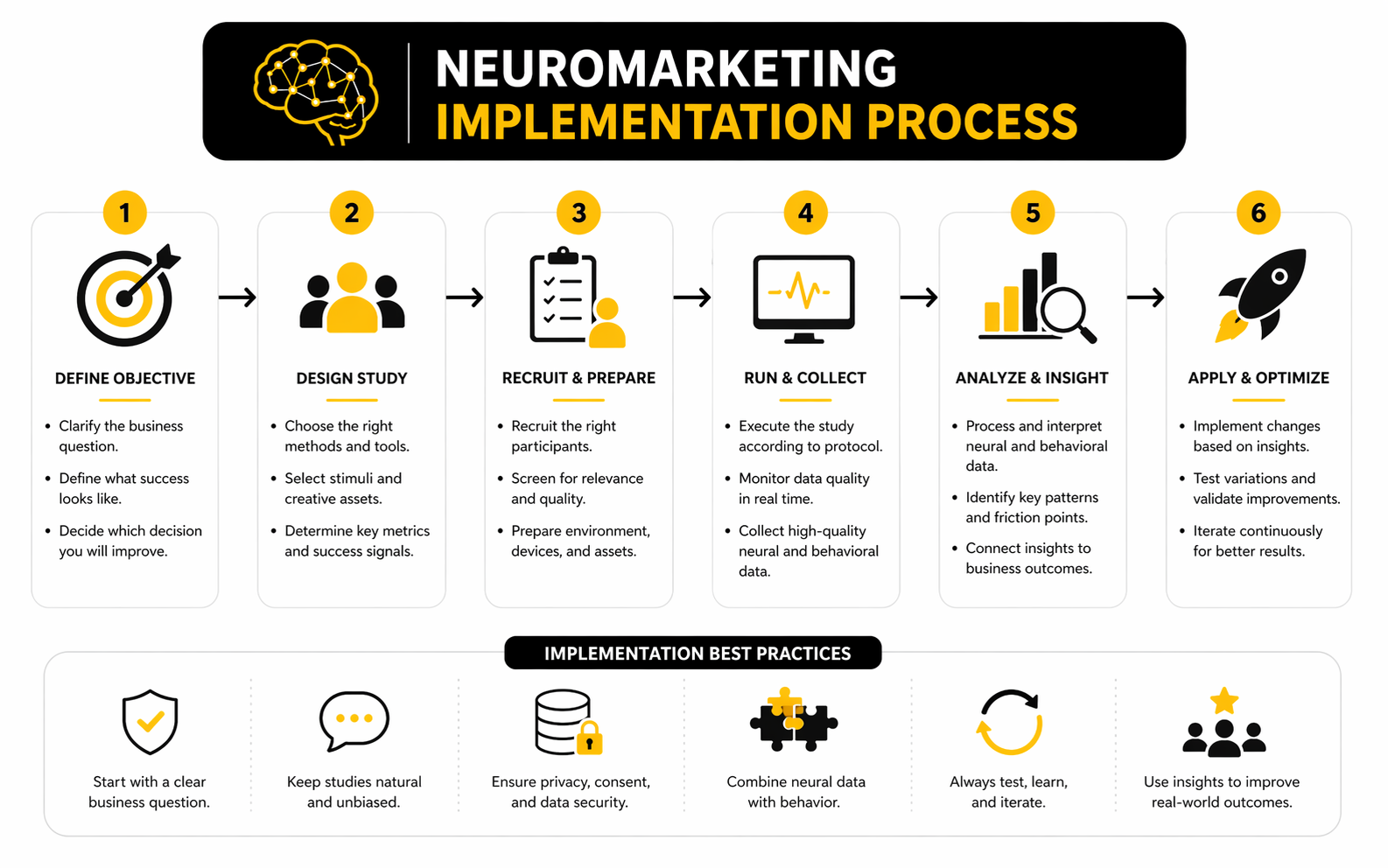
At this point, the execution process becomes much more tangible. Most strong neuromarketing projects follow a sequence that is far less glamorous than people expect, but far more useful.
- Define the business decision. Pick one decision that will change if the research finds something meaningful. That might be choosing between two ad cuts, restructuring a pricing table, or redesigning the order of elements on a product page.
- Choose the core hypothesis. State what you believe is happening before the test begins. For example, you may think the current creative loses attention in the first three seconds, or that a trust signal is placed too low to affect decision-making.
- Select the measurement stack. Use the minimum set of tools that can answer the question. That often means eye tracking plus behavior, EEG plus ad exposure, or biometrics plus a controlled digital task.
- Create realistic stimuli. Test real assets, real screens, real durations, and, when possible, real competitive context. The more artificial the setup, the more cautious the interpretation should be.
- Run the study and interpret cautiously. Look for converging evidence rather than one flashy signal. A fixation pattern, a spike in arousal, and a drop in task success do not all mean the same thing.
- Translate findings into changes. This is where the money is either made or wasted. The research should lead to an edited scene, new CTA placement, simplified copy, a different pack layout, or a more effective sequence of proof elements.
- Validate with market outcomes. The final checkpoint is not whether the chart looks compelling. It is whether the revised asset performs better in live conditions.
That sequence may sound basic, but that is the point. Neuromarketing works best when it behaves like disciplined decision research, not like a performance of scientific sophistication.
Where the Method Shows Up Most Often
In the market, neuromarketing tends to be used in a few repeatable zones because those are the places where hidden friction costs real money. Creative testing is the most obvious one, since marketers need to know whether an ad captures attention, creates emotional traction, and leaves something memorable behind. This is exactly why firms like Kantar frame neuroscience-enhanced ad testing around emotional impact and memorability and why Nielsen links stronger emotional response to stronger sales outcomes.
The second major area is digital experience. Product pages, comparison tables, landing pages, and checkout flows are full of tiny attention and effort problems that users rarely describe well. Eye tracking and related measures are useful here because they show whether the information architecture is helping the decision or quietly getting in the way.
The third area is packaging and retail. That includes how quickly a product gets noticed, which claims are actually seen, whether sustainability or nutrition labels compete with brand cues, and how design changes affect navigation on a crowded shelf. That is why recent eye-tracking research collected by Tobii’s consumer studies program keeps returning to labels, shelf communication, and visual hierarchy.
What Good Implementation Looks Like Inside a Marketing Team
A mature team does not treat neuromarketing as a replacement for strategy. It treats it as a way to reduce blind spots in execution. Strategy still decides who the offer is for, what problem it solves, how the brand should sound, and what the positioning needs to be. Neuromarketing helps check whether the execution of that strategy is being processed the way the team thinks it is.
That is a subtle but important distinction. If the positioning is weak, no amount of eye tracking will save it. If the offer is confusing, EEG will not magically create product-market fit. But once the fundamentals are in place, neuromarketing can become a sharp diagnostic layer for identifying where attention drops, where friction rises, and where memory signals are not strong enough to support performance.
The Biggest Implementation Mistakes
The first mistake is using neuromarketing to answer a question that simple experimentation could answer faster. If a straightforward A/B test can resolve the issue, run that first. Neuromarketing earns its place when the team needs to understand why an asset is underperforming or when the response pattern is too fast, subtle, or unconscious for self-report alone.
The second mistake is treating physiological signals as proof of persuasion. Attention, arousal, and engagement are meaningful, but they are not identical. A strong reaction may reflect excitement, confusion, stress, novelty, or even dislike, which is why interpretation without context is dangerous.
The third mistake is forgetting the economics. Neuromarketing should be applied where the upside is large enough to justify the added rigor. That is easy to defend for major creative launches, high-volume PDPs, expensive acquisition funnels, and retail environments where small gains scale. It is much harder to defend when the stakes are low and the method is being used mainly because it sounds advanced.
The next section needs to deal with the uncomfortable part directly: the ethical boundaries, legal pressure, and practical limits that determine whether neuromarketing stays a useful research discipline or drifts into manipulation theatre.
What the Data Actually Tells You
By this point, the biggest mistake would be treating neuromarketing data like a scoreboard with one magic number. That is not how good teams use it. The real value comes from reading multiple signals together and asking a harder question: what changed in attention, effort, emotion, or memory, and what should we do differently because of it?
That is why the best recent reviews frame neuromarketing as a measurement system rather than a prediction machine. The field keeps coming back to the same core families of variables: attention, affect, cognition, and memory-linked processing across different stages of the buying journey, as synthesized in the 2025 Frontiers review on consumer buying stages and the broader 2025 overview of non-invasive neuroscience in marketing. The data matters only when it helps you decide what to keep, what to cut, and what to redesign.
The Four Signal Groups That Matter Most
Most neuromarketing analytics can be organized into four buckets. The first is attention, which tells you whether people actually looked at the thing you wanted them to see. The second is emotional response or arousal, which tells you whether the stimulus triggered a measurable reaction at all. The third is cognitive effort, which helps reveal whether the experience felt smooth or mentally taxing. The fourth is memory-related processing, which matters because brand and message effects depend heavily on what sticks after exposure.
This structure is much more useful than obsessing over isolated charts. An ad can generate attention but weak memory signals. A product page can create arousal because it is confusing, not because it is persuasive. A package can earn long fixations because shoppers are struggling to decode it. That is exactly why interpretation has to stay tied to the business question rather than the visual drama of the data.
Attention Metrics: Useful, but Easy to Misread
Attention is often the first metric marketers look at because it feels intuitive. Eye tracking gives you measures like time to first fixation, fixation duration, dwell time, scan paths, and visibility across areas of interest. Those metrics are extremely useful for ads, packaging, retail layouts, labels, and product pages because they answer a basic question quickly: did the key element get seen, and in what order?
Recent eye-tracking work collected by Tobii’s consumer research program in late 2024 shows exactly why this is valuable. The studies highlighted there focus on sustainability labels, nutrition cues, digital interfaces, review displays, and product visibility. That is not random academic curiosity. It reflects the places where attention patterns influence whether a message ever gets a chance to work.
But attention is not persuasion. A fixation tells you that the eye landed somewhere, not that the mind agreed with it. So the action from attention metrics is usually structural: move the claim higher, reduce clutter, simplify the path, tighten the hierarchy, or make the branding legible sooner.
Emotion and Arousal Metrics: Strong Signal, Messy Meaning
Emotional and arousal-related signals often come from galvanic skin response, heart rate variation, facial coding, or neural activity tied to social-affective response. These metrics matter because buying decisions are not purely rational, and advertising performance especially depends on emotional traction. A 2024 Journal of Marketing Research paper on video ad liking found that emotion and memory were the earliest predictors after the first three seconds, and that social-affective neural signals improved out-of-sample prediction of ad liking.
That is a big deal because it points to timing, not just outcome. It suggests that the opening seconds of creative deserve much more scrutiny than many teams give them. If early emotional response is flat, the ad may already be in trouble before the message architecture even has time to unfold.
Still, this is where a lot of neuromarketing talk goes off the rails. Arousal is not automatically positive. A spike can reflect excitement, surprise, tension, stress, or confusion. So the action here is not “we got a spike, therefore the ad works.” The action is to compare that spike with scene context, attention flow, recall, and downstream behavior.
Cognitive Load Metrics: Friction Hides Here
One of the most underrated uses of neuromarketing is measuring effort. When a page, an ad, or a shelf experience asks for too much mental decoding, performance usually drops even if the team cannot explain why. EEG, pupillometry, task performance, and gaze patterns can all contribute to understanding whether the experience feels smooth or cognitively expensive.
This matters more in digital journeys than many marketers realize. If users hesitate, loop visually, miss the value proposition, or fail to process the sequence of proof elements, the problem is often not weak traffic. It is overload. That is why cognitive-load reading is often more commercially useful than trying to infer broad emotional states.
The decision it drives is usually simplification. Reduce competing elements, clarify the reading order, compress the message, and remove anything that forces the user to interpret instead of recognize. In neuromarketing terms, less friction often beats more stimulation.
How Benchmarks Should Actually Be Used
Benchmarks are useful, but only when they are treated as context rather than truth. Big research platforms rely on norms because a raw score means little in isolation. Kantar’s 2025 creative testing materials describe comparison against relevant advertising benchmarks drawn from a database of more than 250,000 creative tests, which is valuable because it helps teams understand whether a result is weak, average, or unusually strong for a given format or market.
That said, a benchmark is only as good as the comparison class. A six-second social ad should not be interpreted like a long-form TV ad. A retail shelf test should not inherit norms from a mobile UX study. A beauty product page and a B2B pricing table are not the same cognitive event. Good benchmarking gets specific fast.
The right way to use benchmarks is to ask three questions. Is this metric strong relative to comparable assets? Is it strong in the moment that matters most? And does it connect to an outcome we actually care about? If the answer to the third question is missing, the benchmark may be interesting but not actionable.
Reliability Matters More Than Fancy Dashboards
This is the part most people skip, and they should not. A metric that looks scientific but behaves inconsistently is not a reliable business input. That is why the 2025 Journal of Advertising study on EEG reliability in video ad testing matters so much. The work, summarized clearly by the Neuromarketing Science & Business Association, found that intersubject correlation performed best, while alpha-asymmetry was highly unreliable, and that many EEG metrics need roughly 30 to 40 participants for stable results.
That should change how marketers read any report. If a supplier cannot explain sample size, repeatability, or which measures are stable enough to trust, the visuals should not impress you. Reliability is not a boring technical footnote. It is the difference between insight and noise.
The action this should drive is simple: ask harder questions before buying the conclusion. What metric was used, how stable is it, how large was the sample, and was the result replicated across exposures or segments? If those answers are weak, confidence should drop.
What a Good Analytics Stack Looks Like
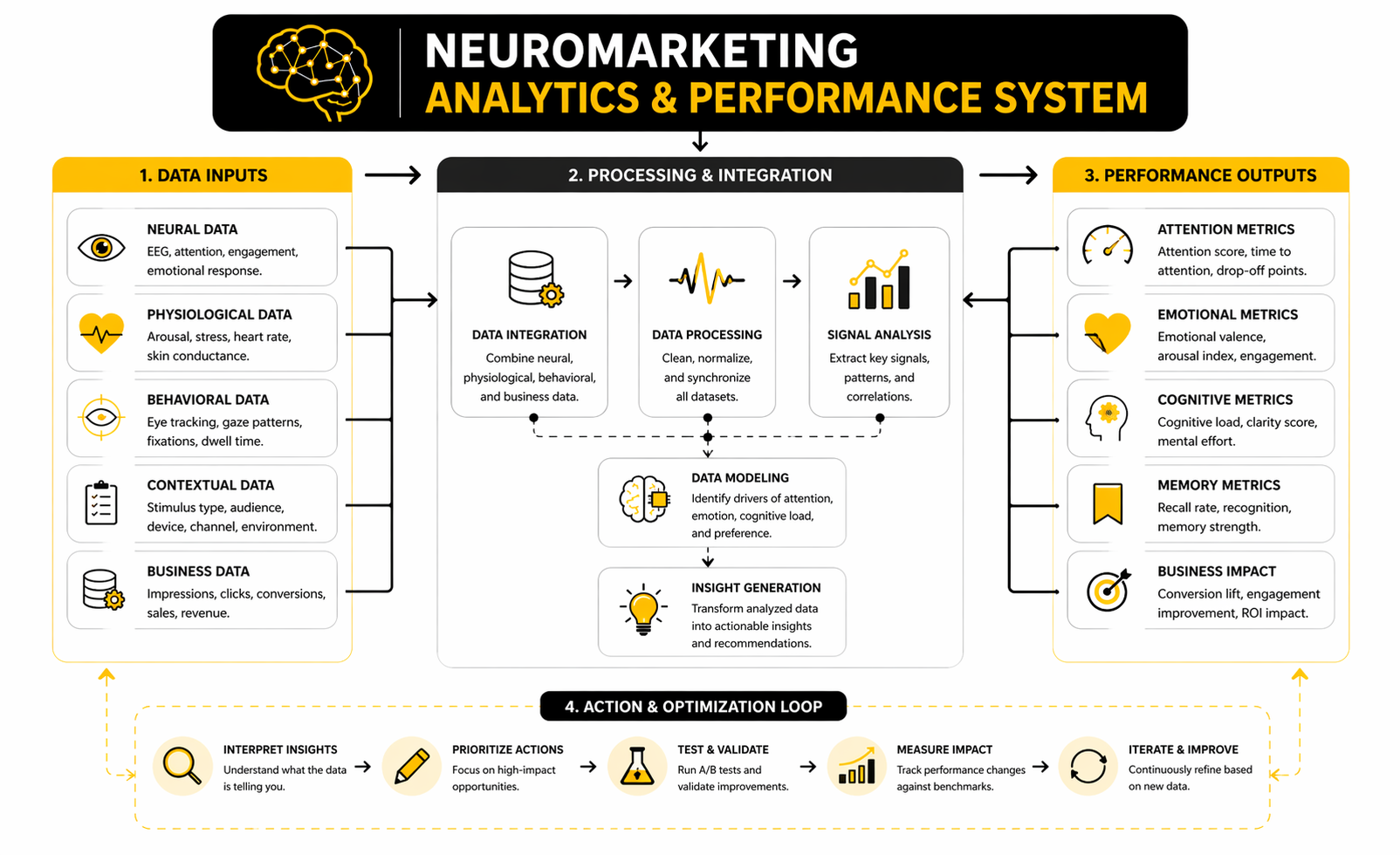
A strong neuromarketing analytics system does not depend on one method. It usually combines implicit data with explicit and behavioral data so the team can see not just what people felt or noticed, but whether those reactions translated into better outcomes. That may include eye tracking plus task success, EEG plus recall, skin conductance plus scene analysis, or implicit response plus in-market lift.
This layered model is where the field becomes genuinely useful. Nielsen’s work on neuroscience-informed ad testing found that ads performing above average on these measures increased sales by 23% overall. That does not mean every emotional ad will drive a 23% lift. It means emotional response can become commercially important when it is measured in a disciplined system and tied to outcome data rather than treated as a standalone spectacle.
So the right analytics stack is not the one with the most sensors. It is the one that links signal to consequence. Did the stronger opening improve recall? Did the cleaner page reduce hesitation? Did the revised scene order hold attention longer without increasing cognitive strain? Those are the questions that make the data useful.
The Best Way to Read Performance Signals
When a neuromarketing result comes back, the first temptation is to ask which version “won.” That is too shallow. A better reading goes in order: where did attention start, where did it collapse, where did emotion rise, where did effort spike, what likely caused that pattern, and what exact creative or UX change follows from it?
This forces the team to interpret the system, not the headline. A weak opening should lead to a different opening. Late branding should lead to earlier branding. Excessive visual wandering should lead to cleaner hierarchy. Arousal without recall should lead to message rework, not celebration.
That is what makes neuromarketing useful in practice. The data is not there to make the research deck look smarter. It is there to produce sharper edits, clearer experiences, and more confident decisions.
The next part needs to address the tension underneath all of this. Once you can measure attention, arousal, and mental effort more directly, the obvious questions are no longer just about performance. They are about ethics, privacy, manipulation, and where the limits should be.
Ethics, Limits, and What Comes Next
This is the point where a serious conversation about neuromarketing has to grow up. Once you move beyond the novelty of brain-based measurement, the real questions are no longer just about better ads or cleaner landing pages. They are about consent, privacy, manipulation, legal exposure, scientific limits, and whether a method designed to reduce guesswork can also cross lines that marketers should not cross.
That tension is not theoretical anymore. A 2025 rapid review in Neuroethics identified recurring concerns around privacy, confidentiality, autonomy, informed consent, scientific validity, vulnerable groups, public policy, and fears of mind control. At the same time, UNESCO’s ethics work on neurotechnology explicitly warns that neural data can be used for commercial influence in ways that raise questions about surveillance, freedom of thought, and the protection of mental privacy.
The Strategic Tradeoff: More Insight, More Responsibility
The more precise the measurement becomes, the more sensitive the governance has to become. That is the basic tradeoff. Neuromarketing gives teams a sharper read on attention, emotion, and cognitive friction, but it also creates a stronger obligation to explain what is being collected, why it is being collected, how long it is stored, and whether participants have a meaningful right to refuse or withdraw.
That is especially true as the boundaries between consumer research, wearable neurotech, AI inference, and commercial profiling keep blurring. UNESCO’s 2025 recommendation on the ethics of neurotechnology pushes member states to adopt stringent safeguards for neural data and related data that can be used to infer mental states. That is a signal to marketers as much as it is a signal to policymakers: the era of treating brain-related data as just another quirky research input is ending.
Privacy Is No Longer a Side Note
For years, a lot of neuromarketing discussion treated privacy as a secondary issue. That position is getting harder to defend. California’s SB 1223 legislative text added neural data to the definition of sensitive personal information under the CCPA framework, and legal analysis from Stanford Law School highlighted how the law treats neural data as distinct because of the depth of inference it can enable.
That matters beyond California. Reuters reported in April 2024 that Colorado signed what it described as the first U.S. law aimed at protecting consumers’ brainwave data, extending privacy protections to biological and neural data in consumer contexts through the state’s broader privacy regime in this Reuters report. Put simply, lawmakers are starting to treat neural information as unusually sensitive, and marketers should assume that pressure will expand rather than disappear.
Consent Has to Be Real, Not Decorative
A checkbox is not enough when the data can reveal something intimate about attention, emotion, or mental state. Good neuromarketing practice requires more than a buried disclosure in a long form. It requires consent that is understandable, specific to the method being used, and reversible without penalty.
This is where a lot of commercial implementation still feels behind the curve. The 2025 Neuroethics review makes informed consent one of the central ethical issues in the field, and UNESCO’s global framework emphasizes that consent to neurotechnology use should be freely given and informed. If a team cannot explain the method in plain language, the participant probably has not meaningfully consented.
The Manipulation Question Is Real, Even If the Hype Is Overblown
The word “manipulation” gets thrown around too loosely, but it cannot be dismissed either. Most commercial neuromarketing is not mind control. It is more ordinary than that. It tries to identify which stimuli get noticed, which sequences create less friction, and which messages generate stronger emotional traction or memory.
Still, the concern becomes legitimate when the method is used to exploit vulnerability rather than improve clarity. The 2025 ethics review and a 2025 literature review on ethics in neuromarketing both highlight manipulation, consumer autonomy, and transparency as core dilemmas. The practical line is not difficult to understand: using research to make choices easier and communication clearer is one thing; using sensitive inference to intensify pressure on vulnerable groups is something else.
Scientific Limits Still Matter More Than Marketing Theater
There is a simpler risk that gets less attention than ethics but deserves just as much respect: bad science. Neuromarketing still struggles with reverse inference, ecological validity, inconsistent metrics, and overinterpretation. A colorful chart can make a weak conclusion look smarter than it is.
That is why the 2025 Frontiers editorial on machine learning in neuromarketing and consumer neuroscience is worth taking seriously. It points directly to low ecological validity and reverse inference as persistent problems, even as AI methods become more capable. In plain English, better models do not automatically rescue bad study design or inflated interpretation.
Scaling Neuromarketing Inside a Business Is Harder Than It Looks
A lot of teams assume that once a method works in one study, it can be rolled out cleanly across the organization. Usually it cannot, at least not without discipline. Scaling neuromarketing means standardizing protocols, choosing stable metrics, training decision-makers not to overread the outputs, and connecting the signal to outcomes the business already trusts.
This is where many programs quietly stall. The method may produce fascinating data, but the organization lacks a repeatable way to turn that data into faster creative decisions, better product design, or clearer prioritization. If the insight cannot be translated into a workflow, it remains interesting but expensive.
Expert-Level Guidance for Using Neuromarketing Well
The highest-leverage teams tend to follow a few hard rules. They use neuromarketing when the question is precise, the commercial upside is meaningful, and traditional methods leave a blind spot. They avoid using it as a substitute for positioning, offer quality, or product-market fit. And they force every finding to answer one brutal question: what exact decision changes now?
They also treat governance as part of the method, not as a legal afterthought. That means explicit consent, narrow collection, careful data handling, limits on reuse, stronger protections around sensitive groups, and clear separation between legitimate research and exploitative targeting. The companies that get this right will be the ones that keep the credibility benefits of neuromarketing without inheriting the reputational downside.
What the Future Probably Looks Like
The future of neuromarketing is unlikely to be a dramatic leap into sci-fi mind reading. It is more likely to be a gradual convergence of behavioral data, biometric signals, AI-based interpretation, and tighter regulation. That future may make measurement more scalable, but it will also make sloppy claims easier to expose and irresponsible data practices harder to defend.
There is already evidence that regulation and public scrutiny are moving in that direction. Beyond state privacy laws, The Verge reported in 2024 that U.S. senators urged the FTC to investigate how neurotechnology companies handle brain-related data, citing concerns about sharing, opt-out rights, and limited deletion rights in consumer-facing settings in this report on the FTC push. That tells you where the pressure is heading: more scrutiny, not less.
The smartest way to prepare for that future is to keep neuromarketing narrow, rigorous, and transparent. Use it where it genuinely improves decisions. Stay honest about what the data can and cannot tell you. And never let the promise of deeper insight become an excuse for weaker ethics.
The final part will bring everything together with practical takeaways and a clear set of answers to the questions most readers still have about neuromarketing.
Where Neuromarketing Is Heading
The future of neuromarketing will probably look less like a standalone specialty and more like a layer inside broader decision systems. Instead of running isolated neuroscience studies for novelty, teams will combine behavioral analytics, creative testing, UX research, biometrics, and AI-assisted interpretation into one workflow. Recent work on multimodal consumer choice prediction using EEG and eye tracking points in exactly that direction: the signal gets stronger when methods are combined thoughtfully rather than treated as rivals.
That shift matters because the market is moving toward integration, not spectacle. Neuromarketing will be most useful when it helps teams make faster calls on creative, landing pages, packaging, retention flows, and product education without pretending it can decode every hidden motive. The strategic win is not “reading minds.” The strategic win is reducing uncertainty in places where attention, friction, memory, and emotion decide whether an offer gets a real chance.
The Teams That Will Benefit Most
Not every company needs a full neuromarketing program. The biggest upside usually appears in categories where creative quality, digital experience, and purchase friction have a direct financial impact, especially in performance marketing, ecommerce, retail, subscription businesses, and high-volume customer acquisition. In those environments, even small gains in attention flow, message clarity, or emotional traction can compound over thousands or millions of impressions.
The teams that benefit most also tend to be the ones that already have strong fundamentals. They know their audience, they have a real offer, and they are already testing aggressively. Neuromarketing works best as an amplifier for good strategy, not a rescue plan for weak positioning.
What a Mature Neuromarketing System Looks Like
A mature system is not built around one vendor dashboard or one dramatic metric. It combines clear hypotheses, realistic testing conditions, reliable measures, behavioral validation, and governance that can survive scrutiny from legal, privacy, and brand teams. That is the only version of neuromarketing that scales without turning into either pseudoscience or a compliance headache.
It also requires restraint. The field is getting stronger, but the most responsible voices are still the most careful ones, whether you look at the 2025 stage-based review in Frontiers, the 2025 overview of non-invasive neuroscience in marketing, or the growing body of ethics guidance around neural data from UNESCO’s neurotechnology framework. The lesson is straightforward: use better tools, make better decisions, and stay honest about the limits.
FAQ - Built for Complete Guide
What is neuromarketing in simple terms?
Neuromarketing is the use of neuroscience and physiological measurement to understand how people react to marketing more directly than surveys alone can. In practice, that usually means looking at signals related to attention, emotional response, cognitive effort, and memory rather than trying to “read minds.” The clearest modern overview is this 2025 systematic review of neuromarketing across the buying journey, which shows how the field has evolved into a more structured research discipline.
Is neuromarketing the same thing as consumer neuroscience?
Not exactly, even though the terms overlap a lot. Consumer neuroscience is usually the broader academic field studying consumer behavior with neuroscience methods, while neuromarketing tends to describe practical or commercial applications of those methods inside marketing decisions. The distinction is not always perfectly clean, but it helps separate theory-building research from applied testing.
Does neuromarketing actually work?
It can work well when the question is specific and the method matches the decision. It is especially useful for diagnosing things like visibility problems, attention drop-off, cognitive overload, and weak emotional engagement in ads, product pages, packaging, and retail layouts. It works far less well when people expect it to deliver a single all-knowing answer about why consumers buy.
Can neuromarketing predict purchases?
Not with anything close to perfect certainty, and serious practitioners should say that plainly. Some research shows that combining signals like EEG and eye tracking can improve prediction models, including this 2025 multimodal consumer choice study, but prediction is still probabilistic and heavily dependent on context. The better way to think about neuromarketing is that it improves odds of making a stronger decision, not that it guarantees an outcome.
What tools are most common in neuromarketing?
The most common tools are EEG, eye tracking, skin conductance, facial coding, and occasionally fMRI. EEG is useful when timing matters, eye tracking is useful when visibility and hierarchy matter, and skin response helps show whether something triggered measurable arousal. That mix is one reason neuromarketing is best understood as a toolkit rather than a single method.
Is eye tracking part of neuromarketing even if it does not measure the brain directly?
Yes, and that is one of the most important practical points in the whole field. Many real-world neuromarketing studies rely on eye tracking because it shows what people actually notice and in what order, which matters enormously in UX, packaging, retail, and creative testing. Recent consumer eye-tracking research roundups from Tobii reflect how widely this method is being used in marketing and behavior research.
What is the biggest mistake marketers make with neuromarketing?
The biggest mistake is overinterpreting one metric. A spike in arousal does not mean delight, a long fixation does not mean persuasion, and a neural pattern does not mean the researcher has uncovered a hidden truth about intent. The right move is always to combine implicit signals with behavior, context, and a clear business decision.
How many participants do you need for a useful neuromarketing study?
There is no universal number because it depends on the method, the metric, and the decision at stake. That said, reliability work matters a lot here, and a 2025 study on EEG metrics in video ad testing found that some measures required roughly 30 to 40 participants for stable estimates. The lesson is not to memorize one magic sample size, but to ask whether the measure being used is stable enough to trust.
Is neuromarketing ethical?
It can be ethical, but only under real constraints. That means informed consent, narrow data collection, careful storage, honest interpretation, and a clear line between improving clarity and exploiting vulnerability. The current ethical direction is getting stricter, not looser, as seen in the 2025 rapid review of neuromarketing ethics and the UNESCO recommendation on the ethics of neurotechnology.
Is neural data legally sensitive now?
Yes, increasingly so. California added neural data to the definition of sensitive personal information through SB 1223, and the broader policy trend is moving toward stronger protections for data that can reveal or infer mental states. That means any company touching this space should treat privacy as a core design issue, not a cleanup task for later.
Is neuromarketing only for huge brands?
No, but the economics have to make sense. Big brands may have bigger budgets for lab-heavy studies, yet smaller teams can still use neuromarketing ideas through lighter methods like eye tracking, structured ad testing, and friction analysis tied to clear conversion goals. The method is most valuable when the decision is high-impact enough to justify the extra rigor.
What should a company test first if it wants to try neuromarketing?
Start where attention and friction are closest to revenue. That usually means ad openings, landing pages, product detail pages, checkout flows, packaging, or shelf communication. The smartest first test is rarely the most glamorous one; it is the one where a better answer can quickly change performance.
Will AI make neuromarketing more powerful?
Probably yes, but also riskier if teams get sloppy. AI can help detect patterns across large multimodal datasets, compare signals faster, and turn raw measurements into usable workflows, which is one reason new Frontiers work on machine learning in neuromarketing and consumer neuroscience is getting attention. But AI does not eliminate the old problems of weak study design, bad inference, or ethical overreach.
What is the smartest way to think about neuromarketing overall?
Think of neuromarketing as a decision-support layer, not a magical truth engine. It helps you see attention, effort, emotion, and memory more clearly, but it does not replace strategy, product quality, experimentation, or common sense. When used with discipline, it can sharpen execution; when used carelessly, it mostly creates expensive confidence.
Work With Professionals
Explore 10K+ Remote Marketing Contracts on MarkeWork.com
Most marketers spend too much time chasing clients, competing on crowded platforms, and losing a percentage of every project to middlemen. MarkeWork gives you a better way. Browse thousands of remote marketing contracts and connect directly with companies desperate to hire skilled marketers like you, without platform commissions and without unnecessary gatekeepers.
If you're serious about finding better opportunities and keeping 100% of what you earn, explore available contracts and create a profile for free at MarkeWork.com.