

NFT marketing is not dead. What died was the lazy version of it: thin promises, rushed Discord hype, and launches that treated attention as the product. The market looks very different now, with DappRadar tracking 18.1 million NFTs sold in Q3 2025 while trading volume reached $1.6 billion, which tells you something important: activity is still there, but buyers are behaving differently.
That shift matters because the strongest NFT campaigns no longer win on novelty alone. Recent marketing research frames NFTs less as speculative objects and more as tools for brand experience, with roles such as identity badges, access passes, storytelling media, and gamified rewards mapped directly to brand-consumer relationships. Another 2025 consumer study makes the practical takeaway even clearer: sustainable NFT projects depend on community quality, transparent leadership, and social value rather than short-term hype if brands want trust to hold up over time.
You can see that tension in real brand behavior. Nike positioned .SWOOSH as a place to collect and eventually co-create virtual products inside a “safe, trusted space,” which is a marketing play built around participation rather than pure resale value from the start. Reddit made the same lesson even more mainstream by tying Collectible Avatars to platform identity and utility on Polygon, not just to crypto-native status inside Reddit itself. At the same time, Starbucks shutting down Odyssey in March 2024 is a useful warning that brand interest alone does not guarantee durable momentum when the program logic is not strong enough.
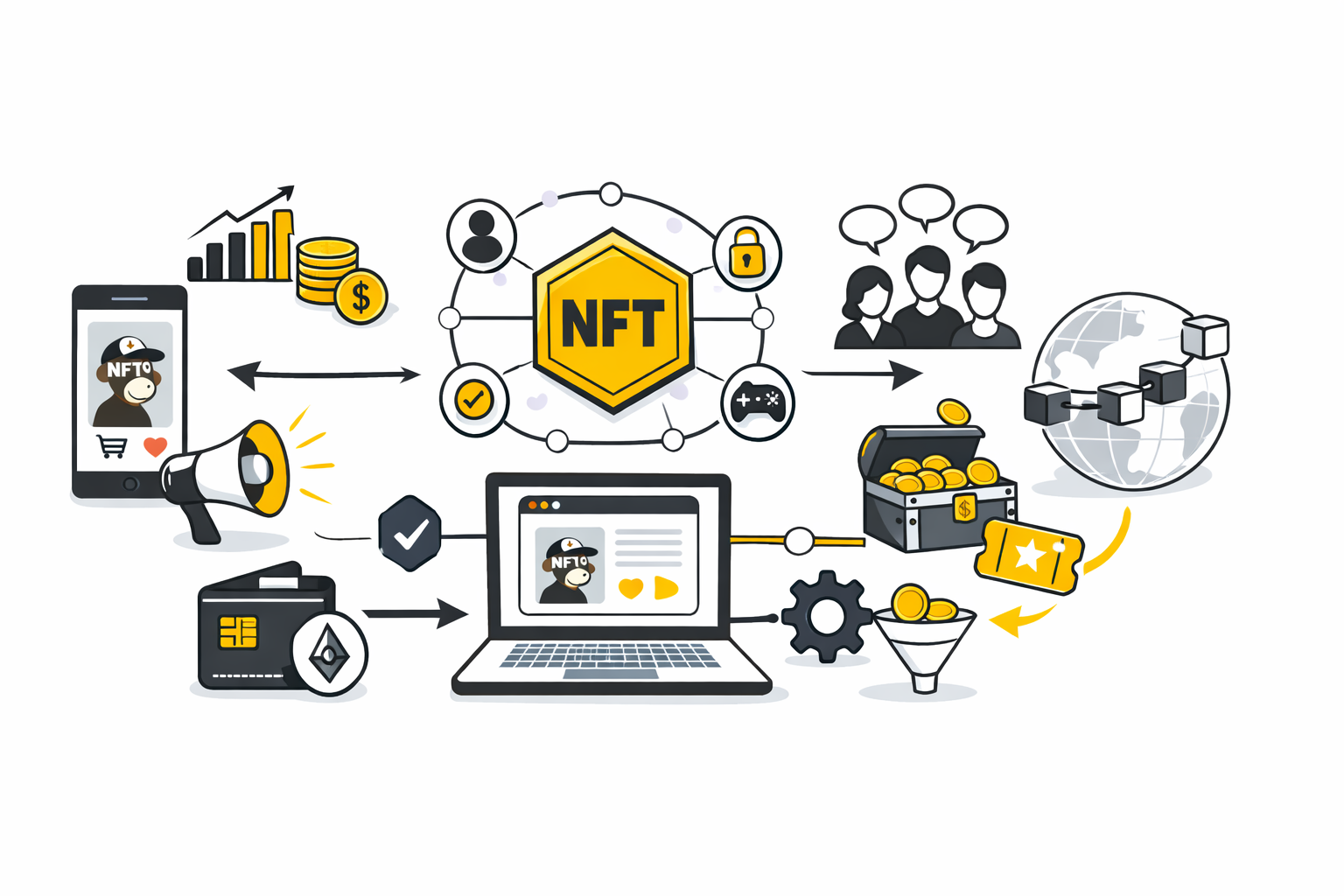
That is why good NFT marketing now looks a lot more like serious retention marketing. It blends positioning, community design, access, creator incentives, owned channels, and post-mint lifecycle management into one system. This article breaks that system down so you can see what actually works, what usually fails, and how to build an NFT campaign that feels like a real brand asset instead of a temporary stunt.
Article Outline
- Why NFT Marketing Still Matters
- The NFT Marketing Framework
- Core Components of a Strong NFT Campaign
- Community, Content, and Launch Execution
- Measurement, Retention, and Risk Management
- Professional Implementation and Common Questions
Why NFT Marketing Still Matters
NFT marketing still matters because ownership changes behavior. A follower can like your content, open your emails, and even buy once without ever feeling connected to the brand. A well-designed NFT program can turn that same person into a participating member with proof of access, status, history, or contribution tied directly to a digital asset.
That distinction is becoming more important as the market matures. DappRadar recorded 18.1 million NFT sales in Q3 2025, but the same report shows a market where volume and sales count are no longer moving in the old “everything pumps together” pattern. In plain English, people are still transacting, but they are becoming more selective about what deserves attention, money, and long-term trust.
For marketers, that is actually good news. Hype markets reward noise, while mature markets reward positioning, product logic, and community design. If your NFT strategy depends on artificial scarcity alone, you are already in trouble, but if it strengthens loyalty, access, identity, or co-creation, it has a real job to do.
NFTs Create a Different Kind of Customer Relationship
Traditional digital marketing is usually rented attention. You build on platforms you do not control, optimize for algorithms you cannot predict, and hope the audience keeps showing up. NFTs introduce a model where the asset itself can hold the relationship, because ownership can unlock community spaces, experiences, product drops, governance privileges, or member recognition over time.
That is not just theory anymore. Reddit defines its Collectible Avatars as limited-edition avatars that give owners unique benefits on the platform while still being tradable off-platform through Polygon-based NFTs. Nike took a similar route with .SWOOSH, framing it as a digital community and experience before treating it like a pure collectible marketplace, then later reporting that the first OF1 virtual collection was built with a community of more than 330,000 members.
The practical takeaway is simple: NFT marketing works best when the token is not the pitch. The token should be the container for a deeper brand relationship. When brands forget that, the whole thing starts to look like merchandising with extra friction.
Utility Has Replaced Novelty
The early NFT wave was powered by novelty, cultural momentum, and aggressive speculation. That phase taught marketers how fast internet-native assets can spread, but it also exposed how weak many offers were once the initial excitement faded. The market since then has pushed brands toward utility because utility is what survives when prices stop doing the storytelling for you.
Recent consumer research backs that up. A 2025 review of NFT consumer behavior highlights social identity, belonging, symbolic value, and experiential value as recurring purchase drivers rather than simple financial upside across the literature. Another 2025 study on metaverse NFT purchase intention found that functional, emotional, experiential, altruistic, and symbolic values all shape buyer intent in different combinations.
That is why serious NFT marketing now overlaps with loyalty, community, and product marketing more than it overlaps with pure trading culture. If the asset unlocks something the audience genuinely wants, the campaign has room to breathe. If the only promise is “this might go up,” the ceiling is lower than most founders want to admit.
Brands Now Need More Than a Drop Calendar
A one-off mint is not a strategy. It can create a spike, it can generate headlines, and it can even produce solid first-day revenue, but it does not automatically produce retention. NFT marketing becomes defensible only when the brand knows what happens after mint, after resale, after the Discord launch, and after the initial audience has either converted or moved on.
That is one reason the mixed results from major brands matter so much. Nike continued to position .SWOOSH around virtual creation, access, and participation inside a broader digital ecosystem, while Starbucks ended its Odyssey beta in March 2024 after testing NFT-based loyalty mechanics inside its rewards universe. The contrast is useful because it shows that brand size does not save weak program design.
For operators, this means NFT marketing should be judged like any other growth system. Does it lower acquisition cost through stronger referrals? Does it increase retention through status and access? Does it deepen first-party data, unlock partnerships, or create new monetization layers? Those are the questions that matter now.
The NFT Marketing Framework
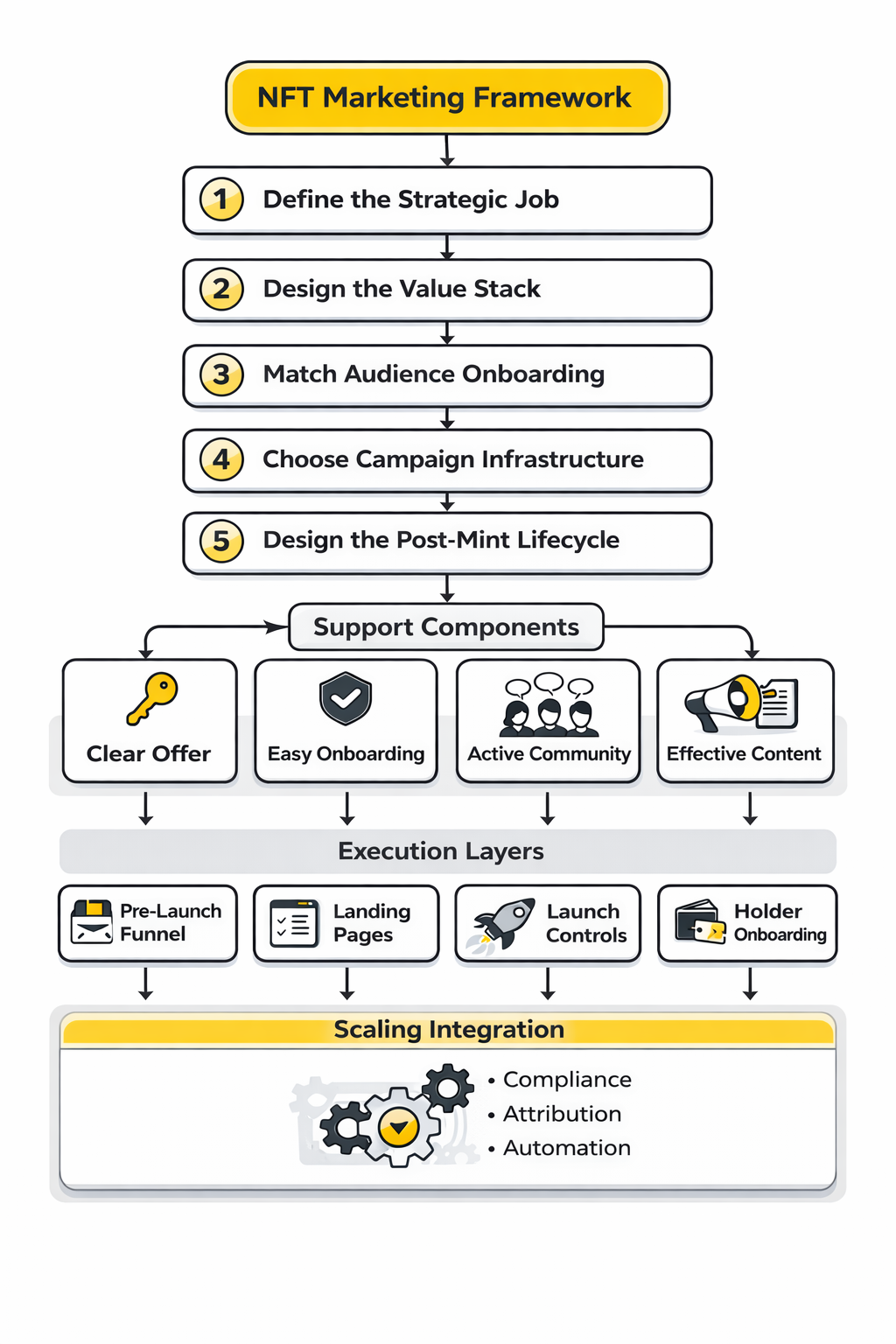
If you want NFT marketing to work, stop thinking in terms of launch tactics and start thinking in terms of systems. The right framework is not “build hype, mint out, celebrate.” It is “define the business role, design the offer, match the audience, choose the infrastructure, orchestrate the launch, and manage the lifecycle.” That sequence sounds less exciting, but it is exactly why it works better.
The cleanest way to approach it is to treat an NFT campaign as six connected decisions. Each decision affects the next one, and weak thinking early on usually shows up as poor conversion, confused positioning, or dead community energy later. When teams skip the strategy layer, they almost always end up overinvesting in visuals and underinvesting in the actual reason anyone should care.
1. Start With the Strategic Job
Every NFT campaign needs one clear job. It can be customer acquisition, community access, loyalty, product storytelling, creator monetization, event credentialing, or premium membership, but it cannot be all of them at once. The more specific the job, the easier it becomes to shape the offer, the messaging, and the funnel around it.
This is where many projects go wrong. They describe the asset instead of the role it plays in the business. Your audience does not need to hear that you are launching an ERC-721 collection on a low-fee chain; they need to understand why owning it changes their experience with your brand in a way that feels worthwhile.
2. Build the Value Stack Before the Artwork
The artwork matters, but not first. What matters first is the value stack: what holders get on day one, what they may unlock later, how scarcity works, how access is verified, what benefits are transferable, and what part of the experience remains valuable even if secondary market activity cools off. This is the layer that turns an NFT from a collectible into an offer.
OpenSea’s own support materials still frame creator earnings as a continuing share of resale value and allow collection owners to define preferred earnings settings, which shows how secondary mechanics remain part of the product design conversation for creators and brands alike. But relying on royalties alone is fragile. A stronger value stack connects the NFT to access, recognition, experiences, or products the audience already wants.
When this part is clear, your messaging becomes much easier. You are no longer asking people to buy into a vague future. You are asking them to join a defined system with concrete benefits and a believable roadmap.
3. Match the Audience to the Right Onboarding Experience
A crypto-native audience will tolerate wallets, bridges, marketplace navigation, and token jargon. A mainstream brand audience usually will not. That single fact should shape almost every marketing choice you make, from landing page copy to checkout flow to email education.
Reddit understood this well by packaging NFT-backed avatars inside a familiar identity product instead of forcing users to think like traders first on day one. That is the real lesson for marketers. The best NFT marketing often hides complexity until the user actually needs to understand it.
This is also where your funnel infrastructure matters. If you are building waitlists, segmented follow-ups, and onboarding sequences, tools such as Brevo, ManyChat, or Buffer can help you manage education and retention around the drop without overwhelming the audience. The important part is not the tool itself. It is that the onboarding journey feels simpler than the technology behind it.
4. Choose Infrastructure That Supports the Story
The chain, marketplace compatibility, wallet experience, and access tooling are not just technical choices. They shape the story your campaign tells. If you choose infrastructure that feels expensive, confusing, or fragile, the audience experiences your brand that way too.
This is one reason Polygon-based implementations gained traction with consumer-facing programs. Reddit explicitly pointed to low-cost transactions and sustainability commitments when it launched blockchain-backed Collectible Avatars for a mainstream user base. The infrastructure choice supported the adoption story instead of fighting it.
Marketers do not need to become protocol experts, but they do need to understand the tradeoff. Every extra step in setup, every confusing wallet interaction, and every mismatch between promise and experience will hurt conversion. Good NFT marketing feels easier than people expect.
5. Design for the Post-Mint Lifecycle
This is where real operators separate themselves from launch-first teams. The mint is not the finish line. It is the moment your obligation to holders becomes visible.
Post-mint planning includes communication cadence, utility delivery, secondary market posture, community moderation, collaboration strategy, and new reasons to stay engaged. Research published in 2025 on follower engagement with NFTs reinforces this point by showing that community dynamics and perceived belonging remain central to sustaining attention after the initial purchase moment rather than before it only.
If you do this well, holders start to feel like insiders. If you do it badly, they start to feel like customers who paid up front for promises that are getting quieter every week. That is a brutal trust gap to recover from.
6. Build With Compliance and Reputation in Mind
NFT marketing is still marketing, but it lives closer to financial, legal, and platform risk than many teams expect. Claims about resale upside, “investment” language, opaque treasury promises, and careless influencer promotion can turn a creative campaign into a liability. The safest route is to build a brand and utility narrative that stands on its own without leaning on speculative messaging.
That caution is not abstract. Public filings from NFT-related companies continue to describe uncertainty around whether certain NFTs could be treated as securities in some contexts, along with the business risk that would follow if regulators took that view. Whether or not a specific project crosses that line, marketers should treat language, disclosures, and expectations with a lot more discipline than the first wave of NFT campaigns did.
This is the part people often resist because it feels less fun than creative strategy. But professional implementation starts here. When the brand promise is clear, the utility is real, and the messaging stays grounded, NFT marketing becomes far more resilient.
Core Components of a Strong NFT Campaign
Once the framework is clear, the next job is execution quality. This is where a lot of NFT marketing either becomes credible or falls apart. The campaigns that hold up are usually built on a small set of components that reinforce each other instead of competing for attention.
What matters most is not how many moving parts you add. It is whether each part supports the same promise. If the collection says access, the funnel should feel exclusive, the onboarding should feel easy, the community should feel alive, and the post-mint experience should prove the promise was real.
A Clear Offer People Can Explain in One Sentence
If your buyers cannot explain why the NFT exists, your marketing is already leaking trust. The offer needs to be simple enough to repeat and strong enough to justify action. That usually means tying the asset to access, identity, perks, recognition, or participation rather than vague future possibilities.
Recent purchase-intention research supports that logic. A 2025 empirical study found that factors such as scarcity, uniqueness, verifiability, royalty design, and social influence all shape NFT buying intent, which means the offer has to feel both distinct and understandable at the same time if you want conversion instead of curiosity. In practical terms, the best NFT marketing does not bury the value proposition under lore, tokenomics, and overproduced teaser content.
This is where teams should slow down. Before you build the landing page, before you book creators, and before you start farming impressions on X, force the offer into one sentence the audience can repeat without effort. That sentence becomes the spine of the entire campaign.
Friction-Light Onboarding
A lot of NFT campaigns still lose users before the actual decision point. Not because the audience hates the idea, but because the path to ownership feels harder than the value being offered. Wallet creation, chain selection, marketplace confusion, and unclear payment flows all create dropout points long before the offer gets a fair shot.
Mainstream-facing programs that worked understood this. Reddit positioned Collectible Avatars as limited-edition identity assets with platform benefits and made the product feel native to Reddit first, with the blockchain layer running underneath rather than demanding a crypto mindset up front. That is a useful benchmark for marketers because it shows how much adoption depends on interface design, not just narrative.
This is also why CRM and messaging workflows matter more than most NFT founders think. If you are collecting early interest, segmenting high-intent leads, and guiding users through reminders and onboarding, tools like ManyChat, Brevo, and GoHighLevel can support the education layer that keeps people moving. NFT marketing gets better the moment the experience starts feeling like polished ecommerce instead of a technical scavenger hunt.
Community With a Real Reason to Exist
Community is still one of the most abused words in Web3. A Telegram group or Discord server is not a community just because people joined it during a whitelist campaign. A real community forms when members gain social value from being there even when nothing is minting that week.
That point is backed by current research. A 2025 paper on community and consumer dynamics in NFTs found that open communities can reduce hesitation, strengthen belonging, and increase purchase intention through social identity and active engagement instead of financial motivation alone. That means community content cannot be filler. It needs to give holders and prospects a reason to stay, participate, and signal membership.
This changes how NFT marketing should be staffed. You do not just need moderators. You need operators who can run rituals, spotlight contributors, create momentum between announcements, and translate product updates into member relevance.
Content That Educates and Converts
Great NFT marketing content does two jobs at once. It reduces uncertainty for people who are interested but cautious, and it increases conviction for people who are already leaning in. Those are different audiences, so the content mix has to reflect both.
For cautious users, the winning content usually answers practical questions: what this unlocks, how claiming works, what chain it uses, whether it is transferable, and what happens after mint. For higher-intent users, the content shifts toward proof, timelines, access previews, holder perks, roadmap delivery, and community receipts. That is why content calendars for NFT campaigns should include education, trust building, and participation prompts instead of pure teaser loops.
On the distribution side, consistency matters more than volume. Buffer is useful if you want clean social scheduling across multiple channels, while Flick can help structure social content workflows when the campaign needs steady short-form distribution. The point is not to spray content everywhere. It is to publish the right content at the right stage of buyer readiness.
A Funnel That Connects Attention to Ownership
This is where a lot of NFT marketing still feels amateur. Teams generate attention on social, maybe run some creator promotion, maybe even build decent demand, and then send everyone into a messy claim flow with no segmentation, no qualification, and no real follow-up system. That is not a funnel. That is hope.
A better setup maps stages clearly: awareness, waitlist, qualification, reminder sequence, mint window, holder onboarding, and post-mint engagement. Each stage needs different messaging, different urgency, and different proof. That is why strong NFT campaigns increasingly borrow best practices from performance marketing and product launches rather than relying on Discord chaos.
If you need a landing page stack that feels more conversion-focused than a typical Web3 microsite, Replo is worth a look for faster page assembly and testing. If you want a simpler funnel-first setup, ClickFunnels or Systeme.io can make more sense. The important thing is that the ownership step feels like the next natural move, not like the moment the experience suddenly becomes confusing.
Community, Content, and Launch Execution
Execution gets tangible when you move from strategy into sequence. At this stage, NFT marketing stops being a concept and turns into a calendar, a workflow, a set of assets, and a chain of decisions that either build trust or quietly kill momentum. Most teams do not fail because they lacked ideas. They fail because they launched without operational discipline.
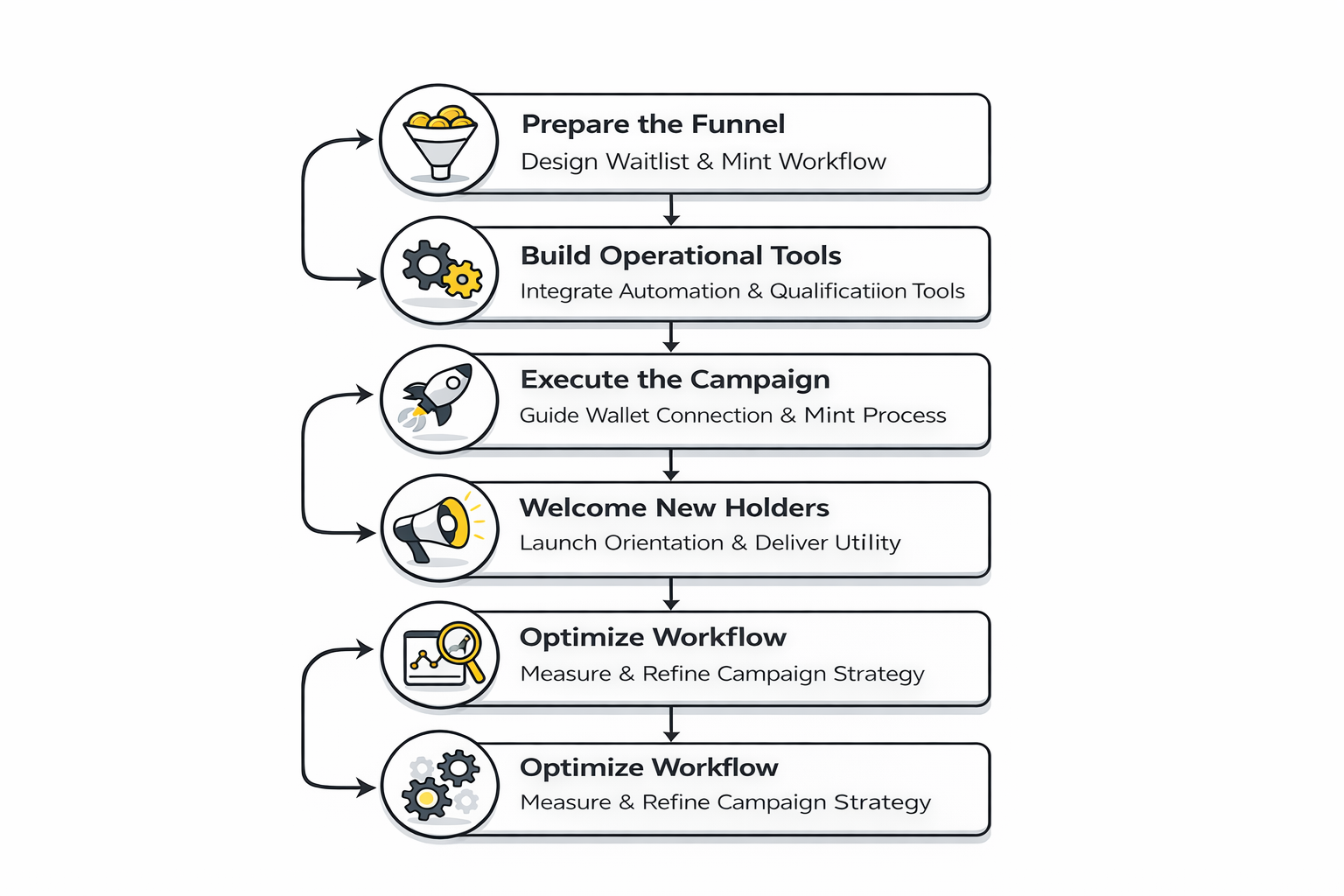
The safest way to think about launch execution is to treat it like a controlled rollout, not a single event. You are warming demand, qualifying intent, reducing friction, validating systems, and only then opening the mint or claim action. When that order is respected, campaigns feel sharper and conversion becomes much easier to manage.
A Practical Execution Process
- Define the promise and the audience. Start by locking the single job of the NFT campaign and the exact audience segment it is for. If the asset is trying to serve collectors, superfans, partners, and first-time buyers all at once, the messaging will get muddy fast. Clear positioning at this stage saves you from rewriting the whole campaign later.
- Build the value stack and access logic. Decide what holders receive immediately, what expands over time, and how access is verified. This includes perks, gated experiences, future drops, collaboration rights, event entry, or member recognition. If the value stack is not concrete here, no amount of launch content will fix it.
- Create the pre-launch funnel. Set up the waitlist, interest forms, segmentation rules, reminder flows, and educational content. Fillout can help capture cleaner qualification data, while Dub is useful if you want cleaner tracking across creators, partners, or channel-specific links. Good NFT marketing gets stronger when attribution is treated seriously before traffic starts.
- Prepare landing pages and proof assets. Your page needs to explain the offer, reduce confusion, and move people toward the next step without overexplaining the tech. Screens, FAQ-style blocks, holder benefits, timeline previews, and claim walkthroughs usually outperform abstract hype copy. If people still need to “figure out what this is,” the page is not ready.
- Warm the audience with staged content. Publish educational posts, community prompts, behind-the-scenes material, access previews, and deadline-based reminders. This is where trust compounds. By the time mint day arrives, the audience should already understand the value, the process, and the reason to act.
- Run the launch like an operations event. Mint day should have support coverage, backup messaging, live status updates, and immediate issue resolution. Nothing destroys momentum faster than technical silence when people are trying to buy. Smooth launches rarely look dramatic from the outside, and that is exactly the point.
- Shift instantly into holder onboarding. The minute the mint ends, the next campaign begins. Holders need confirmation, access instructions, community activation, and a clear sense of what happens next. NFT marketing that goes quiet after the sale teaches people not to trust the next drop.
What Good Execution Looks Like in Practice
Good execution usually feels calmer than bad execution. There is less frantic posting, fewer last-minute changes, and much less overpromising. The brand seems prepared because it is prepared.
Nike’s early .SWOOSH rollout is useful here because it combined community framing, multiple purchase entry points, and member participation in product storytelling instead of treating the digital asset as a one-night event around the OF1 collection launch. That kind of execution works because the campaign feels like part of a system rather than a detached promotion.
You can apply the same principle even on a much smaller budget. The question is not whether you are Nike. The question is whether your NFT marketing feels joined up across product, page, messaging, community, and post-purchase experience.
The Metrics That Matter During Launch
Vanity metrics can make weak NFT campaigns look stronger than they are. Impressions, reactions, and even waitlist size are useful signals, but they do not tell you whether the system is working. The numbers that matter most are the ones that reveal movement between stages.
Pay close attention to landing page conversion, waitlist-to-wallet activation, wallet-to-mint completion, support ticket volume, open rates on reminder sequences, and early holder participation after launch. Those numbers tell you where friction is hiding. They also show whether the campaign promise matched the user experience.
This is where structured tracking becomes a competitive edge. If you are running multiple acquisition channels or creator partnerships, Dub and Copper can help keep source data and relationship management cleaner as the campaign scales. The more professional your measurement layer gets, the easier it is to improve NFT marketing instead of just guessing what worked.
Why Most Launches Still Underperform
Most launches underperform for boring reasons, not mysterious ones. The offer is unclear, the onboarding is too hard, the content educates too late, the community is hollow, or the team confuses noise for demand. None of these problems are glamorous, but all of them are fixable.
The bigger issue is usually that teams try to solve strategic weakness with louder promotion. That almost never works for long. In a more selective market, bad positioning gets exposed faster because audiences have seen enough by now to know when a project is mostly decoration.
That is why disciplined execution matters so much. When NFT marketing is built like a real growth system, the launch becomes a visible result of deeper work, not a desperate attempt to create value through urgency alone.
NFT Marketing Metrics That Matter
By this point, the biggest mistake is measuring an NFT campaign like a vanity-heavy social launch. Big reach can still hide weak conversion, weak retention, and weak holder conviction. The numbers only become useful when they tell you where belief is getting stronger, where friction is creeping in, and whether your NFT marketing system is building a durable audience instead of a temporary spike.
The broader market data helps frame that correctly. DappRadar logged 18.1 million NFT sales in Q3 2025 on $1.6 billion in trading volume, which is a useful reminder that activity and value are no longer rising in lockstep. That matters because a campaign can sit inside an active market and still underperform badly if the audience is browsing, flipping, or testing without forming any real attachment to the project.
The Numbers That Actually Show Campaign Health
The first group of metrics is about movement through the funnel. You want to know how many people moved from awareness to waitlist, from waitlist to wallet setup, from wallet setup to completed mint, and from mint to actual community participation. Those transitions are where NFT marketing becomes measurable in a way that operators can improve.
Landing page conversion matters because it tests whether the offer is clear enough to earn intent. Waitlist-to-mint conversion matters because it tells you whether your reminders, education, and urgency actually work. Holder activation matters because it reveals whether people bought into an experience or just completed a transaction they may never care about again.
Secondary metrics matter too, but in context. Open rate on launch emails, click-through rate on reminders, support ticket volume, failed payment attempts, wallet connection drop-offs, and community response time all tell you where friction lives. If those numbers are noisy while surface-level reach looks strong, the campaign is usually weaker than the dashboard first suggests.
Market Data Only Matters When You Interpret It Properly
A lot of teams throw around volume numbers without understanding what they mean. Rising transaction count can signal stronger attention, but it can also signal lower average ticket sizes, more speculative churn, or a marketplace environment where users are shopping more cautiously. In the Q3 2025 NFT market, sales count hit the highest level since 2022 while dollar volume stayed relatively modest compared with earlier boom periods, which tells marketers that participation has not disappeared, but pricing power is no longer guaranteed.
That should change how you read your own campaign. If your project gets decent mint completion but weak retention, the problem may not be demand at the top of funnel. It may be that the value stack felt good enough to try but not strong enough to hold. If your audience engages heavily with education content but stalls at wallet activation, the issue is probably onboarding friction rather than positioning.
This is where teams get sharper. Instead of asking whether the campaign “did numbers,” ask whether each number tells a useful story about trust, clarity, and post-purchase belief. That is the kind of interpretation that makes the next launch better instead of just louder.
Retention Signals Are More Important Than Hype Signals
Short-term attention is easy to overvalue because it feels exciting. Retention is quieter, which is exactly why it is more useful. In NFT marketing, retention shows up through holder participation, repeated community activity, claim rates on unlocked benefits, attendance in gated experiences, and whether people keep identifying with the asset after the initial drop is over.
Current research supports treating those signals seriously. A 2025 study on NFT community dynamics found that sustainable NFT ecosystems rely on active engagement and trust in long-term leadership, not simply initial purchase behavior if projects want value to persist. Another 2026 study on follower engagement with NFTs emphasizes that emotions, perceived sustainability, and community meaning shape how people stay involved after first contact rather than just what gets them to look once.
That means your analytics stack should not stop at the mint. It should track what holders do next. If nobody claims perks, joins gated channels, attends holder events, or uses the NFT as part of their identity, then the campaign may have sold inventory without building a relationship.
Measuring Performance Without Fooling Yourself
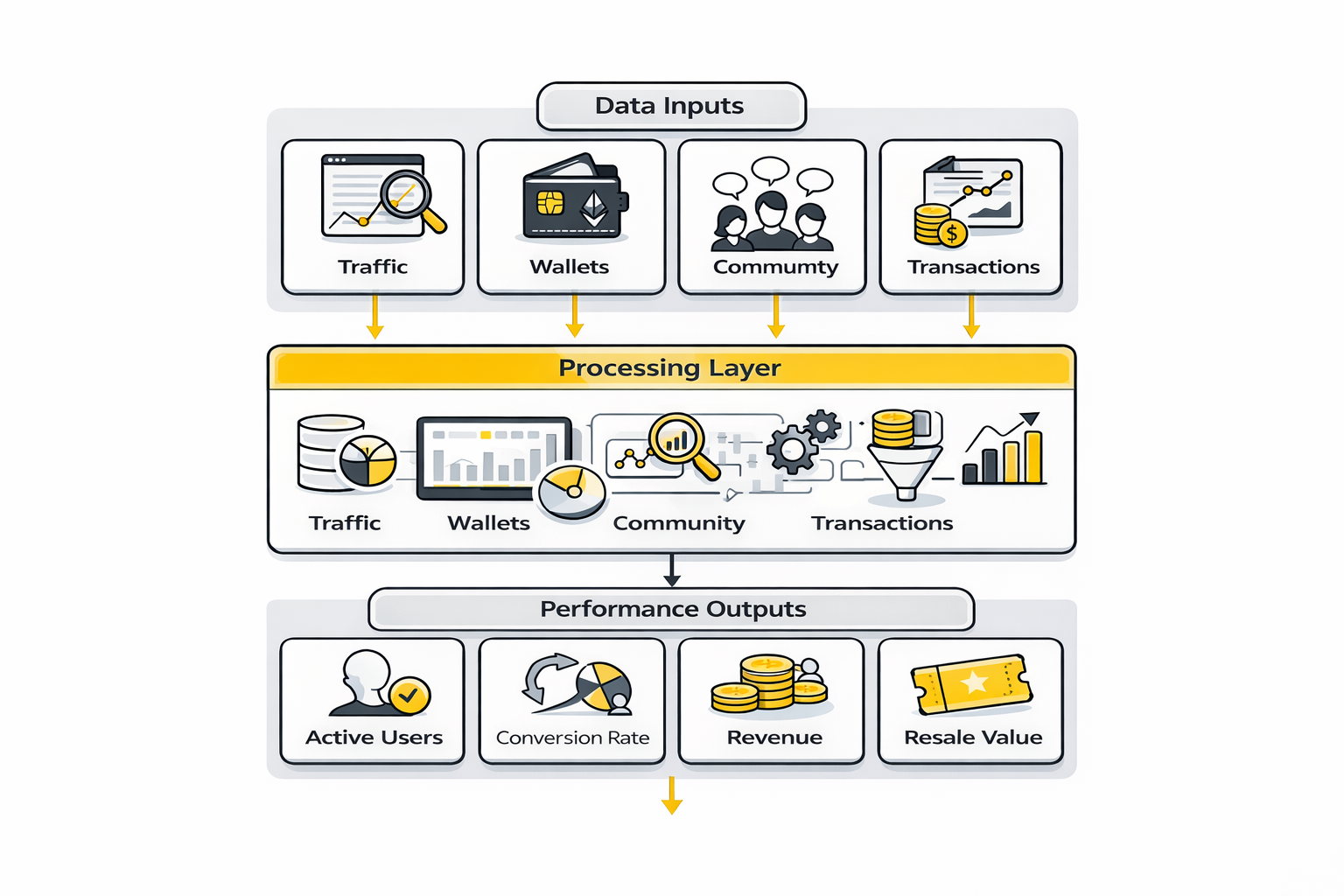
A strong analytics system is not complicated because it has more charts. It is strong because it connects behavior to decisions. Good NFT marketing measurement makes it obvious what to fix, what to repeat, and what to stop doing.
A Simple Analytics Stack for NFT Marketing
Start with acquisition metrics. Track where traffic came from, which creators or partners drove qualified visitors, what content angles led to the highest sign-up rate, and which channels produced the lowest drop-off before wallet connection. This is the part that tells you whether awareness is attracting the right people or just attracting a crowd.
Then move to conversion metrics. Measure landing page conversion, wallet connection rate, mint completion rate, average order value if relevant, and support issues per 100 users during launch. If you are using campaign tracking links, Dub can help you keep channel-level attribution cleaner, while Fillout is useful when qualification data matters before the drop.
After that, track retention and holder quality. Look at community participation after purchase, redemption of benefits, repeat attendance in gated experiences, resale behavior, and how many holders stay engaged after the first week or first month. This is the layer where NFT marketing shifts from launch analysis to business analysis.
Useful Benchmarks Are Behavioral, Not Just Financial
Financial benchmarks still matter, but they are not enough on their own. Marketplace economics can influence your margin and pricing decisions, so they deserve attention. For example, OpenSea’s support documentation states that it typically charges a 1% fee for selling NFTs and a 10% fee for minting an NFT in a primary drop, which affects how teams model launch economics and net revenue.
But the more useful benchmarks for marketers are behavioral ones. Did the landing page convert well for cold traffic or only for warm followers. Did wallet connection collapse on mobile. Did support messages spike right after the claim window opened. Did holders actually use the utility they were sold. These numbers tell you whether the campaign was understandable and credible in the real world.
Research on NFT purchase intention points in the same direction. A 2025 study found that scarcity, uniqueness, verifiability, royalty structure, facilitating conditions, and social influence all affect intent in measurable ways. That means weak conversion can come from more than one place, and your benchmarks need to isolate which part of the decision process broke down.
What Different Data Patterns Usually Mean
If traffic is high but waitlist conversion is weak, the offer is probably not clear enough or the page is not doing enough trust-building. If waitlist conversion is strong but mint completion is weak, the issue is often onboarding, payment flow, or launch-day friction. If mint completion is fine but holder engagement falls off immediately, the value stack probably sounded better in theory than it felt in practice.
If your secondary market activity is lively but community participation is low, you may have built a tradeable asset without building a strong brand relationship. That is not always fatal, but it changes the kind of business you are actually running. If community participation is strong while resale stays quiet, that can still be a healthy sign because it may mean holders see the NFT as something to keep rather than something to flip.
This is why random stats are not enough. The same number can be good or bad depending on where it sits in the sequence. NFT marketing gets more effective when you stop reacting to isolated metrics and start reading patterns across the whole holder journey.
The Action Each Metric Should Trigger
Every important number should point to a next move. Weak landing page conversion should trigger offer clarification, better proof, or tighter audience targeting. Weak wallet activation should trigger onboarding simplification, more education, or better mobile handling.
Weak holder activation should trigger post-mint experience improvements, not just more social posting. That could mean better access delivery, stronger community rituals, cleaner benefit communication, or more visible product follow-through. If the relationship feels vague after purchase, the analytics are doing you a favor by exposing it early.
This is also where a broader operating stack helps. GoHighLevel, Brevo, and ManyChat can support segmented follow-up and lifecycle messaging when the campaign needs more than launch blasts. The right move is almost never “post harder.” It is usually to tighten the exact part of the system the numbers are warning you about.
Why the Best Teams Measure Trust, Not Just Transactions
The most useful insight in NFT marketing is that transactions are not the finish line. They are evidence that attention converted once. Trust is what determines whether attention compounds.
That is why the best teams watch participation, responsiveness, benefit usage, and sentiment as closely as sales totals. In a more selective NFT market, people are still willing to buy, but they are much less willing to stay where the promise feels thin. The teams that understand that do not just collect data. They use it to prove, week after week, that the project deserves to keep the audience it earned.
Advanced Strategy and Real-World Tradeoffs
By now, the fundamentals are clear. What separates average NFT marketing from high-performing campaigns is how teams handle tradeoffs. Every decision forces a compromise somewhere else, and the strongest operators make those tradeoffs intentionally instead of discovering them too late.
At this level, NFT marketing stops being about tactics and becomes about strategic alignment. You are balancing accessibility against exclusivity, liquidity against loyalty, scale against intimacy, and speed against credibility. There is no perfect setup, only choices that match your specific goal.
Accessibility vs Exclusivity
One of the hardest decisions is how easy you make it to enter. Lower friction increases reach and conversion, but it can dilute perceived value if the asset becomes too easy to obtain. Higher exclusivity can strengthen status and community identity, but it usually reduces total participation.
This tension shows up in almost every successful NFT program. Reddit leaned toward accessibility by integrating NFTs into a familiar user experience, which helped adoption but positioned the assets closer to identity tools than elite membership signals. On the other side, more exclusive collections maintain stronger perceived scarcity but often struggle to grow beyond a core audience.
The practical takeaway is to decide early what kind of signal your NFT should send. If it represents belonging to a broad ecosystem, reduce friction aggressively. If it represents elite access, protect scarcity and accept lower volume. Trying to do both usually weakens both.
Liquidity vs Long-Term Holding
Liquidity feels attractive because it creates activity, visibility, and sometimes additional revenue through royalties. But high liquidity can also turn your NFT into a trading asset instead of a relationship asset. When that happens, price action starts to dominate perception, and your brand becomes tied to market volatility.
The alternative is designing for holding behavior. That usually means stronger utility, better ongoing benefits, and more reasons to keep the asset than to flip it. Research on NFT consumer behavior consistently highlights experiential and symbolic value as drivers of long-term engagement, which reinforces the idea that people hold when the asset means something beyond resale in practical use cases.
This is not a binary choice, but it is a spectrum. The more your NFT marketing leans toward trading, the more you need to manage expectations around volatility. The more it leans toward holding, the more you need to deliver consistent value over time.
Scaling Without Breaking the Experience
Scaling is where many NFT projects quietly lose quality. What works with 1,000 engaged holders often breaks at 10,000. Communication becomes slower, community signals become weaker, and the feeling of access starts to disappear if everything becomes too broad.
This is why structure matters. Segmentation, tiered access, smaller sub-communities, and differentiated perks can help maintain intimacy even as the audience grows. Without that, growth can dilute the very thing that made the NFT attractive in the first place.
Operationally, this is where systems become essential. CRM layers, segmented messaging, and automation workflows are no longer optional once the audience grows. Platforms like GoHighLevel or Brevo can help manage lifecycle communication at scale, while tools like ManyChat support more dynamic interaction without overwhelming the team.
Reputation Risk Is Higher Than Most Teams Expect
NFT marketing sits in a sensitive space between branding, finance, and community trust. That means mistakes are more visible and often more permanent than in traditional campaigns. Overpromising, vague roadmaps, unclear utility, or poor communication can damage credibility quickly.
Regulatory uncertainty adds another layer. Public filings from NFT-related businesses continue to highlight the risk that certain digital assets could be interpreted as securities depending on structure and messaging which would introduce compliance obligations. Even without crossing legal thresholds, perception alone can create reputational risk.
The safest path is disciplined messaging and clear expectations. If your NFT marketing does not rely on speculation to make sense, you reduce both legal exposure and trust erosion at the same time.
Creator and Partner Dynamics
As NFT campaigns scale, partnerships become more attractive. Creators, brands, and communities can extend reach and add credibility, but they also introduce complexity. Misaligned incentives or unclear value sharing can weaken the campaign even if the partnership looks strong on paper.
Affiliate tracking and attribution become more important here. Tools like Dub help track partner-driven traffic and conversions, while systems like Copper can support relationship management as partnerships expand. Without clear data, it becomes difficult to evaluate which collaborations actually contribute to growth.
The key is alignment. Partners should benefit from the long-term success of the project, not just the initial launch spike. When incentives match the lifecycle of the NFT, collaboration becomes an asset instead of a risk.
The Real Cost of Weak Post-Mint Strategy
The most expensive mistake in NFT marketing is not a failed launch. It is a successful launch followed by weak follow-through. That scenario creates immediate revenue but damages long-term trust, making future campaigns harder and more expensive.
Post-mint expectations are higher now than they were during the early NFT wave. Buyers have seen enough projects to recognize when delivery is slow, unclear, or inconsistent. Research on NFT engagement shows that perceived sustainability and ongoing interaction strongly influence whether participants stay involved after the initial purchase moment.
That means post-mint is not a support function. It is the core product experience. If it is treated as an afterthought, the entire NFT marketing system becomes fragile.
When NFT Marketing Actually Becomes a Competitive Advantage
At its best, NFT marketing is not a campaign. It is an infrastructure layer for deeper customer relationships. It connects identity, access, ownership, and participation in a way that traditional marketing channels cannot replicate easily.
But that only happens when everything lines up. The offer is clear, the onboarding is smooth, the community is real, the execution is disciplined, and the data is used to improve continuously. Most projects miss at least one of these, which is why the gap between average and high-performing NFT campaigns remains so wide.
If you get it right, the payoff is not just a successful drop. It is a system where your most engaged audience members become part of the brand itself. That is the point where NFT marketing stops being experimental and starts becoming strategic.
Bringing It All Together
At this point, NFT marketing should feel less like a trend and more like a system you can actually operate. You have strategy, execution, analytics, and tradeoffs working together. What matters now is how those pieces connect into something consistent.
The strongest NFT campaigns do not rely on one breakthrough moment. They rely on alignment. The offer matches the audience. The onboarding matches the complexity. The community matches the promise. The data matches the decisions being made. When those pieces line up, the campaign becomes predictable in the best possible way.
What most teams underestimate is how rare that alignment actually is. Many projects get one or two pieces right and still struggle because the rest of the system pulls in a different direction. That is why NFT marketing remains difficult. It is not about knowing tactics. It is about building coherence across the entire experience.
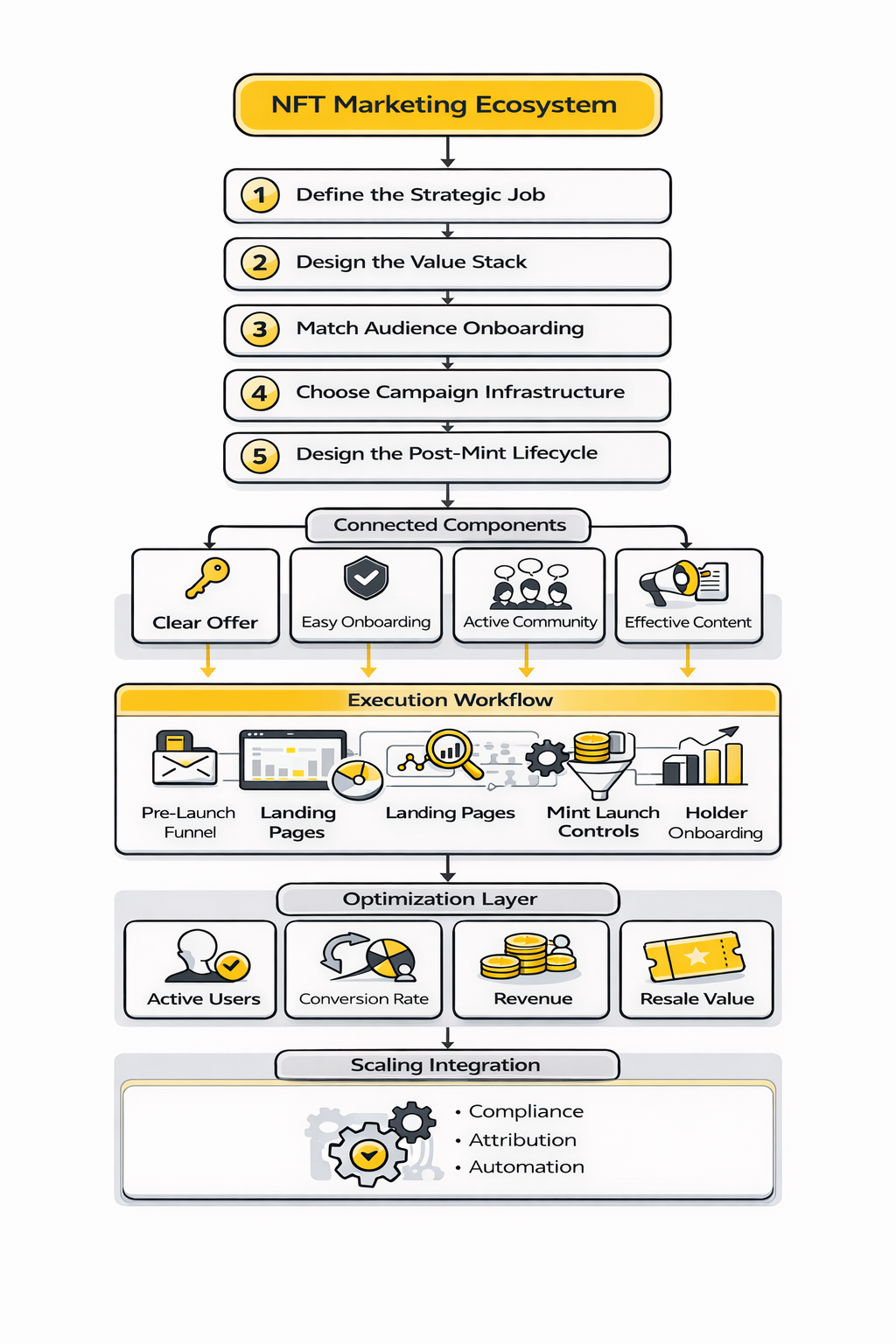
When everything works together, the NFT stops being a campaign asset and becomes part of your brand infrastructure. It holds identity, unlocks access, and creates a reason for people to stay connected beyond a single transaction. That is where the real leverage is.
FAQ - Built for Complete Guide
What is NFT marketing in simple terms?
NFT marketing is the process of using digital assets tied to blockchain ownership to attract, convert, and retain an audience. Instead of just selling products or content, it creates a system where ownership unlocks access, identity, or experiences. The focus has shifted from hype-driven drops to long-term relationship building.
Are NFTs still relevant for marketing in 2026?
Yes, but the approach has changed significantly. Market activity is still strong, with millions of transactions happening quarterly, but users are more selective. NFT marketing works when it delivers real value, not when it relies on speculation or novelty alone.
What makes a successful NFT campaign today?
A successful campaign has a clear purpose, strong value stack, low-friction onboarding, and a real post-mint experience. It also uses data to improve performance instead of guessing what worked. Most importantly, it aligns the NFT with a meaningful role inside the brand.
How do NFTs improve customer retention?
NFTs create a sense of ownership and belonging. When users hold an asset that unlocks benefits or status, they are more likely to stay engaged. Retention improves because the relationship becomes ongoing rather than transactional.
What platforms are best for NFT marketing funnels?
It depends on the complexity of your campaign. For funnel building, tools like ClickFunnels and Systeme.io are useful for structured conversion flows. For lifecycle communication, GoHighLevel and Brevo help manage segmentation and follow-up.
Do you need a large audience to succeed with NFT marketing?
No, but you need a relevant one. Smaller, highly engaged communities often outperform large, passive audiences. NFT marketing rewards alignment more than raw reach.
What is the biggest mistake in NFT marketing?
The biggest mistake is focusing on the launch instead of the lifecycle. A successful mint without a strong post-mint experience leads to lost trust and weaker future campaigns. Long-term value always beats short-term hype.
How important is community in NFT marketing?
Community is critical, but only if it is real. A large but inactive community adds little value. What matters is engagement, participation, and shared identity among members.
Can NFTs work for non-crypto brands?
Yes, and many mainstream brands have already proven that. The key is simplifying onboarding and integrating NFTs into familiar experiences. Users should not need to understand blockchain to see the value.
How do you measure success in NFT marketing?
Success is measured through conversion rates, holder activation, retention, and ongoing engagement. Secondary market activity can be useful, but it should not be the primary success metric.
Are NFTs risky for brands?
They can be if handled poorly. Risks include regulatory uncertainty, reputation damage, and unmet expectations. Clear messaging, realistic promises, and strong execution reduce these risks significantly.
How do you scale an NFT campaign without losing quality?
Scaling requires structure. Segmentation, automation, and clear communication systems help maintain experience quality as the audience grows. Without that, growth often weakens engagement.
Work With Professionals
Explore 10K+ Remote Marketing Contracts on MarkeWork.com
Most marketers spend too much time chasing clients, competing on crowded platforms, and losing a percentage of every project to middlemen.
MarkeWork gives you a better way. Browse thousands of remote marketing contracts and connect directly with companies desperate to hire skilled marketers like you, without platform commissions and without unnecessary gatekeepers.
If you're serious about finding better opportunities and keeping 100% of what you earn, explore available contracts and create a profile for free at MarkeWork.com.