

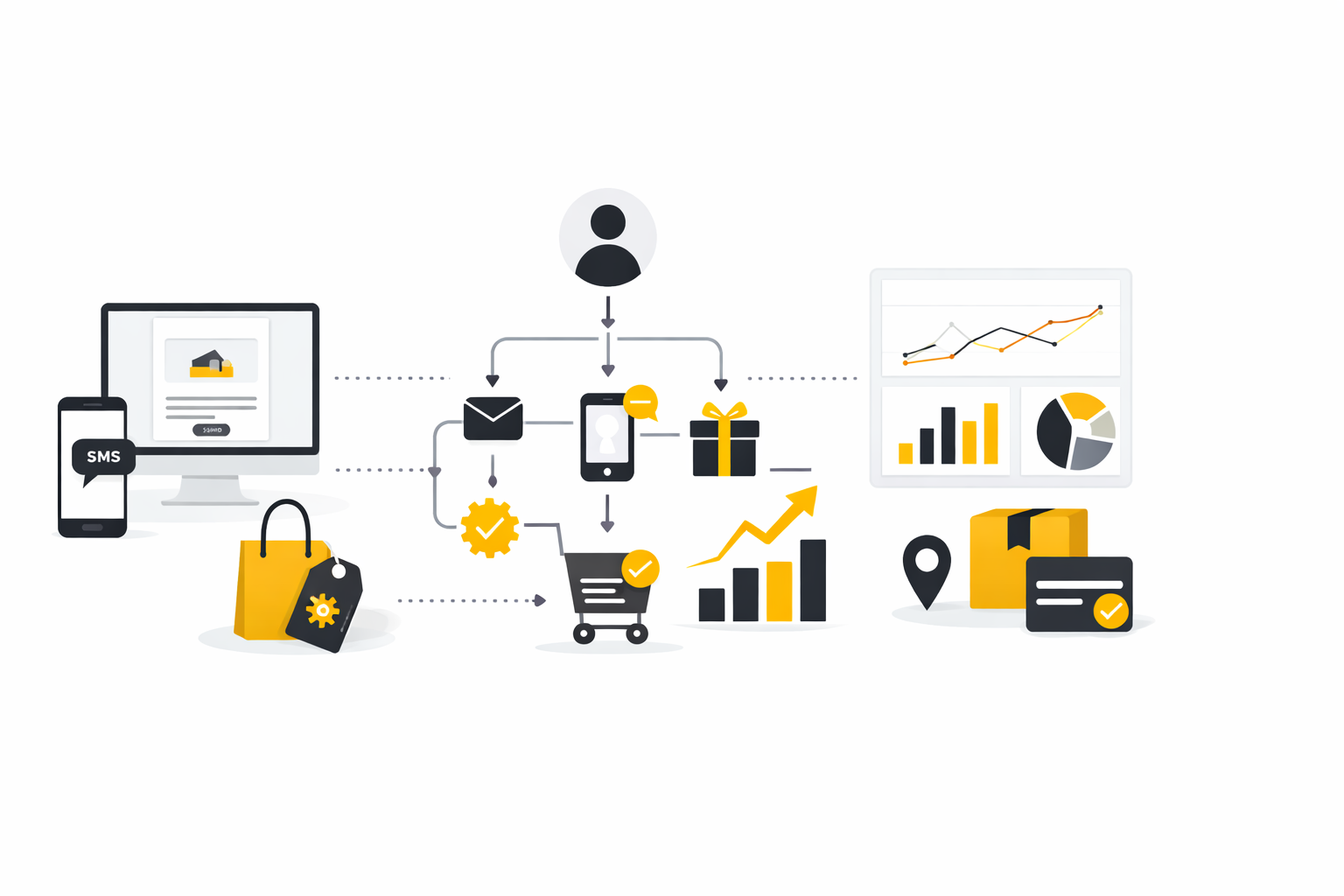
Omnisend sits in a very specific corner of the marketing software world. It is built for ecommerce first, not for generic newsletters, not for broad B2B automation, and not for creators trying to stitch together five separate tools. The platform combines email, SMS, push notifications, signup forms, segmentation, automation, and reporting in one system, with official messaging centered on ecommerce growth and support for major store connections like Shopify, WooCommerce, and BigCommerce via Omnisend’s features page and its integration documentation.
That focus matters more than most people realize. A store does not just need to send campaigns. It needs product data, order history, browsing behavior, cart activity, revenue attribution, and automations that react fast enough to catch purchase intent while it is still warm, which is exactly how Omnisend describes its Shopify sync and real-time event handling in its Shopify connection guide. When a platform is wired into the store correctly, it stops being “an email tool” and starts acting more like a retention engine.
That is also why Omnisend keeps showing up in serious ecommerce conversations. The company positions itself as trusted by 150,000+ brands, its current pricing structure still starts with a free plan that includes all features with sending limits, and its paid tiers are clearly split between email-led growth and heavier email-plus-SMS usage in the 2026 pricing documentation. For merchants that want a fast start without hitting feature paywalls immediately, that is a meaningful differentiator.
The bigger reason to pay attention, though, is performance. Ecommerce marketers keep seeing the same pattern across the last two years of benchmark data: automation outperforms blasts, and coordinated channels outperform isolated ones. Omnisend’s latest public data points to automated messages driving a disproportionate share of revenue in ecommerce, while large benchmark datasets from Klaviyo’s 325B-email report and its 3B-text SMS benchmark report reinforce the same practical takeaway: the real win is not sending more, it is sending the right message at the right buying moment.
If you run an online store, this guide will help you figure out whether Omnisend is actually a fit, how it works in practice, what its core system looks like, and where the tradeoffs show up once your list and revenue start growing. If you are not operating an ecommerce-first business, tools like Brevo or Moosend may end up being simpler fits, but for stores that live or die on retention, Omnisend deserves a closer look.
Article Outline
This article is structured to move from strategy to mechanics and then into execution. That matters because most Omnisend reviews jump straight into features without first explaining what kind of business model the platform actually serves best. Here, the goal is to build the argument in the right order so each later section has context and does not read like a random software checklist.
- Why Omnisend Matters for Ecommerce Growth
- How Omnisend Works as a Retention Framework
- The Core Components Inside Omnisend
- Professional Implementation for Real Stores
- Omnisend Pricing, Strengths, and Tradeoffs
- Final Verdict and Frequently Asked Questions
The next part begins with the business case. Before getting into workflows, templates, or dashboards, it is worth understanding why ecommerce brands keep prioritizing owned channels like email and SMS, and why a platform designed around store data can punch above its weight when margins get tighter and acquisition gets more expensive.
Why Omnisend Matters for Ecommerce Growth
Omnisend matters because ecommerce retention is not a side project anymore. When a store can connect subscriber data, browsing behavior, cart activity, orders, and post-purchase messaging in one place, it can market based on intent instead of guesswork, which is exactly the model Omnisend is built around through its ecommerce integrations, automation workflows, and customer data features in the official platform overview and features documentation. That sounds simple, but in practice it changes everything from how quickly you launch campaigns to how accurately you recover revenue.
The reason this approach keeps winning is that ecommerce brands do not operate like traditional newsletter publishers. They need flows for abandoned carts, browse recovery, order follow-ups, and repeat-purchase nudges, and Omnisend has centered its product around those use cases with prebuilt automations and combined-channel workflows for email, SMS, and push in the automation feature set and the latest support docs for abandoned cart and checkout recovery and browsing behavior automations. That is a much better fit for stores than using a generic email tool and trying to bolt ecommerce logic on afterward.
There is also a practical budget angle here. Omnisend’s current structure still gives users a free plan with all core features and sending limits, while its paid plans are clearly designed around ecommerce sending volume and SMS usage in the 2026 pricing guide. For smaller stores, that lowers the risk of getting started, and for growing stores, it makes it easier to scale inside one system instead of rebuilding the stack every six months.
Performance data also backs up the bigger point. Ecommerce benchmark research built from 325 billion emails and separate SMS benchmark datasets keeps showing the same reality: lifecycle messages and better-timed sends tend to outperform undifferentiated bulk campaigns. Omnisend’s own positioning leans hard into that same outcome, with automation, segmentation, and revenue tracking treated as the core engine rather than optional extras in the feature breakdown.
What really makes Omnisend matter, though, is speed to execution. A store operator can install it through native connections for platforms like Shopify, WooCommerce, and BigCommerce, sync product and customer data, and start with proven automations instead of building every workflow from scratch. In ecommerce, that speed is not cosmetic. It is the difference between catching a buyer during intent and emailing them two days too late.
There is one important boundary to keep in mind. Omnisend is strongest when your business revolves around products, store events, and retention marketing, while broader funnel-led businesses may be better served by tools built more around landing pages and sales funnels such as ClickFunnels or hybrid marketing suites like Brevo. That does not weaken the case for Omnisend. It sharpens it, because the clearer the use case, the easier it is to judge whether the platform will actually help your store grow.
How Omnisend Works as a Retention Framework
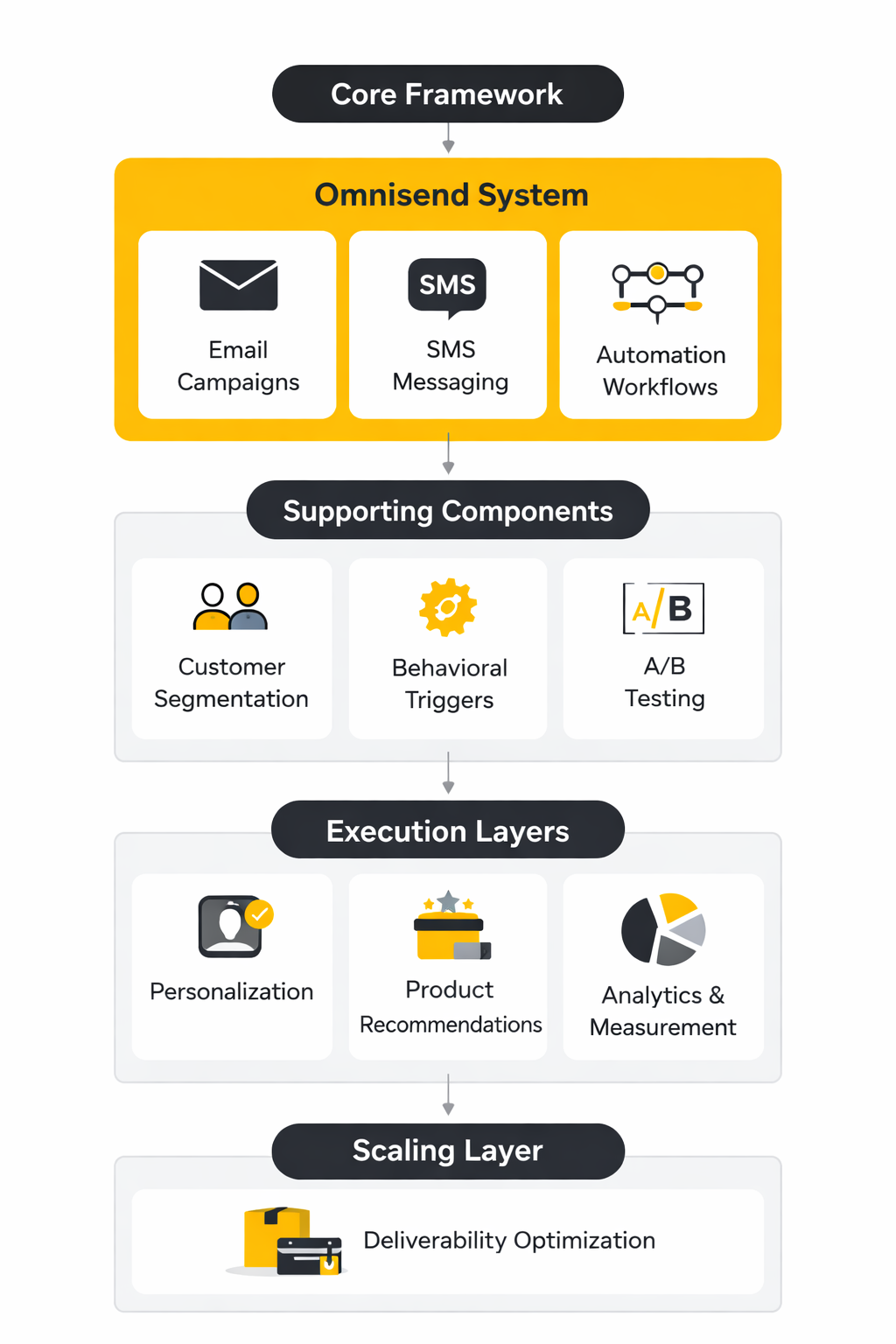
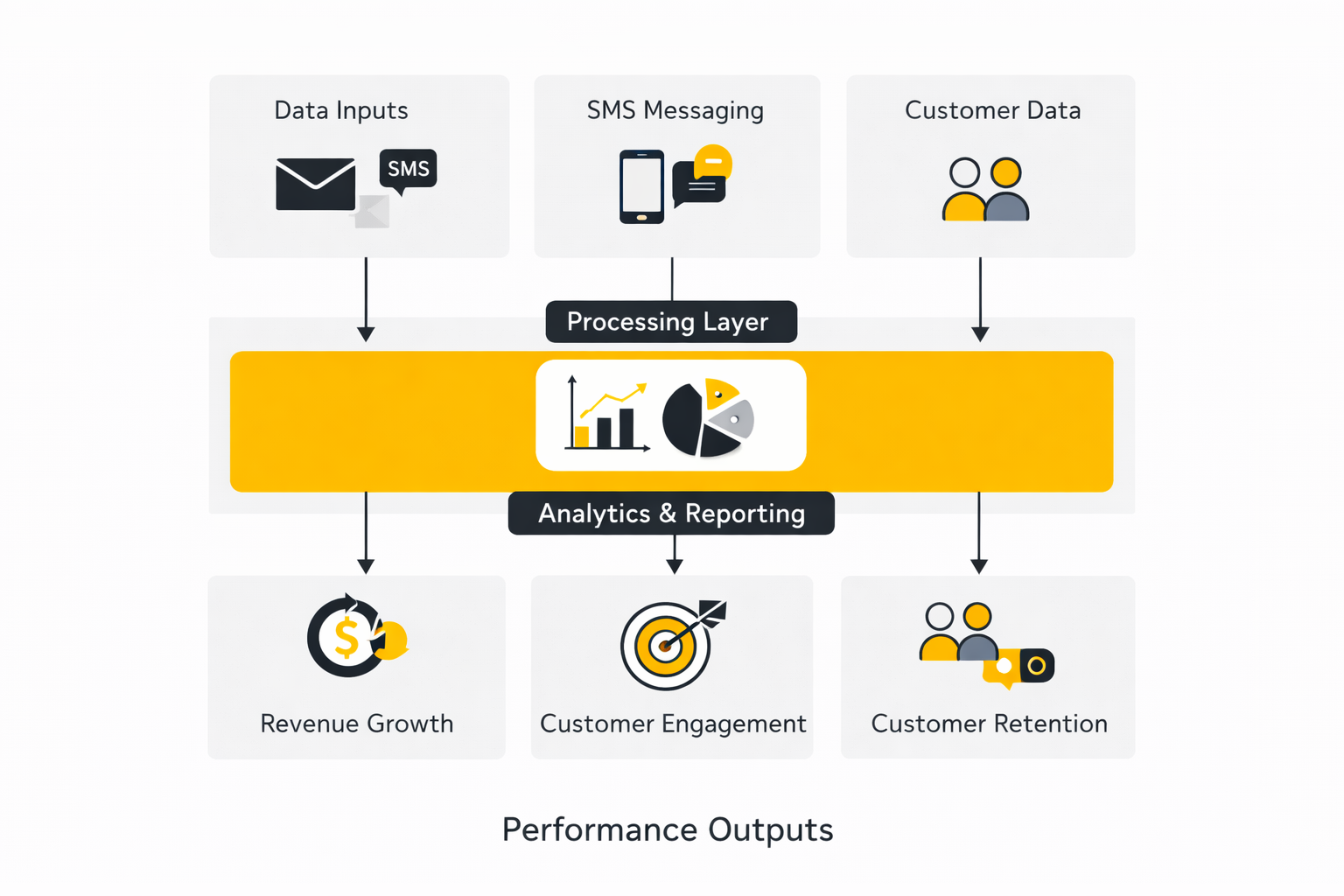
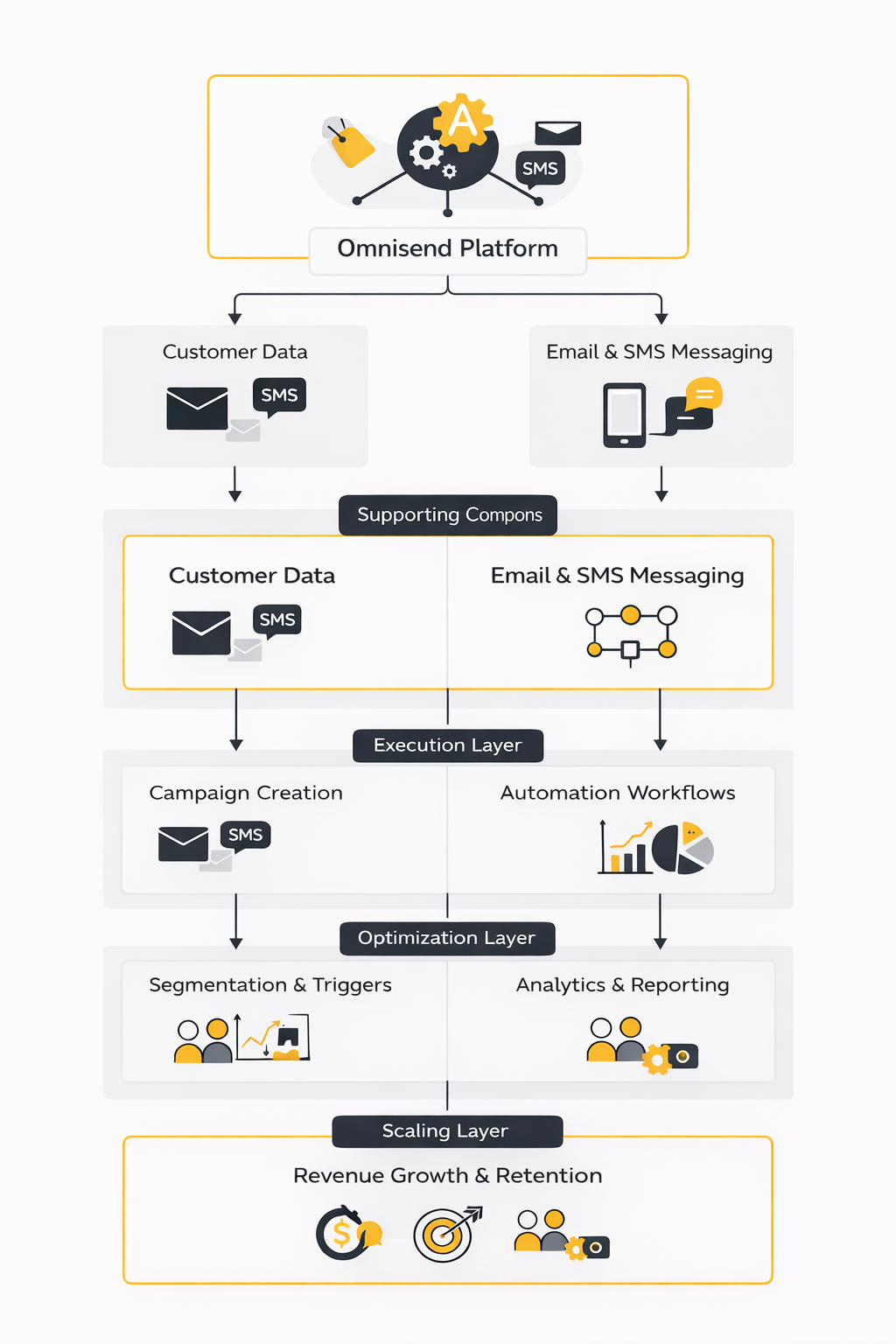
The easiest way to understand Omnisend is to stop thinking about it as just an email platform. It works more like a retention framework built on four layers: data coming in from the store, audience logic that updates as customers behave differently, automated and campaign messaging across channels, and reporting that ties those messages back to orders and revenue through Omnisend’s segmentation tools, customer lifecycle system, and attribution reporting. Once you see that structure, the product makes a lot more sense.
The first layer is store data. Omnisend connects to ecommerce platforms and pulls in product, order, and customer information through native integrations or, for custom setups, through a frontend snippet and API-based backend sync described in the integration support hub and the custom ecommerce integration guide. Without that data layer, you are just sending newsletters. With it, you can trigger messages based on real behavior like viewing a product, abandoning checkout, making a purchase, or dropping into an at-risk lifecycle segment.
The second layer is audience intelligence. Omnisend’s segmentation system lets merchants build dynamic groups based on orders, engagement, location, tags, and other conditions, while lifecycle tools classify customers by relationship strength and churn risk in the segmentation feature page, the customer lifecycle stages overview, and the support docs for lifecycle analysis. That matters because great retention marketing is really a targeting problem. The message itself is important, but relevance is what makes the message work.
The third layer is orchestration. Omnisend allows brands to combine email, SMS, and web push in a single automation view, and it offers prebuilt logic for high-value moments like welcome sequences, cart recovery, browse recovery, and post-purchase communication in the main features page and the support articles for browse abandonment and abandoned cart automation. That means a brand can build one customer journey instead of managing disconnected channel campaigns that compete with each other.
The fourth layer is measurement. Omnisend tracks campaign and automation performance with revenue, placed order metrics, and attribution logic, while also making it clear that attribution can depend on message send date versus order date depending on the report you are using in the campaign reporting documentation, the general reports guide, and the sales attribution explainer. That is an underrated strength. Plenty of tools show activity, but far fewer explain how the revenue is being counted, and that detail matters when you are deciding what to scale, what to cut, and which flow is genuinely pulling its weight.
Put those four layers together and the framework becomes clear. Omnisend captures intent, turns that intent into segments and lifecycle states, responds with automated cross-channel messaging, and then feeds the results back into reporting so the next iteration gets smarter. That is why the platform tends to click for ecommerce operators very quickly: the logic matches the way a real store grows.
There is also a hidden operational benefit here. When forms, segmentation, automations, and reporting all live in one environment, the team spends less time exporting lists, fixing sync issues, and debating whose dashboard is telling the truth, which is exactly the kind of workflow simplification Omnisend pushes through its all-in-one feature positioning and list-building tools such as popups and landing pages. For lean ecommerce teams, that reduction in friction is not a nice bonus. It is often the only reason consistent retention marketing happens at all.
The Core Components Inside Omnisend
Once the framework is clear, the next step is understanding what you actually work with inside Omnisend day to day. This is where most tools get confusing, but Omnisend keeps things relatively tight because everything is built around ecommerce events and customer behavior rather than abstract marketing concepts.
At a practical level, the platform is structured around a few core components that interact with each other continuously. You are not jumping between disconnected modules. You are building one system where each piece feeds the next.
Campaigns and Broadcast Messaging
Campaigns are the most straightforward part of Omnisend. These are your one-off sends: product launches, promotions, seasonal sales, announcements, and newsletters. The difference compared to basic email tools is that campaigns can pull in real store data like products, discount codes, and dynamic customer attributes through the platform’s ecommerce integration layer.
This matters because even a simple campaign becomes more targeted. Instead of sending the same message to everyone, you can segment based on behavior, purchase history, or lifecycle stage using the built-in segmentation system described in the segmentation feature overview. That is the difference between “sending emails” and actually driving revenue.
Automation Workflows
Automation is where Omnisend starts to earn its place. These are prebuilt or custom flows triggered by real customer behavior, such as signing up, abandoning a cart, browsing products, or completing a purchase. The platform provides ready-made workflows for high-impact use cases like welcome series, cart recovery, and post-purchase follow-ups through its automation library and support documentation for abandoned cart flows.
The key here is timing. Automated messages are sent when intent is highest, which is why lifecycle flows consistently outperform generic campaigns in ecommerce benchmark datasets like Klaviyo’s email performance reports. Omnisend builds its entire automation system around capturing and reacting to those moments.
Forms and List Building
Before any automation works, you need subscribers. Omnisend includes popups, embedded forms, and landing pages designed specifically for ecommerce conversion rather than just email capture. These tools integrate directly with segmentation and automation, meaning a signup form can immediately trigger a welcome flow or assign a user to a specific segment through its form builder and popup tools.
This is one of those small details that has a big impact. When list building and automation are connected, you eliminate the delay between capturing a lead and starting the relationship. That alone can improve early conversion rates.
Segmentation and Customer Data
Everything in Omnisend runs on segmentation. The platform allows you to build dynamic groups based on conditions like purchase frequency, order value, engagement level, and browsing behavior, with lifecycle tracking layered on top through the customer lifecycle system.
This is where most ecommerce growth actually happens. The more precisely you can define your audience, the more relevant your messaging becomes. Instead of blasting discounts to everyone, you can target high-value repeat buyers differently from first-time visitors or inactive subscribers.
Reporting and Attribution
Finally, there is reporting. Omnisend tracks revenue attribution, campaign performance, and automation results, giving visibility into which messages are actually generating orders through its reporting system. It also explains how attribution works, including the difference between send-date and order-date tracking in the sales attribution guide.
This is critical because without clear attribution, you are guessing. With it, you can double down on what works and cut what does not.
Professional Implementation for Real Stores
Understanding the components is one thing. Turning them into a working revenue system is where most stores either win or stall. The good news is that Omnisend is designed to reduce setup friction, but there is still a clear order of operations if you want it to perform properly.
Step 1: Connect Your Store and Sync Data
Everything starts with integration. Omnisend needs access to your product catalog, customer data, and order history, which it pulls through native integrations with platforms like Shopify and WooCommerce or through API-based setups described in the integration documentation.
If this step is incomplete or broken, nothing else will work properly. Automations will not trigger correctly, segmentation will be limited, and reporting will be unreliable. This is the foundation, and it has to be solid.
Step 2: Build Your Core Signup System
Next comes list growth. You set up popups, embedded forms, or landing pages to capture visitors and turn them into subscribers using Omnisend’s built-in tools. This is where you define your entry point into the retention system.
For stores that also rely on funnel-based acquisition, tools like Systeme.io or ClickFunnels can complement Omnisend by handling front-end funnel logic, while Omnisend takes over retention and lifecycle messaging once the lead enters the system.
Step 3: Launch High-Impact Automations First
You do not need everything at once. The smartest approach is to start with the flows that have the highest revenue impact:
- Welcome series
- Abandoned cart recovery
- Browse abandonment
- Post-purchase follow-up
These are already supported with templates and best-practice logic inside Omnisend’s automation system. Launching these early means you start capturing lost revenue and nurturing new subscribers almost immediately.
Step 4: Layer in Segmentation and Personalization
Once your core flows are running, you refine targeting. This is where you begin splitting audiences based on behavior, purchase patterns, and engagement. Omnisend’s segmentation tools allow you to evolve from basic messaging into more personalized communication over time.
This step is not about complexity. It is about relevance. Even small segmentation improvements can significantly impact performance because they align messaging with customer intent.
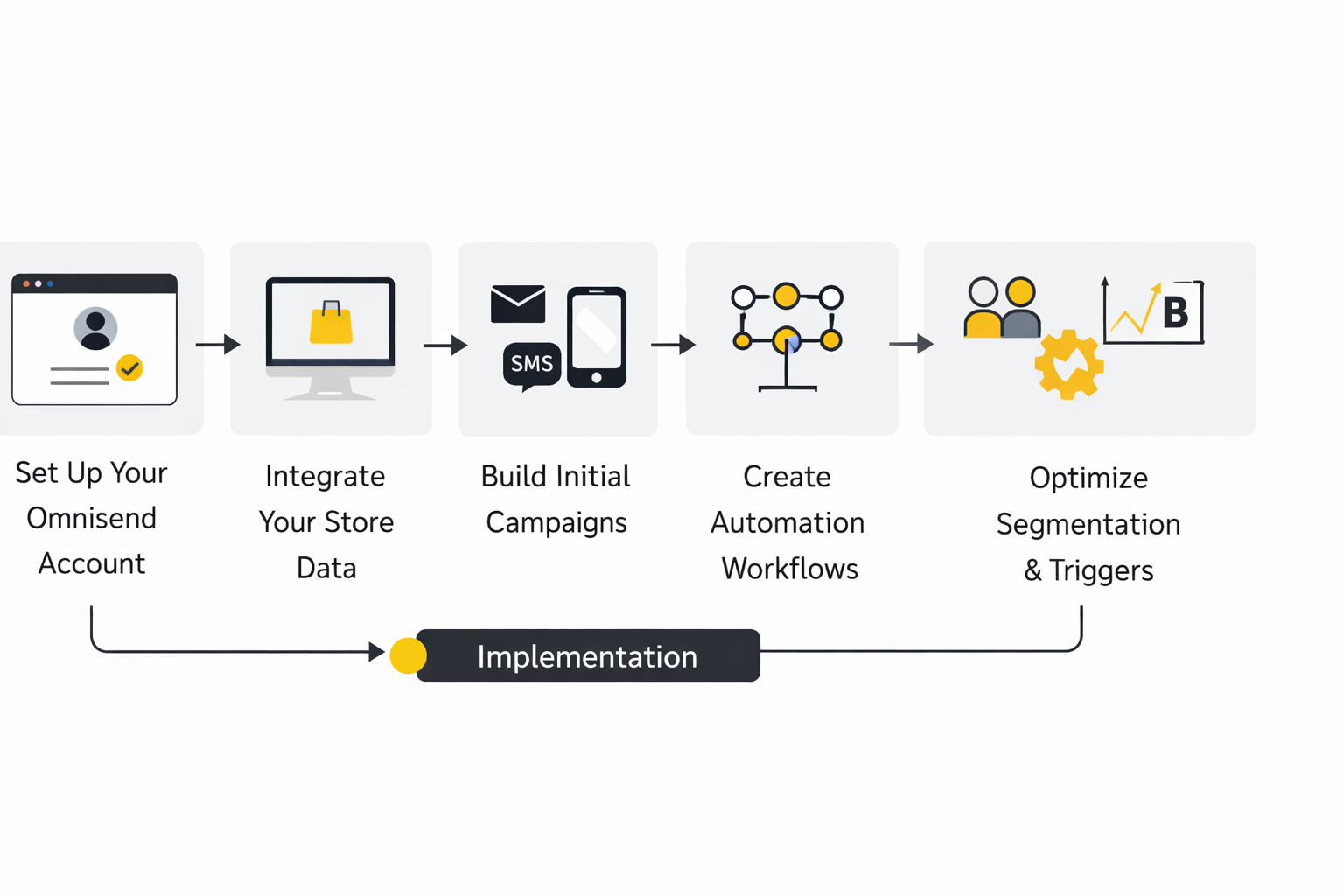
Step 5: Add Campaigns and Promotional Strategy
With automations handling lifecycle communication, campaigns become your strategic lever. This is where you run promotions, product launches, and seasonal pushes. Because your segmentation is already in place, campaigns can be targeted instead of broad.
This is also where many stores make a mistake. They over-rely on campaigns instead of letting automations do the heavy lifting. The best-performing setups use campaigns to amplify momentum, not replace lifecycle messaging.
Step 6: Measure, Adjust, and Scale
Finally, you track results and iterate. Omnisend’s reporting shows which flows and campaigns are generating revenue, allowing you to optimize based on real performance data instead of assumptions.
At this stage, scaling becomes straightforward. You increase volume on what works, refine what underperforms, and gradually expand your automation library. This is where Omnisend transitions from a tool into a growth engine, because the system is now feeding itself with data, insights, and continuous improvement.
What the Data Says About Omnisend Performance
This is the point where most software reviews go off the rails. They throw out a pile of stats, act impressed, and never explain what those numbers actually mean for a store that has to make payroll, protect margins, and decide where to put the next dollar. With Omnisend, the useful question is not whether the metrics look good in isolation. It is whether the data points line up with the kind of execution model the platform is built for.
The strongest pattern is not subtle. In Omnisend’s 2025 ecommerce marketing report, which analyzed 24 billion emails, 230 million SMS messages, and 413 million push notifications sent in 2024, automated messages dramatically outperformed manual campaigns. That headline matters because it validates the core argument of this article: Omnisend is most valuable when it is used as a behavioral system, not as a prettier way to send newsletters.
That broader pattern also matches what other large datasets have been showing. In Klaviyo’s benchmark research, ecommerce performance tends to improve when brands lean harder into lifecycle messaging and tighter segmentation rather than relying on broad promotional sends. Even Mailchimp’s benchmark framework points in the same direction, even though it serves a much wider business mix: performance only becomes useful when you compare your numbers against intent, audience quality, and campaign type instead of treating every send like it should behave the same way.
The Automation Gap Is the Real Story
The cleanest Omnisend statistic is also the most important one. In the company’s 2025 report, automated messages posted 52% better open rates, 332% higher click rates, and 2,361% better conversion rates than manual campaigns. That is not a small optimization. That is a completely different performance profile.
The mistake would be reading that as “automation is magic.” It is not. Automation wins because it is tied to timing, intent, and customer state. A welcome email arrives when interest is fresh, a cart reminder lands when purchase intent is still alive, and a back-in-stock message reaches someone who already signaled demand. Of course those messages convert better. They are triggered by behavior instead of hope.
Omnisend’s own data gets even more specific here. The same report shows that just 2% of email volume drove 37% of email-driven sales, and that abandoned cart, welcome, and browse abandonment automations accounted for 87% of all automated orders. That should drive a very practical action: if a store is new to Omnisend, the first serious build should not be a giant campaign calendar. It should be those few core flows.
Why Click-to-Conversion Matters More Than Vanity Metrics
Open rates still matter, but they are not the headline metric many marketers pretend they are. Omnisend’s report showed global email open rates rising 6% year over year to 26.6% while click rates fell from 1.49% to 1.22%, yet click-to-conversion rates still grew by 27.6%. That combination tells an important story.
It suggests buyers are becoming more selective, not less engaged. More people may open, fewer may click casually, but the people who do click are arriving with stronger purchase intent. In other words, weak traffic is being filtered out earlier, which means a lower raw click rate does not automatically signal worse performance.
That is exactly why Omnisend’s reporting structure matters. The platform emphasizes revenue attribution, order outcomes, and workflow-level performance in its reporting documentation and sales attribution explainer. If you judge the system only by opens, you will optimize for curiosity. If you judge it by click-to-conversion and attributed revenue, you will optimize for buying behavior. That is a much better game to play.
Email Still Does the Heavy Lifting, but SMS and Push Change the Shape of the Funnel
A lot of brands talk about omnichannel and then quietly mean “email plus maybe a few texts.” Omnisend’s data gives a more grounded view. Email still dominates volume and remains the deepest content channel, but the 2025 report found that brands sent 31% more SMS messages and 55% more push notifications year over year, which points to a real shift in how stores are building customer journeys.
That shift makes sense when you look at buyer preferences outside Omnisend’s ecosystem too. In Attentive’s 2025 UK SMS and email survey, 84% of respondents wanted to customize the types of messages they receive by channel, 70% believed email and SMS should serve distinct roles, and 58% said they were more likely to buy when they had seen the same promotion across channels. That is not a case for blasting every message everywhere. It is a case for channel discipline.
So the action here is straightforward. Use email for richer explanation, product context, bundles, launches, and content-heavy promotions. Use SMS for urgency, reminders, shipping updates, and time-sensitive nudges. Use push when you want a fast, low-cost retargeting touch that does not require an inbox open. Omnisend’s advantage is that it lets those decisions live inside one workflow rather than in three disconnected tools.
High-Performing Flows Tell You Where Revenue Actually Hides
The best metrics in Omnisend are not the broadest ones. They are the flow-level numbers that show where intent is most monetizable. In the company’s 2025 report, back-in-stock emails posted a 59.19% open rate and a 5.34% conversion rate, while one in every two people who clicked an automated welcome or abandoned cart email made a purchase. Those are not “nice to have” numbers. They are a roadmap.
What makes these flows so strong is the emotional context around them. A welcome message captures immediate interest. A cart email catches hesitation before it hardens into abandonment. A back-in-stock alert combines prior product interest with scarcity and urgency. None of that is random. These are all moments where customer psychology is already doing most of the work.
This is why implementation should stay brutally focused at first. Stores often waste months designing elaborate automation trees while ignoring the few flows that account for the majority of real ecommerce recovery and repeat purchase opportunity. Omnisend’s own dataset argues for the opposite approach: master the small number of flows that consistently pull revenue, then expand.
Push and SMS Are Not Supporting Actors Anymore
There is a temptation to treat email as the serious channel and everything else as optional seasoning. That is increasingly outdated. Omnisend’s 2025 report found that SMS campaigns in the UK reached a 10.65% click-to-conversion rate versus a 2.18% global average, while automated push notifications averaged a 13.94% click-to-conversion rate and converted 500% better than push campaigns.
Those numbers do not mean every store should suddenly overinvest in texting or browser notifications. They mean the right secondary channel can become extremely efficient when it is used for the right job. SMS is strongest when urgency and immediacy matter. Push is strongest when cost efficiency and instant retargeting matter. Email remains the most flexible base layer.
For Omnisend users, the right interpretation is not “use all channels equally.” It is “match the channel to the buying moment.” That is where the platform’s unified workflow builder becomes practical rather than theoretical.
How to Read Omnisend Reporting Without Fooling Yourself
Measurement gets dangerous when marketers confuse platform reporting with absolute truth. Omnisend is transparent about the fact that revenue views can differ depending on whether a report is using send date or order date in its campaign reporting guide and attribution documentation. That is not a flaw. It is a reminder to read the dashboard like an operator, not a tourist.
The practical way to use Omnisend analytics is to ask four questions every time. Which flows generate the highest attributed revenue per recipient. Which campaigns drive incremental sales versus just catching buyers who would have converted anyway. Which segments convert best after clicking. And which channel is helping complete the journey rather than merely getting credit for the final touch.
If you use the platform that way, the data becomes operational. You stop obsessing over pretty percentages and start making stronger budget decisions, tighter segmentation choices, and better automation priorities. That is where analytics turns into profit.
The Benchmark Trap Most Stores Fall Into
Benchmarks are useful, but only up to a point. Comparing your brand to a giant aggregate dataset can help you spot whether your deliverability, click rate, or conversion rate is clearly underperforming. What it cannot do is tell you whether your store’s economics, product cycle, pricing, or traffic quality match the brands inside that average.
That is why Omnisend benchmarks should be treated as directional, not sacred. If your abandoned cart flow is materially below what the platform’s large-scale data suggests is possible, that is a signal to audit timing, offer strategy, message sequence, and mobile experience. But if your open rate is slightly below a published benchmark while revenue per send is strong, that is not an emergency. Revenue quality beats vanity alignment every time.
The smartest action is to use external data as context and internal trendlines as truth. Watch whether your Omnisend automations are improving month over month. Watch whether segments are tightening. Watch whether click-to-conversion rises when personalization improves. That is the level where measurement becomes useful enough to guide real decisions.
Omnisend Pricing, Strengths, and Tradeoffs
By this point, the case for Omnisend should be pretty clear. It is not trying to be the universal answer for every digital business. It is trying to be a tightly integrated retention platform for ecommerce brands, and a lot of its strengths come directly from that focus.
The pricing structure reflects that positioning. Omnisend’s current pricing page and the more detailed 2026 plan documentation show a model built around contact volume, email credits, and SMS usage, with the big selling point being that all plans include the full feature set rather than locking automations and segmentation behind premium tiers. That is genuinely useful for smaller stores because it means you can build a serious retention system early instead of waiting until the budget catches up.
Where Omnisend Is Strongest
Omnisend is strongest when speed matters and the team is lean. The platform bundles email, SMS, push, forms, segmentation, reporting, and ecommerce data sync in one system, and it still promotes 160+ integrations, 24/7 live chat and email support, list cleaning tools, A/B testing, and prebuilt workflows on all plans. For a resource-constrained ecommerce team, that kind of operational simplicity is not just convenient. It removes a lot of the hidden drag that usually kills execution.
There is also a real usability advantage in the way Omnisend handles migration and setup. The company provides dedicated migration documentation for Mailchimp, Klaviyo, and broader ESP migrations, which tells you something important about its market position. Omnisend knows many of its best customers are not starting from zero. They are switching because they want a more ecommerce-native setup without rebuilding everything from scratch.
Another strength is that Omnisend does not force a fake separation between strategy and execution. The same platform that captures the lead can segment that lead, trigger the flow, score the revenue, and surface the deliverability issues. That kind of closed loop is one reason an ecommerce-first platform can outperform broader tools that do each task reasonably well but never quite feel unified.
The Biggest Strategic Tradeoff
The same specialization that makes Omnisend strong also creates its main limitation. If your business depends more on funnel architecture, long-form sales pages, webinar logic, appointment flows, partner management, or broader CRM-heavy pipelines, Omnisend may not be the center of your stack. In those cases, tools like ClickFunnels, Systeme.io, or even CRM-linked systems like Copper may fit the broader operating model better.
That does not mean Omnisend is weak. It means platform fit matters more than feature count. Omnisend makes the most sense when the commercial center of gravity is the store itself: products, carts, repeat purchases, merchandising, and lifecycle messaging. Once you move outside that zone, the platform can still be useful, but it stops being as naturally aligned.
This is the tradeoff many brands miss. They compare software line by line, looking for the “most features,” when the smarter question is whether the system matches the revenue engine of the business. Omnisend is very good when the business looks like ecommerce. It gets less natural the further you move away from that.
Scaling Gets Easier, but It Also Gets Less Forgiving
A lot of platforms feel great when you are small and start exposing cracks when volume rises. Omnisend avoids some of that because the same architecture supports both early-stage and growing stores, but scaling still raises the stakes. Once your contact base expands, small mistakes in segmentation, offer fatigue, and send frequency become more expensive.
This is where pricing also becomes more real. The 2026 Omnisend plan model ties email credits to contact counts on Standard and includes monthly SMS credits on Pro, which is sensible, but it means sloppy list growth can quietly turn into a cost problem. A big list is not automatically an asset. If the audience is poorly qualified or badly maintained, it can drive costs up while dragging engagement down.
That is why serious scaling with Omnisend requires discipline around audience quality. The platform’s own support content keeps emphasizing list cleaning, deliverability hygiene, and ongoing segment refinement. The message is simple: scale is only valuable when the list is healthy enough to support it.
Deliverability Is Not Automatic
This part matters more than most marketers want to admit. A lot of users assume that if they pay for a good platform, inbox placement will somehow take care of itself. It will not. Omnisend gives you the infrastructure, but deliverability is still earned through authentication, relevance, consent quality, and list hygiene.
The technical side is straightforward. Omnisend provides free domain signing and setup guidance for SPF, DKIM, and DMARC, plus additional guidance for Google and Yahoo sender requirements and even BIMI implementation. That is the technical floor.
The real problem is behavioral. Omnisend’s current deliverability guidance makes it explicit that authentication alone does not guarantee inbox placement because mailbox providers also evaluate engagement, spam complaints, and bounce behavior in the deliverability FAQ. In practical terms, that means no software can save a brand that insists on blasting weak offers to tired segments.
SMS Is Powerful, but the Compliance Burden Is Real
SMS can be brutally effective, but it is also much less forgiving than email. Omnisend supports SMS deeply, yet its own documentation repeatedly stresses compliance best practices, explicit opt-in requirements, and TCPA-related obligations for US and Canadian marketers. That should tell you everything you need to know.
The opportunity is obvious. SMS gives you speed, visibility, and urgency that email often cannot match. The risk is that a sloppy consent setup or aggressive sending strategy can create legal exposure, user frustration, and carrier-level problems much faster than a weak email campaign would.
So the expert move is restraint. Use SMS where immediacy adds real value, not where it merely adds noise. Omnisend gives you the tools, but the brand still has to exercise judgment.
Migration Is Easier Than Rebuilding, but It Is Not Frictionless
Omnisend deserves credit for being honest here. Its migration documentation does not pretend everything transfers perfectly. In the guides for moving from Mailchimp, Klaviyo, and other platforms, the company makes clear that contacts and some assets can move, but workflows often need to be recreated and historical reporting does not always come with you.
That is not a flaw unique to Omnisend. It is the normal cost of switching serious systems. Still, it matters because brands often underestimate the operational work involved in moving from one ESP to another.
The smart way to think about migration is not as a pure copy-paste exercise. It is a rebuild opportunity. You keep the assets worth saving, clean up the logic that was bloated or outdated, and relaunch with tighter segmentation and stronger flows. That takes more effort upfront, but the result is usually better than dragging old mess into a new platform.
The Most Important Expert-Level Guidance
If you want Omnisend to perform at a high level, do not treat it like a content calendar with extra buttons. Treat it like a revenue operating system for owned channels. That means tighter entry points, fewer but stronger automations, serious list hygiene, better measurement discipline, and much more restraint around who gets what message and when.
It also means not chasing complexity too early. Omnisend gives you enough flexibility to build impressive systems, but advanced users know that the best retention programs are not the ones with the most branches. They are the ones with the clearest logic, the healthiest data, and the strongest alignment between customer intent and channel choice.
That is the real tradeoff at the heart of Omnisend. The platform gives ecommerce brands a lot of power without requiring an enterprise stack. But power only compounds when the team behind it is disciplined enough to use it well.
Final Perspective on Omnisend as a System
By now, the pattern should be obvious. Omnisend is not just a tool you “add” to your stack. It becomes the backbone of how your store communicates with customers after they show interest. Everything flows through it: data, segmentation, timing, and revenue attribution.
The reason it works is not because it has more features than competitors. It works because it aligns tightly with how ecommerce actually operates. Products drive behavior, behavior drives segmentation, segmentation drives messaging, and messaging drives revenue. Omnisend simply removes friction between those steps.
For stores that treat retention seriously, that alignment compounds. You start with a few flows, you refine them, you add segmentation, and over time the system becomes more efficient. That is the real outcome you are aiming for. Not more emails. Better timing, better targeting, and higher-quality revenue.
FAQ - Built for Complete Guide
What is Omnisend best used for?
Omnisend is best used for ecommerce retention marketing. It is designed to handle email, SMS, and push messaging tied directly to store behavior like purchases, cart abandonment, and product views. If your business revolves around a product catalog and repeat buyers, it fits naturally.
Is Omnisend good for beginners?
Yes, especially compared to more fragmented setups. The platform includes prebuilt automation workflows and a free plan with full features, which means you can launch core retention flows without needing advanced technical knowledge. The learning curve comes later when you start optimizing segmentation and scaling.
How does Omnisend compare to Klaviyo?
Both are ecommerce-focused, but Omnisend tends to emphasize simplicity and bundled features, while Klaviyo leans deeper into advanced customization and data modeling. For smaller teams or faster setup, Omnisend often feels more approachable. For highly complex segmentation needs, Klaviyo may offer more flexibility.
Does Omnisend support SMS marketing?
Yes, SMS is built directly into the platform alongside email and push notifications. You can include SMS inside automation workflows and campaigns, but you need to handle consent and compliance carefully using Omnisend’s built-in guidelines and opt-in tools.
Can Omnisend replace other marketing tools?
It can replace multiple tools in an ecommerce stack, especially email platforms, SMS tools, popup builders, and basic automation systems. However, it does not replace funnel builders or full CRM systems. Many brands still pair it with tools like Systeme.io or ClickFunnels for front-end acquisition.
How long does it take to set up Omnisend?
A basic setup can be done in a few hours, especially if you are using a native ecommerce integration. A full implementation with optimized flows, segmentation, and campaigns usually takes a few weeks of iteration to get right.
What are the most important automations to build first?
Focus on high-impact flows:
- Welcome series
- Abandoned cart recovery
- Browse abandonment
- Post-purchase follow-up
These consistently drive the majority of revenue in ecommerce automation systems, as shown in large-scale performance reports like Omnisend’s 2025 dataset.
Is Omnisend expensive as you scale?
It depends on how well you manage your list. Pricing grows with contact count and usage, so a clean, engaged list scales efficiently, while a bloated list increases costs without improving results. Good segmentation and list hygiene become critical at scale.
Does Omnisend handle deliverability automatically?
No platform fully automates deliverability. Omnisend provides infrastructure like domain authentication and guidance, but inbox placement depends on engagement, consent quality, and sending practices. You still need to manage your audience and content carefully.
Can Omnisend work for non-ecommerce businesses?
It can, but it is not ideal. Omnisend is built around ecommerce events and product-driven behavior. Businesses that rely more on funnels, services, or complex CRM pipelines may find better alignment with broader marketing platforms like Brevo or Moosend.
What is the biggest mistake people make with Omnisend?
Treating it like a campaign tool instead of a lifecycle system. When brands focus only on newsletters and promotions, they miss the real value, which comes from behavior-driven automations and segmentation. The difference in performance between those approaches is not small. It is massive.
Work With Professionals
Explore 10K+ Remote Marketing Contracts on MarkeWork.com
Most marketers spend too much time chasing clients, competing on crowded platforms, and losing a percentage of every project to middlemen.
MarkeWork gives you a better way. Browse thousands of remote marketing contracts and connect directly with companies desperate to hire skilled marketers like you, without platform commissions and without unnecessary gatekeepers.
If you're serious about finding better opportunities and keeping 100% of what you earn, explore available contracts and create a profile for free at MarkeWork.com.