

Online advertising companies are not just media buyers anymore. The good ones help you connect strategy, creative, tracking, automation, landing pages, and follow-up into one commercial system.
That matters because paid traffic has become more expensive, more automated, and less forgiving. Global ad spending was projected to pass $1 trillion in 2025, with digital taking more than 75% of total media spend in EMARKETER’s worldwide ad spending forecast.
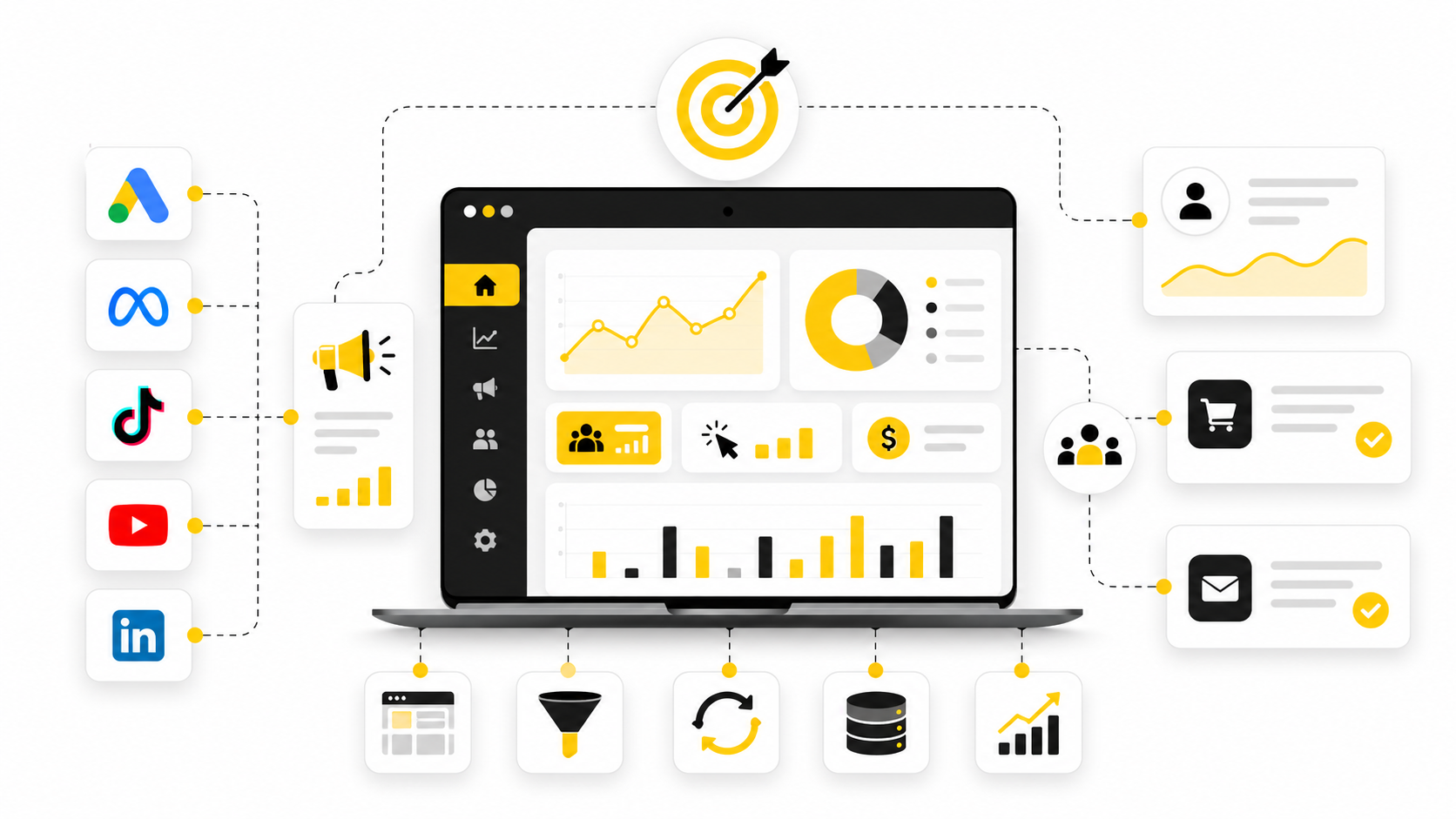
This guide breaks down how online advertising companies actually work, where they fit, and how to choose one without getting blinded by dashboards, jargon, or vague promises.
- Why Online Advertising Companies Matter Now
- The Online Advertising Company Framework
- Core Types of Online Advertising Companies
- What Professional Implementation Looks Like
- How to Compare Providers Without Getting Misled
- FAQs About Online Advertising Companies
Why Online Advertising Companies Matter Now
Online advertising is no longer just about placing ads on Google, Facebook, Instagram, YouTube, TikTok, LinkedIn, or display networks. The real work is making sure the offer, audience, message, landing page, tracking, sales process, and retention system all point in the same direction. When one part is weak, the ad platform usually gets blamed, even when the real problem sits somewhere else.
That is why the best online advertising companies act more like growth partners than simple campaign managers. They help businesses decide what should be advertised, who should see it, what action should happen next, and how success should be measured. This is also where tools such as GoHighLevel, ClickFunnels, and ManyChat can support the back end of paid acquisition when they genuinely fit the business model.
The biggest mistake is treating advertising as a traffic problem only. Traffic is just the beginning. If the conversion path is weak, more traffic simply exposes the weakness faster.
The Online Advertising Company Framework
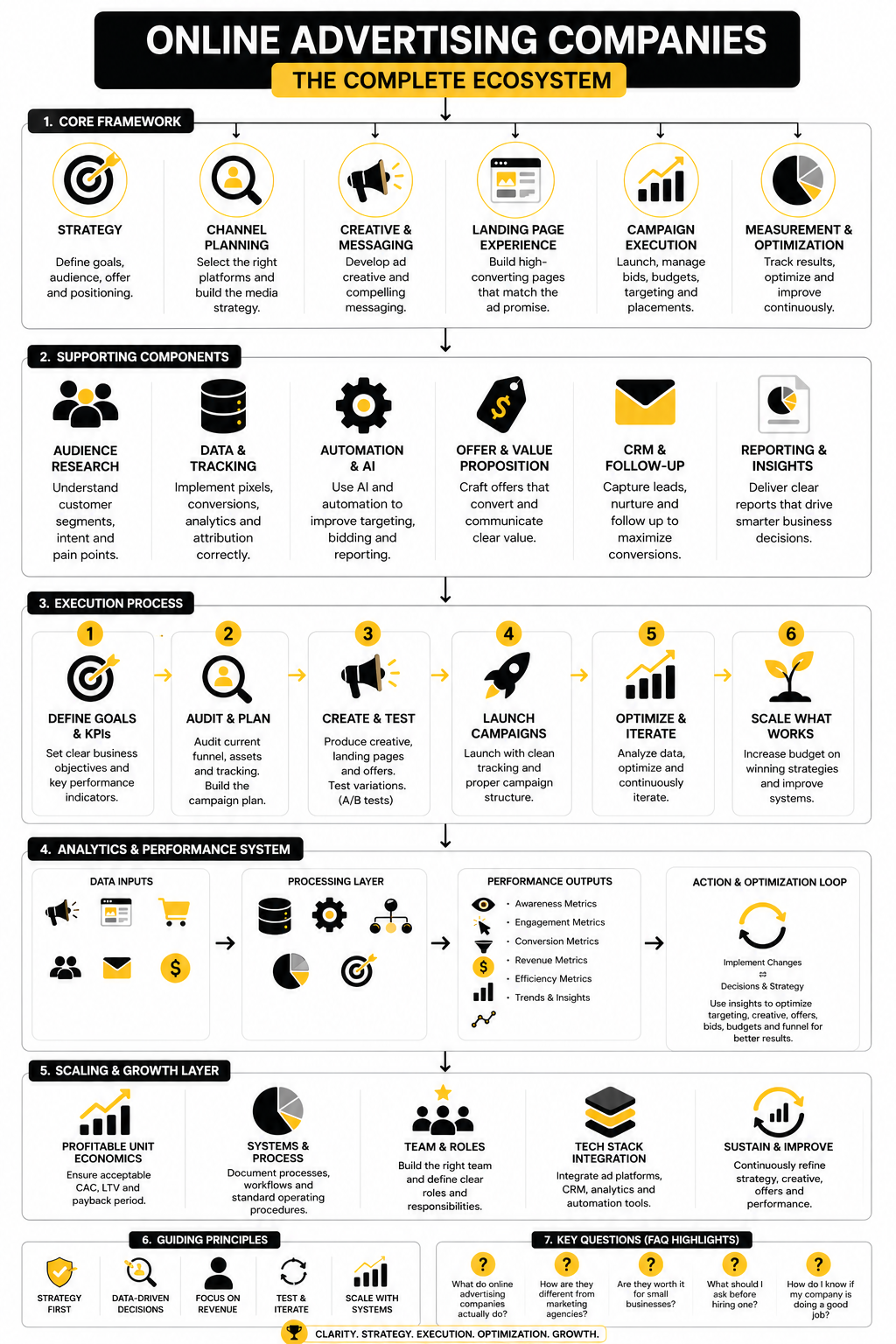
A useful way to understand online advertising companies is to separate them by the part of the growth system they improve. Some companies specialize in media buying, some in creative production, some in landing pages, some in marketing automation, and some in analytics. A full-service partner may cover all of these, but you should still know which parts they are actually strong at.
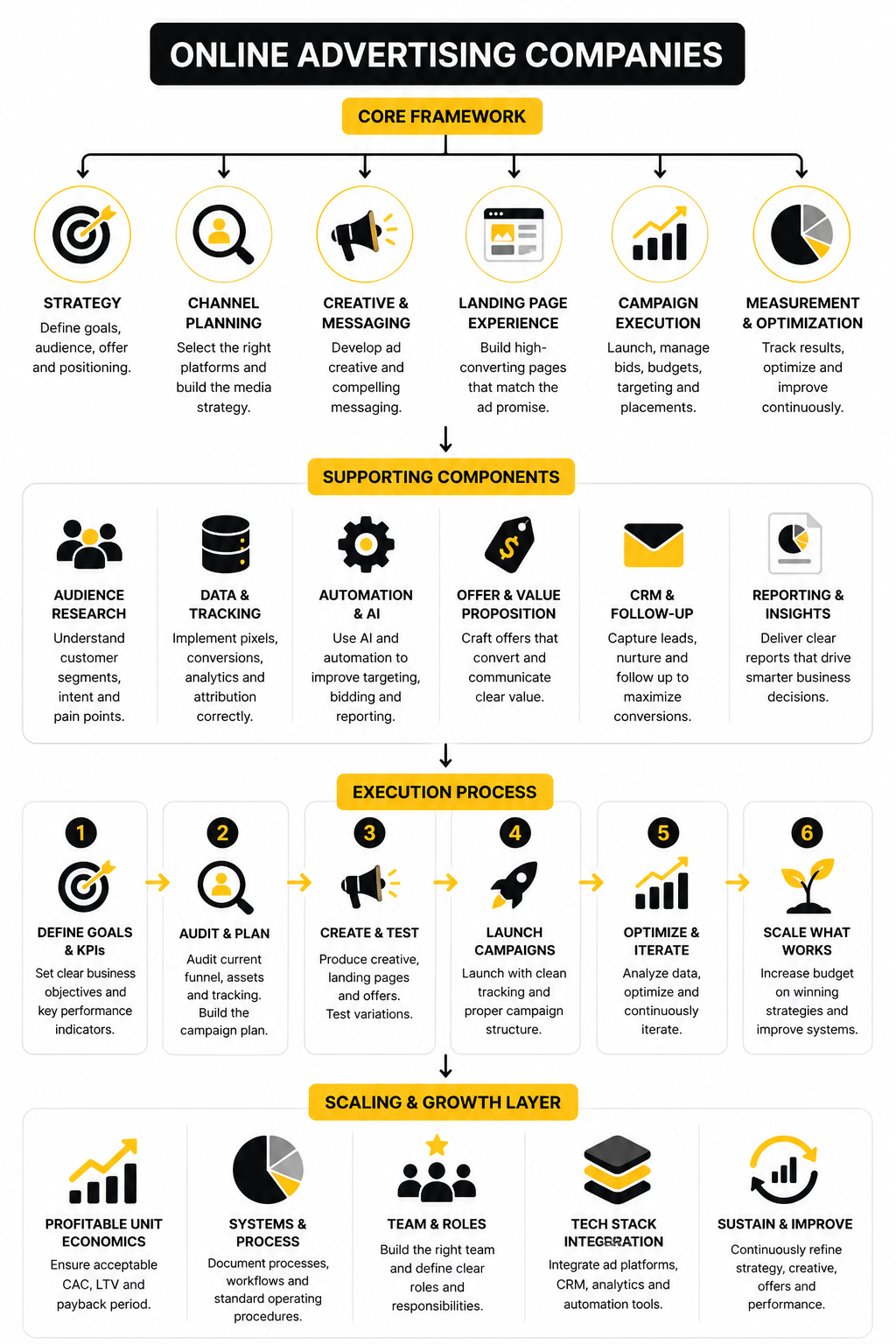
The framework is simple. First, the company needs a clear commercial goal. Second, it needs a measurable acquisition path. Third, it needs creative and targeting that match the customer’s awareness level. Fourth, it needs reporting that tells the truth instead of just making the campaign look busy.
This is where many businesses get stuck. They hire an agency to “run ads,” but they do not give that agency a strong offer, clean tracking, a fast landing page, or a realistic sales follow-up process. Good online advertising companies will push back on those gaps before scaling spend.
Core Types of Online Advertising Companies
The easiest way to compare online advertising companies is to stop putting them all in one bucket. A paid search agency, a social media ad agency, a programmatic media buyer, a landing page specialist, and a marketing automation platform may all support advertising, but they solve different problems. When you know the category, you can judge the company by the right standard instead of expecting one partner to magically fix everything.
Search-focused companies usually help capture demand that already exists. They work best when people are actively looking for your product, service, or category, which is why Google’s ad products remain central to many acquisition plans. U.S. search advertising revenue reached $114.2 billion in 2025, still the largest digital ad revenue category in the IAB’s full-year 2025 revenue report.
Social and creator-focused companies are different. They are often better at creating demand, shaping desire, and turning attention into action before the customer starts searching. Creator marketing keeps moving into the mainstream too, with U.S. creator ad spend projected to reach $37 billion in 2025 in IAB’s creator economy research.
Then you have conversion and funnel companies. These are not always media buyers, but they can make paid traffic far more profitable because they improve what happens after the click. A simple funnel built with ClickFunnels, a landing page created with Replo, or a follow-up sequence inside GoHighLevel can be the difference between “ads don’t work” and “we can scale this.”
Paid Search Specialists
Paid search specialists are best when the market already has intent. Someone searches for an emergency plumber, project management software, mortgage broker, local dentist, or B2B compliance platform because they are already trying to solve a problem. In that situation, online advertising companies need to be strong at keyword strategy, match types, bidding, landing page relevance, negative keywords, and conversion tracking.
The challenge is that paid search is becoming more automated. Google’s Performance Max and AI-driven campaign types use machine learning across bidding, audiences, creative, attribution, and placements in Google’s own Performance Max documentation. That does not make specialists useless. It makes their job more strategic.
A weak search agency hides behind automation. A strong one knows how to structure inputs, protect budget, test landing pages, clean up tracking, and separate useful demand from expensive noise. That matters because automation can optimize toward the wrong goal if the business feeds it bad data.
Paid Social Advertising Companies
Paid social advertising companies usually live or die by creative quality. Targeting still matters, but platforms have pushed more control into algorithmic delivery. The real edge now comes from hooks, angles, offers, proof, formats, and the speed of testing.
This is why great paid social teams often look more like creative labs than old-school media buying desks. They produce variations, study comments, watch retention, analyze thumb-stop rates, and keep refreshing the message before fatigue kills performance. On platforms where people are not actively shopping, the ad has to earn attention before it can ask for a click.
Paid social also needs stronger follow-up than many businesses expect. A person who clicks from Instagram, TikTok, or Facebook may need education, reminders, proof, and a softer conversion path. Tools like ManyChat, Brevo, and Moosend can support that journey when the campaign needs messaging, email, or nurture after the first interaction.
Programmatic, Display, and Video Advertising Companies
Programmatic and display-focused companies help brands buy attention across websites, apps, streaming environments, and digital video inventory. This can be powerful, but it is also where vague reporting can get dangerous fast. Impressions, reach, and viewability are useful only when they connect to a real business objective.
Digital video is becoming a bigger part of that conversation. U.S. digital video ad spend grew 18% year over year in 2024 and was projected to reach $72 billion in 2025 in IAB’s 2025 digital video ad spend report. That growth makes sense because video can build trust, explain complex offers, and retarget people who already showed interest.
Still, more video spend does not automatically mean better advertising. The company must know whether video is being used for awareness, education, retargeting, direct response, or sales enablement. Without that clarity, video becomes expensive decoration.
Marketing Automation and CRM-Driven Advertising Companies
Some online advertising companies focus less on the ad click and more on what happens after it. This is especially important for service businesses, agencies, coaches, consultants, local companies, and B2B teams where the sale does not happen instantly. In those cases, speed-to-lead, pipeline visibility, appointment booking, and follow-up can make or break campaign economics.
A CRM-driven advertising partner should care about lead quality, booked calls, show rates, close rates, and customer value. That is much more useful than celebrating cheap leads that never buy. A platform like GoHighLevel fits naturally here because it connects funnels, forms, pipelines, messaging, automation, and reporting in one place.
This type of company is often the right fit when the business already gets clicks but leaks revenue after the form submission. The ads may not be the main problem. The real issue may be slow follow-up, poor qualification, weak reminders, or no structured sales process.
What Professional Implementation Looks Like
Professional implementation starts before a single campaign goes live. The company should clarify the business model, offer, margin, average order value, sales cycle, fulfillment capacity, and follow-up process. Without that context, online advertising companies can still launch ads, but they are mostly guessing at what “good performance” really means.
The strongest teams do not begin with platform settings. They begin with the customer journey. They want to know where the buyer is emotionally and commercially before the ad, what promise will make them stop, what page will help them decide, and what follow-up will move them closer to revenue.
That process sounds basic, but it is where most bad campaigns fail. A campaign can have clean targeting and still lose money if the offer is unclear. It can have a strong landing page and still fail if the sales team responds too slowly. It can generate leads and still disappoint if nobody tracks which leads actually become customers.
Step 1: Define the Commercial Goal
The first step is deciding what the campaign is supposed to produce. Not impressions. Not clicks. Not vague “brand visibility.” A real commercial goal could be booked appointments, qualified pipeline, product purchases, demo requests, trial starts, repeat purchases, or revenue from a specific customer segment.
This goal affects every other decision. A campaign built for fast ecommerce sales should not be judged the same way as a campaign built for high-ticket B2B conversations. Online advertising companies that ignore this difference usually optimize toward easy platform metrics instead of the business outcome.
This is also where the company should define what counts as a valuable conversion. Google’s AI ad tools rely heavily on good conversion inputs and value signals in Google Ads AI guidance. If the system is trained on weak signals, it may become very efficient at finding the wrong people.
Step 2: Audit the Existing Funnel
Before spending more money, the team should inspect the current path from ad click to sale. That includes the landing page, form, checkout, calendar, email sequence, SMS follow-up, CRM stages, sales scripts, tracking pixels, and analytics setup. This audit often reveals that the campaign is not the only bottleneck.
For service businesses, a tool like GoHighLevel can help centralize forms, pipelines, messaging, appointment booking, and automation. For ecommerce or product-led offers, a focused landing page builder such as Replo can help teams test better post-click experiences without waiting on a full development cycle. For simple funnel builds, ClickFunnels can make sense when speed matters more than custom complexity.
The point is not to add software for the sake of it. The point is to remove friction. Every extra delay, unclear message, broken tracking event, or weak follow-up step makes paid traffic harder to scale.
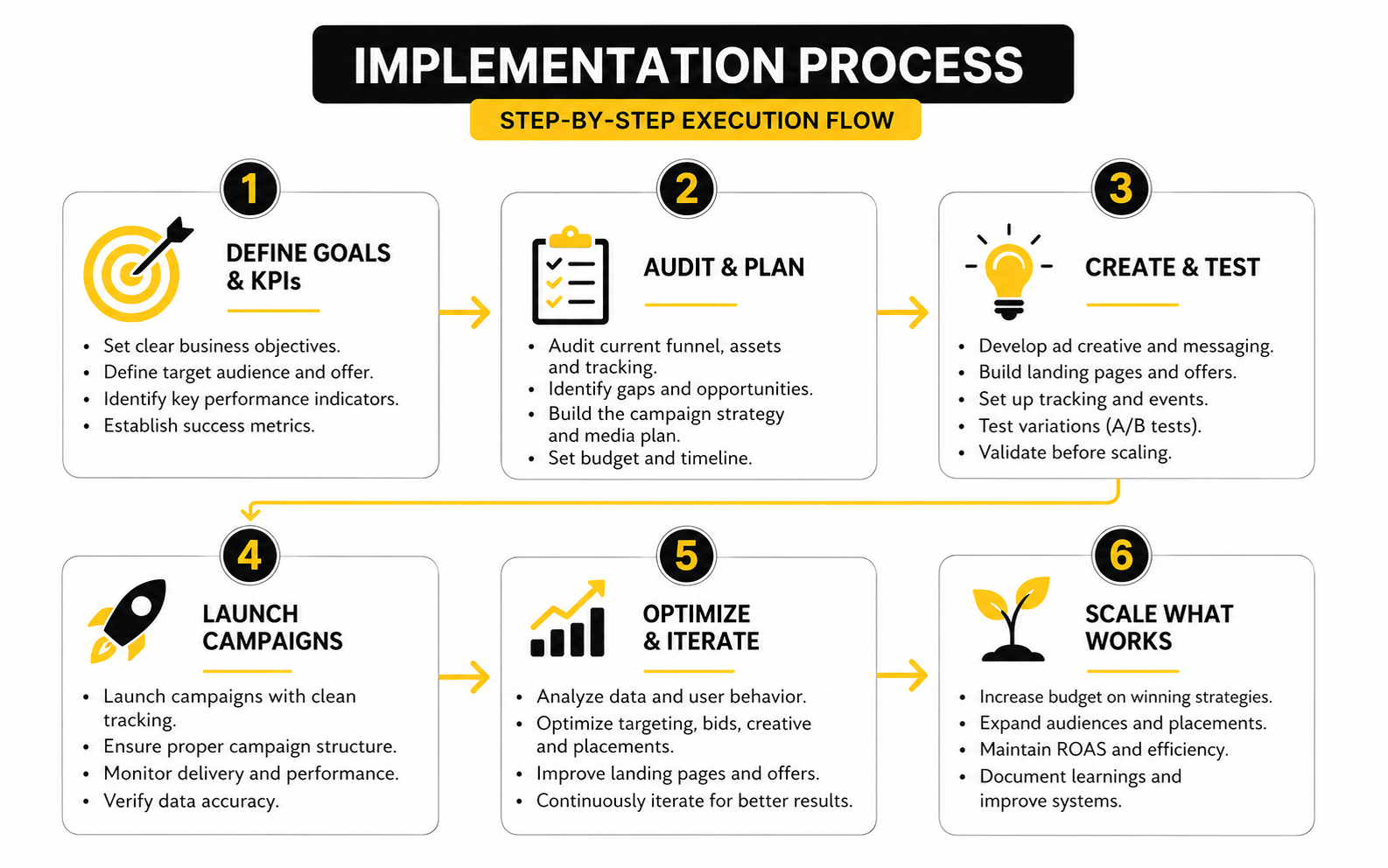
Step 3: Build the Campaign Architecture
Once the goal and funnel are clear, the company can build the campaign structure. This includes channel selection, audience strategy, budget allocation, creative angles, keyword themes, exclusions, retargeting logic, and measurement rules. A good structure gives the platforms enough data to learn without turning the account into a messy collection of disconnected experiments.
Automation now plays a bigger role in this architecture. IAB’s 2025 State of Data research describes AI as increasingly active across audience segmentation, media buying, optimization, and performance measurement in the media campaign lifecycle. That makes campaign inputs more important, not less important.
The practical takeaway is simple. Online advertising companies should not fight automation blindly, but they also should not surrender strategy to it. Human judgment still matters in offer positioning, creative direction, business rules, data quality, and deciding what the machine should optimize for.
Step 4: Produce and Test Creative
Creative is where strategy becomes visible. The ad has to show the right problem, promise, proof, and next step in a format that fits the platform. That could mean a search ad with strong intent matching, a short-form video with a sharp opening, a carousel that explains a product, or a direct response image ad built around one painful customer problem.
Testing should be structured, not random. The team should test meaningful variables such as offer angle, audience awareness level, format, proof type, and landing page match. Changing tiny pieces of copy while ignoring the core message usually creates noise instead of learning.
This is especially important on social platforms where creative fatigue arrives quickly. Meta’s ad ecosystem has been moving toward more automated campaign creation and delivery, with Reuters reporting that Meta aims to further automate advertising with AI by 2026 in its coverage of Meta’s AI advertising plans. When platforms automate more of the buying, creative and offer quality become the clearest human advantage.
Step 5: Launch With Clean Measurement
A professional launch does not mean spending aggressively on day one. It means launching with clean tracking, clear naming conventions, working conversion events, tested forms, verified checkout flows, and a reporting view that separates platform activity from business results. This is boring work, but it protects the budget.
The company should confirm that leads enter the CRM correctly, purchases are recorded properly, UTMs are consistent, calls are tracked when relevant, and sales outcomes can be tied back to campaigns. Without that, reporting becomes a confidence game. Nobody wants that.
Benchmarks can be useful, but only as context. WordStream’s 2025 Google Ads benchmark data lists an average cost per lead of $70.11 across industries in its Google Ads benchmarks report. That number is interesting, but your acceptable cost per lead depends on close rate, gross margin, customer value, and sales capacity.
Step 6: Optimize Toward Revenue, Not Activity
After launch, the job shifts from setup to decision-making. The company should identify which campaigns create real opportunities, which creative angles attract qualified people, which audiences waste spend, and which follow-up steps need improvement. Optimization is not just moving budget between ad sets.
This is where many online advertising companies reveal their level. Weak teams send surface-level reports full of clicks, impressions, and generic commentary. Strong teams explain what changed, what they learned, what they are testing next, and how the campaign is affecting pipeline or revenue.
The best optimization rhythm is practical. Review data, form a clear hypothesis, make one meaningful change, and give the test enough time to produce useful evidence. Fast action is good, but frantic action usually makes campaigns harder to read.
Statistics and Data That Actually Matter
Data is only useful when it changes a decision. Online advertising companies can show hundreds of numbers, but most of them are secondary. The real question is whether the campaign is moving the business toward profitable acquisition, stronger pipeline, or repeatable revenue.
This is why a benchmark should never be treated like a target by itself. WordStream’s 2025 PPC benchmark data shows an average Google Ads click-through rate of 6.66%, average cost per click of $5.26, average conversion rate of 7.52%, and average cost per lead of $70.11 across more than 16,000 U.S.-based campaigns in its 2025 PPC benchmarks. Those numbers are useful for context, but they do not tell you whether your campaign is healthy.
A $70 lead can be terrible for a low-margin product and excellent for a service that closes at $3,000 with strong retention. A low cost per click can still produce bad economics if the audience is unqualified. A high conversion rate can still be misleading if the conversion event is too soft, such as a low-intent download that never becomes a sales conversation.
The Measurement Stack
A serious measurement system connects four layers: platform data, website behavior, CRM outcomes, and financial results. Platform data shows what the ad network thinks happened. Website analytics shows what visitors did after the click. CRM data shows whether leads became opportunities. Financial data shows whether the campaign created profitable revenue.
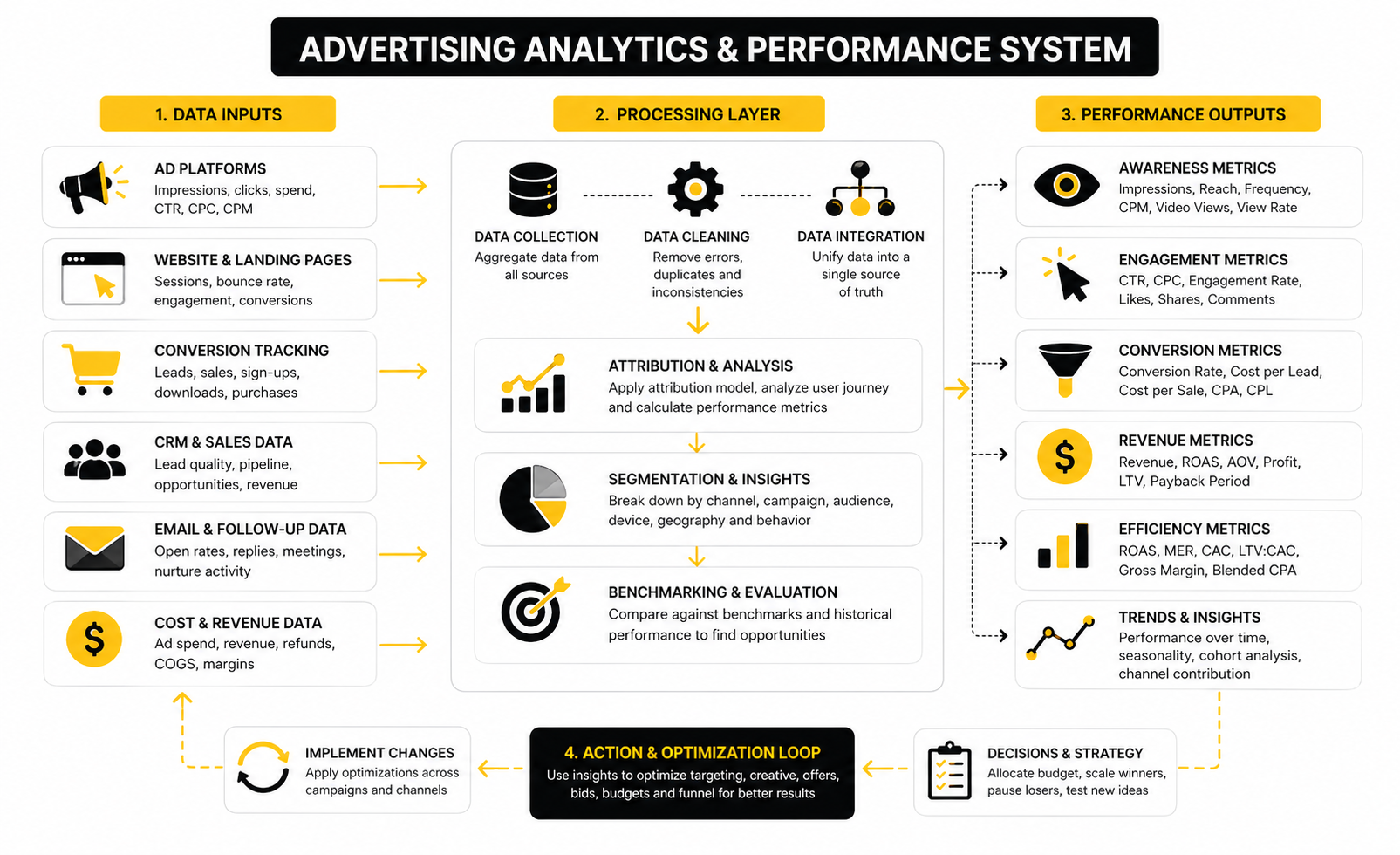
This is where the conversation gets real. If an online advertising company only reports ad platform metrics, they are showing you the top layer of the truth. That can help with creative and targeting decisions, but it is not enough to judge business performance.
For service businesses, the CRM layer is especially important because the sale often happens days or weeks after the click. A platform like GoHighLevel can help connect forms, booked calls, pipeline stages, messages, and sales outcomes. For ecommerce teams, the same principle applies through checkout data, product margins, repeat purchase behavior, and customer lifetime value.
Performance Signals Worth Watching
The best online advertising companies separate diagnostic metrics from decision metrics. Diagnostic metrics help explain what is happening inside the campaign. Decision metrics tell you whether to scale, pause, rebuild, or fix the offer.
Useful diagnostic signals include:
- Click-through rate, because it shows whether the message is getting attention
- Cost per click, because it shows how expensive the market is to enter
- Landing page conversion rate, because it shows whether the post-click promise matches the ad
- Frequency, because it can reveal creative fatigue
- Lead-to-appointment rate, because it shows whether leads are serious
- Appointment show rate, because it exposes follow-up and qualification issues
Useful decision signals include:
- Cost per qualified lead
- Cost per booked appointment
- Cost per sales opportunity
- Cost per acquired customer
- Return on ad spend
- Gross profit after ad spend
- Customer lifetime value
- Payback period
This distinction matters because many campaigns look good until you follow the money. Cheap leads can hide poor intent. Strong click-through rates can hide weak conversion. High return on ad spend can hide low margin if the company is only looking at revenue instead of profit.
Why Attribution Is Getting Harder
Attribution used to feel cleaner than it really was. Now it is obviously messy. Privacy changes, cookie restrictions, consent rules, cross-device behavior, platform modeling, and longer buying journeys all make it harder to say with perfect confidence that one ad caused one sale.
That does not mean measurement is dead. It means online advertising companies need better discipline. IAB’s State of Data 2025 research describes AI as increasingly involved in audience segmentation, media buying, optimization, and performance measurement across the media campaign lifecycle. That makes clean data inputs more valuable, because automated systems can only optimize well when the signals are meaningful.
The practical move is to combine several views instead of worshiping one dashboard. Use platform reporting for campaign optimization. Use analytics for user behavior. Use CRM and sales data for lead quality. Use finance data for actual profitability.
How to Read Benchmarks Without Getting Fooled
Benchmarks are helpful when they create a reasonable starting point. They become dangerous when they replace business logic. A campaign does not need to beat the average cost per lead if the economics already work, and it should not be considered successful just because it beats a public benchmark.
The smarter question is this: what can we afford to pay for the next real customer? That number comes from your margin, close rate, refund rate, sales cycle, retention, and capacity. Online advertising companies that understand this will ask about unit economics before they recommend a budget.
For example, a company with a high-ticket offer and a strong sales team may accept a higher cost per lead because the back-end economics support it. A low-ticket ecommerce brand may need a much tighter cost per purchase and faster payback. Same advertising channel, totally different interpretation.
The Reporting Cadence That Works
Weekly reporting should focus on movement, not noise. What changed, what improved, what got worse, what is being tested, and what decision needs to be made next? Daily reporting can be useful during launches or emergencies, but it often creates overreaction when the sample size is too small.
Monthly reporting should go deeper. It should connect spend, conversions, sales outcomes, revenue, margin, creative learnings, audience insights, and next steps. This is where online advertising companies should explain not just what happened, but what they believe it means.
The best reports are plain-language decision tools. They do not bury the client in screenshots. They make it obvious whether the account needs more budget, better creative, a stronger landing page, cleaner tracking, sharper qualification, or a different offer.
How to Compare Providers Without Getting Misled
Choosing between online advertising companies gets much easier when you stop asking, “Who can get me the cheapest clicks?” and start asking, “Who can help me buy customers at a number that makes sense?” That shift changes the entire conversation. It moves you away from vanity metrics and toward strategy, economics, execution, and accountability.
The right company should be able to explain what they will control, what they will influence, and what they cannot fix alone. No agency can save a weak offer forever. No platform can turn poor follow-up into profitable growth. No dashboard can replace a clear business model.
This is why comparison should include both capability and fit. A brilliant ecommerce media buyer may be the wrong partner for a local service business that needs call tracking, appointment reminders, and sales pipeline cleanup. A strong B2B paid search team may be the wrong fit for a consumer brand that needs rapid creative testing on social.
The Strategic Tradeoffs That Matter
Every advertising decision creates a tradeoff. Search captures demand, but it can get expensive when competitors bid aggressively. Paid social can create demand, but it needs stronger creative and more testing. Programmatic and video can build reach, but they require tighter measurement discipline to avoid paying for attention that never becomes business value.
Budget is another tradeoff. Gartner’s 2025 CMO Spend Survey found marketing budgets holding at 7.7% of company revenue for the second year in a row, which means many teams are being asked to get more productivity from the same level of investment in Gartner’s 2025 budget findings. That makes waste more painful. It also makes partner selection more important.
You do not need the biggest online advertising companies by default. You need the one that matches your stage, economics, speed, internal team, and risk tolerance. Bigger teams can offer more resources, but smaller specialists can sometimes move faster and care more deeply about the outcome.
Red Flags Before You Sign
Bad providers usually reveal themselves early. They talk confidently about scale before they understand your margins. They promise specific results without seeing your funnel, offer, sales process, or historical data. They avoid uncomfortable questions about attribution, creative volume, tracking quality, and what happens when performance drops.
Watch out for these warning signs:
- They focus only on clicks, impressions, or follower growth
- They cannot explain how they define a qualified lead
- They avoid discussing gross margin, close rate, or payback period
- They use one reporting template for every client
- They promise fast scaling without testing the funnel first
- They resist giving you access to your own ad accounts or data
- They blame the platform every time performance weakens
- They cannot clearly explain what they will do in the first 30 days
The access issue is especially important. You should own your ad accounts, pixels, creative assets, analytics, landing pages, and customer data wherever possible. If the relationship ends, your business should not lose its history, audiences, tracking, or campaign learnings.
What a Strong Proposal Should Include
A good proposal should feel specific. It should show that the company understands your business model, audience, offer, conversion path, and current constraints. If the proposal could be sent to any business in any industry, it is not strategic enough.
Look for a proposal that explains:
- The main growth opportunity
- The biggest campaign risks
- The recommended channels and why they fit
- The first testing priorities
- The tracking and reporting plan
- The creative production process
- The expected learning period
- The role your team needs to play
- The decision rules for scaling or pausing
The best online advertising companies are not afraid to say what must be fixed before spend increases. That might be landing page speed, offer clarity, follow-up time, CRM hygiene, product positioning, or sales qualification. This is not negativity. It is protection.
Scaling Without Breaking the System
Scaling paid advertising is not just increasing the budget. It means maintaining efficiency while volume grows, which is much harder than it sounds. As spend rises, campaigns often move into colder audiences, more competitive auctions, broader targeting, and less obvious intent.
This is where many businesses get impatient. They see one good week and immediately push spend too hard. Then performance falls, the team panics, and nobody knows whether the problem was creative fatigue, audience saturation, tracking delay, sales capacity, or normal volatility.
Smart scaling is staged. Increase spend when the data supports it, but also increase creative output, landing page testing, sales capacity, and follow-up discipline at the same time. If you scale traffic without scaling the rest of the system, the numbers usually punish you.
The AI Shift Is Real, but Strategy Still Wins
AI is changing how campaigns are built, bought, optimized, and measured. IAB’s 2025 State of Data report describes AI moving through audience segmentation, media buying, real-time optimization, and performance measurement in the media campaign lifecycle. That is not a small change.
But AI does not remove the need for strategy. It raises the cost of weak strategy because platforms can now spend money very efficiently against the wrong objective. If the conversion signal is poor, the creative is generic, or the offer is weak, automation simply helps you lose money faster.
The practical move is to use AI where it helps and keep humans responsible for the commercial thinking. Let automation support bidding, testing, segmentation, reporting, and production speed. Keep people in charge of positioning, customer insight, offer design, creative judgment, and the final decision on what profitable growth actually means.
Building the Right Operating Rhythm
A strong relationship with an advertising partner has a rhythm. Weekly conversations should focus on current tests, blockers, and immediate decisions. Monthly reviews should connect performance to revenue, margin, customer quality, and next-step strategy. Quarterly reviews should question bigger assumptions, such as channel mix, offer direction, market positioning, and budget allocation.
This rhythm also keeps the client honest. Online advertising companies can do better work when the business shares sales feedback, lead quality notes, customer objections, product changes, and real revenue data. Without that loop, the agency is forced to optimize from incomplete information.
The healthiest partnerships are direct. If performance is weak, the team says so and explains the next move. If the offer is the problem, they do not hide it. If the campaign is ready to scale, they can explain why with evidence instead of hype.
FAQ - Built for Complete Guide
What do online advertising companies actually do?
Online advertising companies help businesses plan, launch, manage, measure, and improve paid campaigns across digital channels. That can include search ads, paid social, video ads, display campaigns, retargeting, landing pages, CRM follow-up, analytics, and creative testing. The best ones do not just buy traffic; they help connect traffic to real business outcomes.
How are online advertising companies different from marketing agencies?
A marketing agency may handle many areas, including branding, content, SEO, social media, email, design, and strategy. Online advertising companies focus specifically on paid digital acquisition and the systems around it. Some full-service agencies do both, but you should still ask exactly who manages paid media, who handles creative, and who owns measurement.
Are online advertising companies worth it for small businesses?
They can be worth it when the business has a clear offer, enough margin, and a realistic budget for testing. Small businesses usually struggle when they expect instant profit from a tiny test budget and no follow-up system. If the offer is proven and the sales process is tight, a specialist can often save time, reduce waste, and create a cleaner growth path.
How much should I spend before judging performance?
You need enough spend to produce useful data, not just emotional reactions. The right amount depends on your industry, cost per click, conversion rate, sales cycle, and average customer value. A local service business, ecommerce store, SaaS company, and high-ticket consultant will all need different testing windows.
What should I ask before hiring an advertising company?
Ask how they define success, what they need from your team, how they handle tracking, what they will test first, and how they decide when to scale. Ask who owns the ad accounts, pixels, landing pages, creative assets, and data. Also ask what they would fix before increasing spend, because that answer reveals whether they think strategically or just sell campaign management.
Which platforms should online advertising companies use?
The right platform depends on intent, audience, offer, and budget. Google Ads is often strong when people are already searching for a solution, while Meta, TikTok, YouTube, LinkedIn, and creator-led campaigns can help shape demand earlier in the buying journey. A good provider will not recommend a channel just because it is popular; they will explain why it fits your customer journey.
What is a good return on ad spend?
A good return on ad spend depends on margin, fulfillment cost, refund rate, repeat purchase behavior, and payback period. A 3x ROAS can be weak for a low-margin business and excellent for a subscription model with strong retention. This is why online advertising companies should discuss gross profit and customer value, not just revenue.
Why do campaigns perform well at first and then drop?
Performance can drop because of creative fatigue, audience saturation, stronger competition, tracking issues, offer fatigue, seasonality, landing page problems, or sales follow-up gaps. Sometimes the first audience pool is simply easier to convert than the next one. Strong teams diagnose the reason before making random changes.
Should I use one full-service company or multiple specialists?
One full-service company is simpler when you need coordination, speed, and one clear owner. Multiple specialists can work better when you already have strong internal management and need deep expertise in paid search, paid social, creative, analytics, or funnel optimization. The risk with multiple specialists is that nobody owns the full customer journey unless you make that responsibility explicit.
What tools should support online advertising campaigns?
The tool stack should match the campaign model. Service businesses often need CRM, booking, pipeline, messaging, and automation, which is why GoHighLevel can be useful. Funnel-heavy businesses may use ClickFunnels, ecommerce teams may test pages with Replo, and nurture-heavy campaigns may use email or messaging tools like Brevo or ManyChat.
How do I know if my advertising company is doing a good job?
You should see clear testing, honest reporting, clean communication, and decisions tied to business results. They should explain what is working, what is not working, what they are changing, and why. If every report sounds positive but revenue does not move, something is missing.
When should I switch online advertising companies?
Switch when the company cannot explain performance, avoids accountability, hides account access, repeats the same tactics without learning, or focuses only on vanity metrics. You do not need to switch after one weak week, because campaigns naturally fluctuate. But if the strategy is unclear and the learning loop is broken, staying longer usually just delays the fix.
Work With Professionals
Explore 10K+ Remote Marketing Contracts on MarkeWork.com
Most marketers spend too much time chasing clients, competing on crowded platforms, and losing a percentage of every project to middlemen.
MarkeWork gives you a better way. Browse thousands of remote marketing contracts and connect directly with companies desperate to hire skilled marketers like you, without platform commissions and without unnecessary gatekeepers.
If you're serious about finding better opportunities and keeping 100% of what you earn, explore available contracts and create a profile for free at MarkeWork.com.