

Running an online boutique is not just about having beautiful products anymore. Ecommerce now represents more than one-fifth of global retail sales, with online sales expected to keep growing through 2028 based on EMARKETER retail ecommerce forecasts. That growth is good news, but it also means more competition, higher ad costs, and less room for vague marketing.
An online boutique marketing agency helps fashion, accessories, beauty, lifestyle, and niche retail brands turn attention into revenue. The right agency does not just “post content” or “run ads.” It builds a system where brand positioning, website conversion, paid traffic, email, SMS, social commerce, creative testing, and retention all work together.
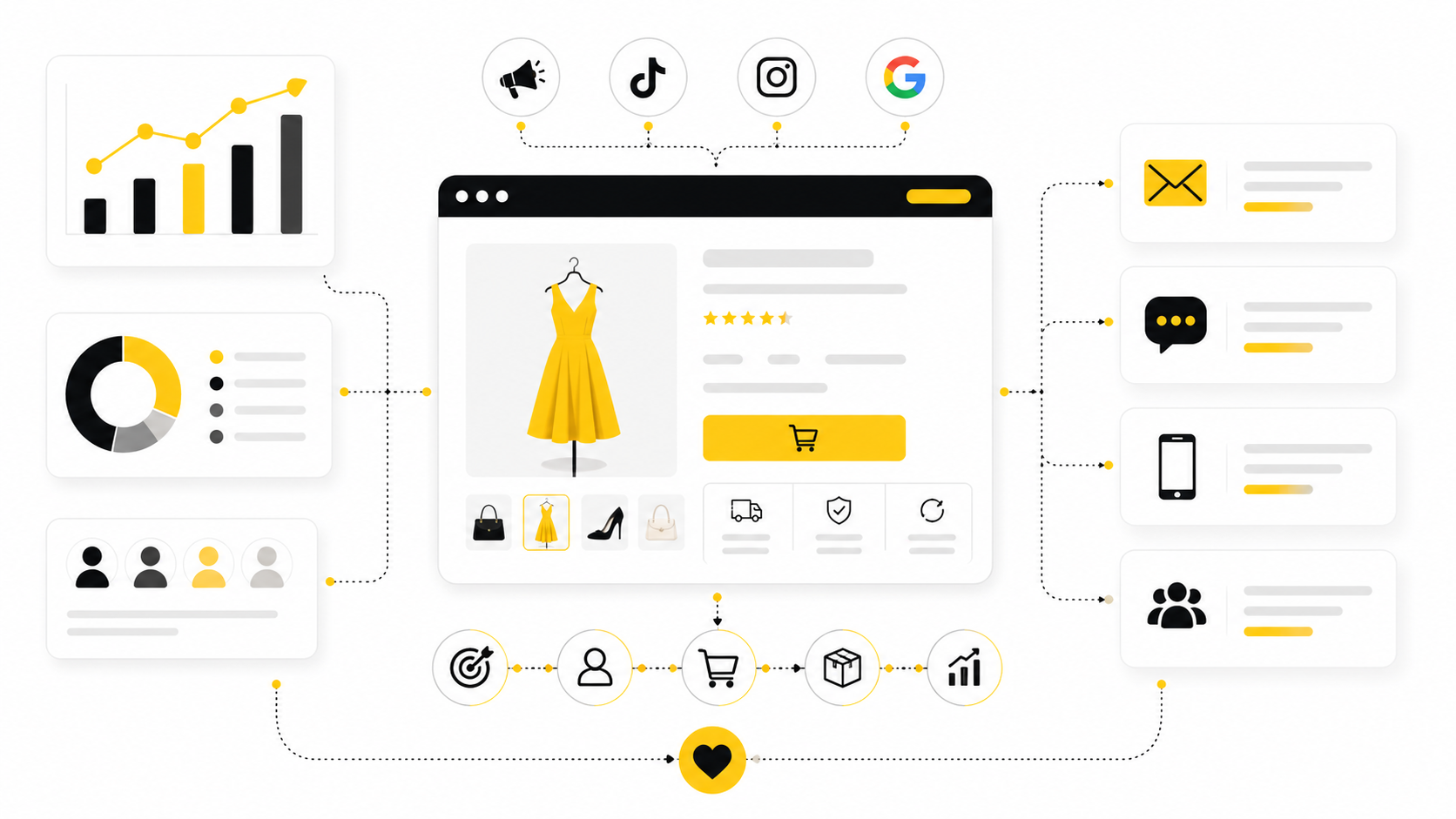
This article breaks that system down in six parts. The goal is simple: help you understand what a strong boutique marketing partner should actually do, where the money is usually made or lost, and how to judge whether an agency can help your store grow profitably.
Article Outline
- Why Online Boutique Marketing Matters Now
- The Online Boutique Growth Framework
- Core Components of Boutique Marketing
- Choosing the Right Online Boutique Marketing Agency
- Professional Implementation and Campaign Execution
- Measurement, Optimization, and Long-Term Growth
Why Online Boutique Marketing Matters Now
Online boutique brands live in a strange middle ground. They need the polish of a serious ecommerce business, but they often do not have the team size, budget, or data depth of a major retailer. That makes strategy more important, not less important.
The market is moving fast. Social commerce, AI-assisted shopping, influencer-led discovery, and mobile-first buying are changing how customers find and trust products. At the same time, checkout friction still hurts sales badly, with Baymard’s ecommerce research showing that around 70% of carts are abandoned before purchase in its checkout usability research.
That means growth is not only about getting more visitors. A boutique can attract the right shopper, lose them on a weak product page, recover them with a good email flow, win them back with SMS, and turn them into a repeat buyer through better post-purchase marketing. A strong online boutique marketing agency understands that the whole journey matters.
The Online Boutique Growth Framework
A boutique growth framework should connect four things: positioning, acquisition, conversion, and retention. If one of those is weak, the rest becomes more expensive. Great creative cannot fully fix a confusing offer, and more traffic cannot fully fix a store that does not convert.
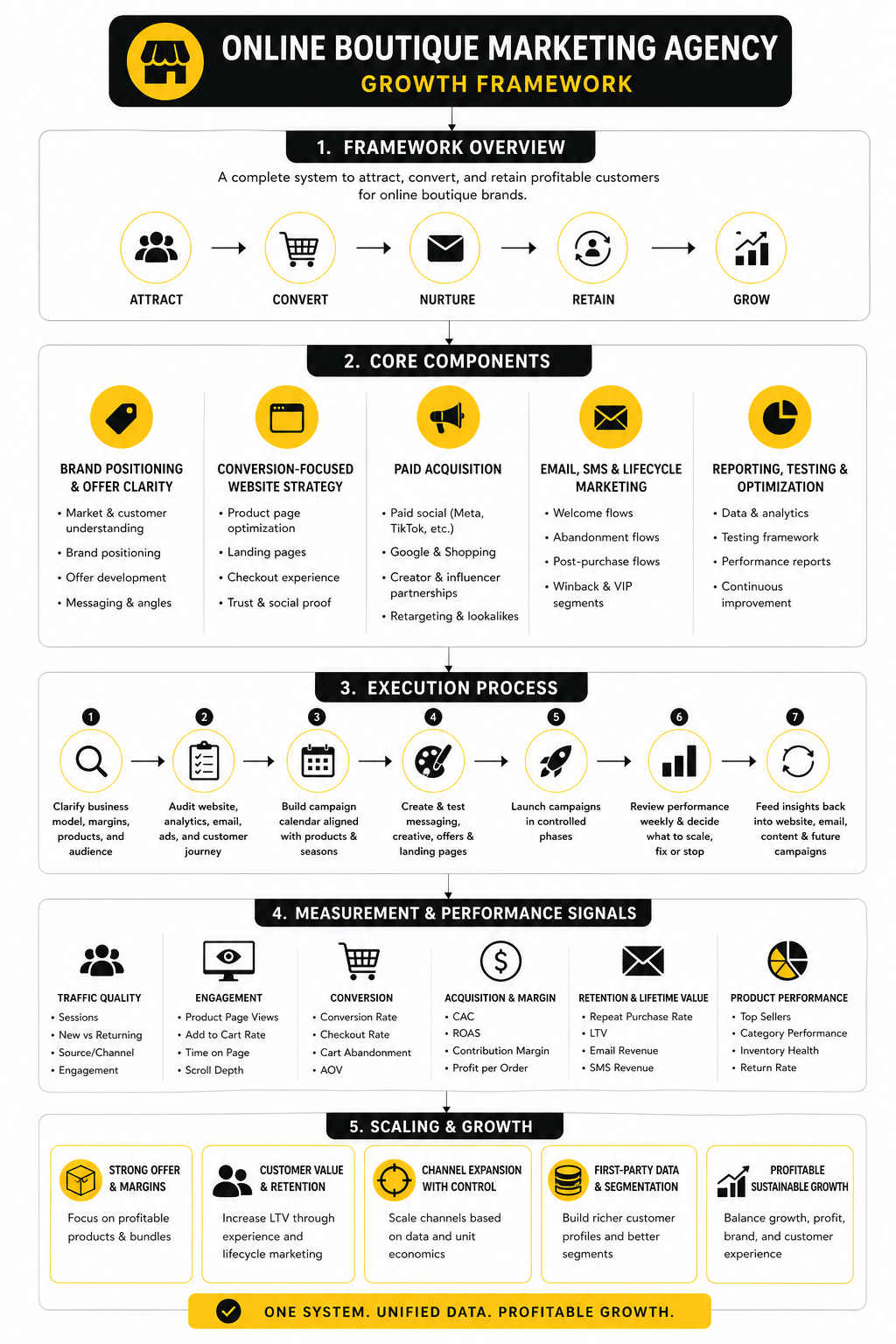
The framework starts with positioning because boutiques rarely win by being generic. Customers need to understand who the brand is for, what makes the products different, and why buying now makes sense. That message then needs to show up consistently across ads, social posts, product pages, email flows, and customer support.
From there, the agency’s job is to build reliable growth loops. Paid social brings qualified traffic, landing pages turn attention into action, email and SMS recover missed revenue, and retention campaigns increase lifetime value. This is where boutique marketing becomes a system instead of a collection of random tactics.
Core Components of Boutique Marketing
A good online boutique marketing agency starts with the store’s commercial reality, not with a content calendar. The first questions should be about margins, average order value, repeat purchase behavior, inventory depth, return rates, and which product categories can actually support paid acquisition. Without that context, marketing becomes guesswork dressed up as strategy.
The core work usually sits across five connected areas:
- Brand positioning and offer clarity
- Conversion-focused website and landing page strategy
- Paid acquisition across social, search, and creator-led channels
- Email, SMS, and customer lifecycle marketing
- Reporting, testing, and margin-aware optimization
This matters because boutique growth is rarely blocked by one single issue. A store might have decent traffic but weak product pages. Another might have strong creative but no retention system. Another might be getting sales, but only by discounting so heavily that profit disappears.
Brand Positioning and Offer Clarity
Boutique brands need a sharp point of view. That does not mean sounding “luxury” or “premium” by default. It means making the customer feel, quickly, that the store understands their taste, lifestyle, problem, or identity better than a generic marketplace does.
This is especially important in fashion, where growth is expected to remain difficult and uneven, with the 2025 fashion outlook pointing to slower global growth and more pressure on brands to differentiate clearly in a crowded market through the State of Fashion 2025 report. For smaller boutiques, that pressure is even more intense because they usually cannot win on price, shipping speed, or inventory scale alone. They need to win through taste, trust, merchandising, and a more personal buying experience.
An agency should help turn that positioning into usable marketing assets. That includes product page copy, ad hooks, collection names, homepage messaging, email angles, and campaign themes. If the positioning only lives in a brand deck and never shows up where people buy, it is not positioning. It is decoration.
Website and Landing Page Conversion
Traffic is expensive, so the store has to work hard once someone lands on it. A boutique website should make the product easy to understand, easy to trust, and easy to buy. That sounds basic, but plenty of stores still hide sizing guidance, shipping details, returns information, reviews, product materials, and styling context until the shopper has already started doubting the purchase.
This is where conversion strategy becomes practical. Product pages should answer the customer’s silent questions before they become objections. Collection pages should help shoppers compare styles without feeling overwhelmed. Checkout should remove avoidable friction because ecommerce checkout research continues to show that roughly 70% of carts are abandoned before purchase in Baymard’s cart and checkout research.
For boutiques that run paid traffic, dedicated landing pages can also make a serious difference. A campaign for a seasonal collection, capsule drop, influencer collaboration, or bestseller bundle should not always send people to the homepage. Tools like Replo can be useful when a boutique needs faster landing page testing without waiting on a full development cycle.
Paid Acquisition That Respects Margins
Paid ads can grow an online boutique, but only when the economics make sense. The agency should understand contribution margin, not just return on ad spend. A campaign that looks good in the ad account can still be weak if it relies on heavy discounts, high return rates, or products that do not generate repeat orders.
For most boutiques, paid social is still a major discovery channel because fashion is visual, emotional, and highly influenced by taste. But social commerce is becoming more than awareness. Apparel shoppers are increasingly discovering brands through social platforms, and one apparel ecommerce survey found that 39% of shoppers discover new apparel brands through social media, while 62.5% of Gen Z shoppers use social platforms as a go-to source for discovering new apparel brands in Podean’s 2025 apparel ecommerce report.
That does not mean every boutique should chase every platform. It means the agency should match the channel to the customer, the product, and the creative capacity of the brand. A strong strategy might combine Meta ads, TikTok-style short-form creative, Google Shopping for high-intent demand, creator whitelisting, and retargeting. A weak strategy simply spends more and hopes the algorithm fixes the fundamentals.
Email, SMS, and Lifecycle Marketing
Once a shopper joins the list, the relationship should not depend on random newsletters. Email and SMS should guide people through the buying journey with useful, timely messages that feel connected to what they actually did on the site. That includes welcome flows, browse abandonment, cart recovery, post-purchase education, replenishment reminders, winback campaigns, VIP segments, and product-drop announcements.
This is where a strong online boutique marketing agency can create revenue without constantly increasing ad spend. Email remains one of the most dependable ecommerce channels, and Omnisend’s 2025 ecommerce marketing research reports that merchants using its platform generated $79 for every $1 spent on email and SMS marketing in its 2025 Ecommerce Marketing Report. That number should not be treated as a guaranteed result, but it does show why lifecycle marketing deserves serious attention.
The key is restraint. Customers do not want endless blasts with the same discount. They want relevant messages: styling ideas, back-in-stock alerts, size guidance, loyalty perks, drop reminders, and thoughtful product recommendations. For boutiques that want an accessible email and automation stack, tools like Brevo, Moosend, or GoHighLevel can support different levels of CRM, automation, and customer follow-up depending on how the business is built.
Professional Implementation and Campaign Execution
The difference between a plan and a working growth system is execution. This is where many boutique brands get stuck because they know what should happen, but they do not have the internal bandwidth to build it properly. An agency should turn strategy into weekly movement, not a beautiful presentation that sits untouched.
Professional implementation usually starts with an audit. The agency reviews the store, analytics, customer journey, creative assets, email flows, ad accounts, catalog setup, pixel tracking, product margins, and existing campaign performance. The goal is not to criticize everything. The goal is to find the few changes that can make growth more predictable.
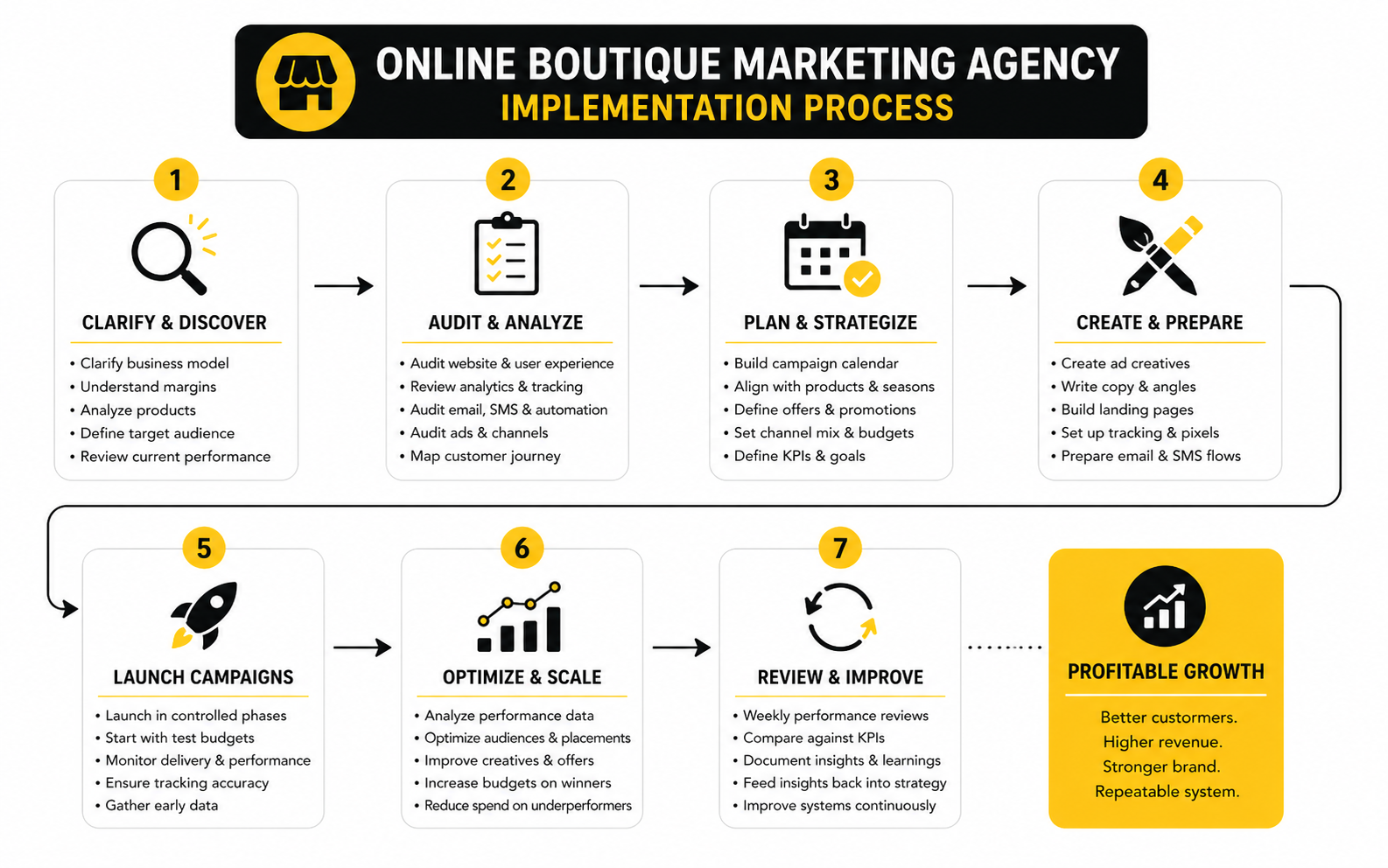
A practical implementation process should look something like this:
- Clarify the business model, margins, bestsellers, customer profile, and inventory priorities.
- Audit the website, product pages, checkout path, analytics setup, email flows, and paid media history.
- Build the campaign calendar around product drops, seasonal demand, sales periods, and content production capacity.
- Create and test messaging angles, visuals, landing pages, offers, and audience segments.
- Launch campaigns in controlled phases instead of changing everything at once.
- Review performance weekly, separate signal from noise, and decide what to scale, fix, or stop.
- Feed winning insights back into the website, email flows, content plan, and future campaigns.
This process works because it respects the complexity of ecommerce without making it bloated. A boutique does not need a 90-page strategy document before it can improve. It needs a clear operating rhythm, honest performance data, and a team that knows which levers to pull first.
Campaign Planning Around Real Buying Behavior
Boutique campaigns should follow how customers actually shop. People buy differently before vacations, holidays, weddings, seasonal changes, payday periods, product drops, and major sale moments. The agency should build the calendar around those buying patterns instead of treating every week like a blank slate.
That calendar should connect merchandising and marketing. If the store has strong margin on a new collection, enough inventory depth, and good visual assets, it can become a campaign priority. If a product is almost sold out, has sizing issues, or tends to generate returns, pushing it harder with paid ads may create more problems than profit.
Strong campaign planning also gives the creative team sharper direction. Instead of asking for “more content,” the agency can request specific assets: try-on videos, size comparisons, product close-ups, founder-led explanations, styling clips, customer review graphics, and collection-focused landing page sections. That makes execution faster and more useful.
Creative Testing Without Randomness
Creative testing is not about throwing twenty ads into the account and hoping one works. It should be structured around clear hypotheses. One test might compare styling-led creative against product-detail creative. Another might compare a founder explanation against a customer review angle. Another might test whether the boutique’s audience responds better to urgency, quality, identity, or practicality.
The testing process should also account for platform behavior. Social platforms reward creative that feels native, fast, and specific. A polished brand video can still work, but a simple try-on clip or direct product demonstration may outperform it if it answers the shopper’s question faster.
An agency should document what each test teaches. Winning ads reveal more than a lower cost per click or better return on ad spend. They reveal what customers care about, which objections matter, which product benefits are strongest, and which visual styles make people stop scrolling. That learning should then improve landing pages, email campaigns, product descriptions, and future creative briefs.
Statistics and Data
Data should make an online boutique marketing agency calmer, not more reactive. The point is not to stare at dashboards all day or chase every tiny movement in the ad account. The point is to understand which numbers explain customer behavior, which numbers explain profit, and which numbers are just noise.
For boutique ecommerce, the most useful reporting usually sits in five layers:
- Traffic quality
- Product page engagement
- Conversion and checkout performance
- Customer acquisition cost and contribution margin
- Repeat purchase, email revenue, SMS revenue, and lifetime value
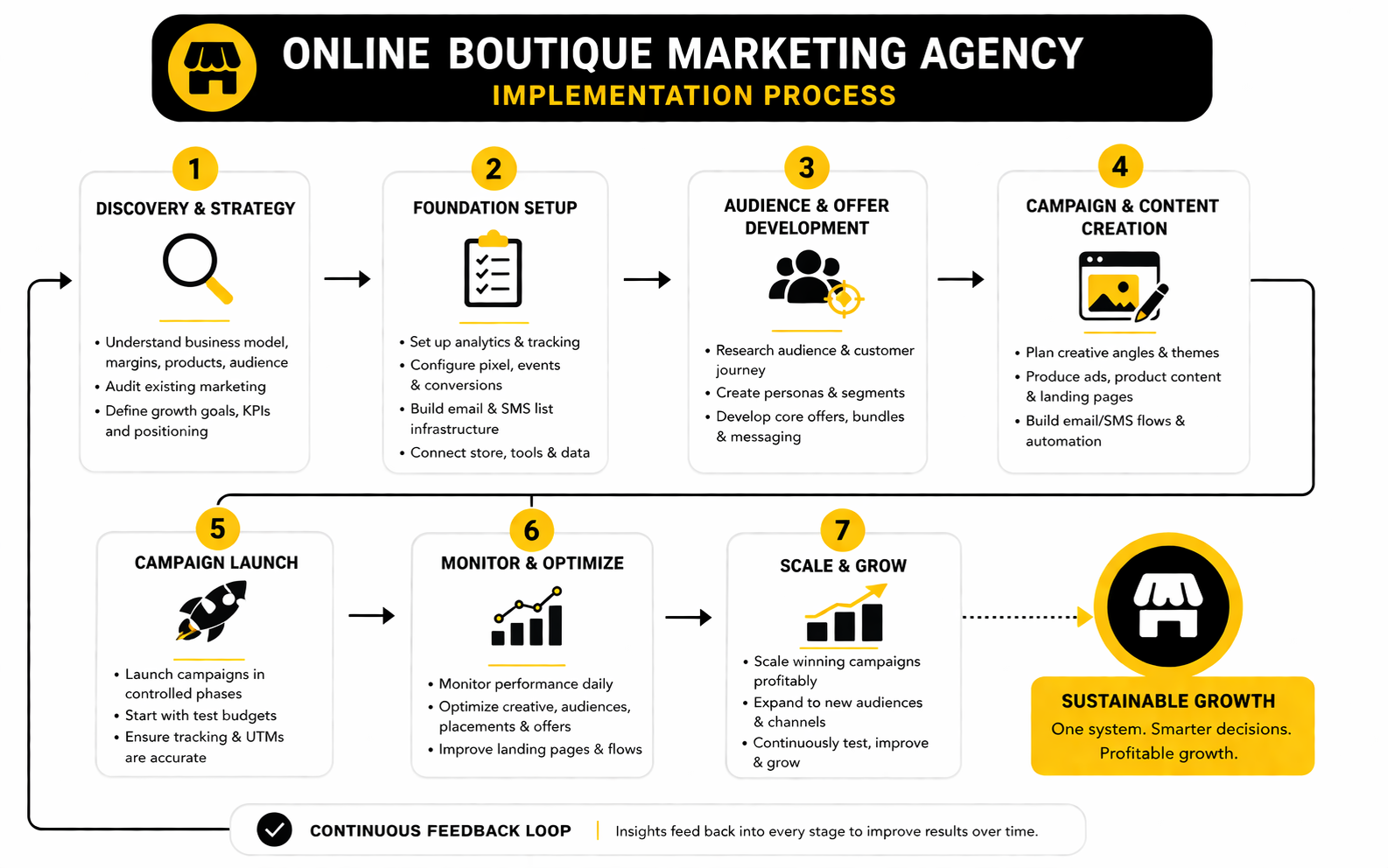
This structure matters because a single metric can easily lie. A campaign may have a strong click-through rate but bring low-intent shoppers. A product page may get plenty of views but fail because the sizing information is weak. A paid ad may show a healthy return on ad spend while still producing poor profit after discounts, shipping, payment fees, returns, and agency costs.
Conversion Rate Is a Diagnostic, Not a Trophy
Conversion rate is one of the first numbers boutique owners look at, but it should never be judged alone. A store selling low-priced accessories may naturally convert higher than a store selling premium dresses. A returning customer campaign may convert better than cold traffic because the shopper already trusts the brand.
Fashion ecommerce benchmarks are useful mainly as a reality check. Recent fashion ecommerce benchmark analysis often places average fashion conversion rates around the low single digits, with some 2025 estimates around 2.9% to 3.3% and stronger stores performing higher in fashion ecommerce conversion research. That does not mean every boutique below that range is broken, and it does not mean every boutique above it is healthy.
The better question is what changed. If conversion rate drops after a new traffic source launches, traffic quality may be the issue. If conversion drops on mobile but not desktop, the site experience may be the issue. If add-to-cart rate is strong but purchase rate is weak, checkout friction, shipping costs, payment options, or return policy clarity may be the issue.
Cart Abandonment Shows Where Trust Breaks
Cart abandonment is not just a checkout problem. It is often the moment where earlier uncertainty finally catches up with the shopper. They liked the product enough to add it to the cart, but something still made them pause.
The global cart abandonment rate has stayed painfully high for years, and Baymard’s ecommerce checkout research continues to show that roughly seven out of ten carts are abandoned in cart and checkout usability research. For online boutiques, that number should push action rather than panic. The goal is not to eliminate abandonment completely. The goal is to remove the avoidable reasons people leave.
An agency should look at this through both analytics and customer experience. Are shipping costs shown too late? Is the return policy easy to find? Are payment options flexible enough? Are discount codes creating hesitation because shoppers leave to search for a better offer? Those are fixable problems, and fixing them can lift revenue without needing more traffic.
Customer Acquisition Cost Needs Profit Context
Customer acquisition cost sounds simple, but it becomes dangerous when it is measured without margin. A boutique might pay $28 to acquire a customer and feel good because the first order is $95. But if product cost, shipping, returns, discounting, transaction fees, and fulfillment eat most of that revenue, the business may still be buying unprofitable sales.
This is why the agency should report contribution margin alongside ad performance. Return on ad spend is useful, but it is not the whole truth. A 4x ROAS on a low-margin product may be weaker than a 2.5x ROAS on a higher-margin bundle with better repeat purchase behavior.
The practical move is to group products by economic role. Some products are acquisition products because they bring new customers in. Some products are profit products because they carry better margins. Some products are retention products because they create repeat orders. A smart online boutique marketing agency does not treat every sale as equal, because the business should not treat every sale as equal.
Email and SMS Data Should Guide Retention
Email and SMS reporting should answer a simple question: are we building a stronger customer relationship after the first visit? Revenue from automated flows, campaign revenue, list growth, unsubscribe rate, click behavior, and repeat purchase rate all help answer that. The strongest lifecycle systems are not just promotional; they teach customers what to buy next and why.
Automation performance is especially important because it captures intent that already exists. Welcome flows, cart recovery, browse abandonment, post-purchase sequences, and winback campaigns work because they respond to behavior. Omnisend’s 2025 ecommerce marketing research reports that merchants on its platform generated $79 for every $1 spent on email and SMS in its 2025 Ecommerce Marketing Report, which shows why retention channels deserve more than leftover attention after paid ads.
Still, the numbers need interpretation. High email revenue can be healthy, but it can also mean the brand is over-discounting its list. A high open rate looks nice, but clicks, orders, and unsubscribes tell the real story. The best agencies use lifecycle data to improve timing, segmentation, creative angles, product recommendations, and customer value over time.
Choosing the Right Online Boutique Marketing Agency
The right online boutique marketing agency should make growth clearer, not more complicated. Boutique owners already deal with inventory, suppliers, fulfillment, returns, customer messages, content, cash flow, and platform changes. An agency that adds more confusion is not a partner. It is another operational burden.
A serious agency should be able to explain what it will do in the first 30, 60, and 90 days. It should know which metrics matter before scaling spend. It should also be honest about what marketing cannot fix, because paid ads cannot save weak margins, inconsistent inventory, unclear positioning, or a poor buying experience forever.
The strongest agencies tend to ask sharper questions before they pitch. They want to understand bestseller depth, profit by product category, repeat purchase windows, return behavior, customer segments, and creative production capacity. That is a good sign. It means they are thinking like operators, not just campaign managers.
The Tradeoff Between Speed and Control
Boutiques often want fast growth, but fast growth creates pressure. More ad spend can expose problems that were hidden at a smaller scale. A weak size guide becomes more expensive when more people order the wrong fit. A vague return policy becomes more painful when order volume rises. A fulfillment bottleneck becomes a brand problem when customers start waiting too long.
This is why controlled scaling usually beats aggressive scaling. The agency should increase spend when the store has enough inventory, enough creative, enough margin, and enough customer support capacity to handle the lift. Scaling before those pieces are ready may create revenue, but it can also create returns, refunds, bad reviews, and cash flow stress.
Fashion returns make this especially important. Apparel ecommerce has a higher return risk than many other categories, and recent apparel ecommerce research estimated that about 24.4% of apparel items bought online were returned, creating $48.1 billion in returned merchandise in Podean’s 2025 apparel ecommerce report. A boutique should not judge scaling only by gross sales. Net revenue after returns is the number that protects the business.
When to Build In-House and When to Use an Agency
Not every marketing task should stay with an agency forever. In many cases, the best setup is a hybrid model where the boutique keeps brand voice, product knowledge, customer insight, and day-to-day content close to the business. The agency then brings strategy, technical setup, media buying, lifecycle structure, reporting, and testing discipline.
This split works because boutiques usually have stronger taste than outsiders. The founder or internal team often knows the customer’s language, styling preferences, objections, and product details better than any external partner. But the agency may be better at turning those insights into a campaign system that can be measured and improved.
The risk comes when a boutique outsources too much thinking. If the agency owns the strategy, the creative direction, the data, the customer insights, and the reporting, the brand becomes dependent. A healthier partnership transfers learning back into the business so the owner gets smarter every month.
Advanced Channel Choices for Scaling
Once the basics are working, channel expansion becomes tempting. A boutique might look at influencer campaigns, affiliate partnerships, Pinterest, TikTok Shop, Google Shopping, retail media, SEO, referral programs, or automated conversational selling. These can work, but only when the core offer and measurement system are already stable.
The smarter move is to choose channels based on buying behavior. Pinterest can support discovery for style-led categories. Google Shopping can capture high-intent searches for specific products. Influencer partnerships can add trust when the creator genuinely matches the brand. Conversational tools like ManyChat can help turn social attention into owned audience growth when the boutique has active engagement on Instagram or Messenger.
Retail media and first-party data are also becoming more relevant across ecommerce. European retail media research found that 87% of buy-side stakeholders were attracted to retail media because of access to retailer first-party data, while 74% valued access to shoppers closer to the point of purchase in Tealium’s 2025 retail media report. For smaller boutiques, the lesson is simple: owned customer data matters. Email lists, SMS subscribers, purchase history, quiz responses, and style preferences are not side assets. They are strategic assets.
Risks That Good Agencies Should Flag Early
A good agency should not only talk about upside. It should flag risk before the brand feels it in cash flow. That includes rising acquisition costs, creative fatigue, low inventory depth, slow page speed, overuse of discounts, weak post-purchase communication, high return rates, and poor customer data quality.
One common risk is scaling a single hero product too hard. It can work for a while, but if the product sells out, gets copied, declines in performance, or attracts too many low-quality buyers, the business becomes fragile. The agency should help develop adjacent offers, bundles, collections, and retention paths so growth is not trapped inside one campaign.
Another risk is measuring success too narrowly. If the agency only reports platform ROAS, it may miss what is happening in the actual business. Better reporting connects paid media, store analytics, email and SMS, contribution margin, returns, new versus returning customers, and product-level performance. That is where smarter decisions come from.
Measurement, Optimization, and Long-Term Growth
At this stage, the marketing system should stop feeling like separate campaigns and start acting like one connected engine. Paid traffic creates demand. Product pages convert that demand. Email and SMS recover and deepen it. Customer data improves the next campaign. That loop is where long-term growth comes from.
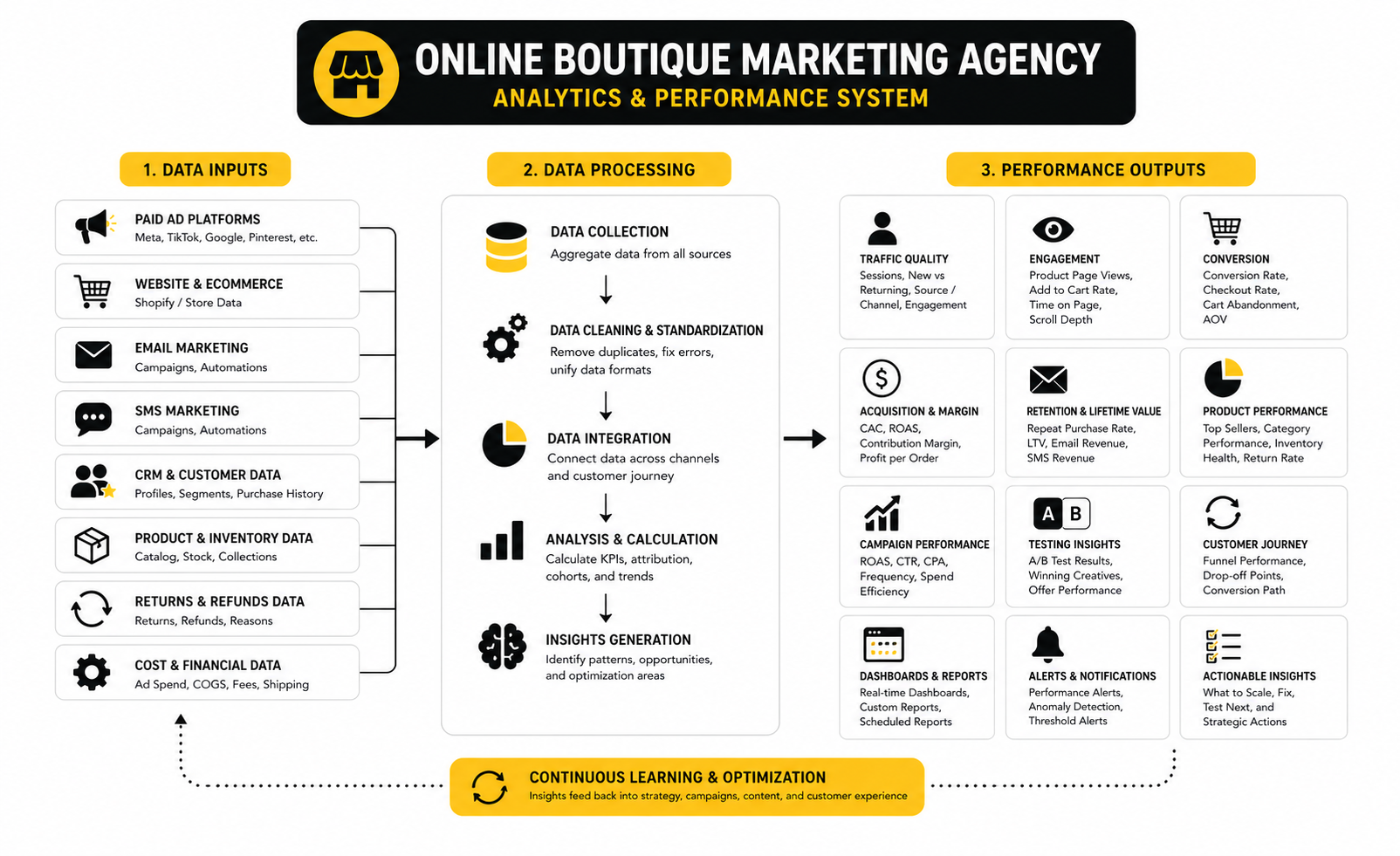
The mistake is treating optimization as tiny button changes or endless dashboard checking. Real optimization is bigger than that. It is the habit of asking better commercial questions every week: which products deserve more attention, which customer segments are improving, which offers are weakening margin, which creative angles are getting tired, and which retention paths are building repeat revenue.
This is also where an online boutique marketing agency should become more valuable over time. In the beginning, the agency may spend more energy fixing obvious gaps. Later, the work should become more strategic: improving customer value, building better campaign systems, refining the brand’s content engine, and helping the boutique scale without losing its identity.
What Sustainable Scaling Actually Looks Like
Sustainable scaling is not just spending more money. It means the business can handle more demand without breaking customer experience, cash flow, or operational quality. For boutiques, that includes inventory planning, fulfillment speed, returns management, customer support, creative production, and product merchandising.
The best agencies understand this because marketing does not happen in isolation. If a campaign sells out the wrong product too quickly, the store loses momentum. If the campaign attracts bargain hunters who never return, the customer file gets weaker. If the agency ignores return rates, the brand may celebrate revenue that later disappears.
A healthier version of scaling is slower, cleaner, and more profitable. The boutique expands winning products, builds stronger bundles, improves repeat purchase flows, tests new channels carefully, and keeps learning from customer behavior. That is less flashy than a sudden spike in sales, but it is much better for a serious brand.
FAQ - Built for Complete Guide
What does an online boutique marketing agency do?
An online boutique marketing agency helps ecommerce boutiques attract customers, convert traffic, and increase repeat purchases. The work can include brand positioning, paid ads, landing pages, email marketing, SMS, influencer strategy, creative testing, reporting, and retention campaigns. The best agencies connect those pieces into one growth system instead of treating each channel separately.
Is a boutique marketing agency different from a general ecommerce agency?
Yes, it should be. Boutique marketing usually depends more on visual storytelling, merchandising, product drops, styling, trust, customer taste, and community than generic ecommerce marketing. A general agency may understand ads, but a boutique-focused partner should understand how fashion, beauty, accessories, and lifestyle shoppers actually make decisions.
When should an online boutique hire a marketing agency?
A boutique should consider hiring an agency when it has product-market fit, enough margin to support customer acquisition, and enough inventory to handle growth. Hiring too early can create pressure before the business is ready. Hiring at the right time can help the owner move from scattered marketing to a more consistent growth system.
What should I look for in an online boutique marketing agency?
Look for strategic clarity, ecommerce experience, strong reporting, creative testing discipline, lifecycle marketing knowledge, and honest conversations about profit. The agency should ask about margins, returns, inventory, customer behavior, and repeat purchase potential before recommending aggressive scaling. If the pitch is only about more ads, be careful.
How much should an online boutique spend on marketing?
There is no universal number because it depends on margins, average order value, lifecycle value, inventory, and growth goals. A newer boutique may need to focus more on organic content, email capture, and conversion basics before increasing ad spend. A more established boutique can usually invest more aggressively once it knows which products and campaigns produce profitable customers.
Which channels work best for online boutiques?
Most online boutiques should consider a mix of organic social, paid social, email, SMS, creator content, Google Shopping, and conversion-focused landing pages. The best mix depends on the product, audience, price point, and creative capacity. A visual fashion brand may rely heavily on social discovery, while a niche product boutique may benefit more from search and lifecycle marketing.
Do online boutiques need email and SMS marketing?
Yes, because owned channels reduce dependence on paid traffic. Email and SMS help recover abandoned carts, welcome new subscribers, announce drops, educate shoppers, and bring past customers back. They are especially useful for boutiques because repeat customers often understand the brand’s fit, quality, and style better than first-time shoppers.
What metrics should a boutique agency report?
A strong agency should report traffic quality, conversion rate, add-to-cart rate, checkout performance, customer acquisition cost, contribution margin, return on ad spend, email revenue, SMS revenue, repeat purchase rate, and product-level performance. The agency should also explain what the numbers mean. Reporting without interpretation is just dashboard decoration.
How long does it take to see results?
Some improvements can show up quickly, especially if the store has obvious checkout, email, or landing page problems. Paid media testing usually needs enough time and data to separate real signals from random fluctuations. Long-term growth takes longer because customer retention, creative learning, and product-level optimization build over time.
Can an agency fix low sales by running more ads?
Not always. More ads can expose problems faster, but they cannot permanently fix weak positioning, poor product pages, low trust, bad margins, unclear sizing, slow fulfillment, or high return rates. A good agency should identify those issues instead of pretending that bigger budgets solve everything.
Should a boutique use influencers or creators?
Creators can work well when there is a strong match between the creator’s audience and the boutique’s customer. The content should feel natural, useful, and specific rather than forced. Try-on videos, styling clips, product reviews, and founder collaborations often work better than generic promotional posts.
What is the biggest mistake boutique owners make with agencies?
The biggest mistake is hiring an agency to “do marketing” without defining what growth should actually look like. Revenue, profit, repeat purchase rate, customer quality, and brand strength are not the same thing. The owner and agency need shared goals, clean reporting, and a clear decision-making rhythm.
Work With Professionals
Explore 10K+ Remote Marketing Contracts on MarkeWork.com
Most marketers spend too much time chasing clients, competing on crowded platforms, and losing a percentage of every project to middlemen.
MarkeWork gives you a better way. Browse thousands of remote marketing contracts and connect directly with companies desperate to hire skilled marketers like you, without platform commissions and without unnecessary gatekeepers.
If you're serious about finding better opportunities and keeping 100% of what you earn, explore available contracts and create a profile for free at MarkeWork.com.