

Online business advertising is not just buying clicks. It is the system a business uses to turn attention into measurable demand, leads, sales, repeat purchases, and customer relationships across digital channels.
That matters because the market is crowded and expensive. U.S. internet ad revenue reached a record $259 billion in 2024, while global ad spending was forecast to pass $1 trillion in 2025. When more money enters the same channels, weak campaigns get punished faster.
The goal is not to advertise everywhere. The goal is to build a repeatable system where the right audience sees the right offer, lands on the right page, receives the right follow-up, and gives you data you can use to improve the next campaign.
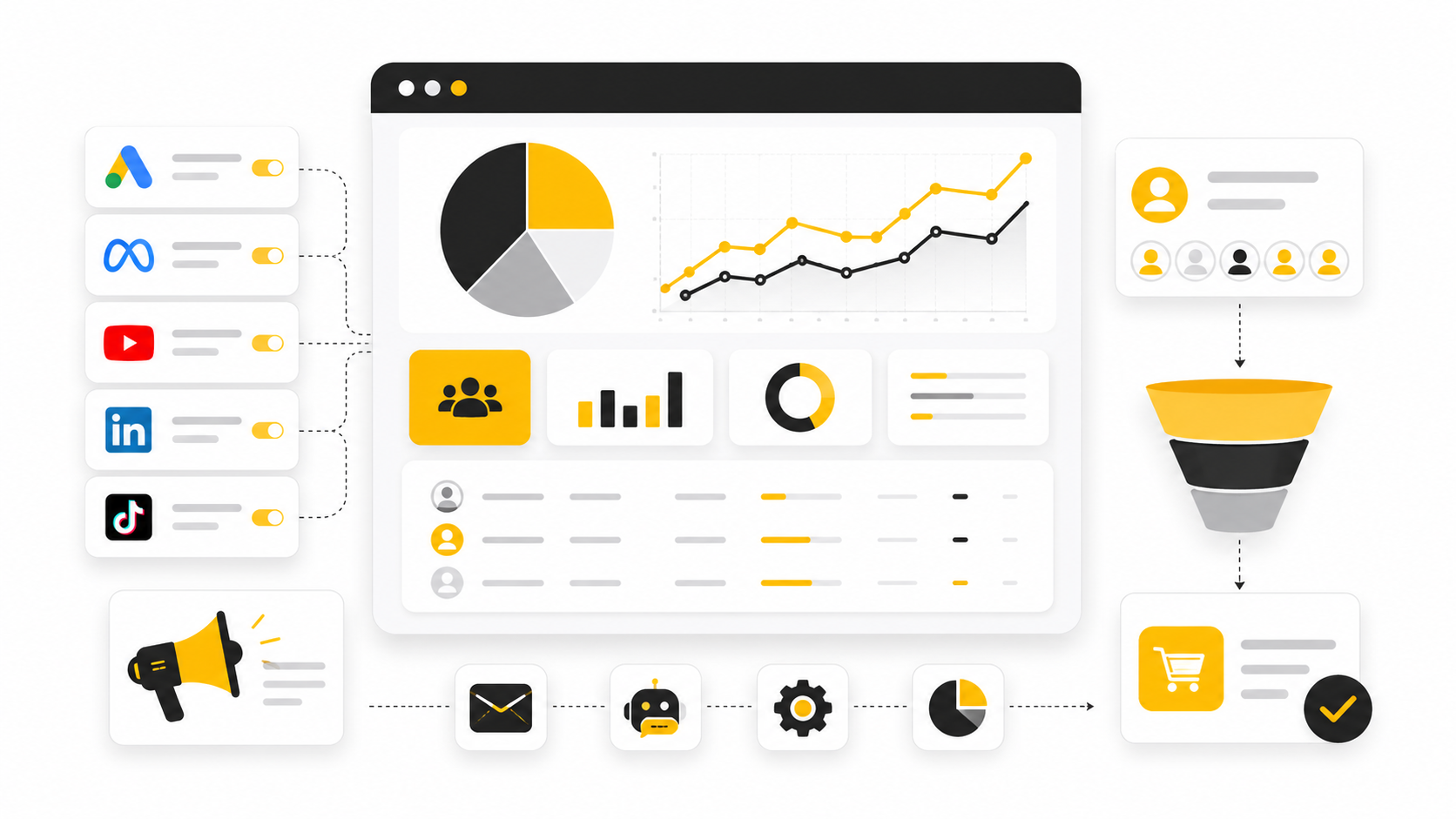
Article Outline
This article is split into six parts so each piece of the system gets enough room without turning into a scattered checklist.
- Why Online Business Advertising Matters Now
- The Online Advertising Framework
- Core Components Of A Profitable Campaign
- Choosing The Right Advertising Channels
- Professional Implementation And Optimization
- Measurement, Scaling, And Frequently Asked Questions
Why Online Business Advertising Matters Now
Online business advertising matters because buyers no longer move through one clean path. A person may discover a product through search, compare it on social, watch a review, click a retargeting ad, join an email list, and buy days later after seeing another offer. If your advertising only focuses on the first click, you miss the real journey.
It also matters because digital channels are becoming more automated. Google’s AI-powered campaign tools, Meta’s automated placements, retail media networks, and creator ads all push advertisers toward broader targeting and faster creative testing. That can be powerful, but only when your offer, landing page, tracking, and follow-up are strong enough to guide the machine.
The practical advantage is control. A business with a clear advertising system can test offers, measure demand, improve conversion rates, and scale winners instead of guessing what “brand awareness” might be doing. That is the difference between spending money online and building an acquisition engine.
The Online Advertising Framework
A strong online advertising framework has four layers: market, message, media, and measurement. The market defines who you are trying to reach and what problem they already care about. The message turns that problem into a clear reason to click, subscribe, book, or buy.
The media layer decides where that message should run. Search ads capture existing intent, social ads create and shape demand, video builds trust, retargeting brings people back, and email or automation turns interest into follow-up. For businesses that need a central CRM and automated pipeline, GoHighLevel fits naturally when ads need to connect with lead capture, nurturing, booking, and sales tracking.
Measurement keeps the whole system honest. It shows whether your ads are producing profitable outcomes or just attractive dashboard numbers. Without measurement, online business advertising becomes a slot machine with nicer charts.
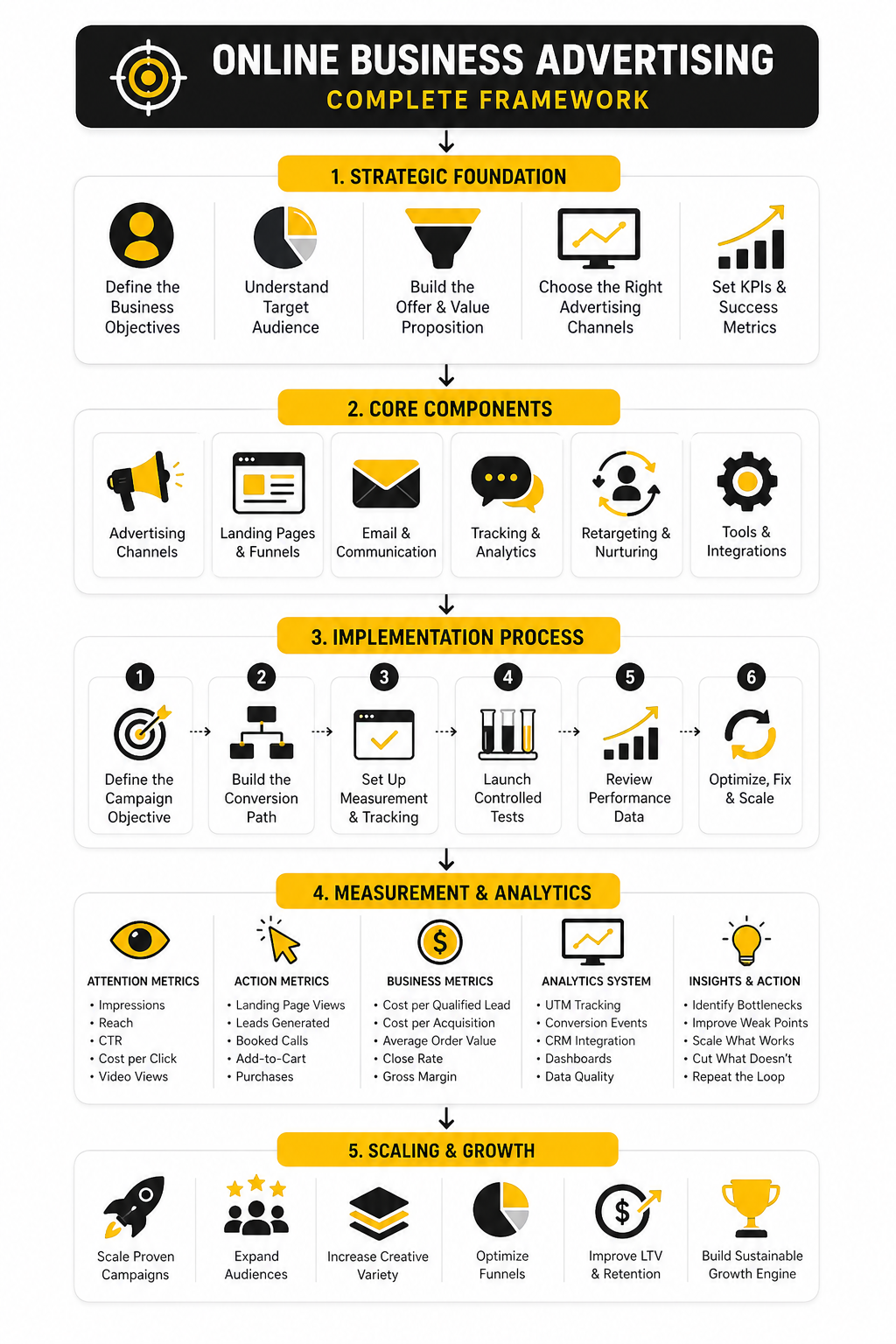
Core Components Of A Profitable Campaign
A profitable campaign starts before the ad account opens. The offer has to be clear, specific, and connected to a real buying motive. Online business advertising works best when the business knows exactly what action it wants from the audience and why that action makes sense right now.
The core components are simple, but they have to work together. You need a defined audience, a strong offer, persuasive creative, a conversion-focused destination, reliable tracking, and a follow-up system. Miss one of those pieces and the campaign becomes harder to diagnose, even if the ads look good on the surface.
This is where many businesses get stuck. They treat the ad as the whole campaign, then wonder why clicks do not turn into customers. The ad creates the first move, but the system after the click usually decides whether the money was well spent.
Audience And Intent
The audience is not just a demographic profile. It is a group of people with a problem, desire, fear, deadline, or buying trigger that makes your offer relevant. A broad audience can still work, especially with automated platforms, but the message must be sharp enough to give the algorithm useful signals.
Intent matters because not every click has the same value. Someone searching for a pricing comparison is in a different state of mind than someone casually scrolling through social media. Search campaigns often capture demand that already exists, while social and video campaigns are better at creating demand before the buyer starts actively looking.
That is why your campaign should define the job of each channel before spending. A cold traffic ad may be designed to introduce the problem. A retargeting ad may handle objections. A branded search ad may protect high-intent demand when someone is close to taking action.
Offer And Positioning
The offer is the reason someone should act now instead of forgetting you. It can be a product, consultation, lead magnet, trial, demo, discount, audit, webinar, or application. The format matters less than the perceived value and the clarity of the next step.
Strong positioning makes the offer easier to understand. It explains who the offer is for, what outcome it helps create, and why this business is the right choice. In online business advertising, vague positioning usually creates expensive traffic because the platform can deliver impressions, but it cannot fix a weak reason to care.
A practical test is simple. After reading the ad, a stranger should understand what is being offered, who it is for, and what happens after the click. If that is not obvious, the campaign needs more work before the budget goes up.
Creative And Message Match
Creative is not decoration. It is the way the campaign earns attention, frames the problem, and makes the offer feel relevant. Good creative can be a short video, a simple image, a founder-led message, a product demo, a comparison, or a direct response ad that speaks plainly.
Message match is where the creative connects to the landing page. If the ad promises a free strategy call, the landing page should not feel like a generic homepage. If the ad promotes a specific product category, the click should land on a page built around that exact intent.
This matters even more as ad platforms lean into automation. Google’s Performance Max gives advertisers access to Google AI across channels, while Meta’s Advantage systems automate more targeting, placement, budget, and creative decisions through its ad delivery stack. Automation can expand reach, but it still needs strong creative inputs and a destination that converts.
Landing Page And Conversion Path
The landing page has one job: continue the conversation the ad started. It should make the offer clear, remove friction, answer the obvious objections, and make the next action easy. A beautiful page that confuses people is not a conversion asset.
For ecommerce, this may mean a product page, advertorial, quiz, collection page, or dedicated landing page. For service businesses, it may mean a booking page, application form, quote request, or lead capture page. Tools like ClickFunnels, Systeme.io, and Replo fit naturally when the campaign needs a focused conversion path instead of sending paid traffic to a general website.
The key is not the tool. The key is reducing the distance between interest and action. Every headline, form field, testimonial, guarantee, button, and follow-up step should help the buyer move forward with less doubt.
Tracking And Follow-Up
Tracking shows what happened. Follow-up improves what happens next. You need both because many buyers do not convert on the first visit, especially when the offer requires trust, comparison, budget approval, or a longer decision cycle.
At minimum, a campaign should track clicks, landing page views, leads, purchases, booked calls, cost per result, conversion rate, and revenue where possible. Better systems also track lead quality, show-up rate, close rate, refund rate, repeat purchases, and lifetime value. That is where online business advertising becomes a business decision instead of a media buying habit.
Follow-up is where a lot of profit hides. Email, SMS, chat automation, retargeting, and sales pipeline reminders can turn missed opportunities into revenue. For example, ManyChat is useful when campaigns rely on conversational flows, while Brevo and Moosend fit when email automation is central to the customer journey.
Choosing The Right Advertising Channels
The right channel is the one that matches the buyer’s intent, the offer’s complexity, and the business model behind the campaign. This is where online business advertising becomes strategic instead of random. You are not choosing platforms because they are popular; you are choosing them because they fit the job you need done.
Search works well when people already know what they want. Social works well when the market needs education, comparison, desire, or repeated exposure before taking action. Video, creator partnerships, email, retargeting, and automation all play different roles, so the smart move is to assign each channel a purpose before judging its performance.
That matters because channel confusion creates bad decisions. A campaign built for awareness should not be judged only by immediate sales. A campaign built for high-intent lead generation should not be optimized around cheap clicks that never turn into pipeline.
Search Advertising
Search advertising is strongest when the buyer is already looking for a solution. Someone searching for a local service, software alternative, product category, or urgent fix is showing intent that most social platforms cannot manufacture on demand. That does not make search automatically better; it just makes it better for capturing existing demand.
The process starts with keyword grouping. Separate branded searches, competitor searches, commercial keywords, local intent, informational searches, and problem-aware searches. Each group needs a different message because a person searching your brand is not in the same mindset as someone searching a broad category.
Your landing page should match that intent as closely as possible. A high-intent search ad should not send people to a vague homepage. It should send them to a page that confirms relevance quickly, explains the offer, shows trust signals, and makes the next step obvious.
Social Advertising
Social advertising is powerful because it lets you reach people before they actively search. That is useful for products, services, communities, courses, apps, and offers where the buyer may not know the exact solution yet. The tradeoff is that attention is colder, so the creative has to do more work.
The strongest social campaigns usually test angles, not just designs. One ad may lead with pain, another with aspiration, another with proof, another with a direct offer, and another with a simple product demonstration. Meta’s Advantage+ automation now supports broader automation across audiences, placements, budgets, and creative delivery, which makes strong creative variety even more important.
Do not treat social ads like tiny posters. Treat them like sales conversations compressed into a few seconds. The first line, first frame, hook, proof, and call to action all matter because people are not waiting to hear from you.
Video And Creator-Led Campaigns
Video is useful when the offer needs demonstration, trust, explanation, or emotion. A short video can show the product, clarify the problem, handle objections, or make the brand feel more human. IAB reported that digital video ad spend grew 18% year over year in 2024 to $64 billion and was projected to reach $72 billion in 2025, which shows how much budget is moving toward formats that can combine attention and performance.
Creator-led campaigns sit close to this same shift. They work because the message comes through a person who already has audience trust, not just through a brand account trying to interrupt a feed. The danger is treating creators like cheap media placements instead of partners who understand how their audience actually listens, reacts, and buys.
For online business advertising, the practical move is to brief creators around the outcome, objections, proof points, and boundaries, then give them room to communicate naturally. Over-scripted creator ads often feel fake. Under-briefed creator ads often miss the business goal.
Retargeting And Lifecycle Campaigns
Retargeting is not magic, but it is useful when the buying journey has more than one touchpoint. People visit, compare, get distracted, check reviews, talk to someone else, and come back later. Retargeting helps you stay present during that gap without pretending every visitor was ready to buy immediately.
The best retargeting campaigns are specific. Someone who viewed a product page should not always see the same message as someone who started checkout, watched a webinar, booked a call, or downloaded a guide. Each action tells you something about their intent, so the follow-up should reflect that.
Lifecycle campaigns extend the same idea beyond ads. Email, SMS, chat, calendar reminders, and CRM tasks can continue the conversation after the click. When campaigns rely on booked calls, applications, demos, or consultations, a platform like GoHighLevel can connect advertising, pipeline tracking, automated follow-up, and sales activity in one place.
Professional Implementation And Optimization
Implementation is where theory becomes real. A business can have a strong offer and still waste money if tracking is broken, pages load slowly, creative is thin, or follow-up is late. Professional online business advertising is less about clever hacks and more about running a clean process every week.
The process should be simple enough to repeat. You define the campaign objective, build the funnel, set up tracking, launch controlled tests, review the right metrics, and improve the weakest part of the system. That sounds basic, but basic done consistently beats complicated done randomly.
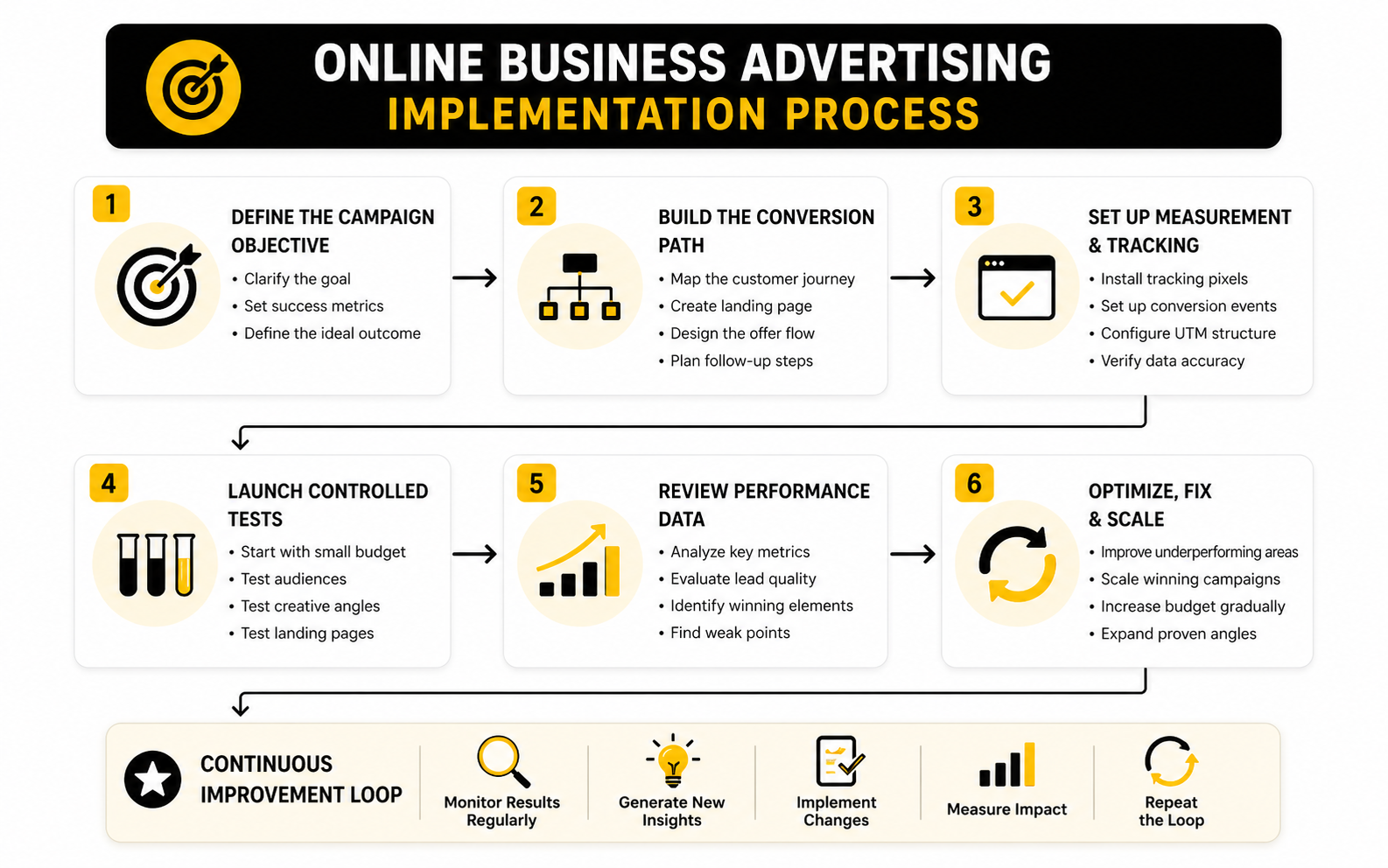
Step 1: Define The Campaign Objective
Start by choosing one primary objective. That could be purchases, qualified leads, booked calls, trial starts, webinar registrations, quote requests, or repeat purchases. Do not let one campaign chase every possible outcome at the same time.
The objective should connect directly to business economics. A cheap lead is not useful if it never answers the phone, shows up, buys, or becomes profitable. This is why serious campaigns define both platform metrics and business metrics before launch.
A simple rule helps. If the sales team, founder, or operator cannot explain what a successful conversion is, the ad platform will not magically solve that confusion. The campaign needs a clear target before budget makes sense.
Step 2: Build The Conversion Path
Once the objective is clear, build the path that gets someone there. For a product, that path may include an ad, landing page, product page, checkout, post-purchase email, and retargeting sequence. For a service, it may include an ad, booking page, form, confirmation message, reminders, call notes, and sales follow-up.
Every step should remove friction. Forms should ask only for what the business needs. Booking flows should be easy to complete. Pages should answer the questions buyers naturally have before they commit.
Tools can help, but they should support the path instead of complicating it. ClickFunnels can work well for funnel-based offers, Systeme.io can fit leaner setups that need pages and email in one place, and Replo is useful when ecommerce teams need more flexible landing pages without rebuilding the whole store.
Step 3: Set Up Measurement Before Launch
Measurement should be installed before traffic starts. That includes platform pixels, conversion events, UTM naming, analytics goals, CRM fields, and call or booking tracking where relevant. Google’s consent mode preserves a visitor’s consent state across pages, which is now part of the measurement conversation for advertisers working in privacy-sensitive markets.
Enhanced conversions and first-party data are also important because browsers, devices, consent rules, and platform limits make perfect tracking unrealistic. The point is not to track everything with false confidence. The point is to make the best possible decisions with clean, consistent signals.
This is also where many campaigns quietly fail. If a purchase fires twice, a lead event fires on page view, or a form submission never reaches the CRM, the optimization data becomes misleading. Bad data teaches the platform bad lessons.
Step 4: Launch Controlled Tests
A controlled launch gives you room to learn without burning the full budget too early. Start with a small number of audiences, offers, and creative angles so you can actually understand what is working. Too many variables make the first round of results almost useless.
Creative testing should be structured around ideas. Test a problem-led message against an outcome-led message. Test a direct offer against an educational lead magnet. Test a founder video against a product demonstration. This gives you insight you can use, not just a pile of random ads.
Budget should match the learning goal. If the campaign cannot generate enough clicks or conversions to reveal patterns, the test may be too small. If the budget is too aggressive before the funnel is proven, the business pays full price for avoidable mistakes.
Step 5: Review, Fix, And Scale
Review starts with the bottleneck. If click-through rate is weak, the message or creative may not be earning attention. If clicks are strong but conversions are weak, the issue may be landing page relevance, offer clarity, price resistance, trust, or form friction.
Do not scale just because one metric looks good. Scale when the campaign shows signs of repeatable economics. That means the numbers make sense beyond the ad account: lead quality, booked calls, sales rate, average order value, margin, refunds, retention, and payback period.
Optimization is not endless tinkering. It is a disciplined loop: find the constraint, improve it, give the system enough data, and then decide the next move. That is how online business advertising becomes a growth process instead of a guessing game.
Statistics And Data
The point of measurement is not to collect numbers. The point is to know what to fix, what to stop, and what to scale. Online business advertising becomes much easier to manage when each metric has a job instead of sitting in a dashboard as decoration.
The market data shows why this discipline matters. U.S. internet advertising revenue reached $294.6 billion in 2025, which means more competition, more automation, and more pressure on weak campaigns. Digital video also kept growing, with U.S. digital video ad spend projected to reach $72 billion in 2025, so advertisers are not just buying search clicks anymore; they are competing across search, social, video, retail media, creators, and retargeting.
That does not mean every business should chase every channel. It means the cost of sloppy measurement is higher. If your tracking cannot separate real buyers from empty engagement, the platform may optimize toward the wrong people while your budget quietly disappears.
The Metrics That Actually Matter
The most useful advertising metrics sit in layers. At the top, you have attention metrics like impressions, reach, video views, click-through rate, and cost per click. These tell you whether the message is getting noticed, but they do not prove that the campaign is profitable.
The middle layer measures action. This includes landing page views, form starts, completed leads, booked calls, add-to-carts, checkouts, purchases, trial starts, and demo requests. These numbers reveal whether the campaign is turning attention into movement.
The bottom layer is where the business case lives. Cost per qualified lead, cost per booked call, cost per acquisition, average order value, close rate, gross margin, payback period, retention, and lifetime value matter because they connect ads to money. If a campaign looks good in the ad account but fails here, it is not a growth channel yet.
How To Read Benchmarks Without Fooling Yourself
Benchmarks are useful for orientation, not decision-making. A published average cost per click or conversion rate can tell you whether your numbers are wildly out of range, but it cannot tell you whether your business is healthy. Your offer, price point, market, funnel, brand trust, sales process, geography, and margin all change what “good” means.
Google Ads benchmark reports are especially tempting because they give clean industry averages for CPC, CTR, conversion rate, and cost per lead. Those numbers can be helpful when you are estimating a first test budget or checking whether an account has a major efficiency problem. But they become dangerous when they replace your own unit economics.
A campaign with a high cost per lead can still be profitable if the leads are qualified, close at a strong rate, and have high lifetime value. A campaign with a low cost per lead can still be a disaster if the leads are unresponsive, poor-fit, or impossible to convert. This is why online business advertising should be judged by the full path, not one attractive metric.
Building A Practical Analytics System
A practical analytics system does not need to be complicated. It needs to be consistent. The campaign should use clean UTM naming, reliable conversion events, a CRM or order system that records lead and customer outcomes, and a reporting view that connects spend to revenue or qualified pipeline.
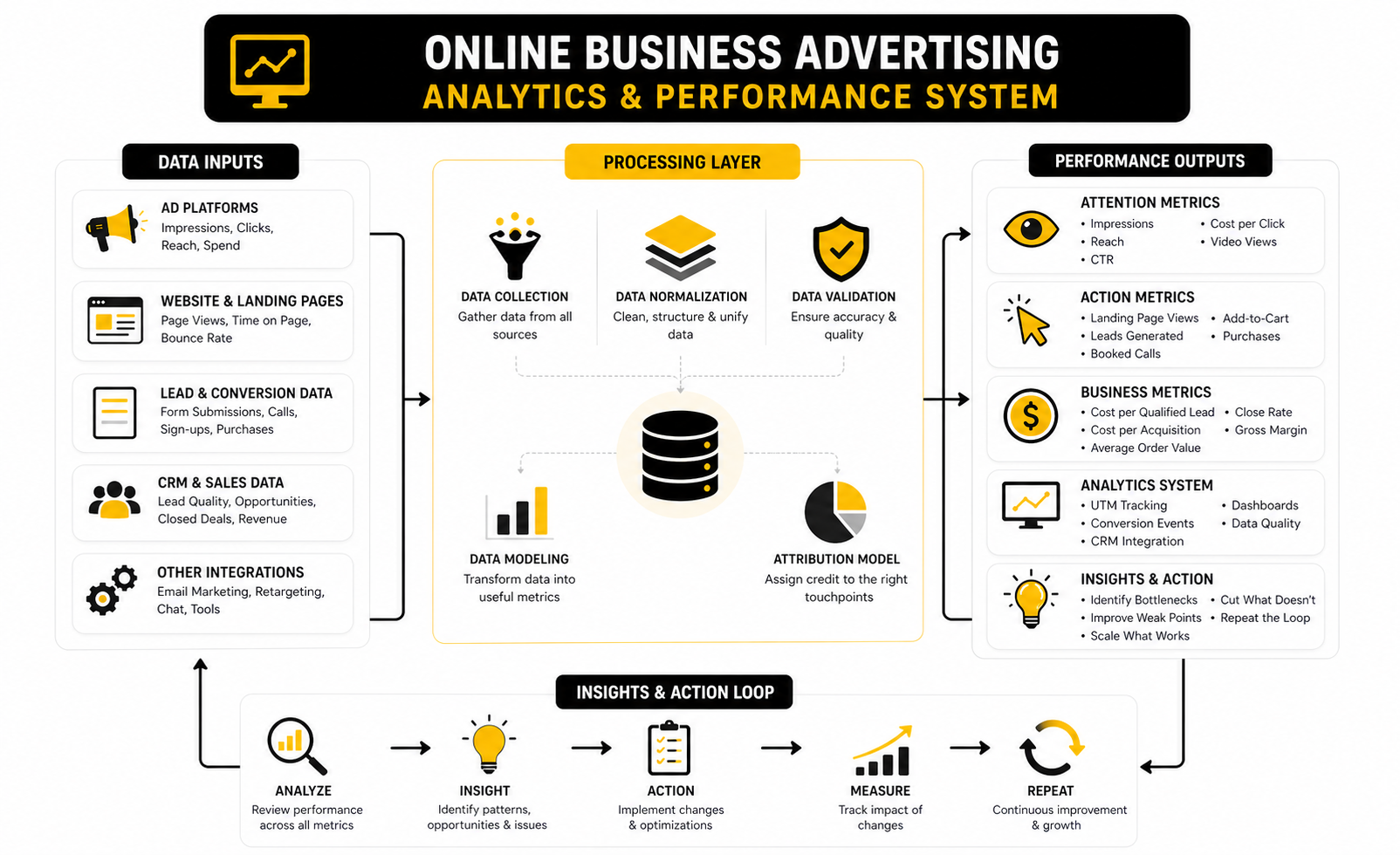
The system should answer five questions every week. Where did the money go? What did it produce? Which audience or keyword showed intent? Which creative angle created action? Which step in the funnel created the biggest drop-off?
This is where tools matter because scattered data creates slow decisions. For service businesses, GoHighLevel can connect ads, forms, booking, pipeline stages, and follow-up. For ecommerce landing page testing, Replo can support more focused campaign pages, while ClickFunnels or Systeme.io can help when the campaign depends on a clear funnel, email sequence, or offer flow.
Performance Signals And What They Mean
Weak click-through rate usually means the ad is not earning attention or the message does not match the audience. The fix is not always a new button color or a bigger discount. More often, the campaign needs a sharper hook, clearer pain point, stronger proof, or a more relevant creative angle.
Strong clicks with weak conversions usually point to a post-click problem. The landing page may not match the ad, the offer may feel unclear, the form may ask for too much, the page may lack trust, or the price may not make sense for the level of demand being created. This is where conversion rate optimization matters more than launching ten more ad variations.
Strong leads with weak sales are a deeper signal. The campaign may be attracting the wrong people, the qualification process may be too loose, the sales team may be slow to respond, or the offer may be positioned in a way that creates curiosity but not buying intent. In that case, the answer is not simply “spend more”; the answer is to tighten targeting, messaging, qualification, and follow-up.
Turning Data Into Action
Good reporting should end with decisions. Increase budget on campaigns that are producing profitable outcomes with enough volume. Cut or rebuild campaigns that keep attracting weak-fit traffic. Improve landing pages where intent is strong but conversion is low.
The best optimization rhythm is boring in the right way. Review performance weekly, compare it against the campaign objective, identify the constraint, make one meaningful change, and give the campaign enough data before judging it again. Random daily edits can damage learning and make results harder to interpret.
Data should make the next move obvious. If it does not, the reporting setup is probably too messy, too shallow, or too disconnected from revenue. Clean measurement gives you confidence, and confidence is what lets you scale without guessing.
Strategic Tradeoffs Before You Scale
Scaling online business advertising is not just increasing the budget. Scaling means the campaign can handle more spend without breaking the economics, the operations, or the customer experience. That only happens when the business understands the tradeoffs behind growth.
The first tradeoff is speed versus confidence. Moving fast helps you test more offers, creative angles, and audiences, but it can also create messy data and rushed decisions. Moving slowly gives you cleaner reads, but it may cause you to miss demand while competitors keep learning.
The second tradeoff is efficiency versus volume. A campaign can look highly efficient at a small budget because it is reaching the easiest buyers first. As spend increases, the platform usually has to reach colder, broader, or more expensive audiences, so costs often rise before the next level of learning appears.
Budget Scaling Without Breaking Performance
Budget increases should follow proof, not hope. If a campaign is profitable at a small budget, raise spend in controlled steps and watch whether conversion quality holds. The question is not only whether cost per lead or cost per purchase changes; the question is whether revenue quality stays strong as the campaign reaches more people.
A common mistake is scaling one winning ad until fatigue hits. That can work for a while, but the campaign becomes fragile because one creative angle carries too much weight. Better scaling comes from building a pipeline of new hooks, landing page tests, offers, and audience signals before the current winner slows down.
You also need to protect the sales and fulfillment side. More leads are not a win if response times get slower, calls are missed, inventory runs out, support gets overwhelmed, or customers receive a weaker experience. Advertising can create demand fast, but operations decide whether that demand turns into profit.
Creative Fatigue And Message Expansion
Creative fatigue happens when the same people see the same message too many times and stop responding. You may notice rising frequency, falling click-through rate, weaker conversion rate, or increasing acquisition costs. The fix is not always a complete rebrand; often, it is expanding the message library.
Message expansion means finding new ways to communicate the same core offer. You can test different pains, outcomes, objections, proof points, formats, and levels of awareness. One person may respond to a direct discount, another to a comparison, another to a founder explanation, and another to a short demonstration.
This is where social planning tools can help keep campaigns organized without turning the creative process into chaos. Buffer can support publishing and testing organic angles before they become paid concepts, while Flick Social can help with social content planning when the brand needs more consistent creative output. Paid ads perform better when the business has more real ideas to test.
Brand Building Versus Direct Response
Direct response advertising is attractive because it gives fast feedback. You spend money, measure leads or sales, and decide what to do next. That is useful, especially for smaller businesses that cannot afford vague campaigns with no path to revenue.
But direct response alone can become expensive over time. If people have never heard of the brand, every ad has to do the hard work of earning attention, building trust, explaining the offer, and asking for action in one short interaction. That is a lot to ask from one campaign.
Brand building reduces that burden. It makes future clicks warmer, retargeting more effective, search demand stronger, and sales conversations easier. The strongest online business advertising systems usually combine both: campaigns that create immediate action and campaigns that make the market more likely to trust the next offer.
Automation, AI, And Human Judgment
Ad platforms are becoming more automated, and that is not going away. Google Ads highlighted 2025 updates around improved conversion measurement, Smart Bidding Exploration, broader reporting, and AI-powered campaign features in its Google Ads Highlights of 2025. Automation can help find patterns faster than a human media buyer scanning rows in a spreadsheet.
The risk is handing over strategy too early. AI can optimize toward the signal you give it, but it does not know whether a lead is actually qualified, whether a customer is profitable, or whether the campaign is attracting people your sales team does not want. If the conversion event is shallow, automation may simply find more shallow conversions.
Human judgment still matters in the parts the machine cannot fully understand. Offer strategy, positioning, creative direction, customer insight, brand risk, sales quality, and profit economics need a person behind them. The best setup is not human versus AI; it is clear human strategy supported by automation that has clean data to learn from.
Privacy, Consent, And First-Party Data
Privacy is now part of advertising performance. Consent rules, browser changes, platform limits, and customer expectations all affect how much data advertisers can collect and how reliably platforms can attribute results. This makes first-party data more valuable because it comes directly from your own forms, customers, subscribers, purchases, bookings, and CRM activity.
First-party data should be earned, not grabbed. Give people a clear reason to subscribe, request a quote, book a call, join a list, or answer a quiz. Then use that data responsibly to improve relevance, follow-up, and customer experience.
This also changes how businesses should think about assets. An email list, CRM, customer database, and content audience are not side projects. They are strategic protection against rising ad costs and weaker platform-level tracking.
Lead Quality And Sales Alignment
Lead generation campaigns can be dangerous when marketing and sales are not aligned. Marketing may celebrate cheap leads while sales complains that nobody is serious. Sales may blame the leads while responding too slowly or failing to follow up properly.
The fix is shared definitions. A lead, qualified lead, booked appointment, sales opportunity, closed customer, and bad-fit contact should each mean something specific. Once those definitions are clear, the campaign can optimize for business quality instead of surface-level volume.
This is where CRM discipline becomes a real advantage. A tool like Copper can support relationship-based selling, while GoHighLevel fits teams that want ad leads, pipeline stages, automation, and follow-up in the same operating system. The tool is not the strategy, but the right setup makes the strategy easier to execute.
Risk Management And Channel Dependence
A profitable channel can become a trap if the business depends on it too heavily. Ad costs can rise, policies can change, accounts can get restricted, tracking can shift, and competitors can enter the same auction. If one platform controls most of your acquisition, your growth is more fragile than it looks.
Risk management starts with knowing where demand comes from. Separate paid search, paid social, organic search, email, referrals, partners, direct traffic, creator campaigns, and repeat customers in reporting. Then look at what would happen if the strongest channel became more expensive next quarter.
The goal is not to avoid paid media. Paid media is still one of the fastest ways to test and scale demand. The goal is to use online business advertising to build assets that survive beyond the click: customer lists, brand demand, content, referral loops, sales processes, and better data.
Measurement, Scaling, And Frequently Asked Questions
At this stage, the campaign should no longer be treated as a collection of ads. It should be treated as an ecosystem. The ad creates attention, the landing page converts intent, the CRM captures the relationship, follow-up builds trust, and reporting shows where the next improvement should happen.
That final-system view is important because online business advertising gets more valuable when every part strengthens the next one. Better creative improves traffic quality. Better landing pages make traffic more profitable. Better follow-up increases conversion after the first visit. Better data helps the next campaign learn faster.
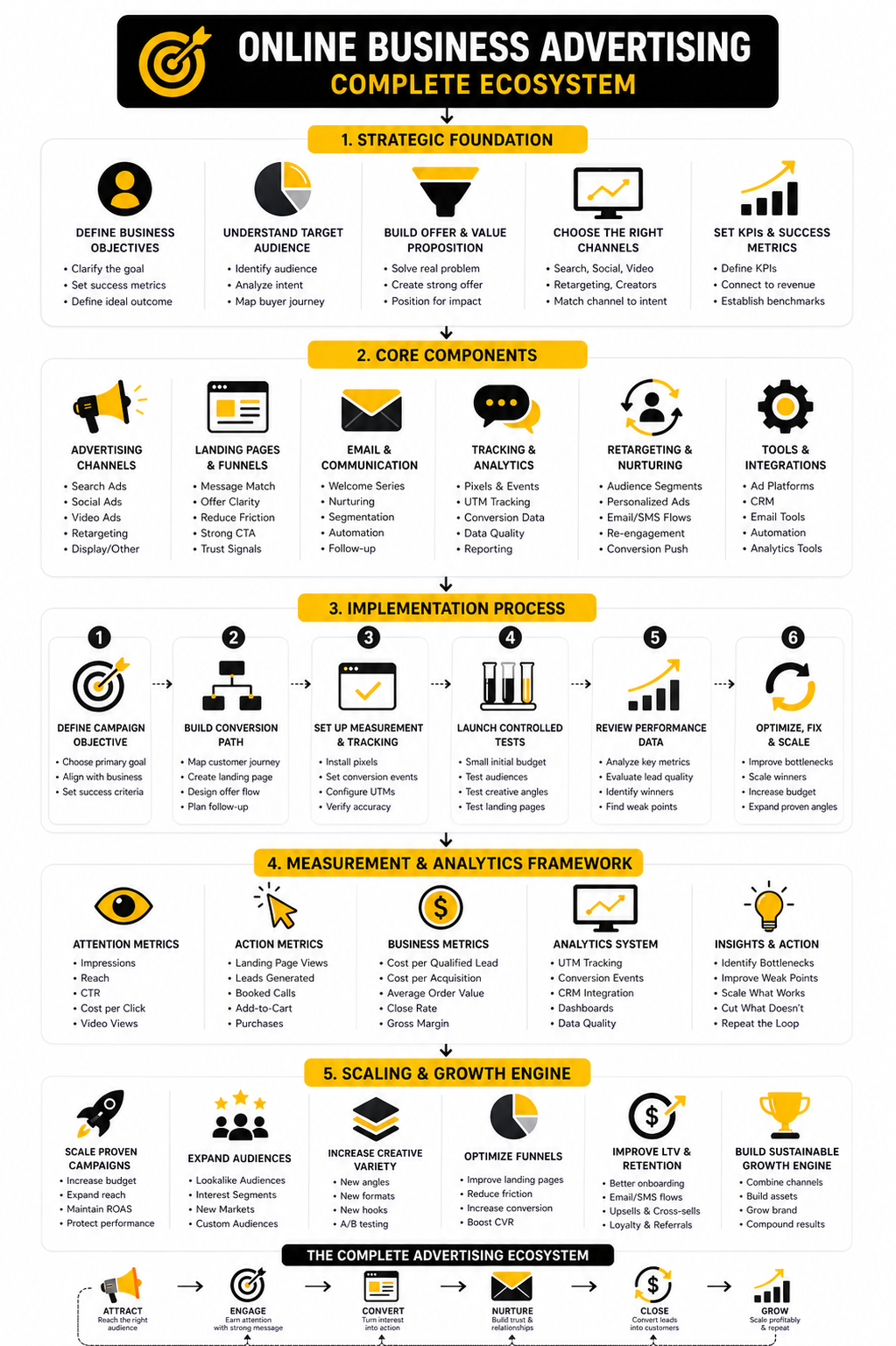
The businesses that win are not always the ones with the biggest budgets. They are usually the ones that learn faster, fix bottlenecks sooner, and build assets from every campaign they run. Paid traffic is temporary, but the insight, audience, customer list, creative library, and sales process you build from it can compound.
FAQ - Built For Complete Guide
What is online business advertising?
Online business advertising is the process of using digital channels to promote a product, service, brand, or offer to a targeted audience. It can include search ads, social ads, video ads, retargeting, email-driven campaigns, creator partnerships, display ads, and sponsored content. The goal is not just visibility; the goal is measurable action that supports the business.
Why is online business advertising important?
It matters because most buyers now research, compare, and make decisions across digital touchpoints. A business that depends only on referrals, organic reach, or word of mouth may grow, but it has less control over demand. Advertising gives you a way to test offers, reach new audiences, measure intent, and scale what works.
What is the best platform for online business advertising?
There is no single best platform for every business. Google Ads is strong when buyers are already searching, Meta works well for visual demand creation and retargeting, LinkedIn can fit B2B targeting, and YouTube is useful when the offer needs explanation or trust. The best platform is the one that matches your audience, offer, budget, and conversion path.
How much should a business spend on online advertising?
The right budget depends on the offer value, sales cycle, conversion rate, margin, and how much data the campaign needs to produce a meaningful test. A small local service business may start with a focused budget around one offer and one location, while an ecommerce brand may need enough spend to test multiple creatives and landing pages. The practical answer is to spend enough to learn, but not so much that one bad test damages the business.
What metrics should I track first?
Start with the metrics that connect directly to the campaign objective. For lead generation, track cost per lead, lead quality, booked calls, show-up rate, close rate, and cost per customer. For ecommerce, track conversion rate, cost per acquisition, average order value, gross margin, return on ad spend, repeat purchase rate, and payback period.
What is a good conversion rate for online ads?
A good conversion rate depends on the channel, offer, price, audience, and level of buying intent. A high-intent search campaign may convert differently from a cold social campaign, and a free guide will convert differently from a high-ticket consultation. Instead of chasing a universal benchmark, compare your conversion rate against your own economics and improve the weakest step in the funnel.
Why are my ads getting clicks but no sales?
Clicks without sales usually point to a mismatch after the click. The ad may create curiosity but not buying intent, the landing page may not match the promise, the offer may be unclear, or the audience may not be qualified. Fix the message match first, then review the page, proof, pricing, checkout, and follow-up.
Should I send paid traffic to my homepage?
Usually, no. A homepage has too many jobs, while an ad campaign needs one clear path. A focused landing page is usually better because it can match the ad, explain the offer, handle objections, and guide the visitor toward one action.
How long should I run an ad test before judging it?
Judge the test after it has enough data to show a real pattern. That may take a few days for a simple low-cost offer or several weeks for a longer sales cycle. Do not make major decisions from a handful of clicks, but do not ignore obvious signs like broken tracking, poor message match, or a landing page that clearly fails to explain the offer.
What is the biggest mistake in online business advertising?
The biggest mistake is treating ads as the strategy. Ads are only one part of the system. If the offer is weak, the page is confusing, tracking is broken, or follow-up is slow, the campaign will struggle no matter how clever the ad looks.
How do I scale online advertising safely?
Scale by increasing budget gradually, expanding winning creative angles, improving landing pages, and watching business-quality metrics. Do not scale only because cost per click looks cheap. Scale when the campaign produces customers, revenue, margin, and retention that support more spend.
Do small businesses need automation?
Small businesses do not need complicated automation, but they do need reliable follow-up. Missed calls, slow replies, forgotten leads, and inconsistent emails can quietly kill campaign profit. Even a simple automation system for confirmations, reminders, lead nurturing, and pipeline tracking can make paid traffic much more valuable.
How does AI change online business advertising?
AI changes how campaigns are built, optimized, and measured. Platforms can automate bidding, targeting, creative combinations, and reporting faster than a person can manually manage every setting. But AI still needs strong inputs: clear objectives, quality data, useful creative, accurate conversion events, and human strategy.
Is retargeting still worth it?
Yes, when it is used with purpose. Retargeting works best when the message reflects what the person already did, such as viewing a product, starting checkout, reading a guide, or booking a call. Generic retargeting is easy to ignore, but specific retargeting can bring serious buyers back at the right moment.
What should I fix first if my campaign is underperforming?
Start with the biggest bottleneck. If nobody clicks, fix the creative and message. If people click but do not convert, fix the landing page and offer clarity. If leads come in but do not buy, fix qualification, speed to lead, sales follow-up, and the promise being made in the ad.
Work With Professionals
Explore 10K+ Remote Marketing Contracts On MarkeWork.com
Most marketers spend too much time chasing clients, competing on crowded platforms, and losing a percentage of every project to middlemen.
MarkeWork gives you a better way. Browse thousands of remote marketing contracts and connect directly with companies desperate to hire skilled marketers like you, without platform commissions and without unnecessary gatekeepers.
If you are serious about finding better opportunities and keeping 100% of what you earn, explore available contracts and create a profile for free at MarkeWork.com.