

Online lead generation has quietly become the backbone of modern business growth. Whether you're running a SaaS company, an agency, or an eCommerce brand, the ability to consistently attract and convert attention into qualified prospects determines whether you scale or stall.
What’s changed is not just the number of channels available, but how buyers behave inside them. Research shows that buyers now complete a significant portion of their decision-making process before ever speaking to sales, with sources like Gartner research on B2B buying journeys highlighting how nonlinear and self-directed this process has become. That means your lead generation system needs to meet people earlier, guide them intelligently, and convert them without friction.
At the same time, competition has intensified. Platforms are saturated, attention spans are shorter, and trust is harder to earn. The businesses winning today aren’t just “getting leads”—they’re building systems that qualify, nurture, and convert those leads predictably.
This article breaks down exactly how that works, starting with the structure behind high-performing online lead generation systems.
Article Outline
- Why Online Lead Generation Matters More Than Ever
- The Online Lead Generation Framework Explained
- Core Components of a High-Converting Lead System
- Professional Implementation Strategies
- Optimization and Scaling Techniques
- Advanced Trends and Future-Proofing Your Lead Generation
Why Online Lead Generation Matters More Than Ever
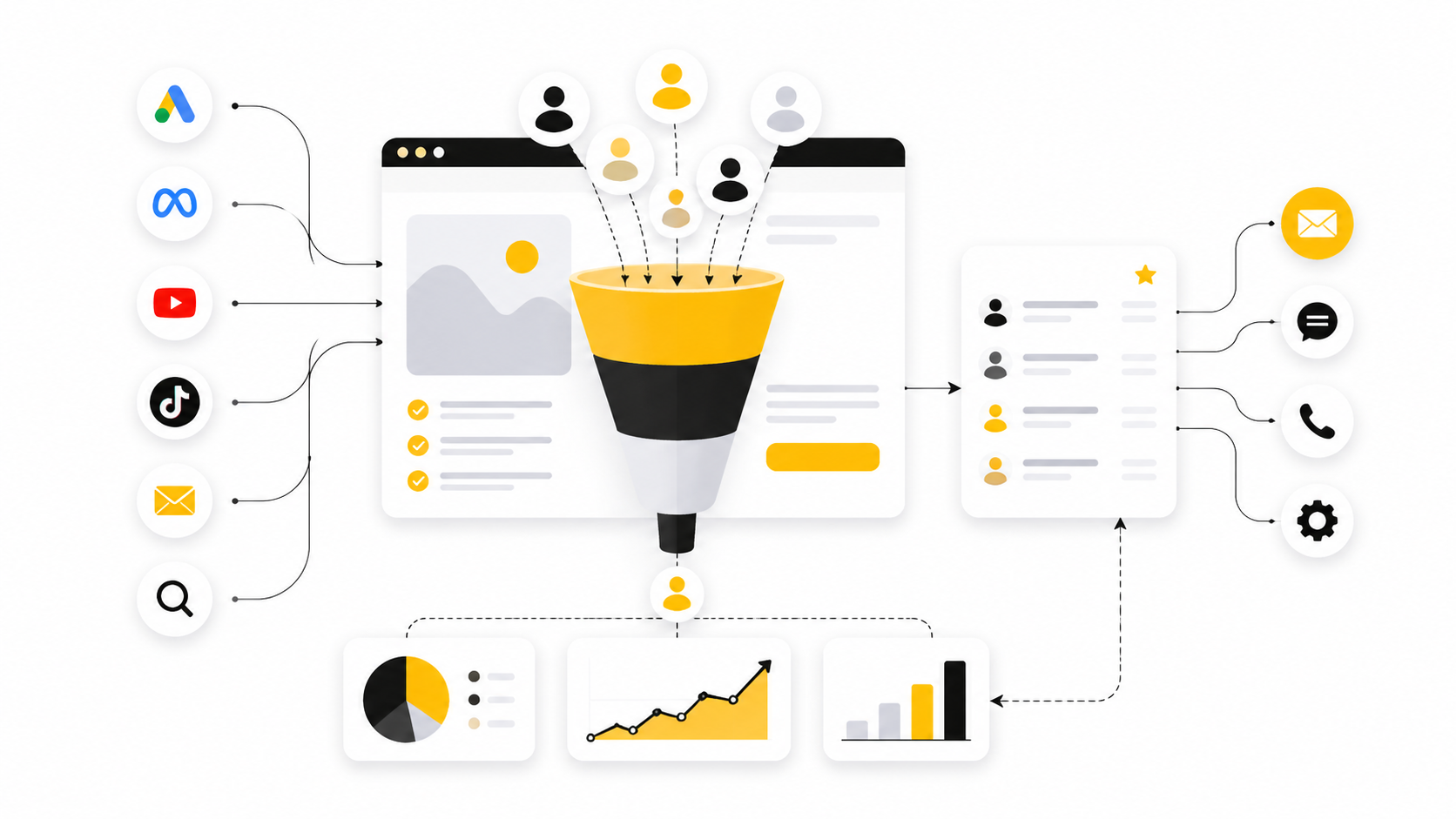
Online lead generation is no longer optional. It’s the primary growth engine for most digital-first businesses, and increasingly for traditional companies transitioning online.
One of the biggest shifts is how buyers interact with brands. Instead of relying on sales reps, people research independently, compare options, and only engage when they’re close to making a decision. Data from HubSpot’s marketing statistics consistently shows that inbound strategies generate significantly higher-quality leads compared to outbound tactics, largely because they align with user intent.
That shift creates both an opportunity and a problem. The opportunity is that you can attract highly qualified prospects at scale. The problem is that if your system isn’t structured properly, those same prospects will bounce, ignore you, or choose a competitor.
There’s also a financial dimension. Customer acquisition costs have risen across platforms due to increased competition and privacy changes. Businesses that rely on short-term tactics without building a proper lead generation engine often see diminishing returns. In contrast, companies that invest in systems—funnels, automation, and nurturing—build compounding advantages over time.
Another key factor is ownership. When you generate leads effectively, you own the relationship. You’re not dependent on algorithms, platforms, or unpredictable traffic sources. Email lists, CRM pipelines, and messaging systems become long-term assets that you control.
Tools like GoHighLevel have become popular precisely because they centralize this ownership—combining funnels, CRM, automation, and communication into one ecosystem. That kind of integration is no longer a luxury; it’s quickly becoming the standard.
The Online Lead Generation Framework Explained
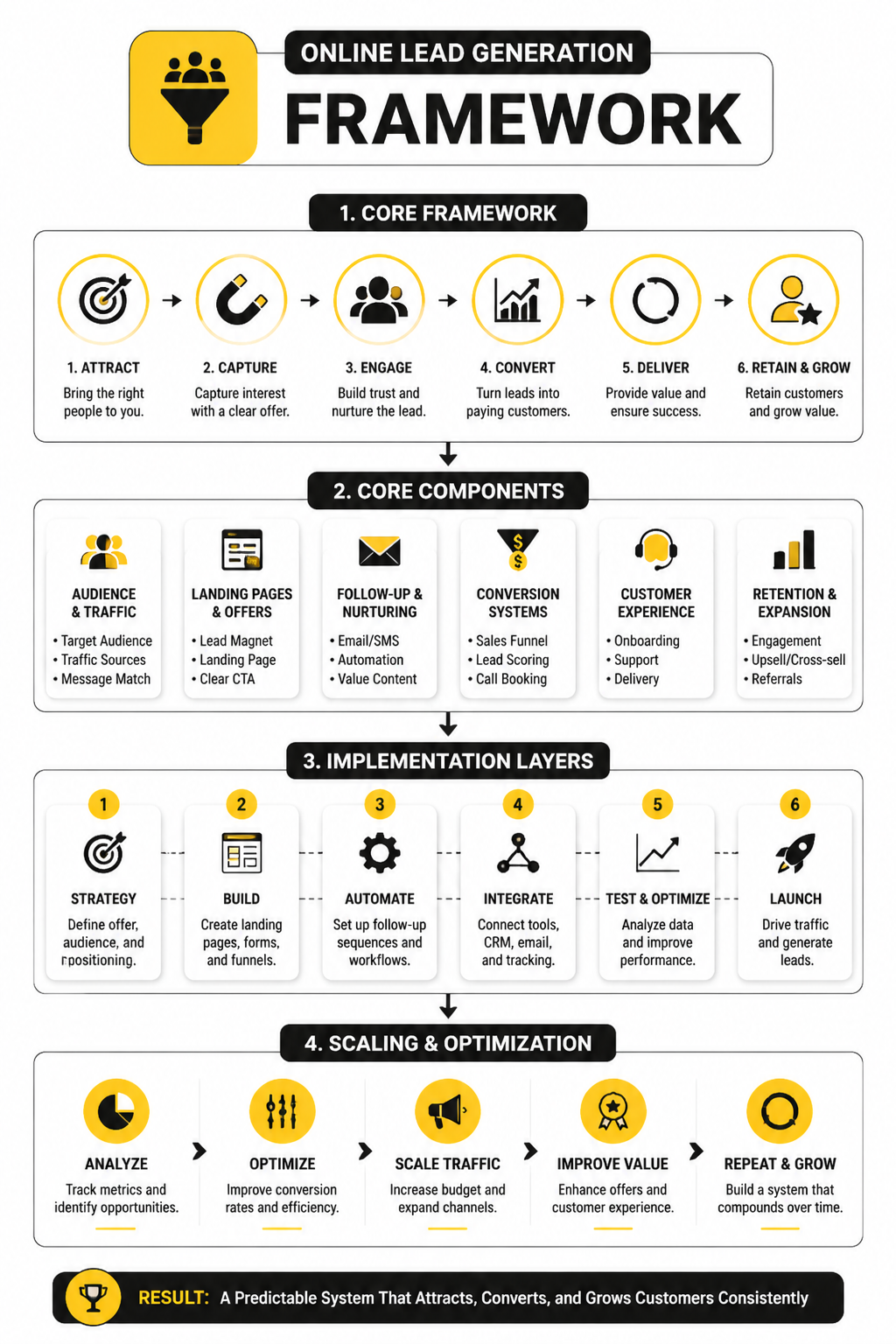
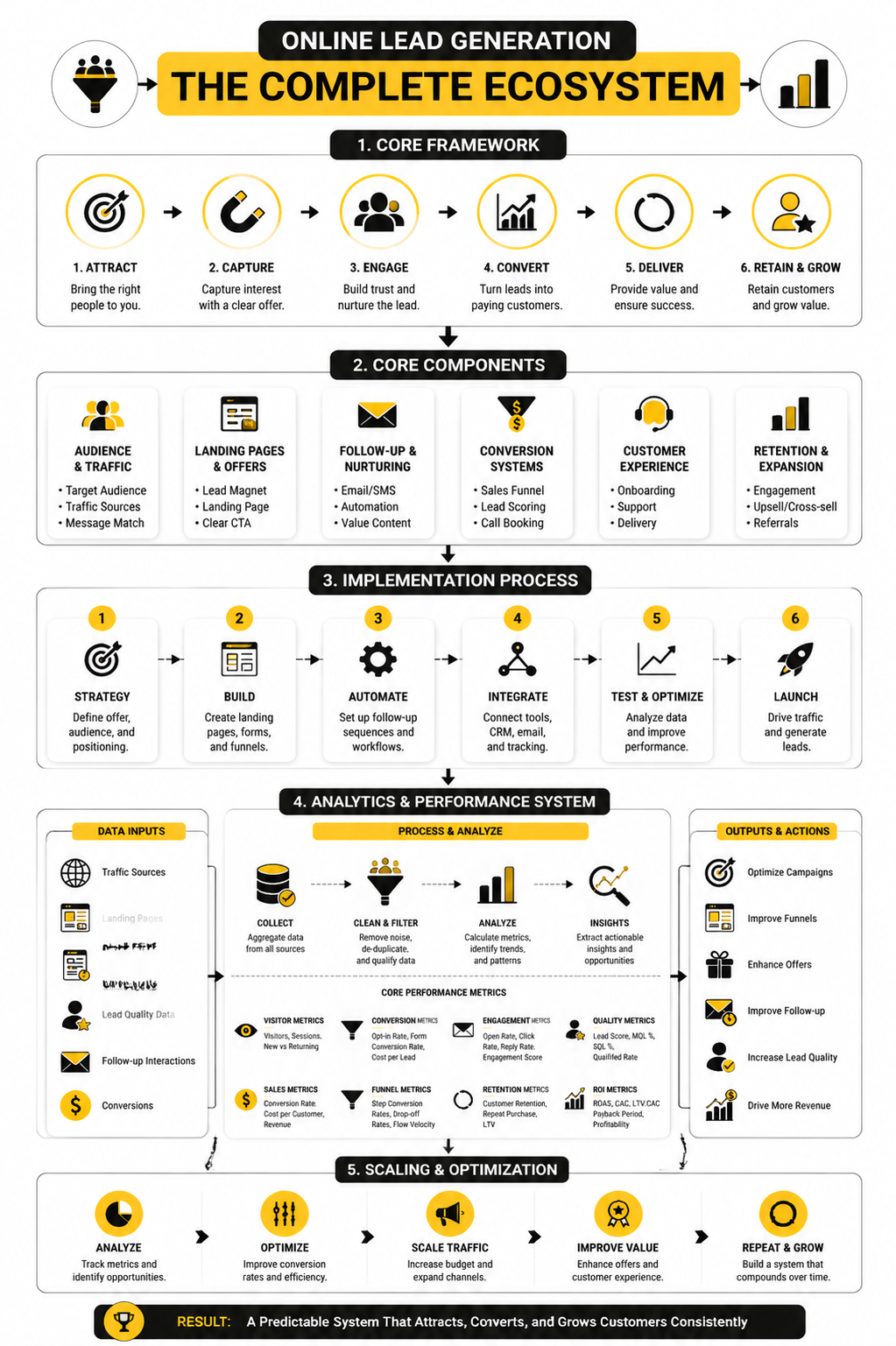
At its core, online lead generation is not about tactics. It’s about a system that moves someone from attention to action in a structured, repeatable way.
The most effective frameworks follow a simple but powerful progression:
- Attract attention
- Capture interest
- Convert into a lead
- Nurture the relationship
- Drive a conversion
This might sound basic, but the execution is where most businesses fail. Each stage requires different messaging, different tools, and different psychology.
For example, attracting attention today often involves short-form content, search visibility, or paid ads. But capturing interest requires something deeper—usually a compelling offer or value exchange. That’s where lead magnets, landing pages, and funnels come in.
Platforms like ClickFunnels or Systeme.io are built specifically to handle this transition from traffic to leads, making it easier to design pages that convert without needing complex development.
Once a lead is captured, nurturing becomes critical. This is where many systems break down. Without follow-up, even high-quality leads go cold. Email sequences, SMS, and conversational tools—like ManyChat—help bridge that gap by maintaining engagement and guiding prospects toward decisions.
The final stage is conversion, but even that isn’t the end. The best systems loop back into retention and referrals, turning customers into new sources of leads.
Core Components of a High-Converting Lead System
A high-performing online lead generation system isn’t built on a single tactic. It’s made up of interconnected components that work together seamlessly.
Traffic Sources That Match Intent
Not all traffic is equal. High-converting systems focus on intent-driven sources—search, targeted ads, and niche content distribution—rather than chasing vanity metrics.
Organic search remains one of the most valuable channels because it captures users actively looking for solutions. Paid ads, when structured correctly, allow for rapid testing and scaling. Social platforms, especially when paired with tools like Buffer, help distribute content consistently and maintain visibility.
The key is alignment. Your traffic source must match the stage of awareness your audience is in.
Lead Capture Mechanisms That Actually Convert
Once you have attention, you need a way to convert it into leads. This is where most businesses lose momentum.
Effective lead capture relies on a clear value exchange. Whether it’s a free resource, a trial, or a consultation, the offer must feel worth the user’s time and data. Landing pages should be focused, distraction-free, and optimized for a single action.
Tools like Replo make it easier to design high-converting pages, especially for eCommerce brands that need both speed and flexibility.
Automated Nurturing Systems
Capturing a lead is just the beginning. Without nurturing, most leads never convert.
Email marketing remains one of the highest ROI channels, with studies like Litmus email ROI reports consistently showing strong returns compared to other channels. But modern systems go beyond email.
Automation now includes SMS, chatbots, and AI-driven responses. Platforms like Brevo combine email, SMS, and CRM capabilities, making it easier to manage multi-channel communication from a single dashboard.
Conversion Infrastructure
The final piece is the system that turns leads into customers. This includes sales pages, booking systems, demos, and follow-ups.
For service-based businesses, scheduling tools like Cal.com remove friction by allowing prospects to book calls instantly. For product-based businesses, optimized checkout flows and upsell sequences play a major role.
Every step should reduce friction, build trust, and move the user closer to a decision.
This foundation sets the stage for everything that follows. In the next part, we’ll break down how professionals actually implement these systems in real-world scenarios—and why most setups fail before they ever get traction.
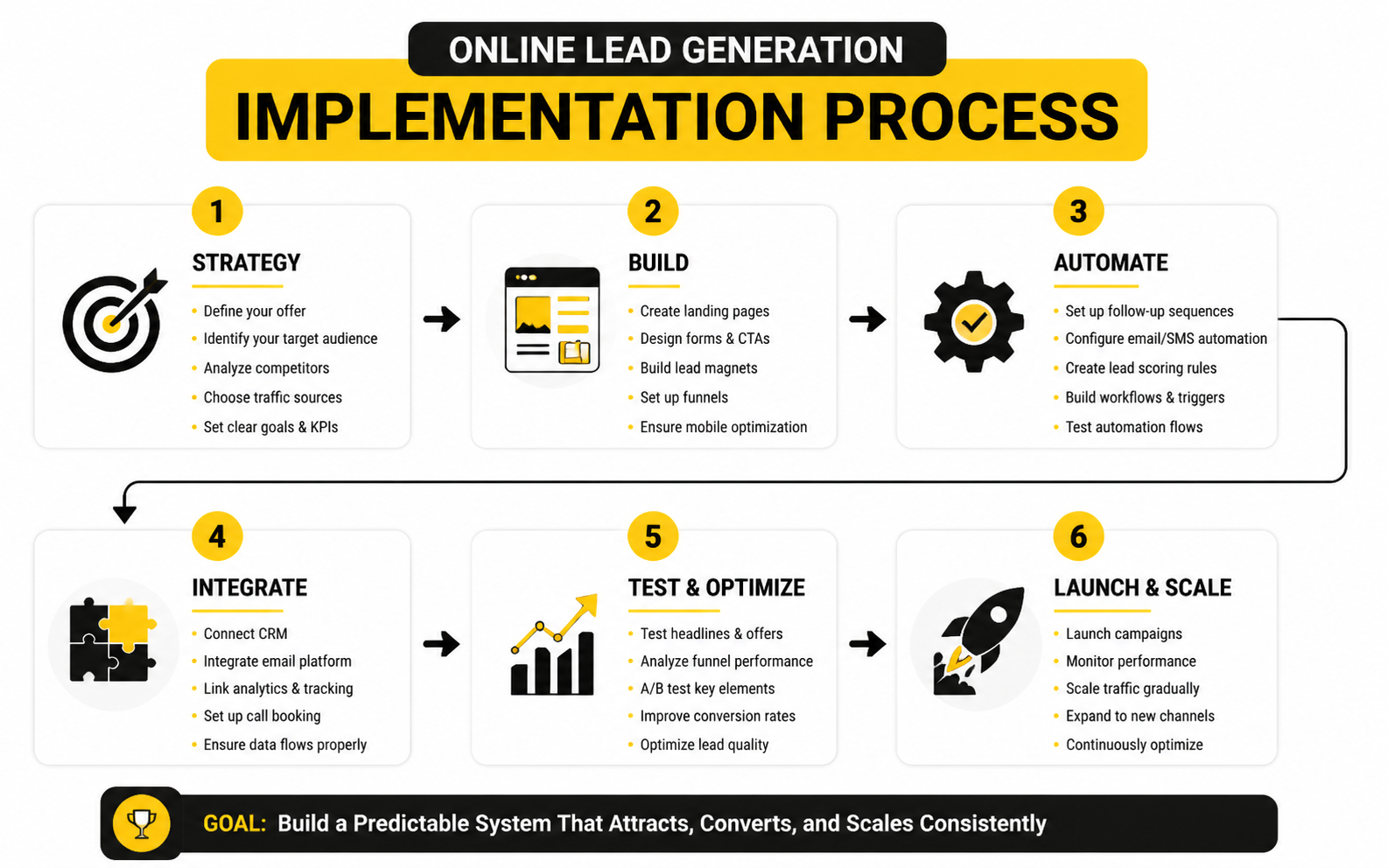
Professional Implementation Strategies
Understanding the framework is one thing. Actually building a system that produces consistent online lead generation results is where most businesses hit friction.
The difference between theory and execution usually comes down to three factors: clarity, integration, and speed. If your system lacks even one of these, performance drops fast.
Start With a Single, Clear Offer
Most lead generation systems fail because they try to do too much at once. Multiple offers, unclear messaging, and scattered funnels create confusion—and confused visitors don’t convert.
A high-performing system starts with one core offer tied to one audience and one outcome. This creates alignment across your entire funnel, from ads to landing pages to follow-ups.
In practice, this means:
- One primary lead magnet or entry point
- One clear problem being solved
- One defined next step for the user
When companies simplify like this, conversion rates tend to improve significantly. Research from MarketingSherpa landing page benchmarks shows that clarity and reduced friction consistently outperform complex multi-offer pages.
Tools like Systeme.io are effective here because they allow you to build streamlined funnels quickly without adding unnecessary complexity.
Build a Funnel Before You Scale Traffic
A common mistake is driving traffic before the funnel is ready. This leads to wasted ad spend and misleading data because you’re optimizing something that isn’t working yet.
Instead, the order should always be:
- Build the funnel
- Test conversion paths
- Validate the offer
- Then scale traffic
This approach mirrors how high-growth startups test acquisition channels. You validate before you invest.
Funnel builders like ClickFunnels make it easier to iterate quickly, especially when you’re testing multiple variations of messaging or layouts.
Connect Your Stack Early
One of the most overlooked aspects of online lead generation is system integration. When your tools don’t talk to each other, you lose data, create delays, and break the user experience.
A modern setup typically includes:
- Funnel builder or landing page system
- CRM for lead management
- Email and SMS automation
- Scheduling or conversion tools
Instead of stitching together five separate platforms, many businesses are moving toward unified systems like GoHighLevel, which combine these functions into one environment. This reduces technical overhead and speeds up implementation.
The key benefit isn’t just convenience—it’s visibility. When everything is connected, you can track the entire journey from click to conversion without gaps.
Automate Follow-Up Immediately
Speed matters more than most people realize. Data from Harvard Business Review lead response research shows that responding to leads quickly dramatically increases the likelihood of conversion.
In practical terms, that means your system should:
- Send a confirmation email instantly
- Trigger a follow-up sequence within minutes
- Offer the next step without delay
Automation tools make this easy, but only if they’re set up properly. Platforms like ManyChat allow you to respond instantly through chat and messaging channels, which often outperform email in early-stage engagement.
The goal is simple: eliminate dead time between interest and interaction.
Design for Conversion, Not Aesthetics
There’s a tendency to overdesign pages—adding animations, extra sections, and unnecessary visuals. But high-converting pages are usually simple, focused, and direct.
Strong conversion design includes:
- Clear headline tied to the offer
- Supporting proof or credibility signals
- Minimal distractions
- Obvious next step
This aligns with findings from Nielsen Norman Group usability studies showing that users scan content quickly and make decisions in seconds.
Tools like Replo help strike the balance between design flexibility and performance, especially when optimizing for conversions rather than just visual appeal.
Use Data Early, Not Just at Scale
Many teams wait until they have large volumes of traffic before analyzing performance. That’s a mistake.
Even small datasets can reveal:
- Drop-off points in your funnel
- Weak messaging areas
- Friction in the user journey
By reviewing this early, you avoid scaling broken systems.
Simple analytics combined with CRM tracking can already show patterns. As you grow, more advanced tools can layer on deeper insights—but the habit of data-driven iteration should start immediately.
At this point, you have a working system: traffic flows in, leads are captured, and follow-ups are automated. But building the system is only half the game.
In the next part, we’ll break down how to optimize and scale online lead generation so it becomes predictable, efficient, and significantly more profitable over time.
Optimization and Scaling Techniques
Once your system is live and generating leads, the real leverage comes from optimization and scaling. This is where online lead generation shifts from being functional to becoming a predictable growth engine.
Most businesses plateau at this stage because they either scale too early or optimize too late. The key is to treat your system like a living asset—something that evolves based on real performance data, not assumptions.
Start With Conversion Rate Optimization First
Before increasing traffic, you need to maximize the value of the traffic you already have. Even small improvements in conversion rates can dramatically impact revenue without increasing ad spend.
For example, improving a landing page conversion rate from 2% to 3% represents a 50% increase in leads with the same traffic. That kind of leverage compounds quickly.
Optimization typically focuses on:
- Headlines and messaging clarity
- Call-to-action placement and wording
- Form length and friction
- Social proof and trust signals
Behavioral research from CXL conversion optimization studies consistently shows that clarity and relevance outperform clever design or copy.
This is why high-performing teams test aggressively. They don’t assume—they validate.
Identify and Fix Drop-Off Points
Every funnel has weak points. The goal is to find them early and fix them before scaling.
Common drop-off areas include:
- Landing page exits before form submission
- Leads not opening emails
- Users not booking calls after opting in
- Abandoned checkout or sign-up flows
This is where integrated systems become critical. Platforms like GoHighLevel allow you to track behavior across the entire journey, making it easier to identify where users disengage.
Once you know where the friction is, improvements become obvious. Sometimes it’s a messaging issue. Sometimes it’s a timing problem. Sometimes it’s simply too many steps.
Scale Traffic Only After Validation
Scaling too early is one of the fastest ways to burn budget. If your funnel isn’t converting efficiently, more traffic just amplifies the problem.
The correct sequence is:
- Validate your funnel conversion rates
- Confirm consistent lead quality
- Ensure follow-up systems are working
- Then increase traffic gradually
Paid acquisition channels are especially sensitive to this. Platforms like Google Ads and Meta optimize based on performance signals, so sending traffic to a weak funnel can actually hurt long-term results.
Once your system is stable, scaling becomes much more predictable.
Expand Channels Without Breaking the System
After your core funnel is working, the next step is expansion. But this should be done carefully.
Instead of rebuilding everything, you replicate your existing system across new channels:
- Add new traffic sources (SEO, paid social, partnerships)
- Repurpose content into multiple formats
- Introduce additional entry points into the same funnel
Content distribution tools like Flick Social or Buffer help maintain consistency across platforms without increasing workload significantly.
The important part is keeping the backend system consistent. Traffic sources can vary, but your conversion infrastructure should remain stable.
Use Automation to Handle Volume
As lead volume increases, manual processes start to break down. Delayed responses, missed follow-ups, and inconsistent communication quickly reduce conversion rates.
Automation solves this by standardizing key interactions:
- Immediate lead responses
- Multi-step email and SMS sequences
- Qualification workflows
- Appointment reminders and confirmations
Tools like Brevo and ManyChat allow you to scale communication without losing personalization.
The goal isn’t to remove the human element—it’s to ensure that no lead falls through the cracks.
Build Feedback Loops Into Your System
The best online lead generation systems improve automatically because they’re designed to learn.
Feedback loops can include:
- Lead quality scoring inside your CRM
- Sales team input on conversion quality
- Customer feedback after purchase
- Performance data across campaigns
This creates a cycle where your system continuously refines itself. Poor-performing segments get adjusted. High-performing segments get scaled.
Over time, this leads to more efficient acquisition and higher lifetime value per customer.
Turn Data Into Strategic Decisions
At scale, data becomes your biggest advantage—but only if you use it correctly.
It’s not about tracking everything. It’s about tracking what matters:
- Cost per lead
- Conversion rate at each stage
- Lead-to-customer rate
- Customer acquisition cost
These metrics tell you whether your system is healthy or not.
Companies that consistently win in online lead generation don’t rely on guesswork. They make decisions based on clear signals, adjust quickly, and double down on what works.
At this stage, your system is no longer just functional—it’s scalable. Leads are coming in, conversion rates are improving, and growth is becoming predictable.
In the next part, we’ll go deeper into advanced strategies and emerging trends that are shaping the future of online lead generation—and how to stay ahead of the curve.
Data, Benchmarks, and What Actually Matters
At this stage, your online lead generation system is running and scaling. But without the right measurement approach, you’re essentially flying blind. Data is what tells you whether your system is efficient, where it’s leaking, and how to improve it without guessing.
The problem is that most businesses track too many vanity metrics and not enough decision-driving ones. Traffic, impressions, and clicks look good on dashboards, but they don’t tell you if your system is profitable.
What matters is how your numbers connect from first touch to final conversion.
The Core Metrics That Define Performance
There are a few metrics that consistently determine whether a lead generation system is working or not. Everything else is secondary.
The most important ones include:
- Cost per lead (CPL) – how much you pay to acquire a lead
- Conversion rate (CVR) – how many visitors turn into leads
- Lead-to-customer rate – how many leads actually convert into buyers
- Customer acquisition cost (CAC) – total cost to acquire a paying customer
These metrics are interconnected. Improving one usually impacts the others.
For example, increasing your conversion rate reduces your cost per lead automatically. Improving lead quality increases your lead-to-customer rate, which lowers your overall acquisition cost.
Benchmarks vary by industry, but data from WordStream advertising benchmarks shows that conversion rates across industries often sit between 2% and 5% for landing pages. That number alone isn’t the goal—it’s the baseline you improve from.
The real question is not “is my conversion rate good?” but “is it improving consistently?”
Understanding Funnel Conversion in Context
Looking at isolated metrics doesn’t give you the full picture. You need to understand how users move through your funnel.
A typical breakdown looks like this:
- Visitor lands on page
- Visitor becomes a lead
- Lead engages with follow-up
- Lead converts into a customer
Each step has its own conversion rate, and small improvements at each stage compound significantly.
For example:
- 1,000 visitors
- 3% opt-in rate → 30 leads
- 20% lead-to-customer rate → 6 customers
If you improve your opt-in rate to 5%, you now generate 50 leads. With the same downstream performance, that becomes 10 customers instead of 6.
That’s the power of funnel-based thinking.
Measuring Lead Quality, Not Just Volume
A common mistake is optimizing purely for volume. More leads feel like progress, but if they don’t convert, they’re just noise.
Lead quality is harder to measure, but far more important.
You can evaluate it through:
- Conversion rates at later stages
- Sales team feedback
- Engagement levels (opens, replies, clicks)
- Time to conversion
This is where CRM systems become essential. Platforms like GoHighLevel allow you to track leads through the entire pipeline, not just at the point of capture.
The insight here is simple: a system that generates fewer but higher-quality leads is often more profitable than one that maximizes volume.
Building a Simple Analytics System That Works
You don’t need a complex data warehouse to get clarity. You need a clean system that tracks the right events.
A practical setup includes:
- Funnel tracking (page views, opt-ins, conversions)
- CRM tracking (lead status, deal stages)
- Campaign tracking (traffic source performance)
- Communication tracking (email, SMS, chat engagement)
When these are connected, you get a full view of your online lead generation performance.
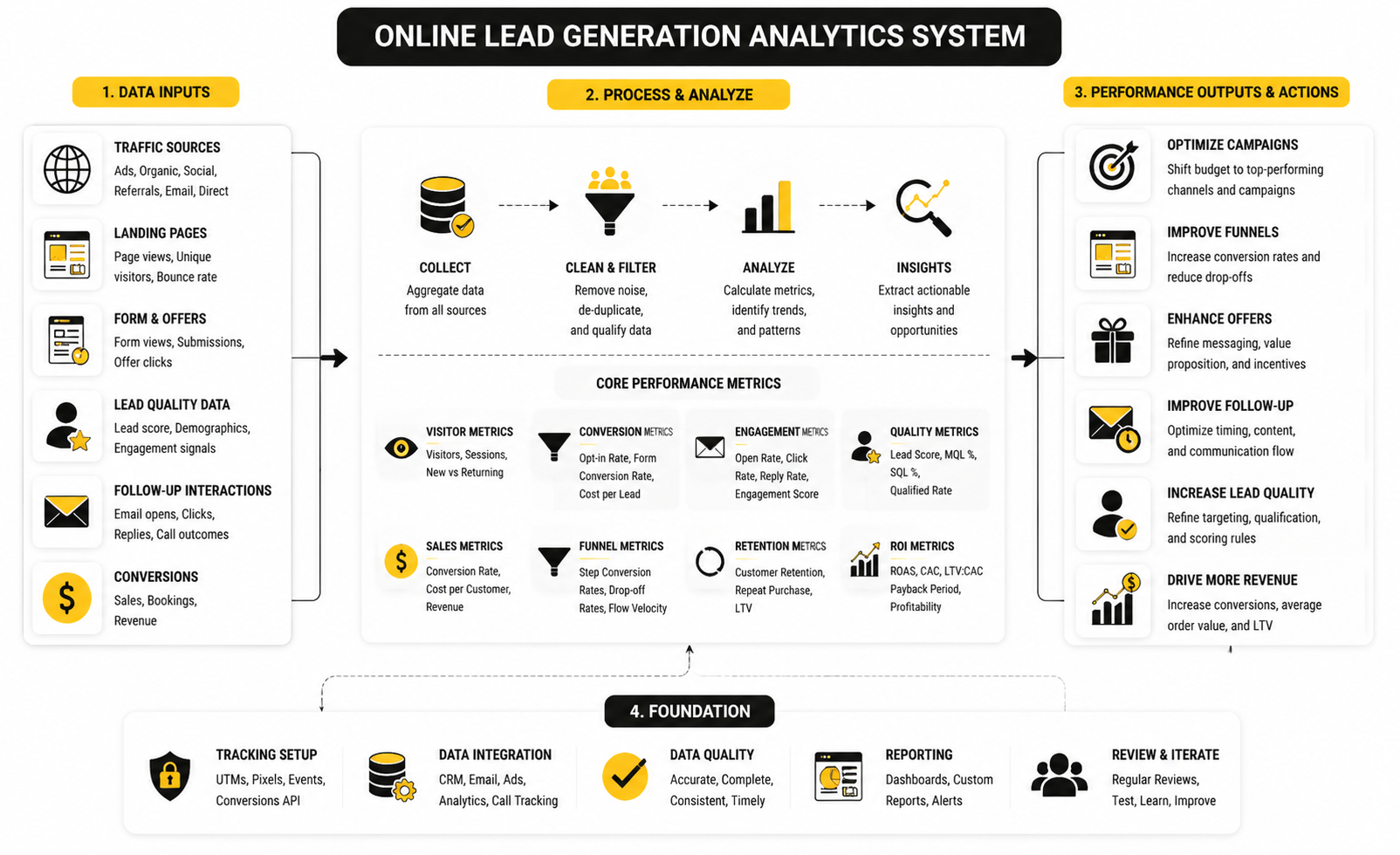
The goal is to see how a single lead moves from first click to final purchase. Once you have that visibility, optimization becomes straightforward.
Tools like Brevo help track engagement across email and messaging, while integrated platforms reduce the need for manual data stitching.
What the Data Should Tell You
Good data doesn’t just report—it guides decisions.
Here’s how to interpret common signals:
- High traffic, low conversions → messaging or offer problem
- Strong opt-ins, weak sales → lead quality or nurturing issue
- Low engagement in follow-up → timing or channel mismatch
- High CAC → inefficient funnel or poor targeting
Each signal points to a specific area of your system that needs adjustment.
This is why data-driven teams move faster. They don’t debate opinions—they respond to patterns.
Turning Metrics Into Action
The final step is turning insights into action. Data without execution is useless.
A simple process looks like this:
- Identify the weakest metric in your funnel
- Form a hypothesis for why it’s underperforming
- Test a focused change
- Measure the impact
- Repeat
This cycle is what drives continuous improvement.
Research from McKinsey on data-driven organizations highlights that companies using data systematically outperform competitors in both efficiency and growth.
That advantage compounds over time. Small improvements stack, inefficiencies get removed, and your system becomes more predictable.
At this point, you’re no longer guessing. Your online lead generation system is measurable, optimizable, and scalable.
In the next part, we’ll move into advanced strategies and emerging trends that are shaping where lead generation is heading—and how to stay ahead while most businesses are still catching up.
Advanced Strategy, Tradeoffs, and Scaling Realities
At a certain point, online lead generation stops being about tactics and starts becoming a strategic discipline. This is where most businesses either build a durable advantage—or slowly lose efficiency without realizing it.
The difference is how you handle tradeoffs, complexity, and long-term system design.
The Tradeoff Between Volume and Quality
One of the biggest decisions you’ll face is whether to prioritize lead volume or lead quality. You can almost always increase one at the expense of the other.
Broad targeting, simple offers, and low-friction opt-ins generate more leads. But those leads often convert at lower rates and require more nurturing.
On the other hand, more specific targeting, higher-commitment offers, and tighter qualification filters reduce volume but increase conversion efficiency.
The right balance depends on your business model. High-ticket services typically benefit from quality-first systems. Lower-ticket or high-volume businesses can afford to optimize for scale.
The key is being intentional. If you don’t define this tradeoff, your system will drift—and performance will become inconsistent.
When Scaling Breaks Your System
Scaling isn’t just about increasing traffic. It introduces new problems that don’t exist at smaller volumes.
As your lead flow grows, you’ll start to see:
- Slower response times
- Lower personalization quality
- Increased operational complexity
- Higher customer acquisition costs
This is why systems that work at 100 leads per month often break at 1,000.
The solution is not just more tools—it’s better structure. Centralized platforms like GoHighLevel help maintain consistency as volume increases by keeping communication, tracking, and automation in one place.
But even with the right tools, you need processes that scale. Otherwise, growth creates inefficiency instead of momentum.
Multi-Channel Expansion Without Fragmentation
As you grow, relying on a single channel becomes risky. Algorithm changes, rising costs, or platform shifts can disrupt your entire system.
The natural move is to expand into multiple channels—but this introduces fragmentation.
Different channels bring different audiences, behaviors, and expectations. If your messaging and funnel structure aren’t consistent, performance becomes unpredictable.
The smarter approach is to:
- Keep one core funnel structure
- Adapt messaging slightly per channel
- Maintain a unified backend system
This ensures that no matter where leads come from, they enter the same optimized process.
Content distribution tools like Buffer help manage this across platforms, but the real leverage comes from consistency in your conversion path.
The Hidden Risk of Over-Automation
Automation is essential for scaling online lead generation, but it comes with a risk that’s easy to overlook.
Over-automation can make your system feel impersonal, predictable, and easy to ignore. Leads start to feel like they’re interacting with a machine instead of a brand.
This often shows up as:
- Lower response rates
- Reduced engagement over time
- Higher unsubscribe rates
The solution isn’t less automation—it’s smarter automation.
You want systems that:
- Personalize messages based on behavior
- Adapt timing based on engagement
- Introduce human interaction at key moments
Tools like ManyChat allow for conversational flows that feel more dynamic than traditional email sequences.
The goal is to scale without losing the human element that drives trust.
Marginal Gains Compound Faster Than Big Changes
At advanced levels, growth doesn’t come from dramatic overhauls. It comes from small, consistent improvements across the system.
Examples include:
- Slightly improving ad targeting
- Refining headline clarity
- Adjusting follow-up timing
- Improving onboarding experience
Each change might seem minor on its own. But together, they compound into significant performance gains.
This is how mature systems outperform competitors. Not by doing something radically different—but by executing better across every step.
Building Long-Term Assets Instead of Short-Term Wins
The final shift is moving from campaign thinking to asset thinking.
Campaigns generate short-term results. Assets generate long-term leverage.
In online lead generation, assets include:
- Email lists
- CRM databases
- Content libraries
- Brand authority
- Conversion-optimized funnels
These are things you own and control. They continue producing value even if traffic sources change.
This is especially important in an environment where privacy regulations and platform changes are reducing the reliability of paid acquisition.
Businesses that focus only on short-term campaigns often find themselves rebuilding constantly. Those that build assets create stability and compounding growth.
At this point, you’re operating at a different level. Your system isn’t just generating leads—it’s evolving, adapting, and strengthening over time.
In the final part, we’ll bring everything together with practical answers to the most common questions about online lead generation, so you can refine your approach and avoid costly mistakes.
Bringing Your Entire Lead Generation System Together
At this point, your online lead generation system is no longer a collection of tactics. It’s a connected ecosystem where traffic, funnels, automation, and data all work together.
The real advantage comes from how these pieces interact. Traffic feeds your funnel, your funnel feeds your CRM, your CRM drives automation, and your data continuously improves everything. When this loop is tight, growth becomes predictable instead of reactive.
The strongest systems today are built around integration, not fragmentation. Instead of stacking disconnected tools, businesses are moving toward unified environments that manage the entire lifecycle—from first click to closed deal.
Platforms like GoHighLevel are designed specifically for this, combining funnels, CRM, automation, and communication into a single system. This reduces complexity and gives you full visibility into performance.
The end goal is simple: a system where every lead is tracked, every interaction is intentional, and every improvement compounds.
FAQ - Built for Complete Guide
What is online lead generation in simple terms?
Online lead generation is the process of attracting people online and converting them into potential customers by capturing their contact information. This usually happens through landing pages, forms, or messaging systems. The goal is to move someone from interest to a structured relationship.
How long does it take to see results?
It depends on your starting point and traffic source. Paid traffic can generate leads within days, while organic strategies like SEO can take months to build momentum. What matters is not speed alone, but whether your system is converting efficiently once traffic arrives.
What is a good conversion rate?
Conversion rates vary by industry, but many landing pages fall between 2% and 5% as shown in WordStream benchmark data. High-performing funnels often exceed that, especially when the offer and targeting are aligned. The focus should always be on improving your baseline over time.
Should I focus on organic or paid traffic?
Both have value, but they serve different roles. Paid traffic offers speed and control, while organic traffic builds long-term stability. The most resilient online lead generation systems use both, balancing short-term results with long-term assets.
What is the biggest mistake in lead generation?
The most common mistake is driving traffic to a system that isn’t ready. Without a clear offer, optimized funnel, and proper follow-up, even high-quality traffic won’t convert. Fix the system first, then scale.
How important is follow-up?
It’s critical. Research like Harvard Business Review lead response studies shows that faster follow-up significantly increases conversion rates. Delayed responses often mean lost opportunities.
What tools do I actually need?
At minimum, you need:
- A funnel or landing page builder
- A CRM system
- Email or messaging automation
- A way to track performance
All-in-one platforms like Systeme.io simplify this by combining multiple functions into one environment.
How do I improve lead quality?
Lead quality improves when your targeting, messaging, and offer are aligned. Narrowing your audience, increasing commitment in your offer, and refining your funnel all help filter out low-quality leads.
Is automation enough to convert leads?
No. Automation helps with speed and consistency, but it doesn’t replace trust. The best systems combine automation with strategic human interaction at key moments in the process.
How do I scale without increasing costs too much?
Scaling efficiently comes from improving conversion rates and lead quality before increasing traffic. When your system is optimized, every additional visitor becomes more valuable, which keeps acquisition costs under control.
What role does content play in lead generation?
Content attracts and educates your audience before they enter your funnel. It builds trust and positions your offer as the logical next step. Without content, you rely entirely on paid traffic, which increases risk and cost.
When should I rebuild my funnel?
You rarely need a full rebuild. Most improvements come from incremental optimization. Only consider a rebuild when your offer, audience, or positioning changes significantly.
Work With Professionals
Explore 10K+ Remote Marketing Contracts on MarkeWork.com
Most marketers spend too much time chasing clients, competing on crowded platforms, and losing a percentage of every project to middlemen.
MarkeWork gives you a better way. Browse thousands of remote marketing contracts and connect directly with companies desperate to hire skilled marketers like you, without platform commissions and without unnecessary gatekeepers.
If you're serious about finding better opportunities and keeping 100% of what you earn, explore available contracts and create a profile for free at MarkeWork.com.