

An online marketing strategy is not a collection of random campaigns. It is the operating plan that connects your market, message, channels, offers, content, automation, and measurement into one growth system.
The reason this matters is simple: attention is fragmented, acquisition costs are unforgiving, and customers compare you against the best digital experiences they see anywhere. Digital ad revenue reached $294.6 billion in 2025, which shows how competitive online growth has become.
A strong online marketing strategy gives you a way to make better decisions before you spend money. It helps you choose who to target, what to say, where to show up, how to convert demand, and how to improve performance over time.
Article Outline
This article is split into six parts so each stage of the strategy gets enough room. The structure moves from big-picture positioning into execution, systems, measurement, and improvement. The goal is to build a strategy you can actually use, not a theory document that sits untouched.
- Why Online Marketing Strategy Matters
- The Online Marketing Strategy Framework
- Core Components of a Strong Strategy
- Channel Strategy and Campaign Planning
- Professional Implementation and Automation
- Measurement, Optimization, and FAQs
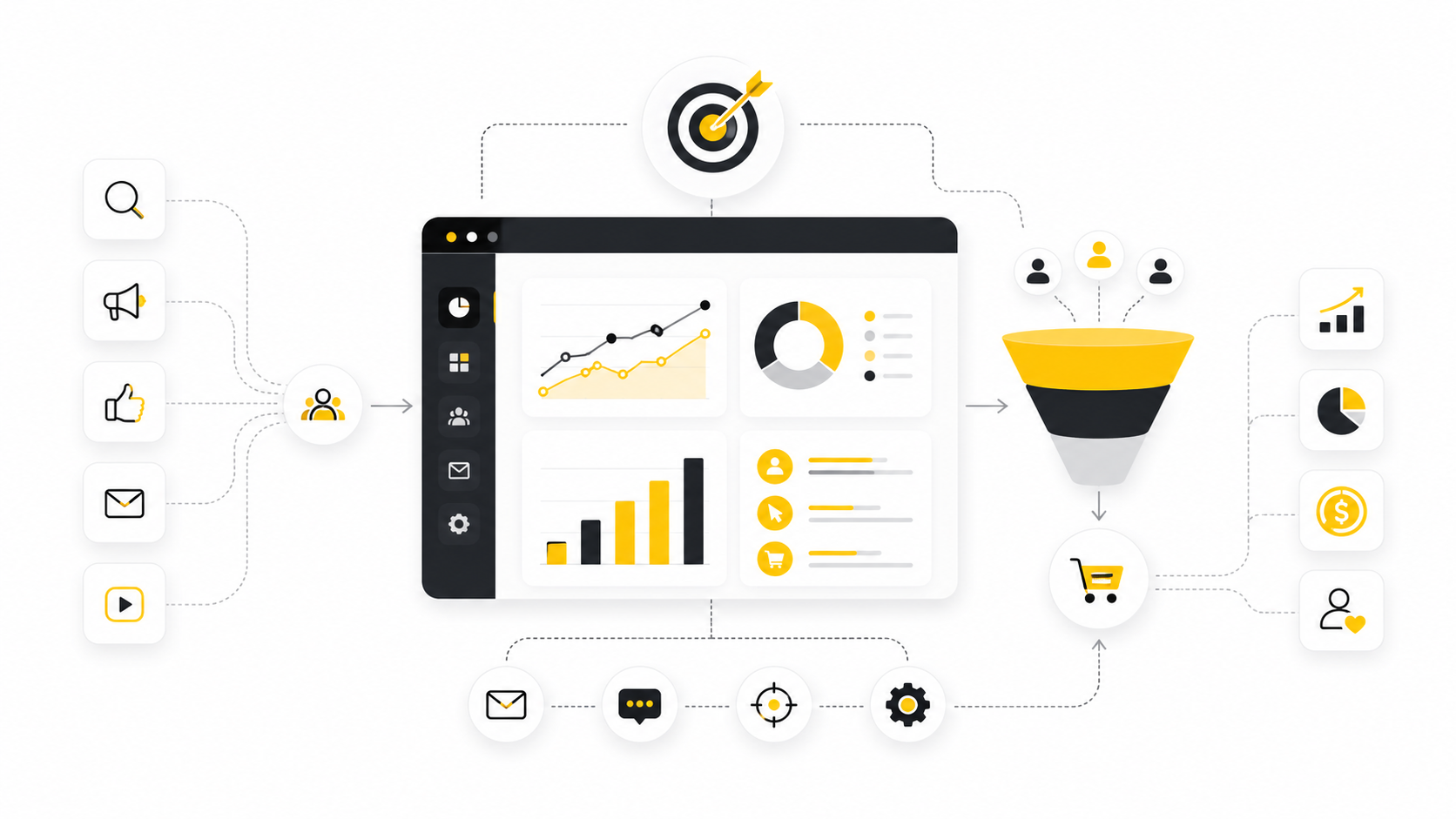
Why Online Marketing Strategy Matters
Online marketing strategy matters because most growth problems are not really channel problems. A business may blame Facebook ads, SEO, email, or funnels, but the deeper issue is usually unclear positioning, weak offers, poor follow-up, or disconnected measurement. When the strategy is messy, every channel becomes harder than it needs to be.
The best strategy creates focus. It tells you which audience deserves priority, what outcome they want, what proof they need, and which path should move them from first touch to purchase. Without that focus, teams create content, ads, pages, emails, and automations that look busy but do not compound.
This is especially important now because AI, personalization, and automation are changing how marketing teams operate. Salesforce’s research with nearly 4,500 marketers worldwide shows that data, personalization, and AI are central priorities for modern marketing teams. That does not mean strategy should become more complicated; it means the strategy has to be clearer before tools start scaling the work.
The Online Marketing Strategy Framework
A practical online marketing strategy starts with the market, not the platform. Before choosing tactics, you need to understand the customer, the problem, the offer, the buying journey, and the business model behind the campaign. Once those pieces are clear, channels become delivery systems instead of guesses.
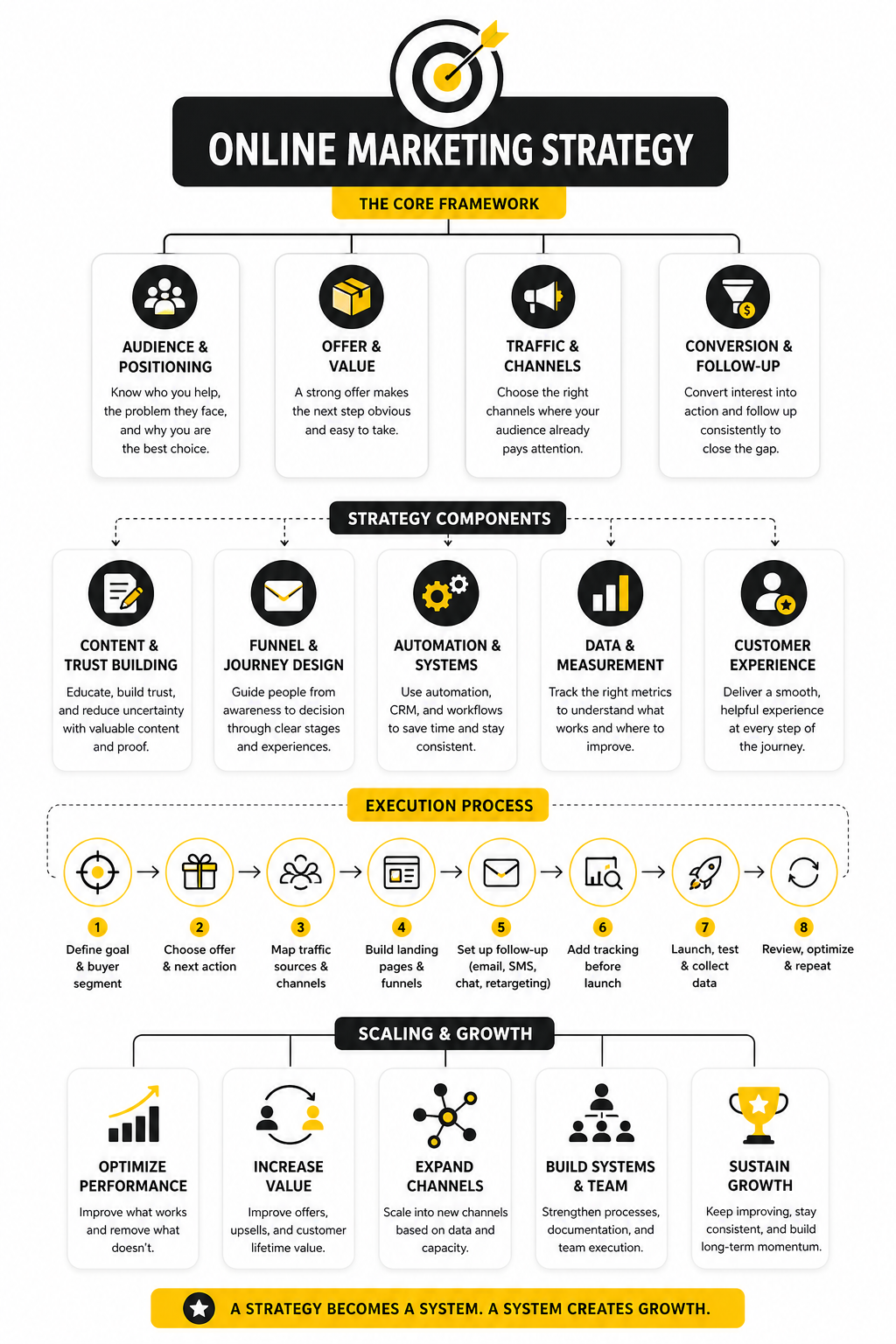
The framework in this article uses four layers: direction, demand, conversion, and optimization. Direction defines who you serve and why your offer deserves attention. Demand brings the right people into your world, conversion turns that attention into action, and optimization improves the system with data.
This structure also keeps the strategy flexible. You might use ManyChat for conversational follow-up, GoHighLevel for CRM and automation, ClickFunnels for funnel building, or Buffer for social publishing. The tool is not the strategy; the strategy decides which tools are worth using.
Core Components of a Strong Strategy
A good online marketing strategy needs four core components: a clear audience, a strong offer, a reliable traffic plan, and a conversion system that follows up properly. Miss one of these, and the whole thing gets unstable. That is why random tactics rarely work for long.
Your audience work should go deeper than demographics. You need to know what problem the buyer is trying to solve, what they have already tried, what objections they carry, and what makes them finally take action. This is where messaging becomes much easier because you are no longer writing for “everyone”; you are speaking to a specific person with a specific problem.
The offer is the next piece. A weak offer makes every channel expensive because the market needs too much convincing. A strong offer makes the next step obvious, whether that step is booking a call, joining a list, starting a trial, downloading a guide, or buying directly.
Traffic only comes after those pieces are clear. Global internet users now spend an average of more than six hours per day online, but that does not mean your brand should be everywhere. The smarter move is to choose the few channels where your audience already pays attention and where your offer can be explained naturally.
Audience and Positioning
Positioning is the part of online marketing strategy that decides how people should understand you. It answers three practical questions: who you help, what result you create, and why someone should choose you instead of another option. If this is vague, your content and ads will feel generic even when they are well designed.
The best positioning usually comes from customer reality, not internal brainstorming. Look at sales calls, support tickets, reviews, search queries, competitor comments, and social conversations. Patterns will show you what people actually care about, which is often different from what businesses assume they care about.
Once you have that clarity, your messaging should become sharper. You can explain the pain, the desired outcome, the cost of staying stuck, and the reason your approach works. This is not about sounding clever; it is about helping the right buyer recognize that they are in the right place.
Offer and Funnel Design
Your offer is the bridge between interest and action. It should make the next step feel useful, low-friction, and relevant to the buyer’s stage of awareness. Someone who has never heard of you may need education first, while someone comparing vendors may need proof, pricing clarity, or a direct consultation.
A funnel gives that offer structure. At the top, you attract people with useful content, search visibility, social posts, paid campaigns, partnerships, or creator collaborations. In the middle, you build trust with deeper resources, email sequences, retargeting, webinars, product pages, or comparison content.
At the bottom, the funnel needs a clear conversion path. That could be a checkout page, booked call, quote request, demo, trial, or lead form. Tools like ClickFunnels, Systeme.io, and Replo can help build these paths, but the strategy still has to define what each page is supposed to do.
Content and Trust Building
Content is where your online marketing strategy earns attention before asking for anything. Good content reduces buyer uncertainty, answers real questions, and gives people a reason to remember you. It also makes paid traffic more efficient because prospects can see proof, depth, and consistency before they convert.
The strongest content usually sits close to buyer intent. Educational guides help people understand the problem, comparison pages help them evaluate options, case studies reduce risk, and product-led content shows how the solution works. B2B marketers continue to treat content as a serious growth asset, with research from Content Marketing Institute showing that top performers are more likely to have a documented strategy and a clear measurement process in place through its 2025 B2B content marketing research.
This is also where distribution matters. Publishing alone is not a strategy. You need a repeatable system for turning one strong idea into search content, email, social posts, short videos, sales enablement, and follow-up assets without diluting the message.
Data, Measurement, and Customer Experience
Measurement keeps strategy honest. It shows which audiences respond, which messages convert, which channels deserve more budget, and where the buyer journey breaks. Without measurement, marketing becomes opinion-driven, and opinion-driven marketing gets expensive fast.
Customer experience also belongs inside the strategy, not after it. Contentsquare’s 2025 benchmark research warns that preventable digital friction continues to cut online journeys short, which means traffic alone will not fix weak experiences. If the page is slow, confusing, irrelevant, or hard to act on, more visitors simply create more wasted opportunity.
A useful measurement setup should track the full path, not only the last click. You want visibility into traffic quality, engagement, lead quality, conversion rate, sales outcomes, retention, and lifetime value. That is how your online marketing strategy becomes a learning system instead of a campaign calendar.
Channel Strategy and Campaign Planning
Once the core strategy is clear, the next step is choosing where the strategy will actually show up. This is where many businesses get distracted because every platform looks important when you are staring at it in isolation. A real online marketing strategy does not chase every channel; it chooses the channels that match the buyer, the offer, and the stage of demand.
A simple way to think about channels is to separate them by intent. Search captures people who are already looking for answers, social creates and shapes demand, email and SMS nurture attention, paid ads accelerate testing, and partnerships borrow trust from audiences that already exist. Each channel can work, but each one needs a different role in the system.
The mistake is treating every channel like it should close the sale immediately. Some channels are better at discovery, some are better at proof, and some are better at conversion. When you understand that, your campaigns stop feeling random and start behaving like a coordinated path.
Building the Execution Process
Implementation should begin with a clean campaign brief. The brief does not need to be fancy, but it must answer the essentials before anyone builds assets. Define the audience, the offer, the primary message, the channel mix, the conversion goal, the follow-up path, and the metrics that will decide whether the campaign worked.
From there, turn the campaign into a sequence of concrete steps. Strategy becomes useful when it can be translated into pages, emails, ads, content, tracking, automations, and sales actions. This is the point where the work becomes tangible, and it is also where gaps become obvious.
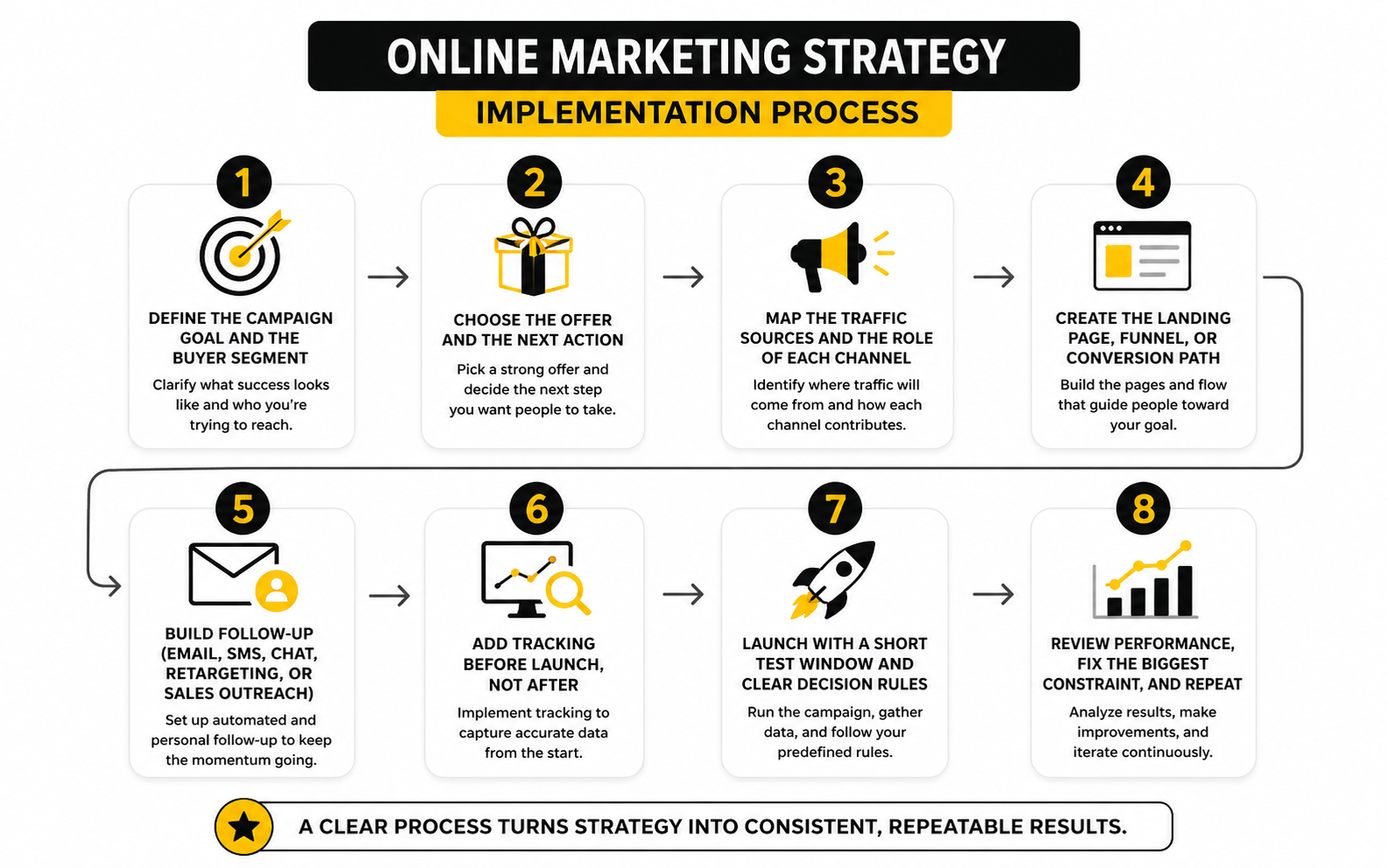
A strong execution process usually looks like this:
- Define the campaign goal and the buyer segment.
- Choose the offer and the next action you want people to take.
- Map the traffic sources and the role of each channel.
- Create the landing page, funnel, or conversion path.
- Build follow-up through email, SMS, chat, retargeting, or sales outreach.
- Add tracking before launch, not after.
- Launch with a short test window and clear decision rules.
- Review performance, fix the biggest constraint, and repeat.
This process keeps everyone honest. It stops the team from launching ads before the landing page is ready, publishing content without a conversion path, or collecting leads without a follow-up system. That discipline matters because preventable digital friction continues to damage online journeys, with Contentsquare’s 2025 benchmark research showing that almost half of online visits still experience friction.
Campaign Assets and Conversion Paths
Every campaign needs assets that match the buyer’s stage of awareness. A cold audience may need a practical guide, checklist, short video, quiz, or educational landing page. A warmer audience may need a comparison page, webinar, product demo, pricing explanation, or proof-driven offer.
The conversion path should be as direct as possible without being careless. If the buyer needs a call, make the booking flow obvious with a tool like Cal.com. If the buyer needs a form, keep it focused with something like Fillout. If the buyer needs a funnel experience, platforms such as ClickFunnels or Systeme.io can help package the journey.
The key is not adding more steps than necessary. Each page, message, or form field should earn its place. If an asset does not help the buyer understand, trust, compare, decide, or act, it is probably adding noise.
Follow-Up and Automation
Follow-up is where many campaigns quietly lose money. A person clicks, reads, submits, asks, or starts a checkout, and then the business responds too late or not at all. That is not a traffic problem; that is a system problem.
Automation helps because it makes the next step consistent. You can use GoHighLevel for CRM workflows, pipelines, and client follow-up, ManyChat for chat-based conversations, or Brevo and Moosend for email marketing. The point is not to automate everything; the point is to automate the parts where speed, consistency, and personalization improve the buyer experience.
A good follow-up system should respond to behavior. Someone who downloads a guide should not receive the same message as someone who visits pricing three times. The stronger your segmentation, the more natural your online marketing strategy feels to the buyer.
Launching With Decision Rules
A campaign should never launch with a vague promise to “see how it goes.” Before launch, decide what numbers matter and what action you will take if those numbers are weak. That may include click-through rate, cost per lead, landing page conversion rate, booked call rate, show-up rate, sales conversion rate, or revenue per visitor.
Decision rules make optimization calmer. Instead of reacting emotionally after two bad days, you know what you are watching and when the data is meaningful enough to act. This protects you from killing good campaigns too early and from funding weak campaigns for too long.
The best marketers treat launch as the start of learning, not the end of production. Even strong campaigns need adjustment once real buyers interact with them. That is why campaign planning should always include time for review, iteration, and improvement.
Statistics and Data
Data should not be used to decorate an online marketing strategy. It should tell you what is working, what is leaking, and what deserves the next decision. The wrong way to use statistics is to collect a dashboard full of numbers that nobody acts on.
The right way is to connect each metric to a business question. Are we attracting the right people? Are they engaging with the message? Are they moving to the next step? Are leads becoming revenue? Are customers staying long enough to justify the acquisition cost?
That is why benchmarks are useful, but only when they are treated as context. IAB and PwC reported that U.S. internet advertising revenue reached $294.6 billion in 2025, which confirms how competitive digital attention has become. That number should not make you spend more by default; it should make you more disciplined about where every dollar goes.
What Your Analytics System Should Track
Your analytics system should follow the buyer journey from first touch to revenue. At the top, track traffic source, audience quality, engagement, and content performance. In the middle, track lead capture, email engagement, retargeting response, form completion, and booked calls.
At the bottom, track sales conversion, average order value, customer acquisition cost, payback period, retention, and lifetime value. This is where marketing becomes serious because the numbers stop being vanity metrics and start showing commercial reality. A campaign with cheap leads can still be a bad campaign if those leads never buy.
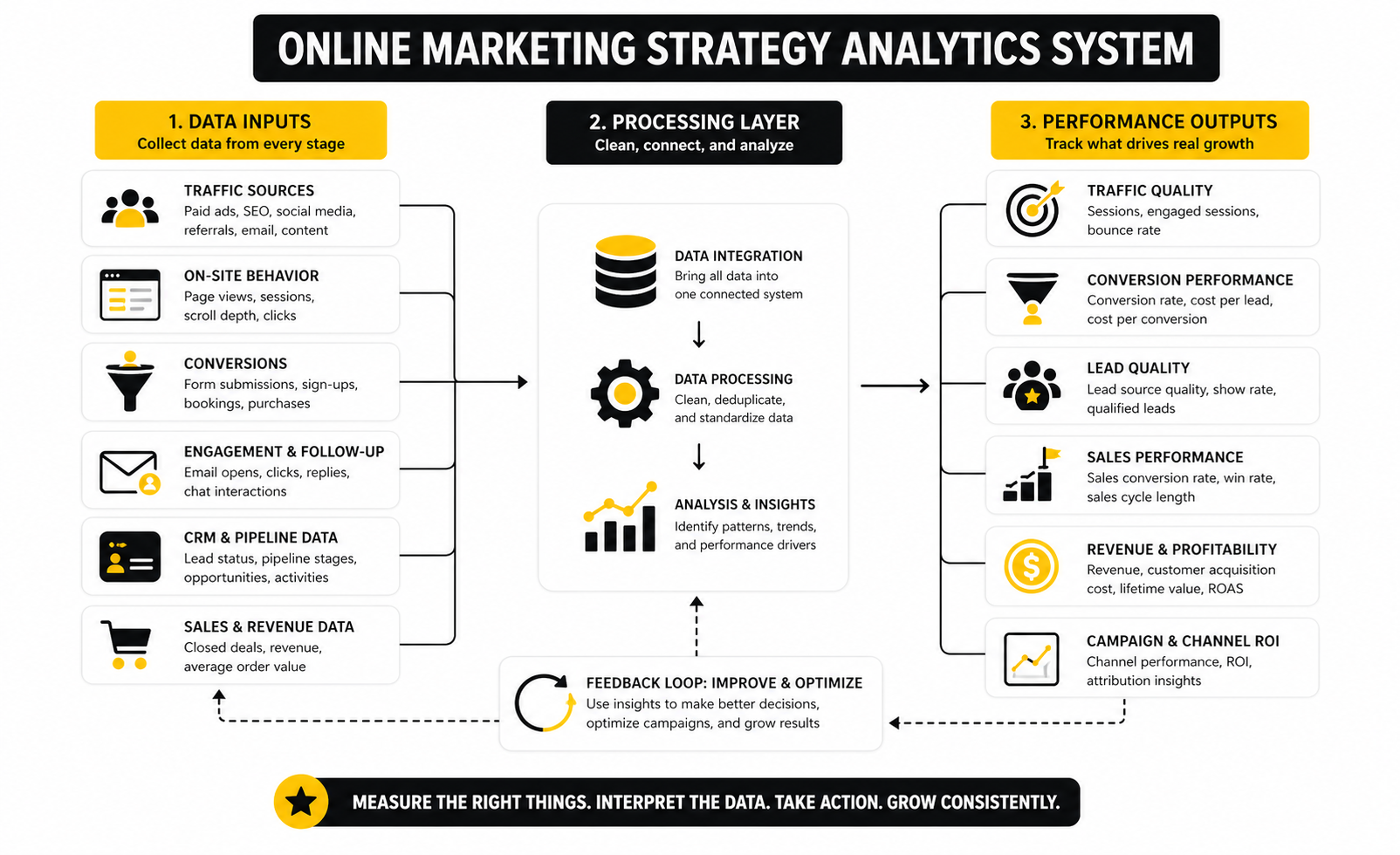
The cleanest setup is a simple scorecard with one owner for each stage. Traffic metrics should explain demand. Conversion metrics should explain friction. Revenue metrics should explain whether the strategy is financially healthy.
Benchmarks Need Context
Benchmarks are helpful when they show whether your performance is unusually weak or unusually strong. They become dangerous when they replace thinking. A 3% landing page conversion rate might be terrible for a warm email audience and perfectly normal for cold paid traffic.
This is why you should compare performance by channel, audience temperature, offer type, and buying stage. Search traffic usually behaves differently from social traffic because the intent is different. Retargeting traffic usually behaves differently from cold traffic because the person already has context.
Digital experience data makes this even more important. Contentsquare’s 2025 benchmark research found that frustrating experiences can reduce conversion rates by 6.1%, and the underlying study analyzed 90 billion sessions across 6,000 websites. The action is obvious: before scaling traffic, fix the pages, flows, and messages that make buyers hesitate.
Performance Signals That Actually Matter
The best performance signals are the ones that reveal intent and movement. A click matters less than what happens after the click. A lead matters less than whether that lead fits the buyer profile and moves toward revenue.
For most businesses, the core signals are:
- Traffic quality: which sources bring visitors who engage, return, and convert.
- Message fit: which hooks, angles, and offers create meaningful action.
- Conversion rate: where people move forward or drop off.
- Lead quality: whether new leads match the sales or purchase profile.
- Speed to follow-up: how quickly interested prospects receive the next useful step.
- Revenue efficiency: whether acquisition cost makes sense against order value and retention.
These signals help you make better decisions without drowning in data. If traffic is high but conversions are weak, the problem is probably message, offer, page experience, or audience quality. If leads are strong but sales are weak, the problem may be qualification, follow-up, pricing, proof, or sales process.
Turning Data Into Action
Data becomes valuable when it changes what you do next. If a landing page gets traffic but weak conversion, test the offer, headline, proof, form length, page speed, or call to action. If email open rates are healthy but clicks are low, the issue is probably relevance, timing, or the next-step promise.
If paid campaigns generate leads but revenue is poor, do not celebrate the cost per lead too quickly. Look at lead source, qualification, sales notes, booked-call rate, close rate, and refund rate. That is how you find whether the campaign is attracting real buyers or just cheap activity.
Tools can help organize this, but they cannot interpret the business for you. A CRM and automation platform like GoHighLevel can keep pipelines, follow-up, and reporting in one place. A social scheduling tool like Buffer can show publishing consistency and engagement patterns, but the strategy still has to decide which signals deserve action.
The Practical Measurement Rhythm
A strong measurement rhythm keeps optimization from becoming chaotic. Daily checks should focus on broken tracking, spend spikes, campaign delivery, and obvious technical issues. Weekly reviews should look at conversion trends, creative performance, lead quality, and follow-up gaps.
Monthly reviews should zoom out. This is where you compare channels, offers, revenue, retention, and customer acquisition cost. The goal is not to change everything every month; the goal is to identify the biggest constraint and improve that first.
This rhythm turns an online marketing strategy into a living system. You launch, measure, learn, and adjust without losing the bigger picture. That is the difference between chasing numbers and using data to build growth.
Professional Implementation and Automation
At this stage, the online marketing strategy becomes less about ideas and more about operating discipline. You need the right people, the right tools, and the right workflow so campaigns can launch without chaos. This is where businesses either build a repeatable growth system or stay stuck rebuilding everything from scratch.
Professional implementation starts by deciding what should be centralized and what should stay flexible. Brand positioning, tracking standards, offer logic, CRM stages, and reporting rules should be consistent. Creative testing, content angles, campaign experiments, and channel tactics should have room to move because the market will keep teaching you things.
The goal is not to make marketing rigid. The goal is to remove unnecessary friction so the team can move faster on the work that actually matters. When execution feels heavy, even good strategy gets delayed.
Advanced Tradeoffs That Shape the Strategy
Every serious strategy has tradeoffs. You cannot optimize for speed, quality, personalization, low cost, and scale all at the same time without making choices. The job is to choose the tradeoffs intentionally instead of letting the platform, budget, or loudest opinion choose them for you.
One major tradeoff is short-term acquisition versus long-term asset building. Paid ads can create faster feedback, but content, email lists, community, partnerships, and organic search can create compounding value. A healthy online marketing strategy usually needs both, but the ratio depends on cash flow, sales cycle, margins, and how quickly the business needs learning.
Another tradeoff is automation versus human touch. Automation is powerful when it improves speed, consistency, and relevance, especially in follow-up and segmentation. But if you automate a weak message, an unclear offer, or a broken sales process, you only scale the problem faster.
Scaling Without Breaking the System
Scaling is not just spending more money. Scaling means increasing volume while keeping quality, conversion, and customer experience under control. If lead quality drops, sales capacity gets strained, or delivery cannot keep up, the business is not scaling; it is leaking.
This is where operational tools become useful. A platform like GoHighLevel can help connect landing pages, CRM stages, automation, pipelines, booking, and follow-up in one system. A tool like Chatbase can support website conversations when buyers need quick answers before they are ready to talk to sales.
The bigger point is that scale requires visibility. You need to know what happens after the lead is captured, not just how many leads came in. If the team cannot see the handoff from marketing to sales to customer success, the strategy will eventually hit a wall.
Privacy, Data Quality, and Trust
Privacy is no longer a compliance footnote. It is part of the customer experience, and it affects how confidently people share information with your business. Cisco’s 2025 privacy research found that organizations continue to connect privacy investment with customer trust, which matters because modern marketing depends on useful, permission-based data.
First-party data is now a strategic asset. Email subscribers, customers, form submissions, purchase behavior, CRM notes, webinar attendance, and product usage signals help you understand demand without relying completely on rented platforms. The more cleanly you collect and organize that data, the more accurate your segmentation and follow-up can become.
This does not mean collecting everything. It means collecting what you can use responsibly. Ask for data that helps you improve the buyer journey, explain why it matters through the experience itself, and avoid turning personalization into something that feels invasive.
AI in the Marketing Workflow
AI can make an online marketing strategy faster, but it cannot replace strategic judgment. It can help with research, content drafts, customer segmentation, ad variations, reporting summaries, chatbot responses, and workflow automation. But it still needs human direction because the market does not reward generic output.
HubSpot’s 2025 AI research reported that 66% of marketers globally use AI in their roles, which means AI is no longer a fringe advantage. The advantage now comes from how well teams integrate AI into a clear process. Random prompts will not beat a strong workflow tied to positioning, offers, customer data, and measurement.
Use AI where it removes bottlenecks. Use human review where accuracy, taste, positioning, ethics, and customer trust matter. That balance is important because marketing speed is valuable only when the output still sounds credible and helps the buyer make a better decision.
Budget Allocation and Risk Control
Budget should follow evidence, not excitement. Early campaigns need enough spend to generate learning, but not so much that a weak assumption becomes expensive. Once a channel shows real signs of quality and revenue potential, you can increase investment with tighter monitoring.
A practical budget model separates exploration from exploitation. Exploration tests new audiences, offers, angles, and channels. Exploitation funds proven paths that already show a clear link between spend, conversion, and revenue.
Risk control matters because online marketing can create false confidence quickly. A campaign may look healthy because clicks are cheap, leads are high, or engagement is strong. But if the pipeline, revenue, retention, or margin does not support the spend, the strategy needs correction before the budget grows.
Measurement, Optimization, and FAQs
The final layer of an online marketing strategy is the ecosystem view. By this point, you are no longer thinking about isolated campaigns, single channels, or one-off launches. You are looking at how audience insight, content, traffic, conversion, follow-up, sales, customer experience, and reporting work together.
This is where strategy becomes durable. A durable system can survive platform changes, rising ad costs, new competitors, and shifts in buyer behavior because it does not depend on one fragile tactic. It has multiple ways to create demand, capture interest, convert buyers, and learn from the data.
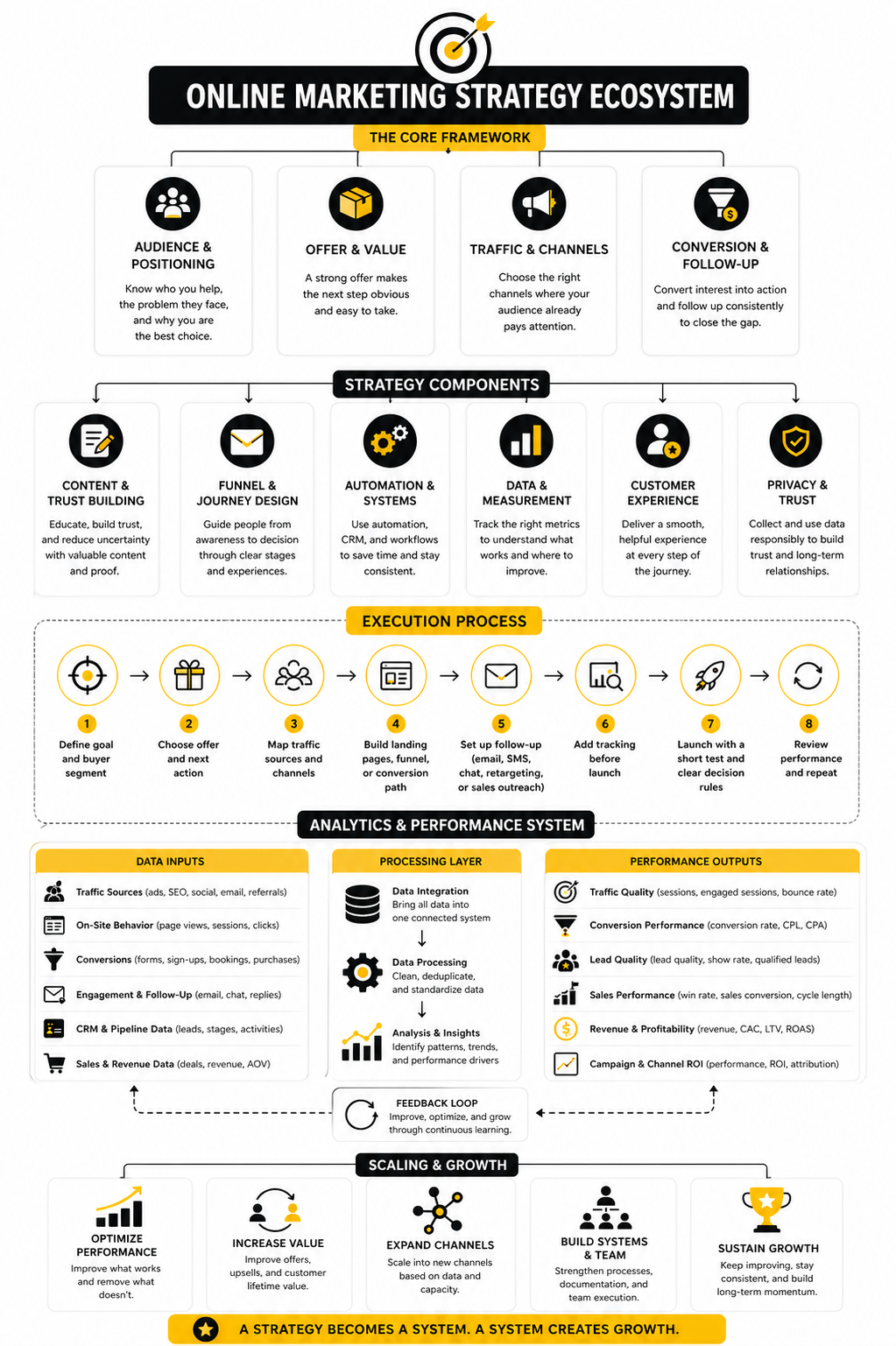
The goal is not perfection. The goal is a system that gets clearer every month. When your online marketing strategy creates better decisions over time, it becomes an asset instead of a constant guessing game.
FAQ - Built for Complete Guide
What is an online marketing strategy?
An online marketing strategy is a plan for attracting, converting, and retaining customers through digital channels. It connects audience research, positioning, offers, content, traffic, funnels, automation, and measurement into one operating system. The strategy decides what to do, why it matters, and how success will be judged.
Why is online marketing strategy important?
It matters because online attention is crowded and expensive. Digital ad revenue reached $294.6 billion in 2025, which means businesses are competing harder for the same buyer attention. A clear strategy keeps you from wasting budget on disconnected tactics.
What should an online marketing strategy include?
A complete strategy should include audience definition, positioning, offer design, channel selection, content planning, funnel structure, follow-up systems, tracking, and optimization. These pieces should not live in separate documents with no connection. They should work together as one buyer journey.
How do I choose the right marketing channels?
Start with buyer intent, not platform popularity. Search works well when people are already looking for answers, social works well for demand creation and trust, email works well for nurture, and paid ads work well for testing and scaling. The right channels are the ones that match your buyer, offer, budget, and sales cycle.
How long does an online marketing strategy take to work?
It depends on the channel mix and the quality of the offer. Paid campaigns can generate faster feedback, while SEO, content, partnerships, and email usually compound over a longer period. The smart move is to build short feedback loops while still investing in assets that become more valuable over time.
What metrics should I track first?
Start with traffic quality, conversion rate, cost per lead, lead quality, sales conversion, customer acquisition cost, and revenue. Do not track everything just because a dashboard makes it available. Track the numbers that explain whether attention is turning into customers profitably.
What is the biggest mistake businesses make with online marketing?
The biggest mistake is launching tactics before the strategy is clear. Businesses run ads, publish content, buy tools, or redesign pages without understanding the buyer, offer, message, and conversion path. That creates activity, but not consistent growth.
How does automation fit into online marketing strategy?
Automation helps with speed, consistency, segmentation, and follow-up. It can send the right message after a form submission, route leads into a CRM, trigger reminders, personalize email sequences, or support chat conversations. Tools like GoHighLevel, ManyChat, and Brevo are useful when the underlying journey is already clear.
Should small businesses use AI in their marketing strategy?
Yes, but only with direction. AI can help with research, drafts, segmentation ideas, reporting summaries, and workflow speed, but it should not replace positioning, judgment, or customer understanding. HubSpot’s AI research found that 67% of marketers believe AI will significantly affect their work in 2025, so the advantage is now in using it thoughtfully.
How do I know if my strategy is working?
Your strategy is working when the numbers and customer behavior both improve. You should see better audience quality, clearer engagement, stronger conversion paths, improved follow-up, and more revenue from the channels you prioritize. If activity is increasing but sales quality is not, the strategy needs adjustment.
How often should I update my online marketing strategy?
Review performance weekly, but update the actual strategy monthly or quarterly depending on how much data you have. Daily changes usually create noise unless something is technically broken. Strategy should evolve from evidence, not panic.
What tools do I need to implement the strategy?
You need tools for publishing, conversion, CRM, email, automation, scheduling, analytics, and customer communication. The exact stack depends on your business model, but simple and connected is usually better than complicated and scattered. Start with the workflow, then choose tools that support it.
Work With Professionals
Explore 10K+ Remote Marketing Contracts on MarkeWork.com
Most marketers spend too much time chasing clients, competing on crowded platforms, and losing a percentage of every project to middlemen.
MarkeWork gives you a better way. Browse thousands of remote marketing contracts and connect directly with companies desperate to hire skilled marketers like you, without platform commissions and without unnecessary gatekeepers.
If you're serious about finding better opportunities and keeping 100% of what you earn, explore available contracts and create a profile for free at MarkeWork.com.