

Online marketing sounds simple until you are the one trying to make it work. You launch a website, post on social media, maybe run a few ads, send a few emails, and then realize very quickly that traffic alone does not create revenue. The real job is building a connected system that turns attention into trust, trust into action, and action into profitable customer growth.
That matters more now because the digital environment is bigger, noisier, and more measurable than ever. DataReportal’s 2025 global overview counted 5.56 billion internet users worldwide, while IAB and PwC reported that US internet advertising revenue reached $259 billion in 2024. In other words, your audience is online, your competitors are online, and the money is already moving online whether your business has a serious strategy or not.
At the same time, the rules have changed. Google has kept pushing marketers toward privacy-aware measurement and stronger first-party data strategies, McKinsey’s 2025 State of AI found that organizations most often use AI in marketing and sales and regularly use generative AI across business functions, and Edelman’s 2025 brand trust research shows trust in brands remains a meaningful decision factor for buyers. So the game is no longer just “get seen.” It is get seen by the right people, earn attention without wasting budget, and build a customer journey you can improve over time.
Article Outline
- Why Online Marketing Matters Now
- The Online Marketing Framework at a Glance
- Search, Content, and Social That Create Demand
- Email, Funnels, and Conversion Systems That Capture Demand
- Analytics, Attribution, and Optimization That Protect Profit
- Professional Implementation, Common Mistakes, and the Next Step
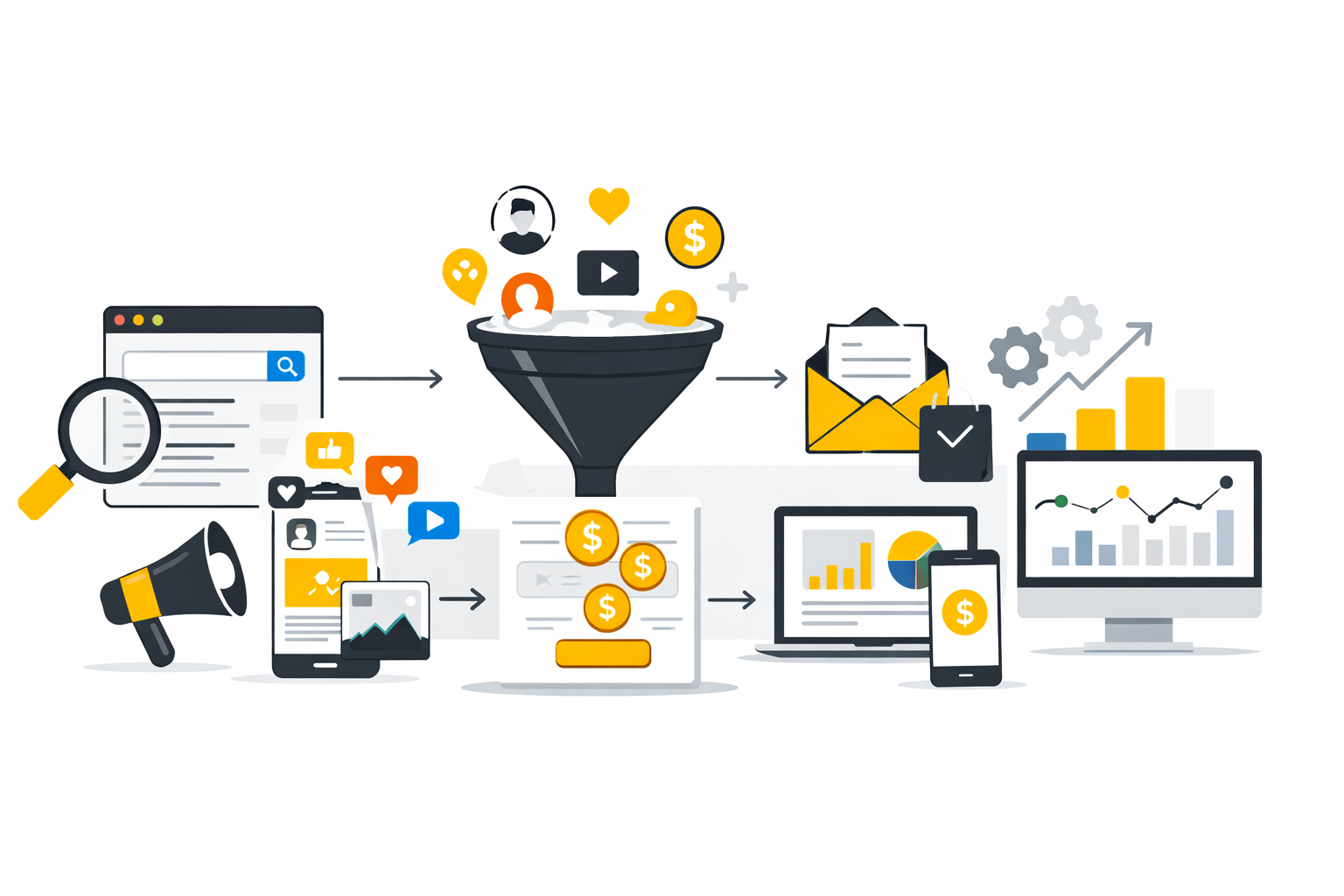
Why Online Marketing Matters Now
Online marketing matters because it sits at the point where modern buyers discover, compare, and decide. Search engines, social platforms, inboxes, retail media networks, and video platforms are no longer side channels for most brands. They are the operating environment, and the scale is obvious when Alphabet’s 2025 annual report shows continued growth in Google Search and YouTube advertising while Meta’s 2025 results show ad impressions and advertising revenue still climbing across its apps.
It also matters because digital marketing is no longer just about buying clicks. Nielsen’s 2025 Annual Marketing Report highlights rising planned investment in channels like CTV and retail media, which tells you the channel mix is getting broader and more complex. That means businesses need a clearer system for deciding where awareness should happen, where leads should be captured, and where conversion should be measured instead of treating every platform like a separate little experiment.
Then there is the trust problem. Buyers have more choice, more noise, and less patience, so the brands that win tend to be the ones that show up consistently with useful content, credible offers, and a smoother path to action. That lines up with Edelman’s 2025 findings that brand trust remains high relative to broader institutional trust and with Google’s guidance that privacy-safe first-party data is now foundational for ad growth. Put simply, online marketing works best when it is designed as a trust-building system, not a random collection of tactics.
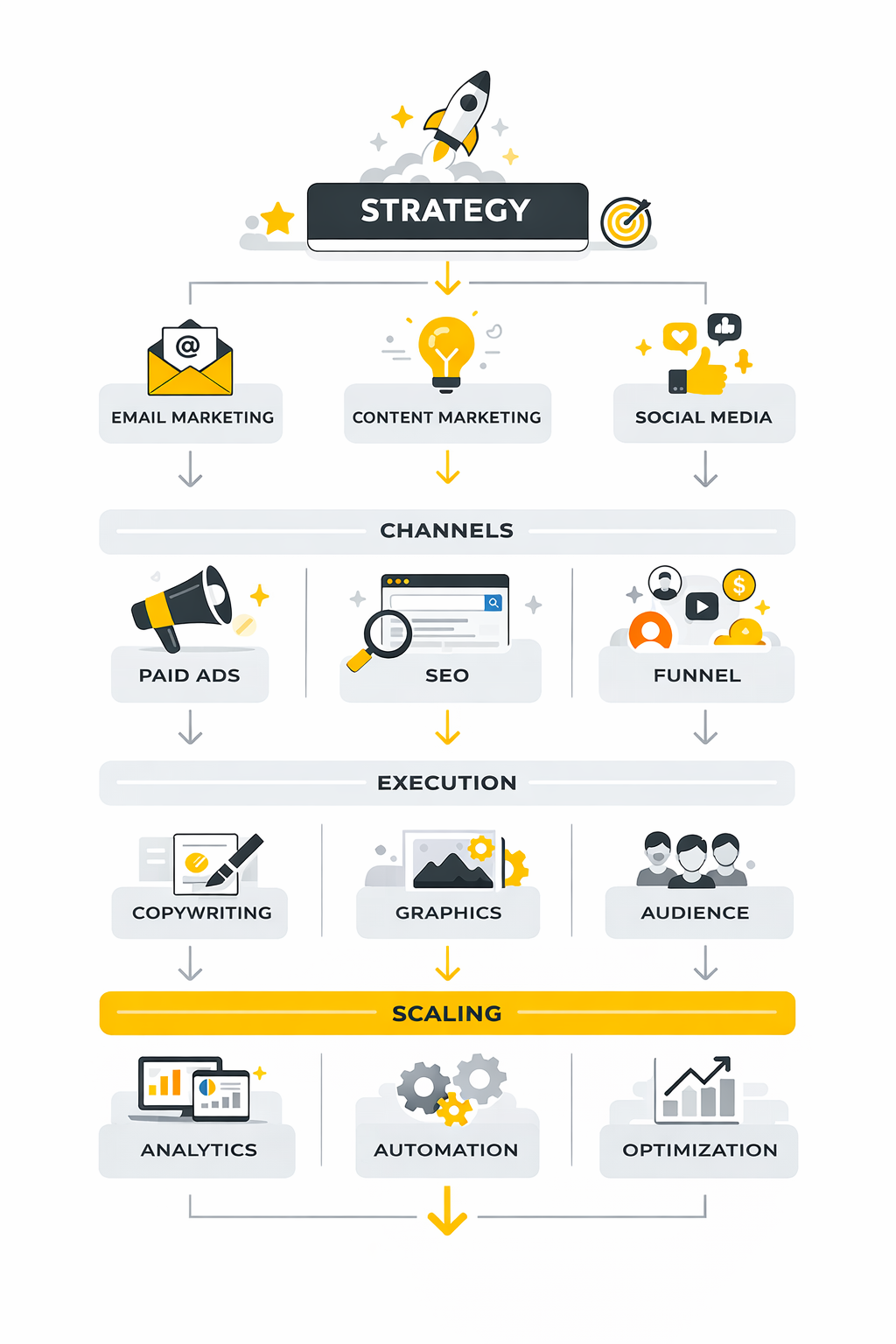
The Online Marketing Framework at a Glance
The easiest way to understand online marketing is to stop thinking in channels first and start thinking in stages. A practical framework looks like this: attract attention, capture intent, convert demand, and then improve results through measurement. That approach matches the reality of modern marketing, where IAB’s market data shows strong growth coming from video, search, social, and retail media together rather than one magic platform.
Here is the framework we will use throughout this article:
- Attract attention through search visibility, content, social distribution, partnerships, and paid reach.
- Capture intent with landing pages, lead magnets, email signups, demos, consultations, or product page visits.
- Convert demand with offers, funnels, sales pages, retargeting, email sequences, and follow-up.
- Measure and improve through attribution, conversion tracking, testing, customer data, and profit analysis.
This framework matters because it keeps you from making one of the most common mistakes in online marketing: trying to scale traffic before the journey is ready. A business with weak messaging, a slow site, broken analytics, or no follow-up system will just pay to discover its own inefficiency faster. On the other hand, a business with a clean funnel and consistent follow-up can often get more from the same traffic, whether it is using organic search, paid media, or an all-in-one stack such as ClickFunnels or Systeme.io to manage pages and automations.
The rest of this article will build that system step by step. First we will look at how search, content, and social create demand. Then we will move into the mechanics that turn that demand into leads and sales, and finally into the professional implementation details that separate real online marketing from busywork.
Search, Content, and Social That Create Demand
If the first job of online marketing is creating demand, this is where it usually starts. People discover brands when they search for answers, when a useful piece of content gets shared, when a video explains something clearly, or when a social post puts the right idea in front of the right audience at the right moment. The mistake is treating these channels like separate games when they are really different ways of earning attention.
That matters even more now because attention is fragmenting. DataReportal’s 2025 global data showed 5.24 billion active social media user identities, YouTube ad reach hit 2.53 billion users in early 2025, and Meta reported average daily family usage of 3.58 billion people in December 2025. Your future customers are not sitting in one place waiting for a banner ad. They are moving between search, video, feeds, communities, and recommendation loops.
That is why strong online marketing does not begin with “Which platform should I post on?” It begins with a better question: where does my market go when it wants to learn, compare, validate, and decide? Once you answer that honestly, your channel choices get much clearer.
Search Still Matters, but the Job Has Changed
Search remains one of the highest-intent parts of online marketing because it captures people when they are already looking. But SEO is not just about ranking for a keyword and waiting for traffic anymore. Google keeps emphasizing helpful, reliable, people-first content, and its own guidance is clear that content created mainly to manipulate rankings is the wrong path.
The click environment has also become tougher. SparkToro and Datos found that for every 1,000 Google searches in the EU, only 374 clicks went to the open web in 2024, while Datos’ 2025 search trend data showed organic click-through rates continuing to fall year over year in both the US and Europe. That means SEO still matters, but its purpose is broader now. Good search visibility builds brand familiarity, supports authority, captures bottom-funnel intent, and feeds retargeting and email acquisition even when every search does not produce a click.
So the practical move is this: build content around real problems, real product comparisons, real objections, and real decision stages. Follow the basics in Google’s SEO Starter Guide, but do not stop at technical hygiene. The pages that win tend to be the ones that deserve to exist because they solve something better than the alternatives.
Content Is the Engine, Not the Decoration
A lot of businesses still treat content like optional branding fluff. That is a mistake. In online marketing, content is often the asset that makes every other channel work better. It gives search engines something to rank, gives social platforms something to distribute, gives email campaigns something useful to send, and gives paid campaigns landing-page relevance that improves conversion quality.
The best content strategy is not “publish more.” It is publish with intent. That means creating different assets for different jobs:
- educational articles that attract problem-aware search traffic
- comparison pages that help buyers evaluate options
- videos that compress trust faster than text alone
- case-driven pages that reduce risk for serious prospects
- lead magnets that turn anonymous traffic into owned audience
That direction matches where marketers are putting budget. Content Marketing Institute’s 2025 B2B research found that 61% expected their organizations to increase investment in video, with paid advertising, thought leadership, and AI-supported content optimization also rising. In plain English, serious teams are not abandoning content. They are getting more selective about formats that can create attention and move people closer to action.
This is also where tools can help when they are used with discipline. A platform like Flick can support social content workflows, and email-capable systems such as Brevo or Moosend can turn content interest into follow-up. But the tool is never the strategy. The strategy is always the message, the audience, and the next step you want the reader to take.
Social Media Creates Discovery Before Search Even Begins
One of the biggest shifts in online marketing is that discovery no longer starts only in Google. People now find products, creators, and opinions inside social platforms long before they type a branded query into a search bar. That is a major reason social content has become part of demand generation instead of just a place for updates and recycled posts.
You can see the commercial push in the platforms themselves. TikTok announced Search Center in 2025 to make buying search ads easier inside TikTok Ads Manager, and TikTok Shop continues to position product discovery through shoppable videos, live streams, and in-app browsing. When a platform builds search and shopping deeper into the product, it is telling marketers exactly where behavior is going.
That does not mean every business should chase every trend. It means you should understand the role social actually plays in your market. For some brands, social is top-of-funnel reach. For others, it is trust reinforcement, customer proof, creator partnerships, or community building. The smartest move is usually to choose one primary platform where your audience already pays attention, create platform-native content consistently, and then connect that activity back to your website, lead capture, and remarketing system.
The Right Mix Is Demand Capture Plus Demand Creation
A mature online marketing strategy balances demand capture with demand creation. Search is brilliant for capturing existing intent, because it reaches people already looking. Content and social are stronger at creating future demand, because they shape awareness before the buyer is ready to act.
That balance matters more than most teams realize. LinkedIn’s Brand to Demand research argues that sustainable growth comes from combining brand building with demand generation rather than over-focusing on short-term lead capture. This is one of those points that feels abstract until you see it in the numbers: brands that only chase ready-to-buy traffic eventually hit a ceiling, because they are competing for the smallest and most expensive slice of the market.
So the goal is not to choose between SEO, content, and social. The goal is to make them work together. Search captures intent. Content deepens understanding. Social widens reach and repetition. When those pieces support the same offer and the same positioning, online marketing starts to feel less chaotic and much more compounding.
What Strong Demand Generation Looks Like in Practice
A healthy demand-generation layer usually has a few clear traits. It publishes content tied to actual customer questions, not random trend chasing. It uses social to distribute ideas with a point of view, not just to fill a calendar. And it builds search visibility around pages that help buyers move, not pages written only to attract weak traffic.
That is the transition point into the next stage of online marketing. Attention is valuable, but only if you can capture it before it disappears. In the next part, we will move from demand creation into the conversion machinery itself: email, funnels, landing pages, offers, and the systems that turn interest into leads and revenue.
Email, Funnels, and Conversion Systems That Capture Demand
Traffic without conversion is just noise. This is the point where online marketing either becomes a real growth system or stays stuck in the “we’re getting visitors but nothing happens” phase. What you build here determines whether attention turns into leads, customers, and repeat revenue.
The shift is simple but critical: instead of sending people to a generic website and hoping they figure it out, you guide them through a structured path. That path is usually a combination of landing pages, lead capture, follow-up emails, and a clear offer. When these pieces are connected, your marketing stops leaking value at every step.
This matters because most users do not convert on the first visit. Google’s research on purchase journeys shows that people move through multiple touchpoints before deciding, and HubSpot’s 2025 marketing data shows average landing page conversion rates still sit in the low single digits for many industries. If you are not capturing and nurturing that interest, you are effectively paying to lose potential customers.
Funnels Replace Guesswork With Structure
A funnel is just a controlled journey. Instead of letting users wander, you decide what they see first, what they should do next, and how you follow up. That structure is what allows online marketing to scale without becoming chaotic.
A basic funnel usually looks like this:
- Entry point – ad, search result, or social post
- Landing page – focused message with one clear action
- Lead capture or offer – email signup, demo request, or direct purchase
- Follow-up sequence – email, retargeting, or both
- Conversion event – sale, booking, or subscription
What makes this powerful is not complexity. It is clarity. Every step has one job, and every step is measurable. That is why platforms like ClickFunnels and Systeme.io exist in the first place. They remove friction between pages, emails, and automation so you can focus on the journey instead of stitching tools together.
Email Is Still One of the Highest-ROI Channels
Email marketing keeps showing up as one of the most reliable parts of online marketing because it is owned attention. You are not depending on an algorithm to show your message. You are speaking directly to people who already raised their hand.
The economics are hard to ignore. Litmus’ 2023–2024 email ROI analysis consistently showed returns in the range of $36 for every $1 spent, and more recent platform-level reporting from providers like Brevo and Moosend continues to highlight strong engagement and automation-driven revenue for businesses that use segmentation properly.
But the real advantage is control. With email, you can:
- educate leads who are not ready yet
- handle objections over time instead of all at once
- promote new offers without paying for every impression
- build long-term relationships that increase lifetime value
Most businesses underuse email because they treat it like occasional announcements instead of a structured follow-up system. The difference between those two approaches is massive.
The Offer Is the Real Conversion Lever
No funnel, no landing page, and no email sequence can compensate for a weak offer. This is where many online marketing strategies quietly fail. They focus on design, traffic, and tools while ignoring the actual value exchange.
A strong offer usually has a few clear traits:
- it solves a specific problem, not a vague one
- it reduces perceived risk with proof or guarantees
- it feels timely or relevant to the user’s current situation
- it is easy to understand without effort
This is also where positioning matters. Two businesses can sell similar products, but the one that frames the outcome better will convert more of the same traffic. That is why conversion-focused platforms and funnel builders matter only after the core message is clear. If the offer is strong, the system amplifies it. If the offer is weak, the system just exposes it faster.
The Execution Process That Turns Traffic Into Revenue
At this point, online marketing becomes tangible. Instead of abstract strategy, you are building a repeatable process that can be tested, improved, and scaled.
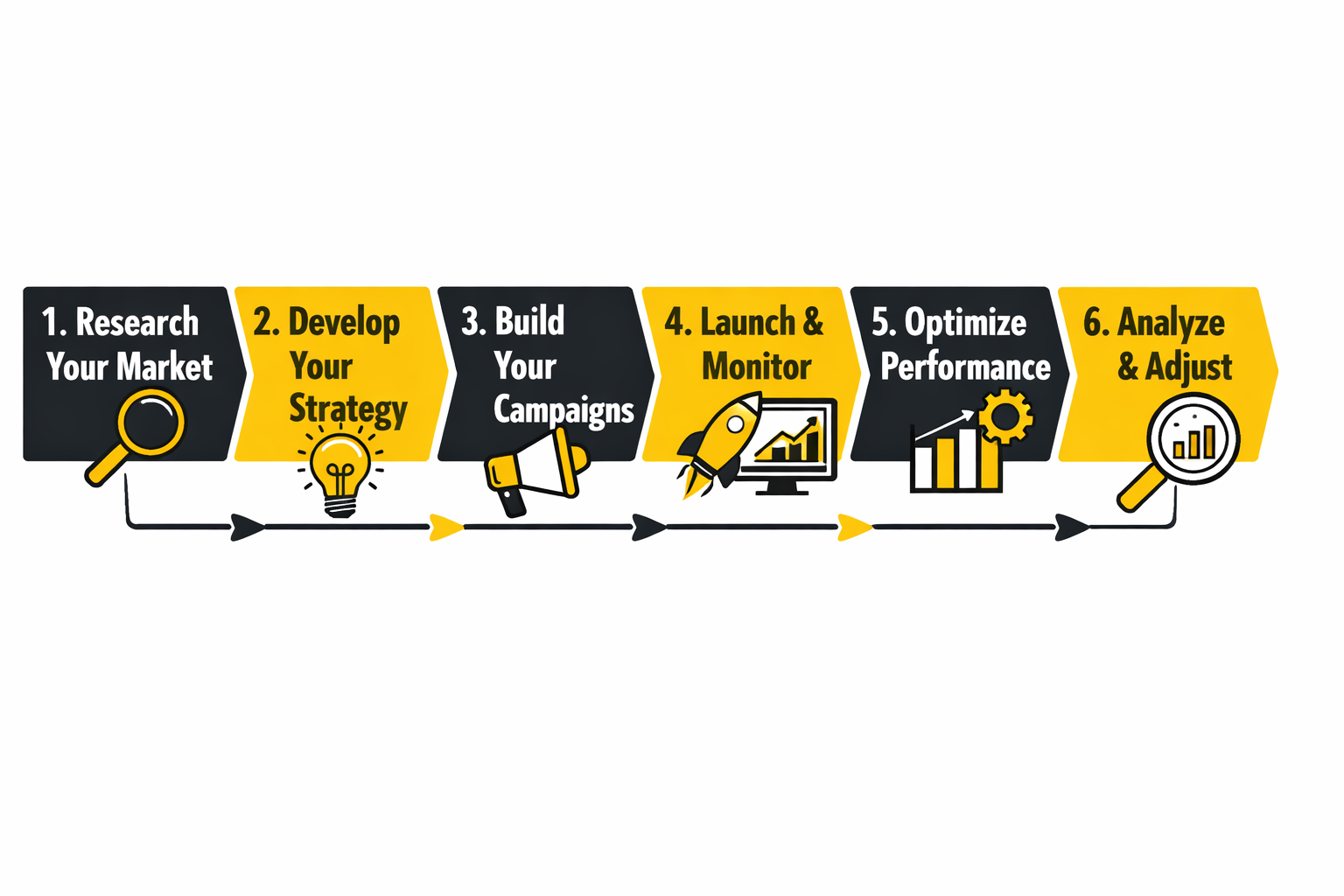
A practical implementation flow looks like this:
- Define the primary conversion goal Decide what action actually matters. This could be a purchase, a booked call, or a qualified lead. Everything else should support this outcome.
- Build a focused landing page Remove distractions. One message, one audience, one action. Strong headline, clear benefit, proof, and a simple next step.
- Create a lead capture or entry offer If the sale is not immediate, give users a reason to stay connected. This can be a guide, a trial, a checklist, or access to something useful.
- Set up an email sequence Start with a welcome email, then move into value, objections, and offer. Even a simple 5–7 email sequence can outperform random follow-up.
- Add retargeting Bring back visitors who did not convert. This is often one of the highest ROI adjustments because the audience is already warm.
- Measure conversion points Track landing page conversion rate, cost per lead, and cost per acquisition. Without this, you are guessing.
- Iterate based on data Improve headlines, offers, and sequences. Small changes at this stage often outperform big changes at the traffic level.
This is where tools like Fillout for forms or automation tools like ScaledMail can support the process, but again, the system matters more than the tool. The goal is to create a loop where traffic feeds the funnel, the funnel produces data, and the data improves the funnel.
Why Most Conversion Systems Underperform
Most online marketing funnels fail for predictable reasons. The traffic is not aligned with the offer, the landing page tries to do too much, or there is no follow-up after the first visit. These are not advanced problems. They are structural problems.
Another common issue is impatience. Businesses expect immediate results, but conversion systems improve over time. Google’s measurement guidance emphasizes the importance of testing and iterative optimization for campaign performance. The first version of a funnel is rarely the best version. The advantage goes to the teams that treat it like a process, not a one-time build.
Finally, many businesses stop at lead generation without fixing what happens after. If sales follow-up is slow, messaging is inconsistent, or onboarding is weak, the entire system suffers. Online marketing does not end at the conversion event. It connects directly to revenue operations.
This is exactly why the next layer matters. Once you have traffic and conversion working together, the real leverage comes from measurement, attribution, and optimization. That is where you stop guessing completely and start scaling what actually works.
Analytics, Attribution, and Optimization That Protect Profit
This is where online marketing stops being guesswork. Up to this point, you have attention coming in and a system that can convert it. Now the question becomes simple and uncomfortable at the same time: what is actually working, what is wasting money, and what should you scale?
Most businesses avoid this layer because it feels technical. In reality, it is the only part that tells you the truth. Without measurement, you can have a great-looking funnel, solid traffic, and still lose money quietly. With the right data, even a simple system can outperform more complex setups because every decision is grounded in reality.
The shift to privacy-first tracking and fragmented user journeys has made this more important, not less. Google’s measurement guidance now emphasizes modeled conversions and first-party data strategies, while Gartner’s marketing analytics research highlights that many teams still struggle to connect data to decisions. The advantage goes to those who simplify what they measure and actually act on it.
The Metrics That Actually Matter
There are hundreds of metrics in online marketing dashboards, but only a handful drive decisions. The goal is not to track everything. The goal is to track what connects activity to revenue.
The core metrics usually fall into four groups:
- Traffic quality
- sessions or visitors
- source (search, social, paid, direct)
- engagement signals like time on page or scroll depth
- Conversion performance
- landing page conversion rate
- cost per lead (CPL)
- cost per acquisition (CPA)
- Revenue efficiency
- average order value (AOV)
- customer acquisition cost (CAC)
- return on ad spend (ROAS)
- Retention and lifetime value
- repeat purchase rate
- customer lifetime value (LTV)
- email engagement over time
What matters is not the number itself, but the relationship between them. A campaign with high traffic but low conversion rate is a messaging problem. A strong conversion rate but unprofitable CPA is a targeting or cost problem. A solid CPA but low lifetime value is a retention problem.
This is where many online marketing strategies break. They look at one metric in isolation instead of understanding how the system behaves as a whole.
Benchmarks Are Context, Not Targets
It is useful to understand general benchmarks, but they should guide thinking, not dictate decisions. For example, WordStream’s latest paid media benchmarks show average Google Ads conversion rates around 6–7% across industries, while HubSpot’s landing page data continues to show many pages converting between 2% and 5% depending on traffic quality.
Those numbers are helpful, but they do not define success for your business. A high-ticket service can be profitable with a much lower conversion rate. An e-commerce brand with strong margins can afford a higher acquisition cost. The real question is always the same: does this channel produce profitable customers?
The better way to use benchmarks is to spot problems. If your landing page converts at 1% while similar offers often perform higher, that signals friction. If your cost per acquisition is rising while conversion stays flat, that signals competition or targeting issues. Benchmarks give you direction, not answers.
Building a Simple Analytics System That Works
You do not need a complicated stack to understand your online marketing performance. You need a clean system that connects traffic, behavior, and outcomes.
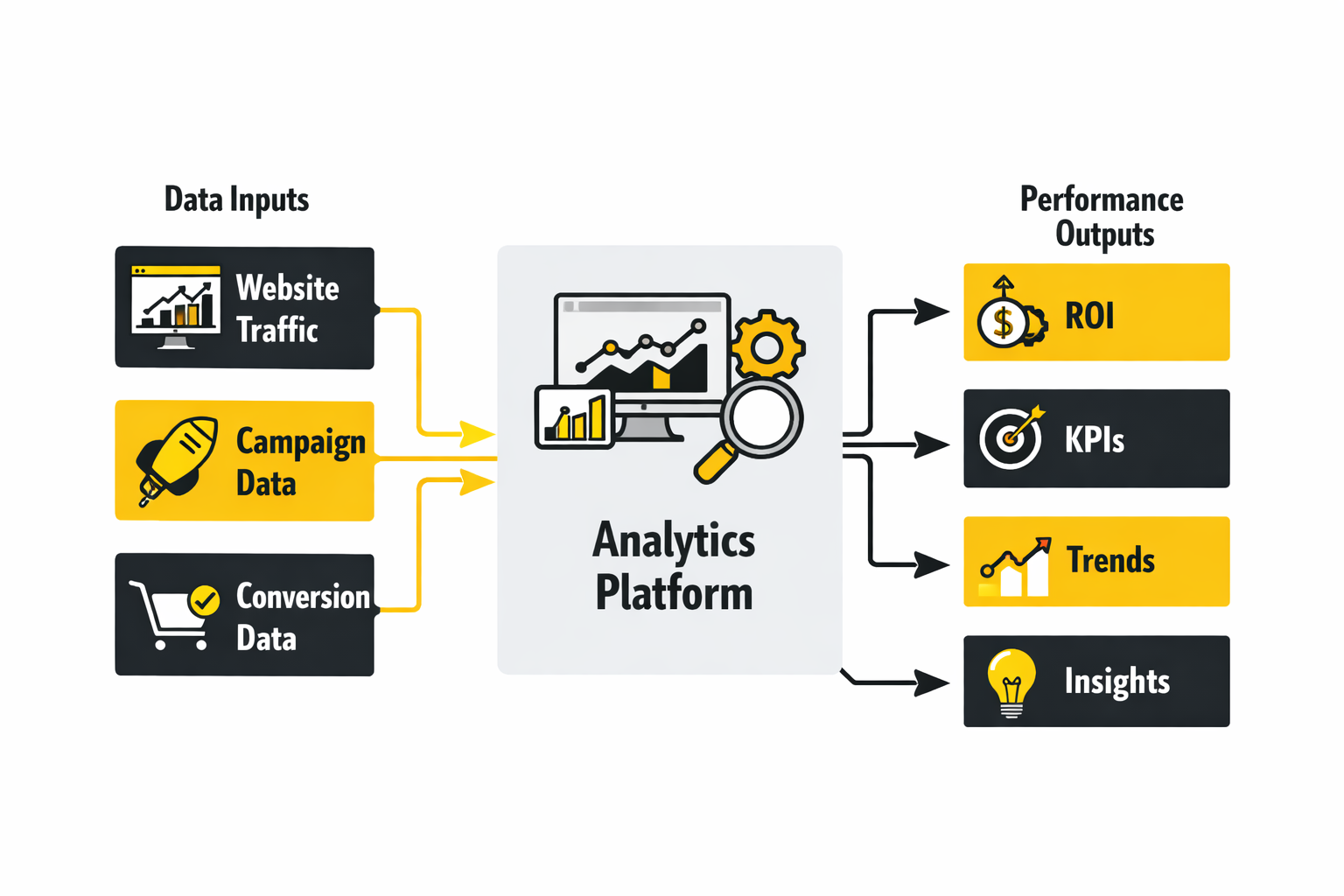
A practical setup looks like this:
- Track key events clearly Define conversions such as purchases, form submissions, or booked calls. Make sure they are recorded consistently across platforms.
- Connect traffic sources to outcomes Use UTM parameters and platform tracking to understand which channels and campaigns drive results, not just clicks.
- Use a central dashboard Whether it is built inside your ad platform, analytics tool, or CRM, you need one place where you can see traffic, conversions, and revenue together.
- Segment your data Break results down by channel, device, audience, or campaign. Aggregated data hides problems.
- Review performance regularly Weekly reviews catch issues early. Monthly reviews reveal trends. Without cadence, data becomes noise.
- Tie marketing to revenue, not just leads A lead is only valuable if it turns into a customer. This is where CRM tools or systems like Copper help connect marketing activity to actual deals.
This system does not need to be perfect. It needs to be consistent. The biggest improvement usually comes from clarity, not complexity.
Attribution Is Imperfect, but Still Useful
Attribution tries to answer a difficult question: which touchpoint deserves credit for a conversion? In reality, modern customer journeys are too complex for a perfect answer. People might discover your brand on social, search for it later, click an email, and then convert through a retargeting ad.
Platforms handle this differently. Google Ads uses data-driven attribution models, while social platforms often favor view-through or engagement-based credit. This creates discrepancies, which is why numbers rarely match across tools.
The practical move is not to chase perfect attribution. It is to use it directionally:
- if a channel consistently drives conversions, it matters
- if a campaign generates clicks but no downstream results, it needs fixing
- if multiple channels assist conversions, they should be evaluated together
Think of attribution as a map, not a measurement device. It shows patterns, not exact distances.
Optimization Is Where Growth Actually Happens
Once you trust your data, optimization becomes the highest-leverage activity in online marketing. This is where small changes produce disproportionate results.
The most effective areas to optimize are:
- headlines and messaging on landing pages
- offer structure and pricing
- audience targeting in paid campaigns
- email subject lines and sequences
- page speed and user experience
Even minor improvements compound. Increasing a landing page conversion rate from 3% to 5% can reduce your cost per acquisition dramatically without increasing traffic. Improving email engagement can lift revenue without spending more on ads.
This is why the best teams do not constantly chase new channels. They improve the system they already have. They test, measure, adjust, and repeat. Over time, that process creates a gap that competitors cannot easily close.
At this stage, online marketing becomes predictable. Not easy, but predictable. You know where growth comes from, what levers to pull, and what numbers need to improve. The final piece is professional implementation: how to run this system consistently, avoid common mistakes, and scale without breaking what works.
Professional Implementation, Common Mistakes, and the Next Step
At this stage, online marketing is no longer about learning what the channels are. It is about operating them well enough that growth becomes repeatable. That sounds less exciting than talking about hacks, but this is where real performance lives.
The uncomfortable truth is that most marketing problems are operational problems in disguise. The offer is unclear, the handoff between marketing and sales is weak, tracking is half-broken, creative gets produced without a strategy, or the team is spread across too many channels. None of that is fixed by more effort alone. It is fixed by better implementation.
Scaling Online Marketing Without Breaking It
Scaling sounds like a traffic question, but it is usually a systems question. More spend, more content, and more campaigns only help when the business can handle the added complexity. If the reporting is messy or the funnel is fragile, scale just magnifies the cracks.
This matters because digital now dominates the budget mix for many teams. Gartner’s 2025 survey found digital channels account for 61.1% of total marketing spend, while the same 2025 Gartner CMO spend data showed overall marketing budgets staying flat at 7.7% of company revenue. That combination matters. Teams are being pushed to get more out of digital without getting much more budget to waste.
So the smart way to scale online marketing is disciplined:
- scale channels that already convert profitably
- increase creative volume only when messaging is consistent
- expand into new traffic sources only after attribution is usable
- automate repetitive work only after the process itself is sound
That last point is important. Automation multiplies what already exists. If the system is clean, automation helps. If the system is sloppy, automation just helps you make mistakes faster.
The Tradeoff Between Efficiency and Brand Strength
A lot of marketers drift too far in one direction. They either become obsessed with short-term performance and starve the brand, or they talk endlessly about awareness without building a serious conversion path. Strong online marketing needs both.
That tradeoff is becoming sharper because AI and automation make it easier to produce more content, more ads, and more personalization at lower cost. But more output is not the same thing as stronger market position. HubSpot’s 2026 State of Marketing report frames AI as baseline rather than a differentiator, and McKinsey’s 2025 work on personalized marketing argues that AI becomes valuable when it helps companies scale more relevant experiences, not just more activity.
The practical takeaway is simple. Use efficiency gains to improve quality, speed, and consistency. Do not use them as an excuse to flood every channel with forgettable content. In online marketing, brand strength still lowers future acquisition costs because people are more likely to click, trust, and convert when they already recognize the name.
Why Channel Diversification Matters More Than It Used To
One of the biggest strategic risks in online marketing is overdependence on one source of traffic. If most of your business comes from one platform, one ad account, one algorithm, or one search pattern, you do not have a marketing engine. You have a vulnerability.
This is not theoretical. Search behavior is shifting, paid media costs fluctuate, and platform incentives change constantly. SparkToro and Datos documented how zero-click search behavior has reduced open-web referral opportunities, while TikTok’s 2025 product roadmap kept pushing deeper into search and commerce functionality. The environment keeps moving, which means your online marketing mix has to stay adaptable.
That does not mean being everywhere. It means building a balanced system:
- one or two main acquisition channels
- one owned audience channel, usually email
- one reliable conversion path
- one measurement layer that works across the whole setup
This is also why tools that support distribution and owned reach can matter at the right stage. A scheduling workflow with Buffer may help keep social execution consistent. A central funnel setup in ClickFunnels or Systeme.io may simplify landing pages and follow-up. But the real protection comes from not letting any single platform own your entire future.
The Biggest Mistakes Businesses Keep Making
The most expensive mistakes in online marketing are rarely exotic. They are usually boring, repeated, and entirely avoidable.
One is spreading too thin. A business launches SEO, YouTube, LinkedIn, paid search, Meta ads, email, webinars, and partnerships all at once, then wonders why none of them perform well. Another is confusing motion with progress. The team is busy every day, but there is no tight link between activity and revenue.
A few mistakes show up again and again:
- chasing channels before fixing the offer
- judging campaigns too early or too late
- optimizing for vanity metrics instead of profit
- ignoring retention while overspending on acquisition
- publishing content without a distribution plan
- buying tools to solve strategy problems
This is where operator discipline matters. Good online marketing is not built by doing everything. It is built by deciding what matters most, doing that well, and removing friction across the whole path from click to customer.
What Professional Execution Actually Looks Like
Professional implementation does not mean a huge team or a massive tech stack. It means the work is structured, measurable, and consistent. The best operators usually run a simple rhythm instead of relying on bursts of motivation.
A strong operating cadence often looks like this:
- Weekly performance review Check traffic quality, conversion rate, acquisition cost, and campaign issues before small problems become expensive ones.
- Monthly strategic adjustment Review channel mix, creative performance, offer strength, and funnel bottlenecks. Decide what to scale, pause, or revise.
- Quarterly system cleanup Audit tracking, landing pages, email automations, CRM fields, and reporting logic. Remove technical debt before it slows growth.
- Ongoing customer feedback loop Use support conversations, sales calls, on-site surveys, and retention data to improve messaging. The market usually tells you what to fix if you listen carefully.
This is also where supporting infrastructure starts to matter more. Better forms from Fillout, cleaner scheduling flows through Cal.com, or stronger outbound follow-up with ScaledMail can improve execution when the core strategy is already in place. The point is not to collect tools. The point is to reduce friction in the moments where leads are won or lost.
The Next Step Most Businesses Should Take
The next step is usually smaller than people expect. It is not “become dominant on every channel.” It is “tighten the weakest part of the current system.” For one business, that means fixing conversion tracking. For another, it means building the first real email sequence. For another, it means cutting three low-performing channels and putting that energy into one that already shows promise.
That is how online marketing matures. Not through random leaps, but through better choices stacked over time. When attention, conversion, and measurement are connected, growth becomes much easier to manage.
The final part will wrap this up with practical questions, clear answers, and the key decisions that help online marketing stay effective as platforms, buyer behavior, and tools keep changing.
Bringing the Entire Online Marketing System Together
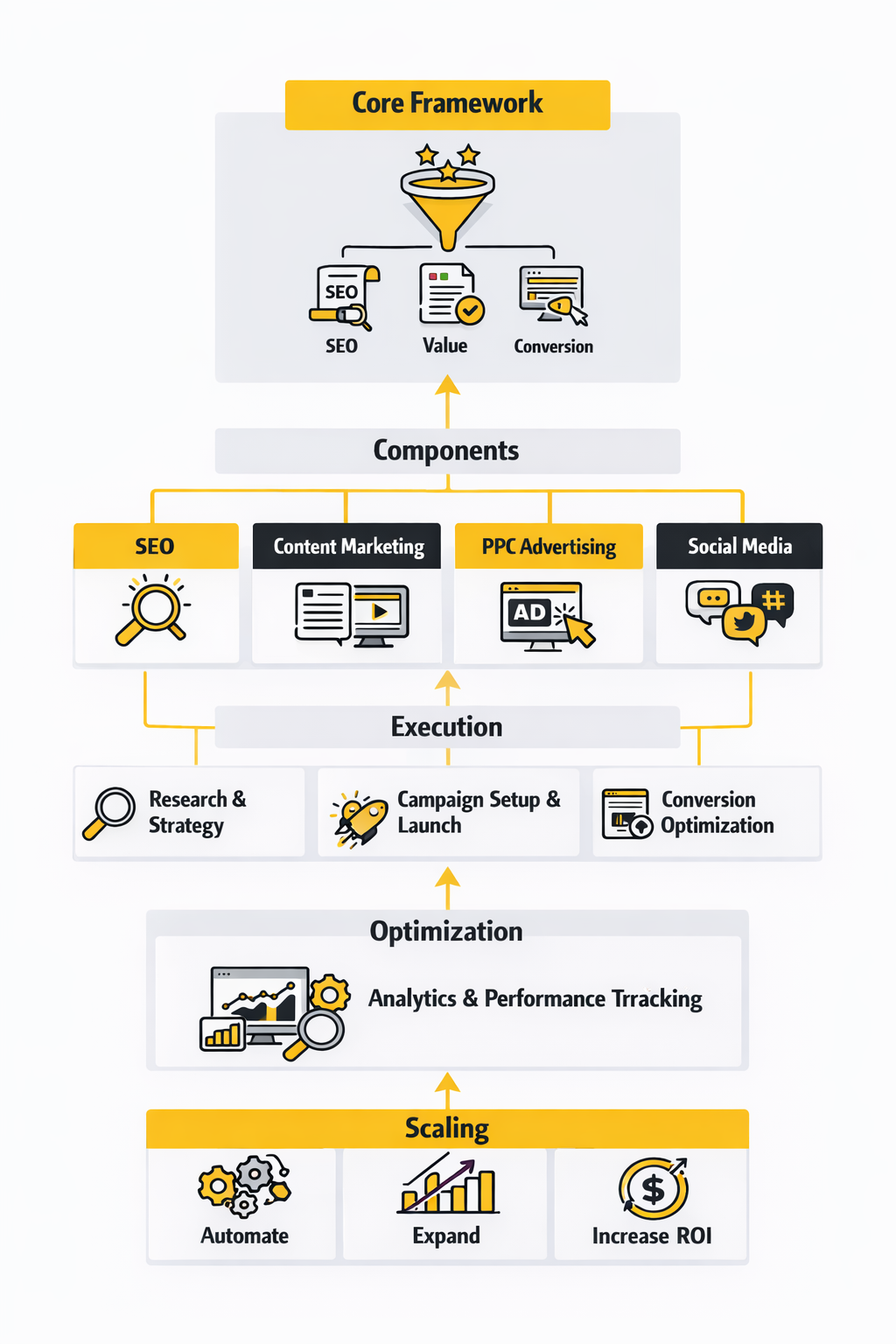
By now, the structure should feel clear. Online marketing is not a collection of tactics. It is a system where each part supports the others. Traffic feeds the funnel, the funnel produces customers, and the data improves the entire process over time.
What separates average execution from strong execution is integration. Search, content, social, email, funnels, and analytics should not operate independently. They should reinforce each other. When that happens, growth becomes more predictable because each layer compounds the previous one.
This is also where most businesses unlock their next level. Not by adding more channels, but by connecting what already exists. A better handoff from content to email. A clearer link between ads and landing pages. A tighter feedback loop between data and decision-making. That is how online marketing turns into a real growth engine instead of a scattered effort.
FAQ - Built for Complete Guide
What is online marketing in simple terms?
Online marketing is the process of attracting, converting, and retaining customers using digital channels. It includes search engines, social media, email, paid ads, and websites working together. The key is not the channels themselves, but how they connect into a system that drives measurable results.
How long does online marketing take to work?
Some channels like paid ads can produce results quickly, sometimes within days. Others like SEO and content take months to build momentum. The realistic expectation is that strong online marketing compounds over time, with early signals appearing in weeks and meaningful growth usually taking a few months of consistent execution.
Which channel is best for beginners?
There is no universal best channel, but search and email are often strong starting points. Search captures existing demand, while email helps you retain and nurture it. The better approach is to pick one main acquisition channel and one conversion system instead of trying everything at once.
How much should a business spend on online marketing?
Spending depends on margins, goals, and stage of growth. Gartner’s 2025 data shows average marketing budgets at 7.7% of company revenue, but high-growth companies often invest more aggressively. The real focus should be on return, not just spend.
Is SEO still worth it with AI and changing search behavior?
Yes, but its role is evolving. SEO now supports visibility, authority, and brand familiarity in addition to traffic. With zero-click searches reducing outbound clicks, the value of being present in search results goes beyond just getting the click.
What is the most important part of a funnel?
The offer. Everything else amplifies it. A strong offer with clear value, low friction, and strong positioning can outperform a technically perfect funnel with weak messaging. This is where most conversion improvements actually come from.
Why is email still important in online marketing?
Email gives you direct access to your audience without relying on algorithms. It allows you to follow up, educate, and convert over time. It also increases customer lifetime value by keeping your brand present after the first interaction.
How do you know if your marketing is working?
You look at the connection between traffic, conversions, and revenue. Metrics like cost per acquisition, conversion rate, and lifetime value tell the real story. If those numbers improve, your online marketing is working. If they do not, something in the system needs adjustment.
Should small businesses use automation tools?
Yes, but only after the process is clear. Tools like Systeme.io or ClickFunnels can simplify funnels and automation, but they do not replace strategy. Automation works best when it supports a system that already converts.
What is the biggest mistake in online marketing?
Trying to do too much at once. Businesses often spread across too many channels without mastering any of them. Focus, consistency, and system thinking outperform random activity almost every time.
How do you scale online marketing safely?
You scale what already works. Increase budget on profitable campaigns, improve conversion rates before adding traffic, and expand channels gradually. Scaling is less about adding complexity and more about increasing efficiency across the system.
Do you need a team or can one person handle it?
One person can build a solid online marketing system at the beginning, especially with modern tools. As the system grows, specialization helps. The key is not team size, but clarity of roles and processes.
Work With Professionals
Explore 10K+ Remote Marketing Contracts on MarkeWork.com
Most marketers spend too much time chasing clients, competing on crowded platforms, and losing a percentage of every project to middlemen.
MarkeWork gives you a better way. Browse thousands of remote marketing contracts and connect directly with companies desperate to hire skilled marketers like you, without platform commissions and without unnecessary gatekeepers.
If you're serious about finding better opportunities and keeping 100% of what you earn, explore available contracts and create a profile for free at MarkeWork.com.