

- Why Oracle Eloqua matters in marketing automation
- Platform overview and capabilities
- Core components every marketer should know
- How Eloqua supports data‑driven personalization
- Best practices for professional implementation
- Measuring performance and proving ROI
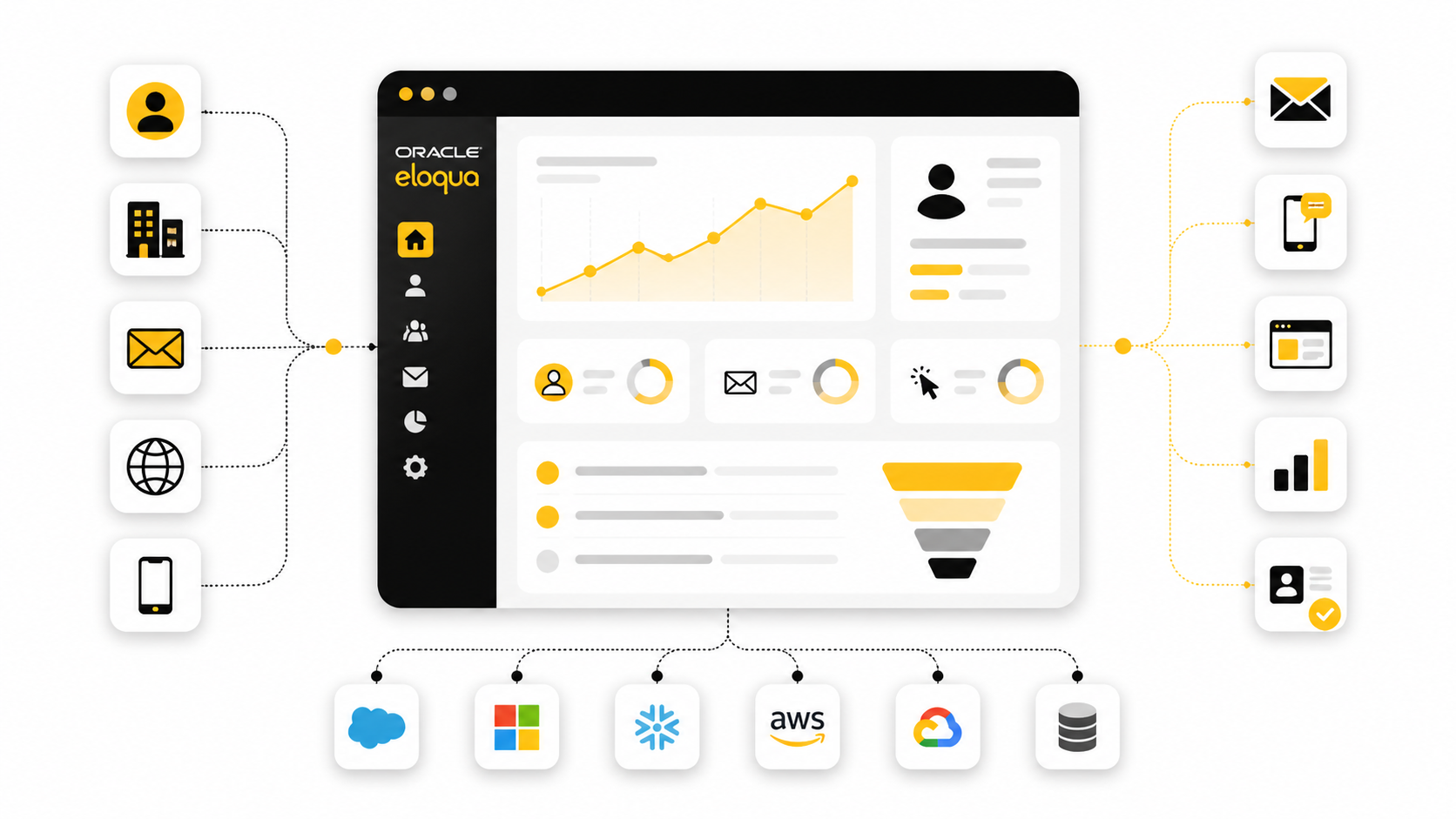
Oracle Eloqua is a cloud‑based enterprise marketing automation platform designed to help B2B marketers plan, execute, and optimize multi‑channel campaigns at scale. It centralizes customer data, orchestrates lead nurturing journeys, and connects deeply with CRM systems so revenue teams can focus on the right prospects at the right time. The platform’s SaaS architecture makes it accessible from anywhere and can scale to support even the most complex demand generation programs.
At its core, Eloqua enables teams to automate repetitive tasks — from email sends and lead scoring to cross‑channel campaign execution — freeing up time for strategic work. It also bridges marketing and sales by providing shared intelligence on leads and accounts, so both teams align around revenue‑based outcomes.
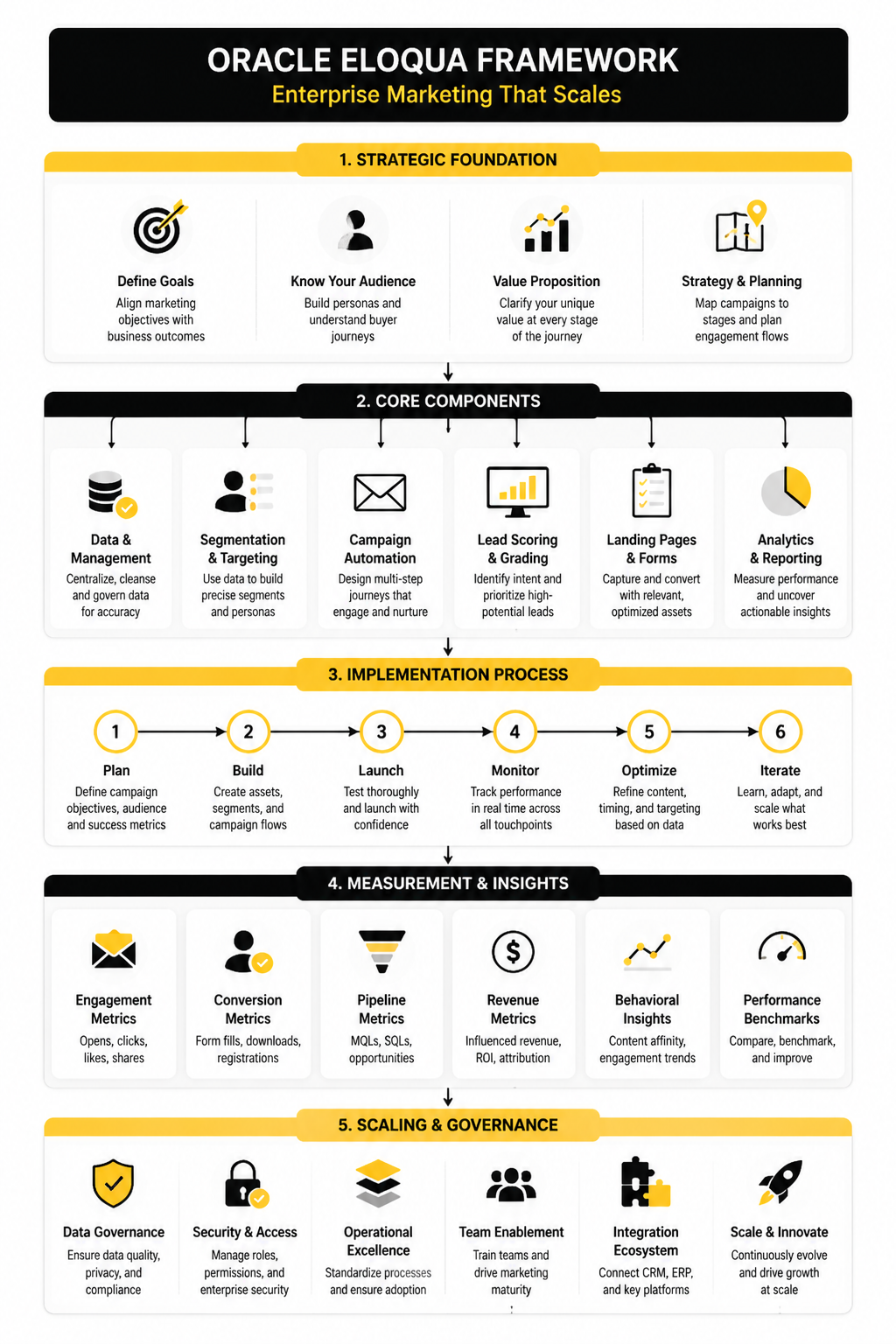
In this article you’ll explore how Oracle Eloqua works, why it matters for B2B growth, its fundamental components, and how to implement it effectively. Each section breaks down key concepts and practical insights so you can understand not just what Eloqua does, but how to apply it to real marketing operations. Understanding this framework will help you leverage marketing automation to convert more leads, deepen engagement, and demonstrate clear impact on business goals.
Why Oracle Eloqua Matters in Marketing Automation
Oracle Eloqua is designed specifically for enterprise marketers who need more than basic email automation. Its strength lies in:
- Sophisticated campaign orchestration: marketers can design multi‑step journeys with triggers, decision splits, and cross‑channel touches without writing code.
- Deep segmentation and personalization: Eloqua combines behavioral and demographic data to target the right contacts with the right message at the right moment.
- Lead management and scoring: built‑in scoring models let teams prioritize high‑value leads and route them efficiently into CRM systems.
These capabilities help organizations accelerate pipeline, reduce manual workload, and improve the quality of leads passed to sales teams.
Platform Overview and Capabilities
Eloqua’s platform provides a unified set of tools for marketing execution:
- Campaign Canvas: a drag‑and‑drop interface to visually build automated campaigns across channels like email, mobile, web, and display advertising.
- Asset creation: intuitive editors for emails, landing pages, and forms that support dynamic content and responsive design.
- Audience segmentation: flexible filters and criteria to define segments based on rich contact profiles and behaviors.
Together, these components give marketers control over entire buyer journeys from first touch to conversion and beyond.
Core Components Every Marketer Should Know
To make the most of Eloqua, it helps to understand the building blocks that support advanced automation:
- Campaign orchestration and Program Canvas – define how prospects progress through email streams, triggers, and decision logic.
- Lead scoring and routing engines – evaluate engagement and profile data to identify high‑quality leads.
- Reporting and analytics dashboards – track performance in real time and attribute revenue back to marketing initiatives.
These components work in concert to help marketing teams be both agile and accountable.
How Eloqua Supports Data‑Driven Personalization
Personalization in Eloqua goes beyond inserting a name into an email. It uses data from multiple sources — including CRM systems — to build rich customer profiles and tailor interactions across channels.
Dynamic content blocks ensure that emails and landing pages adjust based on visitor behavior, interests, and stage in the buying process. This depth of personalization boosts engagement and helps marketers create more relevant experiences at scale.
Best Practices for Professional Implementation
Implementing Eloqua successfully requires more than just software configuration:
- Start with clean data: invest in data hygiene and normalization before launching campaigns to improve segmentation accuracy.
- Align marketing and sales: define shared lead scoring thresholds and SLAs so leads flow smoothly into your CRM.
- Leverage prebuilt integrations: take advantage of Eloqua’s extensive ecosystem of connectors to expand functionality without custom development.
These practices ensure Eloqua supports scalable, repeatable processes that drive outcomes.
Measuring Performance and Proving ROI
One of Eloqua’s strengths is its robust analytics layer:
- Pre‑built reports and dashboards provide insights into email performance, campaign engagement, and conversions.
- Closed‑loop reporting ties marketing activities directly to revenue impact, helping justify investment and optimize future programs.
By tracking key metrics over time, marketing leaders can demonstrate clear value and continuously refine their strategies.
This completes Part 1 of the article. Continue to Part 2 for deeper insights into campaign orchestration and best practices.
How Oracle Eloqua Supports Data‑Driven Personalization
Data‑driven personalization is one of the forces that distinguish enterprise marketing automation from basic scheduling tools. With Oracle Eloqua, personalization is rooted in real customer insights drawn from unified behavioral, profile, and account data rather than generic list tags. 📊 This capability lets you tailor experiences that resonate with buyers at every stage of the journey, not just send name‑insert emails.
Eloqua’s segmentation and targeting features let marketing teams build rich customer profiles based on detailed attributes, historical engagement, and real‑time activity across channels. This includes filtering contacts by behavior, firmographics, and actions taken on web pages, forms, and previous campaigns. The result is segmentation that reflects actual buyer interest instead of assumptions about who might convert.
Dynamic content is central to personalized messaging in Eloqua. By embedding variable content blocks into emails and landing pages, marketers can ensure that each recipient sees information most relevant to their needs and interests. When prospects interact with content — clicking links, visiting pages, submitting forms — Eloqua’s real‑time scoring and rule engines adjust their journeys, serving up next‑best actions with adaptive precision.
Personalization capabilities also extend across channels, so messaging is consistent whether someone engages by email, mobile, display, or social. This cross‑channel approach helps prevent fragmented experiences and reinforces relevance at each touchpoint — a key driver of engagement and conversion in complex B2B buying cycles.
Best Practices for Professional Implementation
Successfully deploying Oracle Eloqua in an organization requires planning, alignment, and ongoing refinement. A professional implementation doesn’t just flip a switch — it embeds automation into strategic marketing processes.
Start with clean and unified data. A common pitfall is launching campaigns on incomplete or inconsistent datasets, which weakens segmentation and scoring accuracy. Investing in data hygiene — removing duplicates, enriching profiles, and unifying records from CRM and external sources — pays dividends when automation rules depend on reliable signals.
Define lead definitions and scoring models in collaboration with sales teams before building automation. Clarifying what constitutes a qualified lead and the behaviors that signal readiness to buy ensures that Eloqua’s automated scoring and routing align with your revenue goals. Marketing and sales alignment here reduces the risk of leads being misprioritized or lost in handoff.
Leverage prebuilt integrations and guided workflows to accelerate setup. Eloqua’s AppCloud marketplace and CRM connectors let organizations plug into existing systems like Oracle Sales, Salesforce, and Microsoft Dynamics with minimal custom coding. These integrations help standardize data flows and automate complex tasks without heavy IT involvement.
Finally, treat your implementation as iterative. Start with core campaigns and scoring models, then use performance insights to refine journeys, messaging, and triggers. Continuous optimization — informed by real‑time analytics — ensures your automation evolves with market shifts and buyer behavior changes.
Measuring Performance and Proving ROI with Eloqua
Marketing automation’s value isn’t just in execution; it’s in measurement and optimization. Oracle Eloqua provides robust reporting and analytics tools that help teams track the performance of their campaigns, engagement metrics, and contribution to revenue.
Prebuilt dashboards let marketers examine key indicators like email open rates, click‑throughs, form submissions, and campaign response trends without exporting data to external systems. This makes it easier to spot bottlenecks and opportunities in real time.
Closed‑loop reporting is especially valuable because it ties marketing activities back to business outcomes — including opportunities influenced, pipeline acceleration, and revenue attribution. With integrated analytics, teams can quantify the impact of a campaign and make stronger cases for continued investment in automation capabilities.
Performance measurement also enables smarter decision‑making. By comparing historical benchmarks, marketers can identify high‑performing segments and automation rules worth scaling, while pruning elements that underperform. Over time, this data‑informed refinement strengthens both strategy and execution.
Transition to the Next Sections
With personalization, implementation, and performance measurement covered, the next part of this article will explore advanced campaign orchestration patterns in Oracle Eloqua. We’ll dive deeper into how marketers can design adaptive, multi‑stage journeys that respond to real‑world buyer behavior and drive sustained engagement across channels.
Implementation and Execution with Oracle Eloqua
Getting Oracle Eloqua up and running goes beyond flipping a switch — it’s about structuring your campaigns so they work predictably and scale. Implementation includes phases like planning, configuration, campaign design, testing, activation, and ongoing operations. When done right, you reduce risk, accelerate time to live, and empower your team to deliver meaningful experiences. ([turn0search6])
Pre‑Implementation Planning and Governance
Before touching the platform, successful implementations start with strategy and preparation. This phase ensures your team is aligned on goals, data quality, and governance rules so marketing automation becomes a durable capability rather than a short‑lived experiment.
- Audit existing systems and data: Inventory your current campaigns, templates, and contact records. Decide what to reuse, archive, or retire to avoid clutter and confusion once Eloqua is active. ([turn0search6])
- Clean and map data: Deduplicate contacts, standardize fields, and align CRM structures with Eloqua objects so segmentation and scoring can work effectively. ([turn0search6])
- Define naming conventions and folder structure: Establish consistent naming for campaigns, assets, and scoring models. This makes it easier for teams to find, reuse, and optimize elements over time. ([turn0search6])
This foundation sets the stage for a smooth configuration phase and reduces the likelihood of errors later in the campaign cycle.
Technical Configuration and Setup
Once planning is complete, the next step involves configuring Eloqua’s technical backbone to support your marketing strategies.
- Authentication and deliverability: Set up SPF, DKIM, and DMARC for reliable email delivery, and configure sender profiles so emails are trusted and compliant. ([turn0search6])
- CRM integration: Connect Eloqua with your CRM system (like Salesforce or Oracle CX) so lead and account data flow bi‑directionally, enabling real‑time scoring and routing. ([turn0search6])
- User roles and security: Create users and assign security groups based on roles to ensure appropriate access and governance across teams. ([turn0search6])
With the system configured, you’re ready to build assets and campaigns.
Campaign Building and Asset Development
At this point, implementation becomes tactical. You’ll design reusable templates, create assets, and storyboard your campaign logic before activating anything live.
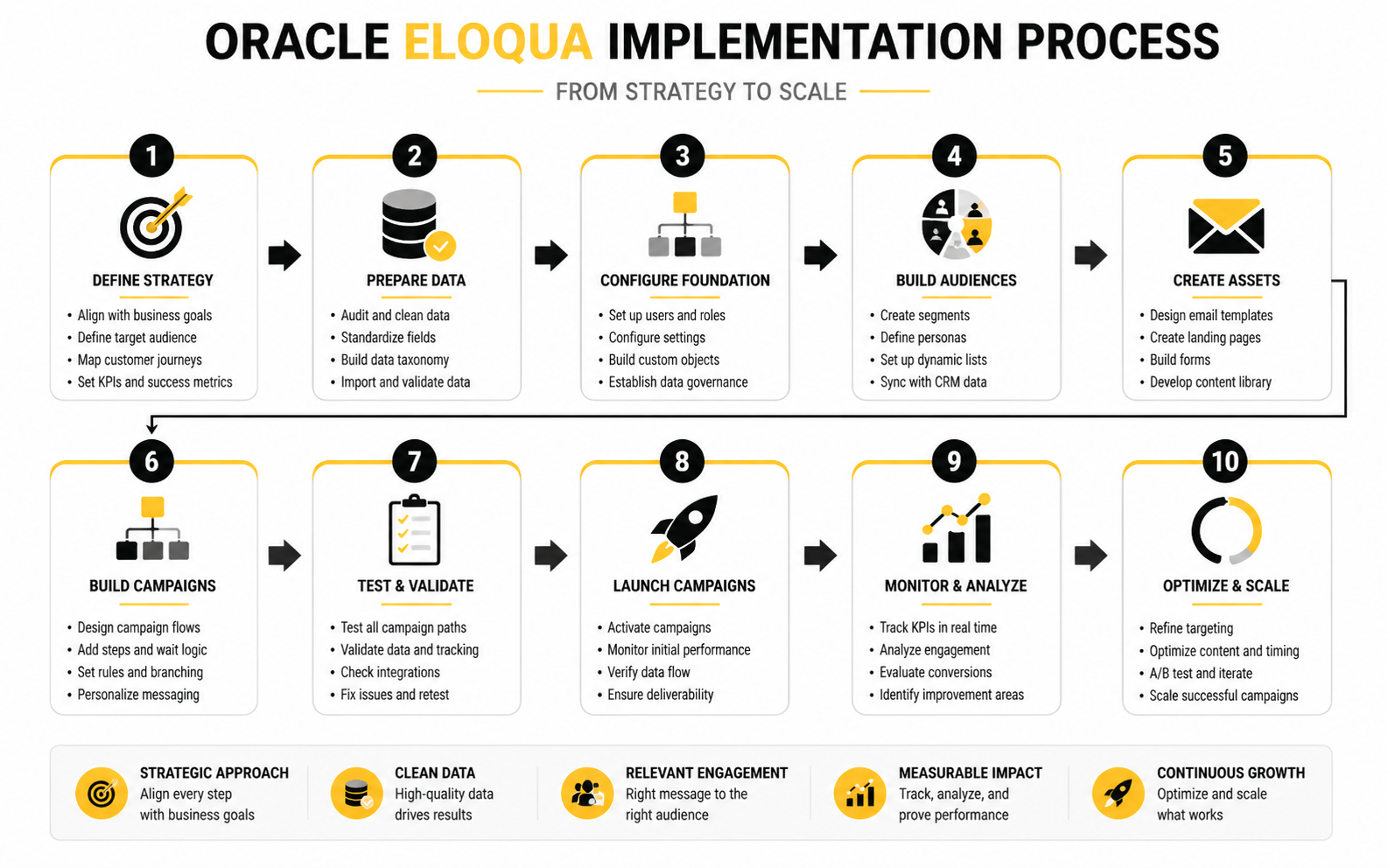
- Create reusable templates: Build email, landing page, and form templates that match your brand and can be reused across campaigns. This saves time and maintains consistency. ([turn0search6])
- Prepare campaign canvases: Use Eloqua’s drag‑and‑drop Campaign Canvas to lay out each step of your journeys. Include audience entry points, decision splits, and actions (like emails and CRM syncs). ([turn0search5])
- Storyboard journeys: Define entry criteria, branching logic, and exit conditions — for example, how a contact moves from a welcome series to a nurture path. Avoid launching without a clear flow map. ([turn0search5])
At this stage your campaigns start to take concrete form, and you can visualize exactly how prospects will move through each automation.
Testing Before Activation
Testing is a critical yet often overlooked piece of implementation. Before activating any campaign — especially multi‑step journeys — running QA helps catch errors early.
- Resolve draft errors: Eloqua flags configuration errors that must be fixed before activation. Addressing these reduces surprises when live traffic hits the campaign. ([turn0search5])
- Validate triggers and actions: Test segments, decision branches, and actions with sample data to confirm prospects flow as expected.
- Simulate CRM handoffs: Ensure lead routing and scoring logic aligns with your CRM rules and that the data syncs properly in both directions.
Testing not only improves performance but builds confidence among stakeholders that automation will behave as designed.
Activation and Monitoring
Once campaigns are tested and error‑free, it’s time to activate and observe performance in real time.
- Activate campaigns: Schedule the start and end dates that match your business rhythm. Active campaigns begin tracking engagement like clicks and form submissions immediately. ([turn0search0])
- Monitor contacts through flows: Watch how contacts move through stages of your automation, then refine segments or assets based on real‑time insights. ([turn0search0])
- Iterate based on results: Use early performance to adjust thresholds, content, and paths — optimization should be ongoing rather than one‑and‑done.
In this phase, implementation transitions into operations, where continuous improvement delivers long‑term value.
This foundation paves the way for deepening your use of Oracle Eloqua. In the next part, we’ll examine advanced campaign orchestration patterns so you can design adaptive journeys that respond to real buyer behavior and maximize engagement.
Meaningful Measurement: Analytics and Performance Data
Measuring outcomes in Oracle Eloqua isn’t just about counting opens and clicks — it’s about understanding what those numbers tell you about buyer behavior, campaign health, and revenue impact. The platform’s analytics capabilities combine campaign metrics with engagement patterns and CRM data so you can shift from “how many” to “why and what next.”
Eloqua’s reporting engine provides more than 70 prebuilt dashboards and customizable reports that help you visualize performance across channels, assets, and audience segments. These dashboards highlight trends over time and show how individual programs contribute to your larger demand‑generation goals.
Core Metrics That Tell a Story
Understanding the meaning behind each metric is critical because raw numbers have limited value without context:
- Open rates: This shows how many delivered emails were opened. Rising open rates generally signal that your subject lines and timing resonate with your audience. However, low open rates might also reveal deliverability issues or list fatigue.
- Click‑through rates (CTR): Clicks are stronger indicators of interest than opens because they represent active engagement. Improving CTR often requires sharper segmentation, relevant offers, and clear calls to action.
- Conversion rates: Whether it’s a form submission or landing page goal, tracking conversions shows how many engaged users took a desired action, tying engagement back to business outcomes.
- Response and inbound activity rates: These metrics help you compare how different campaigns are performing relative to audience size, exposing which messages or channels drive the most activity.
Why Interpretation Matters
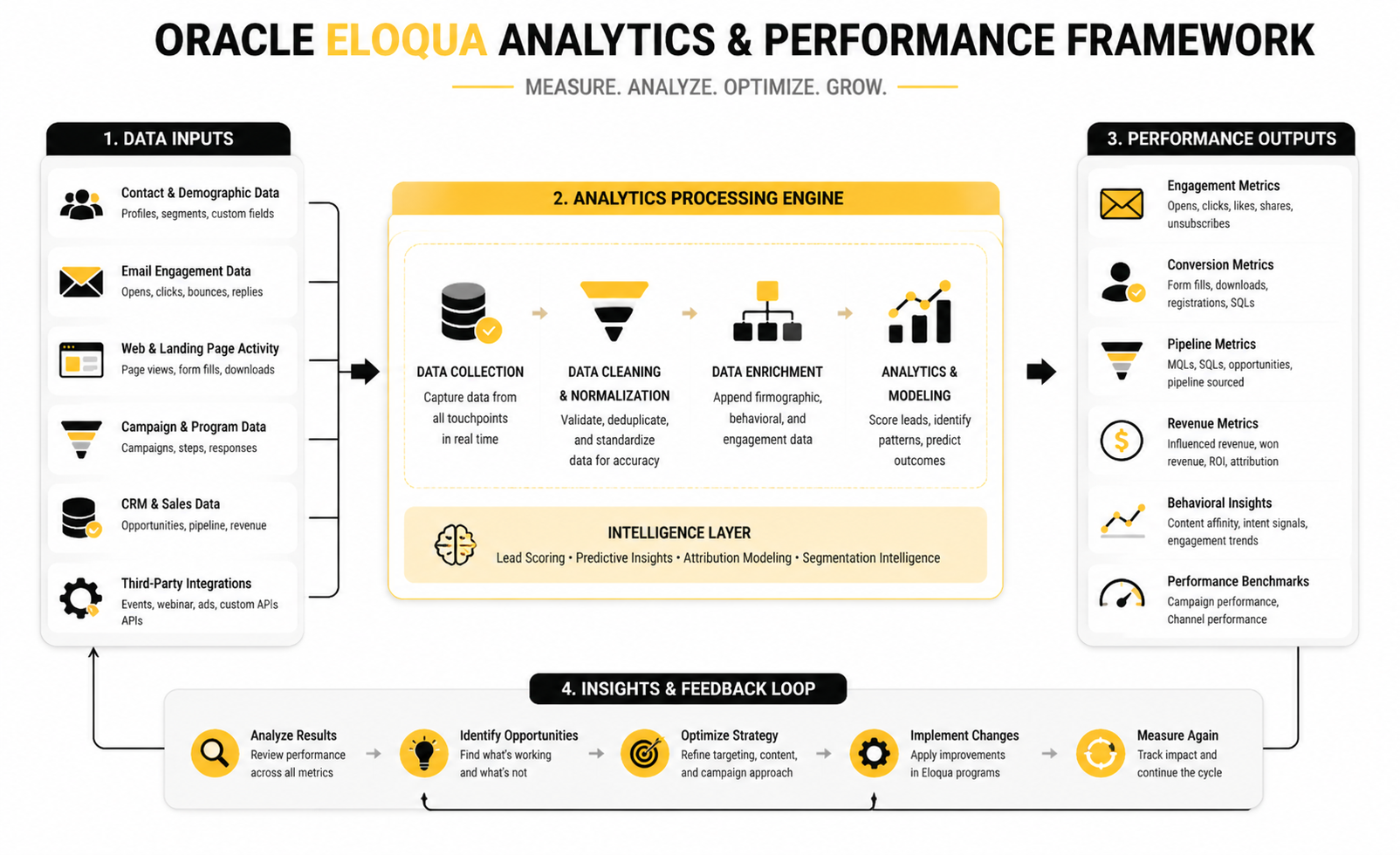
Imagine two campaigns with similar open rates — without deeper analysis, you might assume they perform equally well. But Eloqua’s dashboards let you dig into segment performance, bouncebacks, unsubscribes, and subsequent clicks to see which audience segments or creative elements drove true interest and which didn’t. This kind of analysis moves you from intuition‑based tweaks to evidence‑based optimization.
For example, a high open rate combined with low conversion might tell you you’re attracting interest but not delivering value later in the journey — a signal to refine your landing page or CTA. Conversely, a modest open rate but strong CTR suggests your audience is highly qualified and ready for deeper engagement.
Benchmarks and Benchmarks in Context
While there are industry benchmarks for email metrics (such as 20–35% open rates and 8–12% click‑to‑open rates for well‑executed B2B campaigns), these numbers should be used as reference points rather than goals in isolation. Benchmarks help you understand where performance sits in a broader landscape, but your unique audience, campaign stage, and vertical all influence what “good” looks like for your programs. Comparing your own segment trends over time often yields more actionable insight than chasing detached averages.
Using Data to Drive Action
Effective measurement in Eloqua isn’t passive reporting — it triggers decisions:
- Optimize workflows: If a nurture series shows consistent drop‑offs at a specific email, consider revising the content or timing at that stage.
- Refine segmentation: Use engagement data to identify high‑value audiences and create hyper‑targeted paths tailored to their behavior.
- Improve revenue outcomes: By tying campaign performance back to CRM data and closed‑loop reporting, you can connect automation metrics directly to pipeline influence and revenue contribution.
This blend of actionable metrics and strategic interpretation turns Eloqua analytics from dashboards into a decision engine that informs every stage of your marketing operations — from tactical refinements to long‑term strategy shifts.
Advanced Considerations for Scaling and Strategy
As organizations grow, using Oracle Eloqua at scale introduces strategic and operational complexities. Advanced marketers need to think beyond simple automation and consider architecture, campaign interdependencies, and team governance to ensure automation continues to drive impact efficiently.
Managing Complexity Across Campaigns
When multiple teams run campaigns simultaneously, the risk of overlapping segments or conflicting triggers increases. Eloqua provides folder structures, naming conventions, and campaign dependencies to help manage complexity. Establishing a clear hierarchy of campaigns and reusable assets ensures that each automation is predictable and maintainable. (oracle.com)
- Avoiding audience fatigue: Carefully schedule campaigns to prevent sending too many messages to the same contacts.
- Coordinating multi-channel touches: Map cross-channel sequences so email, social, and display campaigns reinforce rather than compete with each other.
- Version control: Maintain templates and campaign copies with clear version histories to track changes over time.
Strategic Tradeoffs in Automation
Scaling Eloqua often involves tradeoffs between personalization depth and operational simplicity. Highly segmented campaigns increase engagement but require more complex rules and monitoring. Conversely, broad campaigns reduce workload but can dilute relevance.
- Decision-making balance: Use real-time scoring to prioritize high-value leads without overcomplicating automation paths.
- Resource allocation: Assess whether creating unique content for each segment provides a measurable ROI versus leveraging dynamic content blocks. (oracle.com)
Risk Management and Compliance
As automation scales, data privacy and regulatory compliance become more critical. Eloqua includes tools to manage opt-ins, consent, and data handling according to global standards like GDPR and CCPA. Advanced users must ensure:
- Proper data segmentation to honor consent levels.
- Routine audits of lists and suppression logic to avoid compliance violations.
- Training for marketing teams on best practices for personal data handling. (oracle.com)
Optimizing for Organizational Scale
High-performing Eloqua deployments incorporate governance frameworks and process standardization. Expert marketers often establish:
- Campaign lifecycle protocols: Define stages from ideation to deactivation, including QA checks and performance reviews.
- Data-driven decision culture: Encourage teams to use reporting insights to adjust campaigns, refine segments, and optimize scoring. (oracle.com)
- Reusable asset libraries: Templates, dynamic content blocks, and scoring models should be centralized to reduce redundancy and accelerate execution.
Long-Term Strategic Guidance
Scaling Eloqua successfully isn’t just about technology; it’s about building a culture of continuous optimization and strategic alignment. Organizations that embed Eloqua deeply into marketing operations can accelerate revenue impact, maintain high engagement across multiple touchpoints, and adapt quickly to market changes.
- Monitor automation health regularly to catch errors before they impact prospects.
- Evaluate the effectiveness of each campaign in driving pipeline influence, not just clicks or opens.
- Encourage collaboration between marketing, sales, and data teams to sustain insight-driven campaigns at scale.
This advanced perspective positions Eloqua not only as a tool for automation but as a strategic engine for enterprise marketing excellence, capable of supporting complex campaigns across multiple geographies, products, and buyer personas.
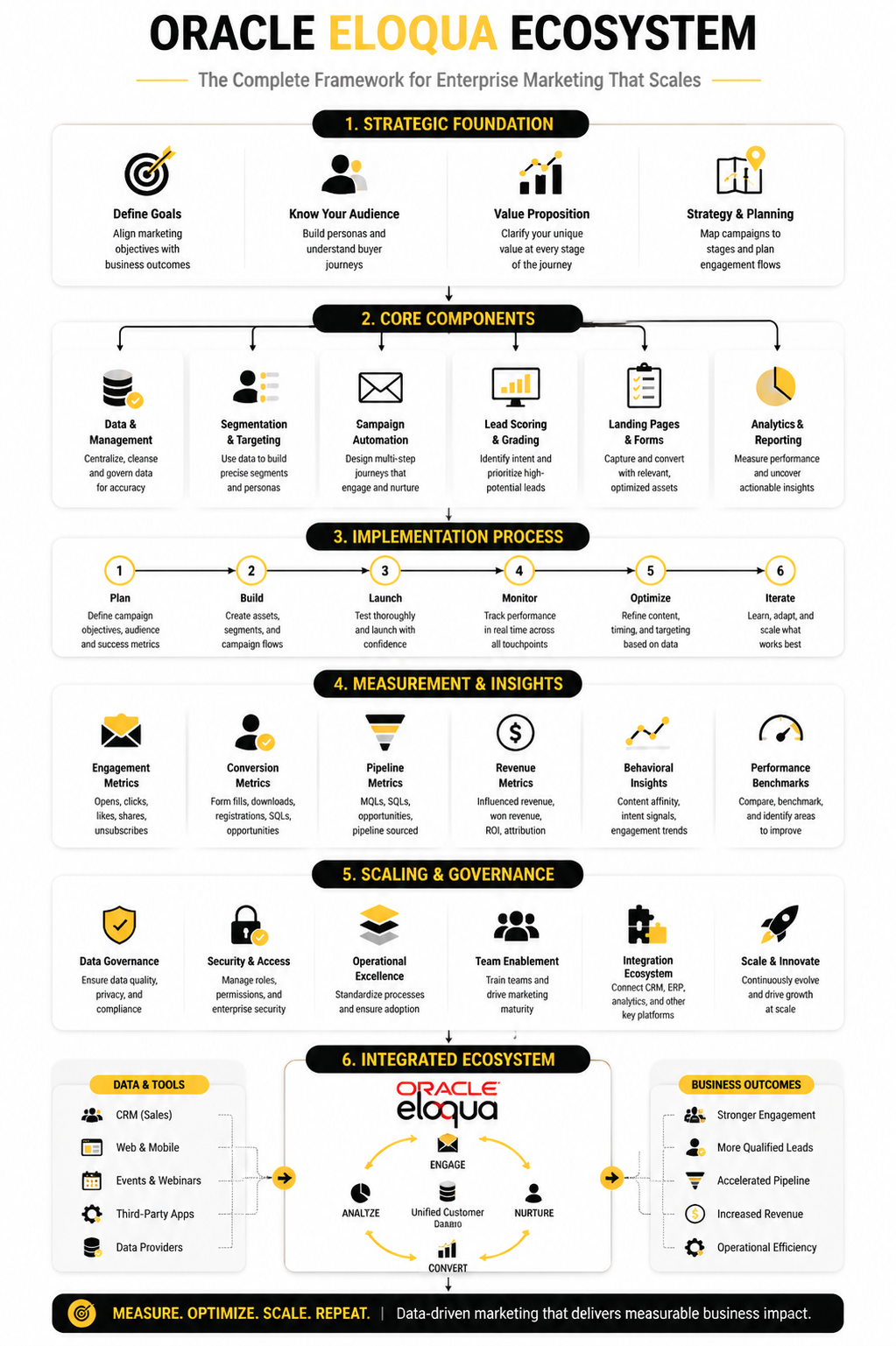
FAQ ‑ Built for Complete Guide
What is Oracle Eloqua?
Oracle Eloqua is a cloud‑based B2B marketing automation platform designed to help teams orchestrate personalized campaigns across email, web, mobile, and other channels while managing lead data and measuring performance.
How does Eloqua integrate with CRM systems?
Eloqua offers native connectors and API‑driven integrations with major CRM systems like Salesforce, Microsoft Dynamics, and Oracle CX, enabling real‑time lead flows and unified data across teams.
What kind of campaigns can I build in Eloqua?
You can build simple email sequences, complex multi‑stage nurture campaigns, account‑based marketing flows, and cross‑channel journeys that react to customer behavior using the Campaign Canvas.
Does Eloqua support segmentation and personalization?
Yes. Eloqua’s segmentation tools let you build rich audience filters based on profile data, behavioral triggers, firmographic criteria, and external signals to deliver highly tailored messaging.
Can I track revenue and ROI in Eloqua?
Eloqua includes closed‑loop reporting that ties marketing activity back to revenue metrics so you can evaluate campaign effectiveness, pipeline influence, and marketing ROI.
How steep is the Eloqua learning curve?
Many enterprise teams find Eloqua powerful but complex; its extensive features and configuration options can present a learning curve, especially for organizations new to sophisticated marketing automation.
Is Eloqua suitable for small businesses?
Eloqua excels in enterprise environments with robust B2B requirements. Smaller businesses may find its scale and complexity better suited to larger teams with specialized resources.
Does Eloqua offer AI features?
Yes, Eloqua provides advanced intelligence tools that help optimize engagement, personalize content, and improve segmentation by applying data‑driven insights to campaign decisions.
What reporting and analytics are available in Eloqua?
The platform includes 70+ prebuilt dashboards and customizable reports for campaign performance, email metrics, account engagement, and system‑wide health insights.
How do I ensure data quality in Eloqua?
Best practices include regular cleansing of contact data, maintaining consent records, using deduplication tools, and aligning CRM and Eloqua schemas so automation rules run on accurate information.
Can Eloqua handle multi‑channel marketing?
Yes, Eloqua supports cross‑channel orchestration including email, SMS, web, display search, and social touches — all managed from a central automation engine.
Work With Professionals
Explore 10K+ Remote Marketing Contracts on MarkeWork.com
Most marketers spend too much time chasing clients, competing on crowded platforms, and losing a percentage of every project to middlemen. MarkeWork gives you a better way. Browse thousands of remote marketing contracts and connect directly with companies desperate to hire skilled marketers like you, without platform commissions and without unnecessary gatekeepers.
If you're serious about finding better opportunities and keeping 100% of what you earn, invite readers to explore available contracts and create a profile for free at MarkeWork.com.