

A paid media agency is not just a team that “runs ads.” At its best, it turns budget into a controlled growth system across search, social, video, retargeting, landing pages, creative testing, tracking, and reporting. At its worst, it burns money while hiding behind platform screenshots and vague performance talk.
This matters more now because paid media is expensive, fragmented, and increasingly automated. Gartner’s 2025 CMO research found that paid media takes 30.6% of marketing budgets, while IAB reported that U.S. digital ad revenue reached 294.6 billion dollars in 2025. More money is moving through paid channels, but that does not mean the money is being managed well.
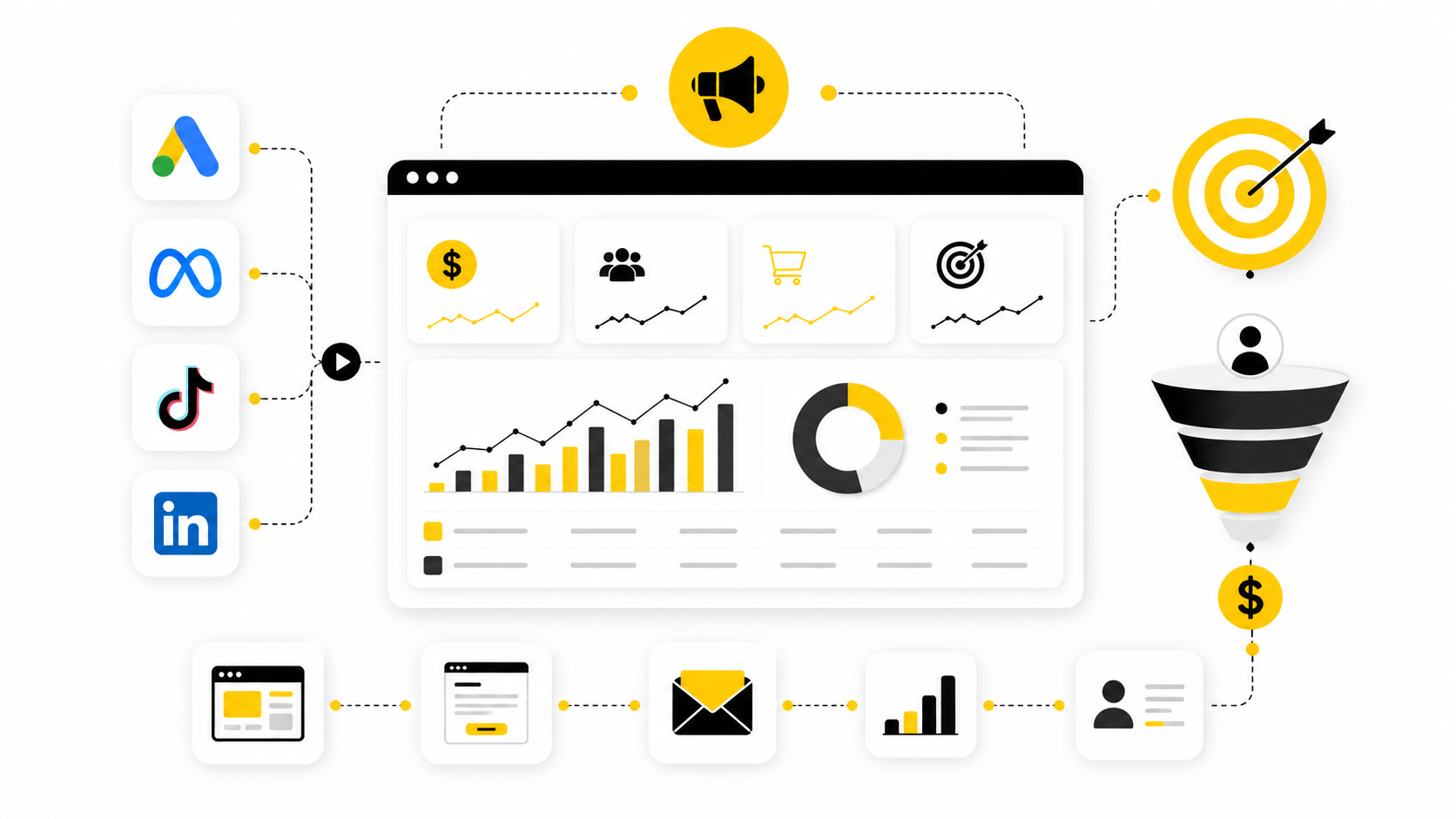
Article Outline
This article is split into six parts so the topic builds in a practical order. First, we define what a paid media agency actually does and why the decision matters. Then we move into evaluation, implementation, management, mistakes, tools, and final decision-making.
- Part 1: Why A Paid Media Agency Matters
- Part 2: What A Paid Media Agency Actually Does
- Part 3: How To Evaluate A Paid Media Agency Before You Hire
- Part 4: How Professional Paid Media Implementation Works
- Part 5: Common Paid Media Agency Mistakes To Avoid
- Part 6: Tools, Final Checklist, And FAQ
Why A Paid Media Agency Matters
Paid media looks simple from the outside because the platforms make launching campaigns feel easy. Anyone can open Meta Ads Manager, Google Ads, TikTok Ads, or LinkedIn Campaign Manager and start spending within a few hours. The hard part is not launching ads; it is knowing what to test, what to ignore, when to scale, and when to stop.
A good paid media agency brings structure to decisions that otherwise become emotional. When campaigns dip, they should know whether the problem is targeting, creative fatigue, offer-market fit, tracking quality, landing page friction, auction pressure, or weak sales follow-up. That distinction matters because each problem needs a different fix.
The agency also becomes important when ad costs rise. WordStream’s 2025 Google Ads benchmark report notes that search advertising costs have continued increasing year over year, which means sloppy testing gets punished faster. A paid media agency has to protect the budget by improving the whole system, not just tweaking bids.
The Paid Media Agency Framework
A strong paid media agency should be judged through a simple framework: strategy, tracking, creative, media buying, conversion, reporting, and iteration. If one of those parts is weak, the rest of the system usually suffers. Great targeting cannot save a weak offer, and great creative cannot fix broken attribution.
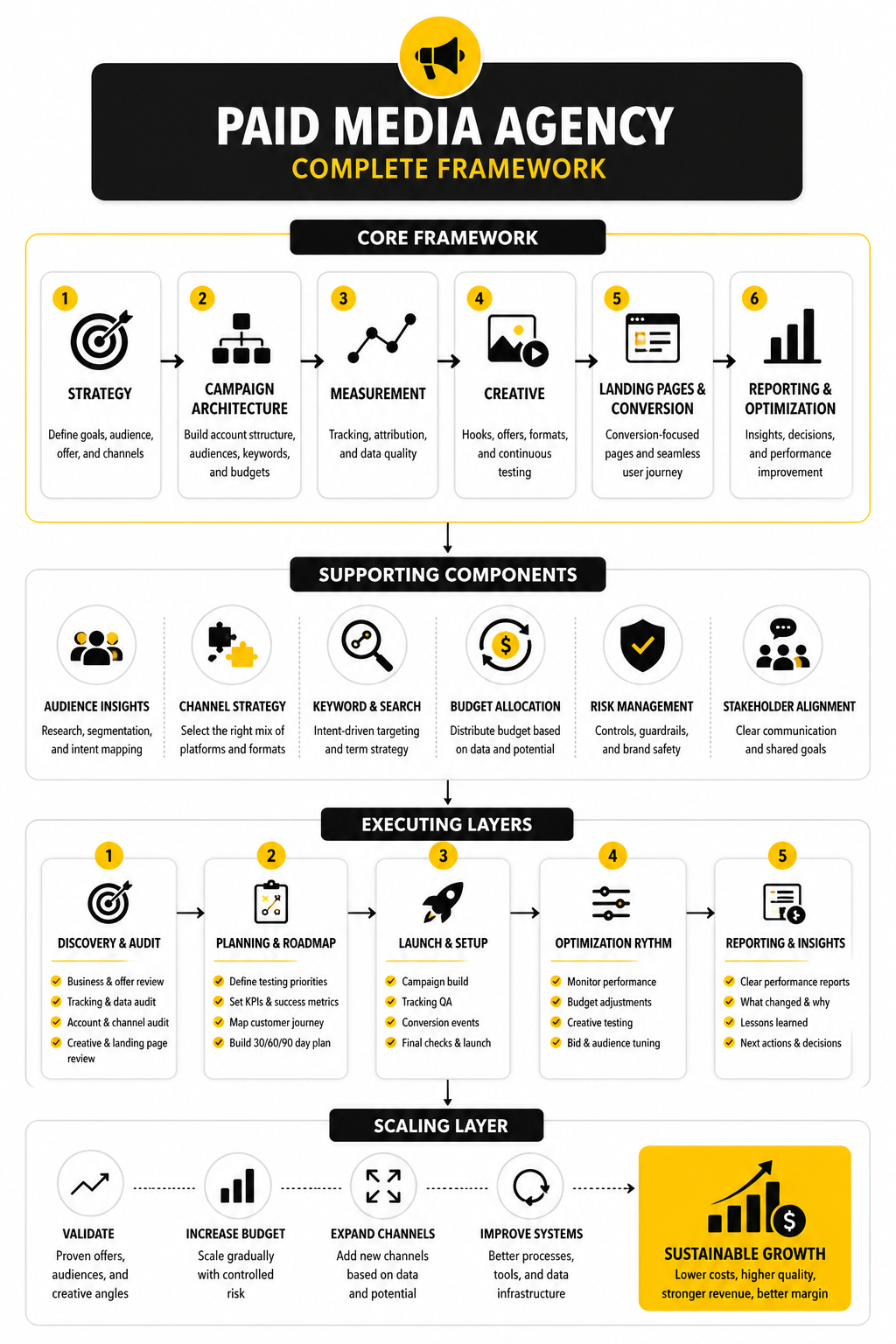
This framework also helps you avoid hiring based on surface-level confidence. Some agencies are strong at campaign setup but weak at landing pages. Others are excellent at creative production but do not understand unit economics, payback periods, or contribution margin.
The right agency should connect paid media to business outcomes. That means they should care about revenue quality, lead quality, customer acquisition cost, lifetime value, sales velocity, and retention where relevant. Clicks and impressions are useful signals, but they are not the finish line.
What A Paid Media Agency Actually Does
A paid media agency manages the paid acquisition system behind your growth. That usually includes campaign strategy, audience planning, channel selection, media buying, creative testing, conversion tracking, landing page feedback, budget allocation, and performance reporting. The better agencies do not treat these as separate tasks; they connect them into one operating rhythm.
This is important because paid media is no longer just a traffic lever. Search, social, video, creator partnerships, retail media, and retargeting all influence how people discover and evaluate brands. IAB’s 2025 report shows social media ad revenue reaching 117.7 billion dollars, which says a lot about where attention and competition are moving.
A paid media agency should help you decide where your money has the highest probability of producing useful outcomes. That might mean Google Search for high-intent demand, Meta for creative-led prospecting, LinkedIn for B2B pipeline, YouTube for education, or retargeting for warmer audiences. The point is not to be everywhere; the point is to spend where the buyer journey actually supports the business model.
Core Components Of Paid Media Management
The first core component is strategy. Before campaigns launch, the agency should understand your offer, margins, sales process, conversion points, target customer, competitors, and current bottlenecks. Without that context, media buying becomes guesswork with a dashboard attached.
The second component is campaign architecture. This includes account structure, campaign objectives, audience segments, keyword themes, exclusions, placements, bidding logic, and budget distribution. A strong structure makes testing cleaner because you can see what is working instead of staring at blended numbers that hide the truth.
The third component is measurement. A serious paid media agency should care about pixels, server-side tracking, CRM events, offline conversions, UTM discipline, and attribution limits. Salesforce’s marketing research continues to highlight data quality and personalization as major priorities for marketers, which is another reminder that performance depends on the inputs, not just the ad platform settings.
Creative Is Now A Media Buying Function
Creative used to be treated like a separate department. That approach does not work well anymore. On platforms like Meta, TikTok, YouTube, and LinkedIn, the ad creative often determines whether the algorithm finds the right audience at an acceptable cost.
A paid media agency should be able to turn customer research into creative angles. That means testing hooks, offers, formats, objections, proof points, product demonstrations, testimonials, founder-led messages, comparison angles, and urgency. The creative calendar should not be random; it should be based on what the market is telling you.
This is where many agencies fall apart. They know how to adjust budgets, but they do not know how to create new demand. If every performance review ends with “we need more creative” but nobody owns the creative testing process, the account will eventually stall.
Landing Pages And Conversion Paths
Paid traffic exposes weak conversion paths very quickly. If the offer is unclear, the page is slow, the form is too long, or the next step feels risky, the campaign will pay for attention that does not convert. That is not only a media problem, but a good paid media agency should still flag it.
For ecommerce, landing page quality can affect product education, bundle clarity, average order value, and checkout intent. Tools like Replo can be useful when a team needs to build and test Shopify landing pages faster without waiting on a full development cycle. For lead generation, the page has to qualify interest without creating so much friction that good prospects disappear.
The agency does not always need to build the page itself. But it should be able to diagnose why paid clicks are not becoming revenue. That diagnosis is often where the real profit is found.
Reporting That Actually Helps You Make Decisions
Good reporting is not a screenshot of ad platform metrics. It should explain what changed, why it likely changed, what was tested, what was learned, and what the next decision should be. You should leave a reporting call knowing what will happen next, not just hearing that CPM went up or CTR went down.
The report should separate leading indicators from business outcomes. Click-through rate, cost per click, thumb-stop rate, and conversion rate can help diagnose performance, but they are not the whole story. Customer acquisition cost, pipeline quality, payback period, revenue, margin, and lead-to-sale conversion are closer to the numbers that matter.
This is especially true when platforms over-credit themselves. A paid media agency should be honest about attribution uncertainty and should avoid pretending that every conversion path is perfectly measurable. The best agencies make decisions with imperfect data, but they do not hide the imperfections.
How To Evaluate A Paid Media Agency Before You Hire
Hiring a paid media agency should feel more like selecting an operating partner than buying a service package. The agency will influence where your budget goes, how quickly you learn, and how confidently you can scale. That means the evaluation process needs to go deeper than portfolio logos, polished case studies, and a confident sales call.
Start with business fit. An agency that is excellent for venture-backed SaaS may not be right for a local lead generation business, and an ecommerce growth shop may not understand a long B2B sales cycle. You want proof that the agency understands your sales motion, decision timeline, margin structure, and the channel mix that fits your category.
Then look at how they think. A strong paid media agency should ask uncomfortable but useful questions about your offer, tracking, creative pipeline, sales follow-up, landing pages, and real economics. If they jump straight into platform tactics before understanding the business, that is a warning sign.
The Implementation Process Should Be Clear Before The Contract
Professional implementation starts before the first campaign goes live. The agency should map the account, audit the current data, define the first testing priorities, and agree on what success actually means. This is where vague promises need to become a working process.
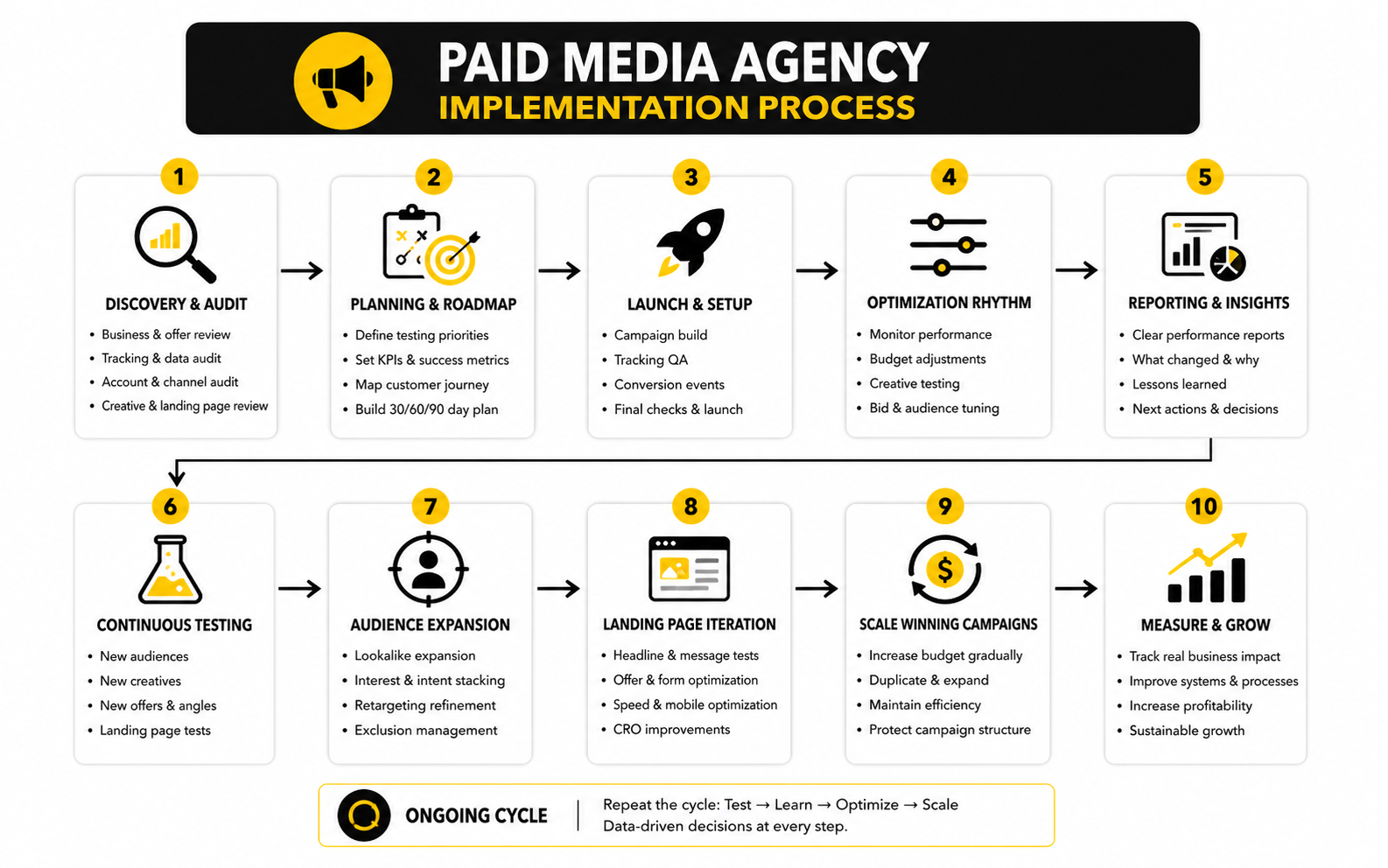
A clean implementation process usually looks like this:
- Business and offer review: The agency clarifies the product, customer, pricing, margin, sales process, and conversion points.
- Tracking and data audit: The team checks pixels, conversion events, CRM connections, UTMs, consent settings, and reporting gaps.
- Account and channel audit: Existing campaigns, budgets, targeting, keywords, placements, exclusions, and historical learnings are reviewed.
- Creative and landing page review: The agency studies hooks, offers, formats, proof, objections, page structure, and conversion friction.
- Testing roadmap: The first 30 to 90 days are planned around specific hypotheses, not random campaign changes.
- Launch and QA: Campaigns are checked for tracking, naming conventions, budgets, exclusions, landing page links, and event accuracy.
- Optimization rhythm: The agency sets a weekly or biweekly cadence for budget shifts, creative decisions, and reporting.
This process matters because modern ad platforms rely heavily on automation. Google’s 2025 updates put more emphasis on AI-powered campaign types and expanded Performance Max controls, which makes clean inputs, conversion data, and clear objectives even more important. If the setup is messy, automation just helps the platform spend faster, not smarter.
Questions That Reveal How The Agency Really Works
The best questions are not trick questions. They are practical questions that show whether the agency has a repeatable operating system. You are trying to understand how they make decisions when performance is good, bad, or confusing.
Ask how they diagnose a campaign that gets clicks but no sales. Their answer should mention more than targeting. They should talk about search intent, audience quality, creative promise, landing page match, offer strength, checkout or form friction, attribution, and lead handling.
Ask what they need from you each month. A serious agency will need access to sales data, customer feedback, creative inputs, offer updates, and honest performance numbers. If they claim they can handle everything without touching the business reality, be careful.
What Good Early Execution Looks Like
Good early execution is usually measured by learning velocity, not instant scale. The first phase should uncover which audiences respond, which hooks create qualified attention, which landing pages convert, and which conversion events are reliable enough for optimization. You should see structured learning, not just budget movement.
The agency should also document what it chooses not to do. That sounds small, but it is incredibly useful. When a paid media agency explains why it is not testing a channel yet, not increasing budget yet, or not trusting a certain conversion event yet, you get insight into its judgment.
This is also where communication matters. You do not need a three-hour report every week, but you do need clear decisions. The agency should be able to say what happened, what it means, what changes next, and what it needs from you.
Red Flags During Evaluation
A paid media agency that guarantees specific revenue before reviewing your data is selling confidence, not strategy. Nobody can responsibly promise a fixed return without understanding your offer, tracking, conversion rate, sales process, and competitive pressure. Strong agencies can estimate, model, and forecast, but they should be honest about uncertainty.
Another red flag is platform-only thinking. If every answer is about campaign settings, the agency may miss the bigger performance levers. Paid media depends on creative, offer clarity, page quality, sales speed, and follow-up discipline.
Be careful with agencies that hide behind proprietary dashboards without explaining the logic behind decisions. Reporting should make the business clearer, not more confusing. If you cannot understand why money is being moved, paused, or scaled, you are not really in control of your budget.
Statistics And Data
The numbers in paid media only matter when they change a decision. A benchmark can tell you whether performance is directionally normal, but it cannot tell you whether your agency is doing a good job by itself. A paid media agency should use data to diagnose the system, not decorate a report.
Paid media is also getting more expensive to manage casually. Gartner’s 2025 CMO research shows paid media taking 30.6% of marketing budgets, while IAB reported that U.S. digital ad revenue reached 294.6 billion dollars in 2025. That means the auction is crowded, the platforms are powerful, and weak measurement gets expensive fast.
The mistake is looking at one metric in isolation. A low cost per click can still produce terrible customers. A high cost per lead can still be profitable if those leads close quickly and produce strong lifetime value.
What The Analytics System Should Track
A professional analytics setup should connect media spend to commercial outcomes. That does not mean every touchpoint will be perfectly measurable, because privacy changes, platform modeling, cookie limits, and cross-device behavior all create gaps. It does mean the agency should build a practical measurement system that is consistent enough to guide decisions.
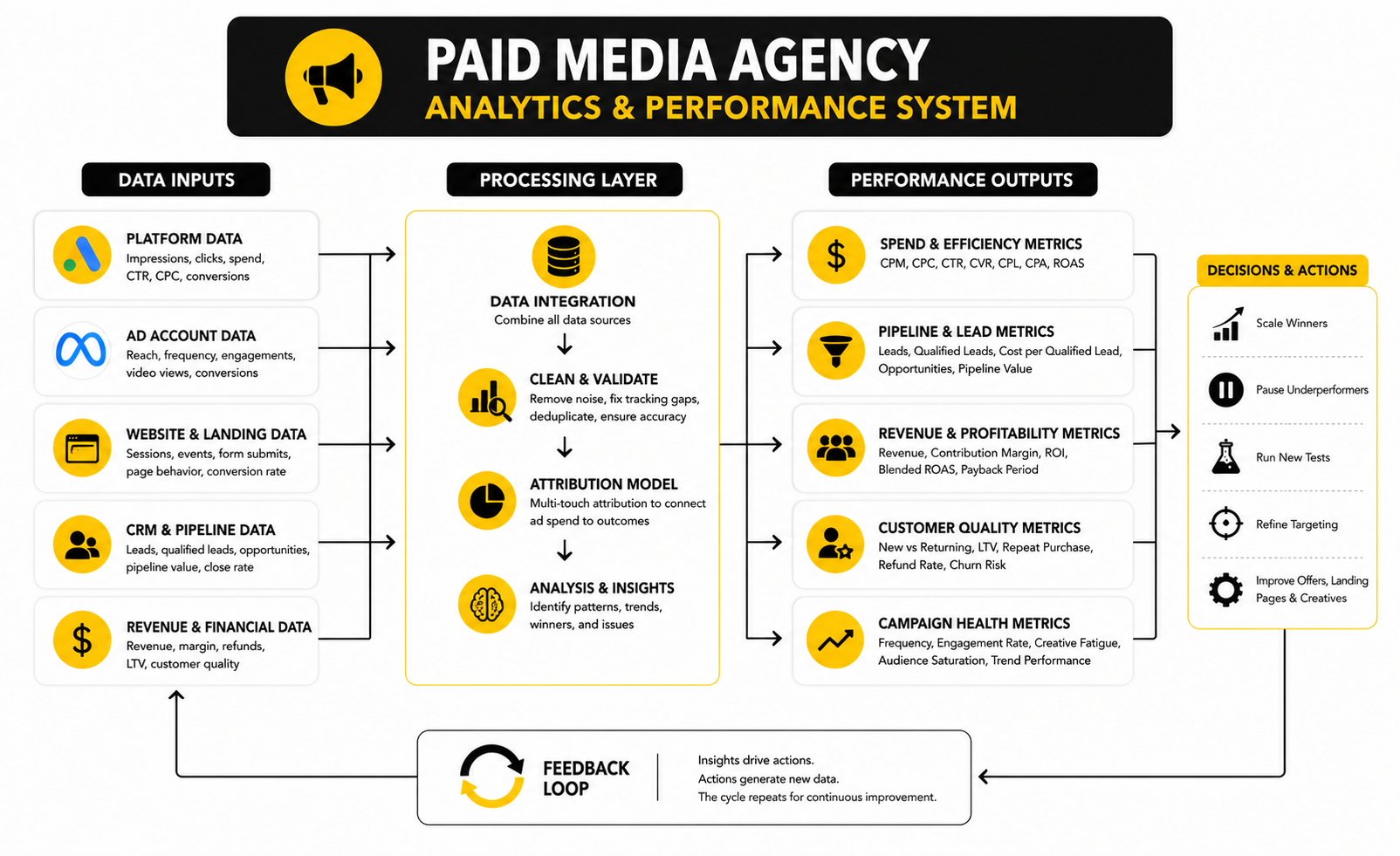
At minimum, the system should track:
- Spend: how much money is being deployed by channel, campaign, audience, keyword, creative, and funnel stage.
- Attention: impressions, reach, video views, click-through rate, thumb-stop rate, and engagement quality.
- Traffic quality: landing page views, bounce behavior, session depth, source quality, and device patterns.
- Conversion behavior: leads, purchases, bookings, trials, calls, form starts, form completions, and checkout steps.
- Revenue quality: closed revenue, average order value, pipeline value, refund rate, repeat purchase, and customer lifetime value.
- Efficiency: cost per acquisition, return on ad spend, payback period, contribution margin, and lead-to-sale rate.
This is where a paid media agency should be very practical. If a metric does not change a budget decision, creative decision, landing page decision, or sales follow-up decision, it should not dominate the conversation. Dashboards are useful only when they make the next move clearer.
Benchmarks Are Context, Not Targets
Benchmarks are useful because they show whether your numbers are wildly outside the market. WordStream’s 2025 Google Ads benchmark report shows that search ad costs have been rising year over year, which helps explain why old cost-per-lead expectations may no longer be realistic. But benchmark averages can also mislead you if your offer, market, brand strength, or sales process is different from the sample.
For example, a B2B software company with a six-month sales cycle should not judge paid media the same way a low-ticket ecommerce store does. One needs pipeline quality, sales acceptance, demo quality, and payback visibility. The other may care more about purchase conversion rate, average order value, contribution margin, and repeat purchase behavior.
A good paid media agency uses benchmarks as a sanity check, then builds your internal baseline. Your own historical performance is often more useful than broad industry averages. Once the baseline is clear, the agency can test whether changes are creating real improvement instead of chasing generic numbers.
The Metrics That Usually Matter Most
For lead generation, cost per lead is only the starting point. The better question is how many leads become qualified opportunities, how many opportunities become customers, and how long that journey takes. A campaign with fewer but better leads can beat a campaign that produces cheap volume and wastes the sales team’s time.
For ecommerce, return on ad spend is useful, but it can hide margin problems. A campaign can show a strong platform ROAS while still being weak after discounts, shipping, refunds, payment fees, and product costs. That is why contribution margin and payback period often tell a more honest story.
For local service businesses, speed-to-lead and follow-up quality can change the entire result. If paid campaigns generate calls or forms but the business responds slowly, the agency may look bad even when the traffic is working. Tools like GoHighLevel can help teams connect forms, calls, CRM follow-up, pipelines, and automation when the main issue is lead handling after the click.
How To Read Performance Signals
A rising click-through rate usually means the creative or search message is becoming more relevant. That is good, but it does not automatically mean the campaign is healthier. If clicks rise and conversion quality falls, the agency may be attracting curiosity instead of buyers.
A rising cost per acquisition can mean competition increased, creative fatigue appeared, conversion tracking changed, landing page performance dropped, or budget was pushed too aggressively. The action depends on the cause. Cutting budget is sometimes right, but refreshing creative, improving the offer, fixing tracking, or narrowing the campaign may be better.
A falling ROAS can also be misunderstood. If the agency is testing colder audiences, launching a new market, or shifting from retargeting to acquisition, short-term ROAS may drop while long-term growth improves. This is why reporting should separate prospecting, retargeting, branded search, non-branded search, and existing-customer campaigns.
Attribution Needs Honesty
Attribution is not truth. It is a model that helps you make decisions with incomplete information. A paid media agency that treats platform-reported conversions as perfect is setting you up for bad budget choices.
The practical solution is triangulation. Look at platform data, analytics data, CRM data, ecommerce revenue, sales feedback, incrementality tests where possible, and blended business performance. None of those sources is perfect alone, but together they give you a more reliable picture.
This is especially important when several channels touch the same buyer. A user might see a Meta ad, search the brand on Google, watch a YouTube review, click an email, and convert later. The agency’s job is not to win an attribution argument; it is to help you understand which spend is creating demand, capturing demand, and converting demand profitably.
Common Paid Media Agency Mistakes To Avoid
The biggest mistake is scaling before the system is ready. More budget does not fix weak tracking, unclear offers, slow follow-up, tired creative, or a landing page that cannot convert. It only makes those problems louder.
A paid media agency should know when to push and when to slow down. That judgment matters because paid media is still taking a large share of marketing investment, with Gartner’s 2025 CMO research showing paid media at 30.6% of marketing budgets. When that much budget is at stake, careless scaling is not a small error.
The agency should also resist the temptation to optimize only for platform-reported wins. Platform data is useful, but it can over-credit campaigns, especially when retargeting, branded search, email, organic content, and sales activity all influence the same buyer. The better move is to combine platform data with CRM, revenue, margin, and customer quality signals.
Advanced Tradeoffs That Separate Good Agencies From Average Ones
Good agencies understand that every paid media decision has a tradeoff. Pushing budget into broader audiences can unlock scale, but it may reduce short-term efficiency. Tightening targeting can improve lead quality, but it can also shrink learning volume and make campaigns fragile.
The same applies to creative. Performance-focused ads can convert well in the short term, but if every message is aggressive, urgent, and discount-led, the brand can start attracting the wrong customers. A strong paid media agency balances direct-response pressure with trust-building creative, especially when the product requires education.
There is also a tradeoff between speed and cleanliness. Moving fast helps the team learn, but moving too fast creates messy tests where nobody knows what caused the result. Professional operators protect the learning process because clean learning compounds.
Scaling Issues That Usually Show Up Later
Early performance can be misleading. A campaign may look strong because it is capturing existing demand, retargeting warm visitors, or converting a small audience that was already close to buying. Once that pool is exhausted, the agency has to create new demand, not just harvest old demand.
This is where many accounts hit a wall. The first few weeks look exciting, then costs rise, frequency climbs, conversion quality drops, and the reporting starts sounding vague. WordStream’s 2025 benchmark data shows search advertising costs have been increasing year over year, so the margin for lazy scaling is getting thinner.
A mature paid media agency should plan for this before it happens. It should build new creative angles, expand landing page tests, separate prospecting from retargeting, protect branded search reporting, and watch blended acquisition costs. Scaling is not just increasing spend; it is increasing spend without breaking the economics.
Risk Management And Budget Control
Risk management sounds boring, but it is one of the most valuable parts of paid media. Budgets can leak through bad tracking, duplicate campaigns, weak exclusions, irrelevant search terms, poor geo settings, broken forms, bad landing page links, or automated recommendations accepted without thought. None of that feels dramatic until the invoice arrives.
A paid media agency should have clear rules for budget increases, pauses, and experiments. For example, new tests should have a defined hypothesis, a budget limit, a success signal, and a review window. Without those guardrails, experimentation becomes an excuse for undisciplined spending.
The agency should also protect decision quality during volatile periods. Short-term swings happen because of seasonality, competitor behavior, auction pressure, platform changes, and tracking delays. A good agency does not panic after one bad day, but it also does not ignore a real trend for three weeks.
When The Agency Needs Better Inputs From You
Even the best agency cannot outperform a weak offer forever. If the market does not care, the page does not explain value, or the sales team does not follow up well, paid media will expose the problem. That is uncomfortable, but useful.
Your job is to give the agency strong inputs. That includes customer feedback, sales objections, product updates, margin targets, lead quality notes, refund patterns, seasonality context, and access to real revenue data. The agency can optimize faster when it is not guessing what happens after the click.
This is especially important for lead generation. If sales follow-up is the bottleneck, a CRM and automation system like GoHighLevel can help keep leads organized, trigger follow-up, and make pipeline visibility cleaner. Paid media works better when the handoff from ad to sales process is tight.
How To Manage The Agency Relationship Like A Pro
Do not manage a paid media agency by asking for constant tiny changes. Manage it by agreeing on goals, constraints, decision rules, reporting cadence, and ownership. That creates space for the agency to do its job while keeping the business in control.
The best review meetings focus on decisions. What did we learn? What are we stopping? What are we scaling? What needs creative support? What is blocked by tracking, sales, offer, or landing page issues? Those questions keep the relationship useful.
You should also keep a shared record of major decisions. When budgets move, campaigns pause, new creative launches, or tracking changes, document why. Six weeks later, that record will save everyone from arguing with memory.
Tools, Final Checklist, And FAQ
By this point, the pattern should be clear: a paid media agency is only as strong as the system around it. The agency needs strategy, creative, tracking, landing pages, reporting, sales feedback, and budget discipline working together. When those pieces are connected, paid media becomes a growth engine instead of a monthly gamble.
The right tool stack depends on your business model. Ecommerce teams may need faster landing page testing, stronger product page experiments, and cleaner post-purchase tracking. Lead generation teams often need better forms, CRM visibility, automated follow-up, call tracking, and pipeline reporting.
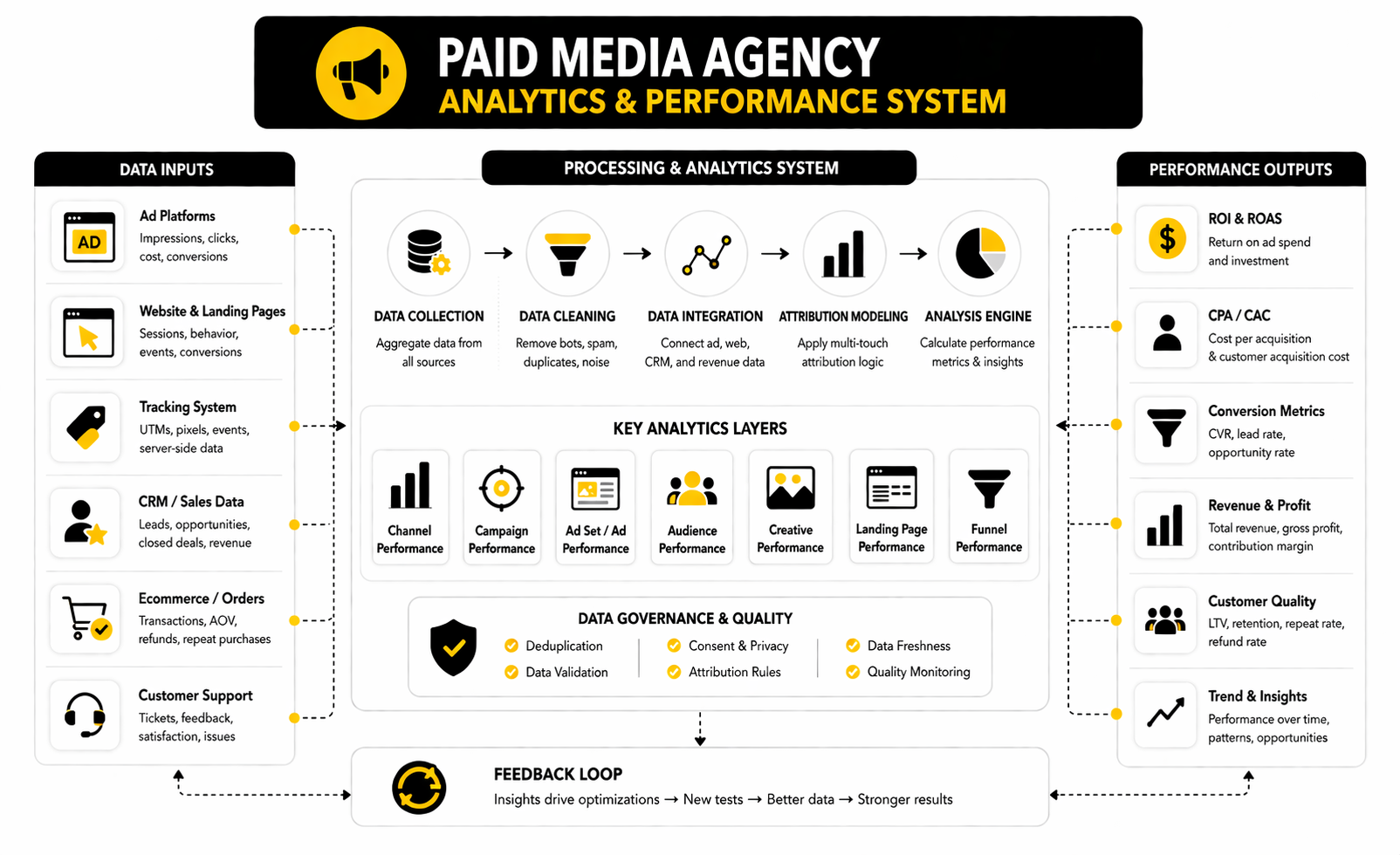
Before you hire or renew with a paid media agency, use this final checklist:
- The agency understands your offer, margins, sales cycle, and customer quality requirements.
- Tracking is audited before major budget decisions are made.
- Campaigns are structured around clear hypotheses, not random platform tweaks.
- Creative testing has an owner, a cadence, and a feedback loop.
- Landing pages are reviewed as part of performance, not treated as someone else’s problem.
- Reporting connects spend to pipeline, revenue, margin, or customer quality.
- Budget increases follow decision rules instead of emotion.
- The agency is honest about attribution limits.
- You know what is being tested, scaled, paused, and learned.
- Both sides agree on what inputs the agency needs from the business.
FAQ - Built for Complete Guide
What does a paid media agency do?
A paid media agency plans, launches, manages, and optimizes advertising campaigns across paid channels. That can include Google Ads, Meta Ads, LinkedIn Ads, TikTok Ads, YouTube, display, retargeting, and other paid placements. The best agencies also help with tracking, creative testing, landing page feedback, reporting, and budget decisions.
How much does a paid media agency cost?
Pricing varies by agency, market, and scope. Some charge a flat monthly retainer, some charge a percentage of ad spend, and some use a hybrid model. The important thing is not just the fee; it is whether the agency can protect and improve the total economics of your ad spend.
When should I hire a paid media agency?
Hire an agency when paid acquisition matters enough that amateur execution is becoming expensive. That usually means you have a real offer, a defined customer, enough budget to test properly, and the ability to track outcomes beyond surface-level clicks. If you still do not know who buys or why they buy, fix that before outsourcing scale.
What budget do I need before hiring a paid media agency?
There is no universal number, but the budget should be large enough to produce meaningful data. If the monthly ad spend is too small, the agency may not have enough signal to test audiences, creative, landing pages, and conversion events properly. A smaller business may be better served by a specialist freelancer before moving into a full-service agency.
How do I know if a paid media agency is good?
A good agency explains decisions clearly. It can tell you what was tested, what changed, what the data suggests, what the next move is, and what it needs from you. It should also connect campaign performance to real business outcomes, not just report platform metrics.
What is the biggest red flag when hiring a paid media agency?
The biggest red flag is a guaranteed result before the agency reviews your data. Responsible agencies can model scenarios and explain what they believe is realistic, but paid media has too many variables for blind promises. Be especially careful when an agency avoids questions about tracking, sales quality, margins, or landing pages.
Should a paid media agency handle creative?
Ideally, yes, or it should at least be heavily involved in creative direction. Creative is now one of the biggest performance levers in paid social, video, and even some search-adjacent campaigns. If the agency only adjusts budgets but never improves messaging, the account can stall quickly.
Should I use one paid media agency for every channel?
Sometimes, but not always. One agency can work well if it has strong cross-channel strategy and enough specialists internally. For complex businesses, it may be better to use a lead agency plus channel specialists, as long as reporting and decision-making stay connected.
How long does it take to judge performance?
You can judge process quality early, but performance needs enough time and data. The first few weeks should show whether tracking is clean, tests are structured, communication is clear, and the agency understands the business. Bigger conclusions about scale usually need more time because creative cycles, sales cycles, and attribution windows affect the data.
What metrics should I watch most closely?
Watch the metrics closest to money. For ecommerce, that usually means contribution margin, payback period, new customer acquisition cost, average order value, repeat purchase, and blended ROAS. For lead generation, watch qualified lead rate, cost per qualified opportunity, close rate, pipeline value, speed-to-lead, and revenue.
Can a paid media agency fix a weak offer?
No agency can permanently save an offer the market does not want. Paid media can test positioning, angles, audiences, and landing pages, but it cannot manufacture real demand from nothing. A good agency will tell you when the offer needs work instead of pretending the issue is only campaign settings.
What tools help agencies and clients work better together?
The useful tools are the ones that reduce friction in the system. GoHighLevel can help lead generation teams manage CRM, automations, pipelines, and follow-up. Replo can help Shopify teams build and test landing pages faster when page speed of execution is the bottleneck.
Work With Professionals
Explore 10K+ Remote Marketing Contracts on MarkeWork.com
Most marketers spend too much time chasing clients, competing on crowded platforms, and losing a percentage of every project to middlemen.
MarkeWork gives you a better way. Browse thousands of remote marketing contracts and connect directly with companies desperate to hire skilled marketers like you, without platform commissions and without unnecessary gatekeepers.
If you're serious about finding better opportunities and keeping 100% of what you earn, explore available contracts and create a profile for free at MarkeWork.com.