

Paid search is the part of digital advertising where you pay to appear when people search for something related to your offer. That sounds simple, but the real value is timing: your ad shows up when the buyer is already asking for help, comparing options, checking prices, or looking for a provider.
The channel still matters because search captures demand that already exists. In 2024, U.S. internet ad revenue reached a record $259 billion, and search remained one of the largest engines behind that growth. Costs are rising too, with 2025 benchmark data showing average Google Ads CPC at $5.26, so the winners are not the brands that simply spend more; they are the brands that structure paid search better.
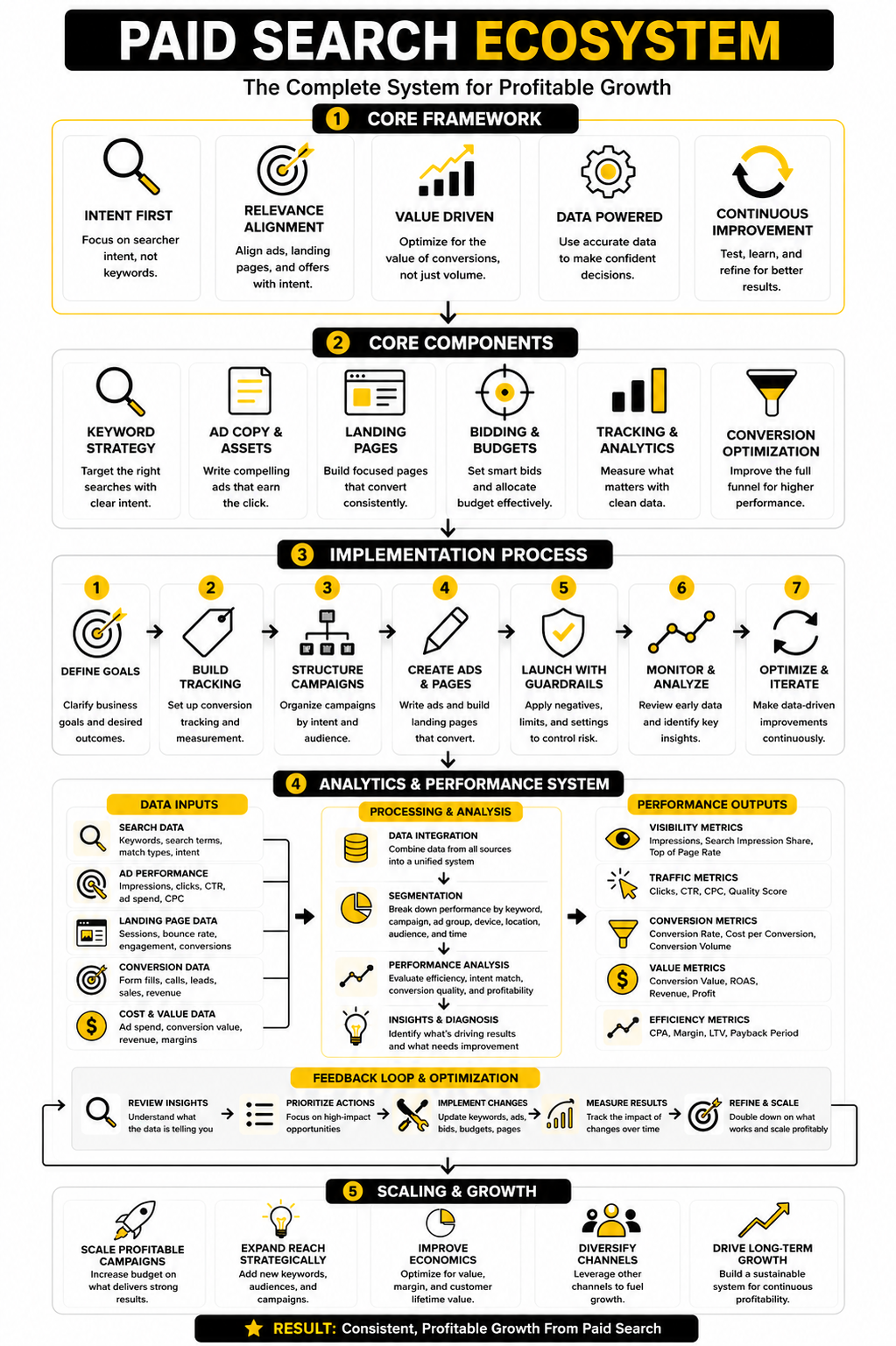
This article will break paid search into six practical parts:
- Why Paid Search Matters
- The Paid Search Framework
- Core Components Of A Profitable Campaign
- Professional Implementation
- Optimization, Measurement, And Scaling
- Paid Search FAQ And Final Checklist
Why Paid Search Matters
Paid search matters because it sits close to commercial intent. Someone searching “best CRM for agencies” or “emergency plumber near me” is much closer to action than someone casually scrolling past a social post. That does not mean paid search is automatically profitable, but it does mean the channel gives you a cleaner signal of what people want.
It also gives you control that organic search cannot always provide quickly. You can test offers, landing pages, keywords, locations, devices, and audience segments without waiting months for rankings to move. For businesses that need pipeline now, paid search is often the fastest way to learn which demand is real.
But paid search is unforgiving. Bad tracking, weak landing pages, broad targeting, and lazy ad copy can burn budget fast. The goal is not to “run ads”; the goal is to build a system where search intent, message, landing page, and conversion economics all line up.
The Paid Search Framework
A strong paid search strategy starts with intent, not keywords. Keywords are only the visible surface of what the buyer is trying to do. Behind every search is a job: compare, buy, book, troubleshoot, replace, estimate, or validate.
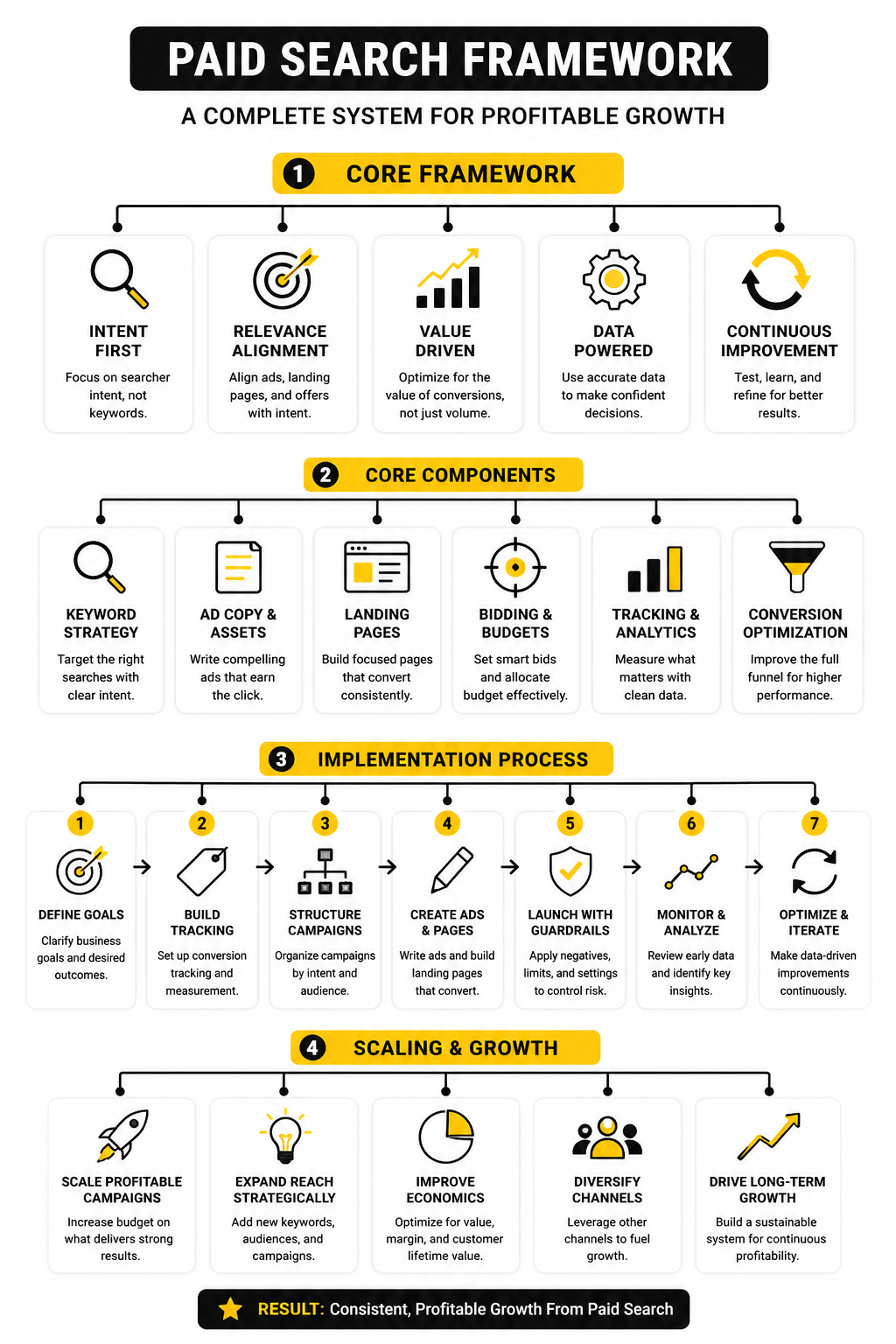
The framework is simple: match the query to the buyer’s intent, match the ad to the promise, match the landing page to the next action, and match the bid to the value of the conversion. When those pieces are aligned, paid search becomes measurable and scalable. When one piece breaks, the campaign usually becomes expensive noise.
Modern paid search also includes more automation than it used to. Google now promotes AI-powered Search features such as AI Max for Search campaigns, while Performance Max can extend campaigns across Google inventory beyond keyword-based Search. That makes the framework even more important, because automation performs best when the inputs are clean.
Core Components Of A Profitable Campaign
A profitable paid search campaign is built from a few moving parts that have to work together. You need the right keywords, but keywords alone are not enough. You also need strong intent grouping, clear ads, useful landing pages, clean tracking, and a bidding model that reflects what a lead or sale is actually worth.
The mistake many advertisers make is treating the account like a list of keywords with budgets attached. That creates campaigns that look busy but do not give you control. A better approach is to build each campaign around a specific business objective, then make every component support that objective.
Keyword Intent
Keyword intent is the foundation because it tells you what the searcher is trying to accomplish. A search like “what is paid search” is informational. A search like “paid search agency pricing” is commercial. A search like “hire paid search agency” is much closer to action.
You do not want to treat those three searches the same way. They need different ads, different landing pages, and different expectations. Informational searches may be useful for remarketing or content-led funnels, but high-intent commercial searches usually deserve tighter budgets and stronger conversion paths.
Match types matter here because they control how closely a search query must relate to your keyword. Microsoft Advertising defines the main keyword match types as broad match, phrase match, and exact match, and Google uses a similar structure. Broad match can help discover new demand, but it needs strong negatives, conversion tracking, and enough data to avoid waste.
Campaign Structure
Campaign structure should make decisions easier. If every service, location, audience, and intent level is mixed together, you cannot clearly see what is working. You end up optimizing averages instead of fixing the real problem.
A cleaner structure usually separates campaigns by business line, market, budget priority, or intent level. For example, brand search, competitor search, core service search, and remarketing-supported search should not all be treated as one bucket. Each has a different level of intent, different cost profile, and different role in the funnel.
This is especially important as automation becomes more common. Google’s 2025 updates positioned AI Max for Search as an AI-powered way to expand relevance, reach, and performance inside Search campaigns through targeting and creative features. That can be useful, but automation does not remove the need for structure. It makes clean structure more valuable because the system needs clear signals.
Ad Copy And Message Match
Good ad copy does not try to be clever first. It reflects the searcher’s problem, gives them a reason to click, and sets an honest expectation for what happens after the click. The best paid search ads usually feel obvious because they match the query so closely.
Message match is the bridge between the keyword, the ad, and the landing page. If someone searches for “paid search audit,” the ad should not send them to a generic marketing homepage. It should make the audit offer clear and take them to a page that continues the same promise.
This matters because Google evaluates more than the bid. Ad Rank is based on a set of values that influence whether an ad can show and where it appears, including factors tied to relevance and expected performance through the auction system described in Google’s Ad Rank documentation. In plain English: relevance is not decoration. It can affect both visibility and efficiency.
Landing Pages
The landing page is where paid search either turns into revenue or becomes an expensive traffic source. A click is not a win by itself. The page has to continue the conversation that started in the search box.
A strong paid search landing page usually has one clear action, a specific promise, proof that reduces risk, and enough detail to help the visitor make a decision. It should not force people to hunt through a full website just to understand the offer. If the page is slow, vague, or disconnected from the ad, the campaign will pay for attention and lose it immediately.
Google’s Quality Score is a useful diagnostic here because it looks at how useful and relevant the ad and landing page are compared with other advertisers at the keyword level. The score runs from 1 to 10, but the number itself is not the business goal. Use it as a signal to improve expected click-through rate, ad relevance, and landing page experience.
Conversion Tracking
Conversion tracking is where many paid search accounts quietly break. If the account is optimizing for weak signals, the platform will learn from weak signals. That means form visits, button clicks, or page views can accidentally become the goal even when they do not represent real pipeline.
You need to define what counts as a meaningful conversion before you scale. For ecommerce, that may be purchases, revenue, and margin-aware return. For lead generation, it may be qualified calls, booked appointments, completed applications, or sales-qualified opportunities.
This is also where your CRM and follow-up system matter. A tool like GoHighLevel can make sense when a business needs landing pages, pipelines, booking, follow-up, and attribution in one place. The key is not the tool itself; the key is closing the gap between the click and the sale.
Budget And Bidding
Budgeting for paid search should start with the economics of the business. You need to know how much a customer is worth, what conversion rate you can realistically achieve, and what cost per acquisition still leaves room for profit. Without that, bidding becomes guesswork.
The market is not getting cheaper. Recent benchmark data put the average Google Ads cost per click at $5.26, while average conversion rates vary heavily by industry and offer. That means a campaign can look fine on the surface and still fail financially if the conversion path is weak.
Smart bidding can help when the account has clean conversion data and enough volume. But it is not magic. Feed the system poor tracking, messy structure, or low-quality leads, and it will optimize toward the wrong outcome faster than a human could.
Professional Implementation
Professional paid search implementation is where strategy turns into a working system. This is the point where the account stops being an idea in a planning document and becomes a live revenue engine with campaigns, tracking, budgets, landing pages, and reporting. The work is detailed, but it should not feel random.
The goal is to launch with enough structure to control spend, enough data quality to trust performance, and enough flexibility to learn quickly. You do not need to build the perfect account on day one. You do need to avoid the kind of sloppy setup that makes every later decision harder.
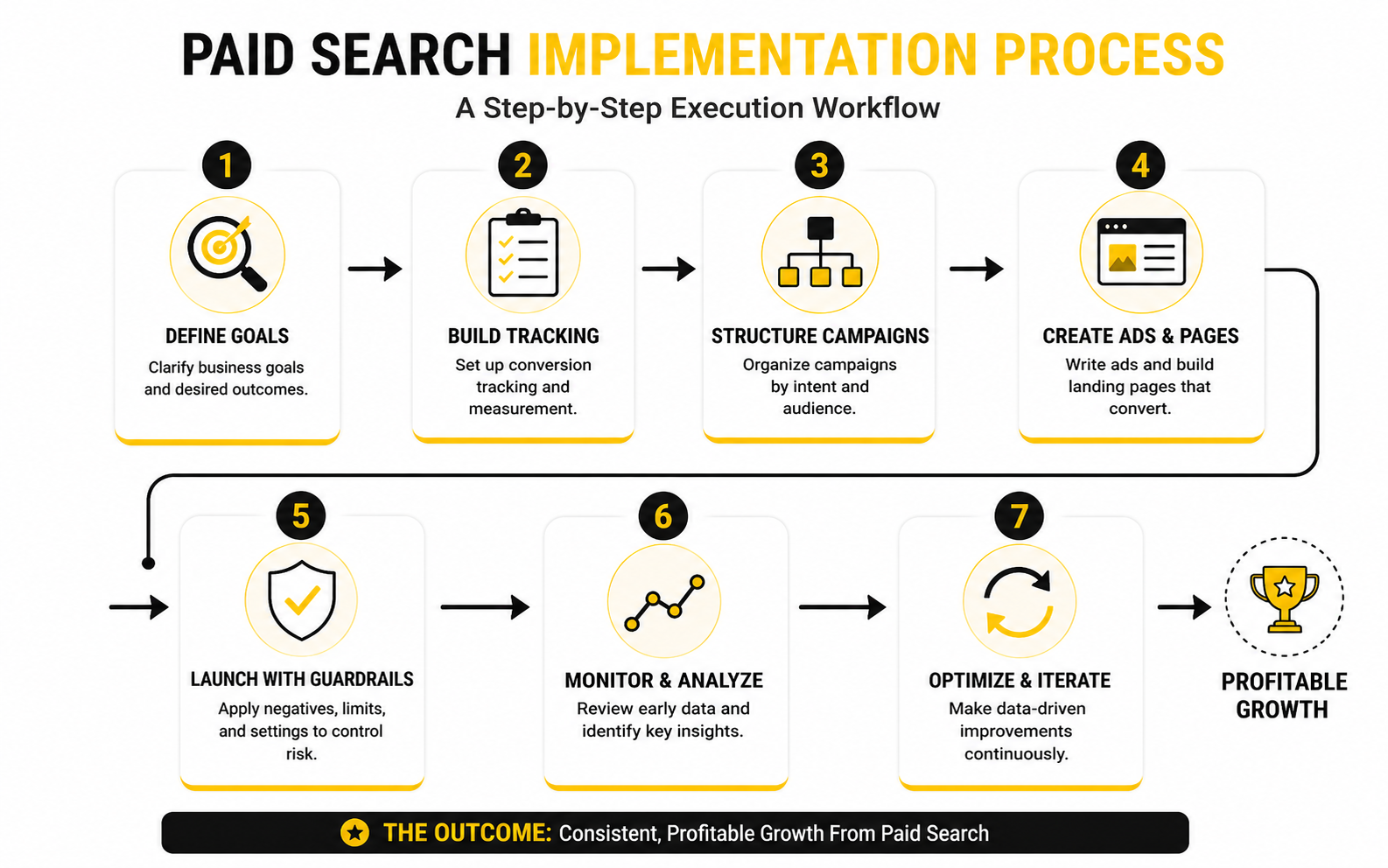
Step 1: Define The Business Goal
Start with the business outcome, not the ad platform. A campaign built to generate booked calls should not be structured the same way as a campaign built to drive ecommerce purchases. The conversion action, bidding strategy, landing page, and reporting view all depend on the goal.
This is where you decide what success means in plain numbers. For lead generation, that might be qualified booked appointments, accepted consultations, or sales opportunities. For ecommerce, it might be profitable purchases, first-order contribution margin, or revenue from new customers.
Do not skip this step because paid search platforms will optimize toward whatever you tell them to value. Google’s conversion documentation makes the same basic point from a technical angle: conversion tracking is what lets you measure actions after an ad interaction, including purchases, calls, installs, and other business outcomes through Google Ads conversion management. If the goal is vague, the system will still optimize, but it may optimize toward the wrong thing.
Step 2: Build The Tracking Foundation
Before launch, tracking has to be treated as part of the campaign, not a separate technical chore. At minimum, you need conversion actions, tag implementation, analytics alignment, CRM capture, and a way to separate real conversions from weak signals. This is not glamorous work, but it is the work that protects the budget.
For lead generation, the best setup usually goes beyond form submissions. Importing offline conversions helps connect ad clicks to later sales activity, such as calls, consultations, qualified opportunities, and closed deals, which Google supports through offline conversion imports. That matters because the first conversion is often not the business outcome.
Enhanced conversions can also improve measurement quality by using hashed first-party customer data in a privacy-safe way to supplement existing conversion data. Google describes enhanced conversions for web as a feature that can improve conversion measurement accuracy by matching hashed customer data to signed-in Google accounts through enhanced conversions. In practical terms, cleaner measurement gives your bidding strategy better signals.
Step 3: Map Intent To Campaigns
Once the tracking foundation is in place, map search intent into campaign groups. This is where the account becomes easier to manage. Instead of throwing all keywords into one structure, separate searches based on how close the person is to buying, booking, comparing, or researching.
Brand terms should be handled differently from non-brand commercial terms. Competitor searches need different expectations from service searches. High-intent bottom-funnel keywords deserve tighter control because they are closer to money, while broader discovery terms need stronger guardrails.
The output should be a simple campaign map that a non-specialist can understand. If the business owner, sales lead, or marketing manager cannot tell what each campaign is supposed to do, the structure is probably too messy. Paid search should create clarity, not another black box.
Step 4: Write Ads Around The Next Action
Ad copy should be written around the next action you want the searcher to take. If the next action is booking a demo, the ad should make that path obvious. If the next action is comparing pricing, the ad should make the comparison promise clear and honest.
This is also where you use assets and extensions carefully. Sitelinks, callouts, structured snippets, call assets, and lead form assets can improve the usefulness of the ad, but only when they support the searcher’s intent. Adding every possible asset without thinking does not make the campaign stronger.
The best ads remove friction. They tell the searcher they are in the right place, give them one strong reason to click, and avoid overpromising. Paid search rewards relevance, but relevance is not just repeating the keyword; it is matching the buyer’s problem with a believable next step.
Step 5: Build The Landing Page Before Scaling
A paid search campaign should not scale into a weak landing page. The landing page has to continue the promise from the ad, explain the offer clearly, reduce uncertainty, and make the conversion action easy. If the page creates confusion, the budget will expose that fast.
For service businesses, a strong landing page usually needs a clear headline, a concise explanation of the outcome, proof, process, objections, and a simple booking path. For ecommerce, the page has to make the product value, price, shipping, reviews, and return confidence obvious. The point is not to make the page long or short; the point is to make the decision easier.
If you are building dedicated landing pages for campaigns, tools like ClickFunnels, Systeme.io, or Replo can fit different workflows. The tool matters less than the discipline: one page, one promise, one primary action, and enough proof to make the click worth something.
Step 6: Launch With Guardrails
The first launch should be controlled. Set budgets at a level that can produce learning without creating unnecessary risk. Use negative keywords, location settings, device review, audience observations, and conversion exclusions carefully before traffic starts flowing.
This is also the moment to check platform recommendations with judgment. Some recommendations are useful, but not every automated suggestion fits your economics. Google’s AI Max for Search is described as an optimization layer for existing Search campaigns that can expand reach, tailor creative, and optimize landing pages through AI-powered Search campaign features, but that does not mean every account should turn on every feature without a test plan.
Guardrails are not about being conservative forever. They are about giving the campaign room to learn without letting early noise control the account. Once you have reliable conversion data and clear search term patterns, you can loosen the system deliberately.
Step 7: Review Early Data Without Panicking
The first days of a paid search launch are usually noisy. Clicks may come in before conversions. Search terms may reveal unexpected language. Ads that looked strong in planning may underperform when real buyers start reacting.
Do not make major changes based on one or two clicks. Do look for obvious waste, broken tracking, irrelevant search terms, rejected assets, landing page errors, and budget allocation problems. Early optimization should focus on fixing setup issues before making strategic judgments.
After the campaign has enough data, review performance by intent group rather than only at the account level. A high average cost per lead might hide one profitable campaign and one wasteful campaign. The job is to find the signal, protect what works, and cut what does not.
Statistics And Data
Paid search data is useful only when it helps you make a better decision. A benchmark can tell you whether your campaign is roughly competitive, but it cannot tell you whether your economics work. That is the part too many advertisers miss.
A campaign with a high cost per click can still be profitable if the conversion rate, sales rate, and customer value are strong. A campaign with cheap clicks can still be a disaster if the traffic is weak or the leads never close. The point of measurement is not to stare at dashboards; it is to decide what to keep, what to fix, and what to cut.
The Market-Level Numbers
Paid search is still one of the biggest channels in digital advertising. U.S. digital ad revenue reached $259 billion in 2024, and search accounted for about $102.9 billion of that spend. That tells you two things at once: demand is still massive, and competition is not going away.
Benchmarks also show why discipline matters. In 2025, cross-industry Google Ads benchmark data reported an average search advertising click-through rate of 6.66%, an average cost per click of $5.26, an average conversion rate of 7.52%, and an average cost per lead of $70.11. Those numbers are useful, but they are not targets you blindly copy.
Use benchmarks as context, not as law. If your industry has expensive clicks but high customer lifetime value, a higher cost per lead may be completely acceptable. If your offer has low margins, even a “good” benchmark cost can be too expensive.
The Metrics That Actually Matter
Most paid search accounts have too many visible metrics and too few meaningful decisions. Impressions, clicks, CTR, CPC, conversion rate, cost per conversion, and return on ad spend all matter in different ways. But none of them should be interpreted alone.
Click-through rate tells you whether the ad is earning attention for the searches it appears on. Cost per click tells you how expensive that attention is. Conversion rate tells you whether the traffic and landing page are aligned. Cost per acquisition tells you whether the campaign has a chance to work financially.
The deeper question is simple: does the campaign produce profitable customers or qualified pipeline? If the answer is no, vanity metrics do not save it. A campaign can have a beautiful CTR and still attract the wrong people.
The Measurement System
A proper paid search measurement system connects the platform, the website, the CRM, and the final business result. The ad platform can show clicks and tracked conversions, but the CRM tells you whether those conversions became real opportunities. Without that connection, you are optimizing for the first visible action instead of the outcome that pays the bills.
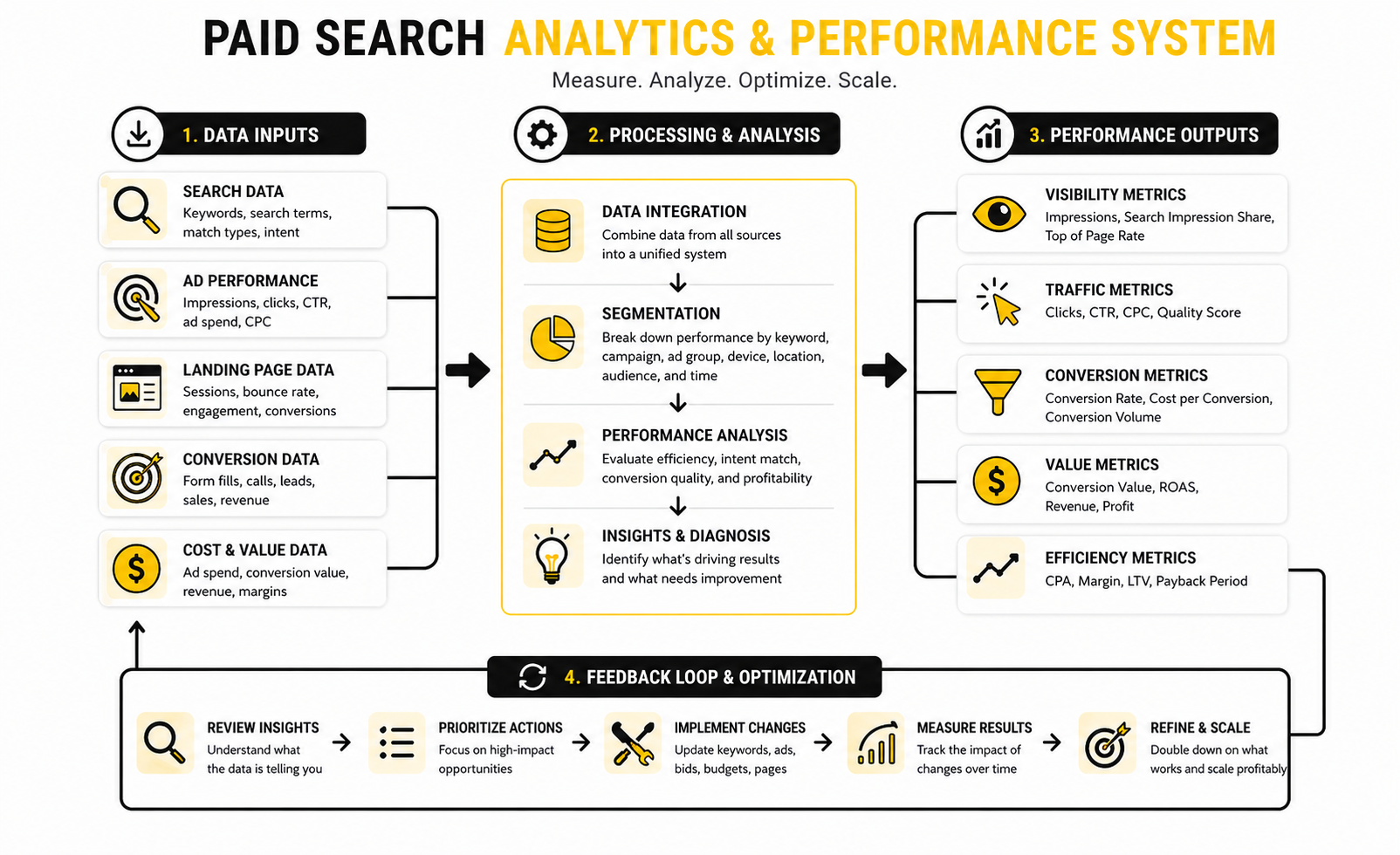
The cleanest setup usually separates measurement into stages:
- Search signal: the query, keyword, match type, location, device, and audience context.
- Ad signal: impressions, clicks, CTR, assets, and message performance.
- Page signal: landing page engagement, form completions, calls, bookings, and checkout behavior.
- Sales signal: qualified leads, opportunities, revenue, refunds, and lifetime value.
This structure matters because each stage answers a different question. Search data tells you whether the traffic is relevant. Ad data tells you whether the message is strong enough to earn the click. Page data tells you whether the promise converts. Sales data tells you whether the conversion was worth buying.
Reading Cost Per Click Correctly
Cost per click is one of the easiest metrics to misunderstand. A low CPC feels good because the traffic looks cheap. A high CPC feels painful because every click carries more pressure.
But the real question is not whether a click is cheap. The real question is whether the click has enough intent to justify the price. Paying more for a buyer who is ready to act can be smarter than paying less for someone who is only browsing.
When CPC rises, do not react emotionally. Check search terms, match types, quality signals, competitor pressure, and conversion value before changing bids. Cutting bids too fast can reduce the exact traffic that was closest to revenue.
Reading Conversion Rate Correctly
Conversion rate shows how well the landing page and offer turn visitors into the tracked action. It is one of the most important paid search metrics, but it can also be misleading. A high conversion rate is not always good if the conversion action is too soft.
For example, a campaign optimized for low-quality form fills may show strong conversion rates while sales complains that the leads are useless. That is not a traffic problem alone. It is a measurement problem, an offer problem, or both.
A better approach is to measure conversion quality in layers. Track the first conversion, but also track qualified lead rate, booking rate, show-up rate, close rate, and revenue. This gives you a clearer view of what the campaign is actually producing.
Reading Return On Ad Spend Correctly
Return on ad spend is useful when revenue is tracked cleanly, especially in ecommerce. It tells you how much revenue came back for each dollar spent. But ROAS can still hide the truth if margins, refunds, repeat purchases, and new versus returning customers are ignored.
A high ROAS campaign may look impressive while bringing in low-margin orders. A lower ROAS campaign may be more valuable if it acquires better customers who buy again. That is why paid search reporting should eventually move from platform ROAS to contribution margin and customer value.
For lead generation, ROAS often shows up later because revenue happens after the click, call, or booked appointment. That is why importing offline conversions matters. When platforms can receive better post-lead signals, they can optimize toward the leads that actually become revenue instead of the leads that merely submit forms.
What The Data Should Make You Do
Data should lead to action. If search terms are irrelevant, tighten match types or add negatives. If CTR is weak, rewrite ads and test stronger angles. If clicks are good but conversions are weak, fix the landing page or offer. If leads convert but do not close, review qualification and sales follow-up.
A practical weekly review should not become a bloated reporting ritual. Look for budget waste, intent mismatches, tracking issues, campaign-level winners, and campaign-level losers. Then make a few clear changes and give them enough time to show results.
The best paid search operators are not the ones with the prettiest dashboards. They are the ones who know which number matters at each stage of the funnel and what action that number should trigger. That is where measurement becomes leverage.
Optimization, Measurement, And Scaling
Scaling paid search is not the same as increasing the budget. Anyone can spend more. The real skill is increasing spend while protecting lead quality, margin, and learning speed.
This is where the account moves from setup into judgment. You are no longer asking only whether the campaign can generate conversions. You are asking which conversions are worth buying, which segments deserve more budget, and which parts of the system are quietly limiting growth.
Scaling Starts With Constraint Diagnosis
Before you scale, identify the constraint. Sometimes the constraint is traffic volume because the campaign is not reaching enough relevant searches. Sometimes it is conversion rate because the landing page is not persuasive enough. Sometimes it is sales follow-up because good leads are being wasted after the form submission.
Do not assume the ad account is always the bottleneck. Paid search sits inside a bigger revenue system, and the weak point can be the offer, the page, the tracking, the sales process, or the economics. If you scale the wrong thing, you multiply the problem.
A simple way to diagnose the constraint is to follow the funnel in order. Are the right searches triggering ads? Are the ads earning qualified clicks? Are the clicks turning into meaningful conversions? Are those conversions becoming revenue? The answer tells you where to work next.
The Tradeoff Between Control And Automation
Modern paid search gives advertisers more automation than ever, but automation is not a replacement for strategy. Google’s Smart Bidding uses AI to optimize for conversions or conversion value through auction-time bidding, as explained in its Smart Bidding guide. That can be powerful when the account has clean data and a clear goal.
The tradeoff is control. Manual bidding gives you more direct control over bids and budgets, but it can become inefficient at scale. Automated bidding can react to more signals, but it needs trustworthy conversion data and enough volume to learn from.
Value-based bidding is often the better long-term direction when the business can pass accurate values back into the platform. Google defines value-based bidding as a Smart Bidding approach that optimizes campaigns based on the value brought to the business, rather than only conversion volume, through conversion value signals. That distinction matters because ten low-quality leads are not better than three high-quality buyers.
When To Expand Keywords
Keyword expansion should happen after you understand what is already working. If your profitable search terms are clustered around specific services, problems, or buyer language, expand from that pattern. Do not expand just because the platform says there is more volume available.
There are three safer ways to expand. First, add close variants of converting terms with clear intent. Second, test adjacent problems that the same buyer is likely to search before purchase. Third, use broader match types only when tracking and negatives are strong enough to control waste.
Expansion should always come with a review rhythm. Search term reports, negative keyword updates, and conversion quality checks become more important as reach grows. More reach means more opportunity, but it also means more ways to buy traffic that looks relevant and does not convert.
When To Expand Channels
Paid search can work as the core acquisition channel, but it should not always carry the whole growth plan alone. Once the highest-intent search demand is covered, additional growth may require remarketing, YouTube, Performance Max, shopping campaigns, social ads, email, or organic content. The right move depends on where the next profitable demand can be created or captured.
Performance Max can be useful when a business has strong creative assets, reliable conversion tracking, and a clear value signal. Google’s 2025 Performance Max update emphasized more controls and reporting, including new ways to improve transparency through Performance Max features. That is helpful, but it still requires careful interpretation because Performance Max is not the same as pure search intent.
The strategic question is simple: are you expanding because the current search campaigns are saturated, or are you expanding because the existing campaigns are not working? Those are very different situations. Expansion should amplify a working system, not distract from fixing a broken one.
The Risk Of Optimizing For The Wrong Conversion
One of the biggest paid search risks is optimizing toward a conversion that is easy to get but commercially weak. This often happens in lead generation. The campaign learns to generate form fills, but the sales team learns that those form fills are not serious buyers.
This is why offline conversion tracking and CRM feedback become more important as spend grows. If a booked call, qualified opportunity, or closed deal is worth more than a basic form submission, the platform needs that information. Otherwise, the algorithm may reward the cheapest leads instead of the best leads.
For agencies and service businesses, a platform like GoHighLevel can help connect forms, calendars, pipelines, and follow-up into one operating system. For simpler funnel builds, ClickFunnels or Systeme.io can be enough. The strategic point is the same either way: track what creates revenue, not just what creates activity.
Budget Scaling Without Breaking Performance
Budget increases should be gradual enough to preserve learning. If a campaign is working at one spend level, doubling the budget overnight can push the system into weaker auctions, broader queries, or less efficient segments. That does not mean you should be afraid to scale, but it does mean you should scale with a plan.
A practical approach is to increase budget where the campaign has stable conversion volume, profitable economics, and search impression share left to capture. If the campaign is limited by budget and still hitting your target cost or value goal, that is a stronger scaling signal. If the campaign is not limited by budget, adding more money may do nothing useful.
Watch marginal performance, not only average performance. The first $1,000 of spend may be highly profitable because it captures the best demand. The next $1,000 may be weaker because it reaches broader or more competitive traffic. Scaling means understanding where the next dollar goes.
Competitive Pressure And Brand Defense
Competitors can change the economics of paid search quickly. New advertisers enter the auction, existing competitors raise bids, and brands may start bidding on each other’s names. This can increase costs even when your account has not changed.
Brand campaigns are often worth protecting because they capture people already looking for you. The strategic debate is not whether brand traffic is valuable; it is how much incremental value the ads provide beyond organic visibility. That depends on your market, competitors, search results, and how aggressively others bid on your brand.
Competitor campaigns require even more discipline. They can be expensive, lower-converting, and harder to message legally and ethically. If you run them, keep the offer clean, avoid misleading copy, and measure performance separately from your core service campaigns.
The Expert-Level Rule
The expert-level rule is simple: scale only what you can explain. If you cannot explain why a campaign is working, you are not ready to scale it aggressively. You may just be riding temporary auction conditions, weak competition, or incomplete tracking.
Strong paid search management is part math, part market reading, and part operational discipline. You need the numbers, but you also need to understand the buyer behind the search. When those two sides line up, scaling becomes much less emotional.
The best accounts are not built around hacks. They are built around clear intent, clean measurement, strong offers, disciplined testing, and honest economics. That is the difference between a campaign that spends money and a campaign that compounds.
Paid Search FAQ And Final Checklist
What Is Paid Search?
Paid search is a form of digital advertising where advertisers pay to appear on search engine results pages for relevant searches. The most common version is Google Ads search advertising, but paid search can also include Microsoft Advertising and other search-based ad platforms. The core idea is simple: you pay to reach people at the moment they are actively searching for something.
Is Paid Search The Same As PPC?
Paid search is a type of PPC, but PPC is broader. PPC means pay-per-click advertising, which can include search ads, display ads, shopping ads, social ads, and other click-based formats. Paid search specifically focuses on ads triggered by search behavior.
How Much Does Paid Search Cost?
Paid search costs depend on the industry, keyword competition, location, conversion value, and account quality. Recent benchmark data puts the average Google Ads CPC at $5.26, but that number should be treated as context rather than a universal target. A profitable campaign is not defined by cheap clicks; it is defined by whether the clicks turn into profitable customers.
How Long Does Paid Search Take To Work?
Paid search can generate traffic almost immediately after launch, but performance usually needs time to stabilize. The first phase is about collecting enough data to understand search terms, conversion quality, ad performance, and landing page behavior. Treat the first few weeks as controlled learning, not instant proof that the whole channel works or fails.
What Makes A Paid Search Campaign Profitable?
Profitability comes from the relationship between customer value, conversion rate, sales rate, and cost. A campaign can survive high CPCs when the buyers are valuable and the funnel converts well. It can also fail with cheap traffic if the leads are weak, the offer is unclear, or the sales process is broken.
Should I Use Broad Match Keywords?
Broad match can work, but it needs guardrails. It is most useful when you have strong conversion tracking, clear negative keywords, enough budget to learn, and a bidding strategy aligned with real business value. Without those pieces, broad match can spend aggressively on searches that look relevant but do not produce qualified demand.
What Is A Good Conversion Rate For Paid Search?
A good conversion rate depends on the offer, industry, funnel, and conversion action. One recent benchmark puts the average Google Ads conversion rate at 7.52%, but your real target should be based on profitability. A lower conversion rate with high-quality buyers can beat a higher conversion rate filled with weak leads.
Do I Need Dedicated Landing Pages?
In most serious paid search campaigns, yes. A dedicated landing page lets you match the search intent, ad promise, and conversion action without forcing visitors through a general website. The page does not need to be complicated, but it does need to be focused, fast, credible, and easy to act on.
Should I Run Brand Search Ads?
Brand search ads can make sense when competitors are bidding on your name, your search results are crowded, or you want tighter control over the message. They are often cheaper and higher-converting than non-brand campaigns because the searcher already knows you. The real question is incremental value: would you have captured that demand anyway, or does the ad protect and improve the outcome?
What Is The Biggest Paid Search Mistake?
The biggest mistake is optimizing for the wrong signal. If the account is told that every form fill is equally valuable, it may learn to generate the cheapest form fills instead of the best customers. That is why serious accounts connect paid search data to qualified leads, pipeline, revenue, and customer value.
How Often Should Paid Search Campaigns Be Optimized?
Paid search should be reviewed regularly, but not every number needs a daily reaction. Early campaigns need close monitoring for tracking issues, search term waste, and budget problems. Mature campaigns need a steady review rhythm focused on meaningful changes, not constant tinkering.
When Should I Hire A Paid Search Professional?
Hire a professional when the account is spending enough that mistakes are expensive, when tracking is unclear, or when growth depends on more than basic campaign setup. A good specialist should understand bidding, structure, analytics, landing pages, and business economics. Paid search is not just platform management; it is revenue system management.
Work With Professionals
Explore 10K+ Remote Marketing Contracts on MarkeWork.com
Most marketers spend too much time chasing clients, competing on crowded platforms, and losing a percentage of every project to middlemen.
MarkeWork gives you a better way. Browse thousands of remote marketing contracts and connect directly with companies desperate to hire skilled marketers like you, without platform commissions and without unnecessary gatekeepers.
If you're serious about finding better opportunities and keeping 100% of what you earn, explore available contracts and create a profile for free at MarkeWork.com.