

Paid search advertising works because it meets people at the moment they are already looking for a solution. Someone searches, an ad appears, and the advertiser pays only when that person clicks. That sounds simple, but profitable paid search is not about buying traffic. It is about matching intent, offer, message, landing page, measurement, and follow-up so tightly that the click has a real chance to become revenue.
The channel still matters because search remains one of the most commercially direct parts of digital marketing. U.S. internet advertising revenue reached $258.6 billion in 2024, and search remained the largest format. At the same time, costs are rising, automation is expanding, and weak campaign structure gets punished faster than before.
This article will break paid search advertising into a practical six-part system. We will start with the strategy, then move into keywords, campaigns, ads, landing pages, tracking, optimization, and scaling. The goal is not to make search ads feel complicated. The goal is to make them controllable.
Article Outline
- Part 1: Paid Search Advertising Strategy And Why It Still Matters
- Part 2: Search Intent, Keyword Strategy, And Campaign Structure
- Part 3: Ad Copy, Assets, Offers, And Landing Page Alignment
- Part 4: Bidding, Budgets, Tracking, And Conversion Quality
- Part 5: Optimization, Testing, Automation, And Scaling
- Part 6: Common Mistakes, Professional Implementation, And FAQ
Paid Search Advertising Strategy And Why It Still Matters
Paid search advertising is the practice of placing ads on search engines and search-powered networks so your business appears when people search for relevant terms. The classic version is a text ad on Google or Microsoft Bing, but the modern version includes broader match types, automated bidding, AI-assisted creative, landing page expansion, audience signals, and conversion-based optimization. Google’s own guidance frames ad quality around relevance, expected click-through rate, and landing page experience, which is why campaign performance depends on more than the keyword alone: Google Ads Quality Score.
The reason paid search remains powerful is simple: search behavior reveals intent. A person searching “best CRM for real estate agents” is not behaving like someone passively scrolling a feed. They are giving you a clue about the problem, category, urgency, and sometimes budget behind the click.
That does not mean every click is valuable. A paid search campaign can burn money quickly when keywords are too broad, ads overpromise, landing pages are generic, or conversion tracking counts low-quality actions as success. The businesses that win are usually not the ones with the flashiest ads. They are the ones with the cleanest intent-to-revenue system.
The Framework Overview
A strong paid search advertising framework has four layers: intent, economics, experience, and measurement. Intent decides which searches are worth paying for. Economics decides how much a click, lead, trial, booking, or sale is worth. Experience decides whether the visitor believes the page matches the promise in the ad. Measurement decides whether the platform is optimizing toward real business value or just cheap activity.
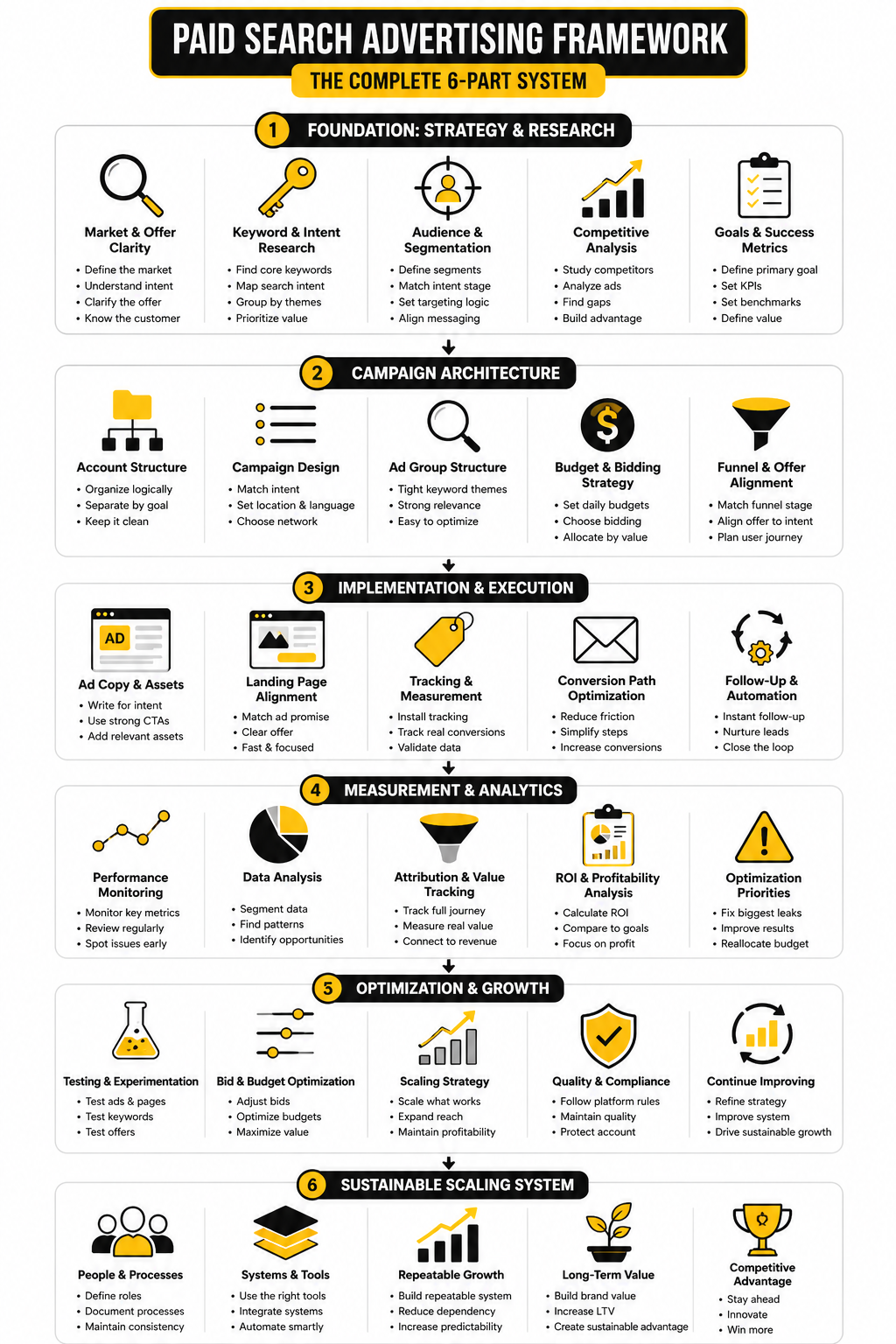
This is where beginners often get the channel wrong. They think paid search starts inside the ad account, but the real work starts before the first campaign is built. You need to know which customer problem you want to capture, what action you want the visitor to take, and what happens after that action.
For example, a lead generation business may need search ads, a focused landing page, a calendar flow, and a CRM follow-up system before it can judge performance fairly. Tools like GoHighLevel can fit that workflow when the business needs landing pages, pipeline tracking, automation, and follow-up in one place. The tool is not the strategy, though. It only helps if the offer, targeting, and measurement are already sharp.
Core Components Of A Profitable Search System
The first component is keyword and query control. Keywords tell the platform where to begin, but search terms reveal what people actually typed. That distinction matters because a campaign can look organized on paper while still paying for irrelevant searches in practice.
The second component is message match. The ad should reflect the searcher’s intent, and the landing page should continue the same promise without forcing the visitor to reinterpret it. If the ad talks about emergency plumbing repair, the page should not send people to a general homepage with twenty unrelated services.
The third component is conversion quality. A form submission, call, booking, trial, or purchase is not automatically valuable just because the platform labels it as a conversion. Good paid search advertising separates high-intent conversions from weak ones, then teaches the ad platform to find more of the actions that actually create revenue.
Search Intent, Keyword Strategy, And Campaign Structure
Paid search advertising becomes much easier when you stop thinking in keywords first and start thinking in intent first. A keyword is only the surface-level phrase. The real question is what the searcher wants, how close they are to action, and whether your business can profitably serve that moment.
A search like “what is paid search advertising” is educational. A search like “Google Ads agency for dentists” is commercial and much closer to a buying decision. Both can matter, but they should not sit in the same campaign with the same budget, bid strategy, ad copy, and landing page.
Start With Search Intent Before You Build Keywords
Search intent usually falls into four practical buckets: informational, commercial, transactional, and navigational. Informational searches are useful for education and retargeting, but they rarely deserve the same bids as bottom-funnel searches. Commercial and transactional searches are usually where paid search advertising becomes most direct because the person is comparing options, looking for pricing, or ready to act.
This is where campaign discipline matters. If you mix early research searches with high-intent purchase searches, the data gets muddy fast. The platform may start optimizing toward cheaper clicks or easier conversions instead of the searches that actually create pipeline and revenue.
A clean structure separates intent levels so you can control budgets and judge performance fairly. You might have one campaign for high-intent service searches, another for competitor or comparison searches, and another for educational terms if the economics support it. That separation gives you better decisions because each campaign has a clear job.
Use Match Types As Control Levers
Keyword match types decide how closely a search query needs to relate to your keyword before your ad can enter the auction. Google Ads currently uses broad match, phrase match, and exact match, with broad match reaching the widest set of related searches and exact match giving tighter control around specific intent: Google Ads keyword matching options. Microsoft Advertising also uses broad, phrase, and exact match types for search campaigns: Microsoft Advertising keyword match types.
Exact match is useful when you already know a keyword is valuable. Phrase match is often a practical middle ground when you want relevant variations without opening the door too wide. Broad match can work, but it needs strong conversion tracking, negative keywords, and enough data for automated bidding to learn from real outcomes.
The mistake is treating match types as a set-and-forget setting. They are control levers. Start tighter when budget is limited, loosen carefully when you need more volume, and always review the actual search terms that triggered your ads.
Build Campaigns Around Business Decisions
A good campaign structure should make business decisions easier. If one service has a higher margin, longer sales cycle, or different geography, it probably deserves its own campaign. If one location has a different budget or close rate, separating it can make reporting and optimization much cleaner.
Ad groups should then cluster closely related searches inside each campaign. The point is not to create hundreds of tiny ad groups just to feel organized. The point is to keep each ad group focused enough that the ad copy and landing page can speak naturally to the searcher’s intent.
This matters because relevance affects performance across the whole system. Google’s Quality Score guidance evaluates expected click-through rate, ad relevance, and landing page experience, so structure directly influences how well your campaigns can compete: Google Ads Quality Score. Better structure will not rescue a weak offer, but bad structure can absolutely hide a strong one.
Use Negative Keywords To Protect The Budget
Negative keywords are one of the most practical tools in paid search advertising because they stop your ads from showing on searches that do not fit. They are not glamorous, but they are often the difference between controlled spending and quiet waste. A campaign without negative keyword management is basically asking the platform to guess what you do not want.
The search terms report is where this work becomes real. It shows the searches that triggered your ads and how those searches performed, which helps you find irrelevant queries, new keyword ideas, and better landing page angles: Google Ads search terms report. Review it regularly, especially during the first weeks of a campaign.
Negative keywords should be organized with the same care as positive keywords. Some negatives belong at the account level because they are never relevant. Others belong at the campaign or ad group level because they only need to be blocked in a specific context.
Match The Funnel To The Follow-Up
Keyword strategy does not end when someone clicks. A high-intent lead might need a direct booking page, while a comparison search may need proof, pricing context, and a clear next step. If the follow-up system is weak, even good search traffic can look worse than it really is.
For service businesses, the biggest leak often happens after the conversion. Someone fills out a form, but the response is slow, the sales team lacks context, or the lead is never properly nurtured. A CRM and automation platform like GoHighLevel can help connect paid search leads to pipelines, follow-up messages, appointment booking, and revenue tracking.
For ecommerce or direct-response campaigns, the follow-up may be email, SMS, remarketing, or a stronger checkout flow. The principle is the same. Paid search advertising should not be judged only by the click or the first form submission; it should be judged by how well the entire path turns search intent into money.
Ad Copy, Assets, Offers, And Landing Page Alignment
Once the campaign structure is clean, execution becomes much more practical. Paid search advertising now has to do a difficult job in a small space: show up for the right query, make the offer clear, qualify the click, and send the person to a page that continues the same conversation. This is where many campaigns lose money because the keyword is right, but the message and page are not strong enough to convert.
The ad is not there to win attention from everyone. It is there to attract the right searcher and discourage the wrong one. That sounds obvious, but it changes how you write, because strong search ads are specific, not loud.
Write Ads Around The Searcher’s Next Decision
A good search ad answers the question the person is really asking. If someone searches for a local emergency service, they want speed, availability, trust, and a way to act now. If someone searches for software comparisons, they want clarity, proof, pricing context, and a reason to choose one option over another.
Responsive search ads give the platform multiple headlines and descriptions to combine for different searches. Google recommends using responsive search ads with varied, relevant assets so the system has more useful combinations to test: responsive search ad guidance. Microsoft Advertising uses a similar model, allowing multiple headlines and descriptions so the system can select combinations for each auction: responsive search ads.
The practical move is to write assets that each do a different job. One headline can name the service, one can qualify the audience, one can mention the core benefit, one can reduce risk, and one can push the next step. Repeating the same phrase fifteen times does not give the system more intelligence; it just gives it more duplicates.
Make The Offer Concrete
Paid search advertising works best when the offer is easy to understand in seconds. A vague “get started today” call to action is usually weaker than a specific next step like booking a consultation, requesting a quote, starting a trial, comparing plans, or downloading a buyer’s guide. The offer should match the searcher’s temperature.
For high-intent traffic, the offer can be direct. A quote request, call, demo, appointment, or checkout path makes sense because the person is already near action. For research-heavy traffic, forcing an immediate sales call may create friction, so a comparison page, calculator, guide, or email follow-up may perform better.
This is also where your funnel tool matters. If you need dedicated pages, order forms, upsells, and follow-up paths, a platform like ClickFunnels can fit direct-response campaigns where the paid click needs a tightly controlled conversion path. The point is not to add more software for fun. The point is to remove friction between the search intent and the action you want.
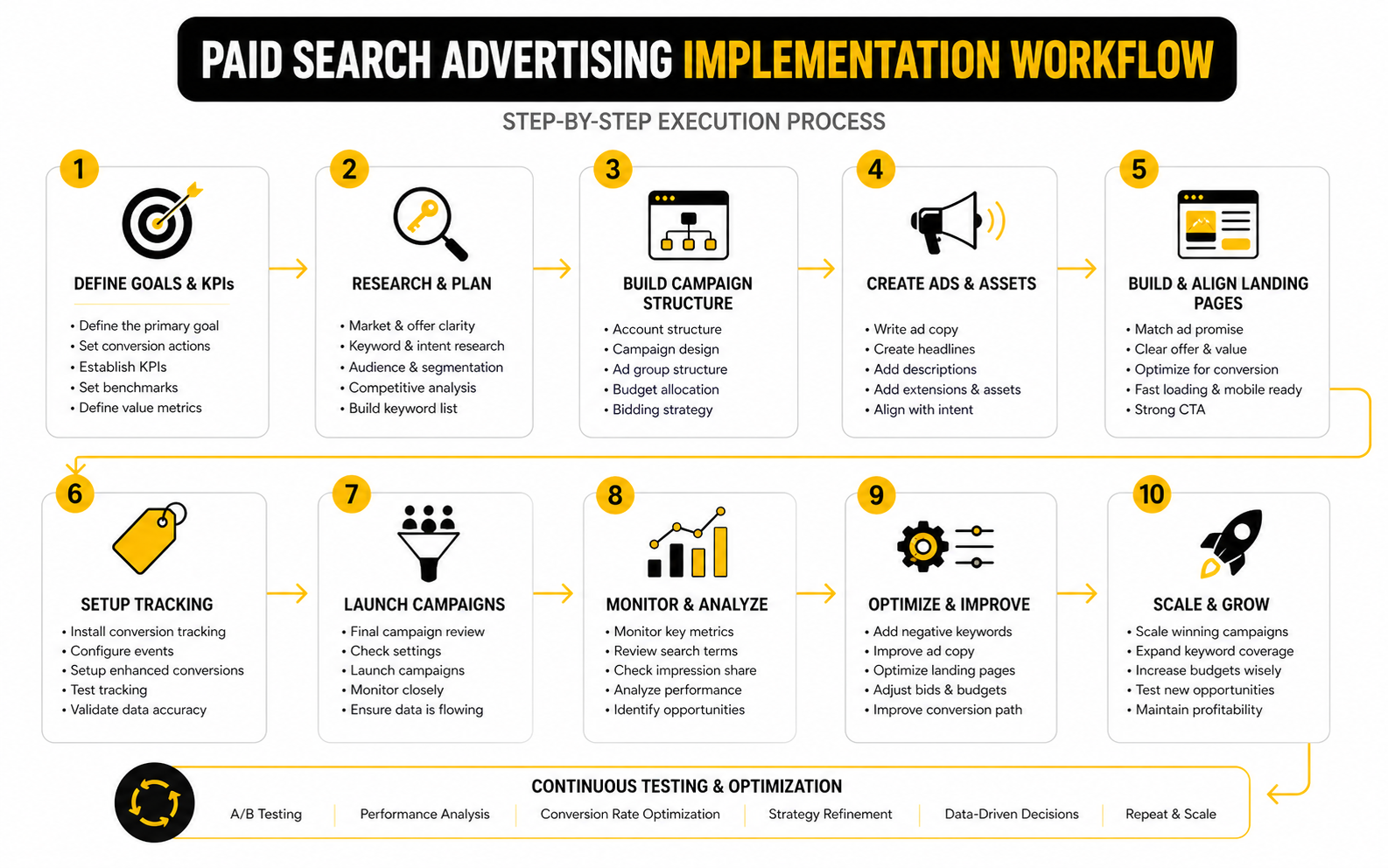
Build The Landing Page Before You Scale The Budget
The landing page is where paid search advertising either becomes an asset or turns into expensive traffic. The page must prove that the visitor landed in the right place. That means the headline should match the ad’s promise, the first screen should make the offer obvious, and the page should answer the objections that would stop the person from acting.
Google’s landing page experience guidance focuses on usefulness, relevance, transparency, and ease of navigation: landing page experience. Microsoft’s ad quality policies also emphasize that landing pages should give clear, direct access to content related to the ads and keywords: ad relevance and landing page quality. In plain English, do not send paid clicks to a page that makes people hunt for what the ad promised.
Speed matters too. Google’s mobile speed research has repeatedly shown that slower mobile experiences hurt conversion behavior, and its older benchmark research found that abandonment rises sharply as load time increases: mobile page speed benchmarks. You do not need a fancy page. You need a page that loads quickly, explains the offer clearly, and makes the next step obvious.
Use Ad Assets To Pre-Qualify The Click
Ad assets give your search ads more room to communicate before someone clicks. Sitelinks can send people to specific pages, callouts can highlight benefits, structured snippets can list service categories, and call assets can make phone action easier. Used well, they improve relevance and help the searcher decide whether your result is worth their time.
Structured snippets are especially useful when you need to show categories, services, product types, or areas of expertise in a scannable way: structured snippet assets. Callouts are better for short value statements such as same-day service, free consultation, transparent pricing, or no long-term contract. Sitelinks are best when the searcher may need a more specific path than the main landing page.
Do not treat assets as decoration. Every asset should either increase confidence, answer a pre-click question, or guide the person to a more relevant destination. If an asset does not help the searcher make a better decision, it is just noise.
Connect The Page To The Follow-Up System
A conversion is not the finish line. It is the handoff from paid traffic to sales, email, SMS, booking, onboarding, or checkout. This is why the implementation process has to include what happens after the form, call, or purchase.
For lead generation, the follow-up should be fast, contextual, and tied to the keyword or offer that created the lead. A person who requested a quote from a high-intent search should not receive a generic newsletter sequence as their first touch. They should get a response that reflects what they searched for and what they asked to receive.
For ecommerce and creator-led funnels, email and automation tools can support abandoned checkout flows, post-purchase sequences, and lead nurture. A platform like Brevo can fit campaigns where paid search leads need email follow-up, segmentation, and lifecycle messaging after the first conversion. The ad gets the click, but the system behind it often determines whether that click becomes revenue.
Bidding, Budgets, Tracking, And Conversion Quality
Paid search advertising gets serious when money and measurement meet. You are no longer asking whether people clicked. You are asking whether the right searches produced the right actions at a cost the business can afford.
That is why tracking should be treated as infrastructure, not admin. A campaign with weak tracking can look successful while it is feeding the platform bad data. A campaign with clean tracking gives you a real shot at improving bids, budgets, landing pages, and follow-up based on what actually creates value.
Statistics And Data
Benchmarks are useful, but only when you use them properly. Recent Google Ads benchmark data puts the average search conversion rate around 7.52% across industries, while average cost per lead across Google Ads sits around $70.11. Those numbers are not targets. They are reference points.
The wrong move is to look at an average and panic because your account is above or below it. A lawyer, local plumber, SaaS company, ecommerce brand, and online course seller should not expect the same cost per click, conversion rate, or payback period. The useful question is not “Are we average?” The useful question is “Are we buying customers at a cost that makes sense for our margins, close rate, and lifetime value?”
Paid search also sits inside a much bigger market. U.S. internet advertising revenue reached $258.6 billion in 2024, which shows how competitive digital attention has become. More competition does not mean you should avoid search. It means sloppy measurement gets expensive faster.
Build The Measurement System Around Revenue
The analytics system should connect four layers: search query, click, conversion, and business outcome. Search query tells you what the person wanted. Click and cost tell you what you paid to reach them. Conversion tells you what action they took. Business outcome tells you whether that action became qualified pipeline, booked revenue, retained customers, or profit.
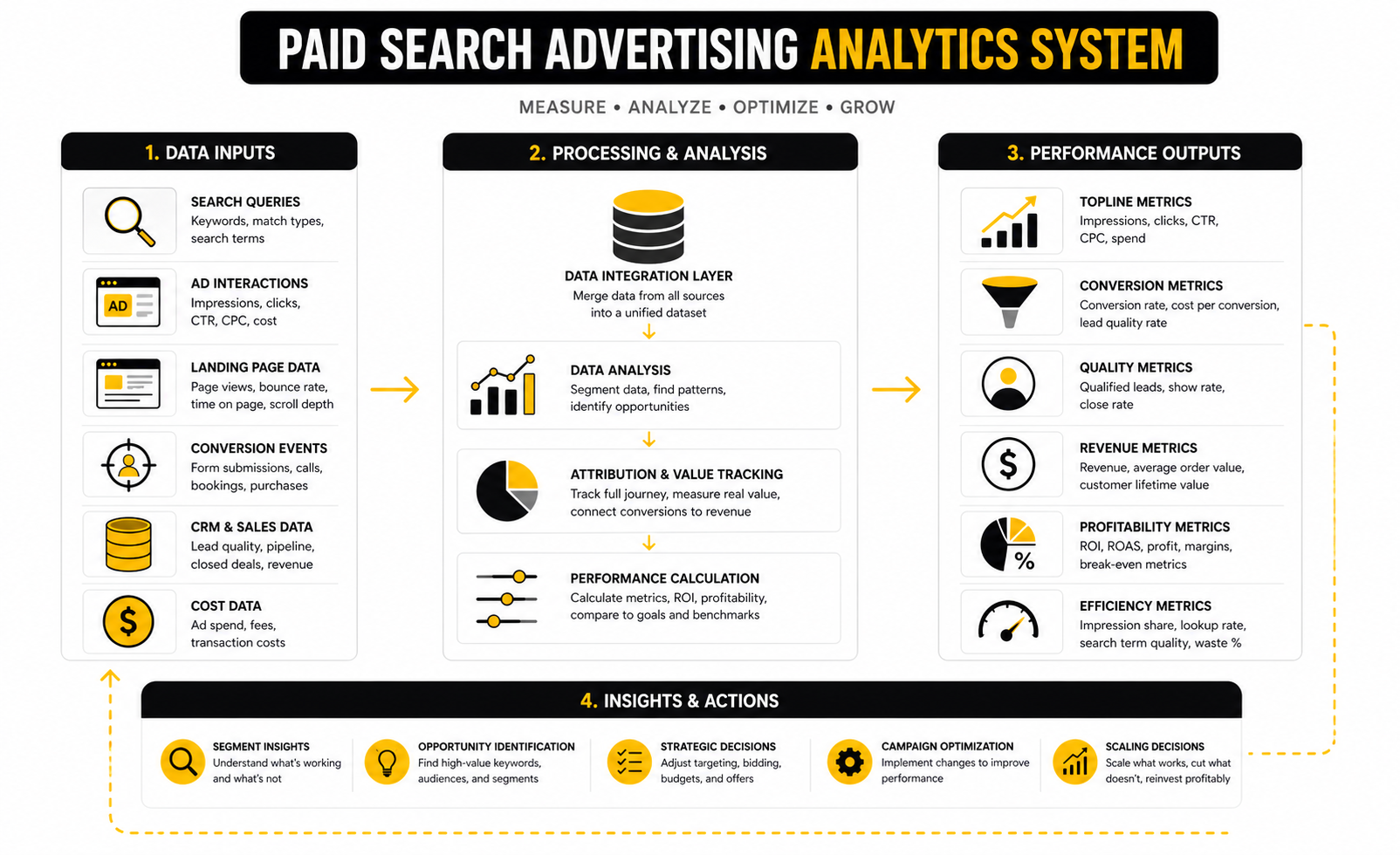
This is why conversion tracking needs more than a basic form thank-you page. Google Ads conversion tracking can measure actions such as purchases, calls, app installs, and lead submissions after an ad interaction: conversion tracking overview. Enhanced conversions can improve measurement accuracy by using hashed first-party data in a privacy-safe way, which is especially useful when browsers, consent rules, and cross-device behavior make attribution messier: enhanced conversions.
For lead generation, the best setup usually includes offline conversion imports or CRM-based revenue tracking. A lead that becomes a qualified appointment should not be valued the same as a spam form submission. When your system can send better quality signals back into the ad platform, bidding has a better chance of optimizing toward customers instead of noise.
Read Performance Signals In The Right Order
Start with impression share and search terms to understand whether you are showing up in the right market. Low impression share can mean your budget is too small, your bids are too low, or your quality is weak. Irrelevant search terms mean the campaign is leaking money before the landing page even gets a chance.
Then look at click-through rate and cost per click. A weak click-through rate may point to poor message match, weak positioning, or ads that do not stand out against competitors. A high cost per click is not automatically bad if the lead quality and close rate support it, but it becomes dangerous when the post-click path is weak.
Finally, judge conversion rate, cost per conversion, qualified lead rate, close rate, and revenue. This order matters because paid search advertising is a chain. If one link is broken, the final number alone will not tell you where the problem started.
Set Budgets Based On Learning And Payback
A paid search budget should be large enough to generate meaningful data, but not so large that bad assumptions become expensive lessons. In the early phase, the goal is controlled learning. You want enough clicks and conversions to see patterns in queries, ads, pages, devices, locations, and times of day.
Once the account has reliable conversion quality data, the budget conversation changes. You can start asking where additional spend produces profitable volume and where it only increases waste. That is the difference between scaling and merely spending more.
This is also where cash flow matters. A business with same-day ecommerce purchases can judge payback faster than a B2B service with a 60-day sales cycle. The campaign may be working long before revenue appears in the ad account, which is why CRM tracking and pipeline reporting are not optional for serious lead generation.
Use Bidding Strategies Only When The Data Supports Them
Automated bidding can be powerful, but it is not magic. It works best when the conversion data is accurate, the campaign has enough volume, and the goal matches the business outcome. If the account is tracking weak conversions, automated bidding will simply get better at finding more weak conversions.
Manual or more controlled bidding can still make sense when volume is low, conversion values are unclear, or the campaign is in a testing phase. Target CPA and target ROAS can make sense when you have enough reliable data and clear economics. Maximize conversions can help in some accounts, but it can also spend aggressively if the goal is poorly defined.
The practical rule is simple: do not hand control to automation until you trust the signal you are giving it. Paid search advertising rewards clean feedback loops. Bad data creates confident automation in the wrong direction.
Optimization, Testing, Automation, And Scaling
Optimization is where paid search advertising stops being a setup project and becomes an operating system. The first version of a campaign is rarely the most profitable version. You launch with a clear hypothesis, collect data, remove waste, improve the offer, and then decide where more budget can actually produce more profit.
The hard part is that every optimization has a tradeoff. More reach can mean less control. More automation can mean less visibility. More aggressive scaling can expose weak points in the funnel that were hidden at lower spend.
Optimize Around Bottlenecks, Not Preferences
Do not optimize based on what you personally like in an ad or landing page. Optimize based on where the system is leaking. If search terms are irrelevant, the bottleneck is targeting. If clicks are expensive but qualified, the bottleneck may be conversion rate or close rate. If leads are cheap but sales are weak, the problem is probably lead quality or follow-up.
This is why paid search advertising needs a simple diagnostic rhythm. Review search terms, budget pacing, impression share, conversion quality, and revenue impact in that order. Each layer tells you whether the issue is reach, relevance, cost, page performance, or sales execution.
Good optimization is not random tweaking. It is controlled decision-making. Change too many things at once and you will not know what worked. Change nothing for weeks and the account slowly drifts away from the market.
Test With A Clear Hypothesis
Testing should answer a specific business question. Does a different landing page increase qualified leads? Does a stronger price qualifier reduce wasted sales calls? Does a new bid strategy improve revenue without lowering lead quality? If the test does not answer a decision, it is just activity.
Google Ads experiments and asset testing are useful because they help isolate changes instead of guessing from before-and-after noise. Performance Max asset testing is designed to measure the impact of adding or changing assets inside campaigns: Performance Max asset testing. Microsoft Advertising experiments also split traffic from a base campaign so advertisers can compare changes such as bidding, targeting, or campaign settings: Microsoft Advertising experiments.
The practical rule is simple: test one meaningful thing at a time. A test should have a reason, a success metric, and enough time to collect useful data. Otherwise, you are not testing; you are just disturbing the algorithm.
Use Automation Without Surrendering Strategy
Automation is now part of serious paid search advertising. Google’s automated bidding sets bids based on the likelihood that an ad interaction will help meet a goal: automated bidding. Microsoft Advertising also positions automated bidding around selected goals, budgets, and KPIs: automated bidding overview.
The opportunity is obvious. Automation can process more auction signals than a human can manually manage. It can adjust bids by device, location, time, audience behavior, query context, and conversion probability in ways that manual bidding cannot realistically match.
The risk is just as real. Automation does exactly what you tell it to do, even when the goal is poorly defined. If the campaign is optimizing for low-quality leads, weak form fills, or underpriced conversions, the machine can scale the wrong behavior very efficiently.
Know When To Expand And When To Tighten
Scaling is not the same as increasing the budget. Scaling means expanding profitable volume while protecting the economics that made the campaign work in the first place. Sometimes that means adding more budget. Other times it means improving conversion rate, raising close rate, testing a stronger offer, or moving into a new search segment.
There are several ways to expand paid search advertising without becoming reckless:
- Add high-intent keyword clusters that are closely related to proven winners.
- Test broader match types only when conversion tracking and negative keywords are strong.
- Expand to new locations or segments with separate budgets and reporting.
- Improve landing pages before raising spend.
- Use remarketing or email follow-up to recover value from expensive clicks.
- Feed qualified lead or revenue data back into the ad platform.
Tightening is just as important. If a campaign is spending into irrelevant queries, unqualified geographies, poor device segments, or weak offers, adding budget will not fix it. It will only make the lesson more expensive.
Protect The Account From Strategic Drift
Paid search accounts drift because markets change, competitors change, search behavior changes, and platforms keep adding automation. Google introduced AI Max for Search campaigns to help advertisers capture additional search opportunities using AI-powered matching and creative improvements: AI Max for Search campaigns. That kind of development can create new reach, but it also makes strategic guardrails more important.
Your account needs a regular control check. Are the highest-spend queries still aligned with the business? Are conversions still valuable? Are automated recommendations being reviewed before they are applied? Are landing pages still matching the offer? Are sales outcomes improving, or only platform metrics?
This is where strong operators separate themselves. They do not reject automation out of fear, and they do not accept every recommendation out of laziness. They use automation to increase leverage while keeping strategy, economics, and customer quality under human control.
Scale The System, Not Just The Campaign
The best paid search advertising accounts eventually become cross-functional. The ad account finds demand, but sales, CRM, landing pages, pricing, creative, and customer success determine how much that demand is worth. If one of those areas is weak, scaling exposes it.
For lead generation, scaling may require better intake speed, better qualification, stronger appointment reminders, and cleaner pipeline reporting. For ecommerce, it may require better product pages, stronger checkout flows, better email recovery, and clearer merchandising. For SaaS, it may require trial activation data, demo quality tracking, and lifecycle reporting.
This is why the final stage of paid search is not just optimization inside the ad account. It is building a business system that can handle more intent without breaking. When the offer, tracking, landing page, sales process, and follow-up all improve together, paid search advertising becomes much more than a traffic source. It becomes a controllable growth channel.
Common Mistakes, Professional Implementation, And FAQ
At this stage, the biggest paid search advertising mistakes are rarely technical. They are strategic. Businesses chase more clicks before they know which clicks are valuable, trust automation before the data is clean, or scale campaigns before the landing page and follow-up system can handle the demand.
The fix is not to make the account more complicated. The fix is to make the system more honest. Every keyword, ad, page, conversion action, bid strategy, and report should answer one question: does this help us turn search intent into profitable revenue?
Common Mistakes That Quietly Waste Budget
The first mistake is treating all conversions as equal. A booked sales call, a spam lead, a newsletter signup, and a low-intent form fill should not teach the platform the same lesson. If you do not separate quality, paid search advertising will optimize toward whatever is easiest to generate.
The second mistake is scaling too early. If the offer is unclear, the landing page is weak, or the sales process is slow, more traffic only makes the leak bigger. More budget should come after the system has proven that it can turn additional demand into additional value.
The third mistake is ignoring the human side of search. People do not click because your account structure is elegant. They click because the ad speaks to their problem, the page feels relevant, and the next step feels worth taking.
Professional Implementation
Professional implementation is not about having every possible campaign type active. It is about building a system that can be audited, improved, and trusted. A good operator can explain why each campaign exists, what it is supposed to produce, and what decision will be made from the data.
For most businesses, the professional process looks like this:
- Define the business goal and acceptable acquisition cost.
- Map the highest-value search intents.
- Build campaigns around clear commercial decisions.
- Write ads that qualify the click before the visitor lands.
- Send traffic to pages that match the promise.
- Track real conversion quality, not just activity.
- Review search terms, leads, sales, and revenue on a consistent rhythm.
- Scale only what is economically proven.
That final point matters most. Paid search advertising should not be run as a guessing game. It should be managed like a financial system with creative, data, and customer psychology working together.
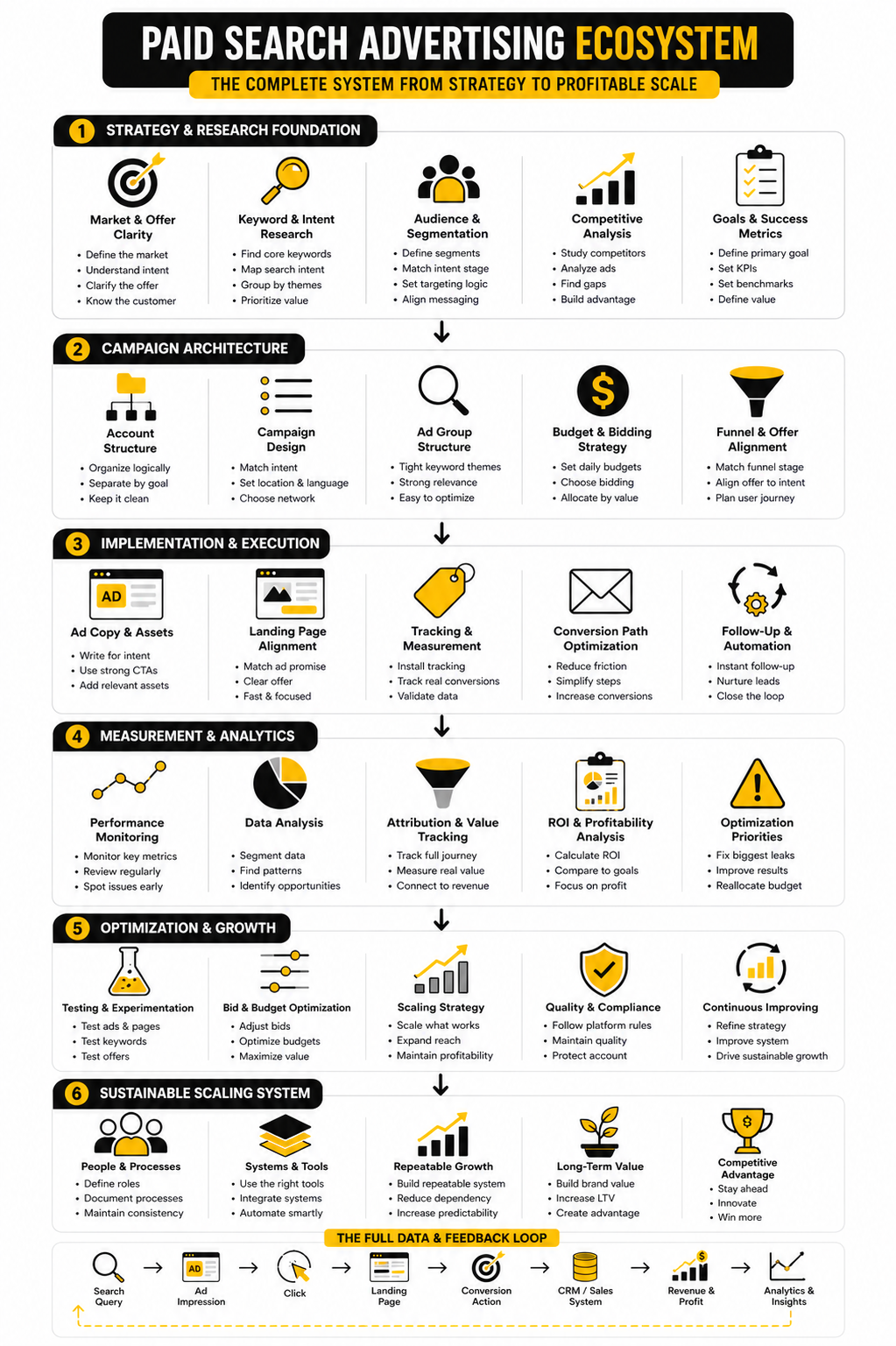
The Final System View
A mature paid search system connects search demand to business outcomes without losing context along the way. The search query explains the intent. The ad frames the promise. The landing page earns the conversion. The CRM or ecommerce system records what happened after the click. The reporting loop shows what should be improved next.
This is why the channel is still valuable even as platforms become more automated. Automation can help with bidding, matching, and creative combinations, but it cannot replace a clear offer, a strong funnel, clean tracking, or a disciplined operator. The businesses that win are not just buying search traffic; they are building a system that makes each click more measurable and more useful.
If you need a simple way to think about the entire article, use this: paid search advertising is not about paying to appear. It is about paying to appear when the right person has the right intent, then giving that person the right path to act.
FAQ - Built for Complete Guide
What is paid search advertising?
Paid search advertising is a form of digital advertising where businesses pay to show ads on search engines when people search for relevant terms. The advertiser usually pays when someone clicks the ad. The goal is to capture existing demand and turn it into leads, sales, bookings, trials, or other valuable actions.
How is paid search advertising different from SEO?
Paid search advertising gives you visibility through paid placements, while SEO earns visibility through organic rankings. Paid search can generate traffic faster, but it requires ongoing budget. SEO can compound over time, but it usually takes longer and depends on content, authority, technical quality, and search engine ranking systems.
Is paid search advertising worth it for small businesses?
It can be worth it when the business knows its margins, close rate, and acceptable cost per lead or sale. Small businesses often do best by starting with high-intent searches, tight geography, strong negative keywords, and simple conversion tracking. The danger is launching too broadly before the offer and follow-up process are ready.
What budget do I need to start paid search advertising?
There is no universal starting budget because costs vary by industry, location, competition, and goal. A local service business may test with a smaller controlled budget, while legal, insurance, finance, SaaS, or ecommerce campaigns may need more data before decisions are reliable. The better question is how much you can spend to get enough clicks and conversions without risking money you cannot afford to lose.
What are the most important paid search metrics?
The most important metrics depend on the business model, but the core signals are search terms, click-through rate, cost per click, conversion rate, cost per conversion, qualified lead rate, close rate, revenue, and return on ad spend. Platform metrics are useful, but they are not the full truth. The most important number is whether the campaign produces profitable business outcomes.
Why are my paid search clicks not converting?
Clicks may not convert because the keyword intent is weak, the ad overpromises, the landing page does not match the search, the offer is unclear, the page loads slowly, or the conversion step creates too much friction. It can also happen when tracking is broken and conversions are not being recorded correctly. Start by checking search terms, then the landing page, then the offer, then the follow-up process.
Should I use broad match keywords?
Broad match can work when the account has strong conversion tracking, enough data, useful negative keywords, and a bidding strategy that optimizes toward real value. It can also waste money quickly in a new or poorly tracked account. Start controlled, then expand when the data proves the campaign can handle more reach.
How often should paid search campaigns be optimized?
New campaigns usually need more frequent review because the first weeks reveal search term issues, budget pacing problems, and conversion quality patterns. Mature campaigns still need regular review because competition, search behavior, landing pages, and platform automation change over time. The key is not constant tinkering; it is consistent decision-making.
What makes a good paid search landing page?
A good landing page matches the ad promise, loads quickly, explains the offer clearly, builds trust, handles objections, and makes the next step obvious. It should not force visitors to search around for the thing they clicked to see. The page should feel like the natural continuation of the search, not a generic brochure.
How do I know when to scale paid search advertising?
Scale when the campaign is producing qualified conversions at an acceptable cost and the business can handle more demand. Before raising budget, confirm that lead quality, close rate, revenue, and follow-up capacity are strong. Scaling too early does not fix a weak system; it exposes it.
Can paid search advertising work without a CRM?
It can work for simple ecommerce or direct checkout campaigns, but lead generation usually needs some form of CRM or pipeline tracking. Without it, you may know which campaign generated a form fill, but not whether that lead became qualified, booked, closed, or retained. That missing data makes optimization much weaker.
What is the biggest mistake beginners make with paid search advertising?
The biggest beginner mistake is judging success too early from surface-level numbers. Cheap clicks are not always good, expensive clicks are not always bad, and more conversions do not always mean more revenue. The goal is not to make the ad account look busy; the goal is to build a profitable acquisition system.
Work With Professionals
Explore 10K+ Remote Marketing Contracts on MarkeWork.com
Most marketers spend too much time chasing clients, competing on crowded platforms, and losing a percentage of every project to middlemen.
MarkeWork gives you a better way. Browse thousands of remote marketing contracts and connect directly with companies desperate to hire skilled marketers like you, without platform commissions and without unnecessary gatekeepers.
If you're serious about finding better opportunities and keeping 100% of what you earn, invite readers to explore available contracts and create a profile for free at MarkeWork.com.