

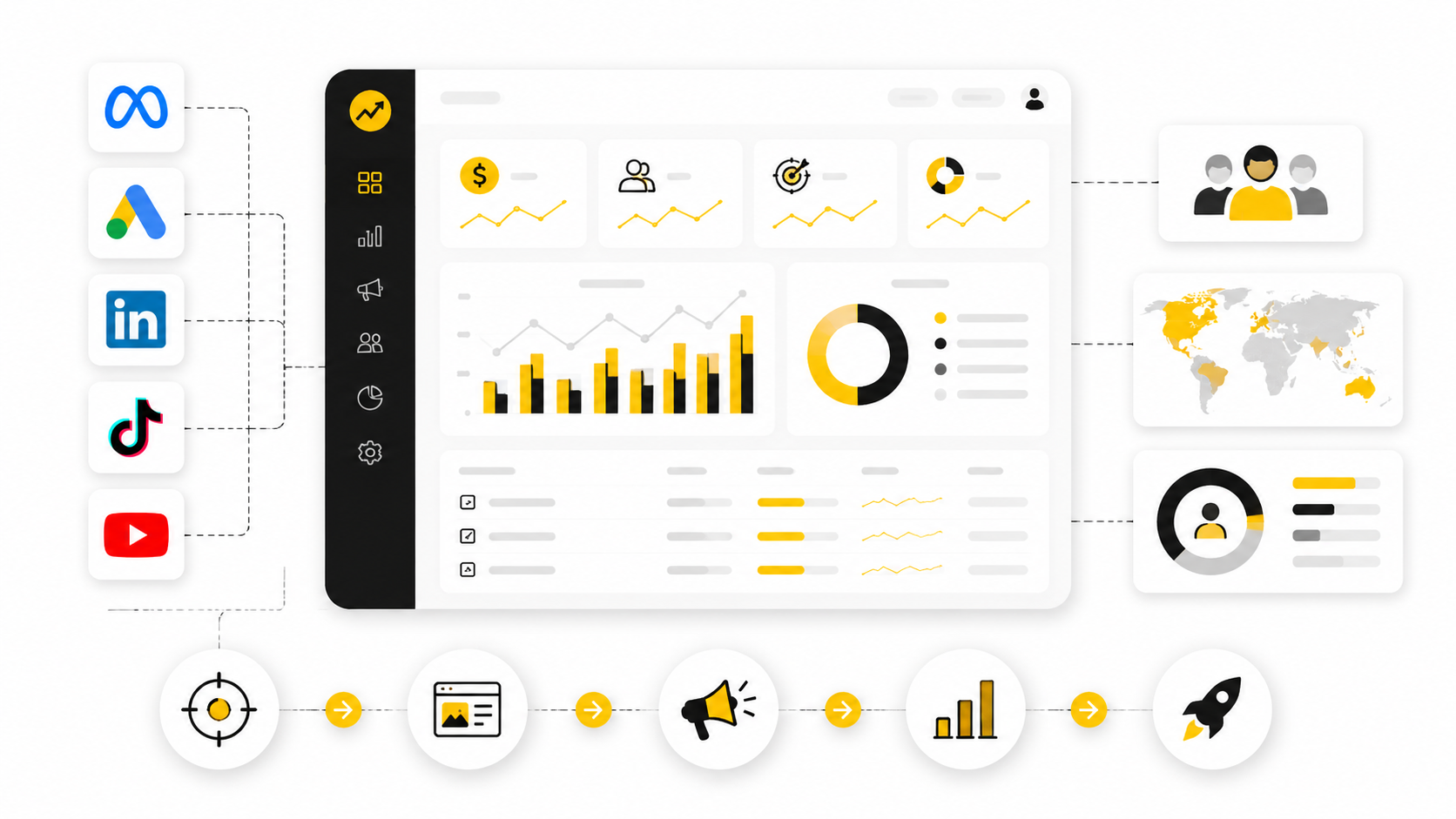
A paid social agency is a specialist partner that plans, creates, manages, and optimizes paid advertising campaigns across social media platforms like Meta (Facebook & Instagram), TikTok, LinkedIn, Pinterest, Snapchat, and X. These agencies turn scattered ad spend into measurable business outcomes — such as sales, leads, app installs, or brand growth — by combining strategic planning, audience targeting, creative development, and performance measurement into a unified system rather than just “running ads.”
In today’s digital landscape, social platforms have become one of the most powerful advertising environments in marketing, with billions of users globally engaging daily. That scale creates an opportunity — and complexity — that most in‑house teams struggle to navigate alone, which is why professional paid social agencies are increasingly essential to achieving results.
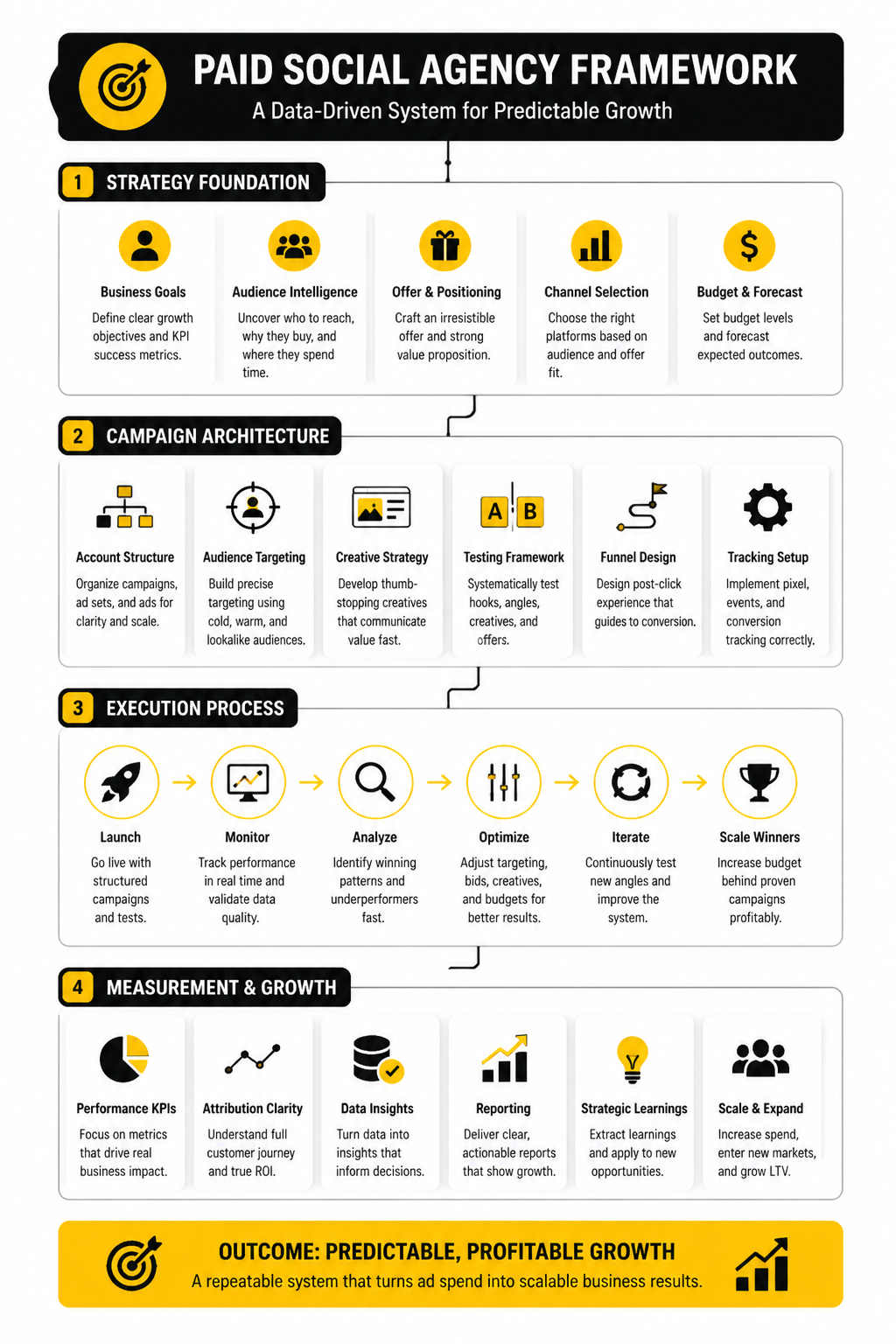
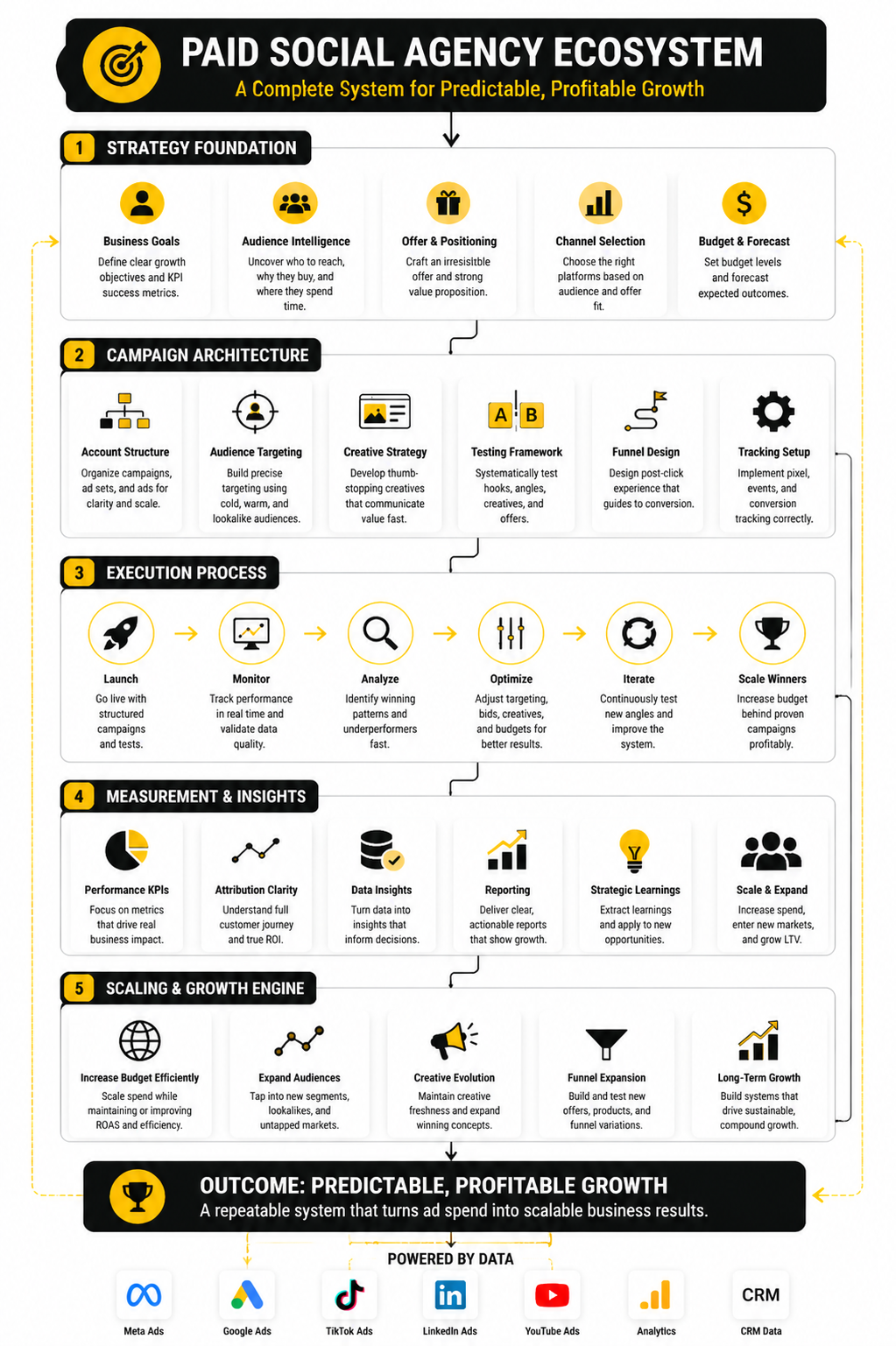
Below is the full structure your article will follow as it unfolds across six parts:
- What a Paid Social Agency Does
- Why a Paid Social Agency Matters for Modern Marketing
- Strategic Framework for Paid Social Success
- Core Components of Effective Paid Social Work
- Professional Implementation Best Practices
- Future Trends and How to Choose the Right Agency
Paid social isn’t a one‑off task — it’s an operating system that connects creative, data, and execution so brands can compete where attention is concentrated.
This first part sets the foundation by defining the concept and showing how the rest of the article will explain its strategic, tactical, and practical implications in detail.
What a Paid Social Agency Does
A paid social agency goes far beyond simply “boosting posts” on a platform. Modern paid social specialists build and manage advertising ecosystems that connect business goals to measurable performance outcomes. They handle everything from strategy to execution so your paid social spend drives real results like sales, leads, app installs, or higher‑quality engagement rather than random impressions.
At the core, these agencies are accountable for managing your advertising across multiple social platforms — not just one. That means platforms such as Meta (Facebook & Instagram), TikTok, LinkedIn, Pinterest, and others are treated as a coordinated portfolio, with campaigns tailored to each channel’s strengths and your business’s goals.
Paid social agencies also bridge creative and analytics. They don’t view creative assets as decorative; instead, they use rigorous testing frameworks to understand what type of content resonates, why it works, and how it drives outcomes when paired with the right audiences.
Strategic and Operational Responsibilities
Paid social agencies typically cover a wide range of services that together form the backbone of a paid social program:
- Audience research and targeting: Building and refining audience segments based on demographics, behavior, and platform signals to ensure ads reach likely converters.
- Campaign strategy and structure: Designing full‑funnel campaigns that guide potential customers from awareness to consideration and conversion.
- Creative asset guidance: Producing or directing visuals, videos, and messaging that stop scrolls and align with platform expectations.
- Bid and budget management: Allocating spend efficiently across audiences and platforms to maximize return on ad spend (ROAS).
- Testing and optimization: Running A/B tests on audiences, creative elements, and placement strategies to continuously improve performance.
- Performance reporting: Providing transparent reporting tied to business outcomes, not vanity metrics, so you understand the true impact of campaigns.
Role in the Marketing Ecosystem
The reason a paid social agency matters is that social platforms are complex advertising environments where performance changes fast. Algorithms learn in real time and audience behaviors shift with trends and broader economic conditions. A professional agency brings systems and discipline that turn this complexity into a competitive advantage rather than a cost center.
In practice, that means a paid social agency becomes an extension of your growth team — not just a vendor that “runs ads.” They help define the right outcomes, adjust tactics when performance shifts, and align with your broader marketing goals so that paid social contributes meaningfully to growth rather than operating in isolation.
By managing the full lifecycle from strategy to reporting, they free up internal teams to focus on broader growth initiatives while keeping performance accountable and adaptable in an ever‑evolving paid social landscape.
Professional Implementation of Paid Social
Implementing a paid social program isn’t just about turning on ads and hoping something sticks. A paid social agency builds a process that’s measurable, repeatable, and aligned with real business outcomes. This implementation phase is where strategy turns into tangible execution and where campaigns move from idea to performance.
At this stage, agencies follow disciplined procedures that connect your goals to outcomes through structured planning, data integrity, campaign setup, and systematic experimentation. Professional implementation protects your ad spend and builds a foundation you can scale rather than just “hoping for improvements.”
From Strategy to Execution: How It Works
Before launching any campaigns, the agency usually begins with discovery and planning. This phase ensures there is clarity around objectives, current performance, measurement gaps, and the overarching plan for your paid social investment.
Once the groundwork is set, the real execution process begins — one that treats paid social like a product launch rather than random spend.
Step-by-Step Implementation
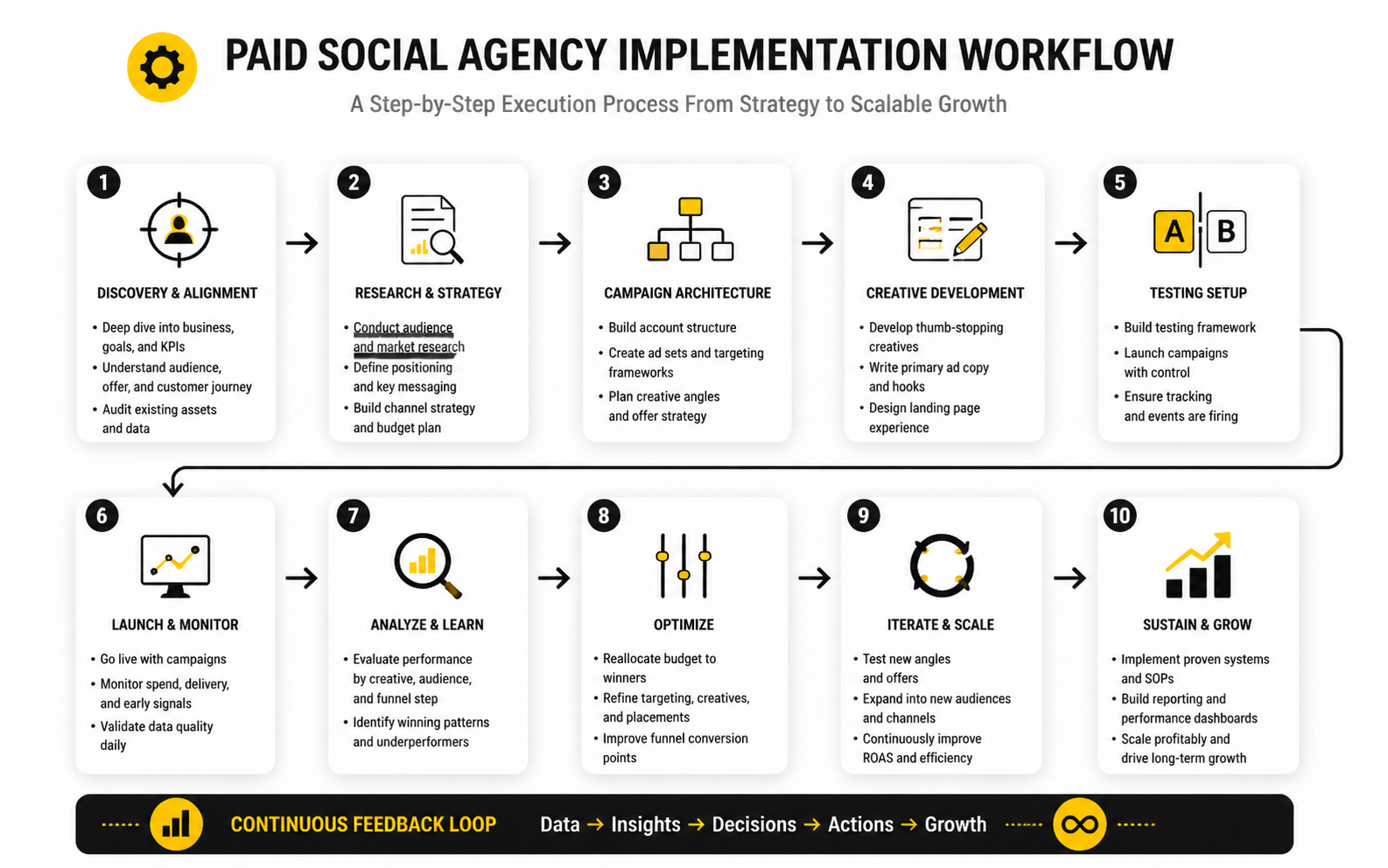
A professional agency’s process typically follows a sequence that balances clarity and controlled experimentation. This sequence helps ensure every part of the campaign — from tracking to scaling — works together:
- Define Clear Outcomes and Metrics
The first step is choosing the business outcome that matters most — for example, purchases for e‑commerce or qualified leads for B2B — and the operational metric that guides weekly decisions such as CPA, ROAS, or cost per qualified lead.
- Audit and Fix Tracking Infrastructure
Without reliable measurement, optimization is guesswork. Agencies audit tracking to ensure events are captured correctly, implement hybrid tracking (browser + server), and eliminate duplication so your data reflects reality.
- Build Campaign Architecture
Campaigns are structured to match the customer journey and separate discovery from retargeting. Clean architecture makes reporting a decision tool rather than a confusing mix of results.
- Set Up Creative and Testing Plans
Instead of launching with one or two ads, agencies deploy multiple creative angles and formats. This pipeline approach allows you to test what resonates before allocating significant budget.
- Launch Controlled Experiments
Early in the launch, the focus is on controlled variables and clean comparisons rather than aggressive spending. This helps identify what truly works and reduces waste.
- Scale with Signal Quality in Mind
Scaling isn’t simply increasing budgets. Professionals scale slowly while preserving signal quality and maintaining a fresh creative cadence so performance doesn’t decay.
- Establish Governance and Reporting Standards
Naming conventions, quality assurance checklists, and consistent reporting rules make campaigns readable and repeatable across teams and time.
These steps aren’t arbitrary — they’re designed so that each campaign decision is backed by data and learning instead of guesswork. Clean implementation prevents common pitfalls like broken tracking, misleading signals, or creative fatigue that can tank performance quickly.
What Makes This Process Effective
The disciplined implementation framework above does three things well:
- Preserves data integrity: Systems are in place so the algorithm learns the right signals and delivers scale without losing control.
- Speeds learning: Controlled experiments help the team understand what resonates with audiences instead of making broad bets.
- Enables repeatable performance: Structured campaigns become a system rather than one‑off wins, making future work more predictable and cost‑efficient.
In essence, professional implementation shifts a paid social program from “guess and hope” to a disciplined engine of learning and growth — and that’s the difference between wasting budget and building a scalable acquisition channel.
Next, we’ll explore the core components that make this execution system successful, including audience strategy, creative development, and performance optimization.
Statistics and Data That Matter in Paid Social
Effective paid social agency work always ties back to real numbers — but the value isn’t in listing stats, it’s in understanding what the data actually tells you about performance, audience behavior, and where to focus optimization. Agencies use benchmarks not as rigid targets, but as guardrails to evaluate whether a campaign is healthy or requires strategic adjustment.
Core Paid Social Metrics and How to Read Them
In paid social, several key performance indicators (KPIs) guide strategic decisions, and each tells a different story about your campaigns:
- CPM (Cost per Thousand Impressions)
This metric shows how much you pay for 1,000 views of your ad. A rising CPM may signal increased competition in the auction or poor ad relevance, while a falling CPM often reflects stronger creative or audience fit.
- CPC (Cost per Click)
A lower CPC means you’re driving engagement more efficiently. If your CPC spikes, it can indicate less relevant targeting, weak creative, or a crowded auction on that platform.
- CTR (Click‑Through Rate)
CTR measures the percentage of people who click after seeing your ad. Benchmarks for paid social CTR often sit around 1–3%, but context matters: a strong CTR suggests your message resonates with the chosen audience.
- Conversion Rate & CPA (Cost per Action)
These metrics reflect how many of those clicks lead to valuable actions — like purchases or lead form completions — and at what cost. High CTR with low conversion implies friction after the click.
- ROAS (Return on Ad Spend)
ROAS tells you how much revenue each ad dollar generates. Healthy ROAS varies by industry and objective, but many well‑managed paid social programs aim for 3× or better.
Benchmarks exist — for example, Meta ads often show CPMs between $8–14, CPCs around $0.60–1.50, and blended ROAS in the 3×–4.5× range for e‑commerce and lead gen campaigns — but your own numbers only matter relative to your goals and unit economics.
Why These Numbers Matter
Measurement isn’t just reporting — it’s decision support. Here’s how the most critical stats drive action:
- Identify Weak Creative or Targeting:
If CTR dips below typical ranges and CPC climbs, it’s often a signal that your audience isn’t engaging with the ad’s messaging or creative. That’s a cue to refresh visuals or retarget with tighter audience segments.
- Gauge Platform Efficiency:
A lower CPM on a platform like TikTok can lure brands to spend there, but if post‑click conversion and ROAS lag behind Meta benchmarks, the cheaper impressions aren’t translating to business outcomes.
- Inform Budget Allocation:
Agencies shift budgets away from channels where CPA is rising and ROAS is declining and toward those where the opposite is true — but only when the numbers are interpreted in the context of long‑term value and seasonality.
- Optimize the Funnel:
Viewing metrics as a system — with CPM and CTR indicating awareness and interest, and conversion and ROAS showing bottom‑line impact — helps teams refine campaigns at every stage.
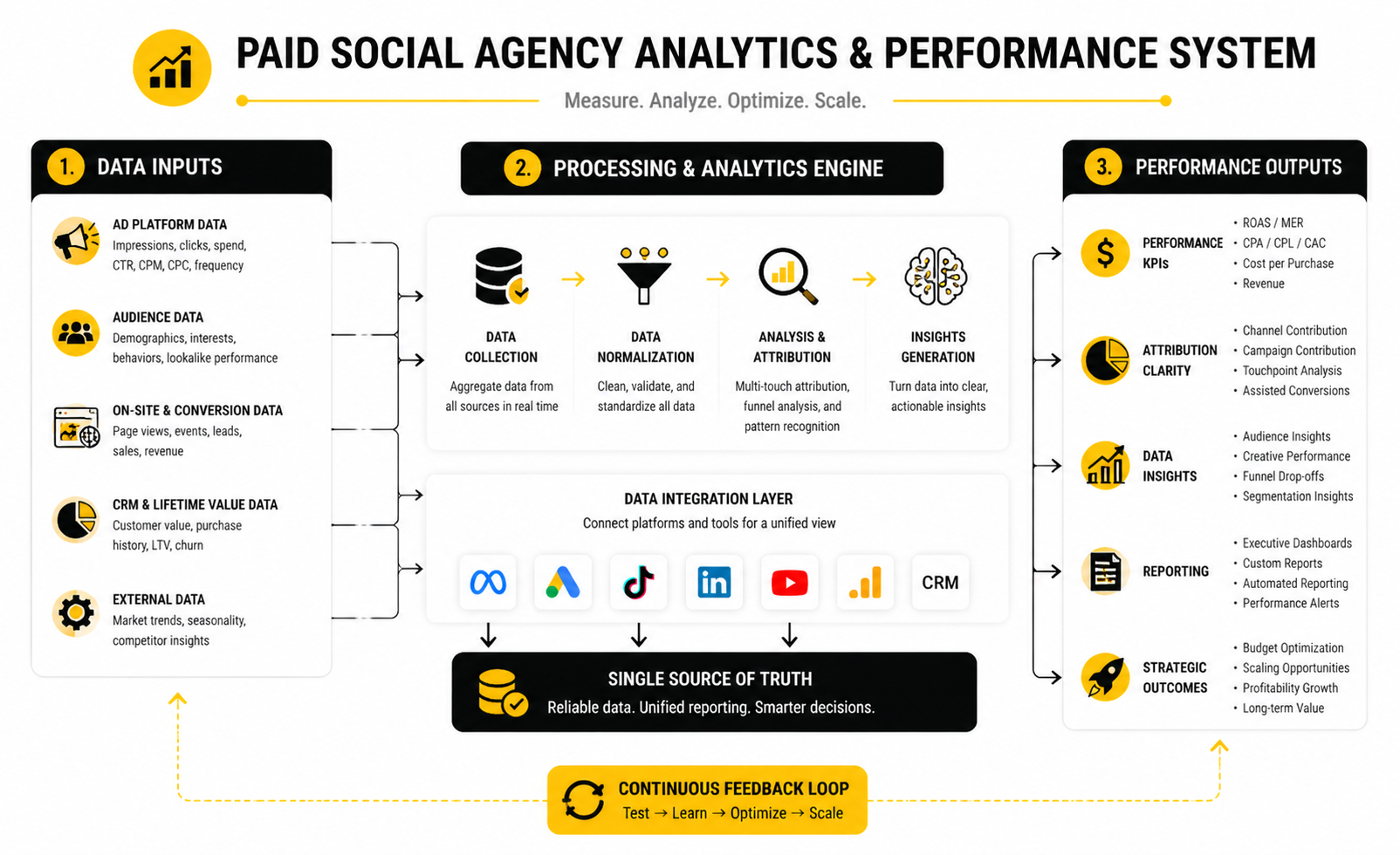
How Agencies Build Analytics Into Decision‑Making
Measurement isn’t static — it’s a cycle of collect, analyze, act, and learn:
- Collect Clean Data
Agencies ensure tracking is accurate across devices and placements. They integrate conversion APIs and server‑side events to reduce measurement gaps created by privacy changes.
- Standardize Metrics Across Platforms
Platforms use different reporting windows and attribution models, so agencies normalize performance — for example, using consistent attribution logic — to compare apples to apples.
- Benchmark Against Real Standards
Benchmarks help flag when performance is truly off track versus when it’s simply below expectations. If your ROAS is 2× but peers in your category average 4×, it’s evidence your creative, audience, or funnel could be refined.
- Translate Data to Action
Rather than bombarding stakeholders with numbers, insights are translated into specific tactical steps — such as pausing weak audiences, reallocating spend to high‑momentum creatives, or refining offers.
In short, paid social metrics are meaningful only when placed in context — trends over time, comparison to relevant benchmarks, and alignment with strategic goals — and that’s exactly how a paid social agency turns data into smarter performance.
Advanced Considerations for Successful Paid Social
Once a paid social agency has the basics in place — clean tracking, structured campaigns, and consistent measurement — the real test becomes how to think like a growth engineer rather than a technician. At advanced levels, strategic tradeoffs, scaling challenges, and risk management become core to how performance actually improves over time. Professional teams treat these as ongoing puzzles, not one‑time tasks.
Strategic Tradeoffs: Speed vs Stability
When brands start pushing budgets higher, the instinct is often to increase spend quickly because “performance looks good today.” But paid social is optimised over learning cycles, and rapid changes can disrupt the algorithm’s ability to find efficient audiences. For example, on Meta, increasing campaign budgets by more than ~20% at once often resets the delivery system into a new learning phase, which can temporarily degrade CPA and ROAS before stabilising again — and sometimes never recovers if the jump was too steep. Structured scaling — incremental budget increases with creative and audience diversification — reduces this volatility.
This is a common scaling tradeoff: you can either grow fast at the risk of unstable performance, or grow slower with steadier efficiency. A paid social agency helps clients choose the right path based on margins, seasonality, and competitive context rather than gut feelings.
Creative Capacity and Fatigue at Scale
A top‑tier paid social agency knows that creative output isn’t a production problem — it’s a scaling problem. When spending increases, your audience sees more impressions and frequency rises. That’s when creative fatigue — declining engagement because users see the same ads too often — becomes the primary performance bottleneck.
To mitigate this, professional programs treat creative development as a continuous pipeline rather than a single deliverable:
- Multiple creative concepts per theme to avoid saturation
- Diverse formats (short video, testimonials, carousel) to match different placements
- Hypothesis‑driven tests that tie back to KPI movement
Without this velocity, campaigns that perform well at modest spend can collapse at scale because the audience “tunes out” before optimisation can push ROI back up.
Attribution, Privacy Shifts, and Measurement Risk
The landscape of measurement and attribution is more complex than ever. Browser‑based pixels alone no longer capture enough signal to reliably optimise campaigns, especially at scale. That’s why advanced agencies implement hybrid tracking approaches, including server‑side events and Conversion APIs, to reduce signal loss and improve optimisation quality.
Even with robust tracking, agencies must contend with attribution ambiguity — the fact that no tool can perfectly tie every dollar of revenue back to a specific touchpoint. Professional practitioners use incrementality tests or holdouts, controls where part of the audience is withheld from exposure, to measure true lift and avoid scaling based on misleading signals.
This moves measurement from “who clicked what” to “which exposures actually caused incremental business value.”
Balancing Automation with Human Insight
Today’s platforms provide more automation and AI‑driven optimisation than ever — from Meta’s Advantage+ campaigns to algorithmic bidding models. These tools can reduce manual work and improve performance when signal quality is high.
But advanced paid social agencies treat automation as a lever, not a crutch:
- Automation shines with clean data and strong creative
- Human strategy determines what goals, audiences, and signals matter most
- Insights must guide when to hand control over to algorithms versus when to intervene
This hybrid approach prevents overreliance on automation that can “optimise” toward short‑term metrics at the expense of long‑term growth.
Future‑Proofing Against Volatility
Professionals know that external shifts — privacy changes, auction dynamics, competitive spend spikes — can create instability. They build guardrails and flexible frameworks that anticipate these risks, such as:
- Segmentation of audiences and budgets to spread risk
- Testing calendars aligned with seasonal trends
- Attribution models that accommodate multi‑touch journeys
Scaling paid social is not simply a matter of more spend; it’s about risk management at growth scale.
By thinking in systems — measurement, creative velocity, controlled scaling, and strategic automation — a paid social agency turns complexity into predictable progress rather than chaos. That’s the leap from running ads to operating a repeatable acquisition engine.
FAQ – Built for Complete Guide
What is a paid social agency and when should a business consider hiring one?
A paid social agency is a specialized marketing partner that plans, executes, and optimizes paid advertising across social platforms. Businesses typically consider hiring one when internal teams lack the expertise, when performance goals aren’t being met consistently, or when they want to scale paid social beyond basic ad buys.
How do paid social agencies measure success?
Success is measured against defined business outcomes — such as cost per acquisition (CPA), return on ad spend (ROAS), lead quality, or customer lifetime value — rather than vanity metrics like impressions alone. These agencies ensure measurement aligns with real revenue and growth goals.
Can a paid social agency manage ads on every social platform?
Yes, most paid social agencies operate across major platforms like Meta, TikTok, LinkedIn, Snapchat, and Pinterest. They choose platforms based on where the target audience is most active and where the campaign objectives are most likely to be achieved.
What’s the typical pricing model for a paid social agency?
Pricing models can vary — common structures include retainer fees, percentage of ad spend, performance‑based fees, or hybrid models. The right structure depends on campaign complexity, expected outcomes, and the level of service required.
How long does it take to see results from paid social?
Initial insights can appear within the first few weeks of launch, especially on metrics like engagement and CPC, but meaningful business outcomes often require multiple learning cycles over 60–90 days as audiences are tested and optimization takes effect.
Do paid social agencies create all campaign creative?
Many agencies either produce creative in‑house or collaborate with your creative partners. The most effective programs integrate creative strategy with performance data so ads are designed to resonate with target audiences and platform behaviors.
How does a paid social agency avoid ad fatigue?
Professional agencies actively monitor frequency, engagement trends, and audience saturation. They refresh creative regularly, segment audiences, and rotate messaging to sustain performance and prevent diminishing returns.
What role does data privacy play in a paid social strategy?
Data privacy changes — such as platform tracking restrictions — impact how conversions are measured. Agencies implement hybrid tracking solutions and attribution models that balance privacy constraints with the need for meaningful performance signals.
How should businesses evaluate a paid social agency’s performance?
Evaluate based on transparency in reporting, clarity of strategic recommendations, alignment between spend and outcomes, responsiveness to change, and the ability to explain why performance trends are occurring rather than just reporting numbers.
Can small businesses benefit from a paid social agency?
Yes. Small businesses with precise goals and tight budgets often benefit because agencies bring advanced tools, benchmarking insights, and strategic frameworks that help avoid costly mistakes and accelerate learning faster than DIY efforts.
Work With Professionals
Explore 10K+ Remote Marketing Contracts on MarkeWork.com
Most marketers spend too much time chasing clients, competing on crowded platforms, and losing a percentage of every project to middlemen. MarkeWork gives you a better way. Browse thousands of remote marketing contracts and connect directly with companies desperate to hire skilled marketers like you, without platform commissions and without unnecessary gatekeepers.
If you're serious about finding better opportunities and keeping 100% of what you earn, invite readers to explore available contracts and create a profile for free at MarkeWork.com.