

Paid traffic is any visitor, lead, or customer you acquire by paying for placement on a platform. That can mean Google Search ads, Meta ads, YouTube ads, TikTok ads, LinkedIn ads, programmatic display, sponsored listings, or retargeting campaigns.
The mistake is thinking paid traffic is just “running ads.” It is not. Paid traffic is a business system where offer, audience, creative, tracking, landing page, follow-up, and economics all have to work together.
Digital ad spend keeps rising, with U.S. internet advertising revenue reaching $294.6 billion in 2025. That does not mean paid traffic is easy. It means more companies are competing in auctions where weak funnels get punished fast.
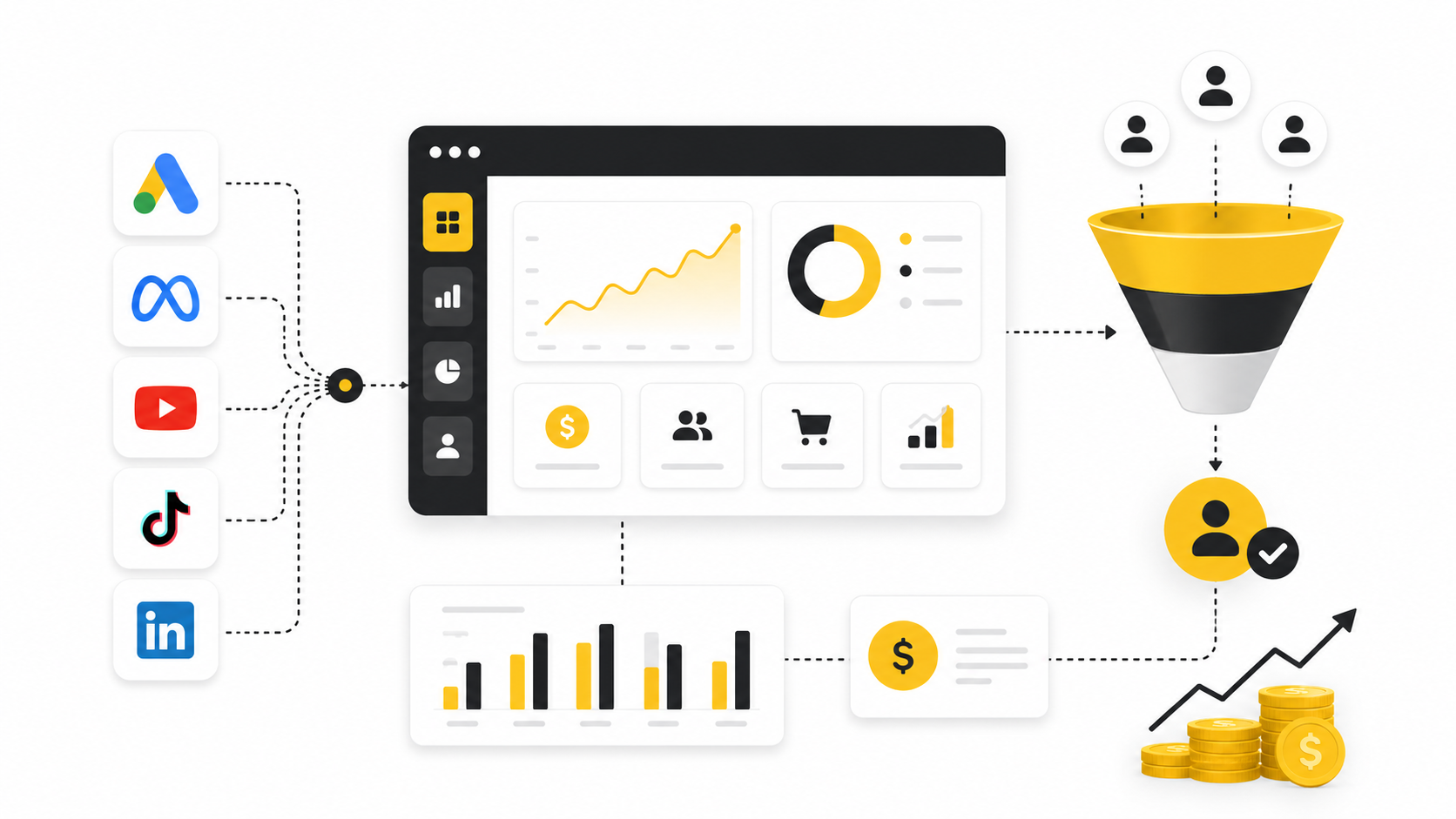
This article will break paid traffic into six connected parts:
- Why Paid Traffic Matters
- The Paid Traffic Framework
- Core Components of a Profitable Campaign
- Channel Strategy and Budget Allocation
- Professional Implementation and Optimization
- Measurement, Scaling, and FAQs
Why Paid Traffic Matters
Paid traffic matters because it gives a business controlled access to demand. Organic marketing is powerful, but it usually takes time to compound. Paid campaigns let you test messages, offers, audiences, and landing pages much faster.
That speed creates both opportunity and risk. Google Ads benchmark data shows the average search advertising cost per click reached $5.26 across industries in 2025, while average conversion rates vary heavily by market. A business with weak tracking or a poor offer can spend a lot of money before it understands what is actually broken.
The real advantage of paid traffic is feedback. You are not just buying clicks. You are buying market data that tells you which promise gets attention, which audience responds, and which funnel turns attention into revenue.
The Paid Traffic Framework
A strong paid traffic system starts before the ad platform. The platform only amplifies what already exists. If the offer is unclear, the landing page is slow, or the follow-up is weak, the campaign will usually expose those problems rather than fix them.
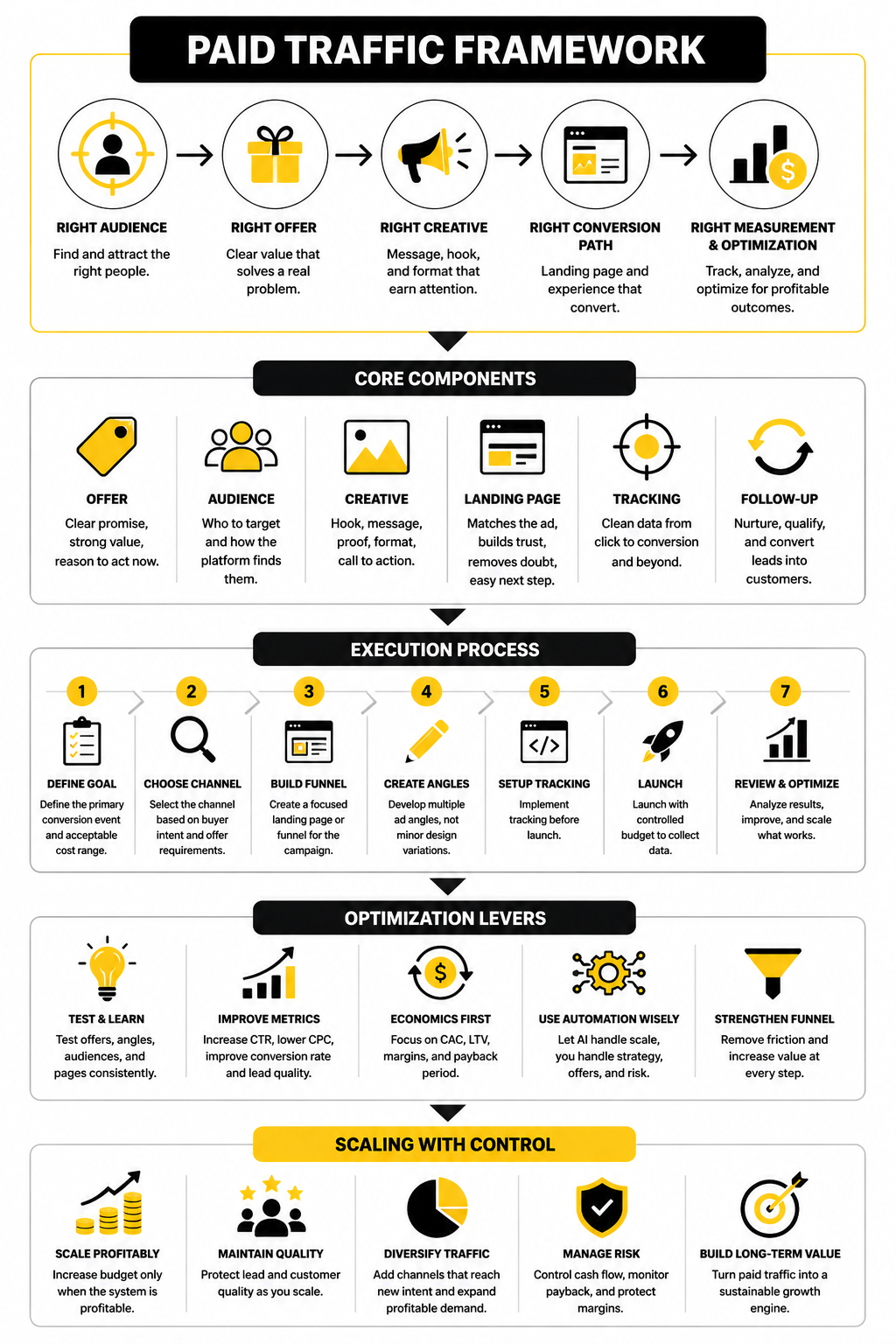
The framework is simple: match the right audience with the right offer, communicate it through the right creative, send people to the right conversion path, and measure the result honestly. Each part affects the others. Better creative can lower costs, but only if the landing page continues the same promise.
This is why professional paid traffic is not managed only inside Ads Manager. It includes analytics, sales process, checkout flow, CRM follow-up, email, retargeting, and margin. The goal is not cheaper clicks. The goal is profitable customer acquisition.
Core Components of a Profitable Campaign
A profitable paid traffic campaign is not built from one clever ad. It is built from several parts that support each other. When one part is weak, the whole system becomes more expensive.
The first component is the offer. Before spending money, you need to know what the audience gets, why it matters now, and why your version is the safer or better choice. A vague offer forces the ad platform to work harder because people do not instantly understand the reason to click.
The second component is the audience. This includes who you target directly, who the platform finds through machine learning, and who your creative naturally attracts. Modern ad platforms are less about tiny manual targeting tricks and more about giving the algorithm strong signals through conversion data, creative angles, and clear intent.
The third component is the creative. Creative is not just design. It is the hook, message, proof, format, and call to action that turn passive scrolling or searching into action. As Meta and Google continue pushing more automation, creative quality becomes one of the biggest levers you still fully control.
The Offer Comes First
Most paid traffic problems are offer problems wearing a media-buying costume. If the promise is weak, the targeting will not save it. If the price-to-value relationship feels unclear, even high-quality clicks will hesitate.
A strong offer answers three questions quickly: what is this, who is it for, and why should someone act now? That does not mean using fake urgency or aggressive claims. It means making the value obvious enough that the right person can self-identify immediately.
For service businesses, this might mean a clear diagnostic call, audit, trial, or quote path. For software, it may be a demo, free trial, template, calculator, or low-friction onboarding flow. For ecommerce, it is often the product promise, bundle, guarantee, delivery expectation, and first-purchase incentive working together.
The Landing Page Must Match the Ad
Paid traffic gets expensive when the ad and landing page feel disconnected. A person clicks because the ad creates a specific expectation. The landing page has to continue that same thought without making them work.
This is where many campaigns leak money. The ad is direct, but the page is generic. The ad promises one outcome, but the page talks about ten different things. The ad speaks to a specific buyer, but the page reads like a company brochure.
A good landing page keeps the scent strong. The headline reflects the ad angle, the proof supports the promise, the call to action is easy to find, and the page removes doubt before asking for commitment. If you build pages frequently for paid campaigns, tools like Replo can fit naturally when speed, testing, and ecommerce landing page control matter.
Tracking Is Not Optional
Paid traffic without clean tracking is guessing with a credit card. You need to know which campaigns, ads, keywords, audiences, and landing pages create meaningful business outcomes. Clicks and impressions are useful signals, but they are not the finish line.
The deeper issue is that platform reporting is not always the same as business reality. Attribution windows, modeled conversions, privacy changes, and cross-device behavior can all make performance look cleaner or messier than it really is. That is why serious advertisers compare platform data with CRM data, payment data, and actual sales outcomes.
At minimum, every campaign should track the primary conversion, key micro-conversions, source, campaign, ad, and landing page. For lead generation, that also means tracking lead quality after the form submission. A campaign that produces cheap leads but poor customers is not profitable paid traffic; it is just expensive noise.
Follow-Up Turns Clicks Into Revenue
The click is only the beginning. Many people who come from paid traffic are interested but not ready to buy immediately. If your follow-up is weak, you pay for attention once and then let it disappear.
This is especially important for lead generation, appointment booking, webinars, and high-ticket offers. Speed-to-lead matters, but so does relevance. The follow-up should continue the conversation that started in the ad, not dump every prospect into the same generic sequence.
For businesses that need CRM, pipeline, automation, booking, and follow-up in one place, GoHighLevel can fit this part of the system. For ecommerce and creator-led funnels, email and SMS tools can also play the same role when they are connected to the original campaign intent. Paid traffic gets much easier to scale when the back end is strong enough to recover more value from every visitor.
Channel Strategy and Budget Allocation
Once the offer, landing page, tracking, and follow-up are in place, the next question is where the paid traffic should come from. This is where many businesses overcomplicate things. They try to advertise everywhere before they have proven they can win anywhere.
The right channel depends on intent, awareness, creative strength, sales cycle, and budget. Search usually captures people who already know they have a problem. Social usually creates or redirects demand by putting the right message in front of the right audience before they actively search.
That difference matters because the same funnel will not perform the same way on every platform. A Google Search visitor may be ready to compare options today. A Meta or TikTok visitor may need a stronger hook, more education, and better retargeting before they become a serious lead or buyer.
Start With the Buyer’s Intent
Buyer intent should guide the first channel decision. If people are already searching for the solution, Google Search can be a strong starting point. If people are not searching yet, or the offer needs visual demonstration, paid social may create demand more efficiently.
This is why keyword research and audience research should happen before campaign setup. Search terms reveal what people already believe they need. Social comments, competitor ads, reviews, and customer interviews reveal the language people use before they become ready to buy.
Paid traffic becomes easier when the channel matches the mental state of the buyer. A high-intent search campaign can often ask for action faster. A cold social campaign usually needs to earn attention first, then move people through a more gradual path.
Build the Campaign Around One Clear Goal
Every campaign should have one primary job. That job might be lead generation, purchases, booked calls, trial starts, webinar registrations, or retargeting. When you ask one campaign to do too many things, optimization gets messy.
The platform needs a clear conversion signal. Your team needs a clear performance standard. The landing page needs a clear next step. Without that alignment, paid traffic reporting turns into a pile of numbers that look busy but do not help you make better decisions.
A clean campaign goal also protects your budget. You can judge performance based on the business outcome that matters instead of celebrating cheaper clicks that never convert. That sounds basic, but it is one of the main differences between amateur ad buying and professional implementation.
Professional Implementation and Optimization
Professional implementation starts with a simple build process. You define the audience and intent, choose the channel, create the message, build the landing path, connect tracking, launch with controlled budget, then optimize based on real data. The process is not glamorous, but it prevents expensive chaos.
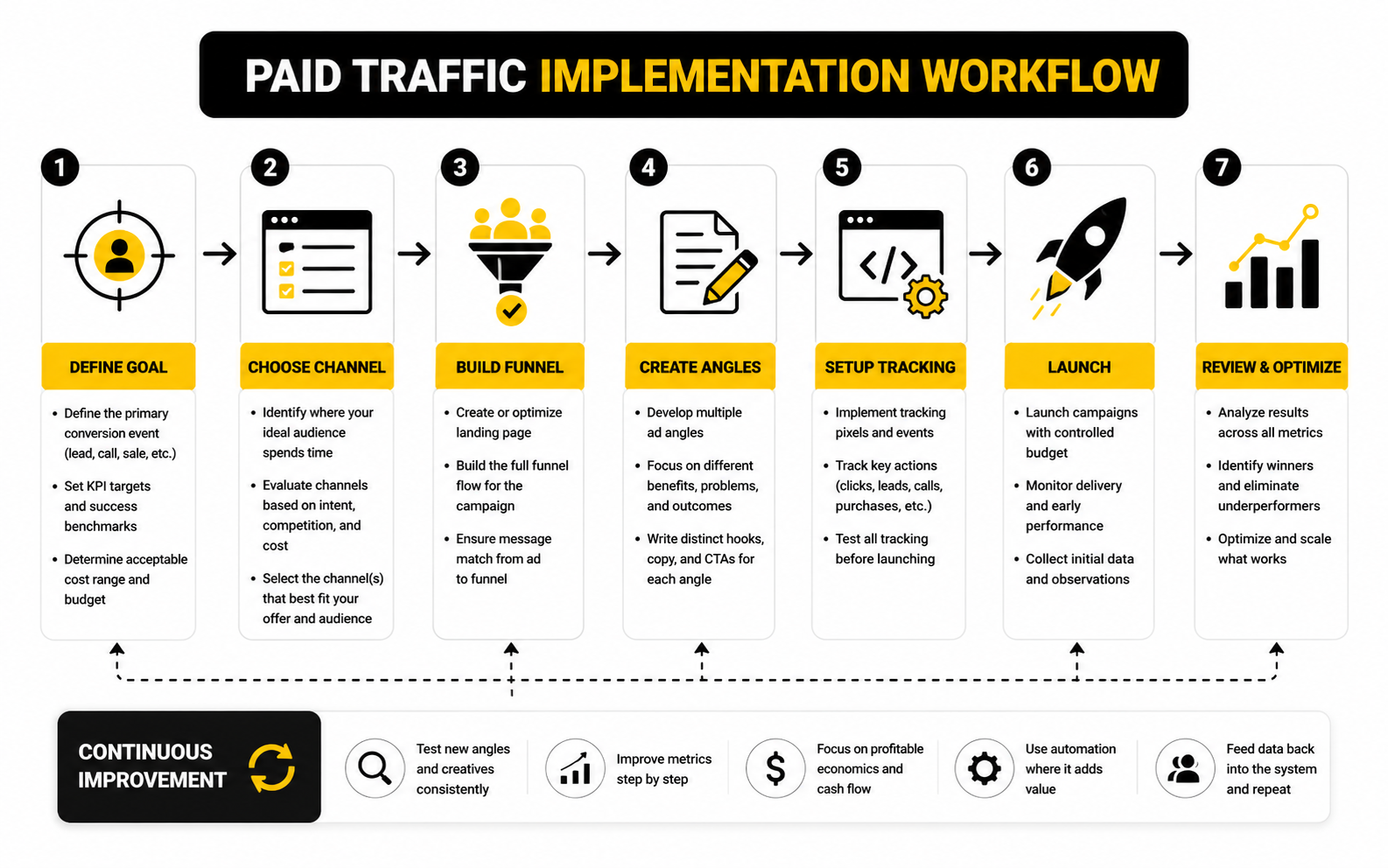
A practical launch sequence looks like this:
- Define the primary conversion event and acceptable cost range.
- Choose the channel based on buyer intent and creative requirements.
- Build one focused landing page or funnel for the campaign.
- Create multiple ad angles instead of minor design variations.
- Set up tracking before launch, not after results look confusing.
- Launch with a budget large enough to collect data but small enough to survive mistakes.
- Review lead quality, sales quality, and revenue quality before scaling.
This is also where automation has changed the job. Google’s AI Max for Search uses expanded matching, text customization, and final URL expansion to reach more relevant queries, while Meta continues pushing advertisers toward broader targeting and creative diversification. The takeaway is not “let the machine do everything.” The takeaway is that your inputs matter more: offer, creative, conversion data, page quality, and budget discipline.
Test Angles Before You Test Tiny Details
Testing button colors and small headline tweaks too early is usually a distraction. In paid traffic, the bigger wins often come from testing different angles. That means different promises, pain points, proof points, objections, audience segments, or use cases.
For example, one angle might focus on saving time. Another might focus on reducing risk. Another might focus on getting a specific outcome faster. These are meaningful differences because they help you learn what the market actually cares about.
Once a winning angle appears, then smaller improvements become worth testing. You can refine the hook, page structure, proof, call to action, and follow-up sequence. But do not start with tiny details when the core message is still unproven.
Use Budget Like a Diagnostic Tool
Budget is not just fuel. Budget is a diagnostic tool that reveals whether your paid traffic system is working. If you spend too little, you may never collect enough data to learn anything. If you spend too much before validation, you turn normal testing mistakes into painful losses.
A sensible early budget should answer one question: can this campaign create the right kind of action at a cost that has a path to profitability? Not perfect profitability on day one. A path. That distinction matters because new campaigns often need time for creative testing, algorithm learning, and funnel improvement.
The budget should increase only when the evidence improves. Better click quality, stronger conversion rates, lower cost per qualified lead, higher booked-call rates, higher purchase rates, or stronger revenue per visitor are all useful signals. Scaling just because the platform reports a few cheap conversions is how campaigns get messy fast.
Keep the Funnel Simple Until It Earns Complexity
Simple funnels are easier to diagnose. When a campaign has too many pages, offers, upsells, segments, and automations from the start, it becomes hard to tell what is helping and what is hurting. Complexity should be earned by performance, not added because it feels advanced.
For many businesses, a simple paid traffic funnel is enough at the beginning: ad, landing page, conversion action, follow-up, sales or checkout process, and retargeting. If that does not work, adding more steps rarely fixes the real issue. It usually hides the issue.
Tools like ClickFunnels or Systeme.io can make funnel building faster when the offer and traffic plan are already clear. The tool is not the strategy, though. The strategy is making every step obvious enough that the right person keeps moving forward.
Statistics and Data
Paid traffic data only matters when it changes what you do next. A benchmark can show whether your campaign is unusually expensive, unusually weak, or simply operating in a competitive market. But a benchmark is not a business model.
The average Google Ads search cost per click reached $5.26 in 2025, and average conversion rates across Google Ads reached 7.52%. Those numbers are useful, but they are not targets by themselves. A $12 click can be cheap if it produces profitable customers, while a $1 click can be expensive if it fills your pipeline with people who never buy.
This is the right way to read paid traffic data: every number should explain a bottleneck. CTR tells you whether the message earns attention. CPC tells you how expensive that attention is. Conversion rate tells you whether the page and offer turn attention into action. Cost per qualified lead, booked call, purchase, or customer tells you whether the campaign is moving the business forward.
The Analytics System
A clean analytics system connects four layers: platform data, website behavior, CRM or checkout data, and revenue data. If you only look inside the ad platform, you may optimize for conversions that look good but do not create profit. If you only look at revenue, you may miss the earlier signal that explains why revenue moved.
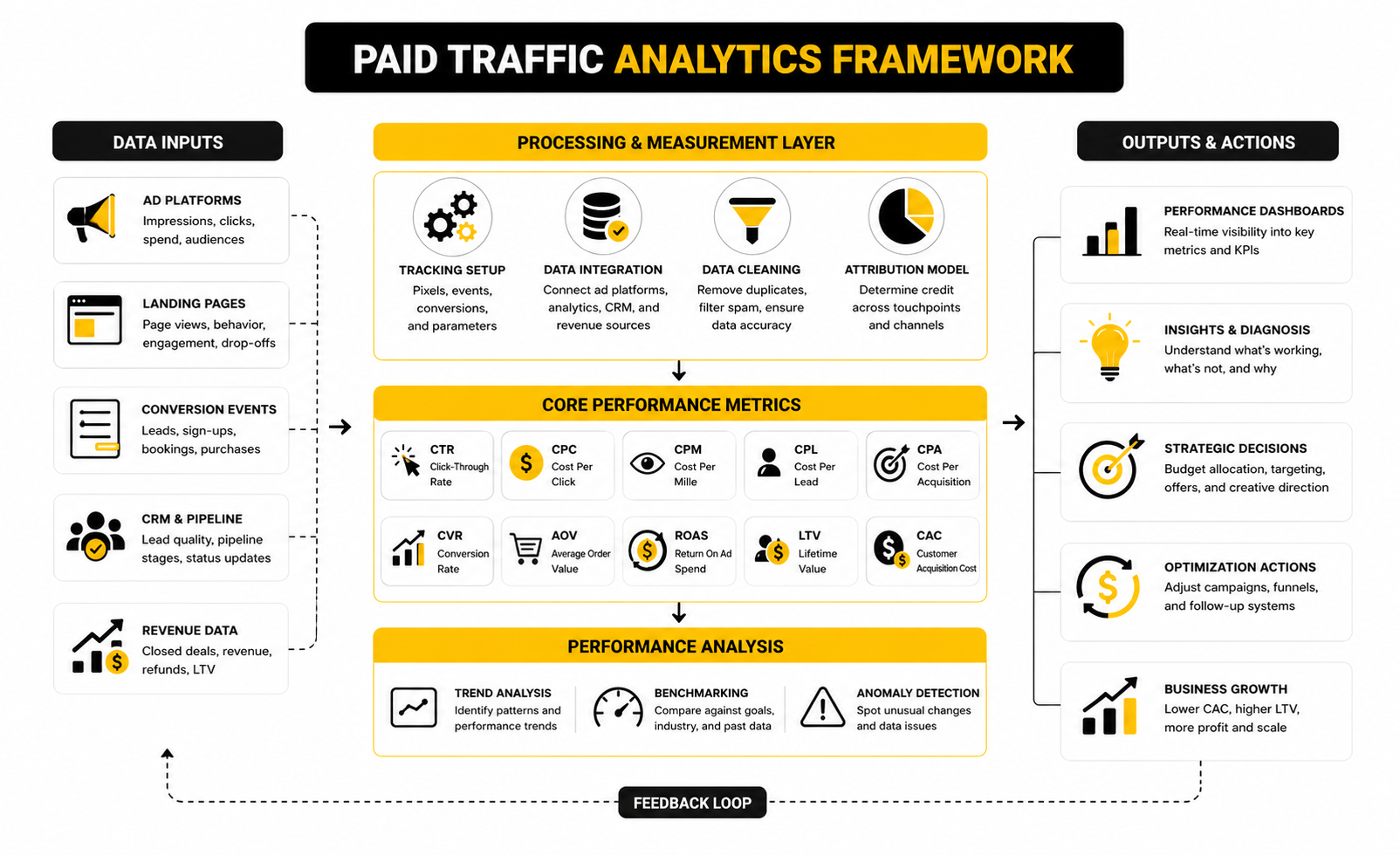
The job is to build a measurement chain from impression to revenue. A person sees the ad, clicks, lands on the page, takes an action, enters follow-up, becomes qualified, and eventually buys or does not buy. Each step has a number attached to it, and each number tells you where to focus.
This is also why UTMs, conversion events, offline conversion imports, call tracking, form tracking, and CRM stages matter. They are not technical decorations. They are the difference between “this campaign feels good” and “this campaign creates customers at a cost we can scale.”
Benchmarks Need Context
Benchmarks become dangerous when they are used without context. Search campaigns, lead ads, ecommerce conversion campaigns, video campaigns, and retargeting campaigns do not behave the same way. A campaign targeting cold audiences should not be judged like a branded search campaign.
Industry also matters. Legal, finance, B2B software, local services, ecommerce, and education can have completely different click costs and sales cycles. A campaign with a high cost per lead may still be strong if lead quality and customer value are high.
The better question is not “is this CPC good?” The better question is “does this cost make sense for our economics?” Paid traffic gets much easier when you compare the numbers against your average order value, close rate, gross margin, lifetime value, and cash flow.
The Metrics That Actually Drive Decisions
Not every metric deserves equal attention. Impressions and clicks help you diagnose reach and interest, but they do not prove revenue potential. Likes, comments, and video views can support analysis, but they should not replace conversion and sales data.
The most useful paid traffic metrics usually include:
- CTR, because it shows whether the message is earning attention.
- CPC, because it shows what the market is charging for that attention.
- Landing page conversion rate, because it shows whether the click has somewhere useful to go.
- Cost per lead or purchase, because it connects spend to action.
- Cost per qualified lead, because cheap leads are not always good leads.
- Customer acquisition cost, because the real goal is not a form fill.
- Return on ad spend, because revenue has to justify the media spend.
- Payback period, because cash flow determines how aggressively you can scale.
The key is sequencing. If CTR is weak, fix the message or creative first. If CTR is strong but conversion rate is weak, fix the landing page or offer. If leads are cheap but sales are weak, fix qualification, follow-up, or sales process before blaming the ad platform.
Attribution Is Directional, Not Perfect
Attribution is helpful, but it is not perfect truth. Privacy changes, cookie limits, modeled conversions, multiple devices, delayed purchases, and dark social all make exact tracking harder. That does not mean measurement is useless. It means you need to read it like a decision system, not a courtroom transcript.
Platform attribution can over-credit campaigns because the platform sees its own touchpoints clearly. Analytics tools can under-credit campaigns because they miss parts of the journey. CRM and sales data can be more grounded, but they often arrive later.
The practical answer is triangulation. Compare ad platform performance, analytics data, CRM outcomes, and actual revenue. When all four point in the same direction, you can move with confidence. When they disagree, slow down and investigate before cutting or scaling budget.
What Good Performance Looks Like
Good paid traffic performance is not just a low cost per click. It is a stable chain from spend to revenue. You want clear demand, enough conversion volume, acceptable acquisition cost, and a path to improve margins over time.
In early testing, good performance may look like qualified leads arriving at a cost that is close to workable. In ecommerce, it may look like strong add-to-cart rates and improving purchase rates as creative and landing pages improve. In B2B, it may look like fewer leads but higher meeting quality and stronger pipeline value.
Do not demand perfection too early, but do demand evidence. A campaign should show you what to improve next. If the data is too messy to guide action, the next optimization is not another ad variation. The next optimization is better measurement.
Scaling Paid Traffic Without Breaking the Economics
Scaling paid traffic is not the same as increasing budget. Anyone can spend more. The hard part is spending more while keeping lead quality, conversion rates, margins, and cash flow under control.
Most campaigns get more volatile as they scale because the platform has to find more people beyond the easiest early wins. The first profitable pocket of traffic may be small. Once budget rises, the system needs stronger creative, broader messaging, better landing pages, and tighter follow-up to keep performance stable.
This is why scaling should happen in stages. Increase budget when the campaign has enough conversion volume, consistent qualified outcomes, and a clear payback path. If performance drops after a budget increase, do not panic immediately, but do not ignore the signal either. Look at where the drop happened: attention, click cost, page conversion, lead quality, close rate, or revenue.
The Creative Ceiling
A lot of paid traffic campaigns hit a creative ceiling before they hit an audience ceiling. The platform can only distribute the assets you give it. If the ads all say the same thing in slightly different ways, performance usually gets tired.
Creative fatigue is not just about people seeing the same ad too often. It is also about the market no longer reacting to the angle. A hook that worked three months ago may still be true, but it may no longer feel fresh enough to stop attention.
The fix is not endless random content. Build creative around strategic angles: problems, outcomes, objections, comparisons, proof, demonstrations, founder perspective, customer language, and use cases. Paid traffic scales better when creative development becomes a repeatable operating rhythm, not a desperate reaction after results decline.
Automation Changes the Skill Set
Ad platforms are becoming more automated, and pretending otherwise is pointless. Google’s AI Max adds expanded matching, text customization, final URL expansion, and improved reporting to Search campaigns. Meta’s automation push is also moving more targeting, placement, budget, and creative decisions into machine-learning systems.
That does not remove the need for strategy. It moves the strategy upstream. Instead of obsessing over tiny manual settings, you need better conversion data, stronger creative inputs, cleaner landing pages, and clearer business rules.
The expert edge is judgment. Automation can find patterns, but it does not know your margins, sales capacity, positioning, fulfillment limits, or brand risk. You still decide what a qualified customer is worth, which promises are acceptable, and when a campaign is scaling profitably versus just spending efficiently inside the platform.
The Risk of Optimizing for the Wrong Conversion
One of the fastest ways to ruin paid traffic is optimizing for the wrong event. If the platform is told to find cheap leads, it will usually find cheap leads. That does not mean it will find buyers.
This problem shows up in lead generation all the time. A campaign looks successful because cost per lead falls, but the sales team says the leads are weak. The platform did its job. The business gave it the wrong target.
The better move is to pass stronger signals back into the system. Qualified leads, booked appointments, attended calls, purchases, subscriptions, and revenue events are more useful than shallow form fills. If you use a CRM-heavy model, a platform like GoHighLevel can help connect pipeline stages and follow-up so the campaign is judged closer to the actual sales outcome.
Budget Allocation Across the Funnel
A healthy paid traffic system usually has more than one campaign type. Cold acquisition brings in new people. Retargeting brings back people who showed intent. Brand search protects demand you already created. Existing customer campaigns can increase repeat purchases, upgrades, or referrals.
The mistake is putting everything into cold acquisition and then wondering why the funnel leaks. Cold traffic needs support. Retargeting, email, SMS, sales follow-up, and organic proof can all improve the return from the original click.
Budget allocation should follow the weakest constraint. If you have traffic but not enough conversions, improve the page and offer. If you have leads but not enough sales, improve qualification and follow-up. If you have customers but low repeat purchase or retention, fix the back end before pouring more money into acquisition.
Cash Flow Matters More Than Vanity ROAS
Return on ad spend is useful, but it can be misleading when viewed alone. A campaign with a strong ROAS may still be hard to scale if margins are thin, refunds are high, or payback takes too long. A campaign with a lower immediate ROAS may be excellent if retention and lifetime value are strong.
This is where paid traffic becomes a finance conversation. You need to know how much you can spend to acquire a customer, how quickly you recover that money, and how much cash the business can tolerate being tied up. Growth that looks good in a dashboard can still hurt the business if payback is too slow.
The cleanest scaling decisions usually come from contribution margin, customer acquisition cost, lifetime value, and payback period. These numbers force honesty. They turn paid traffic from a guessing game into a controlled growth engine.
When to Add More Channels
Adding another channel should solve a specific problem. Do not add TikTok, YouTube, LinkedIn, or programmatic display just because everyone is talking about them. Add a channel because it reaches a buyer state your current mix does not reach, gives you cheaper learning, or expands profitable demand.
A new channel also needs its own creative logic. What works on Google Search will not automatically work on TikTok. What works on Meta may not work on LinkedIn. The audience mindset, format, level of intent, and proof needed can all change.
The best time to add a channel is when your core system is already understandable. You know your offer, funnel metrics, conversion economics, and best-performing angles. Then a new channel becomes an expansion test, not a rescue mission.
Measurement, Scaling, and FAQs
At this point, paid traffic should be treated as an ecosystem rather than a campaign. The ad platform creates distribution, but the business creates the result. Your offer, creative, page, tracking, follow-up, sales process, and economics all work together.
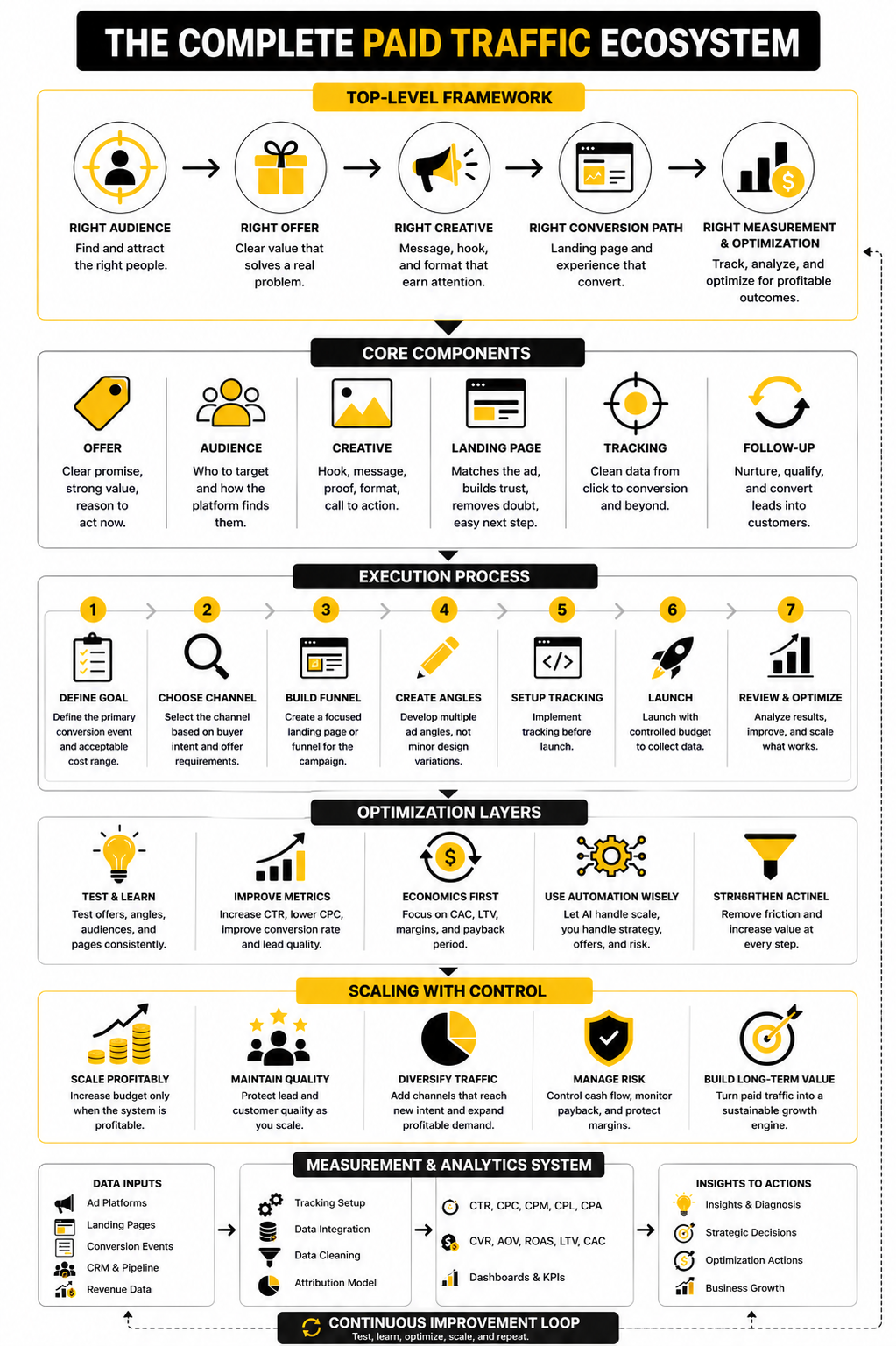
That is the final shift. You stop asking, “Which ad should we run?” and start asking, “Which system gives us the best chance to acquire customers profitably?” When you think this way, every campaign becomes easier to diagnose.
If attention is weak, improve the message. If clicks are expensive, improve relevance and channel fit. If conversions are weak, improve the page and offer. If sales are weak, improve qualification and follow-up. If revenue is delayed, improve cash flow planning before scaling harder.
FAQ - Built for Complete Guide
What is paid traffic?
Paid traffic is website or funnel traffic generated through paid promotion. This includes Google Ads, Meta Ads, YouTube Ads, TikTok Ads, LinkedIn Ads, sponsored placements, retargeting, and other paid media channels. The goal is not just to buy visits, but to turn those visits into leads, customers, revenue, or another measurable business outcome.
Is paid traffic better than organic traffic?
Paid traffic is not automatically better than organic traffic. It is faster, more controllable, and easier to test, but it stops when the budget stops. Organic traffic usually compounds more slowly, but it can become more efficient over time.
How much should I spend on paid traffic?
Your starting budget should be based on the cost of learning, not wishful thinking. You need enough spend to generate meaningful data, but not so much that early mistakes damage the business. A practical starting point is to define your acceptable cost per lead, purchase, or customer, then run a controlled test around that number.
Which paid traffic channel should I start with?
Start where your buyer intent is strongest. If people are already searching for your solution, Google Search may be the cleanest first test. If your offer needs education, demonstration, or visual storytelling, paid social may be the better starting point.
Why is my paid traffic not converting?
The most common reasons are weak offer clarity, poor landing page alignment, bad targeting signals, slow page experience, low trust, or unclear follow-up. The ad may be doing its job by bringing people in, while the rest of the funnel fails to move them forward. Diagnose the full path before blaming the platform.
What is a good conversion rate for paid traffic?
A good conversion rate depends on channel, industry, offer, price point, and conversion type. A lead magnet, booked call, ecommerce purchase, and enterprise demo request will not convert at the same rate. The useful question is whether your conversion rate supports profitable acquisition.
What is the difference between CPC and CPA?
CPC means cost per click. It shows how much you pay when someone clicks your ad. CPA means cost per acquisition or action, and it shows what you pay for the result you actually care about, such as a lead, trial, purchase, or booked call.
Should I optimize for leads or sales?
Optimize as close to revenue as your data volume allows. If you only optimize for cheap leads, the platform may find people who submit forms but never buy. When possible, pass qualified leads, booked calls, purchases, and revenue data back into your decision-making process.
How long should I test a paid traffic campaign?
Test long enough to collect useful data across the main funnel steps. Ending a campaign after a few clicks is usually too early. Let the campaign show whether the problem is attention, cost, conversion, qualification, sales, or revenue before making big decisions.
When should I scale paid traffic?
Scale when you have consistent conversion volume, acceptable acquisition costs, clear lead or customer quality, and a realistic payback path. Do not scale only because one campaign had a good day. Scale when the system is stable enough to handle more spend.
What is retargeting in paid traffic?
Retargeting shows ads to people who already interacted with your business. That may include website visitors, video viewers, email subscribers, abandoned cart users, or previous customers. It usually works best when the message responds to what the person has already done.
Do I need a funnel for paid traffic?
Yes, but the funnel does not need to be complicated. A simple funnel can be an ad, landing page, conversion action, follow-up, and sales or checkout process. The point is to create a clear path from attention to outcome.
What tools help manage paid traffic funnels?
The right tools depend on your model. ClickFunnels and Systeme.io can help with funnel building. GoHighLevel can help when CRM, automation, booking, pipeline, and follow-up are central to the campaign.
What is the biggest mistake with paid traffic?
The biggest mistake is treating ads as the whole strategy. Paid traffic only amplifies the system behind it. If the offer, page, tracking, follow-up, and economics are weak, more ad spend usually makes the weakness more expensive.
Work With Professionals
Explore 10K+ Remote Marketing Contracts on MarkeWork.com
Most marketers spend too much time chasing clients, competing on crowded platforms, and losing a percentage of every project to middlemen.
MarkeWork gives you a better way. Browse thousands of remote marketing contracts and connect directly with companies desperate to hire skilled marketers like you, without platform commissions and without unnecessary gatekeepers.
If you're serious about finding better opportunities and keeping 100% of what you earn, explore available contracts and create a profile for free at MarkeWork.com.