

Pay per click looks simple from the outside. You choose keywords, write an ad, set a budget, and pay when somebody clicks. In practice, though, good PPC is less about buying traffic and more about matching intent, message, landing page, and measurement so tightly that every click has a real job to do.
That is why pay per click is still one of the most important performance channels in digital marketing. The broader US digital advertising market climbed to about $259 billion in 2024, and Google says its products and advertising tools helped drive an estimated $850 billion of economic activity in the US in 2024. Search remains central because it captures demand at the exact moment people are looking for an answer, a product, or a provider. IAB+1
What makes PPC powerful is also what makes it unforgiving. Benchmark data from thousands of campaigns shows that paid search performance can vary fast on the basics alone, with 2025 PPC averages landing around a 6.66% click-through rate, a $5.26 average cost per click, and a 7.52% conversion rate. Those numbers are useful as reference points, but they are not a strategy. The real work is understanding the auction, improving relevance, and building a post-click experience that deserves the visit. WordStream
Google’s own guidance makes that tradeoff clear. Ad rank is not just about bidding higher, because the auction also weighs context and ad quality, while Quality Score reflects how relevant and useful your ad and landing page are to the searcher. In other words, pay per click is not really a money-only game. It is a relevance game with money attached. Google Help+2
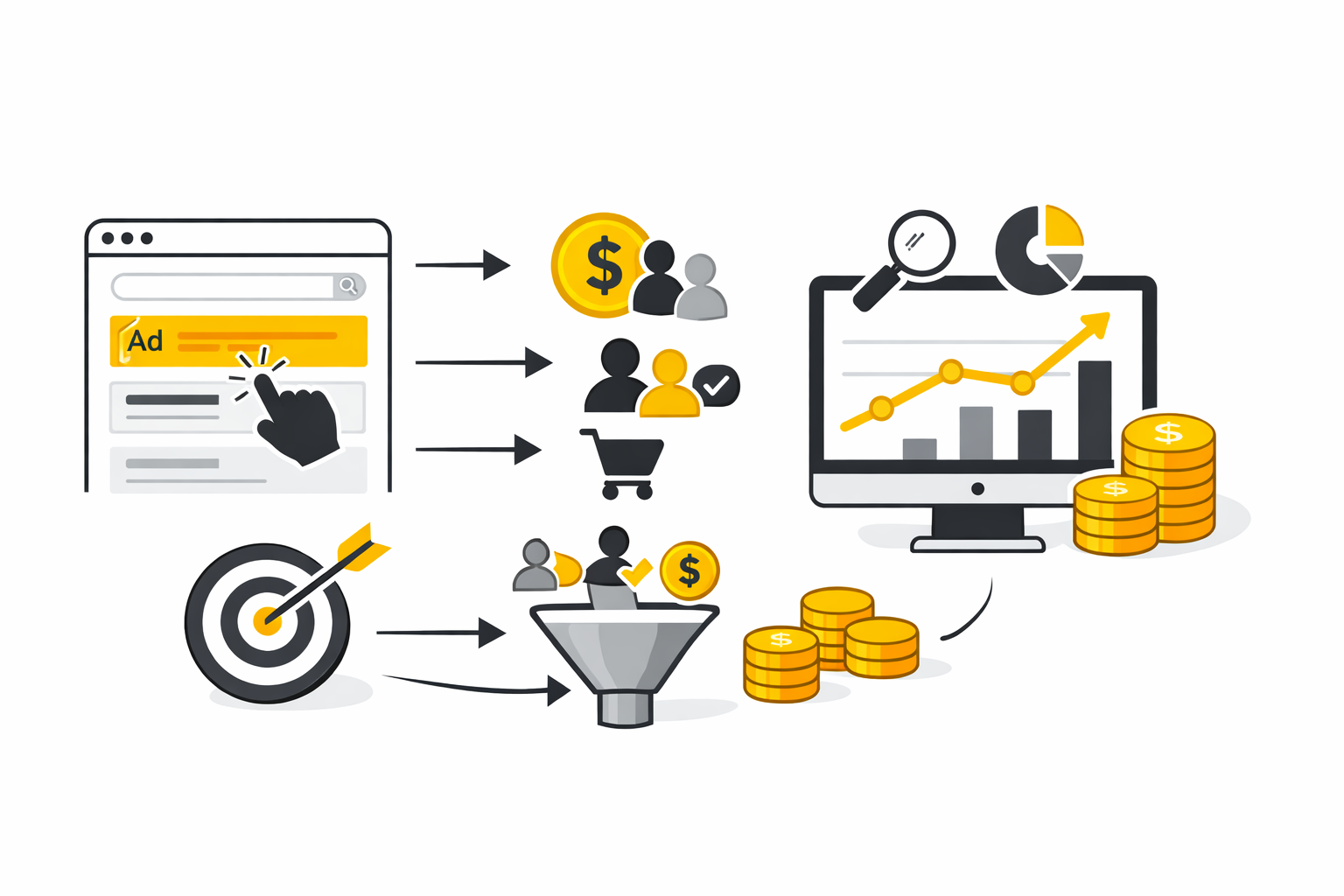
The other big shift is execution. Modern paid search is increasingly shaped by automation, responsive search ads, audience signals, and tighter conversion measurement, which means advertisers need better inputs, not just more toggles. Google’s guidance on responsive search ads and conversion measurement points in the same direction: stronger assets, clearer tracking, and better data lead to better optimization. Microsoft’s search network also remains relevant for many advertisers, especially because it extends reach beyond Google across a large desktop search audience. Google Help+2
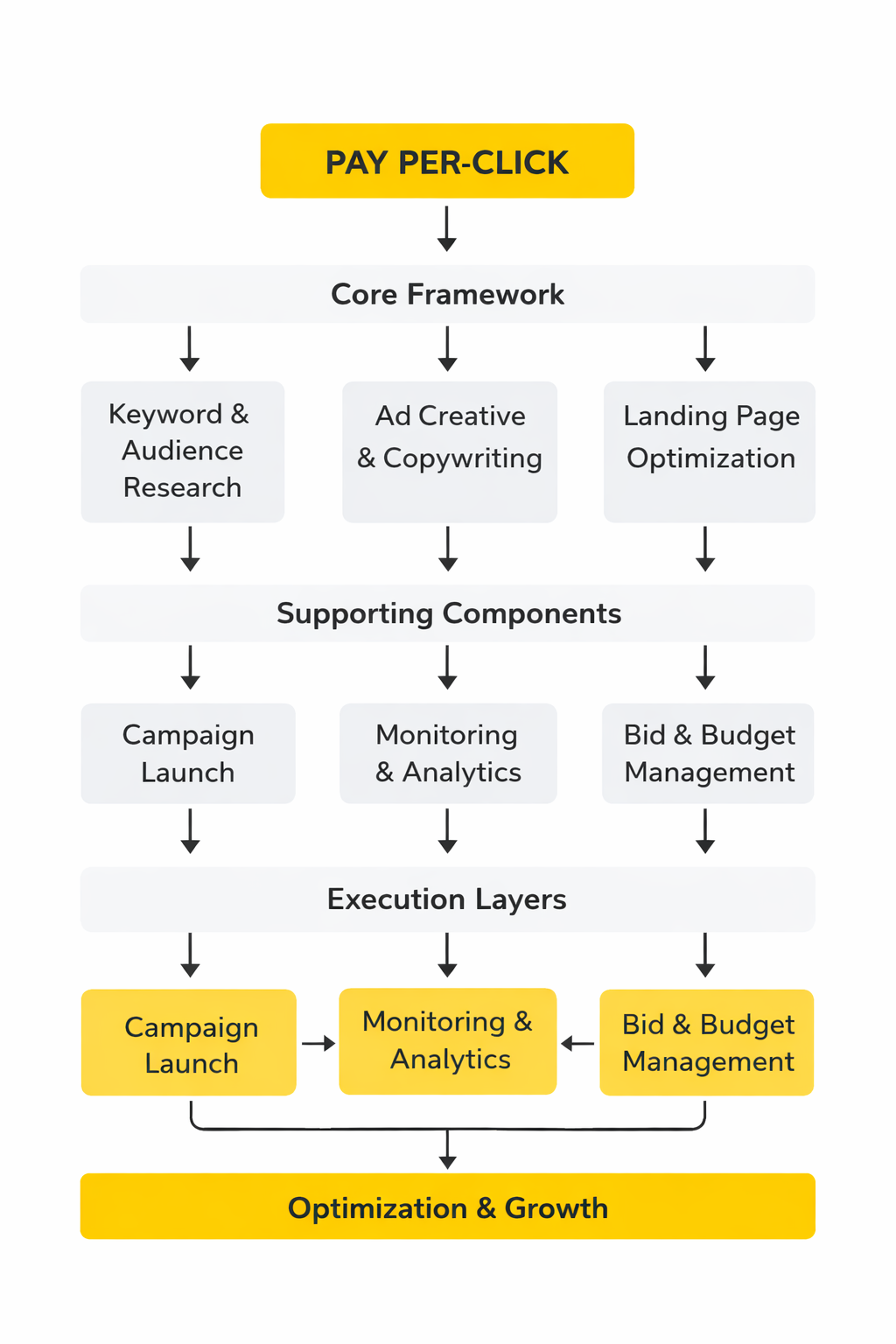
Article Outline
This article is built as a six-part guide so the ideas stack in the right order. We will start with the fundamentals, then move into the operating model behind strong campaigns, and finish with implementation, mistakes, and FAQs. The section names below are the exact names the rest of the article will continue using.
- What Pay Per Click Actually Means
- Why Pay Per Click Still Matters
- The PPC Framework: Intent, Auction, Offer, and Measurement
- Core Components of a High-Performing PPC Campaign
- How Professionals Implement and Optimize PPC
- Common Mistakes, Platform Choices, and FAQs
What Pay Per Click Actually Means
Pay per click is a pricing model in online advertising where the advertiser pays when someone clicks the ad, not when the ad simply appears. That sounds basic, but it matters because it changes how you think about media buying. You are not just renting visibility. You are paying for a measurable action that should move someone closer to a lead, a sale, a booking, or another defined outcome. Google Help+1
In practice, pay per click usually sits inside search engine marketing, where ads appear when someone searches for a relevant query. Google explains CPC bidding as setting the highest amount you are typically willing to pay for a click, while Microsoft frames the same model around only being charged when a user actually clicks. That is why PPC has always attracted businesses that care about control, accountability, and speed. Google Help+2
The important nuance is that PPC is not limited to one platform or one ad format. It is most closely associated with Google Ads and Microsoft Advertising search campaigns, but the underlying model also shows up in other environments where advertisers buy traffic on a click basis. Still, search remains the clearest version of pay per click because the user is already raising a hand and revealing intent through the query itself. Microsoft Advertising+2
PPC Is an Auction, Not a Fixed Price List
A lot of beginners assume there is a flat menu of prices behind pay per click. There is not. Google runs an ad auction every time someone searches or visits a property with eligible ads, and that auction helps determine which ads can show and in what order. Google Help+1
That auction is shaped by more than your bid. Google’s Ad Rank system looks at your bid, ad and landing page quality, minimum thresholds, competitiveness, and search context such as device, location, and time. This is the part many advertisers miss at first: paying more can help, but relevance and usefulness still affect whether you show and how efficiently you buy traffic. Google Help+1
That also explains why actual CPC is often lower than your maximum CPC. Google explicitly states that the final amount charged for a click is often less than the maximum you set, which means the system is not simply draining your budget to the cap on every auction. Good PPC management is really the discipline of creating better inputs so the auction works in your favor more often. Google Help+1
Relevance Is Built Into the Economics
One of the biggest reasons pay per click works is that the platforms try to reward relevance. Google says higher ad quality generally leads to better performance, including better positions and lower cost, and it evaluates that quality through signals tied to the ad and the landing page experience. That shifts PPC from pure bidding warfare into a system where clarity, usefulness, and page experience have financial consequences. Google Help+1
Google’s Quality Score is not the auction itself, but it is still a useful diagnostic because it reflects three things that absolutely matter in campaign performance: expected click-through rate, ad relevance, and landing page experience. Those three components are basically a warning label for sloppy PPC execution. If the keyword, ad, and page do not line up, the platform notices, the user notices, and your costs usually get worse. Google NápovÄ›da
This is why serious pay per click strategy starts before the ad ever goes live. The ad has to match intent, the page has to fulfill the promise, and the offer has to make sense for the stage of awareness. Miss any one of those, and even a campaign that gets clicks can still fail where it matters most. Google Help+1
Why Pay Per Click Still Matters
Pay per click still matters because it captures demand when the demand already exists. Someone types a query, compares options, and is often ready to act. That makes search-based PPC fundamentally different from channels that are better at creating awareness but weaker at capturing a decision already in motion. Microsoft Advertising+1
The scale alone tells you this channel is not going anywhere. The IAB and PwC reported that US internet advertising revenue reached about $258.6 billion in 2024, with search advertising producing roughly $102.9 billion and remaining the largest format by share. That is not a side channel. It is still one of the core engines of digital demand capture. IAB+2
It also matters because businesses want measurable channels. PPC gives you a cleaner line between spend and outcome than many brand-heavy tactics, especially when tracking is set up properly and conversion actions are defined well. Google’s bidding systems now optimize at auction time for conversions or conversion value, which makes measurement quality even more central than it used to be. Google Help+1
PPC Works Because Intent Is Expensive and Valuable
The click itself costs money because intent has value. A user searching for a product, software category, or local service is usually deeper in the buying journey than someone casually scrolling a feed. That is why advertisers are willing to compete hard in search auctions, and it is why weak campaigns burn money fast while strong campaigns can scale. Google Help+1
Recent benchmark data makes that reality concrete. WordStream’s 2025 dataset put average Google Ads click-through rate at 6.66%, average cost per click at about $5.26, and average conversion rate at 7.52%. Those are broad reference points, not promises, but they show the basic truth: clicks are meaningful enough to carry real cost, and performance depends on what happens before and after the click. WordStream+1
That is also why PPC remains one of the fastest ways to validate commercial intent. You can learn quickly which terms attract the right audience, which offers resonate, and which landing pages fail to convert. Done properly, pay per click does not just buy traffic. It buys market feedback at speed. Google Help+1
PPC Still Matters Even in an Automated Ad World
Automation has changed PPC, but it has not made strategy less important. Google’s Smart Bidding uses auction-time signals and machine learning to optimize for conversions or conversion value, which can improve efficiency when the underlying data is trustworthy. The catch is obvious: automation only works well when goals, tracking, creative assets, and landing pages are strong enough to guide it. Google NápovÄ›da
That is where many campaigns still break. Advertisers hand too much responsibility to the platform while feeding it weak conversion signals, generic ad copy, or poor pages. The result is not really an automation problem. It is an input-quality problem. Google Help+2
There is also a reach argument here. Google dominates the conversation around pay per click, but Microsoft continues to position search ads across Bing, Yahoo, DuckDuckGo, and partner inventory in its network. For some advertisers, that means incremental volume, different audience composition, and another path to capture high-intent traffic instead of relying on a single platform. Microsoft Advertising+1
Why Businesses Keep Coming Back to PPC
Businesses keep returning to pay per click because it is flexible. You can control bids, budgets, targeting, messaging, landing pages, and conversion goals without waiting months to see whether the channel works. Microsoft explicitly emphasizes that accounts are free to set up, billing is flexible, and campaigns can be paused, which highlights a core benefit of PPC in general: control is built into the model. Microsoft Advertising
They also come back because the upside can compound beyond the click. Google’s public economic impact reporting says its search, cloud, YouTube, Play, and advertising tools helped drive an estimated $850 billion of economic activity in the US in 2024. That figure covers more than paid search alone, of course, but it reinforces a broader point: search and advertising infrastructure still sit close to real commercial activity. Google Economic Impact+2
So yes, pay per click still matters. It matters because it reaches people at the moment of intent, because it can be measured with unusual precision, and because even in a more automated ad ecosystem, relevance still wins. In the next section, that is exactly where we go deeper: the framework behind PPC that separates random campaign activity from disciplined performance. Google Help+2
The PPC Framework: Intent, Auction, Offer, and Measurement
If you strip pay per click down to its working parts, you end up with a simple but unforgiving system. Every campaign either aligns these four elements or wastes money trying. The framework is not theoretical. It mirrors how platforms like Google Ads actually evaluate relevance, determine ad rank, and optimize toward conversion outcomes. (support.google.com)
The four pieces are:
- Intent – what the user actually wants when they search
- Auction – how your ad competes in that moment
- Offer – what you promise and deliver after the click
- Measurement – how the system learns what success looks like
Miss one, and the rest struggle. Align all four, and performance becomes predictable enough to scale.
Intent: The Starting Point Most Campaigns Get Wrong
Intent is not just the keyword. It is the reason behind the search. Someone typing “buy CRM software” is in a different state than someone searching “what is CRM,” and pay per click treats those differently whether you do or not.
Google’s own ad relevance systems evaluate how closely your ad matches the user’s query and intent, which directly affects performance and cost. That means broad targeting without intent segmentation usually leads to wasted spend and weak conversion rates. (support.google.com)
The practical takeaway is simple:
- Separate campaigns by intent level (informational, comparison, transactional)
- Match ad copy to that intent, not just the keyword
- Send traffic to pages that resolve that specific need
If the intent is wrong, nothing else in your PPC setup can fully fix it.
Auction: Where Strategy Meets Competition
The auction is where your strategy becomes visible. Every time a search happens, your ad competes based on bid, quality signals, and context. Google confirms that ad rank considers not just your bid, but expected impact, relevance, and landing page experience. (support.google.com)
This is where most advertisers oversimplify. They try to “win” by increasing bids, but the auction rewards efficiency more than brute force. Better ads and better pages often outperform higher bids with weak relevance.
In practice, strong auction positioning comes from:
- Tight keyword grouping
- High-quality ad variations
- Clear alignment between query, ad, and landing page
- Consistent performance signals over time
The auction is not something you fight directly. It is something you influence through everything else you build.
Offer: The Part That Actually Converts
Clicks do not generate revenue. Offers do. This is where many pay per click campaigns quietly fail, because the ad gets the click but the page does not carry the weight.
Google explicitly evaluates landing page experience as part of quality signals, including relevance, transparency, and usability. That means slow, generic, or confusing pages do not just convert poorly, they also make traffic more expensive. (support.google.com)
A strong PPC offer usually has three traits:
- Clarity – the visitor immediately understands what they get
- Relevance – the page directly reflects the search intent
- Friction control – minimal steps between interest and action
This is where tools built for conversion-focused funnels can make a difference. Platforms like ClickFunnels or Systeme.io are often used specifically to align PPC traffic with structured, high-converting page flows instead of generic website pages.
Measurement: The Feedback Loop That Drives Everything
Measurement is where PPC becomes a system instead of a gamble. Without clean conversion tracking, the platform cannot optimize properly, and you cannot make informed decisions.
Google’s bidding systems rely heavily on conversion data to optimize in real time, using auction-time signals to adjust bids toward users more likely to convert. That makes tracking accuracy one of the most important technical foundations in any campaign. (support.google.com)
At a minimum, serious PPC measurement includes:
- Primary conversion tracking (sales, leads, bookings)
- Secondary signals (add-to-cart, form starts, engagement)
- Clear attribution windows
- Consistent data flow into the ad platform
If the data is wrong, the optimization is wrong. And when optimization is wrong, scaling becomes expensive very quickly.
Core Components of a High-Performing PPC Campaign
Once the framework is clear, execution becomes much more structured. High-performing pay per click campaigns are not built randomly. They follow a repeatable system where each component supports the others.
Campaign and Ad Group Structure
Structure is where control begins. Google’s own best practices emphasize organizing campaigns and ad groups around tightly themed keyword sets so ads can stay highly relevant. (support.google.com)
A clean structure usually looks like this:
- Campaign level: defined goal (sales, leads, traffic)
- Ad group level: tightly related keyword clusters
- Ads: directly aligned with those clusters
Loose structure leads to generic ads, and generic ads lead to poor performance. Tight structure creates relevance almost automatically.
Keyword Strategy That Reflects Reality
Keywords are still the backbone of search PPC, but modern campaigns rely on intent grouping more than exact matching alone. Match types, search term reports, and negative keywords all shape what traffic you actually pay for.
The most effective keyword strategies focus on:
- High-intent commercial queries first
- Expansion into broader terms only after validation
- Aggressive use of negative keywords to filter noise
This is where many campaigns either become efficient or spiral into wasted spend. What you exclude is just as important as what you target.
Ad Creative That Earns the Click
Responsive search ads allow multiple headlines and descriptions, and Google’s system dynamically tests combinations to improve performance. That means your job is not to write one perfect ad, but to provide strong variations that the system can learn from. (support.google.com)
Strong PPC ads typically:
- Reflect the exact search intent
- Highlight a clear benefit or differentiator
- Include a direct and relevant call to action
Weak ads blend in. Strong ads feel like the obvious next step for the user.
Landing Pages Built for Conversion
Sending PPC traffic to a generic homepage is one of the fastest ways to lose money. The landing page must continue the conversation started in the ad, not restart it.
This is where dedicated funnel builders or conversion-focused page tools often outperform traditional websites. Platforms like this ClickFunnels offer are specifically designed to create focused paths from click to conversion, which aligns naturally with how pay per click traffic behaves.
A Practical PPC Execution Flow
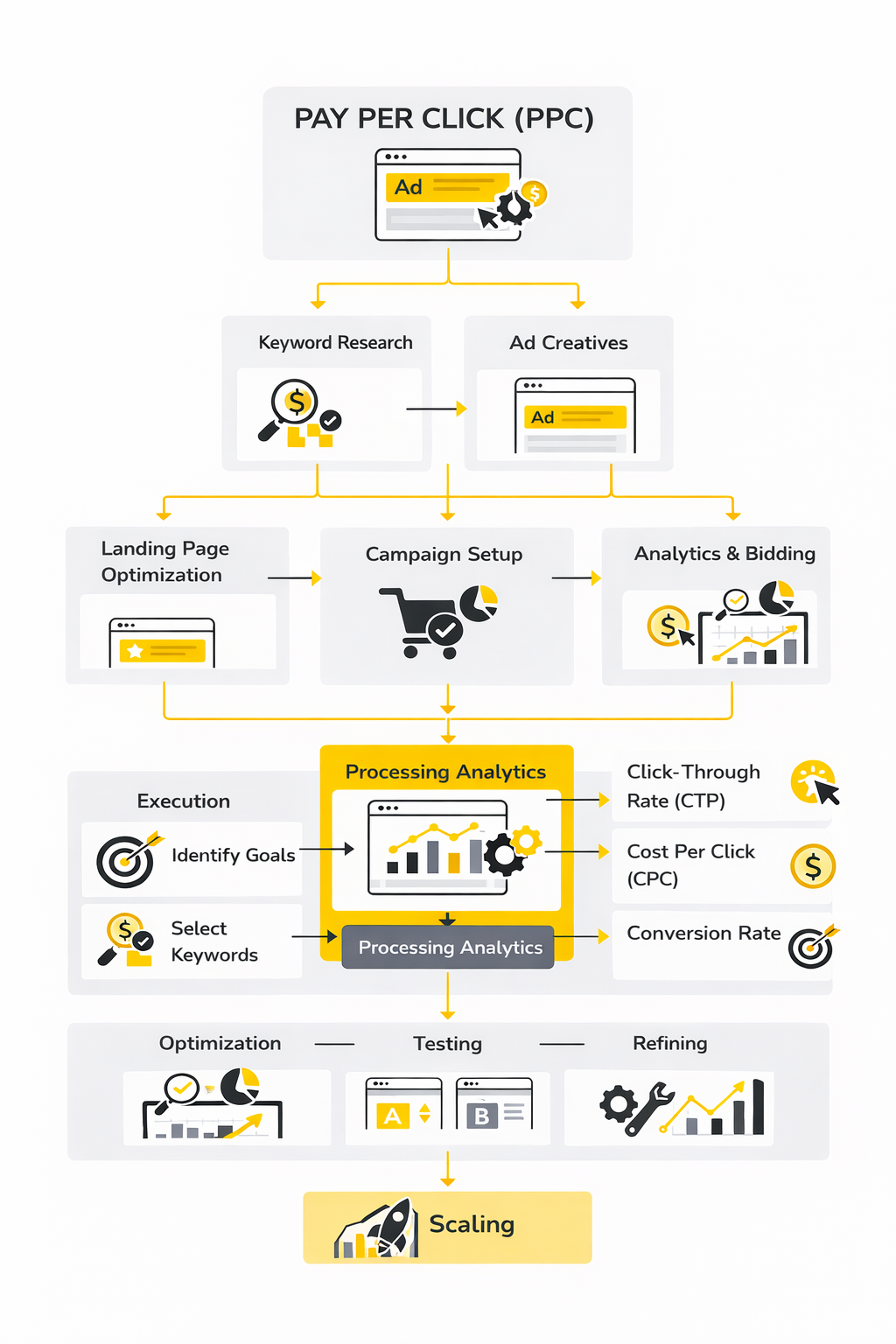
This is where everything becomes tangible. A strong pay per click campaign is not built in one step. It follows a clear sequence where each stage feeds the next.
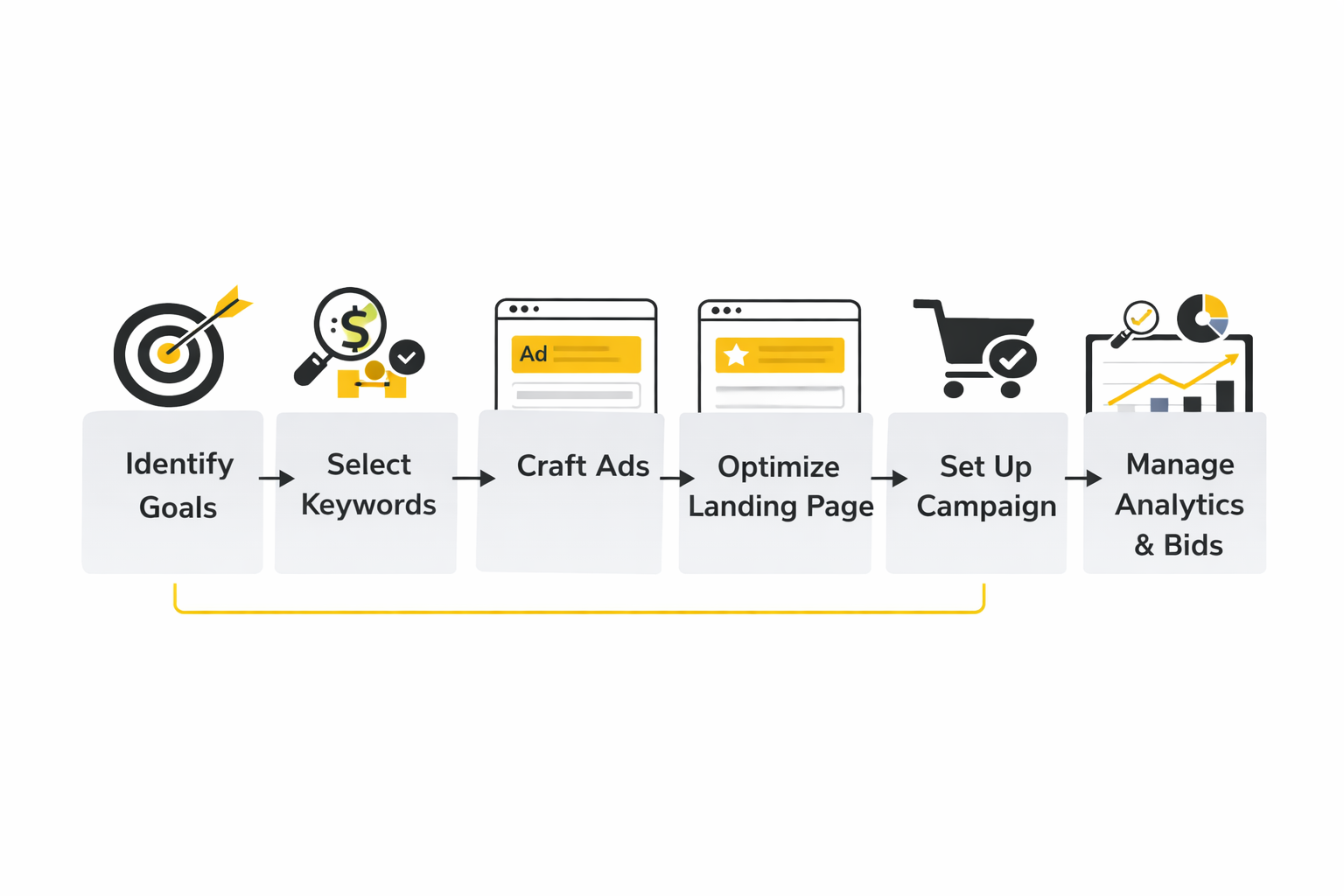
A simplified execution flow looks like this:
- Define the goal Decide exactly what counts as success (purchase, lead, booking). This determines everything from bidding strategy to landing page design.
- Map intent to keywords Group keywords based on what the user is trying to achieve, not just the words themselves.
- Build structured campaigns Create tightly themed ad groups so ads stay relevant and performance is easier to control.
- Write multiple ad variations Give the system enough high-quality inputs to test and optimize combinations.
- Design conversion-focused landing pages Align the page with the ad promise and remove unnecessary friction.
- Set up accurate conversion tracking Ensure every meaningful action is captured so optimization has real data.
- Launch with controlled budgets Start with enough data to learn, but not so much that mistakes become expensive.
- Analyze and refine continuously Use search term data, performance metrics, and conversion insights to improve alignment across the entire system.
This is what separates random PPC activity from structured growth. The process is not complicated, but it is precise. And in pay per click, precision is where profitability lives.
PPC Metrics and Data That Actually Matter
The easiest way to get lost in pay per click is to stare at numbers without understanding what job each one is doing. PPC platforms give you endless data, but not every metric deserves equal attention. The useful ones are the metrics that help you diagnose whether the campaign has an intent problem, an auction problem, an offer problem, or a measurement problem.
That distinction matters because numbers can look healthy while the campaign is quietly underperforming. A strong click-through rate with weak conversion performance usually points to message or landing page issues. A low click-through rate with expensive traffic often signals poor relevance in the auction, which lines up with how Google evaluates ad quality through expected CTR, ad relevance, and landing page experience. (Google’s Quality Score components)
Start With the Metrics That Explain Movement
Most PPC reporting should begin with five core metrics: impressions, click-through rate, cost per click, conversion rate, and cost per acquisition or cost per lead. These are not random dashboard staples. Together, they show whether the campaign is being seen, whether the ad is compelling, whether the traffic is getting expensive, whether the page converts, and whether the economics still work.
Recent benchmark data gives useful reference points, but only if you treat them as a baseline rather than a target. A large 2025 benchmark analysis across more than 16,000 US campaigns reported an average click-through rate of 6.66%, an average cost per click of $5.26, an average conversion rate of 7.52%, and an average cost per lead of $70.11. Those numbers are helpful because they tell you what “normal” can look like across a huge sample, but they should never replace your own margin structure, sales cycle, and customer value.
What matters is the relationship between the metrics, not one isolated number. A campaign can survive a high CPC if the conversion rate and customer value are strong enough. A cheap CPC can still be a disaster if the traffic never converts.
Click-Through Rate Tells You About Message-Market Fit
Click-through rate is one of the clearest signals of whether your ad feels relevant to the searcher. It is not a full performance score, but it is usually the first visible sign that the message is either connecting or missing. Google itself uses expected click-through rate as one of the main components in Quality Score and auction-time ad quality. (Google Ads guidance on ad quality)
That is why CTR should be interpreted as a relevance signal first and a vanity metric second. When CTR is weak, the problem is often one of these:
- the keyword is too broad for the ad
- the ad copy does not match intent
- the offer is not compelling enough
- competitors are making a stronger promise
A rising CTR usually means your targeting and message alignment are improving. But it only becomes meaningful business progress when conversion performance moves with it.
Cost Per Click Tells You How Hard the Auction Is Fighting Back
Cost per click is where many advertisers panic too early. They see a number climbing and assume the campaign is broken. Sometimes it is. Sometimes it just means the traffic is commercially valuable and the competition knows it.
Google’s auction documentation is clear that ad rank depends on more than the bid alone. Bid amount, quality, context, thresholds, and expected asset impact all shape whether your ad shows and what it costs to compete. (Google Ads Ad Rank overview) That means CPC should be read as a combined signal of market pressure and campaign quality.
A high CPC should drive action only after you ask the right follow-up questions:
- Is the keyword commercially strong enough to justify the cost?
- Is the ad relevant enough to compete efficiently?
- Is the landing page converting well enough to absorb the spend?
- Is the campaign chasing volume where intent is too weak?
This is why smart PPC operators rarely try to lower CPC in isolation. They work on relevance and conversion economics so the same click becomes more valuable.
Conversion Rate Exposes the Truth After the Click
Conversion rate is where wishful thinking usually ends. If CTR tells you people like the ad, conversion rate tells you whether the traffic was actually worth buying. This is the metric that reveals the strength of the offer, the clarity of the landing page, and the friction in the user journey.
Google’s emphasis on landing page experience is useful here because it confirms what advertisers learn the hard way: weak pages hurt both efficiency and outcomes. (Google’s landing page experience guidance) A poor conversion rate often points to one of three problems. Either the wrong people are clicking, the right people are landing on the wrong page, or the page is asking them to do too much before they trust you.
That is also why conversion-focused page systems matter more in PPC than in many other channels. When paid traffic hits a page built specifically for one action, the economics usually become easier to manage than when that same traffic lands on a cluttered general site. Tools like ClickFunnels and Systeme.io are often used for exactly that reason: they help turn paid clicks into cleaner, more measurable conversion paths.
What the Data Should Make You Do
Good PPC measurement is not about collecting reports. It is about making better decisions faster. The reason to track benchmarks and signals is to know what lever to pull next.
A practical way to interpret the data looks like this:
- Low CTR and high CPC usually means weak relevance in the auction. Tighten keyword intent, improve ad copy, and strengthen alignment.
- Good CTR but low conversion rate usually means the ad promise is stronger than the landing page experience. Fix the page, not the bid.
- Good conversion rate but bad lead quality usually means the action is too easy or the targeting is too loose. Improve qualification.
- Strong lead quality but high CPA usually means the offer works, but the path is too expensive. Expand efficiency through better segmentation, better negatives, and better bidding.
- Inconsistent performance across time or device usually means the campaign needs more granular controls, better audience understanding, or cleaner tracking.
That is the real point of analytics. The dashboard is not the destination. It is the control panel.
Quality Signals Matter More Than Most Advertisers Think
One of the biggest mistakes in PPC reporting is ignoring quality signals because they look less dramatic than cost and conversion metrics. That is a mistake. Google repeatedly ties performance efficiency to ad quality, and its guidance is blunt that higher ad quality generally leads to better positions and lower costs. (Google’s ad quality explanation)
So when you review campaign data, do not just ask whether performance is up or down. Ask whether the underlying quality inputs are moving in the right direction. In search campaigns, the “big three” signals remain expected CTR, ad relevance, and landing page experience. (Google’s optimization guidance)
If those three are weak, performance improvements rarely last. If those three improve, the account usually becomes easier to scale.
Automation Makes Measurement More Important, Not Less
Some advertisers assume automated bidding reduces the need for careful analytics. It does the opposite. Google’s Smart Bidding systems optimize at auction time using a wide range of contextual signals, and they do that best when the conversion data feeding the system is accurate and meaningful. (Google’s Smart Bidding overview)
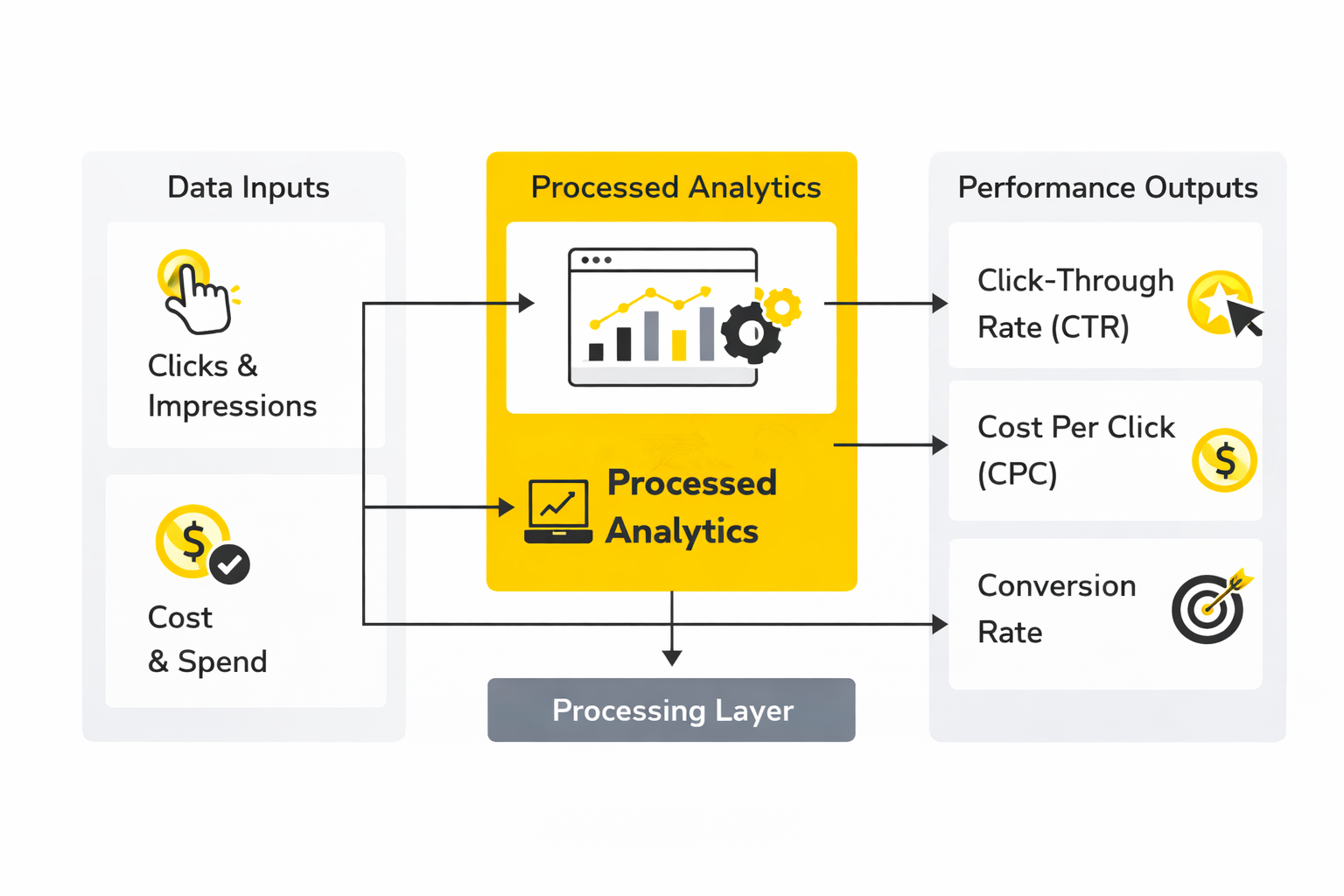
This changes how you should think about data. In older PPC setups, measurement mostly helped humans make better manual decisions. In modern accounts, measurement also trains the bidding system. That means bad tracking does not just confuse your reporting. It actively teaches the platform the wrong lesson.
The action this should drive is simple but not optional:
- track the primary business outcome, not just micro-conversions
- separate qualified leads from weak leads where possible
- keep attribution windows and CRM feedback consistent
- avoid flooding the platform with noisy or low-value conversion events
This is one of those areas where small technical mistakes create expensive strategic consequences.
Benchmarks Are Useful Only When They Trigger Better Questions
Industry averages are helpful because they stop you from operating blindly. They can tell you whether your results are wildly off course or roughly in range. But they become dangerous when advertisers treat them like universal goals.
A 7.52% average conversion rate or a $70.11 average cost per lead means very different things across legal services, home services, ecommerce, software, or local healthcare. Benchmarks should push you to ask sharper questions, such as whether your economics support the current CPA, whether your CTR is weak for your category, or whether your landing page underperforms compared with the intent level of the traffic. (2025 PPC benchmark dataset)
So use benchmark data to orient yourself, not to grade yourself blindly. The only numbers that truly matter are the ones tied to profitable growth in your specific model.
The Metrics That Deserve Executive Attention
If you need to simplify PPC reporting for decision-makers, keep it brutally practical. Most business owners or executives do not need a wall of platform metrics. They need to understand whether spend is turning into profitable outcomes and whether the system is improving.
The most useful executive-level view usually includes:
- spend
- conversions
- cost per acquisition or cost per lead
- conversion rate
- return on ad spend or downstream revenue quality
- trend direction over time
Everything else is support data. Important, yes, but still support data. The real job of PPC analytics is to connect platform performance with business results, not to produce pretty charts that no one acts on.
That brings us to the next layer of the article: how professionals use all of this in the real world, where campaign management is less about textbook setup and more about disciplined optimization, workflow, and avoiding the mistakes that waste the most money.
How Professionals Implement and Optimize PPC
By the time a pay per click account reaches real scale, the work changes. The early phase is about setup, tracking, and finding traction. The later phase is about judgment. This is where experienced operators separate useful automation from lazy automation, protect efficiency while budgets rise, and keep the account aligned with actual business value instead of platform-level vanity wins.
That shift matters because scaling PPC is rarely linear. The first profitable conversions usually come from the most obvious high-intent traffic. After that, each extra layer of volume introduces tradeoffs in targeting, cost, audience quality, and operational complexity. Google’s own documentation around Smart Bidding, value rules, and campaign types makes the pattern clear: the platform can optimize aggressively, but only if the advertiser keeps feeding it better goals, better data, and better constraints. (Google Ads bidding guidance, Performance Max overview)
The Best PPC Teams Optimize for Value, Not Just Conversions
One of the most important professional upgrades in pay per click is moving from raw conversion volume to conversion value. A lead is not always a good lead. A sale is not always an equally profitable sale. Google explicitly supports value-based optimization through conversion values and value rules, which lets advertisers tell the platform which users, devices, or locations matter more to the business. (conversion value rules)
This is a big deal because many PPC accounts look profitable on paper while hiding a quality problem underneath. The campaign generates leads, but the sales team hates them. The account produces purchases, but the margins are weak. Professionals deal with that by pushing better signals back into the system, which often means tying ad platform data more closely to CRM outcomes, revenue quality, or customer lifetime value.
That changes the questions you ask during optimization. Instead of asking only, “How do we get more conversions?” the better question becomes, “How do we get more of the right conversions at a cost the business can actually live with?” That is a much tougher question, but it leads to better decisions.
Scaling PPC Means Accepting Tradeoffs Early
A lot of advertisers think scaling is just a matter of increasing budget once the campaign works. Sometimes that does work for a while. Then the auction pushes back. Costs rise, impression quality changes, search terms broaden, and the account starts reaching users who look similar to your best buyers but do not behave the same way.
This is normal. Pay per click becomes harder to scale because the obvious demand gets captured first. From there, you are often expanding into less certain territory, which means lower intent, higher competition, or weaker economics. That is why professional PPC management is full of controlled tradeoffs rather than magical “scale hacks.”
The main scaling levers usually look like this:
- increase budget where impression share is being lost for budget reasons
- expand into adjacent keyword themes only after core terms are stable
- separate brand and non-brand traffic so performance stays readable
- test new landing pages before forcing more spend into old bottlenecks
- use audience and first-party data inputs to improve targeting quality
The mistake is trying to scale all of them at once. Good operators widen one constraint at a time so they can still tell what caused the change.
Brand Traffic and Non-Brand Traffic Should Not Be Mixed Carelessly
One of the fastest ways to create fake confidence in PPC reporting is to lump brand and non-brand traffic together. Brand campaigns often convert much better because the searcher already knows the company, trusts the brand, or is simply looking for a direct route back. Non-brand campaigns are usually where acquisition pressure really shows up.
That does not mean brand traffic is unimportant. It often plays a protective role, helps control the message, and can defend demand that competitors might try to intercept. But it should not be allowed to mask acquisition problems higher up the funnel. The account may look efficient overall while non-brand campaigns quietly burn money.
Professionals usually keep these streams separate because they answer different business questions. Brand tells you how existing demand behaves. Non-brand tells you how well your PPC machine creates new commercial opportunities from open-market search behavior. Those are not the same thing, and they should not be judged by the same standard.
First-Party Data Is Becoming a Bigger Advantage
As PPC platforms become more automated, first-party data matters more. Google continues to emphasize customer data, audience signals, and first-party inputs in campaign optimization, and it has kept expanding workflows tied to value rules and customer matching. (Customer Match, Google Ads announcements)
This is one of the clearest strategic shifts in modern pay per click. The platform still provides reach and automation, but advertisers who know their customers better can steer the machine more effectively. That includes things like uploaded customer lists, returning-customer logic, qualified lead imports, and revenue-based optimization.
It also changes the role of your broader stack. PPC does not live alone anymore. Your form flow, CRM, email system, scheduling tool, and landing page infrastructure all influence how much useful data gets back into the ad account. A setup that can collect cleaner lead details and pass better conversion signals often outperforms a “bigger budget” approach.
That is one reason businesses running lead generation often pair PPC with tools that tighten the handoff after the click. For example, a cleaner intake or funnel setup through Fillout, Brevo, or ClickFunnels can improve not just conversion rate, but also the quality and usability of the data flowing back into PPC optimization.
Automation Is Powerful, but It Needs Guardrails
This is where experienced advertisers get very practical. Automation absolutely can improve performance. Google’s Smart Bidding uses auction-time signals to optimize bids in ways manual bidding simply cannot match at scale. Microsoft is also continuing to expand automated and cross-network campaign capabilities across its platform. (Smart Bidding, Microsoft search ads, Microsoft product updates)
But automation is not strategy. It is leverage. And leverage amplifies whatever you feed into it. If your conversions are noisy, your landing pages are weak, or your campaign architecture is sloppy, automation does not rescue you. It scales the confusion.
That is why professionals put guardrails around the machine:
- they define the right conversion actions
- they segment campaigns where intent is meaningfully different
- they monitor search terms and lead quality
- they avoid changing too many variables during learning periods
- they judge automation by business outcomes, not platform optimism
This is not anti-automation. It is adult supervision.
Landing Page Friction Becomes More Expensive as Spend Grows
A weak landing page is annoying at low spend and brutal at higher spend. That is because every inefficiency after the click gets multiplied as volume rises. A small drop in conversion rate can turn a scalable campaign into a marginal one very quickly.
This is why professional PPC optimization eventually becomes page optimization whether the team wants it or not. If you are paying for high-intent traffic, the page has to close the gap between curiosity and action with very little wasted motion. The more expensive the click, the less room there is for clutter, hesitation, or vague offers.
In practice, the best pages for pay per click usually do a few things extremely well:
- they match the exact promise of the ad
- they make the next step obvious
- they remove distractions that do not support conversion
- they create trust fast through proof, clarity, and usability
That is also where specialized conversion environments can help. A focused funnel built in Systeme.io or ClickFunnels often gives paid traffic a cleaner path than a general-purpose website trying to serve every audience at once.
Platform Choice Is a Strategic Decision, Not a Loyalty Test
Google is still the center of gravity in most pay per click conversations, and for good reason. But mature PPC strategy is not about brand loyalty to one ad platform. It is about where the economics work.
Microsoft continues to position its search network as a way to reach users across its own ecosystem and partner environments, with planning tools and audience insights designed to support campaign expansion. (Microsoft Advertising Network for Search, Keyword Planner) For some accounts, that means incremental profitable volume. For others, it means little more than extra management overhead. The answer depends on audience behavior, query mix, and how strong the offer is.
Professionals test platforms with discipline. They do not assume the second platform will match the first. They check lead quality, search intent, device behavior, conversion lag, and operational cost before deciding whether the added reach is worth the complexity.
The Biggest Risks Usually Come From False Signals
The most dangerous PPC problem is not always overspending. Sometimes it is believing the wrong story about performance. A campaign can appear healthy because branded traffic props it up, weak leads are being counted as wins, or automated bidding is optimizing toward shallow events that look active but do not create revenue.
That is why expert-level PPC work is so often about signal control. The team is constantly asking whether the platform is being taught the right lesson. If not, the account will drift, sometimes slowly enough that no one notices until a quarter of budget has already been burned.
Here are the risks that deserve the most attention:
- counting low-quality leads as equal to qualified leads
- letting brand traffic inflate account-wide efficiency
- expanding keywords before landing pages are ready
- optimizing to micro-conversions that do not correlate with revenue
- trusting automated recommendations without business context
- failing to connect ad performance to downstream sales outcomes
These are boring mistakes compared with flashy platform updates. They are also the ones that cost the most money.
What Professional PPC Looks Like in the Real World
Professional pay per click management is not just bid changes and ad tweaks. It is a system that connects intent, offer, tracking, sales reality, and business priorities into one operating model. The platforms keep changing, the interfaces keep evolving, and automation keeps getting stronger, but the core principle does not move: better inputs create better outcomes.
That is the reason experienced teams stay obsessed with alignment. They align the keyword with the ad, the ad with the page, the page with the offer, the offer with the buyer, and the conversion signal with actual business value. When that chain holds, PPC can scale surprisingly far. When that chain breaks, even expensive traffic and clever automation cannot save it.
The final part of this article will close the loop with the most common mistakes, the platform decisions that matter most, and the FAQ section people usually need before they put real money into pay per click.
FAQ - Built for Complete Guide
What is pay per click in simple terms?
Pay per click is an advertising model where you pay only when someone clicks your ad. It is most commonly used in search engines, where your ad appears when users search for something relevant. The key advantage is that you are paying for actual interest, not just exposure.
How much does pay per click cost?
There is no fixed price because PPC runs on an auction system. Costs vary by industry, competition, and keyword intent, with averages around $5.26 per click across many industries. What matters more than cost is whether the click produces profitable outcomes.
Is PPC better than SEO?
They serve different roles. PPC gives immediate visibility and predictable traffic, while SEO builds long-term organic presence. Most serious businesses use both, with PPC often acting as a testing ground for keywords and offers before scaling through SEO.
How long does it take to see results from PPC?
You can start seeing traffic and data almost immediately after launching a campaign. However, meaningful optimization usually takes a few weeks because platforms need enough conversion data to learn. Real performance stability often takes one to three months depending on budget and complexity.
What is a good conversion rate in PPC?
Conversion rates vary heavily by industry, but broad benchmarks sit around 7.52% on average. That number alone is not enough to judge performance. A “good” conversion rate is one that supports profitable cost per acquisition in your specific business model.
Why is my PPC campaign getting clicks but no conversions?
This usually points to a mismatch between the ad and the landing page or weak offer positioning. It can also indicate poor targeting where the clicks are not coming from high-intent users. The fix is rarely increasing budget. It is almost always improving alignment between intent, message, and page.
Should I use automated bidding strategies?
In most cases, yes, but only when your tracking is reliable. Google’s Smart Bidding systems optimize using real-time signals, which can outperform manual bidding when fed clean data. Without proper conversion tracking, automation can actually make performance worse instead of better.
What are the biggest mistakes in pay per click?
The most common mistakes include:
- targeting keywords without clear intent segmentation
- sending traffic to generic or weak landing pages
- tracking the wrong conversions or too many low-value actions
- mixing brand and non-brand data into one performance view
- scaling spend before fixing conversion bottlenecks
These issues usually cost more than bidding mistakes.
How do I know if my PPC campaign is profitable?
You need to compare cost per acquisition with customer value, not just conversion volume. That often means looking beyond the ad platform and connecting results to CRM or revenue data. A campaign can look efficient in-platform while losing money at the business level.
Which platform is best for PPC?
Google Ads dominates due to scale and intent volume, but Microsoft Advertising can provide additional reach and sometimes lower competition. The right platform depends on your audience, industry, and how well your offer converts across different environments.
Do I need a funnel for PPC, or is a website enough?
A website can work, but funnels often perform better for paid traffic because they reduce distractions and guide users toward a single action. Tools like ClickFunnels or Systeme.io are commonly used to create these focused conversion paths.
Can small businesses compete in PPC?
Yes, but not by outspending larger competitors. Small businesses win by being more specific, targeting tighter intent, and using stronger offers. Narrow campaigns with high relevance often outperform broad campaigns with bigger budgets.
Work With Professionals
Explore 10K+ Remote Marketing Contracts on MarkeWork.com
Most marketers spend too much time chasing clients, competing on crowded platforms, and losing a percentage of every project to middlemen.
MarkeWork gives you a better way. Browse thousands of remote marketing contracts and connect directly with companies desperate to hire skilled marketers like you, without platform commissions and without unnecessary gatekeepers.
If you're serious about finding better opportunities and keeping 100% of what you earn, explore available contracts and create a profile for free at MarkeWork.com.