

Pinterest marketing is not just posting pretty images and hoping people click. It is the process of using Pinterest as a visual search engine, planning platform, and shopping discovery channel to reach people before they have made a final decision.
That matters because Pinterest users are often in planning mode, not passive scrolling mode. Pinterest reported 619 million monthly active users in Q4 2025 and described the platform as a place where people “find inspiration, curate ideas and shop products” in its 2025 results. For marketers, that changes the strategy: you are not only competing for attention today, you are building assets that can keep getting discovered over time.
Article Outline
This guide is split into six parts so the strategy builds in the right order. Part 1 sets the foundation, then the next parts move into research, content, optimization, systems, measurement, and scaling. The goal is to make Pinterest marketing practical enough to execute, not just interesting to read.
- Part 1: Why Pinterest Marketing Matters And How The System Works
- Part 2: Pinterest Audience Research, Keyword Strategy, And Search Intent
- Part 3: Pinterest Content Strategy, Pin Formats, And Creative Planning
- Part 4: Pinterest SEO, Boards, Profiles, And Traffic Optimization
- Part 5: Pinterest Workflows, Automation, Ads, And Professional Implementation
- Part 6: Measurement, Scaling, Common Mistakes, And FAQ
Why Pinterest Marketing Matters
Pinterest sits in a different category from most social platforms because people use it to plan. They search for ideas, compare options, save inspiration, and often return later when they are ready to act. That makes Pinterest marketing especially useful for businesses that sell products, templates, services, content, courses, recipes, home ideas, fashion, beauty, travel, events, or anything people research visually before buying.
The commercial intent is the key. Weekly Pinterest users have strong shopping behavior, with industry summaries citing that 85% of weekly Pinners have purchased from Pins they saw from brands in research covered by Sprout Social. That does not mean every Pin becomes a sale, but it does mean the platform attracts people who are open to discovering brands before they have chosen one.
Pinterest also gives marketers a longer strategic runway. A post on many social platforms can disappear quickly, while a well-optimized Pin can keep appearing through search, related Pins, boards, and seasonal discovery. That is why the best Pinterest strategy looks more like SEO plus creative testing than a normal social media posting calendar.
The Pinterest Marketing Framework
A strong Pinterest marketing system has four moving parts: audience intent, visual content, search optimization, and conversion flow. Audience intent tells you what people are trying to solve or plan. Visual content earns the first click, search optimization helps the Pin get discovered, and the conversion flow turns that attention into traffic, subscribers, leads, or sales.
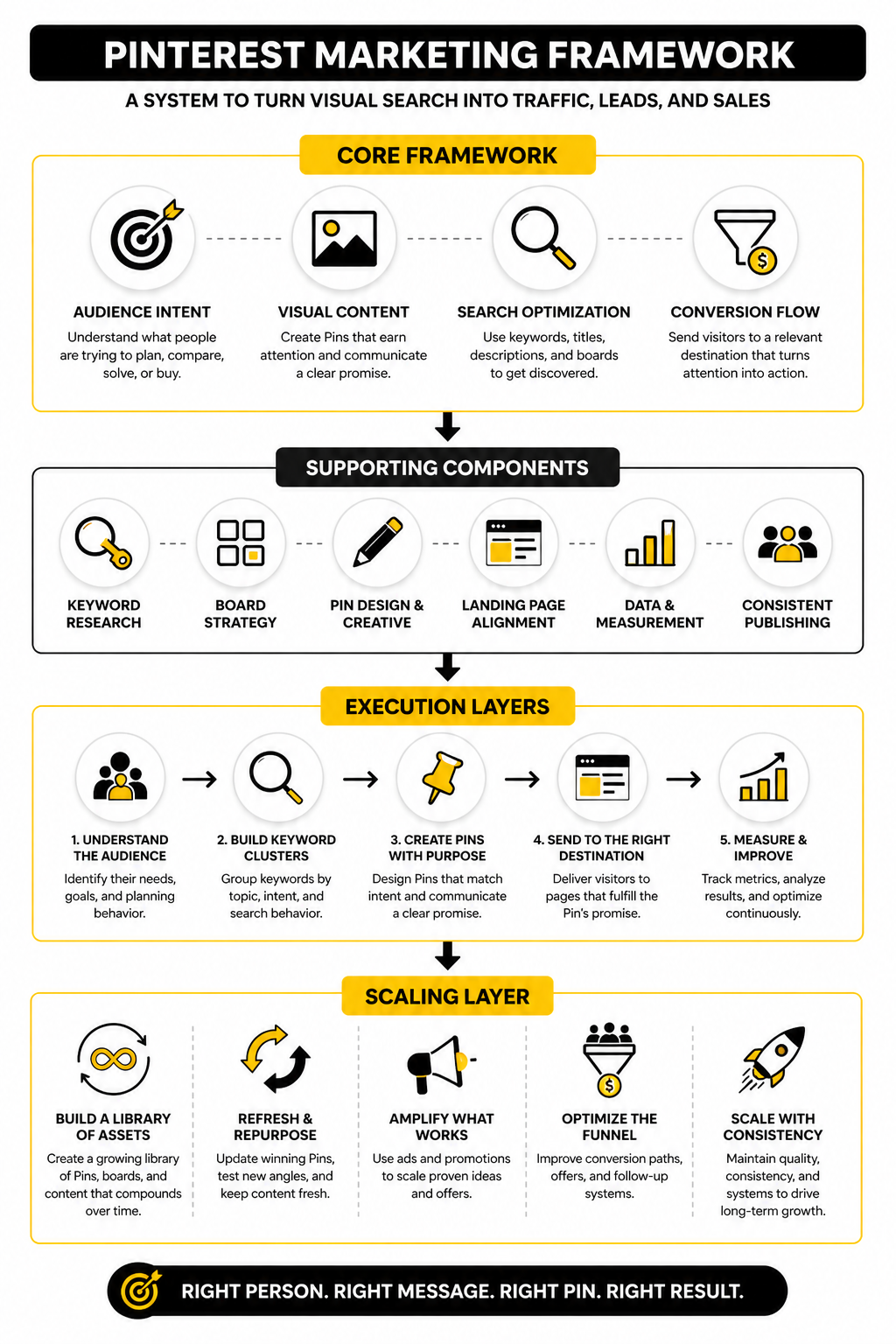
The mistake most brands make is treating Pinterest as a dumping ground for graphics. They upload a few Pins, use vague board names, skip keyword research, and then wonder why nothing happens. Pinterest marketing works better when every Pin has a job: attract a specific searcher, communicate a clear promise, and send the visitor somewhere useful.
This framework also keeps the strategy measurable. You can track impressions to understand discovery, saves to understand relevance, outbound clicks to understand traffic quality, and conversions to understand business impact. Once those numbers are visible, Pinterest stops being a creative guessing game and becomes a repeatable marketing channel.
Pinterest Audience Research, Keyword Strategy, And Search Intent
Pinterest marketing gets much easier when you stop asking, “What should we post?” and start asking, “What is this person trying to plan, compare, solve, or buy?” That shift matters because Pinterest is built around discovery, not interruption. People arrive with open loops in their head, and your job is to create Pins that match those open loops clearly.
Start with the audience before you touch design. Pinterest’s own audience tools let marketers explore user interests, categories, demographics, and planning behavior through Pinterest audience insights. That is useful because Pinterest intent is often broader than a single product search: someone searching “small patio ideas” might need furniture, lighting, planters, color inspiration, a layout guide, or a full shopping list.
Good research should produce practical patterns, not a giant spreadsheet nobody uses. Look for repeated phrases, seasonal spikes, visual styles, and problems that show up again and again. When the same desire appears in different forms, that is usually a content cluster worth building around.
How To Understand Pinterest Search Intent
Pinterest search intent usually falls into four useful categories: inspiration, planning, comparison, and action. Inspiration searches are broad, like “summer outfit ideas” or “home office inspiration.” Planning searches are more specific, like “capsule wardrobe checklist” or “wedding table setup.” Comparison searches show evaluation, while action searches point closer to a click, signup, or purchase.
This is where Pinterest marketing becomes more strategic than random posting. A broad inspiration Pin may earn saves and reach, but a specific planning Pin may earn stronger outbound clicks. Both can be valuable, but they should not be judged by the same metric.
For example, a brand selling templates should not only create Pins for “business templates.” It should also target searches around the job the template helps with, such as planning launches, organizing content, tracking leads, building landing pages, or creating client workflows. That gives the brand more entry points into the buyer’s thinking.
Building A Pinterest Keyword List
Pinterest keyword research starts inside Pinterest itself. Type a core phrase into the search bar and study the suggested completions, related modifiers, visible trends, and the language used by top-ranking Pins. These phrases are valuable because they reflect how real users describe what they want.
A strong keyword list should include:
- Broad topic keywords
- Specific problem keywords
- Seasonal keywords
- Product or service keywords
- Audience keywords
- Style and aesthetic keywords
- Outcome-based keywords
- Comparison and planning keywords
Do not treat all keywords equally. A phrase like “Pinterest marketing” can support an educational guide, while “Pinterest marketing strategy for ecommerce” has clearer business intent. The tighter the keyword, the easier it is to create a Pin, board, and landing page that feel relevant from first impression to final click.
Turning Keywords Into Content Clusters
Once you have keywords, organize them into clusters instead of using them one by one. A cluster gives you multiple angles around the same audience need, which helps you create more Pins without repeating yourself. It also makes your profile look focused, which matters when users click through and decide whether your account is worth trusting.
A simple cluster for Pinterest marketing could include:
- Pinterest keyword research
- Pinterest SEO
- Pinterest content calendar
- Pinterest Pin design
- Pinterest analytics
- Pinterest ads
- Pinterest traffic strategy
- Pinterest ecommerce strategy
Each cluster can support several Pins, multiple board placements, and one strong destination page. That is the cleanest way to build depth without creating thin, disconnected content. It also makes repurposing easier because one article, guide, product page, or lead magnet can support several search angles.
Matching Keywords To The Right Destination
A Pin should never create a promise that the landing page does not fulfill. If the Pin says “Pinterest keyword research checklist,” the destination should give people that checklist or a very clear path to it. If the landing page is too generic, users bounce, and the campaign becomes harder to scale.
This is also where your funnel matters. If the keyword has educational intent, send people to a useful article, tutorial, checklist, or free resource. If the keyword has buying intent, send them to a product page, booking page, offer page, or comparison page that helps them decide.
For creators and service businesses, a simple funnel builder like Systeme.io can fit when Pinterest traffic needs a clean landing page, email capture, and follow-up sequence in one place. For agencies or local businesses that want Pinterest traffic to feed a broader CRM and automation system, GoHighLevel is a more complete option. The tool is not the strategy, but the destination has to be strong enough to convert the attention your Pins create.
Prioritizing Keywords Before You Create Pins
The best keyword is not always the biggest keyword. In Pinterest marketing, the best keyword is the one that connects audience intent, visual clarity, and a useful destination. If you cannot make a clear Pin for it or send users somewhere relevant, it is not ready yet.
Prioritize keywords with this simple filter:
- Does the phrase describe a real user goal?
- Can the idea be communicated visually?
- Is there a relevant page, offer, or resource to send people to?
- Can you create multiple fresh angles without repeating the same Pin?
- Does the keyword support a business outcome, not just vanity reach?
This keeps the strategy grounded. You are not collecting keywords to look busy. You are building a map of what your audience wants, then turning that map into Pins, boards, pages, and offers that work together.
Statistics And Data That Actually Matter
Pinterest marketing data only helps when it changes what you do next. Impressions, saves, clicks, and conversions all tell a different part of the story, so treating them as one generic “performance” number is a mistake. A Pin can get strong reach and weak traffic, or modest reach and excellent sales intent, and those two situations need completely different actions.
Pinterest reached 619 million monthly active users and $4.2 billion in 2025 revenue, which confirms that the platform is still growing as both a consumer discovery engine and an advertising channel through Pinterest’s 2025 results. That matters because Pinterest marketing is not a tiny niche tactic anymore. It is a serious channel, but it still rewards marketers who understand intent better than marketers who only chase volume.
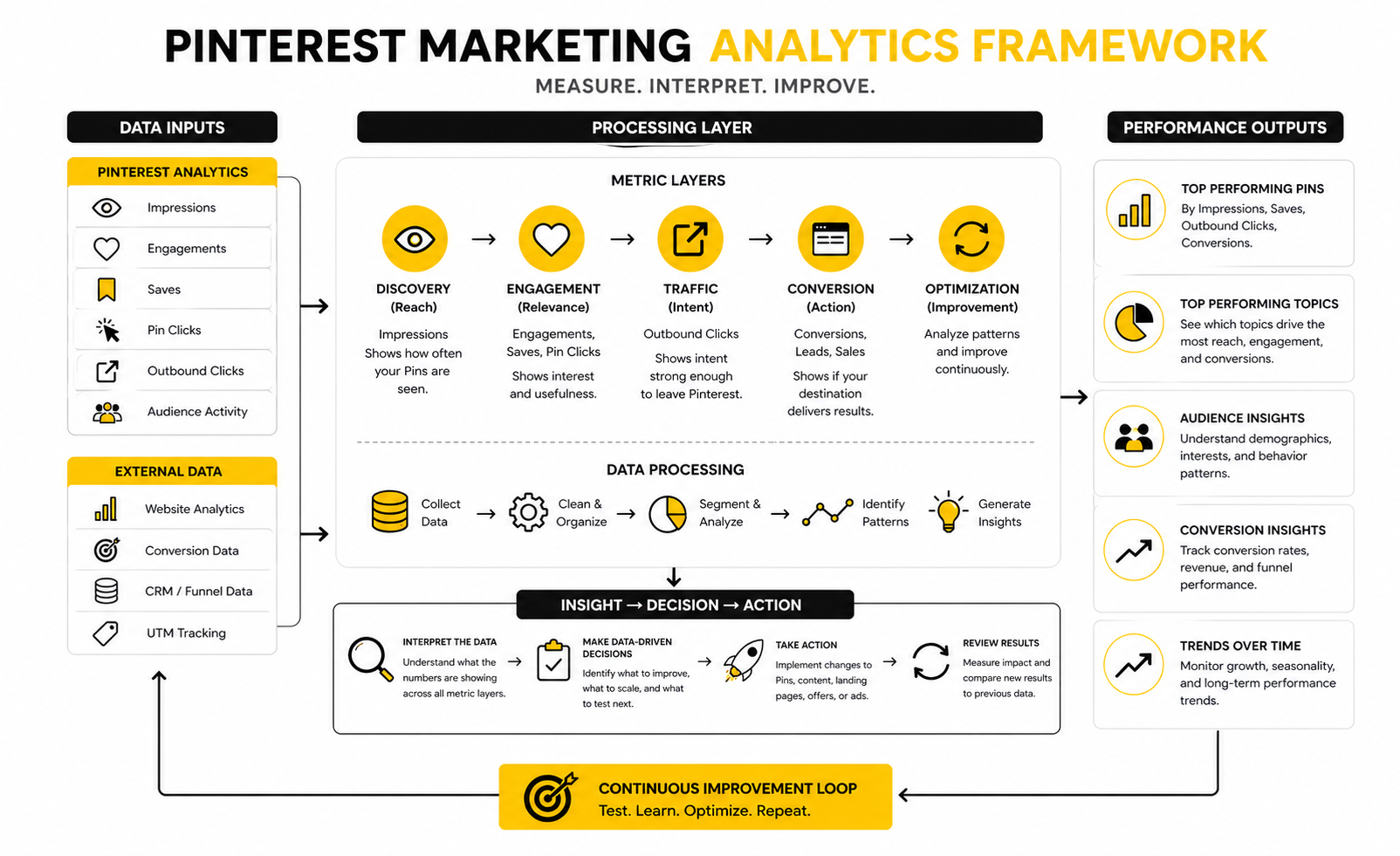
The right way to read Pinterest data is simple: discovery metrics tell you whether people are seeing the content, engagement metrics tell you whether the idea is relevant, traffic metrics tell you whether the promise is strong enough to earn a click, and conversion metrics tell you whether the landing page did its job. Once you separate those layers, the numbers stop feeling random.
The Core Pinterest Metrics To Track
Pinterest Analytics gives business accounts visibility into metrics like impressions, engagements, engagement rate, saves, Pin clicks, outbound clicks, and audience activity through Pinterest Analytics. Each metric has a job, and the job is not to make you feel good. The job is to show where the system is working and where it is leaking.
Impressions show how often your Pins appear on screen. If impressions are low, the issue is usually keyword targeting, board relevance, topic demand, creative freshness, or account authority. The action is not to redesign the whole funnel first; the action is to improve discovery through better keywords, stronger Pin titles, clearer board structure, and more consistent publishing.
Saves show that people find the idea useful enough to keep. That is important because Pinterest is a planning platform, and saving behavior often means the user wants to return later. If saves are strong but outbound clicks are weak, the content may be inspiring but not urgent enough, so your next test should focus on clearer benefits, stronger calls to action, and more specific destination promises.
How To Interpret Clicks Without Fooling Yourself
Pinterest has more than one click signal, and this is where many marketers misread the data. Pin clicks usually mean someone opened or engaged with the Pin inside Pinterest. Outbound clicks mean someone left Pinterest and visited your website, which makes them much closer to business value.
For most organic Pinterest marketing campaigns, outbound clicks are the metric to protect. A Pin with 50,000 impressions and very few outbound clicks may still be useful for awareness, but it is not a strong traffic asset yet. A Pin with fewer impressions and a high outbound click rate may deserve more variations because it has a sharper match between search intent, creative promise, and destination.
Do not panic when one Pin gets saves but another gets clicks. That can be normal. The smarter move is to label Pins by role: some Pins build reach, some build saves, some drive traffic, and some support conversion-heavy searches.
Benchmarks Should Guide You, Not Control You
Benchmarks are useful, but only when you compare similar goals. A fashion inspiration Pin, a B2B checklist Pin, and an ecommerce product Pin should not be judged by the same click-through expectation. The audience, visual format, level of urgency, and landing page all change the numbers.
Large-scale Pinterest studies are helpful because they show patterns, not guarantees. Tailwind’s analysis of more than one million Pins found that over 60% of saves came from Pins more than one year old, which supports the idea that Pinterest can behave more like evergreen search than short-life social posting through its Pinterest benchmark research. The action is clear: do not judge Pinterest only by the first few days after posting.
That said, evergreen does not mean passive. You still need fresh creative, updated landing pages, seasonal planning, and regular analysis. The best Pinterest accounts build a library of assets, then keep improving the parts that show long-term signs of demand.
What Good Performance Signals Look Like
A good Pinterest marketing system usually shows progress in layers. First, impressions rise because Pinterest understands your topics and starts testing your Pins. Then saves and Pin clicks reveal which ideas are resonating. Finally, outbound clicks and conversions show which ideas deserve more creative variations, stronger landing pages, or paid promotion.
Look for these signals:
- Impressions are growing across a focused set of topics
- Saves are concentrated around clear audience problems or aspirations
- Outbound clicks are strongest on specific, promise-driven Pins
- Older Pins continue producing activity after the first posting window
- Top-performing Pins share repeatable patterns in format, wording, or topic
- Traffic from Pinterest converts better when the landing page matches the Pin closely
The point is not to celebrate every upward line. The point is to identify what caused the movement. If one topic repeatedly earns saves and clicks, build more around that topic before chasing something completely new.
Turning Analytics Into Decisions
Analytics should create decisions, not reports nobody reads. Every month, review your top Pins by impressions, saves, outbound clicks, and conversions. Then separate what is working by topic, format, keyword, design style, and destination page.
Use this decision flow:
- If impressions are low, improve keywords, board relevance, publishing consistency, and creative volume.
- If impressions are high but saves are low, improve topic relevance and visual usefulness.
- If saves are high but outbound clicks are low, strengthen the promise and call to action.
- If outbound clicks are high but conversions are low, fix the landing page, offer, page speed, or follow-up.
- If conversions are strong, create more Pins for that same destination and test paid distribution.
This is where a CRM or funnel system can make measurement cleaner. If Pinterest is feeding leads into consultations, forms, email sequences, or sales pipelines, GoHighLevel can help connect traffic to follow-up. If the funnel is simpler and you mainly need landing pages, email capture, and basic automation, Systeme.io can be enough.
The Data Mistake To Avoid
The biggest mistake is optimizing for the metric that is easiest to see instead of the metric that matches the goal. Impressions are visible, but they do not pay you by themselves. Saves are encouraging, but they are not the same as leads. Clicks are valuable, but they still need a page that converts.
Pinterest marketing works best when each metric has a clear role in the system. Reach tells you whether Pinterest is distributing the content. Engagement tells you whether people care. Outbound clicks tell you whether the Pin earns action. Conversions tell you whether the business model supports the traffic.
Once you read the numbers that way, optimization becomes much more practical. You are not asking, “Was this Pin good?” You are asking, “Where did this Pin succeed, where did it fail, and what should we test next?”
Pinterest Workflows, Automation, Ads, And Professional Implementation
Once the research, content, SEO, and measurement pieces are in place, Pinterest marketing becomes an operations problem. That is a good thing. It means you are no longer guessing what to post every morning; you are building a repeatable system that turns ideas into Pins, Pins into traffic, and traffic into business outcomes.
The advanced work is not about doing more for the sake of more. It is about protecting quality while increasing output. Pinterest rewards fresh creative and relevant destinations, but scaling too fast with weak Pins, thin landing pages, or generic automation can damage performance instead of improving it.
Build A Workflow Before You Add Tools
Tools make a good system faster, but they make a messy system messier. Before adding schedulers, AI writers, funnel builders, or reporting dashboards, define the actual workflow. A practical Pinterest workflow should show how topics are chosen, how Pins are designed, how descriptions are written, how URLs are tagged, how content is scheduled, and how results are reviewed.
A clean workflow usually looks like this:
- Choose the content cluster
- Pick the keyword and search intent
- Match the Pin to a specific destination
- Create several creative angles
- Write a natural title and description
- Schedule the Pins across relevant boards
- Track results by Pin, topic, and destination
- Refresh winning ideas with new creative
This gives your team a system they can actually follow. It also makes delegation safer because designers, writers, assistants, and media buyers are not interpreting the strategy from scratch every time.
Use Automation Carefully
Automation should reduce repetitive work, not remove judgment. Scheduling Pins in advance can help maintain consistency, and tools like Buffer can support a steadier publishing rhythm without turning Pinterest into a daily scramble. That is useful, especially when your strategy depends on regular testing across multiple topics and creative variations.
The risk is over-automation. If every Pin looks the same, every description sounds generic, and every destination page feels loosely related, the system becomes efficient but ineffective. Pinterest marketing still needs human taste because visual clarity, search intent, and offer relevance cannot be fully outsourced to a scheduler.
Use automation for calendars, reminders, publishing, UTM consistency, reporting, and routine repurposing. Keep strategy, keyword selection, creative direction, offer positioning, and final quality control close to the business. That balance is where automation becomes leverage instead of noise.
Decide When Organic Pinterest Is Enough
Organic Pinterest is strongest when you have time, useful content, visual consistency, and a destination that can convert later. It works well for evergreen topics, seasonal planning, product discovery, and educational content that people search for repeatedly. The tradeoff is patience: organic Pinterest can compound, but it usually does not behave like an instant traffic switch.
Organic should be your first layer if you are still validating topics. It lets you see which keywords, visuals, and destinations get traction before you spend money. That data is valuable because it lowers the risk of launching ads around weak creative or unclear intent.
The limitation is speed. If you need to support a product launch, promote a seasonal sale, retarget warm audiences, or scale a proven landing page, organic alone may not be enough. That is when paid promotion starts to make sense.
Add Pinterest Ads Only After The Funnel Is Ready
Pinterest ads can amplify a working system, but they will not fix a broken one. Pinterest’s own ad resources emphasize creative testing, objective selection, and format-specific best practices through its Pinterest Business ad guides. The important point is simple: paid traffic magnifies whatever already exists.
Before spending seriously on ads, check the basics. The Pin needs a clear promise. The landing page needs to match that promise. The offer needs to make sense for the user’s stage of intent. The tracking needs to show what happened after the click.
Use paid Pinterest when you have:
- A proven organic Pin angle
- A landing page with a clear conversion goal
- Product pages or lead magnets that match Pinterest intent
- Enough creative variations to test
- A budget that allows learning, not just one nervous campaign
- Tracking that separates traffic quality from surface engagement
For ecommerce, paid Pinterest can be especially useful when product visuals, catalog structure, and seasonal demand line up. For service businesses, it often works better when the ad sends people to a guide, checklist, webinar, calculator, or diagnostic page rather than straight into a cold sales pitch. Pinterest users are often planning before buying, so the funnel should respect that stage.
Protect Creative Quality As You Scale
Scaling Pinterest marketing usually creates a creative quality problem. At the beginning, every Pin gets attention. Later, the team starts producing more variations, and the work can become bland if nobody owns the standard.
The solution is to document what “good” looks like. Create a Pin quality checklist with rules for readability, contrast, headline clarity, brand consistency, keyword relevance, and destination fit. This is not about making every Pin identical; it is about making every Pin understandable at a glance.
A strong creative system should define:
- The promise on the Pin
- The audience segment
- The keyword or topic
- The visual style
- The board placement
- The destination URL
- The call to action
- The reason this Pin deserves to exist
That last point matters. If nobody can explain why a Pin exists, it probably should not be published. More output only helps when the additional Pins create more useful entry points into the same strategy.
Connect Pinterest To Follow-Up
Pinterest traffic is valuable, but it is rarely the whole journey. A visitor may save a Pin today, click next week, join your email list later, and buy after several more touches. If the follow-up system is weak, you will underestimate Pinterest because the platform created demand that your backend failed to capture.
For simple creator funnels, Systeme.io can handle landing pages, email capture, and basic nurturing without adding too much complexity. For agencies, consultants, local businesses, or teams that need pipelines, automations, calendars, and client follow-up in one place, GoHighLevel is usually a better operational fit.
If Pinterest is driving people into a newsletter, product launch, consultation funnel, or free resource, the follow-up should feel connected to the Pin they clicked. Do not send everyone into the same generic sequence if their intent is different. Segment by topic, offer, or entry page whenever the volume justifies it.
Manage The Risks Before They Become Expensive
The biggest Pinterest risks are not dramatic. They are quiet operational mistakes that compound over time. Weak destination pages waste traffic, inconsistent publishing slows learning, poor tracking hides what is working, and generic creative makes your brand forgettable.
There are also strategic risks. Chasing trends without brand fit can attract the wrong audience. Scaling ads before conversion data is stable can burn budget. Relying too heavily on one seasonal topic can create traffic spikes that disappear when the season ends.
A safer scaling strategy keeps the portfolio balanced. Build evergreen clusters that can work all year, seasonal clusters that capture planning moments, and offer-specific clusters that connect directly to revenue. That mix gives Pinterest marketing more stability and makes performance easier to diagnose.
When To Hire Help
Hiring help makes sense when the strategy is working but execution is slowing growth. If you already know which topics matter, which destinations convert, and which metrics define success, a Pinterest manager, designer, copywriter, or media buyer can help scale output. If those foundations are missing, hiring usually creates more activity without more clarity.
The first hire should remove the bottleneck that is actually holding the system back. If ideas are strong but designs are weak, hire design support. If Pins are getting clicks but pages are not converting, fix the landing page or funnel. If organic winners exist but budget is underused, bring in ad expertise.
Do not hire someone just to “do Pinterest.” Hire for a specific business constraint. Pinterest marketing becomes much more profitable when every role is connected to a measurable part of the system.
Common Mistakes That Hold Pinterest Marketing Back
The final layer is simple: avoid the mistakes that quietly weaken the whole system. Pinterest marketing usually fails because the strategy is disconnected, not because the platform does not work. The Pin promises one thing, the landing page delivers another, the board structure is vague, the analytics are ignored, and the follow-up system is treated like an afterthought.
The biggest mistake is publishing without a clear reason. Every Pin should connect to a keyword, a user intent, a destination, and a measurable goal. If a Pin cannot pass that test, it is probably just content for content’s sake.
Another common mistake is quitting too early. Pinterest is not built like a fast-moving feed where everything depends on the first hour. Because Pins can keep surfacing through search and recommendations, your job is to build a strong library, review it consistently, and improve the assets that show signs of demand.
The Final Pinterest Marketing System
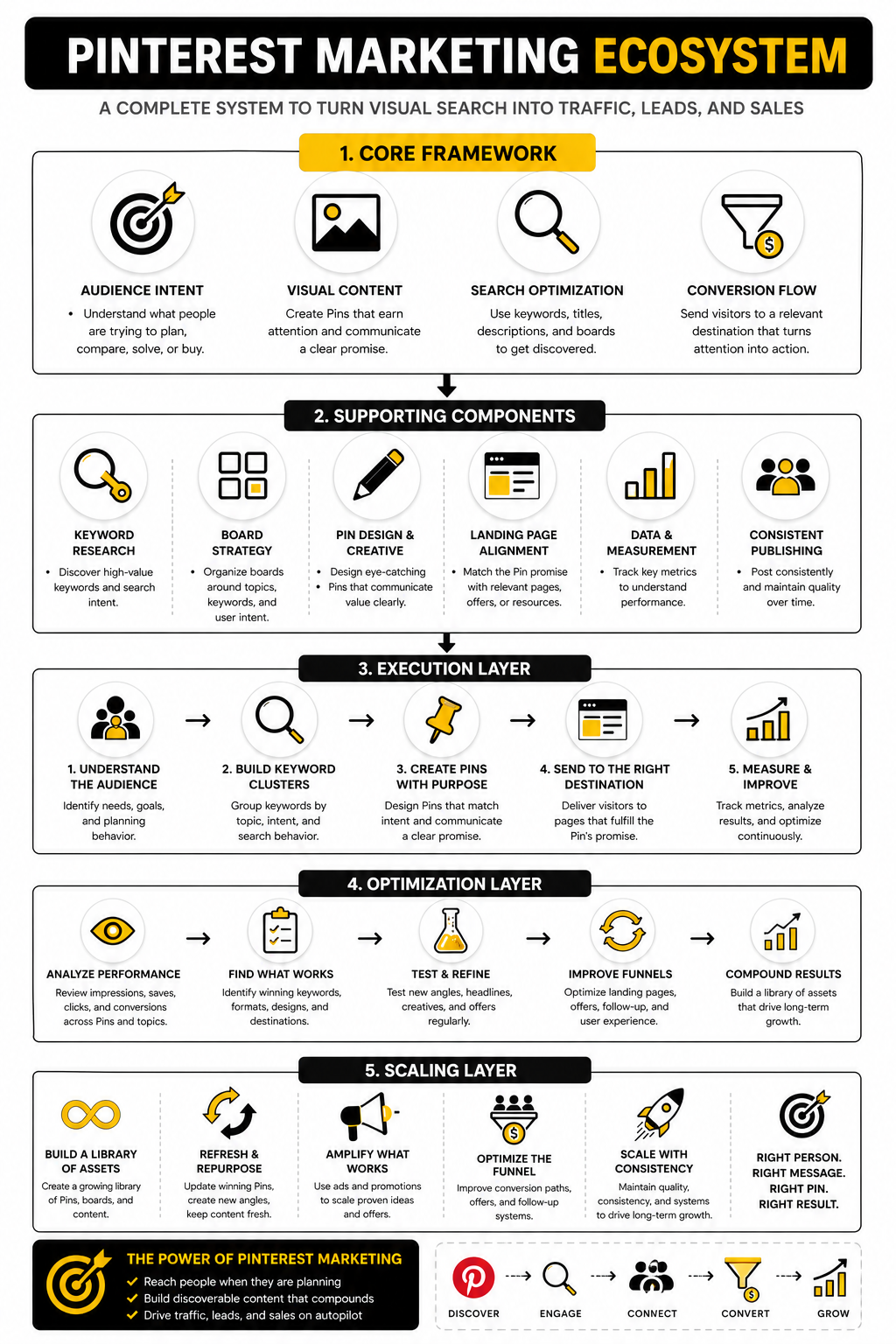
A complete Pinterest marketing system has five connected layers. First, you understand what your audience wants. Then you build keyword clusters around those needs. After that, you create Pins that communicate clear visual promises, send visitors to relevant destinations, and measure what happens after the click.
This is the simple version:
- Research the audience and search intent
- Build keyword clusters and board structure
- Create fresh Pins with clear visual positioning
- Send traffic to matched landing pages or offers
- Track performance and improve the system monthly
That is the whole game. Pinterest marketing is not about chasing hacks. It is about building a repeatable discovery engine that helps the right people find the right offer at the right stage of planning.
FAQ - Built For Complete Guide
What is Pinterest marketing?
Pinterest marketing is the process of using Pinterest to reach people through visual search, recommendations, boards, Pins, ads, and shopping discovery. It can drive traffic, leads, sales, brand awareness, and long-term content visibility. The strongest strategies treat Pinterest as a search and planning platform, not just another social media feed.
Is Pinterest marketing still worth it?
Yes, Pinterest marketing is still worth it for brands with visual content, helpful resources, products, services, or offers people research before buying. Pinterest reported 619 million monthly active users in its 2025 results, so the audience is large and still growing. The real question is whether your business has the right content and conversion path to use that attention properly.
How is Pinterest different from Instagram or TikTok?
Pinterest is more search-driven and planning-driven than most social platforms. People often use it to save ideas, compare options, and return later when they are closer to action. That means Pinterest content should be optimized for keywords, usefulness, and long-term discovery instead of only immediate engagement.
How long does Pinterest marketing take to work?
Pinterest can take time because the platform needs to understand your content, topics, boards, and user response. Some Pins may get traction quickly, but the real value often comes from building a library of searchable assets. A realistic strategy should review performance over months, not just days.
What should beginners track first?
Beginners should track impressions, saves, outbound clicks, and conversions. Impressions show whether Pinterest is distributing the content. Saves show whether the idea is useful. Outbound clicks show whether the Pin creates enough intent to leave Pinterest, and conversions show whether the destination works.
How often should I post on Pinterest?
There is no universal posting number that fits every account. Consistency matters more than random volume, and quality matters more than flooding the platform with weak Pins. A practical approach is to publish fresh Pins regularly, test different angles, and scale output only when the creative and destination quality can stay strong.
Do I need a blog for Pinterest marketing?
You do not always need a blog, but you do need useful destinations. A blog works well for educational searches, guides, recipes, tutorials, comparisons, and evergreen content. Product pages, landing pages, lead magnets, booking pages, and resource pages can also work when they match the intent behind the Pin.
Can Pinterest marketing work for service businesses?
Yes, but service businesses need to think beyond direct sales pitches. Pinterest users may not be ready to book immediately, so guides, checklists, templates, audits, calculators, and educational pages often perform better as entry points. Once someone opts in or visits a relevant page, follow-up becomes the bridge between interest and revenue.
Should I use Pinterest ads?
Pinterest ads make sense when you already have a strong offer, clear landing page, and enough creative angles to test. Paid promotion can speed up learning and scale proven ideas, but it will not fix weak positioning. Start with organic signals where possible, then use ads to amplify what already shows promise.
What makes a good Pinterest Pin?
A good Pinterest Pin is clear, readable, visually focused, and connected to a specific user intent. The headline should communicate the value quickly, and the image should support the promise instead of distracting from it. The best Pins make people understand what they will get before they click.
How do keywords work on Pinterest?
Pinterest uses keywords in Pin titles, descriptions, board names, profile content, and destination relevance to understand what your content is about. Keyword use should sound natural, not stuffed. The goal is to help Pinterest and the user understand the topic quickly.
What is the biggest Pinterest marketing mistake?
The biggest mistake is treating Pinterest as a place to dump graphics instead of building a connected system. Pins, boards, keywords, landing pages, analytics, and follow-up all need to work together. When one part is disconnected, the whole channel becomes harder to scale.
Work With Professionals
Explore 10K+ Remote Marketing Contracts on MarkeWork.com
Most marketers spend too much time chasing clients, competing on crowded platforms, and losing a percentage of every project to middlemen.
MarkeWork gives you a better way. Browse thousands of remote marketing contracts and connect directly with companies desperate to hire skilled marketers like you, without platform commissions and without unnecessary gatekeepers.
If you're serious about finding better opportunities and keeping 100% of what you earn, explore available contracts and create a profile for free at MarkeWork.com.