

Power digital marketing is not about doing more channels, posting more content, or chasing every new tool. It is about building a connected growth system where strategy, traffic, conversion, automation, and measurement work together instead of fighting for attention.
That matters because digital is now where most marketing money goes. Gartner’s 2025 CMO Spend Survey found that digital channels account for 61.1% of total marketing spend, while marketing budgets have stayed tight at around 7% of company revenue. In plain English: businesses are expected to get better results from digital without simply spending their way out of weak strategy.
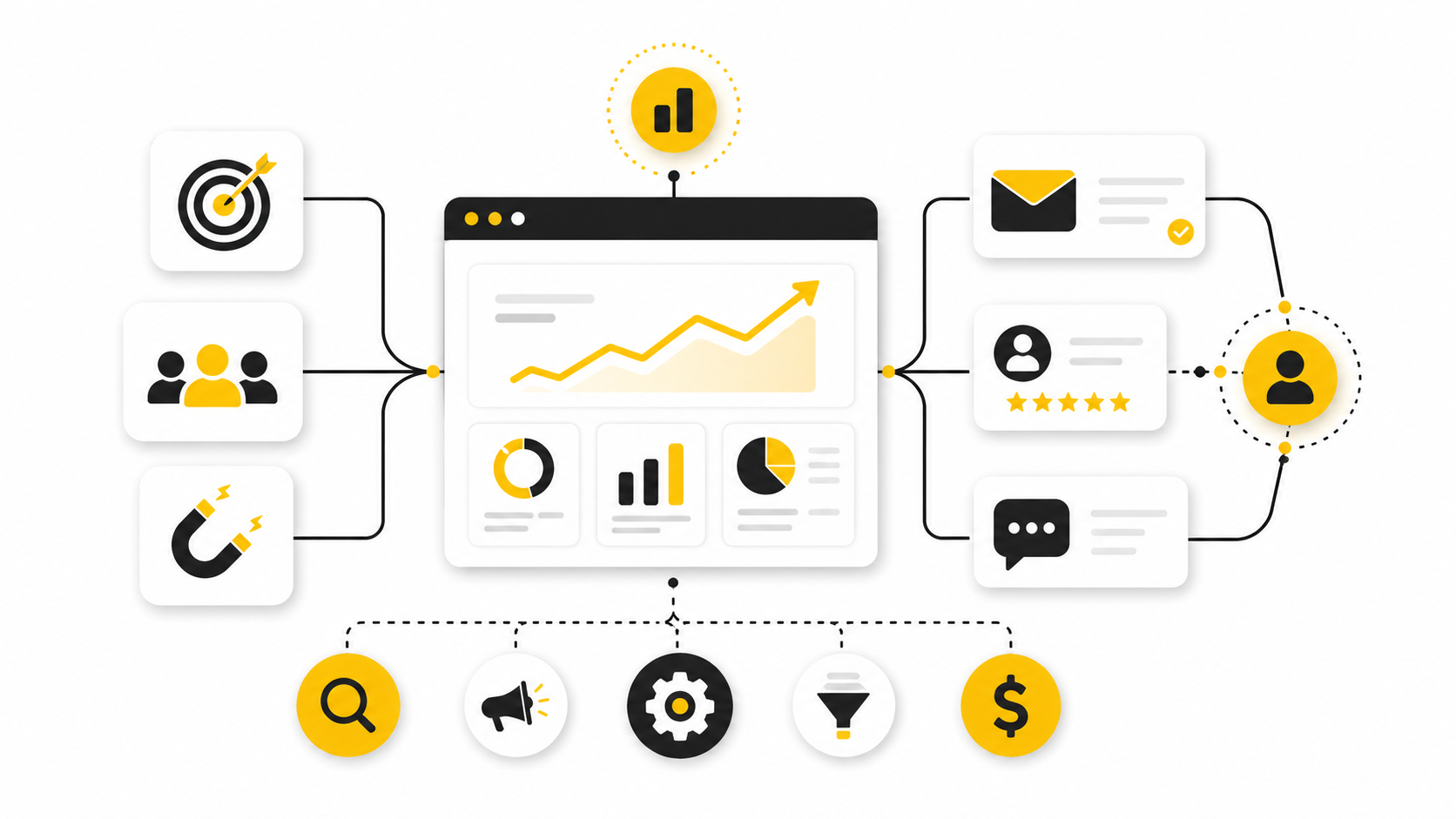
This article breaks power digital marketing into a practical six-part system. The goal is not theory. The goal is to show how a serious business can turn digital marketing into a repeatable engine for qualified attention, trusted positioning, stronger conversion, and measurable revenue.
Article Outline
- Part 1: Power Digital Marketing: A Practical Framework for Building Growth That Compounds
- Part 2: Why Power Digital Marketing Matters Now
- Part 3: The Power Digital Marketing Framework
- Part 4: Core Components of a High-Performance Digital Marketing System
- Part 5: Professional Implementation: Turning Strategy Into Execution
- Part 6: Measurement, Optimization, Tools, and FAQ
Why Power Digital Marketing Matters Now
The old digital marketing playbook was mostly channel-first. A business would run ads, publish SEO content, send emails, post on social, and hope the numbers improved. That approach still creates activity, but activity is not the same as progress.
Power digital marketing starts with the opposite assumption: every channel must have a job. Search should capture demand, content should build trust, paid media should accelerate learning, email should deepen intent, and automation should reduce friction. When these pieces are connected, the business stops treating marketing as a collection of tactics and starts treating it as an operating system.
This is especially important because buyers are harder to influence than they were a few years ago. They compare more options, consume more content before speaking to sales, and expect personalized journeys without feeling manipulated. Strong digital marketing now depends on clarity, consistency, and speed of learning.
Framework Overview
A power digital marketing framework has four layers: market clarity, channel strategy, conversion infrastructure, and performance learning. Market clarity defines who the business is trying to reach and why they should care. Channel strategy decides where attention will come from and what role each platform plays.
Conversion infrastructure turns attention into action. That includes landing pages, offers, funnels, CRM workflows, follow-up sequences, booking paths, sales handoff, and customer nurturing. Tools like GoHighLevel, ClickFunnels, and Replo can support this layer when they fit the business model and execution needs.
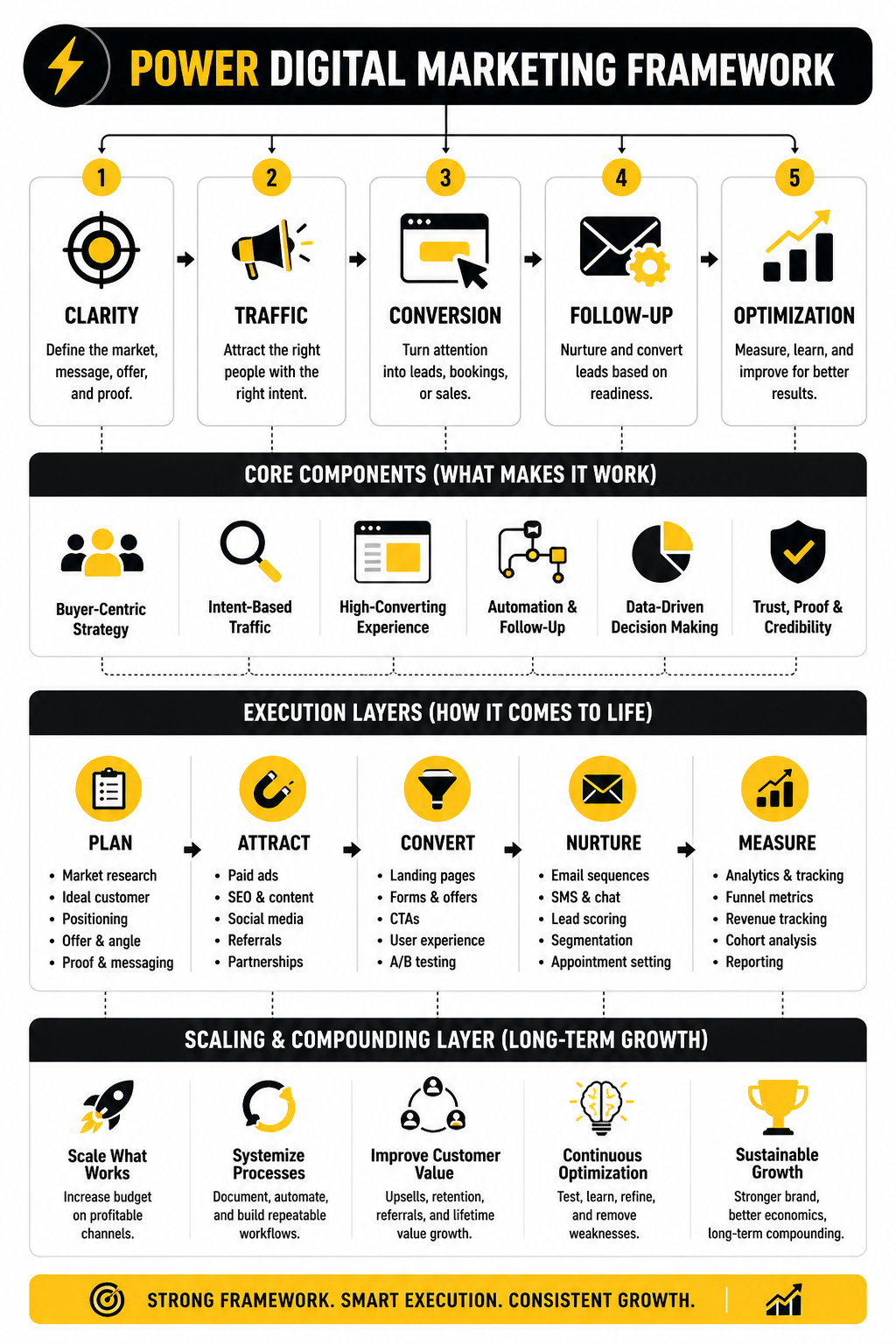
Performance learning is the part many teams skip. It means tracking what actually moves revenue, not just what looks good in a dashboard. A campaign with impressive clicks but weak lead quality is not powerful digital marketing; it is expensive noise with nice reporting.
Why Power Digital Marketing Matters Now
Digital marketing is no longer a side function that supports the “real” business. For many companies, it is where demand is created, qualified, converted, measured, and improved. When the system is weak, the business feels it everywhere: higher acquisition costs, slower sales cycles, inconsistent lead quality, and campaigns that look busy but do not create enough revenue.
The pressure is real because budgets are not expanding the way expectations are. Marketing teams are being asked to deliver more efficiency while average marketing budgets remain around 7.7% of company revenue. At the same time, digital channels now take the majority of marketing investment, with digital accounting for 61.1% of total marketing spend. That combination changes the game.
This is why power digital marketing has to be more than a campaign calendar. It needs to connect positioning, traffic, conversion, automation, sales follow-up, and analytics into one operating rhythm. The companies that win are not always the ones with the biggest budgets; they are usually the ones with the clearest system.
Buyers Have More Control Than Ever
Modern buyers do not wait for a salesperson to educate them. They search, compare, read reviews, watch videos, test tools, ask peers, and form opinions long before they book a call or submit a form. In B2B, this shift is especially obvious, with many buyers showing a strong preference for rep-free digital buying experiences.
That does not mean sales no longer matters. It means marketing has to do more of the trust-building before the sales conversation begins. If your website, content, offer, and follow-up do not answer the buyer’s real questions, someone else will shape the decision before your team gets involved.
This is where power digital marketing becomes practical. It gives buyers useful information at the right stage instead of forcing everyone into the same generic funnel. The job is not to overwhelm people with content; the job is to reduce uncertainty and make the next step feel obvious.
Attention Is Expensive, So Waste Hurts More
Paid traffic can still work extremely well, but it punishes weak systems fast. A business with unclear messaging, slow pages, poor tracking, and weak follow-up will burn budget even when the targeting is decent. The problem is not always the ad platform; sometimes the business is sending expensive attention into a leaky machine.
This is why conversion infrastructure matters so much. Landing pages, lead magnets, booking flows, email sequences, retargeting, CRM stages, and sales reminders all affect whether attention turns into revenue. If those pieces are disconnected, the business keeps paying to reacquire people it already worked hard to attract.
A practical setup does not need to be complicated. A service business might use GoHighLevel to manage lead capture, follow-up, pipelines, and automated reminders in one place. An ecommerce brand might use Replo to move faster on landing page testing without waiting on a full development cycle.
Personalization Is Becoming the Baseline
People expect digital experiences to feel relevant. They do not want every message to sound like it was blasted to a list of strangers. Salesforce’s latest marketing research shows that 83% of marketers recognize the shift toward personalized, two-way messaging, but only a smaller share are satisfied with how well they use data to create those moments.
That gap is important. It means personalization is no longer just a premium tactic for enterprise brands; it is becoming part of basic customer experience. Even simple segmentation by source, intent, lifecycle stage, or product interest can make campaigns feel sharper and more useful.
Power digital marketing uses personalization carefully. It does not mean pretending automation is human or stuffing someone’s first name into every subject line. It means using what you know to make the next message, page, or offer more relevant than the last one.
Measurement Has To Move Beyond Vanity Metrics
Clicks, impressions, followers, and open rates can be useful signals, but they are not the finish line. A campaign can produce beautiful engagement and still fail commercially. A serious digital marketing system has to connect activity to qualified pipeline, sales velocity, customer acquisition cost, retention, and lifetime value.
This is where many teams get uncomfortable. Real measurement exposes what is working, what is inflated, and what only looks impressive because nobody has connected it to revenue. That is a good thing. You cannot optimize what you are afraid to inspect.
Power digital marketing makes reporting more useful by focusing on decisions. The point of analytics is not to decorate a dashboard. The point is to decide what to scale, what to fix, what to stop, and what to test next.
The Power Digital Marketing Framework
Power digital marketing works best when it is built like a system, not a pile of disconnected campaigns. The framework has to show how a stranger becomes aware of the brand, how that attention turns into trust, how trust turns into action, and how the business learns from every step. Without that structure, teams usually end up optimizing tiny pieces while the full customer journey stays messy.
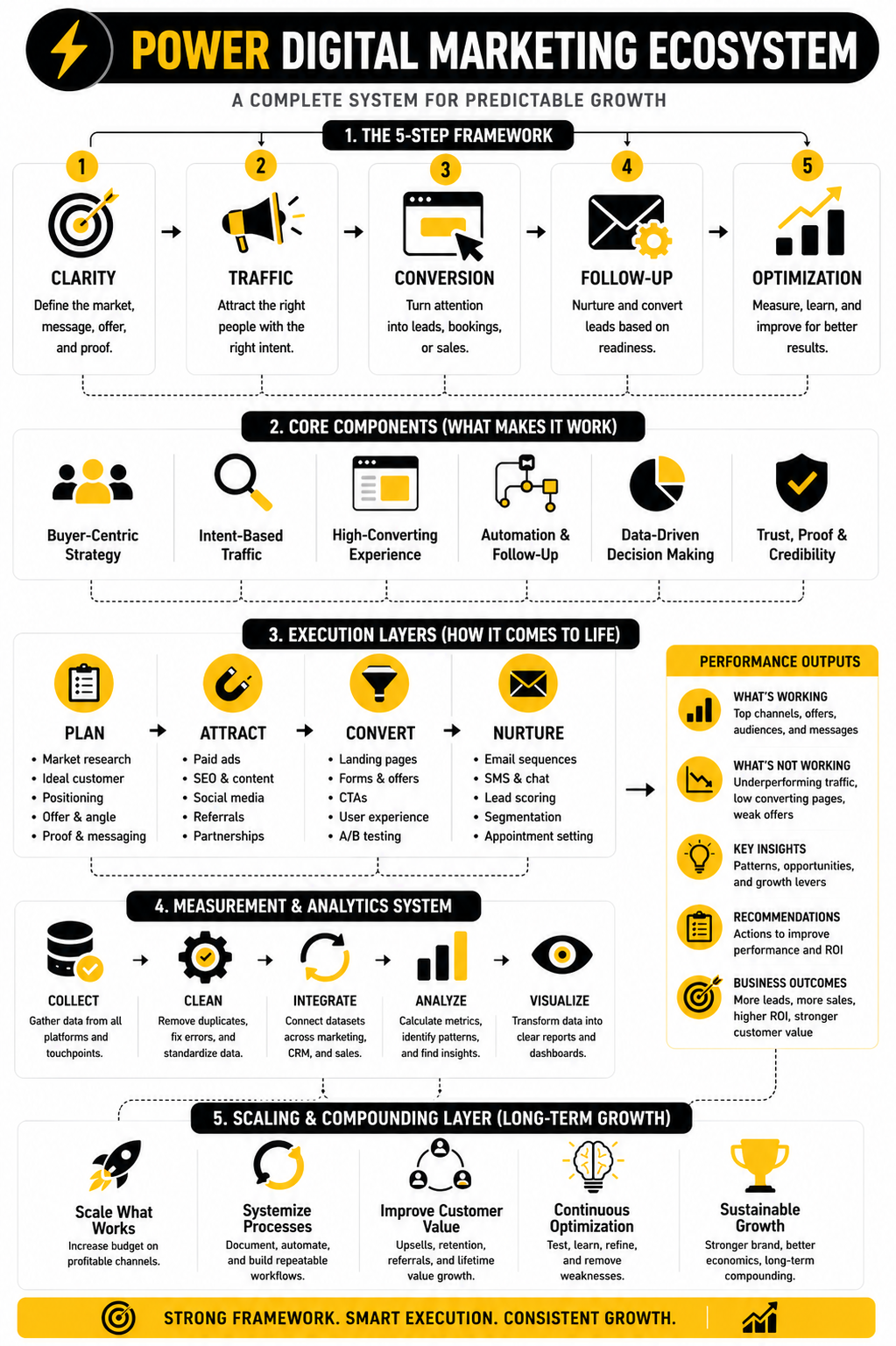
The practical framework has five stages: clarity, traffic, conversion, follow-up, and optimization. Each stage has a different job, and none of them can carry the whole business alone. Strong marketing happens when the handoff between stages is smooth enough that buyers do not feel like they are being pushed through a machine.
This matters even more as acquisition costs rise and digital experiences become easier to compare. Contentsquare’s 2025 benchmark research warns that almost half of online visits still face preventable friction, which means many businesses are paying for attention and then losing it through avoidable experience problems. That is exactly the kind of leak this framework is designed to find and fix.
Stage 1: Clarify the Market and Message
The first step is not choosing a channel. The first step is deciding who the business is for, what problem it solves, why the offer is different, and what proof makes the claim believable. If this foundation is vague, every channel becomes harder because the message has to work too hard.
Good market clarity answers simple but uncomfortable questions. Who is the best-fit buyer? What trigger makes them start looking? What are they comparing against? What would make them hesitate? The answers shape the offer, the content, the landing page, the sales process, and the follow-up.
This is where many teams rush. They want ads, posts, emails, and funnels before the positioning is sharp enough to deserve distribution. Power digital marketing flips that order because weak clarity does not scale; it only gets exposed faster.
Stage 2: Build the Traffic Strategy Around Intent
Traffic is not just volume. A thousand people with weak intent can be less valuable than fifty people who are actively trying to solve the exact problem you address. That is why the traffic strategy should be built around intent levels, not just channel names.
High-intent traffic usually comes from search, comparison pages, retargeting, referrals, and direct response campaigns. Mid-intent traffic often comes from educational content, social proof, newsletters, webinars, and useful organic content. Low-intent traffic can still matter, but it needs a different goal: create awareness, shape beliefs, and earn future attention.
The mistake is expecting every channel to convert immediately. Some channels should create demand, some should capture demand, and some should re-engage people who already showed interest. Once that role is clear, performance becomes easier to judge fairly.
Stage 3: Turn Attention Into Action
Conversion is where strategy becomes visible. A person clicks, lands, reads, compares, hesitates, and decides whether the next step feels worth it. If the page is unclear, the offer is weak, or the path is confusing, the campaign does not just lose a lead; it loses trust.
A strong conversion layer includes clear landing pages, specific calls to action, fast load times, persuasive proof, clean forms, and a next step that matches the buyer’s intent. For funnels, ClickFunnels can make sense when the business needs a dedicated path from offer to checkout or booking. For content-heavy ecommerce landing pages, Replo can help teams test campaign pages without turning every change into a development project.
The point is not to obsess over tools before the offer is right. The point is to remove friction between interest and action. A good page makes the buyer feel understood, informed, and safe enough to continue.
Stage 4: Create Follow-Up That Matches Buyer Readiness
Most people do not convert the first time they interact with a brand. That is not failure; it is normal buyer behavior. The problem is that many businesses treat “not ready now” the same as “not interested,” then let warm leads go cold.
Follow-up should be designed around readiness. A new lead might need education, proof, objection handling, or a reminder to book. A returning visitor might need a stronger offer or comparison content. A sales-qualified lead might need fast human outreach, a calendar link, and a clear confirmation process.
This is where CRM and automation become useful. A platform like GoHighLevel can help connect forms, pipelines, messages, appointment reminders, and sales tasks so fewer leads disappear between systems. For email-focused nurturing, tools like Brevo or Moosend can support segmentation and lifecycle communication when the strategy is already clear.
Stage 5: Optimize Based on Revenue Signals
Optimization should not mean randomly changing headlines because a dashboard looks flat. It should mean improving the parts of the system that are limiting revenue. Sometimes the bottleneck is traffic quality. Sometimes it is the offer. Sometimes it is the page. Sometimes it is follow-up speed.
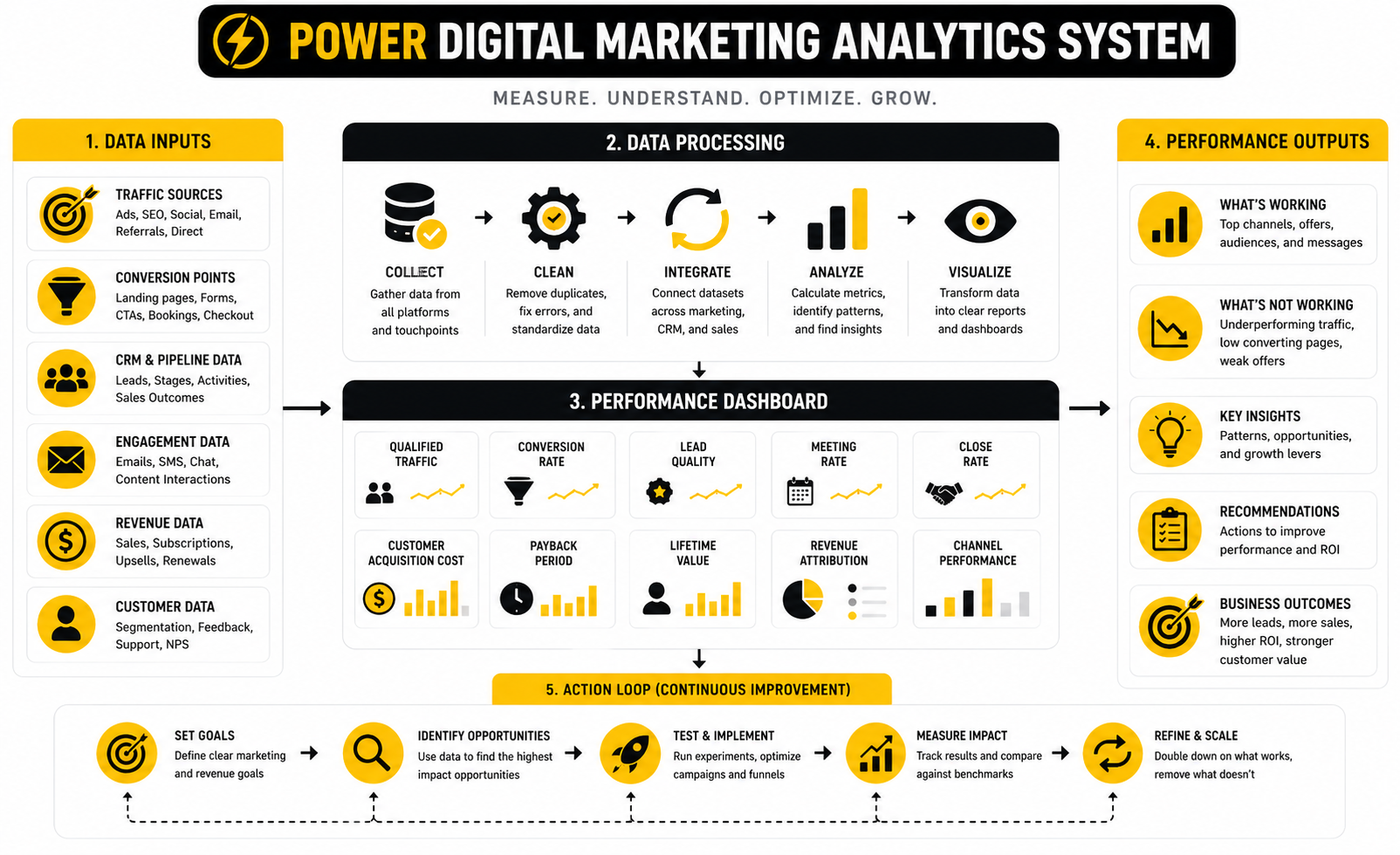
The best way to find the bottleneck is to track each stage separately. Look at source quality, landing page conversion, lead-to-meeting rate, meeting show rate, close rate, acquisition cost, and payback period. When those numbers are visible, the team can stop arguing from opinions and start improving from evidence.
This is also where power digital marketing becomes a compounding asset. Every campaign teaches the business something about the market, the message, the offer, and the buyer journey. The longer the system runs with clean measurement, the smarter it should become.
Statistics and Data That Actually Matter
Data only helps when it changes what you do next. In power digital marketing, the goal is not to collect every metric because a dashboard allows it. The goal is to separate performance signals from noise so the team can make better decisions faster.
The big picture is clear: digital is where the money is going, but efficiency is under pressure. Digital channels now account for 61.1% of total marketing spend, while average marketing budgets have stayed tight at around 7.7% of company revenue. That means better measurement is not a “nice to have.” It is how you avoid wasting budget on campaigns that create activity without creating growth.
The mistake is treating benchmarks like universal truth. A 3% conversion rate can be excellent for one offer and terrible for another. A high cost per lead can be profitable if the close rate and lifetime value are strong. A low cost per click can be useless if the traffic never becomes pipeline.
The Metrics That Show Real Business Health
A power digital marketing dashboard should start with the buyer journey, not the platform menu. Platform metrics tell you what happened inside Google, Meta, LinkedIn, email, or social. Business metrics tell you whether the system is producing useful demand.
The core measurement stack should include:
- Traffic quality: which sources bring visitors who engage, return, and take meaningful action.
- Conversion rate: how well pages, offers, and funnels turn attention into leads, bookings, trials, or purchases.
- Lead quality: whether new contacts match the buyer profile and show real intent.
- Sales progression: how many leads become meetings, opportunities, proposals, customers, or repeat buyers.
- Customer acquisition cost: how much it costs to create a customer, not just a click or lead.
- Payback period: how long it takes to recover the cost of acquisition.
- Lifetime value: how much revenue a customer is likely to create after the first purchase.
These numbers work together. Looking at one metric alone can lead to bad decisions. For example, cutting a campaign because its cost per lead is higher may be a mistake if those leads close faster and buy more.
Why Benchmarks Need Context
Benchmarks are useful for spotting obvious problems, but they should never replace judgment. Contentsquare’s 2025 digital experience research found that frustrating online experiences can reduce conversion rates by 6.1%. That number matters because it points to a practical action: before buying more traffic, check whether the current experience is leaking revenue.
The same logic applies across channels. If paid search converts well but sales quality is weak, the problem may be keyword intent or the offer promise. If organic content drives traffic but not leads, the content may be attracting readers who are curious but not commercially relevant. If email open rates are fine but pipeline does not move, the issue may be segmentation, message timing, or the call to action.
This is why raw averages can mislead. A business does not need to “beat the internet.” It needs to improve its own funnel economics in a way that supports profitable growth. Internal benchmarks usually become more useful than industry averages once the business has enough clean data.
The Analytics System
The analytics system should make the customer journey visible from first touch to revenue. That means tracking source, campaign, landing page, form, booking, CRM stage, deal value, and customer status as one connected path. If those data points live in separate tools with no clean handoff, the team is forced to guess.
A practical analytics system has three layers. The first layer is tracking, which captures where visitors and leads come from. The second layer is attribution, which connects marketing activity to pipeline and revenue. The third layer is decision reporting, which turns the data into actions the team can take this week.
This is where tools matter, but only after the measurement logic is clear. GoHighLevel can help service businesses connect forms, conversations, appointments, pipelines, and follow-up in one CRM-style system. Fillout can be useful when the business needs cleaner forms and intake flows. Dub.co can support cleaner link tracking when campaigns, partners, and attribution paths need more control.
Reading Performance Signals Correctly
Good analytics does not just say what happened. It helps explain why it happened. That difference matters because the wrong interpretation can push the team into the wrong fix.
If traffic is growing but conversions are flat, the first question is whether the new traffic has the same intent as the old traffic. If lead volume is growing but revenue is not, the next question is whether the offer is attracting the wrong people. If revenue is growing but acquisition cost is rising faster, the business may need better retention, stronger upsells, or a sharper channel mix.
The best teams look for bottlenecks in order. They ask where the journey is losing people, where quality drops, and where the numbers stop making economic sense. That keeps optimization grounded instead of turning every campaign review into random opinions.
What the Data Should Make You Do
Data should drive action, not decoration. If analytics shows that one traffic source brings cheap leads but poor close rates, reduce spend or change the targeting. If another source brings fewer leads but higher deal value, protect it and test ways to scale it carefully.
If page analytics show friction, fix the experience before increasing budget. If CRM data shows slow response time, improve follow-up speed before blaming ad quality. If email data shows engagement dropping over time, rebuild the nurture sequence around buyer intent instead of sending more of the same.
This is the practical discipline behind power digital marketing. The numbers are not there to impress anyone. They are there to help the business make sharper decisions, protect margin, and compound what is already working.
Professional Implementation: Turning Strategy Into Execution
The hard part of power digital marketing is not understanding the framework. The hard part is installing it inside a real business with real deadlines, imperfect data, limited people, and pressure to show results. Strategy only becomes valuable when it changes what gets built, launched, measured, and improved.
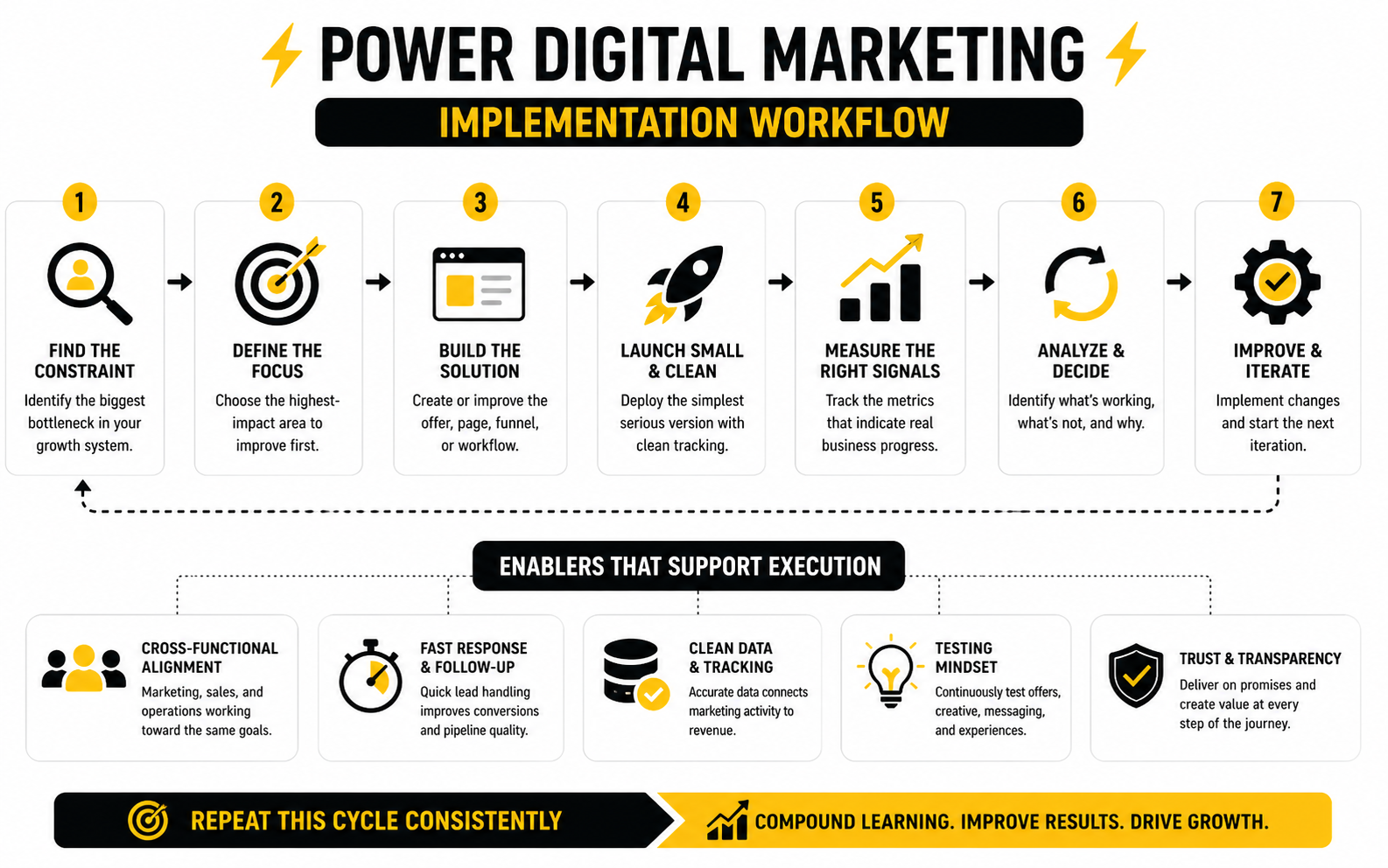
Professional implementation starts with sequencing. You do not fix everything at once. You identify the biggest constraint in the growth system, improve that first, and then move to the next bottleneck. That is how marketing becomes manageable instead of chaotic.
This also protects the business from expensive overengineering. A team does not need ten dashboards, five automation tools, and a full-funnel rebuild before it can make progress. It needs the right next improvement, shipped cleanly, with a clear reason behind it.
Start With the Highest-Leverage Constraint
Every business has a limiting factor. Sometimes it is not enough qualified traffic. Sometimes it is a weak offer. Sometimes the landing page is unclear, the follow-up is slow, or sales is rejecting leads that marketing thought were working. The job is to find the constraint before adding more activity.
A simple way to do this is to walk the funnel in order. Look at who is coming in, what they see, what action they take, what happens after they convert, and how many become customers. The first major drop-off usually tells you where the most urgent work belongs.
This keeps the team from solving the wrong problem. If the offer is weak, more traffic will not fix it. If the lead response process is broken, better ads will only create more missed opportunities. If analytics is unreliable, every optimization decision becomes a guess.
Balance Speed With Strategic Discipline
Speed matters in digital marketing because markets move, competitors react, and campaigns decay. The IAB reported that U.S. digital ad revenue reached 294.6 billion dollars in 2025, which shows how crowded and competitive the digital environment has become. When everyone is spending, slow execution becomes a real disadvantage.
But speed without discipline creates mess. Teams launch campaigns without clean naming, tracking, creative hypotheses, or follow-up logic, then wonder why the results are hard to interpret. Fast is good only when the learning is clean.
A better rhythm is simple: define the hypothesis, launch the smallest serious version, measure the right signals, and make the next decision quickly. That keeps momentum high without turning marketing into random motion. Power digital marketing should feel fast, but it should not feel reckless.
Build Around the Buyer, Not the Org Chart
Many marketing systems are designed around internal teams instead of buyer behavior. Content owns articles, paid owns campaigns, sales owns calls, operations owns CRM, and nobody owns the full journey. The buyer does not care about those handoffs; they only feel the experience.
This is why cross-functional alignment matters. The message in the ad should match the landing page. The form should match the sales conversation. The nurture sequence should reflect what the person actually requested. The CRM stage should show what is truly happening, not what the team wishes were happening.
For service businesses, a connected platform like GoHighLevel can reduce some of the operational gaps between lead capture, follow-up, appointments, and pipeline visibility. For businesses that rely heavily on booking, Cal.com can help make scheduling cleaner when the conversion path depends on fast, low-friction meetings. The tool is not the strategy, but the right tool can remove friction from the strategy.
Avoid Scaling Before the Economics Work
Scaling broken economics is one of the most common digital marketing mistakes. A campaign that barely works at a small budget can fall apart when spend increases. The algorithm reaches broader audiences, frequency rises, conversion quality shifts, and the sales team feels the difference quickly.
Before scaling, the business needs to know the basic economics. What does it cost to create a qualified opportunity? What percentage closes? How long is the payback period? What customer value justifies the acquisition cost? Without those answers, scaling is mostly confidence theater.
This is where serious operators become patient. They improve the offer, the page, the follow-up, and the sales handoff until the system has enough margin for scale. Then they increase spend carefully, watching for the point where quality starts to decline.
Treat AI as Leverage, Not a Substitute for Judgment
AI can make power digital marketing faster, especially in research, content production, creative variation, segmentation, reporting, and workflow automation. McKinsey has described generative AI as a way to expand marketing capability through automation, hyperpersonalization, and faster idea generation. That is useful, but only if the business still has strong judgment behind the system.
The risk is obvious. AI can help produce more campaigns, more copy, more emails, and more creative variants, but more output does not automatically mean better marketing. If the strategy is weak, AI simply helps the team produce weak work faster.
Use AI where it reduces friction and increases learning speed. Use human judgment where positioning, buyer psychology, proof, ethics, and commercial decisions matter. That balance is critical because the winning team will not be the one that automates everything; it will be the one that combines sharper thinking with faster execution.
Protect Trust While You Optimize
Power digital marketing should never become manipulation dressed up as optimization. Aggressive scarcity, misleading claims, fake urgency, unclear pricing, and over-personalized messaging may create short-term lifts, but they damage trust. That damage is expensive even when it does not show up immediately in the dashboard.
This matters more as buyers become skeptical of automated content and AI-generated outreach. People are not against automation; they are against feeling tricked, spammed, or reduced to a data point. A clean marketing system respects attention instead of exploiting it.
The practical rule is simple. Make the next step clear, make the promise honest, and make the follow-up useful. If an optimization improves conversion but weakens trust, it is probably not a real win.
Make the Operating Rhythm Repeatable
A strong implementation needs cadence. Weekly reviews should focus on active campaigns, current bottlenecks, and immediate decisions. Monthly reviews should look at channel economics, offer performance, funnel movement, and upcoming tests. Quarterly reviews should revisit positioning, market shifts, budget allocation, and strategic bets.
This rhythm prevents marketing from becoming reactive. Instead of chasing every fluctuation, the team knows what to inspect and when to act. Small problems get caught early, and strong signals get more support before momentum is lost.
The best version of power digital marketing is not a one-time setup. It is a repeatable operating system that keeps improving. When the business knows how to diagnose, prioritize, launch, measure, and adjust, growth stops depending on luck and starts depending on process.
Measurement, Optimization, Tools, and FAQ
The final layer of power digital marketing is the ecosystem. By this point, the business should understand its market, traffic sources, conversion paths, follow-up process, analytics, and operating rhythm. The next step is making those pieces work together consistently enough that the system can improve without constant reinvention.
A strong ecosystem has clear ownership. Someone owns the offer, someone owns the traffic, someone owns the landing experience, someone owns CRM hygiene, someone owns reporting, and someone owns the next round of tests. When ownership is unclear, good ideas die in handoffs and bad assumptions stay hidden.
The best setup is simple enough to run every week and strong enough to scale over time. A lean business may only need a CRM, landing page builder, email platform, scheduling tool, analytics setup, and clear reporting process. A larger team may need more specialized systems, but the principle stays the same: every tool should support a decision, a workflow, or a buyer action.
Choosing Tools Without Losing the Strategy
Tools can make execution faster, but they can also become a distraction. A business does not need a huge tech stack to do power digital marketing well. It needs tools that match the buyer journey and remove real friction.
For all-in-one lead capture, follow-up, CRM, and pipeline workflows, GoHighLevel is worth considering for agencies and service businesses. For funnel-first campaigns, ClickFunnels can help build dedicated conversion paths. For ecommerce landing pages, Replo can help teams move faster on campaign-specific pages.
For communication and nurturing, Brevo, Moosend, and ManyChat can support different parts of the customer journey. For scheduling, Cal.com can reduce booking friction, while Fillout can improve intake and qualification flows.
The Final System Check
Before scaling any campaign, check whether the system can handle more demand. More leads are not helpful if follow-up is slow, CRM stages are messy, or sales does not know which contacts deserve priority. Growth creates pressure, and weak systems break exactly when more attention arrives.
The final check is practical. Does the business know who it is targeting? Is the offer clear? Are the pages fast and persuasive? Is follow-up automatic where it should be and human where it matters? Can the team see which channels create qualified pipeline and revenue?
When those answers are strong, power digital marketing becomes more than a tactic. It becomes a business asset. It helps the company learn faster, spend smarter, convert more consistently, and protect trust while it grows.
FAQ - Built for Complete Guide
What is power digital marketing?
Power digital marketing is a connected approach to online growth where strategy, traffic, conversion, automation, analytics, and optimization work as one system. It is not just running ads, posting content, or using more tools. The goal is to create a repeatable process that turns qualified attention into measurable business results.
How is power digital marketing different from regular digital marketing?
Regular digital marketing often focuses on individual tactics like SEO, paid ads, email, or social media. Power digital marketing focuses on how those tactics connect across the full buyer journey. The difference is integration: every channel has a clear role, every conversion path is intentional, and every result feeds future decisions.
Why does power digital marketing matter for small businesses?
Small businesses usually cannot afford to waste money on disconnected campaigns. Power digital marketing helps them prioritize the highest-impact actions first, such as improving the offer, fixing follow-up, or tracking lead quality. That makes growth more practical because the business is not guessing where the budget is going.
What are the core parts of a power digital marketing system?
The core parts are market clarity, traffic strategy, conversion infrastructure, follow-up, measurement, and optimization. Each part has a different job, but they only work properly when connected. If one part is weak, the whole system usually feels it.
Which metrics matter most?
The most useful metrics are the ones tied to business outcomes. Track qualified traffic, conversion rate, lead quality, meeting rate, close rate, customer acquisition cost, payback period, and lifetime value. Platform metrics still matter, but they should support business decisions instead of replacing them.
How often should a business review digital marketing performance?
Campaign performance should usually be reviewed weekly, while bigger strategy decisions should be reviewed monthly or quarterly. Weekly reviews help catch issues quickly and keep execution moving. Monthly and quarterly reviews help the business make smarter decisions about budget, channels, positioning, and offers.
Should every business use automation?
Most businesses should use automation somewhere, but not everywhere. Automation is useful for reminders, segmentation, lead routing, nurturing, booking confirmations, and repetitive follow-up. Human judgment still matters for strategy, sales conversations, positioning, and sensitive customer interactions.
What is the biggest mistake businesses make with digital marketing?
The biggest mistake is scaling activity before the system works. Businesses often spend more on traffic before fixing their offer, landing page, follow-up, or tracking. That usually creates more noise, not more profitable growth.
Is AI important for power digital marketing?
AI is important, but it should be used as leverage rather than a replacement for strategy. It can help with research, content drafts, creative variations, segmentation, reporting, and workflow speed. The strongest results still come from combining AI efficiency with strong human judgment.
How do I know if my digital marketing system is working?
Your system is working when you can clearly see how attention turns into revenue. You should know which channels bring qualified buyers, which offers convert, where leads drop off, and what actions improve performance. If the team cannot explain those things, the system needs better tracking and tighter execution.
What should I fix first?
Fix the biggest constraint first. If traffic is weak, improve acquisition. If traffic is decent but leads do not convert, improve the landing page or offer. If leads are coming in but not becoming customers, improve qualification, follow-up, or the sales handoff.
Can power digital marketing work without a large budget?
Yes, but the strategy has to be focused. A smaller budget should go toward the channels, offers, and workflows most likely to create qualified demand. The advantage of a strong system is that it helps the business avoid spreading limited resources too thin.
Work With Professionals
Explore 10K+ Remote Marketing Contracts on MarkeWork.com
Most marketers spend too much time chasing clients, competing on crowded platforms, and losing a percentage of every project to middlemen.
MarkeWork gives you a better way. Browse thousands of remote marketing contracts and connect directly with companies desperate to hire skilled marketers like you, without platform commissions and without unnecessary gatekeepers.
If you're serious about finding better opportunities and keeping 100% of what you earn, explore available contracts and create a profile for free at MarkeWork.com.