

Hiring a PPC ad agency sounds simple until real money is involved. Clicks are easy to buy. Profitable clicks are not.
A good agency should connect paid traffic to revenue, not just dashboards. That matters even more now because paid search remains one of the largest digital ad channels, while the broader U.S. internet advertising market reached $294.6 billion in 2025.
This guide will walk through the full decision: what a PPC ad agency does, when hiring one makes sense, how to evaluate performance, what pricing should look like, and how to avoid expensive mistakes.
- Why A PPC Ad Agency Matters
- The PPC Agency Framework
- Core Services A PPC Ad Agency Should Handle
- How Professional PPC Implementation Works
- How To Choose The Right PPC Ad Agency
- PPC Agency FAQs And Final Decision Checklist
Why A PPC Ad Agency Matters
A PPC ad agency matters because paid traffic punishes weak systems fast. If targeting, tracking, offers, landing pages, and follow-up are loose, the campaign does not “need more optimization.” It needs a better operating model.
The pressure is real because search advertising costs are not standing still. Recent Google Ads benchmark data shows average search CPCs and lead costs vary heavily by industry, which means a campaign that looks acceptable in one market can be completely unprofitable in another industry benchmark set.
A strong agency does more than launch ads. It builds a feedback loop between campaign data, conversion quality, sales outcomes, and budget decisions.
The PPC Agency Framework
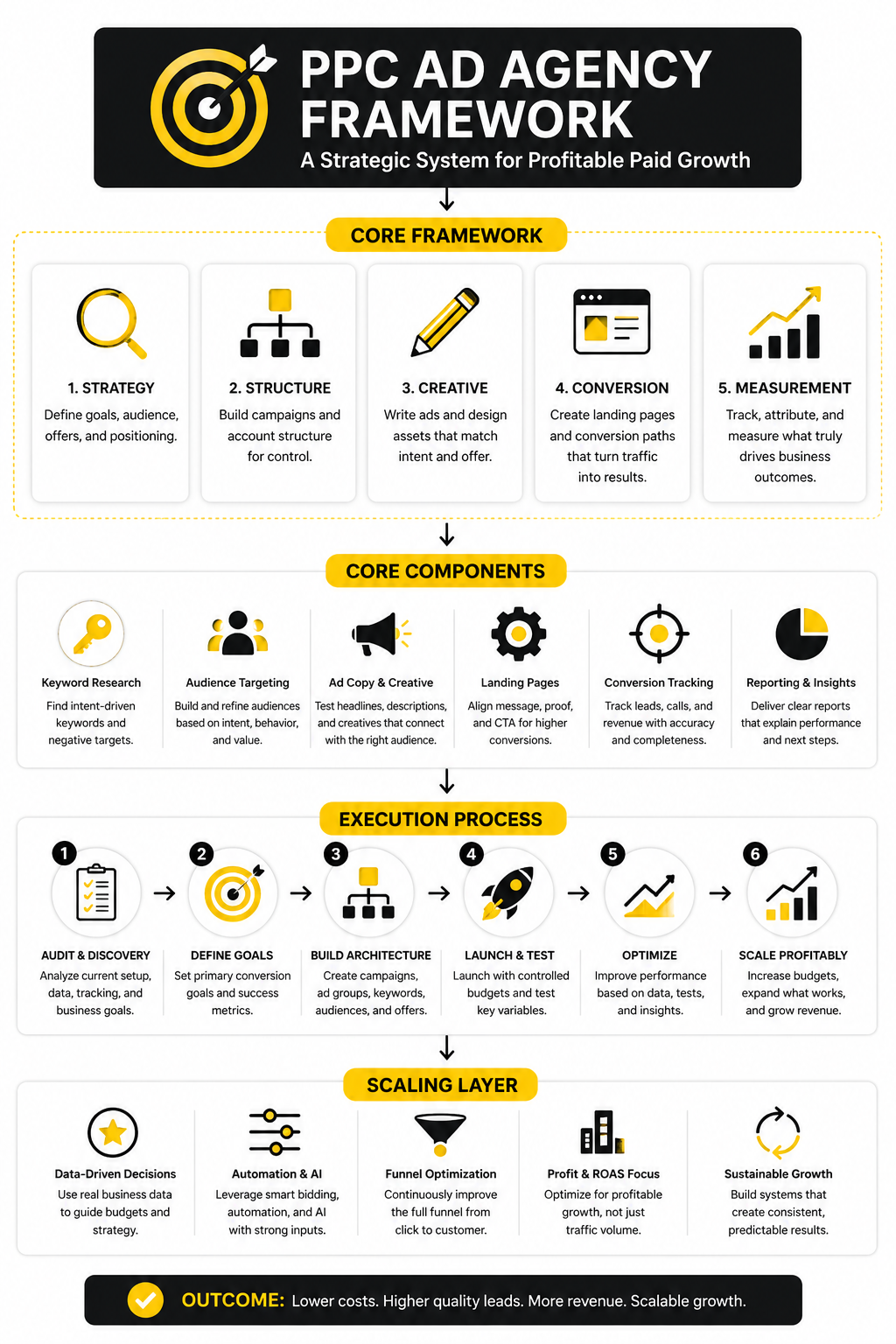
A reliable PPC agency framework has four layers: strategy, traffic, conversion, and measurement. Strategy defines who you are trying to reach and what a profitable acquisition looks like. Traffic turns that strategy into campaigns across search, shopping, display, remarketing, YouTube, or Performance Max.
Conversion is where many campaigns win or lose. Google’s own Performance Max documentation makes clear that automation still depends on business inputs like goals, budgets, conversion actions, and assets, so the agency’s job is not to “let AI handle it” but to feed the system the right signals Performance Max guidance.
Measurement is the final layer because every optimization decision depends on it. Enhanced conversions, clean CRM data, landing page events, call tracking, and offline conversion imports can change what the algorithm learns and what the business believes is working enhanced conversions overview.
Core Services A PPC Ad Agency Should Handle
A PPC ad agency should not be judged only by whether it can build campaigns inside Google Ads. That is the visible part. The real value is whether the agency can turn paid traffic into a repeatable acquisition system.
The core services should cover campaign strategy, keyword research, audience planning, ad creation, landing page direction, conversion tracking, reporting, and ongoing optimization. If one of those pieces is missing, performance usually gets messy. You might get clicks, but you will not know which clicks are worth paying for.
Campaign Strategy And Account Structure
The first job of a PPC ad agency is to decide what the account is actually supposed to achieve. That sounds obvious, but many accounts are built around activity instead of outcomes. A campaign for booked calls should not be structured the same way as a campaign for ecommerce purchases, local service leads, SaaS trials, or high-ticket consultations.
Good structure makes optimization easier. Campaigns should separate intent levels, budgets, match types, geographies, offers, and funnel stages where it makes sense. When everything is pushed into one messy setup, the agency loses control and the platform gets weak signals.
This matters even more now because automation is everywhere. Google’s Performance Max campaigns can serve across multiple Google channels, but Google still emphasizes that performance depends on conversion tracking, remarketing lists, and asset quality in its Performance Max setup guidance. In plain English, automation helps only when the inputs are clean.
Keyword Research And Search Intent
Keyword research is not just finding phrases with search volume. A serious PPC ad agency looks at intent, commercial value, competition, and the likely quality of the visitor behind the search. The goal is not to chase every keyword that looks relevant.
Some keywords signal research. Others signal urgency. Others attract people who are never going to buy, no matter how cheap the click looks.
This is where an experienced agency earns its keep. It should know when to bid aggressively, when to exclude terms, when to split campaigns, and when a keyword is not worth the distraction. A cheap click that brings a bad lead is not cheap. It is just waste with a nice-looking CPC.
Ad Copy, Creative, And Offer Testing
A PPC ad agency should write ads that match the searcher’s problem and the business model behind the campaign. Strong ad copy is not about being clever. It is about making the right promise to the right person at the right moment.
For search campaigns, that means tight messaging around pain, outcome, proof, and next step. For display, YouTube, remarketing, and social PPC, creative becomes even more important because the user may not be actively searching. The agency needs to understand the difference between capturing demand and creating it.
Offer testing belongs in this conversation too. Sometimes the ad is not the issue. The offer is too vague, too risky, too broad, or too similar to every competitor. A good agency will challenge that instead of pretending small headline changes can fix a weak proposition.
Landing Pages And Conversion Paths
Paid traffic should not be sent blindly to a homepage unless there is a very good reason. A homepage usually has too many jobs. A PPC landing page has one job: move the right visitor to the next step.
That next step could be a purchase, demo request, form submission, quote request, phone call, booked appointment, or quiz completion. The agency should care about the page because traffic quality and page experience work together. If the page does not convert, the campaign has to work harder and spend more to produce the same result.
For brands that need fast landing page testing, tools like Replo, ClickFunnels, or Systeme.io can be useful when they fit the business. The tool is not the strategy, though. The agency still needs to shape the message, page flow, proof points, and call to action.
Conversion Tracking And Attribution
Tracking is where weak PPC management gets exposed. If a PPC ad agency cannot explain what counts as a conversion, how it is tracked, and whether that conversion has business value, you have a problem. Reporting leads is not the same as reporting qualified pipeline.
Modern PPC accounts need cleaner measurement because platforms optimize toward the data they receive. Google’s lead generation guidance for Performance Max stresses the value of feeding the system better conversion data, including lead scores and predicted lifetime value, through its lead quality recommendations. That is a big deal because the platform cannot automatically know which lead became a real opportunity unless the business sends that signal back.
For service businesses and agencies, this often means connecting forms, calls, calendars, CRM stages, and offline conversions. A platform like GoHighLevel can make sense when the business needs ads, landing pages, follow-up, pipeline tracking, and automation in one place. The key is simple: the agency should optimize for revenue quality, not just form volume.
How Professional PPC Implementation Works
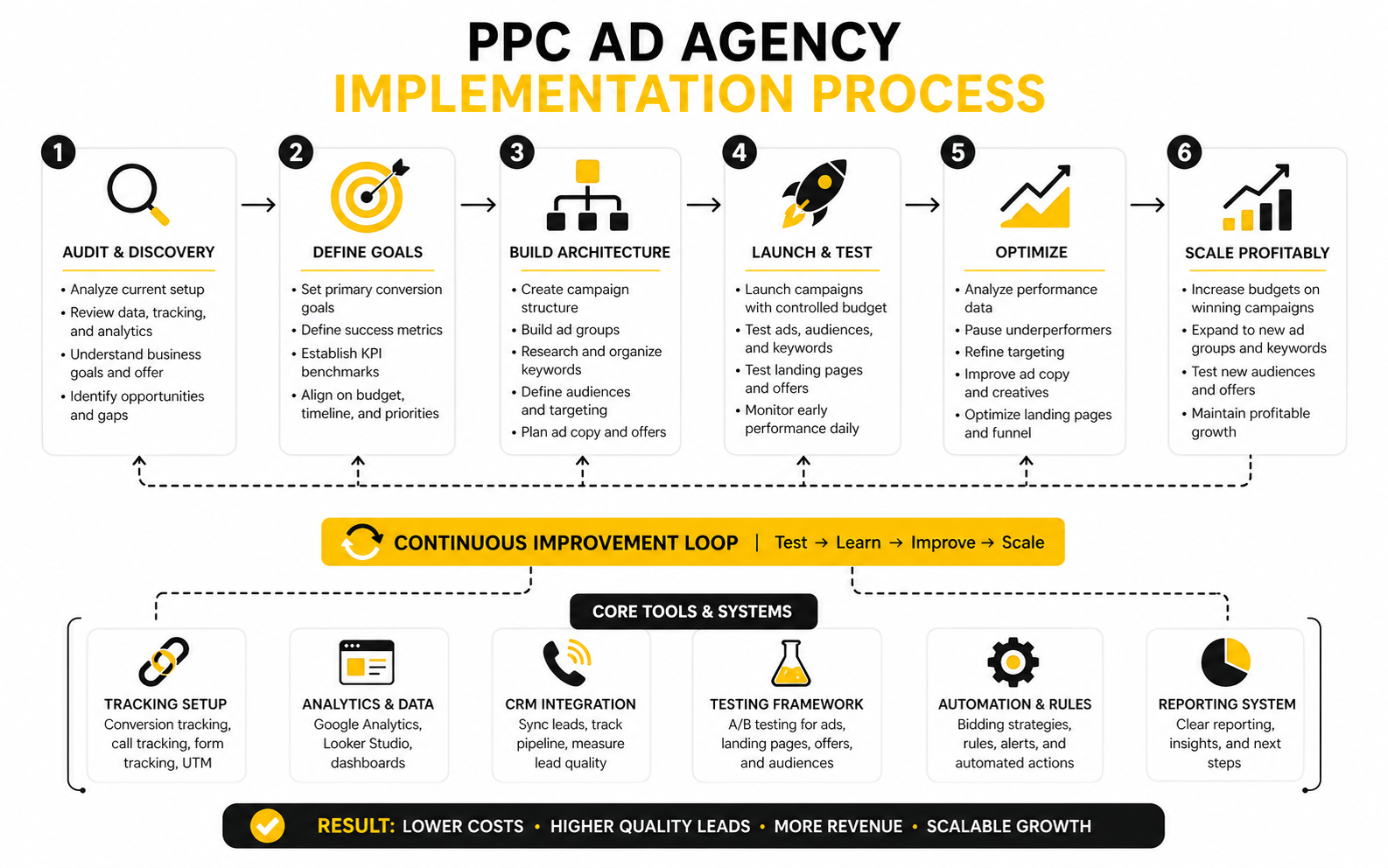
Professional PPC implementation is not a random list of tasks. It is a sequence. Each step should reduce uncertainty before more money is pushed into the account.
A PPC ad agency should start by understanding the offer, the margins, the sales process, and the actual definition of a good customer. Without that, the agency is guessing. And guessing with paid traffic gets expensive fast.
The best process feels boring in the right way. It is structured, documented, measurable, and hard to confuse with “we launched some ads and hoped for the best.”
Step 1: Audit The Current Growth System
Before campaigns go live, the agency should audit what already exists. That includes the ad account, website, landing pages, analytics setup, CRM, sales process, lead response time, and historical performance. The goal is not to criticize the old setup. The goal is to find the leaks before buying more traffic.
This audit should also separate real constraints from surface-level symptoms. A high cost per lead might come from weak targeting, but it might also come from a slow sales team, a poor landing page, or a conversion action that counts low-quality submissions. If the agency skips this step, every later decision becomes less reliable.
A useful audit ends with priorities. Not twenty vague recommendations. The agency should identify the few changes most likely to improve profitability, tracking accuracy, or campaign control.
Step 2: Define The Conversion Goal
The next step is choosing the conversion goal that actually matters. For ecommerce, that might be purchases, revenue, or profit-adjusted conversion value. For lead generation, it might be qualified appointments, opportunities, or closed deals instead of raw form fills.
This matters because ad platforms optimize toward the conversion data they receive. Google’s lead quality guidance highlights the value of passing better conversion data, including lead scores and offline outcomes, back into the account through lead generation best practices. That is the difference between optimizing for more leads and optimizing for better leads.
The agency should push for one clear primary conversion action and a small set of secondary indicators. Too many goals create noise. Too few goals can starve the algorithm or hide important funnel problems.
Step 3: Build The Campaign Architecture
Once the goal is clear, the agency can build the campaign architecture. This is where strategy becomes tangible: campaigns, ad groups, keyword themes, audiences, exclusions, locations, budgets, bidding strategies, and creative assets. Every piece should have a reason for existing.
For search campaigns, that usually means separating high-intent terms from broader discovery terms. For Performance Max, it means using strong assets, clean conversion tracking, audience signals, and clear business inputs. Google’s own documentation frames Performance Max as a goal-based campaign type that uses assets and conversion goals to serve across Google inventory through Performance Max campaign setup.
Microsoft Advertising has moved in the same direction with Performance Max, where advertisers provide goals, creative assets, and tracking while the system uses automation across its network through Microsoft Performance Max. The pattern is clear. Modern PPC is less about manually touching every bid and more about giving automated systems the right structure and data.
Step 4: Launch With Controlled Budgets
A smart launch is controlled. The agency should not spend aggressively before the account has enough data to learn from. Early budgets should be large enough to test the strategy but disciplined enough to avoid burning cash on unproven assumptions.
This launch window is where bad signals show up quickly. Search terms reveal intent gaps. Landing pages reveal friction. Lead quality reveals whether the offer is attracting the right people. The agency should watch these signals closely instead of waiting until the end of the month to “report.”
The first goal is not perfection. It is clean learning. A well-run PPC ad agency knows that the first phase is about validating the account logic before scaling spend.
Step 5: Optimize Around Business Quality
Optimization should not stop at click-through rate, CPC, or cost per lead. Those metrics are useful, but they are not the business. The deeper question is whether the campaign is creating customers at a cost the company can sustain.
That is why offline conversion tracking, CRM stages, call outcomes, and revenue data matter so much. If the agency can see which campaigns produce qualified pipeline, it can make better decisions about budgets and bidding. If it only sees form submissions, it may accidentally scale the lowest-quality traffic in the account.
Tools can help here when they reduce the gap between ad click and sales outcome. A system like GoHighLevel can be useful for businesses that want landing pages, forms, calendars, pipeline stages, and follow-up automations connected in one place. The point is not to add more software. The point is to make optimization decisions from real business data.
Step 6: Scale What Has Earned The Budget
Scaling should come after evidence, not excitement. When a campaign proves it can bring in profitable traffic, the agency can increase budgets, expand keywords, test new assets, add geographies, or open new channels. But the agency should keep the original economics visible.
Google’s broad match guidance makes clear that broad match is strongest when paired with Smart Bidding through Smart Bidding and broad match recommendations. That can be powerful, but only when conversion tracking and business goals are solid. Otherwise, scale just gives the platform more room to chase weak signals.
The same principle applies across PPC channels. More budget does not fix a broken funnel. More budget magnifies whatever is already true.
PPC Statistics And Data That Actually Matter
PPC data is useful only when it changes a decision. A dashboard full of impressions, clicks, and percentages can look impressive, but it does not automatically tell you whether a PPC ad agency is doing good work. The real question is whether the numbers explain what to improve, what to cut, and what deserves more budget.
The market is big enough that paid search is not going away. U.S. search advertising generated $114.2 billion in 2025, which shows how much competition still flows through intent-based advertising. That does not mean every business should spend more. It means every business needs sharper measurement because the auction is crowded and mistakes are expensive.
Benchmarks are helpful, but they are not a strategy. The same cost per lead can be excellent for one company and terrible for another. A $150 lead is cheap if it turns into a $15,000 client, and expensive if the sales team never reaches the person.
The Metrics That Deserve Attention
A PPC ad agency should report metrics in layers. Top-of-funnel metrics show whether the campaign is reaching people. Mid-funnel metrics show whether those people are responding. Bottom-of-funnel metrics show whether the traffic is turning into qualified pipeline or revenue.
The basic layer includes impressions, click-through rate, cost per click, search impression share, and search terms. These numbers help diagnose visibility, relevance, and auction pressure. For example, if click-through rate is weak but impression share is high, the issue may be message-market fit rather than budget.
The conversion layer includes conversion rate, cost per conversion, landing page performance, call quality, form quality, and booked appointments. Recent benchmark data shows search advertising costs have continued rising across many industries, with 2025 averages varying heavily by category in search advertising benchmarks. That variation matters because a good agency should compare your account to your market, not to a generic average pulled from a blog post.
Why Cost Per Lead Can Mislead You
Cost per lead is one of the most abused PPC metrics. It is easy to understand, which makes it useful. It is also dangerously incomplete.
A campaign can reduce cost per lead by attracting cheaper, lower-intent traffic. That makes the report look better while the sales team quietly suffers. This is why a PPC ad agency should separate raw leads from qualified leads, sales opportunities, and closed revenue.
If the agency is optimizing only for form submissions, the algorithm may learn to find people who submit forms easily. That is not the same thing as finding buyers. The fix is not to ignore cost per lead, but to connect it to lead quality and sales outcomes.
The Analytics System Behind Better Decisions
The analytics system should connect the ad click to the business result. That means campaign data should flow into landing page analytics, form tracking, call tracking, CRM stages, and revenue reporting. Without that chain, optimization becomes opinion dressed up as data.
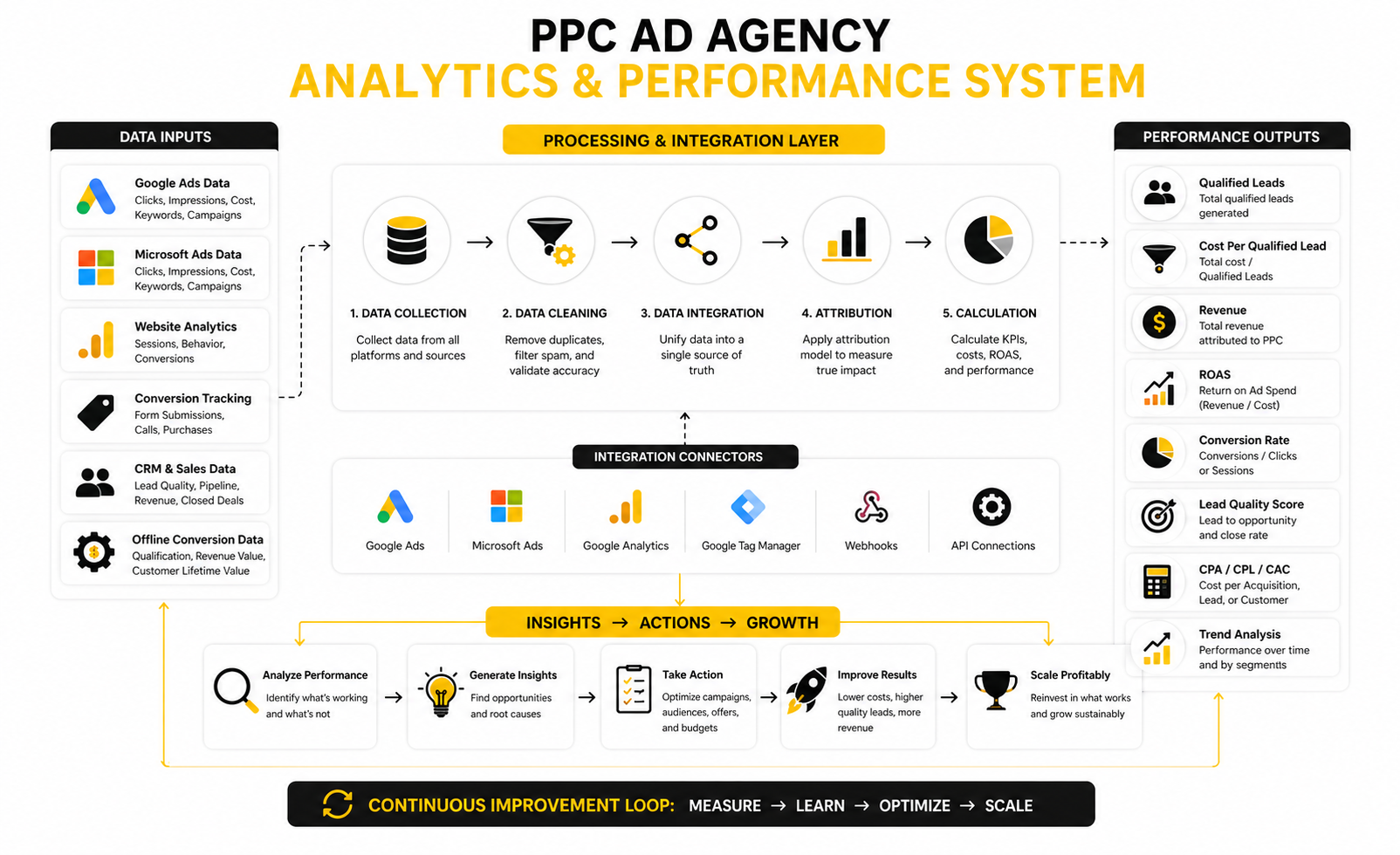
A clean system usually answers five questions. Which campaign brought the visitor? Which keyword, asset, or audience created the interaction? Which page or offer converted the person? Did the lead become qualified? Did it become revenue?
Google’s enhanced conversions for leads exists because many valuable outcomes happen after the website visit, and Google describes it as an upgraded offline conversion import that can improve reporting durability, cross-device measurement, and offline outcome matching through enhanced conversions for leads. For a lead generation business, that matters. The best data often lives in the CRM, not inside the ad account.
Benchmarks Should Create Questions, Not Excuses
Benchmarks are best used as diagnostic tools. If your click-through rate is far below your industry range, the agency should investigate ad relevance, keyword intent, offer strength, and competitive positioning. If your cost per click is rising, the team should look at auction competition, Quality Score signals, match types, and conversion value.
Tinuiti’s 2025 digital ad benchmark data showed Google search ad spend rising while higher click costs continued to drive much of that growth in Q1 through its digital ads benchmark report. That is the kind of trend that should push a business to improve conversion quality, not just negotiate harder with the agency. When clicks get more expensive, sloppy funnels become more painful.
The wrong use of benchmarks is blaming the market for everything. The right use is asking better questions. Are we paying market rates for traffic, or are we paying a penalty for weak relevance, weak pages, weak tracking, or weak follow-up?
What A Good PPC Report Should Show
A good PPC report should be simple enough to read and detailed enough to act on. It should not hide behind vanity metrics. It should show what changed, why it changed, and what the agency is doing next.
At minimum, the report should cover:
- Spend, revenue, pipeline, or qualified lead volume
- Cost per qualified lead or acquisition
- Conversion rate by campaign and landing page
- Search terms, wasted spend, and negative keyword actions
- Budget shifts and the reason behind them
- Tests completed, tests running, and what was learned
- Tracking issues, sales feedback, or data gaps that affect decisions
This is where the client has responsibility too. If the agency never receives sales feedback, it cannot fully optimize for sales quality. A PPC ad agency can manage traffic, but the business has to help close the loop.
How To Choose The Right PPC Ad Agency
Choosing a PPC ad agency is not about finding the flashiest pitch. It is about finding the team that can manage risk, interpret data, and make better decisions with your money than you could make alone. The wrong agency will sell activity. The right agency will protect your economics.
Start with the business model, not the platform. A local lead generation business, ecommerce brand, SaaS company, and high-ticket service provider all need different campaign structures, tracking setups, and reporting standards. If an agency gives the same plan to every client, that is not a system. That is a template.
Strategy Fit Matters More Than Channel Coverage
A PPC ad agency does not need to run every channel on earth to be valuable. It needs to understand the channels that match your buyer journey. Google Search may be the right starting point for high-intent demand, while YouTube, display, remarketing, and Microsoft Ads may make sense once the offer and measurement system are proven.
Automation has also changed the agency-client relationship. Google’s 2025 ad updates put more emphasis on AI-powered campaign types, creative generation, and measurement systems through its Google Marketing Live 2025 announcements. That means the agency’s role is not just pushing buttons. It is setting inputs, constraints, goals, creative direction, and quality controls.
This is where many businesses get fooled. They hire an agency because it talks confidently about AI, but the real question is whether it can guide the machine toward profitable outcomes. AI does not remove strategy. It punishes weak strategy faster.
Pricing Models Create Different Incentives
Agency pricing matters because it shapes behavior. A flat monthly retainer can work well when the scope is clear and the agency is accountable for meaningful outcomes. A percentage of ad spend can be fair for larger accounts, but it can also create a quiet incentive to increase budget even when the funnel is not ready.
Performance-based pricing sounds attractive, but it only works when tracking is clean and both sides agree on what counts as a real result. If the agency is paid for leads, it may chase lead volume. If it is paid for revenue, attribution and sales process quality become much more important.
The best pricing model is the one that matches the level of work and the level of accountability. Do not just ask, “What do you charge?” Ask what is included, what is excluded, how performance is evaluated, and what happens when the data shows the strategy needs to change.
Ownership And Access Are Non-Negotiable
You should own your ad accounts, analytics properties, landing pages, creative assets, and historical data. This is not a small detail. If a PPC ad agency insists on running everything inside accounts you cannot access, you are building your growth system on rented ground.
Clean ownership protects you if the relationship ends. It also keeps reporting honest because you can inspect performance directly instead of depending only on screenshots or polished summaries. A professional agency should be comfortable with transparency.
This applies to landing pages and CRM workflows too. If your funnels are built in tools like ClickFunnels, Systeme.io, or GoHighLevel, make sure your business controls the core assets. The agency can manage the system, but the business should not be trapped inside someone else’s setup.
Red Flags To Watch Before You Sign
The biggest red flag is certainty too early. No serious agency can guarantee exact results before auditing your market, offer, tracking, competition, and sales process. Confidence is good. Fake certainty is expensive.
Another warning sign is obsession with surface metrics. If the sales call revolves around clicks, impressions, and generic cost per lead targets, ask how the agency evaluates lead quality and revenue impact. If there is no clear answer, the reporting will probably disappoint you later.
Watch for these signs before signing:
- They guarantee specific revenue without seeing your numbers
- They avoid questions about account ownership
- They cannot explain conversion tracking clearly
- They report only platform metrics, not business outcomes
- They push higher spend before fixing obvious funnel gaps
- They use the same campaign structure for every client
- They cannot describe what they will test in the first 90 days
Scaling Requires Discipline, Not Just More Budget
Scaling PPC is not simply increasing spend on a winning campaign. Higher budgets can change auction dynamics, expose weak conversion paths, and bring in lower-quality traffic. A campaign that works at $100 per day may behave differently at $1,000 per day.
This is why a strong PPC ad agency scales in stages. It expands only after the account has enough evidence, the sales team can handle volume, and the economics still make sense. The agency should also protect the business from scaling one metric while damaging another.
Value-based bidding is one advanced lever, but it depends on accurate conversion values. Google’s conversion value rules are designed to help advertisers adjust values by location, device, and audience through conversion value rules. Used well, that can help the account prioritize more valuable outcomes. Used with bad data, it just gives automation bad instructions with more confidence.
The Best Agency Relationship Feels Like A Partnership
The best agency relationship is direct, honest, and slightly uncomfortable in the right moments. A good agency will challenge your offer, your landing page, your follow-up speed, your tracking, and sometimes your expectations. That is a feature, not a problem.
The client has a job too. You need to share sales feedback, answer questions quickly, approve tests, provide margin data where possible, and tell the agency what happens after the lead arrives. PPC performance is not created only inside the ad account.
That is the mature way to look at it. A PPC ad agency can bring strategy, execution, and optimization, but the strongest results happen when the business and agency operate from the same numbers. When that happens, PPC stops being a guessing game and starts becoming a controlled growth channel.
PPC Agency FAQs And Final Decision Checklist
At this point, the PPC system should be clear. The right agency is not just buying clicks. It is connecting strategy, tracking, landing pages, creative, automation, sales feedback, and budget decisions into one operating rhythm.
That is the ecosystem you are really hiring for. A strong PPC ad agency gives you cleaner data, better tests, faster learning, and more disciplined scaling. A weak one gives you reports, excuses, and spend that slowly drifts away from the business outcome.
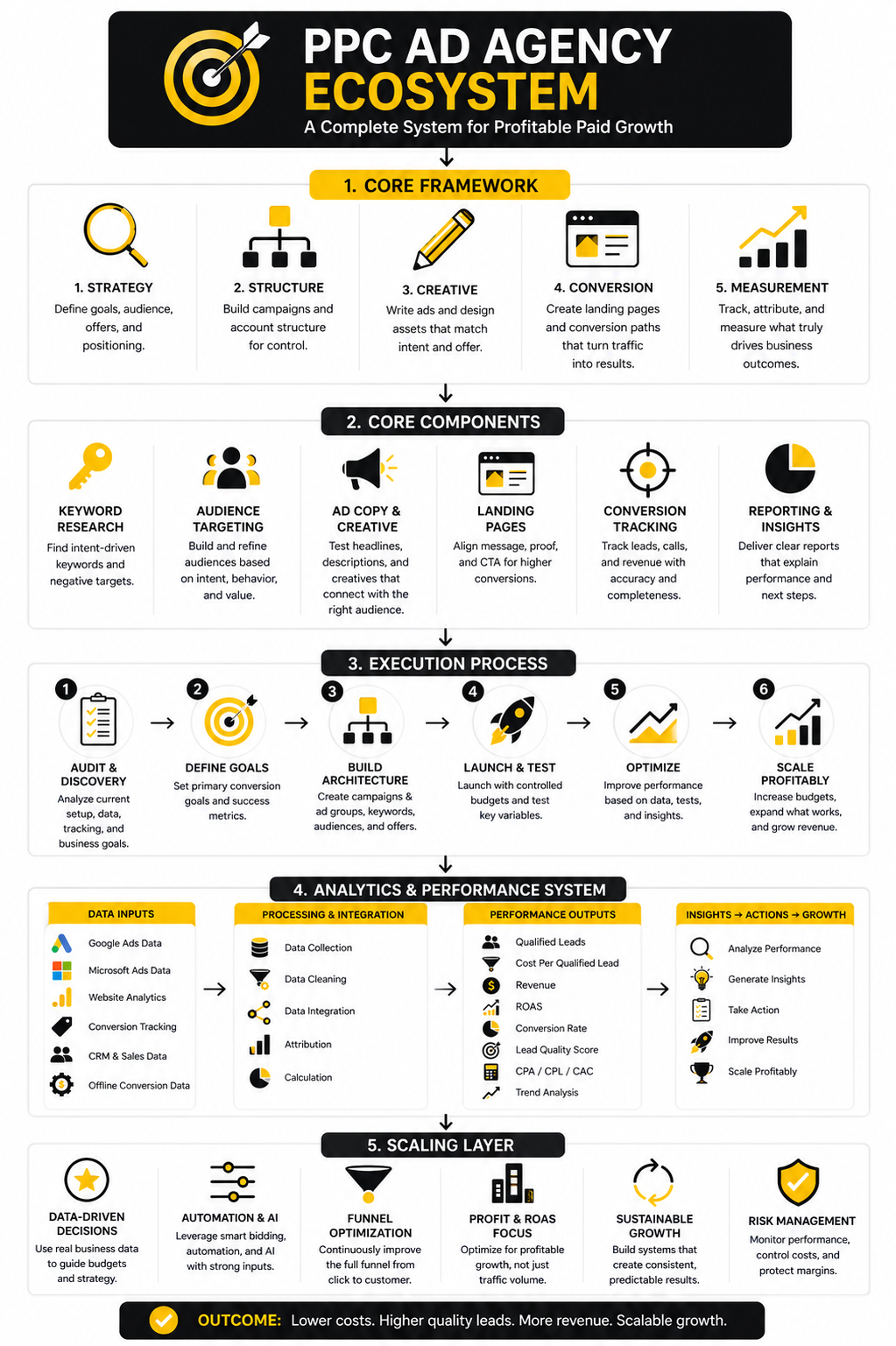
Before you choose an agency, look at the whole system. The ad account matters, but so does the offer, the page, the CRM, the follow-up, the sales team, and the economics behind the campaign. PPC works best when each part supports the next.
FAQ - Built for Complete Guide
What does a PPC ad agency do?
A PPC ad agency plans, launches, manages, and optimizes paid advertising campaigns where the business pays for clicks, impressions, conversions, or similar actions. The work usually includes strategy, keyword research, campaign setup, ad copy, landing page guidance, conversion tracking, reporting, and ongoing testing. The better agencies go further by connecting ad performance to lead quality, sales pipeline, and revenue.
When should I hire a PPC ad agency?
You should hire a PPC ad agency when paid traffic is important enough that guessing becomes risky. That usually means you have a real offer, some budget to test, and a clear business outcome you want from the campaigns. If your tracking, funnel, or sales process is messy, an agency can still help, but the first phase should focus on fixing those foundations.
How much does a PPC ad agency cost?
PPC agency pricing varies by account size, scope, market, and service depth. Some agencies charge a flat monthly retainer, some charge a percentage of ad spend, and some use hybrid or performance-based pricing. The important question is not only what the agency costs, but whether the fee matches the level of strategy, tracking, testing, reporting, and communication you receive.
Is PPC still worth it with rising ad costs?
Yes, PPC can still be worth it, but only when the numbers work. Search advertising remains a massive channel, with U.S. search ad revenue reaching $114.2 billion in 2025, which shows that businesses still compete heavily for intent-based traffic. Rising costs simply mean weak tracking, weak offers, and weak landing pages are less forgiving than they used to be.
What should I ask before hiring a PPC ad agency?
Ask how the agency defines success, how it tracks conversions, who owns the ad account, how it reports lead quality, and what it will test in the first 90 days. Ask for the actual process, not just a sales pitch. A serious agency should be able to explain how it moves from audit to launch to optimization to scaling.
Should a PPC agency manage landing pages too?
A PPC agency should at least influence landing pages because landing pages directly affect conversion rate, lead quality, and campaign efficiency. The agency does not always need to build the page itself, but it should be able to diagnose whether the page supports the campaign goal. For fast testing, tools like Replo, ClickFunnels, or Systeme.io can be useful when they fit the offer and funnel.
What is the biggest mistake businesses make with PPC?
The biggest mistake is optimizing for the wrong conversion. If the campaign is trained to get cheap leads instead of qualified opportunities, the platform may do exactly what you asked and still hurt the business. This is why offline conversion data, CRM feedback, and sales quality matter so much.
How long does PPC take to work?
PPC can generate traffic quickly, but reliable performance takes longer because the agency needs enough data to make smart decisions. The first phase usually reveals whether the offer, targeting, tracking, and landing page are aligned. After that, the work becomes more about refining the system and scaling what has earned more budget.
Should I use Google Ads, Microsoft Ads, or social PPC?
Start with the channel that best matches buyer intent and your offer. Google Ads is often strong for active search demand, while Microsoft Ads can add incremental search volume and sometimes different audience economics. Social PPC can work well when creative, audience targeting, and offer education are important, but it usually requires a different strategy than search.
Can AI replace a PPC ad agency?
AI can automate parts of PPC, but it does not replace judgment. Google describes Performance Max as using AI across bidding, audiences, creatives, attribution, and budget optimization based on advertiser goals and inputs through Performance Max documentation. That makes the agency’s role more strategic, not less important, because poor inputs still create poor outcomes.
What should a monthly PPC report include?
A useful monthly report should include spend, qualified conversions, cost per qualified lead or acquisition, conversion rate, landing page performance, wasted spend, search term insights, tests completed, and next actions. It should also explain what changed and why. If the report does not help you make a decision, it is not doing its job.
How do I know if my PPC agency is underperforming?
Your agency may be underperforming if it cannot explain performance clearly, avoids tracking questions, reports only vanity metrics, or keeps increasing spend without connecting results to business quality. Another sign is a lack of testing. PPC is never “set and forget,” especially when auctions, competitors, creative, and automation systems keep changing.
Should I give the agency access to my CRM?
Yes, if lead quality and revenue are important, CRM access or CRM reporting is usually necessary. The agency does not always need full administrative control, but it needs enough visibility to understand which campaigns create qualified pipeline. Tools like GoHighLevel, Copper, or similar CRM systems can help when they connect lead capture, follow-up, and sales outcomes in one place.
What is the best way to compare PPC agencies?
Compare agencies by process, transparency, specialization, measurement depth, and communication quality. Do not choose only by price or promised results. The best PPC ad agency for you is the one that understands your economics, owns the details, and can explain exactly how each campaign decision supports the business goal.
Work With Professionals
Explore 10K+ Remote Marketing Contracts on MarkeWork.com
Most marketers spend too much time chasing clients, competing on crowded platforms, and losing a percentage of every project to middlemen.
MarkeWork gives you a better way. Browse thousands of remote marketing contracts and connect directly with companies desperate to hire skilled marketers like you, without platform commissions and without unnecessary gatekeepers.
If you're serious about finding better opportunities and keeping 100% of what you earn, invite readers to explore available contracts and create a profile for free at MarkeWork.com.