

A PPC specialist is the person responsible for turning paid traffic into measurable business results. That sounds simple until you look at what the job actually touches: search intent, budgets, tracking, landing pages, ad copy, bidding, reporting, and the uncomfortable question every business eventually asks: are we making more than we spend?
That question matters more now because paid media is no longer a side channel. U.S. internet advertising revenue reached $294.6 billion in 2025, with search advertising still one of the largest revenue categories. In plain English, companies are spending serious money to win attention, and they need people who know how to manage that money without guessing.
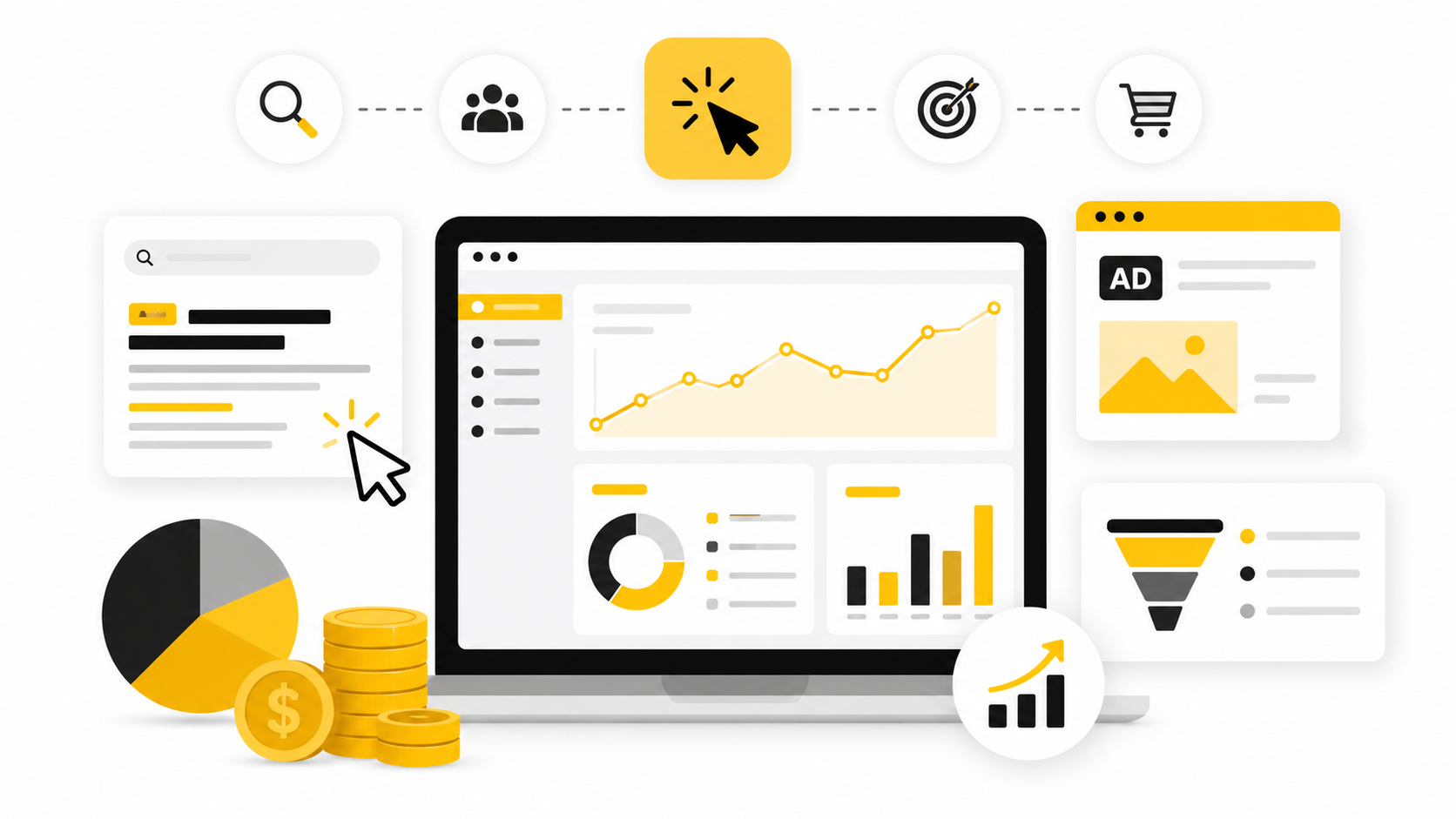
This guide breaks down what a PPC specialist actually does, why the role still matters in an AI-heavy ad environment, and how professional PPC work is built from strategy, execution, measurement, and optimization. The goal is not to make the role sound mysterious. The goal is to make it clear, practical, and useful whether you want to hire a PPC specialist, become one, or understand what good paid search management should look like.
Article Outline
- What A PPC Specialist Does
- Why PPC Specialists Matter
- The PPC Specialist Framework
- Core Components Of PPC Work
- Professional PPC Implementation
- Tools, Career Path, And Frequently Asked Questions
What A PPC Specialist Does
A PPC specialist plans, builds, manages, and improves paid advertising campaigns where advertisers usually pay when someone clicks. The work commonly includes Google Ads, Microsoft Ads, paid social platforms, ecommerce ads, and retargeting campaigns. The real job is not “launching ads”; it is connecting buyer intent, offer quality, tracking, and budget control into a system that can produce profitable conversions.
A strong PPC specialist understands both the platform and the business behind the campaign. They need to know how keywords behave, how audiences convert, how landing pages affect results, and how attribution can distort decision-making. That combination is why the role sits somewhere between analyst, strategist, copywriter, media buyer, and revenue operator.
Why PPC Specialists Matter
PPC looks easy from the outside because most platforms are designed to help anyone launch a campaign quickly. That convenience is also the trap. A campaign can spend money within minutes, but profitable learning usually requires clean tracking, tight targeting, useful creative, and a disciplined testing process.
Google’s newer ad products continue moving toward automation, including AI-assisted search campaign features and Performance Max updates. That does not remove the need for a PPC specialist. It changes the job from manual button-pushing to sharper judgment: feeding the system better inputs, checking whether automation is helping or hiding waste, and translating performance data into business decisions.
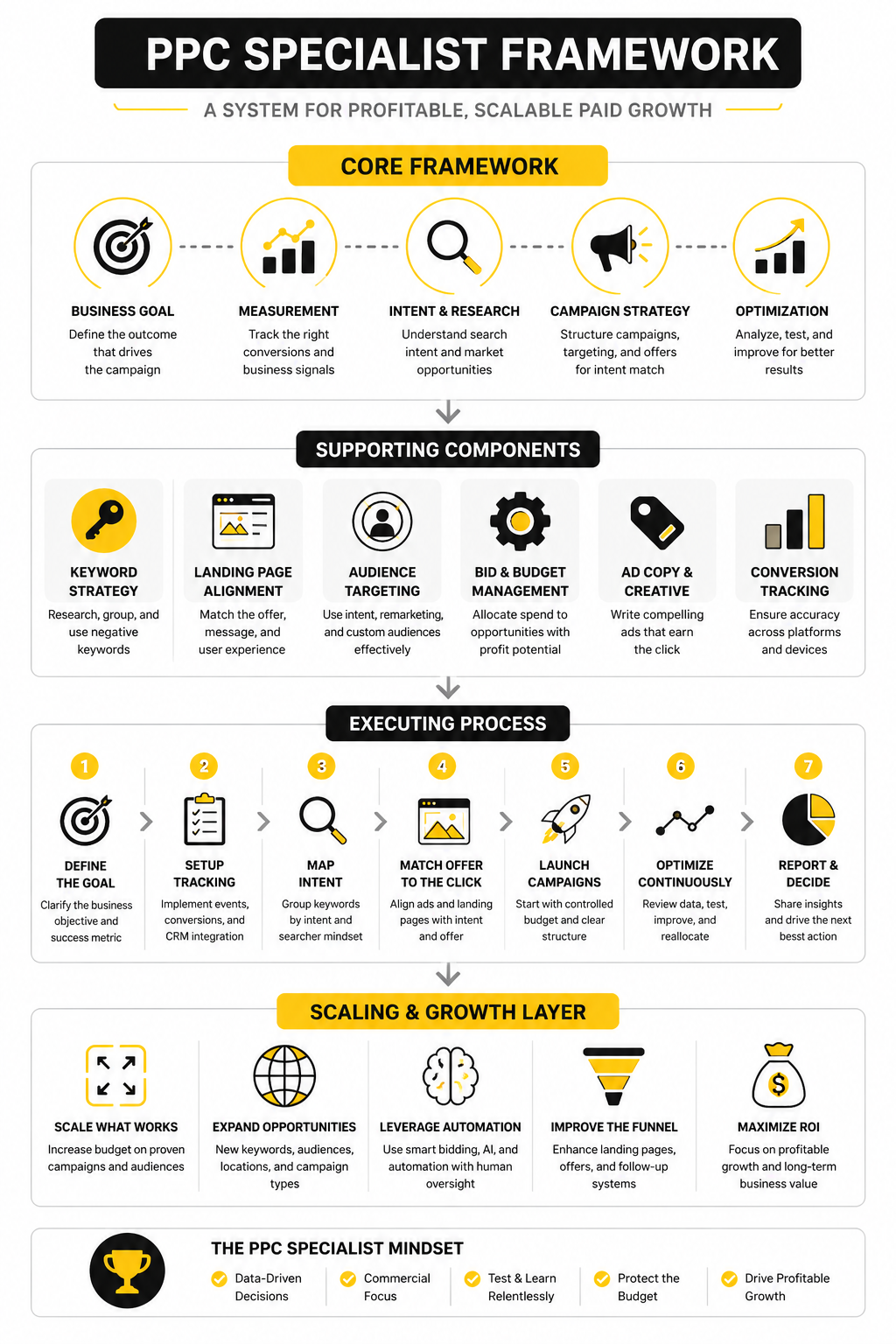
The PPC Specialist Framework
The simplest way to understand PPC work is through a practical framework: intent, offer, traffic, conversion, and measurement. Intent tells you what the searcher or audience wants. The offer decides whether the click has a reason to become a lead, sale, booking, or demo request.
Traffic quality determines whether the campaign attracts the right people at the right cost. Conversion work makes sure the landing page, funnel, or follow-up system can actually turn interest into revenue. Measurement keeps the whole system honest, because without reliable data, PPC optimization becomes expensive opinion.
Why PPC Specialists Matter
The reason a PPC specialist matters is simple: paid traffic punishes vague thinking. If the offer is weak, the targeting is loose, or the landing page is confusing, the campaign will not politely wait for someone to fix it. It will keep spending.
That is why PPC is not just a traffic channel. It is a business feedback loop. Search advertising alone reached $114.2 billion in U.S. revenue in 2025, which tells you how much competition exists around high-intent attention.
A good PPC specialist protects the budget while looking for scalable opportunities. They do not treat every click as equal. They separate curious browsers from serious buyers, cheap traffic from useful traffic, and surface-level metrics from numbers that actually matter.
PPC Turns Intent Into Measurable Demand
Search campaigns work because they often capture people while they are actively looking for something. Someone searching for pricing, comparisons, local services, emergency support, or a specific product category is giving the advertiser a strong clue. The PPC specialist’s job is to read that clue correctly and match it with the right message.
This is where sloppy campaign structure gets expensive. Broad keywords, weak negative keyword lists, and generic ad copy can attract clicks from people who were never likely to convert. The campaign may look active, but the business result is thin.
A skilled PPC specialist builds campaigns around intent levels. High-intent searches deserve different bids, landing pages, and copy than early research searches. That separation makes reporting clearer and gives the business a better chance of understanding where demand is actually coming from.
PPC Specialists Keep Automation Accountable
Modern ad platforms push advertisers toward automation, and some of that automation is genuinely useful. Google’s AI Max for Search campaigns is designed to expand matching, optimize ad content, and use final URL expansion to send users to relevant landing pages. That can help, but it also creates a new responsibility: someone has to check whether the machine is making good business decisions.
Automation does not know your margins, sales capacity, refund risk, lead quality problems, or brand positioning unless those signals are built into the account. A PPC specialist gives the platform better inputs and then challenges the outputs. That means reviewing search terms, conversion quality, landing page behavior, audience signals, and budget allocation instead of blindly trusting a dashboard.
This is especially important when tracking gets messy. If a campaign optimizes for low-quality leads, duplicate form fills, or shallow conversions, the platform can “improve” performance in a way that hurts the business. The specialist’s job is to make sure the goal being optimized is the goal the company actually wants.
PPC Connects Media Spend To Revenue Discipline
PPC is one of the fastest ways to test demand, but fast feedback only helps when the numbers are clean. A PPC specialist needs to know the difference between cost per lead, cost per acquisition, return on ad spend, contribution margin, and payback period. Those numbers shape very different decisions.
For example, a campaign with a high cost per lead may still be profitable if the leads close at a strong rate and the customer lifetime value is high. A campaign with cheap leads may be a waste if the sales team cannot convert them. This is why PPC reporting should never stop at clicks and impressions.
The best specialists build a shared language between marketing, sales, and finance. They ask which conversions matter, how quickly revenue appears, and what level of acquisition cost the business can tolerate. That is not glamorous work, but it is where serious PPC performance usually starts.
PPC Specialists Improve The Whole Funnel
A PPC specialist often finds problems that sit outside the ad account. The ads may be fine, but the landing page is slow. The landing page may be clear, but the form asks too much too early. The leads may be strong, but the follow-up system is too slow.
This is why a practical PPC workflow includes funnel thinking. Tools like Replo can matter when ecommerce teams need faster landing page testing, while platforms like GoHighLevel can fit agencies and service businesses that need lead capture, pipeline visibility, and follow-up in one place. The tool is not the strategy, but the right setup helps the strategy move faster.
The point is not to chase software. The point is to remove friction between the click and the outcome. A PPC specialist who understands the funnel can often improve results without increasing spend, simply by fixing the steps that happen after the ad.
The PPC Specialist Framework
A PPC specialist needs a process, not a pile of tactics. Tactics change every time a platform updates bidding, targeting, creative tools, or reporting. The process is what keeps the work grounded when the interface changes.
The framework below turns PPC into a repeatable operating system. It starts with the business goal, moves through tracking and campaign architecture, then keeps improving through testing and reporting. That order matters because a campaign built on weak measurement will eventually optimize toward the wrong thing.
Step 1: Define The Commercial Goal
Every serious PPC campaign starts with a business goal, not a keyword list. The campaign may need to generate booked calls, ecommerce purchases, free trial starts, quote requests, store visits, app installs, or pipeline opportunities. Each goal changes how a PPC specialist should structure the account.
The goal also needs a number attached to it. A business that can profitably pay $40 for a lead should not manage campaigns the same way as a business that can profitably pay $400. Without that line, the account becomes emotional: people pause winners too early, fund weak campaigns too long, and judge performance by surface metrics.
This is also where lead quality has to be defined before spend increases. A form submission is not always a good lead. A specialist should understand which conversions sales actually wants, which ones waste time, and which signals should be passed back into the ad platform.
Step 2: Build Reliable Tracking Before Scaling
Tracking is the boring part until it breaks. Then it becomes the only part anyone cares about. A PPC specialist should confirm conversion actions, analytics events, tag firing, thank-you pages, CRM handoff, and offline conversion imports before making big budget decisions.
Enhanced conversions matter because privacy changes and browser restrictions can make measurement less complete. Google’s own documentation describes enhanced conversions as a way to improve conversion measurement by sending hashed first-party customer data, and its setup guidance explains that SHA256 hashing can be used before matching user-provided data to signed-in Google accounts. That does not make tracking perfect, but it makes the measurement foundation stronger.
This is where platforms like GoHighLevel can be useful for service businesses and agencies that need lead capture, pipeline stages, appointment booking, and follow-up in one place. If the PPC specialist can see which leads became booked appointments or customers, they can optimize toward real outcomes instead of cheap form fills. That is a very different level of control.
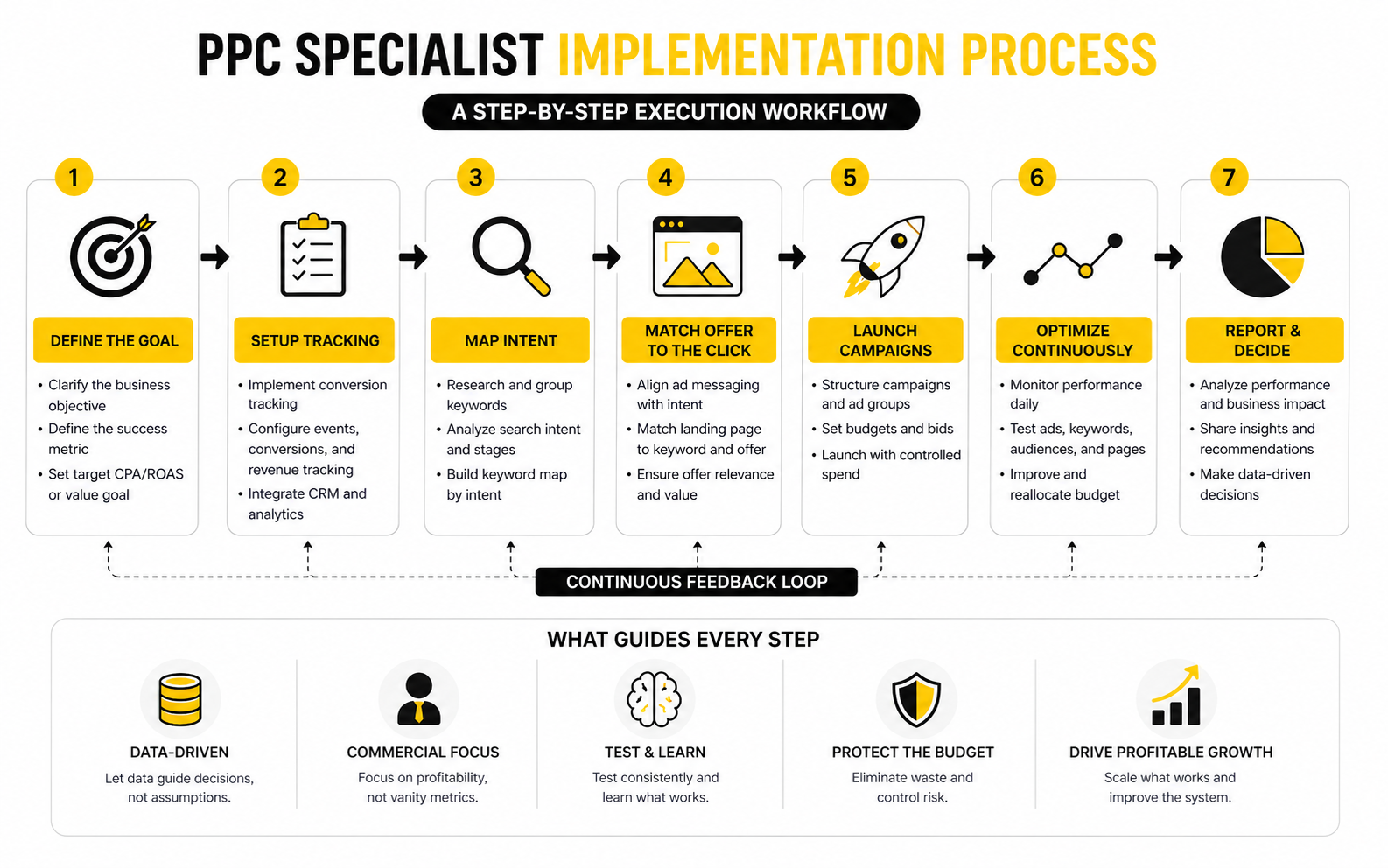
Step 3: Map Intent Before Building Campaigns
Keyword research is not just collecting search terms. It is sorting intent. A person searching “best CRM for agencies” is in a different mental state than someone searching “CRM pricing” or “book demo CRM.”
A PPC specialist should group intent before opening the ad platform. That usually means separating brand searches, competitor searches, high-intent commercial searches, problem-aware searches, local searches, and research-stage searches. Each group deserves its own budget logic, copy angle, and landing page expectation.
This step prevents one of the most common PPC mistakes: mixing too many intent levels into one campaign and then wondering why the data is muddy. When the structure is clean, performance problems become easier to diagnose. You can see whether the issue is demand quality, message fit, landing page friction, or bid strategy.
Step 4: Match The Offer To The Click
A click is not a result. It is only a rented moment of attention. The offer has to make that moment useful.
For ecommerce, the offer might be a product page, bundle, discount, comparison page, quiz, or category landing page. For service businesses, it might be a consultation, audit, estimate, demo, booking page, or lead magnet. The PPC specialist should choose the offer based on intent, not convenience.
Landing page builders such as Replo can help ecommerce teams create and test pages faster when speed matters. Funnel tools such as ClickFunnels or Systeme.io can make sense when the campaign depends on a dedicated opt-in, webinar, checkout, or simple sales flow. The important thing is not the logo on the tool; it is whether the page makes the next step obvious.
Step 5: Launch With Controlled Learning
A clean launch is not about perfection. It is about learning without creating chaos. The specialist should launch with enough structure to read the data, but not so many campaigns and ad groups that budget gets spread too thin.
This usually means starting with the highest-confidence intent first. The account can expand later into broader terms, experimental audiences, new geographies, or automated campaign types. Launching everything at once feels productive, but it often hides what is actually working.
The first phase should answer practical questions. Are the right people clicking? Are the search terms relevant? Are conversions firing correctly? Are leads moving through the pipeline? Once those answers are clear, scaling becomes a decision instead of a guess.
Step 6: Optimize Around Business Signals
Optimization should not mean changing things every day because the dashboard moved. A PPC specialist needs enough patience to let patterns form and enough discipline to act when the data is clear. The work is part analysis, part restraint.
Useful optimization usually includes search term reviews, negative keyword updates, budget shifts, ad copy tests, landing page improvements, bid strategy adjustments, and conversion quality checks. Microsoft Advertising notes that performance reporting can help advertisers track finances, measure performance, and adjust settings to optimize budget, which is exactly the mindset a specialist should bring to every platform. Data is not decoration; it is the steering wheel.
AI-powered campaign types make this even more important. Google’s AI Max for Search and Microsoft Advertising’s Performance Max both lean on automation to match users, assets, and goals across available inventory. The PPC specialist’s role is to guide the system with better inputs, cleaner measurement, and stronger judgment so automation serves the business instead of simply spending the budget.
Core Components Of PPC Measurement
A PPC specialist should never report numbers just because the platform displays them. Measurement has to answer a business question: are we attracting the right people, converting them efficiently, and creating enough revenue to justify the spend? If the answer is unclear, the reporting system is not doing its job.
The easiest mistake is treating PPC metrics as isolated facts. A low CPC can still be bad if the traffic does not convert. A high CPA can still be acceptable if customers are valuable, retained, or likely to buy again.
That is why measurement needs context. Benchmarks can help, but they should never replace account-specific economics. The real standard is not “are we average?” but “are we profitable, scalable, and learning faster than we are wasting money?”
Statistics And Data
The paid search market is large because search still captures commercial intent incredibly well. U.S. internet advertising revenue reached $294.6 billion in 2025, and search remains one of the biggest categories inside digital advertising. For a PPC specialist, that scale means two things: the channel is proven, and the competition is not casual.
Benchmarks show the pressure more clearly. Recent search advertising benchmark data from WordStream and LocaliQ shows that average costs and conversion rates vary heavily by industry, which is why a single “good CPC” or “good conversion rate” is usually a weak target. A legal campaign, an ecommerce campaign, and a local home services campaign can all be healthy with very different numbers.
The practical move is to use benchmarks as a diagnostic tool, not a scoreboard. If your click-through rate is far below the market, the problem may be positioning, keyword relevance, or ad strength. If your conversion rate is weak while traffic quality looks strong, the problem may be the landing page, offer, pricing, form, trust signals, or follow-up.
The Metrics That Actually Matter
A PPC specialist should understand the full chain from impression to revenue. Impressions show available reach, clicks show response, conversions show action, and revenue shows whether the action was worth buying. Looking at only one stage creates blind spots.
The most useful metrics usually include:
- Click-through rate: Shows whether the ad is relevant enough to earn attention.
- Cost per click: Shows how expensive traffic is in that auction.
- Conversion rate: Shows how well traffic turns into the desired action.
- Cost per conversion: Shows how expensive each lead, sale, booking, or signup is.
- Return on ad spend: Shows revenue compared with ad cost.
- Lead-to-sale rate: Shows whether the campaign is producing useful opportunities.
- Customer acquisition cost: Shows the real cost of gaining a customer.
- Lifetime value: Shows how much a customer may be worth beyond the first transaction.
These numbers should be read together. A campaign with a strong click-through rate and weak conversion rate may be attracting attention with the wrong promise. A campaign with a high CPC and strong close rate may deserve more budget, not less.
Why Benchmarks Can Mislead You
Benchmarks are useful, but they are averages across many accounts with different offers, markets, budgets, and tracking quality. That means they are best used to spot unusual patterns, not to judge success by themselves. A PPC specialist who blindly optimizes toward the average can easily damage a campaign that is already profitable.
For example, a software company selling a high-ticket annual contract may tolerate a much higher cost per lead than a low-margin ecommerce store. A local emergency service may pay expensive clicks because urgency creates strong conversion potential. A brand campaign may look cheap and efficient, but it may mostly capture people who already knew the company.
The smarter question is always: what does this number mean for this business model? If the economics support the metric, the campaign can be scaled. If the economics do not support it, the specialist needs to fix the offer, traffic quality, sales process, or measurement setup before adding more spend.
How A PPC Specialist Builds An Analytics System
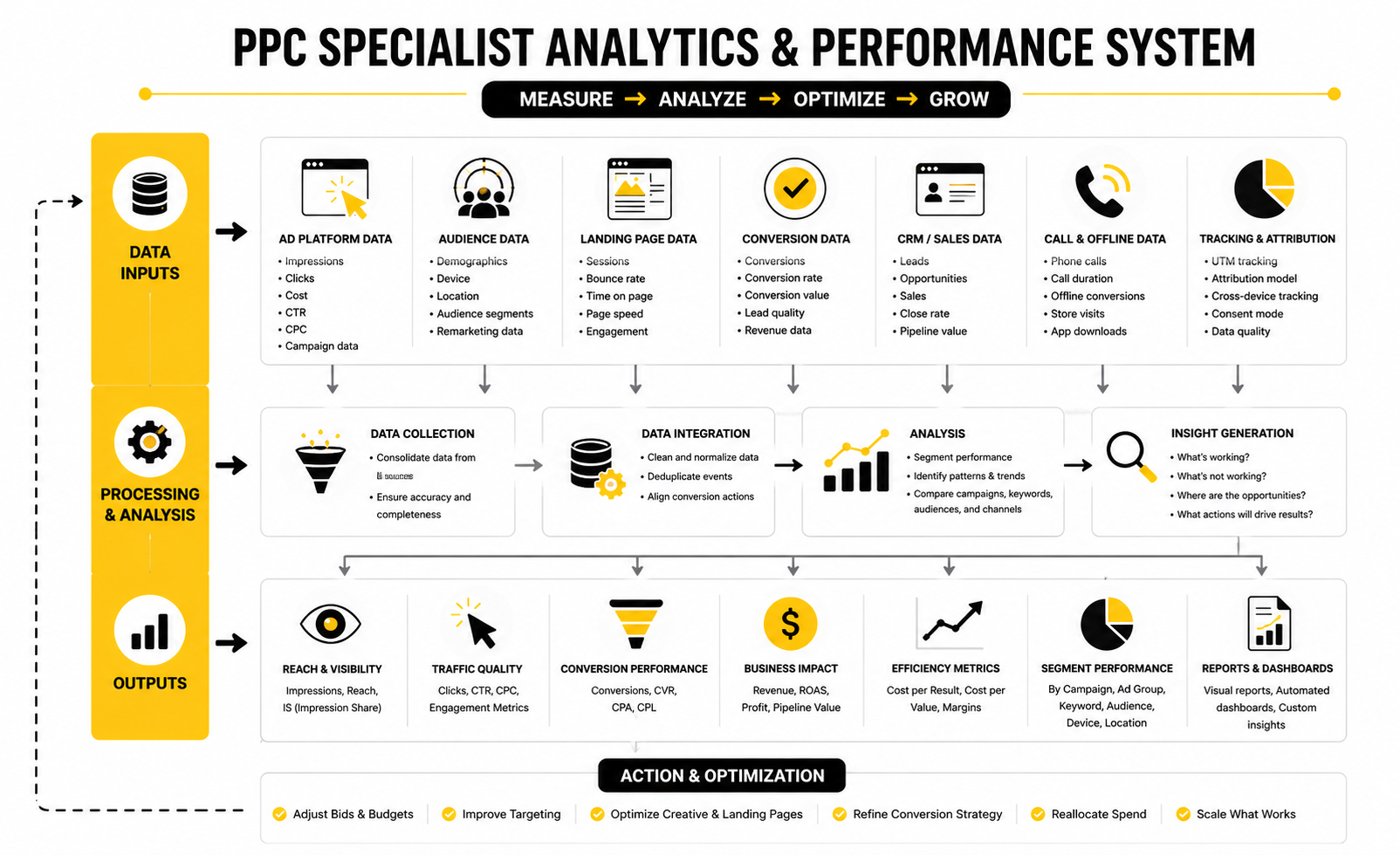
A reliable analytics system starts before the campaign goes live. The PPC specialist should define the primary conversion, secondary conversions, revenue events, CRM stages, and reporting cadence. This prevents the team from changing the definition of success after the data arrives.
The system should connect ad platform data with analytics and business data. Google Ads can use enhanced conversions to improve measurement accuracy by sending hashed first-party customer data, while data-driven attribution gives credit based on how users interact with ads before converting. Those features help, but they still need a clean strategy behind them.
For service businesses, this often means connecting form fills, calls, booked appointments, qualified leads, and closed deals. Tools like GoHighLevel can help when the campaign depends on fast lead follow-up and pipeline tracking. Without that connection, the PPC specialist may optimize for leads that never become customers.
What Performance Signals Should Trigger Action
Not every movement in the account deserves a reaction. PPC data fluctuates, and daily noise can trick people into making nervous decisions. A good PPC specialist knows when to wait, when to investigate, and when to act.
High spend with low conversion volume should trigger a search term, audience, and landing page review. Strong conversion volume with poor sales quality should trigger a lead quality audit, not just a bid adjustment. Rising CPCs should trigger a review of impression share, quality, competition, and keyword mix before assuming the campaign is broken.
The best actions come from patterns, not panic. If the same problem appears across multiple days, campaigns, or segments, it is probably real. If it appears once and disappears, it may just be auction noise.
Reporting Should Create Decisions
A PPC report is not a museum of metrics. It should make decisions easier. The reader should understand what changed, why it matters, what the specialist did, and what should happen next.
Useful reporting usually separates performance into three layers. The first layer is account health: spend, conversions, tracking status, and major anomalies. The second layer is growth: winners, losers, testing results, and budget opportunities. The third layer is business impact: lead quality, sales outcomes, revenue, and profitability.
This is where a PPC specialist becomes more valuable than a dashboard. Dashboards show numbers. Specialists explain what the numbers mean, what risks are hiding behind them, and where the next dollar should go.
Professional PPC Implementation
At a higher level, a PPC specialist is not just managing campaigns. They are managing tradeoffs. More scale can create more waste, more automation can reduce control, and more data can still lead to worse decisions if the wrong signal is being optimized.
This is where the role becomes strategic. The specialist has to decide when to tighten targeting and when to expand, when to trust automation and when to override it, when to keep testing and when to simplify. Those decisions are rarely obvious from one metric alone.
The Scale Problem
Scaling PPC is not the same as increasing the budget. A campaign can handle more spend only when the market, offer, tracking, and operations can absorb it. If any of those pieces is weak, scaling just exposes the weakness faster.
A PPC specialist should look for scale in layers. First, increase budget on proven segments. Then expand into adjacent keywords, new audiences, additional locations, stronger landing pages, or complementary campaign types. This keeps growth controlled instead of turning the account into a messy experiment.
The key is knowing the difference between a campaign that is capped and a campaign that is fragile. A capped campaign has more profitable demand available. A fragile campaign only looks good because spend is low, volume is limited, or tracking is too shallow to reveal the real problems.
The Automation Tradeoff
Automation can be powerful, but it is not a replacement for strategy. Google has continued expanding AI-powered search features, including AI Max for Search campaigns, Smart Bidding Exploration, and more reporting visibility across campaign inventory. That means a PPC specialist needs to become better at guiding systems, not just clicking settings.
The tradeoff is control. Automated campaigns can find opportunities a human might miss, but they can also blur the line between strong traffic and cheap volume. If the account is optimizing toward poor conversion signals, automation will often make that mistake faster.
The best approach is not anti-automation. It is controlled automation. Feed the system clean conversion data, use clear value rules where relevant, monitor search terms and placements where available, and avoid giving broad systems unlimited budget before the business can verify lead quality or revenue quality.
The Risk Of Optimizing Too Narrowly
A PPC specialist can hurt growth by over-optimizing for short-term efficiency. If every decision is based only on this week’s CPA, the account may stop testing new pockets of demand. That can make the dashboard look safer while the business slowly loses future growth.
There is a real balance here. The account needs enough discipline to stop obvious waste, but enough room to learn. New keywords, creative angles, landing pages, and campaign types need a fair test before being judged.
The practical solution is to separate budgets by purpose. Core campaigns should carry predictable performance. Test campaigns should answer specific questions. That way, experimentation does not pollute the main account, and the business does not confuse learning spend with wasted spend.
The Landing Page Constraint
Many PPC accounts do not have an ad problem. They have a page problem. The targeting is reasonable, the search intent is strong, and the offer is relevant, but the page makes the next step too hard.
A specialist should evaluate landing pages like a buyer, not like a marketer. Is the promise clear within a few seconds? Is the proof credible? Is the form appropriate for the level of trust? Is the page fast, focused, and aligned with the ad?
For ecommerce teams that need to test product-focused landing pages quickly, Replo can support faster iteration. For simple funnels, checkout flows, opt-ins, or webinar paths, ClickFunnels or Systeme.io can be useful when speed matters more than a custom build.
The Follow-Up Gap
Lead generation PPC often fails after the conversion. The campaign produces a form fill, the dashboard celebrates, and then the lead sits untouched for hours. That is not a media buying issue anymore, but it still affects campaign economics.
A PPC specialist should care about speed to lead, sales routing, appointment booking, email follow-up, SMS follow-up, and pipeline visibility. If the business cannot respond quickly, the campaign may look expensive even when the traffic is strong. The leak is downstream.
This is why lead management tools matter. GoHighLevel can make sense for agencies and service businesses that want CRM, automation, calendar booking, and follow-up workflows connected to paid campaigns. The goal is simple: make sure paid leads do not disappear between the ad click and the sales conversation.
The Skill Gap That Separates Average From Excellent
An average PPC specialist can build campaigns and report metrics. A strong PPC specialist can diagnose business problems through campaign data. That is a much higher-value skill.
They understand when a low conversion rate is caused by poor intent, weak messaging, a confusing offer, slow page speed, bad pricing, or a sales process issue. They can explain why a campaign should be scaled, paused, rebuilt, or left alone. They know when the account needs more data and when it needs a better decision.
This is the difference between platform management and performance leadership. The platform manager asks, “What changed in the account?” The performance leader asks, “What does this mean for revenue, risk, and the next move?”
Tools, Career Path, And Frequently Asked Questions
A PPC specialist becomes more effective when the working system around them is clear. The ad platform is only one part of that system. The full ecosystem includes research, creative testing, analytics, landing pages, CRM data, automation, reporting, and the commercial judgment to connect all of it.
This is why PPC is a strong career path for marketers who like both numbers and psychology. You need to understand how people search, what makes them click, why they hesitate, and which metrics prove that a campaign is actually helping the business. The role rewards curiosity, discipline, and the ability to stay calm when the data gets noisy.
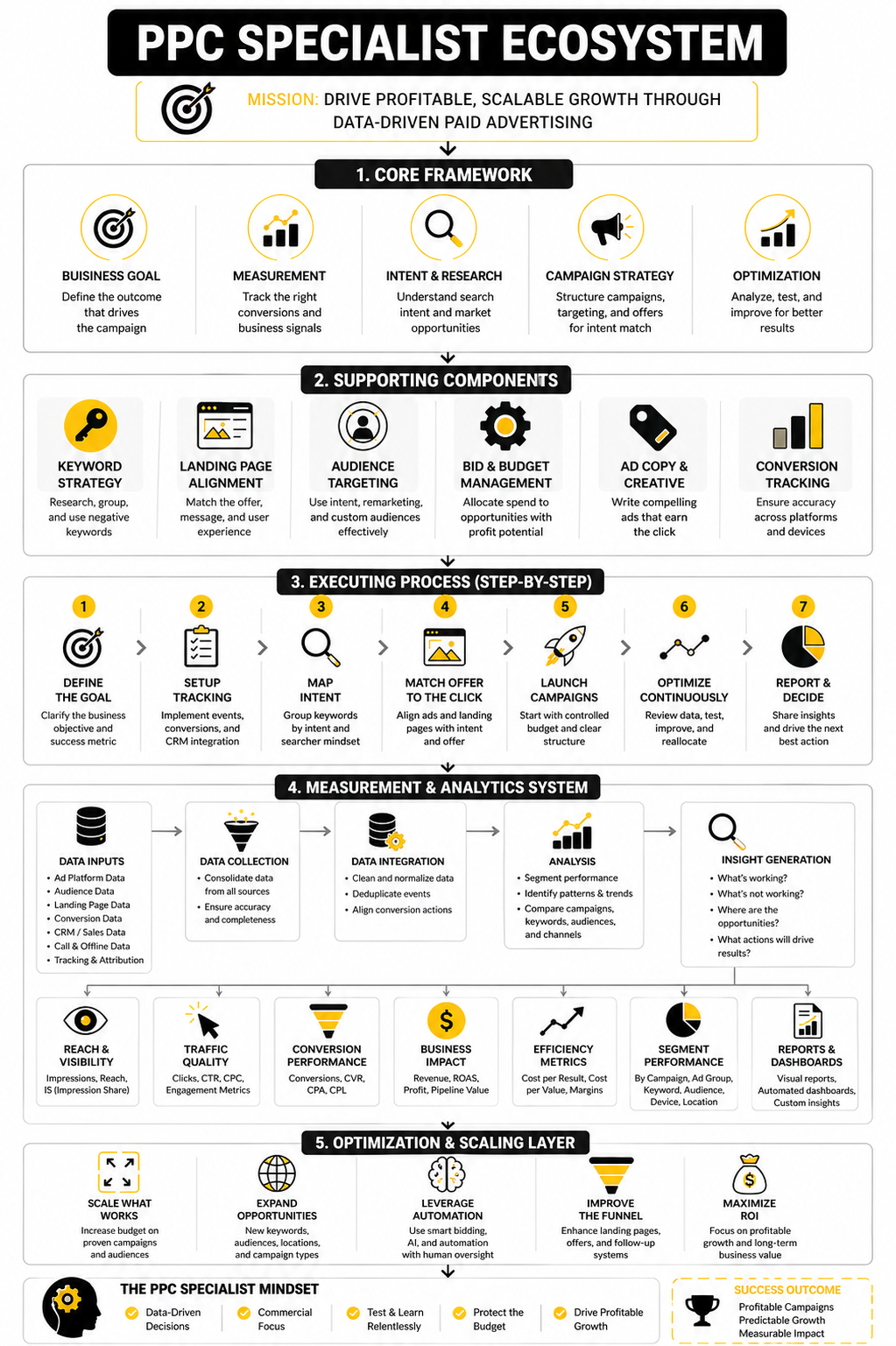
The best tools are the ones that shorten the distance between insight and action. Google Ads, Microsoft Advertising, analytics platforms, call tracking, CRM tools, landing page builders, and reporting dashboards all play a part. For client acquisition and remote marketing work, the bigger opportunity is learning how to package PPC skills into clear outcomes that companies already understand: more qualified leads, better acquisition costs, cleaner tracking, and more predictable growth.
FAQ - Built For Complete Guide
What does a PPC specialist do?
A PPC specialist manages paid advertising campaigns that charge advertisers when someone clicks, views, or takes a defined action depending on the platform. The role usually includes keyword research, campaign setup, ad copy, bidding, tracking, landing page coordination, reporting, and ongoing optimization. A good specialist does not just chase clicks; they connect paid media activity to business outcomes.
Is PPC still worth learning with AI changing ad platforms?
Yes, PPC is still worth learning because AI has not removed the need for strategy, measurement, and commercial judgment. Google’s AI Max for Search campaigns is designed to expand matching, tailor creative, and optimize landing page selection, but those features still need clean conversion data and strong business inputs. The PPC specialist who understands both automation and strategy becomes more valuable, not less.
What skills does a PPC specialist need?
A PPC specialist needs analytical thinking, copywriting ability, keyword research, platform knowledge, tracking setup, budget management, and reporting skills. They also need business judgment because a campaign can look good in the platform while producing weak customers. The strongest specialists understand the full path from search intent to revenue.
How long does it take to become a PPC specialist?
Most people can learn the basics in a few months, but becoming genuinely useful usually takes longer because PPC is learned through real campaign decisions. Certifications help, but they do not replace hands-on work with budgets, tracking issues, testing, and performance pressure. A realistic path is to learn the platforms, build practice campaigns, study reporting, and then manage small accounts before handling larger budgets.
Does a PPC specialist need Google Ads certification?
Google Ads certification can help prove platform familiarity, especially for beginners or freelancers trying to build trust. It is not enough by itself because clients and employers care about results, judgment, and communication. Treat certification as a credibility layer, not the whole skill set.
What is the difference between a PPC specialist and a paid media buyer?
A PPC specialist often focuses heavily on search, shopping, display, remarketing, and performance campaigns where clicks and conversions are tightly measured. A paid media buyer may work across broader channels, including paid social, programmatic, creator ads, and full-funnel media planning. In many companies, the roles overlap, but PPC usually puts more weight on intent, keywords, conversion tracking, and auction-based optimization.
What metrics should a PPC specialist report?
A PPC specialist should report spend, clicks, conversions, cost per conversion, conversion rate, return on ad spend, customer acquisition cost, and lead quality where available. The exact metrics depend on the business model. The report should explain what changed, why it matters, and what action should happen next.
What makes a PPC campaign successful?
A successful PPC campaign produces the right outcome at a cost the business can afford. That outcome might be sales, qualified leads, booked calls, trials, demos, appointments, or profitable repeat customers. Success should be judged against margins, close rates, capacity, and lifetime value, not just platform averages.
How much budget should a business give a PPC specialist?
The right budget depends on the industry, cost per click, conversion rate, sales value, and learning timeline. A tiny budget in a competitive market may not generate enough data to make confident decisions. A practical PPC specialist will usually recommend a test budget that is large enough to produce meaningful conversion data without putting the business at unnecessary risk.
Can a PPC specialist improve results without increasing ad spend?
Yes, and this is often where the best work happens. Better keyword structure, stronger negatives, improved ad copy, cleaner tracking, sharper landing pages, faster follow-up, and smarter budget allocation can all improve performance without adding spend. More budget only helps when the system is already capable of turning traffic into valuable outcomes.
Should a PPC specialist manage landing pages too?
A PPC specialist does not always need to build landing pages, but they should understand them deeply. Ads and landing pages work as one system, so poor page speed, weak proof, confusing forms, or mismatched messaging can ruin otherwise strong campaigns. Whether the specialist builds the page or works with another team, they should influence the page strategy.
What tools should a PPC specialist use?
A PPC specialist will usually work with Google Ads, Microsoft Advertising, Google Analytics, Google Tag Manager, spreadsheets, reporting dashboards, and a CRM or lead tracking system. Depending on the business, tools like GoHighLevel, Replo, ClickFunnels, or Systeme.io can support the funnel after the click. The tool stack should serve the campaign strategy, not distract from it.
How do you hire a good PPC specialist?
Look for someone who asks about margins, conversion quality, sales process, tracking, and business goals before promising results. A weak specialist talks mostly about clicks and platform settings. A strong specialist explains how they will diagnose the account, protect the budget, test opportunities, and report decisions clearly.
Can PPC work for small businesses?
Yes, but small businesses need discipline because budget mistakes hurt faster. PPC can work well when the offer is clear, the local or niche intent is strong, and the follow-up process is reliable. Small businesses should avoid copying big-brand strategies and instead focus on the most commercially valuable searches first.
What is the biggest mistake PPC beginners make?
The biggest beginner mistake is launching campaigns before tracking, offers, and campaign structure are ready. This creates messy data and makes optimization harder than it needs to be. A PPC specialist should slow down at the beginning so the account can move faster later.
Work With Professionals
Explore 10K+ Remote Marketing Contracts On MarkeWork.com
Most marketers spend too much time chasing clients, competing on crowded platforms, and losing a percentage of every project to middlemen.
MarkeWork gives you a better way. Browse thousands of remote marketing contracts and connect directly with companies desperate to hire skilled marketers like you, without platform commissions and without unnecessary gatekeepers.
If you’re serious about finding better opportunities and keeping 100% of what you earn, explore available contracts and create a profile for free at MarkeWork.com.