

Pragmatic marketing is the discipline of building, positioning, launching, and improving products from the market backward. Instead of starting with internal opinions, feature requests, or executive hunches, it starts with real market problems, buyer urgency, competitive pressure, and evidence from customers.
That sounds obvious, but most teams drift away from it. Product hears one thing, sales hears another, marketing packages something else, and leadership asks for a roadmap that somehow makes everyone happy. Pragmatic marketing gives the team a shared operating system so product decisions, messaging, launch plans, and growth work are connected instead of scattered.

This article will continue in six parts:
- What Pragmatic Marketing Really Means
- Why Pragmatic Marketing Matters
- The Pragmatic Marketing Framework Overview
- Core Components Of Pragmatic Marketing
- How To Implement Pragmatic Marketing Professionally
- Common Mistakes, Tools, And FAQ
What Pragmatic Marketing Really Means
Pragmatic marketing is not just “being practical with marketing.” It is a market-driven product management and product marketing approach that helps teams decide what to build, who it is for, why buyers should care, and how the product should go to market. The core idea is simple: markets reward products that solve meaningful problems better than available alternatives.
The term is strongly associated with Pragmatic Institute, whose product framework focuses on understanding market problems, prioritizing opportunities, aligning teams, and bringing products to market with clearer strategy. Their product training describes the goal as learning how to understand the market and build and sell products people want to buy through a structured framework. That makes pragmatic marketing especially useful for B2B, SaaS, technology, and product-led companies where the cost of building the wrong thing is high.
At its best, pragmatic marketing turns scattered customer feedback into disciplined decisions. It helps teams move from “a loud customer asked for this” to “this problem is common, urgent, valuable, and strategically aligned.” That shift matters because product work is not just about shipping; it is about choosing what deserves to be shipped.
Why Pragmatic Marketing Matters
Pragmatic marketing matters because most product failures are not caused by weak execution alone. They often begin earlier, when teams misunderstand the market, overestimate demand, copy competitors without context, or confuse internal enthusiasm with customer urgency. CB Insights has repeatedly found “no market need” among the top reasons startups fail, which reinforces the same hard lesson: building is expensive, but building the wrong thing is brutal.
The framework also matters because product, marketing, sales, and customer success rarely suffer from a lack of effort. They suffer from misalignment. One team optimizes for roadmap velocity, another for pipeline, another for renewals, and another for customer requests. Pragmatic marketing creates shared language around market problems, buyer personas, positioning, launch readiness, and business outcomes.
This is where the approach becomes practical rather than theoretical. A team using pragmatic marketing can make sharper tradeoffs because the discussion is anchored in evidence. Instead of debating opinions endlessly, the team can ask better questions: Who has this problem? How painful is it? What are they doing now? What would they pay to solve it? Why should we win?
The Pragmatic Marketing Framework Overview
The pragmatic marketing framework is best understood as a complete product-to-market system. It connects strategy, planning, execution, launch, enablement, and measurement. That is why it appeals to product managers and product marketers who need more than a campaign checklist or a roadmap template.
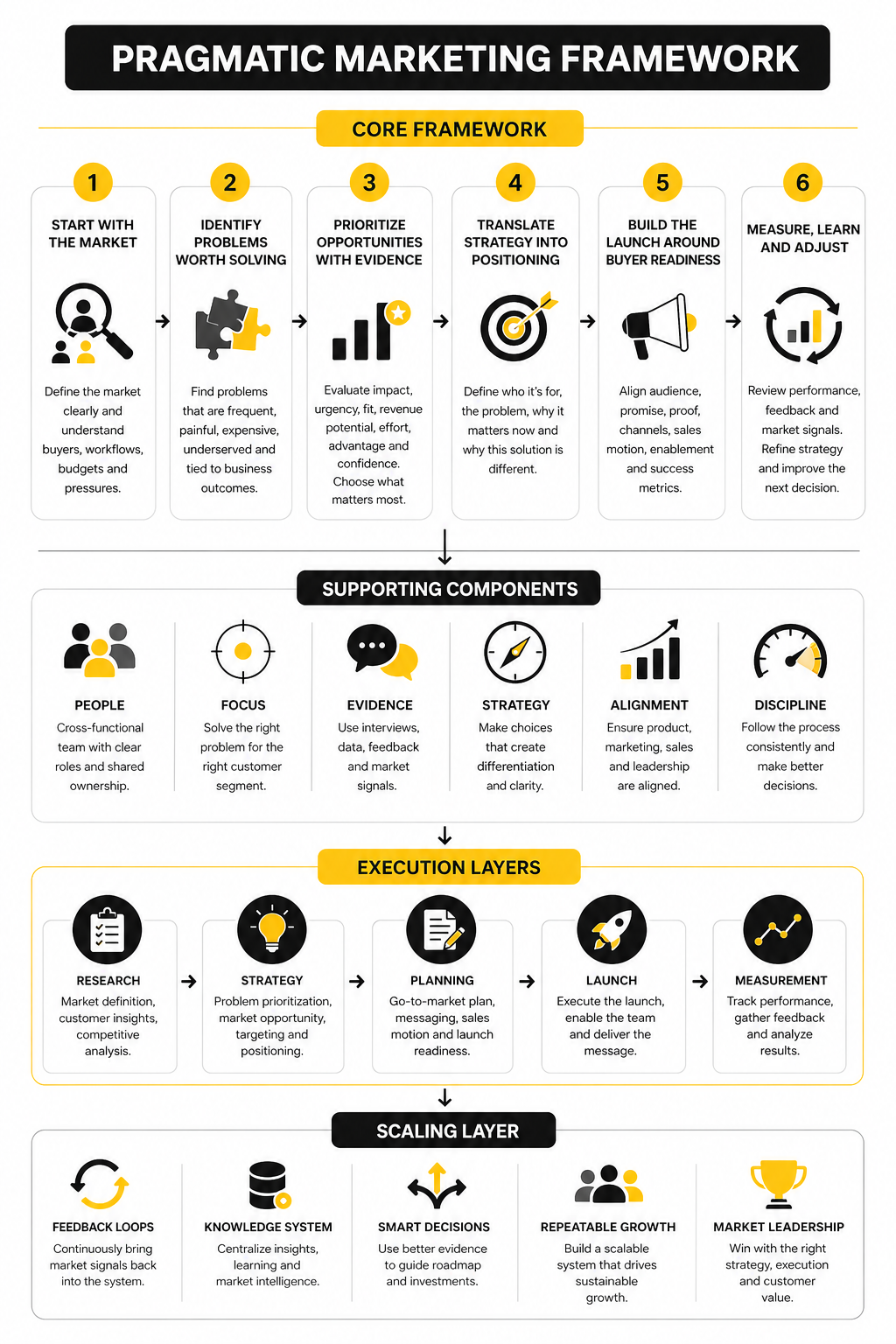
The framework usually starts with market discovery. Teams investigate buyers, users, competitors, market segments, and unsolved problems before making major product bets. This keeps decisions grounded in external reality instead of internal pressure.
From there, the work moves into strategy and execution. Product teams prioritize opportunities, define requirements, shape roadmaps, and work with engineering or delivery teams. Product marketing then translates the same market understanding into positioning, messaging, launch plans, sales enablement, and adoption support.
Core Components Of Pragmatic Marketing
The first core component is market evidence. Pragmatic marketing depends on customer interviews, win-loss analysis, competitive research, usage data, sales conversations, support patterns, and market signals. None of these inputs is perfect alone, but together they create a clearer picture of what the market actually values.
The second component is problem-first prioritization. A pragmatic team does not treat every feature request as equal. It looks for patterns, urgency, willingness to pay, strategic fit, and the size of the opportunity before deciding what deserves attention.
The third component is cross-functional alignment. Pragmatic marketing works only when product, marketing, sales, success, and leadership share the same understanding of the customer and the market. Without that alignment, even a good product can be launched with weak messaging, poor enablement, and confused positioning.
Why Pragmatic Marketing Matters
Pragmatic marketing matters because product teams do not fail only when they build poorly. They fail when they build confidently for a market they do not understand well enough. That is a painful difference, because the team can still look productive while moving in the wrong direction.
The risk is not theoretical. Market need and product-market fit continue to show up as major failure points in startup research, including CB Insights’ recent breakdown of why startups fail. The lesson is blunt: a polished product, a clever campaign, and a busy sales team cannot rescue a weak understanding of the market.
This is where pragmatic marketing earns its place. It forces the team to slow down before expensive decisions and ask whether the problem is real, whether the buyer cares enough, and whether the business can win the opportunity. That discipline is not bureaucracy. It is protection against wasted roadmap cycles, vague messaging, and launches that create noise but not demand.
It Keeps Teams Focused On Market Problems
The strongest pragmatic marketing teams do not begin with features. They begin with market problems. A market problem is not just something one customer mentioned in a call; it is a recurring pain, goal, risk, or constraint that a defined group of buyers recognizes and wants solved.
That distinction matters because internal teams naturally collect biased signals. Sales may push for whatever closes the next deal, customer success may amplify the loudest accounts, and leadership may chase a competitor’s latest announcement. Those inputs can be useful, but they are not strategy by themselves.
A pragmatic approach turns those inputs into evidence. Teams look for patterns across interviews, win-loss notes, support tickets, product usage, churn reasons, and competitive research. Once a problem appears repeatedly across the market, it becomes much easier to decide whether it belongs on the roadmap, in the positioning, or outside the company’s focus.
It Reduces Waste Across Product And Marketing
When product strategy is unclear, marketing usually pays the price later. The team is asked to create messaging for a feature that does not map cleanly to buyer pain, a campaign for a launch with no sharp audience, or sales enablement for a product nobody has clearly positioned. That is how good marketers end up decorating weak strategy.
Pragmatic marketing reduces that waste by connecting product decisions to go-to-market work earlier. If the team understands the buyer, the problem, the alternatives, and the business case before development moves too far, launch planning becomes more precise. Messaging sounds less generic because it is built from real market language rather than internal labels.
This also helps teams avoid overbuilding. A company does not need every possible feature to win a segment. It needs the right solution for a problem that matters, explained in a way the buyer instantly understands.
It Gives Sales A Clearer Story
Sales teams can only sell clearly when the company has done the strategic work behind the scenes. If positioning is fuzzy, sales conversations become inconsistent. One rep sells speed, another sells cost savings, another sells flexibility, and the buyer hears a company that is not fully sure why it matters.
Pragmatic marketing helps fix that by giving sales a sharper narrative. The team can define the target buyer, the trigger event, the pain points, the current alternatives, the value proof, and the reasons the product wins. That makes enablement practical instead of performative.
This is especially important in crowded categories. Buyers are not waiting around for another tool with similar features. They need a clear reason to change, and pragmatic marketing helps teams explain that reason without drowning the buyer in product detail.
It Improves Launch Quality
A launch should not be the first time the company tests whether its story makes sense. By then, the roadmap is already built, the deadline is public, and the pressure is high. Pragmatic marketing pushes validation earlier so launch becomes the result of market understanding, not a scramble to create excitement at the end.
Better launches usually have a few things in common. The target audience is specific, the problem is easy to understand, the proof is credible, and the internal teams know exactly what success means. Without those pieces, launch activity can look impressive while producing weak adoption.
Pragmatic marketing also makes post-launch learning more useful. Instead of asking only whether the campaign performed, the team can ask whether the market problem was framed correctly, whether the buyer segment responded, whether sales conversations improved, and whether product usage confirmed the original assumptions. That feedback loop is where the framework becomes a long-term advantage.
The Pragmatic Marketing Framework Overview
A pragmatic marketing framework works because it gives messy product work a clear operating rhythm. It does not replace judgment, creativity, or leadership, but it does stop teams from treating every idea as equally important. The point is to move from opinion-driven decisions to market-informed decisions that can actually survive contact with buyers.
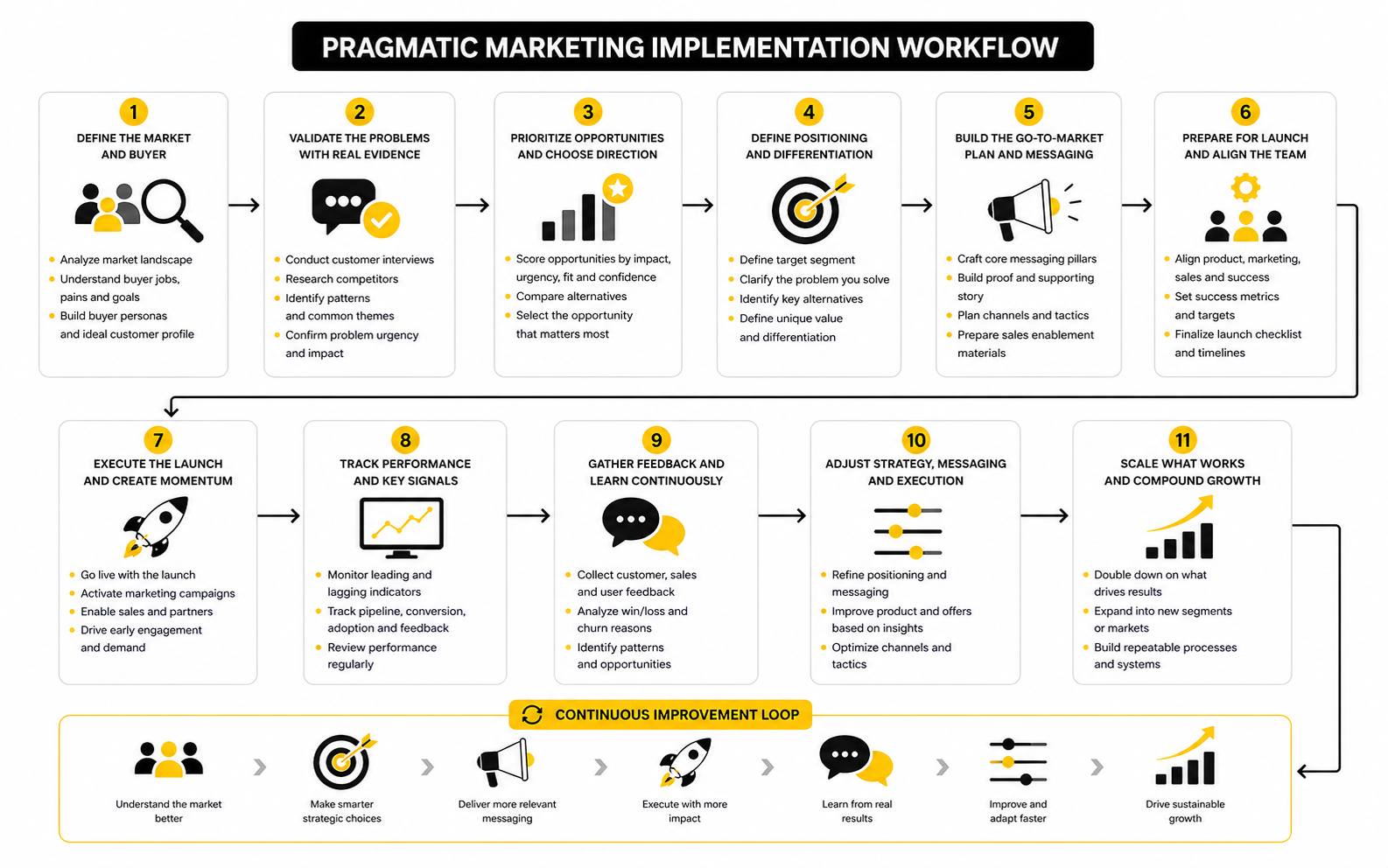
The framework is easiest to understand as a sequence. First, the team learns the market. Then it defines the opportunity, chooses the audience, shapes the product direction, builds the message, prepares the launch, and measures what happens after the launch. That sequence sounds simple, but the discipline comes from doing it consistently instead of only when something goes wrong.
Pragmatic marketing also helps teams decide what not to do. That is underrated. A strong framework should make weak opportunities easier to reject, not just good opportunities easier to pursue.
Step 1: Start With The Market, Not The Product
The first step is to define the market clearly enough that the team can research it without guessing. That means identifying the types of companies, buyers, users, workflows, budgets, and pressures involved. If the market definition is vague, everything that follows will be vague too.
This is where many teams rush. They say “small businesses,” “creators,” “agencies,” or “enterprise teams” as if those labels are specific enough. They are not. A pragmatic marketing process pushes the team to define the segment tightly enough that customer interviews, competitive analysis, and positioning work have real boundaries.
The goal is not to make the market artificially narrow forever. The goal is to focus the current decision. You can expand later, but you cannot make sharp product and messaging choices when the target is still blurry.
Step 2: Identify The Problems Worth Solving
Once the market is defined, the team needs to identify the problems that matter most. Not every pain point deserves a product investment. Some problems are annoying but not urgent, some are urgent but not valuable, and some are valuable but already solved well enough by existing alternatives.
A pragmatic marketing team looks for problems that are frequent, painful, expensive, underserved, and connected to a business outcome. That last part matters. If the buyer cannot connect the problem to revenue, cost, risk, speed, compliance, retention, or strategic advantage, the product will be harder to sell.
The best signal is not one dramatic customer quote. It is a repeated pattern across multiple sources. Interviews, churn notes, sales objections, support tickets, search behavior, product analytics, and competitive gaps all help the team decide whether the problem is real enough to act on.
Step 3: Prioritize Opportunities With Evidence
After the team has a list of market problems, prioritization becomes the next pressure point. This is where pragmatic marketing needs to be firm. A roadmap should not be a popularity contest between sales, leadership, product, and the loudest customers.
A useful prioritization process weighs market impact, customer urgency, strategic fit, revenue potential, delivery effort, competitive advantage, and confidence in the evidence. The exact scoring model can vary, but the principle should not. Decisions need to be explainable.
This also creates healthier internal conversations. Instead of arguing about who has the strongest opinion, the team can discuss which assumptions are proven, which are still risky, and what research would increase confidence. That makes prioritization less political and more useful.
Step 4: Translate Strategy Into Positioning
Positioning is where the market strategy becomes visible. It explains who the product is for, what problem it solves, why it matters now, and why this solution is different from the alternatives. Without positioning, marketing becomes a collection of claims instead of a coherent argument.
Pragmatic marketing treats positioning as internal strategy first. The website headline, sales deck, ads, email campaigns, and demo flow should all come later. Before those assets exist, the team needs a shared positioning document that sales, product, marketing, and leadership can actually use.
Good positioning is specific without being complicated. It should make the buyer feel understood, not overwhelmed. If the message only sounds impressive inside the company, it is not ready for the market.
Step 5: Build The Launch Around Buyer Readiness
A launch is not just a date on the calendar. It is the moment when the company asks the market to pay attention, understand the value, and take action. That only works when the buyer, the product, the message, and the internal team are ready at the same time.
The practical launch plan should define the audience, promise, proof, channels, sales motion, enablement assets, customer communication, success metrics, and feedback loop. This is where pragmatic marketing becomes very operational. Everyone should know what is launching, who it is for, how it will be explained, and what outcome matters.
The mistake is treating launch as a marketing event after product work is finished. In a pragmatic process, launch planning starts earlier because the launch story should come from the same market evidence that shaped the product. That is how the team avoids last-minute messaging that feels bolted on.
Step 6: Measure, Learn, And Adjust
The process does not end when the product ships or the campaign goes live. Pragmatic marketing depends on feedback after launch because the market always teaches you something. Sometimes the message works but the feature needs improvement, sometimes the product works but the sales story is weak, and sometimes the original segment was too broad.
The team should review adoption, activation, conversion, sales feedback, win-loss themes, support issues, churn signals, and customer language. The point is not to drown in dashboards. The point is to understand whether the original market assumptions held up.
This is where the framework becomes a habit rather than a project. Each launch creates better evidence for the next decision. Over time, the company gets sharper because it keeps learning from the market instead of treating every launch as a one-off performance.
Statistics And Data
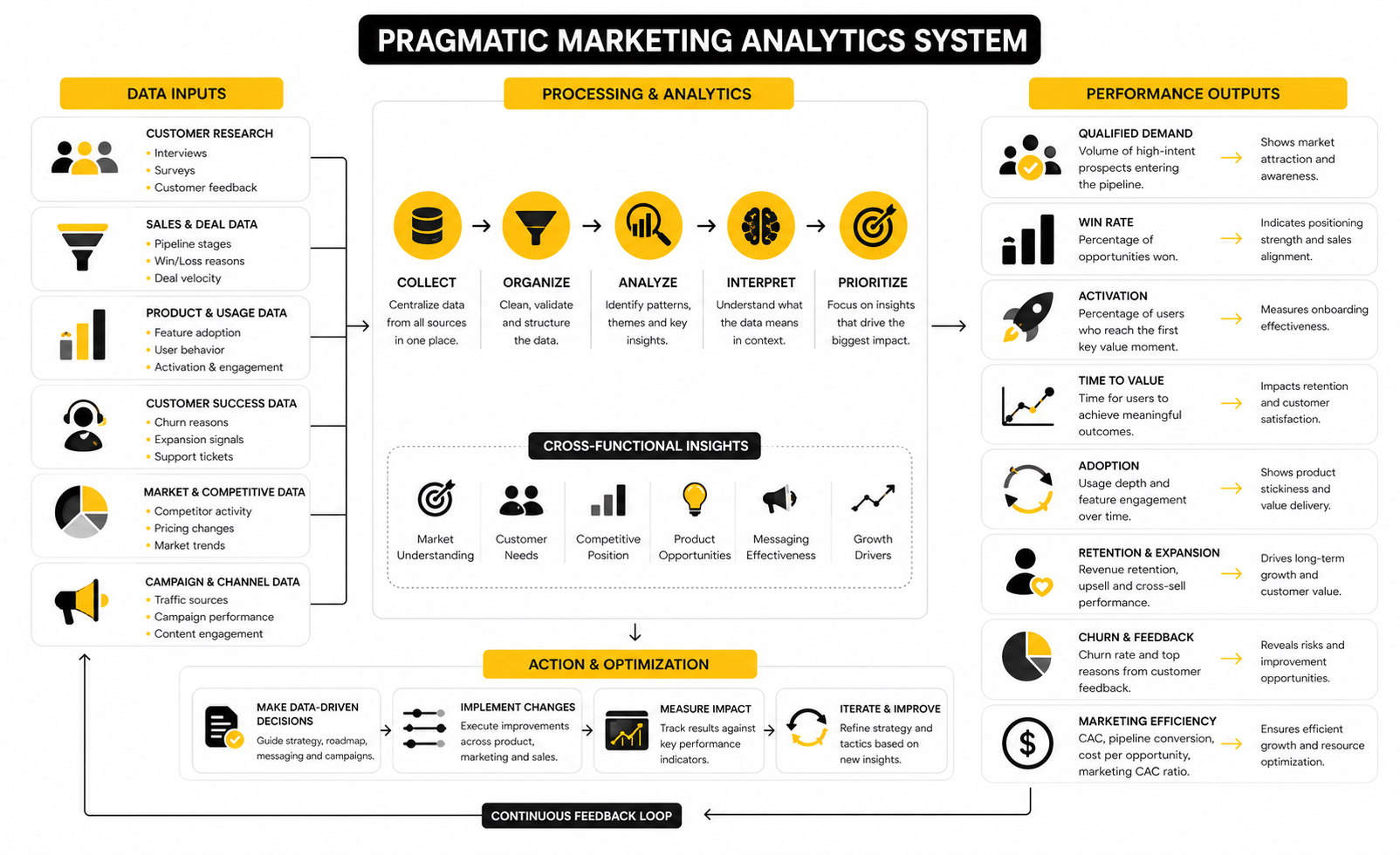
Data matters in pragmatic marketing because it keeps the team honest. It shows whether the market problem is urgent, whether the positioning is landing, whether the launch created real demand, and whether customers are actually adopting the product after the first burst of attention. The mistake is treating data like decoration instead of decision support.
Good measurement is not about collecting every possible metric. It is about choosing the signals that tell you whether the strategy is working. A pragmatic marketing team should be able to look at the numbers and know what to keep, what to fix, and what to stop doing.
The key is interpretation. A high click-through rate might mean the message is interesting, but it does not prove the product solves a valuable problem. A strong demo request rate might look promising, but if sales cycles stall because buyers do not see urgency, the issue is probably positioning or qualification rather than traffic.
Measure The Market Before You Measure The Campaign
Before looking at campaign performance, measure whether the market opportunity is strong enough. This includes search demand, category growth, buyer urgency, competitive intensity, sales objections, customer interviews, and willingness to pay. Pragmatic marketing starts here because campaign metrics are only useful when the underlying market assumption is sound.
The best early signals are usually qualitative and quantitative together. Interview patterns show what buyers say, while behavioral data shows what they actually do. If both point to the same pain, the team can move forward with more confidence.
This matters because weak market understanding creates misleading performance data. A campaign can underperform because the creative is poor, but it can also underperform because the market does not care. Those are very different problems, and they require very different fixes.
Track Product-Market Signals, Not Just Marketing Activity
Product-market signals show whether people are moving closer to value. For a SaaS company, that might include activation rate, feature adoption, product-qualified leads, expansion revenue, retention, net revenue retention, and churn reasons. For a service or agency offer, it might include qualified call rate, close rate, onboarding completion, time to first result, renewal rate, and referral intent.
Benchmarks can help, but they should not become the strategy. The 2025 SaaS Benchmarks Report tracks metrics such as growth rate, gross revenue retention, net revenue retention, and software gross margin because those numbers reveal whether growth is healthy or fragile. For pragmatic marketing, the point is not to copy another company’s numbers blindly; it is to understand what strong performance should look like at your stage.
A practical team looks for movement across the whole journey. If awareness is growing but activation is weak, the promise may be bigger than the product experience. If activation is strong but retention is poor, the product may create initial excitement without becoming essential.
Use Benchmarks As Context, Not Excuses
Benchmarks are useful when they help you ask sharper questions. They are dangerous when they become a shield for average performance. A team should never say, “That conversion rate is normal,” and stop there.
The better question is what the benchmark reveals about your own system. If your demo conversion rate is below category norms, is the offer unclear, the audience too broad, the page too vague, or the follow-up too slow? If retention is below comparable companies, is the issue onboarding, product fit, pricing, customer success, or expectations set during the sale?
This is why pragmatic marketing teams compare numbers by segment. A blended average can hide the truth. One audience may convert beautifully and retain poorly, while another may convert slowly but become highly profitable over time.
Connect Metrics To Decisions
Every important metric should connect to an action. If a number changes and nobody knows what decision it affects, it is probably not a core metric. Pragmatic marketing is practical by design, so measurement has to drive behavior.
For example, win-loss data should influence positioning, objection handling, competitive messaging, and roadmap priorities. Activation data should influence onboarding, product education, and feature emphasis. Churn data should influence customer fit, sales qualification, promise accuracy, and product improvements.
This is where many teams get stuck. They report performance, but they do not change anything. A weekly dashboard is not useful because it exists; it is useful only when it makes the next decision clearer.
Watch For Leading And Lagging Indicators
Lagging indicators tell you what already happened. Revenue, retention, churn, and expansion are important, but they often arrive after the team has already made several decisions. Leading indicators help you spot whether the strategy is working earlier.
For pragmatic marketing, leading indicators can include customer interview consistency, message testing results, sales conversation quality, demo-to-opportunity rate, onboarding completion, first key action, product usage frequency, and repeat engagement. These signals are not perfect, but they help the team adjust before the damage becomes expensive.
Lagging indicators still matter because they prove whether the business outcome arrived. The trick is using both. Leading indicators guide fast learning, while lagging indicators confirm whether the market actually rewarded the strategy.
Build A Simple Pragmatic Marketing Dashboard
A useful dashboard should follow the customer journey rather than the company org chart. That means it should connect market insight, demand creation, sales quality, product adoption, retention, and expansion. When those numbers sit together, the team can see the system instead of arguing from isolated reports.
A simple version can track:
- Market signal: repeated customer pain, search demand, competitive movement, category urgency
- Message signal: landing page conversion, sales call resonance, objection patterns, content engagement
- Demand signal: qualified leads, demo requests, pipeline source, conversion by segment
- Product signal: activation, feature adoption, time to value, usage frequency
- Business signal: win rate, retention, expansion, churn reasons, customer lifetime value
The dashboard does not need to be complicated. It needs to be trusted. If the team debates the accuracy of the numbers every week, fix the measurement system before making strategic decisions from it.
Turn Data Into Better Strategy
The real value of measurement is not reporting. It is learning. Pragmatic marketing uses data to refine the market definition, sharpen the positioning, improve the product, and make future launches stronger.
This is why product and marketing data should not live in separate worlds. Campaign data shows what attracts attention, sales data shows what creates belief, product data shows what creates value, and retention data shows what customers still care about after the purchase. Put together, those signals reveal whether the market strategy is working.
The best teams do not wait for perfect data. They look for enough evidence to make a better decision than yesterday. That is the practical standard, and it is exactly why pragmatic marketing works.
How To Implement Pragmatic Marketing Professionally
Professional implementation is where pragmatic marketing gets harder. The framework sounds clean when it is written on a page, but real companies have pressure, deadlines, politics, budget limits, legacy products, noisy customers, and competitors that will not wait politely while the team gets aligned. That is why the advanced version of pragmatic marketing is not about knowing the framework; it is about making the right tradeoffs when the answer is uncomfortable.
The most important shift is treating pragmatic marketing as an operating discipline, not a workshop exercise. A team can run customer interviews once, build a positioning doc once, and create a launch checklist once, but that does not make the company market-driven. The discipline only starts working when it becomes part of roadmap reviews, campaign planning, sales enablement, customer success feedback, and leadership decision-making.
This also means the process needs ownership. If everyone is responsible for market evidence, nobody is responsible enough. Product, product marketing, sales, customer success, and leadership should all contribute signals, but the company needs clear rules for how those signals become decisions.
Balance Customer Requests With Market Strategy
The first serious tradeoff is between individual customer requests and broader market strategy. Big customers often have strong opinions, and it is tempting to treat their requests as market truth. Sometimes they are pointing at a real opportunity, but sometimes they are asking the company to become a custom development shop.
Pragmatic marketing does not ignore customers. It puts their requests into context. A request becomes strategically meaningful only when it connects to a repeatable market problem, a segment the company wants to win, and a business outcome that justifies the investment.
This is where teams need backbone. Saying yes to every major account can feel safe in the short term, especially when revenue is on the line. But if those decisions pull the product away from the core market, the company slowly loses clarity, and clarity is one of the hardest things to get back.
Avoid The Trap Of Over-Segmentation
Segmentation is essential, but too much segmentation can paralyze the team. If every persona, use case, company size, region, and industry gets its own strategy, the organization ends up with dozens of tiny plans and no real focus. That looks sophisticated, but it usually creates confusion.
A pragmatic marketing approach should segment only when the differences change the decision. If two buyer groups care about the same problem, respond to the same proof, and move through a similar buying process, they may not need separate positioning yet. If their pain, urgency, budget, objections, or success criteria are meaningfully different, then segmentation becomes useful.
The goal is not to map every possible audience. The goal is to choose the segments where the company can win with the clearest advantage. Focus beats completeness.
Make Positioning Strong Enough To Say No
Weak positioning tries to include everyone. Strong positioning makes a choice. It tells the market who the product is really for, what problem it solves best, and why that matters more than the alternatives.
This is uncomfortable because every positioning choice excludes someone. But that is the point. If the message is broad enough for every possible buyer, it is usually too vague to move the buyer who matters most.
Pragmatic marketing makes positioning more strategic by tying it to market evidence. When the team knows which buyers feel the pain most strongly, which alternatives they compare, and which outcomes they value, the message can be sharper. That sharper message may feel narrower internally, but it usually feels more relevant externally.
Scale The Process Without Slowing The Company Down
As companies grow, pragmatic marketing can become either more valuable or more bureaucratic. More teams create more handoffs, more launches, more data, and more opinions. Without a clear process, market understanding gets fragmented across departments.
The answer is not to create endless documentation. The answer is to create lightweight artifacts that people actually use. A strong market requirements summary, positioning brief, launch plan, win-loss review, and product adoption review can do more than a massive folder nobody opens.
This matters even more in B2B SaaS, where efficiency is under pressure. Recent benchmark work shows that marketing teams still often prioritize pipeline and opportunity creation while fewer teams treat efficiency metrics like cost per opportunity, marketing CAC ratio, and pipeline conversion as top measures in their operating rhythm, even though efficient growth is now a major leadership concern. That gap is exactly where pragmatic marketing can help: it connects the market story to business performance instead of treating marketing as activity volume.
Build Feedback Loops That Survive Growth
A small company often has natural feedback loops because everyone hears the customer directly. The founder joins sales calls, the product lead reads support tickets, and marketing can feel what the market is saying. As the company scales, that closeness fades unless it is designed into the system.
A mature pragmatic marketing system keeps feedback moving in both directions. Sales and customer success bring market signals back into product and marketing. Product and marketing turn those signals into positioning, roadmap decisions, launch plans, and enablement. Leadership uses the same evidence to make tradeoffs instead of relying on isolated anecdotes.
The feedback loop should include:
- Win-loss themes that explain why deals are won or lost
- Churn and expansion patterns that reveal whether the product is becoming essential
- Sales objections that expose weak positioning or missing proof
- Usage data that shows where customers reach value or drop off
- Competitive movement that changes how buyers compare options
- Customer language that improves messaging and content
These signals should not live in separate reports. They should shape one shared market view. That is how the company avoids the classic problem where sales knows one truth, product knows another, and marketing is asked to somehow make both sound consistent.
Know When To Break The Framework
Expert teams know that frameworks are tools, not laws. Pragmatic marketing gives structure, but it should not stop the company from moving when speed is the advantage. Sometimes a market window opens, a competitor stumbles, a platform shifts, or a customer segment starts pulling hard enough that the team needs to act before every question is answered.
The key is to know which risk you are accepting. Moving quickly with incomplete evidence is not automatically reckless. Moving quickly while pretending the evidence is complete is the problem.
A strong team can say, “We have enough signal to test this, but not enough proof to scale it.” That sentence is powerful because it protects both speed and discipline. It lets the company experiment without confusing a test with a strategy.
Treat AI As A Force Multiplier, Not A Strategy Replacement
AI is changing product research, content production, competitive analysis, customer support, and sales workflows. It can help teams summarize interviews, cluster feedback, draft messaging variations, analyze calls, and find patterns faster. Used well, it makes pragmatic marketing faster and more responsive.
But AI does not remove the need for judgment. It can organize signals, but it cannot decide which market the company should bet on. It can draft positioning, but it cannot replace the hard choice of what the product will stand for.
This is especially important as software categories shift quickly. AI-native competitors, automation tools, and changing buyer expectations can make yesterday’s positioning feel outdated fast. Pragmatic marketing gives teams a way to keep learning without chasing every trend blindly.
Common Mistakes, Tools, And FAQ
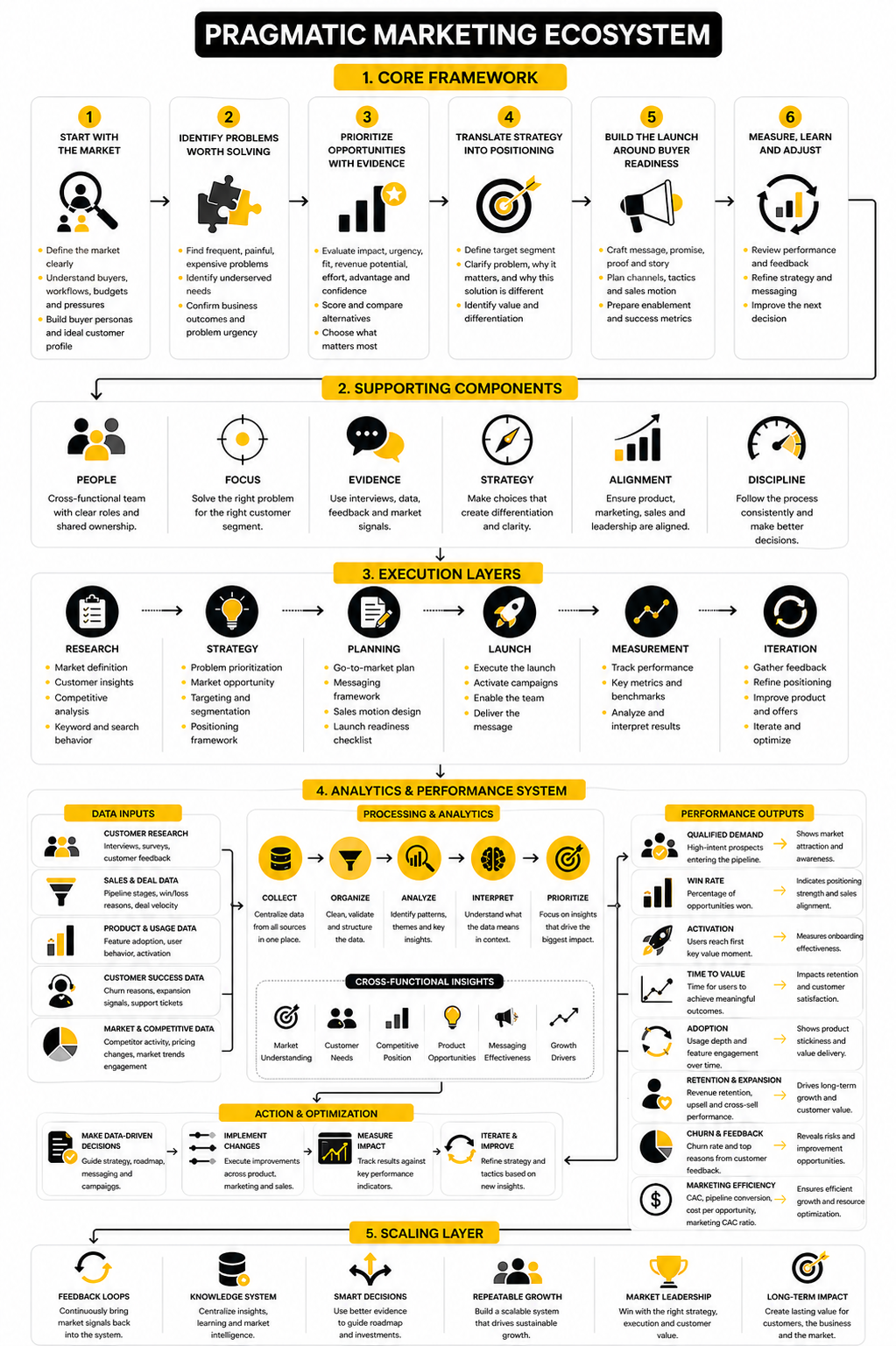
At this point, pragmatic marketing should feel less like a theory and more like a complete system. The company studies the market, chooses the right problems, builds with sharper intent, launches with clearer positioning, and measures whether the strategy is actually working. That is the ecosystem view: every signal should feed the next decision.
The biggest mistake is treating each part as separate. Research lives in one folder, roadmap decisions happen somewhere else, marketing builds campaigns later, and sales gets enablement after the fact. When that happens, the framework loses power because the market insight never becomes a shared operating rhythm.
Common Mistakes To Avoid
The first mistake is confusing customer feedback with market evidence. Feedback is valuable, but it needs context before it becomes strategy. A single customer request should not outweigh repeated patterns from the wider market.
The second mistake is using pragmatic marketing only during launches. The framework is much more useful when it shapes discovery, prioritization, positioning, enablement, measurement, and iteration. If it only appears two weeks before launch, the team is already late.
The third mistake is overcomplicating the process. Teams do not need endless templates to become more market-driven. They need better questions, clearer ownership, and a consistent habit of turning evidence into decisions.
Useful Tools For Pragmatic Marketing
A pragmatic marketing stack should support research, alignment, execution, and measurement. It should not become another source of complexity. The right tools make the market easier to understand and the team easier to coordinate.
For campaign execution and client follow-up, GoHighLevel can fit teams that need CRM, automation, landing pages, and pipeline visibility in one place. For funnel testing and offer validation, ClickFunnels can help turn positioning into measurable buyer action. For email marketing and lifecycle communication, Brevo is useful when customer communication needs to become more structured.
For social distribution and content scheduling, Buffer can support consistent messaging across channels. For customer conversations and lead qualification, ManyChat can help teams capture demand where people already interact. For forms, research intake, and lightweight customer discovery workflows, Fillout can make feedback collection easier to operationalize.
FAQ - Built For Complete Guide
What is pragmatic marketing?
Pragmatic marketing is a market-driven approach to product management and product marketing. It helps teams understand real market problems, prioritize opportunities, position products clearly, and launch with stronger alignment. The goal is to build and sell products people actually want, not products based only on internal assumptions.
Is pragmatic marketing the same as product marketing?
No, but they overlap. Product marketing usually focuses on positioning, messaging, launches, sales enablement, competitive intelligence, and adoption. Pragmatic marketing is broader because it also influences product strategy, market discovery, prioritization, and cross-functional decision-making.
Who should use pragmatic marketing?
Product managers, product marketers, founders, growth teams, sales leaders, and customer success teams can all use it. It is especially useful when a company has unclear positioning, reactive roadmaps, scattered customer feedback, or launches that do not produce enough market traction. The more cross-functional the product motion is, the more valuable the framework becomes.
Why is pragmatic marketing important?
It matters because product and marketing decisions are expensive. When teams misunderstand the market, they waste time building features, campaigns, and sales materials that do not create enough demand. Pragmatic marketing reduces that risk by grounding decisions in customer problems, buyer behavior, competitive context, and measurable outcomes.
What are the main components of pragmatic marketing?
The main components include market research, problem validation, segmentation, prioritization, positioning, messaging, launch planning, sales enablement, adoption, and measurement. These pieces work best when they are connected. If one part breaks, the rest of the go-to-market system usually feels it.
How do you start using pragmatic marketing?
Start by choosing one market segment and one important product decision. Interview customers, review sales and churn data, map the strongest market problems, and define the buyer’s current alternatives. Then use that evidence to sharpen the roadmap, positioning, launch plan, or sales story.
What metrics matter most in pragmatic marketing?
The most useful metrics depend on the business model, but they usually include qualified demand, win rate, activation, time to value, adoption, retention, expansion, churn reasons, and customer feedback patterns. The point is not to track everything. The point is to track the signals that show whether the market strategy is working.
How does pragmatic marketing improve positioning?
It improves positioning by forcing the team to define the buyer, problem, urgency, alternatives, differentiation, and proof before creating external messaging. That makes the message more specific and more credible. Strong positioning should make the right buyer feel understood quickly.
Can small businesses use pragmatic marketing?
Yes. Small businesses may not need a full enterprise-style process, but they absolutely need market clarity. A simple version can include customer interviews, offer testing, competitor review, clear positioning, and regular measurement. The framework scales down well when the team keeps it practical.
What is the biggest pragmatic marketing mistake?
The biggest mistake is treating the framework as a checklist instead of a decision system. Templates can help, but they do not replace judgment. Pragmatic marketing works only when teams use market evidence to make sharper choices.
How often should teams update their pragmatic marketing strategy?
Teams should review it whenever the market changes, product direction shifts, sales feedback becomes consistent, or performance data reveals a pattern. For fast-moving SaaS or agency markets, a quarterly review is usually a practical rhythm. Major launches and positioning changes should also trigger a deeper review.
Does pragmatic marketing work with AI-driven products?
Yes, and it may be even more important for AI-driven products. AI categories move quickly, buyer expectations shift fast, and many products can sound similar from the outside. Pragmatic marketing helps teams avoid chasing hype by focusing on real use cases, measurable value, and buyer trust.
Work With Professionals
Explore 10K+ Remote Marketing Contracts on MarkeWork.com
Most marketers spend too much time chasing clients, competing on crowded platforms, and losing a percentage of every project to middlemen.
MarkeWork gives you a better way. Browse thousands of remote marketing contracts and connect directly with companies desperate to hire skilled marketers like you, without platform commissions and without unnecessary gatekeepers.
If you're serious about finding better opportunities and keeping 100% of what you earn, explore available contracts and create a profile for free at MarkeWork.com.