

A product launch plan is not a launch-day checklist. It is the system that connects market research, positioning, offer design, messaging, sales enablement, campaign execution, customer onboarding, and post-launch optimization. Without that system, teams usually end up shipping the product before the market is ready to care.
That is where launches get expensive. Harvard Business Review’s analysis of failed launches points to repeated issues like weak market preparation, poor product readiness, and demand that never turns into sustainable adoption. MIT Professional Education also highlights the widely cited Clayton Christensen warning that thousands of new products enter the market every year and most miss the mark, which is exactly why a launch cannot be treated like a simple announcement.
A strong product launch plan gives the team one shared operating rhythm. It defines who the product is for, why it matters now, what promise the launch is making, how demand will be created, how buyers will convert, and what happens after the first wave of attention fades.
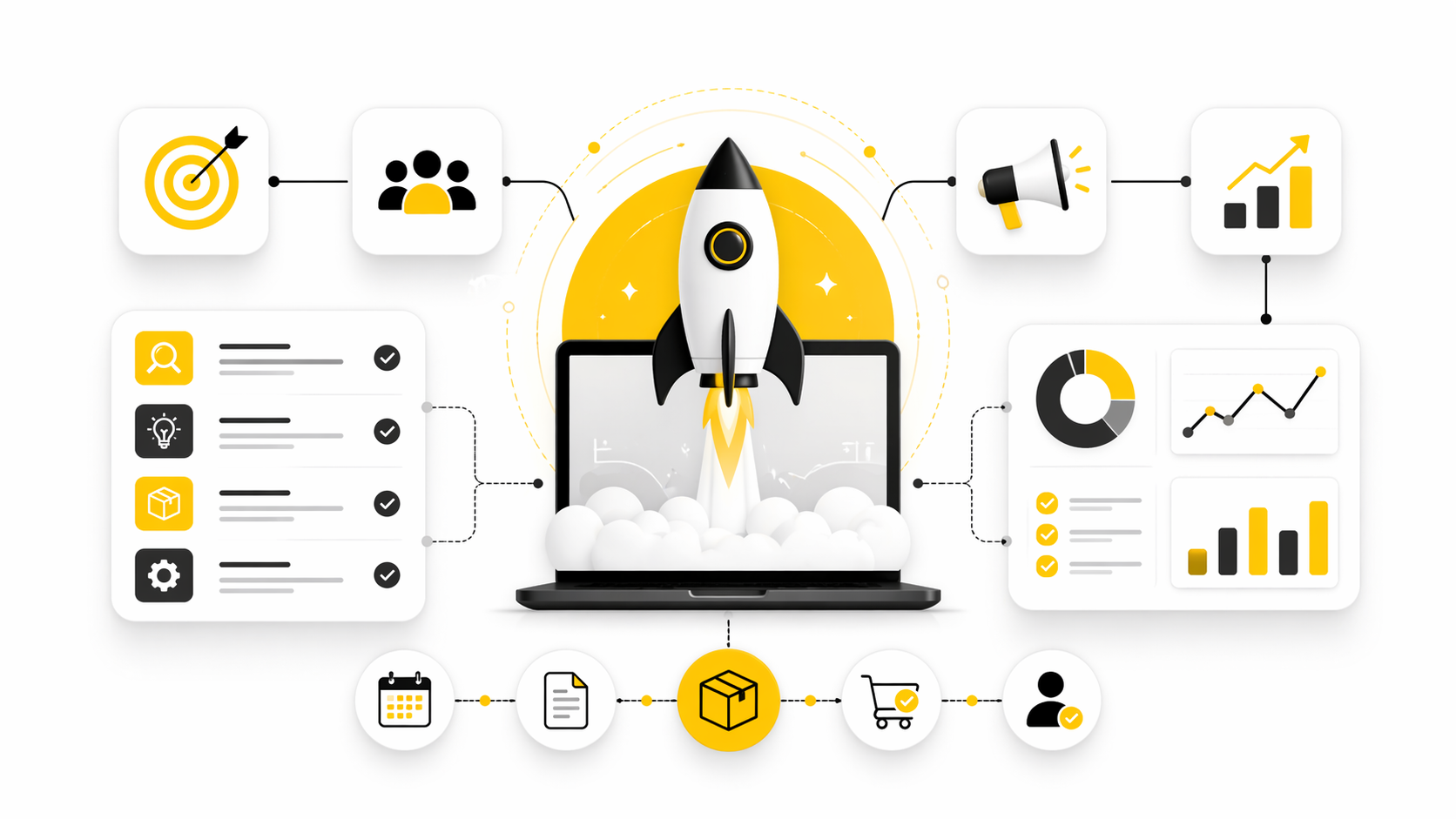
The full article will continue through these sections:
- Why A Product Launch Plan Matters
- The Product Launch Framework
- Core Components Of A Strong Launch
- How To Build And Execute The Launch Plan
- Statistics And Data
- Advanced Launch Strategy And Scaling Risks
- FAQ - Built For Complete Guide
- Work With Professionals
Why A Product Launch Plan Matters
A product launch plan matters because customers are not waiting around for your announcement. They already have habits, tools, workarounds, competitors, budgets, doubts, and internal approval processes. Your launch has to cut through all of that with a message that is clear enough to understand and compelling enough to act on.
This is why “we are excited to announce” is rarely enough. The market does not care that the team is excited. The market cares whether the product solves a painful problem, improves a current workflow, saves time, reduces risk, creates revenue, or helps the buyer look smarter inside their company.
The plan creates discipline before the pressure starts. It forces the team to define the audience, value proposition, offer, channels, responsibilities, assets, metrics, and post-launch follow-up before everyone is scrambling. That preparation is what separates a real launch from a noisy release.
The Real Cost Of A Weak Launch
A weak launch does not always look like failure on day one. Sometimes the campaign goes live, the email gets sent, the launch page gets traffic, and the team sees a small spike of interest. Then the pipeline goes quiet, adoption is soft, and nobody is sure whether the problem was the product, the audience, the message, or the channel mix.
That uncertainty is the real cost. If the team cannot diagnose what happened, the next launch repeats the same mistakes. Worse, leadership may lose confidence in the product even when the bigger issue was weak go-to-market planning.
A strong product launch plan reduces that risk. It gives the team a clear hypothesis, a launch sequence, measurable signals, and a review process. The launch becomes something you can learn from, not just something you survive.
The Product Launch Framework
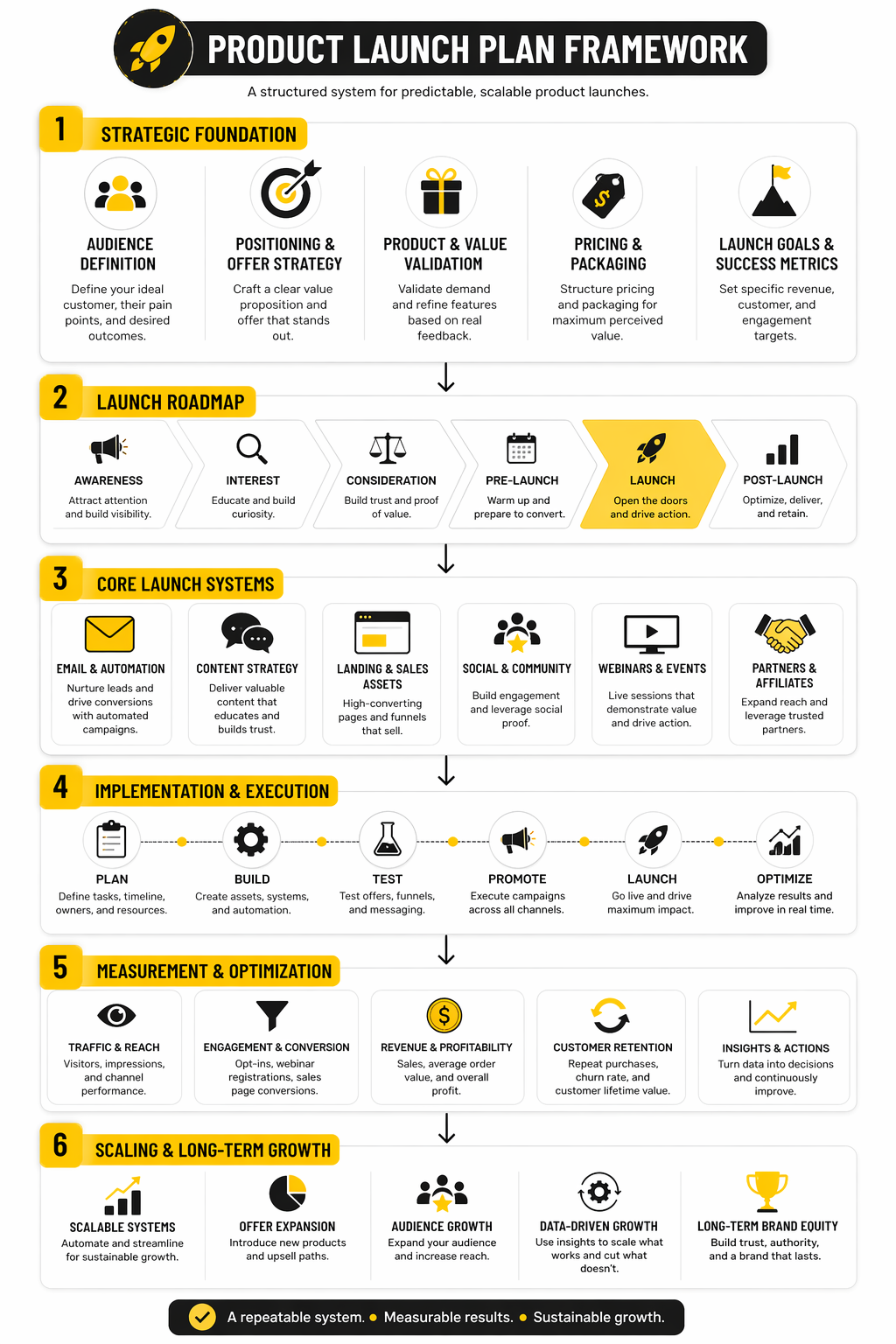
A practical product launch framework has four layers: strategy, readiness, execution, and optimization. Strategy defines the market, audience, positioning, offer, narrative, goals, and success metrics. Readiness prepares the product experience, funnel, content, analytics, sales materials, customer support, and internal ownership.
Execution turns the plan into coordinated launch activity across the channels that actually fit the audience. Optimization uses the launch data to improve messaging, conversion paths, onboarding, retention, and future campaigns. This structure keeps the launch from becoming a pile of disconnected tasks.
The point is not to make the plan complicated. The point is to make the launch complete. Every layer should answer a specific question: why should the market care, are we ready to convert demand, how will we create momentum, and what will we improve after launch?
Layer 1: Strategy
The strategy layer is where the launch earns its direction. It defines the customer, the problem, the category, the current alternative, the differentiated value, the launch goal, and the core message. If this layer is vague, everything else becomes harder.
A useful strategy does not say the product is “for businesses that want to grow.” That is too broad to guide a launch. A useful strategy identifies the specific buyer, the painful situation they are in, the trigger that makes the problem urgent, and the outcome they want badly enough to change behavior.
This layer should also define the launch goal. Some launches are built for revenue. Some are built for waitlist growth, demos, product adoption, partner activation, category awareness, or expansion into an existing customer base. The goal changes the plan.
Layer 2: Readiness
Readiness is where the launch becomes operational. The product needs to support the promise. The launch page needs to explain the offer. The email sequence needs to match the buyer journey. The sales team needs answers to common objections. Support needs to know what questions are coming.
This layer includes landing pages, pricing pages, product demos, sales decks, help docs, onboarding flows, analytics setup, forms, booking links, email sequences, internal launch notes, and approval workflows. It is not glamorous, but it is where many launches are won or lost. Atlassian’s product launch checklist emphasizes planning, coordination, and execution because launches involve many moving pieces that need to work together.
Tools can help here when the launch system is already clear. A team might use ClickFunnels for a launch funnel, Replo for ecommerce landing pages, Fillout for forms, or Cal.com for demo bookings. But the tool should support the plan, not become the plan.
Layer 3: Execution
Execution is the visible launch motion. It includes launch emails, organic content, paid campaigns, sales outreach, partner pushes, creator campaigns, webinars, demos, PR, community posts, customer announcements, and retargeting. This is the part people notice, but it only works when strategy and readiness are already strong.
Good execution is sequenced. The audience should understand the problem before they are pushed to buy. They should see proof before being asked to trust the offer. They should have a clear next step that fits their intent level.
A rushed launch usually feels loud and thin. A strong launch feels coordinated. Every asset reinforces the same central idea, and every channel has a job.
Layer 4: Optimization
Optimization starts when the launch goes live, not weeks later. The team should watch which messages create attention, which channels produce qualified traffic, which pages convert, which objections appear, which audience segments respond, and where users drop off after taking the first step. This is the learning layer.
A product launch plan should include review points for day one, week one, week two, and month one. Those reviews help the team decide what to fix, pause, double down on, or test next. The launch is not just a campaign; it is a market feedback engine.
This is where serious teams separate themselves. They do not treat the first version of the launch as sacred. They use real behavior to sharpen the offer, improve the funnel, strengthen onboarding, and build the next wave of growth.
Core Components Of A Strong Launch
A product launch plan becomes useful when it turns big strategy into specific launch components. The team needs to know the audience, the positioning, the offer, the channel mix, the proof, the sales motion, the onboarding path, and the review process. If any of those pieces are weak, the launch may still create noise, but it will struggle to create durable growth.
This is where teams should slow down before they speed up. A launch can look busy from the outside while being strategically thin underneath. More content, more emails, more ads, and more internal meetings will not fix unclear positioning or a weak offer.
The goal is to build a launch system that makes action easier for the buyer. Each component should reduce confusion, increase trust, and move the right people toward the next step.
Audience And Market Definition
The first component is audience clarity. A product launch plan should define the ideal customer profile, priority segments, buying roles, use cases, current alternatives, pain points, objections, and decision triggers. If the team cannot name the exact buyer and the situation that makes the product urgent, the launch message will become too broad.
Market definition matters because customers rarely compare a new product in isolation. They compare it against competitors, internal workarounds, spreadsheets, agencies, manual processes, old habits, and doing nothing. That means the launch has to explain why switching is worth the effort.
This is why customer value should come before campaign planning. Gartner’s launch guidance focuses on defining customer value, creating a go-to-market plan, and optimizing release cadence because a launch has to connect the product to the way buyers actually adopt new solutions. The better the audience definition, the sharper every campaign asset becomes.
Positioning And Messaging
Positioning decides how the product should live in the customer’s mind. Messaging turns that position into clear language buyers can understand quickly. Both are essential because a product can be useful and still fail if people cannot explain why it matters.
Strong positioning answers five questions:
- Who is this for?
- What painful problem does it solve?
- What are buyers currently using instead?
- What makes this product meaningfully different?
- What outcome does the buyer get?
The launch message should not read like a feature list. It should connect the product to a clear change in the market, a painful problem, and a better path forward. HubSpot’s go-to-market guidance frames GTM as a plan for bringing a product to market, driving demand, identifying the audience, outlining sales and marketing strategy, and aligning stakeholders. That alignment starts with positioning.
Offer And Conversion Path
The offer is the reason someone should act now. It may include the product, pricing, packaging, trial access, launch bonus, demo invitation, onboarding support, implementation help, limited availability, or a lower-friction first step. The stronger the offer, the less pressure the campaign has to carry.
The conversion path should match buyer intent. A low-cost ecommerce product may need a direct landing page and checkout flow. A B2B SaaS product may need a demo page, comparison content, security answers, ROI material, and sales follow-up. A course, service, or community launch may need a waitlist, webinar, application form, or consultation flow.
Tools can help build these paths, but they do not replace the strategy. ClickFunnels, Systeme.io, Replo, and Fillout can support launch pages, funnels, forms, and lead capture. The real work is deciding what the buyer needs to believe before they take the next step.
Channel Strategy
A product launch plan needs a channel strategy, not a random distribution list. Email, paid ads, organic social, SEO, sales outreach, PR, partnerships, affiliates, webinars, communities, events, and creators all serve different jobs. The channel mix should reflect where the buyer already pays attention and how much trust they need before acting.
For a B2B launch, the strongest mix may include sales enablement, account-based outreach, partner webinars, thought leadership, comparison pages, and demo booking. For a consumer or ecommerce launch, the mix may lean more heavily on creators, landing pages, retargeting, email, social proof, and checkout optimization. Different markets need different launch motions.
Do not force every launch into every channel. That creates busy work and weak execution. Choose fewer channels, define the job of each one, and make sure the message stays consistent across the whole launch.
Proof And Risk Reduction
Proof reduces the buyer’s fear of making the wrong decision. This can include customer quotes, beta feedback, demos, case studies, expert validation, waitlist demand, usage data, comparison pages, product screenshots, security documentation, or transparent product limitations. The format depends on the audience and the risk level.
A simple product may need visual proof and social proof. A complex product may need technical proof, buyer enablement, internal stakeholder content, and sales conversations. The more expensive or disruptive the product is, the more proof the buyer needs.
Avoid fake urgency and generic claims. Buyers can feel when a launch is trying too hard. Specific proof, honest expectations, and clear next steps make the launch more credible.
Internal Alignment
Internal alignment is one of the most underrated parts of a product launch plan. Marketing may be ready to announce, but sales may not know the objections. Product may be ready to ship, but support may not have the help content. Leadership may expect pipeline, while the funnel is actually designed for awareness.
A strong plan defines ownership across product, marketing, sales, customer success, support, operations, finance, and leadership. Everyone should know the launch goal, timeline, assets, message, approval path, reporting cadence, and escalation process. Atlassian’s launch checklist emphasizes coordinated execution and alignment across teams for exactly this reason.
This does not mean every team needs to be involved in every decision. It means every team needs enough context to do its job well. Clean alignment prevents the launch from turning into a last-minute internal fire drill.
Customer Experience After Conversion
The launch does not end when someone signs up, books a demo, joins the waitlist, or buys. That action starts the next phase of the customer experience. If onboarding is weak, the launch may create attention but fail to create adoption.
Post-conversion planning should include confirmation emails, onboarding flows, product tours, help documentation, sales follow-up, support readiness, training, customer success handoff, and retention messaging. These assets should be built before the launch goes live.
This matters because launch momentum is fragile. The buyer’s excitement is highest right after they act. A strong product launch plan uses that moment well, helping the customer understand what to do next and why they made the right decision.
How To Build And Execute The Launch Plan
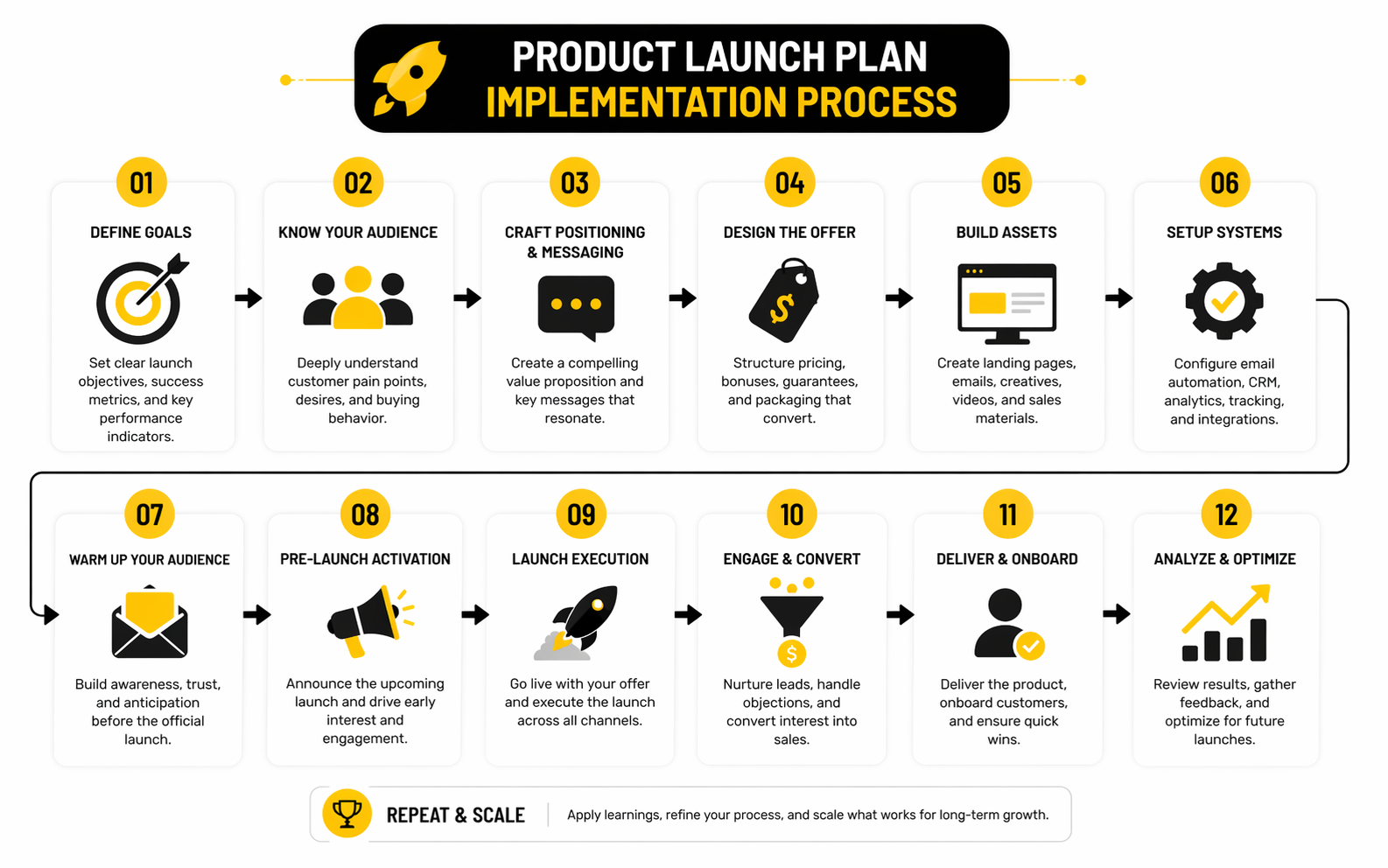
A product launch plan becomes real when the team turns the framework into a clear execution process. This is where strategy stops being a document and starts becoming deadlines, assets, handoffs, campaigns, tracking, and customer experience. The work should move in sequence, because skipping ahead usually creates confusion later.
The best launch process starts with the market and works forward to execution. Do not begin with the launch date, the email copy, or the social posts. Start with the buyer, the problem, the product promise, and the action you want the market to take.
A practical process keeps the launch focused without making it rigid. You still need room to adjust when feedback comes in, but the core sequence should be clear enough that every team knows what happens next and why it matters.
Step 1: Define The Launch Goal
Start by deciding what the launch is supposed to achieve. A product launch plan can be built for revenue, demo bookings, waitlist growth, product adoption, account expansion, category awareness, partner activation, or customer feedback. The goal changes the plan.
If the goal is revenue, the team needs a strong offer, conversion path, sales readiness, objection handling, and follow-up. If the goal is adoption, onboarding and customer education matter more. If the goal is awareness, the team needs stronger storytelling, reach, thought leadership, and distribution.
Do not use vague goals like “generate buzz.” Buzz is not a business outcome. Define the measurable result the launch should create, then build the rest of the plan around that result.
Step 2: Choose The Launch Type
Not every product needs the same launch motion. Some launches should be quiet and controlled. Others should be public, high-energy, and built for maximum attention. The right choice depends on product maturity, audience trust, internal readiness, and the level of market education required.
Common launch types include:
- Soft launch for testing the product with a smaller audience
- Beta launch for collecting feedback before a wider release
- Waitlist launch for building demand before access opens
- Sales-led launch for high-value B2B accounts
- Partner launch for using borrowed trust and shared audiences
- Public launch for broad awareness and market visibility
- Feature launch for improving adoption inside an existing customer base
A launch type is not just a label. It decides the timeline, assets, channel mix, success metrics, and risk level. A beta launch should not be measured like a revenue launch, and a feature launch should not be promoted like a new company announcement.
Step 3: Map The Buyer Journey
The buyer journey shows what the audience needs to understand before they act. A simple launch may only need awareness, interest, proof, and conversion. A complex launch may need education, comparison, internal buy-in, technical validation, financial justification, and onboarding support.
This step prevents the team from asking for action too early. If buyers do not understand the problem yet, the launch needs educational content. If buyers understand the problem but do not trust the solution, the launch needs proof. If buyers want the product but hesitate, the launch needs risk reduction.
Map the journey in plain language. What does the buyer believe before the launch? What do they need to believe after seeing the launch? What question or objection would stop them from moving forward?
Step 4: Build The Launch Assets
Once the journey is clear, build the assets that support each stage. This may include a landing page, product page, sales deck, demo script, email sequence, webinar, FAQ, comparison page, onboarding checklist, help docs, pricing page, case study, social content, video walkthrough, press kit, and partner materials.
The assets should not all say the same thing in different formats. Each asset should have a job. The landing page explains the offer. The email sequence builds context and urgency. The demo shows the product in action. The FAQ handles friction. The onboarding flow protects the customer experience after conversion.
This is where execution tools can make the process faster. GoHighLevel can support CRM, automation, funnels, and follow-up for launch campaigns. Buffer can help schedule and organize social launch content. Chatbase can support customer-facing answers when the same launch questions keep appearing.
Step 5: Create The Timeline And Ownership Map
A launch timeline should work backward from the launch date. Define the major phases first, then break each phase into deliverables, owners, dependencies, deadlines, and approval points. Atlassian’s launch timeline guidance emphasizes working backward through phases, tasks, and dependencies because timing only works when the hidden handoffs are visible.
The ownership map matters just as much as the timeline. Someone must own positioning. Someone must own the launch page. Someone must own email. Someone must own sales enablement. Someone must own analytics. Someone must own customer support readiness.
Without ownership, launch tasks float around until the deadline forces a scramble. With ownership, the team can spot blockers earlier and make cleaner decisions. That is the difference between a plan and a wish list.
Step 6: Prepare The Internal Launch
Before the market sees the launch, the company needs to understand it internally. Sales should know the offer, objections, pricing, target accounts, qualifying signals, and follow-up sequence. Support should know expected questions. Customer success should know onboarding changes. Leadership should know the launch goals and reporting cadence.
An internal launch can include a team briefing, sales enablement session, product walkthrough, FAQ, objection guide, demo recording, Slack or workspace announcement, and owner list. Keep it practical. The goal is not to impress the internal team with a huge document; the goal is to make sure they can execute.
This step is especially important for B2B and SaaS launches. If the customer-facing team is confused, the buyer will feel it. Internal clarity becomes external confidence.
Step 7: Execute The Launch Sequence
The launch sequence should build momentum instead of dropping everything at once. Start with pre-launch education or audience warming. Move into announcement and conversion. Follow with proof, objections, reminders, customer stories, demos, and post-launch reinforcement.
A simple launch sequence might look like this:
- Problem education
- Teaser or waitlist
- Product announcement
- Offer or demo invitation
- Proof and use cases
- Objection handling
- Final reminder or next-step push
- Onboarding and customer follow-up
The sequence should match the buyer’s decision process. A short impulse-driven launch can move quickly. A complex launch may need more time, more proof, and more stakeholder support.
Step 8: Review, Learn, And Improve
The first launch version will not be perfect. That is normal. What matters is whether the team learns fast enough to improve the campaign while attention is still active.
Review traffic, conversion rate, demo bookings, trial starts, purchases, activation, churn signals, support tickets, sales objections, unsubscribe rates, ad performance, and channel quality. Do not just ask whether the launch “worked.” Ask where the launch created movement and where it created friction.
A strong product launch plan includes post-launch review windows. Look at day-one signals, week-one traction, month-one adoption, and longer-term retention. The launch should create a smarter company, not just a temporary spike.
Statistics And Data
A product launch plan should be measured like a business system, not like a publicity moment. Traffic, clicks, impressions, and views can show whether people noticed the launch, but they do not prove that the launch worked. The real question is whether the launch moved the right audience toward the right business outcome.
This is why launch data needs context. A high-traffic launch page with weak conversion may signal a message problem, a poor offer, bad audience fit, or a confusing next step. A smaller launch with strong demo bookings, high activation, and useful customer feedback may be far more valuable than a noisy campaign that does not create qualified demand.
The numbers should help the team decide what to improve. If awareness is low, fix distribution. If interest is high but conversion is weak, fix the offer or page. If conversion is strong but activation is low, fix onboarding. Measurement is not there to decorate a report; it is there to drive action.
Why Launch Benchmarks Are Easy To Misread
Launch benchmarks can be useful, but they can also create lazy thinking. A product launch plan for a $29 ecommerce product should not be judged the same way as a six-figure enterprise software launch. The buying process, risk level, sales cycle, number of stakeholders, and proof requirements are completely different.
Older but still widely cited launch research from Harvard Business Review notes that about 75% of consumer packaged goods and retail products fail to earn even $7.5 million in their first year. MIT Professional Education also repeats Clayton Christensen’s warning that nearly 30,000 new products are introduced each year and 95% miss the mark. Those numbers should not be used as scare tactics, but they do underline a real point: launching is hard because changing customer behavior is hard.
The better move is to compare your launch against your own launch goal and buyer journey. If the goal is paid adoption, revenue and activation matter more than reach. If the goal is beta learning, qualified feedback matters more than short-term sales. If the goal is enterprise pipeline, meeting quality matters more than raw lead volume.
The Measurement System
A useful launch analytics system has three layers: inputs, processing, and outputs. Inputs are the raw signals coming from traffic, email, ads, sales activity, product usage, customer support, and onboarding. Processing is where the team connects those signals to the buyer journey and identifies friction. Outputs are the decisions the team makes because of the data.
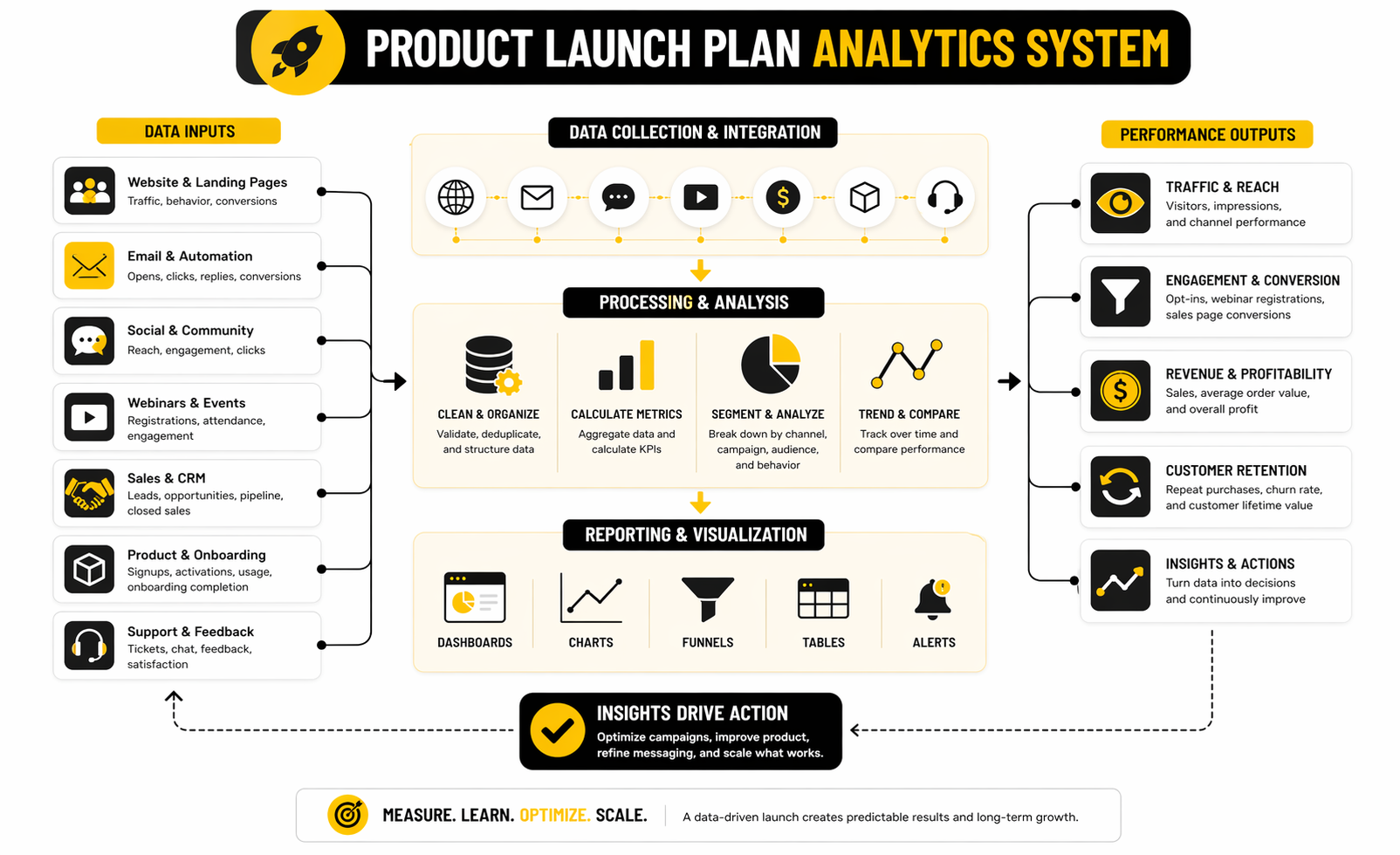
The point is to avoid random reporting. A dashboard with twenty metrics is useless if nobody knows what action each number should trigger. A cleaner system tracks fewer metrics but connects each one to a launch decision.
For example, if email open rates are strong but click-through is weak, the subject line created attention but the body or call to action did not create enough motivation. If launch page traffic is strong but form completion is low, the offer may be unclear, the form may be too demanding, or the page may not reduce enough risk. If demo bookings are high but show rate is low, the follow-up and reminder system needs work.
Awareness Metrics
Awareness metrics show whether the launch reached the market. These include impressions, reach, website sessions, referral traffic, branded search lift, social engagement, video views, press mentions, partner traffic, and email list growth. They are useful at the top of the launch funnel.
But awareness alone is not success. A launch can get attention from the wrong audience and still fail commercially. A post can go viral without creating qualified buyers. A press mention can create credibility but no conversion.
Use awareness metrics to judge distribution quality. If the right people are not seeing the launch, improve channel selection, partner support, audience targeting, creator fit, sales outreach lists, or content angles. Do not celebrate reach unless it is reaching people who can actually buy, adopt, or influence the product.
Engagement Metrics
Engagement metrics show whether people care enough to interact. These include email clicks, landing page scroll depth, webinar registrations, demo page visits, comparison page visits, video completion, content saves, reply rates, comments, and time on page. They help diagnose whether the message is creating curiosity.
Engagement matters because it sits between attention and action. If people see the launch but do not click, read, reply, register, or explore, the message may be too generic. If engagement is strong in one segment but weak in another, the product may be more urgent for a narrower audience than the team expected.
This is where segmentation becomes important. Do not only look at average engagement. Break results down by audience segment, channel, campaign angle, existing customers, new prospects, industry, company size, or use case. The averages often hide the best launch insight.
Conversion Metrics
Conversion metrics show whether people take the intended next step. These include waitlist signups, demo bookings, trial starts, purchases, paid upgrades, partner referrals, sales-qualified leads, application submissions, and checkout completion. This is where the product launch plan starts proving business value.
Conversion data should be interpreted against intent. A cold audience may need more education before converting. A warm audience may convert faster because trust already exists. Existing customers may need a different offer than new buyers because they already understand the brand but need a reason to expand.
If conversion is weak, do not immediately blame the channel. Review the offer, positioning, page structure, proof, pricing, call to action, form friction, and follow-up sequence. Many conversion problems are actually clarity problems.
Product And Adoption Metrics
Product metrics show whether the launch created real use, not just interest. ProductPlan’s 2024 State of Product Management report emphasizes that product usage, product adoption, and retention rate are central success measures for product teams. That matters because a launch that drives signups but not usage is not finished.
Useful product metrics include activation rate, onboarding completion, feature adoption, time to value, repeat usage, retention, expansion, support tickets, and cancellation reasons. These metrics show whether the launch promise matches the actual customer experience.
This is the part many teams review too late. If people convert but fail to activate, the launch may have sold the value but onboarding did not deliver it quickly enough. Fixing that can improve the launch more than sending another promotional email.
Sales And Pipeline Metrics
For B2B launches, sales metrics are essential. These include target account engagement, demo requests, show rates, opportunity creation, pipeline value, win rate, sales cycle length, objection patterns, deal quality, and expansion conversations. A product launch plan should define these before launch so sales and marketing are not arguing later about what worked.
Pipeline metrics require patience. A launch may create early conversations that do not close immediately, especially for complex products. That does not mean the launch failed. It means the team needs to measure movement through the sales process, not only instant revenue.
Look closely at objection patterns. If prospects consistently ask the same questions, the launch content should answer them earlier. If sales conversations stall at the same stage, the team may need better proof, pricing clarity, stakeholder materials, or implementation support.
Post-Launch Review Cadence
The analytics system should create a review rhythm. Day one is for technical issues, early traffic, message response, and obvious conversion problems. Week one is for channel quality, early segment performance, sales feedback, support questions, and quick optimization. Month one is for adoption, pipeline quality, revenue, retention signals, and launch learnings.
Do not wait until the campaign is over to learn from it. A product launch plan should leave room for adjustments while the launch is still active. If one segment responds better than expected, shift resources. If one objection keeps appearing, create content. If one channel produces weak traffic, cut it quickly.
The best launch teams are not the ones with perfect dashboards. They are the ones that turn data into decisions faster than everyone else.
Advanced Launch Strategy And Scaling Risks
A product launch plan gets harder once the basics are working. Early traction creates pressure to spend more, move faster, expand into more channels, add more segments, and turn the launch into a repeatable growth machine. That is where good launches can become messy if the team scales before the system is ready.
Scaling a launch is not the same as making it louder. It means increasing reach without weakening message quality, conversion quality, product experience, support capacity, or unit economics. McKinsey’s launch work warns that launches can become complicated and expensive when costs spiral without a clear strategy and plan, which is exactly what happens when teams confuse activity with control.
The advanced work is about tradeoffs. You cannot optimize every audience, every channel, every offer, and every message at once. A strong launch team chooses the highest-leverage constraint, fixes it, and then scales the next layer.
The Tradeoff Between Speed And Readiness
Speed matters in a launch, but speed without readiness is dangerous. A fast launch can capture attention, beat competitors to market, and create internal momentum. A rushed launch can expose product gaps, confuse customers, overwhelm support, and create negative feedback before the team has a chance to recover.
Harvard Business Review’s launch failure analysis points to product readiness as a serious issue because public feedback spreads quickly when expectations are not met. That matters even more now, when customers can publish complaints, comparisons, reviews, screenshots, and social posts almost instantly. A launch is no longer only controlled by the company.
The practical answer is not endless delay. It is staged readiness. Use private testing, beta groups, internal demos, customer advisory calls, and soft-launch segments to identify risk before a full public push. Move fast where the downside is small, and slow down where trust, revenue, or customer experience could take real damage.
When To Use A Soft Launch Before A Bigger Push
A soft launch is useful when the product, offer, audience, or onboarding flow still needs proof. It lets the team test real behavior with lower pressure. That can be especially valuable for SaaS products, marketplace products, complex B2B offers, mobile apps, courses, ecommerce collections, and anything that depends on user activation after signup.
The soft launch should still have a plan. Define the audience, test group size, success signals, feedback process, support owner, and decision criteria before opening access. Otherwise, the soft launch becomes a vague preview instead of a learning system.
A simple soft-launch scorecard can include:
- Message clarity
- Signup or demo conversion
- Activation rate
- Support questions
- Objection patterns
- Product bugs
- Time to value
- Referral or sharing behavior
- Willingness to pay
- Customer language for future messaging
The goal is not to hide from the market. The goal is to make the bigger launch sharper. If the soft launch exposes the same problem again and again, fix that before scaling distribution.
The Risk Of Overbuilding Before The Market Responds
One of the biggest launch mistakes is building a huge campaign before validating the core offer. The team creates a massive content calendar, complicated automation, paid ad structure, partner plan, webinar series, sales deck, PR angle, and onboarding sequence before knowing whether the message is converting. That feels productive, but it can lock the team into the wrong direction.
A better product launch plan separates fixed decisions from testable assumptions. The launch goal, target segment, product promise, and core offer need enough clarity to move. But the exact headline, page layout, ad angle, email order, demo hook, and objection content should stay flexible until the team sees real signals.
This is why early-user programs are valuable. HBR’s recent product launch coverage includes guidance on early-user programs because early adopters can reveal what the broader market will misunderstand, value, resist, or repeat. That feedback is much cheaper before the company has committed heavy budget and reputation to a large campaign.
Channel Scaling Without Losing Quality
Channel scaling is where many launches start breaking. The first channel works, so the team adds five more. Then the message gets diluted, reporting becomes messy, and nobody knows which activity is actually producing qualified demand. More channels can create more reach, but they also create more complexity.
Scale channels in layers. First, prove one or two channels can produce the right audience. Then add supporting channels that reinforce the same buyer journey. For example, a B2B launch might start with account-based sales outreach and webinars, then add retargeting, comparison content, partner emails, and executive social content. A consumer launch might start with email and creators, then add paid social, organic content, and retargeting.
Each channel should have a defined job:
- Create awareness
- Educate the buyer
- Build trust
- Capture demand
- Convert qualified interest
- Support sales conversations
- Improve onboarding
- Drive retention or expansion
If a channel does not have a clear job, it will probably become noise. Cut it or redefine it before scaling spend.
Budget Discipline During A Launch
Launch budgets can disappear quickly because urgency makes every expense feel justified. Paid ads, creative production, PR, contractors, landing pages, software, events, creators, sponsorships, and sales materials can all make sense individually. Together, they can become expensive before the launch proves the economics.
Budget discipline starts with expected return and learning value. Some launch spend is meant to generate revenue. Some is meant to validate messaging. Some is meant to build brand credibility. Some is meant to activate partners or customers. Treating all spend the same makes the post-launch review useless.
The simplest rule is this: do not scale spend until you know what is working. If paid traffic is generating clicks but not qualified conversions, fix the page or offer before increasing budget. If creator traffic is engaging but not buying, review audience fit and call to action. If sales outreach creates meetings but no opportunities, inspect qualification, positioning, and proof.
Pricing And Packaging Risk
Pricing and packaging can make or break a product launch plan. A strong launch message may still fail if the offer feels misaligned with perceived value, buyer risk, competitive alternatives, or internal approval processes. Pricing is not just a revenue decision; it is part of the launch story.
For early launches, pricing should be tested carefully. A low price can reduce friction, but it can also position the product as less valuable. A high price can support premium positioning, but only if the proof, onboarding, support, and business case are strong enough. A free trial can increase adoption, but it can also attract low-intent users if activation is weak.
Packaging should make the next step obvious. If buyers need to compare too many plans, add-ons, limits, credits, seats, or upgrade paths, the launch loses momentum. Keep the launch offer clear enough that the buyer understands what they get, why it matters, and what to do next.
Operational Capacity And Support Load
A launch can succeed on the front end and fail operationally. More customers, demos, support tickets, refund requests, onboarding calls, bug reports, implementation questions, and sales conversations can overwhelm a team that only planned the campaign side. This is especially risky when the launch creates urgency and compresses demand into a short window.
Operational readiness should be part of the launch plan. Support needs answer libraries. Sales needs qualification rules. Customer success needs onboarding paths. Product needs bug triage. Leadership needs escalation rules. Finance needs pricing and refund clarity.
Do not wait until the inbox is on fire. Identify the support load before launch and prepare the first version of the response system. Even a simple FAQ, help doc, chatbot, demo recording, onboarding email, and internal escalation channel can prevent unnecessary chaos.
International Or Multi-Segment Expansion
Expanding a launch into new markets or segments adds hidden complexity. Language, pricing expectations, regulations, competitors, buying behavior, channels, partner ecosystems, payment preferences, and support requirements can all change. A launch that works in one market may not transfer cleanly into another.
McKinsey’s work on international launches notes that smaller markets can create useful learning, but expansion creates tradeoffs around resources, readiness, and market opportunity. That is the point. Expansion should be treated as a new launch, not a copy-paste campaign.
Before scaling into a new segment or geography, pressure-test:
- Does the pain point exist with the same urgency?
- Does the buyer use the same language?
- Are the competitors different?
- Does pricing still make sense?
- Are there legal, compliance, or support requirements?
- Are the channels still effective?
- Does onboarding need localization?
- Can the team support the new demand?
Scaling should multiply what works, not multiply assumptions.
Building A Repeatable Launch Playbook
The final advanced layer is turning launch learning into a repeatable playbook. A product launch plan should not disappear after one campaign. It should become a living operating system for future product releases, feature launches, market expansions, and seasonal campaigns.
A launch playbook should capture the positioning decisions, channel performance, asset templates, timeline, ownership model, analytics setup, objection patterns, conversion lessons, support issues, onboarding gaps, and post-launch recommendations. McKinsey’s launch guidance highlights the value of comprehensive playbooks because teams need standardized best practices, not one-off heroics.
The playbook does not need to be fancy. It needs to be used. After every launch, update what worked, what failed, what changed, and what should happen differently next time. That is how launches become cheaper, faster, and more reliable over time.
FAQ - Built For Complete Guide
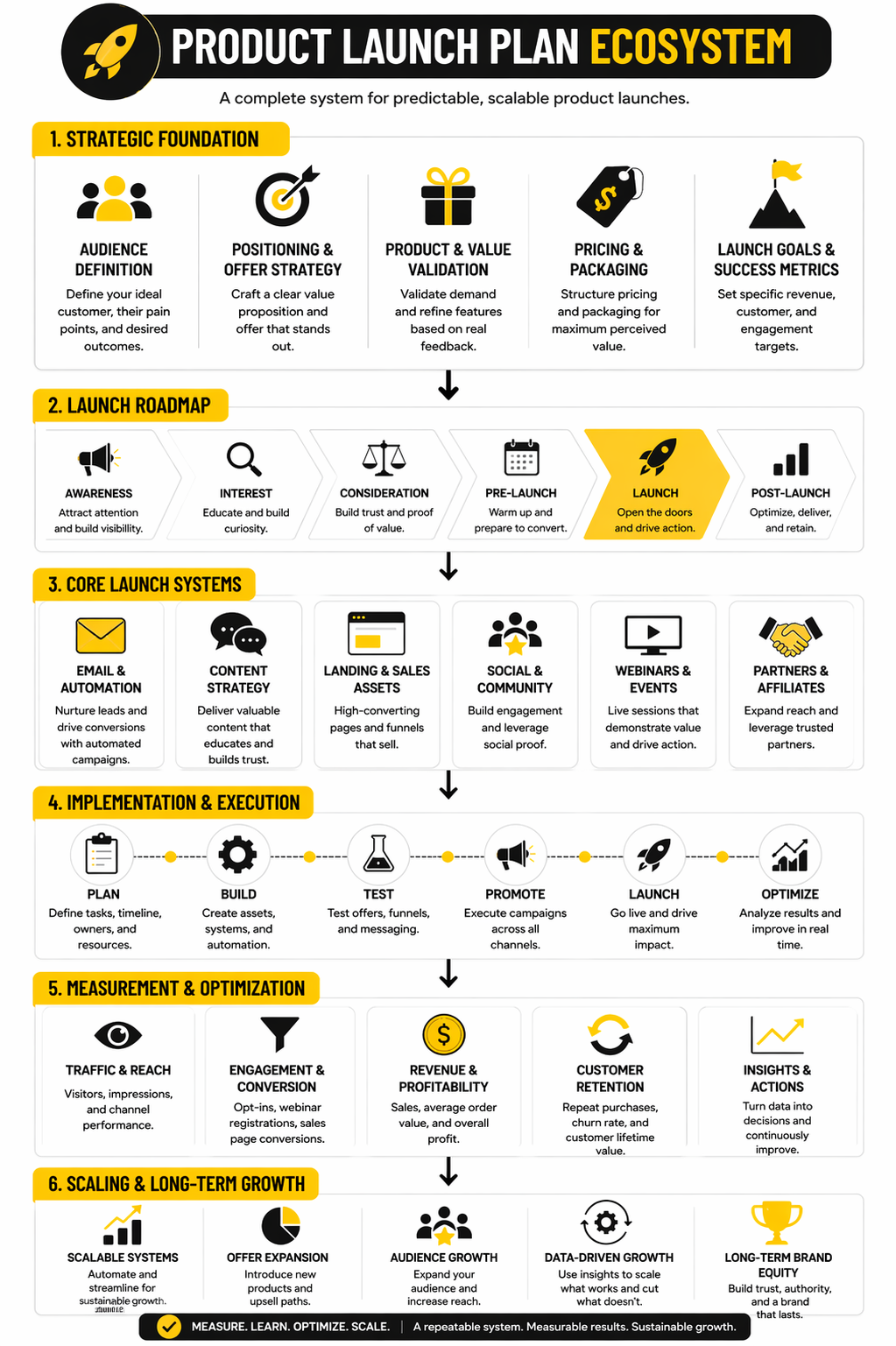
A product launch plan works best when the whole system is visible. Strategy, readiness, execution, measurement, optimization, and scaling all connect. If one part is missing, the launch may still create activity, but it will struggle to create reliable momentum.
The full ecosystem should show how the launch moves from market understanding to buyer action and then into post-launch learning. That is the real goal. Not a bigger announcement, not a prettier launch page, and not a louder campaign, but a launch system that turns attention into adoption, revenue, and useful feedback.
What Is A Product Launch Plan?
A product launch plan is the structured roadmap for bringing a product, feature, service, or offer to market. It defines the audience, positioning, offer, launch type, timeline, channels, assets, responsibilities, metrics, and post-launch optimization. The plan keeps the team aligned before the pressure of launch week starts.
Why Is A Product Launch Plan Important?
A product launch plan is important because customers rarely change behavior just because something new exists. The plan helps the team clarify why the product matters, who it is for, how it will reach the market, and what action the buyer should take. Without that structure, launches often become noisy announcements with weak follow-through.
What Should Be Included In A Product Launch Plan?
A strong product launch plan should include customer research, market context, positioning, messaging, offer design, launch goals, channel strategy, asset list, timeline, ownership map, sales enablement, onboarding plan, analytics setup, and post-launch review process. Each part should connect to a decision or action. If a section does not help the team execute or learn, it probably does not need to be in the plan.
How Long Should A Product Launch Plan Be?
The length depends on the complexity of the product and the size of the launch. A small feature launch may only need a few pages, while a major B2B SaaS launch may need a detailed operating document with timelines, owners, assets, enablement, and reporting. The best product launch plan is not the longest one; it is the one the team actually uses.
When Should You Start Planning A Product Launch?
Start planning as soon as the product direction, target audience, and launch window are clear enough to make decisions. Waiting until the product is nearly finished usually creates rushed messaging, weak sales enablement, and poor onboarding. The earlier the team aligns on positioning, proof, and buyer journey, the cleaner the launch becomes.
What Is The Difference Between A Product Launch Plan And A Go-To-Market Strategy?
A go-to-market strategy defines how a product will enter and compete in the market. A product launch plan turns that strategy into a specific launch sequence with assets, channels, timelines, owners, and metrics. The strategy sets direction, while the launch plan coordinates execution.
What Are The Main Stages Of A Product Launch?
The main stages are strategy, readiness, execution, measurement, optimization, and scaling. Strategy defines the market and message. Readiness prepares the product, funnel, sales team, support, and onboarding. Execution activates the launch sequence. Measurement shows what is working. Optimization improves the system. Scaling expands what has been proven.
How Do You Measure A Product Launch?
Measure a launch through awareness, engagement, conversion, adoption, sales, and retention metrics. The exact metrics should match the launch goal. A revenue launch should focus on purchases, pipeline, demos, paid upgrades, and conversion quality. An adoption launch should focus on activation, onboarding completion, usage, retention, and customer feedback.
What Is A Soft Launch?
A soft launch is a controlled release to a smaller audience before a wider public push. It helps the team test positioning, product experience, onboarding, conversion, and support load with less risk. A soft launch is especially useful when the product is new, the market is uncertain, or the team wants real feedback before scaling distribution.
What Makes A Product Launch Fail?
Product launches often fail because the audience is unclear, the positioning is weak, the offer is not compelling, the product is not ready, or the team measures the wrong signals. Some launches also fail because they create attention but do not support conversion, onboarding, or retention. The biggest issue is usually not one missing tactic; it is a broken system.
How Do You Create Launch Momentum?
Launch momentum comes from sequencing. Warm the audience first, explain the problem, introduce the product, show proof, reduce risk, make the next step obvious, and follow up after the first action. Momentum fades when the launch relies on one announcement and then goes quiet.
What Tools Help With Product Launch Execution?
Launch tools can help with funnels, forms, automation, scheduling, chat, CRM, analytics, and content distribution. GoHighLevel can support CRM and campaign automation, ClickFunnels can support funnel creation, Buffer can organize social scheduling, and Fillout can handle lead capture forms. The tool stack should support the launch plan, not replace it.
How Do You Improve A Launch After It Goes Live?
Review the launch in short cycles. Look at traffic quality, engagement, conversion, sales objections, support questions, activation, onboarding friction, and retention signals. Then adjust the message, page, offer, follow-up, targeting, or onboarding based on what the data shows. The best teams improve while the launch is still active instead of waiting for a postmortem weeks later.
Work With Professionals
Explore 10K+ Remote Marketing Contracts on MarkeWork.com
Most marketers spend too much time chasing clients, competing on crowded platforms, and losing a percentage of every project to middlemen.
MarkeWork gives you a better way. Browse thousands of remote marketing contracts and connect directly with companies desperate to hire skilled marketers like you, without platform commissions and without unnecessary gatekeepers.
If you're serious about finding better opportunities and keeping 100% of what you earn, explore available contracts and create a profile for free at MarkeWork.com.