

Product Marketing Alliance has become one of the most recognizable names in the product marketing world because it does more than publish advice. It combines a free community, career resources, events, certifications, and a practical framework into one ecosystem built specifically for product marketers. On its own site, PMA describes its mission as helping elevate the role of product marketing, while its free Insider membership page says more than 45,000 product marketers use it as a learning and development resource.
That reach matters because product marketing is still a role many companies define differently. Some teams treat it as launch support, others put it at the center of positioning, pricing, enablement, and growth, and that inconsistency creates skill gaps and alignment problems. PMA’s own State of Product Marketing 2025 focuses on exactly those pressure points, including how teams handle positioning, messaging, launches, budgets, and KPIs.
What makes the Product Marketing Alliance especially useful is that it tries to turn a messy function into a repeatable operating system. Its learning hub highlights 40+ certifications, while its core certification page lays out a framework that runs from research and pricing through positioning, enablement, onboarding, and ongoing optimization. That combination of community and structure is why PMA keeps showing up in career conversations, team training discussions, and broader go-to-market planning.

Why Product Marketing Alliance Matters
The biggest reason Product Marketing Alliance matters is simple: product marketing often sits in the middle of the hardest conversations in a business. Teams need somebody who can translate customer insight into positioning, turn product complexity into a clear story, and help sales, marketing, and product move in the same direction. Even Gartner’s guidance on a strong launch stresses the same fundamentals PMA emphasizes, including defined customer value, internal alignment, a coordinated go-to-market plan, and post-launch support through clear launch planning.
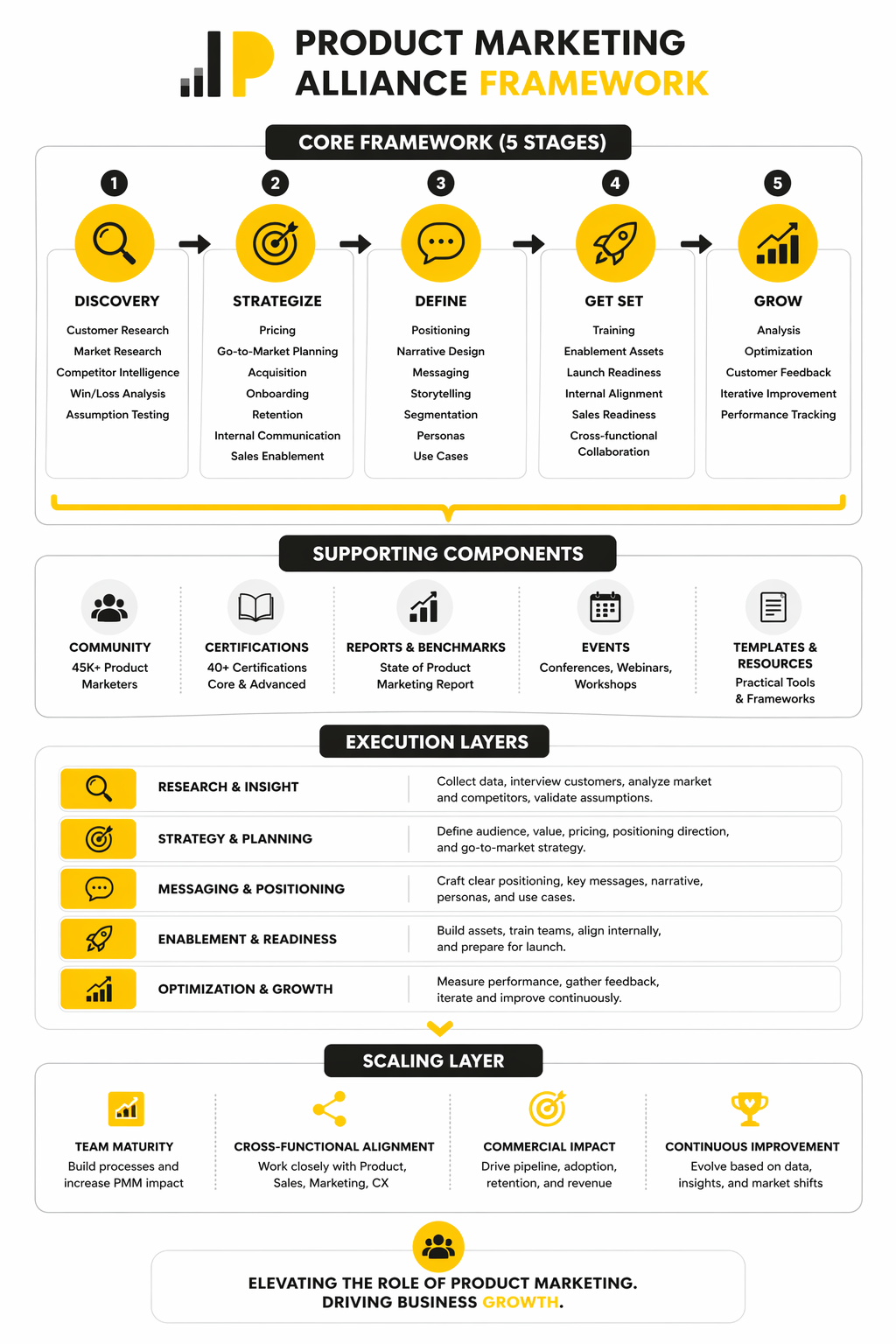
PMA also matters because it gives the discipline a common language. Its main site presents product marketing as a career path with community, resources, events, and certification, not just a vague job title with different expectations at every company. Its published framework moves from Discovery to Strategize, Define, Get Set, and Grow, which gives product marketers a clearer way to explain what they actually do and how their work connects to revenue, adoption, and retention.
There is also a practical credibility layer here. PMA says its education is accredited by CIM and CPD, and it publicly highlights community scale, instructor credibility, and resource depth instead of positioning itself as just another content brand. For readers trying to decide whether the Product Marketing Alliance is worth paying attention to, that mix of reputation, structure, and relevance is the real story.
Article Outline
This article will build from the big picture to the practical details. First, it will explain what Product Marketing Alliance actually is, then it will unpack why it matters, how its framework works, what sits inside the ecosystem, and how professionals can use it without getting lost in content overload. The goal is not to praise the brand blindly, but to give you a clear view of where PMA fits in a serious product marketing career or team setup.
- What Product Marketing Alliance Is
- Why Product Marketing Alliance Matters
- The Product Marketing Alliance Framework
- Core Components of the Ecosystem
- Professional Implementation for Teams and Individuals
- Final Verdict and Frequently Asked Questions
What Product Marketing Alliance Is
Product Marketing Alliance is not just a blog or a course provider. It is a specialist professional ecosystem built around one job family: product marketing. Its current offer spans community access, certifications, reports, events, templates, and team training, all organized around helping product marketers build sharper skills and stronger influence inside their companies.
That focus is a big part of why the brand stands out. A lot of marketing education platforms cover product marketing as one topic among many, but PMA has gone the other direction and built everything around the discipline itself. Its official pages position the organization as a dedicated home for product marketers, while the current learning catalog shows multiple certification paths for different career stages, from core training to more advanced leadership-oriented development.
The scale is also worth paying attention to because it signals market adoption, not just brand noise. PMA’s current core certification page says it is trusted by 10,000+ PMMs, and its Insider membership page has said the free community reaches more than 45,000 product marketers. Those numbers do not automatically prove quality, but they do show that Product Marketing Alliance has moved beyond niche status and become one of the default reference points for people trying to learn the craft, hire product marketers, or create a shared operating model for the role.
Another useful way to think about Product Marketing Alliance is as infrastructure for a profession that still lacks standardization. Product marketing titles can mean very different things across SaaS, enterprise software, consumer tech, and B2B services. PMA tries to reduce that confusion by publishing common frameworks, recurring benchmarks, and structured training that give individuals and teams a more stable definition of the work. That is why its reports and certifications keep showing up in hiring conversations, career planning, and internal enablement efforts.
The Product Marketing Alliance Framework
The most practical part of Product Marketing Alliance is its framework, because this is where the brand stops being a media company and becomes genuinely useful. PMA structures the work into five stages: Discovery, Strategize, Define, Get Set, and Grow. That sequence matters because it reflects how good product marketing actually works in the field: you start with evidence, turn that evidence into decisions, sharpen the message, equip the business, and then keep improving instead of treating launch like the finish line.
The first stage, Discovery, is about reducing guesswork. PMA places customer research, market research, competitor intelligence, win-loss analysis, and assumption testing at the front of the process. That is the right emphasis, because weak product marketing usually starts when teams rush into messaging or launch planning before they have done the hard work of understanding what buyers care about, what alternatives they compare against, and where the product really has an advantage.
Strategize is where the framework becomes commercially serious. PMA groups pricing, go-to-market planning, acquisition, onboarding, retention, internal communication, and sales enablement inside this stage, which is a strong signal that product marketing is not supposed to live only in launch decks and positioning docs. In mature teams, product marketing has to connect market understanding to business decisions, and PMA’s structure reflects that broader mandate clearly.
Define then moves into the language layer of the job. This part covers positioning, narrative design, messaging, storytelling, segmentation, personas, and use cases. The sequence is smart because strong messaging is usually the output of earlier strategic choices, not a creative exercise done in isolation, and PMA’s framework makes that relationship obvious.
Get Set and Grow are where the framework becomes more realistic than many simplified PMM models. PMA treats training, assets, enablement sessions, and cross-functional collaboration as a dedicated stage, which is important because a message is worthless if the rest of the company cannot use it. Then the Grow stage pushes teams into analysis, optimization, customer feedback, and iterative improvement, reinforcing the point that product marketing is an ongoing commercial function rather than a one-time launch service.
What makes this framework useful in practice is not that it is revolutionary. It is useful because it is broad enough to reflect real product marketing work, but still simple enough to teach, remember, and apply across teams. That balance is rare, and it helps explain why Product Marketing Alliance has turned the framework into the backbone of its current core certification and wider learning ecosystem.
Core Components of the Ecosystem
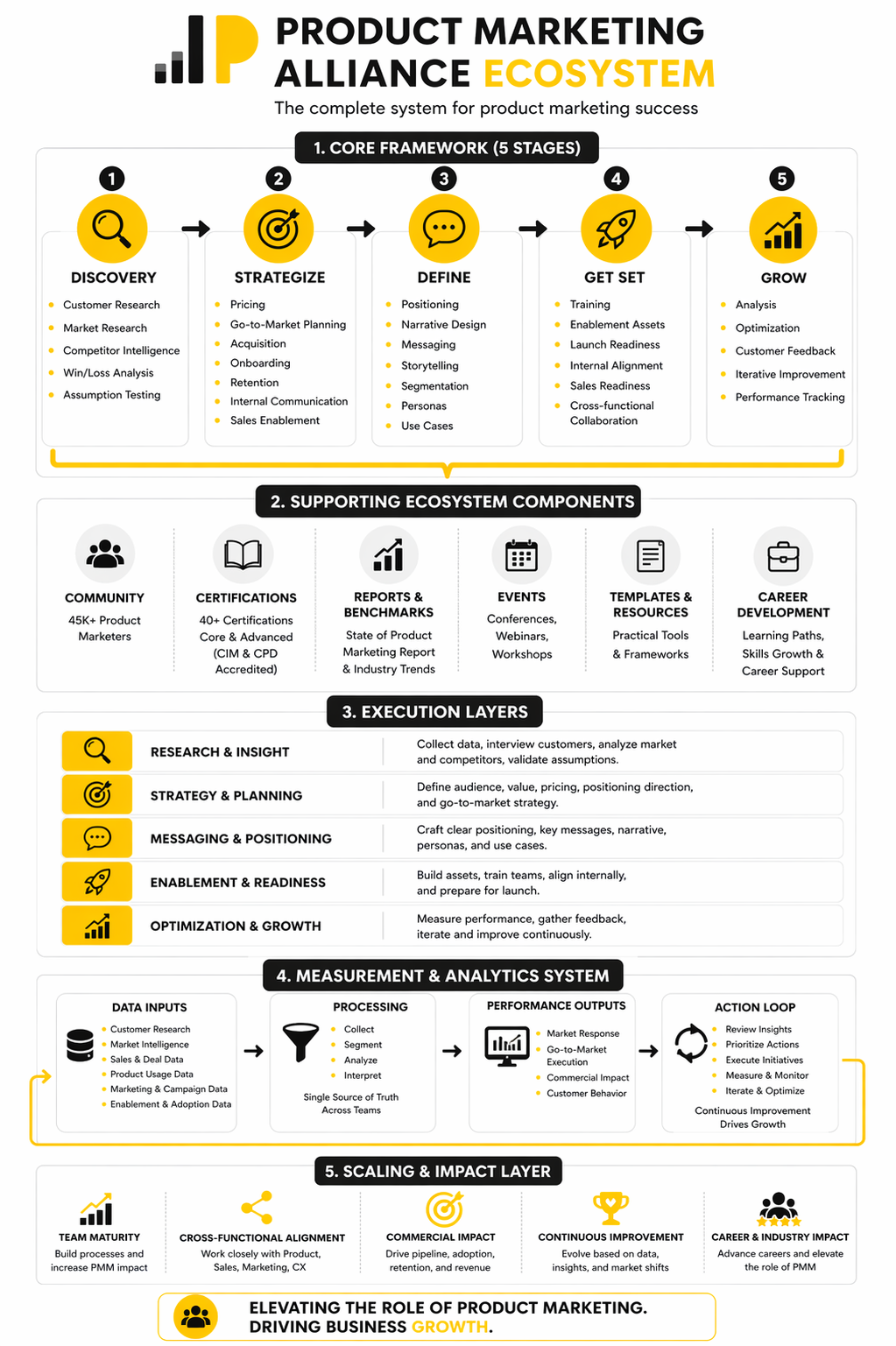
The reason Product Marketing Alliance keeps showing up in serious product marketing conversations is that it is built like an ecosystem, not a single product. Its current setup combines certifications, membership, events, benchmark reports, templates, and role-specific resources that all point back to the same operating logic. In practice, that means someone can use PMA to learn the discipline, benchmark their team, build internal processes, and stay connected to how the role is evolving. The learning hub and the broader membership offer make that structure visible in a way that is unusually clear for a professional education brand.
The certifications are the most obvious component, but they are not the whole value. PMA’s current catalog includes a core certification and a wider set of specialist tracks, which matters because product marketing work does not stay limited to one skill forever. A junior PMM may need help with research and messaging, while a more experienced operator may need sharper systems around pricing, launches, enablement, and leadership communication, and PMA is clearly trying to serve that full curve.
Membership and community are the second major piece, and they matter more than most people expect. Product marketing is one of those roles where context matters a lot, so frameworks alone are rarely enough. PMA’s Insider positioning, event model, and recurring content create a place where practitioners can compare how other teams handle positioning work, sales enablement, launches, stakeholder alignment, and measurement instead of trying to reinvent everything in isolation.
Its benchmark and trend content is another important layer because it keeps the platform connected to real operating conditions. The 2025 state report is framed around practical concerns like collaboration, budgeting, performance measurement, and the growing commercial scope of the PMM role. That matters because a framework is only useful if it keeps pace with how companies actually buy, sell, launch, and expand now, not how they worked five years ago.
What ties all of this together is consistency. Product Marketing Alliance does not present research, training, and community as separate things; it presents them as connected tools for building a more disciplined product marketing function. That is a big reason the brand has become useful to both individuals and teams, because it gives people more than inspiration. It gives them a repeatable way to learn, apply, check progress, and improve.
Professional Implementation for Teams and Individuals
Knowing the Product Marketing Alliance framework is not the same thing as using it well. The best way to implement it is to treat it like an operating cadence, not a certification outline that lives in a slide deck. In other words, you want each stage to produce real decisions, shared documents, and visible handoffs across product, sales, marketing, and customer-facing teams.
For an individual product marketer, implementation starts with a brutally simple question: where is the current gap? Some people are weak in research and jump too quickly into messaging. Others are strong on positioning but weak on enablement, onboarding, or post-launch optimization, which is exactly why PMA’s five-stage structure is useful as a self-audit model. It helps you spot whether the problem is strategic, operational, or communicational before you waste energy polishing the wrong thing.
For teams, implementation needs more discipline. The framework works best when it is mapped to recurring workflows such as launch planning, pricing reviews, messaging refreshes, sales enablement updates, and retention analysis. Gartner’s launch guidance reinforces this kind of structured execution by stressing customer value definition, internal alignment, coordinated go-to-market planning, and post-launch support rather than treating launch day as the end of the job.
A Practical Way to Put the Framework to Work
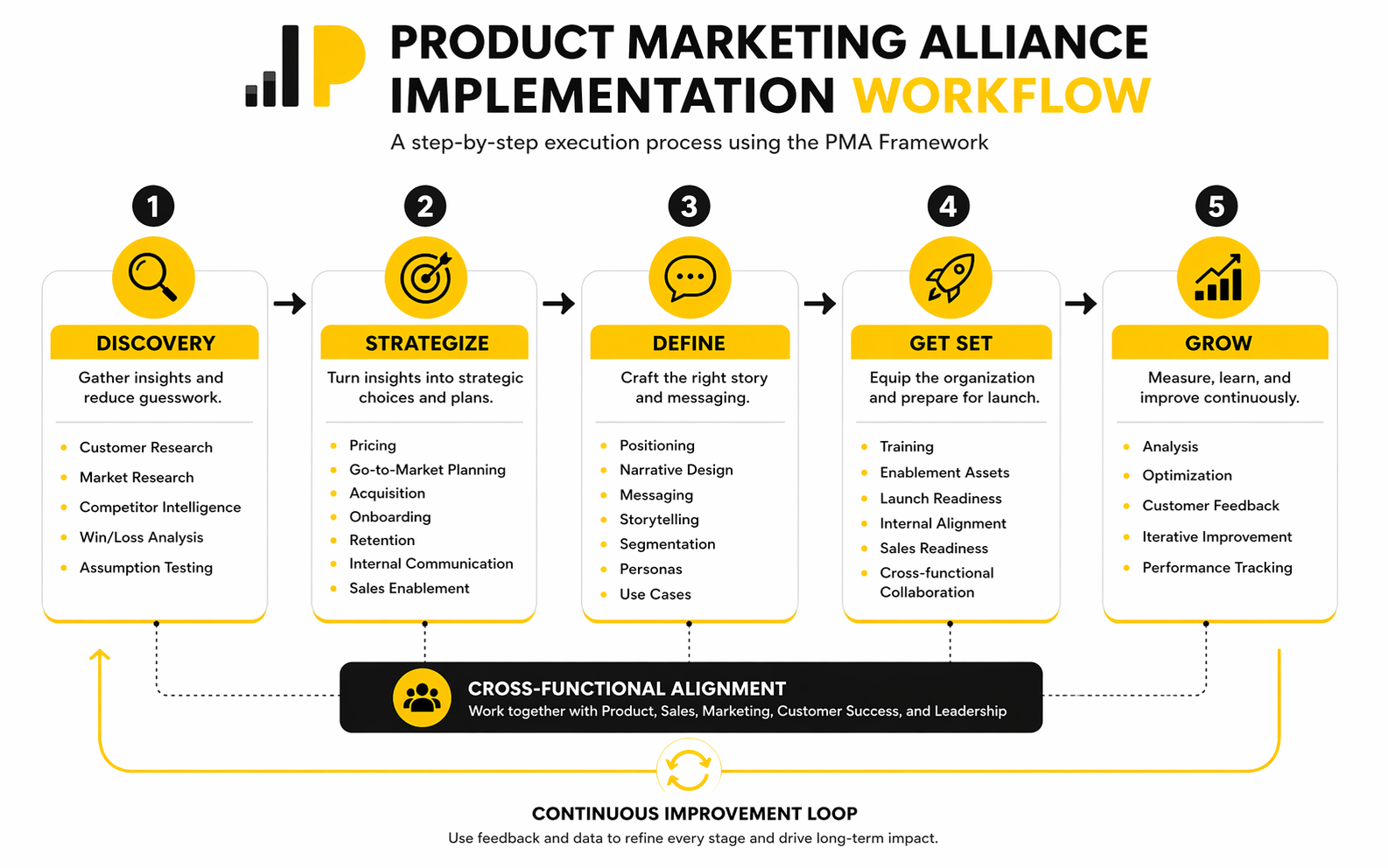
The cleanest way to use Product Marketing Alliance inside a company is to turn the five stages into a simple execution rhythm. That does not mean making the process bureaucratic. It means agreeing on what each stage should answer, what outputs it should create, and who needs to use those outputs next.
- Start with Discovery
Gather customer interviews, lost-deal feedback, win-loss patterns, competitive context, and market signals before you rewrite anything. This is where the team earns the right to make strategic claims instead of relying on internal opinions. If the research is thin, the rest of the work will look polished but feel generic.
- Turn insight into strategic choices
Use the research to decide who the offer is really for, where growth should come from, what barriers matter most, and how pricing, onboarding, or enablement should support the commercial goal. PMA’s own framework places those choices in the Strategize stage for a reason: good product marketing is not just message design, it is decision support for the business.
- Define the story clearly
Build positioning, messaging, narrative hierarchy, personas, and use-case language only after the strategic direction is clear. This is the point where product marketing turns complexity into a story sales, marketing, leadership, and customers can actually understand. McKinsey’s recent work on growth and personalization also reinforces the value of clearer, more relevant communication in modern buying journeys.
- Operationalize through Get Set
Translate the strategy and messaging into training, battlecards, launch materials, internal briefs, onboarding support, and channel-ready assets. This step is where a lot of teams fail, because they confuse having a good message with making that message usable. PMA’s framework is strong here precisely because it treats enablement and readiness as a dedicated stage instead of an afterthought.
- Keep improving in Grow
Review what happened after launch or rollout, look at adoption and revenue signals, collect new feedback, and update the story or enablement package when the market responds differently than expected. This matters because strong product marketing is iterative by default. The companies that keep growing usually keep testing, adjusting, and reinvesting instead of assuming the first version of the message was perfect.
That process may sound obvious, but this is exactly where discipline creates advantage. Most teams do some of these steps occasionally. Far fewer teams turn them into a shared system that survives busy quarters, leadership changes, product shifts, and launch pressure.
What Good Implementation Looks Like in Practice
Good implementation is visible in the way teams work together. Product understands what message the market is hearing, sales knows how to explain differentiation without improvising, marketing does not have to guess which claims matter most, and customer-facing teams get a clearer path from acquisition to onboarding and expansion. When Product Marketing Alliance is used well, it helps create that shared commercial language instead of leaving every team with its own version of the story.
It also shows up in how work gets prioritized. Instead of chasing random requests, the PMM team can tie tasks back to a stage in the framework and ask whether the problem is discovery, strategy, definition, readiness, or growth. That sounds simple, but simple systems are powerful when a role is naturally cross-functional and easy to dilute.
Most importantly, strong implementation changes the quality of decision-making. Teams stop debating opinions in the abstract and start working from evidence, strategic intent, and defined outputs. That is where Product Marketing Alliance is most useful in the real world: not as a badge, but as a structure that helps professionals do better work with less confusion.
Performance Signals and Benchmarks
Once Product Marketing Alliance moves from theory into practice, measurement becomes the difference between a disciplined function and a busy one. The point is not to collect as many dashboards as possible. The point is to track the handful of signals that show whether your positioning is landing, your launches are creating movement, and your enablement work is changing commercial outcomes.
One reason this matters so much is that product marketing sits between leading indicators and lagging outcomes. A PMM team can improve message clarity, sales confidence, and launch readiness long before revenue fully catches up. Gartner’s sales guidance makes the same broader point in a different context: teams trust activity and engagement metrics more when they can connect them to downstream sales performance, which is exactly how good product marketing measurement should work.
PMA’s own recent content points to the same reality. Its 2025 KPI coverage says go-to-market remains the top product marketing KPI, with 54.6% of PMMs ranking it highest, while its current product marketing guide highlights metrics such as feature adoption, win-loss ratios, sales confidence, and pipeline influence. That combination is useful because it tells you product marketers are not just being judged on brand polish or launch volume. They are being judged on whether they help the business move buyers, close deals, and improve adoption after the announcement is over.
The Metrics That Actually Matter
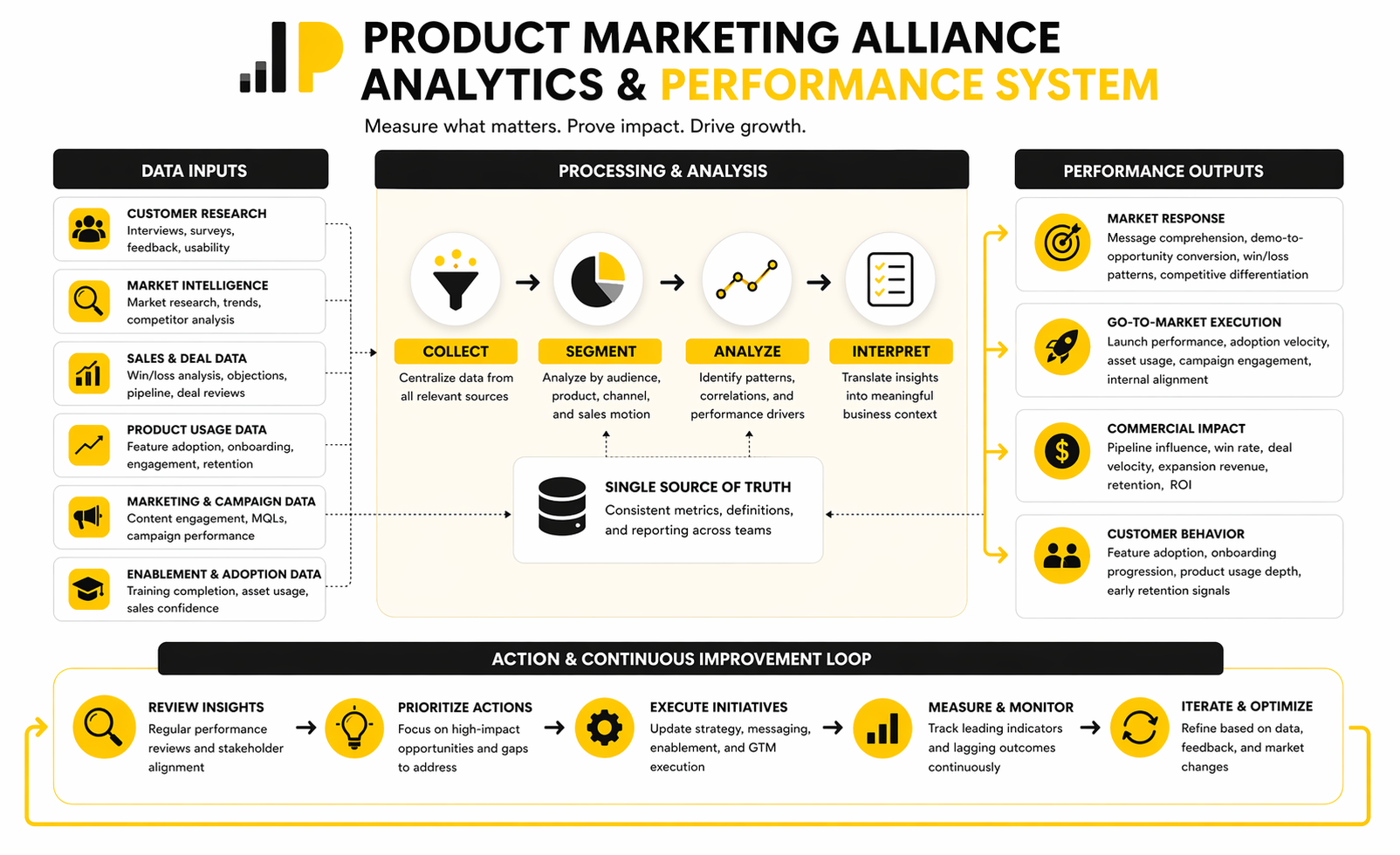
The first category to watch is market response. This includes signals like message comprehension, competitive differentiation, demo-to-opportunity conversion, and win-loss patterns tied to specific objections. These metrics matter because they tell you whether the story is doing its job before you jump to bigger conclusions about pipeline or revenue.
The second category is go-to-market execution. Product Marketing Alliance’s current measurement guidance treats launch performance as more than a calendar event, which is the right approach. A launch should be measured through adoption velocity, sales usage of core assets, campaign engagement, and whether internal teams are actually using the positioning consistently, not through vanity metrics like how many slides were built or how many channels posted on day one.
The third category is commercial impact. This is where pipeline influence, win rate movement, deal velocity, expansion, and retention enter the picture. These are harder metrics, but they matter most because they translate product marketing work into boardroom language, and Gartner’s recent AI value framework makes the same broader argument: leadership cares most about measurable financial and retention outcomes, not activity for its own sake.
The fourth category is customer behavior after the sale. Feature adoption, onboarding progression, product usage depth, and early retention signals often reveal whether the message matched the real product experience. If these numbers stay weak after a launch that looked strong on the surface, the problem may not be awareness at all. It may be positioning drift, poor qualification, or a story that overpromised relative to the customer’s first real experience.
How to Read the Data Without Fooling Yourself
This is where many teams get sloppy. A rise in awareness does not automatically mean better positioning, just like a successful launch webinar does not prove stronger market fit. Product marketing data only becomes useful when it is interpreted as a chain: did the market understand the message, did internal teams use it well, did buyers respond differently, and did that response create better commercial or product outcomes?
That chain matters because PMM metrics are rarely isolated. If sales confidence improves but win rate does not, you may have better internal packaging without real external differentiation. If adoption rises but retention stays flat, the product may be good at initial activation but weak at long-term value realization. If launch metrics look strong but pipeline quality falls, you may have generated attention without attracting the right buyers.
This is also why random benchmark chasing can backfire. PMA’s 2025 reporting that nearly 80% of product marketers work in teams of 1 to 5 people is helpful context, but it should change how you interpret performance expectations. A lean PMM team should not pretend it can track everything with enterprise-level depth; it should choose a smaller measurement system tied directly to its most important commercial responsibilities.
What the Benchmarks Should Drive You to Do
A good measurement system should force action, not just reporting. If go-to-market remains the leading KPI for PMMs, then teams should define what a successful GTM motion actually means before launch begins. That usually includes target audience clarity, message adoption by sales and marketing, expected adoption milestones, and a short list of downstream commercial metrics that will be reviewed after release.
If feature adoption and win-loss insights are central PMM signals, then research loops need to stay active after launch. You do not stop interviewing customers because the asset package is finished. You keep listening so you can learn whether the market is repeating your positioning back to you, misunderstanding it, or choosing competitors for reasons your current narrative does not address.
If leadership wants harder ROI evidence, then PMM needs closer alignment with revenue operations and sales operations. Gartner’s revenue operations framing is useful here because it treats growth as a cross-functional system rather than a set of disconnected team metrics. Product marketing becomes far easier to defend when its work is tied to shared revenue definitions, shared funnel stages, and shared post-launch review cycles.
And if the business is pushing harder into personalization, AI-assisted workflows, or hybrid sales motions, then the measurement model has to evolve too. McKinsey’s recent growth research argues that B2B winners keep investing in omnichannel and experimentation, while its personalization work shows why more tailored experiences matter. For product marketers, that means measurement should increasingly compare message performance across segments, channels, sales motions, and onboarding paths rather than assuming one positioning layer works equally well everywhere.
A Simple Measurement Stack for Product Marketing Alliance Users
The most practical way to use Product Marketing Alliance here is to borrow the discipline of its framework and apply it to analytics. Track one or two metrics for each stage instead of building a giant dashboard no one uses. For example, Discovery can track research volume and insight quality, Strategize can track segment choice and pricing or GTM readiness, Define can track message clarity and competitive resonance, Get Set can track enablement adoption, and Grow can track adoption, win rate movement, and retention trends.
That kind of structure keeps the data honest. It also makes review meetings more useful because the team can see where performance is breaking down instead of arguing in circles about whether “marketing worked.” When Product Marketing Alliance is used well, measurement becomes less about proving activity and more about showing how insight turns into execution, and how execution turns into business results.
Final Verdict
Product Marketing Alliance is most useful when you see it for what it really is: a professional system for making product marketing more consistent, more measurable, and more commercially relevant. It is not magic, and it will not fix weak strategy on its own, but it does give product marketers and teams a common framework, a shared vocabulary, and a practical way to improve how they research, position, launch, enable, and optimize. For a function that is still defined differently from one company to the next, that kind of structure is a real advantage. PMA’s current framework and broader learning ecosystem make that value clear.
The strongest argument for Product Marketing Alliance is not just that it has a large audience. It is that the platform has connected community, certification, benchmarking, and implementation into one operating model that professionals can actually use. When a free membership page points to a community of more than 45,000 product marketers, and the current certification ecosystem highlights CIM and CPD recognition, that signals more than popularity. It signals that Product Marketing Alliance has become one of the main reference points for people who want to take product marketing seriously.
Still, the right takeaway is practical, not tribal. You do not need to treat PMA like a religion to benefit from it. You need to use its framework to tighten your research, sharpen your message, improve cross-functional execution, and build a cleaner measurement system that proves your work matters.
FAQ
What is Product Marketing Alliance in simple terms?
Product Marketing Alliance is a specialist platform built for product marketers rather than for general marketers. It combines community, certifications, events, reports, and practical frameworks so PMMs can learn the role in a more structured way. The reason it gets attention is that it helps turn a loosely defined job into something closer to a repeatable discipline.
Is Product Marketing Alliance only for experienced product marketers?
No, and that is one of the reasons it has grown so much. Its membership and learning paths are positioned for a wide range of experience levels, from newer PMMs trying to understand the basics to more senior operators who need deeper systems for launches, pricing, enablement, and leadership work. The broader ecosystem works best when you treat it as a growth platform, not just a one-time training purchase. The current membership and training pages reflect that wider audience clearly.
Is Product Marketing Alliance worth it for beginners?
For beginners, the value is usually in speed and structure. Instead of piecing together random articles, isolated templates, and contradictory LinkedIn advice, you get a framework that shows how the work fits together from discovery through growth. That does not replace real experience, but it can dramatically reduce confusion in the early stages of a product marketing career.
Does Product Marketing Alliance help with real-world implementation or just theory?
It is much more useful when applied as an operating model than when consumed as theory alone. The current core framework is built around concrete stages such as research, strategy, message definition, readiness, and growth, which makes it easier to map onto launches, positioning refreshes, and sales enablement work. In other words, the framework becomes valuable when you turn it into decisions, documents, and routines inside your team. The latest core certification page shows that implementation-first structure directly.
How large is the Product Marketing Alliance community?
Its Insider page says the community includes more than 45,000 product marketers, which is one reason the platform carries weight in the category. Community size is not the only thing that matters, but it does increase the odds that you will find relevant role-based conversations, peer perspectives, and benchmark context. For a discipline that still lacks standardization, that level of concentration is useful. The free membership page is the clearest current source for that figure.
What makes the Product Marketing Alliance framework useful?
Its real strength is that it is broad without becoming vague. The framework covers Discovery, Strategize, Define, Get Set, and Grow, which reflects the actual flow of strong product marketing work from research to optimization. That matters because many teams are good at only one or two parts of the job, and the framework makes those blind spots harder to ignore. The framework breakdown is one of PMA’s most useful assets for that reason.
Can Product Marketing Alliance help a whole team, not just one person?
Yes, and that is where the value often compounds. A single PMM can use the framework for self-development, but a team can use it to create shared language, cleaner launch processes, better enablement handoffs, and more consistent measurement. When everyone understands what belongs in discovery, strategy, definition, readiness, and growth, cross-functional work usually gets less chaotic.
How should companies measure success after using Product Marketing Alliance ideas?
They should not measure success by course completion or badge collection alone. The better test is whether positioning gets clearer, launch execution gets tighter, sales teams use the message more confidently, and customer adoption or revenue signals improve over time. PMA’s own KPI content reinforces that go-to-market remains a central PMM measurement area, which is exactly why implementation and measurement need to stay linked. Its recent KPI discussion is useful context here.
Is Product Marketing Alliance useful if I already have experience?
Yes, because experienced product marketers often need better systems more than more motivation. At senior levels, the challenge is usually not learning what positioning means. The challenge is making research more rigorous, aligning stakeholders faster, improving enablement, and proving impact in commercial terms, which is where PMA’s frameworks, reports, and benchmark resources can still be valuable.
How does Product Marketing Alliance compare with general marketing education platforms?
General platforms usually treat product marketing as one module among many. Product Marketing Alliance treats it as the center of the whole ecosystem, and that specialization changes the quality of the material because the context is more relevant to PMM work. If your goal is broad marketing exposure, a general platform may be enough, but if your goal is to become better at product marketing specifically, PMA is usually the more direct route.
Does Product Marketing Alliance help with career growth?
It can, especially because product marketing careers often suffer from inconsistent role definitions. A recognized framework, an active community, and visible certifications can make it easier to explain your skills, identify gaps, and show employers that you understand the full commercial scope of the role. PMA also explicitly positions its ecosystem around career development, not just content consumption. Its learning and membership pages make that career angle very clear.
Should you rely only on Product Marketing Alliance to become a strong PMM?
No, and this is important. Product Marketing Alliance can give you structure, language, frameworks, and benchmarks, but great product marketing still depends on live customer exposure, product judgment, collaboration, and repeated real-world execution. The best use of PMA is as a force multiplier for experience, not as a replacement for it.
Work With Professionals
Explore 10K+ Remote Marketing Contracts on MarkeWork.com
Most marketers spend too much time chasing clients, competing on crowded platforms, and losing a percentage of every project to middlemen. MarkeWork gives you a better way. Browse thousands of remote marketing contracts and connect directly with companies desperate to hire skilled marketers like you, without platform commissions and without unnecessary gatekeepers.
If you're serious about finding better opportunities and keeping 100% of what you earn, explore available contracts and create a profile for free at MarkeWork.com.