

Product marketing sits in the space where product truth meets buyer reality. It is the discipline that turns features into value, company language into customer language, and launches into repeatable revenue. When it is done well, the market understands not just what a product does, but why it matters right now.
That matters more than ever because buyers have become harder to influence with generic campaigns and easier to lose with messy positioning. Gartner’s June 2025 buyer survey found that 61% of B2B buyers prefer a rep-free buying experience, while 73% actively avoid irrelevant outreach. At the same time, Product Marketing Alliance’s 2025 state report shows product marketing is being measured more directly against revenue, while Pragmatic Institute’s 2025 industry report shows revenue and profit are now defining product success more often than older activity-based metrics.
Article Outline
- Why Product Marketing Matters Now
- The Product Marketing Framework at a Glance
- Market Intelligence and Positioning
- Messaging, Launches, and Sales Enablement
- Adoption, Retention, and Expansion
- How to Build a Strong Product Marketing Function
Why Product Marketing Matters Now
A lot of teams still confuse product marketing with launch support, content production, or sales collateral. That is too narrow. Product marketing is really the operating layer that connects customer insight, product strategy, market context, positioning, messaging, enablement, and adoption into one coherent commercial system.
The reason this function has become more important is simple: markets are louder, products are more similar on paper, and buyers do more independent evaluation before they ever talk to a human. When buyers self-educate, the company that explains the problem best often earns attention before the company with the longest feature list. That is why strong product marketing creates clarity first and promotion second.
The role itself is also getting more strategic inside companies. Product Marketing Alliance’s 2024 benchmark showed that 80% of product marketers work in teams of just one to five people, which means the function is still lean in many organizations. Yet the 2025 PMA report shows revenue generation is now a common KPI and that product-first operating cultures are rising, which tells you exactly where the discipline is heading: closer to business outcomes, not farther away.
That shift changes how product marketing should be judged. The real question is not whether the launch deck looked polished or whether the webinar got enough registrants. The real question is whether the market understood the product faster, whether the sales team told a sharper story, and whether customers reached value quickly enough to stick.
The Product Marketing Framework at a Glance
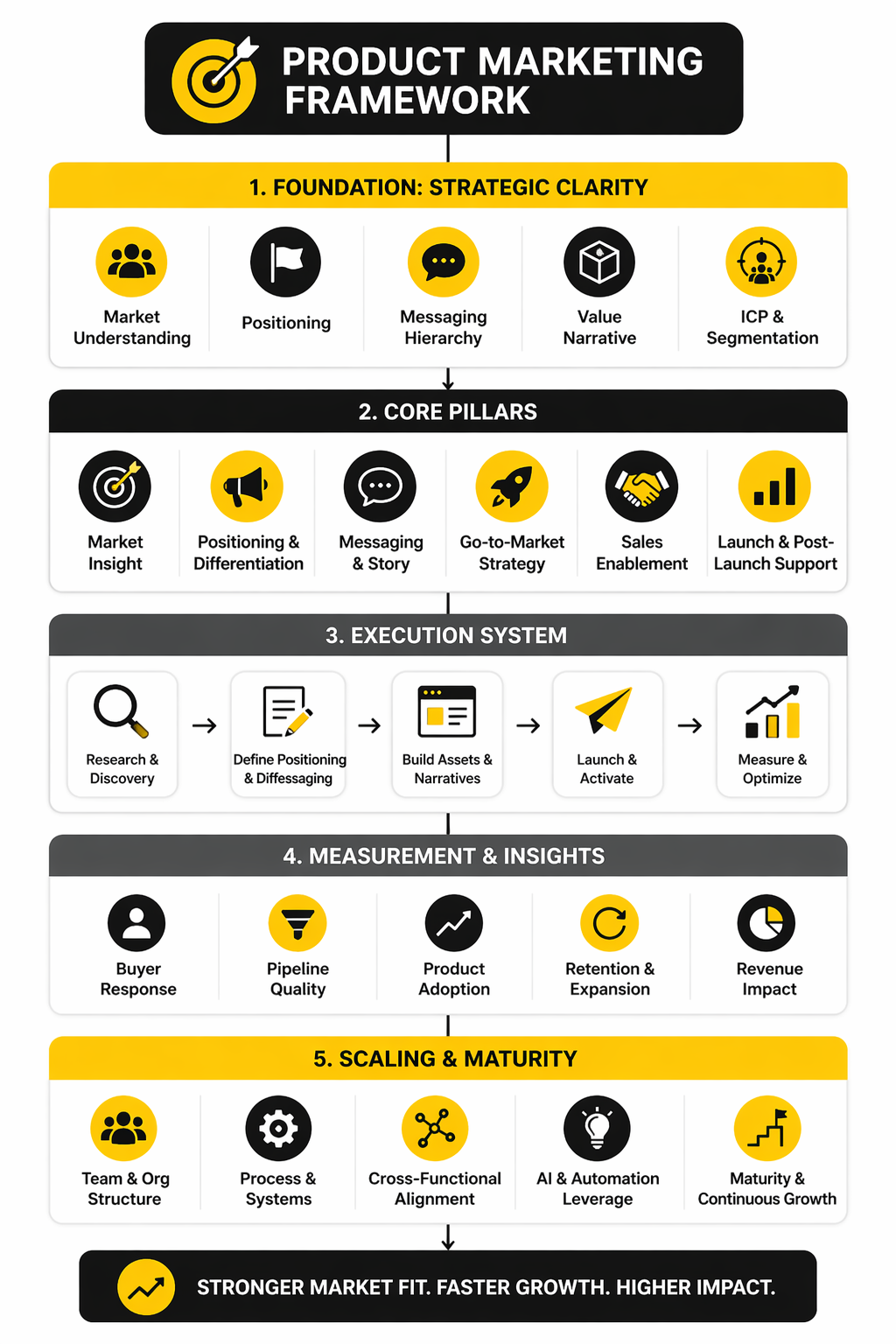
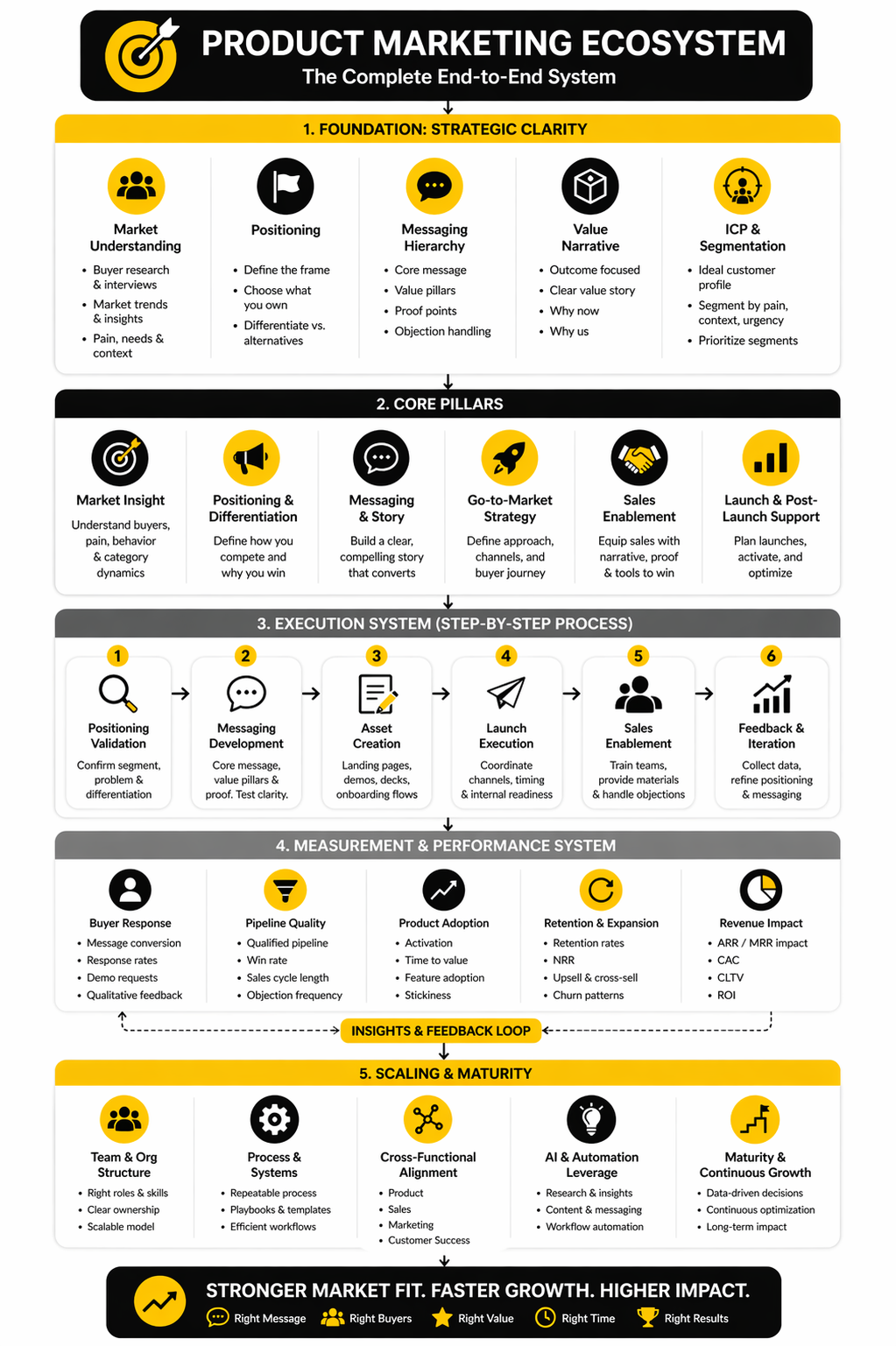
The cleanest way to think about product marketing is as a sequence of connected decisions. First, you understand the market and the buyer. Then you define positioning and messaging. Then you bring that story into launches, channels, sales conversations, onboarding, and retention. Finally, you measure whether the story is landing in the market and changing behavior.
That order matters because product marketing breaks when teams skip straight to execution. If you rush into campaigns before you understand the buyer’s problem, you get noise. If you create messaging before you define positioning, you get copy that sounds polished but interchangeable. If you launch without planning for adoption, you get a spike of attention followed by confusion, low usage, and internal finger-pointing.
The best teams also treat product marketing as a loop, not a one-time project. Forrester’s B2B Buyer Messaging Cycle reflects that shift by framing messaging as an agile, buyer-focused process rather than a static set of statements. That fits what strong teams already know: positioning has to be stable enough to create consistency, but messaging has to keep learning from calls, win-loss patterns, product usage, and market changes.
Data sharpens that loop. Pendo’s 2024 product benchmarks tie product performance to concrete measures like feature adoption, retention, stickiness, and time to value, which is exactly where product marketing should be paying attention after launch. If best-in-class products are reaching a time to value of 0.2 days and user retention of 57%, then product marketing cannot stop at awareness; it has to help shape onboarding, expectation-setting, and proof of value across the full customer journey.
This is the framework the rest of the article will build on. We will move from market intelligence and positioning, into messaging and go-to-market execution, then into adoption and team design, so the entire discipline feels practical instead of abstract.
Market Intelligence and Positioning
The next job of product marketing is to understand the market well enough to make sharp decisions before anyone writes a headline, builds a launch page, or briefs sales. This is where a lot of teams go wrong. They treat market intelligence as background reading, when it should be one of the inputs that determines what the company says, who it says it to, and which fights it should avoid.
That work has become more urgent because buyers are screening vendors earlier and more independently than before. Gartner’s March 2026 sales survey found that 67% of B2B buyers prefer a rep-free experience, which means your positioning often has to do the heavy lifting before a salesperson gets a chance. Once that is true, vague category language stops being a branding problem and becomes a revenue problem.
Strong product marketing starts by answering a few uncomfortable questions clearly. What problem is painful enough to earn attention now? Which buyers feel that pain most acutely? What alternatives are they already using, including spreadsheets, internal workflows, or “do nothing”? And what specific value can your product credibly own without sounding like every other vendor in the category?
Start With Buyer Reality, Not Internal Language
Most weak positioning begins inside the company. Teams describe the product the way they built it, not the way buyers evaluate it. Engineers talk about architecture, founders talk about vision, and marketing talks about broad outcomes, but buyers usually want something much simpler: what is this, who is it for, why is it better for my situation, and how risky is it to choose?
That is why buyer research matters so much in product marketing. Forrester’s buyer messaging cycle is useful because it frames messaging as an ongoing discipline built around buyer understanding, not a one-time copy exercise. Wynter’s guide to message testing points in the same direction by emphasizing that messaging only works when it reflects the problems, priorities, and language real buyers already recognize.
This is also where product marketing earns credibility internally. When you can bring buyer calls, lost-deal patterns, segment-level behavior, and category pressure into one view, you stop arguing from opinion. You give product, sales, and leadership a market-based reason to focus, simplify, and make tradeoffs.
Segment the Market Before You Position the Product
Positioning gets sloppy when the target audience is too broad. “Mid-market companies” is not a market. “E-commerce brands” is not a segment. Product marketing has to narrow the field until the pattern becomes clear enough to support a specific message, a believable proof story, and a realistic go-to-market motion.
The useful way to segment is by combinations of pain, context, urgency, and buying behavior. Two companies with the same revenue can need completely different stories because one is replacing a broken workflow while the other is trying to unlock growth. That difference changes everything from the headline to the proof points to the objection-handling sequence.
The market data supports taking that work seriously. Pendo’s current product benchmarks show that adoption, retention, and time to value vary sharply by product and use case, which means generic messaging will usually miss what matters most in a given segment. Product marketing should treat segmentation as the filter that makes those metrics actionable instead of just interesting.
Positioning Is a Choice, Not a Description
Here is the blunt truth: positioning is not your company bio with nicer wording. It is the deliberate choice of what you want the market to believe about your product relative to alternatives. That means it has to exclude as much as it includes. If your statement could fit five competitors with minor edits, it is not positioning. It is filler.
Good product marketing makes a hard choice about the frame. Sometimes the right move is to define the product against a known category and claim a sharper advantage inside it. Sometimes the smarter move is to reframe the buyer’s decision entirely by showing that the usual comparison set is incomplete or outdated. Both can work, but neither works without discipline.
You can see why this matters in the way the profession itself is evolving. Product Marketing Alliance’s 2025 report shows that product marketing is increasingly tied to revenue and strategic influence, not just launch support. That only happens when the function helps the company make clearer market choices, including who not to chase and which story has the best chance of winning.
The Core Inputs Behind Strong Positioning
Product marketing usually builds stronger positioning when it pulls from several evidence streams instead of relying on one. Customer interviews tell you how buyers describe the pain. Win-loss patterns tell you where the story breaks under pressure. Product usage tells you which outcomes people actually reach. Competitive analysis tells you which claims are already overcrowded.
Those inputs are especially valuable when they disagree. If the sales team says buyers care about breadth, but adoption data shows customers stick because of one specific workflow, that tension matters. If leadership wants a category-defining message but win-loss feedback shows trust and proof are the real blockers, the positioning has to answer the market instead of the org chart.
That is also why professional implementation takes repetition. A positioning statement is not finished when the slide is approved. It is finished when the website, demo, sales deck, onboarding flow, lifecycle messaging, and customer expectations all reflect the same commercial truth.
What Strong Positioning Usually Includes
The structure does not have to be rigid, but the essentials are consistent. Buyers need to understand the target user, the core problem, the value created, the context where the product wins, and the reason to believe the claim. That does not mean dumping a template into every document. It means giving the company one stable strategic story that can be adapted without being diluted.
In practice, strong product marketing usually sharpens positioning through a few questions:
- Who is the best-fit buyer right now?
- What urgent problem are they trying to solve?
- What alternative are they using today?
- Why is this product meaningfully better for that situation?
- What proof makes that claim believable?
Those questions look simple, but they force honesty. They also make later work much easier because messaging, enablement, pricing communication, and launch planning all become cleaner when the positioning has real edges.
Positioning Should Make the Right Buyers Feel Understood
A lot of teams chase cleverness when they should be chasing recognition. The best reaction to positioning is not admiration. It is relief. The buyer should feel that the company understands the situation with enough precision to be useful.
That is where product marketing becomes commercially powerful. Clear positioning reduces the cognitive load on the buyer, shortens the distance between interest and understanding, and gives sales a story worth repeating. In crowded markets, that clarity is not a nice bonus. It is one of the few durable advantages left.
The next step is turning that strategic position into usable language. That is where messaging, launches, and sales enablement come in, and it is where product marketing either compounds its insight or wastes it.
Messaging, Launches, and Sales Enablement
Once positioning is clear, product marketing has to turn that strategic clarity into language and execution that actually moves deals forward. This is where many teams lose momentum. They do the hard thinking upfront, but then dilute it across disconnected campaigns, inconsistent messaging, and generic launch plans.
Execution is where product marketing either compounds its advantage or wastes it. If the positioning is sharp but the messaging is vague, buyers feel friction. If the messaging is strong but sales cannot deliver it consistently, deals stall. And if the launch creates attention without understanding, you get curiosity without conversion.
Turning Positioning Into Messaging That Actually Works
Messaging is not just rewriting positioning in shorter sentences. It is translating strategic intent into language that fits specific moments in the buyer journey. The homepage message, the demo narrative, the outbound email, and the onboarding flow all need to express the same core idea, but in ways that match context and attention span.
That is why message clarity matters more than message volume. Wynter’s message testing data consistently shows that even small changes in clarity and specificity can significantly improve conversion rates, especially in early-stage interactions. Buyers do not reward cleverness. They reward relevance and immediacy.
Product marketing should build messaging layers, not just a single statement:
- Core message: the one idea the market should remember
- Value pillars: 2–3 supporting benefits tied to real outcomes
- Proof points: evidence that reduces skepticism
- Objection handling: direct answers to the most common doubts
This structure makes messaging usable across teams instead of turning it into a static document no one applies.
Launches Should Be Designed for Understanding, Not Noise
Most launches fail because they prioritize visibility over comprehension. Teams chase impressions, clicks, and registrations, but forget that the real goal is to help the right buyers understand why the product matters now.
A strong product marketing launch focuses on a few critical outcomes:
- The right audience recognizes the problem instantly
- The value is clear without needing explanation
- The next step feels obvious and low-risk
This is where execution tools start to matter. Landing pages, funnels, and onboarding flows need to reflect the same clarity as the positioning. Platforms like ClickFunnels or Systeme.io make it easier to build structured launch paths quickly, but the tool is never the advantage. The advantage is having a message strong enough to carry through the entire flow without breaking.
When launches are built this way, they stop being isolated events. They become repeatable systems for introducing new features, entering new segments, or repositioning the product over time.
Sales Enablement Is Where Messaging Gets Stress-Tested
No matter how polished your messaging looks on a website, it gets tested in real conversations. Sales calls expose every weak assumption, every unclear claim, and every missing proof point. That is why product marketing cannot treat sales enablement as an afterthought.
Enablement is about making the message usable under pressure. Sales teams need:
- A clear narrative they can explain in minutes
- Strong examples that connect to real buyer situations
- Structured ways to handle objections without improvising everything
This is also where feedback loops become essential. Product marketing should be listening to calls, reviewing deal notes, and tracking win-loss patterns constantly. Gong’s 2025 revenue intelligence trends show that teams using conversation data improve messaging alignment and close rates faster because they learn from real buyer reactions instead of internal assumptions.
The Execution Process That Ties It All Together
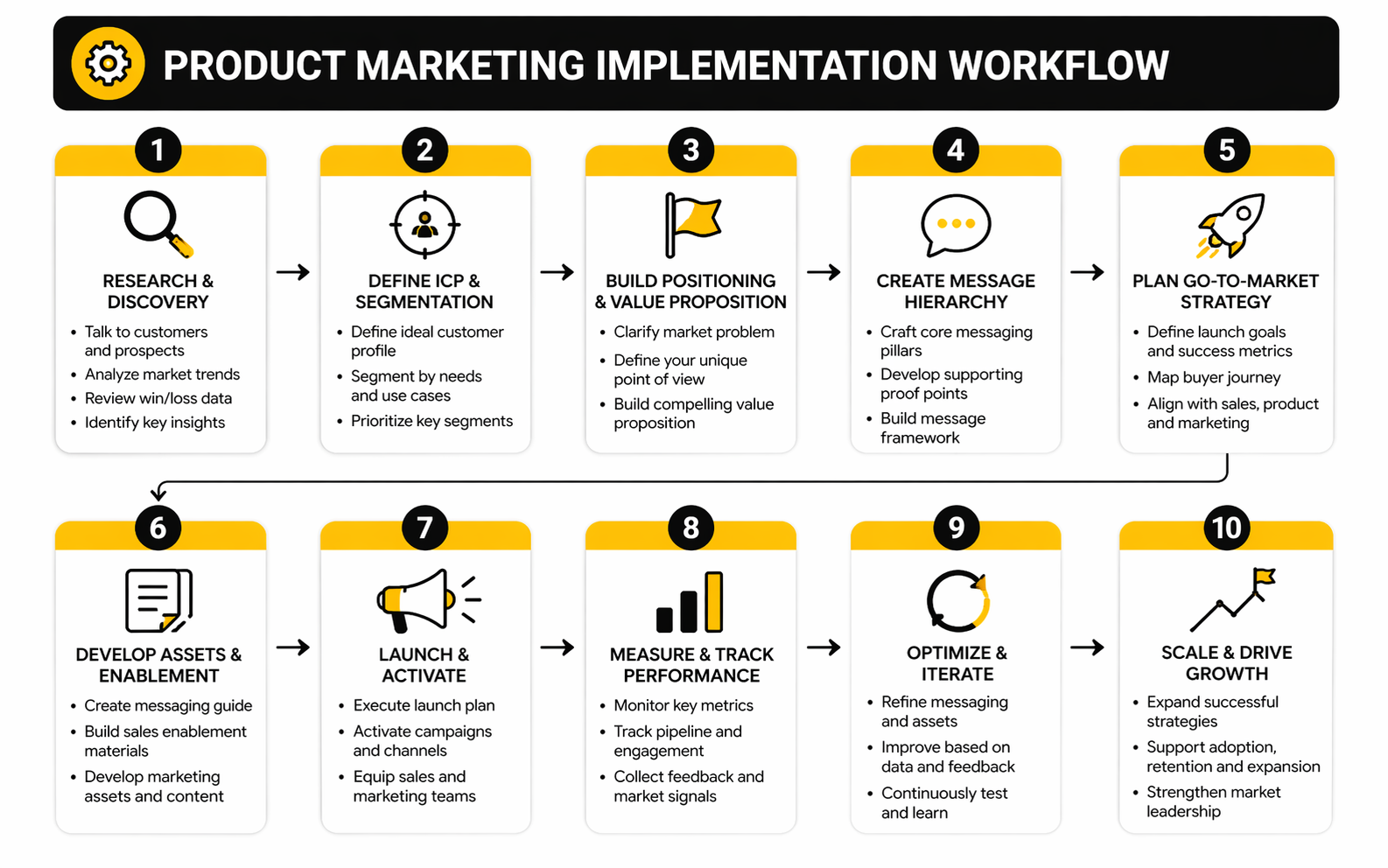
At this point, product marketing needs a repeatable process that connects positioning, messaging, launches, and enablement into one system. Without that, every release becomes a scramble, and every campaign feels disconnected from the last.
A practical execution flow usually looks like this:
- Positioning validation
- Confirm target segment, problem, and differentiation
- Align internally before building anything external
- Messaging development
- Build core message, value pillars, and proof
- Test clarity with real users or prospects
- Asset creation
- Landing pages, demos, decks, onboarding flows
- Ensure consistency across every touchpoint
- Launch execution
- Coordinate channels, timing, and internal readiness
- Focus on understanding, not just reach
- Sales enablement
- Train teams on narrative and objections
- Provide usable materials, not just documentation
- Feedback and iteration
- Collect data from usage, sales, and market response
- Refine positioning and messaging continuously
This is where tools can support the process, especially when managing multiple touchpoints. For example, conversational automation platforms like ManyChat can help reinforce messaging across channels, while integrated platforms like GoHighLevel make it easier to align funnels, CRM data, and follow-up sequences. Again, the tools only amplify what is already there. If the message is weak, the system scales confusion.
Execution Quality Is What Separates Good From Great
At a surface level, many companies look similar. They have websites, campaigns, sales decks, and onboarding flows. The difference shows up in how consistently those pieces reinforce the same story.
Strong product marketing feels coherent. Every touchpoint builds on the last one. Buyers move from curiosity to understanding to confidence without friction. Sales conversations feel aligned with what the buyer already saw. Onboarding delivers the value that was promised.
That level of execution is not accidental. It comes from treating product marketing as a system, not a set of deliverables. And once that system is in place, it becomes much easier to drive the next phase: adoption, retention, and long-term growth.
What the Data Is Really Telling You
A lot of teams say they care about measurement, but what they really track is activity. They count campaign assets, launch dates, email sends, webinar registrations, and content output. That gives the illusion of momentum, but it does not tell you whether product marketing is improving buyer understanding, accelerating adoption, or increasing revenue quality.
That is the real job of measurement in product marketing. The numbers should help you see whether your market story is landing, whether the product promise matches the product experience, and whether your go-to-market motion is creating durable commercial results. When measurement is set up properly, it stops being a reporting exercise and becomes a decision system.
The Metrics That Actually Matter
The cleanest way to evaluate product marketing is to follow the commercial chain from market clarity to business outcome. That usually means looking at four layers together: buyer response, pipeline quality, product adoption, and retention. If you only track one layer, you miss the reason the number moved.
Buyer response tells you whether the message is clear enough to earn attention and action. Pipeline quality tells you whether the story is attracting the right prospects, not just more prospects. Product adoption tells you whether the value promise survives contact with the real user experience. Retention tells you whether the market story and the product reality remain aligned after the sale.
This is exactly why product marketing has moved closer to revenue ownership. Product Marketing Alliance’s 2025 report shows that 53.2% of product marketers now carry revenue generation as a KPI. That shift matters because it forces the function to connect positioning and messaging to measurable business impact instead of staying trapped in launch theater.
Why Activation and Time to Value Matter So Much
If product marketing promises value that users cannot reach quickly, the problem is not just onboarding. It is a broken commercial system. The message may have won attention, but it did not set the right expectation or prepare the user to reach the outcome.
That is why activation and time to value deserve a central place in any product marketing dashboard. Amplitude’s 2025 Product Benchmark Report found that 69% of top performers in week-one activation also ranked as top performers in three-month retention. Pendo’s current benchmark data adds another useful reference point by showing best-in-class products reaching time to value in 0.2 days.
Those numbers are not interesting because they sound impressive. They matter because they tell product marketers where the message may be overpromising, under-explaining, or attracting the wrong fit. If activation is weak, the right response is not always “improve onboarding.” Sometimes the real fix is better expectation-setting before the user signs up.
Retention Is the Truth Serum
Acquisition can flatter you. Retention usually does not. Product marketing can generate a spike in interest with a sharp message, a smart launch, or a timely category narrative, but retention shows whether the product and the market story actually fit together.
That is why retention should be read as a meaning signal, not just a usage signal. Pendo’s 2025 retention benchmarks show that products retain 39% of users after one month and roughly 30% after three months on average. Those are broad reference points, not universal standards, but they are useful because they remind teams how hard it is to hold attention after the initial moment of interest.
When retention underperforms, product marketing should ask sharper questions. Did we position the product for the right use case? Did we attract buyers with urgency but weak long-term fit? Did we make the value sound bigger than the lived experience? Those are not product-only questions. They sit right in the middle of product marketing.
Pipeline Metrics Need Context, Not Just Volume
One of the easiest mistakes in product marketing is celebrating more leads when the real issue is poor-fit demand. Volume looks good in dashboards and status updates, but it often hides weak positioning or over-broad messaging. A better pipeline is usually more selective, more consistent, and easier for sales to convert.
That is where message-to-pipeline alignment becomes important. If demo requests rise but win rates fall, you may have improved attention while damaging fit. If sales cycles get longer after a repositioning effort, the market may be confused even if top-of-funnel numbers look healthy. And if opportunities move faster after the message gets simpler, that is usually a sign that product marketing has reduced friction before the conversation even starts.
This dynamic is becoming more important because buyers are more self-directed than ever. Gartner’s June 2025 survey found that 61% of B2B buyers prefer a rep-free buying experience, and Gartner’s March 2026 update raised that figure to 67%. That means your website, product pages, demos, and onboarding experience are no longer supporting materials. In many cases, they are the primary sales experience.
Build a Simple Analytics System Around Decisions
The best measurement systems are usually not the biggest. They are the clearest. Product marketing needs a view that helps it decide what to fix next, not a giant dashboard full of charts no one trusts.
A practical analytics system usually brings together:
- Message signals: page conversion, response rates, qualitative buyer feedback, demo call reactions
- Pipeline signals: qualified pipeline creation, win rate, sales cycle length, objection frequency
- Product signals: activation, time to value, feature adoption, stickiness
- Growth signals: expansion, retention, churn patterns, segment performance
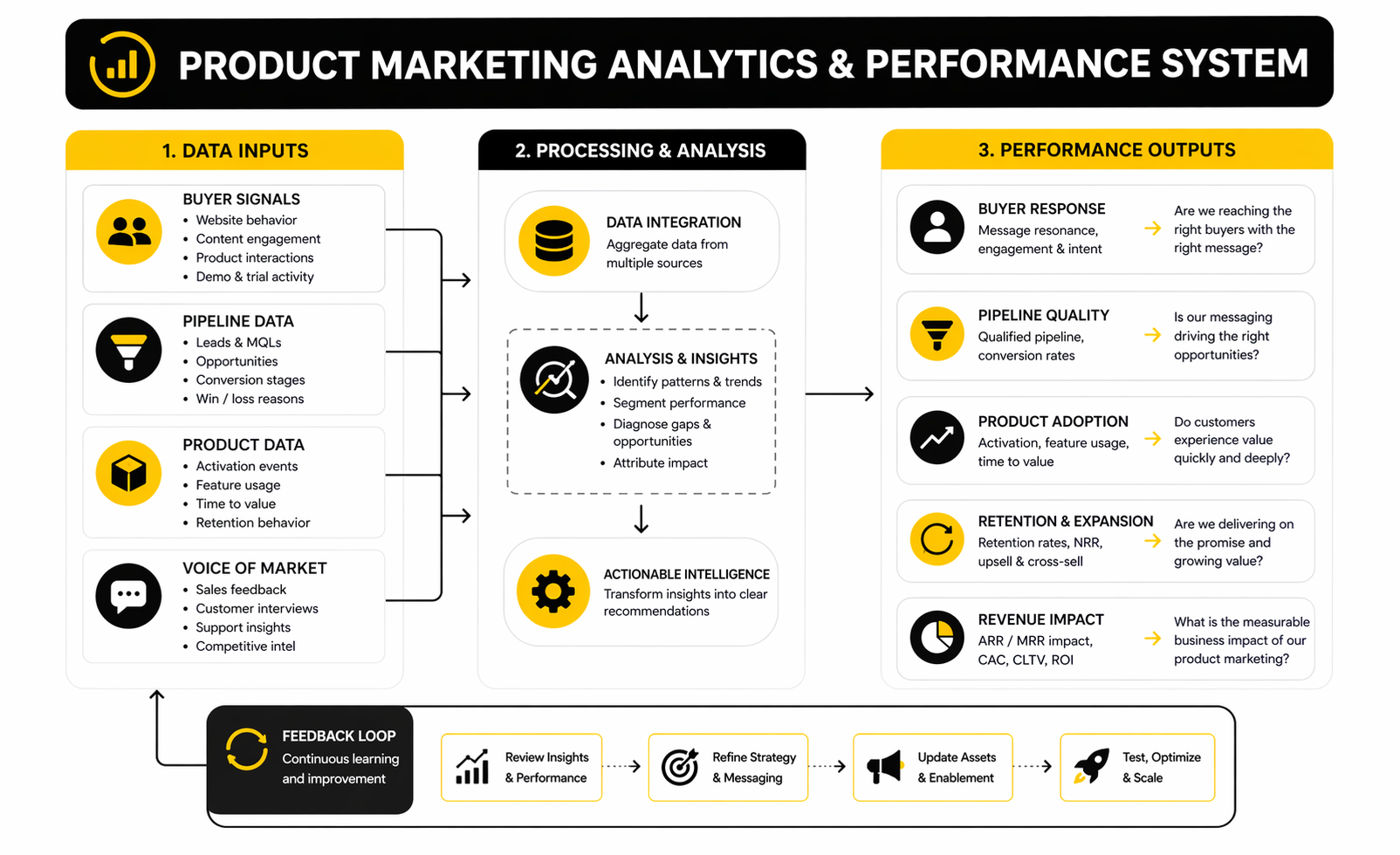
When those layers sit together, product marketing can finally see causality more clearly. If conversion rises but activation falls, the message may be pulling in curiosity without preparing the user for success. If activation improves but expansion stays flat, the initial promise may be landing while the broader value story remains underdeveloped. That is the level where analytics becomes useful.
Tools can help organize this, but the principle matters more than the software. A CRM, product analytics stack, and conversation intelligence layer should work as one measurement loop. Integrated systems such as GoHighLevel, customer communication platforms like Brevo, and scheduling tools like Cal.com can reduce operational friction, but they only matter if the team knows which decisions the data is supposed to support.
Benchmarks Are Useful, but Only If You Read Them Properly
Benchmarks can help product marketers avoid two bad habits: overreacting to normal performance variation and accepting weak performance as inevitable. But they need to be used with care. Benchmarks are reference points, not excuses and not goals by themselves.
For example, Pendo’s benchmark tool offers strong directional context on time to value, engagement, and guide interaction. Amplitude’s benchmark report gives another layer by connecting activation to long-term retention across more than 2,600 companies. Those are useful because they show which patterns tend to travel together, not because they hand you a universal target that applies to every product and segment.
The action should always come from interpretation. If your time to value is slow, the question is not whether you are below a benchmark. The question is what is causing the delay and whether product marketing can remove confusion earlier in the journey. If your retention is average but expansion is weak, the issue may be in packaging, messaging depth, or use-case communication rather than product quality alone.
What the Data Should Drive Next
Measurement in product marketing should create action, not admiration. Every meaningful number should point to a next move. Weak activation should trigger onboarding and expectation reviews. Falling win rates should trigger message and objection analysis. Strong retention in one segment should trigger sharper positioning and more focused demand capture there.
This is where disciplined teams separate themselves. They do not collect numbers just to prove they are busy. They use analytics to tighten the loop between market insight, message quality, product experience, and commercial results.
And once that loop is working, product marketing becomes much easier to scale. The next challenge is organizational: how to build a function that can keep doing this consistently without depending on one exceptional person.
How to Build a Strong Product Marketing Function
By the time a company takes product marketing seriously, it usually has already felt the pain of not doing so. The product is growing, the message is getting stretched across segments, sales wants better enablement, leadership wants clearer category positioning, and launches are starting to feel heavier than they should. That is the point where product marketing stops being a useful individual contributor role and starts becoming an organizational capability.
Building that capability is not just about hiring more people. It is about deciding what product marketing should own, how it should work with adjacent teams, and where it should create leverage instead of becoming a cleanup crew for everyone else’s mess. This is the strategic jump most companies underestimate.
The First Real Tradeoff Is Breadth Versus Depth
Early product marketing teams are almost always underpowered relative to the number of things they are asked to do. They are expected to own launches, messaging, sales enablement, customer research, analyst relations, competitive intelligence, retention support, and sometimes even pricing communication. That can work for a while, but only if the company accepts that not every motion will get the same depth.
This is where discipline matters. Product Marketing Alliance’s 2025 report shows that 44.3% of product marketing teams still have only one or two people, even while revenue responsibility is increasing. That combination creates a clear reality: most teams cannot win by doing more. They win by choosing where product marketing creates the highest leverage and saying no to the rest.
In practice, that usually means deciding whether the current bottleneck is market clarity, launch execution, sales consistency, or adoption quality. If the company has no real positioning, adding more campaign support will not fix anything. If the positioning is strong but launches are chaotic, then execution discipline matters more than another round of buyer research. Product marketing has to follow the bottleneck, not the org chart.
Do Not Let Product Marketing Become a Service Desk
This is one of the biggest scaling risks. Once product marketing proves useful, every team starts pulling on it. Sales wants decks. Product wants launch support. Marketing wants value props. Leadership wants category narratives. Customer success wants retention messaging. Suddenly the function is busy all the time and strategic almost none of the time.
That trap looks productive from the outside, but it weakens the function. Product marketing becomes reactive, fragmented, and increasingly measured by speed of delivery instead of business impact. Over time, the team ends up producing more assets while shaping fewer decisions.
The fix is blunt but necessary: define what product marketing owns and what it influences. Ownership usually belongs in positioning, messaging architecture, launch strategy, market insight, and go-to-market narrative. Influence usually belongs in pricing, onboarding, lifecycle communication, and sales execution. That line will vary by company, but without a line, the function gets buried.
Your Team Structure Should Match Your Growth Problem
There is no perfect product marketing org design because different businesses need different types of leverage. A company with one core product and one main segment can centralize product marketing and stay fairly lean. A company with multiple products, multiple ICPs, and multiple routes to market usually needs more specialization.
The point is not to copy another company’s structure. The point is to align the structure with the commercial complexity you are actually facing. Pragmatic Institute’s 2025 state report reinforces how tightly product success is now tied to revenue and profit outcomes, which means team design should follow the revenue model, not abstract best practices.
A useful way to think about scaling is to add product marketing capability in layers:
- Foundational layer: positioning, messaging, launch basics, sales narrative
- Growth layer: segmentation depth, win-loss analysis, adoption support, expansion messaging
- Scale layer: portfolio strategy, pricing communication, analyst influence, cross-product consistency
That progression matters because hiring specialists too early can create fragmentation, while waiting too long can create strategic bottlenecks that stall growth.
Product Marketing Has to Work Across Power Centers
This part is easy to say and much harder to execute. Product marketing almost never controls all the inputs it depends on. Product owns roadmap decisions. Sales owns frontline conversations. Marketing owns channels and campaign execution. Customer success owns renewal context. Leadership often owns category ambition. Product marketing sits in the middle and has to create alignment without always having formal authority.
That means the job is partly strategic and partly political. Not political in a toxic sense, but in the practical sense of helping different teams agree on the same commercial reality. You need enough trust with product to challenge feature-first narratives, enough trust with marketing to protect message integrity, and enough trust with sales to turn field feedback into actual change.
This cross-functional role is one reason the discipline keeps gaining influence. Product Marketing Alliance’s 2025 data shows product marketers most often collaborate with product and marketing, with 88.8% working closely with product and 81% with marketing. That is not a side note. It is a reminder that product marketing only scales when it becomes the connective tissue between technical reality and market understanding.
AI Changes the Speed of Execution, Not the Need for Judgment
This is another place where teams can get distracted. AI can absolutely help product marketing move faster. It can accelerate research synthesis, draft messaging variants, structure launch content, summarize customer calls, and speed up internal asset creation. Used well, it removes low-leverage work and gives the team more room for strategic thinking.
But there is a real risk here. Faster output can create a false sense of strategic progress. If the positioning is weak, AI just helps you scale weak positioning faster. If the market understanding is shallow, AI can make the language sound polished while making the thinking even more generic.
The broader market context makes that even more important. Forrester’s January 2026 view on zero-click buying argues that buyers will increasingly spend more of their journey with AI answer engines and less time engaging directly with vendor-controlled experiences. That means product marketing has to be even clearer, more differentiated, and more evidence-backed, because the market may encounter your story through summaries and intermediaries before it ever reaches your site.
Scaling Requires More Than Process
By this stage, a lot of companies try to fix everything with templates, launch checklists, and messaging frameworks. Those are useful. You need them. But they are not enough.
The real scaling engine is judgment. Knowing when to narrow a segment, when to simplify a message, when to resist feature overload, when to push back on a launch date, and when to reposition around a sharper use case. Those calls matter more than perfect templates because they shape the commercial truth the whole company will repeat.
That is why strong product marketing leaders build systems without becoming prisoners of the system. They use process to create consistency, but they leave room for strategic intervention when the market signal changes. Forrester’s buyer messaging cycle fits this well because it treats messaging as a repeatable loop, not a static deliverable. That is the right mindset for scaling: stable enough to align teams, flexible enough to adapt.
The Highest-Level Risk Is Losing Market Contact
As product marketing becomes more strategic, there is a strange danger: the team can drift away from actual buyers. It starts spending more time in internal planning, executive reviews, launch planning sessions, and cross-functional alignment meetings. All of that looks important because some of it is important. But if the team stops hearing buyer language directly, the work starts getting smoother and worse at the same time.
That is the risk expert teams guard against. They stay close to calls, interviews, win-loss analysis, support patterns, adoption data, and real objections. They do not outsource market contact completely to sales or research. They stay grounded enough to notice when the story is drifting away from reality.
That is also the right place to move toward the close of this article. Once product marketing becomes a true function instead of an isolated role, the goal is not just to support growth. The goal is to make growth easier, cleaner, and more repeatable. The final part will bring that together and answer the practical questions teams still ask most often.
The final stage of strong product marketing is ecosystem thinking. By that, I mean the ability to connect positioning, messaging, launch execution, sales enablement, measurement, retention, and scaling into one commercial system that keeps learning. That is where the discipline stops feeling like a role and starts feeling like infrastructure.
This matters even more now because buyers are moving through more of the journey on their own terms. Gartner’s March 2026 sales survey found that 67% of B2B buyers prefer a rep-free experience, while Forrester’s January 2026 analysis of zero-click buying argues that buyers will spend more of the process with AI answer engines and less time engaging directly with vendors. That combination raises the standard for product marketing because the story has to be clear, credible, and consistent before a human conversation even starts.
A mature product marketing system usually has a few recognizable traits. It knows which segment matters most right now. It gives every team the same commercial language. It can launch without chaos, measure without vanity, and adapt without losing strategic focus. That is the real endgame.
FAQ
What does product marketing actually do?
Product marketing connects the product to the market in a commercially useful way. That includes market insight, positioning, messaging, launch planning, sales enablement, and post-launch optimization. In practice, the role exists to make sure the right buyers understand the product fast enough to buy, adopt, and stay.
The reason this scope keeps expanding is simple: the market keeps demanding more clarity earlier in the journey. Product Marketing Alliance’s 2026 guide highlights how sales enablement has become one of the biggest core responsibilities for PMMs, which makes sense in an environment where self-education and internal alignment both matter more.
Why is product marketing so important now?
Because buyers are doing more evaluation before they ever speak to sales. When that happens, product marketing becomes responsible for more of the real selling motion than many companies realize. The website, product page, demo narrative, onboarding promise, and proof structure all become part of the buyer’s decision process.
That shift is not theoretical. Gartner’s 2025 survey found that 61% of B2B buyers preferred a rep-free buying experience, and its March 2026 update pushed that figure to 67%. Product marketing matters because the market is demanding clearer commercial experiences.
What is the difference between product marketing and marketing?
Broad marketing often focuses on channels, campaigns, brand visibility, and demand generation. Product marketing focuses on the market story of a specific product or portfolio, including who it is for, why it matters, what makes it different, and how that story should show up across the buyer journey. The two functions overlap, but they are not interchangeable.
The cleanest way to think about it is this: product marketing defines what the market should understand, and broader marketing helps distribute and amplify that understanding. When the two are aligned, growth gets easier. When they are not, even strong campaigns can attract the wrong audience.
What is the difference between product marketing and product management?
Product management is primarily responsible for building the right product. Product marketing is primarily responsible for helping the right market understand and adopt that product. One is centered on roadmap and product decisions, the other on market fit, message clarity, and commercial adoption.
The strongest companies make those roles tightly collaborative. Product Marketing Alliance’s 2025 report shows that product marketers work especially closely with product teams, which reflects reality: weak collaboration here usually creates a gap between what gets built and what the market can actually understand.
What are the core responsibilities of product marketing?
The core responsibilities usually include market research, customer insight, segmentation, positioning, messaging, launch strategy, sales enablement, competitive intelligence, and post-launch performance analysis. Some teams also involve product marketing heavily in pricing communication, onboarding narratives, analyst relations, and expansion messaging.
The exact mix depends on the company stage. Lean teams often combine strategic and execution work inside one role. Larger companies usually split the function by product line, segment, or go-to-market complexity.
How do you know if your product marketing is working?
You know it is working when the market understands the product faster, the pipeline gets cleaner, activation improves, and retention validates the promise. Good product marketing reduces friction across the full journey. It does not just increase activity.
That is why modern teams are measuring closer to business outcomes. Product Marketing Alliance’s 2025 KPI coverage points to revenue-focused metrics such as ARR, MRR, CAC, and CLTV becoming central. The better question is never “did we publish enough assets?” It is “did our clarity improve the commercial result?”
Which metrics should product marketers watch most closely?
The best starting set is usually message conversion, qualified pipeline, win rate, activation, time to value, retention, and expansion. Those metrics show whether the story is attracting the right buyers, whether the product experience matches the promise, and whether customers keep seeing value after the initial decision.
Context matters, though. Amplitude’s benchmark report found that 69% of companies that were top performers in week-one activation were also top performers in three-month retention. That matters because it shows how tightly early value realization and longer-term performance can connect.
How should product marketing work with sales?
Product marketing should give sales a narrative that is clear enough to repeat and strong enough to survive objections. That includes message hierarchy, proof points, competitive framing, objection handling, and a realistic view of which buyers are the best fit. Sales should then feed buyer reactions, objections, and deal patterns back into the system.
The relationship works best when both sides treat messaging as a living commercial asset rather than a one-time deck. Sales hears where the message breaks. Product marketing decides how to sharpen it without losing strategic coherence.
How often should positioning and messaging be updated?
Not constantly, but not rarely either. Core positioning should be stable enough to create market recognition and internal consistency. Messaging should be revisited more often because buying conditions, objections, channels, and use-case emphasis change faster than the product’s strategic identity.
This is exactly why agile messaging has become more relevant. Forrester’s recent messaging cycle work reflects the need for faster adaptation without turning messaging into random weekly rewrites. Stability and responsiveness both matter.
What is the biggest mistake companies make with product marketing?
Treating it like a content support function instead of a strategic commercial function. Once that happens, the team gets pulled into slide-making, campaign support, and launch admin while the hard work of segmentation, positioning, and market clarity gets neglected. That usually creates more output but weaker results.
Another common mistake is measuring activity instead of meaning. If product marketing is only judged by assets shipped, the team will naturally optimize for volume. That is how companies end up looking busy while remaining commercially blurry.
Can AI replace product marketing?
No, but it can absolutely change how fast product marketing works. AI can help synthesize research, summarize calls, generate drafts, test message variants, and speed up production across the board. That is useful. It removes friction from the workflow.
But product marketing still depends on judgment. Someone has to decide which market matters, which message deserves emphasis, which objections reveal a deeper positioning problem, and which signal is noise. AI can assist the process, but it cannot own the commercial judgment that makes the work matter.
What tools are most useful for product marketing teams?
The answer depends on the stage and motion, but most teams need some combination of product analytics, CRM, conversation intelligence, lifecycle messaging, landing page control, and research workflows. The tool stack matters less than the consistency of the message moving through it.
For teams building launch flows and lifecycle paths, tools like Replo can help with fast page execution, while Brevo, ManyChat, and GoHighLevel can support communication, automation, and funnel orchestration. The important part is not the stack itself. It is whether every touchpoint reinforces the same commercial truth.
Work With Professionals
Explore 10K+ Remote Marketing Contracts on MarkeWork.com
Most marketers spend too much time chasing clients, competing on crowded platforms, and losing a percentage of every project to middlemen.
MarkeWork gives you a better way. Browse thousands of remote marketing contracts and connect directly with companies desperate to hire skilled marketers like you, without platform commissions and without unnecessary gatekeepers.
If you're serious about finding better opportunities and keeping 100% of what you earn, explore available contracts and create a profile for free at MarkeWork.com.