

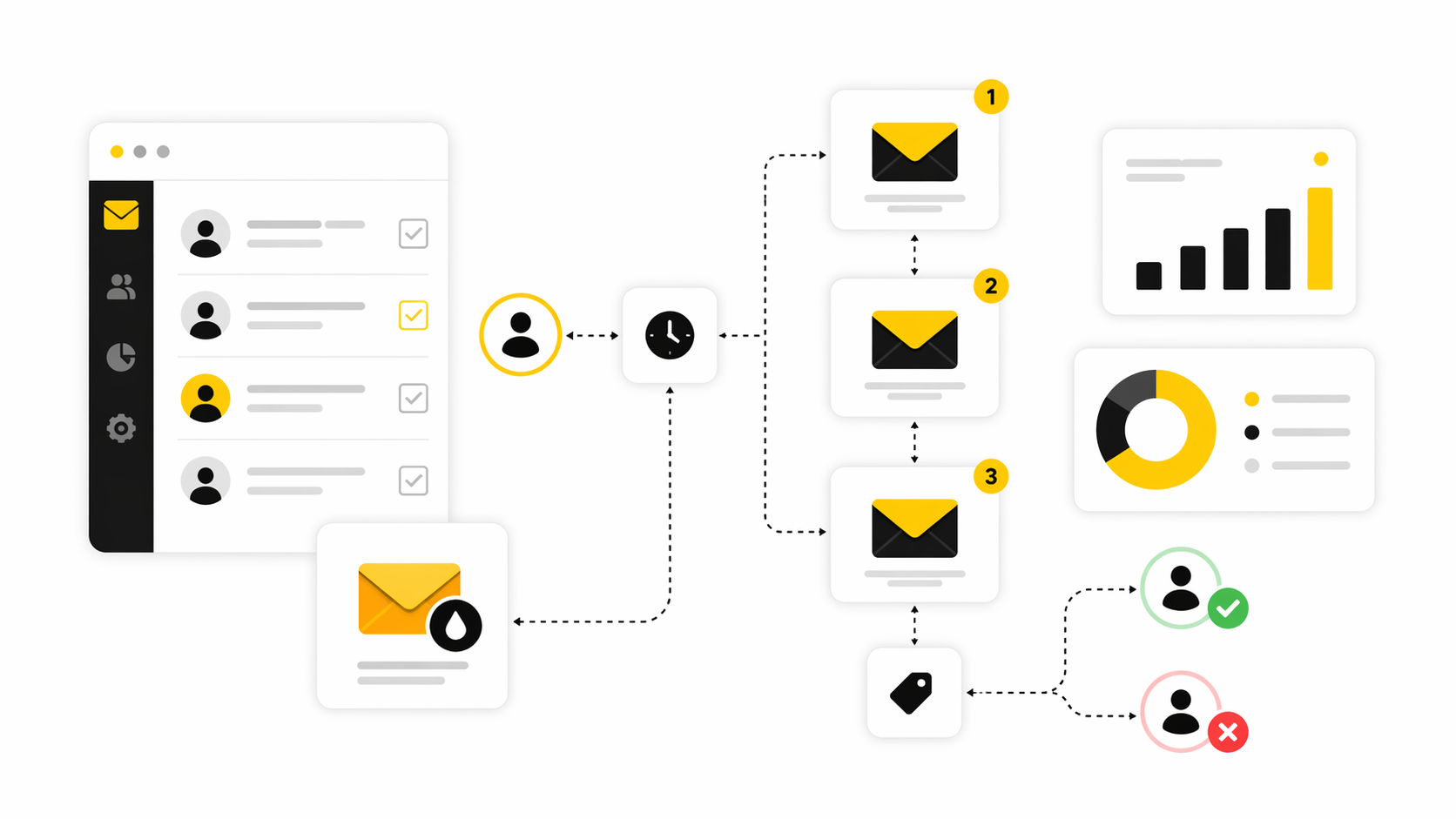
Once the strategy is clear, drip email marketing becomes an execution discipline. This is the point where a lot of teams either build something durable or create a pile of automations that look impressive in the platform and underperform in the inbox. Good implementation is less about fancy branching and more about getting the sequence architecture, data flow, and sending environment right from day one.
The practical mindset here is simple: build the system the way you would want to maintain it six months from now. That means naming conventions that make sense, triggers that are documented, suppression rules that are explicit, and clear ownership of what happens when a contact enters or exits a flow. If that sounds boring, good. In drip email marketing, boring infrastructure is usually what creates reliable results.
Start With a Sequence Map Before You Touch the Tool
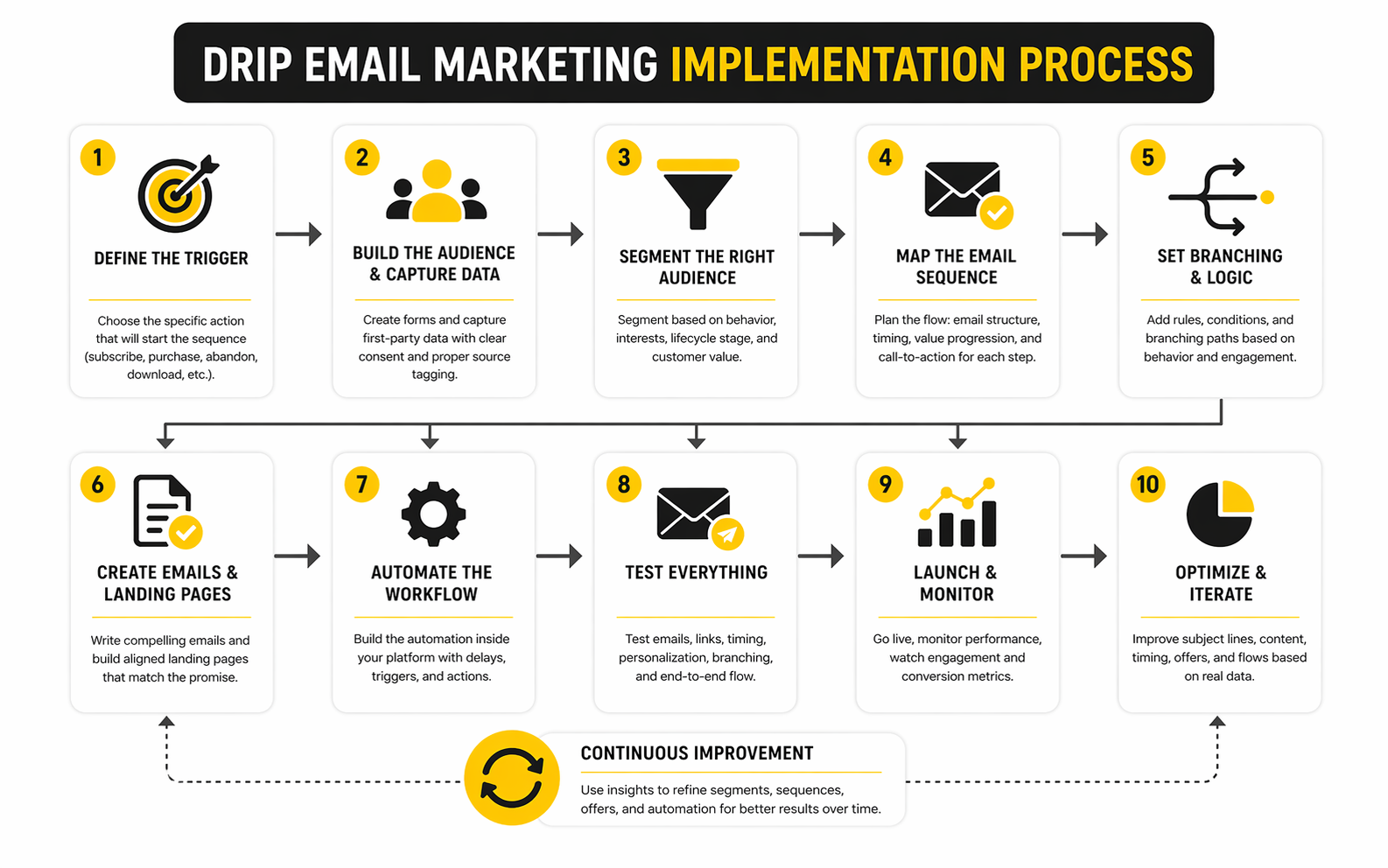
The fastest way to waste time is to open an automation builder before the sequence logic is finished. When teams do that, they make decisions in the interface instead of in the strategy, which leads to messy branches, duplicated filters, and random delays that nobody can explain later. A clean sequence map prevents that because it forces the team to define entry conditions, email order, exit rules, and success events before implementation begins.
A simple planning model usually covers five things: trigger, audience filters, message order, branching logic, and stop conditions. That gives you enough structure to build without overengineering. It also makes handoff easier if different people own copy, CRM operations, and deliverability.
This is where drip email marketing becomes tangible for the business. You can look at the flow on one page and immediately spot weak logic, missing events, or emails that do not earn their place. That kind of visibility matters because maintenance is part of performance, not an afterthought.
Build Around Customer States, Not Internal Teams
Most companies organize work by department, but customers do not experience brands that way. They do not care whether the email came from lifecycle, sales ops, CRM, or ecommerce. They only notice whether the message makes sense given what they just did.
That is why implementation should follow customer states like subscriber, evaluator, first-time buyer, repeat buyer, inactive lead, or at-risk customer. Once the automation is built around those states, the messaging becomes more coherent and the branching logic gets easier to manage. Without that structure, drip email marketing often turns into competing automations firing from different systems at the same person.
This is also where centralization helps. Platforms such as GoHighLevel are attractive when a business wants CRM, pipeline, and automation logic in one place. If the team needs a lighter setup focused on email and marketing automation, Brevo can make more sense. The tool choice matters less than whether the system gives you one reliable source of truth for sequence entry, suppression, and conversion events.
Treat Event Tracking Like Revenue Infrastructure
You cannot run strong automations on weak event data. If form submissions fail to pass source details, if purchases arrive late, or if product views are missing, the drip logic becomes unreliable immediately. The result is familiar: wrong emails, wrong timing, wrong audience, and a team that no longer trusts its own flows.
The implementation fix is to define a tight event layer before launch. That usually includes subscription source, lead status, product or category interest, purchase status, order value, last engagement, and a clean way to record major conversion actions. For more advanced programs, it also includes negative events such as refund, cancellation, inactivity, or failed payment so the system can respond intelligently instead of blindly continuing the sequence.
This is one of those areas where discipline beats cleverness. You do not need fifty events to make drip email marketing work. You need the right events, passed consistently, with names and definitions the whole team understands.
Keep Deliverability in the Build, Not at the End
Deliverability is not something you check after the automations are live. It is part of implementation from the start. The moment you build email as a growth channel, you are also building a sender reputation system that mailbox providers will judge continuously.
That is why current bulk-sender rules matter so much. Google requires bulk senders to support one-click unsubscribe for marketing email and explicitly recommends making it easy for recipients to opt out through the headers and message design in its email sender guidelines. Yahoo also requires a functioning list-unsubscribe option, a visible unsubscribe link, and says senders should keep spam complaint rates below 0.3% in its sender best practices.
The practical takeaway is blunt: if a drip sequence is difficult to leave, it is not just annoying. It is dangerous. Validity’s 2025 deliverability benchmark showed global inbox placement is still far from guaranteed, and Microsoft inbox placement in that report was especially tough at 75.6%. In other words, the email only works if it actually reaches the inbox, and implementation choices directly affect that.
Use a Launch Process That Reduces Preventable Mistakes
A professional rollout should be boring in the best possible way. Before a sequence goes live, every email should be checked for rendering, links, personalization logic, suppression conditions, UTM consistency, and unsubscribe behavior. Trigger tests should verify not just that the first email sends, but that the correct branches fire when users click, convert, or exit.
A simple launch checklist usually catches most of the expensive mistakes. It should include domain authentication, seed-list testing, internal test contacts, QA for mobile rendering, and confirmation that conversions remove people from inappropriate follow-up paths. The cost of skipping this work is higher than people think because automation mistakes repeat at scale.
This is also the moment to be realistic about workload. If the team cannot reliably QA complex branching, the answer is not to build a more complex workflow. The answer is to simplify the sequence until the business can operate it confidently.
Make the Copy Systematic Without Making It Sound Mechanical
Implementation is not just infrastructure. It is also the writing system behind the flow. If each email is written in isolation, the sequence usually loses rhythm and starts sounding like six different people are talking.
A better approach is to define the role of each message before writing. One email confirms the situation. Another builds clarity. Another answers objections. Another creates urgency. Another opens the next step. That keeps the sequence moving and makes editing easier because each email has a specific job.
This structure is especially helpful when multiple people touch the project. The team can keep the voice consistent even while different contributors handle product details, offers, or compliance language. In drip email marketing, strong implementation often shows up in how smooth the sequence feels, not in how complicated the workflow looks behind the scenes.
Connect Email to the Rest of the Funnel
Drip sequences work better when they are not forced to carry every part of the conversion alone. Sometimes the right move is a landing page, a form update, a booking flow, a CRM task, or a retargeting handoff that supports the email sequence instead of making every email do everything. That is where automation starts feeling like a real operating system rather than just a sending tool.
For example, a sequence that pushes readers to a generic page will usually underperform compared with one that routes them to a focused page matched to the trigger context. Brands building those post-click experiences may use tools like Replo for landing-page execution, or combine forms and data capture with tools such as Fillout when the sequence depends on better first-party input. The point is not the specific stack. The point is that drip email marketing gets stronger when the email is connected to the next action cleanly.
That same logic applies to sales and scheduling flows. If the right next step is a call instead of another email, routing people toward Cal.com or a CRM-connected workflow can outperform adding more copy to the sequence. Strong implementation respects the funnel stage instead of assuming every problem should be solved inside the inbox.
Document the System So It Can Scale
The hidden sign of a mature automation program is documentation. Not glamorous documentation, just useful documentation. Each sequence should have a clear purpose, defined trigger, owner, key dependencies, and a note on what metrics matter most.
That sounds operational because it is operational. But this is exactly how drip email marketing avoids decay. Without documentation, teams forget why a delay exists, which condition is suppressing contacts, or whether a branch was meant to support a legacy campaign that no longer matters.
The payoff is bigger than maintenance. Once the system is documented, optimization becomes easier because the team can see where to test, where to consolidate, and where to expand. That leads naturally into the next stage of the article, which is where the real gains usually show up: measuring what matters, testing the right variables, and scaling without wrecking deliverability or customer trust.
What the Metrics Are Really Telling You
Once a drip email marketing system is live, the temptation is to stare at open rates and call it analysis. That is how teams end up making cosmetic changes while missing the real problems. Useful measurement is not about collecting more numbers. It is about understanding which metric reflects attention, which one reflects intent, which one reflects friction, and which one reflects actual business impact.
This matters even more now because email data has become messier. Apple’s Mail Privacy Protection changed how reliable opens are for many senders, and mailbox-provider filtering has made inbox placement a performance variable in its own right. That means modern drip email marketing has to be measured as a system, not as a pile of isolated campaign stats.
Start With Outcomes, Not Activity
The first question is not how many people opened the email. The first question is what the sequence was supposed to change. If the flow was built to activate new users, then activation rate matters most. If it was built to recover carts, recovered revenue matters most. If it was built to warm leads for sales, qualified replies, booked calls, or pipeline progression matter more than vanity engagement.
This sounds obvious, but a lot of teams still optimize for the easiest metric to see rather than the metric that reflects business movement. That is one reason automation data often gets misread. A sequence can post healthy opens and still fail commercially because the emails attract curiosity without driving action.
The benchmark gap between campaigns and automation is useful here because it reinforces the point. In Omnisend’s automation report, automated emails reached a 42.1% open rate, a 5.4% click rate, and a 1.9% conversion rate, far above campaign averages in the same dataset. The action that should follow from that data is not “celebrate higher opens.” It is “shift more of the customer journey into triggered, behavior-led sequences where intent is already present.”
Opens Still Matter, but They Cannot Lead the Dashboard
Open rate is still directionally useful. It can help you spot subject-line weakness, poor timing, list fatigue, or obvious deliverability issues. But it is no longer strong enough to carry the entire analysis on its own, especially in environments shaped by privacy protections and automated prefetch behavior.
That is why drip email marketing works better when open rate is treated as an early signal rather than a verdict. If opens drop sharply across a sequence, that may point to inbox placement problems, poor timing, or audience mismatch. If opens stay high while clicks and conversions collapse, the problem is usually inside the message or in the post-click journey.
This is where benchmarks help, but only when they are used carefully. Mailchimp’s benchmark page shows broad campaign averages such as a 35.63% open rate, 2.62% click rate, and 0.22% unsubscribe rate across all users, while ecommerce averages sit lower on clicks at 1.74%. Those numbers are useful for orientation, but they should not become performance goals on their own because a triggered welcome or recovery flow should normally outperform a generic campaign benchmark.
Clicks Are Better, but Context Still Matters
Click rate is usually a stronger performance signal than opens because it reflects active engagement. A click suggests the message created enough clarity, trust, or urgency to move the reader forward. But even that metric can be misleading if the email has weak CTA structure, too many links competing for attention, or landing pages that do not match the promise made in the message.
For drip email marketing, the better question is often not just “what was the click rate” but “where did the click happen and what happened next.” A healthy click rate paired with weak conversion can point to offer friction, landing-page mismatch, or checkout issues. A lower click rate with strong revenue per recipient can actually mean the sequence is doing a better job of filtering for serious intent.
That is why strong analytics connect email behavior to downstream outcomes. Platforms with better workflow reporting can help, but the principle matters more than the software. The sequence should be measured as a chain of causation, not as a collection of disconnected email stats.
Conversion Rate Is the Metric That Keeps You Honest
Conversion rate is where the discussion gets real. It ties the sequence back to the action it was designed to produce. In a mature drip program, this is usually the anchor metric because it reveals whether the sequence is actually changing customer behavior or just generating inbox activity.
The difference between campaign and automation conversion in the Omnisend dataset is what makes drip email marketing so compelling. The same report shows automated emails converting nearly four times better than campaigns, and notes that one in three automated-email clickers purchased compared with one in twenty campaign clickers. That kind of gap should change strategy, not just reporting. It tells you that triggered moments deserve more creative attention, better segmentation, and more ongoing testing than batch sends.
Conversion data also helps expose hidden sequence problems. If the first email in a welcome flow converts well and the second collapses, the issue may be sequencing or repetition. If clicks stay stable but purchase rate drops after a pricing-page update, the bottleneck may not be the email at all.
Unsubscribe and Complaint Rates Are Not Side Metrics
A lot of marketers treat unsubscribes and spam complaints as minor cleanup data. That is a mistake. In drip email marketing, these are trust signals. They tell you whether the audience believes the sequence is relevant, timely, and worth continuing to receive.
This matters at both the customer and infrastructure level. Yahoo’s sender guidance says complaint rates should stay below 0.3% and stresses visible unsubscribe options in marketing mail, while Google’s bulk-sender rules also require easy unsubscribe for promotional messages. That means high complaint rates are not just annoying. They are warning lights that can damage placement and quietly weaken the entire program.
The right action depends on where the problem shows up. If complaints spike at entry, the trigger or expectation-setting is weak. If they rise later in the flow, cadence, redundancy, or audience qualification may be the issue. Either way, the fix is strategic, not cosmetic.
Deliverability Metrics Deserve a Place on the Main Dashboard
A sequence cannot convert if it does not land in the inbox. That sounds obvious, yet many teams still review deliverability separately from lifecycle performance as if it were a technical side issue. It is not. It is part of the core economics of drip email marketing.
The latest benchmark data makes that clear. In Validity’s 2025 deliverability benchmark, one in six legitimate marketing emails missed the inbox, global spam placement nearly doubled from 4.5% in Q1 to 8.6% in Q4 of 2024, Europe posted an 89.1% inbox placement rate, and Microsoft was the toughest major mailbox environment at 75.6% inbox placement. The action those numbers should drive is straightforward: monitor inbox placement, authentication, complaint trends, and list hygiene with the same seriousness you apply to clicks and revenue.
That is especially important when volume rises. If a brand scales sends without maintaining relevance and suppression discipline, the short-term reporting can still look acceptable while inbox placement quietly erodes. By the time revenue drops noticeably, the sender reputation problem is usually harder to unwind.
Build a Measurement Stack That Mirrors the Customer Journey
The cleanest way to measure drip email marketing is to break the journey into layers. The first layer is delivery and inbox visibility. The second is attention and engagement. The third is action. The fourth is commercial outcome. When the dashboard follows that order, diagnosis becomes much easier.
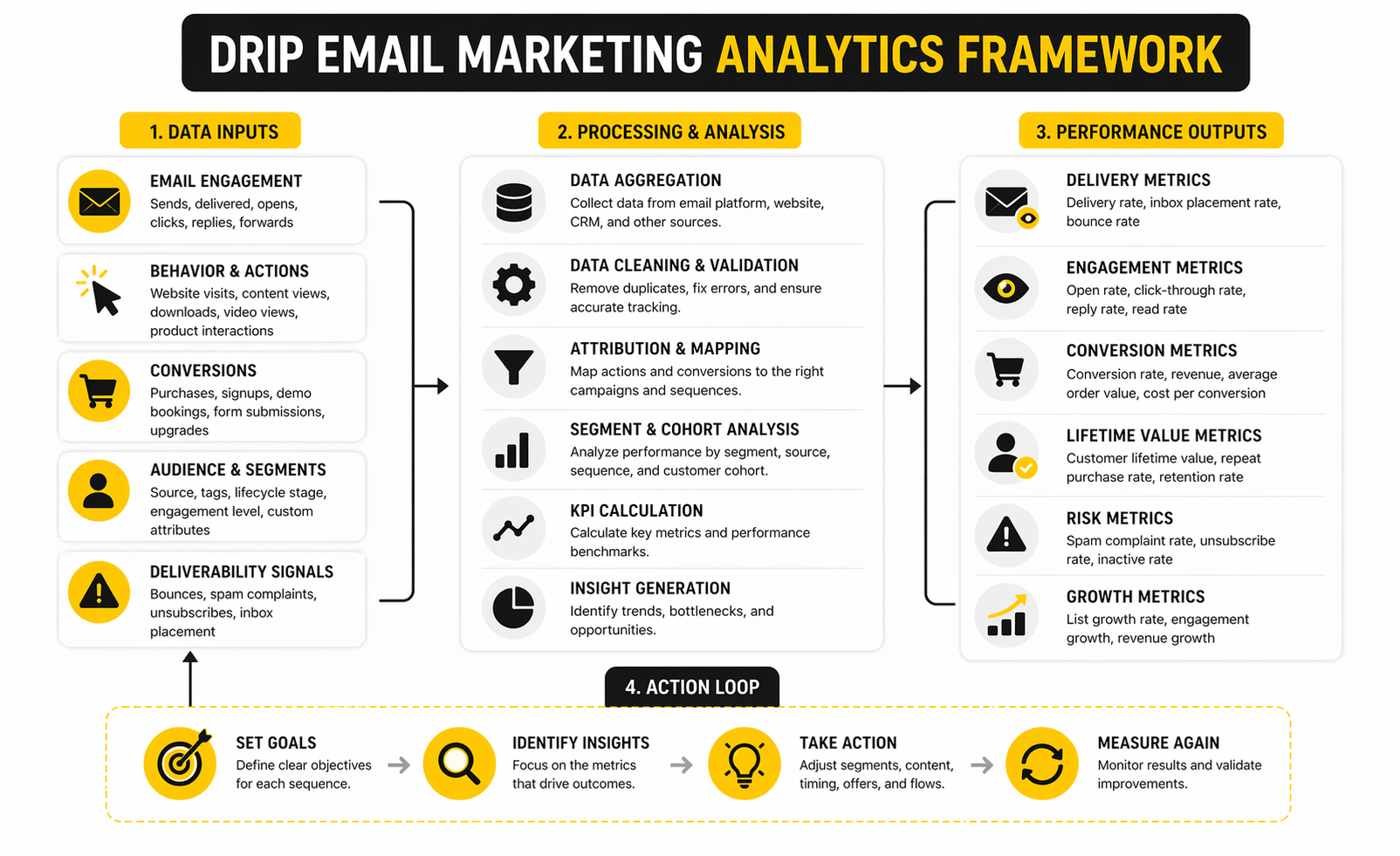
For example, weak delivery plus weak opens usually points to technical or reputation issues. Good delivery plus strong opens but weak clicks usually points to messaging or CTA problems. Good clicks plus weak conversion usually points to post-click friction. This kind of layered reading is far more useful than comparing this month’s click rate with last month’s click rate and hoping the answer appears.
It also keeps the team from overreacting to single metrics. A small open-rate dip may not matter if conversion per recipient improves. A higher click rate may not be good news if unsubscribes also spike. The system has to be read as a whole.
Benchmarks Are a Starting Point, Not a Strategy
Benchmark reports are valuable because they show what normal looks like across industries and sequence types. Klaviyo’s 2025 benchmark report is built from billions of messages, which makes it useful for directional comparison at scale. But benchmark data can also become a trap if it leads teams to optimize for average performance instead of business-specific outcomes.
The better way to use benchmarks is to ask smarter questions. Are your automations outperforming your campaigns by the margin they should? Is your unsubscribe rate unusually high for a welcome or post-purchase flow? Are your clicks strong relative to opens, but weak relative to conversion? Those are strategic questions. Chasing “industry average” in isolation usually is not.
This matters because different drip sequences are supposed to behave differently. A cart-recovery flow should not be judged by the same standards as a long educational nurture. A post-purchase onboarding series may prioritize product adoption or retention rather than immediate revenue. Good measurement respects the job of the sequence.
The Best Metrics Drive the Next Test
The final job of analytics is not reporting. It is decision-making. If the data does not tell you what to test next, the reporting layer is too shallow. Every important metric should create a likely next action.
If opens are weak, test subject line approach, sender name, and trigger timing. If clicks are weak, test message focus, CTA structure, and landing-page match. If conversions are weak, inspect the offer, the page, the checkout, or the sales handoff. If unsubscribes are high, tighten entry logic, reduce redundancy, or shorten the sequence. That is how drip email marketing becomes an optimization system instead of a monthly reporting ritual.
And this is where the article naturally moves next. Once the measurement framework is clear, the next step is scaling performance without losing relevance, overcomplicating the stack, or sending more email than the audience actually wants.
Scaling Drip Email Marketing Without Losing Relevance
Once the foundation is working, the next challenge is not building more automations. It is deciding which automations actually deserve to exist. This is where drip email marketing starts to separate disciplined operators from teams that slowly bury their audience under overlapping flows, conflicting messages, and invisible deliverability damage.
Scaling well means adding precision, not just adding volume. More branches, more triggers, and more content can increase performance, but only if the system stays understandable and the audience still feels like the brand is paying attention. If scale makes the inbox experience feel generic, the sophistication is mostly fake.
Personalization Stops Working When It Becomes Decorative
A lot of brands think personalization means dropping in a first name, showing a recently viewed item, and calling it a day. That can help a little, but it is not what makes drip email marketing feel relevant. Real personalization changes the sequence logic, the timing, the offer, or the next step based on what the person actually did and what they are likely to need next.
That shift matters because customer expectations are still rising. McKinsey’s 2025 research on personalization argues that AI is expanding the ability to tailor experiences at scale, but the real commercial value comes from using better data and decisioning, not just from generating more content. In email, that usually means first-party and zero-party data have more practical value than clever copy variations alone.
The strategic takeaway is simple: personalize the decision, not just the sentence. If two customers should receive different journeys, that matters far more than whether both emails mention the customer’s name. That is the level where drip email marketing starts feeling genuinely useful instead of cosmetically customized.
More Automation Can Create More Collisions
As programs grow, one of the biggest risks is sequence collision. A subscriber might qualify for a welcome flow, browse flow, promotion flow, replenishment flow, and win-back flow within the same month. If those automations are not orchestrated carefully, the customer experiences them as one messy, repetitive brand voice that clearly is not coordinated.
This is why advanced drip email marketing needs priority rules. Some flows should outrank others. Some should pause competing sequences. Some should suppress sends entirely for a period after purchase, after support contact, or after a high-intent sales action. Without these rules, growth teams accidentally optimize individual automations while degrading the total customer experience.
The risk is not only creative fatigue. It also affects complaints, unsubscribes, and reputation over time. Validity’s guidance on complaints and bulk-sender requirements makes the point clearly: even email streams that feel “necessary” internally can trigger negative reactions if the recipient experiences them as excessive or irrelevant.
AI Is Powerful, but It Does Not Remove the Need for Judgment
AI is now part of the conversation around nearly every email program, and for good reason. It can help draft variations faster, summarize customer signals, generate subject line options, and support segmentation ideas that would take much longer manually. Used well, it can absolutely speed up the operating layer of drip email marketing.
But there is a real tradeoff here. The easier it becomes to produce more content, the easier it becomes to flood the system with mediocre content that should never have been sent. Litmus’s 2025 State of Email recap notes that marketers are dealing with personalization challenges, measurement problems, and growing AI use well beyond simple content generation. That combination is useful, but it also makes governance more important, not less.
The best use of AI in this context is usually analytical and operational before it is creative. Let it help identify patterns, surface segments, or accelerate testing ideas. But keep human control over sequencing, offer logic, brand tone, and the moments where one wrong message can make the business look careless.
Frequency Discipline Becomes a Strategic Advantage
When a brand is small, send frequency problems are often obvious. Once a program grows, they become harder to see because no single flow looks excessive on its own. The welcome series may seem reasonable. The product education flow may seem reasonable. The campaign calendar may seem reasonable. The post-purchase automation may seem reasonable. Together, though, they can create a completely unreasonable inbox experience.
That is why advanced drip email marketing needs a frequency view that spans the whole system. The question is not whether one automation is acceptable in isolation. The question is how many messages a real person can receive across all active automations, campaigns, and lifecycle states over a defined period.
This is also where strong teams make deliberate tradeoffs. Sometimes protecting long-term engagement means sending fewer emails in the short term. That is not lost opportunity. It is often the difference between building a durable channel and burning down a list slowly while dashboards still look fine.
First-Party Data Is Becoming the Core Advantage
As privacy rules evolve and paid acquisition costs remain volatile, owned customer data becomes more strategically important. That is one reason email keeps holding its position inside the modern growth stack. It is not just a sending channel. It is one of the clearest ways to turn first-party behavior into measurable follow-up.
Several recent sources point in the same direction. Klaviyo’s strategy material for 2025 emphasizes zero-party and first-party customer data as the base for relevant, timely messaging, while its broader B2C CRM report frames customer data unification as central to modern retention and owned-channel growth. McKinsey’s 2025 personalization research points the same way from a more strategic angle.
The action this should drive is pretty practical. If your drip email marketing still depends on thin subscriber records and broad segments, the next gain may not come from new copy at all. It may come from better preference capture, clearer event tracking, cleaner source attribution, or richer product-interest signals.
Tool Expansion Should Follow Complexity, Not Ego
There is a point where the original email setup starts to feel cramped. Maybe reporting is weak, maybe CRM visibility is fragmented, maybe landing pages and forms live in too many disconnected places. Expanding the stack can help, but only when it solves a real operational constraint instead of creating more surfaces to maintain.
That is where platform decisions become strategic tradeoffs. A business that needs broader workflow control may lean toward something like GoHighLevel, especially if sales process and CRM actions need tighter integration. A business focused on email and marketing automation may prefer a lighter path with Brevo. If post-click experience is the weak point, a landing-page layer like Replo may create more lift than another automation branch.
The expert move is to add infrastructure only where it reduces friction or increases visibility. Too many teams buy complexity before they earn it. In drip email marketing, every added tool should make the customer journey cleaner or the operating model easier to trust.
Governance Is What Keeps Scale From Turning Fragile
At a certain size, performance no longer depends only on smart campaigns or sharp copy. It depends on operating rules. Someone has to decide how flows are named, who can launch new automations, how suppression works, what counts as a conversion, and when a sequence should be retired instead of endlessly patched.
This is the unglamorous side of scaling, but it matters a lot. Without governance, programs grow sideways. Old automations stay live because nobody owns them. Temporary branches become permanent. Reporting definitions drift. Then the team starts arguing over numbers instead of improving them.
Good governance makes drip email marketing faster, not slower. It reduces rework, limits accidental overlap, and makes optimization cleaner because everyone is working from the same logic. That is usually the difference between a program that looks advanced in screenshots and one that actually performs like an asset the business can depend on.
Scaling Should Increase Precision, Not Noise
This is probably the cleanest standard for judging whether an email program is maturing in the right direction. When drip email marketing scales well, the customer sees more relevance, better timing, and fewer useless messages. When it scales badly, the customer sees more volume, more repetition, and more evidence that the automation is being run for the company’s convenience rather than their own.
That is the final strategic tradeoff before the close. You can use automation to manufacture attention, or you can use it to respect intent and deepen the relationship. Only one of those paths tends to compound well.
The last part of the article brings everything together. It will close with the practical endgame: what strong drip email marketing really looks like when the system, the data, and the customer experience are all aligned, plus the FAQ that clears up the most common questions people still get wrong.
Bringing the System Together
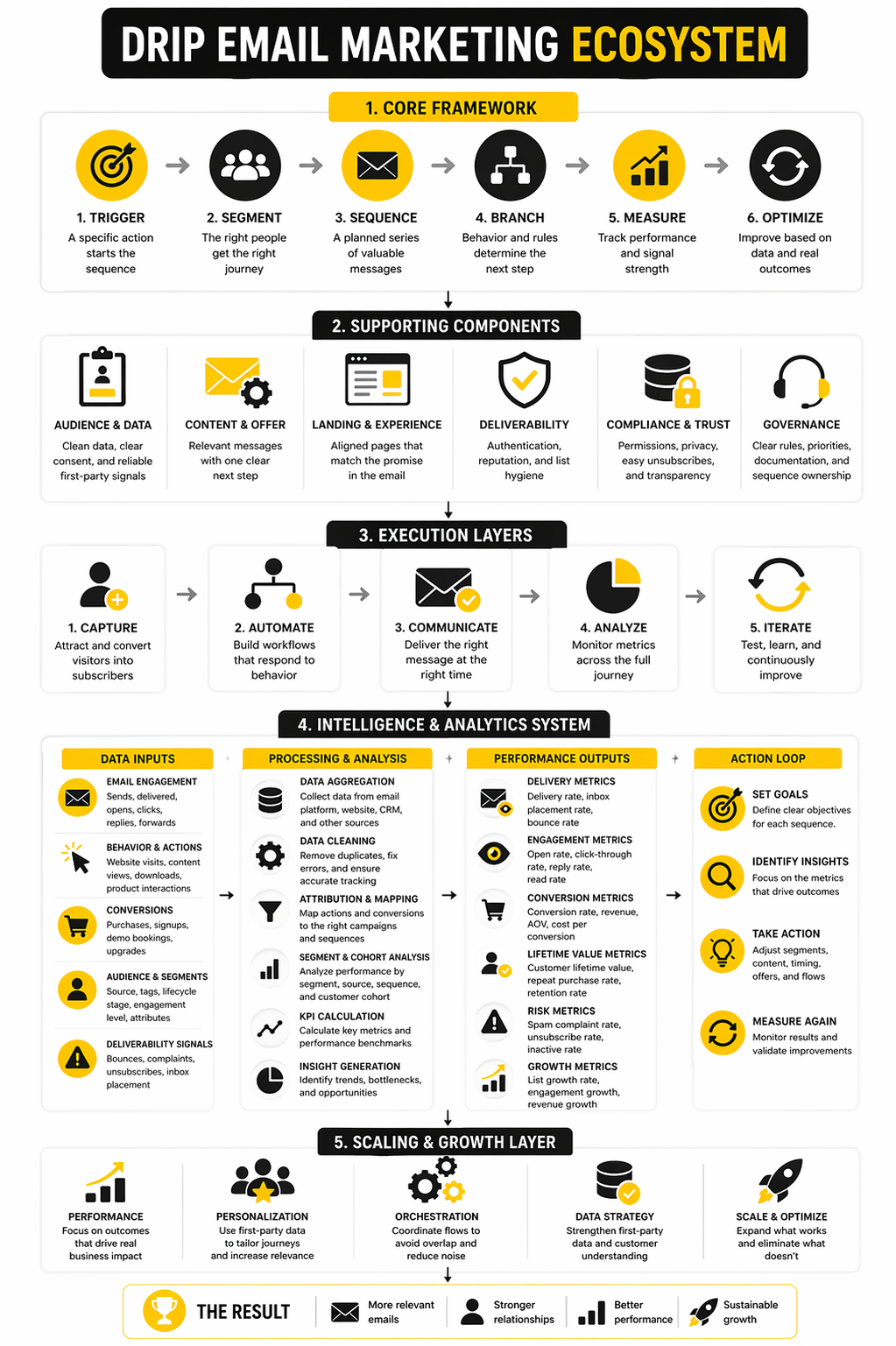
At this point, the shape of strong drip email marketing should be clear. It is not a random sequence of autoresponders, and it is definitely not a “set it and forget it” asset if revenue matters. The real system is built from clean triggers, reliable data, strong message progression, clear suppression logic, serious measurement, and constant respect for deliverability.
When those parts work together, the channel gets much more valuable. The business sends fewer useless emails, customers get more relevant follow-up, and the team can improve performance without rebuilding everything from scratch every quarter. That is the real endgame: not more automation for its own sake, but a marketing system that gets sharper as the business learns more about customer behavior.
For teams that want to level this up fast, the practical stack usually combines a sending platform, a CRM or workflow layer, better forms or data capture, and cleaner post-click experiences. That might mean using Brevo for email automation, GoHighLevel for broader workflow control, Fillout for better first-party data capture, or Replo for tighter landing-page alignment. The exact tool mix matters less than whether the whole system is coordinated.
One thing is non-negotiable now. Bulk senders need proper authentication, low complaint rates, and easy unsubscribes under Google’s sender guidelines and Yahoo’s sender standards. If the automation is clever but the inbox placement is weak, the strategy is still losing.
FAQ
What is drip email marketing in plain English?
Drip email marketing is a sequence of automated emails triggered by a person’s behavior, timing, or lifecycle stage. Instead of sending one campaign to everyone at once, it sends the next relevant message when someone subscribes, browses, abandons a cart, books a demo, buys, or becomes inactive. The reason businesses use it is simple: it lets marketing respond to intent while that intent still has momentum.
How is drip email marketing different from a newsletter?
A newsletter is usually a scheduled broadcast sent to a broad group at the same time. Drip email marketing is behavior-led, meaning the sequence starts and changes based on what an individual contact does. Both can be useful, but they solve different problems, and the performance data from automation-heavy reports such as Omnisend’s benchmark study shows why triggered flows tend to outperform standard campaigns when the goal is conversion.
How many emails should be in a drip sequence?
There is no universal number that works for every business. A welcome sequence may need three to five messages, while a more complex B2B nurture path may need more time and more education. The right answer depends on how much trust, clarity, and urgency the customer needs before taking the next step, not on hitting some arbitrary email count.
How often should automated emails be sent?
Cadence should follow customer intent, not a blanket rule. Someone who just requested a demo or abandoned checkout usually justifies faster follow-up than someone who downloaded a top-of-funnel guide. The best way to judge timing is to watch downstream conversion, unsubscribes, and complaint signals together instead of assuming either “daily is best” or “less is always safer.”
What metrics matter most in drip email marketing?
The most important metric is the outcome the sequence was built to drive. That could be purchase rate, activation rate, booked calls, qualified replies, retention, or reactivation. Opens and clicks still matter, but they should support diagnosis rather than dominate decision-making, especially now that privacy changes and inbox placement issues make superficial dashboard reading much less reliable.
Are open rates still useful?
Yes, but only as a directional signal. Open rates can help you spot weak subject lines, bad timing, list fatigue, or possible deliverability trouble, but they should not be treated as the final measure of success. In modern drip email marketing, clicks, conversions, complaint trends, and inbox placement often tell you much more about what is actually working.
What is a good unsubscribe rate for automated sequences?
There is no perfect single benchmark because sequence type matters, but low and stable is the goal. If unsubscribes rise suddenly, that usually points to weak audience qualification, too much repetition, poor timing, or expectations that were set badly at signup. The important thing is not just to track the rate, but to connect it to the specific email, trigger, and lifecycle stage causing the problem.
Why does deliverability matter so much now?
Because strong copy means nothing if the email does not reliably reach the inbox. Recent benchmarks such as Validity’s 2025 deliverability report show that inbox placement is still far from guaranteed, and Google now requires SPF, DKIM, and DMARC for bulk senders in its sender guidelines. Drip email marketing only compounds well when the underlying sender reputation is protected.
Should every business use personalization in drip email marketing?
Yes, but not the shallow kind. Personalization is valuable when it changes the sequence logic, offer, or timing based on real customer signals such as purchase history, product interest, lead stage, or inactivity. Decorative personalization can make the message look smarter, but strategic personalization is what actually improves relevance and conversion.
What is the biggest mistake teams make with automation?
The biggest mistake is creating too many overlapping flows without strong priority and suppression rules. That leads to inbox collisions, repeated offers, mixed messaging, and rising complaint risk. A smaller number of well-orchestrated sequences usually beats a large pile of automations that all look good individually but create a noisy experience together.
Do small businesses need a complex stack to do this well?
No. Most small businesses do not need a huge stack at the beginning. They need clear triggers, solid segmentation, strong copy, reliable tracking, and a platform they can actually manage without creating operational chaos.
The mistake is assuming maturity requires instant complexity. A lean setup with Brevo or a broader system with GoHighLevel can work well if the core logic is sound. The stack should follow business complexity, not ego.
When should a business rewrite or rebuild an existing sequence?
A rebuild usually makes sense when the trigger logic is outdated, the customer journey changed, reporting is unreliable, or multiple flows are colliding in ways the team can no longer manage cleanly. It also makes sense when conversion stalls even though traffic quality is stable, because that often signals the automation architecture no longer matches real customer behavior. In many cases, the best move is not a total rewrite but a sequence audit that simplifies the system first.
Can AI improve drip email marketing?
Yes, but only when used carefully. AI can speed up ideation, help produce variants, summarize audience signals, and support testing workflows, but it does not replace judgment about message timing, offer relevance, or lifecycle logic. The best use of AI is to strengthen the operating system behind the emails, not to flood the inbox with more content just because content became cheaper to produce.
What does excellent drip email marketing look like at the end of the day?
It looks calm, relevant, and intentional. The emails arrive when they make sense, say something useful, and stop when the customer no longer needs that sequence. The customer feels understood, the business sees measurable movement, and the team can explain exactly why each message exists.
Work With Professionals
Explore 10K+ Remote Marketing Contracts on MarkeWork.com
Most marketers spend too much time chasing clients, competing on crowded platforms, and losing a percentage of every project to middlemen.
MarkeWork gives you a better way. Browse thousands of remote marketing contracts and connect directly with companies desperate to hire skilled marketers like you, without platform commissions and without unnecessary gatekeepers.
If you're serious about finding better opportunities and keeping 100% of what you earn, explore available contracts and create a profile for free at MarkeWork.com.