

Programmatic marketing is the automated buying, selling, targeting, and optimization of digital advertising through data, software, and real-time decisioning. In plain English, it helps marketers decide who should see an ad, where they should see it, how much to bid, and what should happen next.
That matters because digital advertising is no longer just about buying impressions. The market keeps moving toward automation, retail media, connected TV, privacy-safe data, and AI-assisted campaign management. The IAB reported that U.S. internet advertising revenue reached nearly $300 billion in 2025, which makes programmatic marketing less of a niche tactic and more of a core growth system.
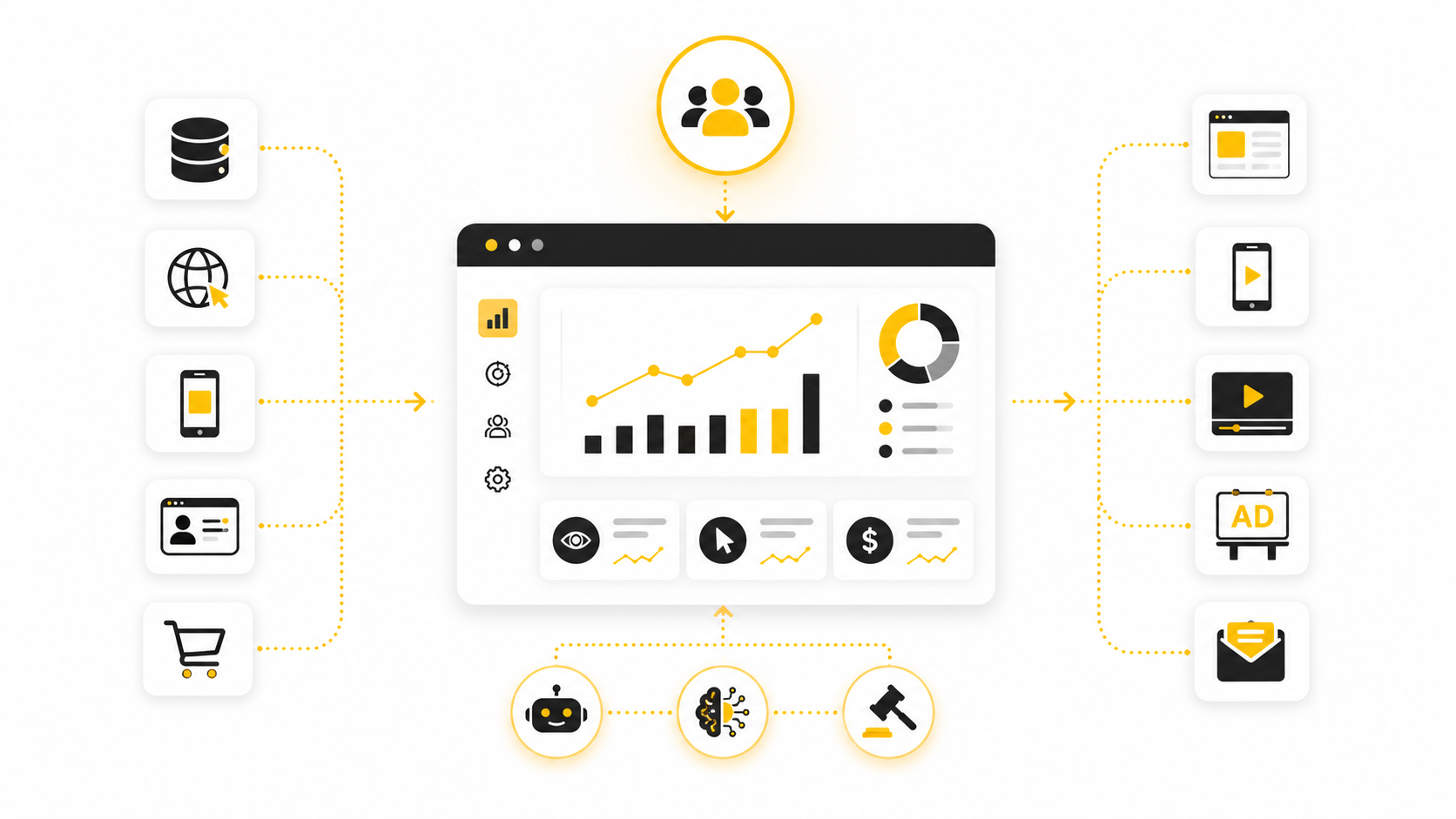
The opportunity is big, but so is the mess. Bad inventory, weak measurement, poor creative testing, messy data, and unclear ownership can quietly drain budget. The ANA’s programmatic transparency work shows why advertisers are putting more pressure on quality, accountability, and supply-path control instead of treating automation as a magic button.
This article breaks programmatic marketing into a practical operating model. Not theory for theory’s sake. The goal is to help you understand how the system works, where the leverage is, and how to build campaigns that can actually improve over time.
Article Outline
- Part 1: Programmatic Marketing In Context
- Part 2: Why Programmatic Marketing Matters Now
- Part 3: The Programmatic Marketing Framework
- Part 4: Core Components Of A High-Performing Programmatic System
- Part 5: Professional Implementation And Optimization
- Part 6: Measurement, Risks, Tools, And FAQs
Programmatic Marketing In Context
Programmatic marketing sits at the intersection of media buying, audience data, creative, analytics, and automation. It is not only display advertising, and it is not only real-time bidding. It can include display, video, connected TV, audio, native, digital out-of-home, and retail media placements, depending on the platforms and inventory being used.
The simplest way to think about it is this: programmatic marketing turns paid media into a system. Instead of manually negotiating every placement, marketers use platforms to make thousands or millions of buying decisions based on audience signals, campaign goals, bid rules, and performance feedback. That system can be powerful, but only when the strategy behind it is clear.
The rest of this article will move from the big picture into the practical details. First, we will look at why programmatic marketing matters now. Then we will map the framework, break down the core components, and finish with implementation, measurement, risk control, tools, and FAQs.
Why Programmatic Marketing Matters Now
Programmatic marketing matters because digital media has become too fragmented to manage well by hand. Buyers are dealing with search, social, display, video, connected TV, retail media, audio, and creator-led placements at the same time. When internet advertising revenue reaches nearly $300 billion in one year, the brands that win are usually not the ones pressing more buttons manually.
The real value is not just automation. The value is better decision-making at scale. Programmatic systems can adjust bids, audiences, placements, frequency, creative rotation, and budget allocation faster than a human team can manually review every impression.
That does not mean the machine should run the strategy. Bad inputs still create bad outcomes. If the audience data is weak, the funnel is broken, or the measurement setup is lazy, programmatic marketing simply helps you waste money faster.
Media Buying Has Become A System Problem
A few years ago, many teams treated programmatic as a media-buying channel. That is too narrow now. It is better understood as an operating layer that connects audience strategy, inventory access, campaign delivery, optimization, and performance feedback.
This shift is important because buying cheap impressions is not the same as buying meaningful attention. The ANA’s programmatic transparency research has repeatedly pushed advertisers to look beyond surface metrics and inspect how much spend reaches quality, measurable, brand-safe inventory. That is the uncomfortable part, but it is also where serious performance gains usually hide.
The practical takeaway is simple. You cannot optimize what you cannot see. A strong programmatic marketing setup needs clean reporting, clear ownership, and enough transparency to separate real efficiency from dashboard theater.
Privacy Changes Made First-Party Data More Valuable
Programmatic marketing used to lean heavily on third-party cookies and broad tracking signals. That world has changed. Browser restrictions, platform privacy changes, consent rules, and shifting identity systems have made first-party data much more important.
This is why CRM data, customer lists, website behavior, purchase history, email engagement, and owned audience signals now matter so much. A business using a CRM and automation platform such as GoHighLevel can build stronger audience segments than a business relying only on generic platform targeting. The advantage comes from owning the relationship, not renting every signal from an ad platform.
The same logic applies after the click. If a campaign sends traffic into a weak landing page, slow follow-up, or generic email sequence, programmatic optimization can only do so much. Tools such as ClickFunnels, Systeme.io, and Brevo fit naturally when the goal is to turn paid traffic into leads, purchases, and repeat engagement.
Connected TV And Retail Media Changed The Game
Programmatic marketing is no longer only about banner ads on the open web. Connected TV, digital video, and retail media have pulled more brand and performance budgets into automated buying environments. Digital video revenue reached $78 billion in 2025, while commerce media reached $63.4 billion, which shows why programmatic planning now touches the full customer journey.
This matters because retail media brings purchase-intent data closer to the ad impression. A brand can use commerce signals to reach people who are more likely to buy, not just people who match a broad demographic. That can make targeting more practical, especially when campaigns are tied to real product demand.
Connected TV adds another layer. It gives advertisers a way to combine TV-style storytelling with digital-style targeting and measurement. The catch is that CTV also brings challenges around frequency, identity, inventory quality, and attribution, so it needs discipline rather than blind budget shifts.
AI Raised The Ceiling And The Risk
AI is making programmatic marketing faster, but speed is only useful when the system is pointed in the right direction. Machine learning can help with bid optimization, predictive audiences, creative testing, budget pacing, and anomaly detection. It can also hide weak assumptions behind confident-looking automation.
That is why professional marketers need to understand the levers, not just trust the platform. The person who knows the offer, margin, sales cycle, customer quality, and creative angle still has a major advantage. AI can optimize toward a goal, but the business has to choose the right goal.
This is especially important for lead generation. Optimizing for the cheapest lead can create a pile of contacts nobody wants to call. Optimizing for qualified pipeline, booked appointments, paid trials, or customer lifetime value is harder, but it is much closer to how money is actually made.
The Programmatic Marketing Framework
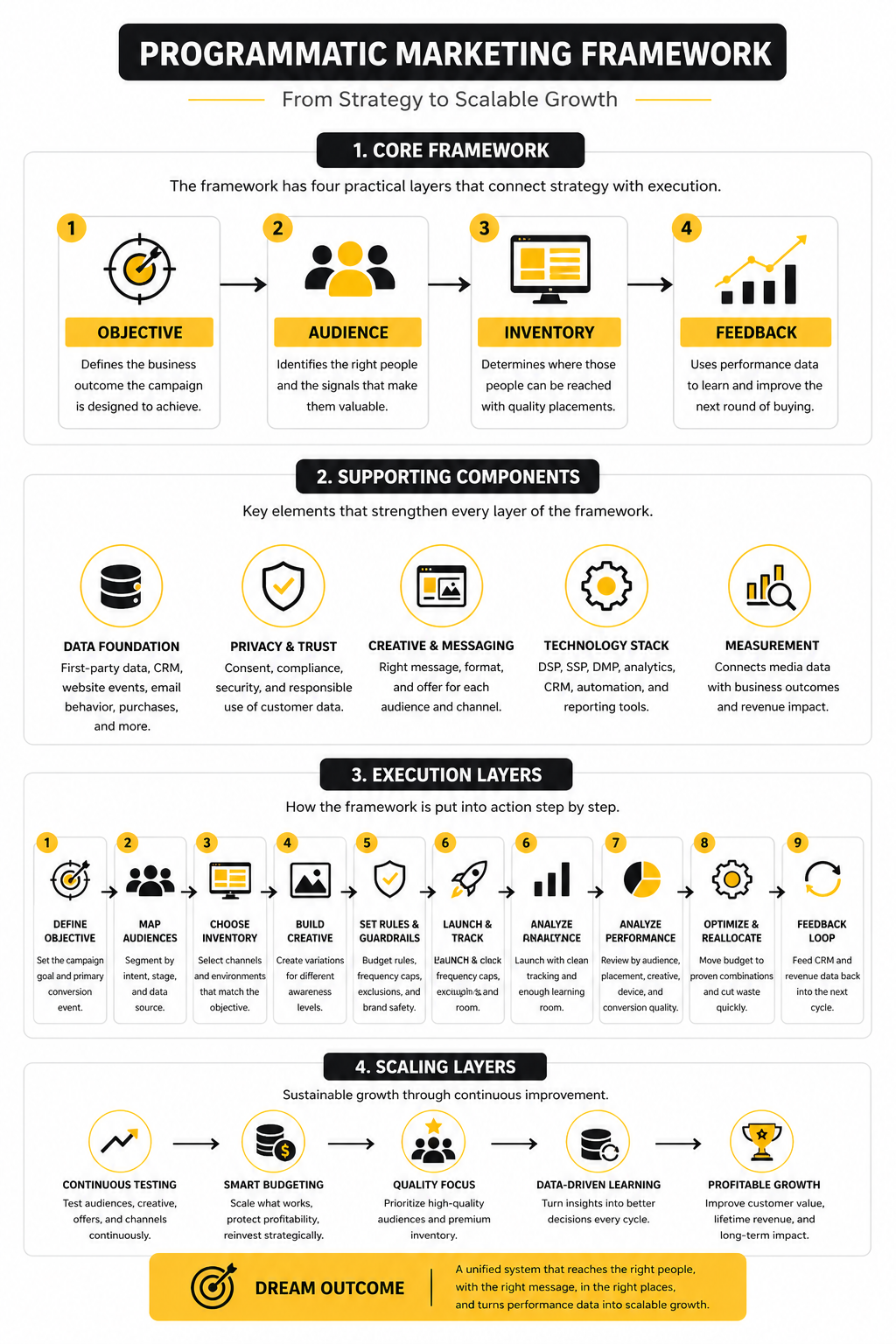
Programmatic marketing works best when it is treated as a framework, not a channel checklist. The framework starts with a business goal, translates that goal into audience and media decisions, then uses performance data to improve the next round of buying. That sounds obvious, but many campaigns skip the hard thinking and jump straight into platform setup.
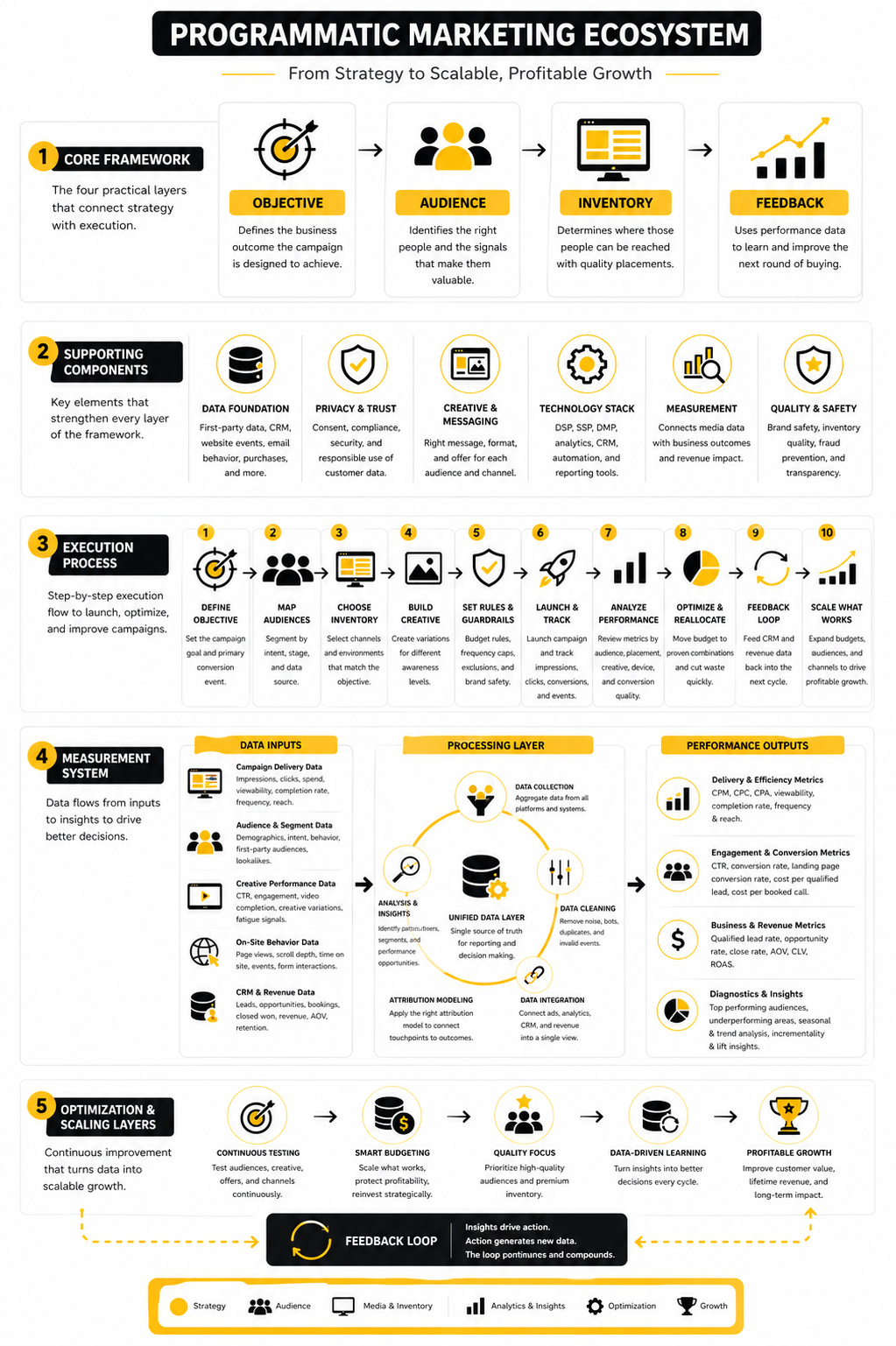
The framework has four practical layers: objective, audience, inventory, and feedback. The objective defines what the campaign is supposed to produce. The audience determines who should be reached and what signals make them valuable. The inventory layer decides where those people can be reached without wasting budget on weak placements. The feedback layer tells the system what to change next.
This is where programmatic marketing becomes useful. It gives you a way to connect strategy with execution without rebuilding the campaign from scratch every time the market shifts. EMARKETER expects programmatic to account for 96.8% of new display ad dollars in 2025, which makes the framework important for almost any serious digital advertiser.
Start With The Business Outcome
The first step is not choosing a DSP, audience segment, or creative format. The first step is deciding what business outcome matters most. A campaign built for qualified leads should not be judged the same way as a campaign built for reach, product consideration, store visits, app installs, or repeat purchases.
This matters because programmatic platforms optimize toward the signals you give them. If you reward cheap clicks, you will usually get more cheap clicks. If you reward qualified pipeline, purchases, subscription starts, or high-intent actions, the system has a better chance of learning from behavior that actually matters.
The goal should also match the sales cycle. A low-ticket ecommerce offer can often move faster from impression to purchase. A complex B2B offer may need retargeting, lead scoring, email follow-up, booking flows, and sales-team feedback before the campaign can be judged properly.
Map The Audience Before You Buy Media
Once the outcome is clear, the next step is audience mapping. This means separating the people you want to reach into useful groups based on intent, relationship stage, and available data. Cold prospects, warm visitors, existing leads, past customers, and high-value accounts should not all receive the same message.
First-party data is the strongest foundation because it comes from relationships the business already owns. CRM records, email behavior, form submissions, website events, purchase history, and booked calls can all help shape better audiences. A platform such as GoHighLevel can be useful here because it keeps lead capture, pipeline visibility, follow-up, and automation closer together.
The mistake is assuming more targeting always means better targeting. Overly narrow audiences can limit learning, raise costs, and make performance unstable. The smarter move is to define audiences clearly, test them cleanly, and let results show which signals deserve more budget.
Choose Inventory Based On Fit, Not Hype
Inventory is where the ad actually appears. That could mean open-web display, premium video, connected TV, retail media, native placements, audio, or private marketplace deals. Each environment has a different role, so the question is not which one is trendy. The question is which one fits the objective, audience, creative, and measurement plan.
Connected TV can be strong for reach and storytelling, but it needs frequency control and realistic attribution. Retail media can be powerful when purchase-intent signals are relevant, but it can also become expensive if the brand does not understand margin and incrementality. Open-web display can still work, but only when inventory quality, fraud controls, and placement transparency are taken seriously.
The ANA’s programmatic benchmark work shows why this discipline matters. Its Q1 2025 findings noted that benchmark participants were moving more spend toward quality ad impressions and away from low-quality made-for-advertising placements, after earlier research showed that a meaningful share of open-web spend could be better allocated. That is the point: programmatic marketing is not only about reaching people, but reaching them in environments worth paying for.
Turn Strategy Into An Execution Process
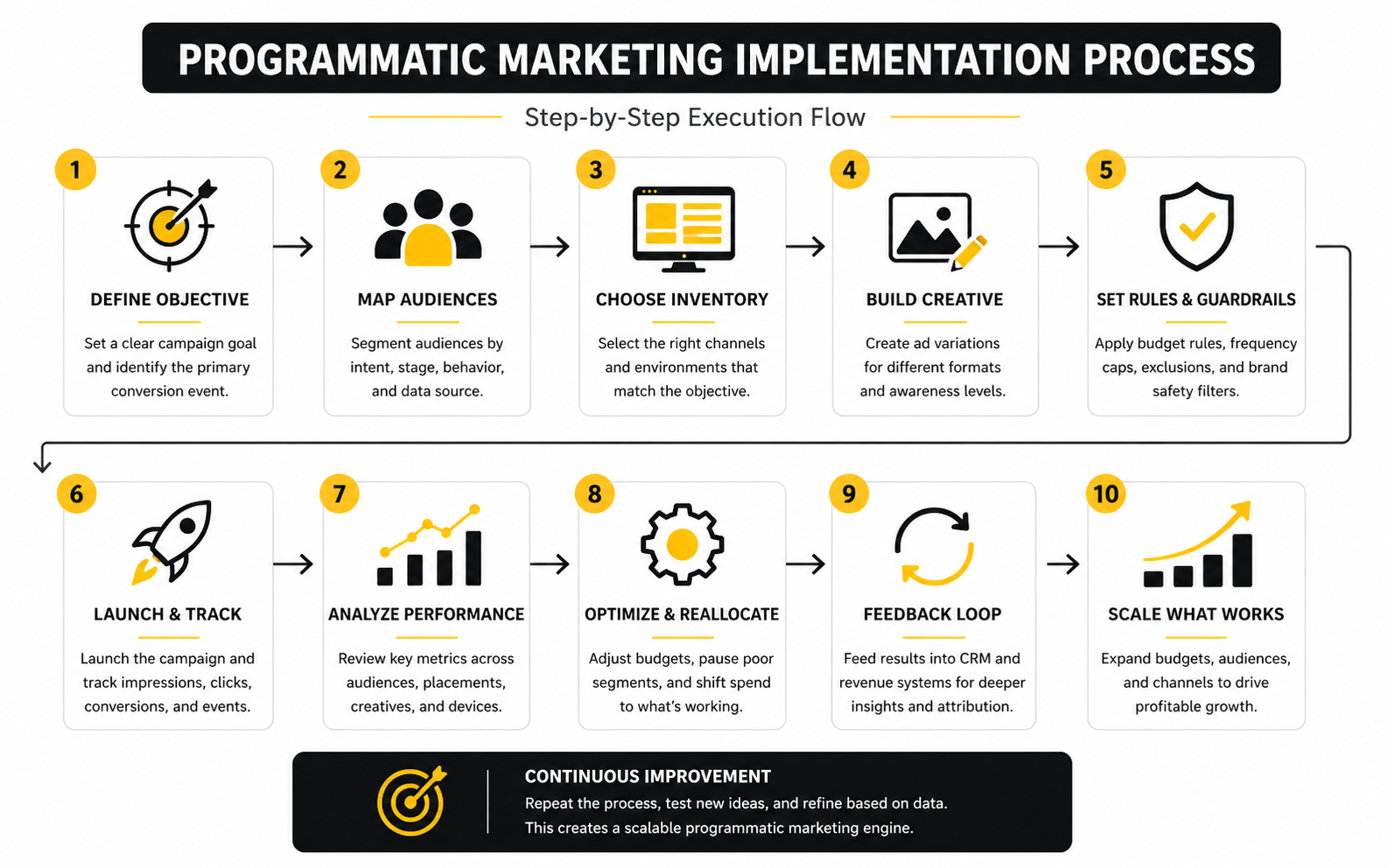
A practical programmatic marketing process should be simple enough to run every month and disciplined enough to improve every quarter. If the process depends on heroics, it will break. If it depends only on platform automation, it will drift.
Use this sequence:
- Define the campaign objective and the primary conversion event.
- Map the audience segments by intent, relationship stage, and data source.
- Choose inventory types that match the message and measurement window.
- Build creative variations for different levels of awareness.
- Set budget rules, frequency limits, exclusions, and brand-safety controls.
- Launch with clean tracking and enough learning room.
- Review performance by audience, placement, creative, device, and conversion quality.
- Reallocate budget toward proven combinations and cut waste quickly.
- Feed sales, CRM, and revenue data back into the next optimization cycle.
This is not complicated, but it requires discipline. The biggest gains often come from fixing boring things: cleaner conversion tracking, stronger landing pages, better exclusions, sharper creative angles, and faster follow-up. For landing page testing, tools such as Replo or ClickFunnels can help turn campaign traffic into pages that are easier to test and improve.
Build The Feedback Loop Before Scaling
Scaling too early is one of the fastest ways to damage programmatic performance. A campaign needs enough data to learn, but it also needs enough control to avoid feeding bad signals back into the system. That balance is where the feedback loop becomes critical.
A useful feedback loop connects media metrics with business quality. Click-through rate, viewability, completion rate, CPM, CPC, and CPA can help diagnose delivery. But they do not tell the whole story. Lead quality, booked-call rate, close rate, average order value, retention, and customer lifetime value reveal whether the campaign is creating real value.
This is why the implementation process should never end at the ad platform dashboard. Programmatic marketing becomes more powerful when media data, CRM data, and revenue data are reviewed together. Once that loop is working, optimization becomes less about guessing and more about making better decisions with better evidence.
Statistics And Data That Actually Matter
Programmatic marketing data is only useful when it changes a decision. A dashboard packed with CPM, CPC, CTR, viewability, reach, frequency, completion rate, and CPA can look impressive, but those numbers do not all carry the same weight. The job is to separate delivery signals from business signals, then use both without confusing one for the other.
Delivery signals tell you whether the campaign is running properly. Business signals tell you whether the campaign is worth scaling. A cheap CPM can still be expensive if the impressions are low quality, and a higher CPA can still be profitable if the customers convert, retain, and spend more.
The broader market shows why this discipline matters. Digital advertising revenue hit $294.6 billion in 2025, while digital video rose to $78 billion and commerce media reached $63.4 billion. More money is moving through automated media systems, which means weak measurement is no longer a small reporting problem. It is a budget protection problem.
The Difference Between Platform Metrics And Business Metrics
Platform metrics are useful, but they are not the finish line. Impressions, clicks, video views, view-through conversions, cost per lead, and return on ad spend can help you understand how the campaign is behaving inside the ad system. The danger comes when these numbers are treated as proof of business performance without checking what happened after the click, form fill, or purchase.
Business metrics sit closer to revenue. They include qualified lead rate, booked-call rate, show-up rate, sales-qualified opportunity rate, close rate, average order value, contribution margin, refund rate, retention, and customer lifetime value. These are harder to track, but they are much harder to fake.
This is why programmatic marketing needs CRM and revenue feedback. If the ad platform says one audience is winning but the sales team says those leads never buy, the campaign is not winning. It is just optimizing toward the wrong signal.
Benchmarks Are Directional, Not Absolute
Benchmarks help you understand whether a number is normal, suspicious, or worth investigating. They should not become rigid targets. A strong CTR on a low-quality placement can be less valuable than a modest CTR from an audience that later converts into real pipeline.
The ANA’s Q1 2025 Programmatic Transparency Benchmark found that participating advertisers directed 41% of programmatic budgets to effective ad impressions, up from 36% in 2023. That improvement matters because it shows buyers can reduce waste when they inspect quality, supply paths, and placement value more seriously. It also shows there is still a large gap between spend delivered and spend delivered well.
This is the right way to use benchmarks. Do not ask, “Is my CPM good?” Ask, “What am I actually buying at this CPM, and does it create the next business action?” That one question will save more money than obsessing over isolated averages.
Build A Measurement System Before You Scale
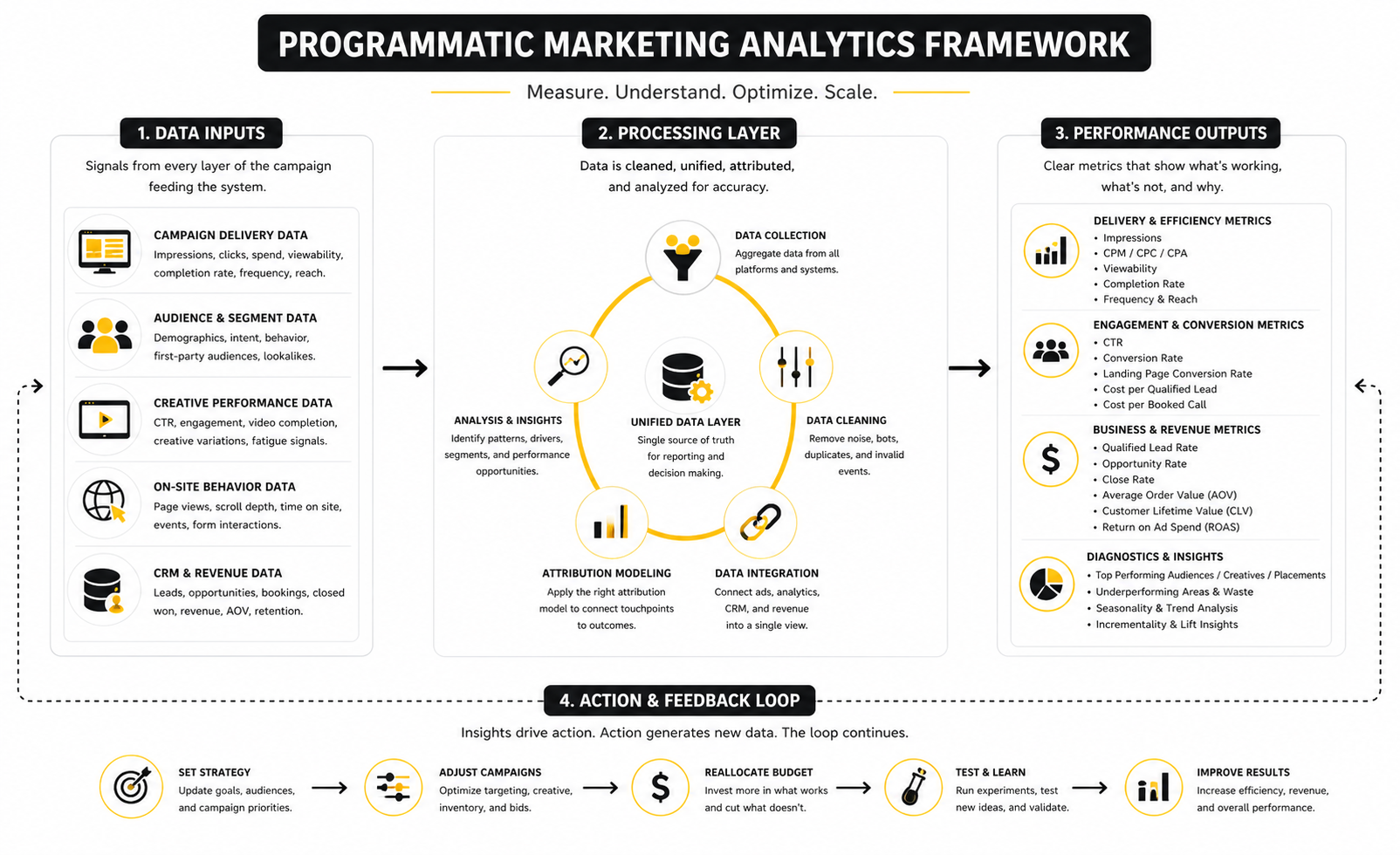
A clean analytics system should connect four layers: media delivery, onsite behavior, conversion quality, and revenue outcome. Media delivery shows where the money went. Onsite behavior shows whether the traffic acted with intent. Conversion quality shows whether leads or buyers were valuable. Revenue outcome shows whether the campaign should get more budget.
The system does not need to be fancy at the start. It needs to be honest. A simple setup that tracks source, campaign, audience, creative, landing page, form submission, booked call, sale, and revenue is usually more useful than a beautiful dashboard with missing data.
For many teams, the weak point is the handoff after conversion. Leads come in, but follow-up is slow. Purchases happen, but customer value is not fed back into reporting. This is where connecting ad performance with a CRM such as GoHighLevel or email follow-up through Brevo can make measurement more practical, because the campaign can be evaluated beyond the first click.
Read Performance Signals In Context
A rising CPM is not automatically bad. It may mean competition increased, targeting tightened, inventory quality improved, or the campaign moved into a more valuable environment. The right response depends on whether downstream performance also improved.
A falling CPA is not automatically good either. If lower-cost conversions are less qualified, the campaign may be getting worse while the dashboard looks better. This happens often in lead generation, where platforms can find people who fill out forms but never answer, book, show up, or buy.
Frequency is another metric that needs context. Too little frequency can mean the message never sticks. Too much frequency can mean the campaign is annoying the same people while running out of new demand. A healthy programmatic marketing setup looks at frequency alongside conversion rate, incremental reach, creative fatigue, and audience saturation.
Use Data To Decide What Happens Next
Measurement should drive action, not reporting theater. If one audience has a higher CPA but better close rate, it may deserve more budget. If one placement has cheap clicks but poor onsite engagement, it should be excluded or capped. If one creative gets attention but fails to convert, the message may need a stronger offer or clearer next step.
A practical weekly review should answer a few direct questions:
- Which audiences are producing the highest-quality outcomes?
- Which placements are delivering measurable value instead of cheap volume?
- Which creatives are improving intent, not just clicks?
- Which landing pages are turning paid traffic into real next steps?
- Which campaigns deserve more budget, less budget, or a full reset?
This is where programmatic marketing becomes a management system. The data tells you where attention, budget, and creative energy should go next. When the numbers are interpreted properly, optimization stops being random tweaking and starts becoming controlled improvement.
Professional Implementation And Optimization
At this stage, programmatic marketing becomes less about setup and more about judgment. The basics are important, but advanced performance comes from choosing the right tradeoffs. More scale can reduce control. More precision can reduce learning. More automation can save time, but it can also hide weak assumptions.
The best teams do not treat optimization as random tweaking. They build a rhythm around budget movement, creative testing, audience refinement, inventory quality, and conversion feedback. That rhythm gives the campaign enough structure to improve without becoming so rigid that it misses opportunity.
This is also where professional implementation separates itself from casual media buying. A beginner asks, “How do we get cheaper traffic?” A stronger operator asks, “Which traffic is worth paying more for, and which traffic should we stop buying entirely?”
Balance Scale With Control
Programmatic marketing is powerful because it can reach large audiences quickly. That same strength creates risk. When campaigns scale before the data is clean, small tracking issues and weak targeting choices can become expensive very fast.
Control starts with exclusions, frequency rules, placement review, creative rotation, and clear audience boundaries. It also includes supply-path decisions, because not every route to an impression creates the same value. The ANA’s Q1 2025 benchmark showed that only 41% of programmatic budgets reached effective ad impressions, which is exactly why serious buyers watch quality instead of chasing cheap reach.
The tradeoff is that too much control can choke performance. If the campaign is narrowed too aggressively, the platform may not have enough room to learn. The practical move is to start with guardrails, measure the quality of what comes through, then tighten or expand based on evidence.
Treat Creative As A Performance Lever
Many programmatic campaigns underperform because the media team optimizes bids while the creative stays almost untouched. That is backwards. Creative is often the fastest way to change who responds, how they respond, and whether the next step feels worth taking.
Good creative testing does not mean swapping colors and pretending that is strategy. It means testing different promises, pain points, formats, proof angles, offers, and levels of awareness. A cold audience may need a simple problem-solution message, while a retargeting audience may need a sharper comparison, stronger guarantee, or clearer reason to act now.
The best creative system is organized, not chaotic. Keep a record of what angle was tested, who saw it, where it ran, and what happened after the click. If the landing page is also part of the test, tools such as Replo and ClickFunnels can help move faster without turning every experiment into a development project.
Make Privacy A Growth Constraint, Not A Panic Button
Privacy is not a side issue anymore. Chrome’s cookie decisions, platform tracking limits, consent requirements, and privacy-preserving ad technologies all changed how marketers should think about identity and attribution. Google’s own ads guidance still emphasizes first-party data, AI-powered solutions, and privacy-preserving technologies as part of a more durable setup.
That means programmatic marketing should be designed around data you have permission to use. Email subscribers, customers, qualified leads, account lists, form submissions, product events, and CRM stages are strategic assets. They help campaigns learn from real relationships instead of relying only on rented platform signals.
This does not mean every business needs a massive data warehouse. It means the basics need to be handled properly. Capture consent clearly, tag traffic consistently, store customer data cleanly, and connect campaign activity to follow-up through tools such as GoHighLevel, Brevo, or Moosend.
Watch For Hidden Waste
Programmatic waste rarely announces itself. It usually hides inside attractive averages. The campaign looks fine at the top level, but one placement, audience segment, geography, device type, or supply path is quietly draining budget.
This is why averages are dangerous. A campaign with an acceptable CPA can still contain pockets of terrible spend. A video campaign with strong completion rates can still fail if those completions come from environments that never create intent.
Look for waste in a structured way:
- Placements with cheap clicks but weak onsite engagement
- Audiences with low CPA but poor lead quality
- Creative with strong attention but no qualified action
- Inventory with high delivery but low viewability or suspicious patterns
- Retargeting pools with high frequency and declining conversion rate
- Geographies or devices that consume spend without revenue contribution
The fix is not always to cut immediately. Sometimes a segment needs a different message or landing page. But if the signal stays weak after a fair test, remove it. Programmatic marketing rewards decisiveness when the evidence is clear.
Scale In Layers, Not Leaps
Scaling should happen in layers. Increase budget only after the campaign has a working signal, then expand audiences, inventory, creative, and offers in a controlled order. Big jumps feel exciting, but they often reset learning, distort delivery, and expose gaps in the funnel.
A clean scaling path might start with one proven audience and one proven offer. Then you add new creative angles, adjacent audiences, higher-intent inventory, broader reach placements, and stronger retargeting. Each layer should answer a specific question rather than simply adding more spend.
This is where many teams get impatient. They find one pocket of performance and immediately try to force it across every channel. The smarter path is slower but more profitable: prove the signal, understand why it worked, expand the pattern, and protect the economics as volume grows.
Measurement, Risks, Tools, And FAQs
Programmatic marketing is strongest when the full ecosystem works together. Media buying, audience data, creative, landing pages, CRM follow-up, analytics, privacy controls, and revenue reporting all need to support the same goal. When those pieces are disconnected, the campaign may still spend money efficiently, but it will not necessarily create profitable growth.
The final point is simple: do not let automation replace strategy. Use automation to make smarter decisions faster. Use measurement to keep those decisions honest. Use human judgment to decide what should be scaled, fixed, or cut.
A strong programmatic marketing system is not built in one launch. It improves through clean inputs, disciplined testing, transparent reporting, and fast action. That is the difference between buying impressions and building a repeatable growth engine.
FAQ - Built For Complete Guide
What Is Programmatic Marketing?
Programmatic marketing is the use of software, data, and automation to buy and optimize digital advertising. It helps advertisers decide who sees an ad, where it appears, how much to bid, and what performance signals should guide future spending. It can include display, video, connected TV, audio, native, digital out-of-home, and retail media.
Is Programmatic Marketing The Same As Programmatic Advertising?
They overlap, but they are not exactly the same. Programmatic advertising usually refers to the automated buying of ad inventory. Programmatic marketing is broader because it includes audience strategy, creative testing, funnel design, CRM feedback, analytics, and optimization beyond the ad placement itself.
Why Is Programmatic Marketing Important?
Programmatic marketing matters because modern media buying is too fragmented to manage manually at scale. It helps marketers reach specific audiences across many environments while adjusting bids and budgets based on performance signals. The real value comes from combining automation with clear strategy, not from automation alone.
What Channels Can Be Bought Programmatically?
Programmatic buying can cover display, native, video, connected TV, audio, digital out-of-home, mobile app inventory, and retail media placements. The available channels depend on the platform, marketplace, publisher relationships, and campaign objective. The best channel is not always the newest one; it is the one that fits the audience, creative, and measurement window.
What Data Is Most Useful For Programmatic Marketing?
First-party data is usually the most useful because it comes from real customer relationships. This includes CRM records, email engagement, purchase behavior, website events, form submissions, booked calls, and customer segments. Third-party and contextual data can still help, but owned data usually gives the campaign a stronger foundation.
How Should Beginners Measure Programmatic Campaigns?
Beginners should separate delivery metrics from business metrics. Delivery metrics include impressions, clicks, CPM, CPC, viewability, completion rate, and CPA. Business metrics include qualified lead rate, booked-call rate, close rate, average order value, retention, and customer lifetime value.
What Is A Good Programmatic Marketing Benchmark?
There is no universal benchmark that works for every campaign. A good CPM, CPA, or conversion rate depends on the market, offer, audience, inventory, creative, and revenue model. Benchmarks are useful for spotting problems, but the best benchmark is whether the campaign produces profitable customers at a repeatable cost.
What Are The Biggest Risks In Programmatic Marketing?
The biggest risks are poor inventory quality, weak tracking, low-quality leads, creative fatigue, privacy issues, attribution confusion, and over-optimization toward shallow metrics. Another major risk is assuming that the platform knows the business better than the team does. Automation needs strong inputs, or it will optimize the wrong thing very efficiently.
How Does AI Affect Programmatic Marketing?
AI can improve bidding, pacing, audience modeling, creative variation, anomaly detection, and budget allocation. It can also make weak campaigns look more sophisticated than they are. The marketer still needs to define the right goal, inspect the data, and make sure the campaign is optimizing toward real business value.
How Does Programmatic Marketing Fit With A Sales Funnel?
Programmatic marketing can support every stage of the funnel. It can reach cold audiences, retarget interested visitors, nurture leads, promote offers, reactivate past customers, and support account-based campaigns. For better post-click execution, tools such as GoHighLevel, ClickFunnels, Systeme.io, and Brevo can help connect traffic with follow-up and conversion systems.
When Should A Business Start Using Programmatic Marketing?
A business should consider programmatic marketing when it has a clear offer, enough budget to test properly, a defined audience, and a way to measure results beyond clicks. It is not ideal when the funnel is broken, the offer is unclear, or the team cannot track what happens after the first conversion. Fix the basics first, then use programmatic to scale what already has a signal.
How Much Budget Is Needed For Programmatic Marketing?
The required budget depends on the market, inventory type, audience size, and campaign goal. Connected TV and premium video usually need more budget than simple retargeting or display tests. The important rule is to spend enough to generate meaningful learning without scaling before the data is trustworthy.
Can Small Businesses Use Programmatic Marketing?
Yes, but small businesses need to be practical. They should start with clear audiences, simple conversion goals, strong landing pages, and disciplined retargeting before moving into complex multi-channel buying. The goal is not to copy enterprise media plans; it is to use automation where it improves focus, follow-up, and measurable growth.
What Is The Best Way To Improve Programmatic Performance?
The best way to improve performance is to strengthen the feedback loop. Connect media data with landing page behavior, lead quality, sales outcomes, and revenue. Then use that information to improve audiences, creative, inventory, budget allocation, and follow-up.
What Tools Are Useful For Programmatic Marketing?
The core tools usually include an ad buying platform, analytics setup, CRM, landing page builder, email or SMS automation, and reporting system. For funnel and follow-up work, options such as GoHighLevel, ClickFunnels, Replo, ManyChat, and Brevo can support different parts of the system. The right stack depends on the campaign type, team size, and how leads or customers are handled after the click.
Work With Professionals
Explore 10K+ Remote Marketing Contracts on MarkeWork.com
Most marketers spend too much time chasing clients, competing on crowded platforms, and losing a percentage of every project to middlemen.
MarkeWork gives you a better way. Browse thousands of remote marketing contracts and connect directly with companies desperate to hire skilled marketers like you, without platform commissions and without unnecessary gatekeepers.
If you are serious about finding better opportunities and keeping 100% of what you earn, explore available contracts and create a profile for free at MarkeWork.com.