

Rakuten affiliate marketing is easy to misunderstand if you only look at it from the outside. A lot of people treat it like a generic network where you grab a link, drop it into content, and hope commissions show up. That is not how this platform really works, and it is exactly why so many beginners get stuck before they ever build momentum.
The better way to think about Rakuten affiliate is as a relationship-driven performance channel. You join the network, apply to specific advertiser programs, and then earn when your audience takes a tracked action under each brand’s terms. Rakuten’s own publisher materials make that clear: sign-up is free, publishers can promote through websites, email, and social media, and approval into advertiser programs happens brand by brand through the publisher dashboard Rakuten publisher sign-up process Quick Start Guide.
That matters more now because affiliate and partner marketing keeps becoming a bigger piece of the digital growth mix. Recent industry reporting points to rising advertiser investment, stronger emphasis on partner diversification, and more scrutiny around compliance and disclosure rather than less PMA industry study State of the Affiliate Nation 2025 FTC endorsement guidance. So if you want to win with Rakuten affiliate, you need a structure that covers platform mechanics, partner fit, implementation quality, and the boring but critical compliance details.

This article is built to do exactly that. We are not going to stay at the surface level or pretend all affiliate networks work the same way. We are going to break down what Rakuten affiliate is good at, where people make bad assumptions, and what a professional setup looks like when you want this to become a serious acquisition channel instead of a side experiment.
Article Outline
- What Rakuten Affiliate Really Is and Why It Matters
- How the Rakuten Affiliate Model Works
- The Core Components of a Strong Rakuten Affiliate Setup
- Choosing Offers and Getting Approved Without Wasting Time
- Professional Implementation That Turns Clicks Into Commission
- Scaling Performance, Tracking Results, and Common Questions
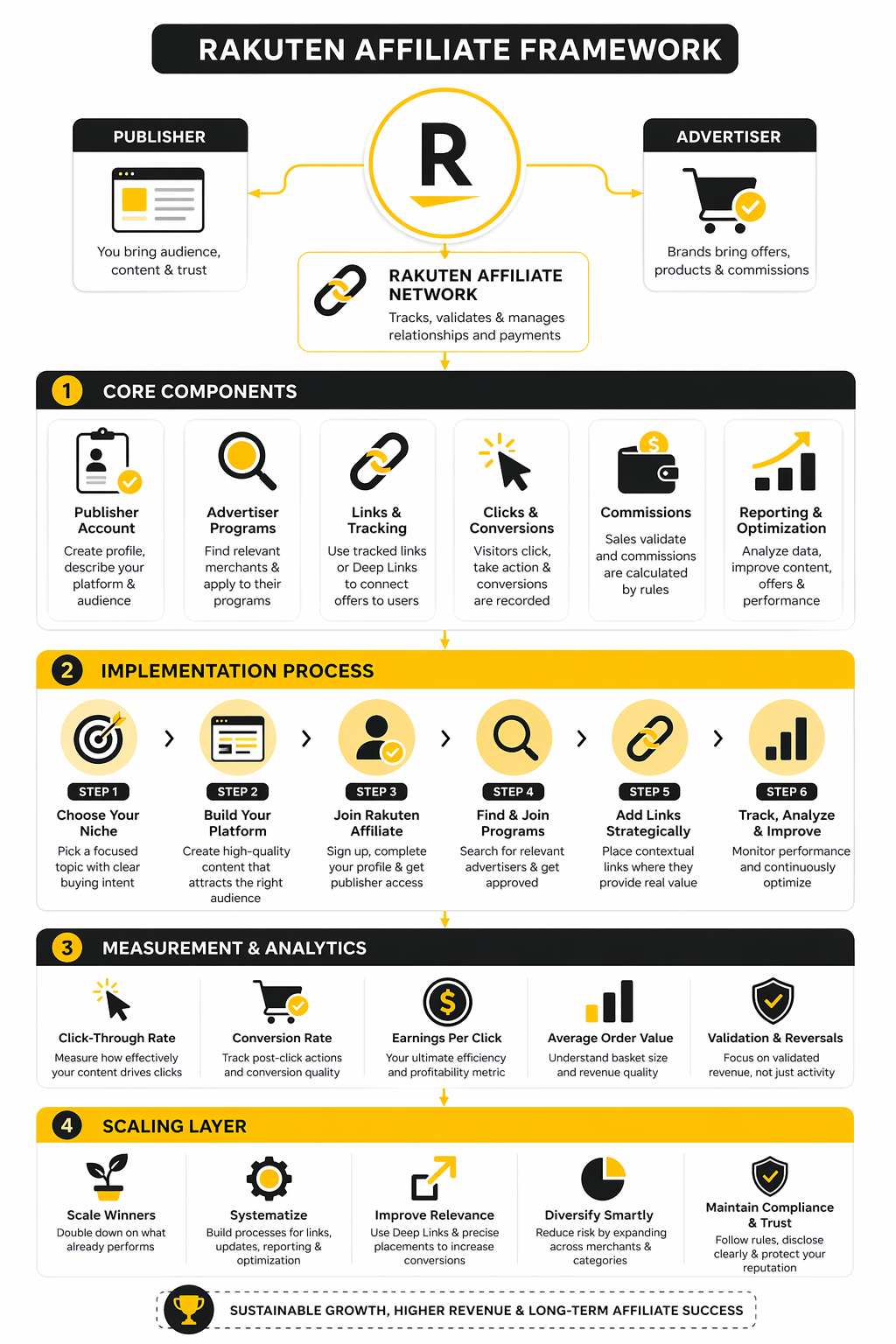
What Rakuten Affiliate Really Is and Why It Matters
Rakuten affiliate is not a plug-and-play shortcut where you join once and instantly promote every brand in the network. The platform works more like a marketplace of advertiser relationships inside one system. You create a publisher account, complete your profile, and then apply to individual programs that decide whether your audience, traffic quality, and promotional methods are a fit.
That distinction matters because it changes how you should approach the channel from day one. If you treat Rakuten affiliate like a giant coupon warehouse, you will usually end up with weak approvals, poor conversions, and generic content that looks interchangeable with everyone else. If you treat it like a curated partner channel, you start thinking about audience intent, brand fit, offer alignment, and how to present products in a way that actually helps people buy.
This is also why Rakuten affiliate tends to be more attractive to publishers who want quality merchants and more structured relationships rather than pure volume. The network has long been associated with bigger retail and brand advertisers, which can be a real advantage if your content is already trust-based. When your traffic is built around reviews, comparisons, gift guides, shopping research, loyalty content, or creator-led recommendations, that environment can be a much better match than networks that feel noisy or overloaded with low-quality offers.
The bigger picture is simple. Affiliate is no longer just a side tactic for blog owners hunting random commissions. Serious brands are putting more budget and more strategic attention into partner marketing, and that raises the bar for publishers too. If you want Rakuten affiliate to become a real revenue stream, you need to show that you can drive qualified traffic, stay compliant, and create content that helps both the merchant and the customer.
Why Rakuten Affiliate Can Be a Strong Fit
One of the biggest advantages of Rakuten affiliate is brand credibility. Well-known merchants make conversion easier because users do not need to cross the trust gap from zero. They already recognize the retailer, understand the product category, and often arrive with purchase intent, which means your job is less about forcing demand and more about guiding a decision.
That makes Rakuten especially useful for content formats where the reader is already in evaluation mode. Product roundups, seasonal buying guides, “best for” articles, loyalty content, and commerce-driven newsletters all fit this model well. You are not trying to invent desire out of nowhere. You are helping someone move from maybe to yes with better context, stronger framing, and cleaner buying paths.
Another reason Rakuten affiliate matters is operational control. Advertisers set their own commission structures, approval rules, and terms, which sounds restrictive at first, but it often creates more clarity. You know that not every offer is meant for every publisher, and that forces better positioning from the start. In practice, that is healthier than joining a network where everything is technically available but very little is strategically aligned.
Where People Get the Wrong Idea
A lot of beginners think the hard part is getting accepted by the network. That is only the first gate. The real game starts after that, because each advertiser relationship has its own standards, economics, and promotional logic.
Another common mistake is assuming that more offers always means more money. It usually does not. Too many unrelated merchant links can dilute trust, make your content messy, and weaken the signal you send to both users and advertisers about what your platform is actually about.
The third bad assumption is that tracking and commission terms are basically the same across programs. They are not. In Rakuten affiliate, different advertisers can vary on commission types, validation timelines, promotional restrictions, and approved traffic methods, so you need to read program terms with a much sharper eye than most people expect.
How the Rakuten Affiliate Model Works
At a practical level, Rakuten affiliate follows a straightforward structure. You join as a publisher, add your promotional properties, browse available advertiser programs, apply to the ones that fit, and then generate links or other creative assets after approval. Once your links are live, the platform tracks referred actions and attributes eligible commissions based on each advertiser’s rules.
That sounds simple enough, but the details are what separate a professional operator from someone casually dropping links into content. The network is the infrastructure layer, not the business model by itself. Your business model comes from how well you match traffic to merchants, how cleanly you position offers, and how consistently you turn attention into qualified clicks and completed actions.
The most important mindset shift is this: Rakuten affiliate is not really about links. It is about structured recommendations inside a tracked commercial relationship. The link is just the mechanism that records what happened after your audience took action.
Step 1: Join as a Publisher
The process starts with your publisher account and profile. This is where many people unintentionally hurt themselves by rushing through setup, using vague property descriptions, or failing to explain how they actually reach an audience. If your application looks unfinished or generic, you make it harder for advertisers to trust the quality of your traffic later.
Your publisher profile should communicate three things clearly. First, who your audience is. Second, how you reach them, whether that is through SEO content, email, social, loyalty, or a mix. Third, why your traffic converts in a way that is useful for merchants rather than just large in volume.
That last point matters a lot. Plenty of publishers talk about traffic numbers, but advertisers care about conversion quality, brand safety, and intent. A smaller but focused platform with clear buying intent can be more attractive than a larger audience with weak commercial relevance.
Step 2: Apply to Individual Advertiser Programs
After the publisher account is live, the next layer is applying to specific advertisers. This is where Rakuten affiliate becomes selective in a good way. You are not automatically entitled to every program just because you joined the network.
Each advertiser is effectively asking a business question: should we let this publisher represent our brand and send us customers? That means your application is being evaluated through the lens of fit, not just eligibility. If your platform is about home office setups, you have a much better case with relevant merchants than with random programs you added just because the commission looked tempting.
This is why targeted applications beat mass applications almost every time. When your site content, audience profile, traffic source, and promotional plan clearly connect to the merchant’s category, you make the decision easy. When there is no obvious relationship, you create work and uncertainty for the advertiser, and that usually hurts your approval odds.
Step 3: Use Approved Links and Creative Assets
Once you are accepted into a program, you can access the tools tied to that advertiser relationship. That usually means trackable links, banners, and sometimes product or offer-specific creative. But this is another place where people make the lazy move and assume any available asset is automatically the right one.
The best asset is not the one that exists inside the dashboard. It is the one that fits the buying moment inside your content or campaign. A text link placed exactly where the user is making a decision will often outperform more aggressive creative because it feels timely, relevant, and low-friction.
This is also where good implementation discipline starts to matter. Your links should match the surrounding copy, the offer should make sense in context, and the call to action should help the reader understand what happens next. If your link presentation feels abrupt or promotional for the sake of it, you will lose clicks from people who were otherwise close to converting.
Step 4: Earn on Qualified Actions
Rakuten affiliate commissions are triggered by qualified actions under the advertiser’s terms. In many programs that means a completed purchase, but the exact economics still depend on the merchant. Some categories are naturally more margin-sensitive, some advertisers reverse transactions more aggressively, and some programs perform well only when traffic arrives at the right stage of the buying journey.
That is why raw click volume is such a weak metric on its own. You can send a lot of traffic and still earn very little if the audience is not commercially ready or the offer is mismatched. A smaller number of well-qualified clicks usually beats a flood of curiosity clicks that never convert.
It also means patience is part of the model. In affiliate, especially with retail and multi-touch journeys, not every click becomes immediate revenue. Some users compare options, return later, or buy only after a few other touchpoints. The publishers who last in Rakuten affiliate understand that their job is to improve intent and reduce friction, not just chase vanity click numbers.
The Real Framework Behind Successful Rakuten Affiliate Publishers
If you strip the process down, successful publishers on Rakuten affiliate tend to win with the same underlying framework. They build trust first, align merchants second, and optimize conversion paths third. That order matters because the wrong sequence creates a fragile business.
Start with trust, because no affiliate setup survives if the audience stops believing your recommendations. Then choose merchants that naturally fit the topics where your audience already wants help. After that, refine placement, tracking, and calls to action so the commercial path feels useful instead of intrusive.
This is the part many people skip because it sounds less exciting than joining programs and generating links. But it is the real operating system behind long-term affiliate revenue. Without it, Rakuten affiliate stays a dashboard. With it, the channel becomes a scalable monetization layer on top of content, email, social, or creator traffic that already earns attention.
The Core Components of a Strong Rakuten Affiliate Setup
A strong Rakuten affiliate setup is not built around luck, and it is definitely not built around how many links you can scatter across a page. It works when a few core pieces line up at the same time. You need the right audience, the right merchants, the right content angle, and a clean path from recommendation to tracked action.
Most people over-focus on the network and under-focus on the system wrapped around it. That is backward. Rakuten affiliate gives you the infrastructure, but your results come from how well you build the commercial journey around that infrastructure.
Audience and Offer Fit Comes First
The first component is fit between your audience and the offers you want to promote. If the people reading your content are in research mode, then educational content and product comparisons make sense. If they already know what they want and just need a final push, then deep product pages, retailer pages, and urgency-driven placements can work much better.
This sounds obvious, but it is where a lot of affiliate setups quietly fail. Publishers often choose merchants because the brand is big or the category looks profitable, even when the audience intent is weak. A Rakuten affiliate campaign only works when the merchant solves a need the audience already has.
Fit also affects approvals, click-through rate, and conversion rate at the same time. That is why it is one of the highest-leverage decisions you will make. Get this part wrong and every later optimization becomes harder than it should be.
Content Has to Match the Buying Stage
Not every page should sell in the same way. Someone reading a broad educational article is in a different state of mind than someone comparing two products or looking for the best place to buy today. Your content has to reflect that difference if you want Rakuten affiliate clicks to become revenue.
At the top of the funnel, content should clarify the problem, narrow the options, and build trust. In the middle, it should help readers compare trade-offs and understand what matters. Near the point of purchase, it should remove friction, highlight the strongest option, and make the next step feel easy.
This is why generic affiliate writing underperforms. It skips the thinking process the reader is actually going through. Better Rakuten affiliate content feels useful first and commercial second, even when the commercial goal is very clear.
Deep Linking Is Where Relevance Becomes Actionable
One of the biggest operational advantages inside Rakuten affiliate is the ability to direct users to more specific destinations than a merchant homepage. That matters because relevance is fragile. If a user clicks from a product recommendation and lands on a broad homepage instead of the product, collection, or category page they expected, you create friction at the worst possible moment.
A strong setup uses destination pages that match the promise made in the content. If the article is about the best carry-on luggage, the click should lead to the exact product or the tightest possible category page, not a generic retail front door. If the article is about a seasonal promotion or a curated bundle, the destination should keep that exact context alive.
That is one of the clearest places where implementation quality shows up. Better deep linking does not magically fix a weak offer, but it can absolutely improve the performance of a good one. In Rakuten affiliate, precision usually beats breadth.
Placement Matters More Than Volume
You do not need affiliate links everywhere. You need them where intent is strongest. That usually means inside comparison tables, product callouts, decision-focused paragraphs, buying guide sections, and conclusion blocks where the reader is ready to move.
Too many links can actually weaken performance because they create noise. The reader starts scanning instead of deciding. Good placement feels like a natural continuation of the content, not an interruption of it.
This is one reason experienced publishers often outperform bigger sites with less traffic. They understand where a recommendation should appear, how much context it needs, and when to stop pushing. Rakuten affiliate works better when the click feels deserved.
Tracking Discipline Is Not Optional
A professional setup also needs clean internal tracking discipline, even when the network itself handles attribution on the affiliate side. You need to know which page, placement, angle, and call to action produced the click. Without that, you cannot tell whether a merchant is weak, a page is weak, or your implementation is weak.
This is where many affiliate programs stay amateur. People look at total commissions and total clicks, but they do not know what actually created the result. That leads to bad decisions, because they end up changing the wrong thing.
With Rakuten affiliate, the better approach is to treat each placement like a testable asset. Every major article, button, text link, email placement, or content block should have a reason for existing and a way to evaluate whether it is doing its job.
Choosing Offers and Getting Approved Without Wasting Time
Once the foundation is in place, the next challenge is merchant selection and approvals. This is where discipline saves a huge amount of time. You do not need more programs. You need the right programs.
A lot of publishers burn hours applying to everything that looks remotely relevant, then wonder why approvals are inconsistent and performance stays flat. The smarter move is to build a short list based on audience alignment, product relevance, content opportunities, and commercial intent.
What to Look for Before You Apply
Start with the customer journey, not the commission. Ask a simple question: where is this merchant a natural next step for my reader? If you cannot answer that clearly, the program is probably not a priority yet.
Then look at product-market fit from the reader’s perspective. Does the merchant solve a clear problem, offer recognizable value, and make sense in the context of the page where you plan to place the link? If the answer is vague, the application is likely premature.
After that, review the practical details that often get ignored. Check whether the merchant supports the kinds of placements you want to use, whether specific product or category pages are linkable, and whether the brand positioning fits the trust level of your platform. A Rakuten affiliate relationship gets much easier when the audience instantly understands why that merchant belongs in your recommendation set.
How to Make Your Publisher Profile Easier to Approve
Advertisers are trying to assess risk and relevance fast. That means your publisher profile should do some of the persuasion before you ever submit an individual application. If the profile is thin, outdated, or generic, you make yourself harder to approve.
Be specific about your audience. Be specific about your traffic sources. Be specific about the kind of content you publish and the categories where you influence purchase decisions. Broad descriptions make you look unfocused, and unfocused publishers are harder for merchants to trust.
It also helps to sound like an operator instead of a hobbyist. You do not need to fake scale, and you should not. But you do want to show that your Rakuten affiliate activity is intentional, brand-safe, and built around useful recommendations rather than random promotional clutter.
Apply With a Point of View
The best applications have a reason behind them. You are not just saying, “let me in.” You are signaling that your audience and your content format give the merchant a logical place to win. That is a stronger position than applying with no clear promotional angle at all.
If your site has category pages, review content, comparison articles, or strong editorial themes, use that logic in how you choose programs. When the fit is obvious, you lower friction for the advertiser. When the fit is messy, you force them to guess.
This is one of the simplest ways to improve your odds with Rakuten affiliate. Do less, but do it with more precision. A focused portfolio of approved merchants is usually worth far more than a long list of irrelevant approvals.
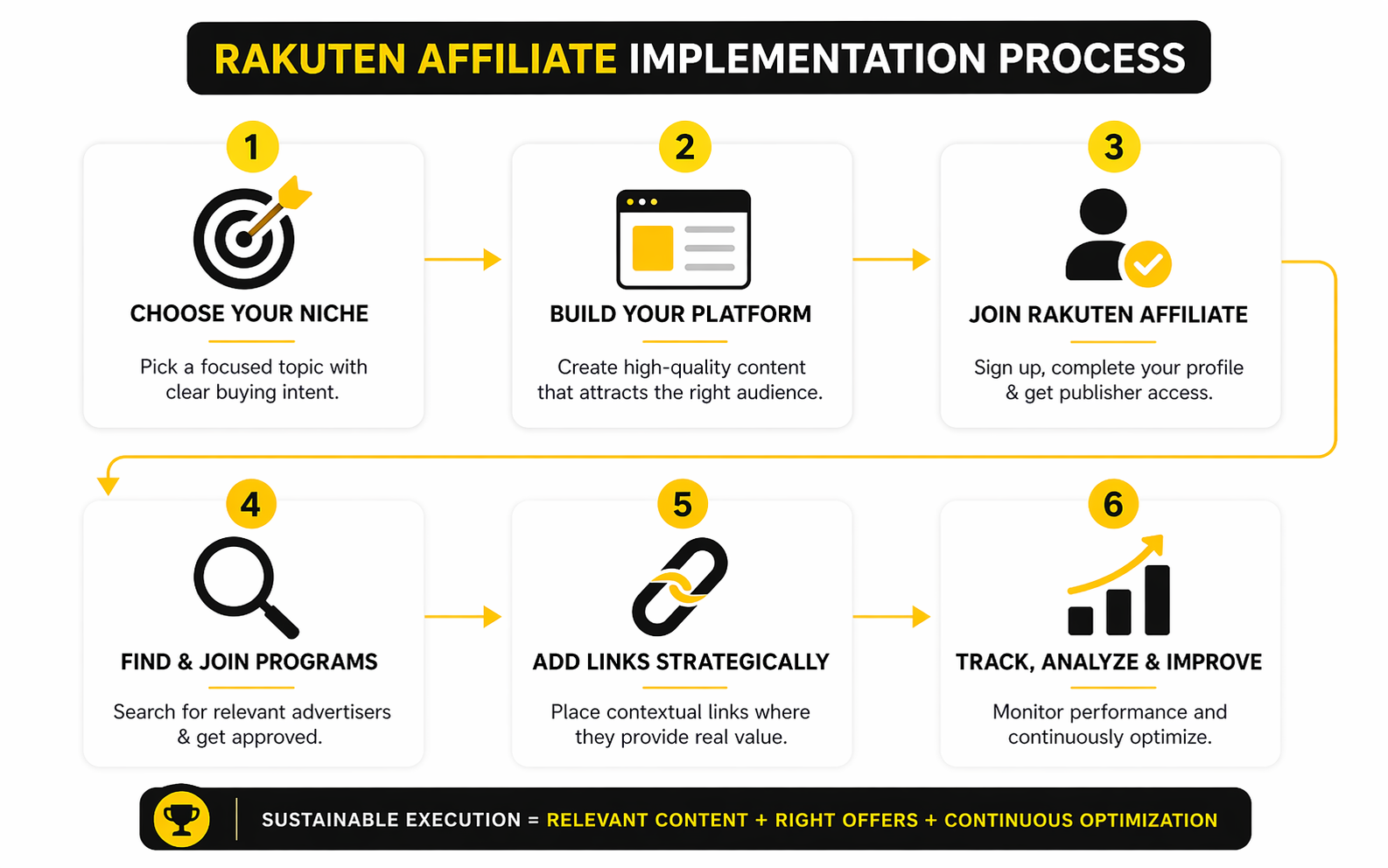
A Practical Approval and Execution Process
Once you stop treating applications like a numbers game, the implementation process gets much cleaner. You can move from strategy to execution in a sequence that actually compounds. A practical Rakuten affiliate workflow usually looks like this:
- Audit your existing content
Find the pages where users already show commercial intent. These are usually product roundups, retailer comparisons, category guides, gift guides, and buying-decision articles. Starting with proven intent is smarter than forcing affiliate links into informational content that was never built to convert.
- Map each page to one or two logical merchant types
Decide what kind of advertiser actually fits the page. A broad buying guide may support multiple merchants, but a specific product-led article often needs only one or two serious options. This keeps the experience focused and makes the recommendation feel more confident.
- Apply only to the advertisers you can genuinely feature
Submit applications for merchants you can place immediately if approved. This creates a tighter feedback loop because you are not collecting programs for later. You are building a live revenue stack around content that already has a job.
- Choose destination pages before generating links
Do not wait until the last second to figure out where the click should land. Decide whether the right destination is a product page, category page, offer page, or curated collection page. This turns Rakuten affiliate implementation from a mechanical task into a conversion decision.
- Place links where the reader is ready
Add your links in the exact moments where the reader needs a next step. That could be after a comparison insight, beneath a product recommendation, inside a “best for” section, or near a conclusion where the choice has already become clearer. Placement is part of persuasion.
- Review disclosures and commercial clarity
Make sure the reader can understand that you may earn from qualifying purchases. This is not just about staying compliant. Clear disclosure also protects trust, and trust is one of the only assets in affiliate marketing that compounds over time.
- Track performance at the page and placement level
Give yourself enough visibility to see which pages deserve more effort. Once something starts producing, improve the surrounding copy, tighten the destination page match, and remove weaker distractions. Rakuten affiliate gets stronger when you optimize proven pages instead of endlessly starting new ones.
The Goal Is a Smaller, Smarter Portfolio
The best-performing affiliate setups are usually more selective than people expect. They are not trying to monetize every paragraph with every possible merchant. They are building a smaller portfolio of offers that match the audience, the content, and the buying moment with much more precision.
That is the real shift from amateur to professional execution. Instead of asking, “How many programs can I join?” you start asking, “Which relationships deserve to become part of my monetization system?” That question leads to better approvals, cleaner implementation, and a Rakuten affiliate setup that is actually built to scale.
Measuring Performance and Making the Numbers Useful
Once your Rakuten affiliate setup is live, the next job is not adding more links. It is learning how to read the data without fooling yourself. That is where a lot of affiliate work goes sideways, because people either obsess over surface metrics or wait too long to spot weak pages, weak merchants, or weak intent.
Rakuten’s reporting tools are built for exactly this stage. The platform’s publisher reporting interface lets you run reports to track activity and analyze performance, and Rakuten has also expanded publisher-side automation and reporting options in recent product updates Rakuten reporting tools Rakuten Automate overview. But the dashboard alone does not tell you what to do next. You need a framework for interpreting the numbers so they lead to better decisions rather than random changes.
That is especially important now because affiliate performance is getting noisier, not cleaner. Recent benchmark data shows more clicking and more comparison behavior, while conversion efficiency has gotten harder in some environments. One major 2025 benchmark found clicks up year over year while conversion rates declined, which is exactly the kind of shift that can trick publishers into thinking traffic is healthy when buying intent is actually getting weaker 2025 affiliate benchmark.
The Metrics That Actually Matter
The first useful metric is click-through rate, because it tells you whether your content and placement are persuading readers to take the next step. A low click-through rate usually means one of three things: the offer is not compelling, the placement is weak, or the reader is not yet in buying mode. It does not automatically mean the merchant is bad.
The second core metric is conversion rate, which tells you what happens after the click. This is where you start testing whether your traffic quality and merchant fit are aligned. Industry benchmark ranges vary by vertical and publisher model, but broad ecommerce affiliate conversion ranges are often discussed in the low-single-digit range, which is why you should treat every program relative to its category, not against a fantasy benchmark affiliate benchmark overview 2025 affiliate research.
The third metric is earnings per click, because it compresses a lot of reality into one signal. It reflects traffic quality, offer fit, conversion efficiency, and commission economics at the same time. If one page drives fewer clicks but produces much higher earnings per click, that page is often more valuable than a page that looks “busy” but monetizes poorly.
The fourth metric is average order value or basket quality, where relevant. This matters because two merchants can convert at similar rates while producing completely different revenue outcomes. A lower-converting merchant with stronger order values can still outperform a higher-converting merchant with weak baskets.
The fifth signal is reversal or validation behavior, even if you have to infer it from delayed commissions or advertiser-specific patterns. Raw sales activity is not final revenue until it clears the merchant’s approval process. If a program looks great at the click and order stage but weakens materially after validations, that is a clue that the fit, traffic source, or advertiser rules deserve a closer look.
What Good Data Interpretation Looks Like
Good interpretation starts with sequence. Look at the path in order: page views, affiliate clicks, post-click conversions, and revenue quality. If you jump straight to commissions, you will miss why the result happened.
For example, a page with high traffic and low clicks is usually a placement or intent problem. A page with strong clicks and weak conversions is often a merchant, landing page, or audience mismatch problem. A page with decent conversions but disappointing revenue may be suffering from weak basket size, lower commissions, or the wrong offer mix.
This is why random optimization is expensive. If you change call-to-action copy on a page that really has a merchant-fit problem, you waste time. If you blame the merchant when the actual issue is that readers are too early in the journey, you make the wrong cut.
The better way is to diagnose performance one layer at a time. Rakuten affiliate becomes much easier to scale when you know which variable is actually broken.
Benchmarks Are Context, Not a Scorecard
Benchmarks can help, but they become dangerous when you use them like universal rules. The affiliate channel is too fragmented for that. A coupon-focused page, a deep editorial review, a creator recommendation, and an email placement can all produce very different click and conversion patterns even when they promote similar merchants.
That is why current industry data should be used as directional context, not as a fixed target. The 2025 benchmark trend showing higher clicks but softer conversions tells you that more users are comparison shopping and delaying decisions 2025 affiliate benchmark. The practical takeaway is not panic. It is that you should pay more attention to intent quality, destination page match, and decision-stage content than you might have a year earlier.
Broader industry data supports the same bigger picture. Affiliate and partner marketing spend has continued to rise, including a reported £1.7 billion in UK brand investment in 2024, up 9% year over year, with hundreds of millions of sales attributed through the channel State of the Affiliate Nation 2025. That tells you the channel is very much alive. It does not tell you every publisher should expect the same economics.
Your real benchmark is your own portfolio. You should compare pages against pages, merchants against merchants, and placements against placements inside the same business model. That produces decisions you can actually use.
Statistics and Performance Signals That Drive Better Decisions
The point of statistics in Rakuten affiliate is not to decorate a report. It is to help you identify where to double down, where to fix friction, and where to stop wasting energy. Good numbers create clarity. Badly used numbers create activity without progress.
That is why the most useful performance signals are tied directly to a next action. If the signal does not change what you do, it is probably not important enough to stare at every week.
Signal 1: Rising Clicks With Flat Revenue
This is one of the easiest traps to fall into. More clicks feel like growth, but they can simply mean curiosity, broader traffic, or weaker user intent. Recent benchmark data showing click growth alongside softer conversion rates makes that risk very real in the current environment 2025 affiliate benchmark.
When this happens in Rakuten affiliate, the right move is usually not “add more merchants.” It is to tighten the path. Check whether the content attracts researchers instead of buyers, whether the destination page still matches the promise of the link, and whether your strongest recommendation appears too early or too late in the page.
If clicks are rising but earnings per click are falling, you are often looking at intent dilution. That is a content and offer-positioning issue before it is a traffic-volume issue.
Signal 2: Strong Click-Through Rate but Weak Conversion Rate
This usually means your page is doing its job, but the handoff is breaking. The offer may be mismatched, the merchant page may be too broad, the audience may not trust the next step enough, or the reader may still be in comparison mode rather than purchase mode.
This is where deep linking becomes measurable instead of theoretical. If you are sending users to broad retailer pages, category clutter may be killing momentum after the click. If you move the destination closer to the exact product, bundle, or relevant category, conversion quality often becomes easier to judge fairly.
It is also where merchant selection gets tested under real conditions. A well-known brand does not always mean a high-performing brand for your audience. Rakuten affiliate performance improves when you let post-click data challenge your assumptions.
Signal 3: Decent Conversion Rate but Weak Revenue
This usually points to economics, not persuasion. You may have traffic that converts, but the average order value is weak, the commission structure is light, or the products being bought are not the ones you expected. This is why conversion rate alone is never enough.
A merchant that converts modestly but produces stronger basket value can be worth more than a merchant that converts easily on lower-value orders. That is also why “top converting” and “top earning” are not always the same thing. Smart operators separate those ideas early.
In practice, the action here is to review what is actually being sold and whether the content is framing the highest-value commercial options. Sometimes the page is attracting the right users but emphasizing the wrong products.
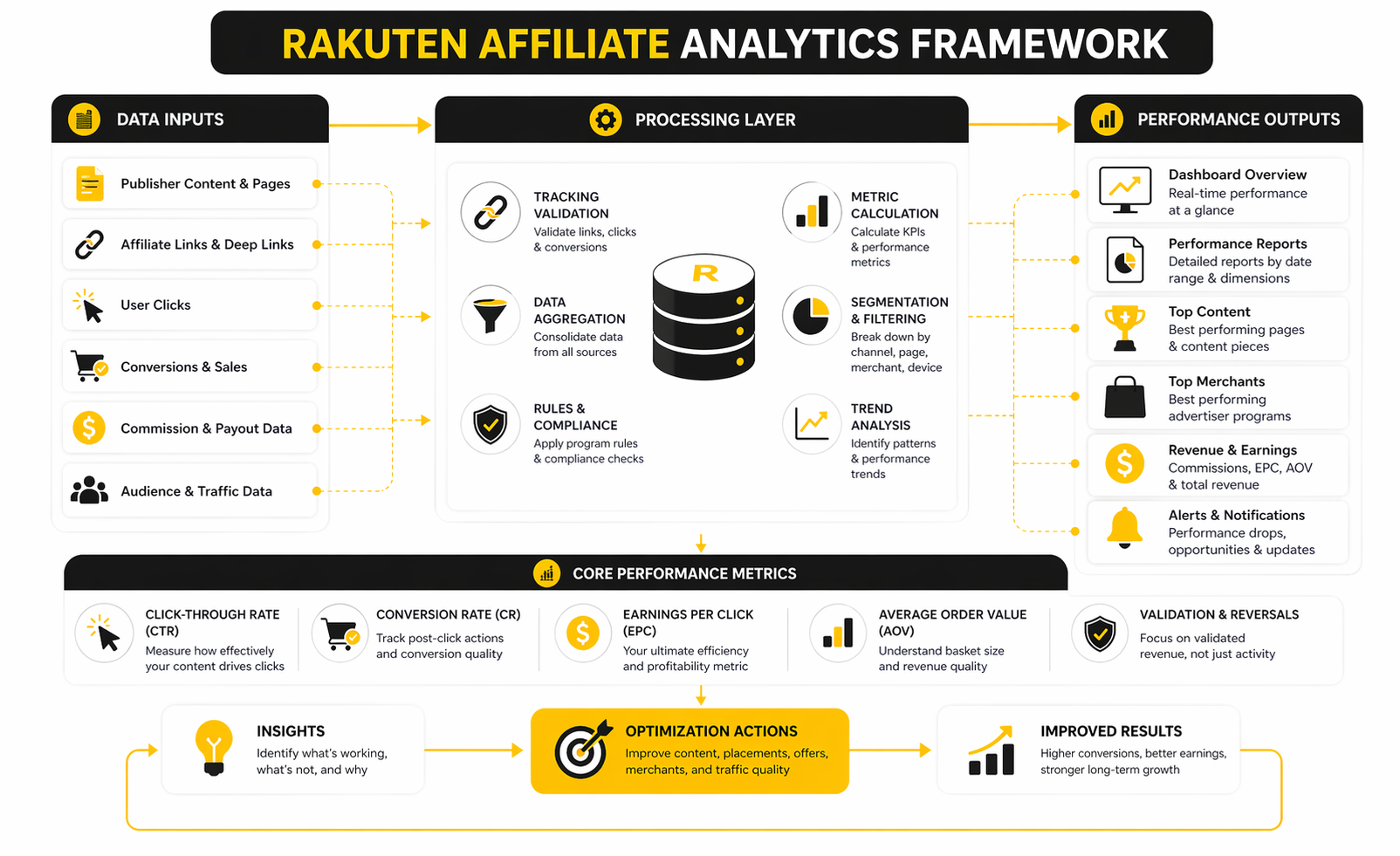
Build a Measurement System You Can Actually Use
A simple measurement system beats a complicated one that never gets reviewed. For most Rakuten affiliate publishers, the usable layer looks like this:
- Track page-level traffic and affiliate clicks
This tells you which content is creating commercial movement and which content only looks busy.
- Track clicks by placement type
Separate in-content links, buttons, comparison blocks, and end-of-article calls to action. That shows where intent is strongest.
- Track merchant-level conversion behavior
Compare how similar pages perform across different advertisers. This helps you isolate merchant quality from page quality.
- Track earnings per click and revenue per page
These numbers turn performance into business language. They help you prioritize what deserves optimization.
- Review validated revenue, not just early activity
Some programs look better in the short term than they do after commissions settle. Finalized economics matter more than early excitement.
This is the level where data becomes operational. You are no longer just observing Rakuten affiliate performance. You are running a system that can tell you what to rewrite, what to remove, what to test, and what to scale.
What the Data Should Make You Do Next
If your best traffic pages are weak on clicks, improve commercial clarity and placement. If your best-clicked pages are weak on conversion, improve merchant fit and destination relevance. If your pages convert but revenue is soft, review product emphasis and commission economics.
That is the whole game in a sentence. Good measurement shortens the distance between signal and action. It helps you move from “something is off” to “this is the variable to fix.”
There is one more layer that matters here, and it is easy to overlook: compliance. The FTC’s current endorsement guidance still makes it clear that material connections must be disclosed clearly and in a way people can actually notice and understand FTC endorsement guidance FTC endorsement rules overview. That is not separate from performance. Trust affects clicks, conversion quality, and long-term durability. A Rakuten affiliate business that scales well is not just optimized. It is measured honestly and presented transparently.
Scaling Rakuten Affiliate Without Breaking What Made It Work
The hardest part of Rakuten affiliate is not getting your first commissions. The hard part is scaling revenue without turning a useful publishing asset into a noisy commercial machine. That usually happens when publishers chase volume too early, add too many merchants, and slowly weaken the trust that made the first wins possible.
Rakuten’s own guidance for new publishers still points back to fundamentals like niche focus, business model clarity, and audience development before aggressive monetization. That is not beginner fluff. It is a reminder that affiliate performance compounds best when the publishing layer stays coherent instead of becoming a patchwork of disconnected offers.
A scalable Rakuten affiliate operation usually grows in three directions at once. It deepens high-intent content, improves the quality of merchant selection, and systematizes execution. What it does not do is blindly multiply links and hope the extra surface area becomes revenue.
Scale the Winners Before You Expand the Portfolio
One of the cleanest ways to grow is to scale what already works before adding more moving parts. If a page, category, or content format has already proven it can drive qualified clicks and validated commissions, that asset deserves deeper attention. Improve the comparison logic, upgrade the merchant mix, tighten the destination pages, and expand adjacent content around the same buying intent.
This sounds less exciting than launching ten new pages or applying to twenty new advertisers, but it is usually more profitable. Proven intent is worth more than speculative coverage. In Rakuten affiliate, a page that already converts gives you a better base for optimization than a fresh page with no behavioral data.
This is also where discipline protects margin. A lot of publishers scale by adding more content volume, but stronger operators often scale by increasing revenue density per page, per merchant relationship, and per click. That is a more defensible model because it depends less on constant content expansion.
Operational Leverage Comes From Systems, Not Hustle
At a certain point, Rakuten affiliate stops rewarding manual effort and starts rewarding systems. You need repeatable ways to review merchant opportunities, build deep links, refresh older pages, monitor disclosures, and prioritize optimization work. If every improvement depends on remembering where a link lives or which article still mentions an outdated offer, your business will eventually hit a wall.
Rakuten’s publisher tooling and Deep Links API matter more at this stage because they reduce friction in execution. The ability to generate deep links programmatically or at scale is not just a convenience feature. It becomes part of how you keep a large content portfolio commercially precise without turning link management into a full-time cleanup job.
That is the real threshold between casual and professional implementation. Casual affiliates add links. Professional affiliates build operating systems around link relevance, offer maintenance, and reporting hygiene.
Your Best Growth Lever Might Be Better Landing Relevance
A lot of people assume the next level of growth comes from more traffic. Sometimes it does. But in Rakuten affiliate, one of the most underused levers is simply improving the match between the reader’s expectation and the page they reach after clicking.
Deep linking is central here because it compresses the distance between interest and action. Rakuten explicitly supports deep linking and even provides dedicated tooling for it because sending users to the most relevant page can improve decision quality and reduce friction. That is not a minor implementation detail. It is a growth lever hiding in plain sight.
This matters even more when shopper behavior is getting less linear. Current affiliate benchmark data points to a market where clicks can rise while conversions soften, which usually means users are researching more aggressively and making slower decisions. In that environment, relevance after the click becomes even more important because any unnecessary friction gives the user another excuse to leave.
Strategic Tradeoffs, Risks, and What Experts Watch Closely
As Rakuten affiliate grows, the problems become less tactical and more strategic. You are no longer just asking whether a link should be added to a page. You are managing dependency, compliance exposure, platform policy risk, and merchant concentration. Those issues matter because they can damage revenue even when your content is strong.
This is where expert-level judgment starts to matter. The goal is not maximum monetization at all costs. The goal is durable monetization that can survive policy shifts, advertiser churn, and changing buyer behavior.
Overdependence on a Small Set of Merchants Can Become a Hidden Risk
A concentrated portfolio can perform brilliantly for a while, but it also creates fragility. If too much of your Rakuten affiliate revenue comes from one merchant, one category, or one seasonal pattern, your business becomes vulnerable to decisions you do not control. Commission changes, tighter approval standards, altered promotional rules, or changes in product availability can hit much harder when your revenue base is narrow.
That does not mean you should diversify for the sake of appearances. Forced diversification often weakens performance. It means you should understand the difference between a focused portfolio and a fragile one.
The expert move is to diversify along logical lines. Add backup merchants in adjacent categories, strengthen content formats that can support multiple credible recommendations, and avoid building your entire monetization system on one commercial assumption. That way Rakuten affiliate stays resilient without becoming diluted.
Compliance Drift Can Wreck Good Performance
One of the most underestimated risks in affiliate marketing is not a bad merchant or a weak page. It is compliance drift. Over time, disclosures get buried, content gets updated unevenly, promotional language becomes more aggressive, and older pages keep monetizing even after they no longer meet the same standard as the newer ones.
Rakuten’s publisher standards are clear that publishers need to follow network policies, applicable laws, and advertiser terms to stay in good standing. The FTC’s guidance remains equally clear that material connections should be disclosed clearly and conspicuously, not hidden in language users are unlikely to notice or understand.
This is not just a legal issue. It is a business quality issue. A Rakuten affiliate property that scales without disclosure discipline often creates trust damage first and operational damage second.
Policy and Attribution Changes Are Part of the Landscape
Affiliate marketing is not static, and pretending otherwise is expensive. Networks, advertisers, browsers, and platforms all keep changing how attribution, promotion, and partner behavior are handled. Recent Rakuten product updates around automation, reporting, and product intelligence are one side of that trend. Network enforcement and partner-quality expectations are the other.
That means expert operators stay close to policy changes even when performance looks healthy. They review network guidance, monitor advertiser terms, and keep an eye on enforcement signals across the ecosystem. The goal is not paranoia. The goal is avoiding surprise revenue loss from rules you should have seen earlier.
This is especially relevant when certain promotional models become controversial or face network scrutiny. You do not need to chase every industry drama to understand the lesson. If your monetization depends on tactics you would struggle to explain clearly to a merchant, a regulator, or your audience, the model is probably weaker than it looks.
Scaling Content and Scaling Trust Are Not the Same Thing
Here is the tradeoff that matters most: content scale and trust scale do not automatically move together. You can publish more pages, more comparisons, and more merchant links, but if each new asset is less thoughtful than the last one, your revenue may become more volatile even while your footprint grows.
That is why advanced Rakuten affiliate operators build editorial filters, not just content calendars. They ask whether a page deserves to exist, whether a merchant recommendation is genuinely useful, and whether the buying guidance adds clarity instead of just monetization pressure. Those filters are what keep scale from becoming entropy.
This is also why some smaller affiliate businesses outperform much larger ones. They are not better because they publish more. They are better because each commercial recommendation carries more relevance, more confidence, and less friction.
The Mature Mindset Is Portfolio Management
At the advanced level, Rakuten affiliate is no longer about isolated links or isolated pages. It becomes portfolio management. You are managing a set of monetized assets, a set of advertiser relationships, a set of compliance responsibilities, and a set of traffic-intent patterns that need different treatment.
That mindset changes how you allocate effort. Instead of constantly asking what to add, you start asking what to strengthen, what to retire, what to consolidate, and what to protect. Those are better questions because they produce a cleaner business.
And that is really the point of this entire second half of the article. Rakuten affiliate rewards practical execution, but it keeps paying when you treat the channel like a business system rather than a collection of links. The final step is pulling all of that into a simple decision framework and answering the questions people usually get wrong.
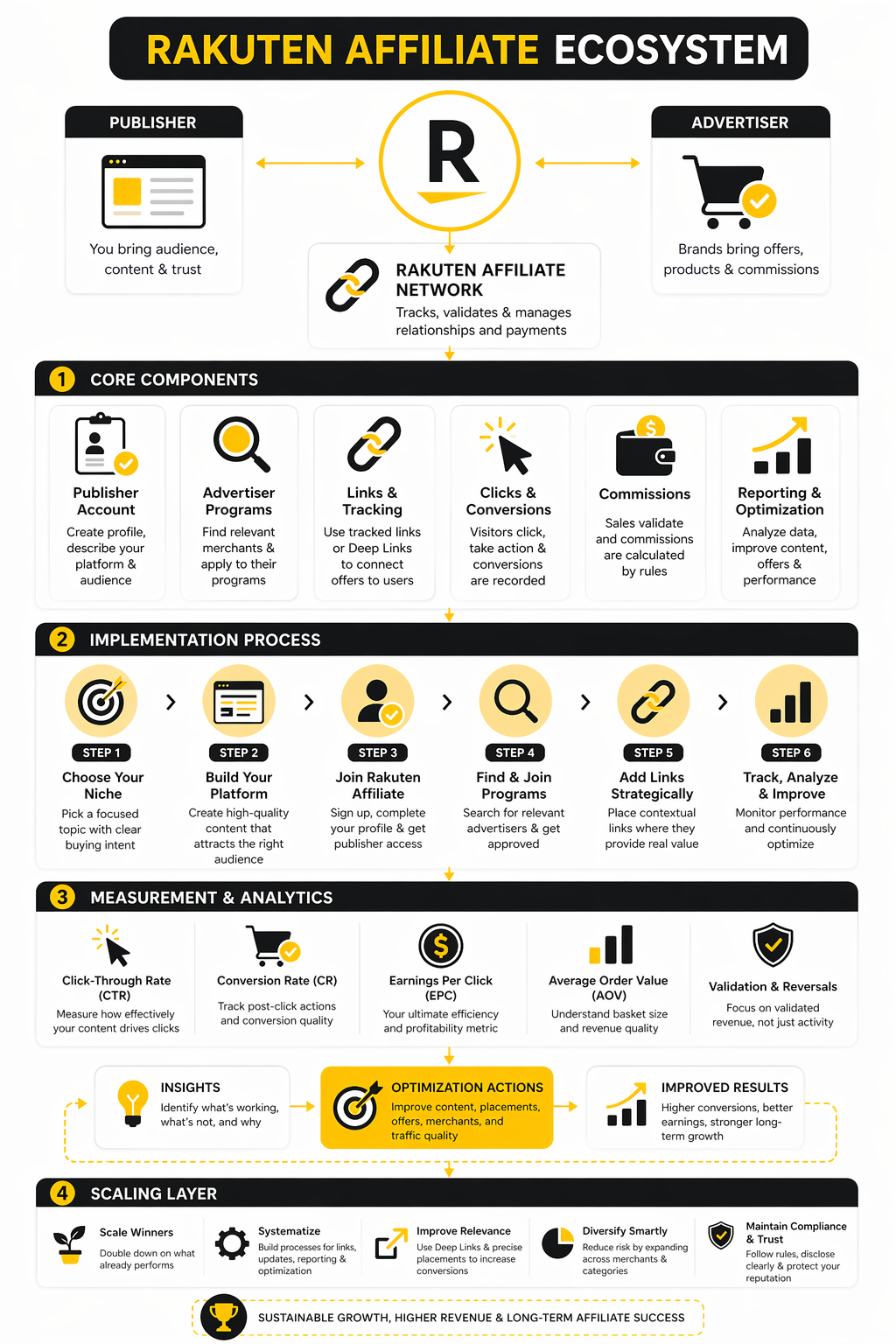
FAQ - Built for Complete Guide
What is Rakuten affiliate in simple terms?
Rakuten affiliate is a partner marketing network that connects publishers with brands that want tracked sales or other performance-based outcomes. You join as a publisher, apply to individual advertiser programs, and use approved links or creative assets to promote relevant offers. When your audience completes a qualifying action under that advertiser’s rules, you can earn a commission.
The important part is that Rakuten affiliate is not one universal approval that unlocks every brand. It works relationship by relationship inside the network. That structure is one of the reasons it can feel more selective, but it is also why the quality of your positioning matters so much.
Is Rakuten affiliate good for beginners?
It can be, but only if you approach it with realistic expectations. A beginner with a focused site, clear audience intent, and useful content can absolutely build traction. A beginner who expects instant approvals and easy passive income usually gets disappointed fast.
Rakuten affiliate rewards clarity more than hype. If your niche makes sense, your traffic source is understandable, and your content genuinely helps people decide what to buy, you have a real shot. If your setup is vague, scattered, or built around chasing any offer that pays, the network will feel much harder.
Do you need a website to use Rakuten affiliate?
A website is one of the strongest assets you can bring because it gives advertisers context and gives you a stable place to publish buying-intent content. That said, Rakuten affiliate is broader than a classic blog-only model. Publishers can also work through channels like email or social, depending on what is allowed and how their properties are represented.
The real issue is not whether you technically have a website. It is whether you have a credible promotional property and a clear explanation of how you reach an audience. A site just makes that easier to prove.
How hard is it to get approved by advertisers?
That depends much more on fit than on raw size. Some advertisers want a very specific kind of audience, content style, or promotional method, and others are more flexible. The mistake is assuming every rejection means your platform is weak.
Usually, the real question is whether your content makes the advertiser’s decision easy. If your audience, niche, and page topics clearly match the merchant’s category, approvals tend to feel more logical. If the connection is fuzzy, the odds naturally get worse.
How many advertiser programs should you join?
Fewer than most people think. A small, well-matched portfolio of merchants almost always beats a giant pile of approvals that do not fit your audience or content structure. More offers can look impressive in a dashboard while quietly hurting trust and focus on the page.
With Rakuten affiliate, quality usually compounds faster than quantity. It is better to have a handful of merchants you can place confidently than dozens you barely use. Once those relationships prove they work, then expanding makes sense.
What kind of content works best for Rakuten affiliate?
Content with commercial intent tends to be the strongest fit. That includes product comparisons, category roundups, gift guides, shopping research content, and decision-stage reviews where the reader is already looking for help choosing. Those formats create a natural bridge between useful advice and a tracked next step.
That does not mean every article has to sound salesy. In fact, the better approach is usually the opposite. Rakuten affiliate works best when the content feels like clear buying guidance, not like monetization disguised as advice.
Should you use banners or text links?
Text links usually win more often than people expect because they can match the moment of decision inside the content. A well-placed text link after a useful recommendation often feels more natural than a banner that interrupts attention. That makes it easier for the click to feel earned rather than forced.
Banners are not useless, but they are rarely the best default. In Rakuten affiliate, your highest-performing placements are often the ones that blend relevance, timing, and clarity. That usually favors in-context links over decorative creative.
What is the biggest mistake people make with Rakuten affiliate?
The biggest mistake is treating it like a link-collecting exercise instead of a monetization system. People join the network, grab whatever seems available, and start inserting links into pages that were never built to support a commercial action. Then they blame the platform when results stay weak.
The better mindset is to build around intent. Pick pages where readers are already close to a decision, choose merchants that belong there, and make the path from recommendation to click extremely clear. That sounds simple, and it is, but it takes more discipline than most people expect.
How long does it take to make money with Rakuten affiliate?
It depends on your starting point. If you already have traffic, buying-intent pages, and a niche with strong merchant fit, you can start learning from real performance data fairly quickly. If you are starting from zero, the process is slower because you are building trust, content, and approvals at the same time.
The wrong expectation is immediate passive income. The right expectation is staged progress. First you build relevance, then you earn clicks, then you learn which merchants and pages actually deserve more effort.
Is Rakuten affiliate better than other affiliate networks?
There is no universal winner because networks solve different problems. Rakuten affiliate can be a strong fit when you want access to established brands, structured advertiser relationships, and a more curated environment. That can be especially valuable if your content leans editorial, retail, or commerce-heavy.
But “better” only matters in context. If your niche, traffic source, and merchant needs align with what Rakuten affiliate does well, it can be a very strong channel. If they do not, another network may fit your business model more naturally.
Can you use Rakuten affiliate without being spammy?
Yes, and honestly, that is the only version worth building. Spammy affiliate content might create short bursts of clicks, but it weakens trust, makes approvals harder to sustain, and usually leads to lower-quality traffic anyway. That is not a real business. It is just noise with links in it.
A cleaner approach is to make recommendations only where they genuinely help the reader. That keeps the content useful, the commercial intent transparent, and the click more likely to convert. Rakuten affiliate performs better when the recommendation feels credible.
What should you focus on first if you want better results?
Start with the pages that already have commercial intent. Do not begin by spraying affiliate links across everything you have ever published. Begin where readers are already trying to compare options, choose a product, or decide where to buy.
Then improve the basics before chasing advanced tactics. Tighten merchant fit, improve destination page relevance, make your calls to action clearer, and track which pages actually produce quality clicks. In Rakuten affiliate, that sequence usually creates better results than trying to outsmart the process.
Work With Professionals
Explore 10K+ Remote Marketing Contracts on MarkeWork.com
Most marketers spend too much time chasing clients, competing on crowded platforms, and losing a percentage of every project to middlemen.
MarkeWork gives you a better way. Browse thousands of remote marketing contracts and connect directly with companies desperate to hire skilled marketers like you, without platform commissions and without unnecessary gatekeepers.
If you're serious about finding better opportunities and keeping 100% of what you earn, explore available contracts and create a profile for free at MarkeWork.com.