

Real estate advertising is not just about putting a property in front of more people. It is about getting the right buyer or seller to stop, care, trust what they see, and take the next step before they move on to the next listing, agent, or platform. That matters even more in a market where buyers are still starting online, most sellers still rely on agents to market their homes, and listing quality can directly influence whether a property even earns a click in the first place. NAR’s 2024 Profile of Home Buyers and Sellers shows that 43% of buyers began their home search on the internet, 51% found the home they purchased online, and 88% bought through a real estate agent or broker, while Zillow’s agent-focused consumer research found that 86% of buyers were more likely to view a home if the listing included a floor plan they liked.
That combination changes the job of real estate advertising. You are no longer competing only with other local agents or nearby listings. You are competing with the speed of scrolling, the expectations created by big real estate portals, and a buyer mindset shaped by search, maps, photos, video, floor plans, reviews, and instant access to alternatives. In a market where the latest NAR snapshot put existing-home sales at a seasonally adjusted annual rate of 3.98 million and the median existing-home price at $408,800 in March 2026, wasted impressions are expensive and weak positioning is even more expensive. NAR’s latest existing-home sales data and its March 2026 market release both point to a still-active but pressure-filled environment where quality marketing has to do more than generate awareness.
Good real estate advertising sits at the intersection of strategy and execution. It needs sharp positioning, strong creative, channel discipline, fast follow-up, and a system for measuring what is actually producing inquiries, appointments, and signed business. That is the difference between advertising that looks busy and advertising that drives revenue.

Article Outline
This article is structured as a practical system rather than a pile of disconnected tactics. The goal is to show how real estate advertising works from the market level down to the campaign level, so each later section builds on the one before it. These are the six sections the full article will use.
- Why Real Estate Advertising Matters in Today’s Market
- The Modern Real Estate Advertising Framework
- Audience, Positioning, and Offer Strategy
- Creative Assets That Make Listings and Brands Stand Out
- Channel Strategy Across Search, Social, Portals, Email, and Automation
- Professional Implementation, Measurement, Optimization, and FAQ
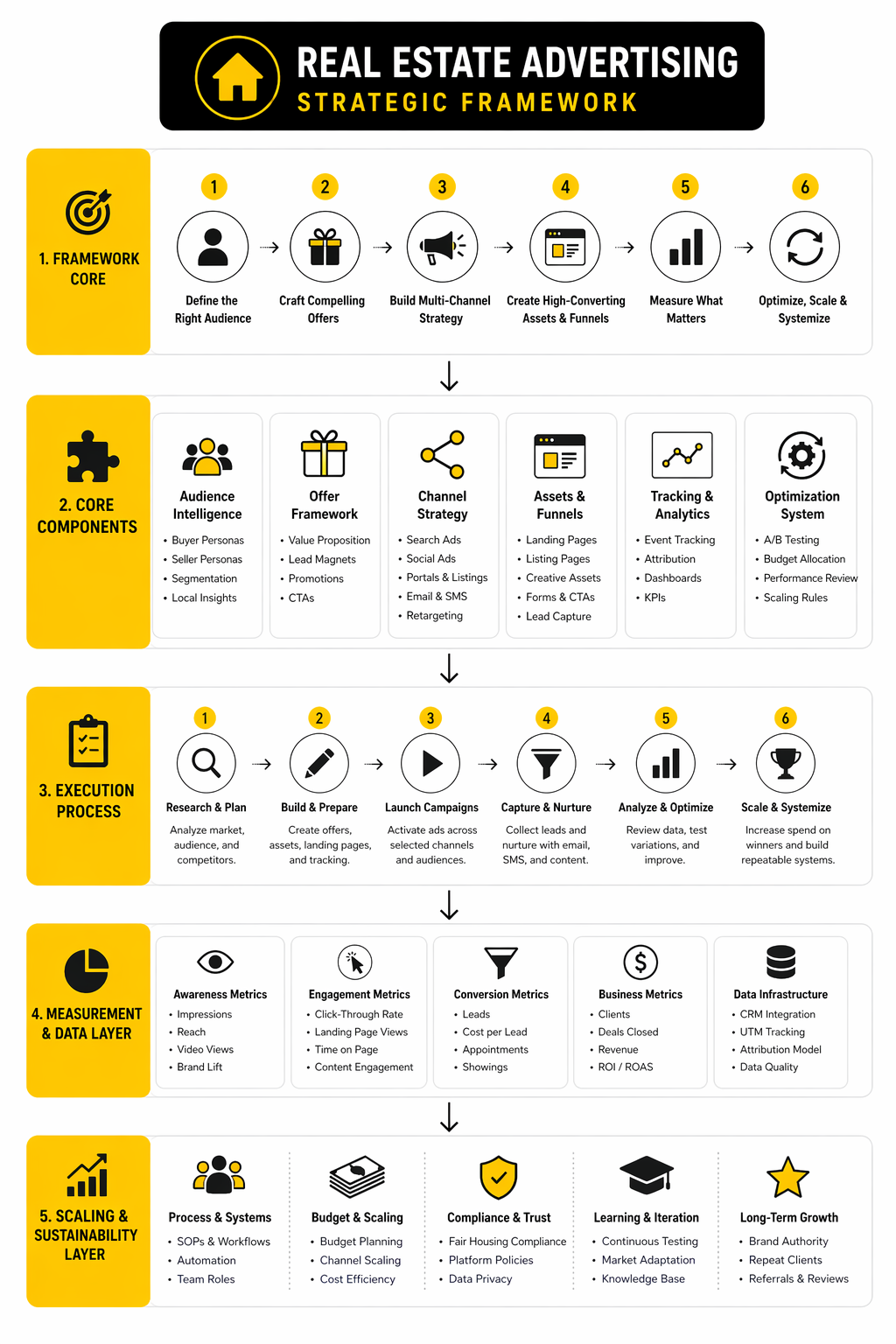
The order matters. First, the article will clarify why real estate advertising has become a business-critical function instead of a nice extra. Then it will move into the framework, break down the core components, and finish with the professional implementation side that most agents, teams, and brokerages either overlook or improvise badly.
Why Real Estate Advertising Matters in Today’s Market
Real estate advertising matters more now because the path to a transaction is fragmented, fast, and heavily shaped by digital discovery. Buyers still begin online at meaningful scale, and many of them decide which homes deserve a closer look before they ever speak to an agent, which means the ad, the listing, and the creative package are doing part of the selling long before a conversation happens. NAR’s home buyer and seller research and Zillow’s buyer trends data both reinforce the same point: visibility is not enough anymore, because digital presentation shapes consideration.
That changes the economics of attention. In slower or affordability-constrained markets, buyers compare more carefully, sellers scrutinize agent marketing more closely, and weak promotion gets exposed fast because homes sit longer, price cuts become more visible, and alternatives stay one tab away. Realtor.com’s 2025 housing market trends and NAR’s affordability and supply analysis both point to a market where buyers are selective and sellers cannot assume demand will cover lazy marketing.
This is why real estate advertising is not a side activity anymore. It is part of pricing strategy, listing strategy, lead generation, brand positioning, and client acquisition all at once. When an agent or brokerage gets it right, advertising does not just generate exposure for a property. It builds trust, shortens the path to inquiry, improves seller confidence, and makes the business easier to grow predictably.
Attention Is Scarcer Than Inventory
A lot of agents still talk about marketing as if distribution is the hard part. It is not. Distribution is easy compared with earning a real stop from a buyer who has already seen twenty similar kitchens, ten nearly identical captions, and a feed full of polished listing clips that blur together after a few seconds.
That is why creative quality now has a direct commercial role. Strong visuals, useful floor plans, sharp headlines, and clear property positioning help a listing stand out inside the browsing experience buyers already use every day. Zillow’s consumer housing research found buyers respond strongly to listing details and visuals, while NAR’s practical guidance on online listings stresses richer visual information, including photos, video, virtual tours, and floor plans, because that is what helps listings compete.
Attention is scarce on the seller side too. Homeowners hear endless promises from agents about social media, exposure, and aggressive marketing. Most of it sounds the same. Real estate advertising becomes persuasive when it is specific enough to prove how the home will be positioned, where the demand will come from, what assets will be created, and how the campaign will be measured.
Sellers Expect Proof, Not Generic Promises
This is one of the biggest shifts in the business. Sellers still hire agents for guidance, negotiation, pricing, and market expertise, but they also expect a real marketing engine behind the listing. They want to know what will be done, how it will look, how quickly it will launch, and why your plan is better than the next agent’s pitch.
That expectation is completely rational. Homes are high-value assets, and the owner is evaluating whether your advertising can help create urgency, wider reach, and a better pool of buyers. NAR’s profile research continues to show how central agents remain in completed transactions, which makes marketing credibility part of the hiring decision rather than a bonus feature.
This is where many agents lose before the listing agreement is even signed. They describe channels instead of outcomes. They say they will post on Instagram, boost on Facebook, put the property on the MLS, and maybe send an email blast. None of that answers the real seller question, which is simple: how will your advertising make my property more desirable to the right buyer pool?
Better Advertising Improves More Than Lead Volume
A lot of people hear the phrase real estate advertising and think only about lead generation. That is too narrow. Good advertising improves listing engagement, strengthens brand perception, creates proof of professionalism, supports premium pricing narratives when justified, and helps agents win more listing presentations because prospects can already see the difference in quality.
It also helps with follow-up efficiency. Better-qualified inquiries are easier to handle than random volume, and structured campaigns make it easier to route leads, nurture them, and stay consistent over time. That matters because speed and consistency still shape conversion in sales environments, and modern sales automation tools are built around exactly those repetitive workflows. HubSpot’s explanation of sales automation and its 2026 roundup on AI CRMs for real estate both highlight lead routing, follow-up sequences, and workflow automation as practical ways to keep opportunities from slipping away after first contact.
The important point is this: advertising is no longer isolated from operations. If your campaign brings in interest but your process is slow, the advertising underperforms. If your process is excellent but your creative is weak, you never earn enough qualified interest in the first place. The whole system has to work together.
The Modern Real Estate Advertising Framework
The most useful way to think about real estate advertising is as a framework, not a tactic list. Random acts of promotion create activity, but they rarely create momentum. A framework gives you sequence, priorities, and standards, so every campaign starts from the same logic even when the property, audience, or market conditions change.
At a practical level, the framework has four layers. First comes market and audience clarity, because you need to know who the property or service is really for. Second comes positioning and offer design, because the same home can be marketed in very different ways depending on what angle will resonate. Third comes creative and channel execution, where the campaign actually becomes visible. Fourth comes follow-up, measurement, and optimization, which is where advertising turns into business results instead of vanity metrics.
That structure matters because most failed campaigns do not fail from lack of effort. They fail because one layer is missing. The targeting is vague, the positioning is generic, the creative is forgettable, or the lead handling breaks the moment someone raises a hand.
Layer One: Market and Audience Clarity
Every effective campaign starts with a sharper question than “how do we promote this property?” The better question is “who is most likely to care about this, and why would they care now?” That framing immediately improves everything that follows, from copy to imagery to platform choice.
For a listing, that means understanding likely buyer profiles, financing realities, neighborhood appeal, and the lifestyle signals that actually matter. For agent-brand campaigns, it means separating first-time buyers, move-up buyers, downsizers, investors, luxury sellers, relocation clients, and local homeowners who are not ready yet but may be within the next year. Zillow’s prospective buyer research makes this point indirectly by showing how broad intent to buy is compared with the smaller share of people who actually transact, which means broad audiences need sharper filtering before the message becomes useful.
Without that clarity, advertising gets lazy. The message becomes generic, the visuals lose relevance, and the campaign starts speaking to everyone in a tone that persuades no one.
Layer Two: Positioning and Offer Design
Once the audience is clear, the next job is positioning. This is where real estate advertising becomes strategic instead of decorative. Positioning answers the question of how this property, service, or agent should be understood in a crowded market.
For a home, the angle might be walkability, layout efficiency, renovation quality, family functionality, design character, school-zone access, lock-and-leave convenience, or investment potential. For an agent, the angle might be local dominance, negotiation skill, off-market access, data-driven pricing, relocation expertise, or a more premium client experience. None of those positions work automatically. They work only when the rest of the campaign supports them.
Offer design is the next step and it is wildly underrated. Not every campaign should ask for the same action. Some ads should drive a showing request. Some should drive a valuation request. Some should drive a list-building asset like a neighborhood update or buyer guide. Some should push people straight into a calendar booking flow through a tool such as Cal.com, while others work better when the lead first enters a nurture sequence inside a system like GoHighLevel or Brevo. The offer has to match the temperature of the audience, not the impatience of the advertiser.
Layer Three: Creative and Channel Execution
This is the layer people usually obsess over first, but it only works when the earlier thinking is solid. Creative is not just what looks nice. It is the packaging of the promise. It tells the audience what matters here and why they should care enough to act.
In real estate advertising, the strongest campaigns usually combine visual clarity with decision-useful information. That includes strong photography, clean video, concise copy, obvious next steps, and supporting assets that help buyers evaluate the property quickly. NAR’s listing guidance pushes for richer visual information, and Zillow’s research on buyer preferences shows why that matters inside the actual browsing behavior of home shoppers.
Channel choice should follow buyer behavior, not habit. Some campaigns belong on portals and search because intent is already high. Others belong on social because interruption can still work when the creative is strong and the audience signal is right. Brand campaigns may benefit from scheduled content distribution using tools like Buffer, while direct-response lead capture can lean on landing page tools such as ClickFunnels or Systeme.io when the campaign needs tighter conversion paths.
Layer Four: Follow-Up, Measurement, and Optimization
This is the layer that separates professionals from people who are just running ads. Once interest comes in, the real work starts. Leads need routing, qualification, response workflows, reminders, appointment booking, and a way to track what actually produced a conversation versus what only produced a click.
That is why the modern framework has to include automation and measurement from the start. A campaign without follow-up logic is incomplete, and a campaign without measurement is just guesswork with a budget attached. Tools like GoHighLevel, ManyChat, and Fillout can support those workflows when they are implemented well, but the principle matters more than the software: the campaign must keep moving after the click.
Optimization then becomes far more useful. Instead of asking whether an ad got reach, you can ask better questions. Which creative angle produced the best inquiries? Which audience brought in actual conversations? Which landing page got appointments instead of empty form fills? Which follow-up sequence recovered cold leads instead of letting them disappear? That is the mindset the rest of this article will build on.
Audience, Positioning, and Offer Strategy
The next layer of real estate advertising is where the campaign stops being generic and starts becoming persuasive. Once the market context is clear, the real question is not how loudly to promote a property or service, but how precisely to match the message to the people most likely to care. That matters because buyers and sellers do not enter the market with the same urgency, the same objections, or the same timeline, and recent consumer research keeps showing just how uneven that journey really is, with 59% of prospective buyers in 2025 saying their search had already lasted six months or longer and many sellers thinking about a move three to four months before they list.
This is where a lot of real estate advertising goes wrong. The creative may look polished, the ad spend may be real, and the channels may be active, but the campaign still underperforms because it is speaking to a vague audience with a vague promise. Precision fixes that. The clearer you are about who the campaign is for, what they care about, and what action they are ready to take, the easier it becomes to write stronger copy, build better assets, and choose the right destination after the click.
Start With Buyer and Seller Intent, Not Demographics Alone
Demographics still matter, but intent matters more. Age, income band, life stage, and household structure can help you understand the audience, but they do not tell you enough on their own. What really sharpens real estate advertising is knowing whether the person is casually browsing, actively comparing, preparing to list, relocating soon, downsizing, investing, or trying to solve a financing problem before they can move.
That shift is practical, not theoretical. NAR’s 2025 generational trends report shows just how differently younger millennials, older millennials, Gen X, and older buyers approach ownership, family needs, and transaction patterns, while Zillow’s prospective-buyer research shows how many people remain in the market for long stretches before acting. That means audience planning has to reflect real intent windows, not just broad identity labels.
For sellers, intent is just as important. A homeowner thinking about listing this spring needs a different message from someone who is only curious about equity or neighborhood pricing. If both see the same ad and land on the same page, one of them is being handled badly. Good real estate advertising does not flatten these audiences into one funnel. It separates them early so the offer can feel relevant from the first touch.
Build Narrow Audience Segments Around Real Problems
The strongest campaigns are usually built around clusters of people facing similar decisions. First-time buyers care about affordability, financing confidence, and clarity around the process. Move-up buyers often care about timing the sale and purchase together, space trade-offs, and neighborhood quality. Downsizers may care more about simplicity, convenience, equity preservation, and trusted guidance than about browsing dozens of new options.
That kind of segmentation matters because the same property features can mean different things to different people. A home office can be a productivity story for a remote worker, a schooling story for a growing family, or a rental-yield detail for an investor. A walkable area can signal lifestyle, resale strength, or convenience depending on who is reading the ad. Real estate advertising gets stronger when those distinctions show up before the creative is produced.
There is hard market logic behind this. NAR’s 2025 buyer and seller profile and its 2025 market summary both point to a market where affordability pressure, limited supply during much of the survey period, and a historically low share of first-time buyers reshaped who could transact and how they approached the process. When the market is that uneven, lazy segmentation gets punished.
Position the Property Around What the Market Will Value Fast
Positioning is not hype. It is the discipline of deciding what the market should notice first and why that angle deserves attention. That sounds obvious, but in practice a lot of real estate advertising still throws every possible feature into the message and hopes the audience will sort it out.
A better approach is to define the lead angle before the campaign launches. For one property, the winning position may be layout efficiency and everyday livability. For another, it may be architectural character, school access, rental potential, lock-and-leave convenience, renovation quality, or outdoor space that is rare for the area. The point is not to be clever. The point is to make the listing easier to understand and easier to remember.
That clarity becomes even more important in a market where buyers have more negotiating leverage in some regions and more choice than they had a year earlier. Redfin reported in January 2026 that sellers outnumbered buyers by a record 47% in December 2025, and Realtor.com’s monthly trends reporting has documented rising inventory and slower market momentum through much of 2025. In that environment, weak positioning is expensive because buyers do not need to work hard to find alternatives.
Turn Positioning Into a Clear Offer
Once the angle is defined, the next job is the offer. This is the bridge between attention and action, and it is where many campaigns stall. Too many real estate ads ask for a big commitment too early or send traffic to a page that does not match the promise of the ad.
A strong offer respects audience temperature. A hot prospect looking at homes right now may be ready to book a showing or speak to an agent. A colder lead may respond better to a neighborhood pricing update, a home valuation, a curated list of listings, or a simple consultation that removes uncertainty without adding pressure. Real estate advertising works better when the ask fits the readiness of the person seeing it.
This is also where systems start to matter. If the offer is a consultation, the path to book should be fast and friction-light, which is why teams often use scheduling tools like Cal.com. If the offer is lead capture and nurture, the campaign usually needs forms, sequences, and routing inside platforms like GoHighLevel, Brevo, or Fillout. The point is not the tool itself. The point is that the offer has to be backed by a process that can carry it.
A Practical Process for Building the Campaign Before You Spend
A lot of real estate advertising problems can be avoided with one simple discipline: build the campaign on paper before you build it in public. That means defining the audience, angle, offer, asset mix, destination, and follow-up path before anyone touches ad copy or launches a boosted post. It sounds basic, but this is where consistency comes from.
When teams skip this step, the campaign usually becomes reactive. The copy changes halfway through, the landing page says something different from the ad, the audience broadens because results look soft, and nobody can tell whether the issue is targeting, message, creative, or follow-up. A simple planning process keeps all of that from turning into noise.
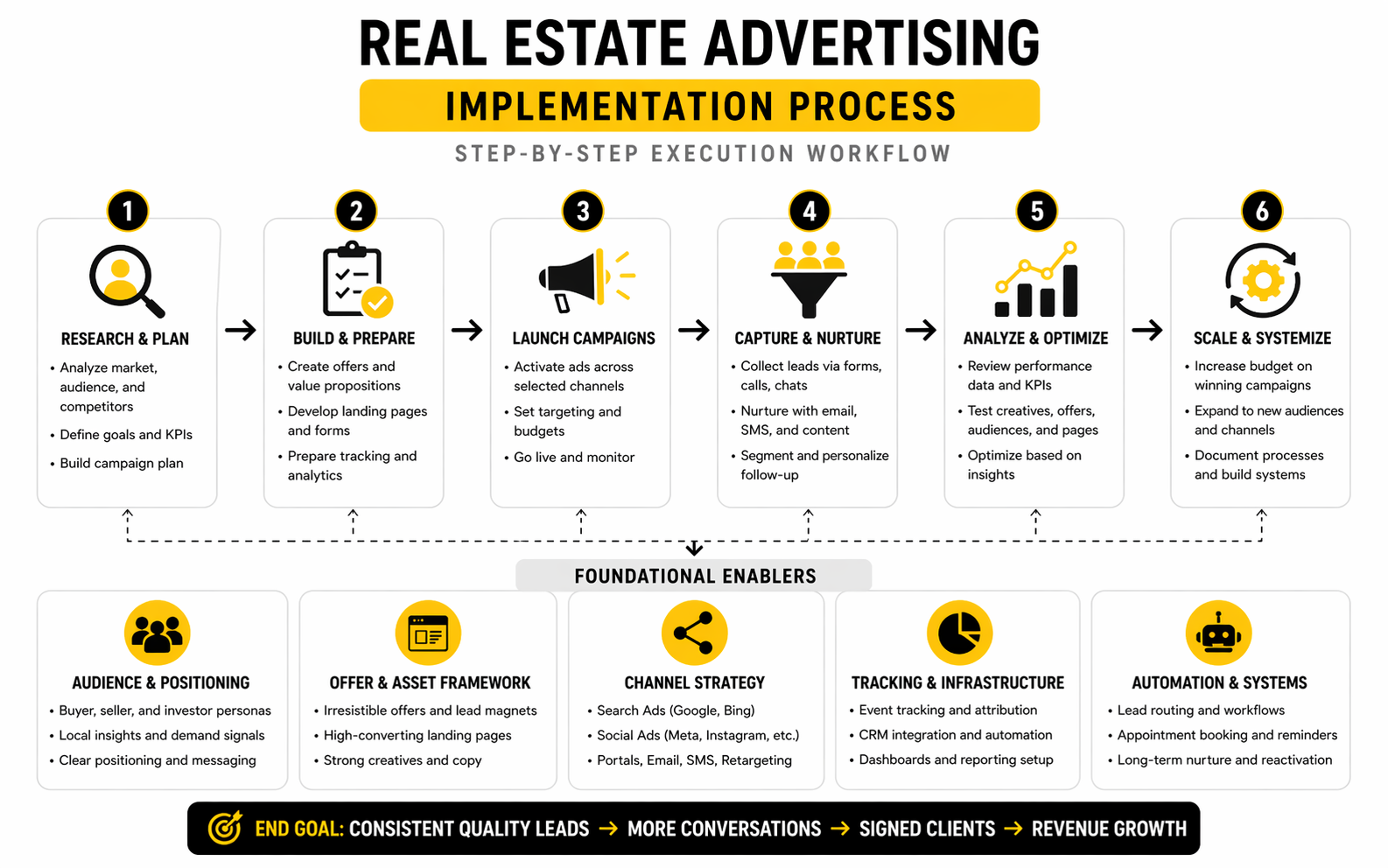
Step 1: Define the Exact Audience for This Campaign
Start by naming the primary audience in plain language. Not “home buyers” or “local homeowners,” but something far more specific, such as first-time buyers priced out of single-family homes who still want a good school area, or homeowners in one neighborhood who may be ready to trade up after two to five years. That level of clarity forces better decisions everywhere else.
Then define the pain, the desire, and the trigger. The pain might be uncertainty, low inventory, poor listing quality, or timing a move. The desire might be simplicity, more space, a faster sale, a stronger marketing plan, or confidence in pricing. The trigger is what made now feel relevant, and Zillow’s selling research makes clear that many homeowners think about a move months before listing, which gives smart advertisers a window to capture attention before competitors do.
Step 2: Choose One Core Positioning Angle
Next, pick the single strongest angle the campaign will lead with. This is not the time to list every benefit. It is the time to decide what should carry the message. If the property’s best advantage is light, layout, and livability, lead there. If the agent’s advantage is speed, local expertise, and a sharper launch process, lead there.
This step is where discipline matters. One clear angle does not make the campaign smaller. It makes it more memorable. Buyers and sellers are already overloaded with information, so real estate advertising performs better when the first impression is tight and instantly understandable.
Step 3: Match the Offer to Audience Readiness
Now decide what you want the audience to do next and make sure it fits their stage of intent. A buyer who is actively comparing homes may be ready for a showing request, a property alert, or a direct call. A homeowner who is only starting to explore options may be far more likely to respond to a valuation, a local market update, or a strategy session about timing and price.
This is where campaign friction has to be taken seriously. The more commitment you ask for, the more confidence your message has to create first. Many real estate advertisers would improve results simply by lowering the pressure of the first conversion step and then using automation to continue the conversation inside ManyChat or GoHighLevel.
Step 4: Build the Message Stack Before You Write the Ad
Before you draft the final ad, build the message stack. That means writing down the headline idea, the proof points, the likely objections, and the action you want the user to take. This one move makes copywriting dramatically easier because you are no longer improvising from a blank page.
For a listing campaign, the proof points might include floor plan quality, renovation detail, location advantages, outdoor space, parking, or price position. For an agent-brand campaign, proof points may include market knowledge, process transparency, speed to launch, content quality, and follow-up systems. Zillow’s buyer research and its listing-product updates tied to richer presentation both reinforce the same operational truth: buyers respond better when the listing experience gives them clearer, more useful information.
Step 5: Send Traffic to a Destination That Matches the Promise
This is a detail that sounds small but wrecks a lot of campaigns. If the ad promises a premium listing experience, the landing page cannot feel generic. If the ad offers a valuation, the page cannot bury the form. If the ad invites a consultation, the calendar flow cannot be awkward or slow.
Message match is one of the simplest ways to improve conversion quality. When the page continues the same angle, uses the same language, and makes the next step feel obvious, real estate advertising becomes easier to trust. That is one reason teams often use focused page builders like ClickFunnels, Systeme.io, or Replo when they need tighter control over the conversion experience.
Step 6: Design the First Seven Days of Follow-Up Before Launch
This is the step most people leave until later, which is a mistake. If the campaign succeeds, leads arrive immediately. If the process is not ready, speed drops, follow-up becomes inconsistent, and the quality of the campaign gets judged through the quality of the response.
That is why the follow-up plan should exist before launch. Decide who gets contacted first, how quickly, through which channel, with what message, and what happens if there is no reply. HubSpot’s real estate CRM guidance is useful here because it focuses on sync, tracking, and follow-up workflows, which are exactly the operational pieces that keep real estate advertising from wasting the attention it just paid for.
Why This Process Changes Results
This process works because it removes ambiguity. Instead of asking creative to save a weak strategy, it gives creative a sharper job to do. Instead of hoping the audience figures out why the offer matters, it makes the value clear before the first click.
It also makes measurement cleaner later. When the audience, positioning angle, offer, page, and follow-up flow are defined in advance, you can finally see what is actually driving outcomes. If a campaign underperforms, you are not stuck guessing whether the problem was everything. You can isolate where the breakdown happened and improve it without rebuilding the entire machine.
That is the real advantage of structured real estate advertising. It looks more professional on the surface, but the bigger win is underneath. It gives you a repeatable system for launching campaigns that are easier to understand, easier to optimize, and much more likely to turn attention into real business.
The Numbers That Actually Matter
By this point, the article has covered why real estate advertising matters, how to build the campaign, and how to structure the message before spending money. Now comes the part most people either overcomplicate or completely botch: measurement. The goal is not to collect more dashboards. The goal is to understand which signals tell you the campaign is healthy, which ones are warning signs, and which ones are just noise dressed up as insight.
That distinction matters because the real estate market itself has been sending mixed signals. Inventory rose for 26 straight months by December 2025, active listings were up 12.1% year over year, homes were taking four days longer to sell than a year earlier, and the national median list price was down 0.6% year over year, which tells you buyer attention is still valuable but no longer automatic. Realtor.com’s December 2025 housing report and Redfin’s 2025 market review point to the same practical reality: more choice and softer demand make marketing efficiency matter more, not less.
In other words, the market is already telling you what your ad data should be interpreted against. If homes are moving slower and buyers are comparing harder, then weak engagement is not just a creative problem. It may be a positioning problem, a pricing problem, or a sign that the audience you targeted was not close enough to action. Measurement becomes useful when it helps you diagnose that correctly.
Start With the Right Funnel, Not the Most Convenient Metric
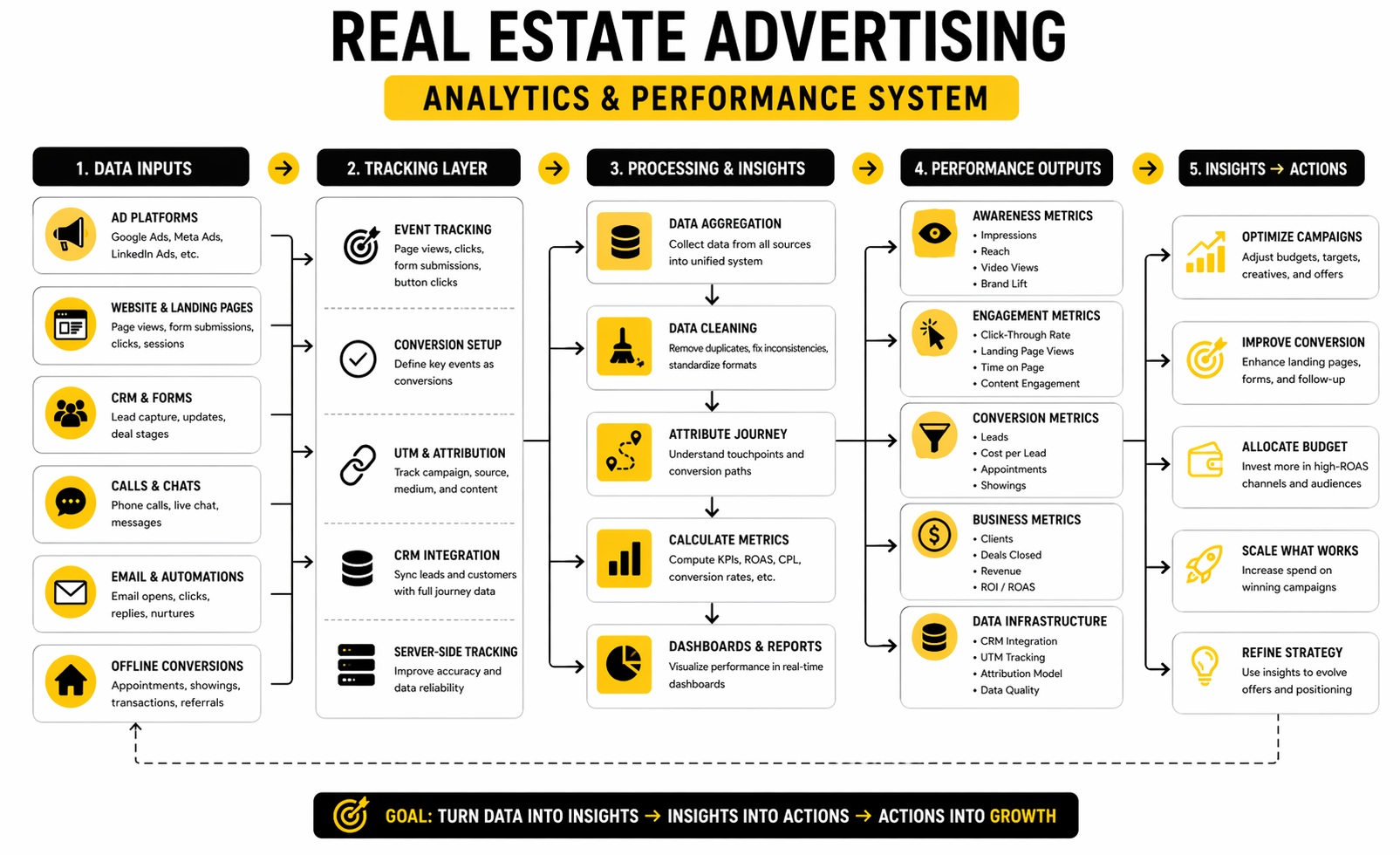
The cleanest way to evaluate real estate advertising is to track the whole funnel in order. That usually means impressions, click-through rate, landing-page engagement, lead rate, contact rate, appointment rate, and eventually signed business. Anything shorter than that can be directionally useful, but it cannot tell the full truth.
This is where many teams get fooled. They optimize for cheap clicks, celebrate reach, or obsess over form fills without checking whether those leads were actually contacted, qualified, or converted into meetings. Google’s current Analytics framework is built around this exact idea: first identify the events that matter to the business, mark them as key events, and then create conversions from the actions that should actually guide campaign optimization. Google’s GA4 documentation is very explicit here: event, then key event, then conversion.
That is the right mental model for real estate advertising. A page view is not a success. A lead is not automatically a success either. A campaign only starts proving itself when those earlier actions connect to meaningful business outcomes.
What a Healthy Measurement System Looks Like
A useful analytics system is not huge. It is disciplined. It tracks a small number of signals at each stage and makes sure every signal has an operational meaning attached to it.
At the top of the funnel, you want to know whether the message is earning attention. That usually means impressions, click-through rate, scroll depth, and time or interaction quality on the landing page. In the middle of the funnel, you want to know whether the offer is convincing enough to produce a real inquiry, so you watch lead rate, call clicks, form starts, form completions, calendar bookings, or chat starts. At the bottom of the funnel, you care about contact rate, show-up rate, qualified opportunities, listings won, closings, and revenue.
The reason this system works is simple: every number has a job. If click-through rate is weak, the market is probably rejecting the creative, headline, audience targeting, or promise. If click-through rate is fine but lead rate is weak, the problem is more likely the landing page, the offer, or the mismatch between ad and destination. If leads come in but appointments stay weak, the issue is usually response speed, lead quality, follow-up process, or the campaign asking the wrong people to raise their hands in the first place.
Benchmarks Are Directional, Not Universal
Benchmarks can help, but only if you use them the right way. They are not goals to copy blindly. They are context for understanding whether your current performance is unusually strong, unusually weak, or simply normal for a difficult category.
Search advertising is a good example. WordStream’s 2025 Google Ads benchmark report, based on 16,446 U.S. search campaigns, found an overall average conversion rate of 7.52%, while real estate sat at 3.28%, with an average cost per lead of $100.48 for the category. That benchmark dataset is useful because it shows real estate search traffic can convert materially worse than the overall search average even when intent is high.
That should change how you interpret your own numbers. If your real estate campaign is converting below broader search averages, that does not automatically mean the campaign is broken. It may simply mean you are operating in a category where consideration is long, competition is intense, and users often compare across multiple properties and agents before acting. What does matter is whether your numbers are improving against your own baseline and whether the downstream business outcomes justify the acquisition cost.
Listing Engagement Data Tells You What Buyers Actually Notice
One of the easiest mistakes in real estate advertising is to treat creative quality as subjective. It is not. Buyer behavior keeps showing that certain listing assets are more useful than others, and that should directly influence what gets produced, tracked, and optimized.
Recent Zillow research found that floor plans ranked as the most important listing feature for 35% of buyers ages 18 to 29, 36% of buyers ages 30 to 39, and 36% of buyers ages 60 and older, while high-resolution photos remained consistently important across age groups. Zillow’s 2025 prospective-buyer research lines up with NAR’s 2025 buyer data, which showed 77% of buyers found photos very useful, 77% valued detailed property information, and 57% appreciated floor plans.
Those numbers matter because they tell you what to measure beyond vanity engagement. If buyers care deeply about floor plans, photos, and detailed property information, then your analytics should track whether people are interacting with those assets, not just whether they saw the page. A campaign that produces clicks but weak engagement with the visual package may be attracting curiosity without real fit. A campaign that produces fewer clicks but stronger interaction with core listing assets may be attracting better buyers.
Agent-Marketing Data Now Has a Bigger Digital Component
Measurement should not stop at property ads. It also needs to cover agent marketing, because the way people choose agents is becoming more digital and more research-driven. Zillow reported at the end of 2025 that 36% of sellers now find their agents through online channels, up from 15% in 2018, while 33% of buyers said online research played a key role in how they chose their agent. Zillow’s official release also noted that repeat buyers made up 55% of all purchasers, which means a larger share of the market is making more deliberate hiring decisions.
That has two implications for real estate advertising. First, brand campaigns need to be measured against trust-building signals, not just immediate leads. Profile visits, repeat site visitors, branded search volume, guide downloads, and consultation requests matter because they reveal whether your presence is becoming more credible over time. Second, seller campaigns should be judged partly on whether they improve listing-win rates, because digital research is increasingly part of the agent-selection process itself.
This is a big deal. It means your marketing is no longer just competing to get a click. It is competing to shape how a prospect evaluates your professionalism before they ever speak to you.
Email and Nurture Metrics Only Matter if They Lead Somewhere
A lot of real estate advertisers use email and automations, but many still read those dashboards too shallowly. Open rate alone is a weak signal. It can tell you whether the subject line or sender identity is getting attention, but it does not tell you whether the message moved someone toward action.
Brevo’s 2025 benchmark data, built from more than 44 billion emails, put the overall average open rate at 31.22% and the overall click-through rate at 3.64%, with North America at a 29.42% open rate and 3.38% click-through rate. Brevo’s 2025 benchmark summary is helpful as directional context, but the real takeaway is not “hit this percentage.” The real takeaway is that click behavior is usually much more revealing than opens, and downstream actions matter more than both.
For real estate advertising, that means email reporting should connect to useful next steps. Did recipients click to view listings, request a valuation, schedule a consultation, or reply to a market update? If not, the sequence may be generating attention without intent. That is not worthless, but it is not enough to call the system effective.
What the Data Should Make You Do
Numbers are only useful when they force a decision. If click-through rate is weak, rewrite the angle, tighten the audience, or improve the creative. If landing-page engagement is decent but form completion is weak, reduce friction, strengthen message match, or offer a lower-pressure next step. If leads are cheap but appointments are poor, change the offer or improve qualification and follow-up before spending another dollar.
This is also why last-click reporting is not enough anymore. Google’s Meridian framework is built around measuring the impact of campaigns across channels, accounting for non-marketing factors, and helping advertisers understand incremental ROI and budget allocation more accurately. Google’s Meridian documentation and its 2025 measurement overview both frame measurement as a broader business question, not just a platform report.
That mindset is especially valuable in real estate advertising because the path to conversion is rarely linear. A buyer may see a social ad, return through branded search, read the listing later, and only convert after an email follow-up. A seller may watch your content for weeks before requesting a valuation. If you only read the last visible click, you can easily underinvest in channels that are doing real work earlier in the journey.
The Best Performance Signals Are the Ones Closest to Revenue
The closer a metric is to money, the more seriously you should take it. That does not mean top-of-funnel numbers are useless. It means they should be treated as diagnostic metrics, not victory metrics. Click-through rate helps you judge attention. Landing-page engagement helps you judge relevance. Lead rate helps you judge offer strength. But appointments, listing consultations, signed clients, and closings tell you whether the campaign is actually producing business.
This is where mature real estate advertisers behave differently. They stop asking whether an ad “performed” in the abstract and start asking whether it produced qualified opportunities at an acceptable cost. They stop celebrating traffic spikes that do not move the pipeline. They stop trusting isolated platform numbers when the CRM says something different.
That shift is what turns analytics from reporting into management. Once your measurement system is tied to real business outcomes, optimization becomes much easier. You know what to scale, what to cut, and what to fix first. And that is exactly where the next section needs to go: the creative and channel decisions that make those numbers improve instead of drift.
Creative Assets That Make Listings and Brands Stand Out
By the time a real estate campaign reaches this stage, the strategy should already be clear. The audience is defined, the offer is mapped, and the measurement system is in place. Now the question becomes sharper: what creative assets actually improve decisions, not just impressions.
That distinction matters because buyers are not browsing real estate content for entertainment alone. They are trying to reduce uncertainty fast. Recent NAR guidance built on 2025 buyer data notes that listing photos remain the most useful online feature for buyers, while Zillow’s consumer research keeps pointing to floor plans and rich visual detail as major drivers of listing interest and consideration. NAR’s March 2026 guidance on online visibility and Zillow’s prospective buyer research support the same practical idea: the best creative in real estate advertising is creative that helps people evaluate a home with less friction.
Strong Listing Creative Reduces Decision Friction
A lot of agents still treat creative as a branding exercise first. That is backwards. For listing campaigns, the strongest assets are usually the ones that answer silent buyer questions before the buyer has to ask them.
That means photos need to clarify scale, light, flow, and condition instead of just flattering the space. Floor plans matter because they remove guesswork about layout. Detailed property information matters because buyers are trying to decide whether a property is worth a showing, not just whether it is visually attractive. NAR’s buyer-facing listing guidance and its 2026 article on listing visibility both reinforce that richer, clearer presentation directly improves the usefulness of a listing.
This is also where bad real estate advertising becomes expensive. Over-edited photos, misleading angles, or AI-enhanced visuals that create false expectations can increase curiosity while hurting trust. NAR’s February 2026 reporting on “picture-perfect” listings makes that tension clear: agents can use modern image tools, but buyers feel burned when polish turns into distortion. That warning from NAR matters because the campaign is not finished at the click. It still has to survive the showing.
Video Works Best When It Clarifies the Story
Video is powerful in real estate advertising, but not because it is trendy. It works when it compresses context quickly. A strong short-form walkthrough, neighborhood clip, or agent explainer can help a buyer understand the emotional logic of a property or help a seller understand the professionalism behind the marketing plan.
That lines up with broader marketing data too. HubSpot’s current reporting on video trends says short-form video remains the top-performing format marketers are using and the format most likely to keep growing. HubSpot’s April 2026 video trend update and its 2025 marketing statistics hub both point in the same direction: short-form visual content keeps outperforming heavier formats for attention and engagement.
But the real strategic point is not “post more reels.” It is that video has a specific job inside real estate advertising. It should create understanding, urgency, and memorability faster than static content can. If the video is all style and no signal, it may get views without improving lead quality, which is one of the fastest ways to confuse activity with progress.
Channel Strategy Across Search, Social, Portals, Email, and Automation
Once the assets are strong, channel strategy becomes the next expert-level problem. This is where real estate advertisers either build a resilient system or start chasing shiny objects. The mistake is assuming every channel should do the same job.
A better approach is to assign each channel a role. Search captures explicit demand. Social creates interruption and familiarity. Portals capture active property intent. Email and automation develop slower-moving leads until timing improves. When you think in channel roles instead of channel hype, decisions get much easier.
Search Should Capture High Intent, Not Carry the Whole Strategy
Search remains one of the cleanest channels for demand capture because people using it are often close to a decision. They are looking for listings, neighborhoods, valuations, agents, or financing-related answers. That is powerful, but it also means search is usually competing in a high-cost, lower-forgiveness environment.
That is exactly why benchmarks need context. WordStream’s 2025 Google Ads benchmark report put real estate search conversion rates at 3.28%, well below the overall cross-industry average of 7.52%, with a real-estate average cost per lead of $100.48. Those 2025 benchmarks do not mean search is weak. They mean real estate advertising on search has to be judged against a category where the transaction is expensive, the consideration window is long, and many users are still comparing options.
So search should usually be treated as a precision channel, not a magic channel. It is excellent for valuation terms, branded agent searches, relocation intent, and active listing demand. It is much less effective when the offer is vague, the landing page is generic, or the advertiser expects search alone to create an entire pipeline.
Social Is Better at Shaping Demand Than Harvesting It
Social media is a different game. It is usually weaker at capturing immediate bottom-funnel intent, but much stronger at creating familiarity, showcasing expertise, and making a property or agent memorable before a direct search ever happens. That makes it especially useful for seller attraction, local authority building, retargeting, and visually led listing promotion.
The trap is expecting social to behave like search. It usually will not. Social works best when the creative earns a stop, the message is simple, and the next step feels appropriately low friction. Sprout Social’s current strategy guidance keeps pushing the same broader principle marketers should care about here: social content performs better when it is tied to business goals instead of vanity engagement. Sprout Social’s 2026 content strategy guidance is not real-estate-specific, but the logic fits perfectly.
For real estate advertising, that means social should often be used to create demand, warm audiences, and increase branded familiarity before the more intent-heavy channels do the closing work. If you judge social only by last-click leads, you will understate what it is doing. If you judge it only by reach, you will overstate it. The job is somewhere in the middle.
Portals Are Powerful, but They Make You More Comparable
Real estate portals are still central because that is where many buyers actively compare homes. The upside is obvious: large intent-rich audiences. The downside is just as obvious: your listing sits next to alternatives, and your brand can disappear behind the platform experience if your presentation is weak.
That is why portal strategy should focus on competitiveness, not just presence. Richer visuals, cleaner copy, better floor plans, and sharper first impressions matter more in a comparison-heavy environment. Zillow’s 2025 reporting that online research now shapes how many buyers and sellers choose agents adds another layer here: portal visibility can influence both property interest and agent evaluation. Zillow’s December 2025 release matters because it shows digital research is not just about homes anymore. It is about who gets trusted to represent them.
That creates a real tradeoff. Portals can deliver serious exposure, but they also make weak positioning more obvious. If the creative, pricing narrative, or property story is bland, the platform will not hide it for you.
Email and Automation Win on Consistency, Not Glamour
Email and automation are rarely the glamorous part of real estate advertising, but they are often where compounding happens. Many buyers and sellers are not ready on first contact. They need time, repeated exposure, useful updates, and an easy path back into the conversation when circumstances change.
That is why nurture systems matter more than most advertisers admit. Brevo’s 2025 benchmark report, based on more than 44 billion emails, showed average opens above 31% and average click-through rates around 3.64%, which is useful not because those are magic numbers, but because they show email still earns attention when the list and message are relevant. Brevo’s benchmark analysis matters most as a reminder that opens are only the start. The real question is whether those messages drive replies, bookings, listing inquiries, or valuation requests.
For scaling teams, this is usually where a system like GoHighLevel, ManyChat, or Brevo becomes less of a convenience and more of an operating requirement. Manual follow-up does not scale well when the lead mix includes cold, warm, and hot prospects moving at different speeds.
The Strategic Tradeoffs That Show Up When You Scale
Scaling real estate advertising is not just spending more money. It is increasing complexity. More markets, more properties, more audiences, and more channels create more chances for misalignment. A campaign that works at small scale can start leaking performance fast when the operating discipline behind it stays small.
One common tradeoff is volume versus fit. Broadening audiences may lower acquisition costs at the top of the funnel, but it can also reduce conversation quality downstream. Another tradeoff is speed versus precision. Launching quickly matters, but fast campaigns built on weak positioning usually create messier analytics and more expensive learning cycles later.
There is also a brand tradeoff. Some advertisers chase direct-response efficiency so aggressively that all their creative starts looking interchangeable. That may produce short-term leads, but it weakens long-term differentiation. Zillow’s data on agent selection moving online suggests this matters more now because prospects increasingly research agents digitally before choosing one. Its 2025 agent-relationship report is a warning here: brand trust and response performance are no longer separate systems.
Compliance Is Part of Performance
At scale, compliance mistakes stop being minor and start becoming structural risk. Housing advertising sits inside a regulated category, and platform policies add another layer of restriction on top of the legal baseline. That means expert advertisers need to think about targeting limits, ad language, audience exclusions, and fair-housing risk before campaigns go live, not after something gets flagged.
Google’s current housing rules for personalized advertising in the U.S. and Canada require all demographics to be set to “Enable” and ZIP code targeting to be removed for housing ads. Google’s housing policy page makes that plain. Meta likewise requires advertisers promoting housing to use a Special Ad Category, which changes audience selection options and is explicitly designed to reduce unlawful discrimination. Meta’s Special Ad Category guidance is essential reading if that platform is part of the mix.
This is not red tape sitting outside performance. It is part of performance. A channel strategy built on targeting options you are not allowed to use is not a strategy. It is a future problem.
The Best Operators Build for Repeatability
At the expert level, the real win is not finding one brilliant campaign. It is building a repeatable advertising system that can launch quickly, learn quickly, and improve without losing coherence. That means templates for offers, creative standards, routing rules, landing-page logic, reporting definitions, and follow-up sequences all need to be documented and reusable.
This is where advanced teams pull away. They do not reinvent the stack every time a new listing goes live or a new seller campaign starts. They use frameworks, but they do not become robotic. They standardize the system underneath so they can customize the message on top.
That is the right place to approach the close of this article. Real estate advertising gets more powerful as it becomes more structured, more honest, and more tightly connected to the actual buying and selling journey. The last section can now do the final job: bring the whole framework together, answer the obvious questions, and turn the article into something immediately usable.
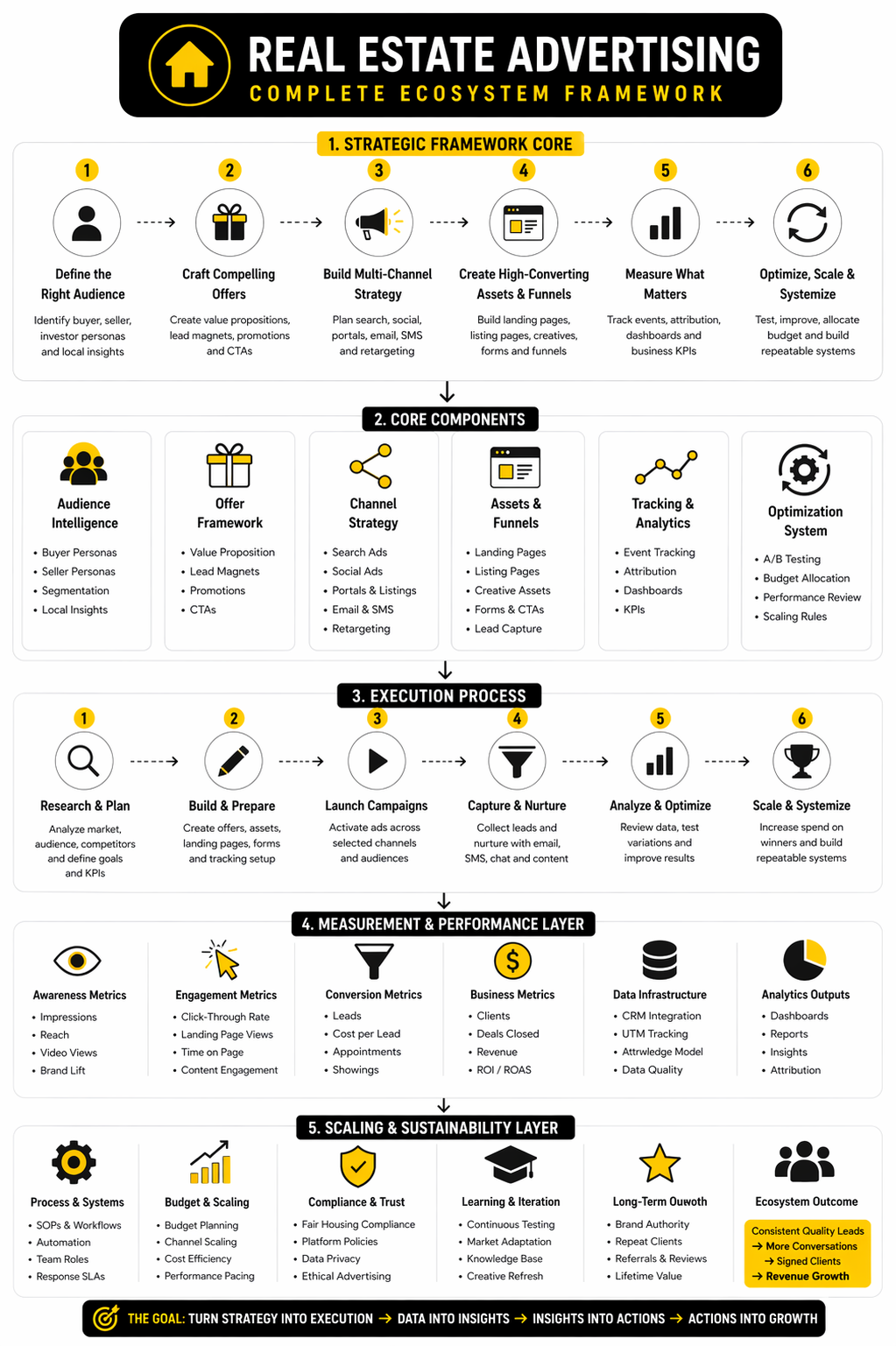
The framework is complete once all the pieces start working together. Real estate advertising is rarely won by a single ad, a single portal, or a single clever campaign. It performs best when positioning, creative, channel mix, measurement, follow-up, and compliance are all treated like one operating system instead of separate tasks being handled ad hoc.
That is the real ecosystem view. Search captures intent, social shapes attention, portals support comparison, email and automation keep momentum alive, and your CRM turns interest into actual pipeline. The stronger that system becomes, the less your results depend on random spikes of luck and the more they depend on repeatable execution.
FAQ
What is real estate advertising in practical terms?
Real estate advertising is the process of promoting properties, agent services, or brokerage offers in a way that attracts the right buyer or seller and moves them toward action. In practice, that includes listing promotion, seller lead generation, buyer acquisition, retargeting, email nurture, and brand-building across channels like search, social, portals, websites, and CRM workflows. It is broader than posting listings because it includes the strategy, the message, the assets, the offer, and the follow-up system behind the promotion.
Why is real estate advertising more important now than it used to be?
It matters more now because buyers and sellers research digitally before they commit to a conversation, and that changes how trust is built. Zillow reported in late 2025 that online research now shapes how many agent relationships begin, while newer buyer research keeps showing that listing presentation and digital context strongly influence interest. Zillow’s 2025 report on online agent selection and its 2025 prospective-buyer research point to the same conclusion: your digital presence now affects both discovery and credibility.
What makes one real estate ad outperform another?
Usually it comes down to clarity and relevance more than raw budget. The better ad speaks to a specific audience, leads with a sharper angle, uses assets that reduce uncertainty, and gives the viewer a next step that feels natural for their stage of intent. Weak ads try to say everything, target everyone, and push too hard too early, which usually makes them blend in instead of stand out.
Which creative assets matter most for listing performance?
The most valuable assets are the ones that help buyers evaluate the property quickly and accurately. Photos still matter enormously, but floor plans, clean layout information, and richer listing detail can be just as important because they reduce guesswork and help buyers decide whether a showing is worth it. Zillow’s 2025 buyer research and NAR’s 2026 guidance on online listing visibility both support that approach.
Should real estate advertising focus more on branding or lead generation?
It should do both, but not in the same way or at the same moment. Some campaigns should be built for direct response, such as valuation leads, showing requests, or consultation bookings, while others should be built to improve familiarity, trust, and future conversion potential. The mistake is forcing every piece of advertising to prove itself only through immediate leads, because some channels and formats do better work earlier in the decision journey.
Is paid advertising necessary, or can organic marketing be enough?
Organic marketing can absolutely help, especially for local authority, trust, and long-term brand recognition, but it is usually slower and less controllable. Paid advertising becomes useful when you need speed, more predictable reach, cleaner testing, or a way to generate demand on purpose instead of waiting for it. The strongest real estate advertising systems usually combine both, using organic content to build trust and paid media to accelerate distribution and capture intent.
What channels usually work best for real estate advertising?
There is no single best channel because different channels do different jobs. Search tends to work well for high-intent demand, portals work well for active property comparison, social is strong for attention and retargeting, and email is excellent for nurturing slower-moving buyers and sellers. The best channel mix depends on whether you are promoting a listing, building a seller pipeline, attracting buyers in a specific segment, or increasing branded trust in a local market.
How should agents think about benchmarks without getting misled?
Benchmarks are useful as directional context, not as commandments. Real estate often behaves differently from broader marketing averages because the transaction value is high, the decision cycle is long, and many leads are early-stage when they first engage. WordStream’s 2025 Google Ads benchmarks showed real estate search campaigns averaging a 3.28% conversion rate and a $100.48 cost per lead, which is helpful as context but not as a universal target for every campaign. Those benchmarks are most useful when they help you interpret your own funnel more realistically.
What metrics matter most in real estate advertising?
The best metrics are the ones closest to revenue and qualified pipeline. Impressions, click-through rate, and page engagement are useful diagnostics, but appointments, listing consultations, qualified conversations, signed clients, and closings tell you whether the campaign is actually producing business. Google’s GA4 documentation is useful here because it emphasizes tracking meaningful events and turning the right ones into conversions instead of relying on vanity activity. Google’s GA4 conversion guidance matches how real estate campaigns should be judged in practice.
How important is follow-up after the lead comes in?
It is critical, and this is where many campaigns quietly fail. A decent campaign with excellent follow-up will often outperform a great campaign with slow, inconsistent response handling. That is why automation, routing, and nurture systems matter so much inside real estate advertising, especially for leads who are interested but not ready to move immediately.
What is the biggest mistake agents make with real estate advertising?
The biggest mistake is treating advertising like a collection of isolated tasks instead of one connected system. They run ads without a clear offer, publish content without a destination, collect leads without a response workflow, or judge channels without proper attribution. That usually creates a lot of motion but very little compounding value.
How can small teams compete with larger brokerages?
Small teams usually win by being sharper, not louder. They can move faster, position more clearly, personalize follow-up better, and build tighter campaigns around specific audience segments instead of trying to look big and generic. In real estate advertising, clarity, consistency, and operational speed often beat bloated marketing that looks impressive but responds slowly.
Is automation worth it for real estate advertising?
Yes, once lead volume or complexity starts to increase, automation becomes far more than a convenience. It helps with lead routing, appointment reminders, nurture sequences, chat capture, and keeping opportunities from disappearing during long buying and selling windows. Tools like GoHighLevel, ManyChat, Brevo, and Cal.com fit naturally when the goal is to make response and nurture more reliable.
How do fair housing and ad-platform rules affect campaign strategy?
They affect it directly, not just legally. Google’s housing ad rules in the U.S. and Canada restrict how demographic targeting works, and Meta’s Special Ad Category rules also limit certain targeting options for housing advertisers. Google’s housing-ad guidance and Meta’s Special Ad Category documentation make this clear, which means smart real estate advertising has to be designed around compliant targeting from the start rather than relying on tactics that cannot be used safely.
What does a mature real estate advertising system look like?
A mature system has a clear audience strategy, repeatable offers, strong creative standards, channel roles, clean tracking, fast follow-up, and regular optimization tied to revenue instead of vanity metrics. It does not depend on one platform or one lucky ad. It is stable enough to scale, flexible enough to adapt, and disciplined enough to keep learning without losing coherence.
Work With Professionals
Explore 10K+ Remote Marketing Contracts on MarkeWork.com
Most marketers spend too much time chasing clients, competing on crowded platforms, and losing a percentage of every project to middlemen. MarkeWork gives you a better way. Browse thousands of remote marketing contracts and connect directly with companies desperate to hire skilled marketers like you, without platform commissions and without unnecessary gatekeepers.
If you're serious about finding better opportunities and keeping 100% of what you earn, explore available contracts and create a profile for free at MarkeWork.com.