

Most lists of real estate marketing ideas fall apart in the real world because they confuse activity with traction. Posting more often, buying more tools, or chasing every new platform can make an agent look busy while the pipeline stays thin. What works now is a tighter system: clear positioning, strong local visibility, better follow-up, and content that helps people make a high-stakes decision with more confidence.
That matters even more in a market where consumers do extensive online research before they ever talk to an agent, and where sellers need more guidance than they did during the frenzy of the pandemic years. In a slower, more selective environment, good marketing does not just attract clicks. It reduces uncertainty, proves expertise, and gives buyers and sellers a reason to choose one professional over the dozens who look interchangeable online.
Article Outline
- Why Real Estate Marketing Matters More Than Ever
- The Modern Real Estate Marketing Framework
- Build a Brand That Wins Local Trust
- Create Content That Pulls In Qualified Leads
- Turn Attention Into Appointments and Conversations
- Put Your Marketing on a Professional System
Why Real Estate Marketing Matters More Than Ever
Real estate marketing has changed because the consumer journey has changed. Buyers and sellers do not wait for an agent to educate them from scratch anymore. They browse listings, compare neighborhoods, watch short-form video, read market updates, and check agent credibility before they ever fill out a form or answer a call.
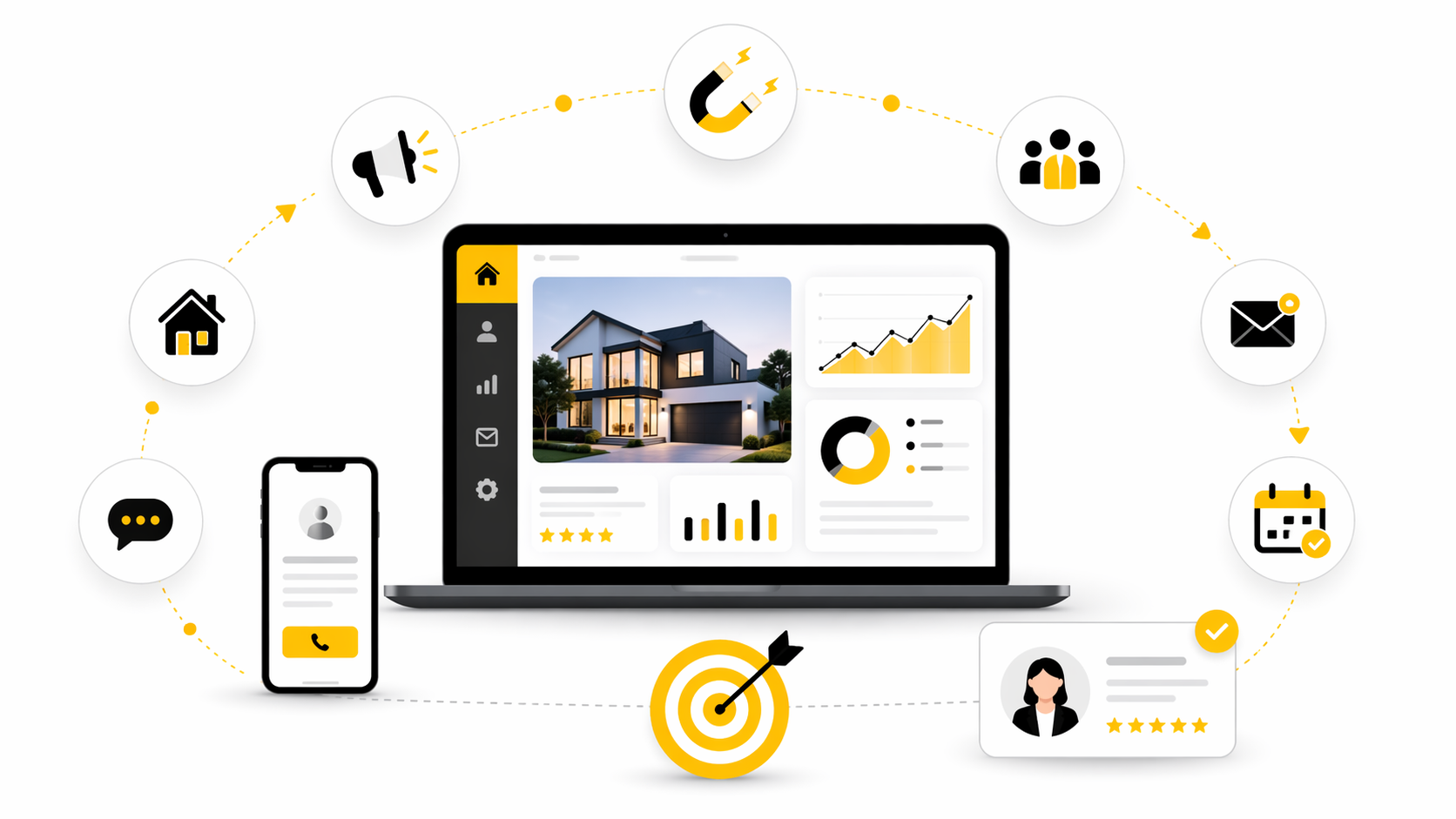
That shift raises the bar. A weak online presence now creates doubt, while a strong one shortens the trust-building process and makes every conversation easier. The best real estate marketing ideas work because they meet people where they already are: search, social platforms, email, listing portals, and local referral networks.
It also means agents need to stop treating marketing as a collection of random tactics. A postcard by itself is not a strategy. A few Instagram Reels are not a strategy either. The real opportunity is to connect visibility, credibility, capture, and follow-up into one repeatable engine that keeps producing leads without starting from zero every month.
The Modern Real Estate Marketing Framework
The strongest real estate marketing ideas usually fit into four connected layers: attract attention, earn trust, capture demand, and nurture the relationship until timing lines up. That sounds simple, but most underperforming marketing breaks because one of those layers is missing. An agent may be visible but forgettable, credible but hard to contact, or good at lead capture but terrible at follow-up.
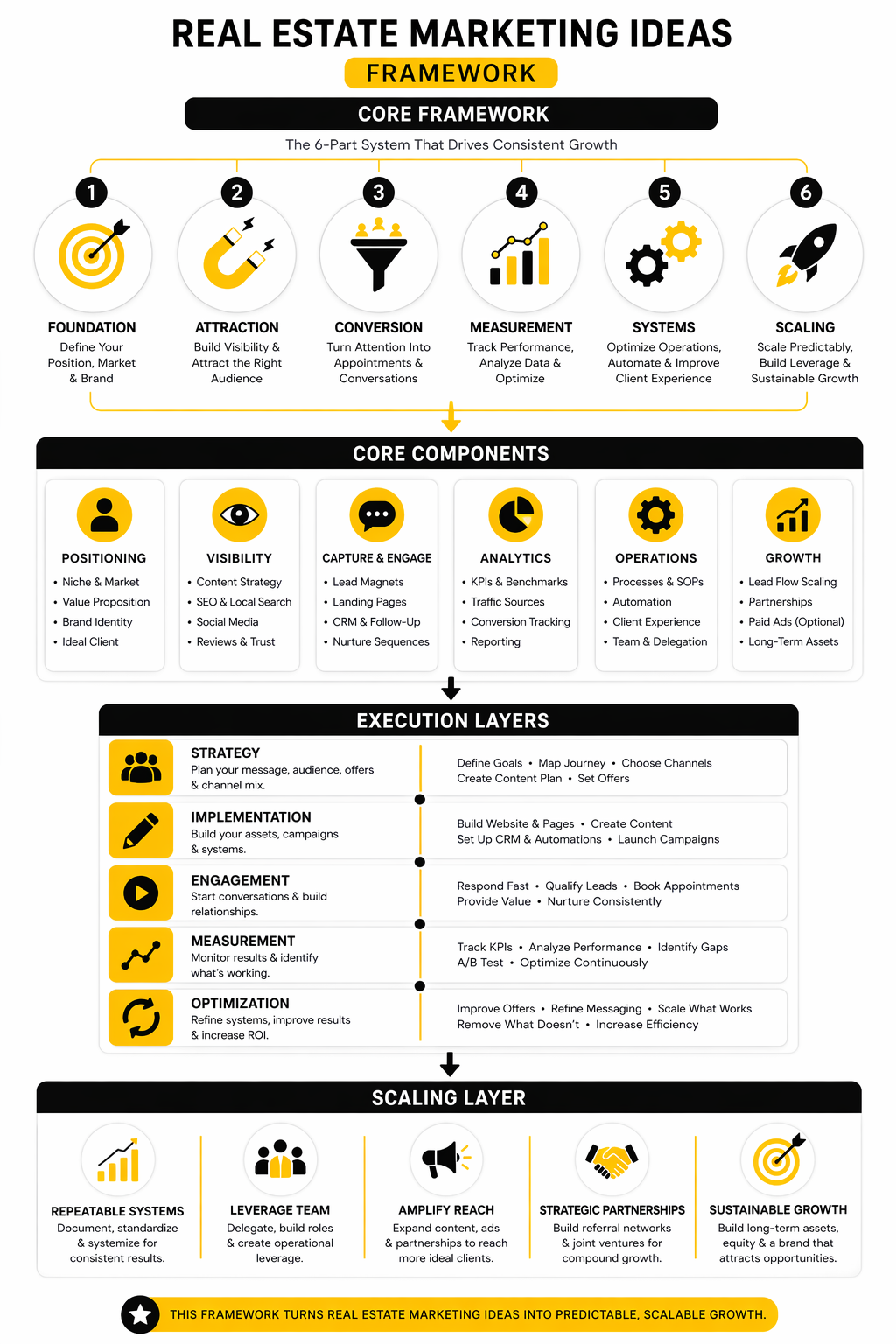
A modern framework starts with local relevance. People do not hire agents because the branding looks polished in isolation. They hire the person who seems to understand the street, school zone, price band, property type, and life transition they are dealing with right now. That is why the rest of this article focuses less on hacks and more on systems that help you become the obvious choice in a specific market segment.
It also helps to think in terms of momentum instead of isolated wins. One neighborhood video can feed social posts, email content, listing presentations, retargeting angles, and future search traffic. One well-built lead magnet can support ads, direct messages, landing pages, and automated follow-up inside a CRM like GoHighLevel or a conversational capture tool like ManyChat. When the framework is right, every marketing asset starts doing more than one job.
Build a Brand That Wins Local Trust
A strong brand in real estate is not your logo, your colors, or a slogan about service. It is the pattern people recognize when they keep seeing your name attached to useful advice, credible local knowledge, well-marketed listings, and consistent follow-through. That is why so many of the best real estate marketing ideas start with trust signals instead of traffic tricks.
The market data points in the same direction. In the latest NAR profile, sellers said an agent’s reputation was the single most important factor when choosing who to work with, ahead of commission, brokerage name, or tech polish. The same report shows that trustworthiness and honesty still carry major weight, which is a useful reminder that brand is really the public version of your reliability.
That has a practical consequence. Your marketing should make it easy for a stranger to answer three questions fast: Do you know this market, can you market a property properly, and will you be easy to work with when things get tense. If your website, profiles, reviews, and content do not answer those questions within a few minutes, you are making the sale harder than it needs to be.
Pick a Clear Market Position Instead of Trying to Appeal to Everyone
Generalist messaging is one of the fastest ways to become forgettable. “I help buyers and sellers with all their real estate needs” is technically true for a lot of agents, but it gives the reader nothing to hold onto. A better approach is to become known for a specific place, price band, property type, or client situation and let that focus shape your content, your listing presentations, and your outreach.
That does not mean turning away all other business. It means organizing your public marketing around a sharp point of view so people can repeat what you do. One agent becomes the person for downtown condos, another becomes the relocation specialist for executives moving into a specific suburb, and another becomes the agent who understands move-up families navigating school zones and timing. Clear positioning makes referrals easier because people know when to think of you.
It also matches how consumers actually evaluate expertise. Zillow’s recent agent research found that online research now shapes how most agent relationships begin, which means your digital footprint is now part of your positioning whether you manage it intentionally or not. If your profiles, reviews, email capture, and content all point in the same direction, you look established. If they feel random, you look replaceable.
Make Your Proof Impossible to Miss
A lot of agents say they provide great service, but very few present proof with enough clarity. The simplest upgrade is to stop burying your strongest credibility signals under generic copy. Put client reviews, neighborhood expertise, listing case evidence, and your process where people will actually see them: your Google profile, your site header, your listing pages, your email signature, and the first follow-up message after an inquiry.
Reviews matter because they reduce perceived risk before the first conversation. The latest BrightLocal review survey and Rio SEO’s local search study both show that people still rely heavily on local reviews when making decisions, while Rio SEO also found that inaccurate listings push consumers away. For real estate, that means your reviews and your business information are not side details. They are part of the conversion path.
There is an important line here, and it matters. Google’s own guidance on reporting inappropriate reviews and the FTC’s rule against buying or selling fake reviews make it clear that manufactured social proof is a bad bet legally and reputationally. Ask for real reviews, ask consistently, and make the request close to the moment when the client feels the win.
Show You Can Market a Listing, Not Just Post One
Sellers are not just hiring advice. They are hiring execution. That is why your brand gets stronger when your public materials demonstrate how you present a property, not just that you have sold one before.
The current data is blunt on this point. Zillow’s agent report shows that sellers are more likely to hire agents who offer high-resolution photography, virtual tours, and interactive floor plans. NAR’s 2025 seller data also shows that agents still rely on a mix of MLS exposure, yard signs, open houses, their own websites, third-party aggregators, and social media, which tells you something useful: professional implementation still beats one-channel thinking.
So the branding move is simple. Turn your listing marketing into visible evidence of standards. Show the photography quality, explain your launch sequence, publish your market prep checklist, and make your sign-to-screen distribution process easy to understand. One clean landing page built in something flexible like Replo or a funnel stack like ClickFunnels can present that process far better than a cluttered “about me” page.
Turn Consistency Into a Competitive Advantage
Most agents do not lose trust because of one dramatic mistake. They lose it in small, repeated ways: outdated bios, old headshots, broken forms, stale neighborhood pages, slow replies, and scattered messaging. In local service businesses, inconsistency reads as risk.
That is why one of the most underrated real estate marketing ideas is operational consistency. Keep the same positioning across your Google profile, social bios, website, listing materials, and email follow-up. Use a scheduling tool like Buffer if that helps you stay visible without disappearing for three weeks at a time, but do not confuse scheduled posts with a full system. The point is not volume. The point is repeated proof that you are active, relevant, and paying attention.
Presentation matters here too, especially if your market responds to polished visuals. A sharper headshot, cleaner brand photos, and better listing collateral can change how people interpret the exact same level of experience, which is why visual assets can be worth upgrading with a tool like BetterPic when the result still looks natural and credible. In real estate, people are not only evaluating whether you know your craft. They are deciding whether you look like the person they would trust with a six- or seven-figure decision.
A trustworthy brand is really the foundation under everything else in this article. Once that foundation is clear, your content performs better, your lead capture feels more believable, and your follow-up lands with less resistance. That is where the next section goes: how to create content that attracts the right prospects instead of just filling your feed.
Create Content That Pulls In Qualified Leads
Once your positioning is clear, content becomes the bridge between visibility and trust. This is where a lot of real estate marketing ideas either start compounding or start wasting time. If your content is built around what buyers and sellers are already anxious about, it attracts the right people; if it is built around whatever feels easy to post that day, it usually disappears without doing much.
The encouraging part is that the formats are not a mystery anymore. HubSpot’s latest marketing research still shows short-form video leading content performance, while broader marketing benchmark data shows that blog content remains one of the strongest long-term ROI formats. That lines up with how real estate decisions actually happen: people want quick answers first, then deeper proof once they start taking the decision seriously.
So the goal is not to become a full-time creator. The goal is to publish content that answers real questions at the right depth, then connect that content to a lead capture path. That is the difference between “content marketing” and a working client acquisition system.
Focus on Buyer and Seller Intent, Not Just Reach
The best content usually starts with friction. What is making a buyer hesitate right now? What is making a seller delay listing, overprice a home, or worry about timing the next purchase? Those are the questions that move people closer to action, and they are far more valuable than generic motivational posts or vague market opinions.
That matters because most prospects do not arrive ready to transact. Zillow’s recent research shows that many adults intend to buy in the next year, but only a much smaller share will actually complete a purchase. In practice, that means your content has to serve people before they are ready, not only after they have raised a hand.
This is why strong real estate marketing ideas usually organize content around decision-stage intent. Some content should help people understand the market, some should help them evaluate risk, and some should help them choose an agent. If every post is trying to “generate a lead” too aggressively, you will lose the reader before trust even has a chance to build.
Use Four Content Pillars That Map to Real Decisions
A useful content system usually has four pillars. The first is local market clarity, where you explain price movement, inventory, neighborhood differences, days on market, and the practical meaning behind the numbers. The second is process education, where you walk people through inspections, prep, financing, negotiation pressure, relocation timing, or how to buy and sell at the same time.
The third is property and neighborhood proof. This includes listing walk-throughs, before-and-after prep examples, street-level neighborhood videos, and breakdowns of what makes one area more competitive than another. The fourth is personal proof, where reviews, client wins, your communication style, and your marketing process show people what it actually feels like to work with you.
This structure keeps your content balanced. You are not just teaching, and you are not just promoting. You are building familiarity, authority, and commercial intent at the same time, which is exactly what the strongest real estate marketing ideas are supposed to do.
Match the Format to the Question
Different questions deserve different formats. A quick myth-busting point about mortgage rates or staging mistakes may work best as a short video. A detailed explanation of how to price a house in a shifting neighborhood usually deserves a longer article, email, or downloadable guide.
That is one reason video works so well at the top of the funnel. Wyzowl’s latest consumer data shows that people still rely heavily on explainer videos when learning about a product or service, and real estate is full of complex decisions that benefit from a face, a voice, and a clear walkthrough. But video should not carry the whole system by itself. Search-friendly written content matters because some prospects want depth, and some of your best traffic will come from questions people type into Google long before they are ready to call.
Email deserves a place here too, especially for slower-burn leads. Recent benchmark reporting shows email engagement has remained resilient even as inbox competition stays high. For an agent, that is useful because the timing gap between curiosity and action can stretch for months. A simple nurture sequence in Brevo or Moosend can keep you present without becoming annoying.
Build One Weekly Content Engine Instead of Reinventing Everything
The biggest implementation mistake is starting from scratch every time. That burns energy, makes quality inconsistent, and usually kills momentum after a few weeks. A better process is to build one weekly engine where a single idea gets turned into multiple assets.
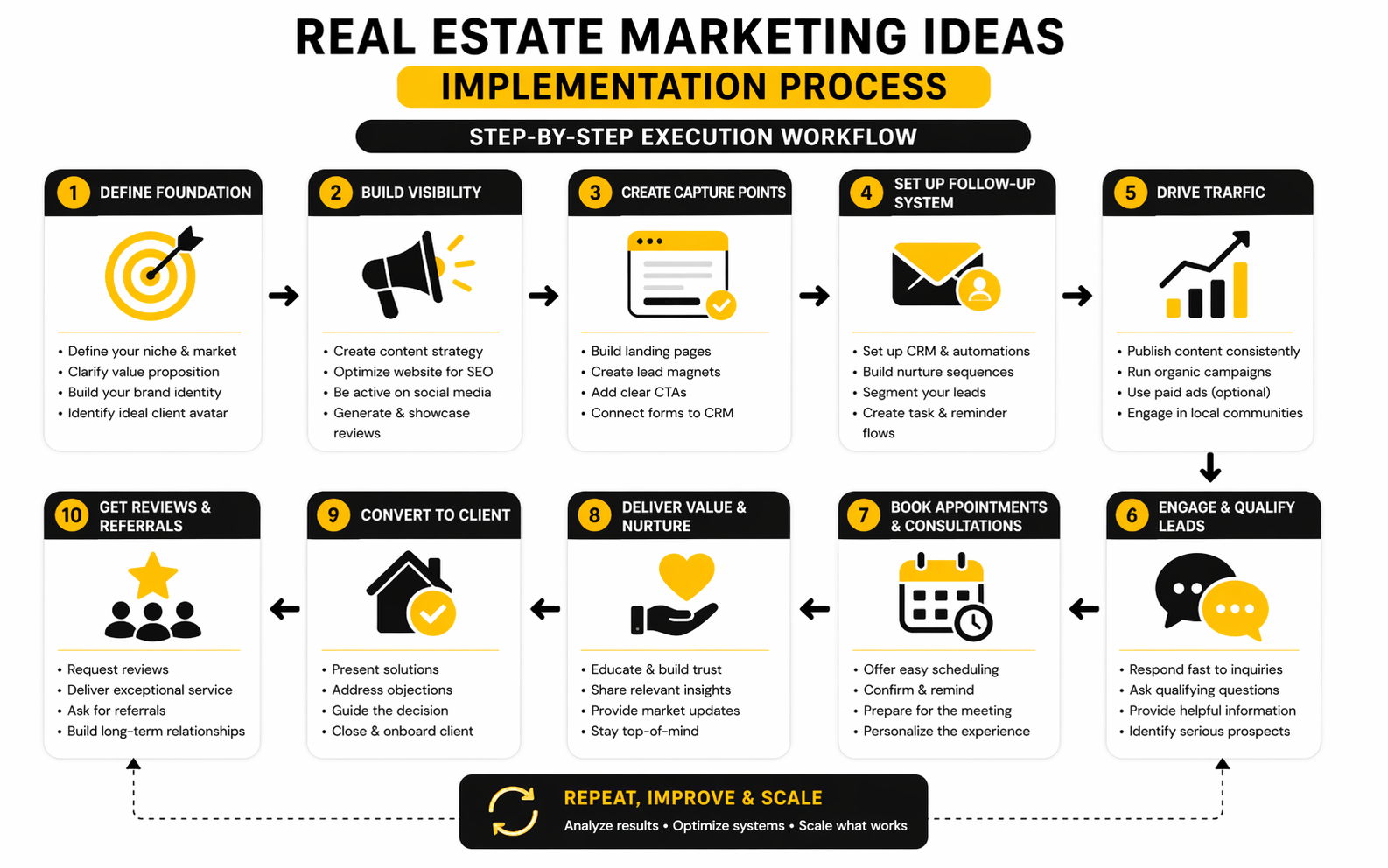
A practical weekly workflow looks like this:
- Start with one real client question from the last seven days.
- Record a short answer on video in plain language.
- Turn that answer into a longer post for your website or newsletter.
- Pull three to five short clips or quote-style posts from the same topic.
- Add a clear next step, such as booking a consult, downloading a checklist, or replying to an email.
- Reuse the best-performing topics in future market updates, listing presentations, and follow-up sequences.
This is where content becomes tangible instead of theoretical. One question about pricing can become a Reel, a carousel, a local blog post, an email, a seller guide, and a talking point for your next listing appointment. That kind of repurposing is what makes real estate marketing ideas sustainable for busy agents who still need to prospect, negotiate, and manage deals.
Put a Real Capture Mechanism Behind Your Best Content
Content without capture is branding only. That is not useless, but it leaves money on the table. Every strong content theme should point toward a simple next step that fits the reader’s level of intent.
For early-stage leads, that might be a downloadable neighborhood guide, seller prep checklist, or monthly market email. For warmer leads, it might be a direct message flow, a valuation request, or a short consult booking link. Tools like Fillout can make forms cleaner, while ManyChat can help route Instagram and Facebook conversations into something more structured, and Cal.com can remove friction when someone is finally ready to talk.
This part matters more than most agents think. Attention is cheap compared with intent. When someone has consumed three or four pieces of useful content and then gets an easy, low-pressure path to contact you, the conversation starts warmer and converts more cleanly.
Keep the Quality Bar High Even When You Move Fast
More content is not always better. Sprout Social’s latest reporting shows that audiences are still pushing brands toward more original and more relevant content, not just trend-chasing volume. Real estate audiences are even less forgiving because the stakes are so high. If your content feels recycled, vague, or obviously automated, trust drops fast.
So keep the standard simple. Speak clearly, make the local angle specific, and avoid posting just to fill a calendar. If you use a scheduler like Buffer or a hashtag and planning tool like Flick, let those tools support judgment instead of replacing it.
That brings us to the next step. Once your content is attracting the right attention, the real question becomes whether your follow-up turns that attention into conversations, appointments, and eventually signed business.
Turn Attention Into Appointments and Conversations
By this point, you have a brand people can trust and content that can pull in the right audience. Now the question changes. You are no longer asking whether people can see you. You are asking whether your real estate marketing ideas are creating the kinds of actions that actually lead to business.
This is where a lot of agents get fooled by surface-level numbers. Views feel good, likes are easy to screenshot, and reach can make a campaign look alive. But none of those numbers matter much if the wrong people are watching, if nobody is taking the next step, or if the leads coming in never turn into serious conversations.
What Your Marketing Data Is Actually Telling You
The first job of measurement is not to impress you. It is to tell you where friction is hiding. If a neighborhood video gets strong reach but no inquiries, that usually means the topic created curiosity without enough local buying or selling intent. If an email gets opened but nobody clicks, the subject line worked but the offer did not.
That difference matters because real estate is not a volume game in the same way ecommerce is. A small number of highly qualified conversations can outperform a huge amount of cheap attention. The recent Zillow agent report reinforces that consumers are doing meaningful online research before selecting representation, which means your marketing data should be read as a chain of trust-building events, not as isolated vanity metrics. Zillow’s agent research makes that point clearly.
The practical takeaway is simple. The more expensive the decision, the less useful shallow engagement becomes on its own. In real estate, the best numbers are usually the ones closest to intent.
The Benchmarks That Matter More Than Follower Counts
If you want to judge your marketing honestly, track the numbers that reveal movement from awareness to action. Website sessions matter if they are growing in the right local pages. Video watch time matters if people stay long enough to absorb the message. Email open rate matters less than whether replies, clicks, and appointment requests are improving.
That is why broader marketing benchmarks are useful only when you interpret them correctly. HubSpot’s current data still shows short-form video performing strongly for marketers, and its wider benchmark data shows content marketing remains a meaningful long-term channel. Those numbers do not mean every agent should post endless video. They mean attention still flows toward helpful, easy-to-consume content, and the opportunity is real if the message matches local intent.
Email data tells a similar story. Recent benchmark reporting from MailerLite’s industry comparison data shows that email still holds up well as a relationship channel. For an agent, that matters because many people who consume your content are not ready this week. The number that matters is whether your email system keeps you in the decision set until the timing changes.
Build a Simple Analytics Stack You Will Actually Use
Most agents do not need a complex dashboard. They need a clean way to see what is working across content, lead capture, follow-up, and appointments. The mistake is building something too complicated to maintain, then going back to guessing.
A practical analytics stack usually has four layers. First, track where attention comes from: search, social, referrals, email, paid traffic, portals, or direct visits. Second, track what people do next: page views, form fills, direct messages, calls, and booked consultations. Third, track sales conversations: how many leads reply, how many show up, and how many become active clients. Fourth, track closed-loop outcomes: listings signed, buyers under contract, and revenue by source.
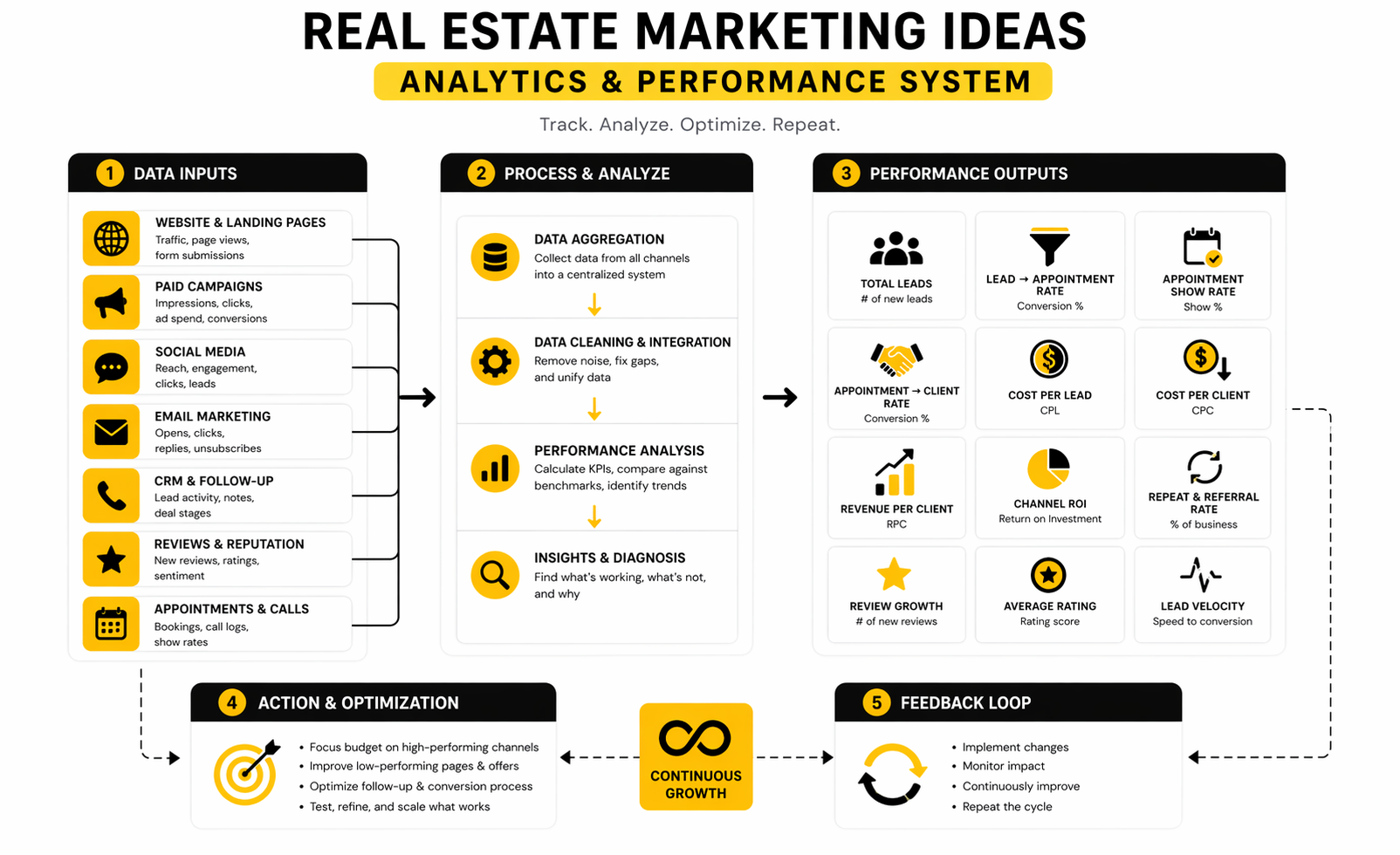
When you make the system visible, the decision-making gets easier. You stop asking whether Instagram is “worth it” in general and start asking whether a specific content theme led to booked calls. You stop wondering whether your website is “good” and start asking whether seller pages or neighborhood pages are producing better-quality inquiries.
This is also where a CRM stops being optional. A system like GoHighLevel, Copper, or a lighter lead-routing stack tied to forms and automations can help you connect first touch to real outcomes. Without that connection, it is very easy to over-invest in the channels that look busiest instead of the ones that quietly make money.
Know the Difference Between Healthy Signals and False Positives
Not every upward number is good news. A spike in traffic can come from broad curiosity, irrelevant reach, or even a topic that attracts people outside your market. A jump in form fills can look exciting until you realize the leads are low-intent, fake, or impossible to contact.
The opposite is also true. Sometimes the strongest signal is smaller but more commercially meaningful. A listing-prep checklist downloaded by 18 local homeowners can be far more valuable than a video viewed 20,000 times by people who will never buy or sell in your area. BrightLocal’s latest local review research and Rio SEO’s 2025 local search behavior study both reinforce the same broader point: local decisions are shaped by credibility, relevance, and trust signals, not just raw exposure.
This is why interpretation matters so much. Good measurement does not just count activity. It separates useful momentum from noise.
Use Leading Indicators Before You Wait for Closings
A lot of agents wait too long to judge performance. They look at closings, realize the pipeline is thin, and only then start asking what went wrong three months earlier. The better move is to watch leading indicators that tell you sooner whether your marketing is healthy.
The most useful leading indicators are usually:
- growth in direct inquiries from the right market segment
- repeat visits to neighborhood or seller pages
- replies to follow-up emails
- consultation bookings
- response speed
- show-up rate for calls
- percentage of conversations that move to a next step
These numbers matter because they shorten the feedback loop. If consultation bookings are flat, you may have an offer problem. If bookings are healthy but show rates are weak, you may have a follow-up and reminder problem. If people show up but do not convert, the issue is probably your sales conversation, your positioning, or the quality of leads entering the funnel.
Measure by Stage, Then Improve One Constraint at a Time
The cleanest way to improve performance is to break the system into stages. First comes attention. Then engagement. Then capture. Then conversation. Then signed business. Once you do that, you can stop trying to fix everything at once.
For example, if social content is getting watched but nobody clicks through, the problem is likely the bridge between content and action. If the click-through is strong but the landing page converts poorly, the page needs work. If the page converts but leads go cold, the issue is follow-up speed, message quality, or the booking process.
That kind of diagnosis is what turns measurement into action. It also keeps you from abandoning good real estate marketing ideas too early. Sometimes the tactic is fine and the handoff is broken.
Let the Data Make You More Focused, Not More Reactive
There is a trap here, and it is common. Once agents start tracking numbers, some begin chasing whatever spiked this week. That usually creates erratic marketing: random content pivots, too many offers, and endless experimentation without enough consistency to learn anything useful.
A better approach is to use data as a filter. Keep asking which topics attract the right audience, which channels create booked conversations, and which follow-up steps produce the highest response quality. Then double down on what is working long enough to build momentum.
That is when the numbers become useful instead of distracting. They stop being a scoreboard and start acting like a compass. And once you know which signals lead to real conversations, the next step is making sure your operational system can turn those conversations into repeatable growth.
Put Your Marketing on a Professional System
At some point, more tactics stop helping. More platforms, more content formats, more automations, more experiments, more dashboards. The agents who keep growing usually do not win because they are doing everything. They win because they have built a professional system that makes good decisions repeatable.
That is the real maturity step in real estate marketing. You stop asking, “What should I try next?” and start asking, “What should this business keep doing every week because it reliably creates trust, conversations, and signed clients?” That shift is where many real estate marketing ideas either turn into an asset or collapse under their own complexity.
The Best System Is Usually Smaller Than You Think
A lot of marketing problems are really prioritization problems. Agents often spread themselves across too many neighborhoods, too many platforms, too many offers, and too many lead sources, then wonder why nothing compounds. The stronger move is usually narrower and more deliberate.
NAR’s latest technology survey makes that point indirectly. It found that social media remained the top lead-generating technology at 39%, followed by CRM at 23% and the local MLS at 17%. That does not mean you need every new tool. It means the channels that already sit closest to visibility and relationship management are still carrying a lot of the real load.
So build around a small core. One strong local website, one consistent content engine, one review-generation habit, one CRM, and one follow-up workflow will outperform a messy stack of disconnected experiments. Simpler systems are easier to maintain, easier to delegate, and much easier to improve.
Scaling Creates New Risks if the Back End Stays Weak
Growth sounds good until the operations behind it break. More leads can expose slow response times, weak qualification, missed follow-up, sloppy handoffs, and uneven client experience. That is why scaling is not just about generating more demand. It is about preserving trust while volume increases.
This is the point where a lot of solo operators hit a wall. The exact marketing that finally starts working creates pressure everywhere else. If your inbox fills up, DMs come faster, forms increase, and consultations rise, but your systems are still manual, your brand can actually get weaker while your visibility gets stronger.
That is where a tool stack can help, but only if the process is already clear. A CRM like GoHighLevel, a cleaner booking flow through Cal.com, better intake forms in Fillout, or a lightweight chat layer like Chatbase can remove friction. But tools do not fix confusion. They only scale whatever process is already there.
Automation Helps, but It Can Also Flatten Your Trust
This matters more now because AI and automation are getting folded into daily real estate work fast. NAR’s technology reporting shows that many REALTORS® are already using emerging tech while still learning it, which is exactly why discipline matters. Used well, automation speeds up response time, captures leads after hours, and keeps nurture sequences from going dark. Used badly, it makes every interaction feel generic.
The risk is not only that it feels robotic. The risk is that it breaks the one thing good real estate marketing is supposed to build: confidence. A seller who gets a canned response after filling out a home valuation form does not feel guided. A buyer who asks a nuanced financing question and gets a vague AI-flavored answer does not feel safe.
The best use of automation is usually narrow and practical. Let it confirm appointments, route inquiries, trigger reminders, sort incoming leads, and support basic nurturing. But keep the human hand strong where judgment matters: pricing, negotiation, local nuance, emotional objections, and anything that affects trust.
Compliance Is Not Optional Once You Systemize Marketing
As marketing gets more automated, compliance risk rises. This is especially true around reviews, local business profiles, advertising claims, and AI-assisted content. The more systems you build, the more careful you need to be about what those systems are actually producing.
That is very clear in the review space. The FTC’s final rule on consumer reviews and testimonials went into effect on October 21, 2024 and prohibits fake reviews, bought reviews, insider reviews without proper disclosure, and other deceptive practices. In plain English, agents should stop treating reviews like a gray area. Ask real clients, ask consistently, and do not get clever.
The same mindset applies to local visibility. Google’s official business profile guidelines are designed to keep listings accurate and trustworthy, and that matters in real estate because outdated information or misleading profile practices can quietly damage conversion. Once your marketing starts working, the boring details become part of the brand.
AI in Housing Marketing Needs a Fair Housing Lens
This is where expert-level caution matters. AI is useful, but housing is not a neutral category. HUD’s 2024 guidance on the use of technology in housing-related advertising warned that automated systems and digital ad tools can create discrimination and liability risks under the Fair Housing Act. That is not an abstract policy concern. It touches audience targeting, ad delivery, listing language, image generation, and recommendation systems.
So if you are using AI tools for ad copy, targeting ideas, lead scoring, or listing visuals, you need rules. Review outputs before publishing. Avoid language that implies preference around protected characteristics. Be careful with automated audience narrowing. Do not assume the tool understands fair housing boundaries just because it writes fluent copy.
This will only get more important. The more AI enters real estate workflows, the more the professionals with real judgment will stand out. That is good news for serious agents, but only if they use the technology with discipline instead of treating it like magic.
Protect Your Brand From the Hidden Costs of Outsourcing Everything
Scaling often creates another tradeoff: speed versus authenticity. Outsourcing can absolutely help, but the wrong version of outsourcing drains the local specificity out of your marketing. Suddenly the content sounds polished but generic, the ads feel templated, and the brand no longer sounds like someone who actually knows the streets, price points, and buyers in the market.
That is why brand voice needs to be documented before work gets delegated. Your assistant, freelancer, marketing partner, or agency should know the neighborhoods you focus on, the objections your prospects raise most often, the way you explain pricing, and the tone you want clients to feel. If that foundation is missing, delegation just scales inconsistency.
A good practical fix is to build a small internal operating playbook. Keep your positioning statement, content pillars, review request process, follow-up scripts, lead qualification standards, and publishing checklist in one place. A tool like Guideless can help organize process knowledge, but the main point is not the software. The point is making the standard transferable.
The Real Goal Is Durability, Not Just Growth
This is the mindset that separates flashy marketing from durable marketing. Flashy marketing can spike attention for a week. Durable marketing keeps producing opportunities when the market shifts, when inventory tightens, when ad costs rise, or when a platform changes its algorithm.
Durability comes from a few things: local trust, repeatable content, strong reviews, clean operations, fair and compliant systems, and the discipline to measure what actually leads to business. It also comes from resisting the urge to rebuild your strategy every time a new tactic gets hyped.
That is the real professional implementation layer under the best real estate marketing ideas. Once that layer is in place, you are no longer depending on hustle alone. You are running a system that is designed to keep working.
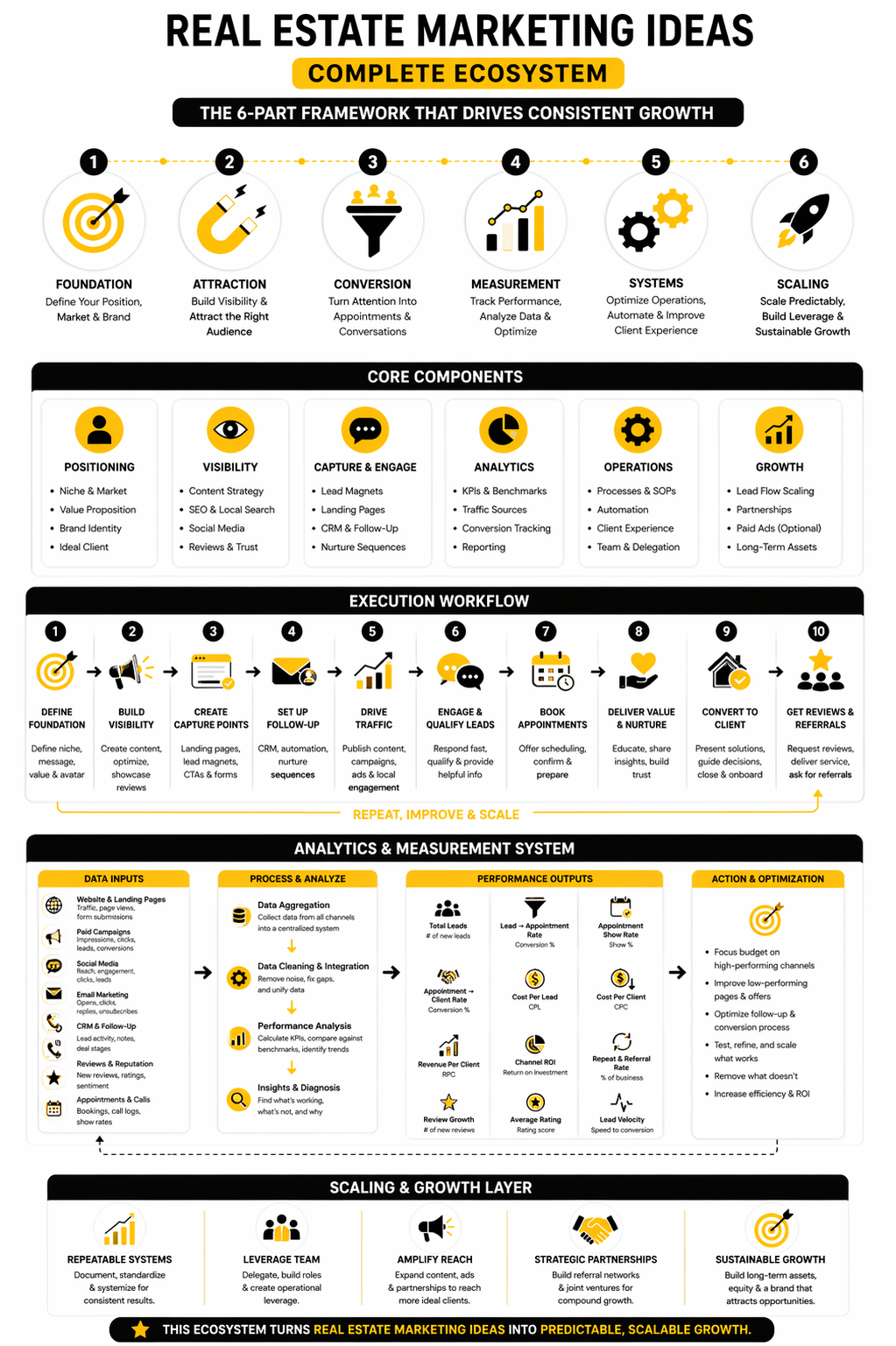
The strongest real estate marketing ideas eventually stop looking like campaigns and start looking like an ecosystem. Your website, reviews, content, lead capture, follow-up, consultations, client experience, and referral process should all reinforce each other. When that happens, marketing feels less like constant chasing and more like steady compounding.
That is the real end goal. Not more noise, not more random tactics, and not a bigger pile of disconnected software. A professional system creates trust before the first conversation, makes the first conversation easier, and keeps producing opportunities long after one post or one ad campaign fades.
FAQ
What are the best real estate marketing ideas for a solo agent?
The best ideas are usually the ones that connect local trust with a repeatable process. For most solo agents, that means a strong Google presence, consistent neighborhood or market content, visible reviews, a simple website with clear calls to action, and reliable follow-up. NAR’s latest technology survey shows that social media, CRM, and the local MLS remain the most productive tech categories for lead generation, which is a useful reminder that simple systems often outperform bloated stacks.
A solo agent should be careful not to confuse visibility with effectiveness. If you can only maintain a few channels well, focus there and make them excellent. It is better to be trusted and memorable in a narrow market than inconsistently present everywhere.
How much should a real estate agent spend on marketing?
There is no universal number that fits every market, because cost structure depends on price point, geography, referral strength, and whether the business relies more on organic marketing or paid acquisition. The smarter way to think about budget is by function: brand visibility, content production, lead capture, CRM, and follow-up infrastructure. If one area is underfunded, the whole system tends to weaken.
The important part is measuring return by qualified conversations and signed business, not by impressions alone. Expensive marketing that brings in the wrong leads is still expensive. Lean marketing that creates consistent appointments can be far more profitable.
Do social media leads actually convert in real estate?
They can, but the answer depends on what happens after the initial attention. Social media is good at creating familiarity and early-stage engagement, which is one reason it continues to rank highly in NAR’s latest technology survey. But the real conversion usually happens through better follow-up, clearer qualification, and a more direct next step.
That is why many agents feel disappointed by social media. The platform creates reach, but the back end is weak. If the handoff from content to conversation is broken, the channel gets blamed for an operations problem.
Is video still worth it for real estate marketing?
Yes, especially when the video answers specific local questions or reduces uncertainty around the process. Video still performs strongly across broader marketing research, with HubSpot showing short-form video remains one of the highest-performing content formats, and Wyzowl continuing to find that consumers rely heavily on video to understand products and services. Real estate fits that behavior naturally because people want to see, hear, and understand before they commit.
The key is not chasing entertainment for its own sake. Useful video usually works better than flashy video. A direct explanation of pricing strategy or neighborhood tradeoffs can outperform a polished but empty montage.
What type of content brings in the highest-quality real estate leads?
Content tied to actual buying or selling decisions usually performs best. That includes neighborhood guides, pricing explainers, seller prep checklists, market updates with context, financing myths, and walkthroughs of stressful parts of the transaction. Zillow’s housing research shows that many prospective buyers are researching online and interacting with real estate websites before taking deeper actions, which means educational content has real leverage.
High-quality leads usually come from clarity, not cleverness. When people feel that you understand the decision they are facing, they move toward you with more intent. That is much more valuable than broad attention with no timing or fit.
How important are online reviews for real estate agents?
They are extremely important because they reduce perceived risk before the first conversation. BrightLocal’s Local Consumer Review Survey 2025 and Rio SEO’s 2025 local search behavior study both reinforce that local buying decisions are strongly influenced by review signals and profile accuracy. In real estate, that matters even more because the service is high-trust and high-stakes.
The important qualifier is that the reviews must be genuine. The FTC’s consumer reviews and testimonials rule guidance makes it clear that fake or deceptive review practices are not a harmless shortcut. Real trust compounds. Manufactured trust eventually blows up.
How fast should agents respond to new leads?
The short answer is faster than most do. People researching homes, values, or local agents often contact multiple professionals, and delay creates room for someone else to win the conversation. Even when the lead is not ready immediately, fast response signals professionalism.
This is where automation can help without replacing judgment. A confirmation text, appointment reminder, or form acknowledgment can buy time and preserve momentum, but the actual conversation still needs a human tone. Speed matters most when it supports trust rather than replacing it.
Should a real estate agent invest more in SEO or paid ads?
That depends on timeline and business model. SEO is slower but more durable, especially for neighborhood pages, market education, and local authority content. Paid ads can create demand faster, but they require stronger follow-up and tighter qualification to stay profitable.
In practice, the best systems often use both at different stages. Organic content builds long-term trust and discoverability, while paid campaigns can accelerate specific offers like home valuations, listing consultations, or open house promotion. The real choice is not either-or. It is whether your infrastructure is strong enough to make either channel pay off.
What tools are most useful for turning leads into appointments?
The most useful tools are usually the ones that reduce friction between interest and action. That can include a CRM, a better form builder, a scheduling page, and messaging workflows that keep people from dropping off. The reason CRM ranks near the top of lead-generating technology in NAR’s latest survey is simple: follow-up quality decides whether many leads go anywhere.
That does not mean every agent needs a giant stack. A cleaner intake form in Fillout, automated routing and nurture in GoHighLevel, conversational flows in ManyChat, and easy booking through Cal.com can already solve most of the practical bottlenecks.
Can AI help with real estate marketing without hurting trust?
Yes, but only if it is used with restraint. AI can help draft outlines, repurpose content, summarize market updates, organize workflows, and handle simple operational tasks. NAR’s recent technology reporting shows that many REALTORS® are already adopting emerging technology while still learning it, so the adoption curve is already here.
The risk is using AI where judgment is the real value. Housing marketing also comes with compliance concerns. HUD’s 2024 guidance warned that technology and advertising systems can create fair housing risks if they are used carelessly. AI should support expertise, not imitate it badly.
How can a real estate agent stand out in a crowded market?
Clarity beats charisma more often than people think. Agents stand out when they become known for a specific market, explain things simply, show real proof of competence, and make it easy for people to move to the next step. NAR’s latest home buyers and sellers data shows that reputation remains the most important factor for many sellers when choosing an agent, and that should shape how you market yourself.
Standing out usually comes from doing ordinary things at a much higher standard. Better reviews. Better market explanations. Better listing presentation. Better follow-up. Better consistency. Most markets are crowded with agents, but not with disciplined ones.
Are websites still necessary if an agent is active on social media?
Yes, because rented attention is not the same as owned infrastructure. Social media can introduce people to you, but your website is where they evaluate you on their own terms. It is also where search traffic, local content, lead capture, and your strongest proof assets can live together.
A website becomes even more important when you want to measure performance cleanly. Social platforms can change reach overnight. Your own pages, forms, and conversion paths give you a more stable system to improve over time.
What should an agent track every month?
Track the numbers that connect marketing to real movement. That usually means traffic by source, inquiry volume, lead-to-appointment rate, appointment show rate, signed client rate, review growth, and revenue by channel. Everything else is secondary unless it clearly helps explain those outcomes.
The reason this matters is simple. Good measurement tells you where the friction is. It helps you decide whether the issue is the offer, the content, the capture point, the follow-up, or the sales conversation itself.
How long does it take for real estate marketing to work?
Some tactics can create activity quickly, especially paid campaigns or direct-response offers. But trust-based marketing usually compounds over time. Reviews, local search visibility, content libraries, and email nurture get more powerful as they stack.
That is why patience and consistency matter. A lot of good real estate marketing ideas fail only because they were abandoned before the system had time to mature. Durable marketing is usually quieter at the start and stronger later.
Work With Professionals
Explore 10K+ Remote Marketing Contracts on MarkeWork.com
Most marketers spend too much time chasing clients, competing on crowded platforms, and losing a percentage of every project to middlemen.
MarkeWork gives you a better way. Browse thousands of remote marketing contracts and connect directly with companies desperate to hire skilled marketers like you, without platform commissions and without unnecessary gatekeepers.
If you're serious about finding better opportunities and keeping 100% of what you earn, explore available contracts and create a profile for free at MarkeWork.com.