

Real estate marketing used to be easier to fake. A few polished listing photos, a postcard drop, and a generic “Just Listed” campaign could create the appearance of momentum even when the pipeline underneath was thin. That does not hold up anymore, because buyers and sellers now move through a fragmented journey that starts online, compares agents fast, and punishes weak positioning almost immediately. Recent buyer research still shows that online search is the most common first step in the process, while listing presentation details like floor plans and digital assets shape whether people keep exploring or bounce.
That shift is exactly why real estate marketing can no longer be treated as “promotion” alone. It is now a full system that connects local visibility, listing quality, reputation, lead capture, follow-up speed, and long-term nurture. Google’s own business profile guidance makes the local discovery piece obvious, and broader marketing data continues to show why email, content, paid social, and video keep earning attention in modern acquisition strategies.
The agents, teams, and brokerages that win are usually not the ones doing the most marketing. They are the ones building a cleaner message, a more credible presence, and a more consistent follow-up machine. This article breaks that system into six practical parts so you can see where visibility comes from, how trust gets built, and what professional implementation looks like when real estate marketing is treated like an operating advantage instead of a collection of random tactics.
Article Outline
- Why Real Estate Marketing Matters More Than Ever
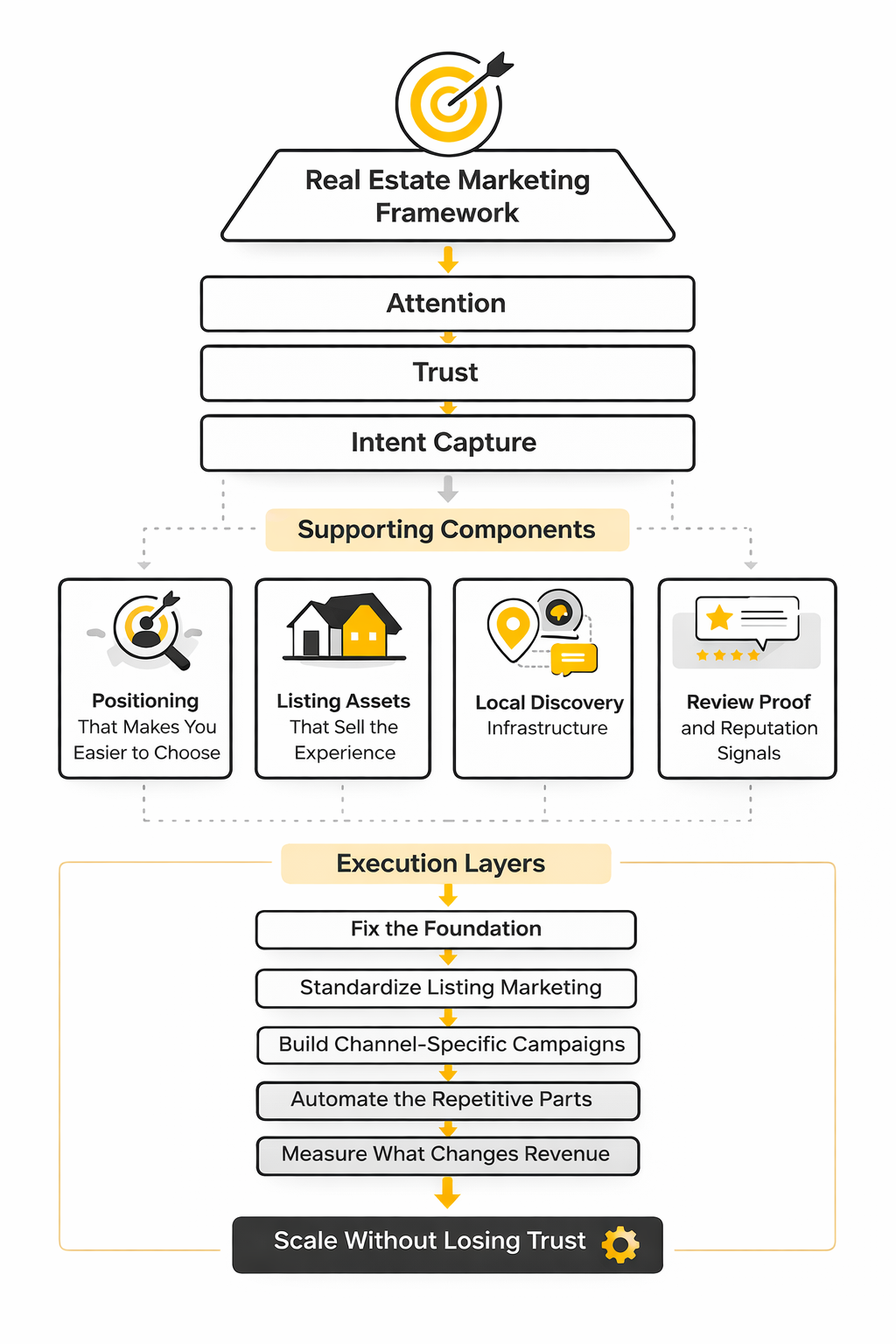
- The Real Estate Marketing Framework
- Core Components of a High-Performance Marketing System
- Content, Listings, and Local Visibility
- Lead Conversion, Automation, and Nurture
- Professional Implementation and Long-Term Growth

A useful way to think about real estate marketing is this: the market does not reward noise nearly as much as it rewards clarity. Sellers want confidence that you can create demand, protect price, and communicate well. Buyers want speed, transparency, and a smoother path through a stressful process. When your marketing makes both sides feel understood before the first conversation, everything downstream gets easier.
That is the standard the rest of this article will use. Not vanity metrics. Not recycled social posts. Not the kind of activity that looks busy but never turns into signed listings or qualified conversations. The goal is a real system that helps people discover you, trust you, contact you, and remember you when timing finally lines up.
Why Real Estate Marketing Matters More Than Ever
Real estate marketing matters more now because the relationship usually starts before the conversation. In the latest national buyer research, 46% of buyers said their first step was looking for properties online, which means your visibility, listing quality, and brand signals are already being judged before anyone fills out a form or picks up the phone. That changes the job completely, because marketing is no longer support for sales. It is the first sales interaction.
The second shift is that digital discovery is not replacing the agent. It is filtering the agent. Buyer data still shows 85% of buyers used an agent, while Zillow’s 2024 buyer research found 94% used at least one online shopping resource. Put those two facts together and the message is obvious: people search digitally, then choose who feels credible enough to guide them.
That is why weak marketing creates a hidden tax on every part of the business. If your listings look average, your local presence is incomplete, your reviews are thin, or your follow-up is slow, you make every listing appointment harder to win and every online lead harder to convert. The market does not usually punish that all at once. It punishes it quietly, through missed calls, lower trust, shorter conversations, and fewer signed agreements.
The Decision Starts Before the First Call
This matters even more because people are making decisions faster once they finally reach out. Zillow’s 2025 agent trends release shows 47% of buyers hired the first agent they spoke with and 59% of sellers did the same. That tells you something important: by the time the call happens, a lot of the real estate marketing work is already done.
So the goal is not just to generate inquiries. The goal is to make sure the right people arrive already leaning in your direction. Good marketing creates that advantage by showing proof, reducing uncertainty, and making your expertise easy to understand in seconds instead of minutes.
Sellers Judge Marketing as a Service, Not a Bonus
Sellers are not only hiring for personality or commission structure. They are hiring for confidence that you can package the home properly and bring qualified attention to it. Zillow’s seller research shows 80% of sellers rate trustworthiness and responsiveness as highly important, and the same dataset shows 78% are more likely to hire agents who offer high-resolution photography while 75% prefer agents who provide virtual tours and interactive floor plans.
That changes how listing presentations should work. You are not pitching marketing as a nice extra anymore. You are proving that your marketing process is part of the value of representation itself, because owners increasingly see presentation quality as a signal of how seriously their property will be taken by the market.
Buyers Reward Clarity, Speed, and Useful Information
On the buyer side, the same pattern shows up differently. NAR’s latest profile found that photos, detailed property information, and floor plans are among the most useful website features, and buyers still report that agents remain one of the most useful information sources in the search process. Zillow’s 2024 buyer report adds that half of buyers said their agent was their most helpful resource, even in a world where online shopping is now normal.
That combination matters. Buyers want convenience, but they do not want confusion. The real estate marketing that works best is the kind that makes information easier to process, gives people a reason to trust the listing, and then makes it effortless to move into a real conversation.
Local Trust Has Become a Marketing Channel
A lot of agents still treat local trust like a soft brand concept. It is not. It is a discoverability asset. Google’s own guidance explains that a verified Business Profile helps businesses show up on Maps and Search, collect reviews, post photos and videos, and direct people to booking links, websites, and calls. For a local service business like real estate, that is not optional territory.
Review behavior reinforces the same point. BrightLocal’s 2025 survey found that over three-quarters of U.S. consumers watch video content when researching local businesses, and it also highlights how people use review signals and local information sources to evaluate credibility. In practical terms, your reputation, content, and visibility in local search now work together. They are not separate marketing projects anymore.
The Real Estate Marketing Framework
The cleanest way to understand real estate marketing is to stop viewing it as a channel list. It is not social media plus postcards plus email plus ads. It is a system with stages, and each stage has one job to do. When those stages are aligned, marketing feels consistent and trust compounds. When they are not, you get traffic without leads, leads without appointments, or appointments without conversions.
A strong framework has four layers: attract attention, build trust, capture intent, and convert through follow-up. Those layers sound simple, but most underperforming real estate marketing breaks because one layer is missing. A team might create strong content but make it hard to book a call. Another might buy leads aggressively but respond too slowly. Another may have good reviews but poor listing presentation, which weakens seller confidence at the exact moment it matters most.
Layer 1: Attention
Attention is where discovery happens. This includes local search, signs, listing portals, organic social, video, community presence, referrals, and paid distribution. The point is not to be everywhere. The point is to be visible in the places where motivated buyers and sellers already look when intent begins to form.
This is where many agents confuse activity with reach. Posting daily does not automatically create attention that matters. Real attention comes from search visibility, strong listing assets, recognizable positioning, and repeat exposure in channels people actually use during a housing decision.
Layer 2: Trust
Once someone notices you, they need a reason to believe you are worth contacting. Trust comes from reviews, proof of local knowledge, quality of listings, clarity of messaging, responsiveness, and the overall feel of your digital presence. Zillow’s seller data showing the importance of trustworthiness, responsiveness, reputation, and neighborhood knowledge makes this layer impossible to ignore.
This is also why brand polish matters more than people like to admit. Not because consumers are shallow, but because polished marketing signals process. A clean Google profile, strong photography, useful market commentary, and consistent listing quality tell the client that the backend experience will probably be organized too.
Layer 3: Intent Capture
At some point attention and trust need to become action. That means a showing request, a valuation form, a seller consultation booking, a text, a call, a direct message, or an open house conversation. If this step is clumsy, your marketing leaks value even when the top of the funnel looks healthy.
Intent capture works best when the next step feels obvious and low-friction. A seller should know exactly how to request a pricing conversation. A buyer should know exactly how to tour, ask a question, or save a search. Confusion kills momentum, especially in a category where timing, stress, and comparison shopping are already high.
Layer 4: Conversion Through Follow-Up
This is the layer people talk about least and blame the most. They complain about lead quality when the real problem is often process quality. A modern real estate marketing system does not stop at the form fill. It routes the inquiry fast, responds across the right channels, and keeps the conversation warm long enough for the client’s timing to catch up.
This matters because the market rewards preparation. Zillow’s 2025 release makes it clear that hiring decisions happen quickly once contact is made, especially when the client has already narrowed the field online. Real estate marketing only performs at a high level when lead generation and follow-up are designed together, not treated as two different departments.
What This Framework Changes in Practice
Once you adopt this framework, the strategy gets clearer fast. You stop asking whether social media or SEO or email is “the best” channel, because that is the wrong question. Instead, you ask which channels create attention, which assets increase trust, which pages or workflows capture intent, and which systems convert that intent into conversations.
That shift is powerful because it keeps you from overinvesting in the visible part of marketing while neglecting the part that makes revenue possible. Great real estate marketing is not the loudest brand in the zip code. It is the business that guides people from discovery to decision with the least friction and the most confidence.
Core Components of a High-Performance Marketing System
Once the framework is clear, the next question is practical: what has to exist inside the business for real estate marketing to perform consistently? Not every agent needs a huge team, a media department, or a giant ad budget. But every serious operation does need a small set of core components working together, because missing just one of them creates drag everywhere else.
The easiest mistake is to think the answer is “more leads.” Usually it is not. Usually the answer is better assets, tighter positioning, cleaner capture, faster follow-up, and a system that keeps working after the first touch. That is what turns marketing from occasional spikes into a reliable pipeline.
Positioning That Makes You Easier to Choose
Positioning is the part most agents skip because it feels less urgent than ads or content. But it is the reason one profile gets ignored while another gets remembered. If your message sounds like every other agent in the market, your real estate marketing has to work much harder just to earn the same level of attention.
Strong positioning is usually built around a few simple things: who you help, what kind of market knowledge you bring, what process you are known for, and what experience clients can expect once they start working with you. Zillow’s recent agent research makes that urgency clear because many buyers and sellers choose quickly after first contact, which means vague messaging leaves too much work for the prospect to do. (agent research showing quick hiring decisions)
This is why the best positioning often sounds less clever and more concrete. “Luxury specialist” is broad. “I help move-up sellers in North Austin prep, price, and market homes for stronger offers without turning the process into chaos” is far more useful. The second version gives people something to hold onto.
Listing Assets That Sell the Experience Before the Showing
Listing assets are not decoration. They are sales material. Buyers keep telling the market that visuals and property detail matter, with the latest buyer research showing how heavily people rely on photos, detailed property information, and floor plans when evaluating homes online. (buyer feature preferences in the latest NAR profile)
That means every listing package has to be treated like a conversion asset, not an admin deliverable. High-resolution photography, smart sequencing, accurate copy, floor plans, short-form video, virtual walkthroughs when appropriate, and strong neighborhood context all reduce friction. They help people picture the home faster, and that is what drives the next action.
The same point matters on the seller side too. Zillow’s consumer housing trends work has shown that sellers are more likely to hire agents who provide strong digital presentation tools like professional photography and virtual tours. (seller preference signals from Zillow) So listing quality is doing two jobs at once: helping sell the current property and helping win the next listing appointment.
Local Discovery Infrastructure
A lot of real estate marketing performance depends on whether people can find and verify you locally without effort. This is where your Google Business Profile, review profile, local landing pages, map visibility, and brand consistency matter more than most agents realize. Google explicitly positions Business Profiles as a way to help people discover a business on Search and Maps, view photos, connect through calls or websites, and interact through reviews. (Google Business Profile overview)
The real point here is not platform compliance. It is trust compression. When someone can search your name, see strong reviews, recognize your service area, understand what you do, and find a clear next step in under a minute, your marketing starts with momentum instead of skepticism.
That is why local discovery should be treated like infrastructure. It may not feel as exciting as social media campaigns, but it supports almost everything else. Even the best ad or referral becomes weaker if the follow-up search result looks thin, outdated, or inconsistent.
Review Proof and Reputation Signals
Reviews are not a vanity layer sitting on top of the brand. They are proof that your claims survive contact with real clients. BrightLocal’s 2025 consumer research shows how central reviews remain to local business evaluation, and it also points to a broader shift: people increasingly assess the full picture rather than looking for a perfect star average alone. (BrightLocal’s 2025 review survey)
That changes how reputation should be managed. The goal is not just collecting praise. It is building a believable body of evidence that reflects responsiveness, expertise, calm under pressure, communication quality, and local knowledge. Those are the traits people are actually hiring for.
In practice, that means asking at the right moments, making the review request easy, and building a habit of publishing testimonials in more than one place. Google reviews matter. Platform-specific reviews matter. So do on-site testimonials, email quotes, and short video clips when clients are willing. The stronger the pattern, the less each individual lead has to guess.
Lead Capture That Feels Frictionless
A lot of lead generation breaks at the moment of action. The page looks good, but the offer is vague. The form exists, but it asks for too much too soon. The call to action is technically there, but it does not match the user’s actual intent. That is where real estate marketing leaks value quietly.
Lead capture should match the stage of awareness. A seller who is curious about pricing may respond to a home valuation or consultation offer. A buyer who is scanning listings may prefer alerts, saved search access, or a fast showing request. Someone who is comparing agents might want a clear booking link and a short explanation of what happens next.
The rule is simple: make the next step obvious, specific, and low-stress. Tools built for landing pages, forms, and scheduling can help tighten this part of the funnel, but only if the message is already clear. For teams that want one place to manage pipelines, forms, automations, and follow-up, a platform like GoHighLevel can fit naturally into a real estate marketing stack when speed and visibility across leads matter.
Follow-Up Systems That Do Not Drop Warm Demand
This is where marketing becomes operations. Leads are rarely dead on arrival. They are more often mishandled, delayed, or forgotten. Once someone raises their hand, speed and consistency matter because the market is full of alternatives and timing windows are short.
That is also why owned channels still matter. Litmus reported in its 2025 email data that many marketers are still seeing returns in the 10:1 to 36:1 range from email, which is a strong reminder that nurture is not some outdated tactic. (Litmus 2025 email ROI data) In real estate, email remains useful because decisions stretch across weeks or months, and buyers and sellers often need multiple touches before they are ready.
The strongest follow-up systems do three things well. They respond fast, they continue across more than one channel, and they stay relevant over time. A missed call can become a text. A valuation request can become a short email sequence. A buyer inquiry can become saved search alerts plus a quick human check-in. None of that is flashy, but it is where a huge share of revenue gets protected.
Professional Implementation and Execution
A professional real estate marketing system is not built by collecting tactics. It is built by sequencing them properly. That means you decide what needs to be fixed first, what needs to be standardized second, and what can be layered on once the foundation is real.
Most teams should think about implementation in five stages. Not because five is a magic number, but because it forces discipline. You stop trying to launch everything at once and start building the machine in the order that creates compounding returns.
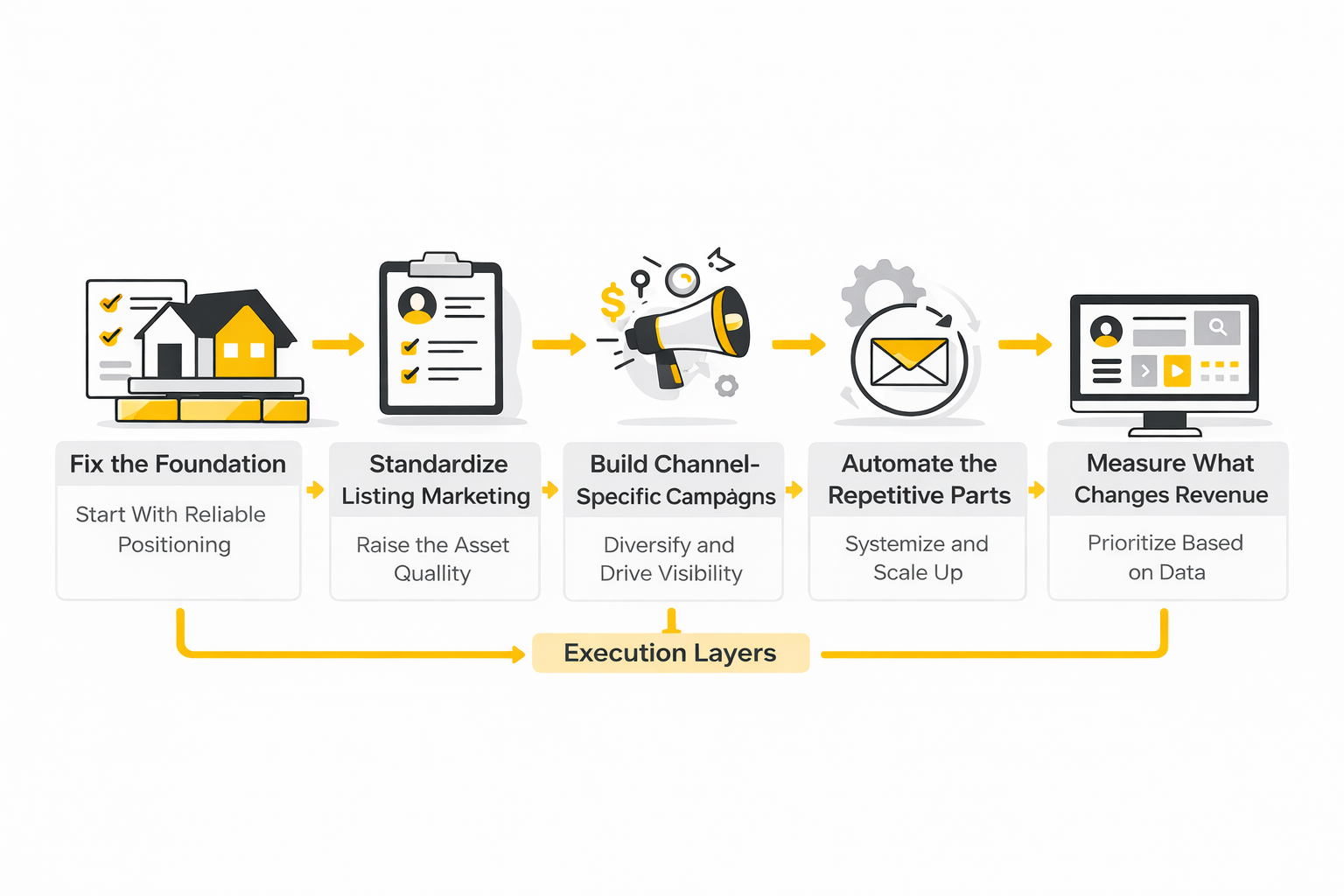
Stage 1: Fix the Foundation
Start with the parts that affect every other channel: positioning, profile quality, review presence, website clarity, and contact pathways. If those are weak, paid traffic just reaches a weak destination faster. If those are strong, almost every future effort performs better.
This stage also includes asset hygiene. Your bio, your service area language, your brand visuals, your listing presentation standards, your Google profile, and your lead forms should all feel like they belong to the same business. That consistency matters because scattered signals create doubt.
Stage 2: Standardize Listing Marketing
The next move is to remove randomness from how listings go live. Professional photography, copy structure, floor plans, video standards, pre-launch checklists, social cutdowns, email announcements, and follow-up expectations should be repeatable. The seller should not feel like quality depends on whether the team is having a busy week.
This matters because repeatability creates leverage. Once the process is documented, execution gets faster, delegation gets easier, and the client experience gets more predictable. That is usually the point where real estate marketing starts feeling like a system instead of a scramble.
Stage 3: Build Channel-Specific Campaigns
Only after the foundation and listing process are stable should you push harder into channel campaigns. That might mean local SEO pages, educational email flows, neighborhood content, retargeting ads, community video, or social content built around common seller and buyer questions. HubSpot’s current marketing data still shows that video and blog content remain among the better-performing formats for many marketers, which fits well with how real estate decisions are researched. (HubSpot’s current marketing statistics)
The key is not doing every channel at once. It is choosing channels that fit your market, your strengths, and your operational capacity. If you cannot respond fast or follow up well, adding more top-of-funnel activity may just create more waste.
Stage 4: Automate the Repetitive Parts Without Automating the Relationship
This is where a lot of teams either get much better or get weird. Automation should handle reminders, lead routing, first-touch confirmations, missed-call texts, nurture flows, scheduling links, and internal task creation. It should not make the client feel like they are trapped inside a generic software sequence.
The right use of automation is practical. It protects response time, makes handoffs visible, and keeps opportunities from falling through the cracks. Used well, it gives the human side of the business more room to show up where judgment and empathy actually matter.
Stage 5: Measure What Changes Revenue, Not Just What Looks Busy
The final stage is measurement, but not the lazy version. Reach and impressions can be useful, yet they are not enough. A stronger scorecard tracks inquiries by source, response times, appointment rates, signed agreements, cost per qualified lead when paid media is involved, and the percentage of listings following the full marketing standard.
This is where the business gets honest. You find out whether your real estate marketing is attracting the right people, whether your team is handling them properly, and whether your content is producing commercial outcomes instead of just attention. Without that view, it is easy to stay active and still be strategically blind.
A Simple Execution Rhythm That Actually Holds Up
The easiest way to keep the system alive is to run it on a weekly rhythm. Review active listings, new leads, response speed, follow-up gaps, content in production, pending review requests, and upcoming campaigns. Keep the meeting focused on movement, not commentary.
Then run a monthly review that looks one level deeper. Which channels are producing qualified conversations, not just traffic? Which listings got the strongest engagement? Which nurture sequences are being ignored? Which review requests are converting? That is where improvement becomes visible.
This is the part many people underestimate. Professional implementation is rarely about one brilliant tactic. It is about reducing friction in dozens of small places until the whole client journey starts to feel sharper, faster, and more trustworthy. That is when real estate marketing stops being an expense line and starts acting like an asset.
What the Data Is Really Telling You
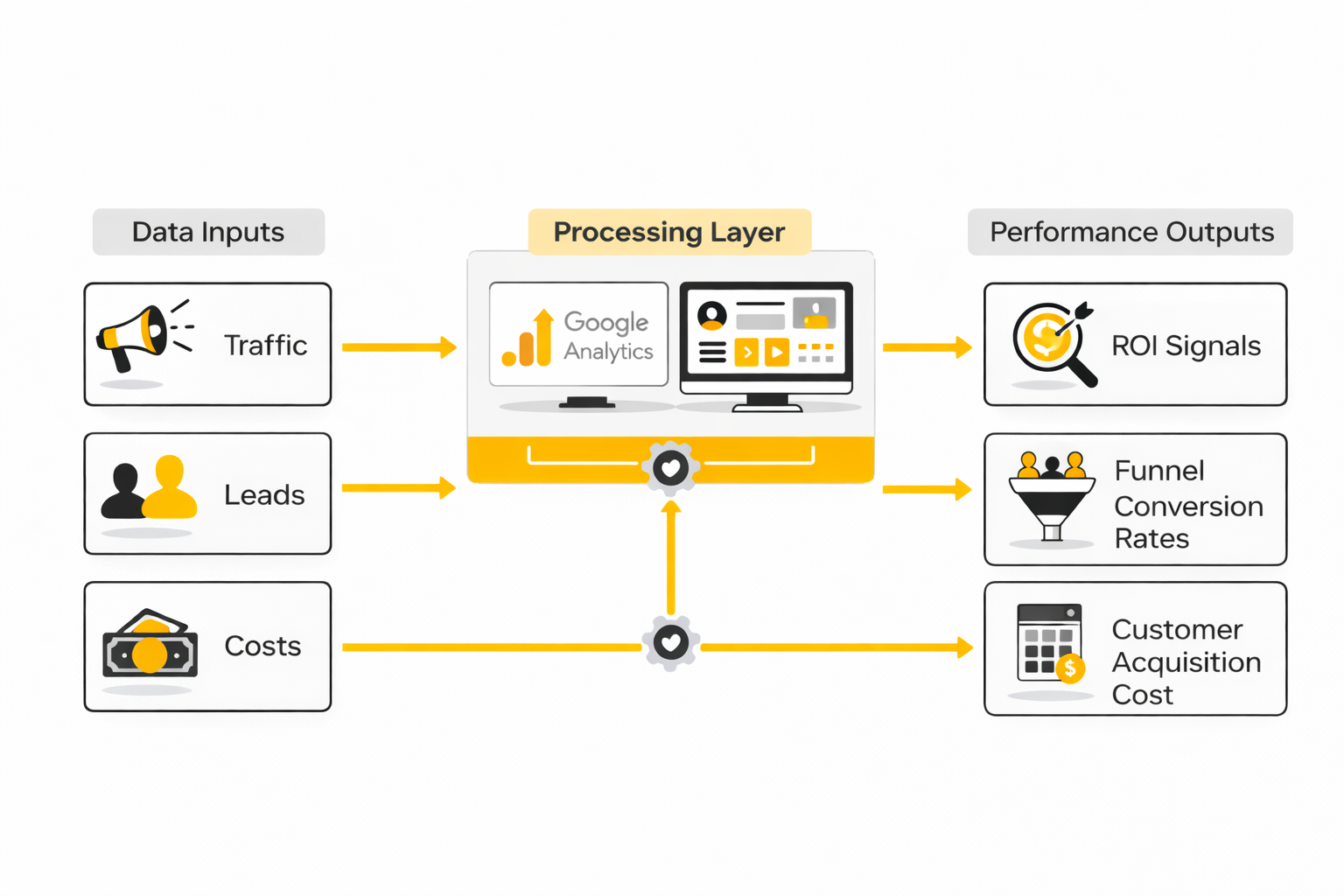
By this point, the structure should be clear: real estate marketing is a system, not a pile of campaigns. The next step is measurement, because without measurement you cannot tell whether the system is attracting the right people, building trust, or simply creating noise. This is where a lot of teams get stuck, not because they have no data, but because they look at the wrong numbers and then make the wrong changes.
The numbers that matter are the ones that explain movement through the client journey. That means you do not start with vanity metrics like impressions or follower count. You start with signals that tell you whether people found you, trusted you, raised their hand, and moved closer to a signed agreement.
Why Raw Traffic Is Not Enough
Traffic matters, but it is one of the weakest metrics when it is viewed alone. A page can get more visits because rankings improved, a listing got syndicated more broadly, or a social post took off for reasons that have nothing to do with seller or buyer intent. If that traffic does not turn into calls, forms, saved searches, valuation requests, or appointments, it is not proof that your real estate marketing is working.
This is especially important in a market where digital discovery happens early and agent selection happens fast. Recent buyer and seller research still shows online research plays a major role in agent choice, while Zillow’s 2025 agent report shows that 47% of buyers and 59% of sellers hired the first agent they spoke with. (Zillow’s 2025 agent trends release) That means weak traffic can look healthy right up until the moment revenue fails to appear.
So the first rule is simple: traffic is only useful when it is tied to intent and outcomes. More visits with flat inquiry volume is not growth. It is usually a sign that the message, offer, or conversion path is off.
Statistics and Performance Signals That Matter
The most useful real estate marketing metrics fall into four buckets: visibility, engagement, intent, and conversion. Each bucket answers a different question. When you read them together, they tell you what is broken and what should happen next.
Visibility Metrics Tell You Whether the Market Can Find You
Visibility is the top of the system. This includes impressions in search, Google Business Profile discovery, listing portal exposure, email reach, and channel-level audience growth. Google’s own Business Profile documentation shows that local businesses can track performance such as searches, calls, bookings, website clicks, and direction requests directly inside the profile. (Google Business Profile performance guidance)
That matters because visibility data helps you answer the first important question: are you actually showing up where local buyers and sellers are looking? If those numbers are weak, you do not start by tweaking follow-up scripts. You fix profile quality, local search presence, review volume, listing distribution, and the consistency of your market-facing assets.
Visibility metrics are also where context matters most. A spike in branded search usually means reputation or referral momentum is improving. A spike in non-branded search can mean your local SEO or listing visibility is improving. Those are not the same thing, and they should not trigger the same action.
Engagement Metrics Tell You Whether the Message Is Landing
Once people find you, engagement tells you whether they care enough to keep going. This includes time on page, listing detail views, video watch behavior, email opens, click-through rates, and profile actions like photo views or website taps. It is not perfect, but it is useful because engagement tells you whether the market is leaning in or bouncing away.
The interpretation here has to stay grounded. A high open rate with low clicks usually means the subject line worked but the body did not. Strong listing views with weak showing requests can mean the home is generating curiosity without enough urgency, or that the pricing, media quality, or CTA is not doing its job. High social reach with weak profile visits often means the content entertained people without moving them closer to contact.
Email is a good example of why interpretation matters more than isolated benchmarks. Current industry reporting from Litmus still shows many marketers estimate email ROI in the 10:1 to 36:1 range, while HubSpot’s 2025 marketing statistics continue to rank email among the strongest ROI channels for B2C brands. (Litmus email ROI reporting) (HubSpot marketing statistics) That does not mean every real estate newsletter is valuable. It means email becomes powerful when it is used to nurture real timing-based demand instead of blasting generic updates.
Intent Metrics Tell You Whether Interest Is Turning Into Opportunity
Intent is where marketing starts getting commercial. This bucket includes calls, valuation requests, showing requests, booking clicks, contact form submissions, replies to email campaigns, direct messages, and saved-search signups. These are the moments when a person stops browsing and signals that they may be ready to talk.
This is also where a lot of teams discover that the channel was never the issue. The issue was friction. If profile views are healthy but calls are weak, the offer may be vague. If landing page traffic is decent but form completions are soft, the page may be asking too much too early. If email clicks rise but booked appointments do not, the handoff may be clumsy.
Google Analytics 4’s recommended event framework is useful here because Google explicitly includes lead and purchase-oriented event structures for industries including real estate. (GA4 recommended events for real estate-related sales measurement) The point is not technical perfection for its own sake. The point is being able to see which actions count as meaningful progress and which pages or campaigns are failing to produce it.
Conversion Metrics Tell You Whether Marketing Is Producing Business
Conversion metrics sit lower in the funnel, and they are the numbers that keep the whole operation honest. This includes lead-to-appointment rate, appointment-to-agreement rate, cost per qualified lead, cost per acquisition where paid media is involved, and percentage of listings won after presentation. These are not always the easiest numbers to track, but they are the most important because they connect marketing behavior to business outcomes.
This is where interpretation becomes uncomfortable in a useful way. A channel that produces cheap leads but weak appointment rates may not be efficient at all. A channel with fewer leads but much stronger close rates may deserve more attention, even if it looks smaller on the dashboard. Good real estate marketing decisions are often made by comparing downstream quality, not just upstream volume.
The same logic applies to listing performance. More listing page traffic is not automatically a win. What matters is whether that traffic leads to stronger inquiry volume, more showing activity, or higher-quality conversations with buyers and brokers. If it does not, then the presentation may be attracting attention without creating conviction.
How to Read Benchmarks Without Fooling Yourself
Benchmarks are useful, but they become dangerous when people treat them like universal targets. An open rate benchmark can be directionally helpful. A click benchmark can tell you whether your audience is disengaged. A local search trend can show whether visibility is moving. But none of those numbers can tell you, by themselves, whether your real estate marketing is healthy in your market.
The reason is simple: channel mix, geography, price point, inventory type, and sales cycle all change the meaning of the benchmark. A luxury agent, an apartment locator, a new-construction team, and a suburban listing specialist should not expect identical performance patterns. The work is different, the audience is different, and the timing is different.
So use benchmarks as reference points, not verdicts. The smarter question is not “Is this number good?” The smarter question is “Is this number improving, and if not, what part of the system is holding it back?” That keeps the analysis tied to action.
The Most Common Misreads
One of the most common mistakes is celebrating reach without checking conversion. Another is blaming lead quality when response quality is the real problem. A third is assuming a content channel is weak when the real issue is that the CTA is unclear or the follow-up process breaks immediately after the first touch.
There is also a local trust mistake that shows up constantly. BrightLocal’s 2025 consumer research found that more than three-quarters of U.S. consumers watch video content when researching local businesses, and review behavior continues to shape how people judge credibility. (BrightLocal’s 2025 survey) If a team sees strong video engagement but weak inquiry volume, that does not automatically mean video is overrated. It may mean the content is informative but disconnected from the next step, or that the proof layer around it is too thin.
The Analytics System a Real Team Can Actually Run
A workable analytics system does not need to be huge. It needs to be clear enough that the team can use it every week without getting lost. That usually means one dashboard view for visibility and engagement, one view for intent and conversion, and one view for sales outcomes inside the CRM.
For visibility and engagement, track search impressions, Google Business Profile actions, website sessions, top landing pages, listing detail engagement, email opens, email clicks, and content-level interaction. For intent, track calls, forms, bookings, direct replies, and source-level lead counts. For conversion, track response time, appointment rate, signed-client rate, and closed business by source.
This is exactly where a CRM and automation layer becomes useful, because spreadsheets alone get messy fast once volume rises. A platform such as GoHighLevel can make that process easier when you need source tracking, pipelines, automations, and reporting in one place. The tool is not the strategy, but it can reduce a lot of operational friction when the marketing system starts growing up.
What the Numbers Should Make You Do
Data is only useful when it changes behavior. If visibility is weak, improve local discoverability, profile quality, reviews, and listing distribution. If engagement is weak, improve message clarity, asset quality, and content relevance. If intent is weak, tighten the offer and reduce friction at the point of contact. If conversion is weak, fix response speed, lead routing, and follow-up consistency.
That sequence matters. Teams often jump to paid acquisition because it feels active, but the data usually tells a quieter story first. Maybe the listings are under-presented. Maybe the Google profile is thin. Maybe email nurture exists but has no clear calls to action. Maybe inquiries are coming in and sitting untouched for too long. Good measurement surfaces those problems before more money gets wasted.
The real value of analytics in real estate marketing is not that it makes the business more complicated. It makes the business more honest. You stop guessing which channels deserve credit, which assets are doing work, and where leads are leaking out. And once that happens, improvement gets much more practical.
Advanced Considerations That Separate Good Marketing From Durable Growth
Once the basics are in place, real estate marketing gets more strategic. At that point, the question is no longer how to generate attention at all. The question becomes how to generate the right kind of attention, protect margins, and keep the client experience strong as volume increases. This is where experienced teams usually pull away, because they stop optimizing for activity and start optimizing for resilience.
That shift matters more than it sounds. A marketing system can look healthy while quietly becoming fragile. It might depend too heavily on one platform, one lead source, one personality, or one operator inside the team. When that happens, growth stops being compounding and starts becoming risky.
The Real Tradeoff Between Scale and Trust
Scaling real estate marketing always creates tension between efficiency and personalization. The more leads you generate, the more tempting it becomes to standardize everything. That helps with speed, but if you standardize too aggressively, the business starts sounding automated, generic, and interchangeable.
This is a real risk in a category where the decision is emotional, financial, and deeply personal. Zillow’s recent agent research shows how quickly buyers and sellers often choose once contact happens, which means the first few touches carry a disproportionate amount of weight. (Zillow’s 2025 agent research) If the process feels cold at exactly that moment, efficiency can cost you the very trust marketing was supposed to create.
The answer is not avoiding systems. The answer is building systems that support human judgment instead of replacing it. Templates, automations, and checklists should remove friction. They should not flatten the personality, empathy, and local intelligence that make the service valuable in the first place.
Why Channel Diversification Matters More as You Grow
One of the fastest ways to build a fragile business is to let one channel carry too much of the pipeline. Teams do this all the time with paid portals, one social platform, one referral partner, or one ad campaign that happens to be working right now. It feels efficient until pricing changes, reach drops, lead quality softens, or platform rules move under your feet.
That is why channel diversification is not just a growth tactic. It is risk management. Zillow’s own 2025 marketing guidance for agents emphasizes video, local expertise, diversified channels, and data-driven decision-making, which is a useful reminder that even large platforms are telling agents not to rely on one lane alone. (Zillow’s 2025 marketing trends for agents)
The practical version of this is simple. Build a mix of search visibility, reviews, listing performance, email nurture, referral systems, and content that can travel across platforms. That way, if one source weakens, the whole business does not wobble with it.
Owned Audience Beats Rented Reach Over Time
There is a reason experienced operators care so much about email lists, CRM quality, and first-party contact data. Social reach is useful, but it is rented. Portal visibility is useful, but it is intermediated. Your database is different because it is the one audience you can keep speaking to even when algorithms, ad costs, or portal policies shift.
This is also where a lot of teams underestimate timing. In real estate, people often signal interest well before they are ready to move. That means the short game and the long game need to coexist. HubSpot’s current marketing statistics continue to rank email among the strongest ROI channels for B2C marketers, which is exactly why owned nurture keeps mattering even when flashier channels get more attention. (HubSpot’s current marketing statistics)
The point is not to force every lead into email. The point is to build a contactable audience you can educate, segment, and re-engage over time. That is how real estate marketing becomes less dependent on constant reacquisition.
Automation Gets More Dangerous When the Database Gets Bigger
Automation is useful, but the downside grows with scale. Small mistakes inside a small database are annoying. Small mistakes inside a large database become expensive, visible, and reputation-damaging. The more contacts, campaigns, tags, and handoffs you have, the more important data quality becomes.
This usually shows up in ordinary ways. The wrong person gets the wrong message. A warm lead gets routed into a cold nurture path. A seller receives buyer content for months. A past client gets hit with repetitive generic follow-up that makes the business feel inattentive rather than professional. None of that looks dramatic on a dashboard, but it weakens trust fast.
Email deliverability adds another layer here. Validity’s 2025 deliverability benchmark report highlights that inbox placement became tougher as mailbox requirements and filtering pressures increased, which matters because a nurture system only works if messages are actually reaching people. (Validity’s 2025 deliverability benchmark report) In other words, advanced real estate marketing is not just about sending more messages. It is about maintaining list quality, relevance, and technical health so the channel keeps working.
Better Data Changes Budget Decisions
As teams scale, budget mistakes get more expensive. A small team can survive a few months of fuzzy attribution and still recover. A larger team spending across paid media, content, software, contractors, and listing assets can burn serious money if it does not know what is actually driving qualified business.
This is why source tracking matters so much once complexity rises. You need to know which leads came from search, which came from direct brand demand, which came from listing portals, which came from referrals, and which came back through nurture after sitting dormant. Otherwise the loudest channel gets credit, even when another channel did the real work earlier in the journey.
A stronger CRM layer becomes valuable here because it makes those handoffs more visible. For teams that want a tighter system for attribution, pipelines, and automation, GoHighLevel can be a practical fit when the problem is less about lead volume and more about operational visibility. The important point is not which tool you choose. It is that advanced marketing needs a reliable record of what happened before the close.
The Risks That Usually Show Up Too Late
The hardest marketing risks to manage are the ones that look like growth until they turn into drag. They do not arrive as obvious failure. They arrive as subtle quality loss. The business gets busier, but not sharper. The team produces more output, but the experience feels less distinctive.
Brand Dilution Through Volume
As output increases, brand consistency usually slips before anyone notices. One listing looks polished, the next looks rushed. One email sounds thoughtful, the next sounds robotic. One social series teaches the market something, while the next month becomes random filler built just to keep posting frequency alive.
This matters because inconsistency creates doubt. In a high-trust business, that doubt has commercial consequences. People do not usually say, “Your messaging architecture feels fragmented.” They just stop leaning in.
The fix is not more brand guidelines for the sake of brand guidelines. It is a tighter operating standard around voice, asset quality, offer clarity, review collection, and follow-up tone. Real estate marketing scales better when the standards are visible and enforceable, not when they live only in the founder’s head.
Over-Reliance on Visible Metrics
Another late-stage risk is letting visible metrics overpower useful ones. Teams start chasing views, clicks, and reach because those numbers update fast and feel exciting. Meanwhile the quieter metrics that matter more, like response time, lead-to-appointment rate, and signed-client rate, get less attention because they are harder to organize.
This is exactly why mature operators build measurement around business movement, not content excitement. BrightLocal’s 2025 consumer research shows that local trust still depends heavily on reviews, detail, and how businesses handle their reputation footprint. (BrightLocal’s 2025 consumer research) So if social reach is rising while review growth, booked consultations, and branded search stay flat, the right conclusion is not “marketing is winning.” The right conclusion is “attention is not being converted into belief.”
The Founder Bottleneck
A lot of real estate brands scale on the back of one person’s energy, face, network, and instincts. That works for a while, and sometimes it works extremely well. The problem comes when the whole marketing system depends on one individual being present in every message, every review request, every piece of content, and every close-worthy conversation.
That creates a hidden ceiling. The business can grow, but only until the founder’s capacity runs out. Past that point, lead quality often falls, response time stretches, and the brand becomes harder to replicate across the team.
The solution is not removing the founder from marketing. It is translating what works about that person into systems other people can execute. That includes process, messaging, standards, training, and proof assets. Expert-level growth usually means turning personal excellence into transferable operating discipline.
What Smarter Scaling Actually Looks Like
Smarter scaling is usually quieter than people expect. It looks like fewer channels done better, stronger nurture instead of more noise, cleaner handoffs, better review habits, tighter offers, and more discipline around the database. It does not always look dramatic from the outside, but it compounds far more reliably.
It also requires saying no. No to random campaigns that do not fit the strategy. No to tools that create extra complexity without clarity. No to lead volume that the team cannot handle well. No to content calendars full of filler. Mature real estate marketing gets stronger partly because it becomes more selective.
That is the point where the business starts to feel different. Not just busier. Better structured. More trustworthy. Easier to understand. Harder to disrupt. And that is exactly the kind of strength you want before moving into the final part of the article, where everything gets tied together into a practical closing view of what lasting real estate marketing success actually looks like.
Bringing the Entire Real Estate Marketing System Together
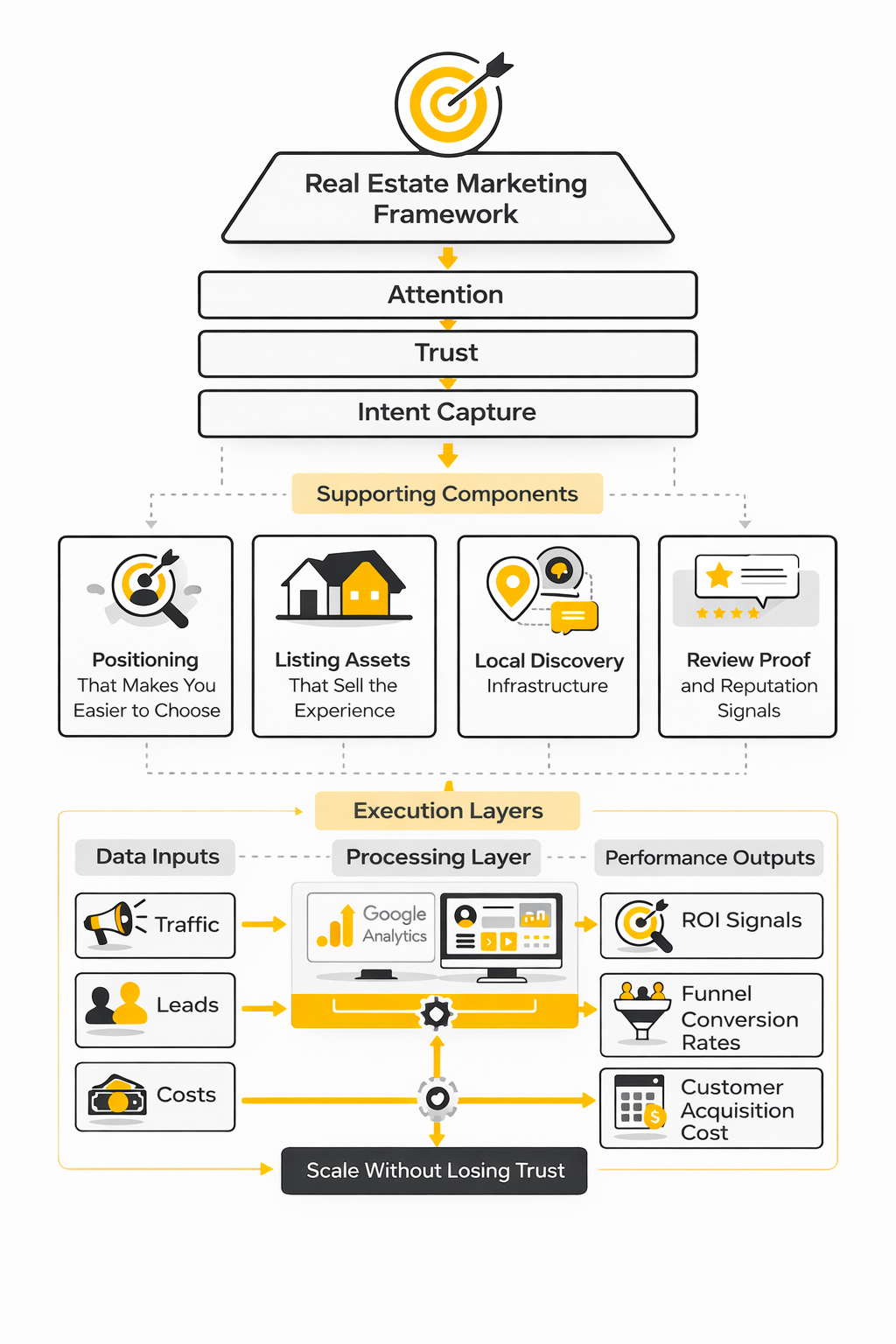
At this point, everything connects. Visibility feeds trust. Trust feeds intent. Intent feeds conversations. Conversations turn into signed clients. And the entire system is held together by consistent follow-up, clean data, and strong execution standards.
The biggest shift most people need is this: stop thinking in campaigns and start thinking in systems. Campaigns create spikes. Systems create stability. Campaigns can win attention for a moment. Systems win trust repeatedly, even when the market slows down or competition increases.
When real estate marketing is working properly, it becomes predictable in a very specific way. You know where your next conversations are likely to come from. You know which listings will generate stronger demand. You know how long it typically takes for a new lead to convert. And you know what part of the system to fix when something drops.
That is what makes the difference between reactive marketing and controlled growth.
FAQ - Built for Complete Guide
1. What is real estate marketing in simple terms?
Real estate marketing is the system used to attract buyers and sellers, build trust, capture interest, and convert that interest into signed clients. It includes everything from listing presentation and local SEO to email nurture and follow-up. The key is that all parts work together, not separately.
2. What is the most important part of real estate marketing?
The most important part is not a channel. It is the connection between trust and follow-up. You can generate attention easily, but if people do not trust you or you respond slowly, the opportunity disappears. The strongest systems combine credibility with fast, consistent communication.
3. How do real estate agents get leads consistently?
Consistent lead flow usually comes from a mix of local search visibility, strong listing assets, referrals, email nurture, and targeted campaigns. The difference is not the source itself, but whether the system converts attention into conversations. That is where most inconsistency comes from.
4. Is social media necessary for real estate marketing?
Social media helps, but it is not mandatory if other channels are strong. Many agents rely more on search, referrals, and database marketing. Social becomes powerful when it supports positioning and trust, not when it is used as random content output.
5. What is a good conversion rate in real estate marketing?
There is no universal number because markets, price points, and lead sources vary. What matters more is improving your own baseline. Track how many leads turn into conversations, how many conversations turn into appointments, and how many appointments turn into signed clients. Improvement across those stages is the real goal.
6. How important are reviews in real estate marketing?
Reviews are critical because they reduce uncertainty before contact happens. Strong review profiles make people more comfortable reaching out and more likely to trust you quickly. They also improve local visibility, which supports discovery in the first place.
7. Should I invest in paid ads or organic marketing first?
Start with the foundation. If your positioning, listings, reviews, and follow-up are weak, paid ads will amplify the problem. Once the system is stable, paid campaigns can accelerate growth. Without that foundation, they often just create expensive noise.
8. What tools are essential for real estate marketing?
At minimum, you need a CRM, email capability, a website or landing pages, and local profile management. As the system grows, tools that combine pipelines, automation, and communication can simplify operations. Platforms like GoHighLevel are often used when teams want to manage everything in one place instead of juggling multiple disconnected tools.
9. How do I know if my marketing is working?
You know it is working when you can trace leads to conversations and conversations to revenue. If you are getting traffic but not inquiries, the message or offer is off. If you are getting inquiries but not appointments, the follow-up is off. If you are getting appointments but not clients, the trust layer needs work.
10. How long does it take for real estate marketing to show results?
Some channels produce results quickly, like paid ads or active listings. Others take longer, like SEO, email nurture, and brand positioning. A balanced system usually shows early signals within weeks, but consistent growth tends to build over months as trust compounds.
11. What is the biggest mistake agents make with marketing?
The most common mistake is treating marketing as separate tasks instead of a connected system. Posting content, running ads, or sending emails without aligning them creates activity without progress. The system has to guide people from discovery to decision.
12. Can automation replace manual follow-up?
No, but it can support it. Automation should handle speed, reminders, and consistency. The human layer still matters for judgment, negotiation, and building real trust. The best systems use both, not one instead of the other.
Work With Professionals
Explore 10K+ Remote Marketing Contracts on MarkeWork.com
Most marketers spend too much time chasing clients, competing on crowded platforms, and losing a percentage of every project to middlemen.
MarkeWork gives you a better way. Browse thousands of remote marketing contracts and connect directly with companies desperate to hire skilled marketers like you, without platform commissions and without unnecessary gatekeepers.
If you're serious about finding better opportunities and keeping 100% of what you earn, explore available contracts and create a profile for free at MarkeWork.com.