

Real estate social media marketing is no longer just posting listings and hoping someone messages you. Buyers, sellers, landlords, investors, and renters now research agents the same way they research restaurants, lenders, and neighborhoods: they look for proof, personality, consistency, and trust before they ever book a call.
That matters because the buying journey is already digital. In the latest NAR buyer data, 46% of buyers started by looking for properties online, while agents remained one of the most useful information sources once buyers were serious. Social media sits between those two behaviors: it helps people discover you before they need you, trust you before they contact you, and remember you when timing finally lines up.
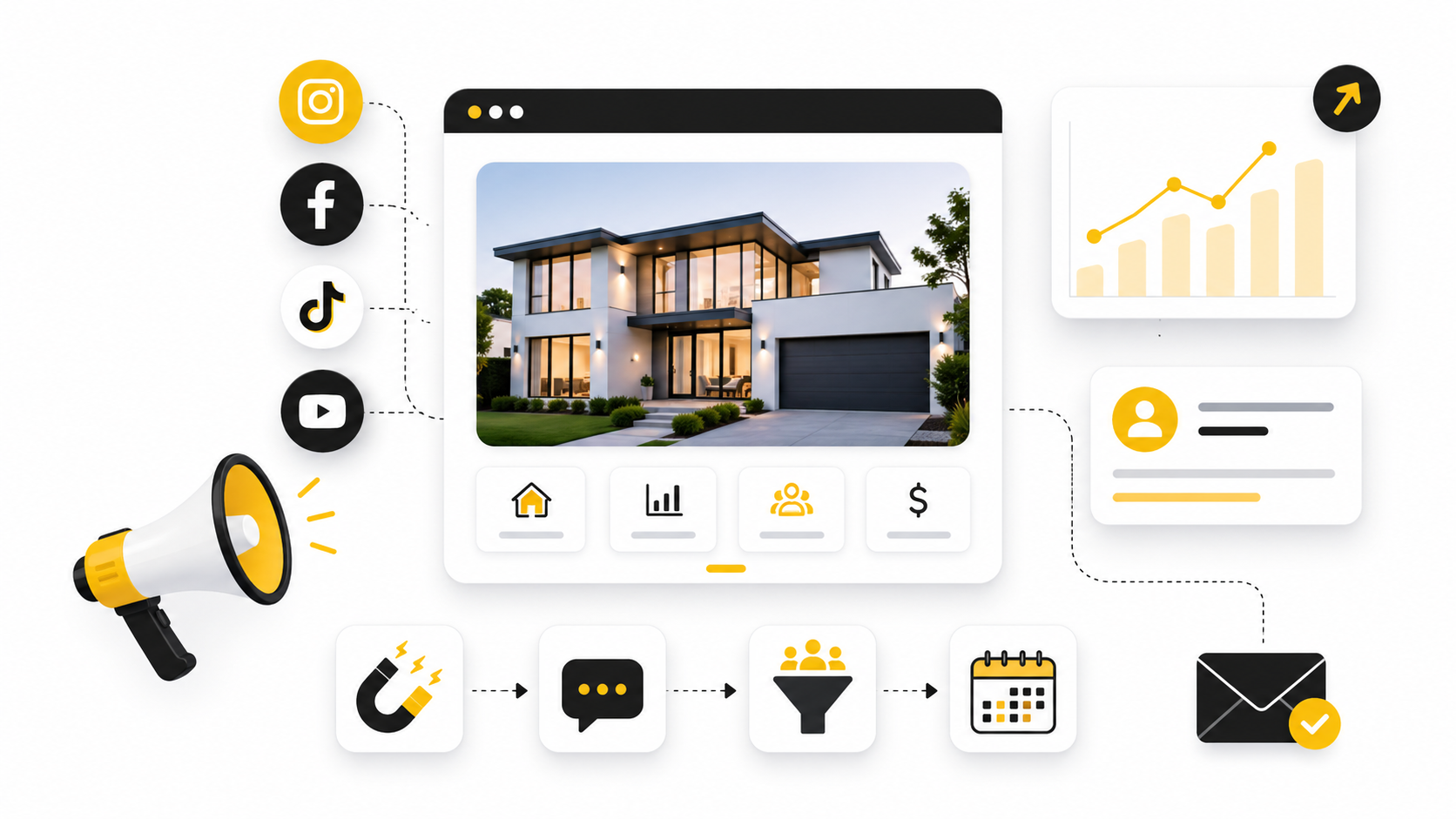
This article breaks real estate social media marketing into a complete six-part system. The goal is not to chase every trend. The goal is to build a repeatable marketing engine that creates attention, captures demand, and turns local trust into real appointments.
Article Outline
- Part 1: Why Real Estate Social Media Marketing Matters Now
- Part 2: The Real Estate Social Media Framework
- Part 3: Content Pillars That Build Local Trust
- Part 4: Platform Strategy for Agents, Teams, and Brokerages
- Part 5: Lead Capture, Follow-Up, and Automation
- Part 6: Measurement, Optimization, and FAQ
Why Real Estate Social Media Marketing Matters Now
Real estate is a high-trust, high-ticket, emotionally loaded decision. Nobody hires an agent because of one pretty post. They hire when they have seen enough signals that you understand the market, communicate clearly, and can guide them through a stressful transaction without making it worse.
That is why social media works so well in real estate when it is done properly. It gives people repeated exposure to your judgment, your local knowledge, your listings, your client process, and your personality. The market may be transactional, but the decision to choose an agent is deeply personal.
The audience is already there. DataReportal’s Digital 2025 reporting shows that social platforms remain a daily habit for billions of people, and NAR’s 2025 Technology Survey found that social media remained the top lead-generating technology for REALTORS® at 39%. That does not mean social replaces referrals, your CRM, search, or local networking. It means social now supports all of them.
The Core Idea
The core idea is simple: your social media should make your market easier to understand and make you easier to trust. If your content only says “just listed,” “just sold,” and “call me,” you are not building much of an asset. You are only broadcasting inventory.
A stronger strategy answers the questions people are already thinking about. What is happening with prices? Which neighborhoods fit which lifestyle? What should sellers fix before listing? What mistakes are buyers making right now? What does a good offer actually look like in this market?
That kind of content does more than generate likes. It builds mental availability, which means people remember you when they move from casual browsing to serious intent. In real estate, that gap can be weeks, months, or years, so consistency matters more than one-off virality.
Framework Overview
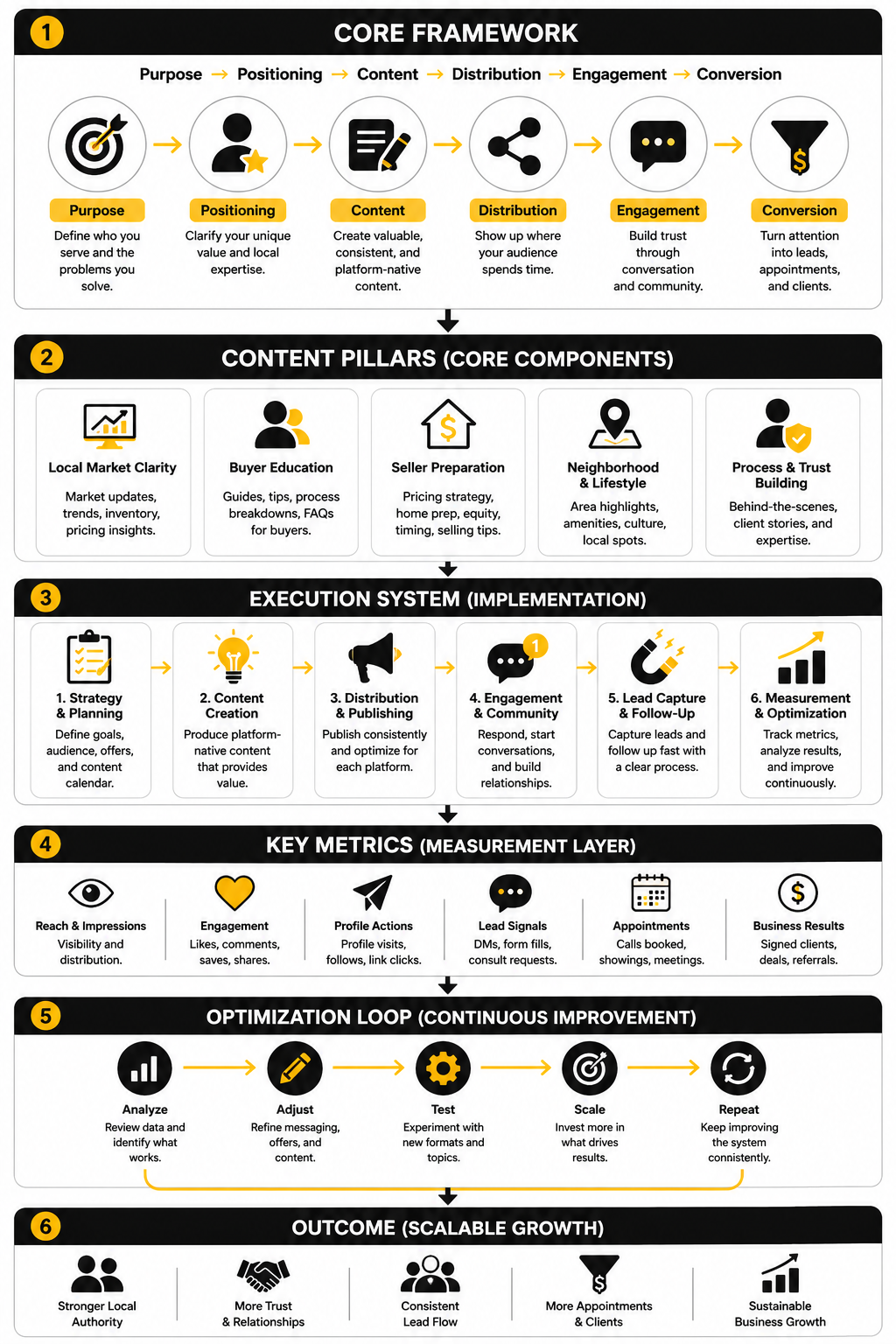
A practical real estate social media marketing framework has four connected layers: audience, content, distribution, and conversion. Each layer has a job. When one layer is weak, the whole system feels inconsistent.
The audience layer defines who you are trying to reach and what they care about. A first-time buyer, downsizing seller, relocation client, investor, and luxury homeowner all need different content. You can still serve multiple segments, but your messaging should not sound like it was written for everyone and no one.
The content layer turns your expertise into useful posts, short videos, carousels, stories, emails, and landing pages. The distribution layer decides where that content belongs and how often it should appear. The conversion layer makes sure attention does not disappear by connecting social activity to DMs, forms, booking pages, CRM follow-up, and nurture campaigns.
Core Components
The first component is local authority. Real estate is location-specific, so broad generic advice is rarely enough. People want to know what is happening in their city, neighborhood, price range, school zone, commute pattern, or property type.
The second component is proof. This includes listing results, client outcomes, market analysis, negotiation insights, review patterns, and behind-the-scenes process content. Proof does not have to be loud, but it does need to be specific.
The third component is conversion design. If someone watches five videos, reads a market update, and replies to a story, there should be a clear next step. That might be a valuation request, a buyer consult, a relocation guide, a showing request, or a simple DM conversation that moves into your CRM.
Professional Implementation
Professional implementation means treating social media like a business system, not a mood board. You need a content calendar, a posting rhythm, a response process, and a way to track which topics create real conversations. Without that, even good content becomes random.
This is where tools can help, but only after the strategy is clear. A scheduling tool like Buffer can help keep publishing consistent, while a DM automation tool like ManyChat can help route interested leads from social conversations into a more reliable follow-up flow. The tool is not the strategy, but the right tool can protect the strategy from falling apart when you get busy.
The rest of this article will build the system step by step. First, we will define the framework in more detail. Then we will turn it into content pillars, platform choices, lead capture, follow-up, and measurement so your real estate social media marketing becomes something you can actually run every week.
The Real Estate Social Media Framework
A strong real estate social media marketing system starts with a clear framework. Without one, content gets reactive fast. You post a listing because it is live, share a closing photo because it happened, then disappear for two weeks because client work takes over.
That is normal, but it is not a strategy. A strategy gives every post a job. Some posts build trust, some create reach, some educate hesitant buyers, some warm up future sellers, and some move people into a direct conversation.
The framework below keeps those jobs separate enough to manage, but connected enough to work as one system.
Start With the Market Segment
The first mistake is trying to speak to “anyone who might buy or sell.” That sounds efficient, but it usually creates bland content. A downsizer does not care about the same problems as a first-time buyer, and an investor does not evaluate property the same way a family relocating for schools does.
Your segment shapes your message. If you work with first-time buyers, your content should reduce confusion and make the process feel less intimidating. If you focus on listings, your content should help sellers understand pricing, preparation, timing, marketing, negotiation, and risk.
This does not mean you can only serve one type of client forever. It means each content series should have a specific reader in mind. The more clearly you know who the post is for, the easier it is to make the post useful.
Map Content to Buyer and Seller Intent
People do not wake up equally ready to transact. Some are casually watching the market. Some are comparing neighborhoods. Some are trying to decide whether now is a terrible time to buy. Some already need an agent but have not raised their hand yet.
That is why your content should match different levels of intent. Low-intent content creates awareness and familiarity. Mid-intent content answers practical questions. High-intent content gives people a reason to contact you now.
A simple intent map can look like this:
- Awareness: neighborhood videos, market shifts, local lifestyle content, myth-busting posts
- Consideration: buyer mistakes, seller preparation, pricing strategy, financing questions, relocation guidance
- Decision: valuation offers, consultation prompts, listing walkthroughs, open house invitations, case-specific calls to action
This matters because social media is not only a lead source. It is also a trust-building layer that supports referrals, search, email, paid ads, and offline conversations. The latest NAR technology data found that social media generated the highest number of quality leads for REALTORS® at 39%, ahead of CRM tools and local MLS sources.
Build Around Four Content Jobs
Every real estate account needs four types of content: visibility, authority, proof, and conversion. If you only post visibility content, people may watch but never trust you. If you only post proof, the account can feel self-congratulatory. If you only post calls to action, people tune out.
Visibility content helps new people discover you. This includes short market takes, local observations, neighborhood clips, timely reactions, and simple educational posts. The goal is not to explain everything; the goal is to earn the next few seconds of attention.
Authority content shows that you understand the job. This includes pricing breakdowns, negotiation lessons, inspection issues, appraisal risks, seller prep, buyer timelines, and local market interpretation. Done well, this is where real estate social media marketing becomes more than content creation. It becomes public evidence of how you think.
Proof content makes your expertise believable. This can include sold results, before-and-after preparation, client review themes, process screenshots with private details removed, marketing plans, and lessons from recent transactions. The key is to explain why the result happened, not just announce that it happened.
Conversion content gives the audience a next step. That could be a home valuation, buyer consult, relocation call, investor analysis, neighborhood list, open house registration, or DM keyword. Tools like ManyChat can help automate that first response when someone comments or messages with intent, but the offer still needs to be useful.
Choose Channels by Behavior, Not Hype
You do not need to be everywhere. You need to be where your market pays attention and where your strengths fit the format. Chasing every platform usually creates shallow execution everywhere.
Instagram and Facebook still matter for local visibility, referrals, community proof, listing content, and retargeting. YouTube is stronger for searchable education, neighborhood guides, relocation content, and longer-form trust building. LinkedIn can work well for luxury, investor, commercial, relocation, and professional-network-driven business.
TikTok can create reach, but reach alone is not the goal. The real question is whether the platform helps you reach the right local audience and move them into a reliable follow-up path. If it only produces random views from people outside your market, it may be good practice, but it is not yet a business asset.
Make Compliance Part of the Framework
Real estate marketing has rules, especially when paid ads enter the picture. Housing-related ads on Meta fall into a special category with targeting restrictions, so you cannot treat them like ordinary local service ads. This affects how you target, write, and structure campaigns.
Compliance also matters in organic content. Avoid language that implies steering, excludes protected classes, or makes unsupported claims about neighborhoods and demographics. Talk about property features, commute context, amenities, price ranges, market data, and lifestyle factors without crossing into assumptions about who belongs where.
This is not just legal housekeeping. It protects trust. A clean, professional account makes people feel safer reaching out, especially when they are about to make one of the largest financial decisions of their life.
Turn Attention Into Owned Follow-Up
Social platforms are rented space. Algorithms change, reach shifts, accounts get flagged, and audiences can disappear overnight. That is why your framework needs a way to move serious attention into owned follow-up.
Owned follow-up can be simple. A buyer guide, seller checklist, relocation form, valuation request, booking page, email list, CRM pipeline, or SMS opt-in can all work. The point is to stop relying on someone seeing your next post at exactly the right time.
For agents and teams that want one place to manage landing pages, forms, pipelines, automations, and follow-up, GoHighLevel can fit this part of the system. If you prefer a lighter front-end form for collecting buyer or seller details, Fillout can also work well. What matters most is that every serious signal gets captured, organized, and followed up before it goes cold.
The Operating Rhythm
A framework only works if it becomes a rhythm. You need a repeatable weekly process for planning, creating, publishing, replying, and reviewing. Otherwise, the system depends on motivation, and motivation is not a business process.
A practical weekly rhythm might include one market insight, one local post, one educational post, one proof post, and one conversion post. That is enough to stay visible without turning your calendar into a content treadmill. Once that is consistent, you can add short-form video, email repurposing, retargeting, or platform-specific series.
The next part will turn this framework into specific content pillars. That is where the strategy becomes easier to execute, because you will know exactly what to post and why each post belongs in the system.
Content Pillars That Build Local Trust
Once the framework is clear, the next job is turning it into content people actually want to consume. This is where many agents overcomplicate real estate social media marketing. They think they need endless new ideas, when what they really need is a small set of repeatable content pillars.
A content pillar is not just a topic. It is a promise to your audience. It tells people what kind of value they can expect from you again and again, so your account starts to feel useful instead of random.
The best pillars are practical, local, and easy to connect back to a real business goal. They help buyers make better decisions, help sellers understand the market, and help future clients see how you think before they ever book a call.
Pillar 1: Local Market Clarity
People do not need more vague market commentary. They need someone to explain what the numbers mean for their situation. That is the difference between content that sounds smart and content that actually helps.
Local market clarity can include pricing trends, inventory shifts, days on market, buyer competition, seller expectations, mortgage-rate sensitivity, and neighborhood-level demand. The key is to translate the data into plain language. Do not just say inventory is up; explain what that changes for a buyer writing offers or a seller choosing a launch price.
This pillar works because it positions you as a guide, not a salesperson. NAR’s 2025 technology reporting shows that social media remains the leading quality lead source for REALTORS®, with 39% naming it as their top lead-generating technology. That makes sense when the content is useful enough to turn passive scrolling into serious trust.
Pillar 2: Buyer Education
Buyer content should reduce fear and confusion. Most buyers are not struggling because they lack motivation. They are struggling because the process feels expensive, unclear, and full of ways to make a bad decision.
Strong buyer education covers financing basics, offer strategy, inspections, appraisal gaps, contingencies, closing costs, timeline expectations, and how to compare homes beyond the photos. You can also explain common emotional traps, like falling in love with a house before understanding the monthly payment or skipping due diligence because competition feels intense.
This pillar is especially useful because buyers often consume content before they are ready to talk. They may not comment or DM immediately, but they are watching. When your posts answer questions they were too embarrassed to ask, you become the person they trust when they finally need help.
Pillar 3: Seller Preparation
Seller content should help homeowners make better decisions before the listing appointment. Many sellers only think about marketing once they are ready to go live, but the best results usually come from decisions made earlier. Pricing, repairs, staging, photography, timing, and launch strategy all affect how the market responds.
This content can include what to fix before listing, what not to waste money on, how pricing strategy changes by market condition, why first impressions matter, and how to interpret feedback after showings. It should also explain the difference between activity and leverage. A listing can get views and still be mispriced.
Seller preparation content is powerful because it attracts homeowners before they raise their hand publicly. A person watching three months of seller advice may not look like a lead yet, but they are building a shortlist. Your job is to be on that shortlist before they invite agents into the living room.
Pillar 4: Neighborhood and Lifestyle Guidance
Real estate is not just about bedrooms, bathrooms, and square footage. People are choosing a daily life. They care about commute patterns, parks, restaurants, noise, walkability, schools, transit, architecture, parking, and how the area feels at different times of day.
Neighborhood content should be specific enough to be useful without making unsupported claims about who should live there. Show the tradeoffs. A neighborhood might have great restaurants but limited parking. Another might offer more space but a longer commute. Another might be quiet and residential but less convenient for nightlife.
This pillar also gives your account local texture. Listings come and go, but neighborhood knowledge compounds. Over time, your audience starts to associate you with the market itself, not just with whatever property you posted last week.
Pillar 5: Process and Behind-the-Scenes Content
Behind-the-scenes content works because it shows the work clients do not always see. A polished closing photo is fine, but it rarely explains what made the transaction successful. The more valuable content is usually in the process.
Show how you prepare a listing, review comps, plan a pricing conversation, structure a showing day, evaluate feedback, coordinate vendors, or think through offer terms. You do not need to reveal private client details. You do need to make the invisible work visible.
This pillar is where professionalism becomes tangible. People often assume agents only open doors and post listings because they have never seen the decision-making behind the scenes. Show the thinking, and you change the perception.
Turning Pillars Into a Weekly Process
Content becomes easier when the pillars turn into a simple production workflow. You are not waking up every morning asking what to post. You are moving through a system that gives each post a role.
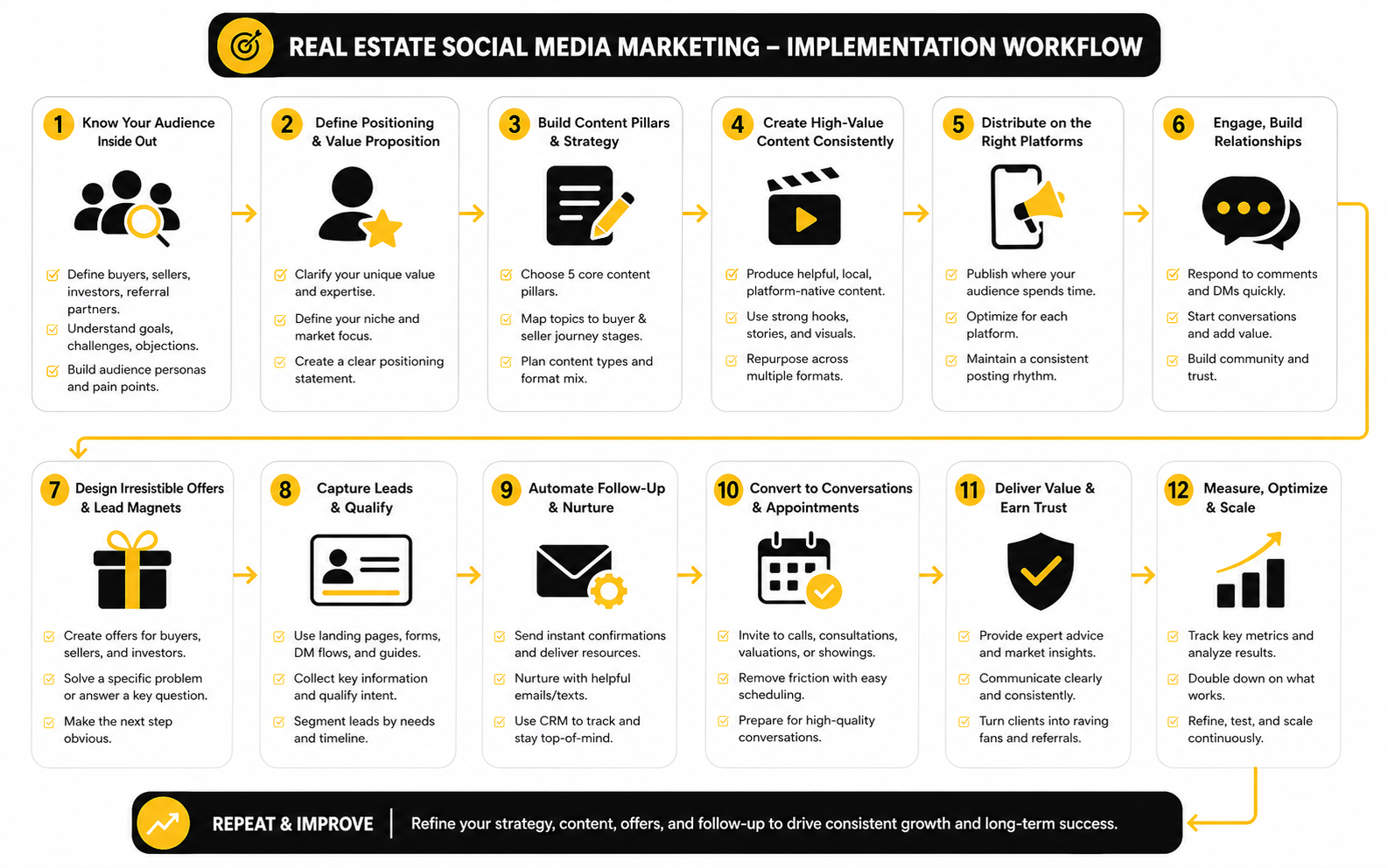
A practical weekly process can look like this:
- Choose one audience segment for the week.
- Pick one market question that segment is asking right now.
- Turn that question into one educational post.
- Support it with one local or neighborhood post.
- Add one proof or behind-the-scenes post.
- Publish one clear next step for people who want help.
- Review which posts created saves, replies, profile visits, form fills, or booked calls.
This is simple on purpose. If the process is too complex, it will not survive a busy week of showings, inspections, negotiations, and client calls. Real estate social media marketing has to fit the business, not become a second full-time job.
Repurpose Before You Create More
The fastest way to burn out is to treat every platform like it needs completely separate content. Most agents do not need more ideas. They need to squeeze more value out of the good ideas they already have.
One market update can become a short video, a carousel, an email, a story sequence, and a seller-facing talking point. One buyer mistake can become a Reel, a checklist, a caption, and a DM prompt. One neighborhood tour can become several clips focused on lifestyle, pricing, commute, and local amenities.
This is where a scheduling tool like Buffer can help keep the workflow organized. A writing or dictation tool like Wispr Flow can also make it easier to turn quick voice notes after showings, listing appointments, or market reviews into usable post drafts. The point is not to automate your expertise away. The point is to capture it before the week gets too busy.
Build Calls to Action Into the Content
A good call to action does not have to be aggressive. In real estate, the best ones usually feel like a helpful next step. The mistake is either asking for nothing or asking for too much too soon.
For lower-intent content, invite people to save the post, ask a question, or message you for a simple resource. For mid-intent content, offer a guide, checklist, neighborhood list, or buyer consultation. For high-intent content, point people toward a valuation request, listing plan, showing request, or strategy call.
The call to action should match the content. A post about seller prep can naturally lead to a pre-listing checklist. A post about first-time buyer mistakes can lead to a buyer planning call. A neighborhood comparison can lead to a custom shortlist.
Create a Feedback Loop
Publishing is not the end of the process. The best agents use social media feedback to understand what their market cares about. Comments, DMs, saves, shares, watch time, and call bookings all tell you something.
Do not judge content only by likes. A post with fewer likes can still produce better leads if it speaks to a serious problem. A seller considering a move may save a pricing post privately without ever engaging in public.
Track patterns over time. Which topics create conversations? Which formats lead to profile visits? Which posts make people ask for help? That feedback should shape the next month of content, because the audience is showing you where the demand is.
Statistics and Data
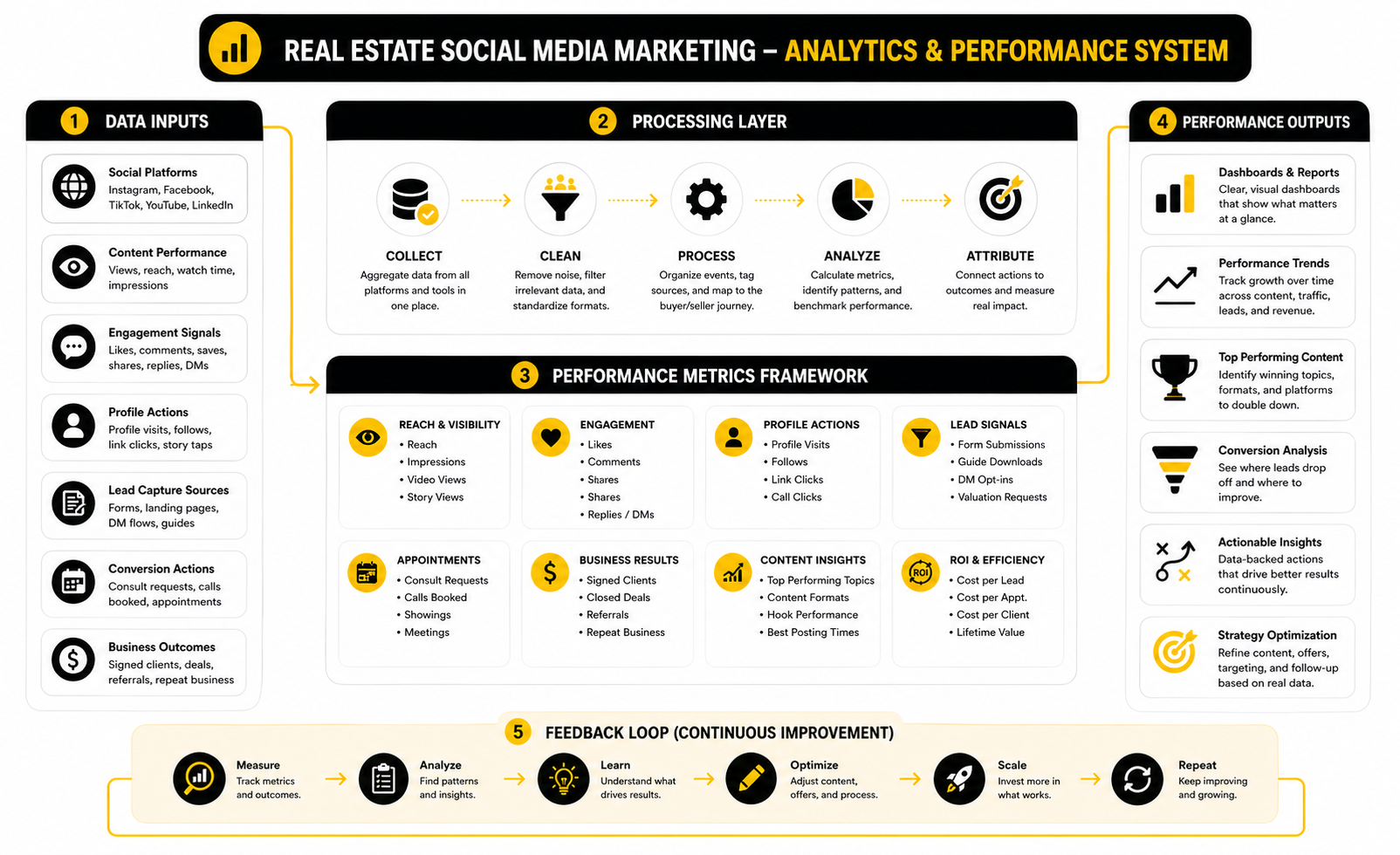
Measurement is where real estate social media marketing gets honest. A post can look successful because it got views, but views alone do not tell you whether it attracted the right people, answered the right question, or created a business opportunity. The point of analytics is not to admire the dashboard; it is to decide what to do next.
Start with the bigger context. Social media deserves serious attention because NAR’s 2025 technology survey found that social media was the top lead-generating technology for REALTORS® at 39%, ahead of CRM tools, local MLS sources, brokerage websites, digital ads, personal websites, and listing portals. That does not mean every social post is valuable. It means the channel can produce quality leads when the content, offer, and follow-up system are aligned.
The broader digital behavior supports the same idea. DataReportal’s 2025 social media reporting shows that people use social platforms for more than entertainment, with 34.5% of active social users saying reading news stories is one of their main reasons for using social media. For real estate, that matters because local market updates, neighborhood changes, rate shifts, inventory movement, and pricing commentary all behave like local news when they are explained clearly.
Measure the Funnel, Not Just the Post
A real estate social media funnel has several stages: reach, attention, engagement, intent, capture, appointment, and client. Each stage tells you something different. If you only track the first two, you will optimize for content that gets attention but may never create business.
Reach shows how many people saw the content. Attention shows whether they stayed long enough to care. Engagement shows whether the post created enough value for someone to like, comment, save, share, reply, or click. Intent shows whether someone took a stronger action, such as sending a DM, requesting a guide, visiting a profile, tapping a link, or asking a specific property question.
The real business metrics come after that. Lead capture, booked appointments, signed agreements, active clients, closed deals, and referral conversations are the signals that prove the system is working commercially. A post with modest reach but three serious seller conversations is more valuable than a viral post watched by people outside your market.
What Each Metric Actually Means
Impressions tell you distribution. They are useful for spotting whether a platform is giving your content a chance, but they do not prove trust or intent. If impressions rise while saves, replies, and profile actions stay flat, your hook may be stronger than your substance.
Watch time and completion rate tell you whether people cared enough to stay. For short-form video, this matters more than likes because it shows whether the topic and pacing held attention. If people drop fast, the opening may be too slow, the promise may be unclear, or the content may be aimed at the wrong audience.
Saves and shares are stronger signals than likes for educational content. A buyer saving a closing-cost breakdown or a seller sharing a pricing post with a spouse is showing private intent. Real estate decisions often happen quietly, so the most valuable signals are not always public.
Comments and DMs show friction, curiosity, and readiness. A comment may be casual, but a direct message with a specific situation is much closer to business value. This is why DM follow-up should be fast, organized, and connected to your CRM instead of handled randomly from memory.
Benchmarks Should Be Internal First
External benchmarks can be useful, but they are not the main scoreboard. Your market, audience size, property type, price point, content format, and local competition all change what “good” looks like. A luxury agent in a small market should not judge performance against a national creator account posting general housing takes.
Your best benchmark is your own last 30, 60, and 90 days. Which topics created the highest saves? Which posts produced DMs? Which videos brought profile visits? Which calls to action turned into booked appointments?
This keeps decisions grounded. If neighborhood comparison posts consistently create buyer conversations, make more of them. If listing posts get likes but no inquiries, change the angle from “look at this house” to “here is what this price buys in this neighborhood right now.” If seller education creates saves but no calls, add a clearer next step.
Separate Vanity Metrics From Business Signals
Vanity metrics are not useless, but they are incomplete. Likes, follower count, and raw views can show momentum. They just should not be treated as the final result.
Business signals are closer to revenue. These include qualified DMs, form submissions, buyer consultations, seller valuation requests, listing appointments, referral introductions, open house registrations, email replies, and CRM-stage movement. These signals are less flashy, but they tell you whether social media is helping the business.
A simple rule helps: if a metric cannot change your next action, do not obsess over it. If saves are high, create more practical educational content. If DMs are low, improve the call to action. If leads are coming in but not booking, fix the follow-up. If appointments are happening but not converting, the issue may be positioning or sales process, not content.
Track Source and Intent Together
A lead source tells you where the person came from. Intent tells you why they acted. You need both because “Instagram lead” is too vague to be useful.
Someone who messages after a neighborhood video is different from someone who fills out a home valuation form after a seller pricing post. One may need area guidance. The other may be closer to a listing conversation. Treating both leads the same is lazy follow-up.
Use simple labels inside your CRM: buyer education, seller prep, relocation, neighborhood guide, valuation request, listing inquiry, open house, investor, referral, or past-client reactivation. A platform like GoHighLevel can help organize these stages, while Copper can work well for relationship-driven pipelines where referrals and repeat touchpoints matter. The tool matters less than the discipline of tracking what prompted the lead.
Read the Data by Content Pillar
Measurement becomes clearer when you connect results back to the pillars from the previous section. Local market clarity should generate saves, shares, profile visits, and informed replies. Buyer education should create saves, guide requests, and consultation questions. Seller preparation should create valuation requests, listing questions, and private shares.
Neighborhood and lifestyle content should be judged by local relevance, not just reach. If a video gets fewer views but attracts people asking about a specific area, it did its job. Process and behind-the-scenes content should improve trust signals, especially replies, referrals, and warmer sales conversations.
This is how you avoid random posting. Every pillar has an expected behavior. If the behavior is not happening, either the topic, format, audience, or call to action needs adjustment.
Build a Monthly Review Rhythm
Do not review analytics every five minutes. That creates anxiety, not clarity. A weekly pulse is useful for spotting obvious winners, but the strategic decisions should happen monthly.
At the end of each month, review:
- Top posts by saves
- Top posts by shares
- Top posts by profile visits
- Top posts by DMs or replies
- Top posts by form fills or booked calls
- Weak posts that still reached the right audience
- Strong posts that attracted the wrong audience
- Content pillars that deserve more volume next month
This review should lead to decisions, not just observations. Keep what produced qualified conversations. Cut what only produced empty reach. Improve the call to action where attention is strong but conversion is weak.
Use Data to Improve the Next Offer
Analytics should eventually shape your offers. If buyers keep asking about affordability, create a buyer planning call or payment-focused guide. If sellers keep asking whether they should renovate before listing, create a pre-listing decision checklist. If relocation questions keep appearing, build a neighborhood comparison form.
This is where tools like Fillout can turn social interest into structured lead information without making the process feel heavy. For more advanced funnels, ClickFunnels or Systeme.io can help package guides, landing pages, and follow-up sequences around a specific campaign.
The important part is the logic. The data tells you what people care about. Your offer turns that interest into a next step. Your follow-up turns that next step into a relationship.
Lead Capture, Follow-Up, and Automation
At this stage, the biggest risk is not a weak post. It is wasted intent. Someone watches your seller content for weeks, finally messages you about timing, and then the conversation sits in your inbox while you are at a showing. That is how real opportunities leak out of the system.
Real estate social media marketing becomes more serious when you treat every signal as part of a pipeline. A comment, DM, form fill, saved post, open house registration, or valuation request should not live in isolation. It should tell you what the person cares about and what should happen next.
The goal is not to automate the relationship. That would be a mistake. The goal is to automate the handoff, the organization, and the reminders so you can show up faster and more personally when the conversation matters.
Design Offers Around Buyer and Seller Intent
A good offer makes the next step obvious. It does not ask a cold follower to book a listing appointment after one post. It gives them a step that matches where they are in the decision process.
For buyers, that might be a payment planning guide, neighborhood shortlist, first-time buyer checklist, relocation consult, or private tour request. For sellers, it might be a pre-listing checklist, pricing review, home prep plan, or valuation request. For investors, it might be a deal review, rent estimate, cash-flow worksheet, or market snapshot.
The stronger the intent, the more direct the offer can be. A post about common buyer mistakes can lead to a checklist. A post about pricing strategy can lead to a seller review. A post about a specific listing can lead to a showing request.
Build Follow-Up Before You Scale Content
Scaling content before follow-up is dangerous. More reach creates more conversations, but it also creates more loose ends. If you cannot respond consistently, qualify leads, and remember context, more visibility can actually make the business feel more chaotic.
Start with a simple follow-up path. Capture the name, contact details, timeframe, intent, property type, location, and urgency. Then move the person into the right next step: consult, valuation, showing, lender intro, listing plan, or nurture sequence.
This is where a CRM matters. A platform like GoHighLevel can connect forms, landing pages, pipelines, text follow-up, email sequences, and appointment booking in one system. If your business is more relationship-led and referral-heavy, Copper can help keep warm contacts, past clients, and partner relationships from getting buried.
Use Automation Carefully
Automation should reduce friction, not make people feel processed. A fast confirmation message is useful. A helpful resource delivery is useful. A reminder to follow up with someone who asked about selling in six months is useful.
What you should avoid is pretending every lead is the same. A seller asking whether to list before summer needs a different follow-up than a buyer casually downloading a neighborhood guide. A relocation lead with a job start date needs a different response than an investor comparing cap rates.
DM automation can help when it is tied to a specific action. For example, someone comments a keyword on a buyer checklist post, receives the resource, answers a couple of qualifying questions, and then gets offered a call if the situation fits. ManyChat fits this use case well because the conversation starts inside the platform where the intent happened.
Respect Compliance and Platform Rules
Real estate marketing has more risk than ordinary creator content because housing is regulated. HUD’s digital advertising guidance makes clear that fair housing obligations apply to advertising through digital platforms, including systems that use targeting, delivery algorithms, or automation. That matters when you run ads, build audiences, write copy, or use AI-assisted tools.
Meta also treats housing as a Special Ad Category, which limits targeting options for real estate advertisers. You cannot build campaigns the same way an ecommerce brand might. The practical takeaway is simple: do not depend on narrow demographic targeting to make the campaign work. Build better creative, stronger local relevance, clearer offers, and cleaner follow-up.
Reviews and testimonials need care too. The FTC’s endorsement and review guidance focuses on deceptive claims, fake reviews, manipulated testimonials, and unclear relationships. If you use client feedback, keep it authentic, avoid exaggerating typical outcomes, and make sure the context is not misleading.
Keep Human Judgment in the Loop
AI can speed up research, drafting, repurposing, captions, email follow-up, and FAQ-style responses. It should not replace your professional judgment. Real estate advice depends on local market conditions, client goals, financing details, property condition, contract terms, and legal context.
Use AI to create first drafts, summarize notes, organize ideas, and turn raw expertise into publishable content. Then edit like a professional. Remove generic claims, check the facts, add local specificity, and make sure nothing creates compliance problems.
This matters even more with visuals. Do not use AI to hide defects, exaggerate property features, or misrepresent a listing. Edited images, virtual staging, and enhanced visuals should be handled transparently and in line with local rules, MLS policies, broker guidance, and consumer protection expectations.
Decide What to Delegate
As the system grows, the question becomes what you should keep and what you should delegate. You should not outsource your point of view. Your market judgment, client philosophy, negotiation perspective, and local interpretation are the assets.
You can delegate editing, scheduling, formatting, repurposing, thumbnail creation, analytics reporting, inbox triage, and CRM cleanup. Those tasks support the strategy without replacing your voice. The mistake is handing off the entire content engine and ending up with generic posts that could belong to any agent in any city.
A simple delegation model works well:
- Agent-owned: opinions, market interpretation, client stories with permission, pricing perspective, offer strategy, local judgment
- Team-supported: filming, editing, captions, scheduling, reporting, CRM updates, lead routing
- Automation-supported: resource delivery, appointment reminders, nurture sequences, task creation, basic segmentation
Balance Organic, Paid, and Referral Traffic
Organic content builds trust and keeps you visible. Paid distribution helps you reach more of the right local audience. Referrals bring warmer conversations because trust is transferred from someone the prospect already knows.
The strongest real estate social media marketing systems connect all three. A past client sees your seller content and forwards it to a friend. A local homeowner watches your organic market updates and later sees a retargeting ad for a valuation. A buyer discovers you through a neighborhood video and then joins your email list.
Do not treat these channels like separate worlds. Use social content to support referral conversations. Use paid ads to amplify proven organic posts. Use email and CRM follow-up to keep social leads warm until timing improves.
Avoid the Scaling Trap
The scaling trap is believing more volume automatically means more business. More posts, more platforms, more ads, more automations, more lead magnets. It feels productive, but it can dilute the whole operation if the foundation is weak.
Scale only what is already working. If seller prep posts generate qualified conversations, build a seller campaign around them. If neighborhood videos bring relocation leads, turn them into a searchable YouTube series and a relocation guide. If buyer education gets saves but no calls, fix the offer before increasing volume.
This is the expert move: do fewer things with sharper intent. A clean weekly content rhythm, one strong lead capture path, one useful CRM pipeline, and consistent follow-up will beat a messy system with ten platforms and no accountability.
Prepare for the Final Layer
By now, the system has moved from positioning to content, from content to measurement, and from measurement to follow-up. The final layer is optimization. That means tightening what works, cutting what does not, and answering the practical questions that come up when agents actually put this into practice.
The next section brings everything together. It will cover how to refine the system over time, what to prioritize first, and the common questions agents, teams, and brokerages have when turning social media into a reliable business channel.
Optimization and Final System
The final layer is where the whole system becomes durable. You are no longer asking, “What should I post today?” You are asking, “Which parts of this real estate social media marketing system are producing trust, conversations, appointments, and clients?”
That shift matters. Random posting depends on energy. A system depends on inputs, feedback, and improvement. When the system is working, content feeds conversations, conversations feed pipeline, pipeline feeds transactions, and transactions create more proof for future content.
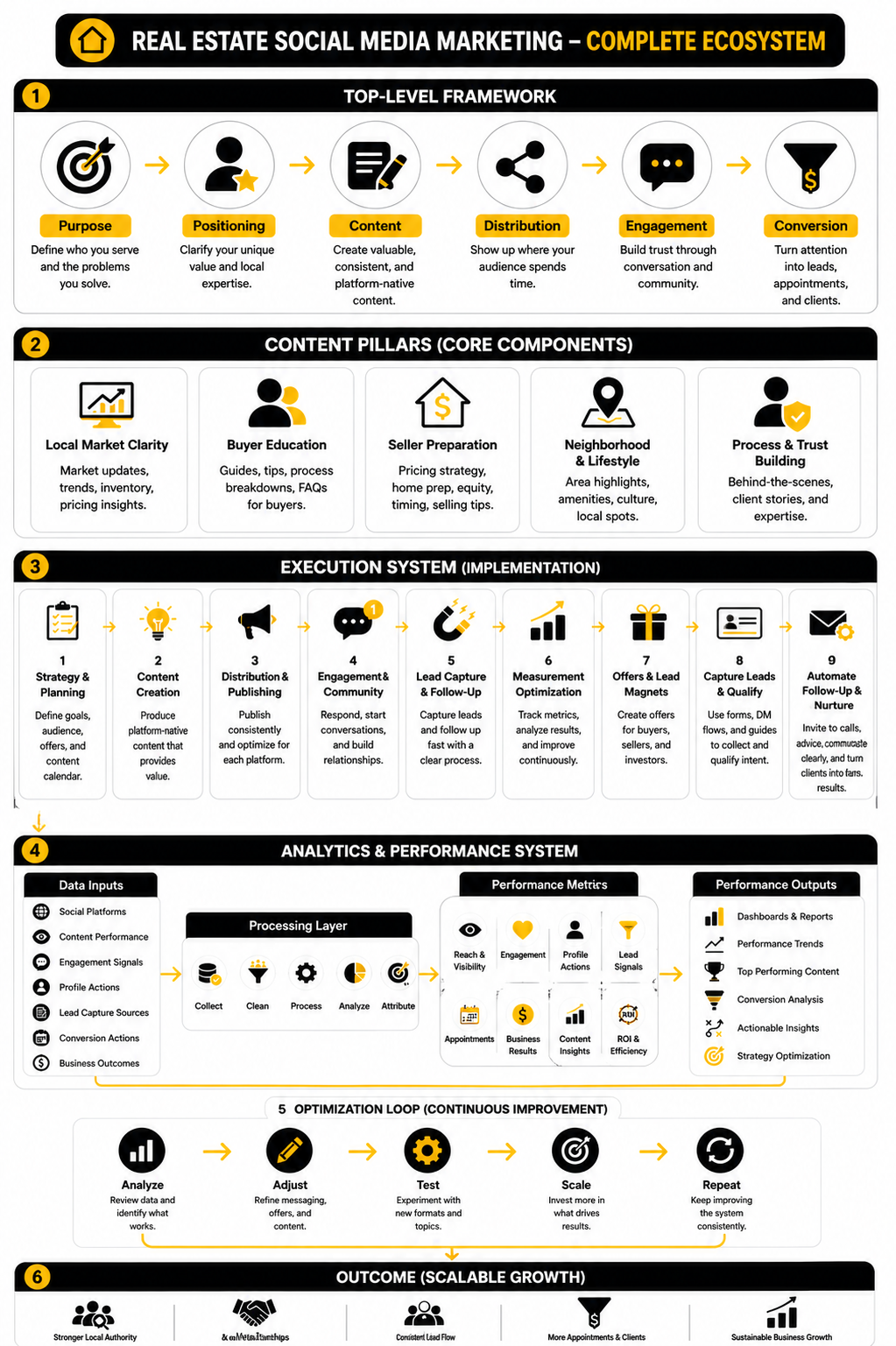
Your goal is not perfection. Your goal is a clean loop:
- Publish useful local content.
- Watch which topics create real intent.
- Capture that intent with a clear next step.
- Follow up in a structured way.
- Turn client work into proof.
- Use the proof to improve future content.
That is the ecosystem. Not one viral Reel. Not one ad campaign. Not one “just sold” graphic. A repeatable loop that makes your expertise visible and easier to trust.
Prioritize the First 90 Days
The first 90 days should be focused, not fancy. Start with one or two platforms, three to five content pillars, one lead capture offer, and one follow-up process. Do not build a massive content machine before you know what your audience responds to.
In month one, publish consistently and learn what feels natural. In month two, improve the topics and calls to action based on saves, replies, profile visits, and DMs. In month three, tighten the follow-up path and turn the strongest topics into repeatable series.
This is where discipline beats intensity. Posting every day for two weeks and then disappearing does not build trust. Showing up with useful content every week for three months gives the market enough repetition to remember you.
Know When to Upgrade the System
You should upgrade only when the current system starts creating pressure. If DMs are being missed, add automation. If leads are scattered, improve the CRM. If good posts are hard to produce consistently, add a scheduling or repurposing workflow.
Do not buy tools to avoid strategy. Buy tools to support a strategy that already makes sense. A simple stack can include a scheduler like Buffer, a DM automation layer like ManyChat, and a CRM or funnel system like GoHighLevel.
The right upgrade should remove friction. It should make content easier to publish, leads easier to organize, and follow-up harder to forget. If a tool adds complexity without improving the client journey, it is probably noise.
Keep the Strategy Human
Real estate is still a relationship business. Social media does not change that. It simply gives people more chances to know how you think before they trust you with a major decision.
That is why the best content sounds like a real professional, not a template. It has judgment. It explains tradeoffs. It gives useful context. It respects the fact that buyers and sellers are making emotional and financial decisions at the same time.
If you remember one thing, remember this: the content should make the next conversation better. When a buyer already understands the process, the call is better. When a seller already understands pricing strategy, the appointment is better. When a referral already trusts your perspective, the relationship starts warmer.
FAQ - Built for Complete Guide
What is real estate social media marketing?
Real estate social media marketing is the use of platforms like Instagram, Facebook, YouTube, TikTok, LinkedIn, and others to build trust, educate the market, promote listings, generate leads, and stay visible with buyers, sellers, investors, and referral partners. It is not just posting homes for sale. The strongest systems combine local expertise, useful content, proof, lead capture, and consistent follow-up.
Which social media platform is best for real estate agents?
The best platform depends on your audience and content strengths. Instagram and Facebook are strong for local visibility, community presence, stories, listing content, and referrals. YouTube is better for searchable education, neighborhood guides, relocation content, and long-term trust building. LinkedIn can work well for luxury, commercial, investor, relocation, and professional-network-driven real estate.
How often should real estate agents post on social media?
Most agents are better off posting consistently three to five times per week than trying to post daily and burning out. A good rhythm might include one market update, one buyer or seller education post, one neighborhood post, one proof post, and one direct call to action. The exact number matters less than whether the content is useful and sustainable.
What should real estate agents post on social media?
Real estate agents should post content that helps people understand the market and make better decisions. Useful topics include local market updates, buyer mistakes, seller preparation, pricing strategy, neighborhood comparisons, behind-the-scenes process content, listing context, client review themes, and practical next steps. The best posts answer questions people already have but may not be asking publicly yet.
Does social media actually generate real estate leads?
Yes, but only when the system is built properly. NAR’s 2025 technology survey found that social media was the top lead-generating technology for REALTORS® at 39%, which shows that the channel can produce serious opportunities when paired with good content and follow-up. The mistake is expecting random posts to perform like a complete lead generation system.
What metrics should real estate agents track?
Track reach and views, but do not stop there. Better signals include saves, shares, profile visits, DMs, form submissions, consultation requests, valuation requests, open house registrations, appointments booked, signed clients, and closed business. The closer a metric is to a real conversation or transaction, the more seriously you should take it.
Are likes important for real estate content?
Likes can show basic interest, but they are not the strongest signal. Saves, shares, DMs, profile visits, and booked appointments usually matter more because they show deeper intent. A seller may privately save a pricing post without liking it, and that action can be more valuable than a public like from someone outside your market.
Should real estate agents use paid ads on social media?
Paid ads can work well when they amplify proven content or promote a clear offer. They are risky when used to push weak messaging to a cold audience. Real estate advertisers also need to respect housing ad rules, including platform restrictions around housing-related targeting, so creative quality and offer clarity become even more important.
How can agents turn followers into clients?
Followers become clients when trust meets timing and a clear next step. That means your content should educate and build credibility, while your calls to action should guide serious people toward a consultation, valuation, guide, showing request, or direct conversation. Follow-up is the bridge between attention and business.
Should agents automate DMs and follow-up?
Yes, but carefully. Automation is useful for delivering resources, asking basic qualifying questions, routing leads, sending reminders, and preventing missed opportunities. It should not replace human judgment or make every conversation feel generic. The best automation supports faster, more personal follow-up.
What is the biggest mistake agents make with social media?
The biggest mistake is treating social media like a posting task instead of a business system. They publish content without a clear audience, without a repeatable framework, without lead capture, and without follow-up. Then they decide the platform does not work, when the real issue is that the strategy was incomplete.
How long does real estate social media marketing take to work?
It can create quick conversations, but the real value compounds over time. Most agents should think in 90-day cycles, not one-week tests. Social media builds familiarity, trust, and recall, which means people may watch quietly for months before reaching out.
Can a small real estate team compete with bigger brokerages on social media?
Yes, because local relevance often beats brand size. A small team that explains the market clearly, shows real process, responds quickly, and creates specific neighborhood content can outperform a larger brokerage posting generic content. The advantage is speed, personality, and local judgment.
What tools help with real estate social media marketing?
Useful tools depend on the stage of your system. A scheduler like Buffer can help with consistency, ManyChat can help with DM workflows, Fillout can help collect lead details, and GoHighLevel can support CRM, funnels, automation, and appointment follow-up. Use tools to strengthen the system, not to replace the strategy.
Work With Professionals
Explore 10K+ Remote Marketing Contracts on MarkeWork.com
Most marketers spend too much time chasing clients, competing on crowded platforms, and losing a percentage of every project to middlemen.
MarkeWork gives you a better way. Browse thousands of remote marketing contracts and connect directly with companies desperate to hire skilled marketers like you, without platform commissions and without unnecessary gatekeepers.
If you're serious about finding better opportunities and keeping 100% of what you earn, explore available contracts and create a profile for free at MarkeWork.com.