

Referral marketing works because it starts where most acquisition channels struggle: trust. People ignore ads, skip sponsored posts, and tune out generic brand messaging, but they still listen when a friend, colleague, or family member says, “You should try this.” That is why the channel keeps showing up in both old and new research, from Nielsen’s long-running trust data on recommendations from people we know to newer brand-trust findings showing peer influence still carries enormous weight in buying decisions.
The bigger point is not that referrals are magically free. It is that good referral marketing turns existing customer satisfaction into a repeatable acquisition system. That matters because referred customers are often worth more over time, with the Journal of Marketing finding that the average value of a referred customer was at least 16% higher than a comparable non-referred customer.
The mistake most brands make is treating referral marketing like a coupon tactic. The brands that win treat it like infrastructure. They design the moment, the incentive, the sharing flow, the tracking, and the follow-up so the referral feels natural to the customer and measurable to the business.
- Why Referral Marketing Matters Now
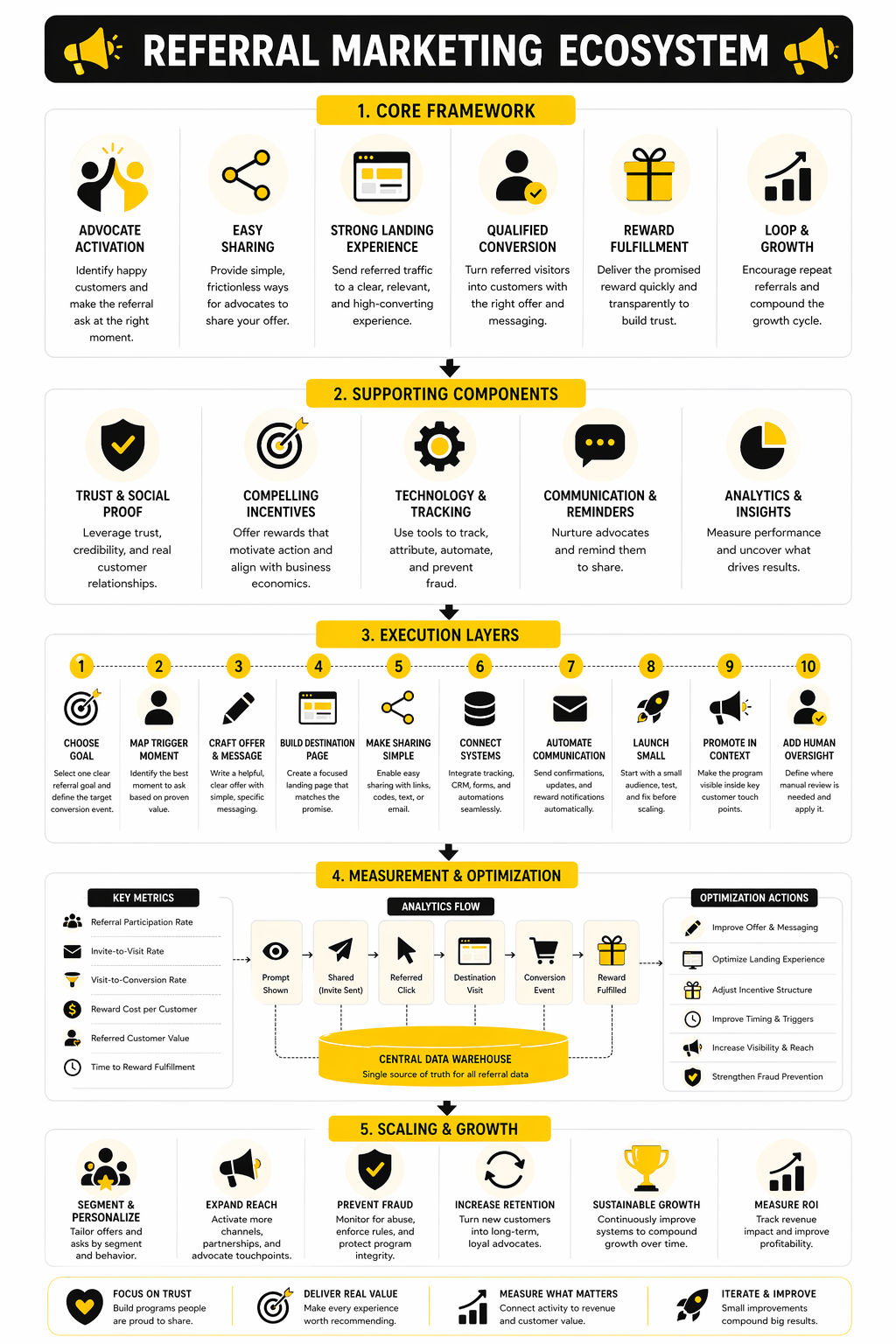
- Referral Marketing Framework at a Glance
- The Core Components of a High-Performing Referral Program
- How to Implement Referral Marketing Without Creating Friction
- Measurement, Optimization, and Fraud Control
- Common Mistakes, Advanced Plays, and Final Takeaways
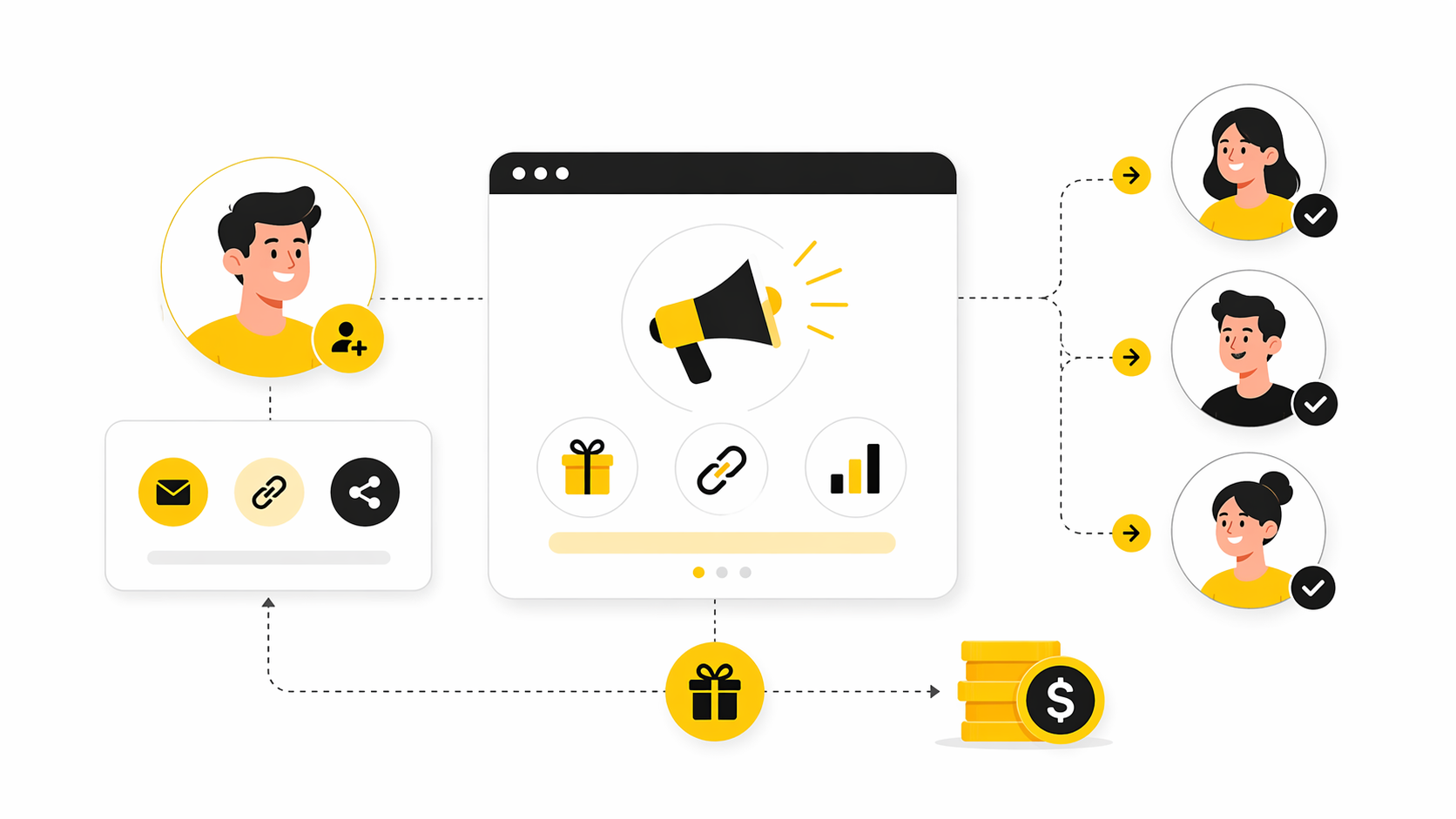
Why Referral Marketing Matters Now
Referral marketing matters now because customer acquisition is noisier, more expensive, and less trusted than it used to be. Brands are fighting for attention in crowded feeds while buyers increasingly rely on signals that feel human. When someone gets a recommendation from a person they already trust, the decision feels less like being sold to and more like getting useful guidance.
That trust advantage is not just emotional. It shows up in customer value. The best-known academic work in the space found referred customers were more loyal and more profitable over time, which explains why referral marketing is not just a top-of-funnel play. It often improves the quality of the customers coming in, which is a very different outcome from simply buying more clicks.
You can also see the channel maturing in how brands structure their programs. In the 2024 State of Referral Marketing report, researchers reviewed more than 120 global B2B and B2C referral programs across five industries. The study found that referral marketing is no longer a side experiment run in isolation. It is being built into websites, apps, checkout flows, and retention systems with more deliberate reward structures, clearer conversion events, and stronger fraud controls.
This shift also explains why referral marketing works across very different business models. SaaS brands use it to drive product adoption and user-led growth. Ecommerce brands use it to turn satisfied buyers into repeat promoters. Fintech brands lean on it because trust is already one of the hardest parts of the sale. Even Airbnb’s engineering team shared that improvements to its referral system increased signups and bookings by more than 300% per day, which is a reminder that the mechanism matters just as much as the offer.
What really makes referral marketing timely, though, is that it fits how people already buy. Buyers compare screenshots, forward links, ask group chats, and look for someone who has actually used the product. A strong referral system does not try to invent that behavior. It simply gives it a cleaner path, a better incentive, and a trackable structure.
Referral Marketing Framework at a Glance
At its core, referral marketing is simple. A current customer has a good enough experience that they are willing to recommend the brand, and the business makes that recommendation easy to share and worth acting on. But when you zoom in, strong referral programs are not built on enthusiasm alone. They depend on a sequence that removes friction at every step.
The framework looks like this: identify the right moment to ask, make sharing effortless, create an offer that feels fair to both sides, define the exact conversion event, and automate the reward plus follow-up. Miss any one of those steps and the program gets weaker fast. Ask too early, and people do not feel confident recommending you. Make the reward confusing, and nobody bothers. Delay the payout, and trust starts to break.
A practical referral marketing framework usually has five moving parts:
- Advocate moment
The best time to ask is after a customer experiences clear value. That could be after a successful purchase, a product win, a positive support interaction, or a milestone like saving time or money. Referral marketing performs better when the ask arrives right after satisfaction, not randomly in the lifecycle.
- Share mechanism
People should be able to share in one or two taps through the channels they already use. Referral links, codes, in-app invites, email prompts, and SMS flows all work when they feel native to the product. The easier the share, the more referral marketing behaves like habit instead of homework.
- Incentive structure
Rewards need to match the product and the customer’s motivation. The 2024 referral benchmark data shows double-sided programs are common in several industries because they reduce the awkwardness of “I get paid, you get nothing.” In plain English, referral marketing gets stronger when the offer feels helpful, not extractive.
- Conversion event
You have to define what counts as a successful referral. Is it an account creation, first purchase, booked demo, paid subscription, or funded account? Serious referral marketing depends on this definition because it drives tracking, cost control, and reward timing.
- Reward and follow-up system
The program cannot stop at the click. Customers need confirmation, status updates, and reward delivery without confusion. This is where tooling matters, and brands that want referral marketing tied into CRM, messaging, and lifecycle follow-up often use systems like GoHighLevel to keep the operational side from falling apart.
The key idea here is that referral marketing is not one tactic. It is a chain. Each link has to hold. When brands say referrals “didn’t work,” the failure usually sits inside the chain rather than in the channel itself.
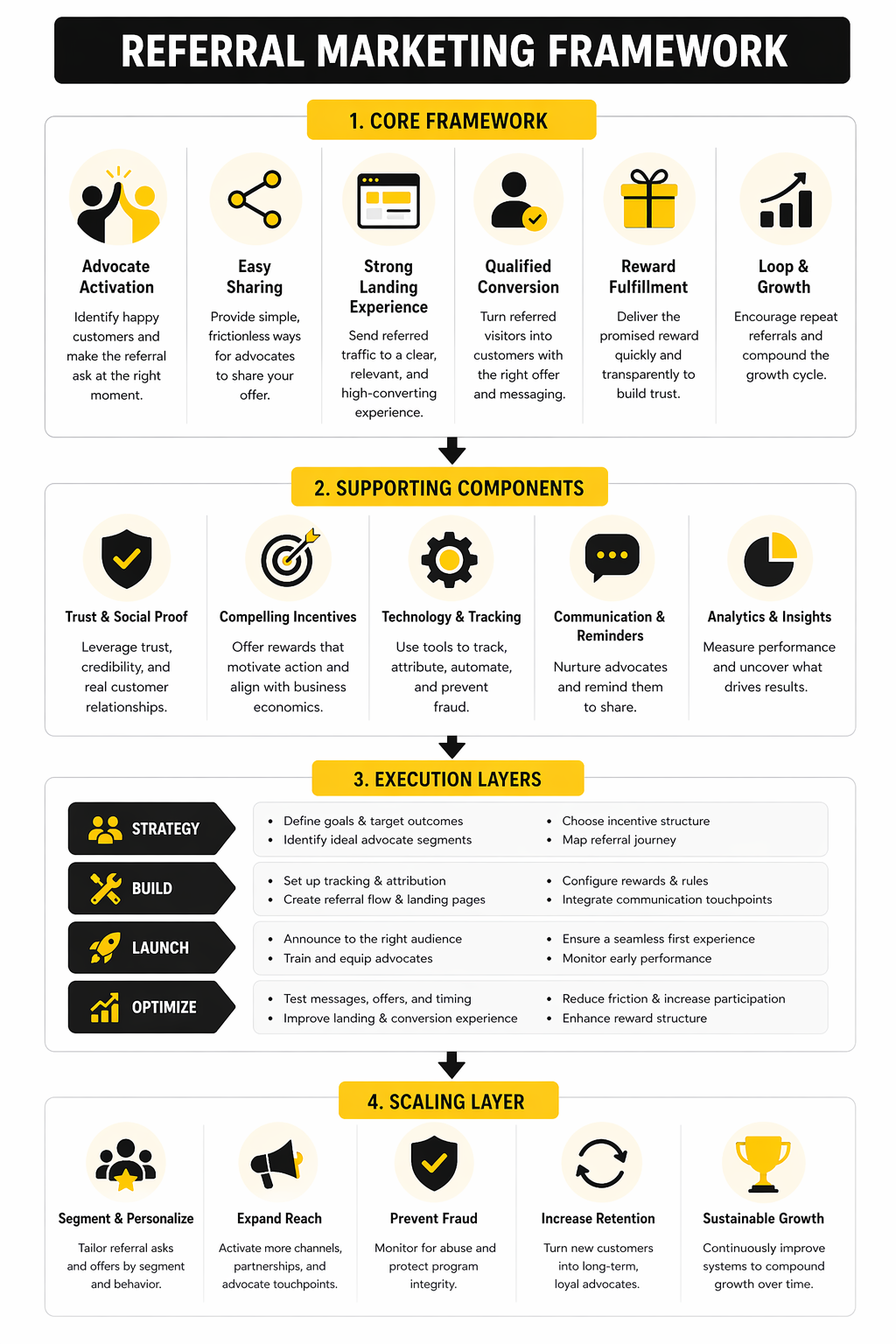
Once that framework is clear, the next step is deciding which parts deserve the most attention in your business. That is where the article goes next, because the highest-performing referral programs are usually not the most creative. They are the ones built from the right components, in the right order, with less friction than the competition.
The Core Components of a High-Performing Referral Program
A referral marketing program usually breaks for boring reasons, not dramatic ones. The offer is weak, the timing is off, the sharing flow is clunky, or the business has no clean way to validate and reward the referral after it happens. When those pieces are tight, referral marketing starts to feel less like a campaign and more like a dependable acquisition channel.
The strongest programs are built around a few components that work together. You need the right customer at the right moment, a reward that feels fair, a sharing experience that takes almost no effort, and an operational layer that keeps trust intact. Leave out one of those pieces and the whole system gets harder to scale.
Start With the Right Customer Moment
Not every happy customer is ready to refer someone. In referral marketing, timing matters because the ask only works when the customer has already felt a clear win. That is why strong programs usually trigger the invitation after a successful purchase, a product milestone, a great support resolution, or some other moment where the value is obvious.
This is also where a lot of brands get impatient. They ask for referrals too early because they want volume, but early asks usually produce weak advocacy. Bain’s loyalty research has long shown that advocacy is concentrated among true promoters rather than customers who are merely satisfied, which is exactly why referral marketing performs best when the ask follows a real proof point instead of a generic onboarding email.
The practical takeaway is simple. Before you build any mechanics, figure out where your customer actually says, “This was worth it.” That moment is the engine of the entire referral marketing system.
Build a Reward Structure That Feels Fair
Incentives matter, but not in the lazy way people often assume. Bigger is not always better. A referral marketing reward works when it matches the economics of the product and the psychology of the customer.
That is why double-sided rewards keep showing up in modern programs. When both the advocate and the new customer get something useful, the referral feels more like a genuine recommendation and less like a cash grab. The 2024 referral marketing research covering more than 120 global programs found that leading brands continue to refine their reward models around fairness, conversion quality, and customer fit rather than defaulting to one generic incentive.
You also need to match the reward to the category. Discounts can work well in ecommerce. Credits often make more sense in SaaS or subscription businesses. In higher-consideration categories, the reward sometimes matters less than lowering risk for the referred customer. Good referral marketing understands that the incentive should support trust, not overpower it.
Make Sharing Frictionless
This is the part brands consistently underestimate. Customers may genuinely want to recommend you, but they will not jump through hoops to do it. If referral marketing requires too many steps, too much explanation, or too much manual effort, participation drops fast.
The best-performing programs make sharing feel obvious. A customer gets a link, code, or prompt they can send through the channels they already use, whether that is text, email, social DM, or an in-app invite. Official guidance from referral platforms keeps coming back to the same pattern: easy link or code sharing, personalized messaging, and fast reward fulfillment are core features of programs that actually convert.
This is why the user experience deserves serious attention. Referral marketing is not only about persuading someone to recommend you. It is also about removing every small point of hesitation between intention and action.
Define the Conversion Event With Precision
A referral is not a referral just because someone clicked a link. Businesses get into trouble when they launch a program without deciding what success really means. In referral marketing, the conversion event has to be unambiguous because it shapes your tracking, reward logic, fraud rules, and customer economics.
For one business, that event might be a first completed purchase. For another, it might be a booked demo, activated account, funded balance, or paid subscription. The right answer depends on where value becomes real, but the definition has to be stable enough that the customer understands it and the business can enforce it consistently.
This is one reason more mature programs outperform casual ones. The companies studied in recent referral marketing reporting were not just offering rewards. They were aligning reward triggers with downstream outcomes that actually mattered to the business, which kept the channel from turning into a vanity metric exercise.
Protect Trust With Validation and Fulfillment
Referral marketing can create momentum quickly, but it can also create mess if the back end is sloppy. Customers need to know whether their referral worked, when a reward is coming, and what happens next. If they have to guess, the trust that made the referral possible starts to erode.
That is why validation and fulfillment are not back-office details. Fraud protection, duplicate detection, clear status communication, and automatic reward delivery are now treated as standard requirements in serious referral infrastructure. The latest guidance from referral software providers keeps emphasizing these features because programs become fragile when brands scale sharing without scaling verification.
Operational discipline matters even more when volume increases. A referral marketing program that feels smooth at 50 referrals per month can become a support nightmare at 5,000 if the reward logic, attribution rules, and customer messaging are not already locked down.
Keep the Referred Customer Experience Strong
The referred customer journey is easy to overlook because so much attention goes to the advocate. But referral marketing only compounds when the new customer has a good first experience. If the landing page is confusing, the offer feels bait-and-switch, or the onboarding flow disappoints, the system weakens immediately.
This is where channel design and conversion design meet. The share message has to match the landing page. The reward has to appear clearly. The next step has to feel low-friction and credible. In practice, referral marketing succeeds when the new customer feels they were helped by someone they trust, not pushed into a funnel that was built for the brand instead of for them.
That consistency is one reason referral marketing can outperform colder acquisition channels. The recommendation creates the opening, but the experience closes the loop. When both sides work, you do not just get one conversion. You get the chance for the next advocate to emerge from the same system.
The next step is implementation, because understanding the components is not enough on its own. Referral marketing gets results when these pieces are translated into prompts, pages, automations, and measurement rules that customers barely notice because everything feels easy.
How to Implement Referral Marketing Without Creating Friction
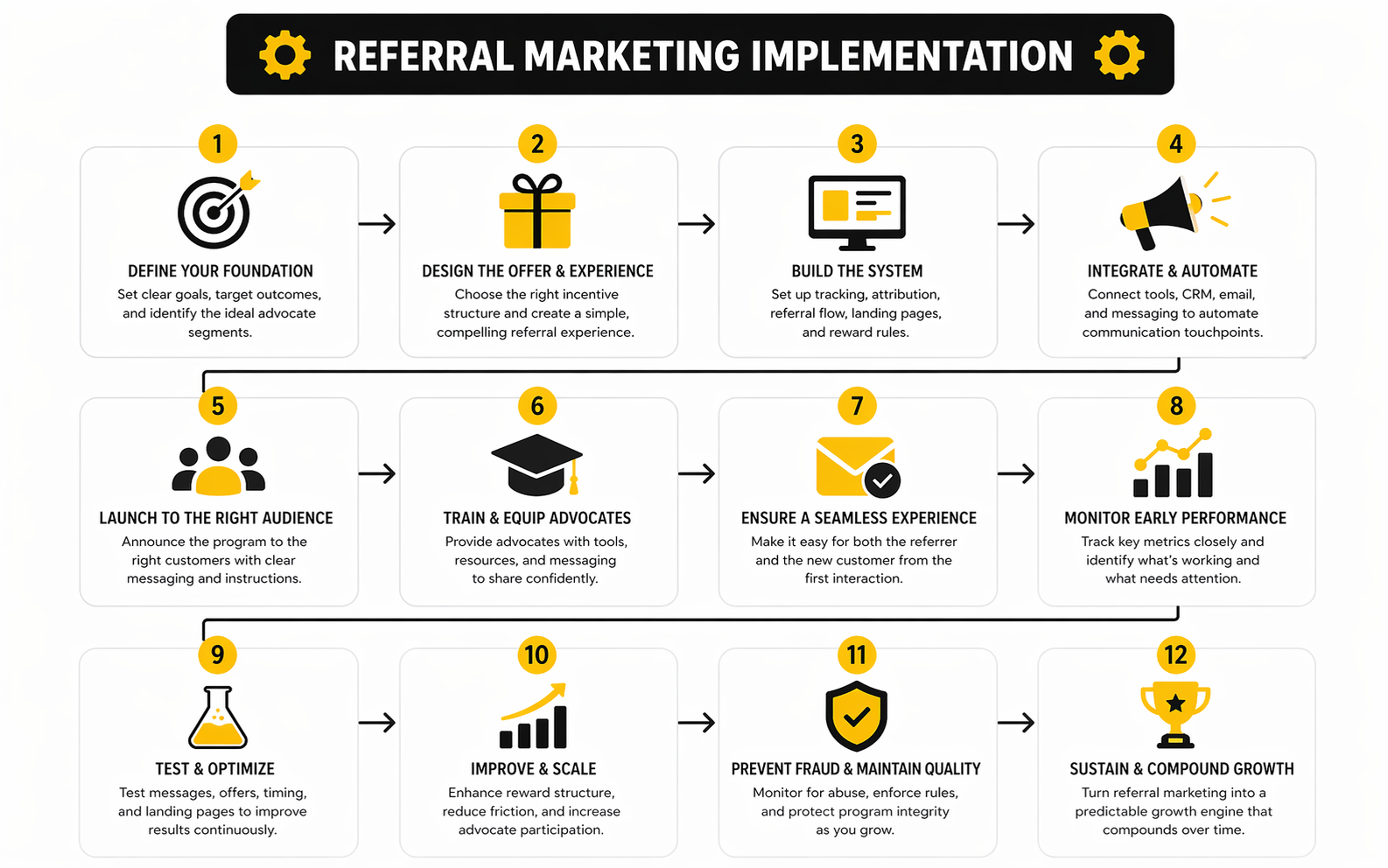
Once the strategy is clear, referral marketing becomes an execution problem. That is actually good news, because execution is fixable. You do not need a clever slogan or some mythical viral hook. You need a process that makes the ask timely, the share easy, the destination credible, and the reward automatic.
The practical way to approach referral marketing is to build it like a customer journey, not like a one-off promo. Every step should answer a simple question: what does the customer need to see, feel, or receive next to keep moving forward without confusion? The best programs do this so smoothly that the referral feels obvious rather than engineered.
Step 1: Choose One Clear Referral Goal
Start narrower than you think. A lot of referral marketing programs get bloated because teams try to reward too many behaviors at once. If you want the system to work, pick one primary conversion event first, whether that is a first purchase, a booked demo, a paid subscription, or an activated account.
This matters because implementation decisions get easier when the goal is precise. Your landing page copy gets sharper, your reward logic gets simpler, and your tracking setup becomes far less fragile. Referral marketing scales better when everyone inside the business can answer the same question about what counts as success.
Step 2: Map the Best Trigger Point
The next move is deciding exactly when to ask. In practice, referral marketing performs best when the request appears immediately after a moment of proven value, not at a random point in the lifecycle. That is why strong programs often trigger after a delivery confirmation, a product milestone, a successful onboarding step, or a positive support interaction.
This is where many brands quietly lose momentum. They bury the referral invitation in a footer, send it too early, or treat it as a generic campaign blast. A better implementation treats the ask as part of the product or customer experience itself, because the emotional context of the moment does half the persuasion for you.
Step 3: Write the Offer So It Sounds Helpful
Before you touch the tech stack, get the message right. Referral marketing breaks when the value proposition is vague or awkward. People need to understand who gets rewarded, when the reward lands, and why sharing this with someone would actually feel useful rather than transactional.
That means the copy has to do less selling and more clarifying. In most cases, the strongest referral message is simple, specific, and framed around usefulness. The customer should instantly understand that they are helping someone get started, not just collecting a bonus for themselves.
Step 4: Build the Destination Page for Referred Visitors
A referred customer should never land on a generic homepage and have to figure things out. This is one of the most common leaks in referral marketing. The original customer does the hard work of trust transfer, and then the landing experience wastes it.
The destination page should repeat the core promise, explain the reward clearly, and make the next action obvious. If you want a cleaner way to build or test high-converting referral landing pages without heavy development work, tools like Replo are a practical fit for teams that care about faster iteration. What matters most, though, is message continuity. The referred customer should feel like they arrived exactly where they expected to go.
Step 5: Make Sharing Dead Simple
This is the part where implementation becomes tangible. Referral marketing gets stronger when sharing takes one or two actions, not six. That usually means a personal link, a referral code, a prefilled text, an email option, or an in-app prompt that matches how customers already communicate.
A good rule here is brutal simplicity. If someone needs instructions to share, the flow is probably too complicated. Brands that improved referral performance consistently focused on discoverability, mobile usability, and fewer steps between the decision to refer and the actual invitation being sent. Airbnb’s own engineering write-up made that painfully clear when it described how the old system was hard to find and absent on mobile, while the rebuilt version drove signups and bookings up by more than 300% per day.
Step 6: Connect Referral Marketing to Your Actual Systems
This is where referral marketing stops being a nice idea and starts acting like a channel. You need the referral event, the signup or purchase event, and the reward event connected to the systems your team already uses. If those are disconnected, your support team gets confused, your reporting gets messy, and customers start asking where their reward went.
For many businesses, this means connecting forms, CRM records, lifecycle messaging, and follow-up automations in one place. Platforms like GoHighLevel are useful here when you want referral marketing tied directly into pipelines, email and SMS automation, and post-conversion follow-up. If you need a lightweight way to capture referral details or route custom logic, Fillout can also help clean up the intake layer.
The point is not that you need a giant stack. The point is that referral marketing needs a real operational home. Once the handoff between systems starts breaking, the customer experience breaks right along with it.
Step 7: Automate Communication at Every Milestone
Silence kills trust. Someone shares your brand, their friend signs up, and then nothing happens for days. That is exactly how a promising referral marketing program starts feeling sketchy. People want confirmation that the share worked, that the referral is being processed, and that the reward is on the way once the conditions are met.
This is why automated communication matters more than most teams expect. A confirmation message, a progress update, and a reward notification can carry a surprising amount of trust. For brands using chat-first flows, ManyChat can make those touchpoints much easier to deploy across messaging channels, while Brevo is a sensible option when email and CRM-driven lifecycle communication are the main priority.
Step 8: Launch Small Before You Scale
One of the smartest ways to implement referral marketing is to avoid the big reveal. Start with one segment, one offer, and one trigger point. That gives you room to catch broken links, unclear reward language, attribution problems, and onboarding friction before you expose the program to your full customer base.
This approach is more disciplined, and it usually wins. Referral marketing is easy to damage with a messy first impression because customers will not keep retrying a confusing program out of politeness. A smaller launch gives you real behavioral data instead of team guesses, which is exactly what you need before you start increasing visibility.
Step 9: Treat Promotion as Part of the Product
Even a well-built program can underperform if customers never notice it. Referral marketing needs visibility in the places where customers already spend attention. That might include account dashboards, order confirmation pages, post-purchase email, onboarding milestones, support conversations, or community spaces.
The lesson from better-performing programs is not just “promote more.” It is “promote in context.” When the referral invitation appears in a moment that already makes sense, it feels like a natural extension of the customer experience rather than a random marketing ask.
Step 10: Decide What Needs Human Oversight
Automation is essential, but full automation is not always the right answer. Some referral marketing programs work beautifully on autopilot. Others, especially in high-ticket or fraud-sensitive categories, benefit from manual review before rewards are released.
You do not need humans touching everything. You do need a clear decision about where oversight belongs. If reward abuse, duplicate accounts, or edge-case attribution could materially hurt the economics of the program, build that review layer now rather than after the first bad month. Referral marketing grows faster when the business trusts its own system.
That is the implementation side in practical terms: clear goal, right trigger, fair message, focused landing page, simple sharing, connected systems, automatic communication, controlled rollout, contextual promotion, and sensible review rules. Once those pieces are in place, the next challenge is not how to launch referral marketing. It is how to measure whether it is actually working, where it is leaking, and what to improve first.
Measurement, Optimization, and Fraud Control
Referral marketing gets expensive when it is measured badly. That sounds obvious, but this is where a lot of programs drift into guesswork. Teams celebrate shares, clicks, and invite volume, then wonder why revenue impact is unclear. The real job of measurement is to tell you whether referral marketing is creating profitable customers, where the journey is leaking, and whether the reward structure is worth the cost.
That is why the data needs interpretation, not just collection. A healthy referral program does not win because one vanity metric looks pretty. It wins because the numbers line up across the funnel: people are sharing, referred visitors are converting, customers are sticking around, and the economics still make sense after rewards and operational overhead are included. Research from Journal of Marketing still matters here because it showed referred customers were worth at least 16% more over time, which means referral marketing should be judged on downstream value, not just top-of-funnel activity.
What You Should Actually Measure
The first layer is participation. You need to know how many eligible customers see the referral prompt, how many of them share, and how many unique referred visitors those shares generate. This tells you whether the program is discoverable and whether the offer is compelling enough to motivate action.
The second layer is conversion quality. This is where referral marketing starts separating from general word-of-mouth. You need to track how many referred visitors complete the target action, how long they take to convert, and whether they behave like quality customers after conversion. The 2024 state-of-market research from impact is useful because it frames referral programs around clearly defined conversion events rather than fuzzy engagement, including purchase-based and lead-based completions that trigger rewards only when a real business outcome occurs. (impact.com research report)
The third layer is economics. You need to compare reward cost, platform cost, fraud loss, support overhead, and any discounts against the revenue and lifetime value generated by referred customers. Referral marketing can look brilliant on a dashboard and still underperform if rewards are being paid too early, paid too often, or paid against weak conversion events.
The Metrics That Matter Most
There is no universal dashboard that fits every business, but there are a few numbers that consistently matter:
- Referral participation rate
This shows what percentage of eligible customers actually refer. If this is weak, the problem is usually timing, visibility, incentive fit, or sharing friction rather than brand awareness.
- Invite-to-visit rate
This tells you whether the shared message is persuasive enough for the referred person to click. If customers are sharing but nobody is visiting, your referral marketing message is probably too generic or the offer is not strong enough to travel.
- Visit-to-conversion rate
This is one of the clearest signals in the whole system. If referred traffic arrives but does not convert, the landing page, onboarding flow, or offer clarity is usually the bottleneck.
- Reward cost per acquired customer
This is where discipline starts. Referral marketing should reduce acquisition friction, but it still has to compete economically with paid channels, partnerships, and lifecycle-led growth.
- Referred customer retention and value
This is the metric most teams underweight. Referred customers are often more important because they stay longer or buy differently, not just because they convert once. That long-term value argument is exactly what made the classic referral customer-value research so influential in the first place. (journals.sagepub.com)
- Time to reward fulfillment
Slow fulfillment erodes trust. A referral system that technically works but leaves people waiting in silence is much weaker than the dashboard suggests.
How to Read the Numbers Without Lying to Yourself
A high share rate is not automatically a win. It can mean customers are curious, or it can mean the reward is attracting low-intent behavior. Referral marketing only gets stronger when high participation is paired with qualified downstream conversions. If those conversions do not materialize, the program may be over-incentivizing the wrong action.
A high conversion rate is not always enough either. Sometimes a referral offer converts well because the discount is too aggressive or because the conversion event is too shallow. If you reward on account creation but the real business value begins at first purchase or first payment, the data will flatter the program while the economics quietly deteriorate.
This is why referral marketing measurement has to connect activity to profit. A program can be healthy with modest participation if the referred customers are strong. A program can be unhealthy with huge invite volume if the channel is attracting low-value signups, duplicate accounts, or abusive behavior.
Build an Analytics System That Mirrors the Journey
The easiest way to measure referral marketing properly is to map analytics to the actual customer path. Track the advocate prompt, the share action, the referred click, the destination-page engagement, the conversion event, and the reward fulfillment event. When those stages are visible, the weak point usually becomes obvious.
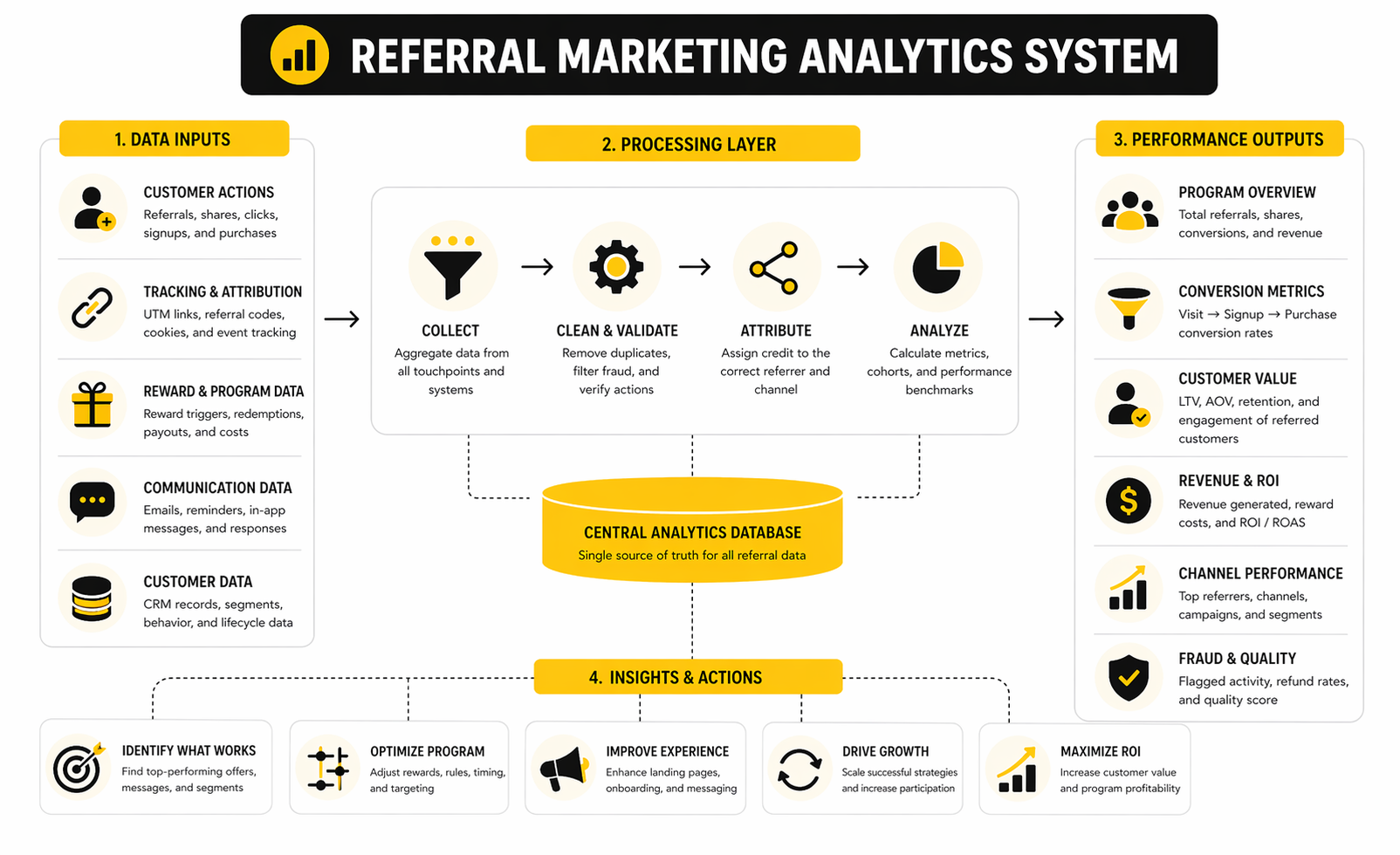
This is where teams stop guessing and start making useful decisions. If clickthrough from shared links is weak, improve the message or the referral incentive. If landing-page visits look fine but conversions lag, fix the referred experience. If conversions are strong but margins are poor, revisit the payout structure or move the reward trigger further downstream.
You do not need a giant enterprise stack to do this well, but you do need consistency. If you want referral marketing tied into CRM stages, messaging, and campaign reporting, GoHighLevel is one practical way to centralize the operating layer. If the main challenge is fast dashboarding and cleaner campaign attribution across links, Dub can help make the share and tracking side more legible.
Useful Benchmarks and What They Mean
Benchmark numbers matter when they help you ask better questions. They become dangerous when they replace thinking. For example, the trust case for referral marketing is still reinforced by long-running research showing that people trust recommendations from people they know far more than most other forms of advertising. (Nielsen) That does not tell you your program is healthy by itself, but it does explain why conversion quality can be higher when the system is built well.
The 2024 impact research is more useful operationally because it shows referral programs are commonly structured around clear purchase and lead conversion events, and that referral can represent up to 20% of annual revenue for some brands. The action this should drive is not blind optimism. It should push you to treat referral marketing like a real channel with revenue accountability rather than a side widget nobody owns.
The older customer-value research is still one of the most actionable data points in the field because it links referrals to stronger long-term customer value, not just cheaper acquisition. That should influence how you report performance internally. If your team only looks at first-order revenue, referral marketing may look smaller than it really is. If you also look at retention, repeat purchase behavior, and contribution margin, the channel often becomes much more interesting. (journals.sagepub.com)
Watch for Three Early Warning Signs
The first warning sign is lots of sharing with weak conversion. That usually means the referred customer experience is underbuilt. The advocate has done their part, but the destination page, onboarding flow, or offer presentation is not closing the loop.
The second warning sign is healthy conversion with poor profitability. This happens when rewards are too rich, triggered too early, or stacked on top of discounts that already compress margin. Referral marketing is supposed to create efficient growth, not just prettier acquisition numbers.
The third warning sign is unexplained spikes or strangely perfect performance. Referral abuse is not rare, especially when the reward is easy to game. Duplicate accounts, self-referrals, coupon-site leakage, and coordinated abuse can all distort the data and make a weak program look stronger than it is. That is why fraud control belongs inside measurement, not after it.
Optimization Should Follow Evidence, Not Hype
Once the data is in place, optimization becomes much less mysterious. You test the referral prompt timing, the incentive framing, the destination page, the share message, and the reward trigger. Each test should be attached to one clear hypothesis, not a vague hope that “something improves.”
Airbnb’s referral rebuild is still a useful reminder here because the dramatic lift did not come from one magical trick. It came from diagnosing friction in the original system, improving discoverability, making the flow work across devices, and measuring against concrete success metrics rather than opinions. (Airbnb engineering) That is how referral marketing usually improves in the real world: not through slogans, but through cleaner system design.
The next step is to deal with the mistakes and advanced plays that determine whether a program stays useful once it grows. That is where referral marketing stops being a clean funnel diagram and starts colliding with real-world problems like poor incentives, audience mismatch, operational drift, and overconfidence.
Common Mistakes, Advanced Plays, and Final Takeaways
By the time a referral marketing program starts working, a new problem shows up: scale changes the rules. What felt simple in the first month becomes harder once more customers, more edge cases, and more money start moving through the system. This is the stage where a decent program either matures into a reliable growth channel or slowly turns into a messy incentive machine.
That is why advanced referral marketing is less about flashy tactics and more about judgment. You have to know when to tighten incentives, when to segment the experience, when to add human review, and when to stop chasing volume for its own sake. The brands that handle this well usually do not look more aggressive. They look more disciplined.
The Biggest Mistake Is Treating Every Customer the Same
Not every customer should see the same referral offer, at the same time, in the same format. This is one of the clearest strategic tradeoffs in referral marketing. Standardization makes the system easier to run, but it can also flatten performance because your best advocates do not behave like casual buyers and your newest customers do not behave like longtime users.
This is why more mature programs segment both the ask and the reward logic. Customers with strong product engagement may respond better to status, access, or tiered benefits than to a basic discount. The 2024 state of referral marketing research points directly at tiered reward design as a way to improve ROI and encourage deeper participation over time, which matters once your first-wave advocates have already referred the easy wins. (state of referral marketing report)
The action here is practical. Stop asking, “What is our referral offer?” and start asking, “Which customer segment is this offer for?” That small shift usually leads to a much better referral marketing system.
Incentives Can Strengthen Trust or Corrupt It
This is where operators get tempted to overcorrect. If participation feels low, the reflex is to increase the reward. Sometimes that works in the short term. But sometimes it attracts the wrong behavior, teaches customers to wait for better offers, or makes the recommendation feel less credible.
That is not just a theoretical risk. Research on referral incentive design has found that program structure materially affects profitability, including evidence that referral-upgrade models can outperform standard cash-style reward structures under the right conditions. (MIS Quarterly) The point is not that one model always wins. It is that referral marketing improves when incentives reinforce product value instead of distracting from it.
A smart operator keeps asking a harder question than “Will this increase referrals?” The better question is, “Will this increase the right referrals without weakening trust?” That is the line that separates sustainable referral marketing from short-term bribery.
Scale Exposes Operational Weaknesses Fast
Small referral programs can survive with rough edges. Large ones cannot. Once referral marketing starts producing meaningful volume, every little weakness becomes more expensive: missing attribution, unclear reward rules, delayed payouts, support tickets, duplicate accounts, and angry customers who feel the program promised more than it delivered.
This is why scaling is not only a growth challenge. It is also an operating challenge. impact’s guidance for scaling advocate programs emphasizes keeping the referral experience consistently branded, visible across key customer touchpoints, and actively maintained rather than left alone after launch. (impact help center) In plain English, referral marketing cannot be treated like a widget you install once and forget.
The practical response is to tighten ownership. Someone needs to own the channel end to end, from performance tracking to customer experience to fraud review. When nobody owns referral marketing completely, it starts leaking value in places no one is watching.
Fraud Prevention Becomes More Important as Rewards Improve
A healthy program attracts advocates. A sloppy program attracts opportunists. This gets sharper as rewards become more generous, easier to claim, or easier to stack. Self-referrals, duplicate accounts, coupon leakage, and coordinated abuse are not side issues once volume rises. They are part of the economics of the channel.
That is one reason strong referral marketing programs define qualification events carefully and avoid rewarding the shallowest possible action. If your reward triggers too early, you are essentially paying to be gamed. The better move is to align the payout to a value event that is harder to fake and easier to verify.
In some categories, the risk is not just fraud. It is compliance. Referral marketing in regulated spaces like healthcare can create legal exposure when incentives influence reimbursable services or resemble improper kickbacks, which is why sector-specific rules matter far more than generic growth advice in those environments. (Reuters legal analysis) That should drive one clear action: the more regulated the category, the less you can afford to copy consumer referral tactics blindly.
The Best Advanced Play Is Lifecycle Integration
One of the strongest moves in referral marketing is not a bigger reward or a fancier landing page. It is integration with the rest of the customer lifecycle. When referral prompts are connected to activation milestones, satisfaction signals, support wins, renewal moments, or community engagement, the channel feels smarter and performs like part of the product experience rather than an isolated campaign.
This is also where tooling can start making a real difference. If you want to route referral marketing into CRM stages, messaging, and pipeline-level automation, GoHighLevel is a practical fit. If your priority is turning post-purchase or community engagement into automated communication flows, Brevo and ManyChat can help turn those moments into something operational instead of manual.
This matters because referral marketing usually compounds when it becomes part of how the business communicates value, not when it lives in a forgotten tab. Integration creates better timing, cleaner data, and fewer dropped handoffs.
Do Not Confuse Advocacy With Reach
There is a subtle trap in mature programs. Once referral marketing starts showing results, teams often assume the answer is simply more exposure. More banners, more prompts, more reminders, more asks. Sometimes that lifts output. Sometimes it burns goodwill.
Advocacy is not the same thing as attention. A customer can see your referral prompt ten times and still not feel ready to recommend you. The deeper truth is that referral marketing depends on confidence, and confidence is earned through actual customer experience. If the product, onboarding, service, or fulfillment is weak, increasing visibility will not fix the channel. It will just make the weakness more visible.
That is why advanced operators keep coming back to experience quality. Referral marketing is not a workaround for a mediocre business. It is an amplifier for a good one.
Know When Referral Marketing Is Not the Main Lever
This part matters, especially for smaller brands. Referral marketing is powerful, but it is not always the first lever to pull. If your retention is poor, your offer is unclear, or your activation rate is weak, the channel may struggle because customers are not yet having the kind of experience they want to recommend.
That does not mean referral marketing is wrong for you. It means you may need to sequence your growth work better. Fix the experience, identify the real value moment, and then layer referrals on top. The channel becomes much stronger when it rests on something customers already feel good about sharing.
This is the strategic tradeoff a lot of teams try to avoid. Referral marketing can absolutely accelerate growth, but only after the business has earned the right to be recommended. That is not a limitation. It is actually the reason the channel is so valuable when it works.
The final part brings everything together with direct answers to the most common referral marketing questions and a practical close on what to do next.
FAQ
What is referral marketing in plain English?
Referral marketing is a structured way to turn happy customers into a real acquisition channel. Instead of hoping people talk about your product on their own, you give them a clear moment to share, a simple way to do it, and a reward or incentive structure that makes sense.
The reason referral marketing keeps working is trust. Recommendations from people someone already knows still outperform most paid messages on credibility, which is exactly why Nielsen’s trust research keeps getting cited so often in this space. The practical takeaway is simple: a referral program works best when it helps natural word-of-mouth travel further without making it feel artificial.
What is the difference between referral marketing and word-of-mouth marketing?
Word-of-mouth marketing happens whether you build a system or not. Referral marketing is what happens when you operationalize that behavior with tracking, incentives, landing pages, qualification rules, and fulfillment logic. One is organic conversation. The other is a managed growth channel.
That difference matters because unmanaged buzz is hard to scale or measure. Referral marketing gives you visibility into who shared, who converted, what reward was triggered, and whether the customer was worth acquiring in the first place.
Why does referral marketing often bring in better customers?
The short version is that trust pre-qualifies the sale. When someone joins through a recommendation, they usually arrive with more context, more confidence, and more realistic expectations than someone who clicked a random ad.
That is not just theory. The customer-value research published in the Journal of Marketing found referred customers were at least 16% more valuable on average, which helps explain why referral marketing often looks stronger on retention and long-term value than on first-click volume alone.
When should a business ask customers for referrals?
The best time is right after a clear value moment. That could be a successful first purchase, a finished onboarding milestone, a strong support interaction, or a visible business result. Referral marketing gets weaker when the ask comes before the customer feels confident recommending you.
This is one of the easiest places to improve performance. If response rates are low, the issue is often not the channel itself. It is usually poor timing, weak visibility, or an ask that shows up before trust is fully earned.
Should a referral program be one-sided or two-sided?
Both can work, but they do different jobs. A one-sided reward mainly motivates the referrer. A two-sided reward makes the invitation feel more generous because the new customer benefits too. In many categories, that makes the recommendation easier to send and easier to accept.
This is why a lot of modern referral marketing programs lean toward balanced structures instead of “I win, you get nothing.” The 2024 state of referral marketing research is useful here because it shows how brands structure programs around clear conversion events and reward logic rather than vague participation.
What is the best reward for referral marketing?
There is no universal best reward. Discounts, credits, cash, account perks, feature unlocks, and exclusive access can all work. The right answer depends on your margins, your audience, your product type, and the behavior you want to encourage.
The smarter question is not “What reward sounds attractive?” It is “What reward supports trust and still preserves unit economics?” If referral marketing only works when the reward is so generous that profitability disappears, the program is not actually healthy.
How do you know whether a referral program is working?
You measure the whole path, not just one event. A strong referral marketing dashboard should show prompt views, shares, referred visits, conversion rate, reward cost, retention, and customer value after acquisition. Shares alone are not enough, and neither are clicks.
The most useful way to read the data is to ask where the leak is. If people are sharing but nobody is converting, fix the offer or landing page. If conversions look good but the channel is unprofitable, tighten the reward structure or move the payout trigger deeper into the journey.
What are the most common referral marketing mistakes?
The biggest mistakes are usually predictable. Asking too early, offering a confusing reward, sending referred traffic to a generic page, failing to automate communication, and paying out before real value is created are the ones that show up most often.
Another common mistake is assuming more exposure always helps. Referral marketing depends on confidence, not just visibility. If the customer experience is weak, adding more referral prompts usually amplifies the weakness instead of solving it.
Can referral marketing work for B2B, or is it mostly for ecommerce and apps?
It can absolutely work for B2B, but the mechanics usually change. In B2B, the referral event may be a qualified intro, a booked demo, or a closed account instead of a simple online purchase. The cycle is often slower, the trust stakes are higher, and the reward may be less transactional.
That is why B2B referral marketing often needs tighter CRM integration and clearer qualification rules. If the handoff between referral source, sales process, and attribution is messy, the program becomes hard to trust internally even before customers ever see it.
How do you prevent abuse and fake referrals?
You prevent abuse by choosing the right conversion event, not by trying to police chaos afterward. If rewards trigger on a shallow action like a bare signup, people will find ways to game it. If they trigger on a real value event such as a completed purchase, activated account, or paid subscription, abuse gets harder and easier to detect.
You also need rules for duplicate accounts, self-referrals, suspicious spikes, and manual review where necessary. Referral marketing becomes much more durable when fraud prevention is designed into the economics instead of bolted on later.
Do small businesses need special software to run referral marketing?
Not always at the beginning. A small business can start with a simple flow if the offer is clear and the tracking is manageable. But once volume grows, manual systems usually become fragile fast. Customers need status updates, reward logic needs consistency, and the data needs to connect back to the rest of your funnel.
That is where tooling becomes useful. If you want referral marketing wired into CRM, automation, and pipeline management, GoHighLevel is one practical option. If your main priority is building cleaner referral landing pages and offer experiences quickly, Replo is a sensible fit.
How long does it take for referral marketing to produce meaningful results?
Usually longer than people hope and faster than people fear, assuming the foundations are solid. If your customers already love the product and the value moment is obvious, referral marketing can start generating traction relatively quickly. If customer satisfaction is uneven or the offer is unclear, the program may launch without real momentum.
This is why patience matters, but not blind patience. Give the system enough time to produce meaningful data, then use the data to improve timing, messaging, visibility, and reward logic. Referral marketing is rarely a one-shot success story. It is usually a compounding system that gets better when operators keep tightening the weak points.
Is referral marketing still worth investing in when paid ads are easier to launch?
Yes, but for a different reason than many teams think. Paid ads are easier to switch on. Referral marketing is often harder to build but stronger once it is working because it is rooted in customer trust and can produce higher-quality acquisition over time.
That does not mean referral marketing replaces paid media. In many businesses, it complements it. Paid channels can create reach, while referrals can convert trust and improve customer quality. The strongest operators do not force a fake choice between the two. They use each channel for what it does best.
Work With Professionals
Explore 10K+ Remote Marketing Contracts on MarkeWork.com
Most marketers spend too much time chasing clients, competing on crowded platforms, and losing a percentage of every project to middlemen.
MarkeWork gives you a better way. Browse thousands of remote marketing contracts and connect directly with companies desperate to hire skilled marketers like you, without platform commissions and without unnecessary gatekeepers.
If you're serious about finding better opportunities and keeping 100% of what you earn, explore available contracts and create a profile for free at MarkeWork.com.