

Restaurant marketing used to mean a decent location, a recognizable sign, and maybe a few seasonal promotions. That is not enough anymore. In 2026, restaurants are competing in a market the National Restaurant Association expects to reach $1.55 trillion in U.S. sales, while guests keep raising their expectations around convenience, visibility, and experience.
The hard part is not getting your restaurant seen once. The hard part is getting discovered in the right places, giving people enough confidence to choose you, and then turning that first visit into a second, third, and tenth one. That matters even more now that off-premises traffic holds a larger share of restaurant demand than it did before the pandemic, which means your marketing has to work across search, maps, social, reservations, takeout, and follow-up communication.
A lot of restaurant owners still treat marketing like a pile of disconnected tactics. They post on Instagram when they remember, boost a few ads when sales dip, and hope word of mouth carries the rest. Strong restaurant marketing works differently: it behaves like a system, where local discovery, proof, conversion, guest data, and repeat visit campaigns all reinforce each other.
Article Outline
- Why Restaurant Marketing Matters Now
- The Restaurant Marketing Framework
- Build a Local Discovery Engine
- Turn First-Time Guests Into Regulars
- Run Promotions Without Discounting Away Margin
- Measure What Actually Drives Covers and Revenue
Why Restaurant Marketing Matters Now
Restaurant marketing matters more today because the decision window is shorter and the comparison set is wider. A guest can discover three nearby options in minutes, scan ratings, check photos, compare menus, look for booking availability, and decide before your team even knows they were considering you. Google explicitly ties local visibility to profile completeness, accurate hours, relevant categories, and active review management, which means marketing is now tightly connected to your operational discipline.
Discovery has also fragmented. SevenRooms found that 49% of diners discover new restaurants on social media, while Toast’s 2026 diner research shows guests are still heavily influenced by digital touchpoints before they ever walk through the door. In plain English, that means your next customer may meet you through Instagram, Google Maps, a review, a reservation app, or a friend’s tagged post, and your brand has to feel consistent across all of them.
Reviews now do more than protect reputation. They shape click-through, trust, and whether someone gives your restaurant a real chance, especially for local-intent searches where people are ready to choose quickly. BrightLocal’s 2026 review research and Google’s own guidance both point in the same direction: review quality, response behavior, and profile freshness are no longer side tasks for someone to handle “when there’s time.” They are part of the sales engine.
The Restaurant Marketing Framework
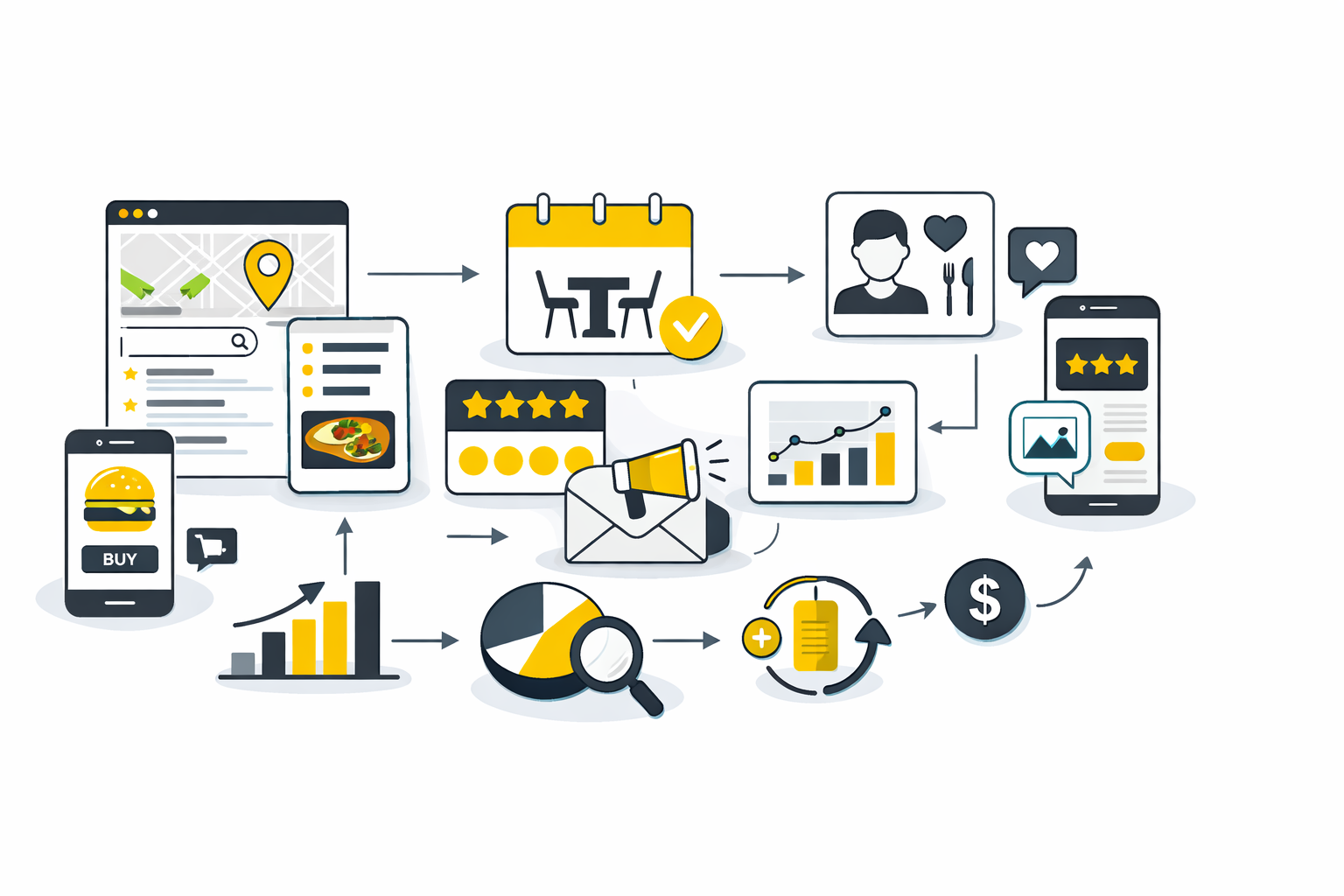
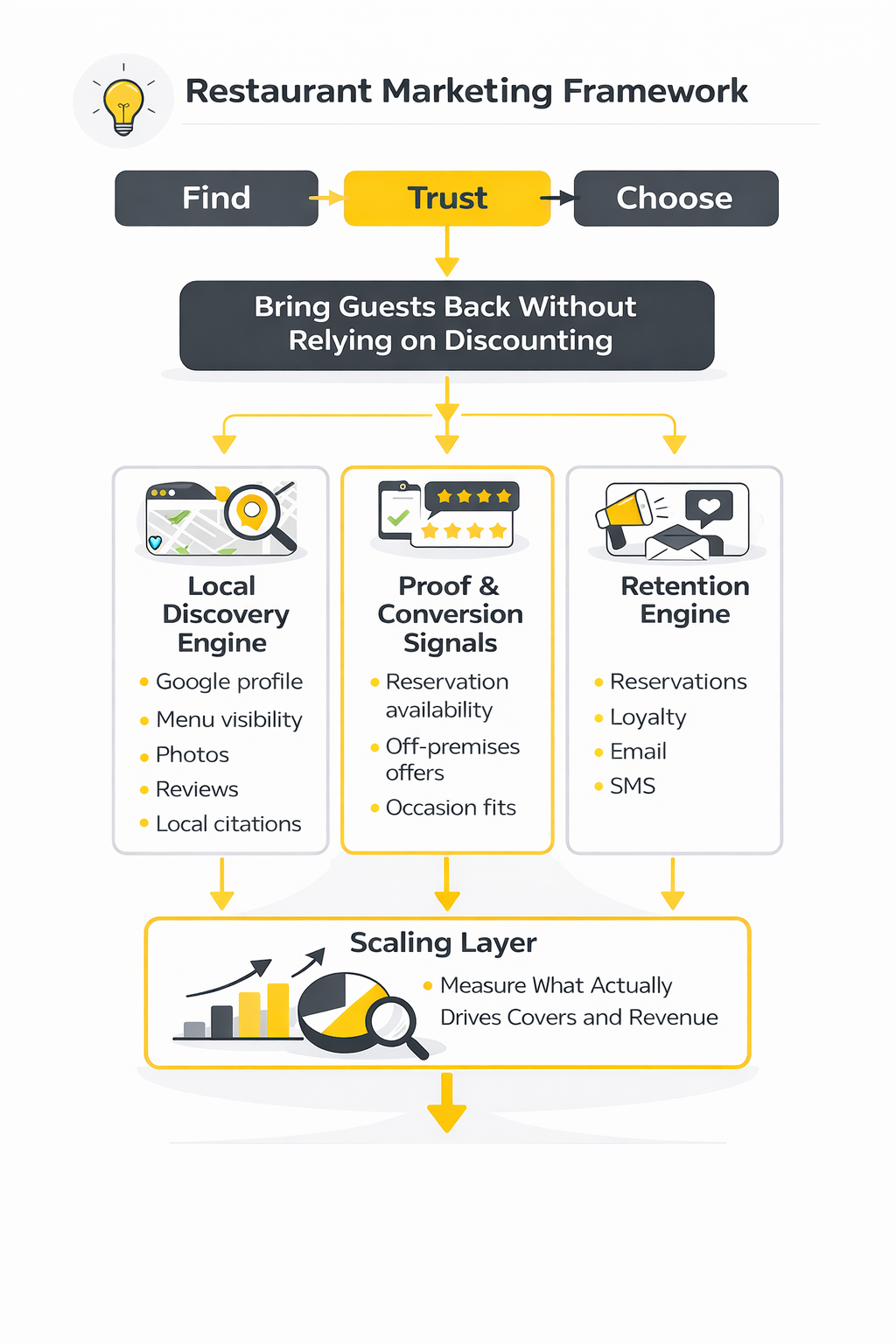
The framework this article uses is simple on purpose. First, you make the restaurant easy to find. Then you make it easy to trust. Then you make it easy to choose. After that, you capture enough guest data to bring people back without relying on constant discounts. That sequence is what turns restaurant marketing from random activity into repeatable growth.
The first layer is local discovery. That includes your Google Business Profile, category selection, menu visibility, photos, review velocity, local SEO signals, and presence anywhere diners compare options. If those assets are weak, the rest of your marketing gets expensive because you are paying to compensate for visibility you should have earned organically.
The second layer is conversion. Once someone finds you, they need proof that your place fits the occasion, the budget, and the expected experience. That proof comes from photos, reviews, clear offers, reservation availability, off-premises convenience, and messaging that matches what the actual guest wants. OpenTable, Toast, and the National Restaurant Association all reflect the same larger pattern: diners want convenience, confidence, and value without friction.
The third layer is retention. This is where many restaurants leave money on the table. If a first-time guest has a good experience and you still have no clean way to reach them again, you are effectively starting from zero every week. Smart restaurant marketing closes that gap by using reservations, loyalty, email, SMS, and guest data to create a path from one visit to repeat revenue.
What Good Restaurant Marketing Actually Does
Good restaurant marketing does not try to shout louder than every competitor. It removes uncertainty at each step of the customer journey. A potential guest should immediately understand what kind of place you are, why you are worth choosing, and what action to take next, whether that is booking a table, ordering takeout, joining a waitlist, or saving you for later.
It also protects margin better than panic promotions do. Restaurants that rely too heavily on blanket discounts often train customers to wait for deals, while restaurants that market the experience, occasion, convenience, and relevance of the offer create demand without giving away as much value. That distinction becomes more important in an industry still dealing with cost pressure even as consumer demand remains resilient.
Most importantly, good restaurant marketing is measurable. You should be able to trace whether growth is coming from stronger local search visibility, better review response habits, improved reservation conversion, higher repeat visit rates, or better follow-up after a first purchase. The restaurants that win are usually not doing one magical tactic better than everyone else. They are running a cleaner system.
Build a Local Discovery Engine
Restaurant marketing breaks fast when people cannot find you at the exact moment they are ready to choose a place. That is why local discovery comes first. Before you worry about ad creative, influencer outreach, or clever campaigns, you need the basics that shape how a restaurant appears across search, maps, menu lookups, and booking flows.
Google is very clear about what drives local visibility: relevance, distance, and prominence all shape local ranking, and your business category, profile completeness, reviews, and overall web presence all influence how often you show up for the searches that matter most. That means restaurant marketing is not separate from operations anymore. If your hours are wrong, your category is vague, or your menu is buried in a PDF no one can navigate, your marketing is leaking demand before it even starts. Google’s local ranking guidance and restaurant profile setup documentation both point in the same direction.
Start With Category, Hours, and Core Profile Data
Most restaurants do not lose local traffic because they are invisible everywhere. They lose it because they are slightly less useful than the place next to them. A profile with the wrong primary category, incomplete attributes, inconsistent hours, or weak menu information gives Google less confidence and gives diners more reasons to keep scrolling.
Your primary category matters more than many operators realize because Google uses it to connect your restaurant with the searches most likely to match what you actually offer. A pizza concept should not hide behind a generic label if a more specific category helps it appear for the right intent, and Google’s own category documentation explains that category choices affect local ranking and customer understanding. Google’s category guidance is blunt on that point.
Hours are just as important. Restaurant marketing often focuses on attention, but a lot of local restaurant searches are action-based and time-sensitive. People search for things like open now, lunch near me, late-night tacos, or takeout nearby, so outdated hours are not a small cleanup task. They directly hurt trust and conversion, especially when Google expects businesses to keep profile details accurate and updated. Google’s profile editing guidance makes that expectation explicit.
Make the Menu Easy to Find and Easy to Trust
A menu is not just an operations asset. It is a conversion asset. When people compare restaurants in search results, a menu helps them answer the questions that actually drive the decision: Is this my price range, does this place fit the occasion, and is there something here I already want to order?
Google gives restaurants multiple ways to surface menu content, including menu links, detailed menu sections, and uploaded menu photos or PDFs. That matters because clearer menu visibility reduces friction between discovery and action. A vague or outdated menu forces the guest to do extra work, and extra work kills clicks. Google’s menu editor documentation and restaurant-specific profile guide both make menu management part of the core setup.
This is where a lot of restaurant marketing gets lazy. Operators spend time on social posts and ignore the most commercial page in the funnel. Your menu should be current, readable on mobile, and consistent across your website, Google profile, and third-party ordering surfaces. If pricing, dish names, or item availability keep changing from one platform to another, you are creating hesitation right where the customer should be moving forward.
Use Photos That Sell the Experience, Not Just the Food
Photos do not work because they are pretty. They work because they remove uncertainty. A guest wants to know what the food looks like, but they also want to know whether the space feels casual or upscale, whether the portions look worth the price, whether the lighting works for a date, and whether the place feels alive.
Google encourages restaurants to upload photos and videos of the interior, exterior, and overall dining experience, not just menu shots. That is a smart reminder because restaurant marketing performs best when it sells context as well as product. Google’s restaurant profile recommendations frame visual content as part of helping customers learn more and choose faster.
OpenTable’s current trend coverage also points toward experience-led demand, especially as more diners treat eating out like a meaningful occasion rather than a forgettable default. That does not mean every restaurant needs luxury positioning. It means your photos should match the promise you want the right guest to believe. OpenTable’s 2026 diner trends report reflects how much experience and perceived value shape dining decisions now.
Treat Reviews Like Conversion Assets
Reviews are usually discussed like a reputation issue. They are bigger than that. In practical terms, reviews influence whether a potential guest clicks, trusts, and books. They also strengthen local prominence signals over time, which means reviews affect both visibility and conversion at the same time.
Google’s documentation on local ranking and review scores makes that connection pretty hard to ignore. Review volume, rating quality, and profile activity all shape how strong your presence looks in local search, and diners can see review scores and top reviews directly in search and maps results. Google’s review score documentation and local ranking guidance cover the mechanics from both angles.
The takeaway is straightforward. Restaurant marketing should include a repeatable review process, not occasional begging after a good night. Ask consistently, make it easy, respond professionally, and learn from patterns in the feedback. That turns reviews from random social proof into a managed growth channel.
Connect Discovery to Ordering and Reservations
Getting found is not enough. You have to reduce the distance between interest and action. For restaurants, that usually means making booking, ordering, or pickup options visible the second someone decides they are interested.
Google allows restaurants to manage food-ordering links and prioritize preferred providers, which helps reduce friction for both pickup and delivery journeys. For reservation-driven concepts, availability accuracy matters for the same reason: once a guest is ready, a broken or confusing booking path can lose the sale instantly. Google’s food ordering documentation and Google’s availability guidance for reservations both reinforce the same operational truth.
This matters even more because off-premises behavior is not some side habit anymore. The National Restaurant Association’s latest off-premises reporting shows takeout, drive-thru, and delivery remain deeply embedded in how people buy restaurant food, especially among younger adults. Restaurant marketing has to reflect that reality instead of pretending every customer journey ends with a host stand. The Association’s off-premises research makes that shift impossible to dismiss.
Why Discovery Wins Compound Over Time
The best part about building a local discovery engine is that it compounds. A stronger profile leads to more views. More views create more visits, orders, and bookings. Better experiences create more reviews and more user-generated photos. That improves prominence, which lifts discovery again.
This is why disciplined restaurant marketing usually beats flashy restaurant marketing over time. A clean profile, sharp categories, accurate hours, useful menu data, strong photos, and steady review momentum are not exciting in the way a viral post is exciting. They are better because they keep working when you are not actively launching a campaign.
That foundation also makes every future channel more efficient. Paid ads convert better when the profile they click into feels complete. Social traffic converts better when the menu and booking path are clear. Email and SMS work better when the first visit happened with confidence instead of confusion. That is the real point of local discovery: it is not just about showing up. It is about making every other part of restaurant marketing work harder.
Turn First-Time Guests Into Regulars
Once local discovery is working, restaurant marketing has to solve a different problem. Getting the first visit is valuable, but it is rarely where the economics get good. The real leverage appears when a restaurant turns a one-time diner, walk-in, or takeout customer into someone who comes back without needing to be reacquired from scratch every time.
That matters because regulars behave differently. Toast’s 2026 survey found that 60% of diners say they are regulars somewhere, and the same research shows many of those guests return with real frequency once they feel known. SevenRooms pushes the same idea from the operator side: guest data, personalization, and follow-up communication are what turn anonymous visits into repeat business. This is where restaurant marketing stops being a visibility game and starts becoming a relationship system.
Retention Starts During the First Visit
A lot of operators think retention begins after the guest leaves. It starts much earlier than that. The first visit is when the guest decides whether your restaurant feels generic or memorable, and that decision is shaped by speed, service, clarity, and whether the experience feels coherent from start to finish.
That is also why personalization matters more now. SevenRooms’ 2025 U.S. trends report found that diners are actively spending on personalized and meaningful experiences, not just meals in the abstract. Restaurant marketing works better when the promise made in search, social, or reviews matches the actual experience on the floor, because that consistency is what gives people a reason to come back instead of treating the visit like a one-off.
The practical implication is simple. If your retention strategy only begins with a discount email three days later, you are already late. The job is to create enough trust and relevance during the first experience that follow-up feels like a continuation, not a rescue attempt.
Capture Guest Data Without Making It Awkward
You cannot build repeat visits around people you cannot identify. That sounds obvious, but this is still where many restaurants hit a wall. Walk-ins pay, leave, and disappear. Takeout customers order through a third party and become someone else’s data. Reservation guests book once, and no one on the team uses what was learned.
SevenRooms is blunt about the risk here: without guest data, restaurants keep serving strangers instead of building a community of regulars. Toast has moved in the same direction by making guest CRM profiles that connect visits, orders, and reservations a core part of how operators can personalize service and drive repeat revenue. Restaurant marketing becomes much more efficient the moment you know who came in, what they bought, when they visited, and whether they are likely to return.
The smart approach is to collect data at natural moments. Reservations already give you names and contact details. Wi-Fi opt-ins, loyalty signups, checkout receipts, digital ordering, and event registration can do the same without creating friction. The goal is not to interrogate guests. The goal is to make data capture feel like part of good hospitality.
Build a Follow-Up System Instead of Random Outreach
Most restaurant follow-up fails because it is inconsistent. Somebody remembers to send a campaign around Valentine’s Day, then nothing happens for three weeks. Or the only messages guests get are broad discounts blasted to everyone, which trains the audience to ignore most of what you send.
A better system uses behavior, not guesswork. Toast’s automation guidance highlights repeatable flows like first-visit follow-up, frequent guest messaging, win-back campaigns, and high-spend guest recognition. Their product documentation gets even more specific, showing operators can trigger messages for every fifth visit, higher-than-average spend, and other guest milestones. That is the right mindset because restaurant marketing gets stronger when communication is tied to actual customer behavior.
This is also where your tooling matters. If you want a simple way to centralize SMS, email, lead capture, and follow-up campaigns, a platform like GoHighLevel can make the process easier to run consistently. If your team prefers a lighter email-first setup for newsletters, promos, and segmentation, Brevo is another practical option. The specific software matters less than the discipline of having the flows in place.
The Process That Makes Retention Real
A strong retention process is not complicated, but it does need structure. Restaurant marketing usually gets more effective when the team defines a small number of triggers and then runs them every week without fail. That is what turns repeat visits from wishful thinking into an operational habit.
A simple version looks like this:
- Capture the guest
Use reservations, online ordering, loyalty enrollment, event RSVPs, or receipt-based signup prompts to collect first-party contact data. This matters because every future campaign depends on whether you can reach the guest directly rather than through a platform that owns the relationship.
- Tag the visit
Mark whether the guest was first-time, returning, high-spend, event-driven, off-premises, or tied to a specific occasion. SevenRooms repeatedly emphasizes that booking behavior, visit history, preferences, and special occasions create the raw material for better segmentation.
- Send a short first follow-up
This should feel human, not like a coupon machine. A thank-you message, a review prompt, or a soft invitation back for a relevant occasion works better than immediately screaming about discounts.
- Trigger the second-visit nudge
This is the real hinge point. Restaurant loyalty experts interviewed by Nation’s Restaurant News point to the third purchase as the moment behavior starts shifting from marketing push to guest habit, so the second visit deserves deliberate attention because it gets the guest closer to that threshold.
- Recognize regular behavior
Once someone comes back multiple times, the communication should change. Recognition, priority offers, event access, chef’s specials, and occasion-based invites are more powerful than sending the same mass promo forever.
- Run win-back campaigns for quiet guests
Not every guest who disappears is lost for good. A well-timed message tied to their past order, favorite daypart, or a seasonal reason to return can recover demand without sounding desperate.
Use Loyalty to Support Value, Not Just Discounts
Loyalty can be useful, but only if it reinforces your positioning instead of weakening it. A lot of restaurants build programs that are basically permanent discount engines, and then act surprised when margins suffer. That is the wrong use of retention marketing.
The National Restaurant Association’s 2025 off-premises coverage shows that nearly two-thirds of drive-thru, delivery, and takeout customers say loyalty programs are an important reason for choosing a restaurant. At the same time, the Association also notes that value for off-premises customers is about more than price and includes convenience, speed, loyalty benefits, and tech-enabled ordering. That is the nuance that matters.
So build loyalty around access, convenience, and relevance. Reward people for repeat behavior, but do it in ways that protect the brand. Early access to limited specials, birthday perks, pickup priority, private tasting invites, or points that unlock useful benefits can all work better than teaching customers to wait for 20% off.
Personalization Beats Volume
One of the biggest mistakes in restaurant marketing is assuming more messages equal better retention. Usually the opposite is true. What brings guests back is not message volume. It is whether the content feels timely and specific enough to matter.
SevenRooms’ 2025 research argues that high-touch hospitality increasingly depends on high-tech systems that help teams personalize at scale. Their operator guidance keeps returning to the same point: guest profiles that track order history, spend, preferences, and occasions make better outreach possible because they help the restaurant sound relevant instead of generic. That is the difference between “Come back soon” and “You loved our patio brunch in April, and the new spring menu is live this weekend.”
This is why segmentation matters so much. First-time guests should not get the same message as weekly regulars. Delivery-heavy customers should not get the same nudge as date-night reservation guests. Restaurant marketing feels much more effective when the message reflects the behavior that already happened.
What This Looks Like in the Real World
In practice, the best retention systems are boring in the best possible way. They run every week. They are tied to clear triggers. They do not rely on someone remembering what to send when the dining room gets slammed. They simply keep turning guest behavior into smart follow-up.
That is also why automation is no longer optional for many operators. Restaurants still win on hospitality, but the communication layer increasingly needs software support to stay consistent. SevenRooms, Toast, and the National Restaurant Association all point toward the same broader shift: guest expectations are rising, personalization matters more, and first-party data is becoming the backbone of modern restaurant marketing.
The good news is that this does not require a giant enterprise stack. It requires one clean system, a few high-value triggers, and the discipline to treat retention like a core growth channel instead of an occasional side project. Once that is in place, the next step is learning how to drive demand without wrecking your margins, which is where smart promotions separate themselves from lazy discounting.
Reading the Numbers That Matter
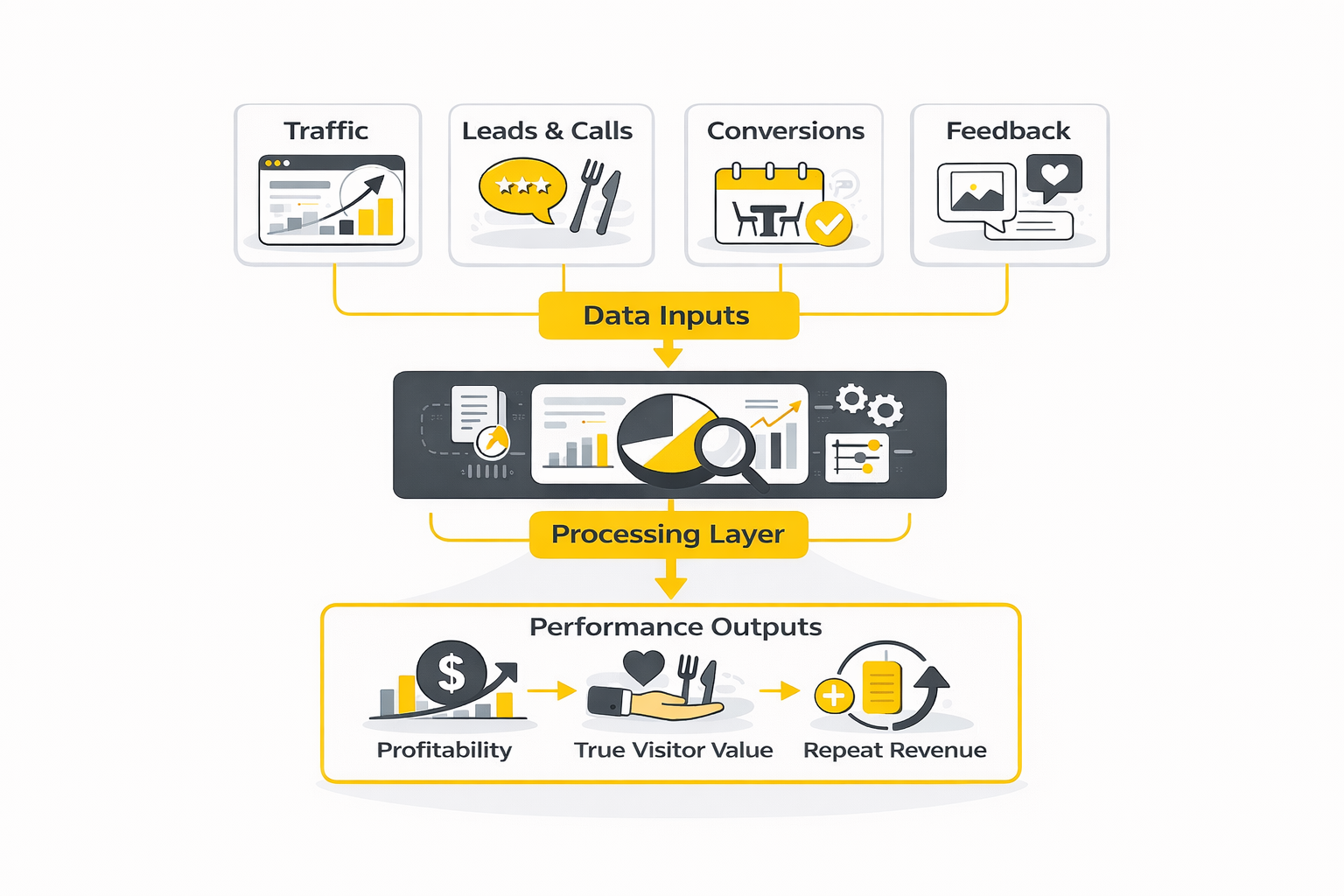
The biggest mistake in restaurant marketing analytics is collecting numbers that look busy but do not change decisions. Impressions without bookings, followers without orders, and email sends without repeat visits can make a report feel active while the dining room tells a different story. The point of measurement is not to prove that marketing exists. The point is to show whether it is creating profitable guest behavior.
That is why the right restaurant marketing dashboard should mirror the customer journey. You want to know whether more people are discovering you, whether enough of them are choosing you, whether they are returning, and whether the whole system is producing revenue without crushing margin. Google, Toast, OpenTable, SevenRooms, and the National Restaurant Association all publish pieces of this puzzle, and together they make one thing clear: the winning metrics are the ones tied to visits, orders, covers, and repeat behavior, not vague attention.
Start With Channel Mix Before You Judge Campaign Performance
A lot of restaurants misread their own performance because they evaluate campaigns without understanding where demand is actually happening. That is dangerous now because dining behavior is split across on-premises, takeout, delivery, drive-thru, reservations, and direct search. The National Restaurant Association’s latest off-premises research shows that nearly 75% of restaurant traffic now happens off-premises, while its 2025 consumer data also found that 47% of adults pick up takeout at least weekly, 42% use drive-thru weekly, and 37% order delivery weekly.
Those numbers matter because they change what “good marketing performance” even means. If most of your guest demand is happening off-premises, then judging success only by seated covers will undercount what your marketing is doing. In that situation, restaurant marketing should be measured across orders, average ticket, reorder rate, and channel profitability, not just dine-in traffic.
The action is simple. Break reporting into the channels your guests actually use. Track dine-in, direct online ordering, third-party delivery, pickup, catering, and events separately. Once you do that, you can stop making bad decisions based on blended revenue that hides where the growth is really coming from.
Measure Discovery With Intent Signals, Not Vanity Signals
Discovery metrics only matter when they suggest real buyer intent. For most restaurants, the strongest top-of-funnel local signals come from Google Business Profile activity because that is where people search when they are close to making a decision. Google’s own performance documentation shows businesses can track views, calls, website clicks, direction requests, bookings, and other customer interactions from Search and Maps.
That is the right place to start because these are not empty exposure metrics. A direction request, a call, or a menu click usually means the guest is moving toward action. In restaurant marketing, a rise in profile views with flat calls and flat website clicks usually means visibility is improving but trust or conversion is not. A rise in calls and direction requests, on the other hand, often signals that your profile content, photos, reviews, and category relevance are getting stronger.
This is also where weekly trend lines matter more than one-day spikes. Restaurant demand is seasonal, weather-sensitive, and event-sensitive, so single-day swings can fool you. Look for movement over four to eight weeks, then compare it to known operational changes like new photography, updated menu links, better review response habits, or improved hours accuracy.
Conversion Metrics Should Show Whether Interest Becomes Revenue
Once people discover you, the next question is whether they actually choose you. This is where many restaurant marketing reports get blurry because they treat website traffic as the finish line. It is not. Conversion means a reservation, an order, a waitlist join, a call that turns into a booking, or a walk-in pattern that clearly improves after local visibility rises.
Reservation data is especially useful because it reveals friction fast. Toast reported that in Q3 2025 seated reservations rose 8% year over year, cancellations rose 7%, and no-shows fell 1%, which matters because it shows demand can grow even while booking volatility increases. If your restaurant marketing is driving more reservation starts but your cancellation rate is also climbing, the lesson is not automatically “market less.” It might mean your booking policies, reminders, deposit rules, or occasion messaging need work.
OpenTable’s live industry view adds another useful benchmark because it tracks weekly year-over-year changes in seated diners from online reservations. That helps you separate your own problem from a market-wide shift. If your covers are down 6% while your local market is up 12%, that is a restaurant problem. If your covers are flat while the market is falling, your marketing may actually be doing its job better than it seems at first glance.
Retention Metrics Matter More Than Most Operators Think
Retention is where restaurant marketing becomes financially intelligent. Getting a first visit is expensive compared with getting a second or third one, which is why the repeat side of the dashboard deserves more attention than it usually gets. Toast’s 2026 regulars research found that 60% of diners say they are regulars somewhere, which is a useful reminder that repeat behavior is normal when a restaurant earns it.
The key is not to stare at “loyalty members” as a vanity total. Instead, track the numbers that reveal movement: first-to-second visit rate, second-to-third visit rate, days between visits, reactivation rate for quiet guests, and share of revenue coming from known guests. SevenRooms keeps emphasizing that guest recognition, personalization, and first-party data are central to repeat revenue, and that only becomes useful when the data is tied to actual behavior instead of sitting in a CRM untouched.
For restaurant marketing, the action behind these numbers is very concrete. If lots of guests visit once but very few return within 30 or 60 days, the problem is not awareness. The problem is follow-up, experience consistency, or offer relevance. If second visits are strong but third visits lag, you likely need better loyalty design or more relevant habit-forming occasions.
Build a Simple Restaurant Marketing Scorecard
You do not need a giant enterprise dashboard to make good decisions. You need a scorecard that shows what changed, why it probably changed, and what action should follow. In most cases, restaurant marketing becomes easier to manage when the dashboard is reduced to a small set of leading and lagging indicators.
A practical weekly scorecard usually includes:
- Discovery signals
Google profile views, calls, direction requests, menu clicks, website clicks, social profile visits, and branded search trends. These tell you whether visibility and intent are increasing.
- Conversion signals
Reservation starts, seated covers, online order volume, direct order share, phone inquiries, waitlist joins, and booking completion rates. These show whether interest is becoming action.
- Retention signals
New guest count, repeat guest count, first-to-second visit rate, days to return, win-back success, and CRM capture rate. These reveal whether your system is building lasting demand.
- Economics
Revenue by channel, average ticket, promo redemption rate, cost per acquired guest, and margin by offer type. These help you avoid confusing volume with healthy growth.
That framework works because it forces every number to answer a practical question. If a metric does not help you decide what to do next, it probably does not belong on the front page of the report.
Use Benchmarks Carefully or They Will Mislead You
Benchmarks are useful, but only when they are close enough to your reality. A suburban fast-casual lunch concept should not copy the benchmarks of an urban tasting-menu restaurant, and a bar-heavy concept should not judge itself by family-dining weekend patterns. This is where comparative tools can help, as long as you stay skeptical and keep context in view.
Toast now offers Benchmarking based on data from a network it says is more than 164,000 restaurants, which is useful because local and peer comparisons help you spot whether a slowdown is unique to your brand or part of a broader market shift. But benchmark data should guide questions, not replace thinking. A peer average can tell you that your Friday dinner conversion is weak. It cannot tell you whether the fix is better photos, shorter booking friction, stronger review response, a sharper offer, or a service issue on the floor.
That is the real interpretation rule. Benchmarks are context, not commands. Good restaurant marketing uses them to investigate, not to imitate blindly.
Reviews and Feedback Are Early Warning Systems
Review scores and guest feedback are often treated like soft data, but they are usually the earliest warning signals on the board. Google review activity influences local prominence, and Google’s documentation on review scores and customer feedback makes clear that ratings are visible and commercially relevant. Tripadvisor’s 2025 transparency reporting also shows how large and influential review ecosystems remain, while warning operators that bad incentives and manipulative tactics damage trust instead of building it. Its report notes around 75% of published reviews carried a 5-bubble rating and the platform’s average rating rose to 4.42 bubbles, which tells you two things at once: positive reviews are common, and falling below market expectations is more dangerous than many restaurants assume.
The right way to use review data is not to obsess over every individual comment. Look for recurring signals. If feedback repeatedly mentions slow check times, delivery packaging issues, reservation friction, or confusing menu pricing, those are marketing problems as much as operational ones because they shape what future guests will see and believe.
Toast’s 2026 feedback research is useful here because it focuses on what actually motivates guests to leave restaurant feedback. That matters because better feedback collection gives you better leading indicators before traffic drops hard enough to show up in revenue.
What the Data Should Make You Do Next
Good measurement should end with action, not a prettier spreadsheet. If discovery is rising but conversion is flat, tighten the profile, menu, reviews, and booking flow. If conversion is rising but repeat behavior is weak, fix your follow-up and second-visit strategy. If repeat behavior is healthy but profit is slipping, the issue is likely offer structure, channel mix, or discount discipline.
This is where restaurant marketing gets more serious. The data is not there to make you feel informed. It is there to tell you what to improve next week. Once you can read the numbers that way, you stop reacting emotionally to random spikes and start managing growth with a lot more precision.
That also sets up the next part of the system. Once you know how to read the numbers, you can design promotions that lift demand without training customers to wait for discounts or pushing your margins into the ground.
Run Promotions Without Discounting Away Margin
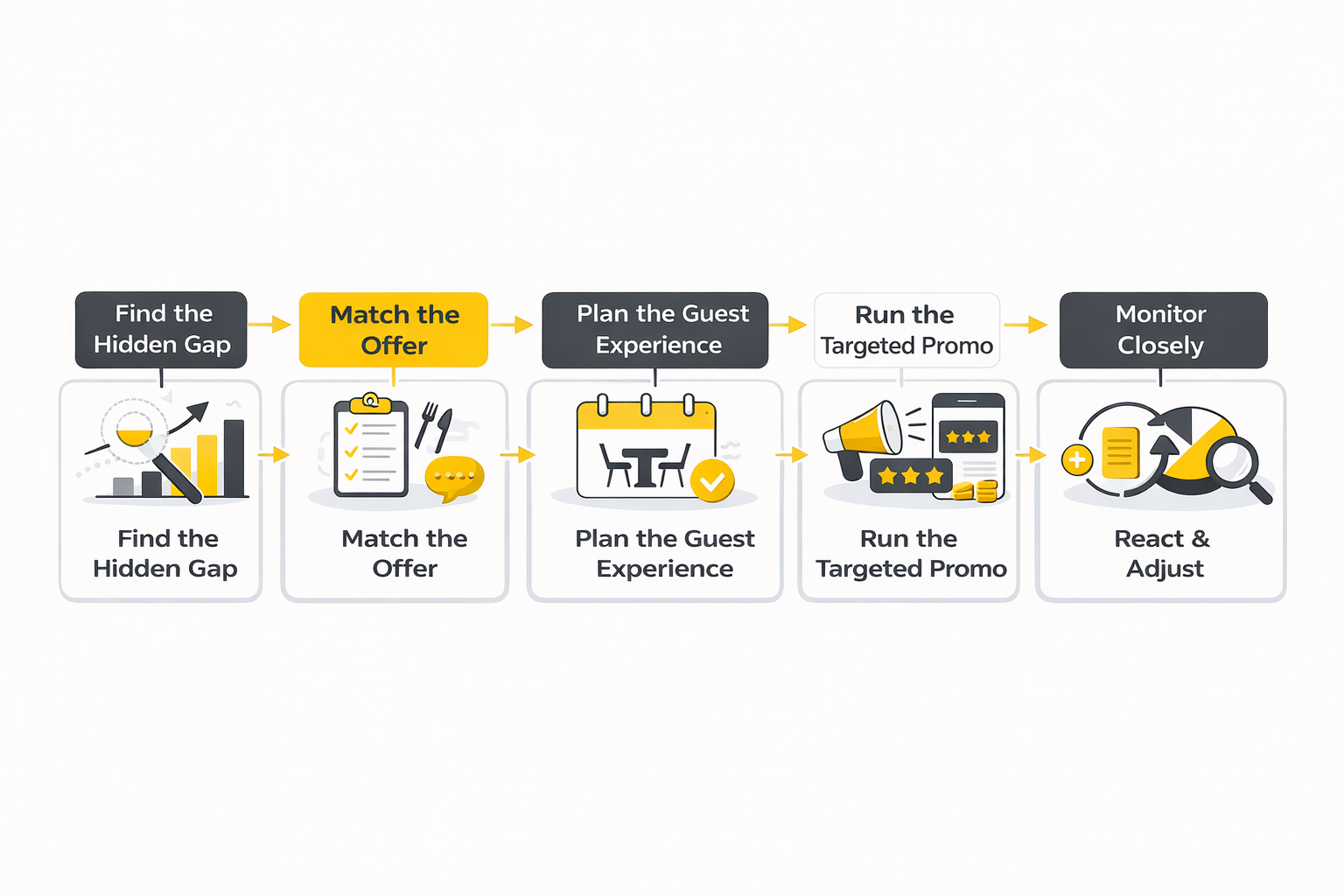
This is where restaurant marketing gets a lot more serious. Anyone can create a spike with a blunt discount. The harder job is creating demand that still leaves enough margin to matter, especially in an industry where the National Restaurant Association says 42% of operators were not profitable in 2025 and many still have limited room to raise prices.
That context changes how you should think about promotions. A promo is not successful because it drives traffic in isolation. It is successful when it brings in the right guests, at the right time, through the right channel, without teaching them to ignore you until the next deal appears. That is the line restaurant marketing has to hold now.
Sell Value, Not Just Lower Prices
Guests absolutely care about value, but value is not the same thing as being cheap. The National Restaurant Association’s off-premises research makes that point clearly: quality, convenience, speed, loyalty programs, and tech-enabled ordering are all part of the value equation alongside deals and discounts. That is good news because it means restaurants have more than one way to compete.
In practical terms, strong restaurant marketing should frame value in the language guests already use to justify a decision. That might mean a fast lunch that feels dependable, a family bundle that removes friction on a busy night, or a private dining offer that makes a celebration easier to plan. When value is built around usefulness, convenience, or experience, you do not have to rely on permanent price cuts to stay attractive.
Toast’s current guidance on discounts is useful here because it admits both sides of the equation: discounts can drive traffic, but overused or poorly planned offers erode margin. That is exactly why discounting should be treated like a precision tool, not a lifestyle.
Build Promotions Around Occasions and Demand Gaps
The smartest promotions usually solve a timing problem. They do not chase every possible guest. They target a weak daypart, a seasonal window, an underused capacity block, or a specific occasion where the restaurant can naturally win.
OpenTable’s recent trend reporting shows how much occasion-led demand still matters. Its 2026 report highlights that special-occasion dining drives meaningfully higher spend than ordinary visits, while its broader hospitality coverage shows parties of six or more rose 8% year over year. Those numbers matter because they suggest a better promotional direction than endless generic coupons. Restaurant marketing is often more profitable when it packages reasons to gather, celebrate, or book ahead instead of simply shouting “20% off.”
That can look like a seasonal tasting menu, a midweek date-night package, a large-party set menu, a private dining offer, or a ticketed workshop. OpenTable’s restaurant guidance keeps pointing operators toward experiential formats like tasting menus, mixology classes, and wine dinners because those offers create demand without positioning the restaurant as a discount brand. That is a much healthier way to fill slower shifts.
Protect Direct Relationships as You Scale Promotions
One of the biggest strategic risks in restaurant marketing is confusing channel growth with brand growth. Sales can rise while control gets weaker if too much demand is pushed through third-party platforms that own the customer relationship. The National Restaurant Association’s off-premises reporting makes clear that off-premises demand is now essential, not optional, and it also shows how heavily consumers now rely on takeout, delivery, and drive-thru behavior in their weekly routines.
That means restaurants need channel strategy, not just channel presence. Promotions that rely entirely on third-party apps can create volume, but they may also hide guest data, reduce profitability, and make it harder to bring customers back directly. Strong restaurant marketing should use third-party channels when they are useful, then steadily pull guests toward direct ordering, direct reservations, loyalty enrollment, and owned communication wherever possible.
The tradeoff is not abstract. If a promotion drives thousands in gross sales but leaves you with weak contribution margin and no first-party data, the long-term value is lower than it first appears. By contrast, a slightly smaller campaign that grows your own guest list, loyalty base, or direct ordering share can be far more valuable over time.
Match the Offer to the Segment
A common scaling mistake is sending the same promotion to everyone. That feels efficient, but it usually weakens performance because different guests respond to different triggers. First-time diners, heavy takeout users, lapsed regulars, event planners, and high-spend date-night guests do not need the same reason to act.
This is where segmentation becomes expert-level restaurant marketing rather than basic campaign execution. SevenRooms keeps pushing this logic because guest data makes it possible to tailor offers to booking behavior, visit history, occasions, and spending patterns. The point is not to create twenty complicated campaigns. The point is to stop wasting one generic message on five very different audiences.
A win-back message for a quiet regular can be subtle. A first-visit follow-up may need reassurance and a reason to return. A large-party prospect may need a planner-friendly package, fast response, and proof the event will be easy to execute. When the offer matches the segment, restaurant marketing feels more relevant and needs less discounting to work.
Watch for the Promotion Traps That Hurt Growth
Promotions fail in predictable ways. The first trap is over-discounting, where every short-term traffic dip is answered with another deal until the guest base starts waiting for markdowns. The second is bad timing, where strong demand periods get discounted for no reason while weak periods remain unsupported. The third is operational mismatch, where marketing successfully creates demand but service, staffing, packaging, or reservation flow cannot deliver the promised experience.
Those traps matter more in a high-cost environment. The Association’s 2026 industry outlook warns that food and labor pressures remain elevated even as demand holds up, so promotions that add volume without protecting execution can backfire fast. A crowded shift with slower ticket times, poor hospitality, or delivery breakdowns may generate revenue today while creating bad reviews and lower repeat rates tomorrow.
There is also a quieter risk: promo addiction inside the team. When every problem is solved with an offer, restaurants stop asking harder questions about positioning, channel mix, menu engineering, waitlist friction, and guest retention. Good restaurant marketing uses promotions as leverage, not as a substitute for fixing the system underneath.
Scale With Playbooks, Not Random Creativity
As a restaurant grows from one location to several, promotion quality often becomes inconsistent. One store runs great community partnerships, another leans too hard on discounts, and another barely follows through on lead capture or review generation. That is usually not a talent problem. It is a systems problem.
Scaling restaurant marketing requires clear playbooks. Define which offers are allowed, which channels support them, what margin guardrails apply, how guest data should be captured, what success looks like, and when an offer should be stopped. Toast’s product and operations guidance increasingly points toward automation, benchmarking, and repeatable campaign systems because that structure is what helps operators avoid reinventing the wheel every month.
The goal is not to make every location identical. It is to create a controlled system where local teams can adapt around a strong core. That is how you scale without losing brand discipline.
The Best Promotions Make the Brand Stronger
This is the final filter that separates sharp restaurant marketing from desperate restaurant marketing. A good promotion should not only produce near-term demand. It should also make the restaurant more memorable, more relevant, or easier to choose again in the future.
That is why experience-led offers, occasion-driven campaigns, loyalty-based perks, and convenience-focused bundles often outperform blunt discounting over time. They create traffic, but they also deepen the reasons someone would come back. When a promo does both, it is no longer just a sales trick. It is brand-building with revenue attached.
That sets up the final piece of the article. Once the system is visible, measurable, and strategically sound, the last job is to answer the questions operators still have when they try to put restaurant marketing into practice in the real world.
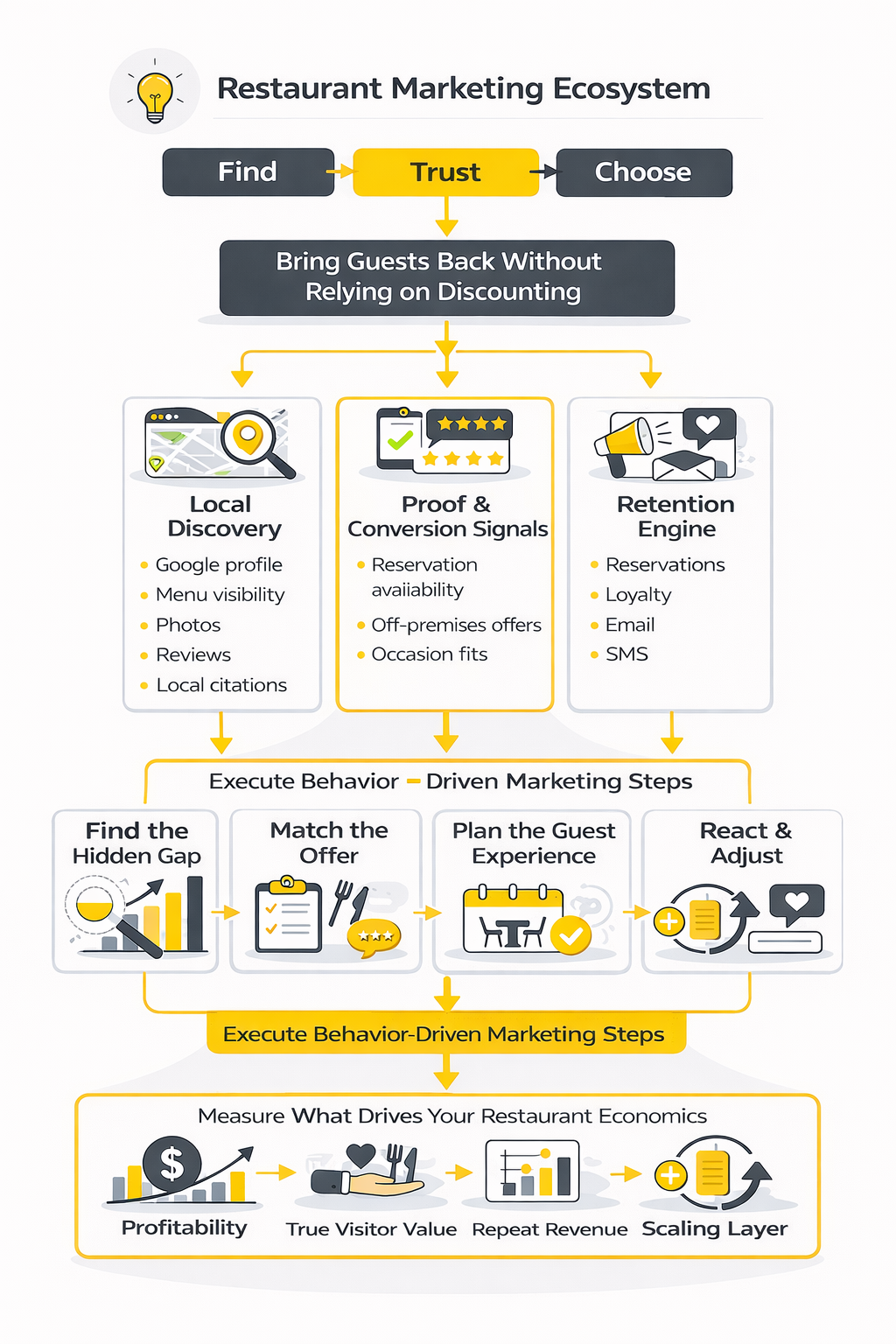
The pattern should be clear by now. Restaurant marketing works best when it behaves like an ecosystem, not a collection of disconnected tricks. Local discovery brings in qualified attention, conversion assets turn that attention into bookings or orders, retention systems create repeat visits, and measurement shows where the engine is strong or leaking. The operators who win are usually the ones who make those pieces work together consistently, not the ones chasing the loudest tactic of the month.
That ecosystem view matters even more in a market where diners discover restaurants across search, maps, reviews, reservation platforms, social content, and off-premises channels all at once. Google keeps emphasizing complete profiles and accurate business information, while Toast and SevenRooms keep highlighting the commercial value of reservations, guest data, personalization, and repeat behavior. In other words, modern restaurant marketing is part local SEO, part conversion design, part CRM, and part operating discipline.
Restaurant Marketing FAQ
What is restaurant marketing in practical terms?
Restaurant marketing is the system a restaurant uses to get discovered, chosen, revisited, and recommended. In practical terms, that means managing local search visibility, reviews, menu presentation, reservation or ordering flows, guest follow-up, and retention campaigns rather than treating marketing as just social posting or paid ads. That broader view fits how Google, Toast, and SevenRooms describe the modern guest journey.
Why does local search matter so much for restaurant marketing?
Local search matters because restaurant choices are often immediate and intent-driven. Google’s guidance still centers local ranking on relevance, distance, and prominence, and complete, accurate profiles are more likely to appear for the searches that actually convert. For a restaurant, that makes local visibility one of the highest-leverage parts of the whole marketing system.
What should a restaurant fix first if marketing is underperforming?
Start with the assets closest to the buying decision. That usually means your Google Business Profile, categories, hours, menu links, photos, reviews, and reservation or ordering path. If those are weak, every other part of restaurant marketing gets more expensive because you are paying to overcome avoidable friction.
Are social media followers a useful metric for restaurants?
They can be useful, but only in context. A growing follower count is not especially meaningful if reservations, calls, direct orders, or repeat visits do not move with it. Restaurant marketing should treat social metrics as secondary unless they clearly connect to buyer behavior and measurable guest actions.
How often should a restaurant ask for reviews?
Consistently, but without making the interaction feel robotic or pushy. Reviews influence both visibility and trust, and Google continues to show them prominently in local discovery experiences. The smartest approach is to build review requests into normal post-visit follow-up or receipt flows so the process happens steadily instead of only when someone remembers.
Is email still worth using for restaurant marketing?
Yes, especially when it is behavior-based rather than generic. Email works best for first-visit follow-up, event promotions, seasonal menu announcements, win-back campaigns, and loyalty communication tied to actual guest behavior. If you want a practical way to run those flows, Brevo is a reasonable option for email and segmentation.
Does SMS work better than email for restaurants?
Sometimes, but not automatically. SMS usually performs best for time-sensitive reminders, waitlist or booking communication, short promotions, and urgent availability updates, while email is better for richer offers, newsletters, and menu storytelling. For many restaurants, the best answer is not email versus SMS but a clean combination of both inside one follow-up system.
Should restaurants use loyalty programs?
Usually yes, but the structure matters. Loyalty works best when it reinforces convenience, recognition, and repeat behavior instead of training guests to wait for discounts. Toast’s regulars and reservation research, along with broader restaurant industry reporting, all point in the same direction: repeat guests are commercially important, and systems that recognize them outperform random reacquisition.
What are the most important numbers to track?
The most useful metrics usually sit in four buckets: discovery, conversion, retention, and economics. That means profile actions, calls, direction requests, bookings, order volume, repeat visit rates, CRM capture rates, average ticket, and channel profitability. These numbers matter because they help you decide what to fix next instead of just proving that activity happened.
How can a restaurant grow without relying on discounts?
Focus on value and occasion, not just lower prices. Experiential offers, group dining packages, priority access, chef events, seasonal specials, and convenience-led bundles often create demand without damaging brand perception the way constant discounting can. Current trend reporting from OpenTable, SevenRooms, and restaurant industry research all suggest diners still respond to experiences, personalization, and relevance.
What is the biggest mistake restaurants make with marketing tools?
They buy software before they define the workflow. A CRM, reservation tool, or automation platform only helps if the restaurant knows what data it wants to capture, which triggers should launch follow-up, and which metrics define success. When the process is clear, a platform like GoHighLevel can help centralize campaigns, lead capture, and automation, but the system still has to come first.
How long does restaurant marketing usually take to show results?
Some fixes can move fast. Updating profiles, photos, menu links, and review practices can affect calls, clicks, and booking behavior within weeks, while repeat-visit and retention improvements usually need longer because they depend on guest behavior over time. The key is to watch trend lines over multiple weeks instead of overreacting to a single busy or slow night.
Should independent restaurants market differently than multi-location brands?
Yes, but the core system is still the same. Independent restaurants often win through personality, local relevance, and sharper hospitality signals, while multi-location groups need stronger playbooks, cleaner reporting, and tighter brand controls so execution stays consistent. The difference is less about whether to do restaurant marketing and more about how much standardization the business needs.
What does a healthy restaurant marketing system look like at the end?
It looks boring in the best way. Discovery is steady, reviews are actively managed, ordering and booking flows are clear, guest data is being captured, repeat visit campaigns are running, and the team knows which numbers matter every week. When restaurant marketing reaches that point, growth becomes far more predictable because the restaurant stops depending on random spikes and starts benefiting from compounding systems.
Work With Professionals
Explore 10K+ Remote Marketing Contracts on MarkeWork.com
Most marketers spend too much time chasing clients, competing on crowded platforms, and losing a percentage of every project to middlemen.
MarkeWork gives you a better way. Browse thousands of remote marketing contracts and connect directly with companies desperate to hire skilled marketers like you, without platform commissions and without unnecessary gatekeepers.
If you're serious about finding better opportunities and keeping 100% of what you earn, explore available contracts and create a profile for free at MarkeWork.com.