

Most marketing looks good on the surface. Campaigns get clicks, posts get likes, dashboards show traffic going up. But none of that answers the only question that really matters: did it make money?
That’s where ROI marketing changes everything. Instead of guessing what works, it forces every campaign, tool, and channel to prove its value in revenue. And when you start thinking this way, your entire strategy shifts from activity to outcomes.
The gap is bigger than most people think. Even though email alone can generate returns above $10 for every $1 spent for many companies, a large portion of businesses still don’t track ROI properly, leaving serious revenue on the table (recent industry data). That’s not a tooling problem. That’s a strategy problem.
This article breaks down ROI marketing into a practical system you can actually use.
Article Outline
- What ROI Marketing Really Means
- Why ROI Marketing Matters More Than Ever
- ROI Marketing Framework Overview
- Core Components of ROI Marketing
- How to Implement ROI Marketing Like a Professional
- Advanced Optimization and Scaling Strategies
What ROI Marketing Really Means
ROI marketing is not a buzzword. It’s a financial lens applied to everything you do in marketing.
At its core, ROI marketing measures how much profit your marketing generates compared to what you spend. In simple terms, it answers: how many dollars did you get back for every dollar invested?
The standard formula is straightforward:
- ROI = (Revenue − Cost) / Cost
But the real meaning goes deeper than the formula. It’s about connecting marketing activity directly to business outcomes like revenue growth, customer acquisition, and profitability.
This is where most businesses fail. They track impressions, clicks, and engagement, but those are just surface-level signals. ROI marketing forces you to go further and tie everything back to actual financial impact.
When done right, it becomes the difference between “marketing that looks busy” and “marketing that drives growth.”
Why ROI Marketing Matters More Than Ever
Marketing used to be about visibility. Now it’s about accountability.
Budgets are tighter, competition is higher, and customer acquisition costs keep rising. If you can’t prove your marketing works, you don’t get to scale it. That’s why improving ROI and attribution consistently ranks as a top priority for marketers worldwide
There are three major reasons this shift is happening.
First, data has changed expectations. Companies now expect marketing to perform like a measurable investment, not a creative experiment. If you can track revenue in sales, you should be able to track it in marketing too.
Second, channel complexity exploded. You’re no longer running one campaign—you’re running dozens across email, ads, content, social, and automation. Without ROI marketing, you can’t tell what’s actually working.
Third, technology raised the ceiling. Tools like GoHighLevel and ClickFunnels make it easier than ever to track leads, conversions, and revenue across the full funnel. The capability is there. The question is whether you’re using it.
The result is simple: companies that understand ROI marketing scale faster, waste less budget, and make better decisions.
ROI Marketing Framework Overview
If you try to “improve ROI” without a system, you’ll get stuck in random optimizations that don’t move the needle.
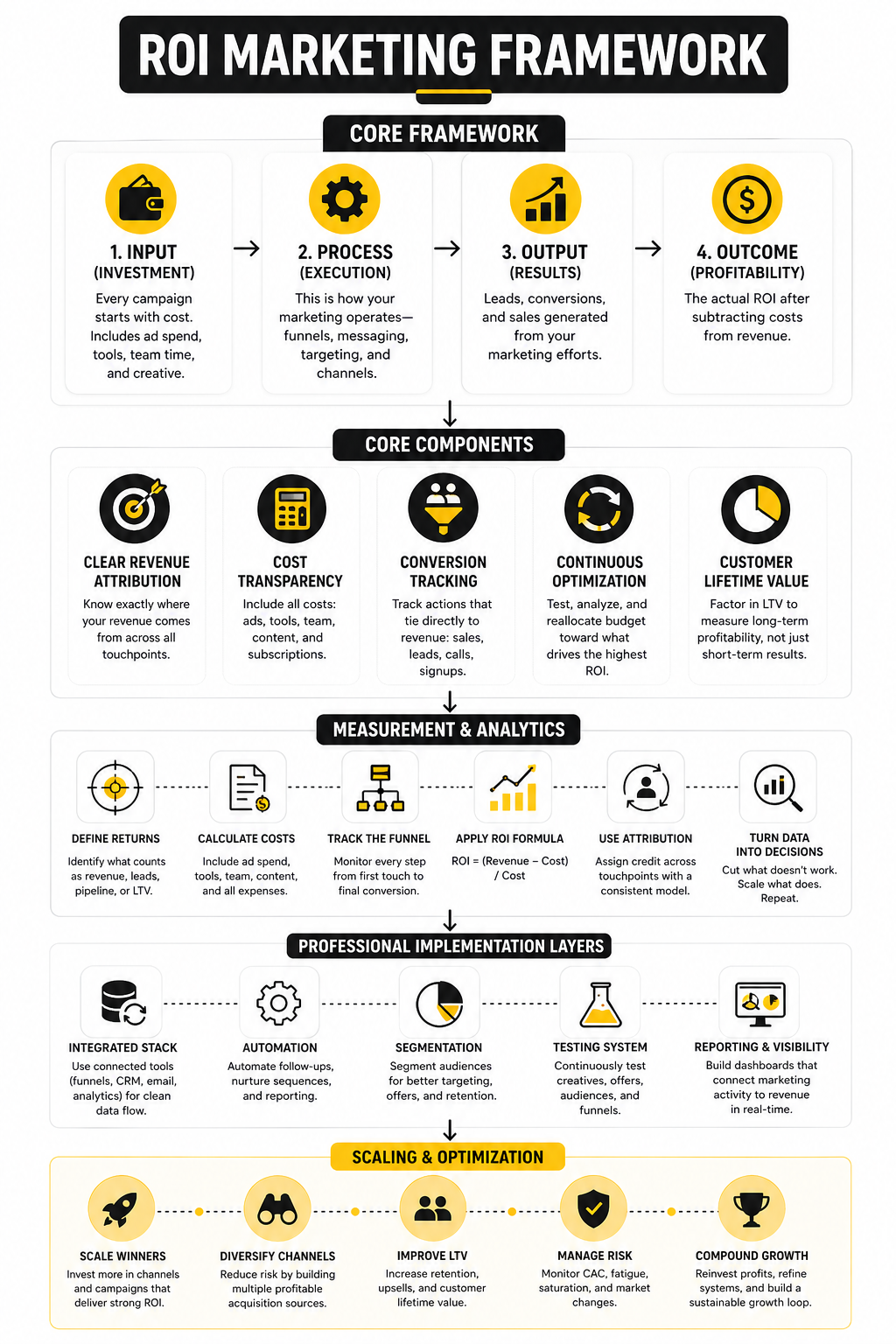
ROI marketing works best as a framework—a structured way of thinking about how money flows through your marketing.
At a high level, it looks like this:
- Input (Investment)
Every campaign starts with cost. This includes ad spend, tools, team time, and creative production.
- Process (Execution)
This is how your marketing operates—funnels, messaging, targeting, and channels.
- Output (Results)
Leads, conversions, and sales generated from your efforts.
- Outcome (Profitability)
The actual ROI after subtracting costs from revenue.
Most people focus only on the middle—the execution. But ROI marketing forces you to connect all four layers.
That’s where tools and systems become critical. For example, platforms like Systeme.io or Brevo help unify campaigns, tracking, and automation so you can actually measure performance end-to-end.
Without that visibility, you’re guessing. With it, you’re optimizing.
Core Components of ROI Marketing
To make ROI marketing work in practice, you need to understand the key components that drive it.
Clear Revenue Attribution
You need to know exactly where your revenue comes from. Not “probably from ads” or “maybe from email,” but specific channels, campaigns, and touchpoints.
This is one of the biggest challenges in modern marketing. Multiple touchpoints influence a single purchase, which makes attribution messy. But without solving it, ROI marketing breaks.
How to Measure ROI Marketing Step by Step
Understanding ROI marketing conceptually is one thing. Measuring it properly is where most businesses break.
The problem isn’t lack of data. It’s that the data is scattered across tools, channels, and stages of the funnel. To fix that, you need a structured measurement process that connects everything from spend to revenue.
Step 1: Define What Counts as a Return
Before you calculate anything, you need clarity on what “return” actually means in your business.
For ecommerce, it’s straightforward—revenue from purchases. But for service businesses or B2B, it’s more layered. A lead might turn into a deal weeks later, which means you need to track pipeline value, not just immediate conversions.
In ROI marketing, returns can include:
- Direct revenue from sales
- Lifetime value of acquired customers
- Qualified leads with assigned deal value
- Subscription revenue over time
This is why tools like GoHighLevel are often used—they allow you to track leads through the full pipeline, not just the first click.
If you don’t define return correctly, your ROI calculation will be incomplete from the start.
Step 2: Calculate True Marketing Costs
This is where most ROI calculations quietly fail.
People calculate ROI using only ad spend, which makes results look artificially strong. Real ROI marketing includes every cost required to generate that revenue.
Your full cost structure should include:
- Paid media spend (Google, Meta, TikTok)
- Software tools and platforms
- Funnel builders like ClickFunnels
- Email marketing systems like Moosend
- Team salaries or contractor fees
- Creative production costs
Even small overlooked expenses compound over time. If your ROI looks incredible but ignores half your costs, it’s not real ROI—it’s a distorted view.
Step 3: Track Conversions Across the Full Funnel
ROI marketing depends on visibility. You need to see what happens between the first touchpoint and the final conversion.
That means tracking:
- Landing page conversions
- Lead form submissions
- Email engagement and click-through
- Sales calls booked and closed
- Upsells and repeat purchases
Modern marketing is multi-touch. A user might discover you through content, get nurtured through email, and convert through a sales call. Without proper tracking, you lose the connection between effort and outcome.
This is where integrating tools matters. For example, combining funnel tracking with automation platforms like Systeme.io allows you to follow the entire journey without gaps.
Step 4: Apply the ROI Formula Correctly
Once you have revenue and costs clearly defined, the calculation itself is simple.
- ROI = (Revenue − Cost) / Cost
But interpretation is where skill comes in.
For example:
- ROI = 1 means you broke even
- ROI = 2 means you doubled your investment
- ROI = 0.5 means you’re losing money
In real-world ROI marketing, you rarely look at a single number in isolation. You compare ROI across:
- Channels (ads vs email vs organic)
- Campaigns (different creatives or offers)
- Time periods (monthly or quarterly performance)
This comparison is what drives smarter decisions.
Step 5: Factor in Customer Lifetime Value
Short-term ROI can be misleading if you ignore long-term revenue.
A campaign that looks unprofitable on the first purchase can become highly profitable when you factor in repeat purchases or subscriptions. This is especially true in SaaS, ecommerce, and membership-based businesses.
Customer lifetime value (LTV) helps you see the bigger picture.
For example:
- You spend $50 to acquire a customer
- They spend $40 initially (negative ROI)
- But over 6 months, they spend $200
Now your ROI is strong—but only if you measure it properly.
This is why ROI marketing is not just about immediate results. It’s about understanding revenue over time.
Step 6: Build a Reliable Attribution System
Attribution is one of the hardest parts of ROI marketing, but also one of the most important.
If you assign all credit to the last click, you undervalue earlier touchpoints like content and email. If you spread credit too evenly, you lose clarity on what actually drives conversions.
Common attribution models include:
- Last-click attribution
- First-click attribution
- Linear attribution
- Data-driven attribution
There’s no perfect model. The goal is consistency and clarity.
Platforms like Brevo help centralize customer interactions so you can make more informed attribution decisions instead of guessing.
Step 7: Turn Data Into Decisions
This is where ROI marketing becomes powerful.
Data alone doesn’t improve performance. Decisions do.
Once you have reliable ROI data, you can:
- Cut campaigns that are consistently unprofitable
- Scale channels that deliver strong returns
- Reallocate budget toward high-performing segments
- Improve messaging based on conversion data
This creates a feedback loop where every campaign improves the next one.
That’s the real advantage. You’re no longer guessing—you’re compounding knowledge.
In Part 3, we’ll break down the exact metrics that matter in ROI marketing, including which ones to ignore, which ones to prioritize, and how to use them to drive consistent growth.
ROI Marketing Benchmarks, Metrics, and What the Data Actually Means
At this point, you understand how to calculate ROI marketing. But raw numbers don’t help unless you know how to interpret them.
This is where most businesses get stuck. They see data, but they don’t know what “good” looks like, what’s broken, or what action to take next. The goal of this section is simple: turn metrics into decisions.
The Metrics That Actually Matter
There are dozens of marketing metrics, but only a handful directly impact ROI marketing. Everything else is either a leading indicator or noise.
The core metrics to focus on are:
- Customer Acquisition Cost (CAC)
- Customer Lifetime Value (LTV)
- Conversion Rate (CVR)
- Return on Ad Spend (ROAS)
- Overall Marketing ROI
These metrics are connected. CAC tells you what it costs to acquire a customer. LTV tells you what that customer is worth. ROI marketing lives in the gap between those two numbers.
For example, if your CAC is $100 and your LTV is $300, you have room to scale. If those numbers are reversed, you’re burning money—even if your campaigns “look” successful.
Real Benchmarks (and How to Think About Them)
Benchmarks are useful, but only if you understand the context behind them.
Email marketing, for example, consistently delivers some of the highest returns in digital marketing. Many businesses see returns around $36 for every $1 spent (litmus.com). That sounds incredible, but it only works when you have a strong list and proper segmentation.
Paid ads are very different. A “good” ROAS in ecommerce often falls between 2x and 4x depending on margins and industry (shopify.com). But that number alone doesn’t tell you if you’re profitable. If your margins are thin, even a 4x ROAS might not be enough.
Here’s how to think about benchmarks in ROI marketing:
- They are reference points, not goals
- They vary heavily by industry and business model
- They only matter when paired with your cost structure
Blindly chasing industry averages is one of the fastest ways to make bad decisions.
The Analytics System Behind ROI Marketing
To make sense of these metrics, you need a system that connects everything in one place.
At a minimum, your analytics stack should include:
- A funnel builder or CRM to track leads and deals
- A marketing automation platform to track engagement
- A reporting layer to connect spend with revenue
This is where most setups fall apart. Data lives in silos, which means you can’t see the full picture.
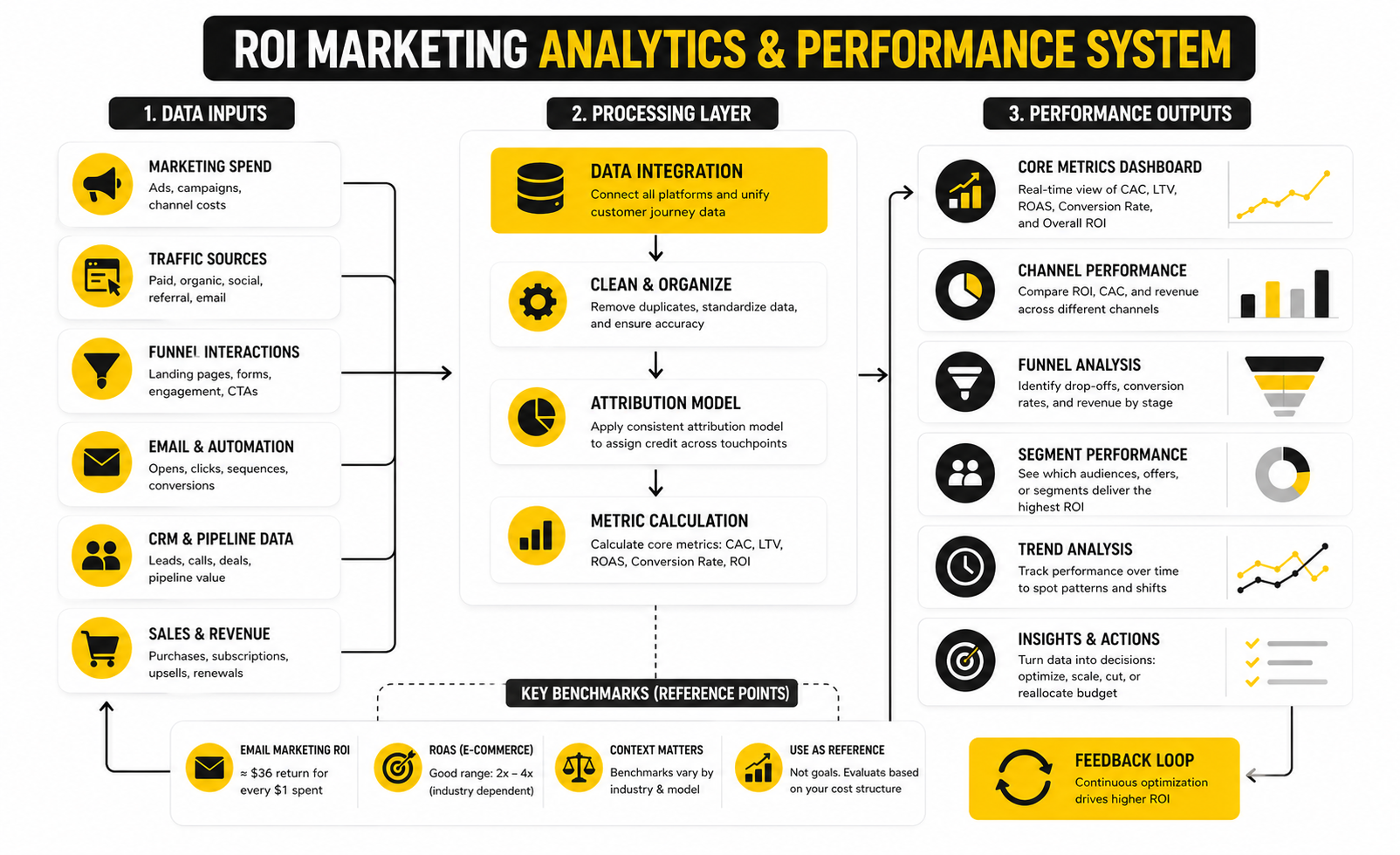
When your analytics system is working properly, you should be able to answer questions like:
- Which campaign generated the most profitable customers?
- Which channel has the lowest acquisition cost?
- Where are users dropping off in the funnel?
- Which segments produce the highest lifetime value?
Platforms like GoHighLevel or Systeme.io are often used because they centralize funnels, CRM, and automation into one system. That removes a lot of the guesswork and gives you clean ROI visibility.
How to Interpret Performance Signals
Numbers don’t mean anything on their own. What matters is the signal behind them.
Here are the most important patterns to watch in ROI marketing:
Rising Traffic, Flat Revenue
This usually means your funnel is broken.
You’re attracting attention, but not converting it. The issue could be messaging, offer clarity, or landing page friction. Increasing traffic in this situation only makes the problem worse.
Strong Conversion Rate, Low ROI
This often points to high costs.
You’re converting well, but spending too much to acquire customers. The fix isn’t always better ads—it might be reducing CAC through organic channels or improving retention.
High ROI, Low Volume
This is one of the best problems to have.
Your campaigns are profitable, but you’re not spending enough. In ROI marketing, this is a signal to scale carefully while maintaining efficiency.
Declining ROI Over Time
This usually indicates saturation or fatigue.
Your audience has seen your ads too many times, or competition has increased. This is where creative testing and new channels become critical.
Turning Metrics Into Action
The entire purpose of ROI marketing is to drive better decisions.
Here’s how to translate data into action:
- If CAC is too high → refine targeting, improve creatives, or test new channels
- If LTV is too low → improve retention, upsells, or customer experience
- If conversion rates are low → optimize landing pages and offers
- If ROI is strong → increase budget and scale what works
This sounds simple, but the difference is execution. Most businesses collect data and stop there. High-performing teams act on it consistently.
Tools like Brevo or ManyChat help close that loop by linking engagement directly to conversion data, making it easier to act quickly.
The Reality Most People Miss
ROI marketing is not about finding perfect numbers. It’s about reducing uncertainty.
You will never have perfect attribution. You will never have complete data. But you can get close enough to make confident decisions.
And that’s the real advantage.
Companies that win with ROI marketing are not the ones with the best dashboards. They’re the ones who use data to move faster, cut losses earlier, and scale winners harder.
In Part 5, we’ll go deeper into professional implementation—how high-performing teams structure ROI marketing systems, workflows, and decision-making processes at scale.
Advanced ROI Marketing: Scaling Without Breaking Profitability
Once your ROI marketing system is working, the next challenge is scaling it without destroying performance.
This is where things get harder. What works at a small budget doesn’t always work at scale. Costs increase, audiences get saturated, and inefficiencies that didn’t matter before suddenly become expensive.
The goal at this stage is not just growth. It’s controlled growth.
The Scaling Trap Most Businesses Fall Into
There’s a common pattern that repeats across industries.
A campaign starts working. ROI is strong. The natural reaction is to increase budget quickly. For a short time, everything looks great. Then performance drops, costs rise, and profitability disappears.
This happens because scaling exposes weaknesses.
- Audiences become less targeted
- Creatives fatigue faster
- Conversion rates drop under broader traffic
ROI marketing forces you to scale with discipline, not emotion. Growth without profitability is not growth—it’s delayed loss.
Horizontal vs Vertical Scaling
There are two fundamentally different ways to scale ROI marketing, and confusing them is expensive.
Vertical scaling means increasing spend on what already works. You’re pushing more budget into proven campaigns. This is the fastest way to grow, but it also hits limits quickly due to saturation.
Horizontal scaling means expanding into new audiences, channels, or offers. This takes more effort, but it’s how you sustain growth long-term.
In practice, you need both:
- Use vertical scaling for short-term gains
- Use horizontal scaling for long-term stability
For example, you might scale ads inside funnels built with ClickFunnels, while simultaneously testing new acquisition channels or lead magnets.
The Role of Margins in ROI Marketing
At scale, margins become everything.
A campaign with a 3x ROAS might look strong, but if your margins are 30%, you’re barely breaking even. On the other hand, a 2x ROAS business with high margins can be extremely profitable.
This is why advanced ROI marketing always connects marketing data with financial data.
You need to know:
- Gross margin per product
- Contribution margin after marketing costs
- Break-even acquisition cost
Without this, scaling decisions become guesswork.
Automation and Operational Leverage
As campaigns grow, manual processes start to break.
You can’t manually track every lead, follow up with every prospect, or optimize every campaign by hand. This is where automation becomes critical.
Systems built inside platforms like GoHighLevel or Systeme.io allow you to:
- Automate lead nurturing
- Trigger follow-ups based on behavior
- Segment audiences dynamically
- Track pipeline movement in real time
Automation doesn’t just save time. It protects ROI by ensuring no opportunities are lost as volume increases.
Managing Risk in ROI Marketing
Scaling always introduces risk.
Markets change, platforms update algorithms, and customer behavior shifts. What worked last quarter might stop working next month.
Strong ROI marketing systems account for this.
You should always:
- Diversify acquisition channels
- Avoid relying on a single campaign or platform
- Continuously test new creatives and offers
- Monitor early warning signals like rising CAC
This reduces the chance of sudden performance drops that can wipe out profits.
Creative Fatigue and the Hidden ROI Killer
One of the most underestimated problems in ROI marketing is creative fatigue.
When the same ads run too long, performance declines. Costs go up, engagement drops, and conversion rates fall. This happens even if your targeting is perfect.
At scale, creative becomes a system, not a one-time effort.
High-performing teams:
- Produce new variations constantly
- Test messaging angles aggressively
- Refresh visuals before performance drops
This is where tools like Flick or content workflows integrated with automation platforms can help maintain consistency without overwhelming your team.
When to Stop Scaling
This is the question almost no one asks.
Not every campaign should be scaled indefinitely. At some point, increasing spend reduces efficiency to the point where ROI no longer justifies the growth.
Clear signals to pause or slow scaling include:
- Rapidly increasing acquisition costs
- Declining conversion rates across multiple campaigns
- Reduced lifetime value from new customers
ROI marketing is not about maximizing spend. It’s about maximizing profitable spend.
Building a Long-Term ROI Engine
At an advanced level, ROI marketing stops being campaign-focused and becomes system-focused.
Instead of asking “How do we improve this campaign?” you start asking:
- How do we improve the entire customer journey?
- How do we increase retention and lifetime value?
- How do we reduce dependency on paid acquisition?
This is where the biggest gains happen.
For example, improving retention by even a small percentage can significantly increase profitability over time, which is why many growth strategies focus heavily on customer experience and lifecycle marketing (harvard business insights on retention impact)
ROI marketing at this level is no longer just about acquisition. It becomes a full business growth strategy.
In Part 6, we’ll bring everything together with practical takeaways, common mistakes to avoid, and answers to the most important questions about ROI marketing.
Bringing It All Together: The ROI Marketing Ecosystem
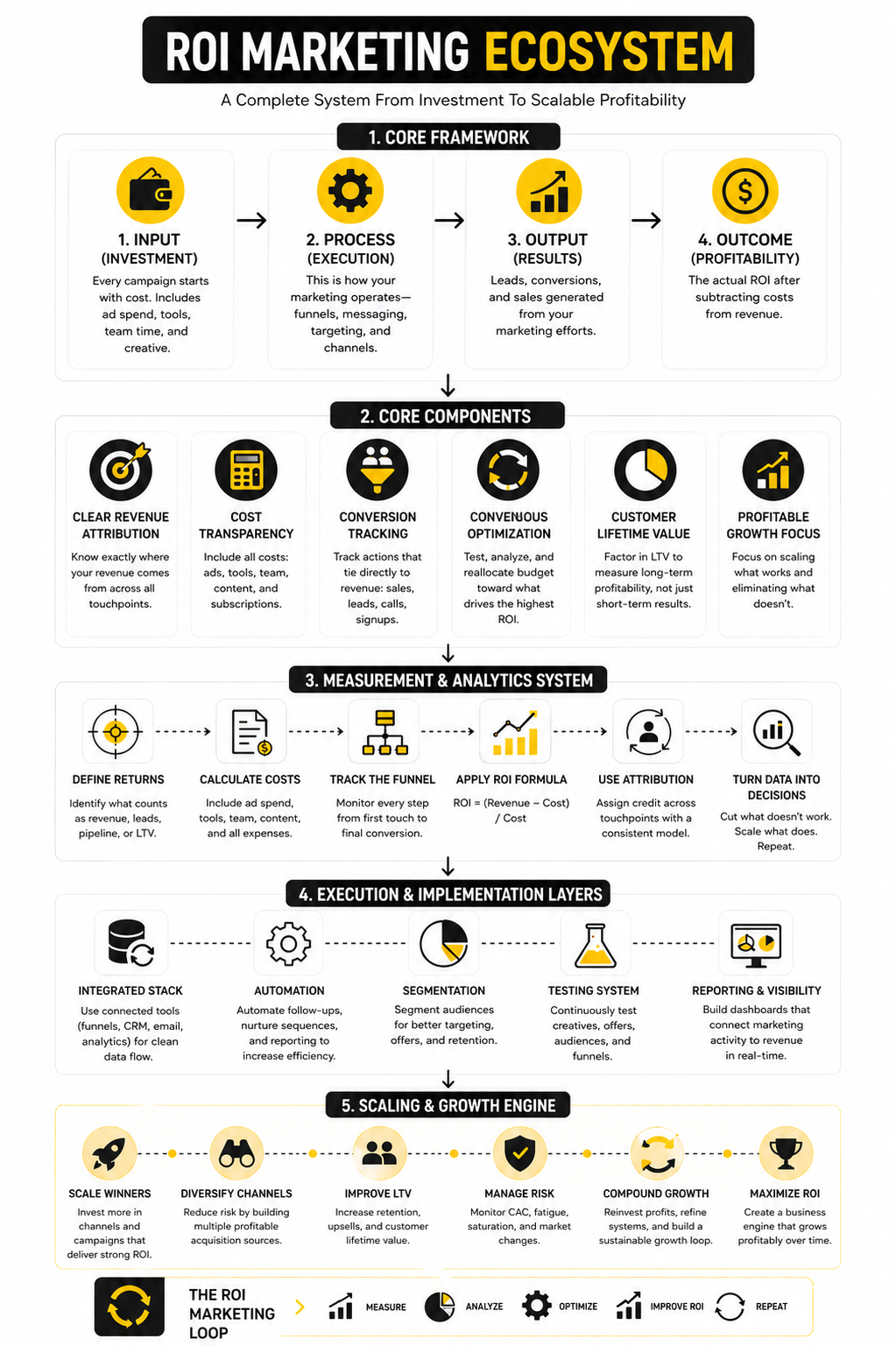
By now, the pattern should be clear. ROI marketing is not one tactic, one tool, or one campaign. It’s an ecosystem where every part of your marketing feeds into measurable business outcomes.
At the center of this system is a simple loop:
- You invest in marketing
- You track what happens across the funnel
- You measure outcomes against cost
- You optimize based on real data
Then you repeat.
What separates high-performing teams is how tightly this loop is built. They don’t rely on disconnected tools or gut decisions. They create a unified system where data flows cleanly from first click to final revenue.
This is where platforms start to matter more. When your funnel builder, CRM, automation, and analytics live in one place—like inside GoHighLevel or Systeme.io—you eliminate blind spots and make faster decisions.
And speed matters. Because in ROI marketing, the faster you learn, the faster you grow.
FAQ - Built for Complete Guide
What is ROI marketing in simple terms?
ROI marketing is the process of measuring how much revenue your marketing generates compared to how much you spend. It focuses on profitability, not just activity. Instead of tracking vanity metrics, it forces every campaign to prove financial impact.
What is a good ROI in marketing?
A “good” ROI depends on your margins and business model. Many businesses aim for at least a 2:1 return, but high-performing channels like email can deliver significantly higher returns in certain cases (litmus.com). The key is aligning ROI with your actual cost structure.
How is ROI different from ROAS?
ROAS measures revenue generated from ad spend only, while ROI includes all costs—tools, salaries, production, and more. ROI marketing gives a more complete picture of profitability. ROAS is useful, but incomplete on its own.
Why do most businesses struggle with ROI marketing?
The biggest issue is fragmented data. Marketing tools, CRMs, and analytics platforms often don’t connect properly. Without a unified system, it’s hard to track the full customer journey and assign revenue accurately.
Can small businesses benefit from ROI marketing?
Yes, and often more than large companies. Smaller teams can implement clean tracking and make faster decisions. With tools like Brevo, even small businesses can track campaigns and automate follow-ups effectively.
How often should ROI be measured?
ROI should be monitored continuously, not occasionally. Weekly reviews are common for active campaigns, while monthly or quarterly reviews help identify long-term trends. The key is consistency.
What’s the biggest mistake in ROI marketing?
Ignoring full costs. Many businesses only calculate ad spend and ignore tools, team, and production costs. This leads to inflated ROI numbers and poor decision-making.
How do you improve ROI marketing quickly?
Start by identifying underperforming campaigns and cutting them. Then double down on what works. Even small improvements in conversion rates or acquisition costs can significantly increase overall ROI.
Is attribution ever fully accurate?
No, and that’s important to accept. Modern customer journeys involve multiple touchpoints, making perfect attribution impossible. The goal is not perfection—it’s clarity that’s good enough to make confident decisions.
What role does automation play in ROI marketing?
Automation ensures consistency and scalability. It helps capture leads, nurture them, and convert them without manual effort. Tools like ManyChat or Chatbase connect engagement directly to conversions, making ROI tracking more reliable.
How long does it take to see ROI improvements?
It depends on your current setup. Some improvements—like fixing tracking or optimizing funnels—can show results quickly. Others, like increasing customer lifetime value, take longer but have a bigger long-term impact.
Do you need expensive tools to do ROI marketing?
No. What matters is integration, not price. Even simple stacks can work if your data flows correctly. That said, all-in-one platforms often reduce complexity and improve visibility.
Work With Professionals
Explore 10K+ Remote Marketing Contracts on MarkeWork.com
Most marketers spend too much time chasing clients, competing on crowded platforms, and losing a percentage of every project to middlemen.
MarkeWork gives you a better way. Browse thousands of remote marketing contracts and connect directly with companies desperate to hire skilled marketers like you, without platform commissions and without unnecessary gatekeepers.
If you're serious about finding better opportunities and keeping 100% of what you earn, invite readers to explore available contracts and create a profile for free at MarkeWork.com.