

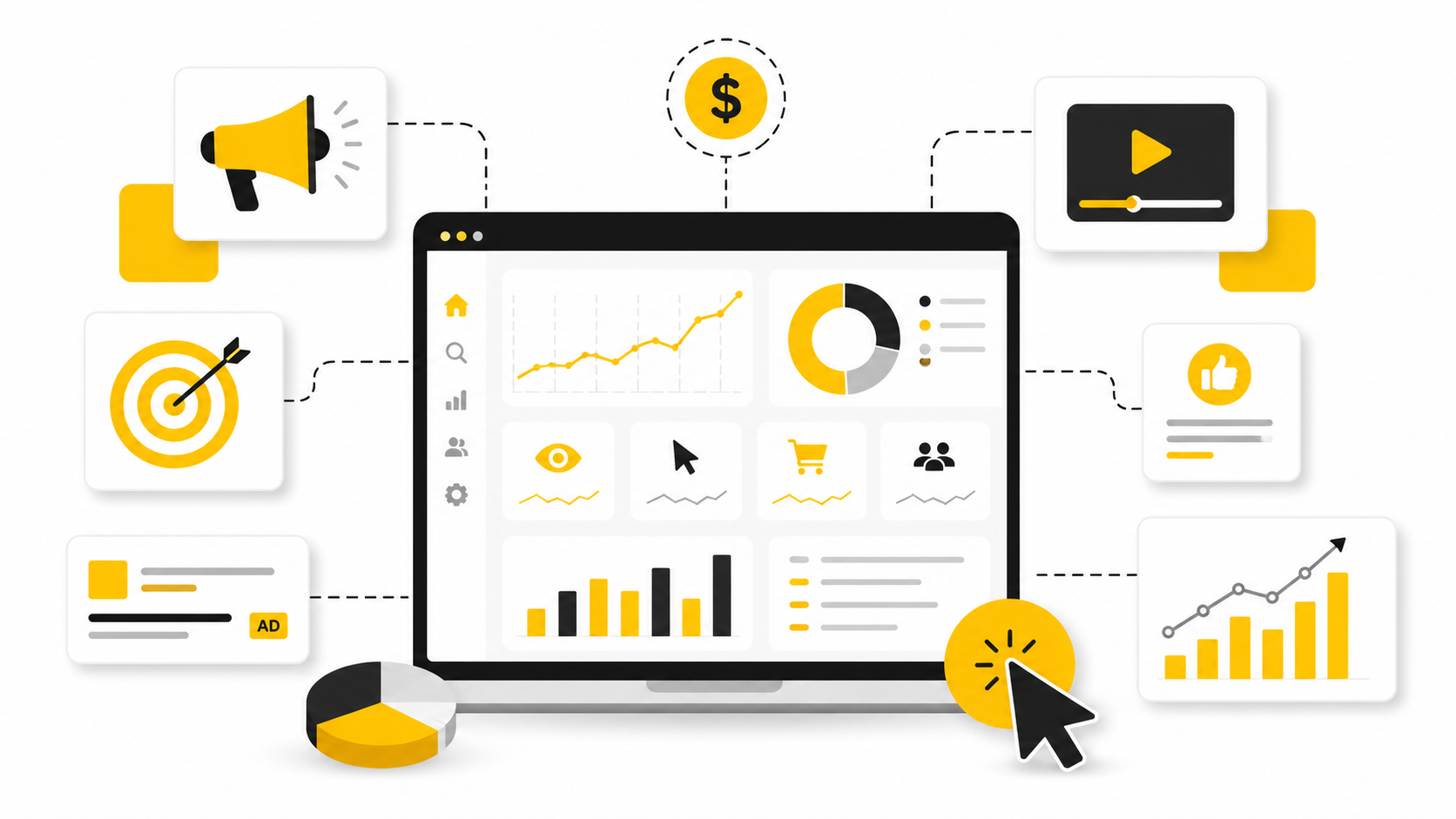
Scaling internet advertising is not just increasing the daily budget. That is the easy part. The harder part is increasing spend while keeping lead quality, conversion rates, fulfillment capacity, and customer economics under control.
A campaign can look scalable inside the ad platform and still create pressure elsewhere in the business. More leads can overwhelm a sales team. More orders can expose weak fulfillment. More impressions can accelerate creative fatigue. This is why scaling should be treated as an operational decision, not only a media buying decision.
The safest way to scale is to identify what is already proven, then expand carefully. Increase budget on campaigns with stable economics, add new creative angles before performance decays, open new audience pools only when the core offer is converting, and watch downstream revenue quality as closely as platform results.
Budget Scaling and Diminishing Returns
Most campaigns do not scale in a straight line. As budget increases, the platform often has to reach broader audiences, more competitive auctions, or less responsive users. That can raise costs even when the campaign is still technically working.
This is why small-budget results should not be blindly projected upward. A campaign spending 100 per day profitably may not behave the same at 1,000 per day. The bigger the spend, the more the system needs creative depth, stronger tracking, better conversion paths, and tighter sales feedback.
The practical move is to scale in stages. Increase budgets gradually when the campaign has enough conversion volume, stable cost trends, and no obvious bottlenecks. If performance drops after a budget increase, do not panic immediately, but do check whether the issue is auction expansion, weak creative supply, landing page friction, or poor lead handling.
Creative Fatigue and Message Rotation
Creative fatigue happens when the same audience sees the same message too often and stops responding. It can show up as rising CPMs, falling click-through rates, weaker conversion rates, or a sudden drop in engagement quality. The fix is not always a new campaign; often, it is a better creative pipeline.
Modern ad platforms increasingly use automation to match creative to users. Meta has described Advantage+ automation as a system that can handle audience creation, budget allocation, placement, and creative generation across Meta surfaces through its Andromeda advertising infrastructure. That makes creative supply more important, not less important.
The best teams plan creative like inventory. They keep testing new hooks, formats, proof points, objections, and offers before performance declines. That gives the algorithm more useful material and gives the audience a reason to pay attention again.
Channel Expansion and Media Mix
Once one channel works, the natural temptation is to add another one immediately. Sometimes that is smart. Other times, it creates noise before the first channel has been fully understood.
Channel expansion should happen when there is a clear strategic reason. Search can capture existing demand. Paid social can create demand and retarget engaged audiences. Video can explain complex offers. Creator campaigns can add trust and distribution. Email and SMS can convert leads that were not ready on the first visit.
The latest IAB/PwC report shows U.S. internet advertising revenue reached $294.6 billion in 2025, with video, social, commerce media, and creator advertising playing major roles in growth. That does not mean every brand needs every channel. It means advertisers need to understand where their buyers pay attention and where the offer can be explained profitably.
Automation, AI, and Human Judgment
AI is now part of internet advertising at every level: campaign creation, bidding, targeting, creative testing, reporting, audience modeling, and customer follow-up. Google has continued expanding Performance Max controls and transparency through new Performance Max features, while major platforms are pushing advertisers toward broader automation. Used well, this can remove repetitive work and improve signal processing.
The tradeoff is control. Automation can optimize toward the wrong outcome if the conversion signal is weak. It can spend efficiently on cheap leads that never buy. It can also hide useful details if the advertiser does not maintain a separate view of CRM quality, customer value, and creative performance.
Human judgment still matters because the machine does not understand your margins, positioning, sales constraints, or brand risk unless you structure the system properly. The smart approach is not “manual versus automated.” It is giving automation better inputs, then using human strategy to decide what should happen next.
Privacy, Compliance, and Trust
Privacy is not a side issue anymore. Consent, data minimization, platform rules, regional privacy laws, and consumer expectations now shape how internet advertising can be targeted and measured. Advertisers who ignore this create legal, reputational, and measurement risk.
The IAB’s State of Data 2025 companion guidance emphasizes combining first-party data, contextual signals, second-party partnerships, and privacy-safe modeling in modern campaign planning through its 2025 data strategy guidance. That direction is practical because it reduces dependence on any single signal source.
Trust also affects performance. People are more cautious with their data, more skeptical of exaggerated claims, and more likely to compare before they convert. Clear privacy language, honest offers, transparent forms, and consistent follow-up are not just compliance details; they help the campaign feel credible.
When Not to Scale
Sometimes the smartest move is not scaling. If the campaign is converting but the sales team cannot follow up quickly, more spend will amplify the problem. If the landing page is weak, more traffic will only expose the weakness faster.
You should also hold back when attribution is unclear, refund rates are high, customer feedback is poor, or the business cannot fulfill demand without hurting quality. Paid traffic is a multiplier. It multiplies what already exists.
This is the part people skip because it is less exciting than raising the budget. But it matters. Internet advertising scales best when the business behind the campaign is ready for more attention, more conversations, more customers, and more operational pressure.
FAQ - Built for Complete Guide
What is internet advertising?
Internet advertising is the use of paid digital placements to reach people online and move them toward a business goal. That can include search ads, social ads, display ads, video ads, creator campaigns, ecommerce ads, sponsored content, retargeting, and paid placements inside marketplaces or apps. The best way to think about it is not as one channel, but as a connected system for creating demand, capturing intent, and converting attention into revenue.
Why is internet advertising important?
Internet advertising matters because people now discover, compare, and buy through digital touchpoints. U.S. digital ad revenue reached nearly $300 billion in 2025, which shows how central online channels have become to modern growth. The opportunity is huge, but the competition is also sharper, so success depends on strategy, measurement, creative, and follow-up.
What are the main types of internet advertising?
The main types are search advertising, paid social, display advertising, video advertising, native advertising, influencer or creator advertising, email sponsorships, affiliate campaigns, and retail media. Each one plays a different role. Search captures demand, social can create demand, video explains and persuades, and retargeting brings people back when they were not ready the first time.
How much should a business spend on internet advertising?
There is no universal number because budget depends on the offer, margins, sales cycle, market competition, and conversion rate. A small local service business might start with a controlled test budget, while an ecommerce brand or SaaS company may need more volume to generate reliable data. The practical rule is to spend enough to learn, but not so much that weak tracking or an unproven offer creates expensive confusion.
Which internet advertising platform is best?
The best platform is the one that matches buyer intent and campaign economics. Google Ads is usually strong when people are already searching for a solution, while Meta, TikTok, LinkedIn, YouTube, and creator campaigns can work well when the offer needs discovery or education. Platform choice should come after the audience, offer, message, and conversion path are clear.
How do you measure internet advertising performance?
Measure performance in layers: delivery, engagement, conversion, revenue, and customer quality. Clicks and impressions show activity, but they do not prove profitable growth. A serious campaign should connect ad spend to qualified leads, purchases, booked calls, pipeline value, close rates, retention, and customer lifetime value.
What is a good conversion rate for internet advertising?
A good conversion rate depends on the industry, offer, traffic temperature, pricing, and page experience. A simple lead magnet may convert much higher than a high-ticket consultation page, but that does not automatically make it more valuable. The better question is whether the conversion rate supports profitable customer acquisition.
Why do internet advertising campaigns fail?
Most campaigns fail because the system is incomplete. The audience may be too broad, the offer may be weak, the creative may not create enough interest, the landing page may not match the ad, or the follow-up process may be slow. Sometimes the ad account gets blamed when the real issue is the funnel, sales process, or product positioning.
How long does internet advertising take to work?
Some campaigns can produce early signals quickly, especially search campaigns with high intent or retargeting campaigns with warm audiences. But stable performance usually takes enough conversion volume to understand what is actually happening. The goal is not to judge too early; it is to collect clean data, make focused improvements, and avoid random edits that destroy the test.
Is AI changing internet advertising?
Yes, AI is changing campaign setup, bidding, creative generation, targeting, reporting, and optimization. Google has expanded AI-driven campaign tools and Performance Max controls through 2025 Google Ads updates, while the broader industry is moving toward AI-supported media planning and measurement. But AI still needs strong human inputs: clear offers, clean data, useful creative, and smart business judgment.
What role does first-party data play?
First-party data helps advertisers measure and optimize when platform tracking is incomplete. It includes customer records, email lists, purchase data, lead stages, booking activity, and CRM outcomes. The industry shift toward first-party data, alternative IDs, and data clean rooms is clearly outlined in the IAB State of Data 2025 report, and the practical takeaway is simple: businesses need to own more of their customer intelligence.
Can small businesses use internet advertising effectively?
Yes, but small businesses need discipline. They should avoid spreading budget across too many channels, chasing every trend, or copying large-brand strategies that do not match their economics. A focused offer, one or two strong channels, clean tracking, and fast follow-up will usually beat a complicated setup with no clear conversion path.
What is the biggest mistake beginners make with internet advertising?
The biggest mistake is launching ads before the offer and conversion path are ready. Paid traffic will not fix unclear positioning, slow pages, weak proof, poor follow-up, or a confusing call to action. Advertising works best when it amplifies a system that already makes sense.
How should a business start with internet advertising?
Start with one clear goal, one defined audience, one strong offer, and one primary channel. Build the landing page or funnel around that offer, set up tracking before launch, and decide what success means before spending. Once the first campaign produces reliable signals, improve the weak point instead of randomly rebuilding everything.
Work With Professionals
Explore 10K+ Remote Marketing Contracts on MarkeWork.com
Most marketers spend too much time chasing clients, competing on crowded platforms, and losing a percentage of every project to middlemen.
MarkeWork gives you a better way. Browse thousands of remote marketing contracts and connect directly with companies desperate to hire skilled marketers like you, without platform commissions and without unnecessary gatekeepers.
If you’re serious about finding better opportunities and keeping 100% of what you earn, explore available contracts and create a profile for free at MarkeWork.com.