

Most brands obsess over what people see and hear. Far fewer think hard about what customers smell the moment they walk through the door, step into a lobby, open a package, or move through a showroom. That gap matters, because scent works fast, reaches people on an emotional level, and can make an environment feel generic or unmistakably branded in a matter of seconds.
That is why scent marketing keeps showing up in retail, hospitality, automotive, wellness, and premium service environments. Done well, it does not feel like a gimmick or a perfume cloud. It feels like the space simply makes sense, and that subtle sense of fit can strengthen comfort, memory, and brand perception long after the visit ends.
Scent marketing is not about pumping fragrance into a room and hoping people spend more. The smart version is much more disciplined than that. It starts with brand identity, matches the scent to the environment, controls intensity, and respects the fact that smell can help people feel welcome just as easily as it can push them away.
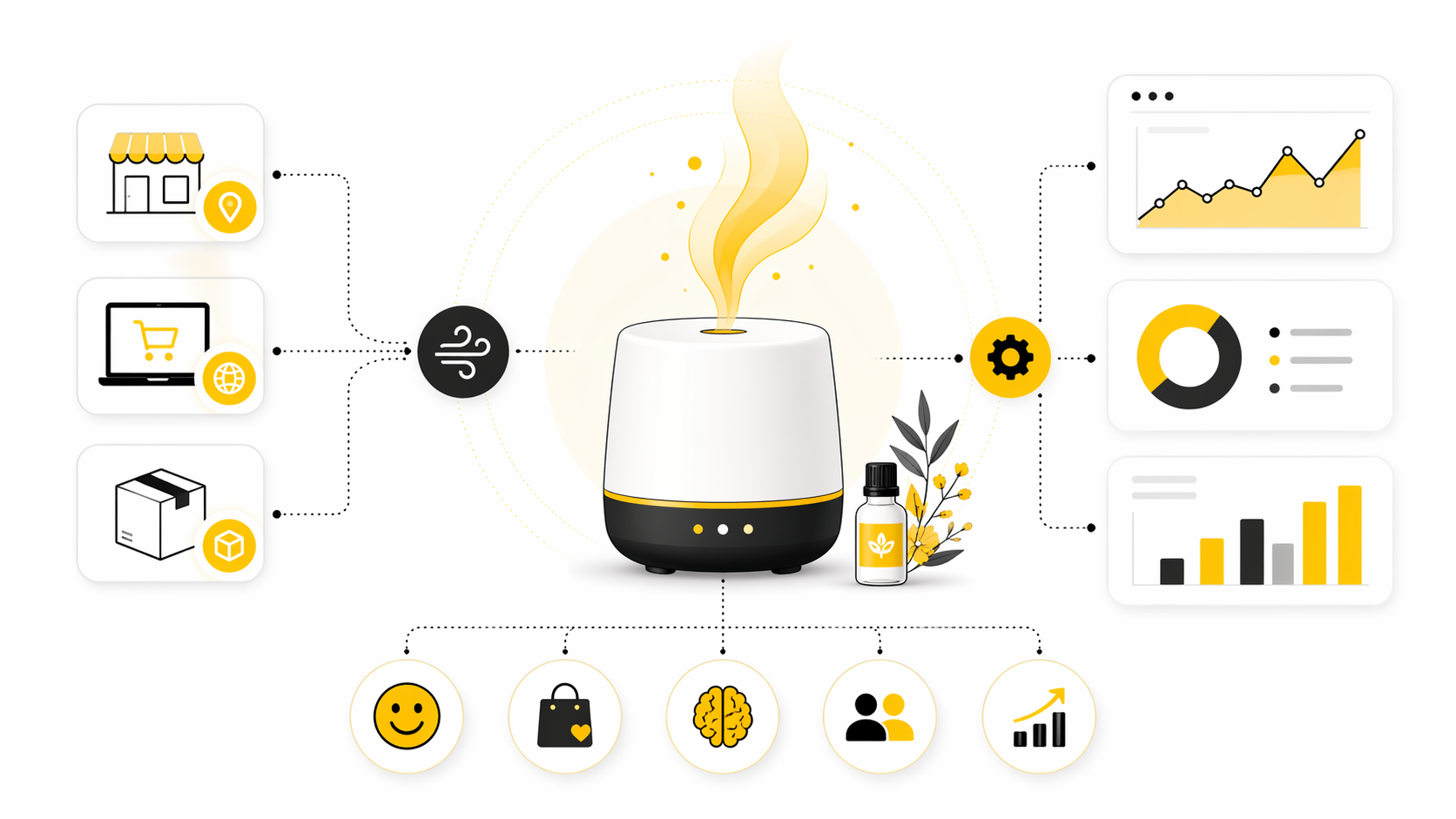
- What Scent Marketing Actually Means
- Why Scent Marketing Matters More Than Most Brands Realize
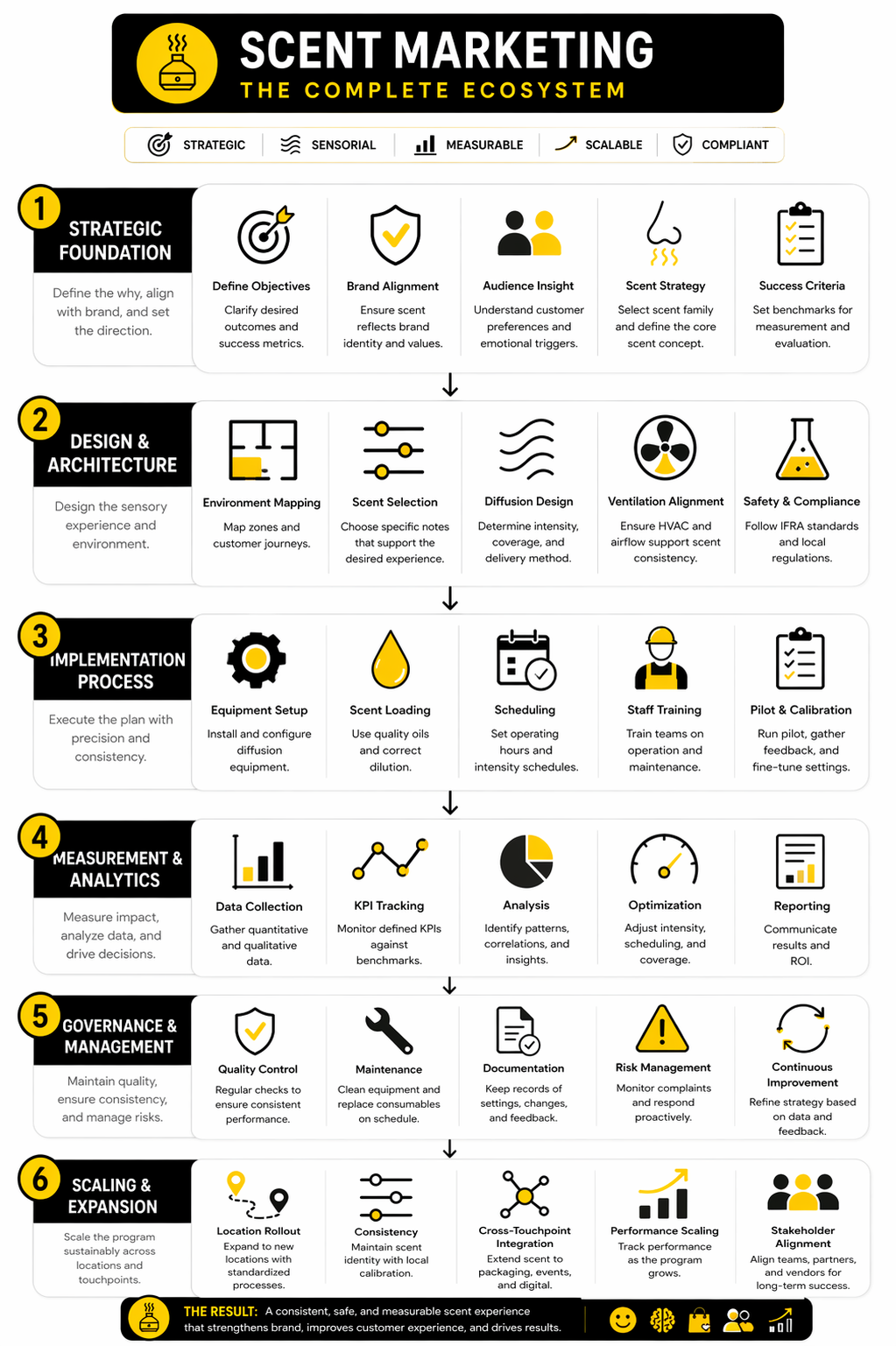
- The Scent Marketing Framework
- The Core Components of a High-Performing Scent Strategy
- How Professionals Implement Scent Marketing Without Guesswork
- How to Measure Results, Avoid Mistakes, and Scale Responsibly
What Scent Marketing Actually Means
Scent marketing is the deliberate use of fragrance to support a brand, a space, or a customer experience. In practice, that can mean a signature scent in a hotel lobby, a carefully selected ambient aroma in a retail store, or a fragrance cue designed to reinforce how a premium service environment is supposed to feel. The point is not fragrance for its own sake. The point is to make the brand more memorable, more coherent, and more emotionally resonant.
That distinction matters because a lot of businesses confuse scent marketing with air freshening. They are not the same thing. Air freshening solves an odor problem, while scent marketing is a brand and experience decision tied to positioning, audience, context, and customer behavior.
The best scent strategies are built on fit. A fragrance has to align with the personality of the brand, the physical environment, and the emotional state the business wants to create. A luxury boutique, a family resort, a medspa, and a car showroom may all benefit from scent, but they should not smell remotely similar because they are not trying to create the same experience.
Scent also behaves differently from other marketing inputs. People can ignore a sign, skip a song, or scroll past a video, but smell enters the experience more directly. That is exactly why scent marketing can be powerful, and exactly why it has to be used with more care than many brands expect.
Why Scent Marketing Matters More Than Most Brands Realize
Brands invest heavily in logos, store design, packaging, sound, and digital creative because those assets help shape recognition. Scent can do something similar, but in a more atmospheric way. It helps turn a location from a physical space into a felt experience, and that difference is often what separates a place people remember from a place they forget almost immediately.
This matters even more now because physical environments have to work harder than they used to. Stores, hotels, studios, and showrooms are no longer competing only on product selection or convenience. They are competing on experience, and experience is multisensory whether a company plans for that or not.
Smell also has unusual leverage because it interacts with mood and memory so quickly. When the fragrance fits the environment, it can make a space feel calmer, warmer, cleaner, more premium, or more distinctive without adding visual clutter. That gives scent marketing a very specific job: it can reinforce what the brand already wants the customer to feel.
There is another reason it matters. Strong visual branding is easy to copy. Pricing can be undercut. Promotions expire. But a well-developed scent signature can become part of the brand’s identity in a way that is much harder to imitate cleanly across locations and touchpoints. That makes scent less like decoration and more like a long-term brand asset.
None of this means scent is automatically effective. The wrong fragrance, the wrong intensity, or the wrong context can create friction instead of affinity. That is why the real question is not whether scent marketing works in the abstract. The real question is what kind of scent, in what space, at what strength, for which audience, and in support of which brand promise.
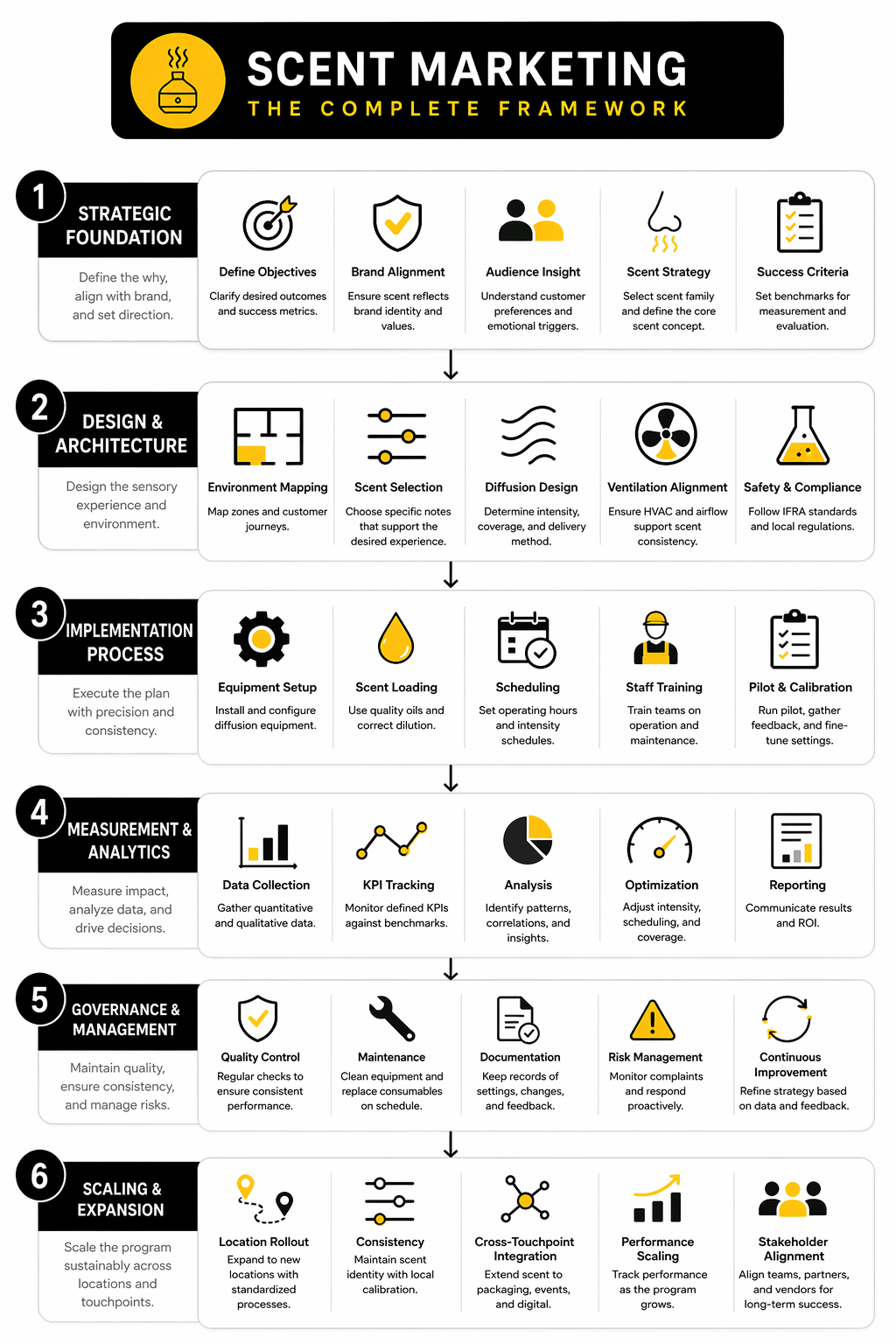
The Scent Marketing Framework
A practical way to think about scent marketing is to treat it as a four-part system: brand fit, environmental fit, delivery control, and measurement. If one of those pieces is weak, the whole strategy gets shaky fast. That is why experienced operators do not begin with fragrance samples. They begin with the brand, the audience, and the role the space is supposed to play.
Brand fit comes first because the scent has to express something real. If the business wants to signal calm expertise, elevated comfort, natural freshness, or modern luxury, the fragrance profile needs to support that message instead of competing with it. A scent can be pleasant and still be wrong for the brand, which is one of the most common mistakes in this category.
Environmental fit comes next because scent does not exist in a vacuum. Ceiling height, traffic flow, dwell time, ventilation, humidity, cleaning routines, and even what products are already present in the space affect how a fragrance will be perceived. A scent that feels subtle and elegant in one setting can feel distracting or overpowering in another.
Delivery control is where strategy becomes execution. This is about diffusion technology, zoning, timing, consistency across locations, and the ability to manage intensity with precision. It is also where professionals separate themselves from amateurs, because scent marketing becomes risky the moment it is handled like a plug-in accessory instead of an operational system.
Measurement is the part too many brands skip. If a company cannot connect scent to brand recall, dwell time, customer feedback, repeat visits, perceived quality, or some other relevant business outcome, it is not really running a scent strategy. It is just adding fragrance and hoping for the best.
That framework is what the rest of this article builds on. In the next part, we will break down the specific elements that make a scent strategy effective, from scent profile and intensity to placement, consistency, and audience fit.
The Core Components of a High-Performing Scent Strategy
Once the framework is clear, the next question is simple: what actually makes scent marketing work in the real world instead of just sounding smart in a strategy deck. The answer is not one magic fragrance or one diffuser brand. It is the combination of a few core components that have to work together, because scent is unusually sensitive to context, intensity, and consistency.
This is where a lot of brands get exposed. They assume a pleasant smell is enough, when the research base on olfactory marketing keeps pointing back to fit, simplicity, and environmental alignment rather than brute-force fragrance deployment. If the scent does not match the space, the audience, and the emotional job of the environment, the whole thing starts to feel forced.
Scent-Brand Congruence Comes First
The most important component in scent marketing is congruence. Put plainly, the smell has to fit the brand and the setting people are in. Studies on ambient scent and store perception have repeatedly found that congruent scents produce stronger reactions than weakly matched or mismatched ones, including better evaluations of the atmosphere and more positive behavioral responses in retail settings, as shown in research on olfactory congruence and spending and in broader reviews of consumer responses to congruent scent cues.
That sounds obvious, but it is where many businesses go wrong. A fragrance can smell expensive, fresh, clean, or luxurious in isolation and still be strategically wrong for the environment. A wellness space may benefit from a calm, airy profile, while a fashion retailer may need something warmer or more identity-driven, and a hotel may need a scent that can carry across multiple zones without becoming tiring.
Congruence also matters because customers rarely evaluate scent on its own. They evaluate the total experience. Research on multisensory congruity shows that when cues across the environment fit together, customers respond more positively to the space and the offer, which is exactly why scent marketing has to be treated as part of the brand system rather than an isolated add-on, as seen in work on multisensory congruity in store environments.
Intensity Has to Be Controlled, Not Maximized
The second core component is intensity, and this is where discipline really matters. A scent that is too faint disappears into the background and fails to do its job. A scent that is too strong creates irritation, fatigue, or avoidance, which means the brand is suddenly remembered for the wrong reason.
This is not just common sense. Real-world supermarket research found that scent intensity changes how shoppers experience time, mood, and the environment, with lower and higher intensity levels producing different effects rather than a simple “more is better” pattern in a field study on ambient scent intensity in supermarkets. That is a useful reminder because many companies still treat scent diffusion like volume control on a speaker when it is closer to calibration.
Good scent marketing feels present but not intrusive. People should notice the environment feels a certain way before they consciously notice why. Once customers start talking about how strong the scent is, the strategy is usually drifting out of the sweet spot.
Simplicity Usually Beats Complexity
Another core component is scent design simplicity. In practice, simple and legible scent profiles tend to work better in public commercial environments than complicated fragrance compositions that unfold like a niche perfume. The goal in most branded spaces is not artistic complexity. The goal is clarity, consistency, and emotional fit.
That idea shows up in applied scent research as well. The supermarket study built around a carefully selected simple and congruent ambient scent is useful here because it reflects how effective commercial scent strategies are often built: not with dozens of competing notes, but with a profile that communicates quickly and cleanly. Simplicity gives the brain less to fight with and gives the brand a better chance of being remembered in a stable way.
This is especially important in spaces with mixed sensory input. In retail, hospitality, and service environments, people are already processing lighting, music, movement, signage, temperature, conversation, and product cues. Scent marketing works better when it supports that experience with a coherent signature instead of trying to dominate it.
The Environment Itself Changes the Outcome
A strong scent strategy is never just about the fragrance oil. The environment changes everything. Ceiling height, airflow, HVAC behavior, occupancy density, materials, traffic patterns, and dwell time all shape how customers actually perceive the same fragrance from one location to another.
That is why brands should stop asking whether a scent is good in the abstract. The better question is whether it performs inside this specific environment. Research in service and retail settings keeps reinforcing that ambient cues interact with one another, including studies on scent and music in retail environments and work on sensory congruity in service settings, even when the second study focuses on music rather than scent directly.
This environmental point matters because scent marketing is operational, not just creative. A fragrance that works beautifully in a flagship location may need adjustment in a smaller branch, a warmer climate, or a more enclosed room. Professionals understand this immediately. Amateurs usually learn it after complaints.
Consistency Across Touchpoints Builds Memory
The last core component in this part is consistency. A signature scent only becomes a meaningful brand asset when customers encounter it reliably enough to build recognition. One-off diffusion can create a pleasant moment, but repeated and coherent exposure is what turns smell into memory.
That memory angle is not marketing folklore. Earlier work showed that pleasant ambient scent can improve evaluation and memory for brands, particularly in unfamiliar brand situations, which is one reason the category remains so interesting for physical spaces and brand-building, as demonstrated in the classic study on ambient scent, brand evaluation, and memory. More recent work is extending that conversation into newer contexts, including parcel and unpacking experiences, where scented parcels improved product evaluation and brand perception.
Consistency does not mean blasting the same fragrance at the same level everywhere. It means preserving the recognizable core while adapting execution to the environment. That is how scent marketing starts behaving like real brand infrastructure instead of a one-location experiment.
These components are what separate serious scent strategy from surface-level ambiance. In the next part, the focus shifts from ingredients to execution: how professionals choose delivery systems, pilot scent programs, manage risk, and roll the strategy out without creating operational chaos.
How Professionals Implement Scent Marketing Without Guesswork
This is the point where scent marketing stops being an idea and becomes an operating system. Serious brands do not begin with a fragrance catalog and pick whatever smells nicest in a meeting room. They start with a brief, test inside the real environment, control diffusion carefully, and document the rollout so the experience stays consistent instead of drifting from location to location.
A professional implementation process also accepts something many teams resist at first: scent is not purely creative. It sits at the intersection of brand strategy, facilities, customer experience, and risk management. That is why the best scent marketing programs look less like a decoration project and more like a cross-functional launch with clear decisions, checkpoints, and owners.
Start With a Clear Scent Brief
Before anyone tests a fragrance, the brand needs a written brief that defines what the scent is supposed to do. That means describing the emotional target, the audience, the type of space, the dwell time, the sensory context, and the role the fragrance should play in the broader customer experience. Without that step, scent marketing becomes subjective fast, and subjective projects usually get hijacked by whoever has the strongest personal taste in the room.
A good brief also draws a line between brand expression and operational reality. If a company says it wants a warm, upscale, calming atmosphere, that sounds useful, but it still is not specific enough for execution. The brief has to answer practical questions too: should the scent be noticeable at the threshold, should it stay in the background, should it extend into secondary zones, and should it remain stable all day or change by time block.
This matters because most bad scent deployments are not caused by terrible fragrance ingredients. They are caused by vague inputs. When the brief is loose, the testing becomes inconsistent, the rollout gets political, and the final environment ends up smelling like compromise rather than strategy.
Audit the Space Before You Test Anything
The next step is not fragrance selection. It is a site audit. Professionals look at airflow, ventilation, entry points, ceiling height, traffic density, material surfaces, competing odors, and how long people actually stay in each zone, because all of those factors shape how a scent is perceived in practice.
This is where scent marketing often gets oversimplified by people who have never implemented it across real locations. A fragrance that feels elegant in a controlled showroom can disappear in a high-ceilinged lobby, feel too dense in a compact studio, or break apart near entrances with heavy airflow. The environment is not a neutral container. It actively changes the performance of the scent.
A proper audit also forces an uncomfortable but necessary question: should this space be scented at all. In some environments, especially where air quality sensitivities, product odors, or ventilation limitations are already an issue, the smartest move is to scale down the plan or keep scenting limited to specific zones instead of treating the entire space as a diffusion target.
Run a Pilot Before You Roll Out
The smartest scent marketing teams pilot first and scale second. They test a small number of options in the actual environment, at realistic operating hours, with staff present and normal customer flow in place. That gives them feedback that is useful, because fragrance judged in a quiet boardroom tells you very little about how it will perform on a busy afternoon in a live commercial setting.
The pilot phase should be structured, not casual. Teams should decide in advance what they are evaluating, which may include perceived fit, intensity comfort, consistency through the day, staff reactions, and whether the scent remains pleasant after repeated exposure. This is where many weak options get eliminated, not because they smell bad, but because they become tiring, thin out too quickly, or feel misaligned once the full environment comes into play.
A pilot also protects the brand from expensive mistakes. It is far easier to adjust a fragrance profile, a diffusion setting, or a zoning plan during a short test than after hardware is installed across multiple sites. The brands that make scent marketing look effortless usually look methodical behind the scenes.
Choose Diffusion Technology That Matches the Space
Once the scent concept survives pilot testing, the delivery method becomes the next serious decision. In larger commercial spaces, professionals typically use systems designed for controlled, even dispersion rather than consumer-style devices built for home aromatherapy. The reason is simple: commercial scent marketing needs repeatability, coverage control, and the ability to calibrate output over long operating hours.
That does not mean one setup fits every environment. Some spaces benefit from HVAC integration because it supports broad and discreet coverage, while others need standalone zoning because the brand only wants scent at the entrance, reception area, or another defined touchpoint. The right answer depends on the architecture of the space and on how intentionally the brand wants the scent to appear.
This is also where restraint matters. Good diffusion technology should make the scent feel stable, not loud. If the equipment forces a brand into peaks, dead zones, or overcorrection, the scent marketing program will feel amateurish no matter how strong the fragrance concept looked on paper.
Build Around Safety, Transparency, and Documentation
A professional rollout does not stop at fragrance choice and hardware. It also requires documentation around formulation, exposure assumptions, servicing, and compliance. That is one reason serious vendors work within established fragrance safety frameworks and provide supporting documentation tied to the intended use of the scent mixture.
This is not bureaucratic overkill. It is part of responsible implementation. IFRA’s standards framework exists because fragrance use has to be managed through risk assessment, exposure categories, and ongoing updates rather than guesswork, and IFRA also maintains a transparency list that gives the industry a clearer ingredient reference point than the old black-box approach many buyers still assume exists.
From the brand side, documentation should also cover operating settings, zone maps, refill schedules, escalation paths for complaints, and who has authority to change the program. That sounds boring until the first store manager turns the intensity up on a busy Saturday and creates a customer-experience problem by Monday morning. Good governance prevents that kind of drift.
Train Staff So the Experience Stays Stable
One of the most overlooked parts of scent marketing is staff alignment. Employees do not need a masterclass in fragrance chemistry, but they do need to understand the purpose of the scent, what normal performance looks like, and what to do when something feels off. Without that, the strategy becomes vulnerable to random adjustments, inconsistent feedback, and unnecessary internal resistance.
Staff training matters for another reason too: employees experience the scent longer than customers do. A fragrance that seems subtle to visitors may feel very different to people who spend full shifts in the environment. That is why pilot feedback should include frontline teams and why ongoing implementation should treat staff comfort as an operating input, not a side issue.
The goal is not to make everyone love the scent equally. That is unrealistic. The goal is to make the program understandable, stable, and easy to manage so the environment consistently delivers the intended brand feeling.
Use a Simple Rollout Sequence
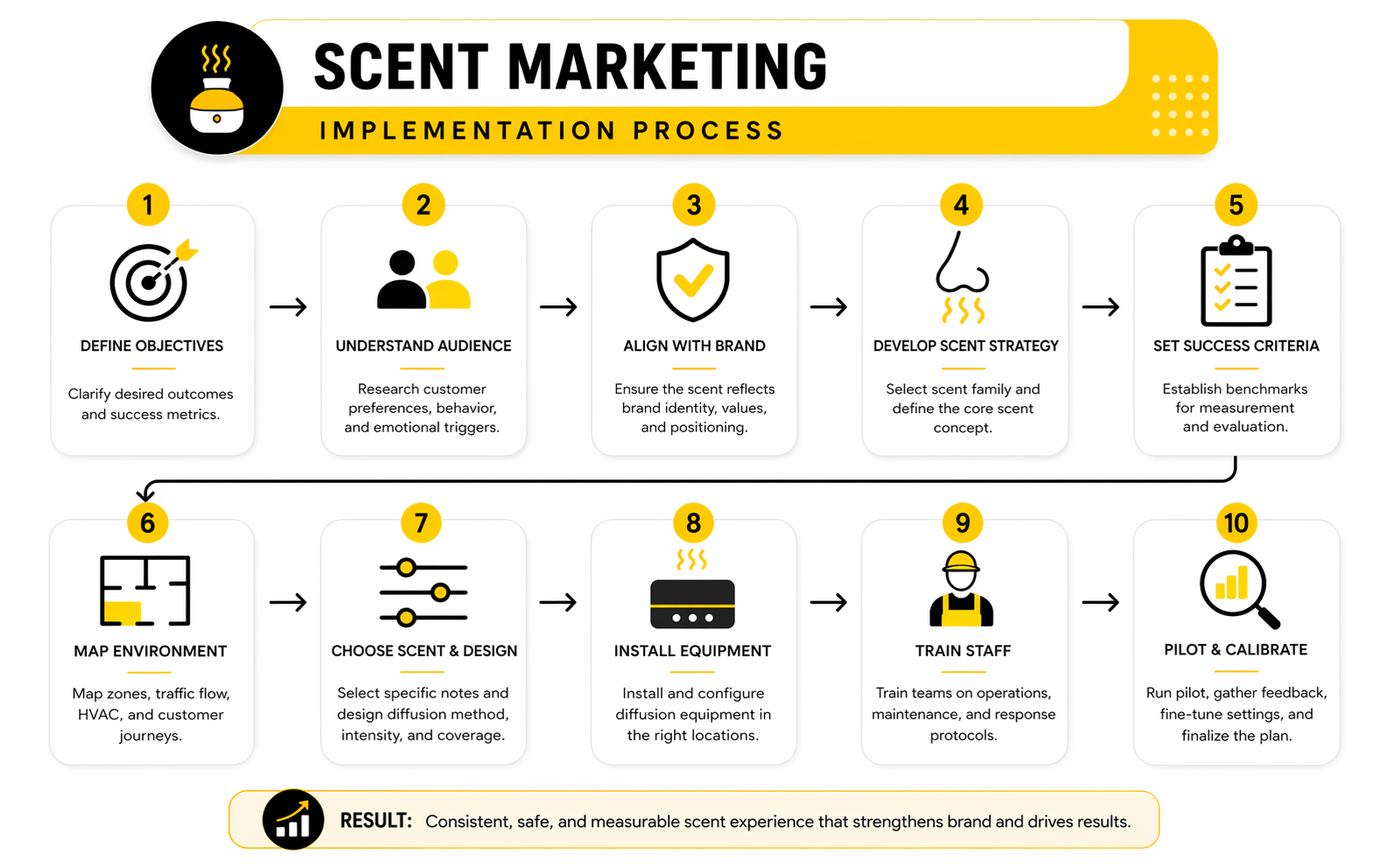
In practice, the cleanest way to implement scent marketing is to move through a disciplined sequence instead of improvising. The brands that get the best long-term results usually follow a pattern like this:
- Define the emotional and brand job of the scent.
- Audit the site and identify environmental constraints.
- Shortlist a small number of congruent fragrance directions.
- Pilot in the live environment with controlled settings.
- Lock the diffusion method, zoning plan, and service routine.
- Document standards and train local teams before scaling.
That sequence works because each step reduces uncertainty before the next one introduces cost. It also keeps scent marketing tied to business reality. A program that cannot survive a structured pilot, clear operating rules, and staff feedback is not ready to scale.
The payoff for this disciplined approach is not just a nicer-smelling space. It is a more coherent branded environment that customers can feel without the brand having to explain itself. In the next part, the focus shifts to measurement, risk, and the mistakes that tend to undermine scent programs after the initial rollout excitement wears off.
What the Data Actually Tells You
By this stage, the real question is no longer whether scent marketing can influence experience. It can. The more useful question is what you should measure so you can tell the difference between a scent program that is helping the brand and one that is just adding cost, complexity, or noise.
This is where a lot of teams get lazy. They collect a few reactions, hear that customers say the store feels nicer, and call the project a win. That is not measurement. That is mood. A proper scent marketing analytics system has to connect sensory changes to business signals, operating conditions, and customer perception over time.
The reason measurement matters so much is simple: scent is rarely a standalone lever. It works inside a wider environment that already includes layout, staffing, music, merchandising, lighting, promotions, and traffic patterns. If you do not control for that reality, you will either over-credit the scent or miss a real effect because you looked at the wrong signal.
Start With the Right Outcome Categories
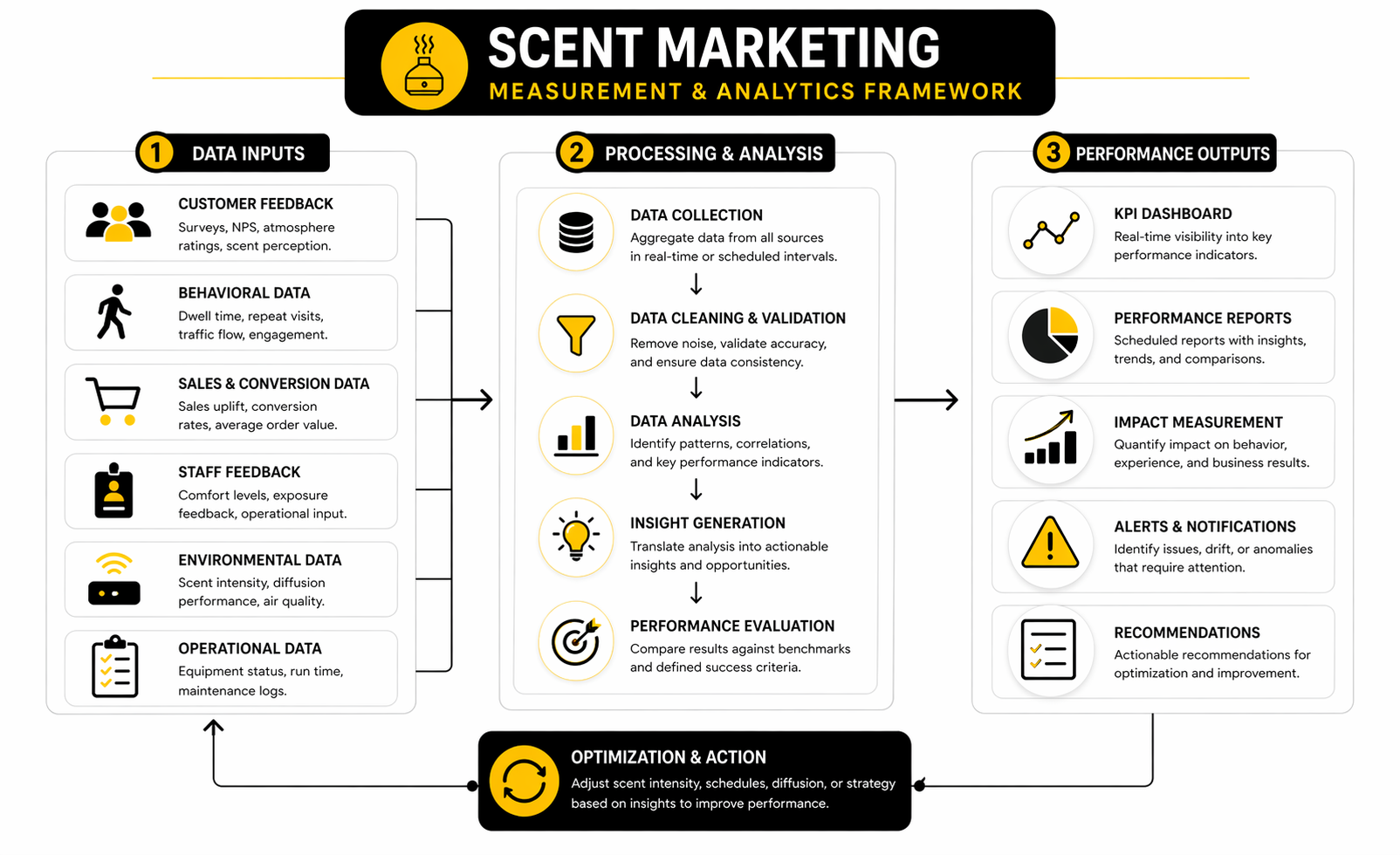
The cleanest way to measure scent marketing is to split outcomes into four buckets: behavioral signals, perception signals, memory signals, and operational signals. That sounds basic, but it immediately forces better thinking. Instead of asking whether the scent “worked,” you start asking whether it changed how people moved, how they felt, what they remembered, and whether the program stayed consistent enough to deserve the credit.
Behavioral signals are the easiest place to start because they tie closest to commercial outcomes. These include dwell time, zone visitation, repeat visits, conversion rate, average transaction value, attachment rate, and in some environments impulse purchases. Research on ambient scent in retail continues to examine these exact kinds of effects, including a 2024 meta-analysis comparing scent effects across retailing and services, and a 2024 cross-cultural retail study with 579 mall shoppers that tracked time spent, money spent, purchase decisions, cognitive responses, and attitudes.
Perception signals matter because scent marketing often does its best work before a customer consciously names it. That means you should measure atmosphere ratings, perceived quality, comfort, premium feel, cleanliness, emotional fit, and brand distinctiveness. Those are not vanity metrics when the purpose of the scent is to shape brand experience, especially because research with 512 consumers on sensory brand experience links sensory cues to customer satisfaction, brand attachment, and brand loyalty pathways.
Memory signals are critical if the scent is meant to become part of the brand system rather than just improve the moment. In that case, you care about aided recall, unaided recall, recognition of the environment, and whether customers associate the experience with the intended brand traits later on. That focus is backed by work on scent-evoked memory and preference formation and by newer evidence that scented parcels can improve brand perception and willingness to pay beyond the physical store visit.
Operational signals are the category almost everyone underestimates. These include diffusion consistency, refill reliability, complaint frequency, staff comfort, zone coverage, and how often local teams override approved settings. If the scent is inconsistent, too strong, or drifting by location, your customer-facing data gets noisy fast and the rest of the analytics become much harder to trust.
The Best Metrics Are the Ones That Match the Job
Not every scent marketing program should be judged by the same scoreboard. A luxury hotel lobby, a medspa, a fashion retailer, and an e-commerce unboxing program are trying to do different things, so the data has to reflect that. This is where weak analysis usually falls apart, because teams copy generic retail metrics instead of measuring the actual job the scent was hired to do.
If the goal is to improve atmosphere and dwell time in a physical space, you should care more about visit duration, zone penetration, return rate, and customer perception after exposure. If the goal is stronger brand distinctiveness, brand memory and qualitative association testing matter more. If the goal is post-purchase experience in direct-to-consumer channels, then packaging satisfaction, product evaluation, and willingness to pay become more relevant, which is exactly why the 2025 scented parcels study is so useful for brands that want scent marketing to extend beyond a store footprint.
This is the practical rule: measure the outcome closest to the promise. If the scent brief said the environment should feel calmer and more premium, but the dashboard only tracks revenue, the analysis is incomplete. If the scent brief said the program should improve conversion and staff report the fragrance feels overpowering by mid-afternoon, the operating data is telling you the commercial data may not hold.
Benchmarks Matter Less Than Baselines
A lot of teams ask for industry benchmarks too early. They want to know what percentage lift counts as “good” for scent marketing before they have even established a clean baseline in their own space. That is backwards. Because scent performance depends so heavily on congruence, setting, traffic, culture, and exposure conditions, your own before-and-after baseline is usually more valuable than a generic benchmark pulled from another category.
That does not mean external studies are useless. They are helpful for understanding which signals tend to move and which mechanisms are plausible. The 2024 cross-cultural study is a good example because it shows that scent effects can vary by shopping context and companionship, which is a reminder that behavior is not uniform across markets. The action this should drive is not blind optimism. It should push brands to test locally, segment results properly, and avoid assuming one rollout setting will perform the same way everywhere.
The same principle applies to sensory brand research more broadly. The 2025 study on sensory brand experience and loyalty supports the idea that sensory cues contribute to satisfaction and attachment, but it does not mean every scent program automatically produces loyalty gains. What it means is that if scent marketing is part of a broader sensory system and executed well, loyalty-related outcomes are worth measuring instead of being dismissed as too soft.
How to Build a Useful Measurement System
A useful analytics setup for scent marketing should be boring in the best way. It should tell you what changed, when it changed, where it changed, and whether the scent was actually running as intended during that period. If you cannot answer those four questions, you are not measuring a scent program. You are measuring a pile of overlapping variables.
A solid system usually includes pre-launch baseline data, a controlled pilot period, location-by-location logging, customer feedback prompts, and a simple way to track operational exceptions. You do not need an enormous data stack to start. What you need is discipline around timing and consistency so you can separate signal from story.
In practice, that often means pairing hard data with light qualitative input. Use behavioral metrics such as dwell time, sales by zone, or revisit rate, then layer in short customer surveys on atmosphere, comfort, and brand fit. That combination is much more useful than relying on either type of data alone, because scent marketing is both behavioral and perceptual by nature.
What the Numbers Should Make You Do
Data is only valuable if it changes decisions. If scent exposure improves atmosphere scores but complaints rise and staff fatigue increases, the action is not to declare victory. It is to lower intensity, adjust zoning, or shorten run windows. If brand perception improves but conversion does not, the scent may still be doing its job, but the business should stop pretending it is a direct-response tool.
If time spent rises but average basket does not, that is not automatically bad news either. It may mean the scent is improving comfort and exploration, while pricing, assortment, or staff conversion is the actual bottleneck. This is why scent marketing data should inform diagnosis, not just reporting. The numbers matter because they tell you where the experience is working and where another part of the system is failing.
The strongest teams treat scent like any other serious brand lever. They define the job, measure the right outcomes, compare results against a clean baseline, and adjust the program based on what the evidence says rather than what the conference room likes. In the next part, that discipline becomes even more important, because the biggest scent marketing failures usually come from avoidable mistakes, not from the core idea itself.
Scaling Scent Marketing Without Creating New Problems
The hardest part of scent marketing is not getting the first version to work. The hardest part is keeping it effective once the program moves beyond a pilot and starts living inside real operations, real buildings, real staffing constraints, and real customer variability. That is where a promising sensory strategy can either mature into a durable brand asset or slowly turn into an expensive source of inconsistency.
This is also the stage where tradeoffs become obvious. A broader rollout can improve consistency across locations, but it can also amplify mistakes faster. Stronger scent presence may help brand recognition in one zone, yet the same setting can increase fatigue, complaints, or operational friction if the environment is not stable enough to support it.
The First Risk Is Scale Drift
Scale drift happens when the original scent concept stays the same on paper, but the customer experience changes from location to location. Ventilation quality, occupancy patterns, store size, climate, competing odors, and local maintenance routines all affect how a fragrance performs, which means a rollout can lose consistency even when the fragrance formula itself does not change. That is exactly why indoor air guidance focuses so heavily on building systems, contaminant sources, and ongoing evaluation rather than assuming one fixed setting will behave the same way everywhere.
This is where less experienced teams usually make a bad move. They assume the answer is to standardize more aggressively by raising output or copying one location’s settings everywhere. In practice, that often creates dead zones in some spaces and overload in others, which weakens the very brand coherence scent marketing was supposed to strengthen.
The expert approach is stricter and more flexible at the same time. Keep the scent identity stable, but calibrate deployment locally. The scent should feel recognizably part of the same brand system while still respecting the physical reality of each environment.
The Second Risk Is Sensory Fatigue Inside the Organization
Customers experience the scent for minutes. Staff may experience it for entire shifts, across weeks and months. That difference matters, because a fragrance that feels subtle and well judged to visitors can feel very different to the people who live inside it operationally, and indoor air guidance explicitly treats ongoing occupant experience as part of the assessment problem rather than an afterthought.
This is one reason scent marketing can quietly fail even while headline metrics look fine. A program may hold atmosphere scores steady while frontline teams start adjusting equipment, ignoring service rules, or reporting discomfort informally instead of through the proper channel. Once that happens, the scent program stops being stable enough to evaluate honestly.
The action this should drive is simple. Brands need a reporting loop for staff, not just customers. If employee feedback is dismissed as resistance to change, the organization often ends up with a scent strategy that looks polished in the deck but unstable in the field.
The Third Risk Is Treating Scent as a Universal Growth Lever
One of the biggest strategic mistakes is assuming scent marketing should always increase spending, conversion, and satisfaction at the same time. The research base is not that simplistic. A 2024 meta-analytic comparison of scent effects in retailing and services makes the useful point that scent effects vary by context and are not equally strong across all settings and outcome types.
That matters because scent is usually best understood as an amplifier, not a miracle fix. It can reinforce atmosphere, memory, perceived fit, and emotional tone, but it cannot rescue poor assortment, weak service, bad pricing, or clumsy merchandising. When brands expect scent marketing to compensate for structural business problems, the rollout becomes vulnerable to disappointment and overclaiming.
The smarter posture is narrower and more profitable. Decide what the scent is supposed to improve, measure that outcome properly, and let the rest of the commercial model stand on its own. That keeps scent marketing in a strategic role instead of turning it into a catch-all explanation for every performance swing.
Category Differences Matter More Than Most Teams Expect
Advanced scent work gets better when brands stop asking whether a scent is effective in general and start asking where it belongs in the category. A hotel, for example, often benefits from scent as part of arrival, comfort, and memory architecture. A busy value retailer may need much lighter deployment because speed, congestion, and environmental noise already compete for attention. The visible differences noted across luxury retail and branded stores in a 2024 reported field look at scent use in Chicago retail illustrate that some brands keep fragrance highly localized while others let it travel further through the space.
That should change how you scale. Category logic should shape the role of scent, the acceptable intensity range, the zones that matter most, and the type of outcomes you expect. The mistake is assuming every branded environment needs the same sensory signature strategy just because scent marketing worked somewhere impressive.
This is where senior teams can make better calls than vendors sometimes do. The business already knows whether it wins on discovery, reassurance, indulgence, speed, wellness, prestige, or familiarity. The scent program should be built to reinforce that edge rather than importing a generic “premium” smell and hoping customers interpret it the right way.
Compliance, Transparency, and Air Quality Are Not Side Notes
As scent marketing gets more ambitious, the compliance conversation gets more important. Fragrance safety frameworks exist for a reason, and the IFRA standards framework is built around safe use by application category rather than the vague assumption that a fragrance is either safe or unsafe in all contexts.
That does not mean every brand needs to become a regulatory expert. It does mean procurement, facilities, and brand teams should stop treating scent as a purely aesthetic purchase. Documentation, supplier transparency, servicing protocols, and response plans for complaints all become more important as the program reaches more people and more sites.
This point becomes even sharper when indoor air quality is already under scrutiny. The more a company talks about wellness, comfort, hospitality, or elevated experience, the less room it has for sloppy implementation. A scent strategy that ignores ventilation quality or occupant sensitivity can undermine the very customer trust it was supposed to deepen.
The Best Programs Know When to Stay Quiet
There is an expert-level insight here that weaker teams miss: sometimes the best scent marketing decision is to pull back. Not every zone needs scent. Not every daypart needs the same output. Not every location needs the same diffusion pattern. Some of the strongest branded scent experiences are memorable precisely because they are subtle, controlled, and context aware rather than aggressively noticeable.
That matters for scaling because restraint is hard to operationalize. Louder and more obvious often feels easier to defend internally because everyone can detect it instantly. But scent marketing usually creates more long-term value when it sits just below the threshold of distraction and works in concert with the rest of the environment.
The brands that win with scent over time are rarely the ones trying to prove they are using it. They are the ones using it with enough precision that the space feels unmistakably like them without announcing the tactic.
Where Scent Marketing Gets Really Interesting
At the advanced level, scent marketing stops being a store-only decision. It starts connecting physical environments, packaging, events, hospitality moments, and other brand touchpoints into one sensory identity. That broader opportunity is exactly why brands keep revisiting scent: not because it is trendy, but because it can translate brand feeling across contexts that visual design alone cannot fully carry.
But that opportunity only pays off when the discipline holds. The strategy has to survive scaling, staff exposure, environmental variation, and the temptation to overdo it. If it does, scent marketing becomes more than ambiance. It becomes infrastructure for memory, atmosphere, and brand differentiation.
The final part will bring all of this together with a grounded close and a practical FAQ focused on the questions brands ask when they are deciding whether scent marketing is worth the effort.
Bringing the Full System Together
At this point, the shape of a serious scent marketing program should be clear. It starts with brand fit, moves through environmental calibration and controlled implementation, and only becomes truly valuable when measurement, governance, and scaling discipline are in place. That is the difference between a space that simply smells pleasant and a space that uses scent as a durable brand asset.
The bigger takeaway is that scent marketing works best when it stays connected to business reality. It should support positioning, improve how a place feels, and strengthen memory without pretending to be a magic fix for weak service, bad merchandising, or confused brand strategy. The evidence base around pleasant ambient scent, multisensory branding, and even newer work on scented parcels keeps pointing in the same direction: smell is powerful, but only when it is congruent, controlled, and interpreted in context through the right outcomes and operating safeguards. Recent meta-analytic work on retail and hospitality scent effects and newer research on e-commerce parcel scenting make that practical point more clearly than the old hype-driven claims ever did.
What separates professionals from dabblers is not whether they believe in sensory branding. It is whether they can translate that belief into a repeatable system that survives real buildings, real customers, real staff exposure, and real commercial pressure. When that system is built well, scent marketing stops feeling like decoration and starts behaving like infrastructure for atmosphere, memory, and brand coherence. IFRA’s standards framework for safe fragrance use and official indoor air quality guidance for occupied buildings are useful reminders that the operational side matters just as much as the creative side.
FAQ
What is scent marketing in simple terms?
Scent marketing is the intentional use of fragrance to shape how a customer experiences a brand, a space, or even a package. It is not the same as making a room smell nice or covering bad odors. The strategic version is tied to brand identity, emotional tone, and customer behavior, which is why the strongest programs are designed around congruence instead of personal fragrance taste. The broader evidence on pleasant ambient scent and customer response helps explain why this distinction matters.
Does scent marketing actually work?
Yes, but not in the simplistic way many vendors imply. Research reviews show that pleasant ambient scent can positively affect affective, cognitive, and behavioral responses, yet the strength of those effects depends heavily on context, congruence, and execution quality rather than scent alone. That means scent marketing works best as a reinforcing layer inside a good experience, not as a shortcut around deeper business problems. A 2024 meta-analysis comparing scent effects across retailing and hospitality and a larger earlier meta-analysis covering mood, evaluations, memory, intentions, and behavior both support that more disciplined interpretation.
Which industries benefit most from scent marketing?
Scent marketing tends to make the most sense in industries where atmosphere, dwell time, memory, and perceived quality matter. That includes hospitality, wellness, luxury retail, showrooms, branded service environments, and certain types of experiential commerce. The point is not that these are the only sectors that can use scent, but that they usually have a clearer emotional job for scent to support. Recent coverage of retail scent programs across brands and environments shows how differently categories use scent depending on their experience model.
Can scent marketing help e-commerce brands too?
Yes, and that is one of the more interesting developments in the category. Newer research suggests that scent can influence post-purchase experience outside traditional physical locations, especially through packaging and parcel experiences. That matters because it expands scent marketing from in-store atmosphere to a broader brand system that can touch the customer at home during unboxing and evaluation. The 2025 study on scented parcels found improvements in unpacking experience, product evaluation, brand perception, and post-order willingness to pay.
How do you choose the right scent for a brand?
You start with the brand and the space, not with a fragrance library. The right scent should express the intended emotional tone of the environment, fit the category, and feel coherent with the rest of the sensory experience. That is why congruence matters so much in the research base: a fragrance can be pleasant and still be strategically wrong if it clashes with the setting, the offer, or the expectations of the customer. Research reviews on olfactory congruence and consumer responses explain why matching the scent to the environment is such a central variable.
How strong should a branded scent be?
Usually lighter than internal stakeholders first imagine. The goal is not to impress people with intensity. The goal is to create an atmosphere that feels coherent and memorable without becoming distracting or tiring. Once customers or staff consistently describe the fragrance as strong, the program is often drifting away from effective scent marketing and toward sensory interference. Field research on ambient scent intensity in supermarket settings is useful here because it shows intensity changes the outcome rather than simply improving it.
What should brands measure when they launch scent marketing?
They should measure outcomes that match the job the scent is supposed to do. That may include atmosphere ratings, dwell time, repeat visits, brand memory, perceived quality, staff feedback, complaint frequency, and location-level operational consistency. The key is to compare against a baseline and track whether the scent was actually running as intended during the measurement window. Recent meta-analytic evidence on scent effects by response category and research on sensory brand experience and loyalty pathways both support a broader measurement model than simple sales lift alone.
Are there risks or downsides to scent marketing?
Absolutely, and serious brands plan for them instead of pretending they do not exist. The biggest risks include mismatched scent selection, over-intensity, location drift during scaling, staff fatigue, poor ventilation fit, and weak governance around who can change the settings. There are also broader indoor air quality and sensitivity considerations, which is why scent marketing should never be treated as a casual decorative purchase. Health Canada’s indoor air quality guidance, EPA guidance for office occupants, and IFRA’s standards overview all reinforce the need for disciplined implementation.
Is scent marketing the same as aromatherapy?
No, and mixing those two ideas creates confusion fast. Aromatherapy is typically framed around personal wellness use, while scent marketing is a commercial strategy focused on customer experience, brand memory, and environmental perception. A hotel lobby, retail floor, or showroom is not trying to deliver a private therapeutic ritual. It is trying to create a branded atmosphere that supports the business goal of the space.
Should every location in a brand network smell exactly the same?
Not in the crude sense of identical output settings everywhere. The scent identity should stay recognizable, but the delivery has to be calibrated to each location’s airflow, architecture, traffic pattern, and operating conditions. Otherwise brands create the illusion of consistency while customers actually get wildly different scent experiences from site to site. Indoor air quality guidance for occupied buildings helps explain why a building-by-building calibration mindset is smarter than one-size-fits-all deployment.
How long does it take to know if scent marketing is working?
You can usually gather directional feedback quickly, but reliable evaluation takes longer because you need baseline comparison, operational stability, and enough exposure to separate novelty from sustained effect. Early positive reactions can be useful, yet they should not be mistaken for proof that the program is commercially or strategically successful. A well-run pilot followed by phased measurement is far more valuable than rushing to declare a win after the first week.
Is scent marketing only for premium brands?
No, but premium brands often have a more obvious use case because they compete heavily on atmosphere and emotional differentiation. Scent marketing can also help other categories if the business has a clear experiential objective and the environment can support controlled execution. The real dividing line is not premium versus non-premium. It is whether the brand understands what role scent is supposed to play and whether it can operate the program well enough to make that role meaningful.
What is the biggest mistake brands make with scent marketing?
The biggest mistake is treating scent like a creative flourish instead of a managed system. That usually leads to vague briefs, poor pilot design, uncontrolled intensity, inconsistent rollout, and no trustworthy measurement. The result is predictable: teams either overstate success or kill the program for the wrong reasons. The strongest scent marketing programs win because they are disciplined, not because they are flashy.
Work With Professionals
Explore 10K+ Remote Marketing Contracts on MarkeWork.com
Most marketers spend too much time chasing clients, competing on crowded platforms, and losing a percentage of every project to middlemen.
MarkeWork gives you a better way. Browse thousands of remote marketing contracts and connect directly with companies desperate to hire skilled marketers like you, without platform commissions and without unnecessary gatekeepers.
If you're serious about finding better opportunities and keeping 100% of what you earn, explore available contracts and create a profile for free at MarkeWork.com.