

Scorpion internet marketing is best understood as a done-for-you growth system for local businesses that need more than random ads, a basic website, or occasional SEO work. Scorpion positions itself around marketing, technology, creative, lead management, and industry-specific strategy for local companies in fields like home services, legal, healthcare, franchise, and multi-location businesses.
That matters because local marketing is no longer just “rank higher on Google.” Customers compare reviews, click ads, check service pages, expect fast responses, and often choose the business that feels easiest to trust. Recent local search research shows that 70% of general online searches happen on Google, while review behavior keeps shaping buying decisions across local categories.
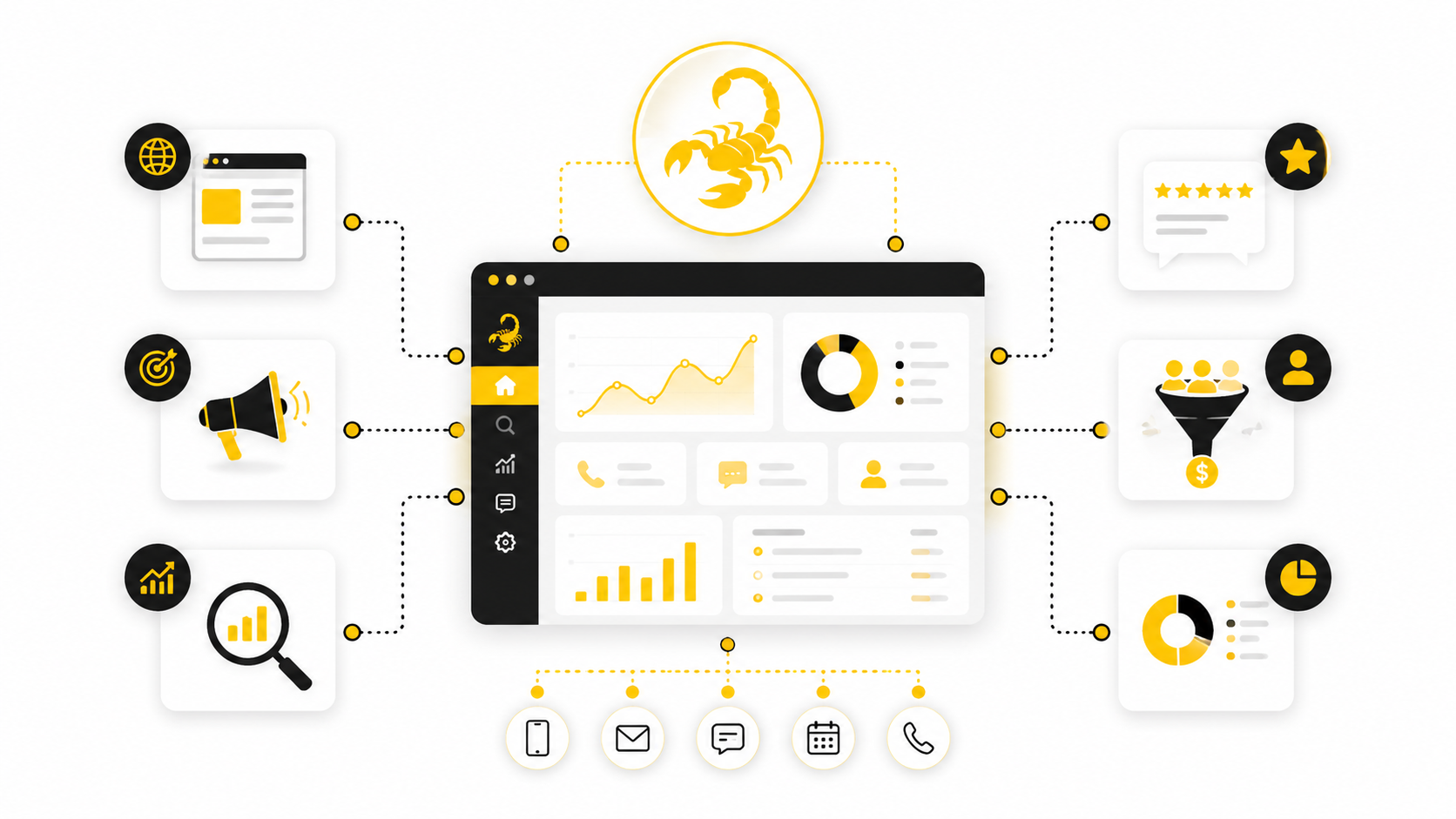
Article Outline
- Why Scorpion Internet Marketing Matters For Local Businesses
- The Scorpion Marketing Framework
- Core Components Of A Scorpion-Style Growth System
- Professional Implementation And Operational Fit
- Strengths, Trade-Offs, And Better-Fit Alternatives
- Final Buying Checklist And FAQ
Why Scorpion Internet Marketing Matters For Local Businesses
Local businesses do not usually lose because they lack ambition. They lose because their marketing is fragmented: one vendor runs ads, another built the website, someone else handles reviews, and nobody can clearly explain which channel produces profitable customers. Scorpion internet marketing appeals to that pain because it promises a more connected approach where website performance, advertising, SEO, reviews, intake, and reporting work together instead of acting like separate projects.
This is especially important in high-intent local categories. A homeowner with a leaking pipe, a patient searching for a specialist, or a client looking for legal help is not casually browsing for inspiration. They are comparing credible options quickly, which means the business needs visibility, trust signals, fast follow-up, and a conversion path that does not leak leads.
The practical takeaway is simple: marketing performance is not only about getting traffic. It is about turning the right traffic into booked conversations, appointments, consultations, or jobs. That is why platforms and agency models like Scorpion are usually judged less by vanity metrics and more by pipeline quality, lead handling, attribution, and revenue clarity.
The Scorpion Marketing Framework
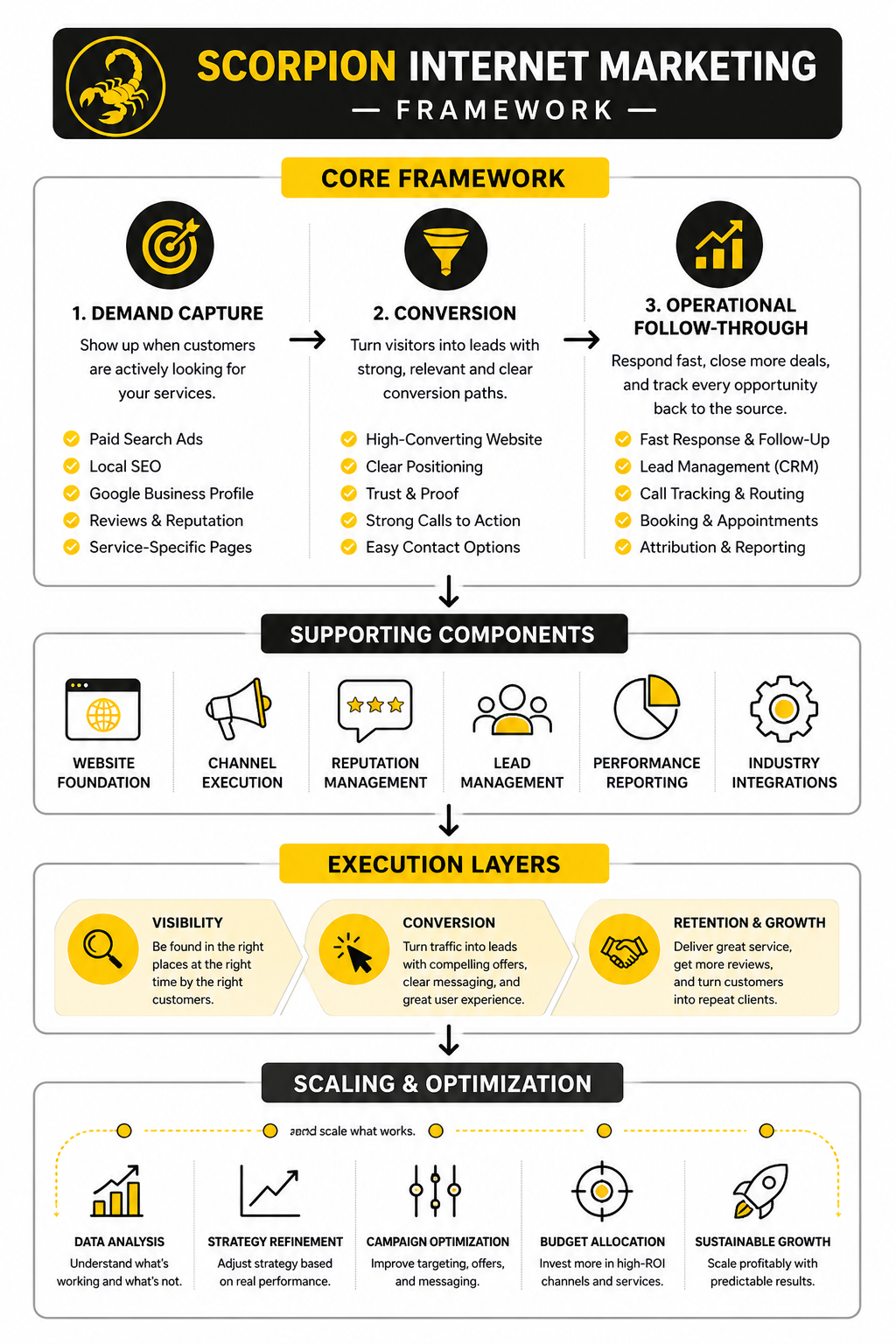
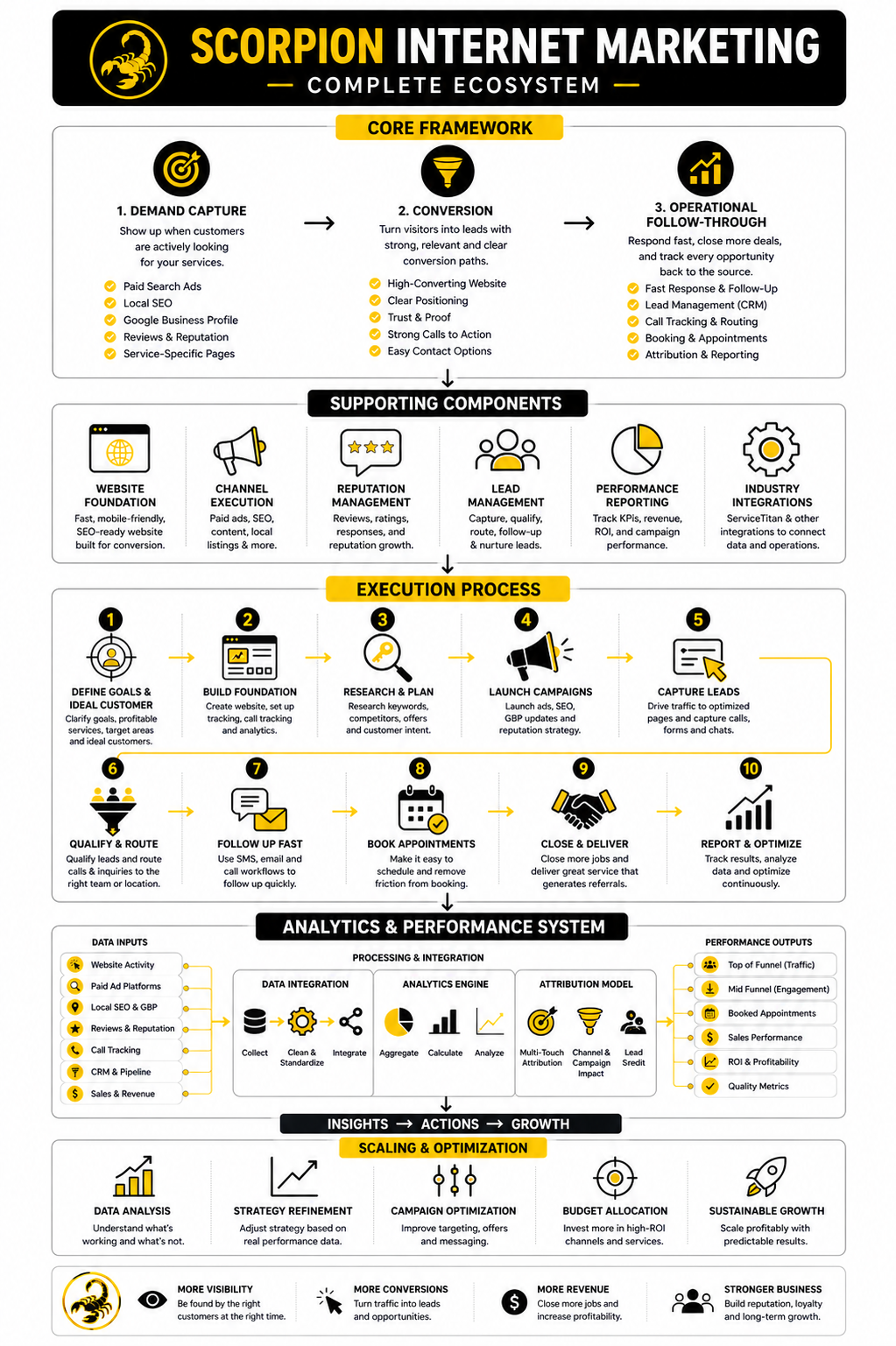
A useful way to think about Scorpion internet marketing is as a four-layer framework: attract, convert, manage, and measure. The attract layer includes channels like search advertising, local SEO, website content, and visibility across the places customers already use. The convert layer focuses on the website, landing pages, chat, forms, calls, and scheduling paths that turn attention into action.
The manage layer is where many local businesses either win or waste budget. If calls go unanswered, forms sit untouched, or staff cannot tell which lead source produced the best jobs, the marketing system breaks after the click. Scorpion’s positioning around connected technology and service support speaks directly to that operational gap.
The measure layer is where mature local marketing becomes different from guessing. Scorpion’s ServiceTitan partnership, for example, emphasizes connecting marketing activity with customer, job, and invoice data so home service companies can see which efforts bring in valuable work, not just more inquiries. That is the right direction because profitable growth depends on revenue quality, not lead volume alone.
Core Components Of A Scorpion-Style Growth System
The first component is a conversion-focused website. A local business website has to explain who the company helps, why it is trustworthy, what services it offers, and how a visitor can take the next step without friction. Scorpion’s own website service positioning centers on building sites that tell the right story and generate more leads.
The second component is demand capture. This includes SEO, paid search, local listings, reviews, and service pages built around what buyers are already searching for. For businesses that want a more flexible funnel builder alongside agency support, tools like ClickFunnels or systeme.io can fit when the goal is landing pages, offers, and follow-up flows rather than a full-service local marketing partner.
The third component is speed-to-lead. Local buyers often contact multiple providers, so response time becomes part of the marketing system. Tools like ManyChat, Chatbase, and GoHighLevel can support that layer when a business wants automated messaging, CRM workflows, and faster follow-up.
Professional Implementation And Operational Fit
Scorpion internet marketing makes the most sense when a business wants strategic support, industry-specific marketing execution, and a more centralized system. It is not just a tool decision. It is an operating decision, because the business has to be ready to handle more leads, track outcomes, and communicate clearly with the marketing team.
The best-fit companies usually have real customer demand, enough margin to invest seriously, and a team that can answer calls, book appointments, and close opportunities. A marketing provider can improve visibility and conversion paths, but it cannot fix a broken intake process on its own. That point matters because many businesses blame ads when the real leak is response time, sales process, or unclear offer positioning.
The rest of this guide will break down the framework in more detail, starting with why the Scorpion model became relevant in the first place. From there, we will look at the core pieces, where professional implementation helps, and where a leaner tool stack may be the smarter move.
Why Scorpion Internet Marketing Matters For Local Businesses
The big reason Scorpion internet marketing gets attention is that local competition has become brutally compressed. A customer can search, compare, read reviews, call, and book without ever visiting a second page of results. That means local businesses are not just competing on service quality anymore; they are competing on visibility, trust, speed, and follow-up.
This is where many companies discover the uncomfortable truth: more traffic does not automatically mean more revenue. A campaign can generate clicks, but if the website is vague, the phone process is slow, or the lead source is impossible to track, the business still leaks money. Scorpion’s model is built around reducing that gap between marketing activity and actual booked business.
Local proof matters here. BrightLocal’s 2025 research found that consumers still rely heavily on reviews when evaluating nearby businesses, and Google’s own Local Services Ads product is designed around connecting local buyers with providers at the moment they are ready to act. In plain English, the buyer journey has become faster, more visible, and less forgiving.
The Real Problem Scorpion Tries To Solve
Most local businesses do not have a “marketing problem” in one clean category. They have a system problem. Their ads, website, SEO, reviews, CRM, booking process, and reporting are often disconnected, which makes it hard to know what is working and what is quietly wasting budget.
Scorpion internet marketing tries to solve that by acting more like a growth partner than a single-channel vendor. The offer is not simply “we run your ads” or “we build your website.” The stronger version of the value proposition is that Scorpion helps connect the pieces that affect revenue, from search visibility to lead capture to attribution.
That matters most in industries where one customer can be worth hundreds or thousands of dollars. A law firm, roofing company, HVAC contractor, dental group, or specialty healthcare practice cannot afford sloppy tracking and weak follow-up. When the value of a qualified lead is high, the cost of a broken marketing system is high too.
The Scorpion Marketing Framework
A practical Scorpion-style framework starts with demand capture. This means showing up when someone is actively looking for a service, not just hoping a social post gets noticed. Search ads, local SEO, Google Business Profile optimization, review signals, and service-specific pages all sit in this layer.
The second layer is conversion. Once a visitor lands on the site, the business needs clear positioning, proof, service details, strong calls to action, and simple contact options. This is where a polished website matters, but only if it is built around buyer intent instead of looking pretty for its own sake.
The third layer is operational follow-through. Calls need to be answered, forms need to be handled quickly, and booked opportunities need to be tracked back to the channel that produced them. This is why Scorpion’s ServiceTitan partnership is relevant for home service companies, because connecting marketing activity with job and invoice data creates a cleaner view of what actually produces revenue.
Where Tools Fit Into The Framework
A full-service partner can be useful, but not every business needs the same level of support. Some companies want Scorpion internet marketing because they prefer an agency-led model with strategy, execution, and reporting bundled together. Others may prefer a leaner stack where they control more of the system themselves.
For example, a business that mainly needs funnels, offers, and landing pages may be better served by ClickFunnels or systeme.io. A company that needs CRM, automation, missed-call text back, appointment workflows, and pipeline management may find GoHighLevel more relevant. If live chat or automated buyer support is the missing piece, Chatbase can support that specific layer without replacing the whole marketing operation.
The point is not that one option is universally better. The point is fit. Scorpion makes more sense when the business wants a managed, industry-aware marketing system, while standalone tools make more sense when the team has the skill and time to build, test, and manage the machine internally.
Core Components Of A Scorpion-Style Growth System
A strong implementation starts with the parts of the system that directly affect revenue. Scorpion internet marketing is not only about getting a business in front of more people. The real goal is to connect visibility, conversion, intake, and reporting so the company can see which marketing actions produce valuable opportunities.
The first component is the website, because it usually becomes the center of the local buyer journey. A good local business site needs service pages, location relevance, proof, clear calls to action, fast loading, and a path that makes it easy to call, book, or request help. Scorpion’s public positioning focuses on bringing strategy, technology, and expert support together so local businesses are not guessing what works.
The second component is channel execution. That includes paid search, SEO, local listings, reviews, content, and sometimes social or video depending on the market. The mistake is treating these channels like isolated campaigns instead of connected parts of the same buyer path.
The third component is lead handling. This is where many businesses quietly waste money. Research around speed-to-lead consistently shows that faster response improves the chance of connecting with a prospect, so the marketing system has to include calls, forms, messages, routing, reminders, and follow-up instead of stopping at “lead generated.”
Professional Implementation And Operational Fit
Professional implementation should begin with a blunt audit. Before changing campaigns, the business needs to know what is already happening: which services are most profitable, which locations need growth, which calls are being missed, which pages convert, and which lead sources create actual booked jobs. Without that baseline, every marketing discussion becomes opinion.
The next step is prioritization. Not every business should launch every channel at once. A law firm in a competitive metro may need stronger search visibility and intake tracking first, while an HVAC company may need better local service pages, paid search segmentation, and a tighter connection between marketing data and booked jobs.
This is also where the internal team matters. Scorpion internet marketing can support strategy and execution, but the business still has to answer the phone, train staff, handle estimates, and close work. Marketing creates opportunity; operations turns that opportunity into revenue.
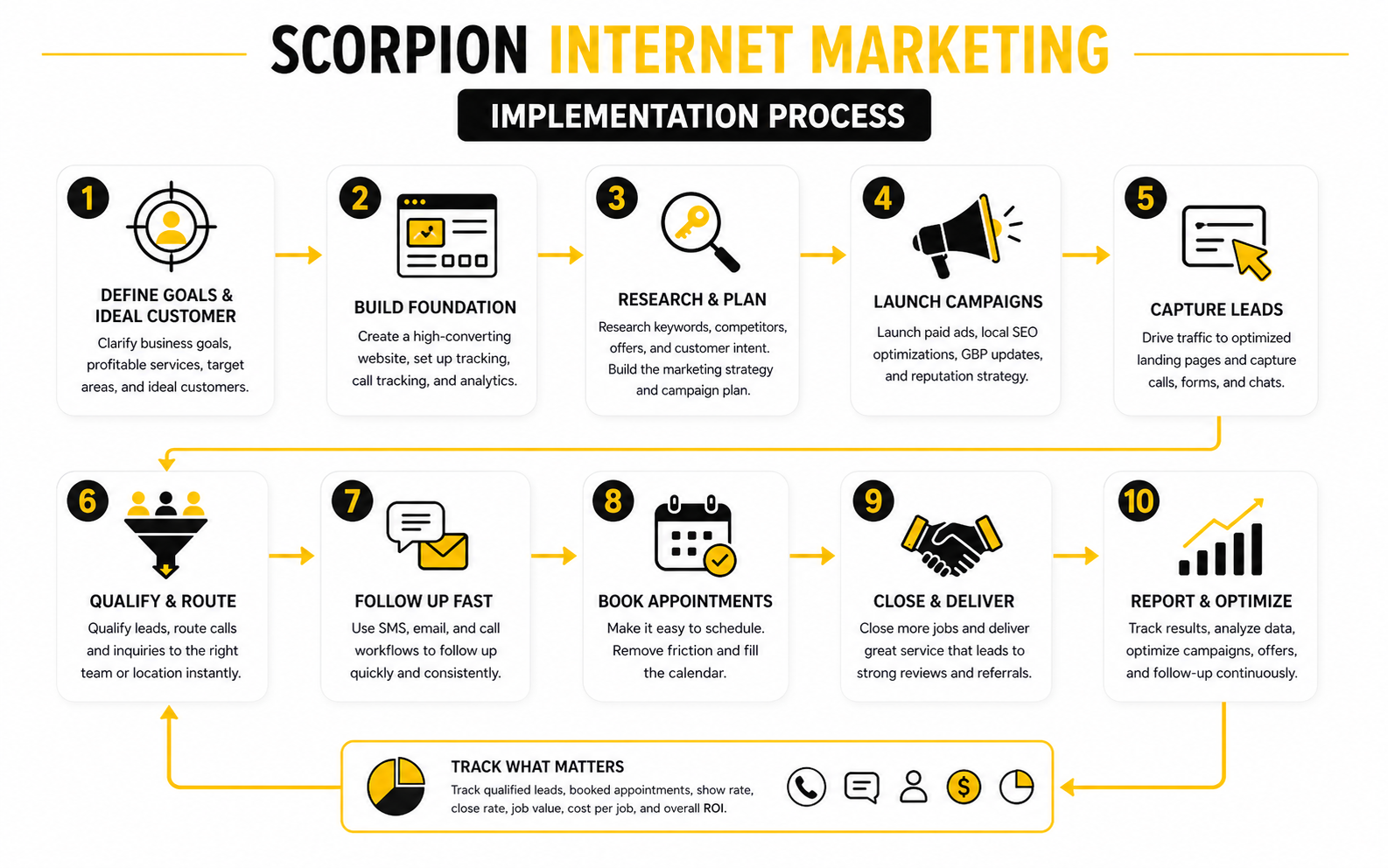
A Practical Implementation Process
- Clarify the revenue target. Start with the services, locations, and customer types that matter most. More leads are not always better if they come from low-margin jobs, poor-fit customers, or areas the team does not want to serve.
- Audit the current buyer path. Review the website, Google Business Profile, reviews, ads, service pages, phone process, form routing, and CRM follow-up. The goal is to find the biggest leaks before spending more money.
- Build or refine the conversion foundation. Fix the pages, calls to action, tracking, and proof points that affect whether a visitor becomes a lead. This is where tools like Fillout can help with cleaner forms, while Chatbase can support automated answers for common visitor questions.
- Launch the highest-intent channels first. For many local businesses, that means paid search, local SEO, and service-specific landing pages before broader awareness campaigns. If the business needs funnel-style pages for offers or campaigns, ClickFunnels can fit that specific job.
- Connect lead management. Every inquiry needs ownership, follow-up rules, and visibility. A CRM and automation platform like GoHighLevel can be useful when the business wants pipelines, reminders, missed-call text back, and campaign follow-up in one place.
- Measure revenue quality, not just lead count. The best reporting connects campaigns to booked appointments, completed jobs, consultations, cases, or invoices. Scorpion’s ServiceTitan partnership is relevant because it focuses on tying marketing activity to customer, job, and invoice data for home service companies.
What The First 90 Days Should Prove
The first 90 days should not be judged only by whether everything feels busy. Busy is easy. The better question is whether the business now has clearer tracking, stronger conversion paths, better follow-up, and early evidence that the right leads are moving through the pipeline.
In the first month, the focus should be discovery, tracking, website fixes, campaign structure, and operational cleanup. This is not the glamorous part, but it is the part that protects the budget. If the foundation is weak, scaling ads just scales waste.
By months two and three, the business should start seeing which services, locations, keywords, and pages deserve more investment. Some campaigns will need tighter targeting. Some pages will need stronger proof. Some lead sources may look good on paper but fail once judged by booked revenue, and that is exactly the point of building the system properly.
Statistics And Data
The numbers only matter if they change what the business does next. Scorpion internet marketing should not be judged by a dashboard full of impressions, clicks, and calls without context. A good measurement system explains where demand is coming from, which leads become real opportunities, and which campaigns deserve more budget.
Start with local intent. BrightLocal’s 2025 consumer review research shows that people still use reviews heavily when choosing nearby businesses, which means reputation is not a side metric. If a campaign drives traffic but the business has weak ratings, thin review volume, or unanswered negative feedback, the data is already warning you that conversion will be harder.
Paid search benchmarks need the same discipline. WordStream’s 2025 Google Ads benchmark report shows that search advertising costs have continued rising across many categories, while LocaliQ’s benchmark data is based on more than 16,000 campaigns across 23 industries. That does not mean paid search is bad. It means every click needs a job, every landing page needs a reason to exist, and every lead needs to be tracked beyond the first form fill.
The Metrics That Actually Matter
A Scorpion-style analytics system should separate surface metrics from business metrics. Surface metrics help diagnose activity. Business metrics tell you whether the activity is worth paying for.
The useful surface metrics include impressions, click-through rate, cost per click, call volume, form submissions, landing page conversion rate, and organic visibility. These numbers help you see whether the business is getting attention and whether the offer is pulling people into the next step. But they are not enough on their own, because a cheap lead can still be a bad lead.
The business metrics are stronger: qualified lead rate, booked appointment rate, show rate, close rate, average job value, cost per booked job, revenue by channel, and profit by service line. This is where scorpion internet marketing has to prove its value. If one campaign produces fewer leads but more profitable jobs, it may deserve more budget than a campaign that looks better in a lead-count report.
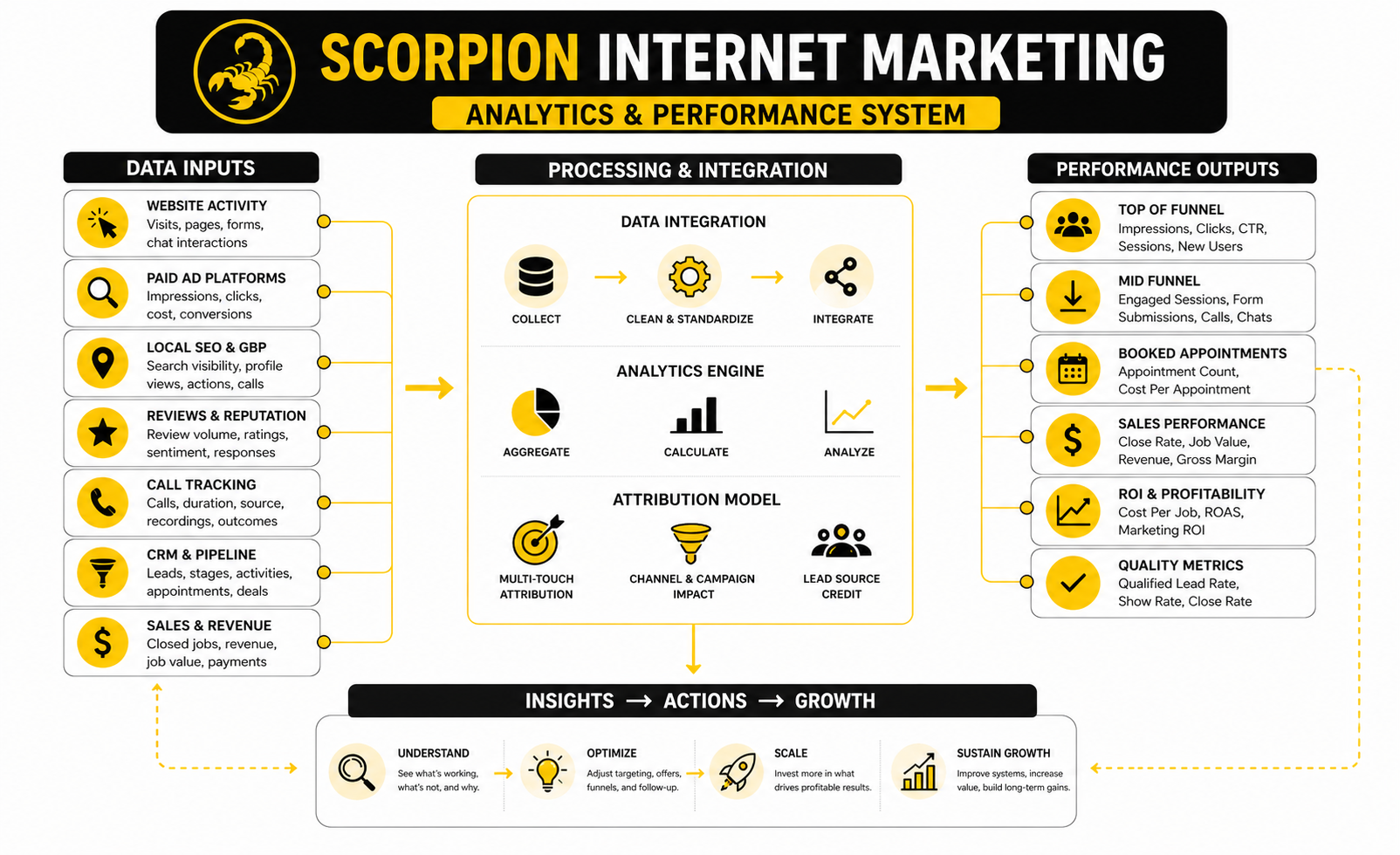
How To Read The Analytics System
A proper analytics setup should follow the customer from search to revenue. The path usually starts with a keyword, ad, map listing, organic result, social touchpoint, referral source, or service page. From there, the system needs to track the call, form, chat, booking, appointment, closed job, invoice, or retained client.
This is why Scorpion’s ServiceTitan partnership matters for home service businesses. Scorpion says its integration connects customer, job, and invoice data so companies can see which marketing efforts bring in the most valuable jobs. That is a stronger measurement model than stopping at “this campaign generated 47 leads.”
For businesses managing their own stack, the same principle still applies. A CRM like GoHighLevel can help connect pipelines, missed-call follow-up, automation, and campaign reporting. A form tool like Fillout can help clean up intake data, while Call.com can support smoother scheduling when appointment flow is the bottleneck.
Benchmarks Are Directional, Not Absolute
Benchmarks are useful, but they are not commandments. A legal campaign in a major city, an emergency plumbing campaign, and a multi-location healthcare campaign will not behave the same way. The cost per lead, conversion rate, and sales cycle all depend on urgency, competition, service value, geography, reputation, and how well the team follows up.
That is why the best use of benchmarks is diagnosis, not panic. If cost per click is high but booked revenue is strong, the campaign may be healthy. If cost per lead is low but the close rate is terrible, the targeting, offer, or intake process may be attracting the wrong people.
The smarter question is not “Are we above or below the average?” The smarter question is “What is this number telling us to fix?” A weak landing page conversion rate points to messaging, proof, page speed, or offer clarity. A weak booked appointment rate points to intake. A weak close rate points to sales process, pricing fit, lead quality, or expectation setting.
What Good Reporting Should Drive
Good reporting should create decisions, not just meetings. If the numbers do not change budget, messaging, staffing, follow-up, or service focus, the reporting is probably too shallow. This is where a business should expect scorpion internet marketing or any serious alternative to connect data with action.
The first decision is budget allocation. Campaigns that produce profitable booked work should earn more investment, while channels that create noise should be tightened, paused, or rebuilt. The second decision is operational improvement, because marketing data often exposes non-marketing problems like missed calls, slow estimates, weak scripts, or poor appointment confirmation.
The third decision is positioning. If certain services convert better, generate higher average job value, or attract better-fit customers, the website and campaigns should reflect that. Data should make the business sharper, not just busier.
Strengths, Trade-Offs, And Better-Fit Alternatives
The strongest argument for Scorpion internet marketing is focus. Scorpion is not trying to be a generic website builder or a one-feature marketing app. Its pitch is built around local businesses that need websites, advertising, SEO, reputation, lead management, and reporting to work together inside a service model.
That can be valuable when the business owner or leadership team does not want to manage every technical detail. A local company with aggressive growth goals may not have time to coordinate web developers, ad specialists, SEO writers, call tracking tools, CRM setup, review requests, and reporting dashboards. In that situation, paying for an integrated partner can be more practical than assembling the whole system alone.
The trade-off is control. A managed platform can simplify execution, but it can also make the business more dependent on the provider’s systems, process, and reporting structure. Before signing, a company should understand what it owns, what it can export, how data access works, how campaigns are managed, and what happens if the relationship ends.
Strategic Trade-Offs To Consider
The first trade-off is speed versus flexibility. A done-for-you partner can move faster because the process, templates, team roles, and reporting structure already exist. The downside is that highly custom experiments, unusual funnel logic, or niche brand ideas may be harder to execute than they would be in a fully self-managed stack.
The second trade-off is specialization versus portability. Scorpion internet marketing can be attractive because it is built for local business categories, especially industries where calls, jobs, consultations, and appointments matter. But if a business wants full control over every landing page, workflow, data layer, and third-party integration, it should ask deeper questions before committing.
The third trade-off is convenience versus internal capability. Outsourcing can help a company grow faster, but it should not make the team passive. The healthiest client relationship is not “handle everything while we ignore the numbers.” It is a partnership where the provider brings expertise and the business brings operational feedback, sales quality data, service priorities, and real-world customer insight.
Risks That Can Quietly Hurt Performance
The biggest risk is judging performance too early or too shallowly. Local marketing needs enough time and data to separate noise from signal, especially when campaigns are being rebuilt, tracking is being cleaned up, and the website is being improved. But patience should not become blind faith; the business still needs clear milestones and honest reporting.
Another risk is optimizing for the wrong lead. A campaign can look successful if it drives cheap inquiries, but those inquiries may be outside the service area, below the right budget level, or tied to low-margin work. That is why every serious scorpion internet marketing plan should define what a qualified opportunity actually means before scaling spend.
A third risk is operational drag. If the team misses calls, responds slowly, forgets follow-up, or fails to update job outcomes, the data becomes weaker and the marketing looks worse than it really is. This is where a CRM and automation layer like GoHighLevel can help, but only when the team actually uses the pipeline and keeps the process clean.
When A Leaner Stack May Make More Sense
A leaner stack can make sense when the business already has marketing talent in-house. If the team can write, build pages, manage ads, review analytics, and improve conversion paths, then a full-service provider may be more than they need. In that case, the better move may be to combine focused tools instead of buying a broader managed solution.
For landing pages and offer funnels, ClickFunnels or systeme.io can be a practical choice. For ecommerce-style landing pages, Replo is more relevant when the business needs flexible page building rather than a full local marketing partner. For email and lifecycle campaigns, Brevo or Moosend can support follow-up without overcomplicating the stack.
This path is not automatically cheaper once you count time, mistakes, and management effort. It works best when someone owns the whole system and has the discipline to test, measure, and improve it every week. Tools do not create strategy by themselves.
How To Scale Without Breaking The System
Scaling should happen after the business understands its economics. That means knowing cost per qualified lead, cost per booked appointment, close rate, average job value, gross margin, and capacity by service or location. Without those numbers, increasing spend is just a louder version of guessing.
The next scaling move is segmentation. Separate campaigns by service type, location, urgency, margin, and buyer intent where the data supports it. A high-margin emergency service should not be managed the same way as a lower-margin maintenance offer, because the economics and customer behavior are different.
Finally, keep capacity tied to marketing. If technicians, attorneys, doctors, sales reps, or office staff are fully booked, blindly increasing lead volume can damage customer experience. The better move is to shift budget toward services and locations with capacity, then tighten the follow-up system so every good inquiry gets handled properly.
Final Buying Checklist And FAQ
Before choosing Scorpion internet marketing, get clear on the system you are actually buying. The decision is not just “agency or no agency.” It is whether your business needs a managed growth partner, a tighter internal stack, or a hybrid setup where specialists support the pieces your team cannot handle well yet.
A simple buying checklist helps keep the conversation honest. Ask what services are included, what reporting connects to revenue, what assets you own, how call tracking works, how reviews are managed, how campaign changes are approved, and what happens if you leave. Also ask how the provider defines a qualified lead, because that one answer can reveal whether the strategy is built around real business outcomes or just activity.
The final system should feel connected. Website, ads, SEO, reviews, forms, calls, CRM, scheduling, follow-up, and reporting should all point toward the same revenue goal. If those pieces still feel scattered after implementation, the business has not really solved the core problem.
FAQ - Built for Complete Guide
What is Scorpion internet marketing?
Scorpion internet marketing refers to Scorpion’s digital marketing services for local businesses, usually combining website strategy, advertising, SEO, lead management, reputation support, and reporting. The main appeal is that these pieces are meant to work together instead of being managed as separate projects. It is best viewed as a managed growth system rather than a simple software tool.
Who is Scorpion internet marketing best for?
It is best suited for local service businesses that need serious lead generation and do not want to manage every technical detail internally. This can include home services, legal, healthcare, franchise, and multi-location businesses. It makes the most sense when the business has enough margin, capacity, and operational discipline to turn more opportunities into revenue.
Is Scorpion only for large businesses?
No, but it is usually a better fit for businesses that are ready to invest beyond basic DIY marketing. A very small business with limited budget may get more value from a leaner stack first. Once the business needs stronger execution, reporting, and channel coordination, a managed partner becomes easier to justify.
What should I measure before hiring Scorpion?
Start with revenue-focused numbers, not vanity metrics. Track qualified lead rate, booked appointment rate, close rate, average job value, cost per booked job, and revenue by channel. Clicks and impressions are useful for diagnosis, but they do not prove profitable growth by themselves.
How long does it take to see results?
Some paid campaigns can create activity quickly, but reliable performance takes longer because tracking, website improvements, channel testing, and follow-up systems need time to settle. The first 90 days should prove whether the system is becoming clearer and more actionable. Long-term performance depends on competition, budget, service category, location, and how well the business handles leads.
What are the biggest risks?
The biggest risks are unclear ownership, weak reporting, poor lead definitions, and operational follow-through that cannot support the marketing. A campaign can look bad if calls are missed or staff fail to update lead outcomes. A campaign can also look good while quietly producing the wrong type of customer, so quality matters more than volume.
Is Scorpion better than GoHighLevel?
They solve different problems. Scorpion internet marketing is closer to a managed marketing partner, while GoHighLevel is a platform for CRM, automation, funnels, pipelines, messaging, and agency-style operations. If you want hands-on strategic execution, Scorpion may fit better; if you want to build and control the system yourself, GoHighLevel may be more practical.
Is Scorpion better than ClickFunnels?
Not directly, because the comparison is not one-to-one. ClickFunnels is mainly useful for funnels, landing pages, offers, and conversion paths. Scorpion internet marketing is broader and usually more relevant when a local business wants website, ads, SEO, lead handling, reputation, and reporting support together.
Can I build a Scorpion-style system myself?
Yes, but someone has to own the full system. You would need pages, tracking, ads, SEO, reviews, CRM, forms, scheduling, automation, follow-up, and reporting. Tools like systeme.io, Fillout, Chatbase, and Brevo can cover specific pieces, but the strategy and discipline still have to come from you.
What questions should I ask before signing?
Ask what is included, what is custom, what is templated, what data you can access, and what assets you own. Ask how reporting connects marketing activity to booked jobs, consultations, cases, or invoices. Also ask what the first 30, 60, and 90 days will focus on, because vague onboarding usually leads to vague results.
How should a business compare Scorpion with other agencies?
Compare the operating model, not just the pitch. Look at industry experience, reporting depth, website ownership, campaign transparency, communication cadence, review strategy, and lead management support. The best option is the one that helps the business make better decisions and convert more of the right demand into revenue.
Does Scorpion internet marketing replace internal sales and operations?
No. Marketing can create attention and opportunity, but the business still has to respond quickly, follow up, quote properly, book appointments, and deliver the service. This part matters a lot. A weak sales or intake process can make even a strong marketing system look underpowered.
Work With Professionals
Explore 10K+ Remote Marketing Contracts on MarkeWork.com
Most marketers spend too much time chasing clients, competing on crowded platforms, and losing a percentage of every project to middlemen.
MarkeWork gives you a better way. Browse thousands of remote marketing contracts and connect directly with companies desperate to hire skilled marketers like you, without platform commissions and without unnecessary gatekeepers.
If you're serious about finding better opportunities and keeping 100% of what you earn, explore available contracts and create a profile for free at MarkeWork.com.