

SEM marketing gets reduced to a lazy definition far too often. People say it means buying clicks on Google, watching a dashboard, and hoping conversions appear. That misses the real point. At its best, sem marketing is the discipline of turning existing demand into measurable revenue by showing up at the exact moment a buyer is already looking for a solution.
That matters even more now because search is still one of the biggest performance channels on the internet. Google Search & other revenue grew 17% in 2025 in Alphabet’s latest results, while the newest IAB/PwC report says U.S. search advertising reached $114.2 billion in 2025 and remained the largest digital ad format, with 38.8% of total digital ad revenue. Even with AI changing how people search, StatCounter still shows Google holding 99.63% of the worldwide search-engine market in March 2026, which tells you something important: search intent is not going away.
The opportunity is huge, but so is the confusion. Google’s own materials now describe search behavior as becoming longer, more complex, and more decision-oriented inside AI-powered experiences, while Google Ads continues pushing automation, auction-time bidding, and more integrated campaign systems across search inventory. The result is simple: sem marketing is still one of the clearest ways to capture demand, but sloppy setup gets punished faster than ever through wasted spend, weak relevance, and bad landing-page experiences.
In this article, we’ll break sem marketing down the practical way. Not as jargon. Not as a pile of platform features. As a working system you can understand, evaluate, and implement without pretending the old playbook still fits the current market.
Article Outline
- What SEM Marketing Really Means
- Why SEM Marketing Still Matters
- The SEM Marketing Framework
- The Core Components of High-Performing Campaigns
- How Professionals Build and Optimize SEM Programs
- Where SEM Marketing Is Going Next
What SEM Marketing Really Means
SEM marketing is the practice of using paid search ads to put your business in front of people who are actively searching for something related to what you sell. In most cases, that means bidding on keywords in platforms like Google Ads or Microsoft Advertising so your offer appears near the top of search results when intent is already present. Microsoft’s own guide frames it clearly: you control budget, targeting, and where ads appear, and you generally pay when someone clicks, which is why the channel has stayed so attractive for performance-focused marketers across businesses of all sizes.
The important distinction is that sem marketing is not just “running Google Ads.” It is the full commercial system behind paid search: keyword targeting, query matching, ad relevance, bidding strategy, landing-page experience, measurement, and post-click conversion design. Google reinforces that point in its documentation by treating signals like Quality Score as a diagnostic for how relevant and useful your ads and landing pages are compared with competitors in the same auction, not as an isolated vanity metric inside the platform.
That is why sem marketing works differently from interruption-based channels. You are not forcing attention the way many display or social campaigns do. You are entering an active demand stream. Someone searches because they want an answer, a provider, a quote, a product, or a next step. Paid search lets you compete for that moment directly, which is why the quality of your offer and the clarity of your message matter so much more than clever ad copy alone.
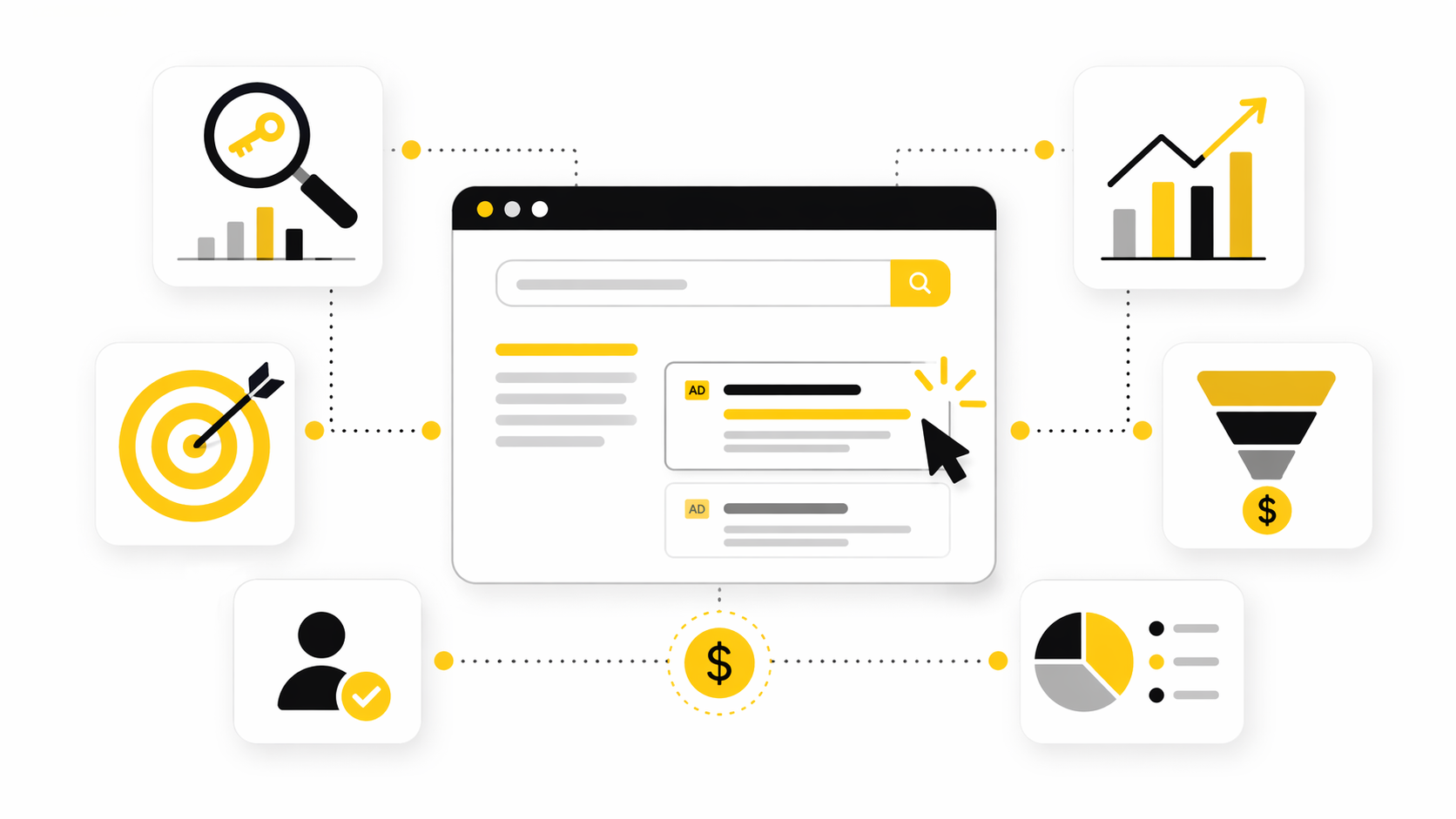
A useful way to think about sem marketing is this: it sits between user intent and business outcome. The search query reveals intent. The ad qualifies the click. The landing page turns that click into an action. The tracking stack tells you whether the action was worth the cost. Once you see it as a chain instead of a single campaign, the whole channel starts to make more sense.
Why SEM Marketing Still Matters
The biggest reason sem marketing still matters is brutally simple: buyers still search before they buy. Search remains the dominant discovery layer for commercial intent, and even as AI assistants grow, search behavior is becoming more detailed rather than disappearing. Google’s recent analysis of AI-powered search behavior says queries are getting longer and more complex, with users trying to shorten the path from discovery to decision through more specific prompts and follow-up exploration inside search experiences.
The economic scale behind that behavior is impossible to ignore. Alphabet reported that Google Services revenue reached $95.9 billion in Q4 2025, led in part by 17% growth in Google Search & other. At the market level, the IAB/PwC report says digital advertising hit nearly $300 billion in 2025, with search still the largest format. That combination tells you why serious companies keep investing here: search is still where demand gets converted into accountable revenue.
Sem marketing also matters because it is one of the few channels where feedback arrives fast enough to be strategically useful. You can learn which queries drive leads, which messages lift click-through rate, which landing pages convert, and which audiences waste budget without waiting months for a verdict. Google’s Smart Bidding documentation makes the platform’s direction obvious as well: bidding is increasingly optimized in real time at the auction level for conversion goals and value, which means the winners are usually the advertisers with cleaner data, stronger signals, and tighter offer-to-query alignment rather than the ones manually tweaking every lever by hand.
There is also a practical business reason to care. Google says its search, advertising tools, and related products helped generate $947 billion of economic activity in the U.S. in 2025, a figure expanded in its methodology and national report. You do not need to accept every corporate framing inside that claim to see the core truth underneath it: search visibility has real commercial consequences, especially for companies that need leads, calls, demos, bookings, or high-intent ecommerce traffic.
The SEM Marketing Framework
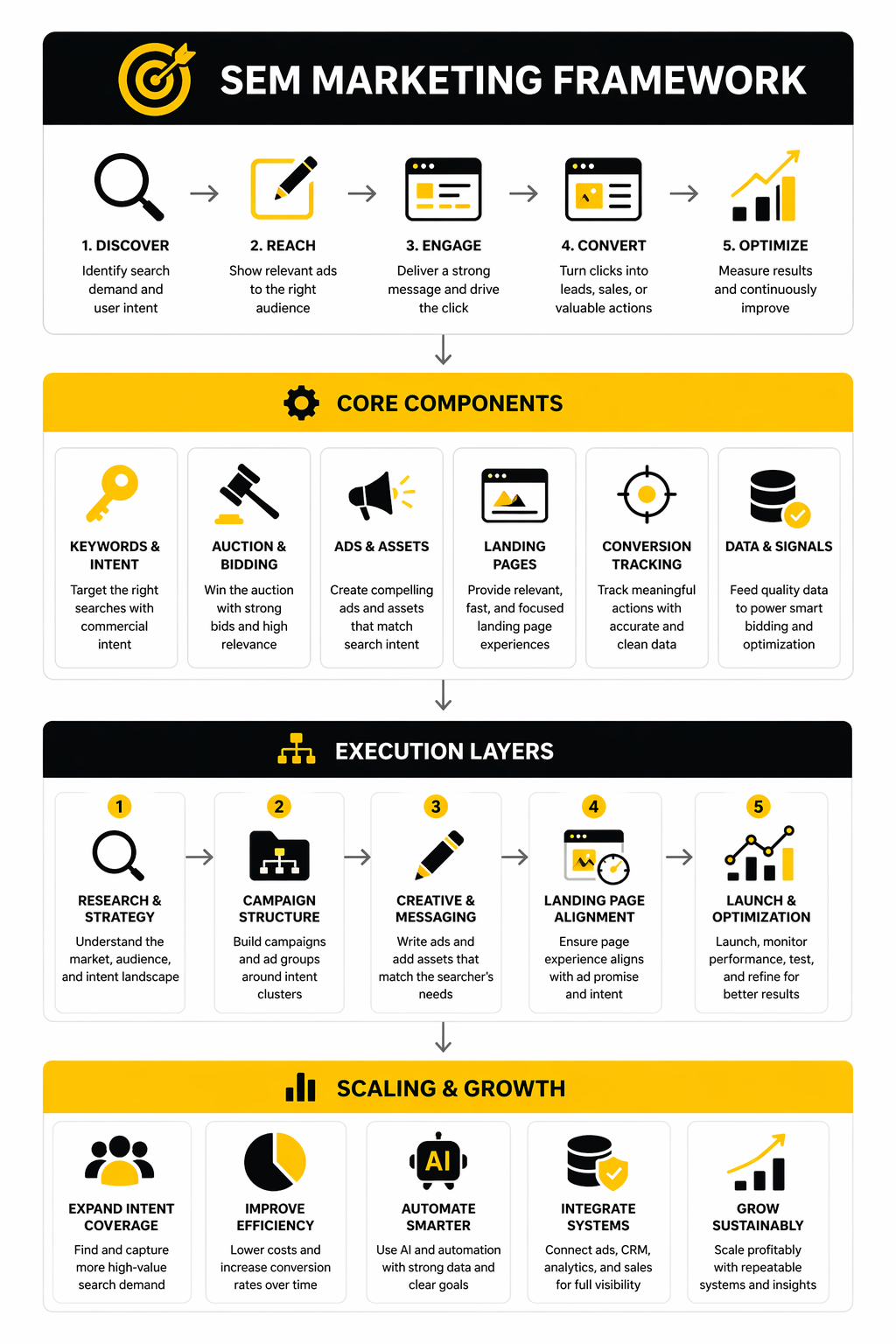
A strong sem marketing program is easier to manage when you stop viewing it as a campaign dashboard and start viewing it as a framework. The clean version has four layers: demand mapping, traffic capture, conversion architecture, and optimization. Miss one layer and the whole system gets weaker, even if the others look good in reports.
Demand mapping comes first because keyword lists alone are not strategy. You need to understand what people are actually trying to accomplish when they search. Some queries signal research, some signal comparison, and some signal readiness to buy right now. When search behavior becomes more complex, as Google says it is becoming in AI-powered search, this step matters even more because intent clusters are often hidden behind longer phrases and more nuanced wording than older keyword models assumed.
Traffic capture is the layer most people think is the whole job. It covers campaign structure, match types, targeting, bidding, budgets, search terms, and ad creative. But this layer only works when relevance stays tight. Google’s Quality Score documentation and Smart Bidding guidance both point to the same reality from different angles: search platforms reward usefulness, intent match, and strong conversion signals more than surface-level activity inside the auction and at bid time.
Conversion architecture is where a lot of accounts quietly fail. A click is not the outcome. The outcome is a qualified lead, a booked call, a sale, or whatever action actually creates value. If the landing page is vague, slow, misaligned, or overloaded with friction, the entire sem marketing engine breaks after the click. That is why professionals obsess over message match, page layout, offer clarity, form design, and measurement setup instead of treating the website as someone else’s problem.
Optimization is the final layer, but it is not just weekly maintenance. It is the operating rhythm that turns data into advantage. That includes query pruning, bid strategy evaluation, creative testing, landing-page iteration, budget reallocation, and better conversion tracking. The point is not to “optimize everything.” The point is to improve the parts of the system that change business outcomes.
Here is the framework in plain language:
- Map intent so you know which searches are worth paying for.
- Build campaigns around relevance so the right message appears for the right query.
- Design landing pages for action so clicks become measurable outcomes.
- Feed the system clean data so bidding and reporting reflect real value.
- Optimize against profit, pipeline, or revenue instead of vanity metrics.
That framework will carry the rest of this article. Next, we’ll move from the big-picture model into the specific components that make sem marketing succeed or fail in the real world.
The Core Components of High-Performing Campaigns
Once the framework is clear, the next question is what actually makes sem marketing perform in practice. Not in theory, not in conference slides, and not in screenshots from cherry-picked accounts. In the real world, strong results usually come from a handful of core components working together without friction.
That sounds obvious, but it is exactly where a lot of campaigns fall apart. A business can choose decent keywords and still lose because the ad is vague. It can write strong ads and still lose because the landing page breaks trust. It can fix both and still optimize badly because conversion tracking is incomplete. Sem marketing gets expensive when one weak link drags down the whole chain.
Keywords and Search Intent
Keywords still matter, but not in the old spreadsheet-hoarding way. The job is not to collect as many terms as possible. The job is to map commercial intent, separate useful traffic from low-value traffic, and structure campaigns around what the user is actually trying to do.
That distinction matters more now because matching systems have become more intent-aware and more automated. Google’s own documentation shows that broad match is increasingly tied to conversion-based Smart Bidding and can now be used at the campaign level, which makes it easier to expand reach but also raises the stakes on account structure, data quality, and negative keyword discipline inside current Search campaign settings. In plain English, broader matching can work well, but only when the account gives the algorithm enough signal to understand what a good click actually looks like.
This is why search terms matter just as much as keywords. Google’s search terms report exists for a reason: it shows the real queries that triggered your ads, not just the words you added yourself in the account setup. If you are serious about sem marketing, that report becomes one of your most useful feedback loops because it tells you where relevance is strong, where intent is drifting, and where money is quietly leaking.
Negative keywords are part of the same discipline. Google describes them very simply: they exclude search terms you do not want so you can focus on the searches that matter to your customers. That is not housekeeping. It is strategic control. Good accounts are rarely built by adding more traffic first. They are usually improved by cutting the wrong traffic faster.
Ad Rank, Bidding, and the Auction
The next core component is the auction itself. Sem marketing is not just a list of bids competing on price. Search ads are served through ad auctions that evaluate factors like relevance, expected performance, bid strategy, and the context of the individual search, which is why average advertisers often misunderstand why they lose even when they are willing to pay more.
Google’s current Smart Bidding guidance is blunt about the platform direction: bids are optimized at auction time, for each individual auction, using contextual signals the advertiser cannot realistically manage by hand at scale through manual adjustments alone. That does not mean automation magically fixes weak campaigns. It means modern sem marketing depends less on isolated bid tweaks and more on whether the system has enough clean conversion data, relevant assets, and intent-aligned traffic to make good decisions.
Quality Score fits into this section, but it needs to be understood correctly. Google calls it a diagnostic tool, not a direct KPI, and it is meant to help advertisers compare the relevance and usefulness of their ads and landing pages against other advertisers in the same auctions at the keyword level. That is why obsessing over the score itself can become a distraction, while ignoring what it points to is a mistake. The score is not the prize. The relevance behind it is.
When you step back, the practical lesson is simple. Bid strategy should follow business goals, not ego. If the goal is lead volume, the bidding setup should reflect qualified lead generation. If the goal is revenue, value-based signals matter more. The auction rewards clarity, signal quality, and consistency far more than frantic micromanagement.
Ads, Assets, and Message Match
A keyword gets you into the auction. The ad gets you the click. That is where a surprising amount of sem marketing still underperforms, because too many advertisers write ads like generic brand statements instead of decision-making prompts.
Responsive Search Ads now dominate the format, and both Google and Microsoft continue pushing more automated asset generation and combination testing. Microsoft’s guidance on Responsive Search Ads frames the point clearly: the format is designed to mix and match headlines and descriptions to improve performance and reduce the guesswork around which combinations work best for search advertisers. That makes good inputs more important, not less. Automation helps, but it still needs clear value propositions, specific claims, and clean message priorities to work with.
Assets expand that message. Google’s sitelink assets let advertisers send users to more specific destinations such as pricing, category pages, booking pages, or store hours directly from the ad unit. Callout assets help highlight differentiators like free shipping, support coverage, or other non-clickable proof points beneath the main ad copy. Structured snippets add factual scannable detail about offerings, services, brands, or features, which can make the ad feel more complete before the click even happens in eligible search results.
The bigger principle here is message match. The user types a query. Your ad should answer that query directly enough that the click feels obvious. If someone searches with transactional intent and the ad sounds like a vague awareness campaign, performance drops. If someone searches with a local-service need and the ad hides the offer, location, or next step, the click becomes harder to win. In sem marketing, relevance is not a branding nice-to-have. It is conversion economics.
There is also a more current wrinkle worth noticing. Google has already announced more AI-driven changes to Search campaign management, including the 2026 upgrade path from Dynamic Search Ads and campaign-level broad match settings into AI Max for Search campaigns. That makes ad copy strategy even more important because the system is moving toward broader discovery and more automation, while still depending on good creative inputs and landing-page alignment to perform well.
Landing Pages and Conversion Architecture
If the ad wins the click, the landing page has to earn the action. This is the component that separates campaigns that look promising in-platform from campaigns that generate actual business results. A lot of sem marketing waste is not caused by bad traffic. It is caused by sending decent traffic to pages that are slow, generic, distracting, or mismatched to the promise in the ad.
Google’s optimization guidance could not be much clearer here. It recommends choosing landing pages that closely match your ad and keywords because that alignment improves ad relevance and landing-page experience, both of which feed back into overall performance inside Search campaigns. This is one of those areas where common sense and platform mechanics point in the same direction. If the search is specific, the page needs to be specific too.
Speed belongs in this conversation as well. Google’s PageSpeed Insights documentation explains that the tool reports on real user experience signals and gives improvement suggestions for both mobile and desktop pages at the page level. Older but still useful Google guidance has also shown how slower landing pages damage conversion behavior, which is why page speed remains one of the fastest practical wins in performance work for mobile experiences.
A strong landing page does not need to be flashy. It needs to be coherent. The headline should continue the promise from the ad. The offer should be visible without hunting. The next action should be obvious. The page should answer the buyer’s immediate questions before they have a reason to bounce. When sem marketing feels expensive, this is often the first place worth checking.
Conversion Tracking and First-Party Data
None of the earlier components can be optimized properly if measurement is weak. That is the uncomfortable truth behind a lot of bad sem marketing decisions. Teams argue about bidding, keywords, and creative when the real problem is that the account is learning from incomplete or distorted conversion data.
Google’s 2026 update to enhanced conversions shows exactly where the platform is heading. Starting in April 2026, Google Ads began accepting user-provided data from website tags, Data Manager, and API connections at the same time, and starting in June 2026 it is merging enhanced conversions for web and leads into a single on/off feature to simplify setup. That is not a minor interface change. It reflects a bigger shift toward first-party data as the foundation of modern paid search measurement.
For advertisers, the implication is straightforward. If your account cannot reliably connect clicks to meaningful outcomes, automation becomes less trustworthy and performance becomes harder to scale. Better data does not guarantee better sem marketing, but weak data almost always caps it. The platform can only optimize what it can actually see.
This is also why mature accounts define conversions carefully instead of tracking every possible action as if all of them are equally valuable. A newsletter signup, a qualified demo request, a booked appointment, and a closed sale are not the same thing. The clearer that hierarchy becomes, the more useful your bidding, reporting, and budget decisions become too.
The next step is where all these components start behaving like an operating system instead of a checklist. That is what separates amateur setup from professional execution, and it is where the article goes next.
How Professionals Build and Optimize SEM Programs
Knowing what sem marketing is and understanding the parts inside the machine is useful, but implementation is where the channel either becomes a growth engine or an expensive habit. This is also the point where a lot of advice online starts to drift away from reality. Real operators do not launch campaigns by dumping in keywords, turning on Smart Bidding, and hoping the platform figures the rest out.
Professional implementation usually starts with restraint. The goal is not to launch the biggest account possible on day one. The goal is to launch a system that can learn cleanly, spend with purpose, and produce signal you can trust. That sounds less exciting than “scale fast,” but it is how strong sem marketing programs avoid burning money before the first useful lesson even arrives.
The process is not mysterious. It is structured, repeatable, and surprisingly practical when done well. The teams that consistently win tend to move through the same sequence: define the business outcome, map search intent, build tight campaign architecture, align the landing page, verify tracking, launch with control, and only then expand.
Start With the Business Outcome, Not the Platform
The first implementation mistake is opening the ad platform before deciding what success actually means. That sounds basic, but it is common. A company says it wants more leads, when what it really needs is more qualified pipeline. Another says it wants more sales, when the real constraint is low average order value or weak post-click conversion rate.
Professional sem marketing starts by translating business goals into campaign goals that can be measured cleanly. That means defining the primary conversion, the acceptable acquisition cost, the quality threshold for leads if sales are involved, and the revenue logic behind the offer. If those pieces are fuzzy, the account ends up optimizing for activity instead of outcomes.
This is also where channel fit gets tested. Some offers have obvious search intent and clear demand capture potential. Others need education before buyers are ready to act. A strong operator can still use sem marketing in both cases, but the implementation approach changes depending on how close the searcher is to a decision.
Build From Intent Clusters, Not Random Keyword Lists
Once the business outcome is clear, the next job is grouping intent the right way. This is where campaign strategy becomes tangible. Professionals usually build around clusters of searches that reflect a similar need, a similar stage of awareness, or a similar commercial value rather than stuffing unrelated terms into one campaign for convenience.
That matters because intent drives everything downstream. It shapes the ad angle, the landing page promise, the bidding logic, and the way performance should be judged. A high-intent “near me” search, a comparison query, and an early research query may all be relevant, but they do not belong in the same bucket if you want clean data and useful optimization decisions.
A practical structure often starts with a few core segments:
- brand intent
- non-brand high intent
- competitor or comparison intent
- local or geo-modified intent
- informational or research intent with strong downstream value
That does not mean every account needs all five. It means professionals separate demand by behavior and value, not by whatever keyword export happened to come first. Cleaner intent grouping makes sem marketing easier to control, easier to analyze, and much easier to scale later.
Create Campaign Architecture That Protects Signal
Good campaign architecture is not about making the account look pretty. It is about protecting relevance and preserving signal. When structure is messy, the platform mixes very different searches together, ads become generic, landing pages become compromised, and reporting gets harder to trust.
Professionals typically keep the first version tighter than beginners expect. They do not launch ten experiments at once if they cannot feed them properly. They start with the campaigns that have the clearest intent and the strongest connection to business value, then let actual search-term and conversion data justify expansion.
That same discipline applies to geography, device logic, and budget distribution. If a business only serves certain markets well, those markets should not be diluted by broad national targeting just because the interface makes it easy. If mobile traffic converts differently from desktop traffic because the site experience is weaker, that reality should shape implementation decisions instead of being ignored in the name of simplicity.
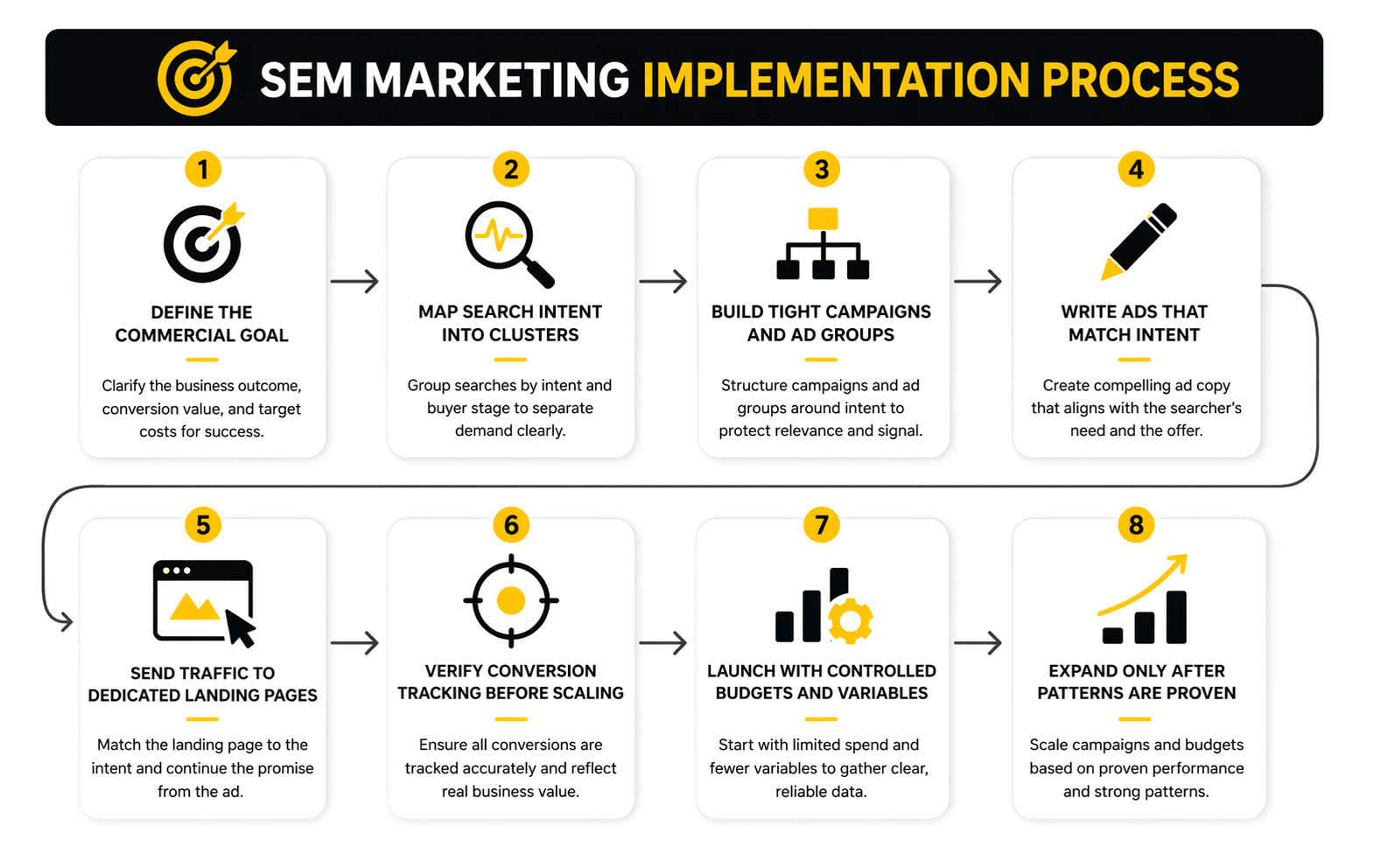
A clean implementation process usually looks like this:
- Define the commercial goal so the account knows what a win actually is.
- Map search intent into clusters so different buyer needs are not blended together.
- Build tight campaigns and ad groups so relevance stays strong from query to ad.
- Write ads that match intent directly so the click feels like the obvious next step.
- Send traffic to dedicated landing pages so the page continues the promise instead of resetting it.
- Verify conversion tracking before scaling so optimization decisions are grounded in reality.
- Launch with controlled budgets and limited variables so early data is interpretable.
- Expand only after patterns are proven so growth comes from evidence, not impatience.
This sequence is not glamorous, but it is reliable. It turns sem marketing into an operating process rather than a guessing game.
Match Landing Pages to Buying Moments
One of the clearest signs of professional implementation is that the landing page is treated as part of the campaign, not an afterthought. Weak operators send all traffic to one generic page and then wonder why click costs feel painful. Strong operators understand that different intents deserve different page experiences.
Someone searching for a pricing-related term usually needs clarity, proof, and a fast route to action. Someone looking for a local service often needs location trust, availability, and a direct contact path. Someone exploring alternatives may need comparison logic, objections handled early, and stronger reassurance before converting. Sem marketing works best when the landing page respects the emotional and practical context of the search.
This is why dedicated landing pages often outperform broad website destinations. They remove distraction, continue the message from the ad, and make the next step easier. For teams that need to move quickly, a builder like Replo can make that testing process much faster, especially when landing-page speed matters as much as message match.
Set Up Measurement Before You Trust Any Result
A campaign is not really live until the data is trustworthy. This is the part many teams rush through because the ads are already running and clicks are coming in. That is exactly how bad assumptions get baked into the account early.
Professional sem marketing implementation treats tracking as infrastructure. Primary conversions are defined clearly. Secondary conversions are separated so they do not pollute optimization. Form submissions, calls, bookings, purchases, and offline sales outcomes are mapped based on actual business value rather than convenience. If lead quality matters, the measurement plan has to reflect that instead of pretending every form fill is equally useful.
This is also where first-party systems start to matter. If leads move through a CRM, that connection should not stay trapped outside the ad platform forever. Tools like GoHighLevel, Copper, or structured form workflows through Fillout can help tighten that feedback loop when the business needs cleaner attribution and better lead handling. The platform can optimize far better when the business feeds it better truth.
Launch Narrow Enough to Learn
A smart launch does not try to prove everything at once. It tries to answer the most important questions first. Which intent clusters convert? Which messages attract the right click? Which landing-page path creates enough signal to justify more budget? That is the level of clarity you want from an initial rollout.
This usually means fewer campaigns, fewer variables, and stronger control over spend than beginners expect. Broad experiments can come later. At launch, you want enough room for the algorithm to learn, but not so much sprawl that the first two weeks generate noise instead of insight.
This discipline is especially important in sem marketing because early account history influences what happens next. If the launch phase trains the account on weak conversions, vague traffic, or low-intent queries, optimization gets pulled in the wrong direction. A controlled launch protects the account from learning the wrong lessons too fast.
Turn Optimization Into an Operating Rhythm
After launch, professional implementation shifts into operating cadence. This is where mediocre accounts drift and strong accounts compound. The difference is rarely one genius tactic. It is usually the consistency of review, decision-making, and action.
The best operators review search terms for intent drift, cut waste without hesitation, test new ad angles based on buyer language, and update landing pages when friction appears. They reallocate budget toward the queries and campaigns that create real business value instead of clinging to pet experiments. They also know when not to touch things too quickly, because sem marketing performance can get distorted when every fluctuation triggers a reaction.
A useful weekly rhythm often includes:
- reviewing spend against actual business outcomes
- checking search-term quality and adding negatives
- comparing ad messaging against top-performing intent groups
- identifying landing-page leaks
- watching conversion quality, not just conversion count
- moving budget toward clearer winners
That sounds operational because it is. Sem marketing at a high level is not about hacks. It is about disciplined execution repeated long enough for compound gains to show up.
Build Systems That Make Scaling Easier Later
The final mark of professional implementation is that the account is built to scale without collapsing under its own complexity. That means naming conventions that still make sense six months later, tracking that can survive team changes, landing-page processes that support ongoing testing, and reporting that connects media metrics to revenue decisions.
It also means supporting the campaign with systems around it. Follow-up speed matters for leads. Scheduling flow matters for booked calls. CRM hygiene matters for understanding which campaigns create real value. If the post-click workflow is weak, sem marketing can look less effective than it really is because the business fails the lead after the ad has already done its job.
That is why serious operators think beyond the ad platform. For example, if faster lead routing or automated follow-up is the real bottleneck, a platform like ManyChat or Brevo can strengthen the path after the click. That does not replace the core job of sem marketing. It makes the business more capable of capturing the value sem marketing creates.
The next part of the article moves from process into the harder strategic layer: how professionals decide what to optimize first, what to ignore, and how to keep the account improving without overcomplicating it.
Where SEM Marketing Is Going Next
By the time a sem marketing program is working, the challenge changes. The early stage is mostly about getting relevance, tracking, and offer alignment under control. The later stage is about making smarter tradeoffs when growth gets harder, the platform gets more automated, and the data gets messier.
That is the part people usually underestimate. Scaling does not just mean spending more. It means protecting efficiency while the easy wins disappear, the query mix broadens, and the account starts surfacing more edge-case traffic. This is where real judgment matters, because the platform can help you move faster, but it cannot decide what kind of growth is actually worth buying.
Scaling Usually Lowers Precision Before It Raises Volume
The first uncomfortable truth about scale is that growth often comes with lower precision. When an account expands beyond the cleanest intent clusters, it starts reaching more ambiguous searches, more mixed-quality audiences, and more marginal opportunities. That does not mean expansion is bad. It means every extra dollar usually has to work harder than the first one.
Google’s own AI Max materials make this tradeoff visible. AI Max is designed to help advertisers find more untapped queries by combining advertiser inputs with richer signals and real-time optimization, while Google’s technical documentation makes clear that it expands reach through search term matching and asset optimization inside existing Search campaigns rather than acting like a simple keyword tool and inside the campaign layer itself. That is powerful, but it also means scale increasingly depends on how well your account can absorb broader query discovery without letting relevance slip.
Professionals handle this by expecting the tradeoff instead of pretending it will not happen. They separate “can spend more” from “should spend more.” Sometimes the smartest move in sem marketing is not to chase the last bit of volume. It is to defend the profitable core, keep testing around the edges, and accept that not every account should expand at the same pace.
Automation Changes the Job, but It Does Not Remove It
A lot of commentary around sem marketing still swings between two bad extremes. One side acts like automation is a magic button. The other acts like human operators can still outmanage every decision manually. Neither view matches where the platforms are actually going.
Google spent much of 2025 and 2026 pushing that direction harder, tying together AI Max, measurement updates, and workflow automation in its own recap of product releases for advertisers. Microsoft is moving the same way, positioning Copilot as an assistant inside Microsoft Advertising for campaign creation, insight discovery, and workflow support across the platform. The pattern is obvious: machines are taking on more execution, while humans are left with the harder work of strategy, input quality, offer design, and commercial judgment.
That changes the skill set that matters. The old edge of sem marketing was often tactical control. The new edge is better decision architecture. Can you feed the system cleaner signals, sharper creative inputs, stronger landing pages, and better business context than the average advertiser? If yes, automation becomes an advantage. If not, automation just helps you waste money more efficiently.
Measurement Has to Move Beyond In-Platform Reporting
As accounts get more sophisticated, the biggest mistake is trusting one dashboard too much. In-platform reporting is necessary, but it is not the whole truth. It shows what the ad system can attribute, not always what the business actually gained.
That is why Google keeps pushing first-party data and broader measurement approaches at the same time. The enhanced conversions changes rolling out in 2026 are built around accepting user-provided data from multiple sources and simplifying how that data is used for measurement and bidding inside Google Ads. At the same time, Google is promoting Meridian as an open-source marketing mix modeling framework built for modern measurement challenges and more privacy-durable analysis. Those two moves point to the same strategic lesson: sem marketing decisions get stronger when you combine platform data with broader business measurement instead of forcing one system to answer every question.
This matters most when budgets get large. A campaign can look efficient in-platform while still cannibalizing branded demand, pulling forward conversions that would have happened anyway, or hiding weak lead quality behind pretty cost-per-conversion metrics. Strong teams learn to compare platform reporting with CRM outcomes, sales feedback, and broader modeling rather than treating any single number as sacred. That is not complexity for the sake of complexity. It is how you avoid false confidence.
AI Search Will Change Surfaces More Than It Changes Intent
There is a lot of noise around AI and search right now, and some of it is real. Search results are changing. Ad formats are changing. The path from query to answer is becoming more conversational in some contexts. But the core reason sem marketing exists has not actually changed: people still reveal commercial intent when they look for solutions.
Google has already been testing ads across newer AI-powered search experiences, while industry data keeps showing search as an enormous performance channel. The latest IAB/PwC figures put U.S. search advertising at $114.2 billion in 2025, and recent reporting on Google’s AI search experiments shows the company continuing to reshape how answers and follow-up prompts appear inside search itself. The interface is shifting, but the commercial signal behind search behavior is still there.
That is why the smart response is not panic. It is adaptation. Sem marketing teams need to think less like keyword librarians and more like intent architects. The winners will be the advertisers who understand buyer language, structure campaigns around actual commercial moments, and keep their offers visible even as the search environment becomes more AI-mediated.
The Real Risks Are Usually Strategic, Not Technical
By this stage, the biggest dangers are rarely hidden inside a settings menu. They are strategic errors. Scaling before conversion quality is proven. Letting automation broaden reach before the business has clean feedback loops. Judging performance on lead volume when sales quality is deteriorating. Expanding campaigns while the landing page and follow-up process stay weak.
There is also a broader privacy and data-governance pressure that serious advertisers cannot ignore. Google continues to frame first-party data and privacy-preserving measurement as a core part of modern ad growth for marketers, while its broader Privacy Sandbox work has reflected how much the industry is still trying to balance measurement needs with user expectations and regulatory pressure. Even when specific initiatives change shape, the strategic direction is clear enough: sem marketing will reward businesses that own cleaner customer data, better consent practices, and stronger internal systems.
That is why mature teams stop treating paid search like an isolated media channel. They connect it to CRM quality, sales process discipline, landing-page operations, and revenue measurement. They document what works. They build repeatable workflows. If that operational side is weak, tools that help centralize follow-up and attribution, like GoHighLevel, can make the whole system easier to manage. But the principle matters more than the software: sem marketing scales best when the business around it is built to capture and use demand properly.
The Best Operators Get More Selective as They Get More Advanced
This is the part that surprises people. Expert-level sem marketing often looks less busy from the outside. Fewer random experiments. Fewer vanity tests. More patience. More ruthless prioritization. More attention to signal quality, commercial truth, and where the next incremental gain is actually likely to come from.
That does not mean advanced operators stop testing. It means they get better at deciding what deserves a test in the first place. They know that not every drop in efficiency is a crisis, not every new feature is a breakthrough, and not every scaling opportunity is worth taking. The mature version of sem marketing is not louder. It is sharper.
The final part will bring all of this together and answer the practical questions readers usually ask once the strategy is clear: what sem marketing is best for, where it goes wrong, and how to judge whether a program is actually working.
Bringing the Full SEM System Together
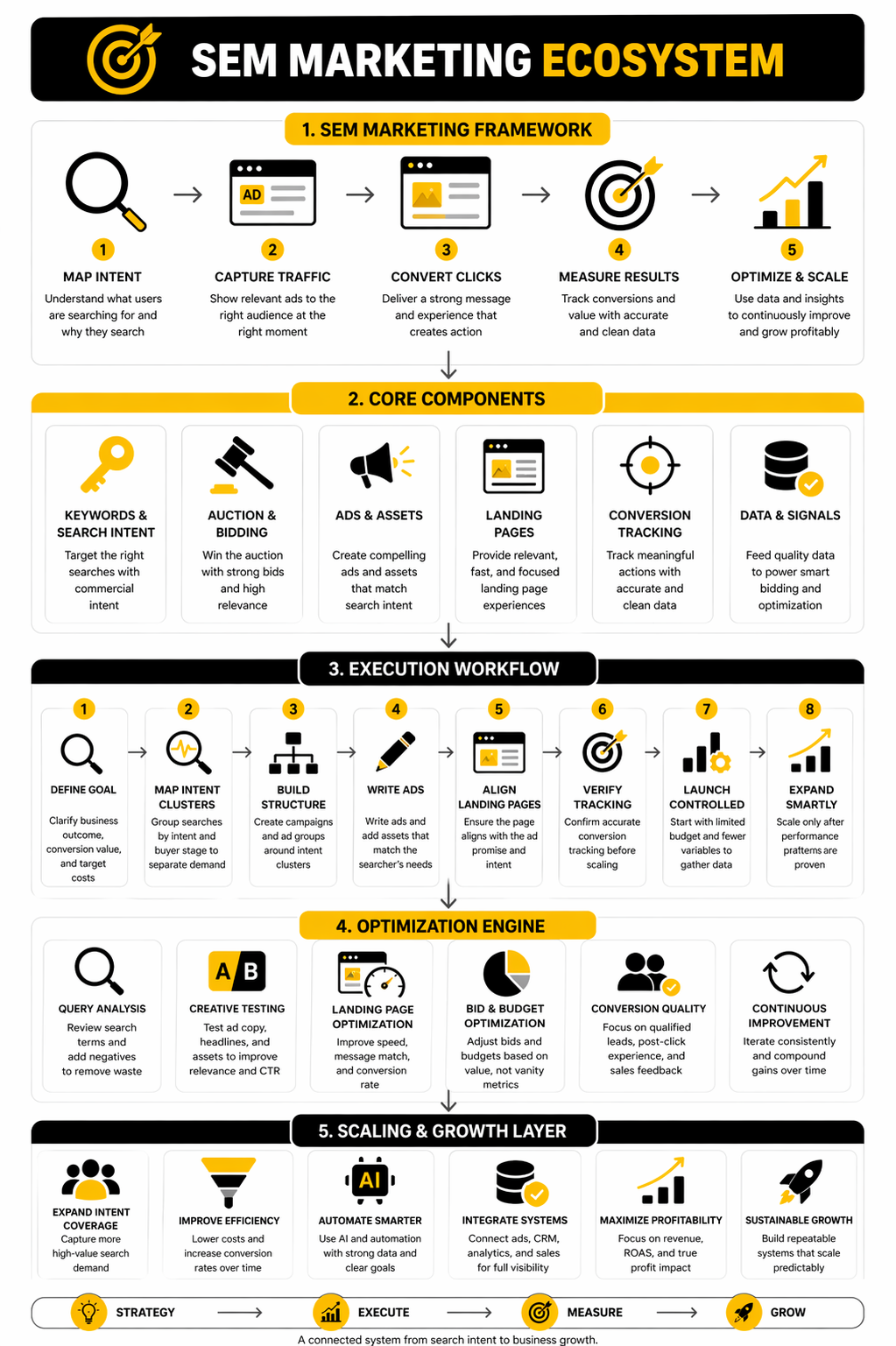
By this point, the shape of sem marketing should be clear. It is not just keyword buying, and it is not just a dashboard game. It is a connected system built from intent mapping, campaign structure, ad relevance, landing-page alignment, conversion tracking, follow-up quality, and disciplined optimization.
That systems view matters even more now because the platforms are pushing harder into AI-assisted expansion, automated bidding, richer matching, and first-party-data-based measurement. Google’s recent updates around AI Max and enhanced conversions make that direction obvious, while Microsoft continues expanding automation and responsive ad workflows across its advertising stack.
The practical takeaway is simple. The businesses that win with sem marketing are rarely the ones doing the most. They are usually the ones doing the fundamentals better, feeding cleaner signals into the platform, and building a stronger system around the click once it arrives.
FAQ
What is sem marketing in simple terms?
Sem marketing is paid search advertising built around user intent. A person searches for something related to a product, service, or solution, and your business pays to appear in that moment with a relevant offer. The real job is not just buying visibility, though. It is turning that intent into measurable business results.
Is sem marketing the same thing as Google Ads?
Not exactly. Google Ads is one of the main platforms used to run sem marketing, but the discipline itself is broader than the tool. It includes strategy, keyword and query selection, messaging, landing pages, conversion tracking, and optimization logic. Microsoft Advertising also fits into sem marketing, and the core principles stay the same even when the interface changes.
Does sem marketing still work in 2026?
Yes, and the business scale behind search still makes that hard to dismiss. The latest IAB/PwC report shows U.S. search advertising reached $114.2 billion in 2025, and Alphabet’s latest results still showed strong growth in Google Search & other revenue. That does not mean every campaign works automatically. It means the channel still matters, but execution quality matters more than ever.
What is the difference between sem marketing and seo?
Seo is about earning visibility organically over time. Sem marketing is about paying for visibility in search auctions so you can appear immediately for relevant queries. In practice, the two work best together. Seo builds durable search presence, while sem marketing helps you capture demand faster, test messaging, and protect high-intent search coverage.
How much budget do you need to start sem marketing?
There is no universal number because cost depends on the market, the query set, the competition, and the value of a conversion. A small local campaign can start with a tightly controlled budget if intent is strong and tracking is clean. What matters most early is not the size of the budget. It is whether the account is structured narrowly enough to learn from the spend without flooding itself with low-quality traffic.
What matters more in sem marketing: keywords or landing pages?
That is the wrong fight because both matter, just at different moments. Keywords and search terms decide whether you are entering the right auctions, while the landing page decides whether the click has any real chance of turning into value. If the keyword strategy is weak, you buy the wrong traffic. If the landing page is weak, you waste the right traffic.
Is broad match good or dangerous?
It can be either, depending on how well the rest of the account is built. Google is clearly moving toward more automation and broader signal use, which means broad match can uncover valuable demand when conversion tracking and bidding are strong. But if the account is learning from bad data or weak conversion definitions, broad match can expand waste just as fast as it expands opportunity.
How long does sem marketing take to work?
It can start generating clicks and conversions quickly, which is one reason businesses like it. But meaningful performance learning usually takes longer because you need enough data to understand which search terms, ads, landing pages, and conversion paths are actually producing business value. Early movement is easy to see. Reliable optimization signals take more discipline.
What are the biggest reasons sem marketing fails?
The most common failures are usually not exotic. Businesses target the wrong intent, write vague ads, send paid traffic to weak landing pages, optimize toward low-quality conversions, or scale before they really understand what is working. Sometimes the ad account is not even the core problem. The real issue is slow follow-up, poor sales handling, or weak CRM discipline after the lead comes in.
Should small businesses use sem marketing?
Often yes, especially when the service or offer lines up with obvious search intent. Local services, urgent-need categories, B2B demo offers, and many ecommerce products can all perform well when the account is tightly structured. The key for small businesses is usually focus. It is better to own a narrow, high-intent slice of demand than to chase every possible keyword and burn through budget.
Is sem marketing getting replaced by AI search?
No, but it is definitely being reshaped by AI-assisted search behavior and AI-powered ad systems. The search surface is changing, the matching logic is getting broader, and the workflow is becoming more automated, but the commercial intent behind search still exists. People still look for solutions when they want to buy, compare, book, or fix something. The winning move is not to abandon sem marketing. It is to adapt how you build and measure it.
How do you know whether sem marketing is actually profitable?
You know by connecting campaign activity to business outcomes, not just platform metrics. Cost per click, click-through rate, and even cost per conversion can look fine while lead quality or downstream revenue stays weak. Real evaluation usually requires CRM feedback, sales validation, and a clear view of what different conversion types are actually worth to the business.
What tools make sem marketing easier to manage?
The exact stack depends on the business model, but most strong setups use a combination of ad platforms, landing-page tools, analytics, CRM workflows, and reporting systems. The tool itself is rarely the advantage. The advantage comes from using tools in a way that keeps the system connected from query to click to conversion to follow-up. When that connection breaks, the account becomes much harder to improve.
Work With Professionals
Explore 10K+ Remote Marketing Contracts on MarkeWork.com
Most marketers spend too much time chasing clients, competing on crowded platforms, and losing a percentage of every project to middlemen. MarkeWork gives you a better way. Browse thousands of remote marketing contracts and connect directly with companies desperate to hire skilled marketers like you, without platform commissions and without unnecessary gatekeepers.
If you're serious about finding better opportunities and keeping 100% of what you earn, explore available contracts and create a profile for free at MarkeWork.com.