

The Semrush affiliate program is one of the more interesting SaaS affiliate plays because it sits close to buyer intent. People searching for SEO tools, competitor research, content planning, PPC research, and AI visibility tracking are usually not browsing casually. They are often trying to solve a revenue problem.
Semrush now positions its affiliate program around fixed commissions, product-specific payouts, Impact tracking, last-click attribution, and a 120-day cookie window through its official affiliate program. That matters because affiliates are not just promoting a cheap impulse buy. They are promoting a professional marketing platform where trust, comparison content, and timing can make or break conversions.

Article Outline
- Why The Semrush Affiliate Program Matters
- Framework Overview For Promoting Semrush
- Core Components Of A Strong Semrush Affiliate Strategy
- Professional Implementation Across Content, Funnels, And Email
- Conversion Optimization And Common Mistakes
- Final Evaluation, Alternatives, And FAQ
Why The Semrush Affiliate Program Matters
The biggest reason this program matters is simple: Semrush solves expensive problems. If a business cannot understand search demand, competitors, rankings, backlinks, or content gaps, it usually wastes money on weak campaigns. That gives affiliates room to create genuinely useful education instead of thin promotional content.
The commission model also gives creators a clear reason to take the program seriously. Semrush lists tiered fixed payouts across products, with higher quarterly sales volume unlocking stronger partner commissions on its affiliate program page. That structure rewards affiliates who build repeatable systems, not just one-off review posts.
There is also a broader market reason this is worth watching. Semrush reported $376.8 million in 2024 revenue and about 117,000 paying customers in its full-year 2024 financial results. A program attached to a growing SaaS product with established demand is very different from promoting a tool nobody has heard of.
Framework Overview For Promoting Semrush
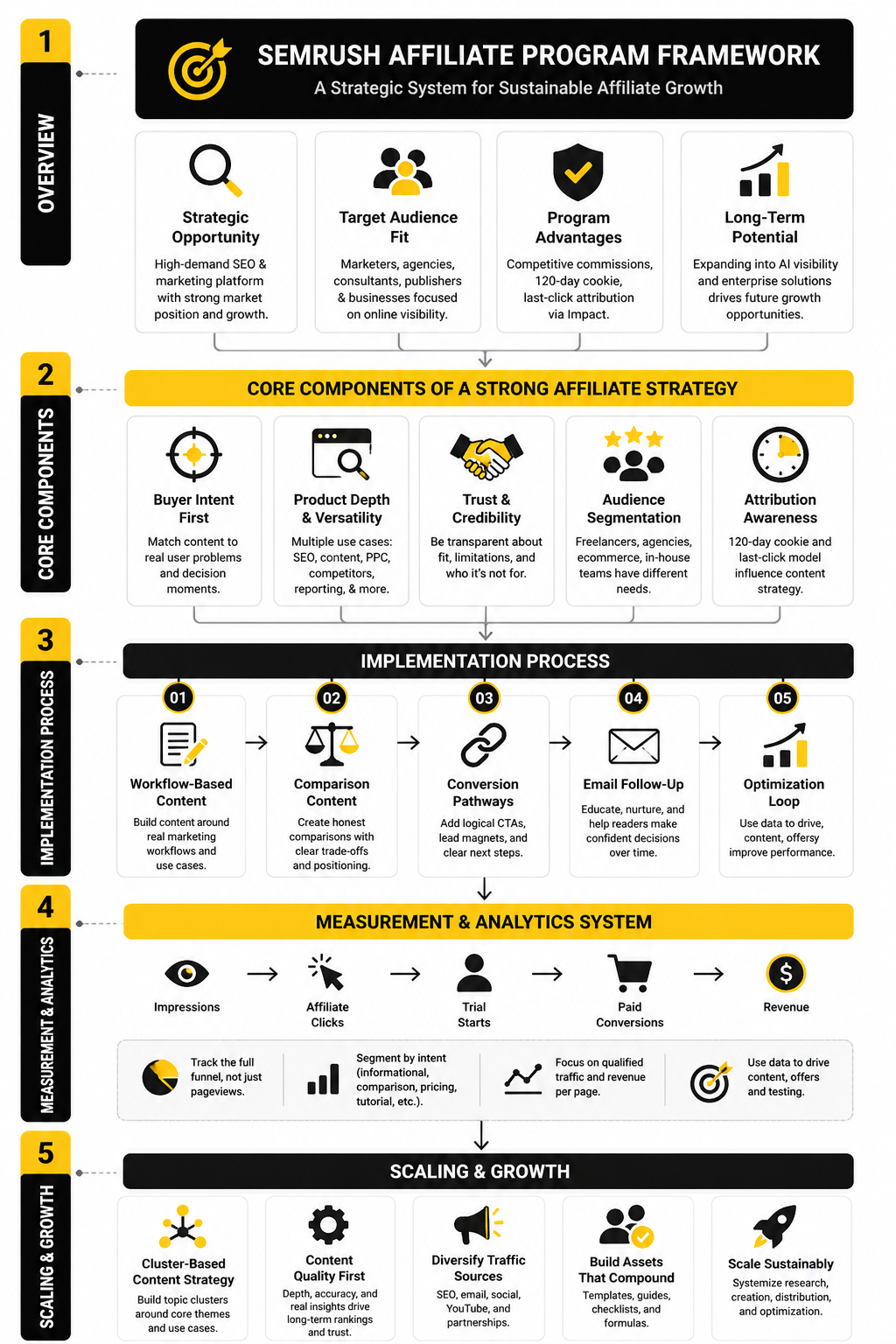
The right way to approach the Semrush affiliate program is not to ask, “How do I get clicks?” The better question is, “Where does Semrush naturally appear in a buyer’s decision process?” That shift changes the whole strategy because it forces you to match content to intent.
A practical framework has three layers: education, comparison, and implementation. Education content helps readers understand the problem, comparison content helps them choose between tools, and implementation content helps them imagine using Semrush inside their workflow. Each layer can earn affiliate revenue, but each one needs a different angle.
This article will build that framework step by step across six parts. We will start with the market logic and structure, then move into the components that actually drive conversions, and finally evaluate whether Semrush is worth promoting compared with other affiliate-friendly marketing tools.
Core Components Of A Strong Semrush Affiliate Strategy
A strong Semrush affiliate strategy starts with matching the tool to the right buyer. Semrush is not a casual productivity app someone buys because it looks nice. It is a serious marketing platform for people who already care about search visibility, competitor research, paid traffic, content performance, or client reporting.
That means your content should filter readers before it sells to them. A freelancer with one small blog, an agency managing ten clients, and an ecommerce team watching competitors all have different reasons to consider Semrush. The best affiliate content makes those use cases clear instead of pretending one generic pitch works for everyone.
The Semrush affiliate program also rewards precision because the official program runs through Impact, uses last-click attribution, and includes a 120-day cookie window on its affiliate program knowledge base. That gives your content more time to convert, but it also means weak positioning can lose the final click to someone else. Your job is to become the page people trust before they sign up.
Buyer Intent Comes First
The easiest mistake is writing a broad review that says Semrush is “good for SEO.” That is technically true, but it is not enough. Readers already know Semrush is an SEO tool, so the useful question is whether it is the right tool for their specific situation.
High-intent content usually comes from searches like “Semrush vs Ahrefs,” “best keyword research tool for agencies,” “Semrush pricing worth it,” or “how to find competitor keywords.” These readers are already close to a decision. They need clarity, trade-offs, and a reason to click through now.
This is where the semrush affiliate program becomes more than a link placement exercise. You are not just dropping a link after a feature list. You are helping a reader decide whether the platform fits the problem they are already trying to solve.
Product Depth Creates More Angles
Semrush is useful for affiliates because it has multiple entry points. You can talk about keyword research, site audits, rank tracking, backlink analysis, PPC research, local SEO, content planning, or competitive intelligence without repeating the same article forever. That matters because sustainable affiliate revenue usually comes from a cluster of related content, not one lonely review.
The company’s 2025 results show why this depth matters commercially. Semrush reported total ARR of $471.4 million and described AI products plus its enterprise platform as $63 million of ending ARR in its full-year 2025 financial results. That signals a product ecosystem moving beyond basic SEO checks into larger marketing workflows.
For affiliates, the takeaway is practical. Build content around jobs the reader wants done, not just around Semrush features. “How to audit a competitor’s content strategy” is usually more compelling than “Semrush features explained.”
Trust Is The Real Conversion Asset
Affiliate marketers often overfocus on commission rates and underfocus on trust. That is backwards. A higher payout does not matter if the reader does not believe your recommendation.
Trust comes from being specific about who should and should not use the tool. Semrush can be powerful for agencies, consultants, in-house marketers, serious publishers, and ecommerce teams. It may be overkill for someone who only needs a simple posting schedule, where a lighter social workflow tool like Buffer could make more sense.
That honesty improves conversion quality. When readers feel you are not forcing every person into the same recommendation, your Semrush links become more credible. In affiliate SEO, credibility is not decoration. It is the asset.
Professional Implementation Across Content, Funnels, And Email
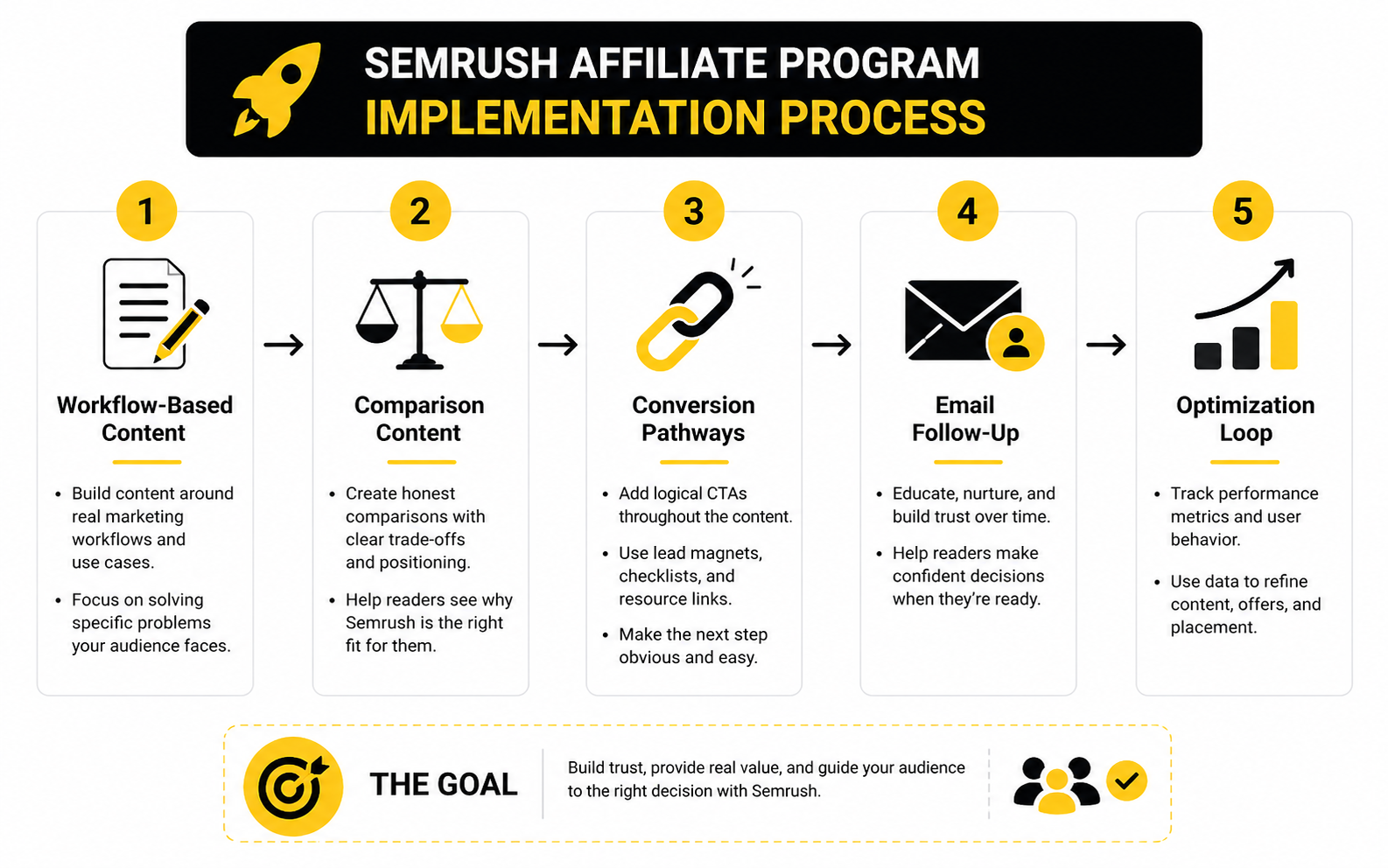
Once the positioning is clear, the next step is execution. This is where most affiliates either build an asset that compounds or create a pile of disconnected posts that never turn into a real business. The Semrush affiliate program works best when your content, capture points, and follow-up flow all support the same buyer journey.
The process should feel simple from the reader’s side. They discover a problem, understand the cost of ignoring it, compare possible solutions, and then see how Semrush fits into the workflow. Your job is to remove friction at each step without turning the article into a pushy sales page.
A good implementation system has four moving parts: search-focused content, proof-based comparison pages, conversion paths, and follow-up. None of these needs to be complicated. But they do need to connect.
Step 1: Build Content Around Real Workflows
Start with workflow-based content because it is easier to make useful and easier to convert. A post about “keyword research” is broad. A post about “how to find competitor keywords before launching a content campaign” is much closer to the moment where Semrush becomes relevant.
This matters even more now because Semrush has expanded beyond classic SEO into AI visibility, competitor intelligence, content planning, and enterprise marketing workflows. Its AI Visibility Toolkit is built to show how brands appear in AI-generated answers, which creates a new implementation angle for marketers who care about visibility beyond traditional search. That gives affiliates more room to create timely, practical content without pretending every reader only cares about Google rankings.
The strongest workflow content usually follows a clear pattern:
- Define the business problem.
- Show what the reader needs to inspect.
- Explain the decision they need to make.
- Introduce Semrush as the tool that makes the process easier.
- Give a practical next step, such as starting a trial or comparing plan limits.
Step 2: Create Comparison Content With Real Trade-Offs
Comparison content is where affiliate intent gets serious. Readers searching for tool comparisons are usually not looking for inspiration. They are trying to avoid buying the wrong product.
This is where you should be direct. Semrush is strong when the reader wants a broad SEO and competitive intelligence platform. It may not be the best fit if the reader only needs a lightweight funnel builder like ClickFunnels, an all-in-one agency CRM like GoHighLevel, or a simple email marketing tool like Brevo. That kind of framing makes your recommendation feel more useful because you are separating categories instead of pretending every tool solves the same job.
A strong comparison page should explain who each product is for, where Semrush wins, where it may be too much, and what kind of buyer should test it first. Do not hide weaknesses. Readers can sense when an affiliate review is avoiding the obvious.
Step 3: Add Conversion Paths Without Overloading The Page
The conversion path should be visible, but not desperate. A Semrush review or tutorial does not need a link after every paragraph. It needs links at the moments where the reader has enough context to act.
The best placements usually appear after a use-case explanation, after a pricing discussion, after a workflow walkthrough, and near the conclusion. In those places, the link feels like a logical next step. Random links in low-intent paragraphs usually look spammy and reduce trust.
If you are building a more advanced funnel, connect the article to an email capture asset. For example, a keyword research checklist, competitor audit template, or SEO content planning worksheet can bridge the gap between reading and buying. Tools like Fillout can help collect leads, while a CRM such as Copper can keep follow-up organized if you are promoting to consultants, agencies, or B2B buyers.
Step 4: Use Email To Reinforce The Decision
Email works well for the semrush affiliate program because buyers often need more than one touch before choosing a paid marketing platform. They may read a review today, compare plans tomorrow, and only start a trial after they understand how the tool fits their work. That delay is not a problem if your follow-up helps them make progress.
A simple email sequence can cover the same journey as the article but in a more focused way. One email can explain the problem, another can show a practical workflow, another can compare Semrush with alternatives, and the final email can help the reader decide whether the trial is worth starting. This is not about pressure. It is about reducing uncertainty.
Keep the sequence useful even for readers who never buy. That is the standard. When your emails teach something real, the affiliate link becomes part of the solution instead of the whole point of the message.
Statistics And Data That Actually Matter
The data behind a Semrush affiliate strategy should answer one question: what is moving the reader closer to a qualified trial or purchase? Pageviews alone do not answer that. A review article can attract traffic and still fail if the wrong readers arrive, skim the page, and leave before they understand why Semrush fits their situation.
Start with the commercial context. Semrush reported total ARR of $471.4 million for 2025, while AI products and the enterprise platform together represented $63 million of ending ARR in its 2025 financial results. For affiliates, that matters because it shows Semrush is not just defending an old SEO category. It is expanding into AI visibility, enterprise workflows, and broader online visibility management.
The affiliate terms also shape how you interpret performance. Semrush says its program is powered by Impact, uses last-click attribution, and offers a 120-day cookie window in its affiliate program knowledge base. That means you should not judge every article only by same-day conversions. Some readers need time to compare tools, check budgets, and return later.
Measure The Funnel, Not Just The Article
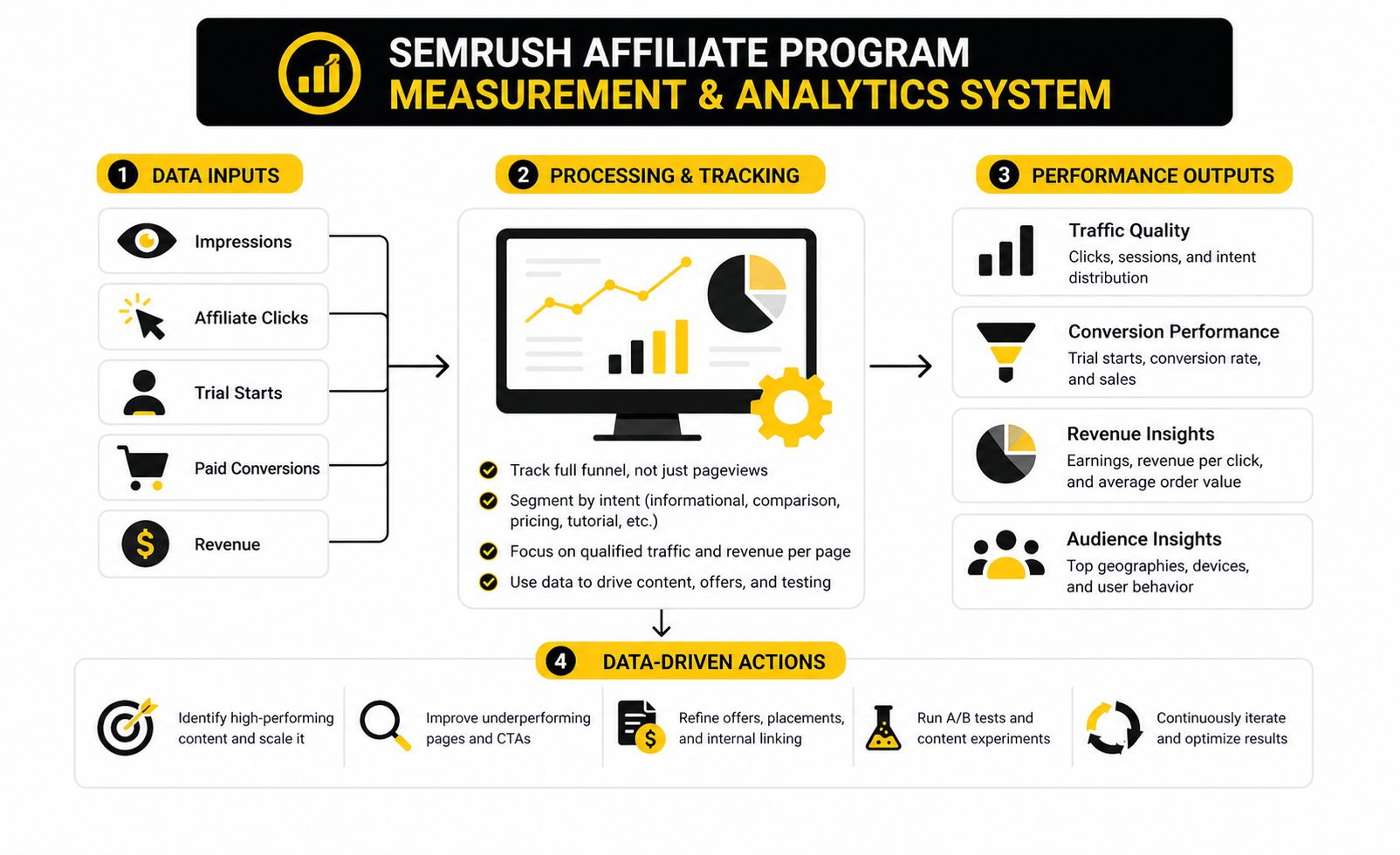
The basic measurement system should track impressions, clicks, affiliate link clicks, trial starts, paid conversions, and revenue. Each number tells you something different. If impressions are growing but affiliate clicks are flat, the page may rank for low-intent queries or the call to action may appear too late.
If affiliate clicks are strong but trials are weak, the content may be creating curiosity without enough buyer qualification. That usually means the article is promising value too broadly. Fix the positioning before you blame the program.
If trials happen but paid conversions lag, look at audience fit. Semrush is most attractive to people who can use SEO, competitive research, and content intelligence in a real workflow. A general creator audience may click, but an agency, consultant, ecommerce marketer, or in-house SEO team is more likely to understand the value quickly.
Use Benchmarks Carefully
Benchmarks are useful only when they help you make a decision. A SaaS funnel benchmark saying lead-to-customer conversion often lands around 2 percent to 5 percent is helpful context, but it should not become your excuse or your ceiling. Affiliate content can perform above or below that range depending on intent, traffic source, trust, and offer fit.
The more useful benchmark is your own content cluster. Compare your Semrush review against your comparison pages, workflow tutorials, and pricing explainers. If a tutorial gets fewer visits but sends more qualified clicks, it may deserve more internal links and stronger placement in your content calendar.
This is where many affiliates get it wrong. They chase the biggest keyword instead of the cleanest conversion path. The semrush affiliate program will usually reward pages that help a serious reader make a decision, not pages that simply attract the broadest audience.
Read Performance Signals Like A Marketer
A good analytics setup should tell you which parts of the article create belief. Scroll depth shows whether readers reach the comparison or pricing section. Click maps show whether people act after workflow examples or only near the conclusion. Email opt-ins show whether the topic is strong enough to continue the conversation beyond one visit.
You should also segment by search intent. Someone landing on a “Semrush affiliate program” article may be an affiliate researching commissions, while someone landing on a “Semrush review for agencies” article may be a potential buyer. Those are different readers, and they should not be measured as if they have the same conversion path.
The action is simple: tag your content by intent before you judge performance. Use categories like informational, comparison, pricing, tutorial, and alternative. Then measure affiliate clicks and downstream conversions by category, not just by total traffic.
Turn Data Into Decisions
The point of measurement is not reporting. The point is deciding what to improve next. If comparison pages convert best, build more comparison content. If tutorial pages drive clicks but not paid customers, tighten the audience and show stronger use cases.
If your email list produces delayed conversions, invest more in lead capture and education. A simple checklist, audit template, or competitor research worksheet can give readers a reason to stay connected before they are ready to buy. For more advanced tracking and link management, a tool like Dub.co can help organize campaigns without turning the whole workflow into a mess.
Keep the dashboard lean. Track the few numbers that change your next action: qualified traffic, affiliate click rate, trial intent, paid conversion, and revenue per page. Everything else is supporting detail.
Conversion Optimization And Common Mistakes
At this stage, the strategy should move from “publish more content” to “make every qualified visit work harder.” That does not mean squeezing the reader with aggressive popups or fake urgency. It means removing confusion, sharpening the offer, and making the next step obvious when the reader is ready.
The Semrush affiliate program has enough product depth that messy messaging becomes a real risk. If one page talks about SEO audits, AI visibility, local SEO, agencies, backlinks, PPC, and content marketing all at once, the reader may understand that Semrush does a lot but still not know what to do next. A high-converting page should usually lead with one buyer problem and use the rest of the product ecosystem as supporting context.
The commercial backdrop also makes positioning more important. Semrush reported $471.4 million in total ARR for 2025, while AI products and its enterprise platform represented $63 million of ending ARR in its 2025 financial results. That tells you the market is moving toward broader visibility intelligence, not just traditional keyword tracking.
Optimize For The Reader Who Is Almost Ready
The best conversion gains usually come from helping the almost-ready reader decide. These readers do not need a motivational speech about SEO. They need proof that Semrush fits their workflow, budget, and level of sophistication.
Your page should answer the questions that naturally appear before a click:
- What problem does Semrush solve better than a lighter tool?
- Which type of user gets the most value from it?
- Where might it be too advanced or too expensive?
- What should someone test first during a trial?
- How does it compare with the alternatives they are already considering?
This is where clear calls to action matter. A vague “check it out” link is weaker than a practical next step tied to the section. After a pricing discussion, the call to action should help the reader evaluate plans. After a workflow walkthrough, it should encourage them to test that workflow inside Semrush.
Avoid The Thin Review Trap
The biggest mistake is publishing a generic Semrush review that could have been written by someone who never used an SEO tool. These pages usually repeat feature names, add a few screenshots, and end with a forced recommendation. They may rank temporarily, but they rarely build durable trust.
A stronger review explains trade-offs. Semrush can be excellent for people who need keyword research, competitor analysis, technical audits, backlink visibility, rank tracking, and reporting in one platform. It can be too much for someone who only wants a simple social scheduler, a basic email tool, or a landing page builder.
That distinction is not a weakness. It is exactly what makes the recommendation more believable. When readers see that you are willing to say “not for everyone,” your recommendation carries more weight when you say “this is probably right for you.”
Watch The Attribution Risk
Semrush uses Impact, last-click attribution, and a 120-day cookie window in its affiliate program knowledge base. The long cookie window is useful, but last-click attribution creates a strategic risk. If your article educates the reader but another page captures the final click, you may do the hard work without earning the commission.
That does not mean you should become aggressive. It means your content should give readers a clear reason to return to your page before they act. Helpful comparison tables, trial checklists, implementation steps, and email follow-up can all protect your role in the decision journey.
The practical move is to build assets that stay useful after the first visit. A reader may bookmark a competitor audit process, save a pricing breakdown, or join an email sequence for a checklist. Those assets make your page more than a one-time research stop.
Scale Without Diluting Quality
Scaling affiliate content is tempting because the keyword universe is large. There are comparison keywords, alternative keywords, pricing keywords, use-case keywords, and tutorial keywords. The danger is publishing too fast and turning the site into a shallow content farm.
A smarter scaling model is cluster-based. Build one strong hub page, then support it with focused articles around specific jobs: competitor keyword research, content gap analysis, SEO reporting for clients, AI visibility tracking, and technical audits. Each supporting page should have a clear reason to exist.
Tools can help with production, but they should not replace judgment. If you use automation to collect research or structure drafts, keep the final article human, opinionated, and specific. For example, Firecrawl can support research workflows, while Wispr Flow can speed up drafting, but neither tool should decide your positioning for you.
Stay Compliant And Transparent
Affiliate compliance is not optional. The FTC explains that endorsements should make a material connection to a brand obvious to the audience in its disclosure guidance. In plain English, readers should not have to hunt for the fact that you may earn a commission.
Good disclosure does not hurt trust when it is handled naturally. In fact, hiding the relationship is what damages credibility. A simple, visible disclosure near the start of the article is cleaner than burying vague language at the bottom.
This also protects the brand relationship. Serious SaaS affiliate programs want partners who can drive qualified customers without creating compliance risk. If you want to build long-term revenue from the semrush affiliate program, treat transparency as part of the business model, not as a legal footnote.
Final Evaluation, Alternatives, And FAQ
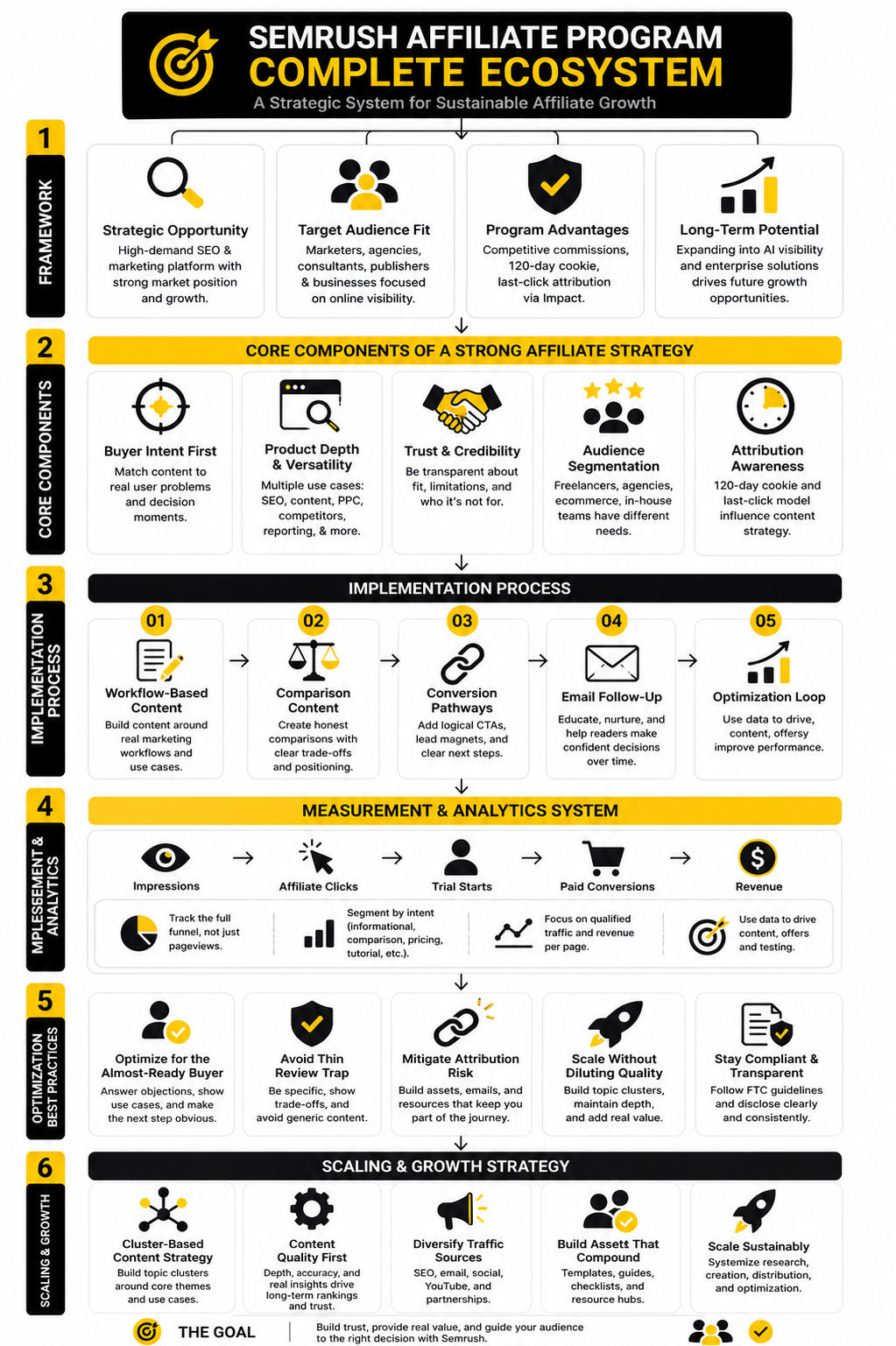
The Semrush affiliate program is strongest when you treat it as a serious B2B recommendation, not a quick commission link. The audience is usually making a considered decision. They are comparing tools, budgets, workflows, and expected outcomes before they commit.
That is why the best affiliate strategy is not built around hype. It is built around fit. Semrush can be a strong recommendation for marketers, agencies, consultants, publishers, ecommerce teams, and SEO professionals who need a deeper view of search, competitors, content, backlinks, and online visibility.
The program also has enough structure to reward a long-term content system. Semrush lists commissions from $50 to $300 per sale, plus $10 for qualified free trials, with last-click attribution and a 120-day cookie window on its official affiliate program page. That combination makes sense for affiliates who can educate buyers across multiple touchpoints instead of relying on one shallow review.
When Semrush Is The Right Recommendation
Semrush is usually the right recommendation when the reader needs a complete online visibility platform. If they care about SEO, competitor research, keyword planning, content optimization, paid search research, or client reporting, the tool has a clear place in the workflow. It is especially useful when the reader has enough traffic, clients, products, or campaigns to justify a deeper research platform.
It is also a strong fit for readers who want to connect strategy with execution. They can research competitors, find content gaps, audit technical issues, monitor visibility, and build reports inside one ecosystem. That is a much stronger value proposition than simply saying “Semrush helps with SEO.”
The buyer should still know what they are getting into. Semrush is not the lightest option, and it may be more than a beginner needs on day one. The recommendation becomes more credible when you say that clearly.
When Another Tool May Fit Better
Some readers do not need Semrush yet. If they mainly need funnels, checkout flows, or offer pages, a platform like ClickFunnels may fit the job better. If they run an agency and need CRM, pipeline, automation, and client management, GoHighLevel may be the more natural first step.
If the reader mostly needs email campaigns, Brevo or Moosend may be easier to adopt. If they need AI support or a customer-facing assistant, Chatbase may be closer to the immediate problem. The point is not to push every reader into the same tool. The point is to recommend the right tool at the right stage.
This is where expert affiliate content wins. You are not just comparing features. You are helping readers avoid buying the wrong thing.
FAQ - Built For Complete Guide
What Is The Semrush Affiliate Program?
The Semrush affiliate program lets approved partners promote Semrush and earn commissions when referred users start eligible trials or make qualifying purchases. It is designed for publishers, educators, SEO creators, agencies, consultants, and marketers who can send relevant buyers to Semrush. The program is strongest when your audience already cares about search visibility, competitor research, content marketing, or digital growth.
How Much Can Semrush Affiliates Earn?
Semrush lists commissions from $50 to $300 per sale, plus $10 for qualified free trial signups, on its official affiliate program page. The exact payout depends on the product and partner terms. This fixed-commission model is useful because affiliates can estimate revenue more clearly than with vague or hidden payout structures.
What Is The Semrush Affiliate Cookie Window?
Semrush states that its affiliate program uses a 120-day cookie window. That matters because many buyers do not purchase a serious marketing platform immediately after one visit. A longer window gives your content more time to influence a considered decision.
Does Semrush Use First-Click Or Last-Click Attribution?
Semrush says the program uses last-click attribution through Impact in its affiliate program knowledge base. This means the final eligible affiliate touchpoint before conversion usually receives credit. For affiliates, that makes strong calls to action, saved resources, email follow-up, and comparison content especially important.
Is The Semrush Affiliate Program Good For Beginners?
It can work for beginners, but only if they are willing to create serious content. A thin review will struggle because Semrush is a sophisticated product with informed buyers. Beginners have a better chance when they focus on one use case, such as keyword research for bloggers, SEO reporting for freelancers, or competitor research for ecommerce stores.
What Type Of Content Converts Best For Semrush?
The best content usually matches clear buying intent. Reviews, comparisons, pricing explainers, alternative pages, tutorials, and workflow-based guides can all work well. The key is to help the reader decide whether Semrush fits their situation instead of simply listing features.
Can Agencies Promote Semrush As Affiliates?
Yes, agencies can be a strong fit if they educate clients, marketers, or business owners about SEO and online visibility. Agency-led content can be especially credible because it often comes from real implementation experience. The best approach is to show how Semrush fits into audits, reporting, competitor analysis, and campaign planning.
Is Semrush Only An SEO Tool?
No. Semrush is still deeply associated with SEO, but its platform now covers broader online visibility, competitor intelligence, content workflows, local marketing, PPC research, and AI visibility. Semrush reported that AI products and its enterprise platform represented $63 million of ending ARR within total ARR of $471.4 million in its 2025 financial results. That shift gives affiliates more angles than traditional keyword research alone.
What Are The Biggest Mistakes Semrush Affiliates Make?
The biggest mistake is treating Semrush like a generic tool instead of matching it to specific buyer problems. Another common mistake is chasing traffic without checking whether the audience is qualified. Affiliates also lose conversions when they hide trade-offs, avoid pricing context, or fail to explain what readers should test during a trial.
Should I Promote Semrush Or A Cheaper Alternative?
It depends on the reader’s job. Semrush makes sense when someone needs deeper SEO, competitor, content, or visibility intelligence. A cheaper alternative may be better for a beginner with a tiny site, a creator who only needs social scheduling, or a business that mainly needs email, funnels, or CRM before advanced search intelligence.
How Do I Increase Semrush Affiliate Conversions?
Improve conversions by tightening the match between search intent, content angle, and call to action. Build pages for specific use cases, add comparison sections, explain who Semrush is not for, and place links only where the reader has enough context to act. Then use analytics to find which pages drive qualified clicks, not just traffic.
Is The Semrush Affiliate Program Worth It?
The semrush affiliate program is worth considering if your audience includes marketers, agencies, consultants, founders, publishers, ecommerce operators, or SEO professionals. It is less attractive if your audience has no need for search data, competitor research, or online visibility tools. The program works best when you build trust first and monetize the decision second.
Work With Professionals
Explore 10K+ Remote Marketing Contracts on MarkeWork.com
Most marketers spend too much time chasing clients, competing on crowded platforms, and losing a percentage of every project to middlemen.
MarkeWork gives you a better way. Browse thousands of remote marketing contracts and connect directly with companies desperate to hire skilled marketers like you, without platform commissions and without unnecessary gatekeepers.
If you're serious about finding better opportunities and keeping 100% of what you earn, explore available contracts and create a profile for free at MarkeWork.com.