

Most people treat SEO and search ads like two separate channels. That is usually the first mistake. In practice, they shape the same search results page, compete for the same attention, and influence the same buyer journey.
That is why seo advertising works best when you stop thinking in silos. Organic visibility builds authority, captures compounding demand, and lowers long-term acquisition pressure. Paid search gives you speed, message testing, controlled coverage, and a direct way to show up when rankings are still catching up.
The real opportunity is not choosing one over the other. It is building a system where SEO informs your ad strategy, ads sharpen your SEO decisions, and both push traffic into pages that are built to convert. That is the approach this article follows from start to finish.
Article Outline
- What SEO Advertising Actually Means
- Why SEO Advertising Matters Now
- The SEO Advertising Framework
- Core Components of a Unified Search Strategy
- Professional Implementation Across Content, Ads, and Landing Pages
- Measurement, Optimization, and Long-Term Scale
What SEO Advertising Actually Means
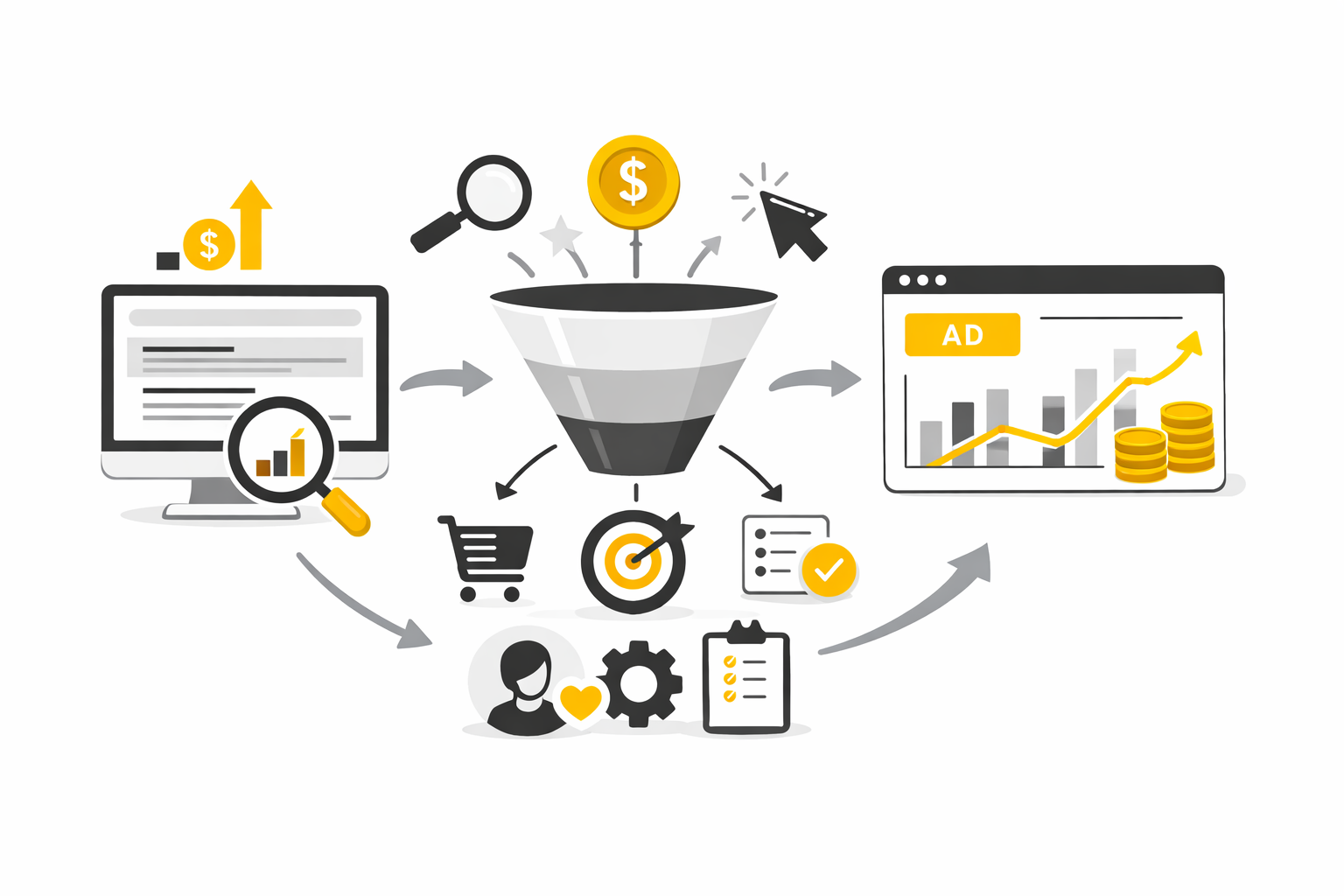
SEO advertising is not a formal platform category. It is a practical way to describe a search strategy that combines organic search visibility and paid search promotion around the same commercial goals. Instead of running SEO on one side and PPC on the other, you treat them as one coordinated engine for demand capture.
That changes how you plan keywords, landing pages, offers, and reporting. Informational topics can build trust and bring in early-stage traffic through search optimization, while high-intent commercial queries can be covered with ads when speed and control matter more. Over time, the two channels start improving each other because they are learning from the same market signals.
It also reflects how search works now. Users do not care whether a click came from an ad or an organic result if the page solves the problem quickly. They care about relevance, clarity, trust, and speed, which means your search presence has to feel consistent no matter where the click starts.
Why SEO Advertising Matters Now
Search has become more crowded, more expensive, and more compressed on the results page. You are competing not just with other websites, but with shopping features, local packs, AI-generated answers, map results, videos, and multiple ad placements that can push traditional listings further down. That makes fragmented search strategy much weaker than it used to be.
At the same time, relying on only one channel creates obvious risk. If you depend only on SEO, growth can stall because rankings take time and algorithm shifts can hit your visibility. If you depend only on paid search, customer acquisition can become fragile because costs rise, margins tighten, and performance drops the moment spend slows down.
A combined approach gives you leverage. SEO gives your brand a durable footprint, while paid search gives you immediate reach and fast testing. When both are aligned, you can protect branded demand, learn from search intent faster, and put your budget where it makes the biggest commercial difference instead of guessing.
The SEO Advertising Framework
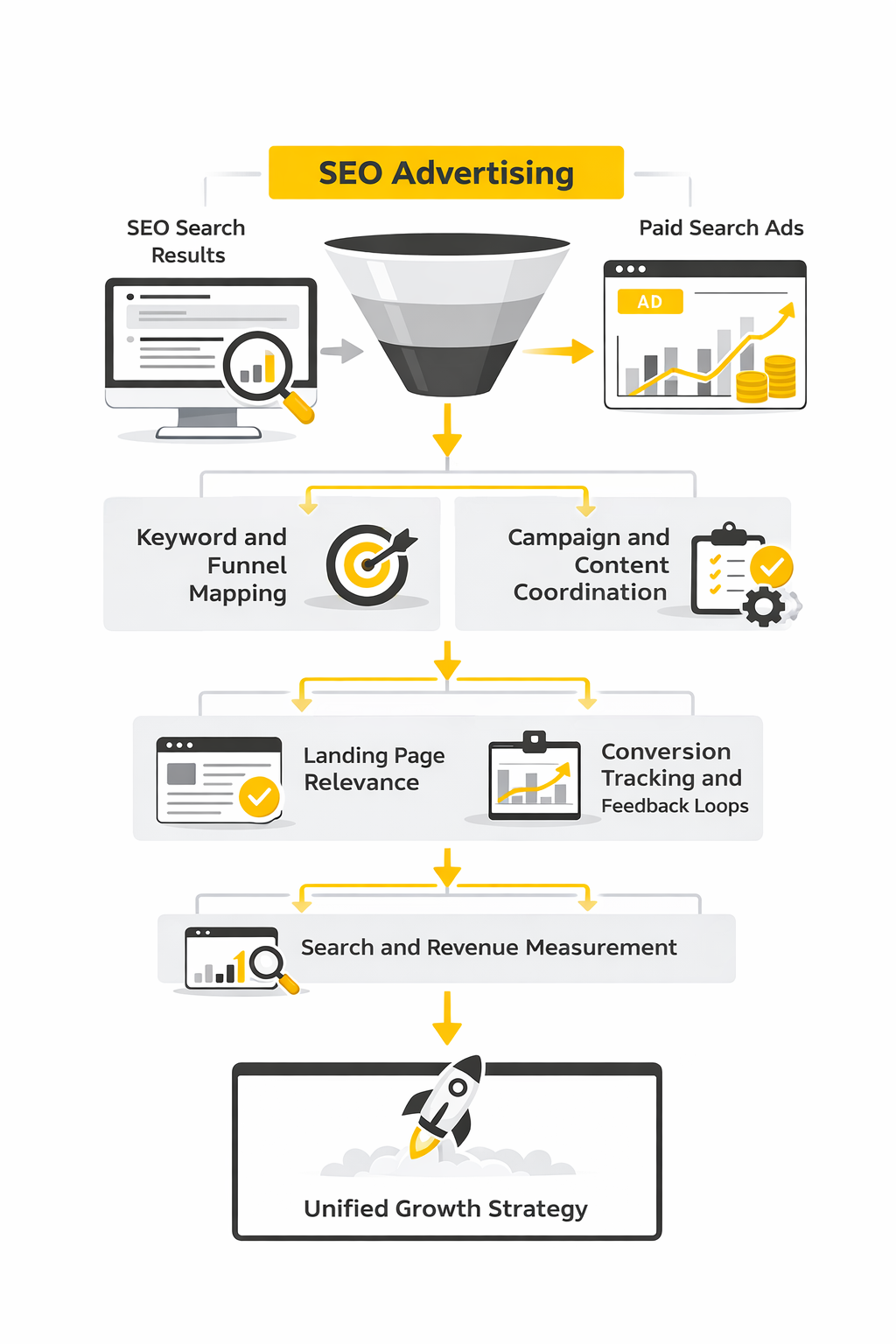
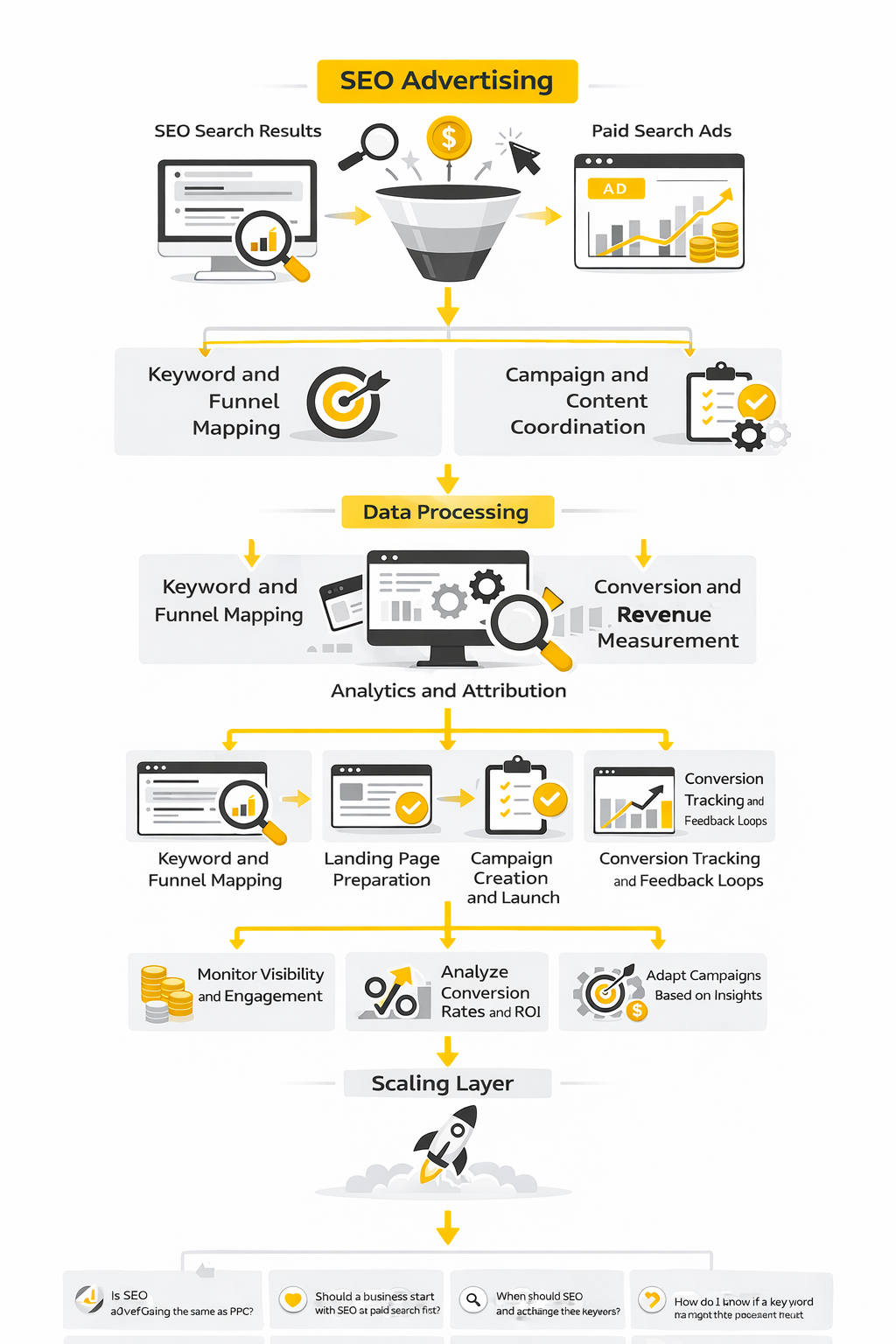
The framework in this article is simple on purpose. First, you map search intent across the funnel so you know where organic content should educate, where paid campaigns should convert, and where both should appear together. Then you build pages that match that intent instead of sending every click to the same generic destination.
From there, you connect the operating pieces: keyword research, campaign structure, landing page design, conversion tracking, and message testing. This is where most teams either create momentum or waste months. The winning setups are rarely the fanciest ones; they are the ones where data moves cleanly from search terms to ads, from ads to pages, and from pages to revenue.
That is also why professional implementation matters so much. You do not get the full value of seo advertising by publishing random blog posts and running disconnected campaigns. You get it by building a search system that knows what to rank, what to bid on, what to test, and what to improve next.
Core Components of a Unified Search Strategy
A strong seo advertising system is built from a few moving parts that need to work together, not in parallel. When one piece is weak, the entire search program gets noisy fast. You end up bidding on the wrong terms, publishing content that attracts the wrong visitors, or sending qualified traffic into pages that do not close the gap between interest and action.
The core components are simple to name but harder to execute well. You need tight intent mapping, smart keyword segmentation, message alignment between ads and pages, and measurement that tells you what actually influenced revenue. Once those pieces connect, search becomes much more predictable.
Intent Mapping Comes First
Search intent is the layer that decides where SEO should lead, where paid search should lead, and where both should show up together. If the query is educational, organic content often has more room to build trust and capture the visit naturally. If the query signals urgency, comparison, or purchase readiness, ads usually deserve immediate coverage because they let you control the message and the destination.
This is where a lot of teams get sloppy. They build campaigns around keyword volume without asking what the searcher is trying to accomplish in that exact moment. Google’s guidance on people-first content and its documentation on search performance reporting both point in the same direction: useful search strategy starts with understanding the query, not just collecting it.
A practical way to do this is to sort search intent into three buckets. Informational queries deserve content that teaches. Commercial investigation queries deserve comparison pages, category pages, or solution pages. Transactional queries deserve high-clarity landing pages and tightly matched ad copy. That sounds obvious, but getting this right is one of the biggest differences between random traffic and qualified traffic.
Keyword Segmentation Has to Be Commercially Honest
Not every keyword deserves the same budget, the same content depth, or the same landing page type. Some terms exist to bring in early attention, some terms qualify serious buyers, and some terms are just expensive distractions. The job is not to “cover keywords.” The job is to separate valuable demand from vanity demand.
For paid search, match type control still matters, even in a more automated environment. Google’s own explanation of keyword matching options and Microsoft’s guide to the search term report both show the same reality: advertisers still need to monitor what queries actually trigger impressions and clicks. That is one of the fastest ways to spot wasted spend, discover profitable variations, and feed high-converting search language back into SEO.
For organic search, segmentation should shape site architecture. Broad topic clusters belong in educational assets, while high-intent commercial modifiers belong closer to service, product, or category pages. When the same query family performs well in both channels, that is usually a sign you are looking at a core revenue theme, not just a traffic opportunity.
Search Messaging Should Stay Consistent Across Organic and Paid
A user should not feel like they entered two different brands depending on whether they clicked an ad or an organic listing. The promise in the headline, the framing in the description, and the expectation set before the click should all stay aligned. That consistency improves trust, and trust affects everything that happens after the visit.
This also matters operationally. Google notes that landing page experience and Quality Score are tied to how relevant and useful the ad-page combination feels to the searcher. In other words, weak message match does not just hurt conversions. It can also hurt efficiency inside the ad account itself.
The best teams use paid search copy as a live testing environment. If a benefit, offer, or objection-handling angle wins in ads, that language often deserves a place in title tags, meta descriptions, hero sections, and conversion copy across the site. SEO gives you scale and staying power, but ads often tell you faster what people actually respond to.
Landing Pages Are the Conversion Bridge
Search traffic is only valuable when the destination page matches the job the visitor is trying to get done. That is true for blog content, product pages, service pages, and dedicated campaign landing pages. When the page misses the intent, even strong rankings and strong click-through rates start leaking value immediately.
That is why landing pages sit at the center of seo advertising instead of at the end of it. Google’s guidance on optimizing ads and landing pages makes the connection clear: relevance between keyword, ad, and page supports better ad outcomes. On the organic side, Google also recommends strong user experience signals through Core Web Vitals, which reinforces the same principle from a different angle.
In practice, the page has to answer three questions fast. What is this offer? Why should I trust it? What should I do next? If the visitor has to work hard to understand any of those, the page is probably underperforming no matter how good the acquisition channel looks in reports.
Measurement Needs to Connect Search Visibility to Business Outcomes
This is the point where many search strategies break. SEO teams report rankings and clicks. Paid teams report conversions and return on ad spend. Leadership gets two dashboards and no clear picture of how search as a whole is creating pipeline, customers, or revenue.
A better setup starts by connecting platform signals without pretending they are identical. Search Console shows how pages and queries perform in organic search. Google Analytics updates and ad platform conversion systems help show what happens after the click. Used together, they reveal where search intent is strong, where landing pages are weak, and where organic visibility and paid demand are overlapping in useful ways.
This matters more now because the results page is changing. Research from Pew Research Center and updated analysis from Ahrefs both show that AI-generated search features are reducing clicks to standard listings on many queries. That raises the value of owning more of the search surface, protecting high-intent terms, and measuring contribution with more discipline than last-click thinking allows.
Tools Should Support Execution, Not Replace Strategy
The market is full of platforms promising to automate the hard parts. Some of them are genuinely useful, especially when you need to spin up better landing pages faster, tighten CRM follow-up, or turn lead capture into something more systematic. But tools only help when the underlying search strategy is already clear.
For teams that need faster page testing, a platform like Replo can make iteration easier. For businesses that want tighter lead routing, automation, and campaign follow-up in one stack, GoHighLevel is often part of the conversation. The point is not the tool itself. The point is whether it helps you shorten the distance between search intent, page relevance, and conversion action.
That is the lens to keep. A tool should make your system sharper, faster, or easier to manage. It should not be the reason the system exists.
Professional Implementation Across Content, Ads, and Landing Pages
This is where seo advertising stops being a concept and becomes an operating system. Most teams already have some SEO activity, some ad activity, and some landing pages in play, but the pieces usually were not built to inform each other. Professional implementation fixes that by turning scattered efforts into one repeatable process.
The goal is not to launch more assets. The goal is to make every search insight improve the next ad, every ad test improve the next page, and every page performance signal sharpen the next content decision. Google’s own guidance on people-first content, Search Console performance reporting, and landing page evaluation in Google Ads points to the same operating principle: search performance improves when relevance is managed end to end.
Start With Search Intent and Business Priority
The first move is not opening an ad platform or publishing a new article. The first move is deciding which search intents deserve immediate commercial attention and which ones deserve long-term organic development. That forces you to prioritize based on revenue potential instead of getting distracted by raw keyword volume.
A clean way to do this is to build a simple intent matrix. Put high-intent transactional queries at the top, commercial investigation terms below them, and informational discovery terms after that. Then match each bucket to a page type, a measurement goal, and a channel mix so you know where SEO should lead, where paid search should lead, and where both should work together.
Build the Right Destination Before You Scale Traffic
Too many teams buy traffic before they have a destination worth sending it to. That creates misleading performance data because the problem looks like weak targeting when the real issue is weak page relevance. Before you scale spend or push new content, define the page experience that will carry the conversion job.
For commercial queries, that usually means dedicated landing pages or tightly focused service and product pages. For early-stage intent, it can mean educational content that naturally leads into a product or service next step. Google Ads still treats landing page relevance and usefulness as part of ad quality, and Google Search still rewards content built for people rather than for mechanical ranking games.
The Execution Process That Actually Works
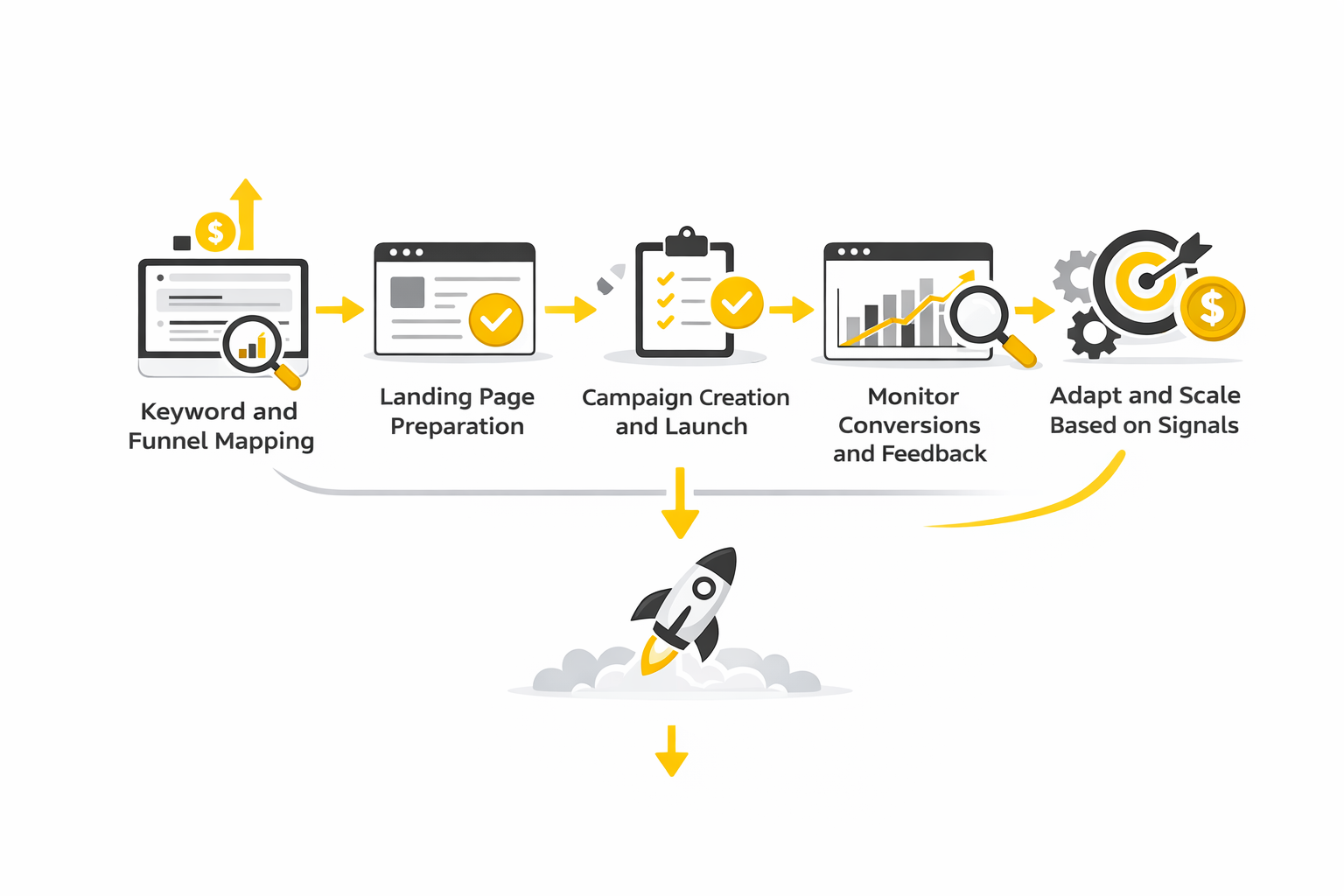
Once intent and page targets are clear, implementation gets much more tangible. You are no longer asking vague questions like whether SEO or ads work better. You are building a system that decides how each query should be captured, where that traffic should land, and how the result should be measured.
A practical execution flow looks like this:
- Pull query data from Search Console and separate branded, non-branded, informational, commercial, and transactional intent themes.
- Review paid search query data to see which terms already convert, which ones waste spend, and which modifiers reveal stronger buying intent.
- Map each keyword cluster to a single primary page type instead of letting multiple pages compete for the same job.
- Build or improve the destination page so the headline, promise, proof, and call to action match the exact query family.
- Launch paid search coverage on the highest-intent terms first while SEO work develops broader and mid-funnel coverage.
- Feed winning ad copy themes back into page titles, meta descriptions, hero copy, and supporting on-page messaging.
- Recheck performance weekly at the query, page, and conversion level so the system improves instead of drifting.
This process is boring in the best possible way. It removes guesswork. It also creates a shared language between SEO, paid media, and CRO work, which is one of the biggest advantages of doing seo advertising seriously.
Use Ads as a Live Testing Layer
One of the fastest ways to improve search strategy is to treat paid search like a controlled messaging lab. Responsive Search Ads were built to test combinations of headlines and descriptions against real search demand, which makes them useful far beyond campaign management. When certain messages consistently earn stronger engagement or conversion behavior, that is market feedback you should not ignore.
This matters because organic optimization is often slower to validate. A title tag update may take time to show its full effect. A paid campaign can tell you much faster whether users respond better to outcome-driven language, proof-driven language, urgency, pricing clarity, or category framing. The smart move is to use that learning everywhere the same intent appears.
Turn Search Console Into a Prioritization Tool, Not Just a Reporting Tool
Search Console is often treated like a place to check clicks and positions after the fact. That leaves a lot of value on the table. In a strong implementation model, it becomes one of the main sources for deciding which organic pages deserve updates, which query families deserve dedicated pages, and which near-page-one opportunities should get immediate attention.
Google’s documentation makes it clear that the Performance report is built to show which queries and pages generate visibility and traffic, and how those trends change over time. That is exactly the information you need when deciding where organic effort can reduce paid dependency or where paid search should temporarily protect a valuable search theme until rankings improve.
Keep Ad Structure Tight Enough to Produce Useful Signals
Campaign structure still matters, even with heavier automation. If your ad groups and keyword themes are too broad, the data becomes messy and the message match gets weaker. If they are too fragmented, you create unnecessary management overhead without gaining much strategic clarity.
The middle ground is usually best. Group queries by tight commercial theme, make sure the ad language reflects that theme clearly, and send clicks to the most relevant page available. Microsoft’s guidance around responsive search ads and search term visibility reinforces the same lesson seen in Google Ads: control is still valuable because it protects relevance and gives you cleaner input for future SEO and landing page decisions.
Build Landing Pages for Search Intent, Not Just for Design Approval
A search landing page has a specific job. It needs to confirm relevance immediately, reduce friction fast, and make the next action obvious. That sounds simple, but many pages still fail because they prioritize internal brand language over the wording the market actually uses.
This is why implementation should include a formal message-match check. Compare the search term, the ad or title tag, the page headline, the supporting proof, and the primary call to action. If those five elements do not line up, the page is asking the visitor to do too much interpretive work. Google Ads’ quality documentation and landing page reporting both reinforce how important that relevance chain remains.
For teams that need to launch and test pages quickly, Replo can be useful when speed matters and internal development is the bottleneck. The point is not to use more tools for the sake of it. The point is to reduce the time between learning what searchers want and putting a better page in front of them.
Connect Conversion Tracking Before You Trust Performance
This part is unglamorous, but it is where real search programs separate themselves from optimistic dashboards. If your conversions are not defined clearly, imported correctly, and checked against actual business outcomes, you can end up optimizing for noise. That is expensive in paid search and misleading in SEO.
Google’s setup documentation shows that Analytics events can be marked as key events and then imported into Google Ads as conversions, while recent Analytics updates also expanded attribution controls and reporting flexibility. That makes the measurement layer more powerful, but only if you are disciplined about which actions truly represent qualified business value. A form start and a booked call are not the same thing, and your search strategy should never treat them as if they are.
Use Automation to Tighten Follow-Up, Not to Hide Weak Strategy
Automation becomes powerful after the search system is already structured well. Once the right traffic reaches the right page and converts into a lead, you can improve speed to lead, qualification, nurturing, and pipeline movement. That is where platforms built around CRM and follow-up workflows start making a real difference.
If your business depends on lead capture rather than instant checkout, GoHighLevel is one of the more natural fits because it connects forms, funnels, automations, and pipeline handling in one place. But the order matters. Do not automate a weak offer, a weak page, or weak targeting and expect a different outcome just because the backend looks cleaner.
Professional Implementation Is Mostly About Discipline
There is no mystery move hiding here. The teams that do seo advertising well are usually the teams that document intent clearly, structure campaigns tightly, improve pages continuously, and measure results honestly. They do not chase every platform feature or every search trend the second it appears.
That is especially important now as Google keeps expanding AI-led search experiences and reshaping how users discover pages in the results. Google’s updated guidance on AI features in Search and newer recommendations on succeeding in AI search experiences make the direction obvious: the advantage goes to sites that publish useful, distinctive content and pair it with strong page experience, not to brands trying to brute-force visibility with disconnected tactics.
That is the real implementation standard. Clear intent. Better pages. Tighter feedback loops. Consistent measurement. Everything else is secondary.
Search Performance Metrics That Actually Matter
The biggest reporting mistake in seo advertising is staring at numbers that look busy but do not change decisions. More impressions can be good, but they can also mean you are surfacing for weaker queries. More clicks can look exciting, but if they come from low-intent traffic, they can quietly reduce efficiency instead of improving it.
That is why measurement has to be read in layers. First you look at visibility. Then you look at click behavior. Then you look at what happened after the click. Google Search Console’s Performance report is built around exactly that first layer by showing clicks, impressions, average CTR, and average position, while Google Ads adds a second layer with CTR, relevance, and cost signals. The useful question is never “Did the metric move?” The useful question is “What does that movement tell me to do next?”
Impressions Tell You About Reach, Not Success
Impressions are often over-celebrated because they make a graph look healthy. In reality, impressions mostly tell you how often your pages or ads entered the field of view. Search Console explains that an impression is counted when your property appears in search results under Google’s visibility rules, which means the number is helpful for diagnosing coverage, but not enough for judging quality on its own. Google’s explanation of impressions, clicks, and position makes that distinction clear.
What should you do with that? If impressions are rising but clicks are flat, the issue is often weak snippet appeal, weaker query targeting, or SERP features stealing attention. If impressions are flat on high-value topics, that usually points to poor ranking coverage, weak page depth, or the fact that your page is simply not matching the intent tightly enough yet.
CTR Is a Diagnostic Signal, Not a Vanity Metric
Click-through rate matters because it shows how well your listing or ad earns the click once it has visibility. Google defines CTR simply as clicks divided by impressions, which sounds basic, but the interpretation is where people get sloppy. Google Ads’ CTR definition and Search Console’s explanation of average CTR are useful because they keep the metric grounded in behavior rather than hype.
A falling CTR does not always mean your copy is worse. Sometimes rankings slipped slightly, sometimes the SERP got more crowded, and sometimes AI-generated search features changed what users click on. That last point matters more now than it did even a year ago. Pew Research Center found that users who saw an AI summary clicked a traditional search result in 8% of visits, compared with 15% when no AI summary appeared. That should change how you read lower CTR on informational queries. It may not mean your page is broken. It may mean the search environment changed around it.
Average Position Helps, but It Can Fool You
Average position is useful when you treat it as directional context, not as a scoreboard. Search Console describes it as the average position of the topmost result from your site, which means it is already a simplified view of something more complex. Google’s documentation on average position is worth taking seriously because it reminds you that ranking averages can hide query-level variation.
That matters in practice. A page can improve average position while losing commercial traffic if it gained visibility on lower-value long-tail queries. The reverse can also happen: average position can look worse even while leads improve because the page is surfacing for a broader set of terms. The action here is simple. Never judge position without checking which queries moved, which pages received the visibility, and whether conversion quality improved with it.
The Best Analytics Setup Follows the Entire Search Journey
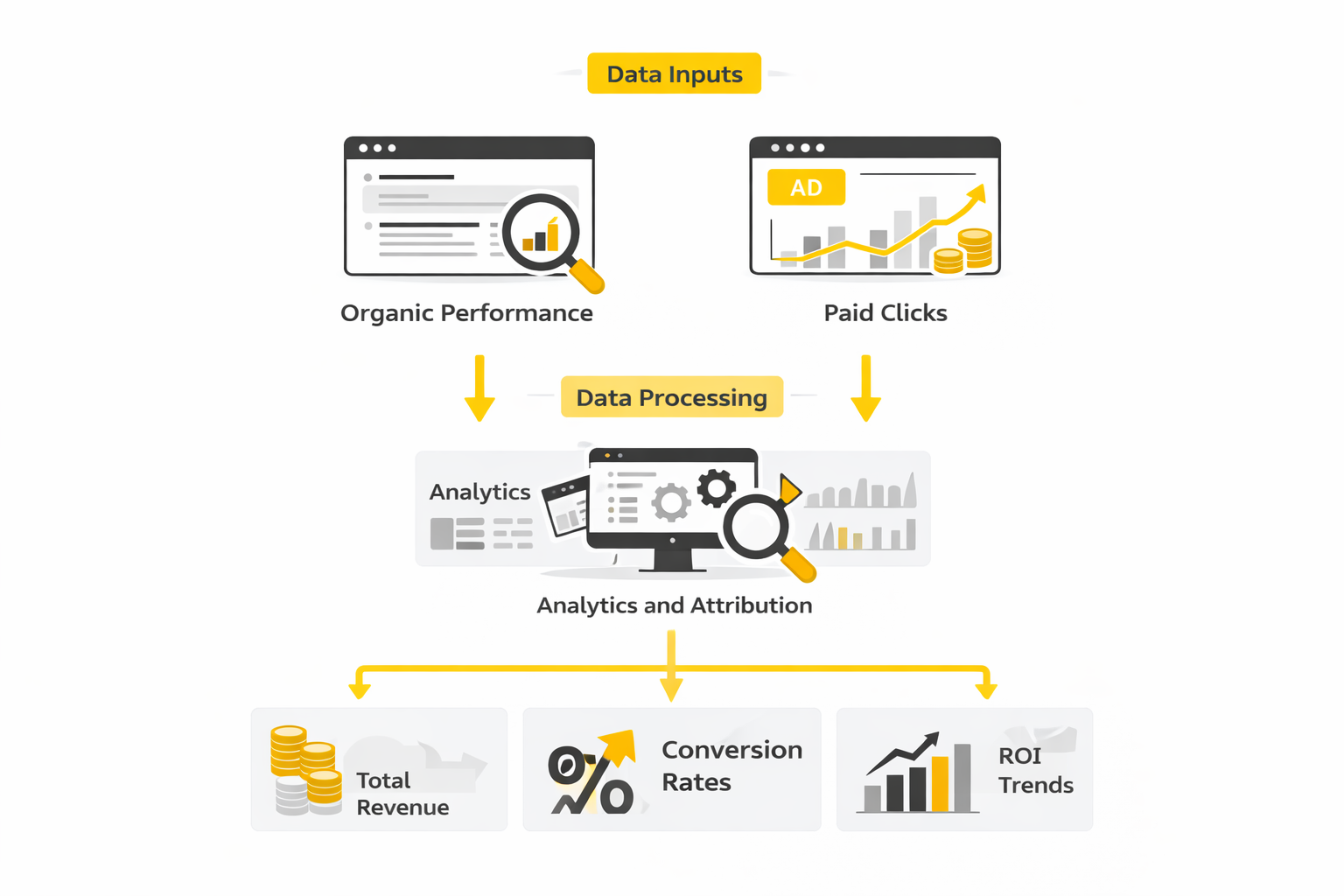
A good analytics system for seo advertising connects four checkpoints. First, did you appear for the right searches? Second, did users click? Third, did they engage meaningfully with the page? Fourth, did they complete an action that actually matters to the business?
That is the reason Google’s current Analytics language around key events matters. Important business actions can now be marked as key events and then used to create Google Ads conversions, which helps reduce avoidable reporting mismatch between analytics and ad platforms. That sounds technical, but the strategic point is simple: if your measurement layer cannot distinguish a casual visit from a qualified action, your optimization decisions will drift.
Not All Conversions Deserve the Same Weight
This is where a lot of reporting goes wrong. Teams often count every tracked action as if it carries equal business value, and that can quietly poison bidding decisions, landing page priorities, and even SEO content planning. A newsletter signup, a pricing-page click, a demo request, and a closed sale are not interchangeable.
Google’s documentation on conversions vs. key events in GA4 and its guidance on creating Google Ads conversions from Analytics events give you the mechanics, but the interpretation is what matters. You should group actions into primary outcomes and secondary signals. Primary outcomes deserve optimization priority. Secondary signals are useful for diagnosis, but they should not be allowed to masquerade as revenue.
Quality Score Components Matter More Than the Score Itself
A lot of advertisers obsess over the number and miss the actual lesson. Google is very explicit here: the important pieces are the three components behind Quality Score, not the score as a vanity number. Those components are expected CTR, ad relevance, and landing page experience.
That framework is useful far beyond paid search. Expected CTR is really a message problem. Ad relevance is an intent-matching problem. Landing page experience is a promise-delivery problem. When one of those drops, the fix is usually not complicated, but it does require honesty. Rewrite the message, tighten the keyword grouping, or improve the page so it actually answers the query faster and more clearly.
Modeled Data Is Useful, but You Still Need Judgment
Modern measurement includes estimation. Google explains that modeled key events help fill gaps caused by privacy controls, technical limitations, and cross-device behavior. That is not inherently bad. In many cases, modeled reporting gives you a more realistic directional picture than raw observable data alone.
But it does mean you should stop treating dashboards like courtroom evidence. Modeled conversions are excellent for trend analysis and optimization guidance, especially inside automated bidding systems. They are much weaker when used as the only proof of business impact. The practical move is to compare platform-reported conversion trends against CRM outcomes, qualified lead rates, or actual sales reporting whenever possible.
Benchmarks Are Useful Only When They Are Your Benchmarks
A lot of marketers go searching for average CTR numbers, average conversion rates, or average CPC ranges because they want reassurance. That instinct is understandable, but it often sends people in the wrong direction. External averages flatten category differences, SERP differences, offer differences, and margin differences into something that looks objective but is often not useful enough to act on.
A stronger approach is to build internal benchmarks by intent type. Compare branded search against non-branded search. Compare informational organic traffic against commercial landing-page traffic. Compare demo-intent ads against category-intent ads. Once you do that, performance starts telling a much clearer story. You stop asking whether your metrics are “good” in the abstract and start asking whether they are improving where it counts.
What the Data Should Make You Do
Good measurement only matters if it changes the next move. If impressions rise and CTR falls, review titles, descriptions, ad copy, and SERP competition before touching budgets. If CTR is healthy but conversion rate is weak, the landing page is the likely problem. If conversion volume rises but qualified outcomes do not, your tracking priorities are probably too broad.
This is the real point of statistics and data in seo advertising. Numbers are not there to decorate reports. They are there to tell you whether the problem sits in visibility, click appeal, relevance, page experience, or conversion quality. Once you read them that way, analytics becomes much more useful and much less noisy.
Scaling SEO Advertising Without Breaking the System
Once the foundations are in place, the next challenge is not getting more traffic. It is scaling without creating confusion, wasted spend, or a reporting mess. That is where seo advertising becomes more strategic, because growth starts depending less on isolated wins and more on how well the whole system holds together under pressure.
At this stage, the risks change. Early on, the danger is usually underinvestment or poor structure. Later, the danger becomes overlap, duplication, automation drift, and the temptation to publish or bid on everything just because more volume is available. Google’s recent guidance on AI search experiences also makes this more urgent because search behavior is fragmenting across standard listings, AI-generated summaries, and richer results surfaces.
Growth Creates Channel Overlap, and That Is Not Always Bad
As you scale, SEO and paid search will start touching the same query categories more often. Some teams panic when they see overlap because they assume one channel is cannibalizing the other. That can happen, but it is not automatically a problem. Sometimes overlap is exactly what protects revenue on high-value terms, especially when the results page is crowded and organic listings are pushed down.
The right question is not whether overlap exists. The right question is whether overlap improves total qualified traffic, conversion quality, and defensibility. On branded and bottom-funnel terms, running both channels can still make strategic sense because it lets you control more of the page, protect message clarity, and reduce the chance that a competitor captures demand that you created yourself. Google’s documentation on AI features in Search and Pew’s findings on lower link-click behavior when AI summaries appear both reinforce the same point: owning more of the search surface is becoming more valuable, not less.
Automation Is Powerful, but It Can Scale Mistakes Faster
Modern Google Ads systems are built to automate more of the heavy lifting. Smart Bidding optimizes bids at auction time, and Google keeps expanding AI-driven controls and campaign capabilities. That can absolutely improve performance, but only when the inputs are clean enough to deserve automation. Google is very clear that Smart Bidding optimizes toward the conversion goals and attribution setup you choose. If those signals are messy, the system gets efficient at chasing the wrong target.
This is one of the most important expert-level tradeoffs in seo advertising. Manual control feels safer, but it often limits scale. Full automation feels easier, but it can hide weak targeting, soft conversions, and poor page quality behind polished dashboards. The mature approach is to automate bidding and optimization only after you trust the intent mapping, landing pages, and conversion definitions underneath it.
Scaled Content Is Not the Same as Useful Content
A lot of teams see scaling as a content production problem. They assume the answer is more pages, more clusters, more templates, and faster publishing. That works only up to the point where the added pages stop being distinct, useful, or commercially purposeful. After that, scale starts creating noise instead of growth.
Google’s guidance on generative AI content is careful but direct: AI can help with research and structure, but using it to generate many pages without adding value can violate spam policies on scaled content abuse. That is not just a compliance issue. It is a business issue. Thin or repetitive pages make internal prioritization harder, create index bloat, weaken trust, and often confuse measurement because multiple URLs end up competing for the same theme.
Cannibalization Usually Starts as an Architecture Problem
When teams scale fast, they often create multiple pages for slight variations of the same intent. That can happen through blog content, campaign landing pages, faceted navigation, regional pages, or copy-heavy service pages that all try to rank for nearly identical terms. Then the reporting gets messy, internal links spread authority too thinly, and no one is sure which page should actually win.
Google’s canonicalization documentation exists for a reason. Search systems need clear signals about which URL represents the primary version of a topic or offer. If your site structure keeps producing duplicate or near-duplicate pages without a strong canonical strategy, you are not scaling search presence. You are scaling ambiguity.
The SERP Is Harder to Win Than It Looks in a Dashboard
You can improve rankings and still lose actual opportunity if the results page changes around you. That is one of the biggest strategic shifts of the last two years. Search performance is no longer just about your position relative to ten blue links. It is about how much attention is left after ads, shopping modules, local results, AI summaries, videos, and other rich features take their share.
That is why expert teams now think in terms of SERP share, not just channel share. If AI summaries are reducing clicks to traditional listings on some query types, then informational content may need stronger differentiation, clearer first-click value, and more deliberate paths into owned audiences like email or CRM follow-up. The search visit itself is becoming less guaranteed, which means every click has to do more work once you earn it.
Scale Exposes Weak Offers Faster Than Weak Traffic
At smaller budgets or lower traffic levels, a weak offer can hide for a while. You can blame the keyword, the ad copy, the algorithm, or the page layout. Once you scale, that excuse starts collapsing. If qualified traffic grows and outcomes do not improve, the market is usually telling you something more fundamental about the offer, the proof, the pricing, or the conversion friction.
This is why mature seo advertising work pulls strategy closer to product, sales, and operations. Search can surface demand and intent very efficiently, but it cannot rescue an offer that feels vague, risky, overpriced, or hard to act on. Scale does not fix those problems. It reveals them faster.
Brand Strength Becomes a Bigger Performance Lever Over Time
The deeper you go into search, the more obvious it becomes that brand and performance are not separate worlds. Strong brand demand improves branded search, branded CTR, direct revisits, assisted conversions, and the general trust users bring into the click. Weak brand recognition makes every non-branded click work harder because the visitor has less reason to believe your promise immediately.
That matters even more now because AI-assisted search experiences reward distinctiveness. Google’s own advice for succeeding in AI search emphasizes unique, non-commodity content that genuinely helps people. In plain English, being more generic is becoming less defensible. The brands that win are usually the ones that are easier to remember, easier to trust, and easier to choose across both organic and paid search touchpoints.
The Best Search Programs Get More Selective as They Grow
This is the part many people get backwards. They think scale means broader targeting, more content, more campaigns, more experiments, and more software. Sometimes it does. But the best operators usually become more selective, not less. They learn which query types deserve full-funnel coverage, which ones are useful only for SEO, which ones are too expensive for paid search, and which ones look attractive in a spreadsheet but rarely produce meaningful business outcomes.
That discipline is what keeps seo advertising profitable over time. You do not need maximum visibility everywhere. You need strong visibility where intent, economics, and execution line up. That is the difference between a search program that looks busy and one that compounds.
FAQ
Is seo advertising the same thing as PPC?
Not exactly. PPC is the paid side of search, while seo advertising is the broader system of using both organic search and paid search together around the same intent, landing pages, and conversion goals. The difference matters because once you plan them together, the data becomes more useful and the traffic becomes easier to scale.
Should a business start with SEO or paid search first?
That depends on urgency, budget, and how fast you need qualified traffic. If you need immediate visibility on high-intent searches, paid search usually gives you faster signal. If you already have some authority, some content depth, or a longer growth horizon, SEO can compound harder over time, and the best setups usually combine both as early as practical.
When should SEO and ads target the same keyword?
They should overlap when the keyword has clear business value and the search results page is competitive enough that owning more space improves outcomes. That is especially true for branded terms, high-intent commercial terms, and categories where competitors are actively bidding. The goal is not overlap for its own sake, but stronger control over the click path and better protection of demand you already earned.
How do I know whether a keyword belongs in SEO, paid search, or both?
Start with intent, not volume. Informational queries often lean toward SEO because useful content can build trust and capture demand efficiently, while urgent transactional queries often justify paid search because speed and message control matter more. If a keyword repeatedly shows strong business intent and strong economics, it often deserves both.
What is the biggest mistake people make with seo advertising?
The biggest mistake is treating traffic acquisition and conversion experience like separate jobs. Teams spend time chasing rankings or clicks, then send visitors into pages that do not match the promise of the search. That breaks the system because even good traffic becomes noisy when the destination is unclear.
Do I need dedicated landing pages, or can I use regular site pages?
Regular pages can work if they match the query precisely and make the next step obvious. The problem is that many site pages are written too broadly, which weakens relevance for both ads and organic visitors. Dedicated landing pages are often worth it when the keyword theme is commercially important and the visitor needs a tighter message path.
How long does seo advertising take to work?
Paid search can start generating useful data quickly, often as soon as campaigns are structured well and conversion tracking is reliable. SEO usually takes longer because rankings, crawl patterns, content quality, and competition all affect the pace of movement. The real advantage of combining both is that paid search gives you fast feedback while SEO builds durable coverage underneath it.
What metrics matter most in a combined search strategy?
The most useful metrics are the ones that show where the system is breaking. Visibility metrics help you understand reach, click metrics help you understand message strength, and conversion metrics help you understand whether the visit was commercially useful. Once you connect those layers, you can tell whether the issue is search demand, snippet quality, landing page relevance, or offer strength.
How often should I optimize the system?
Search strategy works best when optimization is continuous but not chaotic. Weekly reviews are usually enough to catch waste, message mismatches, and landing page friction, while monthly reviews are better for broader structural decisions like page creation, budget shifts, or content prioritization. The key is consistency, because search systems usually drift when no one is checking them closely.
Can AI tools replace the strategy work?
No, and this is where a lot of teams fool themselves. AI tools can help with research support, content workflows, ad drafting, data handling, and faster iteration, but they do not replace intent judgment, offer clarity, or conversion strategy. If the underlying search system is weak, AI usually just helps you produce weak assets faster.
Is seo advertising only useful for big brands?
Not at all. Smaller businesses often benefit even more because they cannot afford to waste time on disconnected channels. A focused combined strategy helps them choose better keyword battles, build more relevant pages, and use paid search for speed while SEO compounds around the same commercial themes.
What should I do first if my search performance is inconsistent?
Start by checking whether the problem is really in traffic quality, not just in volume. Look at the query intent, the page people land on, and the action you actually want them to take. Most inconsistent performance comes from one of three issues: the wrong keyword, the wrong page, or a weak offer that the market is not buying into clearly enough.
Work With Professionals
Explore 10K+ Remote Marketing Contracts on MarkeWork.com
Most marketers spend too much time chasing clients, competing on crowded platforms, and losing a percentage of every project to middlemen.
MarkeWork gives you a better way. Browse thousands of remote marketing contracts and connect directly with companies desperate to hire skilled marketers like you, without platform commissions and without unnecessary gatekeepers.
If you're serious about finding better opportunities and keeping 100% of what you earn, explore available contracts and create a profile for free at MarkeWork.com.