

SEO copywriting is not about stuffing keywords into sentences until the page sounds broken. It is the discipline of writing content that helps the right reader solve the right problem while giving search engines a clear reason to understand, trust, and rank the page.
That matters more now because search has become less forgiving. Weak content, generic AI drafts, and pages written only to chase traffic are easier to ignore. Strong SEO copywriting does the opposite: it connects search intent, useful structure, credible information, persuasive messaging, and a clear next step.

Article Outline
- Why SEO Copywriting Matters Now
- The SEO Copywriting Framework
- Search Intent And Audience Fit
- Keyword Strategy Without Keyword Stuffing
- Page Structure, Headlines, And On-Page Flow
- Writing Copy That Builds Trust And Converts
- Professional SEO Copywriting Workflow
- Tools, Automation, And Quality Control
- Common SEO Copywriting Mistakes
- SEO Copywriting Checklist
- FAQ
Why SEO Copywriting Matters Now
Good rankings are useful, but rankings alone do not pay the bills. A page can bring traffic and still fail if the reader does not trust it, understand it, or feel guided toward the next step. That is why SEO copywriting sits between content strategy and conversion strategy.
The best pages are not written for algorithms first. They are written for people with a specific intent, then structured so search engines can clearly interpret the page. When those two sides work together, the content has a much better chance of earning visibility and turning attention into action.
This is where many businesses get stuck. They either publish shallow SEO content that sounds robotic, or they write persuasive copy that search engines cannot easily connect to demand. SEO copywriting fixes that gap by making the page useful, findable, and commercially focused at the same time.
The SEO Copywriting Framework
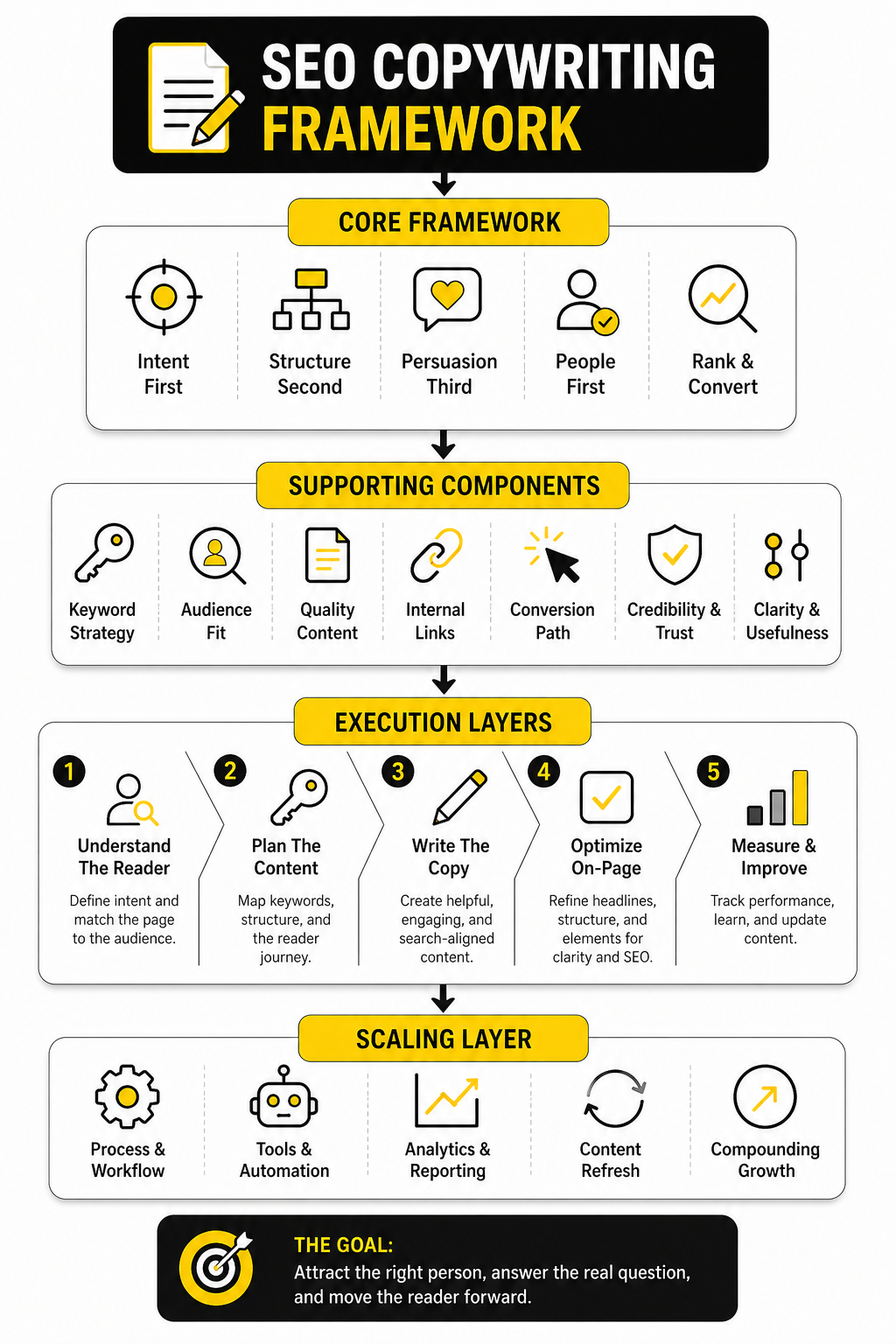
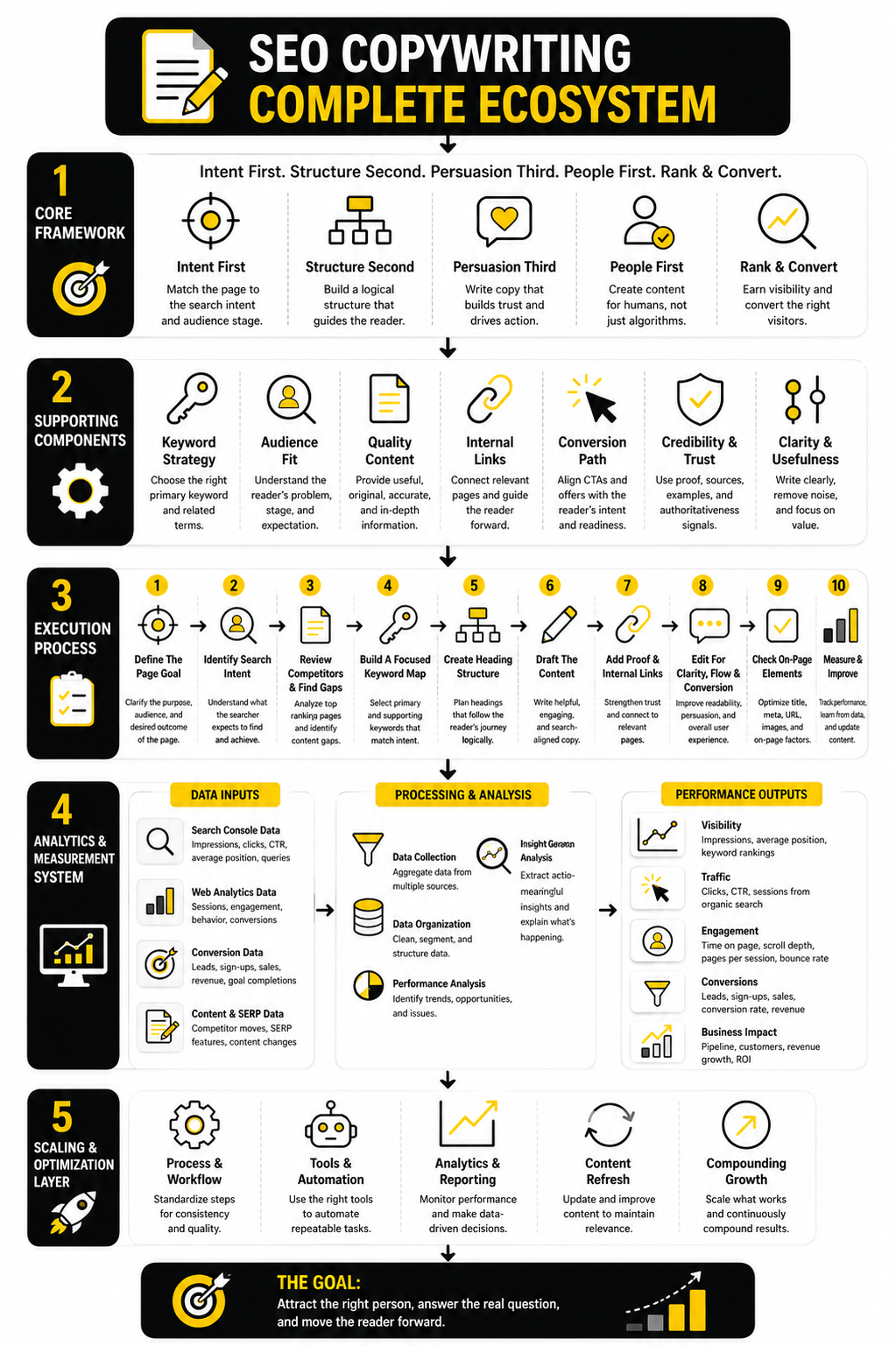
The cleanest way to think about SEO copywriting is simple: intent first, structure second, persuasion third. If the search intent is wrong, even polished writing will miss. If the structure is weak, readers will bounce before the argument has time to work.
Google’s own guidance keeps coming back to the same core idea: create content that is genuinely useful for people, not content made mainly to manipulate search rankings. That sounds obvious, but it changes how you write. You stop asking, “How many times should I use the keyword?” and start asking, “What would make this page the best next step for this reader?”
A strong SEO copywriting framework usually includes:
- A clear search intent match
- A specific audience segment
- One primary keyword and a focused cluster of related terms
- A logical heading structure
- Original insight or practical depth
- Internal links that help the reader continue
- A conversion path that fits the page intent
- Editing for clarity, credibility, and usefulness
This is also why generic content performs badly. A page can be technically optimized and still feel empty. The framework gives your writing a job: attract the right person, answer the real question, and move the reader forward without making them feel pushed.
Search Intent And Audience Fit
Search intent is the reason behind the query. Someone searching “what is SEO copywriting” needs a different page than someone searching “SEO copywriting services for SaaS.” The words overlap, but the expectation is completely different.
Most SEO copywriting problems start here. The writer targets a keyword but does not fully understand what the searcher wants to accomplish. That creates content that feels close but not quite right, and “not quite right” is enough for a reader to leave.
The practical fix is to classify the page before writing. Is the reader trying to learn, compare, buy, troubleshoot, or validate a decision? Once you know that, the article structure becomes much easier because every section has a reason to exist.
Match The Page To The Reader’s Stage
A beginner needs definitions, examples, and a clear mental model. A marketing manager needs workflow, prioritization, and proof that the process can scale. A founder may care less about theory and more about whether the page can bring qualified leads.
That is why SEO copywriting should never treat “the audience” as one vague group. The tighter the audience fit, the sharper the copy becomes. You can choose better examples, remove unnecessary explanations, and write CTAs that feel natural instead of forced.
This matters even more as search results become more crowded. AI summaries, featured snippets, video results, ads, and comparison pages all compete for attention. Recent search research shows that organic search still drives a major share of digital growth, while AI search is growing fast but remains a much smaller referral source, which makes clear, useful, search-aligned content still worth doing properly: BrightEdge found that AI search referral traffic remained under 1% while organic search continued to drive stronger conversions.
Write For The Real Next Question
Good SEO copywriting does not stop at answering the exact keyword. It anticipates the next question the reader will ask after the first answer lands. That is where depth comes from.
For example, after someone understands what SEO copywriting is, they usually want to know how it differs from normal copywriting, how keywords should be used, what a strong page structure looks like, and how to measure results. Those are not random additions. They are natural next steps in the reader’s decision process.
This is how you avoid thin content without padding the page. You are not adding words for length. You are building a path that mirrors how a real person thinks through the problem.
Keyword Strategy Without Keyword Stuffing
Keyword strategy starts with choosing the right primary keyword, but it cannot end there. A page about SEO copywriting should use that phrase naturally, then support it with related terms that help search engines and readers understand the full topic. The goal is not repetition. The goal is topical clarity.
Keyword stuffing creates the opposite effect. It makes the page harder to read, weakens trust, and signals that the content was written for rankings instead of usefulness. Google’s guidance is clear that helpful content should be made for people first, not mainly to manipulate search visibility: Google Search Central explains how to evaluate people-first content.
The practical move is to build a keyword map before drafting. Put the primary keyword in the title, opening, one or two natural headings if it fits, and a few places where the phrase belongs in context. Then use secondary terms to support the subject instead of forcing the same phrase into every paragraph.
Build A Search Intent Keyword Map
A search intent keyword map keeps the page focused. It separates the main query from supporting queries, related questions, and conversion terms. That gives the writer a clear lane before the first draft begins.
For a page targeting SEO copywriting, the map might include informational phrases like “what is SEO copywriting,” process-based phrases like “how to write SEO copy,” and commercial phrases like “SEO copywriting services.” Each phrase should earn its place based on what the reader needs at that point in the article. If a term does not help the page become more useful, it does not belong.
This also protects the article from becoming bloated. You are not trying to include every keyword tool suggestion. You are choosing the terms that support the promise of the page and help the reader move through the topic with less friction.
Page Structure, Headlines, And On-Page Flow
Structure is where SEO copywriting becomes tangible. A strong page guides the reader from awareness to understanding to action. A weak page dumps information on the screen and expects the reader to organize it alone.
Headlines do a lot of the heavy lifting. They should tell the reader what each section is about, but they should also create momentum. Clear headings make the page easier to scan, easier to understand, and easier for search engines to interpret.
The best structure usually follows the reader’s decision path. Start with the problem, define the concept, explain why it matters, show the framework, break down the process, then move into implementation and next steps. That sequence feels natural because it mirrors how people learn and decide.
Use A Step-By-Step Drafting Process
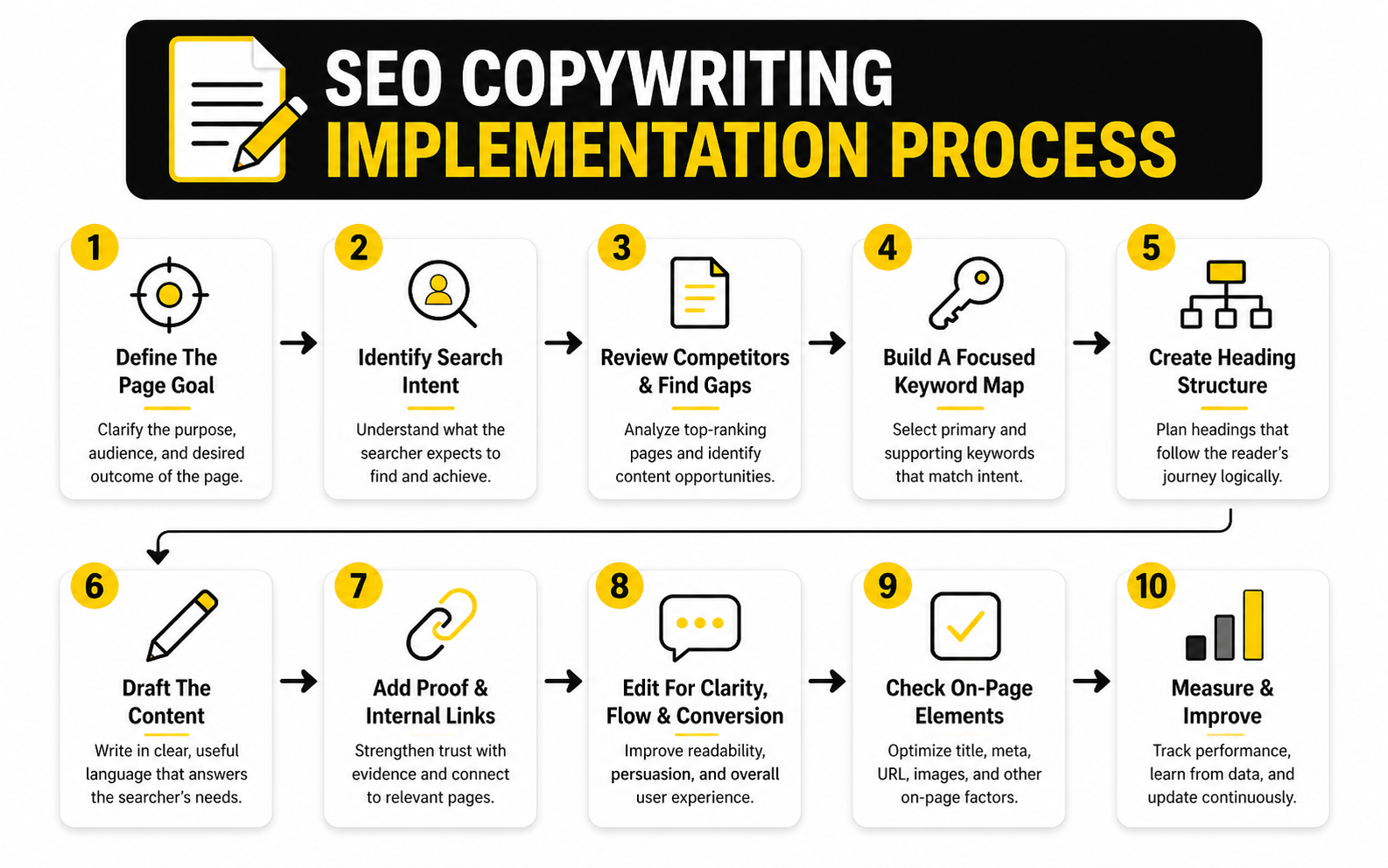
A reliable SEO copywriting process removes guesswork. It gives you a repeatable way to move from research to finished content without losing the human angle. This matters because most bad SEO content is not bad because the writer cannot write. It is bad because the process is messy.
Use this sequence:
- Define the page goal before writing.
- Identify the search intent behind the primary keyword.
- Review the strongest competing pages and look for gaps.
- Build a focused keyword map.
- Create a heading structure that follows the reader’s logic.
- Draft the page in plain, useful language.
- Add proof, examples, and internal links where they genuinely help.
- Edit for clarity, flow, trust, and conversion.
- Check on-page elements before publishing.
- Measure performance and update the page when the data shows a need.
Do not skip the planning steps. They are what keep the final article from becoming a loose collection of SEO tips. A proper process turns SEO copywriting into a business asset instead of another blog post.
Make Every Heading Earn Its Place
Every heading should answer one simple question: why does the reader need this section now? If the answer is weak, the section probably needs to be removed, merged, or rewritten. Strong structure is not about adding more headings. It is about creating a smoother path.
This is where many articles fall apart. They start well, then drift into disconnected subtopics because the writer is trying to cover every possible angle. That makes the article look comprehensive, but it often feels exhausting to read.
A better approach is to keep each heading tied to the article’s main promise. If the article promises a practical framework for SEO copywriting, every section should support that framework. Anything else is noise.
Statistics And Data
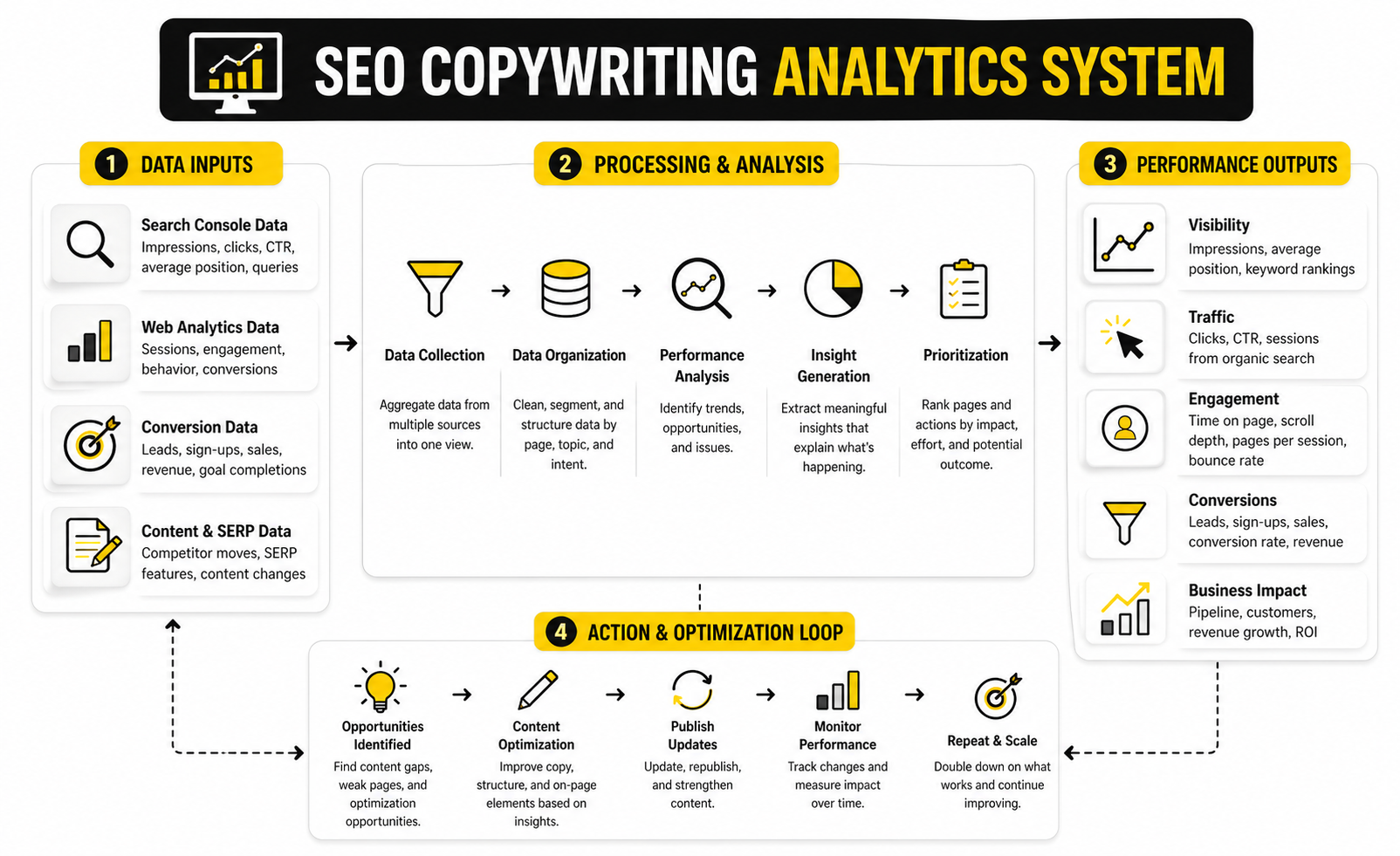
Data should make SEO copywriting sharper, not noisier. The point is not to collect random numbers and decorate the article with them. The point is to understand what readers are doing, where the page is losing momentum, and which improvements should happen next.
Start with the difference between visibility and performance. Impressions tell you that the page is being shown in search. Clicks tell you that people are choosing it. Conversions tell you that the page is attracting the right visitors and giving them enough confidence to act.
Organic search still deserves serious attention because it remains one of the strongest demand-capture channels. BrightEdge research found that AI search referrals were still under 1% while organic search continued to drive the majority of conversions, which means SEO copywriting is not dead; it is becoming more performance-sensitive: organic search remains a primary conversion driver even as AI search grows.
The Metrics That Actually Matter
The first metric to watch is impressions. If impressions are growing but clicks are flat, the page may be ranking for more queries without earning enough attention. That usually points to a title, meta description, intent mismatch, or SERP feature problem.
The second metric is click-through rate. Google Search Console defines CTR as clicks divided by impressions, and that simple ratio helps you see whether your search result is compelling enough to win the click: Google explains clicks, impressions, CTR, and position in Search Console. A low CTR does not always mean the copy is bad, but it does mean the search result needs investigation.
The third metric is conversion quality. Traffic is useful only when it brings readers who are likely to subscribe, enquire, book, buy, or continue deeper into the site. A page with fewer visits but better qualified leads can be more valuable than a page with high traffic and weak intent.
How To Read SEO Copywriting Performance
Do not judge a page from one number. A strong SEO copywriting review looks at the full path from search result to page behavior to conversion. That is how you avoid fixing the wrong thing.
Use this simple reading system:
- If impressions are low, improve keyword targeting, internal links, topical depth, and indexing signals.
- If impressions are high but CTR is low, improve the title, meta description, angle, and search intent match.
- If clicks are high but engagement is weak, improve the opening, page structure, readability, and above-the-fold clarity.
- If engagement is strong but conversions are weak, improve the offer, CTA placement, proof, and next-step relevance.
- If conversions are strong, update and protect the page instead of constantly rewriting it.
This is where the discipline matters. Many teams panic when traffic drops and immediately rewrite everything. A better approach is to isolate the bottleneck first, because a CTR problem needs a different fix than a conversion problem.
Benchmarks Are Useful, But Context Wins
Benchmarks can help you spot obvious underperformance, but they should never replace judgment. A top-ranking page in a crowded SERP with ads, AI answers, shopping modules, and videos may naturally get a lower CTR than a simple informational result. That does not mean the page failed.
Search behavior is also changing. AI Overviews and zero-click results can reduce clicks even when visibility improves, especially for simple informational queries. That makes it more important to target queries where the reader still needs depth, comparison, trust, tools, examples, or a clear next step.
The action is straightforward: measure pages by their job. An educational article should be judged by qualified traffic, scroll depth, assisted conversions, and internal click-through. A service page should be judged by lead quality, enquiry rate, and revenue influence. SEO copywriting works best when each page has a clear role before the data is interpreted.
Writing Copy That Builds Trust And Converts
Advanced SEO copywriting is not just about getting the page ranked. It is about making the reader feel that the page understands the problem better than the alternatives. That trust is built through specificity, clarity, proof, and restraint.
The biggest mistake is trying to convert too early. A reader who is still learning does not want a hard pitch in every section. A reader comparing solutions may need proof, risk reduction, and a clear reason to choose one path over another.
This is where copywriting judgment matters. You need to know when to educate, when to challenge assumptions, when to show proof, and when to ask for action. Push too hard and the page feels salesy. Stay too passive and the page earns attention without creating business value.
Balance Helpful Content With Commercial Intent
Not every SEO page should sell in the same way. An informational article may convert best through a soft next step, such as a checklist, audit, newsletter, or internal link to a service page. A high-intent landing page can be more direct because the reader is already closer to a decision.
This is especially important when using tools, funnels, and automation. If the page helps readers build campaigns after the article, a platform like GoHighLevel can fit naturally as a next step for agencies and service businesses. If the reader is building landing pages or sales funnels, ClickFunnels or Systeme.io may make sense depending on the offer and budget.
The key is relevance. Affiliate links should support the reader’s next action, not interrupt the article. When the recommendation fits the topic, it feels useful. When it does not, it damages trust.
Professional SEO Copywriting Workflow
A professional workflow protects quality when one page becomes ten pages, and ten pages become a full content system. Without a workflow, SEO copywriting becomes random. One article is strong, the next is thin, and nobody can explain the difference.
The workflow should separate strategy, writing, editing, optimization, and measurement. Those are different jobs, even when one person handles them all. Mixing them together usually creates rushed drafts, weak outlines, and copy that sounds optimized but does not actually help the reader.
A scalable workflow usually includes:
- Keyword and intent validation
- SERP review and content gap analysis
- Brief creation
- Drafting
- Expert review
- SEO review
- Conversion review
- Publishing
- Performance tracking
- Refresh planning
Use AI Carefully, Not Lazily
AI can speed up research organization, outline development, clustering, editing, and repurposing. It can also flood your site with generic content if you use it without judgment. That is the tradeoff.
Google has stated that the issue is not whether content is AI-generated, but whether it is helpful, reliable, and created for people rather than manipulation: Google’s guidance on AI-generated content focuses on quality and usefulness. That means AI can be part of the workflow, but it cannot replace strategy, expertise, fact-checking, or editorial taste.
Use AI for leverage, not as an excuse to publish weak material faster. Let it help with first-pass structure, summaries, pattern recognition, and editing suggestions. Then bring in human judgment to sharpen positioning, remove fluff, verify claims, and make the copy sound like a real expert wrote it.
Build A Refresh System Before Content Decays
SEO copywriting does not end when the page goes live. Search intent shifts, competitors improve, SERP features change, and your offer may evolve. A page that performed well last year can slowly lose relevance if nobody maintains it.
Refresh work should be based on evidence. Look for declining clicks, falling average position, weaker conversions, outdated screenshots, stale examples, and missing sections that newer competitors now cover. Do not rewrite everything just because a page is old.
The best refreshes are targeted. Update the angle, strengthen the opening, improve headings, add new proof, tighten the CTA, and remove anything that no longer supports the page’s job. That is how SEO copywriting compounds instead of constantly starting from zero.
Tools, Automation, And Quality Control
SEO copywriting becomes much easier to scale when the right tools support the right workflow. The danger is letting tools make the decisions for you. Software can help you research, draft, publish, track, and follow up, but it cannot decide what your audience should trust.
Use automation for the repeatable parts. Keyword clustering, brief templates, CRM follow-up, reporting dashboards, and content refresh reminders are all good candidates. The human work is still strategy, judgment, positioning, editing, and deciding what the page should actually say.
A practical stack might include a page builder, an email platform, a CRM, a chatbot, and a reporting system. For example, GoHighLevel can support agencies that want CRM, funnels, automations, and follow-up in one place, while Brevo can make sense when email marketing and customer communication are the main priority. The tool is not the strategy. The tool should make the strategy easier to execute.
Common SEO Copywriting Mistakes
The first big mistake is writing before understanding intent. That creates pages that look optimized but do not match what the reader expected to find. When the page misses intent, better grammar will not save it.
The second mistake is copying the structure of ranking pages without adding anything better. Competitor research is useful, but imitation is not strategy. Your job is to understand what already works, then make the page clearer, more useful, more specific, or more actionable.
The third mistake is treating SEO copywriting as a one-time task. Search results move, products change, and readers become more sophisticated. Strong pages need maintenance, especially when they support important offers, services, or revenue paths.
SEO Copywriting Checklist
Use this checklist before publishing or refreshing an important page. It keeps the work grounded and stops small issues from turning into performance problems. Do not treat it like a formality.
- The primary keyword fits the page intent.
- The opening makes the topic and value clear quickly.
- The headings follow a logical reader journey.
- The content answers the main question and the next natural questions.
- The copy sounds human, direct, and useful.
- The page includes proof where proof is needed.
- Internal links help the reader continue.
- The CTA matches the reader’s stage.
- The title and meta description are written for clicks, not just keywords.
- The page has a measurement plan before publishing.
A checklist will not make weak thinking strong. But it will catch the common gaps that hurt otherwise good content. That is the point: fewer preventable mistakes, better consistency, and a smoother path from search visibility to business results.
FAQ - Built For Complete Guide
What Is SEO Copywriting?
SEO copywriting is the practice of writing content that is useful for readers and easy for search engines to understand. It combines search intent, keyword strategy, page structure, persuasive writing, and conversion thinking. Done well, it helps a page attract qualified visitors and guide them toward a meaningful next step.
How Is SEO Copywriting Different From Normal Copywriting?
Normal copywriting focuses mainly on persuasion and action. SEO copywriting adds search visibility, keyword relevance, and content structure to that process. The best version still persuades, but it also answers the searcher’s question clearly enough to earn organic visibility.
How Often Should I Use The Primary Keyword?
Use the primary keyword where it naturally helps the reader and clarifies the page. That usually means the title, opening, a relevant heading if it fits, and a few natural mentions throughout the article. Do not force it into sentences where a normal person would not say it.
Is Keyword Density Still Important?
Keyword density is not a useful primary goal. A page can repeat a keyword often and still fail if the content is thin, confusing, or mismatched to intent. Focus on relevance, depth, structure, and natural language instead.
Can AI Be Used For SEO Copywriting?
Yes, AI can help with research organization, outlines, summaries, editing, and content repurposing. But it should not replace expert judgment, fact-checking, or brand voice. Google’s guidance on generative AI content emphasizes usefulness, reliability, and people-first value rather than the tool used to produce the draft: Google explains how generative AI content should meet Search standards.
What Makes SEO Copywriting Convert Better?
Conversion improves when the page matches intent, builds trust, and gives the reader a relevant next step. A beginner article may convert through a checklist or newsletter, while a high-intent service page may need proof, comparison, and a direct enquiry CTA. The CTA should match the reader’s readiness.
How Long Should An SEO Copywriting Article Be?
The article should be long enough to satisfy the search intent and no longer than necessary. Some topics need a short, direct answer. Others need a complete guide with definitions, process, examples, tools, and measurement advice.
What Metrics Should I Track?
Track impressions, clicks, CTR, average position, engagement, internal clicks, leads, and conversions. Google Search Console explains how clicks, impressions, CTR, and position work inside performance reports: Google Search Console defines core search performance metrics. The important part is connecting those numbers to the page’s actual job.
How Often Should I Update SEO Copy?
Update important pages when data or context shows a reason. Falling clicks, changing search intent, outdated sections, weaker conversions, or stronger competitors are all valid triggers. Do not rewrite pages randomly just because they are old.
What Is The Biggest SEO Copywriting Mistake?
The biggest mistake is writing for the keyword before writing for the reader. That creates content that may look optimized but feels empty. Strong SEO copywriting starts with the reader’s problem, then uses search data to make the solution easier to find.
Do I Need Special Tools For SEO Copywriting?
You do not need a huge stack, but tools can help you work faster and stay organized. Use tools for research, planning, publishing, automation, and measurement. For landing pages and funnels, options like ClickFunnels or Systeme.io can support the conversion side when they fit the offer.
Work With Professionals
Explore 10K+ Remote Marketing Contracts on MarkeWork.com
Most marketers spend too much time chasing clients, competing on crowded platforms, and losing a percentage of every project to middlemen.
MarkeWork gives you a better way. Browse thousands of remote marketing contracts and connect directly with companies desperate to hire skilled marketers like you, without platform commissions and without unnecessary gatekeepers.
If you're serious about finding better opportunities and keeping 100% of what you earn, explore available contracts and create a profile for free at MarkeWork.com.