

SEO digital marketing is no longer just about ranking blog posts on Google. It is the discipline of making your business discoverable, trusted, and easy to choose across search engines, AI answers, local results, social platforms, comparison pages, and conversion paths.
That matters because search behavior is changing fast. Google’s own SEO documentation still centers on helping search engines crawl, index, and understand useful content, but newer research shows users are clicking less often when AI summaries appear in results, which means visibility now has to work before, during, and after the click: Google Search Central and Pew Research Center.
This guide treats SEO as part of digital marketing, not as an isolated checklist. The goal is simple: attract qualified demand, turn that attention into leads or sales, and build a system that keeps improving instead of depending on random traffic spikes.
Article Outline
- Why SEO Digital Marketing Matters Now
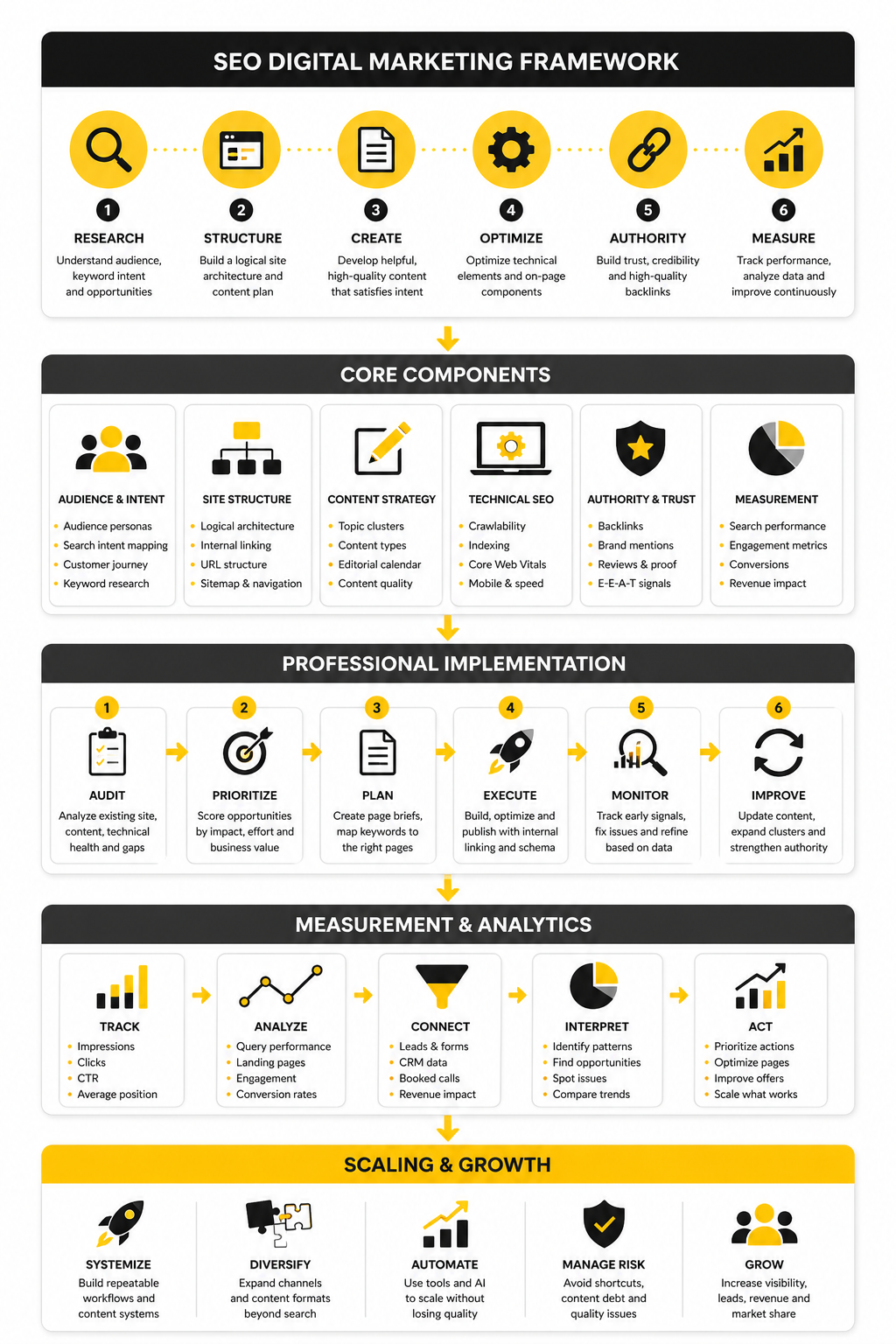
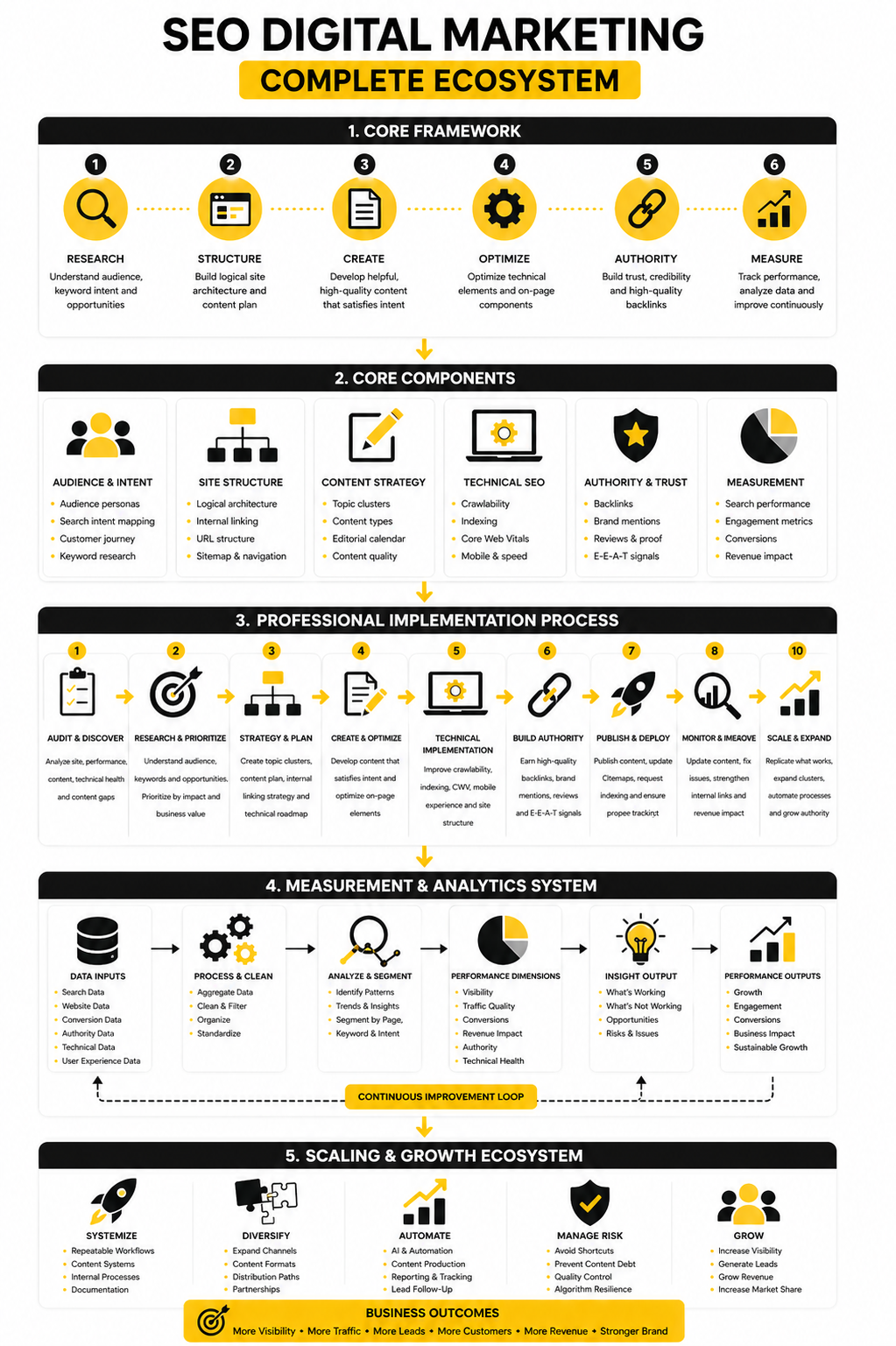
- The SEO Digital Marketing Framework
- Core Components Of A Strong SEO System
- Professional SEO Implementation
- Measurement, Optimization, And Scaling
- FAQs And Final SEO Digital Marketing Checklist
Why SEO Digital Marketing Matters Now
SEO matters because people still use search when they have intent. They search when they are comparing options, solving a problem, checking credibility, looking for a local provider, or deciding whether a brand is worth trusting. That makes SEO digital marketing different from interruption-based channels because the demand already exists.
The hard part is that rankings alone are no longer enough. SparkToro’s zero-click research found that a large share of Google searches end without a click, and Pew’s 2025 analysis found that users who saw an AI summary were less likely to click external results. That does not make SEO dead; it makes weak SEO painfully exposed: SparkToro zero-click study and Pew AI summary click research.
The practical takeaway is that modern SEO has to earn visibility and conversion at the same time. Your content has to be useful enough to be cited, structured enough to be understood, credible enough to be trusted, and connected enough to move visitors toward the next step.
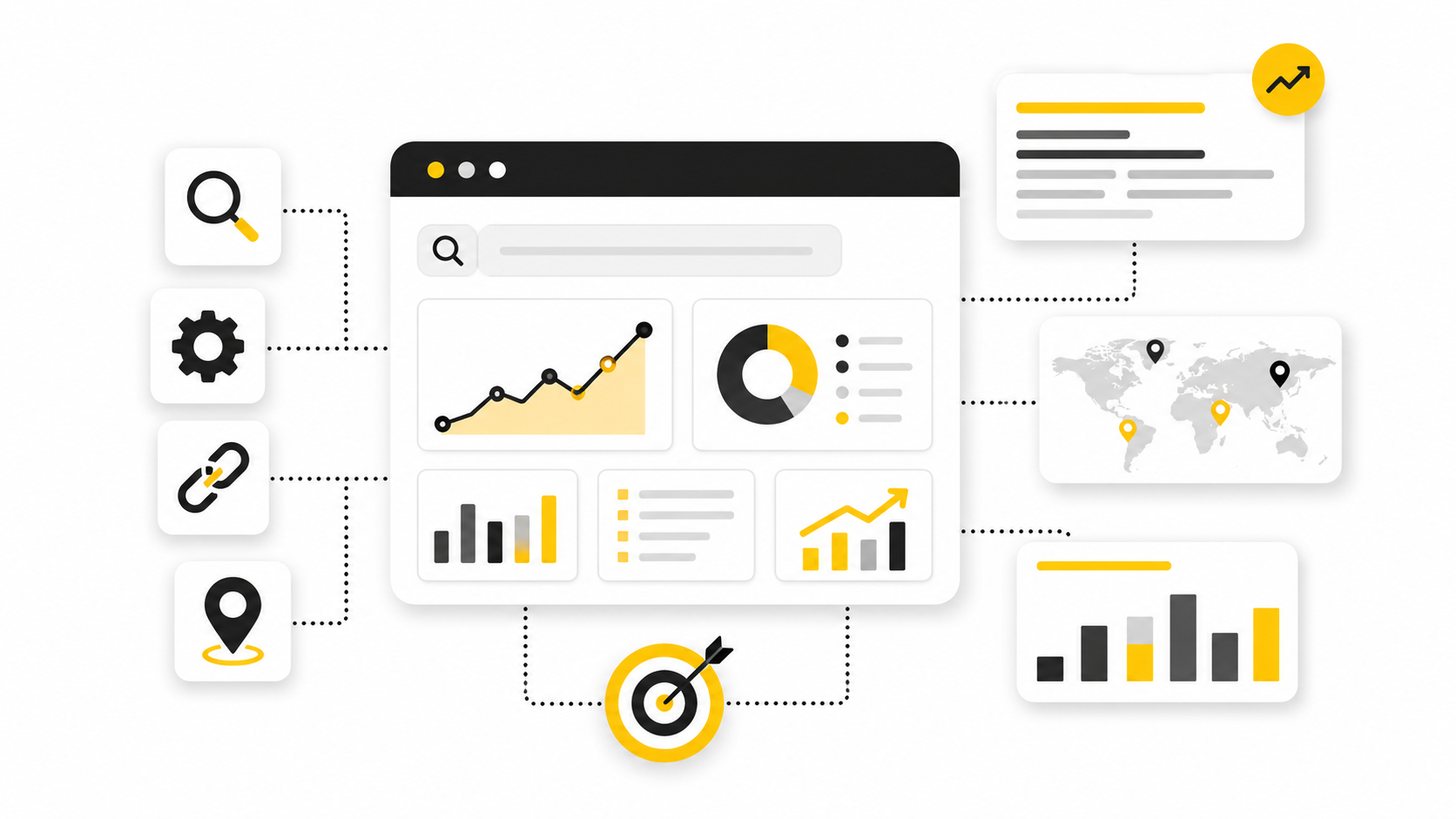
The SEO Digital Marketing Framework
A useful SEO digital marketing framework starts with intent. Before writing pages, choosing tools, or publishing content, you need to know what people are trying to accomplish when they search. Some searches are educational, some are commercial, some are local, and some are ready-to-buy.
The second layer is discoverability. This includes technical SEO, site architecture, internal linking, structured content, and page experience. If search engines cannot crawl, understand, or confidently evaluate your pages, even strong content can underperform.
The third layer is conversion. SEO should not stop at traffic because traffic without action is just a vanity metric. For service businesses, ecommerce brands, creators, and agencies, the page should naturally guide users toward a lead form, booking page, product page, email signup, demo, consultation, or automated follow-up system like GoHighLevel when that fits the business model.
Core Components Of A Strong SEO System
A strong SEO system has four core components: technical foundation, content strategy, authority building, and conversion infrastructure. Technical SEO makes the site accessible and understandable. Content strategy answers real search intent better than competing pages.
Authority building helps prove that the brand deserves attention. That can include backlinks, expert contributions, original research, brand mentions, reviews, partnerships, and consistent publishing across relevant channels. In a market where AI summaries and zero-click results reduce easy traffic, authority becomes even more important because trusted brands are more likely to be recognized before the click.
Conversion infrastructure turns SEO from a traffic play into a revenue system. That might mean better landing pages, clearer calls to action, email automation, retargeting audiences, CRM tracking, or chat support through tools like ManyChat for businesses that rely on conversations before purchase. SEO gets the right people in the door, but the rest of the system decides whether that attention becomes business.
Professional SEO Implementation
Professional SEO digital marketing starts with diagnosis, not publishing. Before you create another page, you need to know what already exists, what is blocked, what is outdated, and what has a real chance of ranking or converting. Google’s documentation is clear that useful search performance depends on crawlability, indexing, helpful content, and page experience, so guessing your way through SEO is a bad habit: Google Search Central.
A proper implementation usually begins with a technical audit. That means checking index coverage, duplicate pages, redirects, internal links, broken links, canonical tags, Core Web Vitals, sitemap quality, robots.txt rules, structured data, and mobile usability. None of this is glamorous, but it matters because weak technical foundations can quietly limit every content and link-building effort that comes after.
The next step is commercial mapping. Every important keyword should connect to a business outcome, not just a traffic number. For SEO digital marketing, that means grouping keywords by intent, matching each group to the right page type, and deciding whether the user needs a blog post, landing page, product page, comparison page, service page, local page, or lead magnet.
Start With Search Intent
Search intent is the difference between traffic that reads and traffic that buys. Someone searching “what is SEO” needs education, while someone searching “SEO agency for ecommerce brands” is much closer to a buying decision. Treating those searches the same creates generic content that satisfies nobody.
The easiest way to handle intent is to look at what already ranks, then ask why those pages deserve to be there. Are they guides, tools, reviews, service pages, category pages, videos, local listings, or comparison pages? Search results are not perfect, but they reveal what Google currently believes users want.
Once intent is clear, build the page around the job the reader is trying to complete. A beginner guide should explain clearly and reduce confusion. A commercial page should prove fit, answer objections, show credibility, and make the next step obvious.
Build Topic Clusters Instead Of Random Blog Posts
Random publishing is one of the fastest ways to waste an SEO budget. A topic cluster gives your site a clear structure, where one main page covers the broad subject and supporting pages answer narrower questions around it. This helps readers move through the topic naturally and helps search engines understand how your pages relate to each other.
For example, an SEO digital marketing cluster might include pages on keyword research, technical SEO, content strategy, local SEO, ecommerce SEO, AI search visibility, analytics, and conversion tracking. Each page should have a distinct purpose, so you are not publishing five versions of the same idea with slightly different wording. That is how sites become bloated and confusing.
Internal linking is what turns the cluster into a system. The main page should link to the supporting pages, the supporting pages should link back to the main page, and related pages should connect where it genuinely helps the reader. This is simple, but it is also one of the most ignored parts of practical SEO.
Turn Content Into Conversion Paths
SEO content should help first, but it should not leave the reader stranded. When someone finishes a useful page, the next step should feel natural. That could be a checklist, booking link, product demo, consultation, calculator, template, email signup, or a relevant service page.
This is where many businesses separate SEO from digital marketing by accident. They rank a page, get traffic, and then send visitors into a dead end. A better system connects organic traffic to follow-up through email, CRM, retargeting, forms, chat, and sales workflows.
For service businesses and agencies, a platform like GoHighLevel can make sense when SEO leads need to be captured, routed, followed up with, and tracked in one place. For funnel-heavy businesses, ClickFunnels or Systeme.io may fit better when the goal is to move traffic into a focused offer, webinar, lead magnet, or checkout flow.
Strengthen Trust Signals
Trust is not a design decoration. It affects whether users stay, believe you, contact you, buy from you, or remember your brand after seeing you in search. Google’s guidance around helpful, reliable, people-first content pushes site owners to show experience, expertise, and clear ownership instead of publishing anonymous content made only to rank: Google helpful content guidance.
Strong trust signals include author credibility, real contact details, clear policies, transparent pricing where appropriate, customer reviews, original photos, case studies, expert input, secure checkout, and current information. These details matter even more in competitive niches where many pages say the same basic thing. When the content is similar, credibility becomes the separator.
Do not fake authority. Do not invent case studies, inflate numbers, or use vague claims like “trusted by thousands” unless you can prove it. Real trust compounds slowly, but fake trust can damage a brand fast.
Implementation, Optimization, And Scaling
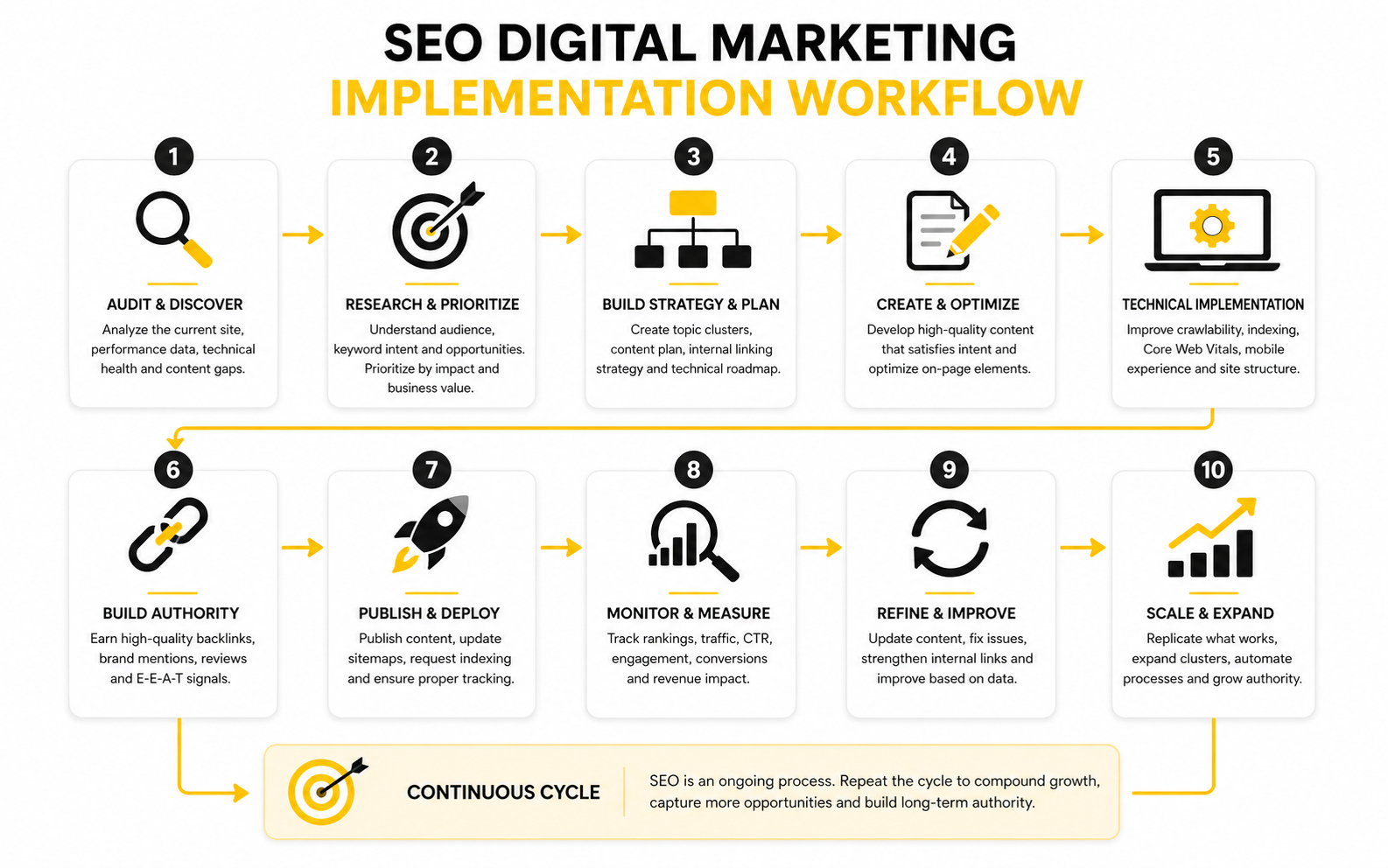
Once the strategy is clear, implementation has to become a repeatable process. This is where SEO digital marketing moves from planning into execution. The goal is not to “do SEO” once; the goal is to build a workflow that keeps improving the site, content, authority, and conversions over time.
A good implementation process removes guesswork. Every page should have a reason to exist, every keyword group should map to a search intent, and every update should connect to a measurable outcome. That is how SEO becomes a growth system instead of a pile of disconnected tasks.
Step 1: Audit What Already Exists
Start with the pages you already have. Look for pages that rank but do not convert, pages that get impressions but weak clicks, pages that have lost traffic, and pages that compete with each other for the same intent. Google Search Console is usually the cleanest place to begin because it shows real queries, impressions, clicks, and indexing issues from Google’s own data.
This step is not just technical. You also need to judge whether each page is still accurate, useful, and aligned with what the searcher wants today. Google’s guidance on helpful content puts real emphasis on whether a reader leaves feeling satisfied, which is a better standard than simply asking whether a page contains enough keywords: helpful, reliable, people-first content.
Keep the audit practical. Mark each page as keep, improve, merge, redirect, or remove. That one decision framework can clean up years of messy publishing and make the next round of SEO work much sharper.
Step 2: Prioritize By Business Impact
Not every SEO task deserves the same attention. A broken indexation issue on a high-value service page matters more than rewriting a low-intent blog post that never influenced revenue. Prioritization should balance opportunity, difficulty, commercial value, and speed of execution.
The best pages to improve first are often the ones already close to working. A page sitting near the bottom of page one, a landing page with strong impressions but weak clicks, or a comparison page with clear buying intent can produce faster gains than a brand-new article. This is where disciplined SEO digital marketing beats random content production.
Create a simple priority score if your team needs structure. Rate each opportunity by search demand, revenue relevance, current position, conversion potential, and effort required. Then work from the highest-impact items down instead of chasing whatever feels urgent that week.
Step 3: Create The Page Brief
A page brief keeps writers, SEOs, designers, and stakeholders aligned before anyone starts drafting. It should define the primary intent, target keyword group, audience awareness level, required sections, internal links, conversion goal, proof points, and page format. Without this, content usually drifts.
The brief should also clarify what the page is not trying to do. One page cannot educate beginners, compare every competitor, sell the service, rank for every variation, and answer every possible question without becoming bloated. Clear boundaries make stronger pages.
For conversion-focused pages, include the next step in the brief. If the page is meant to generate calls, link to a booking flow. If it is meant to capture leads, connect it to a form or email sequence through tools like Fillout, Brevo, or Moosend when email follow-up is part of the funnel.
Step 4: Build, Publish, And Internally Link
Publishing should be treated like launch, not upload. Before a page goes live, check the title tag, meta description, URL, headings, internal links, schema, image alt text, page speed, mobile layout, and call to action. Google’s SEO starter guide still emphasizes making pages easy for users and search engines to understand, which is basic but easy to skip when teams rush: SEO starter guide.
Internal links deserve special attention at this stage. New pages should link to relevant existing pages, and existing pages should be updated to link back to the new asset. This helps users continue their journey and gives search engines clearer context.
For ecommerce and landing-page-heavy businesses, the publishing workflow may also involve page builders and testing tools. A tool like Replo can fit when Shopify teams need flexible landing pages, while ClickFunnels can fit when the page is part of a focused funnel rather than a traditional content hub.
Step 5: Measure Early Signals Before Making Big Changes
SEO takes time, but early signals still matter. After publishing or updating a page, watch whether it gets indexed, whether impressions grow, which queries appear, whether the click-through rate is reasonable, and whether users take the intended next step. Do not panic after a few days, but do not ignore clear problems either.
Core Web Vitals are also worth monitoring because they reflect real-world loading performance, interactivity, and visual stability. Google describes them as user experience metrics rather than magic ranking levers, which is the right way to think about them: Core Web Vitals and Google Search. Fast, stable pages help users, and helping users usually helps the business.
Give pages enough time to collect data before making heavy edits. Small fixes are fine, especially when something is obviously broken. But if you keep rewriting a page every week, you make it harder to understand what actually caused movement.
Statistics And Data
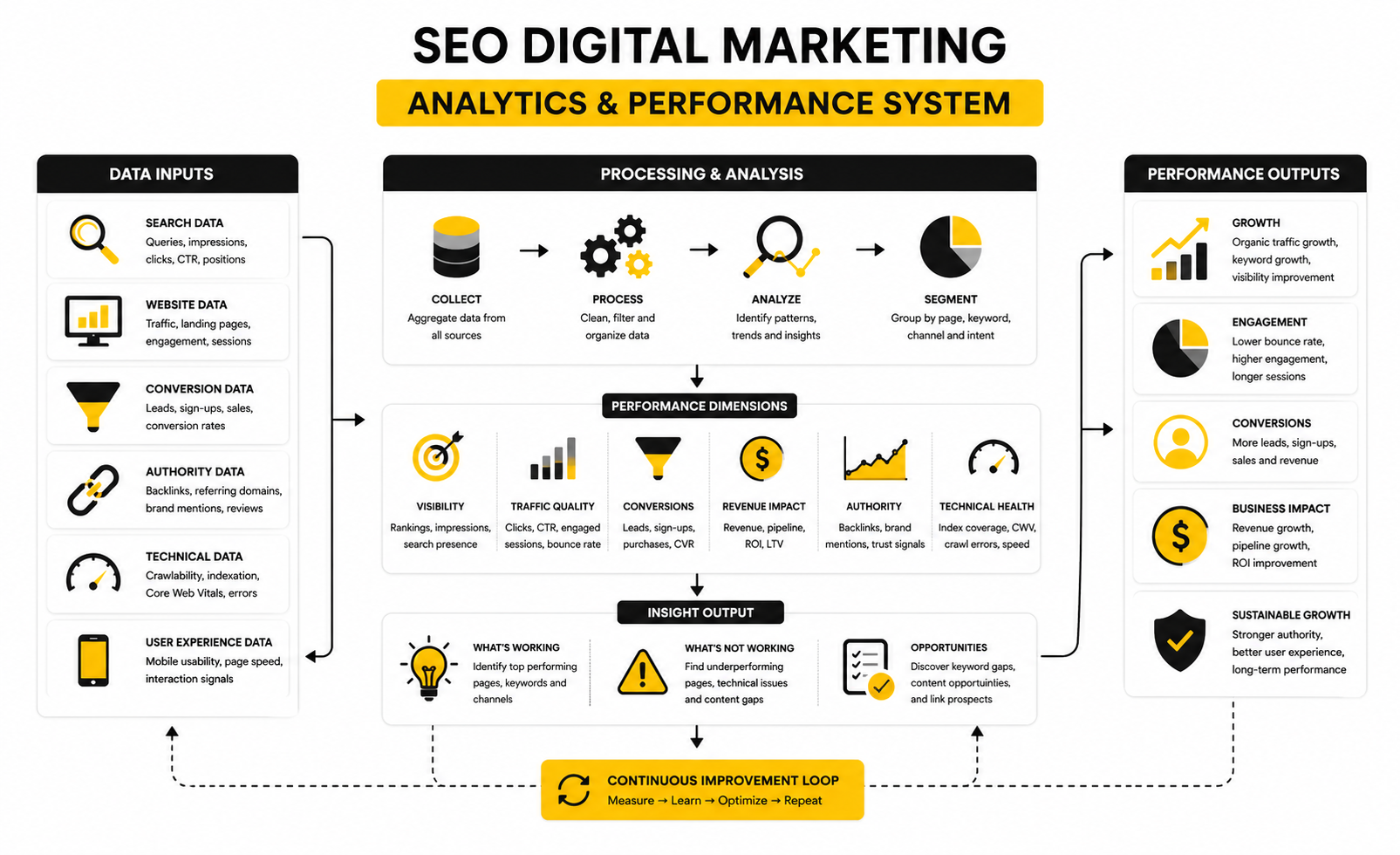
Measurement is where SEO digital marketing becomes honest. Strategy can sound impressive, content can look polished, and rankings can move in the right direction, but the data tells you whether the work is creating visibility, qualified traffic, leads, sales, and long-term momentum. Without measurement, SEO turns into opinion.
The mistake is treating every metric as equally important. Clicks, impressions, rankings, CTR, conversions, assisted revenue, engagement, and pipeline value all answer different questions. A strong analytics system does not dump numbers into a dashboard; it connects each number to a decision.
What Search Console Metrics Actually Mean
Google Search Console gives you four core performance metrics for search: clicks, impressions, CTR, and average position. Clicks show how often users came to your site from Google Search, impressions show how often your result appeared, CTR shows the percentage of impressions that became clicks, and average position estimates where your result appeared across queries. These metrics are useful because they come directly from Google’s search performance reporting: Google Search Console performance report.
The key is interpretation. High impressions with low clicks usually means the page is visible but not compelling enough, or the search result is being crowded by ads, AI answers, featured snippets, local packs, video results, or stronger competitors. Low impressions with strong conversion can mean the page serves a valuable niche and should be expanded carefully instead of rewritten from scratch.
Average position also needs context. A page might have an average position of 12 because it ranks fourth for one valuable query and 40th for many irrelevant variations. That is why query-level analysis matters more than staring at one blended number.
The New Reality Of Click-Through Rates
Click-through rate is harder to benchmark than it used to be. AI Overviews, featured snippets, ads, shopping modules, map packs, Reddit results, YouTube results, and other SERP features can all change how many clicks organic listings receive. That means a “good CTR” depends heavily on the query, device, intent, result layout, and brand recognition.
Recent AI search research makes this clear. Ahrefs found that the presence of an AI Overview correlated with a 34.5% lower average CTR for the top-ranking page on informational keywords, while Pew Research Center found that users were less likely to click traditional links when an AI summary appeared in Google results: Ahrefs AI Overview CTR study and Pew Research Center AI summary research.
The action is not to panic. The action is to separate your SEO measurement by intent and result type. Informational content may need stronger brand recall, clearer summaries, original data, video support, and email capture, while commercial pages should be judged more heavily by qualified leads, sales calls, assisted conversions, and revenue.
Benchmarks Should Guide You, Not Control You
Benchmarks are useful when they help you spot something abnormal. They are dangerous when they make you chase averages that do not fit your market. A local accountant, a SaaS company, an ecommerce brand, and a media publisher should not judge SEO performance with the same expectations.
Use benchmarks as directional checks. If organic traffic is growing but leads are flat, the issue may be intent mismatch or weak conversion paths. If impressions are rising but CTR is falling, the issue may be title quality, meta description relevance, SERP crowding, or AI answer displacement. If rankings improve but revenue does not, the keyword portfolio may be too top-of-funnel.
The best benchmark is your own trend line. Compare performance against the previous period, the same season last year, and the business goal behind the page. That gives you a cleaner view than copying generic industry averages without context.
The SEO Measurement Stack
A practical SEO measurement stack should show what happened before the click, after the click, and after the lead. Search Console shows search visibility. Analytics tools show user behavior on the site. CRM and sales tools show whether that traffic became pipeline, customers, or revenue.
For most businesses, the basic stack should track:
- Query impressions and clicks
- Landing page sessions
- Engagement and scroll behavior
- Form submissions and booked calls
- Email signups and lead source
- Assisted conversions
- Sales-qualified leads
- Revenue or customer value
- Content updates and publish dates
The important part is connecting these tools instead of reviewing them in isolation. A CRM like Copper can help teams understand what happens after an organic lead enters the sales process, while Cal.com can make booked calls easier to attribute when appointment scheduling is the main conversion. For SEO digital marketing, that connection matters because traffic only becomes meaningful when it can be tied to a business outcome.
Performance Signals That Deserve Attention
The most useful SEO signals are the ones that suggest a clear next action. A page with rising impressions and low CTR may need a better title, stronger meta description, clearer search intent match, or richer result eligibility. A page with good traffic and weak conversions may need better proof, stronger offers, clearer CTAs, or a shorter path to action.
Declining traffic deserves a different response. First check whether the drop is page-specific, query-specific, sitewide, seasonal, or caused by indexing issues. Then compare the page against current search results to see whether the intent has shifted or competitors now answer the query more completely.
Do not overreact to normal fluctuation. SEO data is noisy, especially at the query level. Look for patterns across several weeks, compare against known updates or site changes, and keep a log of major technical fixes, content updates, redirects, and conversion changes so you can connect cause and effect later.
Advanced SEO Strategy And Scaling
Scaling SEO digital marketing is not about publishing more. It is about making better decisions at a larger volume without lowering the quality of the work. This is where many teams break the system they worked so hard to build.
The pressure usually comes from growth targets. More pages, more keywords, more tools, more AI workflows, more channels, more reports. None of that is automatically bad, but speed without judgment creates thin pages, duplicate intent, weak brand trust, and messy attribution.
The Tradeoff Between Scale And Quality
AI can help with research, briefs, outlines, content refreshes, metadata, clustering, and repurposing. Used well, it removes repetitive work and gives marketers more room for strategy. Used badly, it floods the site with generic content that sounds correct but adds nothing new.
Google’s guidance on generative AI content is practical here: focus on accuracy, quality, and relevance, especially when automation touches titles, descriptions, structured data, image alt text, and visible page content: Google guidance on generative AI content. That means the risk is not “AI content” by itself. The risk is scaled content with no editorial judgment, no original insight, and no real usefulness.
The right approach is human-led production with AI support. Let tools speed up research, formatting, summarization, and first-pass structure. Keep strategy, fact-checking, examples, positioning, expert review, and final judgment in human hands.
AI Search Changes The Visibility Game
Search is no longer only about ranking a blue link. AI summaries, answer engines, and conversational search tools are becoming part of the customer journey. Bain reported that many users now rely on AI-written search summaries regularly, and that behavior can reduce traditional organic traffic even when demand still exists: Bain research on AI search behavior.
This changes how brands should think about SEO digital marketing. Some users may discover you without clicking. Some may compare you inside an AI-generated answer. Some may only visit your site after they already have a shortlist.
To adapt, your content needs to be clear, sourceable, specific, and consistent across the web. Strong product pages, comparison pages, author pages, original research, FAQs, reviews, schema, and brand mentions all help search systems understand who you are and when you are relevant. The goal is not just to rank; the goal is to become a credible entity that search and AI systems can confidently associate with the right topics.
Avoid The Biggest Scaling Risks
The biggest SEO risks usually come from shortcuts. Programmatic pages without unique value, mass-produced AI articles, expired-domain games, low-quality link schemes, fake reviews, copied comparison pages, and doorway pages can create short-term movement but long-term damage. If the strategy depends on fooling the system, it is fragile.
There is also a quieter risk: content debt. This happens when a site keeps publishing but rarely updates, merges, redirects, or removes anything. Over time, the site becomes harder to crawl, harder to manage, and harder for users to trust.
A safer scaling model looks like this:
- Publish fewer pages with clearer intent
- Update proven assets before creating new ones
- Merge overlapping pages instead of letting them compete
- Build internal links as part of every publishing workflow
- Track content decay quarterly
- Keep expert review in sensitive or high-value topics
- Use automation for workflow, not final judgment
Build Distribution Beyond Google
SEO should not live alone. If a page is genuinely useful, it can also support email, social, sales enablement, paid retargeting, webinars, short-form video, community posts, and partner content. That is how one strong asset turns into multiple growth paths.
This matters because search visibility is becoming less predictable. Social platforms, creator channels, newsletters, podcasts, and AI tools all influence discovery before someone reaches your website. IAB’s 2025 research shows AI is reshaping advertising workflows, while creator marketing has become a serious media channel rather than a side experiment: IAB State of Data 2025 and IAB creator marketing coverage.
For practical execution, repurpose SEO assets into formats people actually consume. Turn a comparison page into a sales script. Turn a guide into an email sequence using Brevo. Turn a research post into social clips scheduled through Buffer. Turn a high-intent page into a lead capture path with GoHighLevel if your sales process needs follow-up, pipeline tracking, and automation.
Know When Not To Chase A Keyword
Not every keyword is worth pursuing. Some keywords look attractive because they have volume, but the audience is too broad, the intent is too weak, or the SERP is dominated by platforms you cannot realistically beat. Chasing those terms can drain months of work with very little business return.
A better question is: would ranking for this keyword help the business if it worked? If the answer is unclear, pause. SEO digital marketing should prioritize relevance before volume.
This is especially important for small teams. You do not need to win every topic in your industry. You need to win the searches that match your offer, your credibility, your margins, and your ability to serve the customer well.
FAQ - Built For Complete Guide
What is SEO digital marketing?
SEO digital marketing is the process of using search visibility to support broader business growth. It includes technical SEO, content strategy, authority building, analytics, conversion paths, and follow-up systems. The point is not just to rank higher; the point is to attract the right people and turn that attention into measurable business outcomes.
How is SEO different from digital marketing?
SEO is one channel inside digital marketing. Digital marketing can include paid ads, email, social media, funnels, partnerships, automation, analytics, and conversion optimization. SEO becomes more powerful when it connects with those channels instead of operating as a separate traffic project.
Is SEO still worth it with AI search results?
Yes, but the strategy has to evolve. AI summaries and zero-click results can reduce traditional clicks, especially on informational searches, so brands need to focus on authority, original insight, commercial intent, and conversion quality. SEO is still valuable because people continue using search to compare options, validate brands, and solve problems before buying.
What should I measure first in SEO digital marketing?
Start with impressions, clicks, query growth, landing page performance, conversions, and lead quality. Rankings are useful, but they do not tell the whole story. A page that ranks for fewer searches but brings qualified leads can be more valuable than a high-traffic page that attracts people who will never buy.
How long does SEO take to work?
SEO usually takes time because search engines need to crawl, understand, compare, and trust your pages. Some improvements, like fixing indexation problems or updating pages already near the top, can show movement faster. New content in competitive markets often needs months of consistent publishing, internal linking, authority building, and refinement before it becomes a serious growth driver.
What is the biggest mistake businesses make with SEO?
The biggest mistake is publishing without a strategy. Many businesses create blog posts because they heard content matters, but they never connect those posts to search intent, internal links, offers, lead capture, or revenue. That creates traffic at best and clutter at worst.
How many keywords should one page target?
One page should target one main intent, not one exact keyword. It can naturally rank for many related terms if the topic is handled well. The key is to avoid mixing unrelated intents on the same page because that makes the content weaker for both users and search engines.
Do small businesses need technical SEO?
Yes, but they do not need to overcomplicate it. Small businesses should make sure their site can be crawled, indexed, loaded quickly, used on mobile, and understood clearly. Once the basics are solid, most small teams get more value from better service pages, local relevance, reviews, internal links, and conversion paths.
Should SEO content be written by AI?
AI can help with research, structure, outlines, summaries, and workflow speed. It should not replace human judgment, expert review, accuracy checks, or original perspective. The safest approach is to use AI as an assistant, not as an autopilot for publishing generic content at scale.
What role do backlinks still play?
Backlinks still matter because they can signal authority, relevance, and trust. The quality of links matters far more than the number of links. A few relevant mentions from credible websites can be more useful than a large batch of weak links that exist only to manipulate rankings.
How does conversion optimization fit into SEO?
Conversion optimization turns SEO traffic into results. A page should answer the searcher’s question, build trust, and guide the reader toward the next logical action. Without conversion paths, SEO can look successful in analytics while failing commercially.
What tools are useful for SEO digital marketing?
Useful tools depend on the business model. Google Search Console and analytics software are the foundation for measurement. For lead capture, follow-up, funnels, scheduling, and CRM workflows, tools like GoHighLevel, ClickFunnels, Systeme.io, Brevo, and Cal.com can support the system after someone finds you.
Work With Professionals
Explore 10K+ Remote Marketing Contracts on MarkeWork.com
Most marketers spend too much time chasing clients, competing on crowded platforms, and losing a percentage of every project to middlemen.
MarkeWork gives you a better way. Browse thousands of remote marketing contracts and connect directly with companies desperate to hire skilled marketers like you, without platform commissions and without unnecessary gatekeepers.
If you're serious about finding better opportunities and keeping 100% of what you earn, explore available contracts and create a profile for free at MarkeWork.com.